Search Results: "mt"

8 October 2014

Jonathan Dowland: Ansible

I've just recently built the large bulk of VMs that we use for first semester teaching. This year that was 112. We use the same general approach for these as our others: get a generic base image up and running, with just enough configuration complete so a puppet client starts up; get it talking to our master; let puppet take it from there. There are pragmatic balances between how much we do in the kickstart versus how much we do in puppet, but also when we build a new VM from scratch versus when we clone an existing image, and how specialisation we do in the clone image. Unfortunately this year we ended up in a situation where our clone image wouldn't talk to our puppet master out of the box, due to some changes we'd made to our master set up since the clone image was prepared. We didn't really have enough time to re-clone the entire set of VMs from a fixed base image, and instead needed to fix them whilst up. However we couldn't rely on puppet to do that, since they wouldn't talk to the puppet master. We needed to manually reset the puppet client state per VM and then re-establish a trust relationship with the correct master (which is not the default master hostname in our environment anymore). Luckily, we deploy a local account with a known passphrase via the kickstart, which also has sudo access, as an interim measure before puppet strips it back out again and sets up proper LDAP and Kerberos authentication. So we can at least get into the boxes. However logging into 112 VMs by hand is not a particularly pleasant task. In the past I might have tried to achieve this using something like clusterssh but this year I decided to give ansible a try instead. Ansible started life, I believe, as a tool that would let you run arbitrary commands on remote hosts, including navigating ssh and sudo as required, without needing any agent software on the remote end. It has since seemed to grow into an enterprise product in its own right, seemingly in competition with puppet, chef, cfengine et al. Looking at the Ansible website now I'd be rather put off by just how "enterprisey" it has become - much as I am by the puppet website, if I'm honest - but if you persevere past the webinars, testimonials, etc. etc., you can find yourself to the documentation, and running an arbitrary command is as simple as The hosts file format is simple
[somehosts]
host1
host2
...
[otherhosts]
host3
The command line can be a little bit more complex, especially if you need to use one username for ssh, another for sudo, and you don't want to use ssh key auth:
ansible -i ./hostsfile somehosts -k -u someuser \
    --sudo -K -a 'puppet agent --onetime --no-daemonize --verbose 
"all" would work where I've used somehosts in the example above. So there you go: using one configuration management system to bootstrap another. I'm sure I've reserved myself a special place in hell for this.

EvolvisForge blog: PSA: #shellshock still unfixed except in Debian unstable

I just installed, for work, Hanno B ck s bashcheck utility on our monitoring system, and watched all systems go blue. All but two. One is not executing remote scripts from the monitoring for security reasons, the other is my desktop which runs Debian sid (unstable). (Update, 2014-10-20: jessie, precise, trusty are also green now.) This means that all those distributions still have unfixed #shellshock bugs. I don t know if/when all distributions will have patched their packages but thought you d want to know the hysteria isn t over yet however, I hope you were not stupid enough to follow the advice of this site which suggests you to download some random file over the net and execute it with superuser permissions, unchecked. (I think the Ruby people were the first to spread this extremely insecure, stupid and reprehensible technique.) Updates: Thanks to tarent for letting me do this work during $dayjob time!

2 October 2014

Jonathan Dowland: Gigabyte J1900N-D3V Mini-ITX mainboard

For my 31st birthday I decided to build myself a computer, specifically a NAS and backup server which could do some other bits and pieces. I ended up buying a system based on the Gigabyte J1900N-D3V SoC from Mini-ITX (who's after sales support is great, by the way). I hope to write up a more comprehensive overview of what I've ended up with (probably in my rather dusty hardware section), but in the meantime I have a question for anyone else with this board:
If you've upgraded the BIOS, do the more recent BIOS versions insist on there being a display connected in order to boot?
Sadly the V1 BIOS version does, which seriously limits the utility of this board for my purposes. I did manage to flash the board up to V3, once, but it later decided to downgrade itself (believing the flashed BIOS to be corrupt). I haven't managed a second time. The EFI implementation in this board is... interesting. Convincing it to boot anything legacy is a tricky task. As an aside, I recently stumbled across this suggestion on reddit to use an old-ish, Core-era Thinkpad T-series with a dock for this exact purpose: the spare ultrabay gives you two SATA drive slots; the laptop battery serves as a crude UPS and there's a built in keyboard and mouse, avoiding the issue I'm having with the J1900N-D3V. A Core i5 is more than fast enough for what I want to do and it will have vt. Hindsight is a wonderful thing...

1 October 2014

Vincent Sanders: It is a bad plan that admits of no modification

I find it somewhat interesting that thousands of years later that our society still uses Publilius Syrus sententiae though I imagine the tendency to leave well enough alone means such phrases stay in usage.

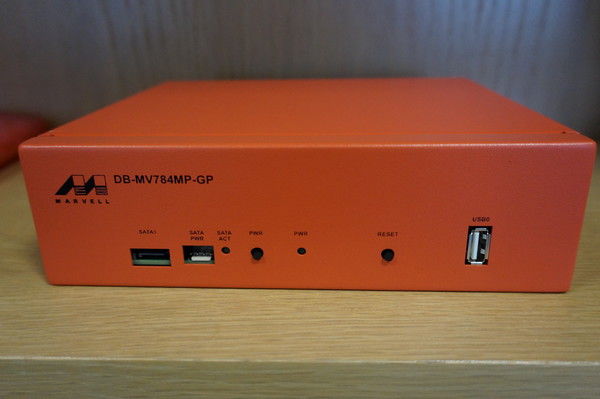
Marvell ARM system - Photo from Steve McIntyre
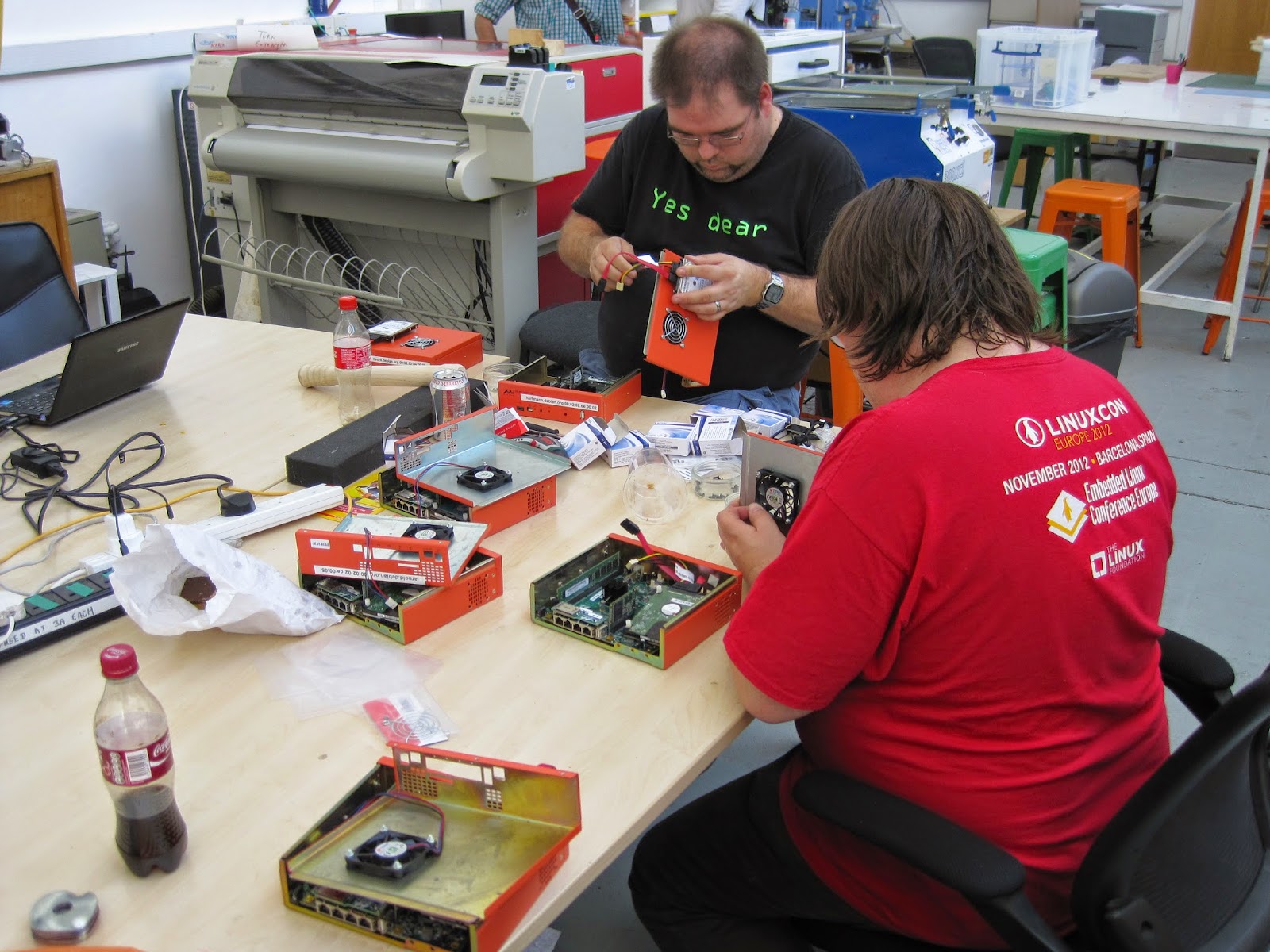
One weekend Steve McIntyre asked me if I could find a source of some of some 40mm fans for some systems with some pretty strict requirements. They needed to be long life and shift a lot of air to combat a persistent overheating issue.

I sat with him and went through the Farnell utterly hateful parametric web interface and eventually came up with a couple of options which were very expensive. Only then did I stop and ask what the actual problem was.

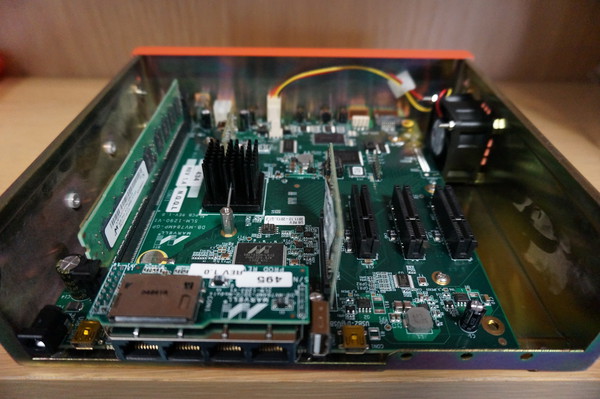
Marvell ARM system Original internal cooling arrangement - Photo from Steve McIntyre
Steve showed me one of the Debian ARM buildd boxes which are Marvell development machines. These systems are powerful quad core machines housed in compact steel enclosures.

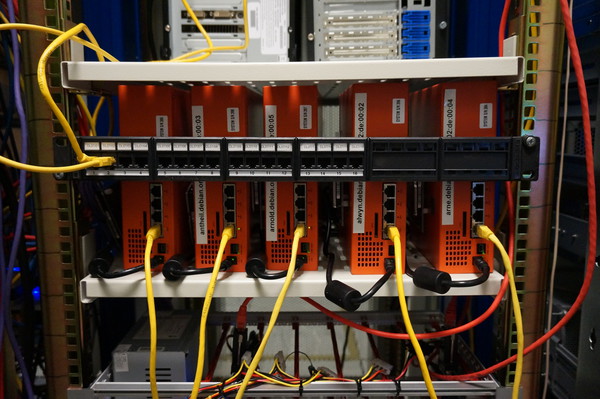
There is a single 40mm fan trying to provide cooling for the entire enclosure. When the units are placed horizontally and used intermittently this proves adequate. Unfortunately when the system are arranged vertically in a rack and run at full load continuously they often overheat and have to be restarted. In addition the small high speed fans need replacing frequently as their bearings wore out quickly.

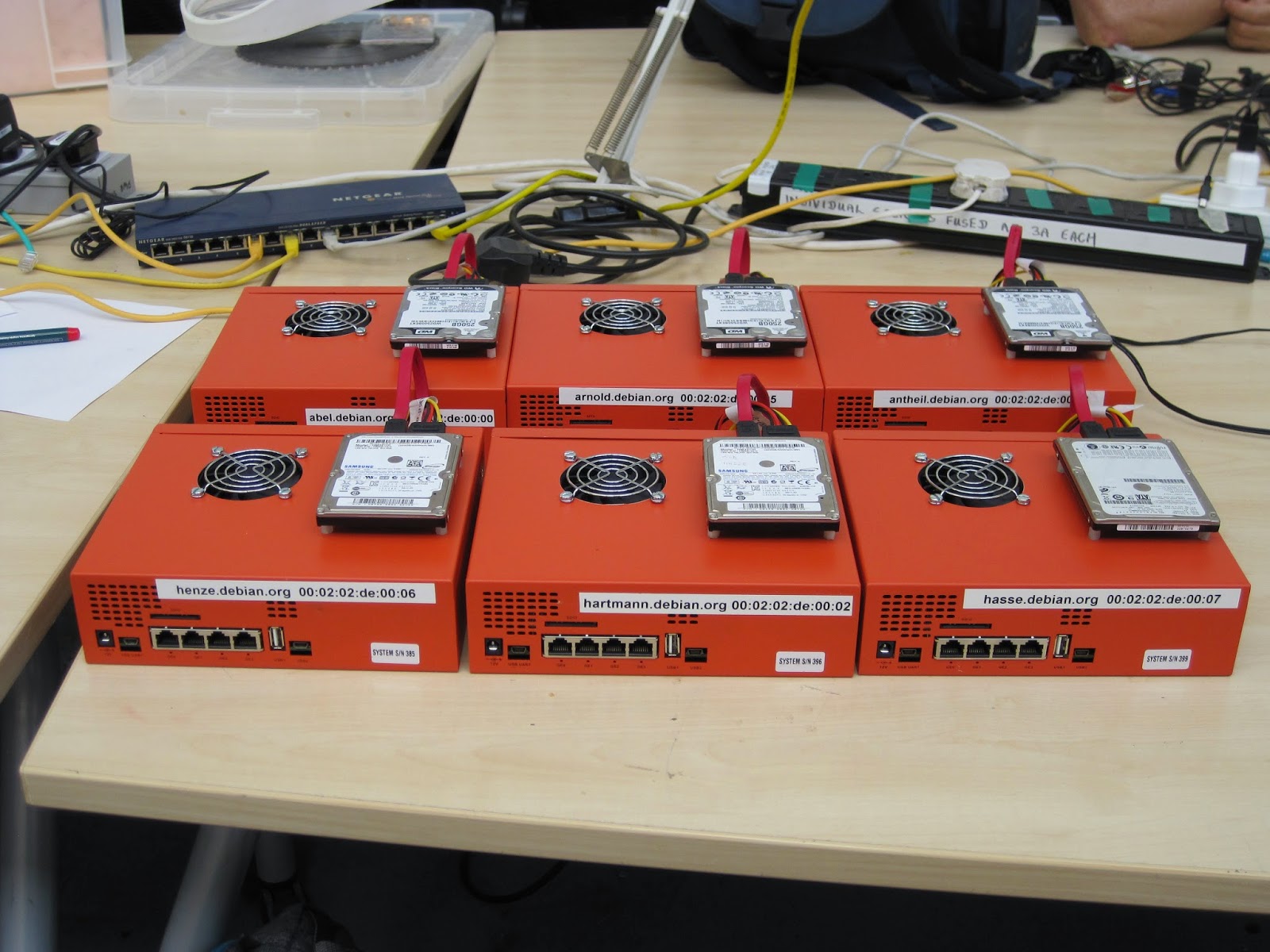
Debian ARM buildd systems - Photo from Steve McIntyreThis was obviously causing some issues for the ARM Debian ports which Steve wanted to rectify. After talking the problem through for a while we came to the conclusion we could use much larger 60mm fans to blow air directly through the top of the case onto the cpu heatsink.

Larger fans can be run much more slowly to move a similar volume of air to the smaller 40mm fans which gives a much longer service life.

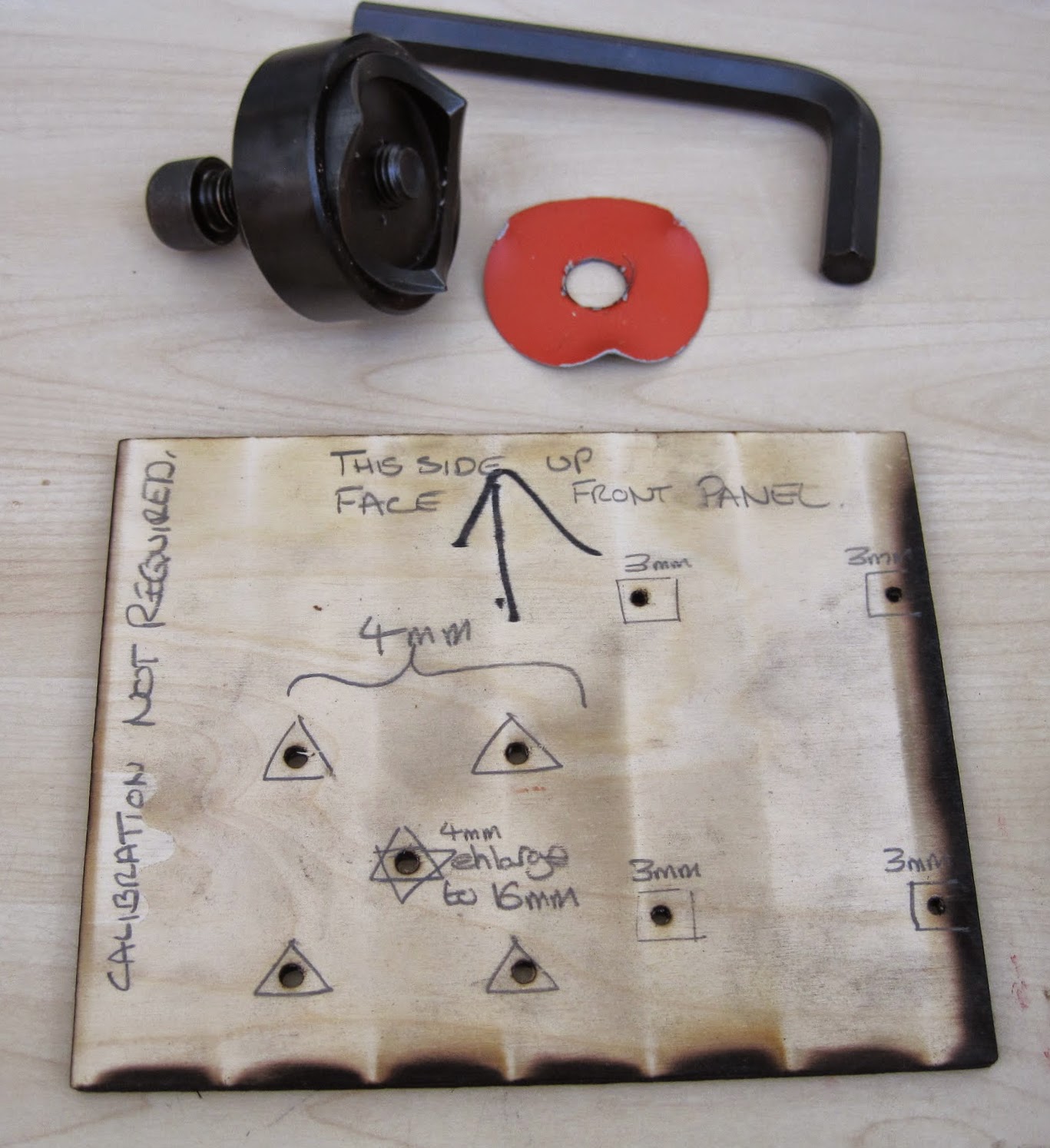
Hole punch and Drilling template
Steve proceeded to order enough parts to allow us to modify all the Debian systems, this worked out cheaper than a single "special" 40mm high volume fan.

I acquired a rather large steel hole punch, I chose this tool because it produces a much superior finish to a hole cutter and this project demanded a high level of finish (not to mention I loved having a valid excuse to own and use a huge allen key!)

If we had simply been modifying a single case I would have measured and marked up by hand. With the prospect of altering at least eight I laser cut a template from plywood which Andy Simpkins took great glee in excessively annotating.

We also used the opportunity to add bolt holes to securely attach the 2.5 inch SATA drives instead of using sticky pads.

Steve and I modified a single system to begin with both to check our alignment and the efficacy of the change. We were pleasantly surprised to discover that hoiby could now repeatedly do kernel compiles with all four cores flat out which was not possible before. The measured CPU temperature, which had previously been around 90 C, did not rise above 40 C

Steve and Andy on the assembly line
Steve, Andy and I then arranged a day where we took all the remaining units out of the rack at ARM, modified and returned them. We used the facilities at the Cambridge Makespace where I am a member to do the modifications.

I broke two 3mm drill bits and dulled a 4mm bit drilling all the holes, Roger Smith was good enough to loan us the use of his "Christmas tree bit" to ream the fan hole out to 16mm so we could thread the hole punch and cut the 60mm fan aperture out.

six modified systems ready to be re-racked.
We managed to get quite an assembly line going and, in my opinion, the results look pretty professional.

It has been several months since we did this work and these systems continue to run without issue. To complete the story we can see some graphs courtesy of the DSA munin instance.

CPU load on arnold.debian.org
You can clearly see the huge drop in temperature at the end of Week 25 despite the continuously high CPU load. Also there is only a single gap in the data after the changes (these indicate crashes where data was not recorded) where before there were frequent and extensive times where the systems were simply unusable.

CPU Temperature of arnold.debian.org
One reason I continue to enjoy Debian so much is the wide variety of ways in which I can contribute not only by maintaining my packages. Sometimes this kind of work does not receive the credit it deserves and hopefully highlights a small part of the frantic paddling that goes on under the serene surface of the Debian project to keep things "just working".

29 September 2014

Jonathan Dowland: Letter to Starburst magazine

I recently read a few issues of Starburst magazine which is good fun, but a brief mention of the Man Booker prize in issue 404 stoked the fires of the age old SF-versus-mainstream argument, so I wrote the following:
Dear Starburst, I found it perplexing that, in "Brave New Words", issue 404, whilst covering the Man-Booker shortlist, Ed Fortune tried to simultaneously argue that genre readers "read broadly" yet only Howard Jacobson's novel would be of passable interest. Asides from the obvious logical contradiction he is sadly overlooking David Mitchell's critically lauded and undisputably SF&F novel "The Bone Clocks", which it turned out was also overlooked by the short-listers. Still, Jacobson's novel made it, meaning SF&F represents 16% of the shortlist. Not too bad I'd say. All the best & keep up the good work!
As it happens I'm currently struggling through "J". I'm at around the half-way mark.

28 September 2014

Jonathan Dowland: Puppet and filesystem mounts

Well, not long after writing my last post I've found some time to write up some of my puppet adventures, sooner than I imagined... Outside work, I sys-admin a VPS instance that is shared by a few friends. We recently embarked in a project to migrate to a different VPS instance and I took the opportunity to revisit how we managed home directories. I've got all the disk space allocated to the VM set up as LVM physical volumes. This has proven very useful for later expansion: we can do it all live. Each user on the VM may have one or more UNIX accounts that they use. Therefore, in the old scheme, for the jon user, we mounted an allocation of disk space at /home/jons, put the account home directories under it at e.g. /home/jons/jon, symlinked /home/jon -> /home/jons/jon for brevity, and set that as the home field in the passwd entry. This worked surprisingly well, but I was always uncomfortable with having a symlink in the home path (and some software was, too.) For the new machine, I decided to try bind mounts. Short story: they just work. However, the mtab (and df output) can look a little cluttered, and mount order becomes quite important. To manage the set-up, I wrote a few puppet snippets. First, a convenience definition to make the actual bind-mounts a little less verbose.
define bindmount($device)  
  mount   $name:
    device  => $device,
    ensure  => mounted,
    fstype  => 'none',
    options => 'bind',
    dump    => 0,
    pass    => 2,
    require => File[$device],
   
 
Once that was in place, we then needed to ensure that the directories to which the LV were to be mounted, and to where the user's home would be bind-mounted, actually exist; we also need to mount the underlying LV and set up the bind mount. The dependency chain is actually a graph, but with the majority of dependencies quite linear:
define bindmounthome()  
  file   ["/home/$ name s", "/home/$ name "]:
    ensure  => directory,
    -> # depended upon by
  mount   "/home/$ name s":
    device  => "LABEL=$ name ",
    ensure  => mounted,
    fstype  => 'ext4',
    options => 'defaults',
    dump    => 0,
    pass    => 2,
    -> # depended upon by
  bindmount   "/home/$ name ":
    device  => "/home/$ name s/$ name ",
   
  file   "/home/$ name s/$ name ":
    ensure  => directory,
    owner   => $name,
    group   => $name,
    mode    => 0701, # 0701/drwx-----x
    require => [User[$name], Group[$name], Mount["/home/$ name s"]],
   
 
That covers the underlying mounts and the "primary" accounts. However, the point of this exercise was to support the secondary accounts for each user. There's a bit of repetition here, and with some refactoring both this and the preceding bindmounthome definition could be a bit shorter, but I'm not sure whether that would be at the expense of legibility:
define seconduser($parent)  
  file   "/home/$ name ":
    ensure => directory,
    -> # depended upon by
  bindmount   "/home/$ name ":
    device => "/home/$ parent s/$ name ",
   
  file   "/home/$ parent s/$ name ":
    ensure  => directory,
    owner   => $name,
    group   => $name,
    mode    => 0701, # 0701/drwx-----x
    require => [User[$name], Group[$name], Mount["/home/$ parent s"]],
   
 
I had to re-read the above a couple of times just now to convince myself that I hadn't missed the dependencies between the mount invocations towards the bottom, but they're there: so, puppet will always run the mount for /home/jons before /home/jons/jon. Since puppet is writing to the fstab, this means that the ordering is correct and a sequential start-up will work. If you want anything cleverer than serialised, one-at-a-time mounting at boot, I think one would have to use something other than trusty-old fstab for the job. I'm planning to look at Systemd's mount unit type, but there's no rush as this particular host is still running sysvinit for the time being.

Jonathan Dowland: What have I been up to?

It's been a little while since I've written about what I've been up to. The truth is I've been busy with moving house - and I'll write a bit more about that at another time. But asides from that there have been some bits and bobs. I use a little tool called archivemail to tidy up old listmail (my policy is to retain 30 days of listmail for most lists). If I unsubscribe to a list, then eventually I end up with an empty mail folder corresponding to that list. I decided it would be nice to extend archivemail to delete mailboxes if, after the archiving has taken place, the mailbox is empty. Doing this properly means adding delete routines to Python's "mailbox" library, which is part of the Python standard library. I've therefore started work on a patch for Python. Since this is an enhancement, Python would only accept a patch for Python 3. Therefore, eventually, I would also have to port archivemail from Python 2 to 3. "archivemail" is basically abandonware at the moment, and the principal Debian maintainer is MIA. There was a release critical bug filed against it, so I joined the Debian Python team to co-maintain archivemail in Debian. I've worked around the RC bug but a proper fix is still to come. In other Debian news, I've been mostly quiet. A small patch for squishyball to get it to build on Hurd, and a temporary fix patch for lhasa to get it to build on the build daemons for all architectures (problems with the test suite). All three of lhasa, squishyball and archivemail need a little bit of love to get them into shape before the jessie freeze. I've had plans to write up some of the more interesting technical things I've been up to at work, but with the huge successes of the School we've been so busy I haven't had time. Hopefully you can soon look forward to some of our further adventures with puppet, including evaluating Shibboleth modules, some stuff about handling user directories, bind mounts and LVM volumes and actually publishing some of our more useful internal modules; I hope we will also (soon) have some useful data to go with our experiments with Linux LXC containers versus KVM-powered virtual machines in some of our use-cases. I've also got a few bits and pieces on Systemd to write up.

27 September 2014

DebConf team: Wrapping up DebConf14 (Posted by Paul Wise, Donald Norwood)

The annual Debian developer meeting took place in Portland, Oregon, 23 to 31 August 2014. DebConf14 attendees participated in talks, discussions, workshops and programming sessions. Video teams captured a lot of the main talks and discussions for streaming for interactive attendees and for the Debian video archive. Between the video, presentations, and handouts the coverage came from the attendees in blogs, posts, and project updates. We ve gathered a few articles for your reading pleasure: Gregor Herrmann and a few members of the Debian Perl group had an informal unofficial pkg-perl micro-sprint and were very productive. Vincent Sanders shared an inspired gift in the form of a plaque given to Russ Allbery in thanks for his tireless work of keeping sanity in the Debian mailing lists. Pictures of the plaque and design scheme are linked in the post. Vincent also shared his experiences of the conference and hopes the organisers have recovered. Noah Meyerhans adventuring to Debian by train, (Inter)netted some interesting IPv6 data for future road and railwarriors. Hideki Yamane sent a gentle reminder for English speakers to speak more slowly. Daniel Pocock posted of GSoC talks at DebConf14, highlights include the Java Project Dependency Builder and the WebRTC JSCommunicator. Thomas Goirand gives us some insight into a working task list of accomplishments and projects he was able to complete at DebConf14, from the OpenStack discussion to tasksel talks, and completion of some things started last year at DebConf13. Antonio Terceiro blogged about debci and the Debian Continuous Integration project, Ruby, Redmine, and Noosfero. His post also shares the atmosphere of being able to interact directly with peers once a year. Stefano Zacchiroli blogged about a talk he did on debsources which now has its own HACKING file. Juliana Louback penned: DebConf 2014 and How I Became a Debian Contributor. Elizabeth Krumbach Joseph s in-depth summary of DebConf14 is a great read. She discussed Debian Validation & CI, debci and the Continuous Integration project, Automated Validation in Debian using LAVA, and Outsourcing webapp maintenance. Lucas Nussbaum by way of a blog post releases the very first version of Debian Trivia modelled after the TCP/IP Drinking Game. Fran ois Marier s shares additional information and further discussion on Outsourcing your webapp maintenance to Debian. Joachim Breitner gave a talk on Haskell and Debian, created a new tool for binNMUs for Haskell packages which runs via cron job. The output is available for Haskell and for OCaml, and he still had a small amount of time to go dancing. Jaldhar Harshad Vyas was not able to attend DebConf this year, but he did tune in to the videos made available by the video team and gives an insightful viewpoint to what was being seen. J r my Bobbio posted about Reproducible builds in Debian in his recap of DebConf14. One of the topics at hand involved defining a canonical path where packages must be built and a BOF discussion on reproducible builds from where the conversation moved to discussions in both Octave and Groff. New helpers dh_fixmtimes and dh_genbuildinfo were added to BTS. The .buildinfo format has been specified on the wiki and reviewed. Lots of work is being done in the project, interested parties can help with the TODO list or join the new IRC channel #debian-reproducible on irc.debian.org. Steve McIntyre posted a Summary from the d-i / debian-cd BoF at DC14, with some of the session video available online. Current jessie D-I needs some help with the testing on less common architectures and languages, and release scheduling could be improved. Future plans: Switching to a GUI by default for jessie, a default desktop and desktop choice, artwork, bug fixes and new architecture support. debian-cd: Things are working well. Improvement discussions are on selecting which images to make I.E. netinst, DVD, et al., debian-cd in progress with http download support, Regular live test builds, Other discussions and questions revolve around which ARM platforms to support, specially-designed images, multi-arch CDs, and cloud-init based images. There is also a call for help as the team needs help with testing, bug-handling, and translations. Holger Levsen reports on feedback about the feedback from his LTS talk at DebConf14. LTS has been perceived well, fits a demand, and people are expecting it to continue; however, this is not without a few issues as Holger explains in greater detail the lacking gatekeeper mechanisms, and how contributions are needed from finance to uploads. In other news the security-tracker is now fixed to know about old stable. Time is short for that fix as once jessie is released the tracker will need to support stable, oldstable which will be wheezy, and oldoldstable. Jonathan McDowell s summary of DebConf14 includes a fair perspective of the host city and the benefits of planning of a good DebConf14 location. He also talks about the need for facetime in the Debian project as it correlates with and improves everyone s ability to work together. DebConf14 also provided the chance to set up a hard time frame for removing older 1024 bit keys from Debian keyrings. Steve McIntyre posted a Summary from the State of the ARM BoF at DebConf14 with updates on the 3 current ports armel, armhf and arm64. armel which targets the ARM EABI soft-float ARMv4t processor may eventually be going away, while armhf which targets the ARM EABI hard-float ARMv7 is doing well as the cross-distro standard. Debian is has moved to a single armmp kernel flavour using Device Tree Blobs and should be able to run on a large range of ARMv7 hardware. The arm64 port recently entered the main archive and it is hoped to release with jessie with 2 official builds hosted at ARM. There is talk of laptop development with an arm64 CPU. Buildds and hardware are mentioned with acknowledgements for donated new machines, Banana Pi boards, and software by way of ARM s DS-5 Development Studio - free for all Debian Developers. Help is needed! Join #debian-arm on irc.debian.org and/or the debian-arm mailing list. There is an upcoming Mini-DebConf in November 2014 hosted by ARM in Cambridge, UK. Tianon Gravi posted about the atmosphere and contrast between an average conference and a DebConf. Joseph Bisch posted about meeting his GSOC mentors, attending and contributing to a keysigning event and did some work on debmetrics which is powering metrics.debian.net. Debmetrics provides a uniform interface for adding, updating, and viewing various metrics concerning Debian. Harlan Lieberman-Berg s DebConf Retrospective shared the feel of DebConf, and detailed some of the work on debugging a build failure, work with the pkg-perl team on a few uploads, and work on a javascript slowdown issue on codeeditor. Ana Guerrero L pez reflected on Ten years contributing to Debian.

Ritesh Raj Sarraf: Laptop Mode Tools 1.66

I am pleased to announce the release of Laptop Mode Tools at version 1.66. This release fixes an important bug in the way Laptop Mode Tools is invoked. Users, now when disable it in the config file, the tool will be disabled. Thanks to bendlas@github for narrowing it down. The GUI configuration tool has been improved, thanks to Juan. And there is a new power saving module for users with ATI Radeon cards. Thanks to M. Ziebell for submitting the patch. Laptop Mode Tools development can be tracked @ GitHub

AddThis:

Categories:

Keywords:

21 September 2014

Dariusz Dwornikowski: statistics of RFS bugs and sponsoring process

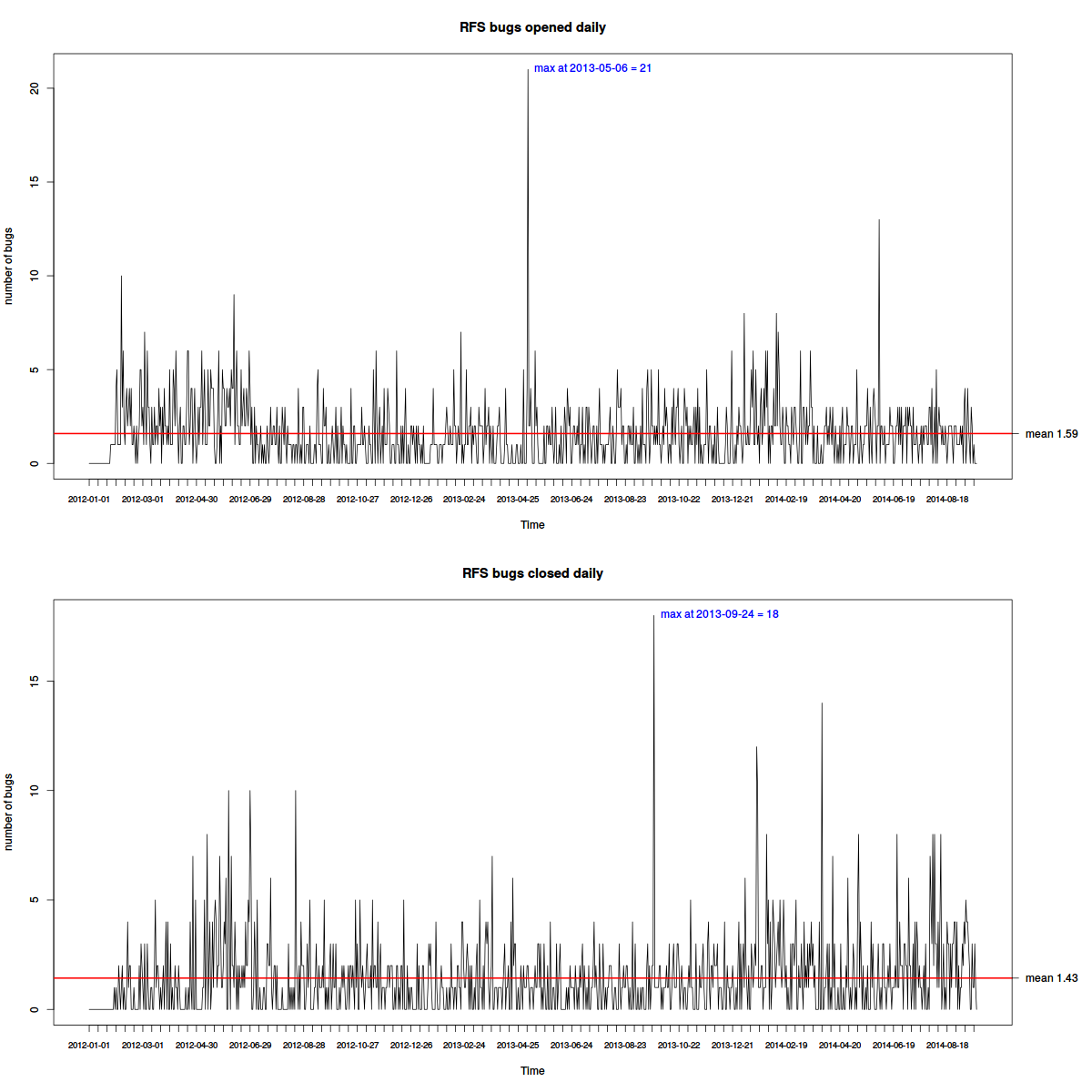
For some days I have been working on statistics of the sponsoring process in Debian. I find this to be one of the most important things that Debian has to attract and enable new contributions. It is important to know how this process works, whether we need more sponsors, how effective is the sponsoring and what are the timings connected to it. How I did this ? I have used Debbugs SOAP interface to get all bugs that are filed against sponsorship-requests pseudo package. SOAP gives a little bit of overhead because it needs to download a complete list of bugs for the sponsorship-requests package, and then process them according to given date ranges. The same information can be easily extracted from the UDD database in the future, it will be faster because SQL is better when working with date ranges than python obviously. The most problematic part was getting the "real done date" of a particular bug, and frankly most of my time I have spent on writing a rather dirty and complicated script. The script gets a log for a particular bug number and returns a "real done date". I have published a proof of concept in a previous post.. What I measured ? RFSs is a queue, and in every queue one is interested in a mean time to get processed. In this case I called the metric global MTTGS (mean time to get sponsored). This is a metric that gives the overall performance insight in RFS queue. Time to get sponsored (TTGS) for a bug is a number of days that passed between filing an RFS bug and closing it (bug was sponsored). Mean time to get sponsored is calculated as a sum of TTGSs of all bugs divided by number of bugs (in a given period of time). Global MTTGS is MTTGS calculated for a period of time 2012-1-1 until today(). Besides MTTGS I have also measured typical bug related metrics: Plots and graphs Below is a plot of global MTTGS vs. time (click for a larger image). mttgs plot As you can see, the trend is roughly exponential and MTTGS tends to settle around 60 days at the end of the year 2013. This does not mean that your package will wait 60 days on average nowadays to get sponsored. I remind that this is a global MTTGS, so even if the MTTGS of last month was very low, the global MTTGS would decrease just slightly. It gives, however, a good glance in performance of the process. Even that more packages are filed for sponsoring (see next graphs) now, than in the beginning of the epoch, the sponsoring rate is high enough to flatten the global MTTGS, and with time maybe decrease it. The image below (click for a larger one) shows how many bugs reside in a queue with status open or closed (calculated for each day). For closed we have an almost linear function, so each day more or less the same amount of bugs are closed and they increase the pool of bugs with status closed. For bugs with status open the interesting part begins around May 2012 after the system is saturated or gets popular. It can be interpreted as a plot of how many bugs reside in the queue, the important part is that it is stable and does not show clear increasing trend. open done plot The last plot shows arrival and departure rate of bugs from RFS queue, i.e. how many bugs are opened and closed each day. The interesting part here are the maxima. Let's look at them. opened closed plot Maximal number of opened bugs (21) was on 2012-05-06. As it appears it was a bunch upload of RFSs for tryton-modules-*..
  706953  RFS: tryton-modules-account-stock-anglo-saxon/2.8.0-1 
  706954  RFS: tryton-modules-purchase-shipment-cost/2.8.0-1 
  706948  RFS: tryton-modules-production/2.8.0-1 
  706969  RFS: tryton-modules-account-fr/2.8.0-1 
  706946  RFS: tryton-modules-project-invoice/2.8.0-1 
  706950  RFS: tryton-modules-stock-supply-production/2.8.0-1 
  706942  RFS: tryton-modules-product-attribute/2.8.0-1 
  706957  RFS: tryton-modules-stock-lot/2.8.0-1 
  706958  RFS: tryton-modules-carrier-weight/2.8.0-1 
  706941  RFS: tryton-modules-stock-supply-forecast/2.8.0-1 
  706955  RFS: tryton-modules-product-measurements/2.8.0-1 
  706952  RFS: tryton-modules-carrier-percentage/2.8.0-1 
  706949  RFS: tryton-modules-account-asset/2.8.0-1 
  706904  RFS: chinese-checkers/0.4-1 
  706944  RFS: tryton-modules-stock-split/2.8.0-1 
  706981  RFS: distcc/3.1-6 
  706945  RFS: tryton-modules-sale-supply/2.8.0-1 
  706959  RFS: tryton-modules-carrier/2.8.0-1 
  706951  RFS: tryton-modules-sale-shipment-cost/2.8.0-1 
  706943  RFS: tryton-modules-account-stock-continental/2.8.0-1 
  706956  RFS: tryton-modules-sale-supply-drop-shipment/2.8.0-1
Maximum number of closed bugs (18) was on 2013-09-24, and as you probably guessed right also tryton modules had impact on that.
  706953  RFS: tryton-modules-account-stock-anglo-saxon/2.8.0-1 
  706954  RFS: tryton-modules-purchase-shipment-cost/2.8.0-1 
  706948  RFS: tryton-modules-production/2.8.0-1 
  706969  RFS: tryton-modules-account-fr/2.8.0-1 
  706946  RFS: tryton-modules-project-invoice/2.8.0-1 
  706950  RFS: tryton-modules-stock-supply-production/2.8.0-1 
  706942  RFS: tryton-modules-product-attribute/2.8.0-1 
  706958  RFS: tryton-modules-carrier-weight/2.8.0-1 
  706941  RFS: tryton-modules-stock-supply-forecast/2.8.0-1 
  706955  RFS: tryton-modules-product-measurements/2.8.0-1 
  706952  RFS: tryton-modules-carrier-percentage/2.8.0-1 
  706949  RFS: tryton-modules-account-asset/2.8.0-1 
  706944  RFS: tryton-modules-stock-split/2.8.0-1 
  706959  RFS: tryton-modules-carrier/2.8.0-1 
  723991  RFS: mapserver/6.4.0-2 
  706951  RFS: tryton-modules-sale-shipment-cost/2.8.0-1 
  706943  RFS: tryton-modules-account-stock-continental/2.8.0-1 
  706956  RFS: tryton-modules-sale-supply-drop-shipment/2.8.0-1
The software Most of the software was written in Python. Graphs were generated in R. After a code cleanup I will publish a complete solution on my github account, free to use by everybody. If you would like to see another statistics, please let me know, I can create them if the data provides sufficient information.

18 September 2014

Dariusz Dwornikowski: RFS health in Debian

I am working on a small project to create WNPP like statistics for open RFS bugs. I think this could improve a little bit effectiveness of sponsoring new packages by giving insight into bugs that are on their way to being starved (i.e. not ever sponsored, or rotting in a queue). The script attached in this post is written in Python and uses Debbugs SOAP interface to get currently open RFS bugs and calculates their dust and age. The dust factor is calculated as an absolute value of a difference between bugs's age and log_modified. Later I would like to create fully blown stats for an RFS queue, taking into account the whole history (i.e. 2012-1-1 until now), and check its health, calculate MTTGS (mean time to get sponsored). The list looks more or less like this:
Age  Dust Number  Title
37   0    757966  RFS: lutris/0.3.5-1 [ITP]
1    0    762015  RFS: s3fs-fuse/1.78-1 [ITP #601789] -- FUSE-based file system backed by Amazon S3
81   0    753110  RFS: mrrescue/1.02c-1 [ITP]
456  0    712787  RFS: distkeys/1.0-1 [ITP] -- distribute SSH keys
120  1    748878  RFS: mwc/1.7.2-1 [ITP] -- Powerful website-tracking tool
1    1    762012  RFS: fadecut/0.1.4-1
3    1    761687  RFS: abraca/0.8.0+dfsg-1 -- Simple and powerful graphical client for XMMS2
35   2    758163  RFS: kcm-ufw/0.4.3-1 ITP
3    2    761636  RFS: raceintospace/1.1+dfsg1-1 [ITP]
....
....
The script rfs_health.py can be found below, it uses SOAPpy (only python <3 unfortunately).
#!/usr/bin/python
import SOAPpy
import time
from datetime import date, timedelta, datetime
url = 'http://bugs.debian.org/cgi-bin/soap.cgi'
namespace = 'Debbugs/SOAP'
server = SOAPpy.SOAPProxy(url, namespace)
class RFS(object):
    def __init__(self, obj):
        self._obj = obj
        self._last_modified = date.fromtimestamp(obj.log_modified)
        self._date = date.fromtimestamp(obj.date)
        if self._obj.pending != 'done':
            self._pending = "pending"
            self._dust = abs(date.today() - self._last_modified).days
        else:
            self._pending = "done"
            self._dust = abs(self._date - self._last_modified).days
        today = date.today()
        self._age = abs(today - self._date).days
    @property
    def status(self):
        return self._pending
    @property
    def date(self):
        return self._date
    @property
    def last_modified(self):
        return self._last_modified
    @property
    def subject(self):
        return self._obj.subject
    @property
    def bug_number(self):
        return self._obj.bug_num
    @property
    def age(self):
        return self._age
    @property
    def dust(self):
        return self._dust
    def __str__(self):
        return "  subject:   age:  dust: ".format(self._obj.bug_num, self._obj.subject, self._age, self._dust)
if __name__ == "__main__":
    bugi = server.get_bugs("package", "sponsorship-requests", "status", "open")
    buglist = [RFS(b.value) for b in server.get_status(bugi).item]
    buglist_sorted_by_dust = sorted(buglist, key=lambda x: x.dust, reverse=False)
    print("Age  Dust Number  Title")
    for i in buglist_sorted_by_dust:
        print(" :<4   :<4   :<7   ".format(i.age, i.dust, i.bug_number, i.subject))

17 September 2014

Steve Kemp: If this goes well I have a new blog engine

Assuming this post shows up then I'll have successfully migrated from Chronicle to a temporary replacement. Chronicle is awesome, and despite a lack of activity recently it is not dead. (No activity because it continued to do everything I needed for my blog.) Unfortunately though there is a problem with chronicle, it suffers from a bit of a performance problem which has gradually become more and more vexing as the nubmer of entries I have has grown. When chronicle runs it : In the general case you rebuild a blog because you've made a entry, or received a new comment. There is some code which tries to use memcached for caching, but in general chronicle just isn't fast and it is certainly memory-bound if you have a couple of thousand entries. Currently my test data-set contains 2000 entries and to rebuild that from a clean start takes around 4 minutes, which is pretty horrific. So what is the alternative? What if you could parse each post once, add it to an SQLite database, and then use that for writing your output pages? Instead of the complex data-structure in-RAM and the need to parse a zillion files you'd have a standard/simple SQL structure you could use to build a tag-cloud, an archive, & etc. If you store the contents of the parsed-blog, along with the mtime of the source file you can update it if the entry is changed in the future, as I sometimes make typos which I only spot once Ive run make steve on my blog sources. Not surprisingly the newer code is significantly faster if you have 2000+ posts. If you've imported the posts into SQLite the most recent entries are updated in 3 seconds. If you're starting cold, parsing each entry, inserting it into SQLite, and then generating the blog from scratch the build time is still less than 10 seconds. The downside is that I've removed features, obviously nothing that I use myself. Most notably the calendar view is gone, as is the ability to use date-based URLs. Less seriously there is only a single theme, which is what is used upon this site. In conclusion I've written something last night which is a stepping stone between the current chronicle and chronicle2 which will appear in due course.
PS. This entry was written in markdown, just because I wanted to be sure it worked.

15 September 2014

Julien Danjou: Python bad practice, a concrete case

A lot of people read up on good Python practice, and there's plenty of information about that on the Internet. Many tips are included in the book I wrote this year, The Hacker's Guide to Python. Today I'd like to show a concrete case of code that I don't consider being the state of the art. In my last article where I talked about my new project Gnocchi, I wrote about how I tested, hacked and then ditched whisper out. Here I'm going to explain part of my thought process and a few things that raised my eyebrows when hacking this code. Before I start, please don't get the spirit of this article wrong. It's in no way a personal attack to the authors and contributors (who I don't know). Furthermore, whisper is a piece of code that is in production in thousands of installation, storing metrics for years. While I can argue that I consider the code not to be following best practice, it definitely works well enough and is worthy to a lot of people. Tests The first thing that I noticed when trying to hack on whisper, is the lack of test. There's only one file containing tests, named test_whisper.py, and the coverage it provides is pretty low. One can check that using the coverage tool.
$ coverage run test_whisper.py
...........
----------------------------------------------------------------------
Ran 11 tests in 0.014s

OK
$ coverage report
Name Stmts Miss Cover
----------------------------------
test_whisper 134 4 97%
whisper 584 227 61%
----------------------------------
TOTAL 718 231 67%

While one would think that 61% is "not so bad", taking a quick peak at the actual test code shows that the tests are incomplete. Why I mean by incomplete is that they for example use the library to store values into a database, but they never check if the results can be fetched and if the fetched results are accurate. Here's a good reason one should never blindly trust the test cover percentage as a quality metric. When I tried to modify whisper, as the tests do not check the entire cycle of the values fed into the database, I ended up doing wrong changes but had the tests still pass. No PEP 8, no Python 3 The code doesn't respect PEP 8 . A run of flake8 + hacking shows 732 errors While it does not impact the code itself, it's more painful to hack on it than it is on most Python projects. The hacking tool also shows that the code is not Python 3 ready as there is usage of Python 2 only syntax. A good way to fix that would be to set up tox and adds a few targets for PEP 8 checks and Python 3 tests. Even if the test suite is not complete, starting by having flake8 run without errors and the few unit tests working with Python 3 should put the project in a better light. Not using idiomatic Python A lot of the code could be simplified by using idiomatic Python. Let's take a simple example:
def fetch(path,fromTime,untilTime=None,now=None):
fh = None
try:
fh = open(path,'rb')
return file_fetch(fh, fromTime, untilTime, now)
finally:
if fh:
fh.close()

That piece of code could be easily rewritten as:
def fetch(path,fromTime,untilTime=None,now=None):
with open(path, 'rb') as fh:
return file_fetch(fh, fromTime, untilTime, now)

This way, the function looks actually so simple that one can even wonder why it should exists but why not. Usage of loops could also be made more Pythonic:
for i,archive in enumerate(archiveList):
if i == len(archiveList) - 1:
break

could be actually:
for i, archive in itertools.islice(archiveList, len(archiveList) - 1):

That reduce the code size and makes it easier to read through the code. Wrong abstraction level Also, one thing that I noticed in whisper, is that it abstracts its features at the wrong level. Take the create() function, it's pretty obvious:
def create(path,archiveList,xFilesFactor=None,aggregationMethod=None,sparse=False,useFallocate=False):
# Set default params
if xFilesFactor is None:
xFilesFactor = 0.5
if aggregationMethod is None:
aggregationMethod = 'average'

#Validate archive configurations...
validateArchiveList(archiveList)

#Looks good, now we create the file and write the header
if os.path.exists(path):
raise InvalidConfiguration("File %s already exists!" % path)
fh = None
try:
fh = open(path,'wb')
if LOCK:
fcntl.flock( fh.fileno(), fcntl.LOCK_EX )

aggregationType = struct.pack( longFormat, aggregationMethodToType.get(aggregationMethod, 1) )
oldest = max([secondsPerPoint * points for secondsPerPoint,points in archiveList])
maxRetention = struct.pack( longFormat, oldest )
xFilesFactor = struct.pack( floatFormat, float(xFilesFactor) )
archiveCount = struct.pack(longFormat, len(archiveList))
packedMetadata = aggregationType + maxRetention + xFilesFactor + archiveCount
fh.write(packedMetadata)
headerSize = metadataSize + (archiveInfoSize * len(archiveList))
archiveOffsetPointer = headerSize

for secondsPerPoint,points in archiveList:
archiveInfo = struct.pack(archiveInfoFormat, archiveOffsetPointer, secondsPerPoint, points)
fh.write(archiveInfo)
archiveOffsetPointer += (points * pointSize)

#If configured to use fallocate and capable of fallocate use that, else
#attempt sparse if configure or zero pre-allocate if sparse isn't configured.
if CAN_FALLOCATE and useFallocate:
remaining = archiveOffsetPointer - headerSize
fallocate(fh, headerSize, remaining)
elif sparse:
fh.seek(archiveOffsetPointer - 1)
fh.write('\x00')
else:
remaining = archiveOffsetPointer - headerSize
chunksize = 16384
zeroes = '\x00' * chunksize
while remaining > chunksize:
fh.write(zeroes)
remaining -= chunksize
fh.write(zeroes[:remaining])

if AUTOFLUSH:
fh.flush()
os.fsync(fh.fileno())
finally:
if fh:
fh.close()

The function is doing everything: checking if the file doesn't exist already, opening it, building the structured data, writing this, building more structure, then writing that, etc. That means that the caller has to give a file path, even if it just wants a whipser data structure to store itself elsewhere. StringIO() could be used to fake a file handler, but it will fail if the call to fcntl.flock() is not disabled and it is inefficient anyway. There's a lot of other functions in the code, such as for example setAggregationMethod(), that mixes the handling of the files even doing things like os.fsync() while manipulating structured data. This is definitely not a good design, especially for a library, as it turns out reusing the function in different context is near impossible. Race conditions There are race conditions, for example in create() (see added comment):
if os.path.exists(path):
raise InvalidConfiguration("File %s already exists!" % path)
fh = None
try:
# TOO LATE I ALREADY CREATED THE FILE IN ANOTHER PROCESS YOU ARE GOING TO
# FAIL WITHOUT GIVING ANY USEFUL INFORMATION TO THE CALLER :-(
fh = open(path,'wb')

That code should be:
try:
fh = os.fdopen(os.open(path, os.O_WRONLY os.O_CREAT os.O_EXCL), 'wb')
except OSError as e:
if e.errno = errno.EEXIST:
raise InvalidConfiguration("File %s already exists!" % path)

to avoid any race condition. Unwanted optimization We saw earlier the fetch() function that is barely useful, so let's take a look at the file_fetch() function that it's calling.
def file_fetch(fh, fromTime, untilTime, now = None):
header = __readHeader(fh)
[...]

The first thing the function does is to read the header from the file handler. Let's take a look at that function:
def __readHeader(fh):
info = __headerCache.get(fh.name)
if info:
return info

originalOffset = fh.tell()
fh.seek(0)
packedMetadata = fh.read(metadataSize)

try:
(aggregationType,maxRetention,xff,archiveCount) = struct.unpack(metadataFormat,packedMetadata)
except:
raise CorruptWhisperFile("Unable to read header", fh.name)
[...]

The first thing the function does is to look into a cache. Why is there a cache? It actually caches the header based with an index based on the file path (fh.name). Except that if one for example decide not to use file and cheat using StringIO, then it does not have any name attribute. So this code path will raise an AttributeError. One has to set a fake name manually on the StringIO instance, and it must be unique so nobody messes with the cache
import StringIO

packedMetadata = <some source>
fh = StringIO.StringIO(packedMetadata)
fh.name = "myfakename"
header = __readHeader(fh)

The cache may actually be useful when accessing files, but it's definitely useless when not using files. But it's not necessarily true that the complexity (even if small) that the cache adds is worth it. I doubt most of whisper based tools are long run processes, so the cache that is really used when accessing the files is the one handled by the operating system kernel, and this one is going to be much more efficient anyway, and shared between processed. There's also no expiry of that cache, which could end up of tons of memory used and wasted. Docstrings None of the docstrings are written in a a parsable syntax like Sphinx. This means you cannot generate any documentation in a nice format that a developer using the library could read easily. The documentation is also not up to date:
def fetch(path,fromTime,untilTime=None,now=None):
"""fetch(path,fromTime,untilTime=None)
[...]
"""

def create(path,archiveList,xFilesFactor=None,aggregationMethod=None,sparse=False,useFallocate=False):
"""create(path,archiveList,xFilesFactor=0.5,aggregationMethod='average')
[...]
"""

This is something that could be avoided if a proper format was picked to write the docstring. A tool cool be used to be noticed when there's a diversion between the actual function signature and the documented one, like missing an argument. Duplicated code Last but not least, there's a lot of code that is duplicated around in the scripts provided by whisper in its bin directory. Theses scripts should be very lightweight and be using the console_scripts facility of setuptools, but they actually contains a lot of (untested) code. Furthermore, some of that code is partially duplicated from the whisper.py library which is against DRY. Conclusion There are a few more things that made me stop considering whisper, but these are part of the whisper features, not necessarily code quality. One can also point out that the code is very condensed and hard to read, and that's a more general problem about how it is organized and abstracted. A lot of these defects are actually points that made me start writing The Hacker's Guide to Python a year ago. Running into this kind of code makes me think it was a really good idea to write a book on advice to write better Python code!
The Hacker's Guide to Python
A book I wrote talking about designing Python applications, state of the art, advice to apply when building your application, various Python tips, etc. Interested? Check it out.

13 September 2014

Laura Arjona: Disabling comments in the blog

I m getting more spam than the amount that I can stand in this blog. Comments are moderated, so the public is not suffering that, only me. From time to time I go to my dashboard and clean the spam. I m afraid that I delete some legit comment in these spam-cleaning-fevers, or, more probably, that a legit comment waits in the queue for several days (weeks?), just because I m lazy to deal with spam and let days pass by (until the fever comes). I think I m going to follow the wisdom of Bradley M. Kuhn and link to a pump.io note for comments on my blog posts (disabling them here in WordPress.com). I usually post a notice when I write something in my blog, so the only task is to update the blog post with the pump.io URL of the thread for comments. While WordPress.com allows to write comments quickly, without need of an account (you write just a name and an email, and the comment), in pump you need to have an account and sign in to comment. That looks as a bad thing, a barrier for people to participate. But of course, it stops spam :) After thinking about it a bit, pump.io it s a federated network, you can choose the pump server that they want, you can create a fake account, you don t need to provide personal information and it s another way to promote one of the social networks where I live. Other systems link to facebook, twitter, or other places, and nobody complains! Even when those services don t have any of the advantages of being in a federated free-software powered social network :) If anybody don t want to use pump.io but wants to comment, other ways to reach me or the related blog post are: So now it s decided, and this is the first post of this new experiment. This text is posted in pump.io too, and you can comment there :)
Filed under: My experiences and opinion, Tools Tagged: Blog, English, federation, pump.io, social networks, Wordpress

11 September 2014

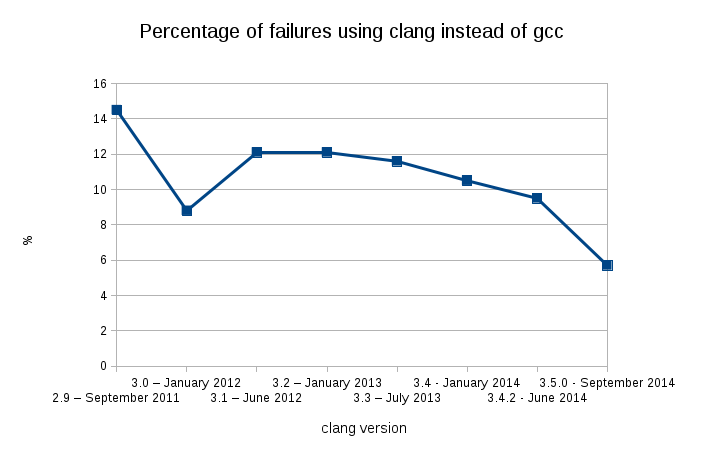
Sylvestre Ledru: Rebuild of Debian using Clang 3.5.0

Clang 3.5.0 has just been released. A new rebuild has been done highlight the progress to get Debian built with clang. tl;dr: Great progress. We decreased from 9.5% to 5.7% of failures. Full results are available on http://clang.debian.net At time of the rebuild with 3.4.2, we had 2040 packages failing to build with clang. With 3.5.0, this dropped to 1261 packages. Fixes With Arthur Marble and Alexander Ovchinnikov, both GSoC students, we worked on various ways to decrease the number of errors. Upstream fixes First, the most obvious way, we fixed programming bugs/mistakes in upstream sources. Basically, we took categories of failure and fixed issues one after the other. We started with simple bugs like 'Wrong main declaration', 'non-void function should return a value' or 'Void function should not return a value'.

They are trivial to fix. We continued with harder fixes like ' Undefined reference' or 'Variable length array for a non POD (plain old data) element'.

So, besides these one, we worked on:
In total, we reported 295 bugs with patches. 85 of them have been fixed (meaning that the Debian maintainer uploaded a new version with the fix).

In parallel, I think that the switch by FreeBSD and Mac OS X to Clang also helped to fix various issues by upstreams. Hacking in clang As a parallel approach, we started to implement a suggestion from Linus Torvalds and a few others. Instead of trying to fix all upstream, where we can, we tried to update clang to improve the gcc compatibility.

gcc has many flags to disable or enable optimizations. Some of them are legacy, others have no sense in clang, etc. Instead of failing in clang with an error, we create a new category of warnings (showing optimization flag '%0' is not supported) and moved all relevant flags into it. Some examples, r212805, r213365, r214906 or r214907

We also updated clang to silent some useless arguments like -finput_charset=UTF-8 (r212110), clang being UTF-8 compliant.

Finally, we worked on the forwarding of linker flags. Clang and gcc have a very different behavior: when gcc does not know an argument, it is going to forward the argument to the linker. Clang, in this case, is going to reject the argument and fail with an error. In clang, we have to explicitly declare which arguments are going to be transfer to the linker. Of course, the correct way to pass arguments to the linker is to use -Xlinker or -Wl but the Debian rebuild proved that these shortcuts are used. Two of these arguments are now forwarded: New errors Just like in other releases, new warnings are added in clang. With (bad) usage of -Werror by upstream software, this causes new build failures: I also took the opportunity to add some further categorizations in the list of errors. Some examples: Next steps The Debile project being close to ready with Cl ment Schreiner's GSoC, we will now have an automatic and transparent way to rebuild packages using clang. Conclusion As stated, we can see a huge drop in term of number of failures over time:
Hopefully, Clang getting better and better, more and more projects adopting it as the default compiler or as a base for plugin/extension developments, this percentage will continue to decrease.
Having some kind of release goal with clang for Jessie+1 can now be considered as potentially reachable. Want to help? There are several things which can be done to help: Acknowledgments Thanks to David Suarez for the rebuilds of the archive, Arthur Marble and Alexander Ovchinnikov for their GSoC works and Nicolas S velin-Radiguet for the few fixes.

4 September 2014

Junichi Uekawa: I wanted to file a bug but Debian BTS doesn't seem toreceive my SMTP mail for some reason.

I wanted to file a bug but Debian BTS doesn't seem to receive my SMTP mail for some reason. Somewhere between the MTA and the server something is wrong.

2 September 2014

Rapha&#235;l Hertzog: My Free Software Activities in August 2014

This is my monthly summary of my free software related activities. If you re among the people who made a donation to support my work (65.55 , thanks everybody!), then you can learn how I spent your money. Otherwise it s just an interesting status update on my various projects. Distro Tracker Even though I was officially in vacation during 3 of the 4 weeks of August, I spent many nights working on Distro Tracker. I m pleased to have managed to bring back Python 3 compatibility over all the (tested) code base. The full test suite now passes with Python 3.4 and Django 1.6 (or 1.7). From now on, I ll run tox on all code submitted to make sure that we won t regress on this point. tox also runs flake8 for me so that I can easily detect when the submitted code doesn t respect the PEP8 coding style. It also catches other interesting mistakes (like unused variable or too complex functions). Getting the code to pass flake8 was also a major effort, it resulted in a huge commit (89 files changed, 1763 insertions, 1176 deletions). Thanks to the extensive test suite, all those refactoring only resulted in two regressions that I fixed rather quickly. Some statistics: 51 commits over the last month, 41 by me, 3 by Andrew Starr-Bochicchio, 3 by Christophe Siraut, 3 by Joseph Herlant and 1 by Simon Kainz. Thanks to all of them! Their contributions ported some features that were already available on the old PTS. The new PTS is now warning of upcoming auto-removals, is displaying problems with uptream URLs, includes a short package description in the page title, and provides a link to screenshots (if they exist on screenshots.debian.net). We still have plenty of bugs to handle, so you can help too: check out https://tracker.debian.org/docs/contributing.html. I always leave easy bugs for others to handle, so grab one and get started! I ll review your patch with pleasure. :-) Tryton After my last batch of contributions to Tryton s French Chart of Accounts (#4108, #4109, #4110, #4111) C dric Krier granted me commit rights to the account_fr mercurial module. Debconf 14 I wasn t able to attend this year but thanks to awesome work of the video team, I watched some videos (and I still have a bunch that I want to see). Some of them were put online the day after they had been recorded. Really amazing work! Django 1.7 After the initial bug reports, I got some feedback of maintainers who feared that it would be difficult to get their packages working with Django 1.7. I helped them as best as I can by providing some patches (for horizon, for django-restricted-resource, for django-testscenarios). Since I expected many maintainers to be not very pro-active, I rebuilt all packages with Django 1.7 to detect at least those that would fail to build. I tagged as confirmed all the corresponding bug reports. Looking at https://bugs.debian.org/cgi-bin/pkgreport.cgi?users=python-django@packages.debian.org;tag=django17, one can see that some progress has been made with 25 packages fixed. Still there are at least 25 others that are still problematic in sid and 35 that have not been investigated at all (except for the automatic rebuild that passed). Again your help is more than welcome! It s easy to install python-django 1.7 from experimental and they try to use/rebuild the packages from the above list. Dpkg translation With the freeze approaching, I wanted to ensure that dpkg was fully translated in French. I thus pinged debian-l10n-french@lists.debian.org and merged some translations that were done by volunteers. Unfortunately it looks like nobody really stepped up to maintain it in the long run so I did myself the required update when dpkg 1.17.12 got uploaded. Is there anyone willing to manage dpkg s French translation? With the latest changes in 1.17.13, we have again a few untranslated strings:
$ for i in $(find . -name fr.po); do echo $i; msgfmt -c -o /dev/null --statistics $i; done
./po/fr.po
1083 translated messages, 4 fuzzy translations, 1 untranslated message.
./dselect/po/fr.po
268 translated messages, 3 fuzzy translations.
./scripts/po/fr.po
545 translated messages.
./man/po/fr.po
2277 translated messages, 8 fuzzy translations, 3 untranslated messages.
Misc stuff I made an xsane QA upload (it s currently orphaned) to drop the (build-)dependency on liblcms1 and avoid getting it removed from Debian testing (see #745524). For the record, how-can-i-help warned me of this after one dist-upgrade. With the Django 1.7 work and the need to open up an experimental branch, I decided to switch python-django s packaging to git even though the current team policy is to use subversion. This triggered (once more) the discussion about a possible switch to git and I was pleased to see more enthusiasm this time around. Barry Warsaw tested a few workflows, shared his feeling and pushed toward a live discussion of the switch during Debconf. It looks like it might happen for good this time. I contributed my share in the discussions on the mailing list. Thanks See you next month for a new summary of my activities.

2 comments Liked this article? Click here. My blog is Flattr-enabled.

30 August 2014

John Goerzen: 2AM to Seattle

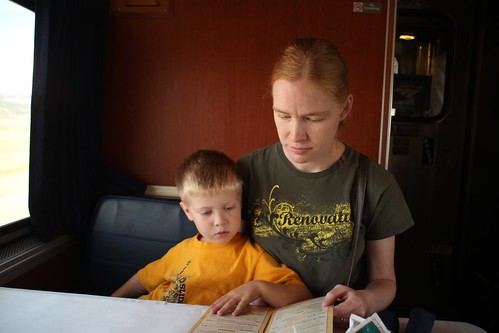
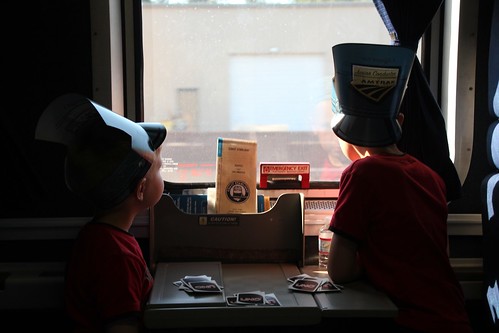
Monday morning, 1:45AM. Laura and I walk into the boys room. We turn on the light. Nothing happens. (They re sound sleepers.) Boys, it s time to get up to go get on the train! Four eyes pop open. Yay! Oh I m so excited! And then, Meow! (They enjoy playing with their stuffed cats that Laura got them for Christmas.) Before long, it was out the door to the train station. We even had time to stop at a donut shop along the way. We climbed into our family bedroom (a sleeping car room on Amtrak specifically designed for families of four), and as the train started to move, the excitement of what was going on crept in. Yes, it s 2:42AM, but these are two happy boys: 2014-08-04 02 Jacob and Oliver love trains, and this was the beginning of a 3-day train trip from Newton to Seattle that would take us through Kansas, Colorado, the Rocky Mountains of New Mexico, Arizona, Los Angeles, up the California coast, through the Cascades, and on to Seattle. Whew! Here we are later that morning before breakfast: IMG_3776 Here s our train at a station stop in La Junta, CO: IMG_3791 And at the beautiful small mountain town of Raton, NM: IMG_3805 Some of the passing scenery in New Mexico: IMG_3828 Through it all, we found many things to pass the time. I don t think anybody was bored. I took the boys exploring the train several times we d walk from one end to the other and see what all was there. There was always the dining car for our meals, the lounge car for watching the passing scenery, and on the Coast Starlight, the Pacific Parlor Car. Here we are getting ready for breakfast one morning. IMG_3830 Getting to select meals and order in the train restaurant was a big deal for the boys. IMG_3832 Laura brought one of her origami books, which even managed to pull the boys away from the passing scenery in the lounge car for quite some time. IMG_3848 Origami is serious business: IMG_3869 They had some fun wrapping themselves around my feet and challenging me to move. And were delighted when I could move even though they were trying to weight me down! IMG_3880 Several games of Uno were played, but even those sometimes couldn t compete with the passing scenery: IMG_3898 The Coast Starlight features the Pacific Parlor Car, which was built over 50 years ago for the Santa Fe Hi-Level trains. They ve been updated; the upper level is a lounge and small restaurant, and the lower level has been turned into a small theater. They show movies in there twice a day, but most of the time, the place is empty. A great place to go with little boys to run around and play games. IMG_3896 The boys and I sort of invented a new game: roadrunner and coyote, loosely based on the old Looney Tunes cartoons. Jacob and Oliver would be roadrunners, running around and yelling MEEP MEEP! Meanwhile, I was the coyote, who would try to catch them even briefly succeeding sometimes but ultimately fail in some hilarious way. It burned a lot of energy. And, of course, the parlor car was good for scenery-watching too: IMG_3908 We were right along the Pacific Ocean for several hours sometimes there would be a highway or a town between us and the beach, but usually there was nothing at all between us and the coast. It was beautiful to watch the jagged coastline go by, to gaze out onto the ocean, watching the birds apparently so beautiful that I didn t even think to take some photos. Laura s parents live in California, and took a connecting train. I had arranged for them to have a sleeping car room near ours, so for the last day of the trip, we had a group of 6. Here are the boys with their grandparents at lunch Wednesday: 2014-08-06 11 We stepped off the train in Seattle into beautiful King Street Station. P8100197 Our first day in Seattle was a quiet day of not too much. Laura s relatives live near Lake Washington, so we went out there to play. The boys enjoyed gathering black rocks along the shore. IMG_3956 We went blackberry picking after that filled up buckets for a cobbler. The next day, we rode the Seattle Monorail. The boys have been talking about this for months a kind of train they ve never been on. That was the biggest thing in their minds that they were waiting for. They got to ride in the very front, by the operator. P8080073 Nice view from up there. P8080078 We walked through the Pike Market I hadn t been in such a large and crowded place like that since I was in Guadalajara: P8080019 At the Seattle Aquarium, we all had a great time checking out all the exhibits. The please touch one was a particular hit. P8080038 Walking underneath the salmon tank was fun too. We spent a couple of days doing things closer to downtown. Laura s cousin works at MOHAI, the Museum of History and Industry, so we spent a morning there. The boys particularly enjoyed the old periscope mounted to the top of the building, and the exhibit on chocolate (of course!) P8100146 They love any kind of transportation, so of course we had to get a ride on the Seattle Streetcar that comes by MOHAI. P8090094 All weekend long, we had been noticing the seaplanes taking off from Lake Washington and Lake Union (near MOHAI). So finally I decided to investigate, and one morning while Laura was doing things with her cousin, the boys and I took a short seaplane ride from one lake to another, and then rode every method of transportation we could except for ferries (we did that the next day). Here is our Kenmore Air plane: P8100100 The view of Lake Washington from 1000 feet was beautiful: P8100109 I think we got a better view than the Space Needle, and it probably cost about the same anyhow. P8100117 After splashdown, we took the streetcar to a place where we could eat lunch right by the monorail tracks. Then we rode the monorail again. Then we caught a train (it went underground a bit so it was a subway to them!) and rode it a few blocks. There is even scenery underground, it seems. P8100151 We rode a bus back, and saved one last adventure for the next day: a ferry to Bainbridge Island. 2014-08-11 14 2014-08-11 16 Laura and I even got some time to ourselves to go have lunch at an amazing Greek restaurant to celebrate a year since we got engaged. It s amazing to think that, by now, it s only a few months until our wedding anniversary too! There are many special memories of the weekend I could mention visiting with Laura s family, watching the boys play with her uncle s pipe organ (it s in his house!), watching the boys play with their grandparents, having all six of us on the train for a day, flying paper airplanes off the balcony, enjoying the cool breeze on the ferry and the beautiful mountains behind the lake. One of my favorites is waking up to high-pitched Meow? Meow meow meow! Wake up, brother! sorts of sounds. There was so much cat-play on the trip, and it was cute to hear. I have the feeling we won t hear things like that much more. So many times on the trip I heard, Oh dad, I am so excited! I never get tired of hearing that. And, of course, I was excited, too.

24 August 2014

Noah Meyerhans: Debconf by train

Today is the first time I've taken an interstate train trip in something like 15 years. A few things about the trip were pleasantly surprising. Most of these will come as no surprise:
  1. Less time wasted in security theater at the station prior to departure.
  2. On-time departure
  3. More comfortable seats than a plane or bus.
  4. Quiet.
  5. Permissive free wifi
Wifi was the biggest surprise. Not that it existed, since we're living in the future and wifi is expected everywhere. It's IPv4 only and stuck behind a NAT, which isn't a big surprise, but it is reasonably open. There isn't any port filtering of non-web TCP ports, and even non-TCP protocols are allowed out. Even my aiccu IPv6 tunnel worked fine from the train, although I did experience some weird behavior with it. I haven't used aiccu much in quite a while, since I have a native IPv6 connection at home, but it can be convenient while travelling. I'm still trying to figure out happened today, though. The first symptoms were that, although I could ping IPv6 hosts, I could not actually log in via IMAP or ssh. Tcpdump showed all the standard symptoms of a PMTU blackhole. Small packets flow fine, large ones are dropped. The interface MTU is set to 1280, which is the minimum MTU for IPv6 and any path on the internet is expected to handle packets of at least that size. Experimentation via ping6 reveals that the largest payload size I can successfully exchange with a peer is 820 bytes. Add 8 bytes for the ICMPv6 header for 828 bytes of payload, plus 40 bytes for the IPv6 header gives an 868 byte packet, which is well under what should be the MTU for this path. I've worked around this problem with an ip6tables rule to rewrite the MSS on outgoing SYN packets to 760 bytes, which should leave 40 for the IPv6 header and 20 for any extension headers:
sudo ip6tables -t mangle -A OUTPUT -p tcp --tcp-flags SYN,RST SYN -j TCPMSS --set-mss 760
It is working well and will allow me to publish this from the train, which I'd otherwise have been unable to do. But... weird.

11 August 2014

Juliana Louback: JSCommunicator - Setup and Architecture

Preface During Google Summer of Code 2014, I got to work on the Debian WebRTC portal under the mentorship of Daniel Pocock. Now I had every intention of meticulously documenting my progress at each step of development in this blog, but I was a bit late in getting the blog up and running. I ll now be publishing a series of posts to recap all I ve done during GSoC. Better late than never. Intro JSCommunicator is a SIP communication tool developed in HTML and JavaScript. The code was designed to make integrating JSCommunicator with a website or web app as simple as possible. It s quite easy, really. However, I do think a more detailed explanation on how to set things up and a guide to the JSCommunicator architecture could be of use, particularly for those wanting to modify the code in any way. Setup To begin, please fork the JSCommunicator repo. If you are new to git, feel free to follow the steps in section Setup and Clone in this post. If you read the README file (which you always should), you ll see that JSCommunicator needs a SIP proxy that supports SIP over Websockets transport. Some options are: I didn t find a tutorial for Kamailio setup, I did find one for repro setup. And bonus, here you have a great tutorial on how to setup and configure your SIP proxy AND your TURN server. In your project s root directory, you ll see a file named config-sample.js. Make a copy of that file named config.js. The config-sample.js file has comments that are very instructive. In sum, the only thing you have to modify is the turn_servers property and the websocket property. In my case, debrtc.org was the domain registered for testing my project, so my config file has:
turn_servers: [
	  server:"turn:debrtc.org"       
],
Note that unlike the sample, I didn t set a username and password so SIP credentials will be used. Now fill in the websocket property here we use sip5060.net.
websocket:  
    servers: 'wss://ws.sip5060.net',
    connection_recovery_min_interval: 2,
    connection_recovery_max_interval: 30,
   ,
I m pretty sure you can set the connection_recovery properties to whatever you like. Everything else is optional. If you set the user property, specifically display_name and uri, that will be used to fill in the Login form and takes preference over any Remember me data. If you also set sip_auth_password, JSCommunicator will automatically log in. All the other properties are for other optional functionalities and are well explained. You ll need some third-party javascript that is not included in the JSCommunicator git repo. Namely jQuery version 1.4 or higher and ArbiterJS version 1.0. Download jQuery here and ArbiterJS here and place the .js files in your project s root directory. Do make sure that you are including the correct filename in your html file. For example, in phone-dev.shtml, a file named jquery.js is included. The file you downloaded will likely have version numbers in it s file name. So rename the downloaded file or change the content of src in your includes. This is uber trivial, but I ve made the mistake several times. You ll also need JsSIP.js which can be downloaded here. Same naming care must be taken as is the case for jQuery and ArbiterJS. The recently added Instant Messaging component and some of the new features need jQuery-UI - so far version 1.11.* is known to work. From the downloaded .zip all you need is the jquery-ui-...js file and the jquery-ui-...css file, also to be placed in the project s root directory. If you ll be using the internationalization support you ll also need jquery.i18n.properties.js. To try out JSCommunicator, deploy the website locally by copying your project directory to the apache document root directory (provided you are using apache, which is a good idea.). You ll likely have to restart your server before this works. Now the demo .shtml pages only have a header with all the necessary includes, then a Server Side Include for the body of the page, with all the JSCommunicator html. The html content is in the file jscommunicator.inc. You can enable SSI on apache, OR you can simply copy and paste the content of jscommunicator.inc into phone-dev.shmtl. Start up apache, open a browser and navigate to localhost/jscommunicator/phone-dev.shmtl and you should see: jscommunicatorRaw Actually, pending updates to JSCommunicator, you should see a brand new UI! But all the core stuff will be the same. Architecture Disclaimer: I m explaining my view of the JSCommunicator architecture, which currently may not be 100% correct. But so far it s been enough for me to make my modifications and additions to the code, so it could be of use. One I get a JSCommunicator Founding Father s stamp of approval, I ll be sure to confirm the accuracy. Now to explain how the JSCommunicator code interacts, the use of each code item is described, ignoring all the html and css which will vary according to how you choose to use JSCommunicator. I m also not going to explain jQuery which is a dependency but not specific to WebRTC. The core JSCommunicator code is the following: Each of these files will be presented in what I hope is an intuitive order. The next three files could be considered utils : These two are where the magic happens: Now for some extras: Third party code: Here s a diagram of sorts to help you visualize how the code interacts: jscommArch In sum, 1 - JSCommUI.js handles what is displayed in the UI and feeds data to JSCommManager.js; 2 - JSCommManager.js actually does stuff, feeding data to be displayed to JSCommUI.js; 3 - JSCommManager.js calls functions from the three utils , parseuri.js, webrtc-check.js and jssip-helpher.js which organizes the data from config.js; 4 - JSCommManager.js initializes a SIP User Agent based on the implementation in Arbiter.js. When making any changes to JSCommunicator, you will likely only be working with JSCommUI.js and JSCommManager.js.

Next.

Previous.