Search Results: "mak"

1 July 2024

Ben Hutchings: FOSS activity in April 2024

Sahil Dhiman: Personal ASNs From India

Internet and it s working are interesting and complex. We need an IP address to connect to the Internet. A group of IP addresses with common routing policy is known as an Autonomous System (AS). Each AS has a globally unique Autonomous System Number (ASN) and is maintained by a single entity or individual(s). Your ISP would have an ASN. IP addresses/prefixes are advertised (announced) by an AS through Border Gateway Protocol (BGP) to its peers (ASes which it connects to) to steer traffic in its direction or back. Take for example Google DNS service at 8.8.8.8 owned and operated by AS15169 Google LLC. AS15169 through BGP announcements, lets all its peers know that traffic for whole of 8.8.8.0/24 (including 8.8.8.8) prefix should be sent to them. See the following screenshot response of mtr -zt 8.8.8.8 from my system. From my Internet Service Provider (ISP), AS133982 Excitel Broadband, traffic travels to AS15169 to reach 8.8.8.8 (dns.google) and returns via the same path. This Inter-AS traffic makes the Internet tick. mtr from Excitel to Google ASes comes in different sizes and purposes. Like AS749 DoD Network Information Center which holds more than 200 million+ IPv4 addresses for historical reasons or AS23860 Alliance Broadband Services which has 68 thousand+ IPv4 address for purpose of providing consumer Internet. Similarly, some individuals also run their personal ASN including a bunch of Indians. Most of these Indian ASNs are IPv6 (primary or only) networks run for hobby and educational purposes. I was interested in this data, so complied a list of active ones (visible in the global routing table) from BGP.Tools: Let me know if I m missing someone.

Russell Coker: VoLTE in Australia

Introduction In Australia the 3G mobile frequencies are to be reused so they are in the process of shutting down the 3G service. That means that everyone has to use VoLTE (Voice Over LTE) for phone calls (including emergency calls). The shutdown time varies by telco, Kogan Mobile (one of the better services which has good value for money and generally works well) shut down their 3G service in January. Aldi Mobile (another one of the good services which is slightly more expensive but has included free calls to most first-world countries and uses the largest phone network) will shut theirs down at the end of August. For background there s a Fosdem talk about OpenSIPS with VoLTE and VoNR [1], it s more complex than you want to know. Also VoNR (Voice over New Radio) is the standard for 5G voice and it s different from VoLTE and has a fallback to VoLTE. Another good lecture for background information is the Fosdem talk on VoLTE at the handset end [2]. The PinePhonePro In October 2023 I tried using my PinePhonePro as my main phone but that only lasted a few days due to problems with calls and poor battery life [3]. Since then I went back to the Huawei Mate 10 Pro that I bought refurbished in June 2019 for $389. So that has been my main phone for 5 years now, giving a cost of $1.50 per week. I had tried using a Huawei Nova 7i running Android without Google Play as an experiment but that had failed, I do many things that need Android apps [4]. I followed the PinePhone wiki to get my PinePhonePro working with VoLTE [5]. That worked fine for me, the only difference from the instructions is that I had to use device /dev/ttyUSB3 and that the modem kept resetting itself during the process and when that happened I had to kill minicom and start again. After changing the setting and saving it the PinePhonePro seemed to work well with VoLTE on a Kogan Mobile SIM (so definitely not using 3G). One issue I have found is that Plasma Mobile (my preferred FOSS phone GUI) appears to have a library issue that results in polling every 14ms even when the screen is locked [6]. If you have a few processes doing that (which means the most lightly used Plasma system) it really hurts battery use. The maintainer has quite reasonably deferred action on this bug report given the KDE 6 transition. Later on in the Trixie development cycle I hope to get this issue resolved, I don t expect it to suddenly make battery life good. But it might make battery life acceptable. I am now idly considering carrying around my PinePhonePro in a powered off state for situations where I might need to do high security operations (root logins to servers or online banking) but for which carrying a laptop isn t convenient. It will do well for the turn on, do 30 mins of work that needs security, and then turn off scenario. Huawei Mate 10 Pro and Redmi 9A The Huawei Mate 10 Pro has been my main phone for 5 years and it has worked well, so it would be ideal if it could do VoLTE as the PinePhonePro isn t ready yet. All the web pages I ve seen about the Mate 10 Pro say that it will either allow upgrading to a VoLTE configuration if run with the right SIM or only support it with the right SIM. I did a test with a Chinese SIM which gave an option of turning on VoLTE but didn t allow any firmware updates and the VoLTE option went away when I put an Australian SIM in. Some forum comments had led me to believe that it would either permanently enable VoLTE or allow upgrading the firmware to one that enables VoLTE if I used a Chinese SIM but that is not the case. I didn t expect a high probability of success but I had to give it a go as it s a nice phone. I did some tests on a Redmi 9A (a terrible phone that has really bad latency on the UI in spite of having reasonably good hardware). The one I tested on didn t have VoLTE enabled when I got it, to test that I used the code *#*#4636#*#* in the dialler to get the menu of SIM information and it showed that VoLTE was not provisioned. I then had to update to the latest release of Android for that phone and enter *#*#86583#*#* in the dialler to enable VoLTE, the message displayed after entering that magic number must end in DISABLE . I get the impression that the code in question makes the phone not check certain aspects of whether the carrier is good for VoLTE and just do it. So apparently Kogan Mobile somehow gives the Redmi 9A the impression that VoLTE isn t supported but if the phone just goes ahead and connects it will work. I don t plan to use a Redmi 9A myself as it s too slow, but I added it to my collection to offer to anyone else I know who needs a phone with VoLTE and doesn t use the phone seriously or to someone who needs a known good phone for testing things. Samsung Galaxy Note 9 I got some Samsung Galaxy Note 9 phones to run Droidian as an experiment [7]. But Droidian dropped support for the Note 9 and I couldn t figure out how to enable VoLTE via Droidian, which was very annoying after I had spent $109 on a test phone and $215 on a phone for real use (I have no plans to try Droidian again at this time). I tried installing LineageOS on one Note 9 [8] which was much easier than expected (especially after previously installing Droidian). But VoLTE wasn t an option. According to Reddit LineageOS doesn t support VoLTE on Samsung devices and you can use a magisk module or a VoLTE enabler module but those aren t supported by LineageOS either [9]. I downloaded an original image for the Note 9 from SamsMobile.com [10]. That image booted past the orange stage (where if you have problems then your phone is probably permanently useless) but didn t boot into the OS. A friend helped me out with that and it turned out that the Heimdal flash tool on Linux didn t do something it needed to do and that Odin on Windows was required. After using Odin everything was fine and I have a Note 9 with VoLTE running the latest Samsung firmware which is security patch level 1st July 2022!!! So I have a choice between using a Note 9 for data and SMS while running a current version of Lineage OS with all security fixes or running a Samsung image with no security updates for 2 years which supports phone calls. So based on this I have to recommend Pixel as the phone of choice, it has a decent level of support from Google and long term support from LineageOS. According to the LineageOS web site you can run the current version of Lineage on the original Pixel phone from 2016! Of course getting VoLTE to work on it might be another saga, but it would probably be easier to do with LineageOS on a Pixel than on a Samsung phone. Conclusion The operation of the Note 9 for me is decent now apart from the potential security issues. The same goes for selling one of the phones. The PinePhonePro still has potential to become my daily driver at some future time if I and others can optimise power use. Also a complicating factor is that I want to have both Jabber and Matrix be actually instant IM systems not IM with a 5 minute delay, so suspend mode isn t a good option. Pixel phones will be a much higher priority when looking at phones to buy in future. The older Pixel phones go for as little as $100 on eBay and can still run the latest LineageOS. VoLTE seems needlessly complicated.

Niels Thykier: Debian packaging with style black

When I started working on the language server for debputy, one of several reasons was about automatic applying a formatting style. Such that you would not have to remember to manually reformat the file. One of the problems with supporting automatic formatting is that no one agrees on the "one true style". To make this concrete, Johannes Schauer Marin Rodrigues did the numbers of which wrap-and-sort option that are most common in https://bugs.debian.org/895570#46. Unsurprising, we end up with 14-15 different styles with various degrees of popularity. To make matters worse, wrap-and-sort does not provide a way to declare "this package uses options -sat". So that begged the question, how would debputy know which style it should use when it was going to reformat file. After a couple of false-starts, Christian Hofstaedtler mentioned that we could just have a field in debian/control for supporting a "per-package" setting in responds to my concern about adding a new "per-package" config file. At first, I was not happy with it, because how would you specify all of these options in a field (in a decent manner)? But then I realized that one I do not want all these styles and that I could start simpler. The Python code formatter black is quite successful despite not having a lot of personalized style options. In fact, black makes a statement out of not allowing a lot of different styles. Combing that, the result was X-Style: black (to be added to the Source stanza of debian/control), which every possible reference to the black tool for how styling would work. Namely, you outsource the style management to the tool (debputy) and then start using your focus on something else than discussing styles. As with black, this packaging formatting style is going to be opinionated and it will evolve over time. At the starting point, it is similar to wrap-and-sort -sat for the deb822 files (debputy does not reformat other files at the moment). But as mentioned, it will likely evolve and possible diverge from wrap-and-sort over time. The choice of the starting point was based on the numbers posted by Johannes #895570. It was not my personal favorite but it seemed to have a majority and is also close to the one suggested by salsa pipeline maintainers. The delta being -kb which I had originally but removed in 0.1.34 at request of Otto Kek l inen after reviewing the numbers from Johannes one more time. To facilitate this new change, I uploaded debputy/0.1.30 (a while back) to Debian unstable with the following changes:
  • Support for the X-Style: black header.
  • When a style is defined, the debputy lsp server command will now automatically reformat deb822 files on save (if the editor supports it) or on explicit "reformat file" request from the editor (usually indirectly from the user).
  • New subcommand debputy reformat command that will reformat the files, when a style is defined.
  • A new pre-commit hook repo to run debputy lint and debputy reformat. These hooks are available from https://salsa.debian.org/debian/debputy-pre-commit-hooks version v0.1 and can be used with the pre-commit tool (from the package of same name).
The obvious omission is a salsa-pipeline feature for this. Otto has put that on to his personal todo list and I am looking forward to that.
Beyond black Another thing I dislike about our existing style tooling is that if you run wrap-and-sort without any arguments, you have a higher probability of "trashing" the style of the current package than getting the desired result. Part of this is because wrap-and-sort's defaults are out of sync with the usage (which is basically what https://bugs.debian.org/895570 is about). But I see another problem. The wrap-and-sort tool explicitly defined options to tweak the style but provided maintainers no way to record their preference in any machine readable way. The net result is that we have tons of diverging styles and that you (as a user of wrap-and-sort) have to manually tell wrap-and-sort which style you want every time you run the tool. In my opinion that is not playing to the strengths of neither human nor machine. Rather, it is playing to the weaknesses of the human if anything at all. But the salsa-CI pipeline people also ran into this issue and decided to work around this deficiency. To use wrap-and-sort in the salsa-CI pipeline, you have to set a variable to activate the job and another variable with the actual options you want. The salsa-CI pipeline is quite machine readable and wrap-and-sort is widely used. I had debputy reformat also check for the salsa-CI variables as a fallback. This fallback also works for the editor mode (debputy lsp server), so you might not even have to run debputy reformat. :) This was a deliberate trade-off. While I do not want all us to have all these options, I also want Debian packaging to be less painful and have fewer paper cuts. Having debputy go extra lengths to meet wrap-and-sort users where they are came out as the better solution for me. A nice side-effect of this trade-off is that debputy reformat now a good tool for drive-by contributors. You can safely run debputy reformat on any package and either it will apply the styling or it will back out and inform you that no obvious style was detected. In the latter case, you would have to fallback to manually deducing the style and applying it.
Differences to wrap-and-sort The debputy reformat has some limitations or known differences to wrap-and-sort. Notably, debputy reformat (nor debputy lsp server) will not invoke wrap-and-sort. Instead, debputy has its own reformatting engine that provides similar features. One reason for not running wrap-and-sort is that I want debputy reformat to match the style that debputy lsp server will give you. That way, you get consistent style across all debputy commands. Another reason is that it is important to me that reformatting is safe and does not change semantics. This leads to two regrettable known differences to the wrap-and-sort behavior due to safety in addition to one scope limitation in debputy:
  1. debputy will ignore requests to sort the stanzas when the "keep first" option is disabled (-b --no-keep-first). This combination is unsafe reformatting. I feel it was a mistake for wrap-and-sort to ever allow this but at least it is no longer the default (-b is now -bk by default). This will be less of a problem in debhelper-compat 15, since the concept of "main package" will disappear and all multi-binary source packages will be required to use debian/package.install rather than debian/install.
  2. debputy will not reorder the contents of debhelper packaging files such as debian/install. This is also an (theoretical) unsafe thing to do. While the average package will not experience issues with this, there are rare corner cases where the re-ordering can affect the end result. I happen to know this, because I ran into issues when trying to optimize dh_install in a way that assumed the order did not matter. Stuff broke and there is now special-case code in dh_install to back out of that optimization when that happens.
  3. debputy has a limited list of wrap-and-sort options it understands. Some options may cause debputy to back out and disable reformatting entirely with a remark that it cannot apply that style. If you run into a case of this, feel free to file a feature request to support it. I will not promise to support everything, but if it is safe and trivially doable with the engine already, then I probably will.
As stated, where debputy cannot implement the wrap-and-sort styles fully, then it will currently implement a subset that is safe if that can be identified or back out entirely of the formatting when it cannot. In all cases, debputy will not break the formatting if it is correct. It may just fail at correcting one aspect of the wrap-and-sort style if you happen to get it wrong. It is also important to remember that the prerequisite for debputy applying any wrap-and-sort style is that you have set the salsa-CI pipeline variables to trigger wrap-and-sort with the salsa-CI pipeline. So there is still a CI check before the merge that will run the wrap-and-sort in its full glory that provides the final safety net for you.
Just give me a style In conclusion, if you, like me, are more interested in getting a consistent style rather than discussing what that style should be, now you can get that with X-Style: black. You can also have your custom wrap-and-sort style be picked up automatically for drive-by contributors.
$ apt satisfy 'dh-debputy (>= 0.1.30), python3-lsprotocol'
# Add  X-Style: black  to  debian/control  for "just give me a style"
#
# OR, if there is a specific  wrap-and-sort  style for you then set
# SALSA_CI_DISABLE_WRAP_AND_SORT=no plus set relevant options in
# SALSA_CI_WRAP_AND_SORT_ARGS in debian/salsa-ci.yml (or .gitlab-ci.yml)
$ debputy reformat
It is sadly not yet in the salsa-ci pipeline. Otto is looking into that and hopefully we will have it soon. :) And if you find yourself often doing archive-wide contributions and is tired of having to reverse engineer package formatting styles, consider using debputy reformat or debputy lsp server. If you use debputy in this way, please consider providing feedback on what would help you.

Guido G nther: Free Software Activities June 2024

A short status update of what happened on my side last month. Was able to test our Cellbroadcast bits, feedbackd became more flexible regarding LEDs, Phosh 0.40 is out, and some more. Phosh Phoc gmobile phosh-mobile-settings phosh-wallpapers emacs Debian ModemManager Feedbackd Livi Calls Chatty meta-phosh Libhandy If you want to support my work see donations.

30 June 2024

Joachim Breitner: Do surprises get larger?

The setup Imagine you are living on a riverbank. Every now and then, the river swells and you have high water. The first few times this may come as a surprise, but soon you learn that such floods are a recurring occurrence at that river, and you make suitable preparation. Let s say you feel well-prepared against any flood that is no higher than the highest one observed so far. The more floods you have seen, the higher that mark is, and the better prepared you are. But of course, eventually a higher flood will occur that surprises you. Of course such new record floods are happening rarer and rarer as you have seen more of them. I was wondering though: By how much do the new records exceed the previous high mark? Does this excess decrease or increase over time? A priori both could be. When the high mark is already rather high, maybe new record floods will just barley pass that mark? Or maybe, simply because new records are so rare events, when they do occur, they can be surprisingly bad? This post is a leisurely mathematical investigating of this question, which of course isn t restricted to high waters; it could be anything that produces a measurement repeatedly and (mostly) independently weather events, sport results, dice rolls. The answer of course depends on the distribution of results: How likely is each possible results.

Dice are simple With dice rolls the answer is rather simple. Let our measurement be how often you can roll a die until it shows a 6. This simple game we can repeat many times, and keep track of our record. Let s say the record happens to be 7 rolls. If in the next run we roll the die 7 times, and it still does not show a 6, then we know that we have broken the record, and every further roll increases by how much we beat the old record. But note that how often we will now roll the die is completely independent of what happened before! So for this game the answer is: The excess with which the record is broken is always the same. Mathematically speaking this is because the distribution of rolls until the die shows a 6 is memoryless. Such distributions are rather special, its essentially just the example we gave (a geometric distribution), or its continuous analogue (the exponential distributions, for example the time until a radioactive particle decays).

Mathematical formulation With this out of the way, let us look at some other distributions, and for that, introduce some mathematical notations. Let X be a random variable with probability density function (x) and cumulative distribution function (x), and a be the previous record. We are interested in the behavior of Y(a) = X a X > x i.e. by how much X exceeds a under the condition that it did exceed a. How does Y change as a increases? In particular, how does the expected value of the excess e(a) = E(Y(a)) change?

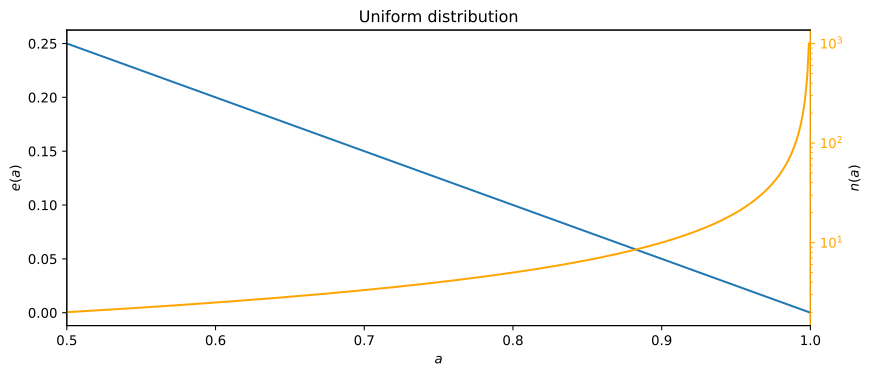
Uniform distribution If X is uniformly distributed between, say, 0 and 1, then a new record will appear uniformly distributed between a and 1, and as that range gets smaller, the excess must get smaller as well. More precisely, e(a) = E(X a X > a) = E(X X > a) a = (1 a)/2 This not very interesting linear line is plotted in blue in this diagram:
The expected record surpass for the uniform distribution The expected record surpass for the uniform distribution
The orange line with the logarithmic scale on the right tries to convey how unlikely it is to surpass the record value a: it shows how many attempts we expect before the record is broken. This can be calculated by n(a) = 1/(1 (a)).

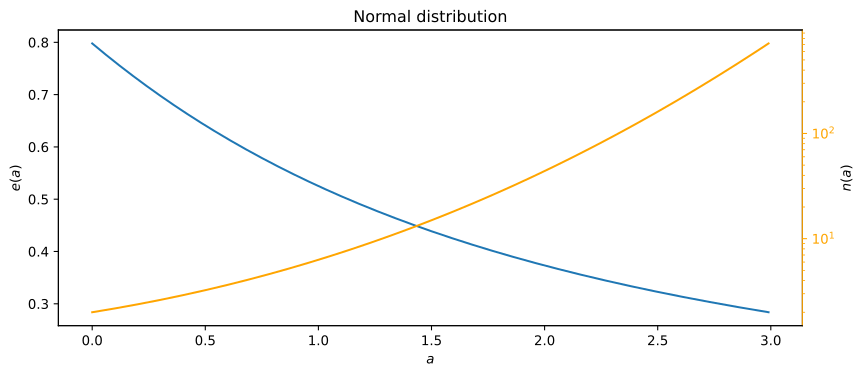
Normal distribution For the normal distribution (with median 0 and standard derivation 1, to keep things simple), we can look up the expected value of the one-sided truncated normal distribution and obtain e(a) = E(X X > a) a = (a)/(1 (a)) a Now is this growing or shrinking? We can plot this an have a quick look:
The expected record surpass for the normal distribution The expected record surpass for the normal distribution
Indeed it is, too, a decreasing function! (As a sanity check we can see that e(0) = (2/ ), which is the expected value of the half-normal distribution, as it should.)

Could it be any different? This settles my question: It seems that each new surprisingly high water will tend to be less surprising than the previously assuming high waters were uniformly or normally distributed, which is unlikely to be helpful. This does raise the question, though, if there are probability distributions for which e(a) is be increasing? I can try to construct one, and because it s a bit easier, I ll consider a discrete distribution on the positive natural numbers, and consider at g(0) = E(X) and g(1) = E(X 1 X > 1). What does it take for g(1) > g(0)? Using E(X) = p + (1 p)E(X X > 1) for p = P(X = 1) we find that in order to have g(1) > g(0), we need E(X) > 1/p. This is plausible because we get equality when E(X) = 1/p, as it precisely the case for the geometric distribution. And it is also plausible that it helps if p is large (so that the next first record is likely just 1) and if, nevertheless, E(X) is large (so that if we do get an outcome other than 1, it s much larger). Starting with the geometric distribution, where P(X > n X n) = pn = p (the probability of again not rolling a six) is constant, it seems that these pn is increasing, we get the desired behavior. So let p1 < p2 < pn < be an increasing sequence of probabilities, and define X so that P(X = n) = p1 pn 1 (1 pn) (imagine the die wears off and the more often you roll it, the less likely it shows a 6). Then for this variation of the game, every new record tends to exceed the previous more than previous records. As the p increase, we get a flatter long end in the probability distribution.

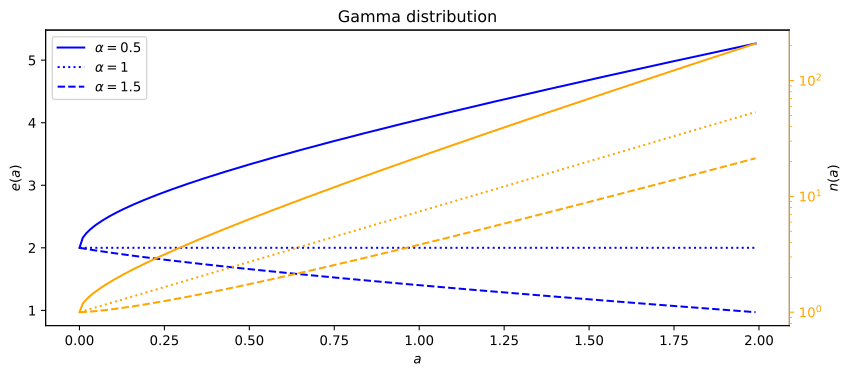
Gamma distribution To get a nice plot, I ll take the intuition from this and turn to continuous distributions. The Wikipedia page for the exponential distribution says it is a special case of the gamma distribution, which has an additional shape parameter , and it seems that it could influence the shape of the distribution to be and make the probability distribution have a longer end. Let s play around with = 2 and = 0.5, 1 and 1.5:
The expected record surpass for the gamma distribution The expected record surpass for the gamma distribution
  • For = 1 (dotted) this should just be the exponential distribution, and we see that e(a) is flat, as predicted earlier.
  • For larger (dashed) the graph does not look much different from the one for the normal distribution not a surprise, as for , the gamma distribution turns into the normal distribution.
  • For smaller (solid) we get the desired effect: e(a) is increasing. This means that new records tend to break records more impressively.
The orange line shows that this comes at a cost: for a given old record a, new records are harder to come by with smaller .

Conclusion As usual, it all depends on the distribution. Otherwise, not much, it s late.

29 June 2024

Russ Allbery: Review: Bitter Angels

Review: Bitter Angels, by C.L. Anderson
Publisher: Ballantine Books
Copyright: 2009
ISBN: 0-553-59217-3
Format: Mass market
Pages: 438
Bitter Angels is a stand-alone science fiction novel. It won the Philip K. Dick award for best SF original paperback in 2010. C.L. Anderson is a pen name for Sarah Zettel. Terese was a Guardian, one of the agents of the Pax Solaris who find ways to keep the peace in troubled systems and high-stress situations with the help of an implanted Companion, an assistant AI. Forty years ago, on one of those missions, she was captured and her Companion was forcibly removed. She was rescued by her friend and mentor and retired afterwards, starting a new life and a new family, trying to leave the memories behind. Now, the woman who rescued her is dead. She was murdered on duty in the Erasmus system, a corporate hellhole that appears to be on the verge of exploding into a political hot spot. Bianca's last instructions asked for Terese to replace her. Terese's family is furious at her for even considering returning to the Guardians, but she can't say no. Duty, and Bianca's dying request, call too strongly. Amerand is Security on Dazzle, one of the Erasmus stations. He is one of the refugees from Oblivion, the station that the First Bloods who rule the system let die. He keeps his head above water and tries to protect his father and find his mother without doing anything that the ever-present Clerks might find concerning. Keeping an eye on newly-arriving Solaris saints is a typical assignment, since the First Bloods don't trust the meddling do-gooders. But something is not quite right, and a cryptic warning from his Clerk makes him even more suspicious. This is the second book by Sarah Zettel that I've read, and both of them have been tense, claustrophobic thrillers set in a world with harsh social inequality and little space for the characters to maneuver. In this case, the structure of her future universe reminded me a bit of Iain M. Banks's Culture, but with less advanced technology and only humans. The Pax Solaris has eliminated war within its borders and greatly extended lifespans. That peace is maintained by Guardians, who play a role similar to Special Circumstances but a bit more idealist and less lethal. They show up where there are problems and meddle, manipulating and pushing to try to defuse the problems before they reach the Pax Solaris. Like a Culture novel, nearly all of the action takes place outside the Pax Solaris in the Erasmus system. Erasmus is a corporate colony that has turned into a cross between a hereditary dictatorship and the Corporate Rim from Martha Wells's Murderbot series. Debt slavery is ubiquitous, economic inequality is inconceivably vast, and the Clerks are everywhere. Erasmus natives like Amerand have very little leeway and even fewer options. Survival is a matter of not drawing the attention of the wrong people. Terese and her fellow Guardians are appalled, but also keenly aware that destabilizing the local politics may make the situation even worse and get a lot of people killed. Bitter Angels is structured like a mystery: who killed Bianca, and what was her plan when she was killed? Unlike a lot of books of this type, the villains are not idiots and their plan is both satisfyingly complex and still depressingly relevant. I don't think I'm giving anything away by saying that I have read recent news articles about people with very similar plans, albeit involving less science-fiction technology. Anderson starts with a tense situation and increases the pressure relentlessly, leaving the heroes one step behind the villains for almost the entire novel. It is not happy or optimistic reading at times, the book is quite dark but it certainly was engrossing. The one world-building quibble that I had is that the Erasmus system is portrayed partly as a hydraulic empire, and while this is arguably feasible given that spaceship travel is strictly controlled, it seemed like a weird choice given the prevalence of water on the nearby moons. Water smuggling plays a significant role in the plot, and I wasn't entirely convinced of the politics and logistics behind it. If this sort of thing bugs you, there are some pieces that may require suspension of disbelief. Bitter Angels is the sort of tense thriller where catastrophe is barely avoided and the cost of victory is too high, so you will want to be in the mood for that before you dive in. But if that's what you're looking for, I thought Anderson delivered a complex and satisfying story. Content warning: major character suicide. Rating: 7 out of 10

27 June 2024

Jonathan McDowell: Sorting out backup internet #4: IPv6

The final piece of my 5G (well, 4G) based based backup internet connection I needed to sort out was IPv6. While Three do support IPv6 in their network they only seem to enable it for certain devices, and the MC7010 is not one of those devices, even though it also supports IPv6. I use v6 a lot - over 50% of my external traffic, last time I looked. One suggested option was that I could drop the IPv6 Router Advertisements when the main external link went down, but I have a number of internal services that are only presented on v6 addresses so I needed to ensure clients in the house continued to have access to those. As it happens I ve used the Hurricane Electric IPv6 Tunnel Broker in the past, so my pass was re-instating that. The 5G link has a real external IPv4 address, and it s possible to update the endpoint using a simple HTTP GET. I added the following to my /etc/dhcp/dhclient-exit-hooks.d/modem-interface-route where we are dealing with an interface IP change:
# Update IPv6 tunnel with Hurricane Electric
curl --interface $interface 'https://username:password@ipv4.tunnelbroker.net/nic/update?hostname=1234'
I needed some additional configuration to bring things up, so /etc/network/interfaces got the following, configuring the 6in4 tunnel as well as the low preference default route, and source routing via the 5g table, similar to IPv4:
pre-up ip tunnel add he-ipv6 mode sit remote 216.66.80.26
pre-up ip link set he-ipv6 up
pre-up ip addr add 2001:db8:1234::2/64 dev he-ipv6
pre-up ip -6 rule add from 2001:db8:1234::/64 lookup 5g
pre-up ip -6 route add default dev he-ipv6 table 5g
pre-up ip -6 route add default dev he-ipv6 metric 1000
post-down ip tunnel del he-ipv6
We need to deal with IPv4 changes in for the tunnel endpoint, so modem-interface-route also got:
ip tunnel change he-ipv6 local $new_ip_address
/etc/nftables.conf had to be taught to accept the 6in4 packets from the tunnel in the input chain:
# Allow HE tunnel
iifname "sfp.31" ip protocol 41 ip saddr 216.66.80.26 accept
Finally, I had to engage in something I never thought I d deal with; IPv6 NAT. HE provide a /48, and my FTTP ISP provides me with a /56, so this meant I could do a nice stateless 1:1 mapping:
table ip6 nat  
  chain postrouting  
    type nat hook postrouting priority 0
    oifname "he-ipv6" snat ip6 prefix to ip6 saddr map   2001:db8:f00d::/56 : 2001:db8:666::/56  
   
 
This works. Mostly. The problem is that HE, not unreasonably, expect your IPv4 address to be pingable. And it turns out Three have some ranges that this works on, and some that it doesn t. Which means it s a bit hit and miss whether you can setup the tunnel. I spent a while trying to find an alternative free IPv6 tunnel provider with a UK endpoint. There s less call for them these days, so I didn t manage to find any that actually worked (or didn t have a similar pingable requirement). I did consider whether I wanted to end up with routes via a VM, as I described in the failover post, but looking at costings for VMs with providers who could actually give me an IPv6 range I decided the cost didn t make it worthwhile; the VM cost ended up being more than the backup SIM is costing monthly. Finally, it turns out happy eyeballs mostly means that when the 5G ends up on an IP that we can t setup the IPv6 tunnel on, things still mostly work. Browser usage fails over quickly and it s mostly my own SSH use that needs me to force IPv4. Purists will groan, but this turns out to be an acceptable trade-off for me, at present. Perhaps if I was seeing frequent failures the diverse routes approach to a VM would start to make sense, but for now I m pretty happy with the configuration in terms of having a mostly automatic backup link take over when the main link goes down.

Russ Allbery: Review: Lyorn

Review: Lyorn, by Steven Brust
Series: Vlad Taltos #17
Publisher: Tor
Copyright: 2024
ISBN: 1-4668-8971-3
Format: Kindle
Pages: 274
Lyorn is the 17th Vlad Taltos book and a direct sequel to 2014's Hawk. (Yes, actual main story progress!) You do not want to start reading here; you would be hopelessly confused. When this series is complete, I want to re-read the entire thing from the beginning and pick up more of the bits I missed the first time. Vlad is not, in fact, free to see his friends and get entangled in imperial politics again as I thought after Hawk. Despite the successes of that story, there is one remaining small problem: incredibly powerful magic users still want to kill him. His immediate solution is to shelter in a theater, since Draegaran theaters are well-known for their excellent magical shielding. This works well enough at first, but the theater is rehearsing a play about Draegaran politics that is highly offensive to the Lyorn and the theater may be shut down because of it. Vlad's enemies are also willing to lean on his friends to find him and kill him. This series continues to be thoroughly enjoyable. Lyorn is "just" more of Vlad being Vlad, meddling in everyone's business and coming up with elaborate plans with too many moving parts that he somehow manages to pull off, but I'll happily read lots of books like that. Vlad is both anxious and grumpy, both of which give the plot some needed tension without being overwhelming. There are no truly major world-building revelations here (or, if there are, I missed them), but there's a lot of processing of what the reader learned in Tsalmoth. It's increasingly looking like the payoff from those revelations is going to be the series finale. This is the first Vlad book that contains solid confirmation of where the series as a whole is headed. Brust mentioned some time ago that the last book is titled The Last Contract, and Lyorn comes close to stating explicitly what that contract will be. I am sure that it will be more complicated than it appears now and there are misdirections yet to come, but I am excited to see where Brust takes this idea. Vlad has been insistently apolitical for much of the series, meddling in politics only when he has to or to help his friends and otherwise treating it as a system that he has to navigate and survive. That was the root of the conflict in Teckla, all the way back at the start of the series. This may be starting to change, and when Brust ties it together with the Jenoine, the Great Weapon Godslayer, and the rest of the world-building he's cued up, the results are going to be explosive. Two books left: Chreotha and The Last Contract. I can hardly wait. In every Vlad book, Brust plays some sort of structural game. This time, befitting the setting, it's a musical. The action is interspersed with quotes from a fictional history about the play the theater is putting on, a work called Song of the Presses about political censorship during the reign of a Lyorn emperor in the 14th cycle, thousands of years before the time of this book. This was, at times, nearly as interesting as the main plot. The chapters are also numbered like the acts and scenes of a play, although this I didn't notice as much since books often have that structure anyway. Since this is a musical, there are also songs. Specifically, each chapter is introduced by a parody of songs from various musicals in our world, rewritten so that they fit within Brust's fictional musical. Brust is also a musician and a filker, so these songs are actually good, or at least they amused me a great deal. I'm not much of a musical fan and I still could hear the tune playing when I read most of them. Lyorn is not so good that I would rave about it. It's one of those functional connective books of a series that advances the plot, tells a good story, and has some fun along the way. The guns on the mantelpiece of this world have not gone off yet, and Vlad is still maneuvering into position. But it's looking like we're going to get the conclusion, and it's going to be spectacular. If you have read this far, you will want to keep reading. Followed by Chreotha, which may be a bit of a wait because apparently Brust is going to write The Last Contract first to make sure he ties up loose ends properly. Rating: 7 out of 10

24 June 2024

Dirk Eddelbuettel: x13binary 1.1.61 on CRAN: Maintenance

The x13binary team is thrilled to share the availability of Release 1.1.61 of the x13binary package providing the X-13ARIMA-SEATS program by the US Census Bureau which arrived on CRAN earlier today. This release brings two updates suggested by the tireless CRAN maintainers. Kurt Hornik suggested to now also ignore stderr when calling the x13 binary via system: it appears that builds under the new-ish and clang-based flang-new now emit on stderr even if Fortran-based binaries did not before. So we adjust. And Brian Ripley pointed out that our Makefile for creating the x13 binary was not quite as is should be, which we adjusted. And I just realized I should have named this 1.1.60-2 to follow the upstream convention but didn t. Next time. Courtesy of my CRANberries, there is also a diffstat report for this release showing changes to the previous release. If you like this or other open-source work I do, you can sponsor me at GitHub.

This post by Dirk Eddelbuettel originated on his Thinking inside the box blog. Please report excessive re-aggregation in third-party for-profit settings.

23 June 2024

Sahil Dhiman: How I Write Blogs - June 2024 Edition

I wrote about my blog writing methodology back April 2021. My writing method has undergone a significant shift now, so thought about writing this update. New blog topics are added to my note-taking app quite frequently now. Occasionally going through the list, I merge topics, change order to prioritize certain topics or purely drop ideas which seems not worth a write-up. Due to this, I have the liberty to work on blogs according to mood. Writing the last one was tiring, so I chose to work on an easy one, i.e. this blog now. Topic decided, everything starts on etherpad now. Etherpad has this nice font and sync feature, which helps me write from any device of choice. Actual writing usually happens in the morning, right after I wake up. For most topics, I quickly jot down pointers and keep on expanding them over the course of multiple days at a leisurely pace. Though, sometime it adds too many pieces in the puzzle and takes additional time to put everything in flow. New pointer addition keeps on happening along with writing. Nowadays, pictures too dot my blog, which I rarely use to do earlier. I have come to believe on less usage of external links. These breaks the flow of readers. If someone is sufficiently motivated to learn more about something, finding useful sources isn t. As the first draft comes into being, I run it through LanguageTool for spelling corrections (which typically are many) and fixing grammatical issues. Post that, for the first time I read the complete write-up in one go for formation of coherent storyline, moving paragraphs around for form a structure , adding explainers wherever something new or unexplained is introduced, removing elaborate sentences, making amends wherever required and moving paragraphs around for forming structure. Another round of LanguageTool follows. All set now, I try to space out my final read before publishing, which helps find additional mistakes or loopholes. When everything is set, I do hugo to generate the site and rsync everything to the web server. A final git sync closes the publication part. After a day or two, I come back to read the blog on the website. This entails another round finding and fixing trivial mistakes. After this, it s set for good. Nowadays, in addition to being on my blog, everything is syndicated on Planet FSCI and Planet Debian, which has given it more visibility. As someone who s into infrastructure and Internet as a lot, I do pay attention to logs on my server, but as a disconnected exercise to if the blog is being read or not. More hits on the blog doesn t translate to any gratification for me, at least for writers point of view. Occasionally, people do mention my blog, which does flatter me. Four years and nearly a hundred posts later, I still wonder how I kept on writing for this long.

19 June 2024

Sahil Dhiman: First Iteration of My Free Software Mirror

As I m gearing towards setting up a Free Software download mirror in India, it occurred to me that I haven t chronicled the work and motivation behind setting up the original mirror in the first place. Also, seems like it would be good to document stuff here for observing the progression, as the mirror is going multi-country now. Right now, my existing mirror i.e., mirrors.de.sahilister.net (was mirrors.sahilister.in), is hosted in Germany and serves traffic for Termux, NomadBSD, Blender, BlendOS and GIMP. For a while in between, it hosted OSMC project mirror as well. To explain what is a Free Software download mirror thing is first, I ll quote myself from work blog -
As most Free Software doesn t have commercial backing and require heavy downloads, the concept of software download mirrors helps take the traffic load off of the primary server, leading to geographical redundancy, higher availability and faster download in general.
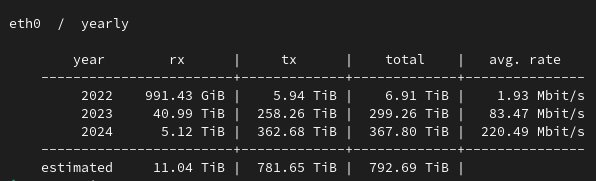
So whenever someone wants to download a particular (mirrored) software and click download, upstream redirects the download to one of the mirror server which is geographical (or in other parameters) nearby to the user, leading to faster downloads and load sharing amongst all mirrors. Since the time I got into Linux and servers, I always wanted to help the community somehow, and mirroring seemed to be the most obvious thing. India seems to be a country which has traditionally seen less number of public download mirrors. IITB, TiFR, and some of the public institutions used to host them for popular Linux and Free Softwares, but they seem to be diminishing these days. In the last months of 2021, I started using Termux and saw that it had only a few mirrors (back then). I tried getting a high capacity, high bandwidth node in budget but it was hard in India in 2021-22. So after much deliberation, I decided to go where it s available and chose a German hosting provider with the thought of adding India node when conditions are favorable (thankfully that happened, and India node is live too now.). Termux required only 29 GB of storage, so went ahead and started mirroring it. I raised this issue in Termux s GitHub repository in January 2022. This blog post chronicles the start of the mirror. Termux has high request counts from a mirror point of view. Each Termux client, usually checks every mirror in selected group for availability before randomly selecting one for download (only other case is when client has explicitly selected a single mirror using termux-repo-change). The mirror started getting thousands of requests daily due to this but only a small percentage would actually get my mirror in selection, so download traffic was lower. Similar thing happened with OSMC too (which I started mirroring later). With this start, I started exploring various project that would be benefit from additional mirrors. Public information from Academic Computer Club in Ume s mirror and Freedif s mirror stats helped to figure out storage and bandwidth requirements for potential projects. Fun fact, Academic Computer Club in Ume (which is one of the prominent Debian, Ubuntu etc.) mirror, now has 200 Gbits/s uplink to the internet through SUNET. Later, I migrated to a different provider for better speeds and added LibreSpeed test on the mirror server. Those were fun times. Between OSMC, Termux and LibreSpeed, I was getting almost 1.2 millions hits/day on the server at its peak, crossing for the first time a TB/day traffic number. Next came Blender, which took the longest time to set up of around 9 10 months. Blender had a push-trigger requirement for rsync from upstream that took quite some back and forth. It now contributes the most amount of traffic on the mirror. On release days, mirror does more than 3 TB/day and normal days, it hovers around 2 TB/day. Gimp project is the latest addition. At one time, the mirror traffic touched 4.97 TB/day traffic number. That s when I decided on dropping LibreSpeed server to solely focus on mirroring for now, keeping the bandwidth allotment for serving downloads only. The mirror projects selection grew organically. I used to reach out many projects discussing the need of for additional mirrors. Some projects outright denied mirroring request as Germany already has a good academic mirrors boosting 20-25 Gbits/s speeds from FTP era, which seems fair. Finding the niche was essential to only add softwares, which would truly benefit from additional capacity. There were months when nothing much would happen with the mirror, rsync would continue to update the mirror while nginx would keep on serving the traffic. Nowadays, the mirror pushes around 70 TB/month. I occasionally check logs, vnstat, add new security stuff here and there and pay the bills. It now saturates the Gigabit link sometimes and goes beyond that, peaking around 1.42 Gbits/s (the hosting provider seems to be upping their game). The plan is to upgrade the link to better speeds. vnstat yearly
Yearly traffic stats (through vnstat -y )
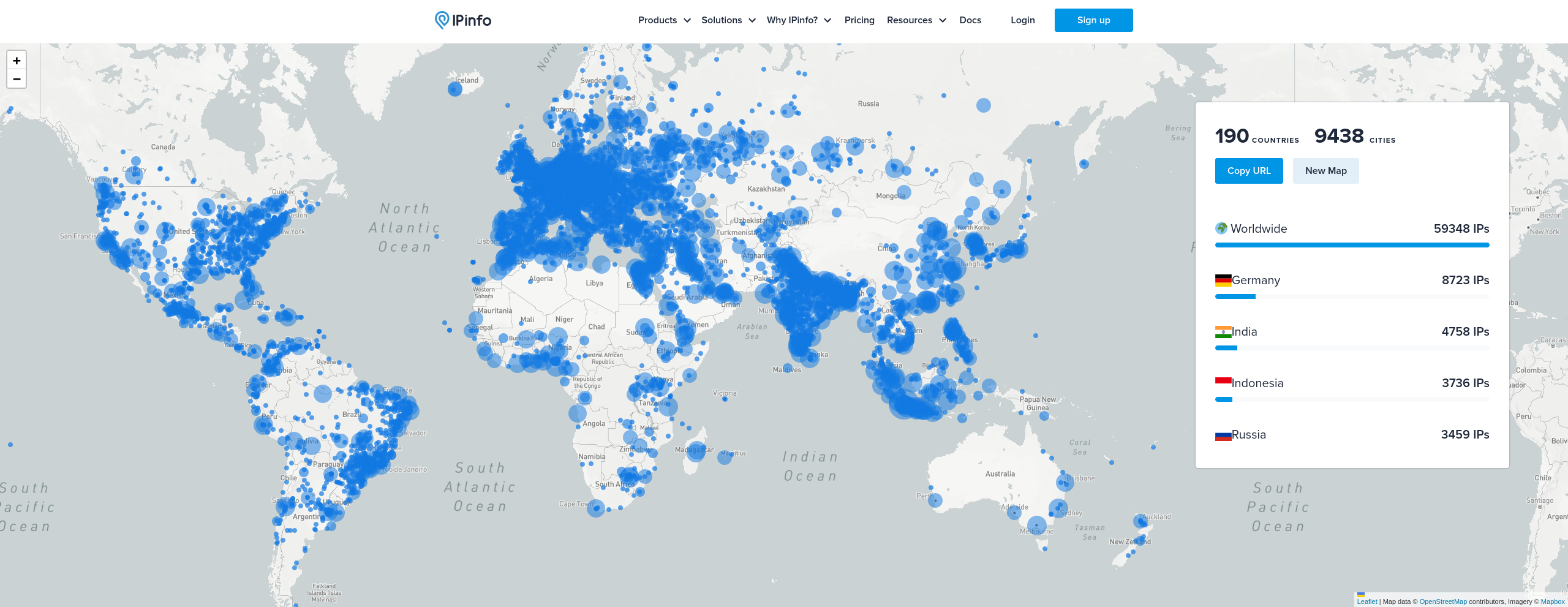
On the way, learned quite a few things like - GeoIP Map of Clients from Yesterday Access Logs
GeoIP Map of Clients from Yesterday's Access Logs. Click to enlarge
Generated from IPinfo.io
In hindsight, the statistics look amazing, hundreds of TBs of traffic served from the mirror, month after month. That does show that there s still an appetite for public mirrors in time of commercially donated CDNs and GitHub. The world could have done with one less mirror, but it saved some time, lessened the burden for others, while providing redundancy and traffic localization with one additional mirror. And it s fun for someone like me who s into infrastructure that powers the Internet. Now, I ll try focusing and expanding the India mirror, which in itself started pushing almost half a TB/day. Long live Free Software and public download mirrors.

14 June 2024

Paul Tagliamonte: Reverse Engineering a Restaurant Pager system

It s been a while since I played with something new been stuck in a bit of a rut with radios recently - working on refining and debugging stuff I mostly understand for the time being. The other day, I was out getting some food and I idly wondered how the restaurant pager system worked. Idle curiosity gave way to the realization that I, in fact, likely had the means and ability to answer this question, so I bought the first set of the most popular looking restaurant pagers I could find on eBay, figuring it d be a fun multi-week adventure.

Order up! I wound up buying a Retekess brand TD-158 Restaurant Pager System (they looked like ones I d seen before and seemed to be low-cost and popular), and quickly after, had a pack of 10 pagers and a base station in-hand. The manual stated that the radios operated at 433 MHz (cool! can do! Love a good ISM band device), and after taking an inital read through the manual for tips on the PHY, I picked out a few interesting things. First is that the base station ID was limited to 0-999, which is weird because it means the limiting factor is likely the base-10 display on the base station, not the protocol we need enough bits to store 999 at least 10 bits. Nothing else seemed to catch my eye, so I figured may as well jump right to it. Not being the type to mess with success, I did exactly the same thing as I did in my christmas tree post, and took a capture at 433.92MHz since it was in the middle of the band, and immediately got deja-vu. Not only was the signal at 433.92MHz, but throwing the packet into inspectrum gave me the identical plot of the OOK encoding scheme. Not just similar identical. The only major difference was the baud rate and bit structure of the packets, and the only minor difference was the existence of what I think is a wakeup preamble packet (of all zeros), rather than a preamble symbol that lasted longer than usual PHY symbol (which makes this pager system a bit easier to work with than my tree, IMHO). Getting down to work, I took some measurements to determine what the symbol duration was over the course of a few packets, I was able to determine the symbol rate was somewhere around 858 microseconds (0.000858 seconds per symbol), which is a weird number, but maybe I m slightly off or there s some larger math I m missing that makes this number satisfyingly round (internal low cost crystal clock or something? I assume this is some hardware constrait with the pager?) Anyway, good enough. Moving along, let s try our hand at a demod let s just assume it s all the same as the chrismas tree post and demod ones and zeros the same way here. That gives us 26 bits:
00001101110000001010001000
Now, I know we need at least 10 bits for the base station ID, some number of bits for the pager ID, and some bits for the command. This was a capture of me hitting call from a base station ID of 55 to a pager with the ID of 10, so let s blindly look for 10 bit chunks with the numbers we re looking for:
0000110111 0000001010 001000
Jeez. First try. 10 bits for the base station ID (55 in binary is 0000110111), 10 bits for the pager ID (10 in binary is 0000001010), which leaves us with 6 bits for a command (and maybe something else too?) which is 8 here. Great, cool, let s work off that being the case and revisit it if we hit bugs. Besides our data packet, there s also a preamble packet that I ll add in, in case it s used for signal detection or wakeup or something which is fairly easy to do since it s the same packet structure as the above, just all zeros. Very kind of them to leave it with the same number of bits and encoding scheme it s nice that it can live outside the PHY. Once I got here, I wrote a quick and dirty modulator, and was able to ring up pagers! Unmitigated success and good news only downside was that it took me a single night, and not the multi-week adventure I was looking for. Well, let s finish the job and document what we ve found for the sake of completeness.

Boxing everything up My best guess on the packet structure is as follows:
base id
argument
command
For a call or F2 operation, the argument is the Pager s ID code, but for other commands it s a value or an enum, depending. Here s a table of my by-hand demodulation of all the packet types the base station produces:
Type Cmd Id Description
Call8Call the pager identified by the id in argument
Off60Request any pagers on the charger power off when power is removed, argument is all zero
F240Program a pager to the specified Pager ID (in argument) and base station
F344Set the reminder duration in seconds specified in argument
F448Set the pager's beep mode to the one in argument (0 is disabled, 1 is slow, 2 is medium, 3 is fast)
F552Set the pager's vibration mode to the one in argument (0 is disabled, 1 is enabled)

Kitchen s closed for the night I m not going to be publishing this code since I can t think of a good use anyone would have for this besides folks using a low cost SDR and annoying local resturants; but there s enough here for folks who find this interesting to try modulating this protocol on their own hardware if they want to buy their own pack of pagers and give it a shot, which I do encourage! It s fun! Radios are great, and this is a good protocol to hack with it s really nice. All in all, this wasn t the multi-week adventure I was looking for, this was still a great exercise and a fun reminder that I ve come a far way from when I ve started. It felt a lot like cheating since I was able to infer a lot about the PHY because I d seen it before, but it was still a great time. I may grab a few more restaurant pagers and see if I can find one with a more exotic PHY to emulate next. I mean why not, I ve already got the thermal printer libraries working

13 June 2024

Sergio Durigan Junior: The Pagure Debian package is now orphan

As promised in the last post, I have now orphaned the Pagure Debian package. Here s the full text I posted on the BTS:
After several years, I finally decided to orphan pagure :-(. I haven t been using it as my personal forge anymore, and unfortunately upstream development slowed down quite a bit after the main author and maintainer stopped contributing regularly to the project. But that is not to say that upstream is dead; they are still working towards preparing the next release. Pagure is a big package with several components and an extensive list of build dependencies (and an even bigger testsuite which I never managed to make fully work on Debian). It is not for the faint of heart, and most of the time is usually spent fixing its (build) dependencies so that it doesn t get removed from testing. If I may, I would like to leave some suggestions for a future maintainer.
  • I never had the time to write dep8 tests, mainly because setting up the software is not trivial. It would be great if the package had more Debian-centric testing.
  • Speaking of the hurdles to setting up Pagure, I believe the package installation could be made a bit more automated using debconf. I don t see a way to fully automate it (look at d/README.Debian), but there is certainly room for improvement.
I also left a brief TODO list inside d/README.source; feel free to tackle any item there! I wish the next maintainer can have as much fun with the package as I did when I first made it for Debian! Thank you,
That s it. It was good while it lasted, but I needed to feel myself unburdened so that I don t have that constant feeling of I should be properly maintaining this package . If you feel like you d like to give it a try at maintaining Pagure, now is the time!

8 June 2024

Reproducible Builds: Reproducible Builds in May 2024

Welcome to the May 2024 report from the Reproducible Builds project! In these reports, we try to outline what we have been up to over the past month and highlight news items in software supply-chain security more broadly. As ever, if you are interested in contributing to the project, please visit our Contribute page on our website. Table of contents:
  1. A peek into build provenance for Homebrew
  2. Distribution news
  3. Mailing list news
  4. Miscellaneous news
  5. Two new academic papers
  6. diffoscope
  7. Website updates
  8. Upstream patches
  9. Reproducibility testing framework


A peek into build provenance for Homebrew Joe Sweeney and William Woodruff on the Trail of Bits blog wrote an extensive post about build provenance for Homebrew, the third-party package manager for MacOS. Their post details how each bottle (i.e. each release):
[ ] built by Homebrew will come with a cryptographically verifiable statement binding the bottle s content to the specific workflow and other build-time metadata that produced it. [ ] In effect, this injects greater transparency into the Homebrew build process, and diminishes the threat posed by a compromised or malicious insider by making it impossible to trick ordinary users into installing non-CI-built bottles.
The post also briefly touches on future work, including work on source provenance:
Homebrew s formulae already hash-pin their source artifacts, but we can go a step further and additionally assert that source artifacts are produced by the repository (or other signing identity) that s latent in their URL or otherwise embedded into the formula specification.

Distribution news In Debian this month, Johannes Schauer Marin Rodrigues (aka josch) noticed that the Debian binary package bash version 5.2.15-2+b3 was uploaded to the archive twice. Once to bookworm and once to sid but with differing content. This is problem for reproducible builds in Debian due its assumption that the package name, version and architecture triplet is unique. However, josch highlighted that
This example with bash is especially problematic since bash is Essential:yes, so there will now be a large portion of .buildinfo files where it is not possible to figure out with which of the two differing bash packages the sources were compiled.
In response to this, Holger Levsen performed an analysis of all .buildinfo files and found that this needs almost 1,500 binNMUs to fix the fallout from this bug. Elsewhere in Debian, Vagrant Cascadian posted about a Non-Maintainer Upload (NMU) sprint to take place during early June, and it was announced that there is now a #debian-snapshot IRC channel on OFTC to discuss the creation of a new source code archiving service to, perhaps, replace snapshot.debian.org. Lastly, 11 reviews of Debian packages were added, 15 were updated and 48 were removed this month adding to our extensive knowledge about identified issues. A number of issue types have been updated by Chris Lamb as well. [ ][ ]
Elsewhere in the world of distributions, deep within a larger announcement from Colin Percival about the release of version 14.1-BETA2, it was mentioned that the FreeBSD kernels are now built reproducibly.
In Fedora, however, the change proposal mentioned in our report for April 2024 was approved, so, per the ReproduciblePackageBuilds wiki page, the add-determinism tool is now running in new builds for Fedora 41 ( rawhide ). The add-determinism tool is a Rust program which, as its name suggests, adds determinism to files that are given as input by attempting to standardize metadata contained in binary or source files to ensure consistency and clamping to $SOURCE_DATE_EPOCH in all instances . This is essentially the Fedora version of Debian s strip-nondeterminism. However, strip-nondeterminism is written in Perl, and Fedora did not want to pull Perl in the buildroot for every package. The add-determinism tool eliminates many causes of non-determinism and work is ongoing to continue the scope of packages it can operate on.

Mailing list news On our mailing list this month, regular contributor kpcyrd wrote to the list with an update on their source code indexing project, whatsrc.org. The whatsrc.org project, which was launched last month in response to the XZ Utils backdoor, now contains and indexes almost 250,000 unique source code archives. In their post, kpcyrd gives an example of its intended purpose, noting that it shown that whilst there seems to be consensus about [the] source code for zsh 5.9 in various Linux distributions, it does not align with the contents of the zsh Git repository . Holger Levsen also posted to the list with a pre-announcement of sorts for the 2024 Reproducible Builds summit. In particular:
[Whilst] the dates and location are not fixed yet, however if you don help us with finding a suitable location soon, it is very likely that we ll meet again in Hamburg in the 2nd half of September 2024 [ ].
Lastly, Frederic-Emmanuel Picca wrote to the list asking for help understanding the non-reproducible status of the Debian silx package and received replies from both Vagrant Cascadian and Chris Lamb.

Miscellaneous news strip-nondeterminism is our tool to remove specific non-deterministic results from a completed build. This month strip-nondeterminism version 1.14.0-1 was uploaded to Debian unstable by Chris Lamb chiefly to incorporate a change from Alex Muntada to avoid a dependency on Sub::Override to perform monkey-patching and break circular dependencies related to debhelper [ ]. Elsewhere in our tooling, Jelle van der Waa modified reprotest because the pipes module will be removed in Python version 3.13 [ ].
It was also noticed that a new blog post by Daniel Stenberg detailing How to verify a Curl release mentions the SOURCE_DATE_EPOCH environment variable. This is because:
The [curl] release tools document also contains another key component: the exact time stamp at which the release was done using integer second resolution. In order to generate a correct tarball clone, you need to also generate the new version using the old version s timestamp. Because the modification date of all files in the produced tarball will be set to this timestamp.

Furthermore, Fay Stegerman filed a bug against the Signal messenger app for Android to report that their reproducible builds cannot, in fact, be reproduced. However, Fay is quick to note that she has:
found zero evidence of any kind of compromise. Some differences are yet unexplained but everything I found seems to be benign. I am disappointed that Reproducible Builds have been broken for months but I have zero reason to doubt Signal s security in any way.

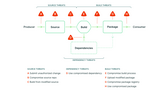
Lastly, it was observed that there was a concise and diagrammatic overview of supply chain threats on the SLSA website.

Two new academic papers Two new scholarly papers were published this month. Firstly, Mathieu Acher, Beno t Combemale, Georges Aaron Randrianaina and Jean-Marc J z quel of University of Rennes on Embracing Deep Variability For Reproducibility & Replicability. The authors describe their approach as follows:
In this short [vision] paper we delve into the application of software engineering techniques, specifically variability management, to systematically identify and explicit points of variability that may give rise to reproducibility issues (e.g., language, libraries, compiler, virtual machine, OS, environment variables, etc.). The primary objectives are: i) gaining insights into the variability layers and their possible interactions, ii) capturing and documenting configurations for the sake of reproducibility, and iii) exploring diverse configurations to replicate, and hence validate and ensure the robustness of results. By adopting these methodologies, we aim to address the complexities associated with reproducibility and replicability in modern software systems and environments, facilitating a more comprehensive and nuanced perspective on these critical aspects.
(A PDF of this article is available.)
Secondly, Ludovic Court s, Timothy Sample, Simon Tournier and Stefano Zacchiroli have collaborated to publish a paper on Source Code Archiving to the Rescue of Reproducible Deployment. Their paper was motivated because:
The ability to verify research results and to experiment with methodologies are core tenets of science. As research results are increasingly the outcome of computational processes, software plays a central role. GNU Guix is a software deployment tool that supports reproducible software deployment, making it a foundation for computational research workflows. To achieve reproducibility, we must first ensure the source code of software packages Guix deploys remains available.
(A PDF of this article is also available.)

diffoscope diffoscope is our in-depth and content-aware diff utility that can locate and diagnose reproducibility issues. This month, Chris Lamb made a number of changes such as uploading versions 266, 267, 268 and 269 to Debian, making the following changes:
  • New features:
    • Use xz --list to supplement output when comparing .xz archives; essential when metadata differs. (#1069329)
    • Include xz --verbose --verbose (ie. double) output. (#1069329)
    • Strip the first line from the xz --list output. [ ]
    • Only include xz --list --verbose output if the xz has no other differences. [ ]
    • Actually append the xz --list after the container differences, as it simplifies a lot. [ ]
  • Testing improvements:
    • Allow Debian testing to fail right now. [ ]
    • Drop apktool from Build-Depends; we can still test APK functionality via autopkgtests. (#1071410)
    • Add a versioned dependency for at least version 5.4.5 for the xz tests as they fail under (at least) version 5.2.8. (#374)
    • Fix tests for 7zip 24.05. [ ][ ]
    • Fix all tests after additon of xz --list. [ ][ ]
  • Misc:
    • Update copyright years. [ ]
In addition, James Addison fixed an issue where the HTML output showed only the first difference in a file, while the text output shows all differences [ ][ ][ ], Sergei Trofimovich amended the 7zip version test for older 7z versions that include the string [64] [ ][ ] and Vagrant Cascadian relaxed the versioned dependency to allow version 5.4.1 for the xz tests [ ] and proposed updates to guix for versions 267, 268 and pushed version 269 to Guix. Furthermore, Eli Schwartz updated the diffoscope.org website in order to explain how to install diffoscope on Gentoo [ ].

Website updates There were a number of improvements made to our website this month, including Chris Lamb making the print CSS stylesheet nicer [ ]. Fay Stegerman made a number of updates to the page about the SOURCE_DATE_EPOCH environment variable [ ][ ][ ] and Holger Levsen added some of their presentations to the Resources page. Furthermore, IOhannes zm lnig stipulated support for SOURCE_DATE_EPOCH in clang version 16.0.0+ [ ], Jan Zerebecki expanded the Formal definition page and fixed a number of typos on the Buy-in page [ ] and Simon Josefsson fixed the link to Trisquel GNU/Linux on the Projects page [ ].

Upstream patches This month, we wrote a number of patches to fix specific reproducibility issues, including:

Reproducibility testing framework The Reproducible Builds project operates a comprehensive testing framework running primarily at tests.reproducible-builds.org in order to check packages and other artifacts for reproducibility. In May, a number of changes were made by Holger Levsen:
  • Debian-related changes:
    • Enable the rebuilder-snapshot API on osuosl4. [ ]
    • Schedule the i386 architecture a bit more often. [ ]
    • Adapt cleanup_nodes.sh to the new way of running our build services. [ ]
    • Add 8 more workers for the i386 architecture. [ ]
    • Update configuration now that the infom07 and infom08 nodes have been reinstalled as real i386 systems. [ ]
    • Make diffoscope timeouts more visible on the #debian-reproducible-changes IRC channel. [ ]
    • Mark the cbxi4a-armhf node as down. [ ][ ]
    • Only install the hdmi2usb-mode-switch package only on Debian bookworm and earlier [ ] and only install the haskell-platform package on Debian bullseye [ ].
  • Misc:
    • Install the ntpdate utility as we need it later. [ ]
    • Document the progress on the i386 architecture nodes at Infomaniak. [ ]
    • Drop an outdated and unnoticed notice. [ ]
    • Add live_setup_schroot to the list of so-called zombie jobs. [ ]
In addition, Mattia Rizzolo reinstalled the infom07 and infom08 nodes [ ] and Vagrant Cascadian marked the cbxi4a node as online [ ].

If you are interested in contributing to the Reproducible Builds project, please visit our Contribute page on our website. However, you can get in touch with us via:

7 June 2024

Freexian Collaborators: Debian Contributions: DebConf Bursaries, /usr-move, sbuild, and more! (by Stefano Rivera)

Contributing to Debian is part of Freexian s mission. This article covers the latest achievements of Freexian and their collaborators. All of this is made possible by organizations subscribing to our Long Term Support contracts and consulting services.

DebConf Bursary updates, by Utkarsh Gupta Utkarsh is the bursaries team lead for DebConf 24. Bursary requests are dispatched to a team of volunteers to review. The results are collated, adjusted and merged to produce priority lists of requests to fund. Utkarsh raised the team, coordinated the review, and issued bursaries to attendees.

/usr-move, by Helmut Grohne More and more, the /usr-move transition is being carried out by multiple contributors and many performed around a hundred of the requested uploads. Of these, Helmut contributed five patches and two uploads. As a result, there are less than 350 packages left to be converted, and all of the non-trivial cases have patches. We started with three times that number. Thanks to everyone involved for supporting this effort. For people interested in background information of this transition, Helmut gave a presentation at MiniDebConf Berlin 2024 (slides).

sbuild, by Helmut Grohne While unshare mode of sbuild has existed for quite a while, it is now getting significant use in Debian, and new problems are popping up. Helmut looked into an apparmor-related failure and provided a diagnosis. While relevant code would detect the chroot nature of a schroot backend and skip apparmor tests, the unshare environment would be just good enough to run and fail the test. As sbuild exposes fewer special kernel filesystems, the tests will be skipped again. Another problem popped up when gobject-introspection added a dependency on the host architecture Python interpreter in a cross build environment. sbuild would prefer installing (and failing) a host architecture Python to installing the qemu alternative. Attempts to fix this would result in systemd killing sbuild. ischroot as used by libc6.postinst would not classify the unshare environment as a chroot. Therefore libc6.postinst would run telinit which would kill the build process. This is a complex interaction problem that shall eventually be solved by providing triggers from libc6 to be implemented by affected init systems.

Salsa CI updates, by Santiago Ruano Rinc n Several issues arose about Salsa CI last month, and it is probably worth mentioning part of the challenges of defining its framework in YAML. With the upcoming end-of-support of Debian 10 buster as LTS, armel was removed from deb.debian.org, making the jobs that build images for buster/armel to fail. While the removal of buster/armel from the repositories is a natural change, it put some light on the flaws in the Salsa CI design regarding the support of the different Debian releases. Currently, the images are defined like these (from .images-debian.yml):
.all-supported-releases: &all-supported-releases
  - stretch
  - stretch-backports
  - buster
  - bullseye
  - bullseye-backports
  - bookworm
  - bookworm-backports
  - trixie
  - sid
  - experimental
And from them, different images are built according to the different jobs and how they are supported, for example:
images-prod-arm:
  stage: build
  extends: .build_template
  tags:
    - $SALSA_CI_ARM_RUNNER_TAG
  parallel:
    matrix:
      # Base image, all releases, all arches
      - IMAGE_NAME: base
        ARCH:
          - arm32v5
          - arm32v7
          - arm64v8
        RELEASE: *all-supported-releases
The removal of buster/armel could be easily reflected as:
images-prod-arm:
  stage: build
  extends: .build_template
  tags:
    - $SALSA_CI_ARM_RUNNER_TAG
  parallel:
    matrix:
      # Base image, fully supported releases, all arches
      - IMAGE_NAME: base
        ARCH:
          - arm32v5
          - arm32v7
          - arm64v8
        RELEASE:
          - stretch
          - buster
          - bullseye
          - bullseye-backports
          - bookworm
          - bookworm-backports
          - trixie
          - sid
          - experimental
      # buster only supports armhf and arm64
      - IMAGE_NAME: base
        ARCH:
          - arm32v7
          - arm64v8
        RELEASE: buster
Evidently, this increases duplication of the release support data, which is of course not optimal and it is error prone when changing the data about supported releases. A better approach would be to have two different YAML lists, such as:
# releases that have partial support. E.g.: buster is transitioning to
# Debian LTS, and buster armel is no longer found in deb.debian.org
.old-releases: &old-releases
  - stretch
  - buster

.currently-supported-releases: &currently-supported-releases
  - bullseye
  - bullseye-backports
  - bookworm
  - bookworm-backports
  - trixie
  - sid
  - experimental
and then a unified list:
.all-supported-releases: &all-supported-releases
  - *old-releases
  - *currently-supported-releases
that could be used in the matrix of the jobs that build all the images available in the pipeline container registry. However, due to limitations in GitLab, it is not possible to expand the variables or mapping values in a parallel:matrix context. At least not in an elegant fashion. This is the kind of issue that recently arose and that Santiago is currently working to solve, in the simplest possible way. Astute readers would notice that stretch is listed in the fully supported releases. And there is no problem with stretch, because it is built from archive.debian.org. Otto actually has tried to fix the broken image build job doing the same, but it is still incorrect, because the security repository is not (yet) available in archive.debian.org. Additionally, Santiago has also worked on other merge requests, such as:
  1. support branch/tags as target head in the test projects,
  2. build autopkgtest image on top of stable
  3. Add .yamllint and make it happy in the autopkgtest-lxc project
  4. enable FF_SCRIPT_SECTIONS to log multiline commands, among others.

Archiving DebConf Websites, by Stefano Rivera DebConf, the annual Debian conference, has its own new website every year. These are typically complex dynamic web applications (featuring registration, call for papers, scheduling, etc.) Once the conference is over, there is no need to keep maintaining these applications, so we archive the sites off as static HTML, and serve them from Debian s static CDN. Stefano archived the websites for the last two DebConfs. The schedule system behind DebConf 14 and 15 s websites was a derivative of Canonical s summit system. This was only used for a couple of years before migrating to wafer, the current system. Archiving summit content has been on the nice to have list for years, but nobody has ever tackled it. The machine that served the sites went away a couple of years ago. After much digging, a backup of the database was found, and Stefano got this code running on an ancient Python 2.7. Recently Stefano put this all together and hooked in an archive export to finally get this content preserved.

Python 3.x and pypy3 security bug triage, by Stefano Rivera Stefano Rivera triaged all the open security bugs against the Python 3.x and PyPy3 packages for Debian s stable and LTS releases. Several had been fixed but this wasn t recorded in the security tracker.

Linux livepatching support for Debian, by Santiago Ruano Rinc n In collaboration with Emmanuel Arias, Santiago filed ITP bug #1070494. As stated in the bug, more than an Intent to Package, it is an Intent to Design and Implement live patching support for the Linux kernel in Debian. For now, Emmanuel and Santiago have done exploratory work and they are working to understand the different possibilities to implement livepatching. One possible direction is to rely on kpatch, and the other is to package the modules using regular packaging tools. Also, it is needed to evaluate if it is possible to rely on distributing the modules via packages, or instead as a service, as it is done by some commercial distributions.

Miscellaneous contributions
  • Thorsten Alteholz uploaded cups-bjnp to improve packaging.
  • Colin Watson tracked down a baffling CI issue in openssh to unblock several merge requests, removed the user_readenv=1 option from its PAM configuration, and started on the first stage of his plan to split out GSS-API key exchange support to separate packages.
  • Colin did his usual routine work on the Python team, upgrading 26 packages to new upstream versions, and cherry-picking an upstream PR to fix a pytest 8 incompatibility in ipywidgets.
  • Colin NMUed a couple of packages to reduce the need for explicit overrides in Packages-arch-specific, and removed some other obsolete entries from there.
  • Emilio managed various library transitions, and helped finish a few of the remaining t64 transitions.
  • Helmut sent a patch for enabling piuparts to work as a regular user building on earlier work.
  • Helmut sent patches for 7 cross build failures, 6 other debian bugs and fixed an infrastructure problem in crossqa.debian.net.
  • Nicholas worked on a sponsored package upload, and discovered the blhc tool for diagnosing build hardening.
  • Stefano Rivera started and completed the re2 transition. The release team suggested moving to a virtual package scheme that includes the absl ABI (as re2 now depends on it). Adopted this.
  • Stefano continued to work on DebConf 24 planning.
  • Santiago continued to work on DebConf24 Content tasks as well as Debconf25 organisation.

4 June 2024

Dirk Eddelbuettel: ulid 0.4.0 on CRAN: Extended to Milliseconds

A new version of the ulid package is now on CRAN. The packages provides universally (unique) lexicographically (sortable) identifiers see the spec at GitHub for details on those which offer sorting which uuids lack. The R package provides access via the standard C++ library, had been put together by Bob Rudis and is now maintained by me. Mark Heckmann noticed that a ulid round trip of generating and unmarshalling swallowed subsecond informationm and posted on a well-known site I no longer go to. Duncan Murdoch was kind enough to open an issue to make me aware, and in it included the nice minimally complete verifiable example by Mark. It turns out that this issue was known, documented upstream in two issues and fixed in fork by the authors of those issues, Chris Bove. It replaces time_t as the value of record (constrained at the second resolution) with a proper std::chrono object which offers milliseconds (and much more, yay Modern C++). So I switched the two main files of library to his, and updated the wrapper code to interface from POSIXct to std::chrono object. And with that we are in business. The original example of five ulids create 100 millisecond part, then unmarshalled and here printed as a data.table as data.frame by default truncates to seconds:
> library(ulid)
> gen_ulid <- \(sleep) replicate(5,  Sys.sleep(sleep); generate() )
> u <- gen_ulid(.1)
> df <- unmarshal(u)
> data.table::data.table(df)
                        ts              rnd
                    <POSc>           <char>
1: 2024-05-30 16:38:28.588 CSQAJBPNX75R0G5A
2: 2024-05-30 16:38:28.688 XZX0TREDHD6PC1YR
3: 2024-05-30 16:38:28.789 0YK9GKZVTED27QMK
4: 2024-05-30 16:38:28.890 SC3M3G6KGPH7S50S
5: 2024-05-30 16:38:28.990 TSKCBWJ3TEKCPBY0
>
We updated the documentation accordingly, and added some new tests as well. The NEWS entry for this release follows.

Changes in version 0.4.0 (2024-06-03)
  • Switch two functions to fork by Chris Bove using std::chrono instead of time_t for consistent millisecond resolution (#3 fixing #2)
  • Updated documentation showing consistent millisecond functionality
  • Added unit tests for millisecond functionality

Courtesy of my CRANberries, there is also a diffstat report for this release. If you like this or other open-source work I do, you can sponsor me at GitHub.

This post by Dirk Eddelbuettel originated on his Thinking inside the box blog. Please report excessive re-aggregation in third-party for-profit settings.

2 June 2024

Colin Watson: Free software activity in May 2024

My Debian contributions this month were all sponsored by Freexian. The bulk of my Debian time this month went towards trying to haul more Python packages up to current versions, but I got a few other bits and pieces done as well. You can support my work directly via Liberapay.

1 June 2024

Guido G nther: Free Software Activities May 2024

A short status update of what happened on my side last month. A broken gcovr in Debian triggered a bit of busy work but 0.39.0 came out nicely nevertheless. We also reduced build time quiet a bit in phosh and phoc. If you want to support my work see donations.

Ian Jackson: What your vote is worth - a back of the envelope calculation

tl;dr: Your vote really counts! Each vote in a UK General Election is worth maybe 100,000 - to you and all your fellow citizens taken together. If you really care about the welfare of everyone affected by actions of the UK government, then it s worth that to you too. Introduction It seems a common perception that one vote, in amongst all those millions, doesn t really matter. So maybe it s not worth voting. But, voting is (largely) what determines what the government does - and the government is big. It s as big as all the people. If you are the kind of person who cares about what happens to everyone in your polity and indeed everyone its actions affect, then even your one vote is very important indeed. A method for back of the envelope calculation It would be nice to give a quantitative estimate. Many things in our society are measured in money, so let s try taking a stab at calculating the money value of your vote. The argument I m going to make is this: the government (by which I include the legislature), which is selected by our votes, decides how to spend the national budget. So, basically, I m going to divide the budget, by the electorate. UK Parliament UK Parliamentary elections decide not only the House of Commons, but, through that, the government. The upper house, the House of Lords, has very limited influence. So I think it s fair to regard the Parliamentary election as, simply, controlling that budget. Being lazy, I m going to use Wikipedia data. We have the size of the electorate, for 2019, 47.6 million. But your influence isn t shared with the whole electorate, only with the other people who also vote. Turnout in 2019 was 67.3%. The 2019 budget isn t listed but I ll just average the 2018 and March 2020 figures 842bn and 873bn, so 857 billion. (Strictly speaking I should add up the budgets for the period of the Parliament, but that seems like a lot of effort.) There s a discrepancy in the timescale we need to account for. Your vote influences the budgets for several years, depending how long it is until the next election. Taking Wikipedia s list of elections this century there ve been 7 in 24 years. So that s an average of about 3.4y. So, multiplying it through, we have ( 857b * (24 / 7)) / (47.6M * 67.3%), giving a guess at the value of your UK General Election vote: 92,000. European Parliament 2022 budget for the European Union (Wikipedia again) was 170.6 bn. The last election, in 2019, had a turnout of 198,352,638. Each EU Parliament lasts 5 years. The Parliament, however, shares responsibility for the budget with the European Council, which is controlled, ultimately, by national governments. We have to pick a numerical value for the Parliament s share of the influence. Over the past years the Parliament has gradually been more willing to exercise its powers in this area. I m going to arbitrarily call its share 50%. The calculation, then, is 170.6 bn * 5 * 50% / 198M, giving a guess at the value of your EU Parliamentary Election vote: 2150. This much smaller figure reflects simply that the EU doesn t spend very much money, for a polity of its size. (Those stories in the British press giving the impression that the EU is massively wasteful are, simply, lies.) The interaction of this calculation with the Council s share of the influence, and with national budgets, is a bit of a question, but given the much smaller amounts involved, it doesn t seem worth thinking about that too hard. Only if you care about other people as much as yourself! All of this is only true for you if you value and want to help everyone in your society. That includes immigrants, women, unemployed people, disabled people, people who are much poorer or richer than you, etc. If you think about it in purely personal terms, your vote is hardly worth anything - because while the effect of your vote, overall, is very large, that effect is shared by everyone in your polity. So if you only care about yourself, voting is a total waste of time. The more selfish and xenophobic and racist and so on you are - caring only about people like yourself - the less your vote is worth. This is why voting is rightly seen as a civic duty. I just spent 30 to courier my EP vote to Den Haag. That only makes sense because I m very willing to spend that 30 to try to improve the spending of the 2000 or so that s my share of the EU budget. This is a very rough analysis These calculations neglect a lot of very important things: politics isn t just about the allocation of resources. It s also about values, and bad politics can seriously harm people. Arguably many of those effects of your vote, are much more important than just how the budget is set and spent. It would be interesting to see an attempt at a similar analysis but for taking into account life and death questions like hate crime, traffic violence, healthcare, refugees welfare, and so on. I m not sure how to approach that. Maybe some real social scientists have done so? References welcome. Also, even on its own terms, this analysis is very rough and ready. We haven t modelled the ability of the government to change its tax rates; perhaps we should be multiplying GDP (or some other better measure) by 90% percentile total tax rate amongst countries like this one . The amount of influence that can be wielded by one vote is probably nonlinear in the size of the political faction, but IDK in which direction. In unfair voting systems like the UK s, some people s votes are worth much more than others. In a very marginal constituency, which is a target seat, your vote might be worth tens of millions. In a safe seat, it might only be worth a few thousand. And in practical terms you don t get to choose precisely the policies you want; you have to pick a party, which is sometimes very much a question of the lesser evil. So, there is much I haven t modelled. But the key point stands: Conclusion Although your vote is diluted by everyone else s votes, together, we control the government, which affects us all. So if you care about the whole of society, the big numbers in the divisor, and the numerator, cancel out. You can think of your vote as controlling one citizen s worth of government activity.
edited 2024-06-01 09:40 Z to fix a grammar botch


comment count unavailable comments

Next.

Previous.