Search Results: "jan"

17 May 2013

Rob Bradford: GNOME in Moblin: Myzone

Howdy, i m sure most people are aware of the recent release of Moblin 2.0; a user experience for netbooks. I m going to write a few blog posts about how the Moblin user experience is built on the awesome technologies in the GNOME platform. So first up, let s look at the Myzone, we re starting here since this is the first thing I really worked on in the Moblin UX and i ve been able to see it through from early ideas to the 2.0 and 2.1 releases. So, deep breath, the idea behind the Myzone is to provide a springboard to things that matter to you most: your recent files and web pages you ve visited, your upcoming events and things you need to do, things that are happening on social web services and your favourite applications. Now then, that s the theory, how does it work:

15 May 2013

Daniel Kahn Gillmor: OpenPGP User ID Comments considered harmful

Most OpenPGP User IDs look like this:
Jane Q. Public <jane@example.org>
This is clean, clear, and unambiguous. However, some tools (gpg, enigmail among others) ask the user to provide a "Comment:" field when they are choosing a new User ID (e.g. when making a new key). These UI prompts are evil. The savvy user knows to avoid entering anything in this field, so that they can end up with a User ID like the one above. The user who provides something here (perhaps even something inconsequential like "I like strawberries", due to not being sure what should go in this little box) will instead end up with a User ID like:
Jane Q. Public (I like strawberries) <jane@example.org>
This is bad. This means that Jane is asking the people who certify her key+userid to certify whether she actually likes strawberries (how could they know? what if she changes her mind? should they revoke their certifications?) and anywhere that she is referred to by name will include this mention of strawberries. This is not Jane's identity, and it doesn't belong in an OpenPGP User ID packet. Furthermore, since User IDs are atomic, if Jane wants to change the comment field (but leave her name and e-mail address the same), she will instead need to create a new User ID, publish it, get everyone who has certified her old key+userid to certify the key+newuserid, and then revoke the old one. It is difficult already to help people understand and participate in the certification network that forms that backbone of OpenPGP's so-called "web of trust". These bogus comment fields make an already-difficult task harder. And all because of strawberries! Tools like enigmail and gpg should not expose the "Comment:" field to users who are generating keys or choosing new User IDs. If they feel it absolutely must be present for some weird corner case that 0.1% of their users will have, they could require that the user enters some sort of "expert mode" before prompting the user to do something that is likely to be a mistake. There is almost no legitimate reason for anyone to use this field. Let's go through some examples of this people use, taken from some examples i have lying around (identifying marks have been changed to protect the innocent who were duped by this bad UI choice, but you can probably find them on the public keyserver network if you want to hunt around):
domain repetition
John Q. Public (Debian) <johnqpublic@debian.org>
We know you're with debian already from the @debian.org address. If this is in contrast to your other address (johnqpublic@example.org) so that people know where to send you debian-related e-mail, this is still not necessary. Lest you think i'm just calling out debian developers, people with @ubuntu.com addresses and (Ubuntu) comments (as well as @example.edu addresses and (Example University) comments and @example.com addresses and (Example Corp) comments) are out there too.
nicknames already evident
John Q. Public (Johnny) <johnqpublic@example.net>
John Q. Public (wackydude) <wackydude@example.net>
Again, the information these comments are providing offers no clear disambiguation from the info already contained in the name and e-mail address, and just muddies the water about what the people who certify this identity should actually be trying to verify before they make their certification.
"Work"
John Q. Public (Work) <johnqpublic@example.com>
if John's correspondents know that he works for Example Corp, then "Work" isn't helpful to them, because they already know this as the address that they're writing to him with. If they don't know that, then they probably aren't writing to him at work, so they don't need this comment either. The same problem appears (for example) with literal comments of (School) next to their @example.edu address.
This is my nth try at this crazy system!
John Q. Public (This is my second key) <johnqpublic@example.com>
John Q. Public (This is my primary key) <johnqpublic@example.com>
John Q. Public (No wait really use this one) <johnqpublic@example.com>
OpenPGP is confusing, and it can be tricky to get it right. We all know :) This is still not part of John's identity. If you want to designate a key as your preferred key, keep it up-to-date, get people to certify it, and revoke or expire your old keys. People who care can look at the timestamps on your keys and tell which ones are the most recent ones. You do have a revocation certificate for your key handy just in case you lose it, right?
Don't use this key
John Q. Public (Old key, do not use) <johnqpublic@example.com>
John Q. Public (Please only use this through September 2004) <johnqpublic@example.com>
This kind of sentiment is better expressed by revoking the key in question or setting an expiration time on the key or User ID self-sig directly. This sentiment is not part of John's identity, and shouldn't be included as though it were.
"none"
John Q. Public (none) <johnqpublic@example.com>
sigh. This is clearly someone getting mixed up by the UI.
I use strong crypto!
John Q. Public (3092 bits of RSA) <johnqpublic@example.com>
This comment refers to the strength of the key material, or the algorithms preferred by the user. Since the User ID is associated with the key material already, people who care about this information can get it from the key directly. This is also not part of the user's actual identity.
"no comment"
John Q. Public (no comment) <johnqpublic@example.com>
This is actually not uncommon (some keyservers reply "too many matches!"). It shows that the user is witty and can think on their feet (at least once), but it is still not part of the user's identity.
But wait (i hear you say)! I have a special case that actually is a legitimate use of the comment field that cannot be expressed in OpenPGP in any other way! I'm sure that such cases exist. I've even seen one or two of them. The fact that one or two cases exist does not excuse the fact that that overwhelming majority of these comments in OpenPGP User IDs are a mistake, caused only by bad UI design that prompts people to put something (anything!) in the empty box (or on the command prompt, depending on your preference). And this mistake is one of the thousand papercuts that inhibits the robust growth of the OpenPGP certification network that some people call the "web of trust". Let's avoid them so we can focus on the other 999 papercuts. Please don't use comments in your OpenPGP User ID. And if you make a user interface for OpenPGP that prompts the user to decide on a new User ID, please don't include a prompt for "Comment" unless the user has already certified that they are really and truly a special special snowflake. Thanks!Tags: openpgp, ui

13 May 2013

Jan Wagner: 500 OOPS: vsftpd: refusing to run with writable root inside chroot ()

If you updated recently your system to Debian wheezy and you are using vsftpd with enabled chrooted local users ...
[~] # grep -i  ^chroot_local_user=yes /etc/vsftpd.conf   tail -1
chroot_local_user=YES
... you maybe faced with the following problem:
500 OOPS: vsftpd: refusing to run with writable root inside chroot()
Login failed.
This problem raised already in Bug #656900 and it was fixed by adjusting the documentation. Beside that there maybe configurations you want to relax such a strict check. Unfortunately this feature was implemented in version 3.0.0 which is not part of Debian wheezy:
- Add new config setting "allow_writeable_chroot" to help people in a bit of
a spot with the v2.3.5 defensive change. Only applies to non-anonymous.
The Frontier Group created a patched package of vsftpd for Ubuntu. After reviewing the patch we decided to also create a Debian package for wheezy. You can easily install the package by the following sniplet:
echo "deb http://ftp.cyconet.org/debian wheezy-updates main non-free contrib" >> \
/etc/apt/sources.list.d/wheezy-updates.cyconet.list; \
aptitude update; aptitude install -t wheezy-updates debian-cyconet-archive-keyring vsftpd && \
echo "allow_writeable_chroot=YES" >> /etc/vsftpd.conf && /etc/init.d/vsftpd restart
Updates, in case of bugfixes in Debian wheezy, should be also available through this distribution channel.

11 May 2013

Petter Reinholdtsen: Debian, the Linux distribution of choice for LEGO designers?

In January, I announced a new IRC channel #debian-lego, for those of us in the Debian and Linux community interested in LEGO, the marvellous construction system from Denmark. We also created a wiki page to have a place to take notes and write down our plans and hopes. And several people showed up to help. I was very happy to see the effect of my call. Since the small start, we have a debtags tag hardware::hobby:lego tag for LEGO related packages, and now count 10 packages related to LEGO and Mindstorms:
brickosalternative OS for LEGO Mindstorms RCX. Supports development in C/C++
leocadvirtual brick CAD software
libnxtutility library for talking to the LEGO Mindstorms NX
lnpddaemon for LNP communication with BrickOS
nbccompiler for LEGO Mindstorms NXT bricks
nqcNot Quite C compiler for LEGO Mindstorms RCX
python-nxtpython driver/interface/wrapper for the Lego Mindstorms NXT robot
python-nxt-filersimple GUI to manage files on a LEGO Mindstorms NXT
scratcheasy to use programming environment for ages 8 and up
t2nsimple command-line tool for Lego NXT
Some of these are available in Wheezy, and all but one are currently available in Jessie/testing. leocad is so far only available in experimental. If you care about LEGO in Debian, please join us on IRC and help adding the rest of the great free software tools available on Linux for LEGO designers.

4 May 2013

Russ Allbery: Review: Democracy at Work

Review: Democracy at Work, by Richard Wolff
Publisher: Haymarket
Copyright: 2012
ISBN: 1-60846-247-1
Format: Kindle
Pages: 220
I've been reading (mostly on-line) and thinking quite a bit lately about workplace governance models, economic structure, and why the current organization of the US workplace bothers me so intensely, partly triggered by reading John Kenneth Galbraith's The Affluent Society. The economic monoculture has made that process particularly frustrating. It's rare to find a discussion, even in the context of organizational strategies that are considered radical, that avoids the standard frame of productivity and business value. Most discussion is long on tactics and short on strategy and examination of goals. Wolff's appearance on Moyers & Company was a rare breath of fresh air, enough so that I grabbed his book shortly afterwards. Wolff is a Marxian economist (meaning that he makes use of Marxist analysis of economics and capitalism while separating them from Marxist politics and Marx's advocacy of revolutionary socialism), which for me was part of the interest. Marxist thought of any branch is not common in the United States; we're regularly deprived of several sides in the international conversation on economic models. I was taught Marxist theory in elementary and high school (in retrospect, surprisingly even-handedly and well, despite the biases of my schooling), but none of the later developments of Marxist thought. I think that's a typical experience here; in the United States, Marxism culminated in Mao and Stalin, and no further development of the underlying theories is ever mentioned. Democracy at Work is subtitled A Cure for Capitalism and does indeed advocate a concrete alternative to capitalist business structures. But this is only the last third of the book (and in some ways the least useful, as I'll discuss in a moment). The first two-thirds of the book is basically a remedial education in modern, as opposed to historic, Marxian economics for US readers like myself who have never heard it before, cast in the context of the current financial crisis. This may well be old hat for Europeans, but if you've been wondering what (at least some) modern-day Marxists actually believe, or are saying to yourself "there are modern-day Marxists after the collapse of the Soviet Union?", I recommend this book to your attention. It's an excellent summary, which I read with the delightful feeling of an expanding viewpoint and the discovery of new directions from which to look at a problem. There's quite a bit in this section that's worth thinking about, including another take on the nature of the recent economic collapse and how that fits into a Marxian analysis of capitalist crises. But there was one point in Wolff's explanation that I found particularly helpful. He completely restructured my understanding of the Marxian analysis of worker exploitation and profit allocation. There are two angles of Marxist economic thought and socialist economics that get a great deal of attention, at least in the United States, in history and economics classes: the role (or lack thereof) of markets in price setting, and the ownership of the means of production. Defenders of capitalism like to focus on the former, since it's quite easy to identify the advantages of theoretical free markets in finding ideal prices and balancing supply and demand, whereas central planning of prices and production has resulted in some catastrophic and deadly failures. (Although I will note, with passing interest, that those failures predate large-scale computing, and there are now large corporations that manage budgets larger than some countries via centralized command-and-control economic practices.) Defenders of socialism are more likely to focus on the ownership of the means of production, since it's easy to show prima facie unfairness in owners of capital extracting vast profits without having to do any work themselves, only be lucky enough to start with large quantities of money. Wolff, however, argues that both of these focuses misses a core critique by Marx of the workplace structure in capitalism, and that, by ignoring that critique, supposedly Marxist countries did not create anything that was actually Marxist in implementation. The Soviet Union was just as much a capitalist country as the United States is. It was state capitalism rather than private capitalism, but the core capitalist structure was intact. Wolff arrives at this conclusion, which may be well-trodden ground in parts of the world that include active Marxist thought but which was quite startling to this American, by treating the ownership of capital as a partial distraction. He focuses on a more direct question and practical question: who determines what a worker does on a day-to-day basis and how that product is used? Who determines what profits are collected and how they are spent? In private capitalism, this is done by the owners of the capital: large shareholders, major investors, and the managerial class that they hire. In Soviet state capitalism, this is done by national politicians, bureaucrats, and the managerial class that they hire. In neither model is it done by the workers themselves. The Soviet model gives theoretical ownership of the capital to the workers, but that ownership is diffused, centralized, and politicized, redirected through the mechanisms of the state, and therefore is effectively ignored. Ownership and control is entirely captured by the political class. Both of these systems are capitalist in Wolff's view of Marx: there is a class of owners and managers, who control the terms and nature of work and who allocate the profits, and a class of workers, who have to do what they're told, are not paid full value for their labor, and don't have a say in how the profits their work generates are spent. At the most important level of day-to-day autonomy and empowerment, they are functionally identical. They are both equally hierarchical and exploitative; the only difference is in whether the system is controlled by rich individuals or by well-connected politicians. (And, as any study of modern politics quickly reveals, the distinction between those two groups in most countries is murky at best.) Wolff convincingly recasts modern economic history as a constant pendulum swing between private capitalism and state capitalism. Crises in one system push countries towards the other system; subsequent crises push the country back towards the first system. Regulation grows and shrinks, companies are nationalized and then privatized, but both systems are united in excluding the worker from any meaningful control over their work life. The first two-thirds of the book was full of insights like this for me. I didn't agree with all of it, but all of it was worthwhile and thought-provoking. But I was a bit leery of Wolff's proposed solution. My past experience with critics of capitalism is that the critique is often quite compelling, but the proposed solution is much less believable. And, sadly, that concern was warranted here as well. The core of Wolff's proposal is predictable but possibly sound: a restructuring of the workplace to be radically democratic. The business would be owned entirely and exclusively by the people who work for it, equally regardless of the job of the worker, and the workers would decide democratically or via elected repesentatives from among the workers how to allocate the profits of the business, what standards and business practices should be followed, and how the work is to be done. I was particularly interested to hear that this model (workers' self-directed enterprises) has apparently been successful in Spain in the form of the Mondragon Cooperative. Given all the tricky, small details that have to be resolved in an actual workplace, an existence proof is worth more than pounds of theory. Unfortunately, like a lot of proposed alternatives, Wolff's description of WSDEs is quite fuzzy and involves a lot of hand-waving. I was never able to build, from this book, a coherent and complete mental model of how such a workplace would function. Wolff tends to surround every specific in a halo of contingencies, possibilities, and alternative models, and is maddeningly nonspecific on such practical matters as how line management would work, how such a business would do financial planning or project approval, how competing interests in different parts of the organization would be balanced, and other practical governance matters that fill my work life. Maybe the answer to all of that is just "democracy," but I'm dubious. Democracy has a number of well-known flaws that I thought weren't adequately addressed. For example, democracies are often quite happy to further and reinforce existing prejudice (such as sexism or racism), and are prone to yielding control to the most charismatic. Democracies also have an informed voter problem, which seems like it would be particularly acute if democracy is going to make detailed business decisions. And, for larger organizations, control by pre-existing money could re-enter the equation via propaganda and campaigning around votes. Some of this gap in the book could be addressed via a more in-depth look at how Mondragon and any other real-life examples work, but that is sadly missing here. (I am interested enough now, though, that I'd read a good popular treatment of the history and methodology of Mondragon, although I don't think I'm up to working through an academic study.) The hierarchical, dictatorial management structure imposed by capitalism is so awful that WSDEs don't have a particularly high bar to meet to be fairer and more empowering than what we have today. The question, rather, is would they function sufficiently well that the business would be able to make effective decisions, and that's unclear to me from this book. This is, as Wolff spends some time discussing, particularly difficult when in direct competition with capitalist enterprises. This sort of endeavor will probably trade some degree of economic efficiency and raw marketplace power for improvements to fairness and empowerment, but that means it's going to require support from the surrounding society, which is a huge obstacle. I doubt there's a free lunch here: true fairness and equity also leading to improved economic efficiency in a capitalist context is a nice dream, but not horribly practical. Wolff also seems to suffer from something else I associate with Marxist thought: a preferential focus on a very narrowly-defined type of productive worker, apparently left over from Marx's original critique in the context of industrialization. Wolff inserts a very odd and quite awkward distinction in his WSDE model between workers who directly produce the product that's sold, and who in his model therefore produce the profits of the business, and all other workers in the business. He then gives special privileges to the former group to decide how much profit to return in worker compensation and how much to use for other purposes, thus making the supporting workers second-class citizens within this supposedly equal workplace. Speaking as someone who works in IT, and hence would be classified by Wolff into the supporting rather than directly productive category, I do not find this division at all convincing, and Wolff never provides a coherent explanation for why he introduced it. He only says that it's necessary for the governance of the business to not be exploitative, which seems to assume that there is a special economic role played by the workers who work directly on a saleable product. Maybe there is some analysis that could convince me of this, but, if so, it's not present in this book. It struck me as a recipe for continuing the exploitation of the most invisible and powerless workers in capitalism: janitors, groundskeepers, and other low-paid service jobs. I wish the whole book were as insightful and pointed as the first two-thirds, but alas I found the WSDE discussion to be somewhat muddled and utopian. "How do we get there from here" is always the hardest part of this type of discussion, and Wolff has no special skill in that department. But, despite that, I got a lot of fascinating ideas and new conceptual frameworks out of this book, and I'm tempted to read it again. I suspect some of this, similar to my discovery of promises and infinite streams in programming, is filling in of odd gaps in my personal education rather than a discovery of unusual, new ideas. But if you too have gotten your political education within the US capitalism ber alles bubble, this book may fill in similar gaps in your knowledge. If so, it's a very rewarding experience. If you're curious about a preview of Wolff's perspective without paying for the book, I recommend watching the first episode of Moyers & Company in which he appeared. Wolff is a clear and engaging speaker, and his interview provides a good feel for his discussion style and his general perspective. Rating: 8 out of 10

1 May 2013

Rapha&#235;l Hertzog: My Free Software Activities in April 2013

This is my monthly summary of my free software related activities. If you re among the people who made a donation to support my work (102.70 , thanks everybody!), then you can learn how I spent your money. Otherwise it s just an interesting status update on my various projects. Debian France Work on Galette. I spent quite some time on Debian France s galette installation (the web application handling its member database), first converting its Postgres database to UTF-8, then upgrading to 0.7.4 while working-around many known problems. I also created Debian packages of three Galette plugins that we have been using (galette-plugin-paypal, galette-plugin-admintools, galette-plugin-fullcard). But every time I use galette, I tend to find something to report. This month I filed 5 tickets: I tested quite some fixes prepared by the upstream author (3 of the above bugs are already fixed) and this lead to the 0.7.4.1 bugfix release. Preliminary work on new bylaws. I have setup a git repository to make it easier to collaborate on new versions of our bylaws and internal rules. The goal is to make Debian France a trusted organization of Debian and to update everything to be compliant with the association 1901 law (we currently have a special statute reserved to associations from Alsace/Moselle). Kali Linux Improve accessibility support in Debian Wheezy. Offensive Security wanted Kali Linux to be fully accessible to disabled people. Since Wheezy was suffering from some serious regressions in that area, we hired Emilio Pozuelo Monfort to fix #680636 and #689559 in gdm3. On my side, I updated debian-installer s finish-install to correctly pre-configure the system when you make an install with speech synthesis (patch submitted in #705599).
Thanks to accommodating release managers, this work has already been integrated in Wheezy and won t have to wait the first point release. Fix bugs in Debian s live desktop installer. We also wanted to enable the desktop installer in the Kali live DVD. While our first tries a few months ago failed, this time it worked almost out of the box (thanks to Ben Armstrong who fixed it). I still identified a few issues that I fixed in debian-installer-launcher s git repository. Packaging and misc Debian work I also spent a significant number of hours to answer questions of students who want to participate in Google s summer of code and who are interested by the rewrite of the Package Tracking System with Python and Django. Some of the discussions happened on debian-qa@lists.debian.org. Thanks See you next month for a new summary of my activities.

One comment Liked this article? Click here. My blog is Flattr-enabled.

30 April 2013

Gunnar Wolf: Activities facing the next round of Trans-Pacific Partnership negotiations ( #yaratpp )

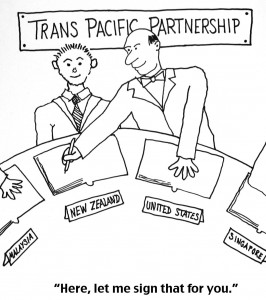
Excuse me for the rush and lack of organization... But this kind of things don't always allow for proper planning. So, please bear with my chaos ;-) What is the Trans-Pacific Partnership? Yet another secretely negotiated international agreement that, among many chapters, aims at pushing a free-market based economy, as defined by a very select few Most important to me, and to many of my readers: It includes important chapters on intellectual property and online rights. Hundreds of thousands of us along the world took part in different ways on the (online and "meat-space") demonstrations against the SOPA/PIPA laws back in February 2012. We knew back then that a similar project would attempt to bite us back: Well, here it is. Only this time, it's not only covering copyright, patents, trademark, reverse engineering, etc. TPP is basically a large-scale free trade agreement on steroids. The issue that we care about now is just one of its aspects. Thus, it's way less probable we can get a full stop for TPP as we got for SOPA. But we have to get it on the minds of as many people as possible! Learn more with this infography distributed by the EFF. Which countries? The countries currently part of TPP are Chile, Peru, New Zealand, Australia, Malaysia, Brunei, Singapore, Vietnam And, of course, the USA. Mexico, Canada and Japan are in the process of joining the partnership. A group of Mexican senators are travelling to Lima to take part of this round. Image by Colin Beardon (It's Our Future, NZ) What are we doing about it? As much as possible! I tried to tune in with Peru's much more organized call The next round of negotiations will be in Lima, Peru, between May 14 and 24. Their activities are wildly more organized than ours: They are planning a weekend-long Camping for Internet freedom, with 28 hours worth of activities. As for us, our activities will be far more limited, but I still hope to have an interesting session: Poster design by Gacela. Thanks! This Friday, we will have Aula Magna, Facultad de Ingenier a, UNAM, M xico DF, from 10AM and until 3PM. We do not have a clear speakers program, as the organization was quite rushed. I have invited several people who I know will be interesting to hear, and I expect a good part of the discussion to be a round table. I expect we will:
  1. Introduce people working on different corners of this topic
  2. Explain in some more detail what TPP is about
  3. Come up with actions we can take to influence Mexico's joining of TPP
  4. And this will be at Facultad de Ingenier a. Another explicit goal of this session will be, of course, to bring the topic closer to the students!
We want you! So... I am posting this message also as a plead for help. Do you think you can participate here? Were you among the local organizers for the anti-SOPA movement? Do you have some insight on TPP you can share? Do you have some gear to film+encode the talks? (as they will surely be interesting!) Or, is the topic just interesting for you? Well, please come and join us! So, again: Friday, 2012-05-03, 10:00-15:00
AttachmentSize
Poster. Desgin by Gacela Thanks!457.49 KB
Infography about TPP distributed by the EFF392.45 KB
"Here, let me sign this for you". Image by Colin Beardon.27.08 KB

Gunnar Wolf: Activities facing the next round of Trans-Pacific Partnership negotiations ( #yaratpp #tpp #internetesnuestra )

Excuse me for the rush and lack of organization... But this kind of things don't always allow for proper planning. So, please bear with my chaos ;-) What is the Trans-Pacific Partnership? Yet another secretely negotiated international agreement that, among many chapters, aims at pushing a free-market based economy, as defined by a very select few Most important to me, and to many of my readers: It includes important chapters on intellectual property and online rights. Hundreds of thousands of us along the world took part in different ways on the (online and "meat-space") demonstrations against the SOPA/PIPA laws back in February 2012. We knew back then that a similar project would attempt to bite us back: Well, here it is. Only this time, it's not only covering copyright, patents, trademark, reverse engineering, etc. TPP is basically a large-scale free trade agreement on steroids. The issue that we care about now is just one of its aspects. Thus, it's way less probable we can get a full stop for TPP as we got for SOPA. But we have to get it on the minds of as many people as possible! Learn more with this infography distributed by the EFF. Which countries? The countries currently part of TPP are Chile, Peru, New Zealand, Australia, Malaysia, Brunei, Singapore, Vietnam And, of course, the USA. Mexico, Canada and Japan are in the process of joining the partnership. A group of Mexican senators are travelling to Lima to take part of this round. Image by Colin Beardon (It's Our Future, NZ) What are we doing about it? As much as possible! I tried to tune in with Peru's much more organized call The next round of negotiations will be in Lima, Peru, between May 14 and 24. Their activities are wildly more organized than ours: They are planning a weekend-long Camping for Internet freedom, with 28 hours worth of activities. As for us, our activities will be far more limited, but I still hope to have an interesting session: Poster design by Gacela. Thanks! This Friday, we will have Aula Magna, Facultad de Ingenier a, UNAM, M xico DF, from 10AM and until 3PM. We do not have a clear speakers program, as the organization was quite rushed. I have invited several people who I know will be interesting to hear, and I expect a good part of the discussion to be a round table. I expect we will:
  1. Introduce people working on different corners of this topic
  2. Explain in some more detail what TPP is about
  3. Come up with actions we can take to influence Mexico's joining of TPP
  4. And this will be at Facultad de Ingenier a. Another explicit goal of this session will be, of course, to bring the topic closer to the students!
We want you! So... I am posting this message also as a plead for help. Do you think you can participate here? Were you among the local organizers for the anti-SOPA movement? Do you have some insight on TPP you can share? Do you have some gear to film+encode the talks? (as they will surely be interesting!) Or, is the topic just interesting for you? Well, please come and join us! Some more informative links BE THERE! So, again: Friday, 2012-05-03, 10:00-15:00 [Update] So, 2012-05-03 came and went. And thankfully, Alfredo was there to record most of the talk! So, you can download the video: Gunnar Wolf, Salvador Alc ntar: Qu es TPP? Por qu me debe preoucpar? Qu podemos hacer?
AttachmentSize
Poster. Design by Gacela Thanks!457.49 KB
Infography about TPP distributed by the EFF392.45 KB
"Here, let me sign this for you". Image by Colin Beardon.27.08 KB

28 April 2013

Christian Perrier: [life] Running update: January-April...and more.

It seems that I didn't send any update to my international friends for quite a while, at least when it comes at my running activities. So, in short, I ran A LOT during the first months of April 2013. I mean it. As of now (April 28th), I cumulated 1424 kilometers, with a peak in March up to 375 kilometers. So, that's an average 12 kilometers per day. How did I achieve this? Among many other things, by doing part of my commute to work by running, which means 14 kilometers in one day, with a backpack containing everything needed to be dressed "normally" while working, plus my laptop, my rain jacket, etc....so up to 4 kilograms on my shoulders. And, yes, I can use a shower at work and I don't stink all day long! This alone already makes a fairly good training. Of course, all alone, it wouldn't be really funny, so I, of course, add some runs during the week-end, mostly trail running, enjoying the nature around our place. Official races have been mostly trail races during these months. The only road race has been an half-marathon in Bullion, back in February (4th year in a row I'm running this one, which is traditionnaly the "resume road races" competition in the area). I completed it in 1h39, quite close to my PB, even if....that was meant to be a training only. In February, still as a preparation race for Paris Ecotrail, I ran a 20km trail in Auffargis (a neat small village in the neighbourhood of our place), again completing it with great success, with a big negative split (for non hard-core runners, a negative split happens when one runs the second half of a race faster than the first one). All this was in preparation for Paris Ecotrail race, my second time on this 80km race that ends up at Eiffel Tower. Last year, being my first attempt on such distance,, I completed it in 11 hours 5 minutes. To make it short, this year, I finished 579th out of more than 2000 runners, in 9h36. That was indeed a really great result, in line with my 8h15 time back in November for the 70km "Le Puy-Firminy" night race. Moreover, I could indeed recover very quickly : the race was run on a Saturday and I resumed my "commute runs" on Wednesday. The next target were two trail races in April : I originally planned a 44km race on April 21st and finally ended up adding to it a 35km trail race on April 7th (the day of Paris Marathon), only 3 weeks after Ecotrail..:-) And I completed both these with a huge success. Indeed my best trail races ever, again with two negative splits and also a very good place. Indeed, I now usually complete races close to the very first women...:-). So, on April 7th, the trail du Josas (35km, 800m positive climb... which means about the equivalent of a marathon) was completed in 3h40....and last Sunday, the trail des Lavoirs (44km, 1100m positive climb) was completed in 4h40, with the last 2 kilometers being run above 13km/h. Describing how one can feel when "flying" in the very last kilometers of such a long run is just....impossible. Great, great, great memories. Then, during the week following the trail des Lavoirs, I ran 101km in 6 days, confirming that recovery is perfect. So, definitely, I am stunned by what I could achieve during these months, without injury, without big pain. Just good training and good results, without suffering and a giant pleasure. Yes, running is definitely a drug and I'm deeply addicted. Well, the result is, in short, that I feel good and well, so I think I won't stop soon...:-) Next challenge : Mont-Blanc marathon, in Chamonix : 42.195km....and 2500meters positive climb, with 1500 meters negative. Start in Chamonix at 1050m high and end at Planpraz (2050m), facing the Mont-Blanc, with a maximum altitude of 2267m during the race. Quite an interesting "marathon", isn't it? That will be my first race in real mountains...and, I guess not the last one. Target time: 6 hours. Secret wish: 5h30. During summer, I will mostly be preparing for the second part of the year....but I'll certainly enjoy the neighbourhood of Vaumarcus, Switzerland, where I'll attend DebConf. Challenge : combine running, hacking, cheese eating and fit all this in 24 hours every day. For the end of the year, challenges should peak between October and December: So, well, see you soon on this blog for another update after Mont-Blanc marathon. Let's hope I'll give you good news.

16 April 2013

Michal &#268;iha&#345;: Weblate 1.5

Weblate 1.5 has been released today. It comes with lot of improvements, especially in performance, reporting and support for machine translations. Full list of changes for 1.5: You can find more information about Weblate on it's website, the code is hosted on Github. If you are curious how it looks, you can try it out on demo server. You can login there with demo account using demo password or register your own user. Ready to run appliances will be soon available in SUSE Studio Gallery. Weblate is also being used https://l10n.cihar.com/ as official translating service for phpMyAdmin, Gammu, Weblate itself and others. If you are free software project which would like to use Weblate, I'm happy to help you with set up or even host Weblate for you.

Filed under: English Phpmyadmin Suse Weblate 0 comments Flattr this!

Johannes Schauer: botch - the debian bootstrap software has a name

After nearly one year of development, the "Port bootstrap build-ordering tool" now finally has a name: botch. It stands for Bootstrap/Build Order Tool CHain. Now we dont have to call it "Port bootstrap build-ordering tool" anymore (nobody did that anyways) and also dont have to talk about it by referring to it as "the tools" in email, IRC or in my master thesis which is due in a few weeks. With this, the issue also doesnt block the creation of a Debian package anymore. Since only a handful of people have a clone of it anyway, I also renamed the gitorious git repository url (and updated all links in this blog and left a text file informing about the name change in the old location). The new url is: https://gitorious.org/debian-bootstrap/botch Further improvements since my last post in January include: In the mean time a paper about the theoretical aspects of this topic which Pietro Abate and I submitted to the CBSE 2013 conference got accepted (hurray!) and I will travel to the conference in Canada in June. Botch (yeey, I can call it by a name!) is also an integral part of one of the proposals for a Debian Google Summer of Code project this year, mentored by Wookey and co-mentored by myself. Lets hope it gets accepted and produces good results in the end of the summer!

14 April 2013

Andreas Metzler: balance sheet snowboarding season 2012/13

All in a below average season. Although we had lots of snow in December, my first day on-piste was December 22nd. Riding in snowstorm or thick fog is just not my kind of thing. The christmas holiday season was absurdely warm, getting rid of most of the snow again. I managed 7 snow-days from December 22nd to January 1st, but this was more sport than fun. Really sunny days were rare in the whole winter. Due to minor injury and minor illness I had to take long breaks from snowboarding (just two snow days in the periode from January 8th to February 15th!). Early easter cut the season short. This year I ended up in skiline.cc's top-100 list for both most meters of altitude in a single day and the whole season which shows that other people had a short season, too. On the plus side, we had enough and good snow. This is also evident from the balance sheet below, I almost always went to Diedamskopf where there is almost no artificial snow. Here is the balance sheet:
2005/06 2006/07 2007/08 2008/09 2009/10 2010/11 2011/12 2012/13
number of (partial) days2517293730302523
Dam ls10105101623104
Diedamskopf15424231341419
Warth/Schr cken03041310
total meters of altitude12463474096219936226774202089203918228588203562
highscore10247m8321m12108m11272m11888m10976m13076m13885m
# of runs309189503551462449516468

8 April 2013

Matthias Klumpp: Tanglu status report

Hello everyone! I am very excited to report about the awesome progress we made with Tanglu, the new Debian-based Linux-Distribution. :) First of all, some off-topic info: I don t feel comfortable with posting too much Tanglu stuff to Planet-KDE, as this is often not KDE-related. So, in future Planet-KDE won t get Tanglu information, unless it is KDE-related ;-) You might want to take a look at Planet-Tanglu for (much) more information. So, what happened during the last weeks? Because I haven t had lectures, I nearly worked full-time on Tanglu, setting up most of the infrastructure we need. (this will change with the next week, where I have lectures again, and I also have work to do on other projects, not just Tanglu ^^) Also, we already have an awesome community of translators, designers and developers. Thanks to them, the Tanglu-Website is now translated to 6 languages, more are in the pipeline and will be merged later. Also, a new website based on the Django framework is in progress. The Logo-Contest We ve run a logo-contest, to find a new and official Tanglu logo, as the previous logo draft was too close to the Debian logo (I asked the trademark people at Debian). More than 30 valid votes (you had to be subscribed to a Tanglu Mailinglist) were received for 7 logo proposals, and we now have a final logo: Tanglu Logo (Text) I like it very much :) Fun with dak I decided to use dak, the Debian Archive Kit, to handle the Tanglu archive. Choosing dak over smaller and easy-to-use solutions had multiple reasons, the main reason is that dak is way more flexible than the smaller solution (like reprepro or min-dak) and able to handle the large archive of Tanglu. Also, dak is lightning fast. And I would have been involved with dak sooner or later anyway, because I will implement the DEP-11 extension to the Debian Archive later (making the archive application-friendly). duckWorking with dak is not exactly fun. The documentation is not that awesome, and dak contains many hardcoded stuff for Debian, e.g. it often expects the unstable suite to be present. Also, running dak on Debian Wheezy turned out to be a problem, as the Python module apt_pkg changed the API and dak naturally had problems with that. But with the great help of some Debian ftpmasters (many thanks to that!), dak is now working for Tanglu, managing the whole archive. There are still some quirks which need to be fixed, but the archive is in an usable state, accepting and integrating packages. The work on dak is also great for Debian: I resolved many issues with non-Debian dak installations, and made many parts of dak Wheezy-proof. Also, I added a few functions which might also be useful for Debian itself. All patches have of course been submitted to upstream-dak. ;-) Wanna-build and buildds GearThis is also nearly finished :) Wanna-build, the software which manages all buildds for an archive, is a bit complicated to use. I still have some issues with it, but it does it s job so far. (need to talk to the Debian wanna-build admins for help, e.g. wanna-build seems to be unable to handle arch:all-only packages, also, build logs are only submitted in parts) The status of Tanglu builds can be viewed at the provisoric Buildd-Status pages. Setting up a working buildd is also a tricky thing, it involves patching sbuild to escape bug #696841 and applying various workarounds to make the buildd work and upload packages correctly. I will write instructions how to set-up and maintain a buildd soon. At time, we have only one i386 buildd up and running, but more servers (in numbers: 3) are prepared and need to be turned into buildds. After working on Wanna-build and dak, I fully understand why Canonical developed Launchpad and it s Soyuz module for Ubuntu. But I think we might be able to achieve something similar, using just the tools Debian already uses (maybe a little less confortable than LP, but setting up an own LP instance would have been much more trouble). Debian archive import The import of packages from the Debian archive has finished. Importing the archive resulted in many issues and some odd findings (I didn t know that there are packages in the archive which didn t receive an upload since 2004!), but it has finally finished, and the archive is in a consistent state at time. To have a continuous package import from Debian while a distribution is in development, we need some changes to wanna-build, which will hopefully be possible. Online package search The Online-Package-Search is (after resolving many issues, who expected that? :P ) up and running. You can search for any package there. Some issues are remaining, e.g. the file-contents-listing doesn t work, and changelog support is broken, but the basic functionality is there. Tanglu Bugtracker We now also have a bugtracker which is based on the Trac software. The Tanglu-Bugtracker is automatically synced with the Tanglu archive, meaning that you find all packages in Trac to report bugs against them. The dak will automatically update new packages every day. Trac still needs a few confort-adjustments, e.g. submitting replies via email or tracking package versions. Tanglu base system tanglu-platform-smallThe Tanglu metapackages have been published in a first alpha version. We will support GNOME-3 and KDE4, as long as this is possible (= enough people working on the packaging). The Tanglu packages will also depend on systemd, which we will need in GNOME anyway, and which also allows some great new features in KDE. Side-effect of using systemd is at least for the start that Tanglu boots a bit slow, because we haven t done any systemd adjustments, and because systemd is very old. We will have to wait for the systemd and udev maintainers to merge the packages and release a new version first, before this will improve. (I don t want to do this downstream in Tanglu, because I don t know the plans for that at Debian (I only know the information Tollef Fog Heen & Co. provided at FOSDEM)) The community The community really surprised me! We got an incredible amount of great feedback on Tanglu, and most of the people liked the idea of Tanglu. I think we are one of the less-flamed new distributions ever started ;-) . Also, without the very active community, kickstarting Tanglu would not have been possible. My guess was that we might be able to have something running next year. Now, with the community help, I see a chance for a release in October :) The only thing people complained about was the name of the distribution. And to be really honest, I am not too happy with the name. But finding a name was an incredibe difficult process (finding something all parties liked), and Tanglu was a good compromise. Tanglu has absolutely no meaning, it was taken because it sounded interesting. The name was created by combining the Brazilian Tangerine (Clementine) and the German Iglu (igloo). I also dont think the name matters that much, and I am more interested in the system itself than the name of it. Also, companies produce a lot of incredibly weird names, Tanglu is relatively harmless compared to that ;-) . In general, thanks to everyone participating in Tanglu! You are driving the project forward! The first (planned) release I hereby announce the name of the first Tanglu release, 1.1 Aequorea Victoria . It is Daniel s fault that Tanglu releases will be named after jellyfishes, you can ask him why if you want ;-) I picked Aequorea, because this kind of jellyfish was particularly important for research in molecular biology. The GFP protein, a green fluorescent protein (=GFP), caused a small revolution in science and resulted in a Nobel Prize in 2008 for the researchers involved in GFP research (for the interested people: You can tag proteins with GFP and determine their position using light microscopy. GFP also made many other fancy new lab methods possible). Because Tanglu itself is more or less experimental at time, I found the connection to research just right for the very first release. We don t have a time yet when this version will be officially released, but I expect it to be in October, if the development speed increases a little and more developers get interested and work on it. Project Policy We will need to formalize the Tanglu project policy soon, both the technical and the social policies. In general, regarding free software and technical aspects, we strictly adhere to the Dbian Free Software Guidelines, the Debian Social Contract and the Debian Policy. Some extra stuff will be written later, please be patient! Tanglu OIN membership I was approached by the Open Invention Network, to join it as member. In general, I don t have objections to do that, because it will benefit Tanglu. However, the OIN has a very tolerant public stance on software patents, which I don t like that much. Debian did not join the OIN for this reason. For Tanglu, I think we could still join the OIN without someone thinking that we support the stance on software patents. Joining would simply be pragmatic: We support the OIN as a way to protect the Linux ecosystem from software patents, even if we don t like the stance on software patents and see it differently. Because this affects the whole Tanglu project, I don t want to decide this alone, but get some feedback from the Tanglu community before making a decision. Can I install Tanglu now? Yes and no. We don t provide installation images yet, so trying Tanglu is a difficult task (you need to install Debian and then upgrade it to Tanglu) if you want to experiment with it, I recomment trying Tanglu in a VM. I want to help! Great, then please catch one of us on IRC or subscribe to the mailinglists. The best thing is not to ask for work, but suggest something you want to do, others will then tell you if that is possible and maybe help with the task. Packages can for now only be uploaded by Debian Developers, Ubuntu Developers or Debian Maintainers who contacted me directly and whose keys have been verified. This will be changed later, but at the current state of the Tanglu archive (= less safety checks for packages), I only want people to upload stuff who definitely have the knowledge to create sane packages (you can also proove that otherwise, of course). We will later establish a new-member process. If you want to provide a Tanglu archive mirror, we would be very happy, so that the main server doesn t have to carry all the load. If you have experience in creating Linux Live-CDs or have worked with the Ubiquity installer, helping with these parts would be awesome! Unfortunately, we cannot reuse parts of Linux Mint Debian, because many of their packages don t build from source and are repackaged binaries, which is a no-go for the Tanglu main archive. Sneak peek And here is a screenshot of the very first Tanglu installation (currently more Debian than Tanglu):



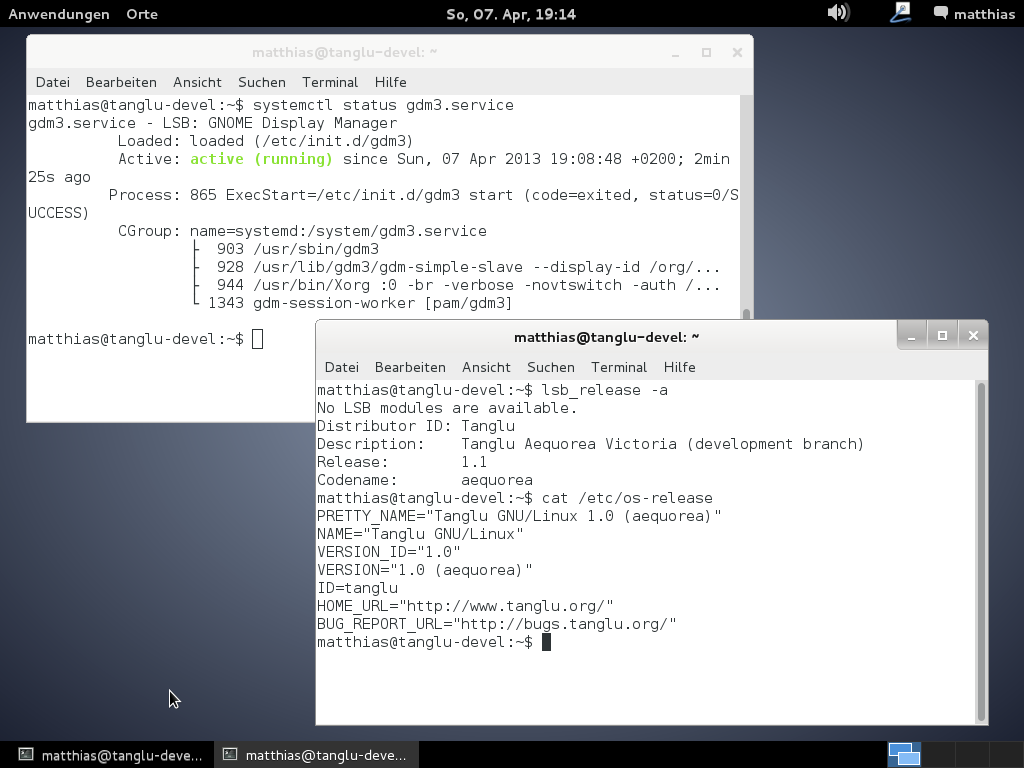
tanglu_sneak-peek_screenshot Something else I am involved in Debian for a very long time now, first as Debian Maintainer and then as Debian Developer and I never thought much about the work the Debian system administrators do. I didn t know how dak worked or how Wanna-build handles the buildds and what exactly the ftpmasters have to do. By not knowing, I mean I knew the very basic theory and what these people do. But this is something different than experiencing how much work setting up and maintaining the infrastructure is and what an awesome job the people do for Debian, keeping it all up and running and secure! Kudos for that, to all people maintaining Debian infrastructure! You rock! (And I will never ever complain about slow buildds or packages which stay in NEW for too long ;-) )

Bits from Debian: Debian joins Free & Open Source Software Outreach Program for Women

The GNOME Foundation started the Free & Open Source Software Outreach Program for Women, OPW, in 2010. In the January-April 2013 round, many other FOSS organizations joined the program. We are happy to announce that Debian will also join in the next round from June-September and we'll offer one internship. You can find more details about Debian's participation in the program at Debian OPW page. Call for mentors and projects OPW allows applicants to work on any kind of project, including coding, design, marketing, web development... The Debian Google Summer of Code projects will be offered also as possible projects for OPW, but GSoC only allows coding projects. If you have any idea of a non-coding project and you want to mentor it, please contact us in the soc-coordination mailing list adding [OPW] in subject. OPW works in the same way as GSoC except Google doesn't play a part here. The same advice that is provided for GSoC mentors works for OPW mentors. Call for participants The main goal of this program is to increase the number of women in FOSS, so all women who are not yet a Debian Developer or a Debian Maintainer are encouraged to apply. There are no age restrictions and applicants don't need to be a student. If you want to apply, you must follow three steps:
  1. Choose a project from this list. There are two lists, one for GSoC and another with non-coding tasks that can be only offered by the OPW. Those lists may change and add or remove more projects in the next few weeks.
  2. Make a small contribution to Debian. Projects will add a task the applicant must complete as part of the pre-selection process. If no task is provided, you are welcome to ask the mentors of the project. You can also make a different extra task of the one listed to show your skills and interest.
  3. Create a page in the Debian wiki with your application. You can do so under pseudonym, but in that case, please give us information about yourself privately by email to the coordinators listed in the Debian OPW page!

31 March 2013

Russell Coker: Links March 2013

Russ Allbery wrote an informative post about how to determine which charities are worth donating to [1]. He has a link to another article about the charities to which he donates and concentrates on ways of analysing the effectiveness of charities. So someone who has different ideas about which types of charity are worthy of donation could still learn a lot from his post. Adam Green wrote an interesting article for The New Yorker about Apollo Robbins who is one of the world s best pick-pockets [2]. Apollo picks pockets as a magician to entertain people and always returns what he steals. Now he is working with neuroscientists who are devising experiments to determine why his tricks work. Rick Falkvinge wrote an insightful article describing the way that the copyright monopoly is in direct opposition to the freedom to make contracts [3]. It s a good rebuttal of a common argument in favor of copyright law. Seth Godin gave an interesting TED talk about the problems with the education system, how and why it teaches conformity and little else [4]. One of his suggestions for improvement is to have students spend their evenings watching lectures by experts and class time asking questions. He also says that everything should be open book and that there is no value in memorising anything it s a bit of an overstatement but it s essentially correct. Cory Doctorow wrote an interesting article for The Guardian about positive externalities and copyright law [5]. I think that he didn t choose the best way of framing this issue, but he makes some very interesting points anyway. Andrew Norton wrote an interesting article about how to reduce corruption in the police force and other government agencies [6]. A large part of this is based on making them subject to the same laws as everyone else, which seems to be a radical idea. Valerie Aurora wrote an insightful blog post about suicide [7]. Emily Oster gave an interesting TED talk about the factors that determine the spread of AIDS in Africa [8]. It s quite different to what you probably expect.

29 March 2013

Olivier Berger: Managing Python code with UTF-8 (french chars) in org-mode + babel + minted for LaTeX export

The goal of this article is to illustrate how to manage Python code which includes comments in UTF-8 characters inside a latin-1 source org-mode for LaTeX export. Note that I ve pasted in wordpress the HTML generated by org-mode, so I hope it isn t broken too much. My typical use case is a french lecture on Python where the text is written in french, as well as some of the code comments and examples We ll use org-mode s babel module to include and manage the Python
examples. The goal is to write the source of the Python programs
directly in the same org source as the class book s text, and to extract them into a subdir (with the tangle feature), so that they can be shipped to the students to experiment with. The minted LaTeX environment is used, for babel, to make the Python syntax highlighting.

1.1 Issues
  • The source org-mode is in latin-1 so that it compiles with pdflatex
  • The examples source-code will be in UTF-8 so that Python 2.7 executes them well on a modern Linux desktop
  • Minted relies on pygmentize wich doesn t seem to handle UTF-8 so well

1.2 Solution
We ll show how to patch minted s use of pygmentize to take advantage
of its conversion capacity to convert the Python sources from UTF-8 to
latin-1 at document rendering time (LaTeX compilation). It s a hack, but works. The current document s source shows how this works

1.2.1 Customization
The org document should contain the following headers :
#+LANGUAGE:  fr
#+LaTeX_HEADER: \usepackage[latin1] inputenc 
#+LaTeX_HEADER: \usepackage[french] babel 
#+LaTeX_HEADER: \usepackage color \usepackage minted 
and the footers :
# Local Variables:
# coding: latin-1
# org-src-preserve-indentation: true
# tab-width: 4
# End:
Also note that pdflatex should use the -shell-escape option necessary for minted Now, the document should also include the following patch for minted :
#+LATEX_HEADER: \makeatletter
#+LATEX_HEADER: \renewcommand\minted@pygmentize[2][\jobname.pyg] 
#+LATEX_HEADER:   \def\minted@cmd pygmentize -l #2 -f latex -F tokenmerge
#+LATEX_HEADER:     \minted@opt gobble  \minted@opt texcl  \minted@opt mathescape 
#+LATEX_HEADER:     \minted@opt startinline  \minted@opt funcnamehighlighting 
#+LATEX_HEADER:     \minted@opt linenos  -P "verboptions=\minted@opt extra "
#+LATEX_HEADER:     -O encoding=UTF-8,outencoding=iso-8859-1 -o \jobname.out.pyg #1 
#+LATEX_HEADER:   \immediate\write18 \minted@cmd 
#+LATEX_HEADER:   % For debugging, uncomment:
#+LATEX_HEADER:   %\immediate\typeout \minted@cmd 
#+LATEX_HEADER:   \ifthenelse \equal \minted@opt@bgcolor 
#+LATEX_HEADER:     
#+LATEX_HEADER:     \begin minted@colorbg \minted@opt@bgcolor 
#+LATEX_HEADER:   \input \jobname.out.pyg 
#+LATEX_HEADER:   \ifthenelse \equal \minted@opt@bgcolor 
#+LATEX_HEADER:     
#+LATEX_HEADER:     \end minted@colorbg 
#+LATEX_HEADER:   \DeleteFile \jobname.out.pyg 
#+LATEX_HEADER: \makeatother
The important change is the addition of the -O encoding=UTF-8,outencoding=iso-8859-1 option of pygmentize, that will convert the UTF-8 source code to latin-1. Hopefully most of the characters will convert fine, for a document written in french.

2 Examples

2.1 Basic Python
This is a generic verbatim example, which doesn t use babel / minted.
$ python
Python 2.7.3 (default, Jan  2 2013, 16:53:07) 
[GCC 4.7.2] on linux2
Type "help", "copyright", "credits" or "license" for more information.
>>> print "Hello, world!"
Hello, world!
>>>

2.2 Python source code for french speakers
Here, we first include the source code, so that it can be exported to
an examples/ subdir, with the following (note that the #+ BEGIN_src / #+ END_src should be changed to get rid of the space
character between + and BEGIN / END, and that the :shebang and following text should be on the BEGIN_SRC line I seem to have not quoted
these properly in this document):
#+name: helloworld
#+ BEGIN_src python :tangle examples/helloworld.py :noweb yes \\
:shebang #!/usr/bin/python :padline no :exports none
# -*- coding: utf-8 -*-
# Ceci est un exemple d'affichage d'une cha ne accentu e
name = raw_input("Quel est v tre nom ? ")
print "J'esp re que  a va bien aujourd'hui", name
#+ END_src
Editing it with C-c will open an UTF-8 buffer, so hopefully, this will be consistent with the utf-8 coding system declared on the second line. The regeneration of the examples/helloworld.py file is made with C-c C-v t (babel tangling ). Note that we don t add the #!/usr/bin/python first line in the source, as we want it to be added by the tangling process (which will also make the script executable). Once this is done, the script may be run :
$ python examples/helloworld.py 
Quel est v tre nom ? Fran ois
J'esp re que  a va bien aujourd'hui, cher Fran ois
Now, to add the colorized rendering in the lecture book, we do (here again, remove the spaces):
# +BEGIN_latex
\inputminted python examples/helloworld.py 
# +END_latex
And here it is, rendered by minted:
# -*- coding: utf-8 -*-
# Ceci est un exemple d'affichage d'une cha ne accentu e
name = raw_input("Quel est v tre nom ? ")
print "J'esp re que  a va bien aujourd'hui, cher", name
Here are links to : the source, the PDF result, and the generated Python program.

27 March 2013

Benjamin Mako Hill: The Institute for Cultural Diplomacy and Wikipedia

A month ago, Mark Donfried from the Institute for Cultural Diplomacy (ICD) an organization dedicated to promoting open dialogue sent me this letter threatening me with legal action because of contributions I ve made to Wikipedia. Yesterday, he sent me this followup threat. According to the letters, Donfried has threatened me with legal action because I participated in a discussion on Wikipedia that resulted in his organization s article being deleted. It is not anything I wrote in any Wikipedia article that made Donfried so upset although Donfried is also unhappy about at least one off-hand comment I made during the deletion discussion on a now-deleted Wikipedia process page. Donfried is unhappy that my actions, in small part, have resulted in his organization not having an article in Wikipedia. He is able to threaten me personally because unlike many people I edit Wikipedia using my real, full, name. Donfried s letter is the latest step in a saga that has been ongoing since last June. It has been a frustrating learning experience for me that has made me worried about Wikipedia, its processes, and its future. In Wikipedia, debates can be won by stamina. If you care more and argue longer, you will tend to get your way. The result, very often, is that individuals and organizations with a very strong interest in having Wikipedia say a particular thing tend to win out over other editors who just want the encyclopedia to be solid, neutral, and reliable. These less-committed editors simply have less at stake and their attention is more distributed. The ICD is a non-profit organization based in Berlin. According to its own website, a large part of the organization s activities are based around arranging conferences. Its goals peace, cultural interchange, human rights are admirable and close to my heart. Its advisors and affiliates are impressive. I had never heard of the ICD before their founder, Mark Donfried, emailed me in April 2012 asking me to give a keynote address at their conference on The 2012 International Symposium on Cultural Diplomacy & Human Rights. I replied, interested, but puzzled because my own research seems very far afield of both cultural diplomacy (which I had never heard of) and human rights. I replied saying:
What would you like me to talk about I ask because I don t consider myself an expert in (or even particularly knowledgeable about) cultural diplomacy. Did someone else refer you to me?
Donfried replied with a long message seemingly copy and pasted thanking me for considering attending and asking me for details of my talk. I replied again repeating text from my previous email and asking why he was interested in me. Donfried suggested a phone call to talk about details. But by this point, I had looked around the web for information about the ICD and had decided to decline the invitation. Among things I found was a blog post by my friend James Grimmelmann that suggests that, at least in his case, the ICD had a history of sending unsolicited email and an apparently inability to take folks off their email lists even after repeated requests. I also read the Wikipedia article about the ICD. Although the Wikipedia article was long and detailed, it sent off some internal Wikipedian-alarm-bells for me. The page read, to me, like an advertisement or something written by the organization being described; it simply did not read to me like an encyclopedia article written by a neutral third-party. I looked through the history of the article and found that the article had been created by a user called Icd_berlin who had made no other substantive edits to the encyclopedia. Upon further examination, I found that almost all other significant content contributions were from a series of anonymous editors with IP addresses associated with Berlin. I also found that a couple edits had removed criticism when it had been added to the article. The criticism was removed by an anonymous editor from Berlin. Criticisms on the article included links to a website called Inside the ICD which was a website that mostly consisted of comments by anonymous people claiming to be former interns of the ICD complaining about the working conditions at the organization. There were also many very positive descriptions of work at the ICD. A wide array of pseudonymous users on the site accused the negative commenters of being liars and detractors and the positive commenters of being ICD insiders. I also found that there had been evidence on Wikipedia also removed without discussion by an anonymous IP from Berlin of an effort launched by the youth wing of ver.di one of the largest trade unions in Germany to campaign for good internships at the ICD. Although details of the original campaign have been removed from ver.di s website, the campaigned ended after coming to an agreement with the ICD that made explicit a set of expectations and created an Intern Council. Although the article about ICD on Wikipedia had many citations, many were to the ICD s own website. Most of the rest were to articles that only tangentially mentioned the ICD. Many were about people with ICD connections but did not mention the ICD at all. As Wikipedia editor, I was worried that Wikipedia s policies on conflict of interest, advertising, neutrality, and notability were not being served by the article in its state. But as someone with no real experience or knowledge of the ICD, I wasn t sure what to do. I posted a request for help on Wikipedia asking for others to get involved and offer their opinions. It turns out, there were several editors who had tried to improve the article in the past and had been met by pro-ICD editors reverting their changes. Eventually, those editors lost patience or simply moved on to other topics. By raising the issue again, I kicked off a round of discussion about the article. At the termination of that discussion, the article was proposed for deletion under Wikipedia s Articles for Deletion policy. A new Wikipedia editor began working enthusiastically to keep the article by adding links and by arguing that the article should stay. The new user edited the Wikipedia article about me to accuse me of slander and defamation although they removed that claim after I tried to explain that I was only trying to help. I spent quite a bit of time trying to rewrite and improve the article during the deletion discussion and I went link by link through the many dozens of citations. During the deletion discussion, Mark Donfried contacted me over email and explained that his representatives had told him that I was working against the ICD in Wikipedia. He suggested that we meet. We had a tentative plan to meet in Berlin on an afternoon last July but, in the end, I was too busy trying to submit my thesis proposal and neither of us followed up to confirm a particular time within the time window we had set. I have still never met him. My feeling, toward the end of the deletion discussion on Wikipedia, was mostly exasperation. Somewhat reluctantly, I voted to delete the article saying:
Delete This AFD is a complete mess for all the reasons that the article itself is. Basically: there are a small number of people who seem to have a very strong interest in the Institute for Cultural Diplomacy having an article in Wikipedia and, from what I can tell, very little else. Hessin fahem, like all the major contributors to the page, joined Wikipedia in order to participate in this issue. This article has serious problems. I have posted a detailed list of my problems on the article talk page: primary sources, conflict of interest for nearly all substantive contributions and reading like an advert are the biggest issues. My efforts to list these problems were reverted without discussion by an anonymous editor from Berlin. I have seen no evidence that the Institute for Cultural Diplomacy satisfies WP:ORG but I agree that it is possible that it does. I strongly agree with Arxiloxos that articles should always be fixed, and not deleted, if they are fixable. But I also know that Wikipedia does not deserve this article, that I don t know to fix it, and that despite my efforts to address these issues (and I ll keep trying), the old patterns of editing have continued and the article is only getting worse. This ICD seems almost entirely based around a model that involves organizing conferences and then calling and emailing to recruit speakers and attendees. A large number of people will visit this Wikipedia article to find out more about the organization before deciding to pay for a conference or to join to do an internship. What Wikipedia shows to them reads like an advert, links almost exclusively to of pages on the organizations websites and seems very likely to have been written by the organization itself. We are doing an enormous disservice to our readers by keeping this page in its current form. If somebody wants to make a serious effort to improve the article, I will help and will happily reconsider my !vote. But after quite a bit of time trying to raise interest and to get this fixed, I m skeptical this can be addressed and my decision reflects this fact. mako 05:18, 12 June 2012 (UTC)
I concluded that although the organization might be notable according to Wikipedia s policies and although the Wikipedia article about it might be fixable, the pattern of editing gave me no faith that it could be fixed until something changed. When the article was deleted, things became quiet. Several months later a new article was created again, by an anonymous user with no other edit history. Although people tend to look closely at previously deleted new pages, this page was created under a different name: The Institute of Cultural Diplomacy and was not noticed. Deleted Wikipedia articles are only supposed to be recreated after they go through a process called deletion review. Because the article was recreated out of this process, I nominated it for what is called speedy deletion under a policy specifically dealing with recreated articles. It was deleted again. Once again, things were quiet. In January, it seems, the Inside the ICD website was threatened with a lawsuit by the ICD and the maintainers of the site took it down with the following message:
Apparently, the ICD is considering filing a lawsuit against this blog and it will now be taken down. We completely forgot about this blog. Let s hope no one is being sued. Farewell.
On February 25, the Wikipedia article on ICD was recreated once again out of process and by a user with almost no previous edit history. The next day, I received an email from Mark Donfried. In the message, Donfried said:
Please note that the ICD is completely in favor of fostering open dialogue and discussions, even critical ones, however some of your activities are raising serious questions about the motives behind your actions and some even seem to be motives of sabotage, since they resulted in ICD not having any Wikipedia page at all. We are deeply concerned regarding these actions of yours, which are causing us considerable damages. As the person who initiated these actions with Wikipedia and member of the board of Wikipedia [1], we would therefore request your answer regarding our questions below within the next 10 days (by March 6th). If we do not receive your response we will unfortunately have to consider taking further legal actions with these regards against you and other anonymous editors.
I responded to Donfried to say that I did not think it was prudent to speak with him while he was threatening me. Meanwhile, other Wikipedia editors nominated the ICD article for deletion once again and unanimously decided to delete it. And although I did not participate in the discussion, Donfried emailed again with more threats of legal action hours after the ICD article was deleted:
[A]s the case of the ICD and its presentation on the Wikipedia has seriously worsened in recent days, we see no alternative but to forward this case (including all relevant visible and anonymous contributors) to our legal representatives in both USA and Europe/Germany as well as to the authorities and other corresponded organizations in order to find a remedy to this case.
Donfried has made it very clear that his organization really wants a Wikipedia article and that they believe they are being damaged without one. But the fact that he wants one doesn t mean that Wikipedia s policies mean he should have one. Anonymous editors in Berlin and in unknown locations have made it clear that they really want a Wikipedia article about the ICD that does not include criticism. Not only do Wikipedia s policies and principles not guarantee them this, Wikipedia might be hurt as a project when this happens. The ICD claims to want to foster open dialogue and criticism. I think they sound like a pretty nice group working toward issues I care about personally. I wish them success. But there seems to be a disconnect between their goals and the actions of both their leader and proponents. Because I used my real name and was skeptical about the organization on discussion pages on Wikipedia, I was tracked down and threatened. Donfried insinuated that I was motivated to sabotage his organization and threatened legal action if I do not answer his questions. The timing of his first letter the day after the ICD page was recreated means that I was unwilling to act on my commitment to Wikipedia and its policies. I have no problem with the ICD and I deeply regret being dragged into this whole mess simply because I wanted to improve Wikipedia. That said, Donfried s threat has scared me off from attempts to improve the ICD articles. I suspect I will not edit ICD pages in Wikipedia in the future. The saddest part for me is that I recognize that what is in effect bullying is working. There are currently Wikipedia articles about the ICD in many languages. For several years, ICD has had an article on English Wikipedia. For almost all of that period, that article has consisted entirely of universally positive text, without criticism, and has been written almost entirely by anonymous editors who have only contributed to articles related to the ICD. In terms of the ICD and its article on Wikipedia, I still have hope. I encourage Donfried and his representatives to create accounts on Wikipedia with their full names just like I have. I encourage them to engage in open dialogue in public on the wiki. I encourage them go through deletion review, make any conflicts of interest they have unambiguously clear, and to work with demonstrably non-conflicted editors on Wikipedia to establish notability under Wikipedia s policies. The result still can be an awesome, neutral, article about their organization. I have offered both advice on how to do this and help in that process in the past. I have faith this can happen and I will be thrilled when it does. But the general case still worries me deeply. If I can be scared off by threats like these, anybody can. After all, I have friends at the Wikimedia Foundation, a position at Harvard Law School, and am close friends with many of the world s greatest lawyer-experts on both wikis and cyberlaw. And even I am intimidated into not improving the encyclopedia. I am concerned by what I believe is the more common case where those with skin in the game will fight harder and longer than a random Wikipedian. The fact that it s usually not me on the end of the threat gives me lots of reasons to worry about Wikipedia at a time when its importance and readership continues to grow as its editor-base remains stagnant.
[1] It s a minor mistake but worth pointing out that I am not on the board of Wikipedia ; I am on its advisory board which carries no power or responsbility within the organization. Sometimes, the foundation asks for my advice and I happily give it.

26 March 2013

Junichi Uekawa: can't seem to clone from alioth git.

can't seem to clone from alioth git. Something changed ? Is git://git.debian.org/git/pbuilder/cowdancer.git no longer working ? according to titanpad it has been down since January, oh? Seems like it was a temporary problem.

20 March 2013

Jan Wagner: Chemnitzer Linux-Tage 2013!

Also this year the Debian project was present at Chemnitzer Linuxtage, this time right next the debianforum.de booth. The booth folks arriving on friday organized a flashmob at Expitas after booth setup. Unfortunatly our second planned flashmob at the mensa was boycotted by much more students, so we ended up in the Turm-Brauhaus, which is a great location with good drinks but the service was very harshly. On the next two days at the booth we chatted and discussed with visitors and other exhibitors a wide variety of questions, including 'When will be (the next Debian version) released?' and 'Are there installation disks available?'. The answers was as always 'When we are ready and we will have reached the quality-level we defined', 'No we don't have installation medias, as they are always outdated. Do you have an USB-dongle with you?'. Merchandising was requested by visitors as always, but we just had some leftovers of fosdem, brought by Axel. The demonstration was as usual a small box running Babelbox and xpenguins which worked out the last years too. This year there were three lectures held by Debian related people, about Debian GIS, Aptitude - known but even unknown and SSH and unreliable network connections. The organisation team did a really great job. The social event at saturday night was very exciting and we left it early in the morning. The whole event was indeed fun and a pleasure to find new friends and meet old ones of the Free Software community. Many thanks to Florian Baumann, Jan Dittberner, Andreas Tille, Christian Hoffmann, Axel Beckert, Markus Rekkenbeil, Daniel Schier, Jonas Genannt, Jan H rsch and kurio for taking care and running the booth, which worked out this year extreme smoothly from my point of view. Likewise as the last years a special thanks to TMT GmbH & Co. KG, which kindly donated additional boothtickets, the equipment, its transportation and accommodation for almost half of the booth staff.
14 March 2013

Richard Hartmann: The day the Reader died

...we stopped the singing. This may be irony:
No More Google Reader
from Google Operating System by Alex Chitu
via What's Hot in Google Reader

but the topic at hand remains serious. This is a stark reminder of why it's important to be able to get your data out of cloud services at a moment's notice and why you should always keep local backups of important data. Thankfully, Google is quite fair about this, as opposed to a lot of other large players. (As a side note, export of full data should be doable, but come with another layer of security like a grace period, password confirmation, verification email, or other means. Imagine someone gains temporary access to your account and exports all your digital life at once. And yes, I know how that relates to IMAP.) Google Reader has felt like a second class citizen for quite some time now, the removal of features to push Google+ and the slow updates for Android were two signs that didn't forebode well (Vim's spelling correction does not know "forbode", how weird is that)(turns out I'm simply stupid, see comments; thanks Jim). I can see how this move may make sense from Google's POV even though I am sad to see an old companion go. Anyway, the stats page of two of my accounts show how sadly I will miss Google Reader in two simple lines:
Since January 24, 2010 you have read a total of 59,253 items.
Since February 20, 2011 you have read a total of 215,285 items.

Farewell, my friend. PS: Maybe those petitions will sway them, but I won't get my hopes up. PS: Speaking of Google, I found this gem today; TMI.

Next.

Previous.