Search Results: "ina"

22 November 2024

Matthew Palmer: Your Release Process Sucks

For the past decade-plus, every piece of software I write has had one of two release processes. Software that gets deployed directly onto servers (websites, mostly, but also the infrastructure that runs Pwnedkeys, for example) is deployed with nothing more than git push prod main. I ll talk more about that some other day. Today is about the release process for everything else I maintain Rust / Ruby libraries, standalone programs, and so forth. To release those, I use the following, extremely intricate process:
  1. Create an annotated git tag, where the name of the tag is the software version I m releasing, and the annotation is the release notes for that version.
  2. Run git release in the repository.
  3. There is no step 3.
Yes, it absolutely is that simple. And if your release process is any more complicated than that, then you are suffering unnecessarily. But don t worry. I m from the Internet, and I m here to help.

Sidebar: annotated what-now?!? The annotated tag is one git s best-kept secrets. They ve been available in git for practically forever (I ve been using them since at least 2014, which is practically forever in software development), yet almost everyone I mention them to has never heard of them. A tag , in git parlance, is a repository-unique named label that points to a single commit (as identified by the commit s SHA1 hash). Annotating a tag is simply associating a block of free-form text with that tag. Creating an annotated tag is simple-sauce: git tag -a tagname will open up an editor window where you can enter your annotation, and git tag -a -m "some annotation" tagname will create the tag with the annotation some annotation . Retrieving the annotation for a tag is straightforward, too: git show tagname will display the annotation along with all the other tag-related information. Now that we know all about annotated tags, let s talk about how to use them to make software releases freaking awesome.

Step 1: Create the Annotated Git Tag As I just mentioned, creating an annotated git tag is pretty simple: just add a -a (or --annotate, if you enjoy typing) to your git tag command, and WHAM! annotation achieved. Releases, though, typically have unique and ever-increasing version numbers, which we want to encode in the tag name. Rather than having to look at the existing tags and figure out the next version number ourselves, we can have software do the hard work for us. Enter: git-version-bump. This straightforward program takes one mandatory argument: major, minor, or patch, and bumps the corresponding version number component in line with Semantic Versioning principles. If you pass it -n, it opens an editor for you to enter the release notes, and when you save out, the tag is automagically created with the appropriate name. Because the program is called git-version-bump, you can call it as a git command: git version-bump. Also, because version-bump is long and unwieldy, I have it aliased to vb, with the following entry in my ~/.gitconfig:
[alias]
    vb = version-bump -n
Of course, you don t have to use git-version-bump if you don t want to (although why wouldn t you?). The important thing is that the only step you take to go from here is our current codebase in main to everything as of this commit is version X.Y.Z of this software , is the creation of an annotated tag that records the version number being released, and the metadata that goes along with that release.

Step 2: Run git release As I said earlier, I ve been using this release process for over a decade now. So long, in fact, that when I started, GitHub Actions didn t exist, and so a lot of the things you d delegate to a CI runner these days had to be done locally, or in a more ad-hoc manner on a server somewhere. This is why step 2 in the release process is run git release . It s because historically, you can t do everything in a CI run. Nowadays, most of my repositories have this in the .git/config:
[alias]
    release = push --tags
Older repositories which, for one reason or another, haven t been updated to the new hawtness, have various other aliases defined, which run more specialised scripts (usually just rake release, for Ruby libraries), but they re slowly dying out. The reason why I still have this alias, though, is that it standardises the release process. Whether it s a Ruby gem, a Rust crate, a bunch of protobuf definitions, or whatever else, I run the same command to trigger a release going out. It means I don t have to think about how I do it for this project, because every project does it exactly the same way.

The Wiring Behind the Button
It wasn t the button that was the problem. It was the miles of wiring, the hundreds of miles of cables, the circuits, the relays, the machinery. The engine was a massive, sprawling, complex, mind-bending nightmare of levers and dials and buttons and switches. You couldn t just slap a button on the wall and expect it to work. But there should be a button. A big, fat button that you could press and everything would be fine again. Just press it, and everything would be back to normal.
  • Red Dwarf: Better Than Life
Once you ve accepted that your release process should be as simple as creating an annotated tag and running one command, you do need to consider what happens afterwards. These days, with the near-universal availability of CI runners that can do anything you need in an isolated, reproducible environment, the work required to go from annotated tag to release artifacts can be scripted up and left to do its thing. What that looks like, of course, will probably vary greatly depending on what you re releasing. I can t really give universally-applicable guidance, since I don t know your situation. All I can do is provide some of my open source work as inspirational examples. For starters, let s look at a simple Rust crate I ve written, called strong-box. It s a straightforward crate, that provides ergonomic and secure cryptographic functionality inspired by the likes of NaCl. As it s just a crate, its release script is very straightforward. Most of the complexity is working around Cargo s inelegant mandate that crate version numbers are specified in a TOML file. Apart from that, it s just a matter of building and uploading the crate. Easy! Slightly more complicated is action-validator. This is a Rust CLI tool which validates GitHub Actions and Workflows (how very meta) against a published JSON schema, to make sure you haven t got any syntax or structural errors. As not everyone has a Rust toolchain on their local box, the release process helpfully build binaries for several common OSes and CPU architectures that people can download if they choose. The release process in this case is somewhat larger, but not particularly complicated. Almost half of it is actually scaffolding to build an experimental WASM/NPM build of the code, because someone seemed rather keen on that. Moving away from Rust, and stepping up the meta another notch, we can take a look at the release process for git-version-bump itself, my Ruby library and associated CLI tool which started me down the Just Tag It Already rabbit hole many years ago. In this case, since gemspecs are very amenable to programmatic definition, the release process is practically trivial. Remove the boilerplate and workarounds for GitHub Actions bugs, and you re left with about three lines of actual commands. These approaches can certainly scale to larger, more complicated processes. I ve recently implemented annotated-tag-based releases in a proprietary software product, that produces Debian/Ubuntu, RedHat, and Windows packages, as well as Docker images, and it takes all of the information it needs from the annotated tag. I m confident that this approach will successfully serve them as they expand out to build AMIs, GCP machine images, and whatever else they need in their release processes in the future.

Objection, Your Honour! I can hear the howl of the but, actuallys coming over the horizon even as I type. People have a lot of Big Feelings about why this release process won t work for them. Rather than overload this article with them, I ve created a companion article that enumerates the objections I ve come across, and answers them. I m also available for consulting if you d like a personalised, professional opinion on your specific circumstances.

DVD Bonus Feature: Pre-releases Unless you re addicted to surprises, it s good to get early feedback about new features and bugfixes before they make it into an official, general-purpose release. For this, you can t go past the pre-release. The major blocker to widespread use of pre-releases is that cutting a release is usually a pain in the behind. If you ve got to edit changelogs, and modify version numbers in a dozen places, then you re entirely justified in thinking that cutting a pre-release for a customer to test that bugfix that only occurs in their environment is too much of a hassle. The thing is, once you ve got releases building from annotated tags, making pre-releases on every push to main becomes practically trivial. This is mostly due to another fantastic and underused Git command: git describe. How git describe works is, basically, that it finds the most recent commit that has an associated annotated tag, and then generates a string that contains that tag s name, plus the number of commits between that tag and the current commit, with the current commit s hash included, as a bonus. That is, imagine that three commits ago, you created an annotated release tag named v4.2.0. If you run git describe now, it will print out v4.2.0-3-g04f5a6f (assuming that the current commit s SHA starts with 04f5a6f). You might be starting to see where this is going. With a bit of light massaging (essentially, removing the leading v and replacing the -s with .s), that string can be converted into a version number which, in most sane environments, is considered newer than the official 4.2.0 release, but will be superceded by the next actual release (say, 4.2.1 or 4.3.0). If you re already injecting version numbers into the release build process, injecting a slightly different version number is no work at all. Then, you can easily build release artifacts for every commit to main, and make them available somewhere they won t get in the way of the official releases. For example, in the proprietary product I mentioned previously, this involves uploading the Debian packages to a separate component (prerelease instead of main), so that users that want to opt-in to the prerelease channel simply modify their sources.list to change main to prerelease. Management have been extremely pleased with the easy availability of pre-release packages; they ve been gleefully installing them willy-nilly for testing purposes since I rolled them out. In fact, even while I ve been writing this article, I was asked to add some debug logging to help track down a particularly pernicious bug. I added the few lines of code, committed, pushed, and went back to writing. A few minutes later (next week s job is to cut that in-process time by at least half), the person who asked for the extra logging ran apt update; apt upgrade, which installed the newly-built package, and was able to progress in their debugging adventure. Continuous Delivery: It s Not Just For Hipsters.
+1, Informative Hopefully, this has spurred you to commit your immortal soul to the Church of the Annotated Tag. You may tithe by buying me a refreshing beverage. Alternately, if you re really keen to adopt more streamlined release management processes, I m available for consulting engagements.

Matthew Palmer: Invalid Excuses for Why Your Release Process Sucks

In my companion article, I made the bold claim that your release process should consist of no more than two steps:
  1. Create an annotated Git tag;
  2. Run a single command to trigger the release pipeline.
As I have been on the Internet for more than five minutes, I m aware that a great many people will have a great many objections to this simple and straightforward idea. In the interests of saving them a lot of wear and tear on their keyboards, I present this list of common reasons why these objections are invalid. If you have an objection I don t cover here, the comment box is down the bottom of the article. If you think you ve got a real stumper, I m available for consulting engagements, and if you turn out to have a release process which cannot feasibly be reduced to the above two steps for legitimate technical reasons, I ll waive my fees.

But I automatically generate my release notes from commit messages! This one is really easy to solve: have the release note generation tool feed directly into the annotation. Boom! Headshot.

But all these files need to be edited to make a release! No, they absolutely don t. But I can see why you might think you do, given how inflexible some packaging environments can seem, and since that s how we ve always done it .

Language Packages Most languages require you to encode the version of the library or binary in a file that you want to revision control. This is teh suck, but I m yet to encounter a situation that can t be worked around some way or another. In Ruby, for instance, gemspec files are actually executable Ruby code, so I call code (that s part of git-version-bump, as an aside) to calculate the version number from the git tags. The Rust build tool, Cargo, uses a TOML file, which isn t as easy, but a small amount of release automation is used to take care of that.

Distribution Packages If you re building Linux distribution packages, you can easily apply similar automation faffery. For example, Debian packages take their metadata from the debian/changelog file in the build directory. Don t keep that file in revision control, though: build it at release time. Everything you need to construct a Debian (or RPM) changelog is in the tag version numbers, dates, times, authors, release notes. Use it for much good.

The Dreaded Changelog Finally, there s the CHANGELOG file. If it s maintained during the development process, it typically has an archive of all the release notes, under version numbers, with an Unreleased heading at the top. It s one more place to remember to have to edit when making that preparing release X.Y.Z commit, and it is a gift to the Demon of Spurious Merge Conflicts if you follow the policy of every commit must add a changelog entry . My solution: just burn it to the ground. Add a line to the top with a link to wherever the contents of annotated tags get published (such as GitHub Releases, if that s your bag) and never open it ever again.

But I need to know other things about my release, too! For some reason, you might think you need some other metadata about your releases. You re probably wrong it s amazing how much information you can obtain or derive from the humble tag so think creatively about your situation before you start making unnecessary complexity for yourself. But, on the off chance you re in a situation that legitimately needs some extra release-related information, here s the secret: structured annotation. The annotation on a tag can be literally any sequence of octets you like. How that data is interpreted is up to you. So, require that annotations on release tags use some sort of structured data format (say YAML or TOML or even XML if you hate your release manager), and mandate that it contain whatever information you need. You can make sure that the annotation has a valid structure and contains all the information you need with an update hook, which can reject the tag push if it doesn t meet the requirements, and you re sorted.

But I have multiple packages in my repo, with different release cadences and versions! This one is common enough that I just refer to it as the monorepo drama . Personally, I m not a huge fan of monorepos, but you do you, boo. Annotated tags can still handle it just fine. The trick is to include the package name being released in the tag name. So rather than a release tag being named vX.Y.Z, you use foo/vX.Y.Z, bar/vX.Y.Z, and baz/vX.Y.Z. The release automation for each package just triggers on tags that match the pattern for that particular package, and limits itself to those tags when figuring out what the version number is.

But we don t semver our releases! Oh, that s easy. The tag pattern that marks a release doesn t have to be vX.Y.Z. It can be anything you want. Relatedly, there is a (rare, but existent) need for packages that don t really have a conception of releases in the traditional sense. The example I ve hit most often is automatically generated bindings packages, such as protobuf definitions. The source of truth for these is a bunch of .proto files, but to be useful, they need to be packaged into code for the various language(s) you re using. But those packages need versions, and while someone could manually make releases, the best option is to build new per-language packages automatically every time any of those definitions change. The versions of those packages, then, can be datestamps (I like something like YYYY.MM.DD.N, where N starts at 0 each day and increments if there are multiple releases in a single day). This process allows all the code that needs the definitions to declare the minimum version of the definitions that it relies on, and everything is kept in sync and tracked almost like magic.

Th-th-th-th-that s all, folks! I hope you ve enjoyed this bit of mild debunking. Show your gratitude by buying me a refreshing beverage, or purchase my professional expertise and I ll answer all of your questions and write all your CI jobs.

20 November 2024

Ian Jackson: The Rust Foundation's 2nd bad draft trademark policy

tl;dr: The Rust Foundation s new trademark policy still forbids unapproved modifications: this would forbid both the Rust Community s own development work(!) and normal Free Software distribution practices. Background In April 2023 I wrote about the Rust Foundation s ham-fisted and misguided attempts to update the Rust trademark policy. This turned into drama. The new draft Recently, the Foundation published a new draft. It s considerably less bad, but the most serious problem, which I identified last year, remains. It prevents redistribution of modified versions of Rust, without pre-approval from the Rust Foundation. (Subject to some limited exceptions.) The people who wrote this evidently haven t realised that distributing modified versions is how free software development works. Ie, the draft Rust trademark policy even forbids making a github branch for an MR to contribute to Rust! It s also very likely unacceptable to Debian. Rust is still on track to repeat the Firefox/Iceweasel debacle. Below is a copy of my formal response to the consultation. The consultation closes at 07:59:00 UTC tomorrow (21st November), ie, at the end of today (Wednesday) US Pacific time, so if you want to reply, do so quickly. My consultation response
Hi. My name is Ian Jackson. I write as a Rust contributor and as a Debian Developer with first-hand experience of Debian s approach to trademarks. (But I am not a member of the Debian Rust Packaging Team.) Your form invites me to state any blocking concerns. I m afraid I have one: PROBLEM The policy on distributing modified versions of Rust (page 4, 8th bullet) is far too restrictive. PROBLEM - ASPECT 1 On its face the policy forbids making a clone of the Rust repositories on a git forge, and pushing a modified branch there. That is publicly distributing a modified version of Rust. I.e., the current policy forbids the Rust s community s own development workflow! PROBLEM - ASPECT 2 The policy also does not meet the needs of Software-Freedom-respecting downstreams, including community Linux distributions such as Debian. There are two scenarios (fuzzy, and overlapping) which provide a convenient framing to discuss this: Firstly, in practical terms, Debian may need to backport bugfixes, or sometimes other changes. Sometimes Debian will want to pre-apply bugfixes or changes that have been contributed by users, and are intended eventually to go upstream, but are not included upstream in official Rust yet. This is a routine activity for a distribution. The policy, however, forbids it. Secondly, Debian, as a point of principle, requires the ability to diverge from upstream if and when Debian decides that this is the right choice for Debian s users. The freedom to modify is a key principle of Free Software. This includes making changes that the upstream project disapproves of. Some examples of this, where Debian has made changes, that upstream do not approve of, have included things like: removing user-tracking code, or disabling obsolescence timebombs that stop a particular version working after a certain date. Overall, while alignment in values between Debian and Rust seems to be very good right now, modifiability it is a matter of non-negotiable principle for Debian. The 8th bullet point on page 4 of the PDF does not give Debian (and Debian s users) these freedoms. POSSIBLE SOLUTIONS Other formulations, or an additional permission, seem like they would be able to meet the needs of both Debian and Rust. The first thing to recognise is that forbidding modified versions is probably not necessary to prevent language ecosystem fragmentation. Many other programming languages are distributed under fully Free Software licences without such restrictive trademark policies. (For example, Python; I m sure a thorough survey would find many others.) The scenario that would be most worrying for Rust would be embrace - extend - extinguish . In projects with a copyleft licence, this is not a concern, but Rust is permissively licenced. However, one way to address this would be to add an additional permission for modification that permits distribution of modified versions without permission, but if the modified source code is also provided, under the original Rust licence. I suggest therefore adding the following 2nd sub-bullet point to the 8th bullet on page 4:
  • changes which are shared, in source code form, with all recipients of the modified software, and publicly licenced under the same licence as the official materials.
This means that downstreams who fear copyleft have the option of taking Rust s permissive copyright licence at face value, but are limited in the modifications they may make, unless they rename. Conversely downstreams such as Debian who wish to operate as part of the Free Software ecosystem can freely make modifications. It also, obviously, covers the Rust Community s own development work. NON-SOLUTIONS Some upstreams, faced with this problem, have offered Debian a special permission: ie, said that it would be OK for Debian to make modifications that Debian wants to. But Debian will not accept any Debian-specific permissions. Debian could of course rename their Rust compiler. Debian has chosen to rename in the past: infamously, a similar policy by Mozilla resulted in Debian distributing Firefox under the name Iceweasel for many years. This is a PR problem for everyone involved, and results in a good deal of technical inconvenience and makework. Debian could seek approval for changes, and the Rust Foundation would grant that approval quickly . This is unworkable on a practical level - requests for permission do not fit into Debian s workflow, and the resulting delays would be unacceptable. But, more fundamentally, Debian rightly insists that it must have the freedom to make changes that the Foundation do not approve of. (For example, if a future Rust shipped with telemetry features Debian objected to.) Debian and Rust could compromise . However, Debian is an ideological as well as technological project. The principles I have set out are part of Debian s Foundation Documents - they are core values for Debian. When Debian makes compromises, it does so very slowly and with great deliberation, using its slowest and most heavyweight constitutional governance processes. Debian is not likely to want to engage in such a process for the benefit of one programming language. Users will get Rust from upstream . This is currently often the case. Right now, Rust is moving very quickly, and by Debian standards is very new. As Rust becomes more widely used, more stable, and more part of the infrastructure of the software world, it will need to become part of standard, stable, reliable, software distributions. That means Debian.
(The consultation was a Google Forms page with a single text field, so the formatting isn t great. I have edited the formatting very lightly to avoid rendering bugs here on my blog.)

comment count unavailable comments

Arnaud Rebillout: Installing an older Ansible version via pipx

Latest Ansible requires Python 3.8 on the remote hosts ... and therefore, hosts running Debian Buster are now unsupported. Monday, I updated the system on my laptop (Debian Sid), and I got the latest version of ansible-core, 2.18:
$ ansible --version   head -1
ansible [core 2.18.0]
To my surprise, Ansible started to fail with some remote hosts:
ansible-core requires a minimum of Python version 3.8. Current version: 3.7.3 (default, Mar 23 2024, 16:12:05) [GCC 8.3.0]
Yep, I do have to work with hosts running Debian Buster (aka. oldoldstable). While Buster is old, it's still out there, and it's still supported via Freexian s Extended LTS. How are we going to keep managing those machines? Obviously, we'll need an older version of Ansible. Pipx to the rescue TL;DR
pipx install --include-deps ansible==10.6.0
pipx inject ansible dnspython    # for community.general.dig
Installing Ansible via pipx Lately I discovered pipx and it's incredibly simple, so I thought I'd give it a try for this use-case. Reminder: pipx allows users to install Python applications in isolated environments. In other words, it doesn't make a mess with your system like pip does, and it doesn't require you to learn how to setup Python virtual environments by yourself. It doesn't ask for root privileges either, as it installs everything under ~/.local/. First thing to know: pipx install ansible won't cut it, it doesn't install the whole Ansible suite. Instead we need to use the --include-deps flag in order to install all the Ansible commands. The output should look something like that:
$ pipx install --include-deps ansible==10.6.0
  installed package ansible 10.6.0, installed using Python 3.12.7
  These apps are now globally available
    - ansible
    - ansible-community
    - ansible-config
    - ansible-connection
    - ansible-console
    - ansible-doc
    - ansible-galaxy
    - ansible-inventory
    - ansible-playbook
    - ansible-pull
    - ansible-test
    - ansible-vault
done!      
Note: at the moment 10.6.0 is the latest release of the 10.x branch, but make sure to check https://pypi.org/project/ansible/#history and install whatever is the latest on this branch. The 11.x branch doesn't work for us, as it's the branch that comes with ansible-core 2.18, and we don't want that. Next: do NOT run pipx ensurepath, even though pipx might suggest that. This is not needed. Instead, check your ~/.profile, it should contain these lines:
# set PATH so it includes user's private bin if it exists
if [ -d "$HOME/.local/bin" ] ; then
    PATH="$HOME/.local/bin:$PATH"
fi
Meaning: ~/.local/bin/ should already be in your path, unless it's the first time you installed a program via pipx and the directory ~/.local/bin/ was just created. If that's the case, you have to log out and log back in. Now, let's open a new terminal and check if we're good:
$ which ansible
/home/me/.local/bin/ansible
$ ansible --version   head -1
ansible [core 2.17.6]
Yep! And that's working already, I can use Ansible with Buster hosts again. What's cool is that we can run ansible to use this specific Ansible version, but we can also run /usr/bin/ansible to run the latest version that is installed via APT. Injecting Python dependencies needed by collections Quickly enough, I realized something odd, apparently the plugin community.general.dig didn't work anymore. After some research, I found a one-liner to test that:
# Works with APT-installed Ansible? Yes!
$ /usr/bin/ansible all -i localhost, -m debug -a msg="  lookup('dig', 'debian.org./A')  "
localhost   SUCCESS =>  
    "msg": "151.101.66.132,151.101.2.132,151.101.194.132,151.101.130.132"
 
# Works with pipx-installed Ansible? No!
$ ansible all -i localhost, -m debug -a msg="  lookup('dig', 'debian.org./A')  "
localhost   FAILED! =>  
  "msg": "An unhandled exception occurred while running the lookup plugin 'dig'.
  Error was a <class 'ansible.errors.AnsibleError'>, original message: The dig
  lookup requires the python 'dnspython' library and it is not installed."
 
The issue here is that we need python3-dnspython, which is installed on my system, but is not installed within the pipx virtual environment. It seems that the way to go is to inject the required dependencies in the venv, which is (again) super easy:
$ pipx inject ansible dnspython
  injected package dnspython into venv ansible
done!      
Problem fixed! Of course you'll have to iterate to install other missing dependencies, depending on which Ansible external plugins are used in your playbooks. Closing thoughts Hopefully there's nothing left to discover and I can get back to work! If there's more quirks and rough edges, drop me an email so that I can update this blog post. Let me also credit another useful blog post on the matter: https://unfriendlygrinch.info/posts/effortless-ansible-installation/

19 November 2024

Melissa Wen: Display/KMS Meeting at XDC 2024: Detailed Report

XDC 2024 in Montreal was another fantastic gathering for the Linux Graphics community. It was again a great time to immerse in the world of graphics development, engage in stimulating conversations, and learn from inspiring developers. Many Igalia colleagues and I participated in the conference again, delivering multiple talks about our work on the Linux Graphics stack and also organizing the Display/KMS meeting. This blog post is a detailed report on the Display/KMS meeting held during this XDC edition. Short on Time?
  1. Catch the lightning talk summarizing the meeting here (you can even speed up 2x):
  1. For a quick written summary, scroll down to the TL;DR section.

TL;DR This meeting took 3 hours and tackled a variety of topics related to DRM/KMS (Linux/DRM Kernel Modesetting):
  • Sharing Drivers Between V4L2 and KMS: Brainstorming solutions for using a single driver for devices used in both camera capture and display pipelines.
  • Real-Time Scheduling: Addressing issues with non-blocking page flips encountering sigkills under real-time scheduling.
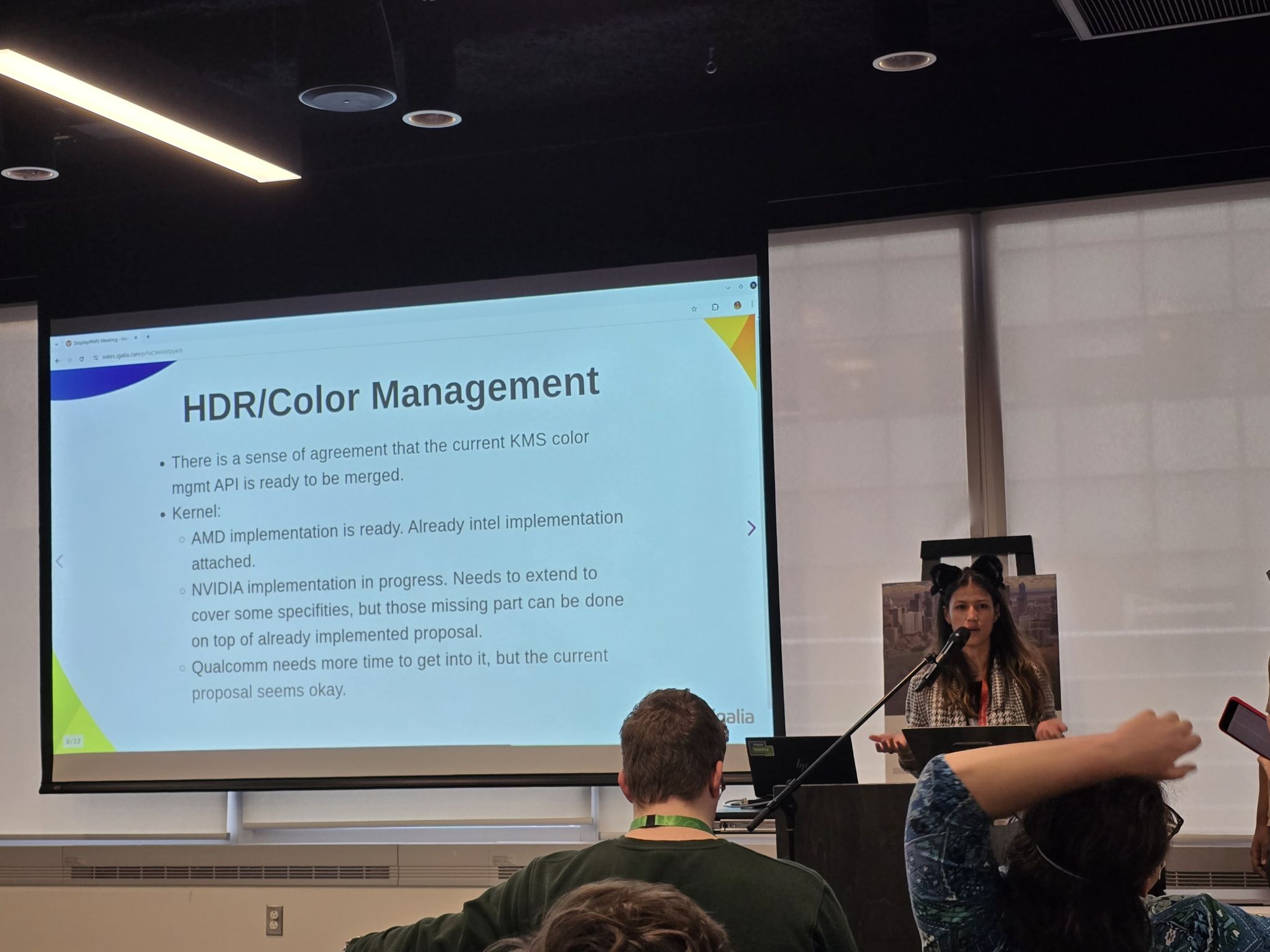
  • HDR/Color Management: Agreement on merging the current proposal, with NVIDIA implementing its special cases on VKMS and adding missing parts on top of Harry Wentland s (AMD) changes.
  • Display Mux: Collaborative design discussions focusing on compositor control and cross-sync considerations.
  • Better Commit Failure Feedback: Exploring ways to equip compositors with more detailed information for failure analysis.

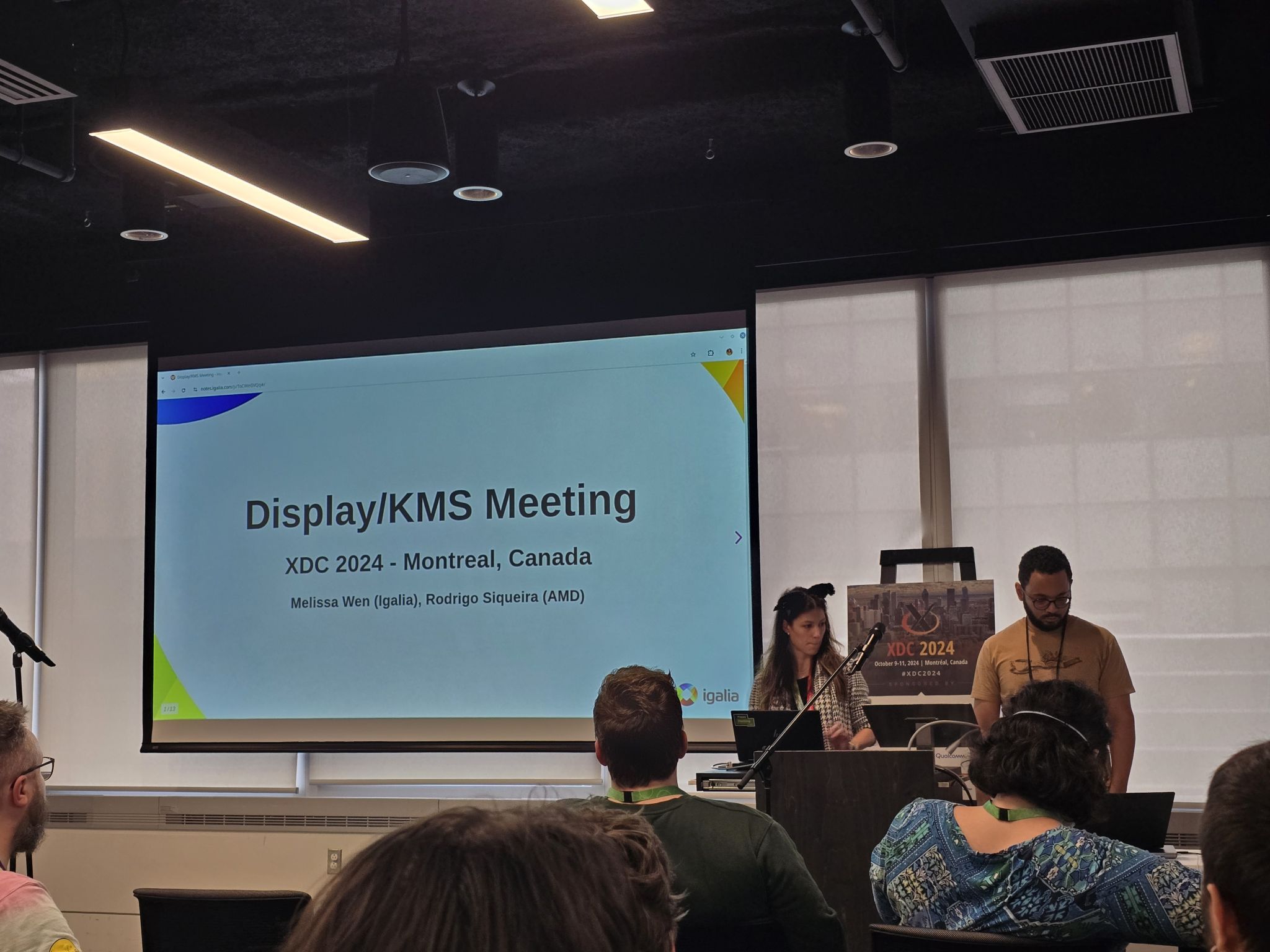
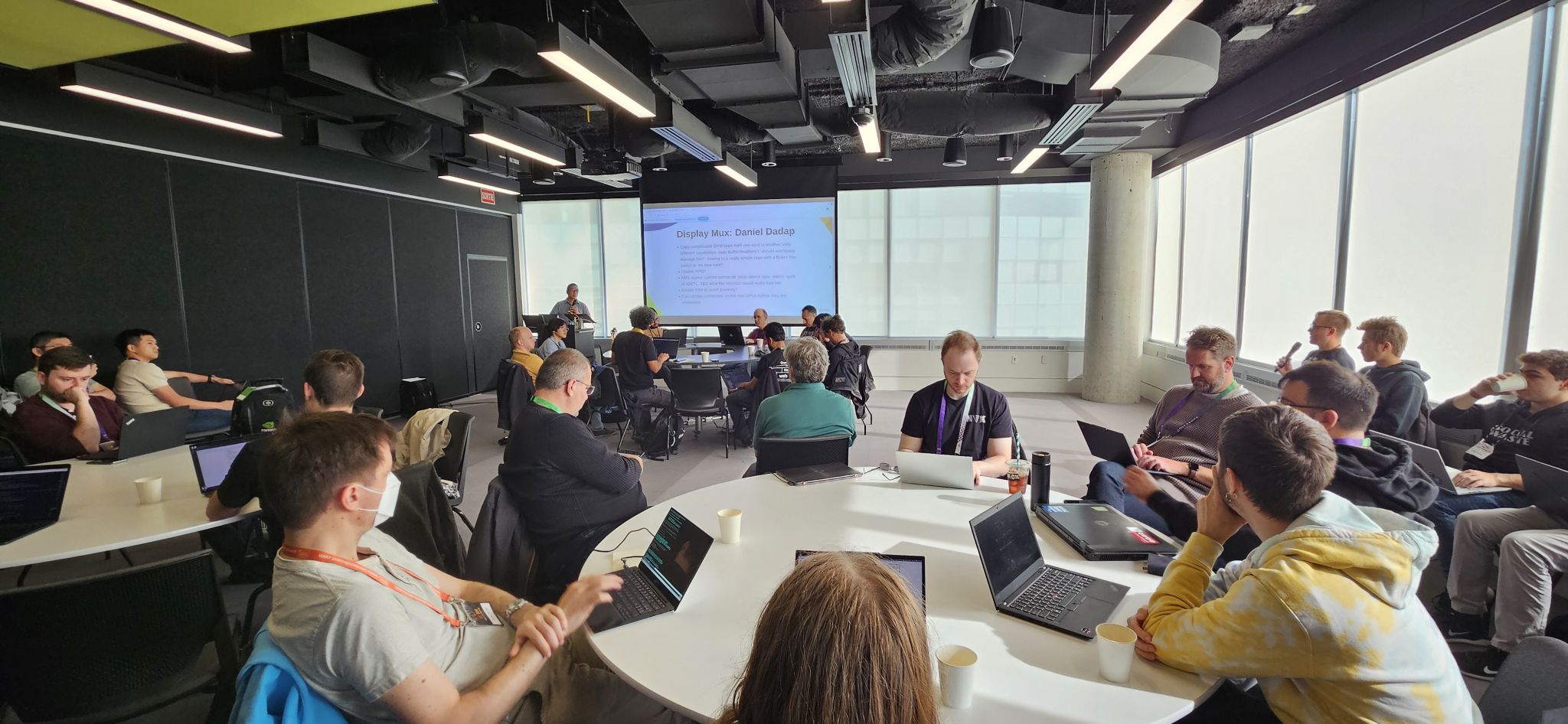
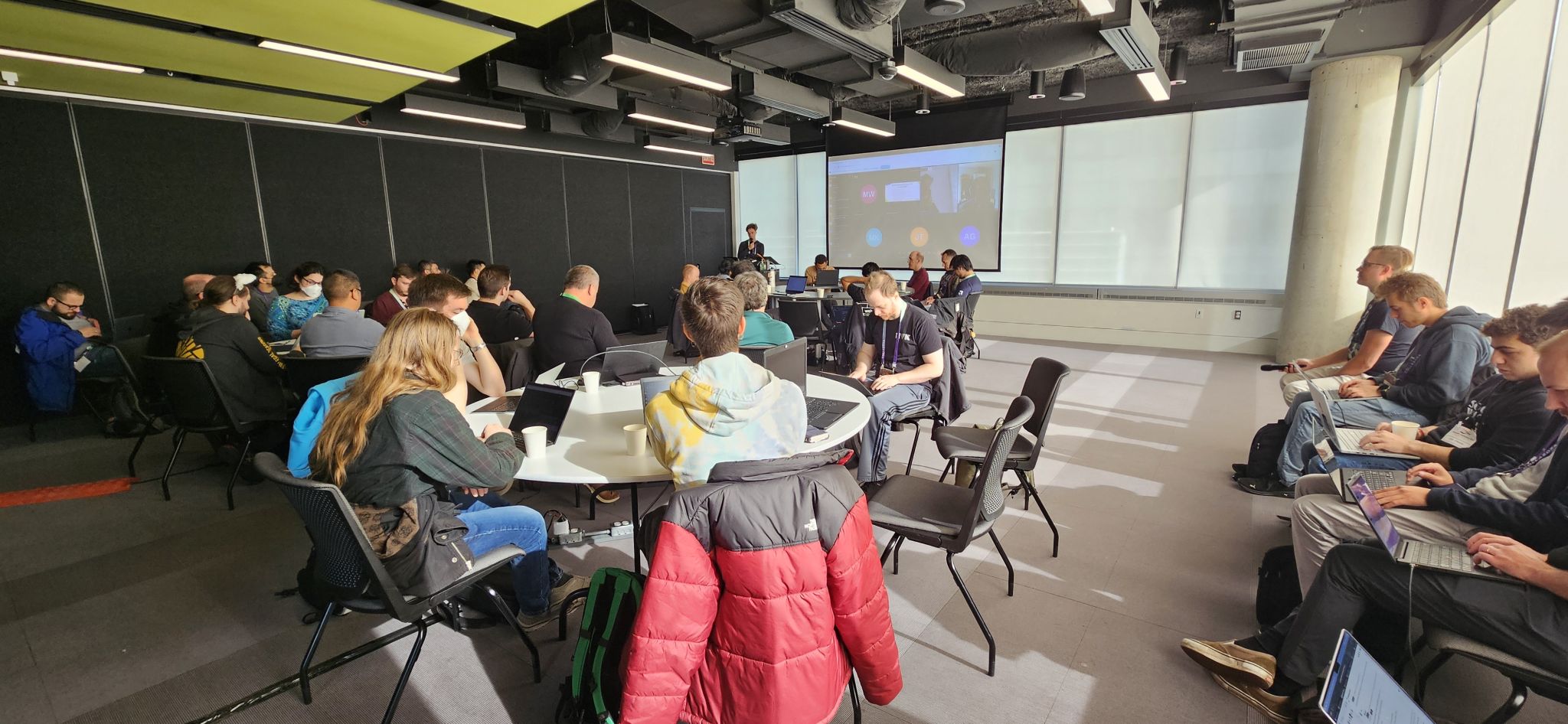
Bringing together Linux display developers in the XDC 2024 While I didn t present a talk this year, I co-organized a Display/KMS meeting (with Rodrigo Siqueira of AMD) to build upon the momentum from the 2024 Linux Display Next hackfest. The meeting was attended by around 30 people in person and 4 remote participants. Speakers: Melissa Wen (Igalia) and Rodrigo Siqueira (AMD) Link: https://indico.freedesktop.org/event/6/contributions/383/ Topics: Similar to the hackfest, the meeting agenda was built over the first two days of the conference and mixed talks follow-up with new ideas and ongoing community efforts. The final agenda covered five topics in the scheduled order:
  1. How to share drivers between V4L2 and DRM for bridge-like components (new topic);
  2. Real-time Scheduling (problems encountered after the Display Next hackfest);
  3. HDR/Color Management (ofc);
  4. Display Mux (from Display hackfest and XDC 2024 talk, bringing AMD and NVIDIA together);
  5. (Better) Commit Failure Feedback (continuing the last minute topic of the Display Next hackfest).

Unpacking the Topics Similar to the hackfest, the meeting agenda evolved over the conference. During the 3 hours of meeting, I coordinated the room and discussion rounds, and Rodrigo Siqueira took notes and also contacted key developers to provide a detailed report of the many topics discussed. From his notes, let s dive into the key discussions!

How to share drivers between V4L2 and KMS for bridge-like components. Led by Laurent Pinchart, we delved into the challenge of creating a unified driver for hardware devices (like scalers) that are used in both camera capture pipelines and display pipelines.
  • Problem Statement: How can we design a single kernel driver to handle devices that serve dual purposes in both V4L2 and DRM subsystems?
  • Potential Solutions:
    1. Multiple Compatible Strings: We could assign different compatible strings to the device tree node based on its usage in either the camera or display pipeline. However, this approach might raise concerns from device tree maintainers as it could be seen as a layer violation.
    2. Separate Abstractions: A single driver could expose the device to both DRM and V4L2 through separate abstractions: drm-bridge for DRM and V4L2 subdev for video. While simple, this approach requires maintaining two different abstractions for the same underlying device.
    3. Unified Kernel Abstraction: We could create a new, unified kernel abstraction that combines the best aspects of drm-bridge and V4L2 subdev. This approach offers a more elegant solution but requires significant design effort and potential migration challenges for existing hardware.

Real-Time Scheduling Challenges We have discussed real-time scheduling during this year Linux Display Next hackfest and, during the XDC 2024, Jonas Adahl brought up issues uncovered while progressing on this front.
  • Context: Non-blocking page-flips can, on rare occasions, take a long time and, for that reason, get a sigkill if the thread doing the atomic commit is a real-time schedule.
  • Action items:
    • Explore alternative backtraces during the busy wait (e.g., ftrace).
    • Investigate the maximum thread time in busy wait to reproduce issues faced by compositors. Tools like RTKit (mutter) can be used for better control (Michel D nzer can help with this setup).

HDR/Color Management This is a well-known topic with ongoing effort on all layers of the Linux Display stack and has been discussed online and in-person in conferences and meetings over the last years. Here s a breakdown of the key points raised at this meeting:
  • Talk: Color operations for Linux color pipeline on AMD devices: In the previous day, Alex Hung (AMD) presented the implementation of this API on AMD display driver.
  • NVIDIA Integration: While they agree with the overall proposal, NVIDIA needs to add some missing parts. Importantly, they will implement these on top of Harry Wentland s (AMD) proposal. Their specific requirements will be implemented on VKMS (Virtual Kernel Mode Setting driver) for further discussion. This VKMS implementation can benefit compositor developers by providing insights into NVIDIA s specific needs.
  • Other vendors: There is a version of the KMS API applied on Intel color pipeline. Apart from that, other vendors appear to be comfortable with the current proposal but lacks the bandwidth to implement it right now.
  • Upstream Patches: The relevant upstream patches were can be found here. [As humorously notes, this series is eagerly awaiting your Acked-by (approval)]
  • Compositor Side: The compositor developers have also made significant progress.
    • KDE has already implemented and validated the API through an experimental implementation in Kwin.
    • Gamescope currently uses a driver-specific implementation but has a draft that utilizes the generic version. However, some work is still required to fully transition away from the driver-specific approach. AP: work on porting gamescope to KMS generic API
    • Weston has also begun exploring implementation, and we might see something from them by the end of the year.
  • Kernel and Testing: The kernel API proposal is well-refined and meets the DRM subsystem requirements. Thanks to Harry Wentland effort, we already have the API attached to two hardware vendors and IGT tests, and, thanks to Xaver Hugl, a compositor implementation in place.
Finally, there was a strong sense of agreement that the current proposal for HDR/Color Management is ready to be merged. In simpler terms, everything seems to be working well on the technical side - all signs point to merging and shipping the DRM/KMS plane color management API!

Display Mux During the meeting, Daniel Dadap led a brainstorming session on the design of the display mux switching sequence, in which the compositor would arm the switch via sysfs, then send a modeset to the outgoing driver, followed by a modeset to the incoming driver.
  • Context:
  • Key Considerations:
    • HPD Handling: There was a general consensus that disabling HPD can be part of the sequence for internal panels and we don t need to focus on it here.
    • Cross-Sync: Ensuring synchronization between the compositor and the drivers is crucial. The compositor should act as the drm-master to coordinate the entire sequence, but how can this be ensured?
    • Future-Proofing: The design should not assume the presence of a mux. In future scenarios, direct sharing over DP might be possible.
  • Action points:
    • Sharing DP AUX: Explore the idea of sharing DP AUX and its implications.
    • Backlight: The backlight definition represents a problem in the mux switch context, so we should explore some of the current specs available for that.

Towards Better Commit Failure Feedback In the last part of the meeting, Xaver Hugl asked for better commit failure feedback.
  • Problem description: Compositors currently face challenges in collecting detailed information from the kernel about commit failures. This lack of granular data hinders their ability to understand and address the root causes of these failures.
To address this issue, we discussed several potential improvements:
  • Direct Kernel Log Access: One idea is to directly load relevant kernel logs into the compositor. This would provide more detailed information about the failure and potentially aid in debugging.
  • Finer-Grained Failure Reporting: We also explored the possibility of separating atomic failures into more specific categories. Not all failures are critical, and understanding the nature of the failure can help compositors take appropriate action.
  • Enhanced Logging: Currently, the dmesg log doesn t provide enough information for user-space validation. Raising the log level to capture more detailed information during failures could be a viable solution.
By implementing these improvements, we aim to equip compositors with the necessary tools to better understand and resolve commit failures, leading to a more robust and stable display system.

A Big Thank You! Huge thanks to Rodrigo Siqueira for these detailed meeting notes. Also, Laurent Pinchart, Jonas Adahl, Daniel Dadap, Xaver Hugl, and Harry Wentland for bringing up interesting topics and leading discussions. Finally, thanks to all the participants who enriched the discussions with their experience, ideas, and inputs, especially Alex Goins, Antonino Maniscalco, Austin Shafer, Daniel Stone, Demi Obenour, Jessica Zhang, Joan Torres, Leo Li, Liviu Dudau, Mario Limonciello, Michel D nzer, Rob Clark, Simon Ser and Teddy Li. This collaborative effort will undoubtedly contribute to the continued development of the Linux display stack. Stay tuned for future updates!

18 November 2024

Dirk Eddelbuettel: RcppArmadillo 14.2.0-1 on CRAN: New Upstream Minor

armadillo image Armadillo is a powerful and expressive C++ template library for linear algebra and scientific computing. It aims towards a good balance between speed and ease of use, has a syntax deliberately close to Matlab, and is useful for algorithm development directly in C++, or quick conversion of research code into production environments. RcppArmadillo integrates this library with the R environment and language and is widely used by (currently) 1191 other packages on CRAN, downloaded 37.2 million times (per the partial logs from the cloud mirrors of CRAN), and the CSDA paper (preprint / vignette) by Conrad and myself has been cited 603 times according to Google Scholar. Conrad released a minor version 14.2.0 a few days ago after we spent about two weeks with several runs of reverse-dependency checks covering corner cases. After a short delay at CRAN due to a false positive on a test, a package failing tests we also failed under the previous version, and some concern over new deprecation warnings _whem using the headers directly as _e.g. mlpack R package does we are now on CRAN. I noticed a missing feature under large 64bit word (for large floating-point matrices) and added an exporter for icube going to double to support the 64-bit integer range (as we already did, of course, for vectors and matrices). Changes since the last CRAN release are summarised below.

Changes in RcppArmadillo version 14.2.0-1 (2024-11-16)
  • Upgraded to Armadillo release 14.2.0 (Smooth Caffeine)
    • Faster handling of symmetric matrices by inv() and rcond()
    • Faster handling of hermitian matrices by inv(), rcond(), cond(), pinv(), rank()
    • Added solve_opts::force_sym option to solve() to force the use of the symmetric solver
    • More efficient handling of compound expressions by solve()
  • Added exporter specialisation for icube for the ARMA_64BIT_WORD case

Courtesy of my CRANberries, there is a diffstat report relative to previous release. More detailed information is on the RcppArmadillo page. Questions, comments etc should go to the rcpp-devel mailing list off the Rcpp R-Forge page. If you like this or other open-source work I do, you can sponsor me at GitHub.

This post by Dirk Eddelbuettel originated on his Thinking inside the box blog. Please report excessive re-aggregation in third-party for-profit settings.

17 November 2024

Russ Allbery: Review: Dark Deeds

Review: Dark Deeds, by Michelle Diener
Series: Class 5 #2
Publisher: Eclipse
Copyright: January 2016
ISBN: 0-6454658-4-4
Format: Kindle
Pages: 340
Dark Deeds is the second book of the self-published Class 5 science fiction romance series. It is a sequel to Dark Horse and will spoil the plot of that book, but it follows the romance series convention of switching to a new protagonist in the same universe and telling a loosely-connected story. Fiona, like Rose in the previous book, was kidnapped by the Tecran in one of their Class 5 ships, although that's not entirely obvious at the start of the story. The book opens with her working as a slave on a Garmman trading ship while its captain works up the nerve to have her killed. She's spared this fate when the ship is raided by Krik pirates. Some brave fast-talking, and a touch of honor among thieves, lets her survive the raid and be rescued by a pursuing Grih battleship, with a useful electronic gadget as a bonus. The author uses the nickname "Fee" for Fiona throughout this book and it was like nails on a chalkboard every time. I had to complain about that before getting into the review. If you've read Dark Horse, you know the formula: lone kidnapped human woman, major violations of the laws against mistreatment of sentient beings that have the Grih furious on her behalf, hunky Grih starship captain who looks like a space elf, all the Grih are fascinated by her musical voice, she makes friends with a secret AI... Diener found a formula that worked well enough that she tried it again, and it would not surprise me if the formula repeated through the series. You should not go into this book expecting to be surprised. That said, the formula did work the first time, and it largely does work again. I thoroughly enjoyed Dark Horse and wanted more, and this is more, delivered on cue. There are worse things, particularly if you're a Kindle Unlimited reader (I am not) and are therefore getting new installments for free. The Tecran fascination with kidnapping human women is explained sufficiently in Fiona's case, but I am mildly curious how Diener will keep justifying it through the rest of the series. (Maybe the formula will change, but I doubt it.) To give Diener credit, this is not a straight repeat of the first book. Fiona is similar to Rose but not identical; Rose had an unshakable ethical calm, and Fiona is more of a scrapper. The Grih are not stupid and, given the amount of chaos Rose unleashed in the previous book, treat the sudden appearance of another human woman with a great deal more caution and suspicion. Unfortunately, this also means far less of my favorite plot element of the first book: the Grih being constantly scandalized and furious at behavior the protagonist finds sadly unsurprising. Instead, this book has quite a bit more action. Dark Horse was mostly character interactions and tense negotiations, with most of the action saved for the end. Dark Deeds replaces a lot of the character work with political plots and infiltrating secret military bases and enemy ships. The AI (named Eazi this time) doesn't show up until well into the book and isn't as much of a presence as Sazo. Instead, there's a lot more of Fiona being drafted into other people's fights, which is entertaining enough while it's happening but which wasn't as delightful or memorable as Rose's story. The writing continues to be serviceable but not great. It's a bit cliched and a bit awkward. Also, Diener uses paragraph breaks for emphasis. It's hard to stop noticing it once you see it. Thankfully, once the story gets going and there's more dialogue, she tones that down, or perhaps I stopped noticing. It's that kind of book (and that kind of series): it's a bit rough to get started, but then there's always something happening, the characters involve a whole lot of wish-fulfillment but are still people I like reading about, and it's the sort of unapologetic "good guys win" type of light science fiction that is just the thing when one simply wants to be entertained. Once I get into the book, it's easy to overlook its shortcomings. I spent Dark Horse knowing roughly what would happen but wondering about the details. I spent Dark Deeds fairly sure of the details and wondering when they would happen. This wasn't as fun of an experience, but the details were still enjoyable and I don't regret reading it. I am hoping that the next book will be more of a twist, or will have a character more like Rose (or at least a character with a better nickname). Sort of recommended if you liked Dark Horse and really want more of the same. Followed by Dark Minds, which I have already purchased. Rating: 6 out of 10

14 November 2024

Stefano Zacchiroli: In memory of Lunar

In memory of Lunar I've had the incredible fortune to share the geek path of Lunar through life on multiple occasions. First, in Debian, beginning some 15+ years ago, where we were fellow developers and participated in many DebConf editions together. Then, on the deontology committee of Nos Oignons, a non-profit organization initiated by Lunar to operate Tor relays in France. This was with the goal of diversifying relay operators and increasing access to censorship-resistance technology for everyone in the world. It was something truly innovative and unheard of at the time in France. Later, as a member of the steering committee of Reproducible Builds, a project that Lunar brought to widespread geek popularity with a seminal "Birds of a Feather" session at DebConf13 (and then many other talks with fellow members of the project in the years to come). A decade later, Reproducible Builds is having a major impact throughout the software industry, primarily due to growing fears about the security of the software supply chain. Finally, we had the opportunity to recruit Lunar a couple of years ago at Software Heritage, where he insisted on working until he was able to, as part of a team he loved, and that loved him back. In addition to his numerous technical contributions to the initiative, he also facilitated our first ever multi-day team seminar. The event was so successful that it has been confirmed as a long-awaited yearly recurrence by all team members. I fondly remember one of the last conversations I had with Lunar, a few months ago, when he told me how proud he was not only of having started Nos Oignons and contributed to the ignition of Reproducible Builds, but specifically about the fact that both initiatives were now thriving without being dependent on him. He was likely thinking about a future world without him, but also realizing how impactful his activism had been on the past and present world. Lunar changed the world for the better and left behind a trail of love and fond memories. Che la terra ti sia lieve, compagno. --- Zack

12 November 2024

Paul Tagliamonte: Complex for Whom?

In basically every engineering organization I ve ever regarded as particularly high functioning, I ve sat through one specific recurring conversation which is not a conversation about complexity . Things are good or bad because they are or aren t complex, architectures needs to be redone because it s too complex some refactor of whatever it is won t work because it s too complex. You may have even been a part of some of these conversations or even been the one advocating for simple light-weight solutions. I ve done it. Many times. Rarely, if ever, do we talk about complexity within its rightful context complexity for whom. Is a solution complex because it s complex for the end user? Is it complex if it s complex for an API consumer? Is it complex if it s complex for the person maintaining the API service? Is it complex if it s complex for someone outside the team maintaining it to understand? Complexity within a problem domain I ve come to believe, is fairly zero-sum there s a fixed amount of complexity in the problem to be solved, and you can choose to either solve it, or leave it for those downstream of you to solve that problem on their own. That being said, while I believe there is a lower bound in complexity to contend with for a problem, I do not believe there is an upper bound to the complexity of solutions possible. It is always possible, and in fact, very likely that teams create problems for themselves while trying to solve a problem. The rest of this post is talking to the lower bound. When getting feedback on an early draft of this blog post, I ve been informed that Fred Brooks coined a term for what I call lower bound complexity Essential Complexity , in the paper No Silver Bullet Essence and Accident in Software Engineering , which is a better term and can be used interchangeably.

Complexity Culture In a large enough organization, where the team is high functioning enough to have and maintain trust amongst peers, members of the team will specialize. People will begin to engage with subsets of the work to be done, and begin to have their efficacy measured against that part of the organization s problems. Incentives shift, and over time it becomes increasingly likely that two engineers may have two very different priorities when working on the same system together. Someone accountable for uptime and tasked with responding to outages will begin to resist changes. Someone accountable for rapidly delivering features will resist gates between them and their users. Companies (either wittingly or unwittingly) will deal with this by tasking engineers with both production (feature development) and operational tasks (maintenance), so the difference in incentives isn t usually as bad as it could be. When we get a bunch of folks from far-flung corners of an organization in a room, fire up a slide deck and throw up some aspirational to-be architecture diagram in order to get a sign-off to solve some problem (be it someone needs a credible promotion packet, new feature needs to get delivered, or the system has begun to fail and needs fixing), the initial reaction will, more often than I d like, start to devolve into a discussion of how this is going to introduce a bunch of complexity, going to be hard to maintain, why can t you make it less complex? Right around here is when I start to try and contextualize the conversation happening around me understand what complexity is that being discussed, and understand who is taking on that burden. Think about who should be owning that problem, and work through the tradeoffs involved. Is it best solved here, or left to consumers (be them other systems, developers, or users). Should something become an API call s optional param, taking on all the edge-cases and on, or should users have to implement the logic using the data you return (leaving everyone else to take on all the edge-cases and maintenance)? Should you process the data, or require the user to preprocess it for you? Frequently it s right to make an active and explicit decision to simplify and leave problems to be solved downstream, since they may not actually need to be solved or perhaps you expect consumers will want to own the specifics of how the problem is solved, in which case you leave lots of documentation and examples. Many other times, especially when it s something downstream consumers are likely to hit, it s best solved internal to the system, since the only thing that can come of leaving it unsolved are bugs, frustration and half-correct solutions. This is a grey-space of tradeoffs, not a clear decision tree. No one wants the software manifestation of a katamari ball or a junk drawer, nor does anyone want a half-baked service unable to handle the simplest use-case.

Head-in-sand as a Service Popoffs about how complex something is, are, to a first approximation, best understood as meaning complicated for the person making comments . A lot of the #thoughtleadership believe that an AWS hosted EKS k8s cluster running images built by CI talking to an AWS hosted PostgreSQL RDS is not complex. They re right. Mostly right. This is less complex less complex for them. It s not, however, without complexity and its own tradeoffs it s just complexity that they do not have to deal with. Now they don t have to maintain machines that have pesky operating systems or hard drive failures. They don t have to deal with updating the version of k8s, nor ensuring the backups work. No one has to push some artifact to prod manually. Deployments happen unattended. You click a button and get a cluster. On the other hand, developers outside the ops function need to deal with troubleshooting CI, debugging access control rules encoded in turing complete YAML, permissions issues inside the cluster due to whatever the fuck a service mesh is, everyone needs to learn how to use some k8s tools they only actually use during a bad day, likely while doing some x.509 troubleshooting to connect to the cluster (an internal only endpoint; just port forward it) not to mention all sorts of rules to route packets to their project (a single repo s binary being run in 3 containers on a single vm host). Beyond that, there s the invisible complexity complexity on the interior of a service you depend on. I think about the dozens of teams maintaining the EKS service (which is either run on EC2 instances, or alternately, EC2 instances in a trench coat, moustache and even more shell scripts), the RDS service (also EC2 and shell scripts, but this time accounting for redundancy, backups, availability zones), scores of hypervisors pulled off the shelf (xen, kvm) smashed together with the ones built in-house (firecracker, nitro, etc) running on hardware that has to be refreshed and maintained continuously. Every request processed by network ACL rules, AWS IAM rules, security group rules, using IP space announced to the internet wired through IXPs directly into ISPs. I don t even want to begin to think about the complexity inherent in how those switches are designed. Shitloads of complexity to solve problems you may or may not have, or even know you had. What s more complex? An app running in an in-house 4u server racked in the office s telco closet in the back running off the office Verizon line, or an app running four hypervisors deep in an AWS datacenter? Which is more complex to you? What about to your organization? In total? Which is more prone to failure? Which is more secure? Is the complexity good or bad? What type of Complexity can you manage effectively? Which threaten the system? Which threaten your users?

COMPLEXIVIBES This extends beyond Engineering. Decisions regarding what tools are we able to use be them existing contracts with cloud providers, CIO mandated SaaS products, a list of the only permissible open source projects will incur costs in terms of expressed complexity . Pinning open source projects to a fixed set makes SBOM production less complex . Using only one SaaS provider s product suite (even if its terrible, because it has all the types of tools you need) makes accreditation less complex . If all you have is a contract with Pauly T s lowest price technically acceptable artisinal cloudary and haberdashery, the way you pay for your compute is less complex for the CIO shop, though you will find yourself building your own hosted database template, mechanism to spin up a k8s cluster, and all the operational and technical burden that comes with it. Or you won t and make it everyone else s problem in the organization. Nothing you can do will solve for the fact that you must now deal with this problem somewhere because it was less complicated for the business to put the workloads on the existing contract with a cut-rate vendor. Suddenly, the decision to reduce complexity because of an existing contract vehicle has resulted in a huge amount of technical risk and maintenance burden being onboarded. Complexity you would otherwise externalize has now been taken on internally. With a large enough organizations (specifically, in this case, i m talking about you, bureaucracies), this is largely ignored or accepted as normal since the personnel cost is understood to be free to everyone involved. Doing it this way is more expensive, more work, less reliable and less maintainable, and yet, somehow, is, in a lot of ways, less complex to the organization. It s particularly bad with bureaucracies, since screwing up a contract will get you into much more trouble than delivering a broken product, leaving basically no reason for anyone to care to fix this. I can t shake the feeling that for every story of technical mandates gone awry, somewhere just out of sight there s a decisionmaker optimizing for what they believe to be the least amount of complexity least hassle, fewest unique cases, most consistency as they can. They freely offload complexity from their accreditation and risk acceptance functions through mandates. They will never have to deal with it. That does not change the fact that someone does.

TC;DR (TOO COMPLEX; DIDN T REVIEW) We wish to rid ourselves of systemic Complexity after all, complexity is bad, simplicity is good. Removing upper-bound own-goal complexity ( accidental complexity in Brooks s terms) is important, but once you hit the lower bound complexity, the tradeoffs become zero-sum. Removing complexity from one part of the system means that somewhere else maybe outside your organization or in a non-engineering function must grow it back. Sometimes, the opposite is the case, such as when a previously manual business processes is automated. Maybe that s a good idea. Maybe it s not. All I know is that what doesn t help the situation is conflating complexity with everything we don t like legacy code, maintenance burden or toil, cost, delivery velocity.
  • Complexity is not the same as proclivity to failure. The most reliable systems I ve interacted with are unimaginably complex, with layers of internal protection to prevent complete failure. This has its own set of costs which other people have written about extensively.
  • Complexity is not cost. Sometimes the cost of taking all the complexity in-house is less, for whatever value of cost you choose to use.
  • Complexity is not absolute. Something simple from one perspective may be wildly complex from another. The impulse to burn down complex sections of code is helpful to have generally, but sometimes things are complicated for a reason, even if that reason exists outside your codebase or organization.
  • Complexity is not something you can remove without introducing complexity elsewhere. Just as not making a decision is a decision itself; choosing to require someone else to deal with a problem rather than dealing with it internally is a choice that needs to be considered in its full context.
Next time you re sitting through a discussion and someone starts to talk about all the complexity about to be introduced, I want to pop up in the back of your head, politely asking what does complex mean in this context? Is it lower bound complexity? Is this complexity desirable? Is what they re saying mean something along the lines of I don t understand the problems being solved, or does it mean something along the lines of this problem should be solved elsewhere? Do they believe this will result in more work for them in a way that you don t see? Should this not solved at all by changing the bounds of what we should accept or redefine the understood limits of this system? Is the perceived complexity a result of a decision elsewhere? Who s taking this complexity on, or more to the point, is failing to address complexity required by the problem leaving it to others? Does it impact others? How specifically? What are you not seeing? What can change? What should change?

Freexian Collaborators: Monthly report about Debian Long Term Support, October 2024 (by Roberto C. S nchez)

Like each month, have a look at the work funded by Freexian s Debian LTS offering.

Debian LTS contributors In October, 20 contributors have been paid to work on Debian LTS, their reports are available:
  • Abhijith PA did 6.0h (out of 7.0h assigned and 7.0h from previous period), thus carrying over 8.0h to the next month.
  • Adrian Bunk did 15.0h (out of 87.0h assigned and 13.0h from previous period), thus carrying over 85.0h to the next month.
  • Arturo Borrero Gonzalez did 10.0h (out of 10.0h assigned).
  • Bastien Roucari s did 20.0h (out of 20.0h assigned).
  • Ben Hutchings did 4.0h (out of 0.0h assigned and 4.0h from previous period).
  • Chris Lamb did 18.0h (out of 18.0h assigned).
  • Daniel Leidert did 29.0h (out of 26.0h assigned and 3.0h from previous period).
  • Emilio Pozuelo Monfort did 60.0h (out of 23.5h assigned and 36.5h from previous period).
  • Guilhem Moulin did 7.5h (out of 19.75h assigned and 0.25h from previous period), thus carrying over 12.5h to the next month.
  • Lee Garrett did 15.25h (out of 0.0h assigned and 60.0h from previous period), thus carrying over 44.75h to the next month.
  • Lucas Kanashiro did 10.0h (out of 10.0h assigned and 10.0h from previous period), thus carrying over 10.0h to the next month.
  • Markus Koschany did 40.0h (out of 40.0h assigned).
  • Ola Lundqvist did 14.5h (out of 6.5h assigned and 17.5h from previous period), thus carrying over 9.5h to the next month.
  • Roberto C. S nchez did 9.75h (out of 24.0h assigned), thus carrying over 14.25h to the next month.
  • Santiago Ruano Rinc n did 23.5h (out of 25.0h assigned), thus carrying over 1.5h to the next month.
  • Sean Whitton did 6.25h (out of 1.0h assigned and 5.25h from previous period).
  • Stefano Rivera did 1.0h (out of 0.0h assigned and 10.0h from previous period), thus carrying over 9.0h to the next month.
  • Sylvain Beucler did 9.5h (out of 16.0h assigned and 44.0h from previous period), thus carrying over 50.5h to the next month.
  • Thorsten Alteholz did 11.0h (out of 11.0h assigned).
  • Tobias Frost did 10.5h (out of 12.0h assigned), thus carrying over 1.5h to the next month.

Evolution of the situation In October, we have released 35 DLAs. Some notable updates prepared in October include denial of service vulnerability fixes in nss, regression fixes in apache2, multiple fixes in php7.4, and new upstream releases of firefox-esr, openjdk-17, and opendk-11. Additional contributions were made for the stable Debian 12 bookworm release by several LTS contributors. Arturo Borrero Gonzalez prepared a parallel update of nss, Bastien Roucari s prepared a parallel update of apache2, and Santiago Ruano Rinc n prepared updates of activemq for both LTS and Debian stable. LTS contributor Bastien Roucari s undertook a code audit of the cacti package and in the process discovered three new issues in node-dompurity, which were reported upstream and resulted in the assignment of three new CVEs. As always, the LTS team continues to work towards improving the overall sustainability of the free software base upon which Debian LTS is built. We thank our many committed sponsors for their ongoing support.

Thanks to our sponsors Sponsors that joined recently are in bold.

11 November 2024

Dirk Eddelbuettel: RcppSpdlog 0.0.19 on CRAN: New Upstream, New Features

Version 0.0.19 of RcppSpdlog arrived on CRAN early this morning and has been uploaded to Debian. RcppSpdlog bundles spdlog, a wonderful header-only C++ logging library with all the bells and whistles you would want that was written by Gabi Melman, and also includes fmt by Victor Zverovich. You can learn more at the nice package documention site. This releases updates the code to the version 1.15.0 of spdlog which was released on Saturday, and contains fmt 11.0.2. It also contains a contributed PR which allows use std::format under C++20, bypassing fmt (with some post-merge polish too), and another PR correcting a documentation double-entry. The NEWS entry for this release follows.

Changes in RcppSpdlog version 0.0.19 (2024-11-10)
  • Support use of std::format under C++20 via opt-in define instead of fmt (Xanthos Xanthopoulos in #19)
  • An erroneous duplicate log=level documentation level was removed (Contantinos Giachalis in #20)
  • Upgraded to upstream release spdlog 1.15.0 (Dirk in #21)
  • Partially revert / simplify src/formatter.cpp accomodating both #19 and previous state (Dirk in #21)

Courtesy of my CRANberries, there is also a diffstat report. More detailed information is on the RcppSpdlog page, or the package documention site. If you like this or other open-source work I do, you can sponsor me at GitHub.

This post by Dirk Eddelbuettel originated on his Thinking inside the box blog. Please report excessive re-aggregation in third-party for-profit settings.

10 November 2024

Dirk Eddelbuettel: inline 0.3.20: Mostly Maintenance

A new release of the inline package got to CRAN today marking the first release in three and half years. inline facilitates writing code in-line in simple string expressions or short files. The package was used quite extensively by Rcpp in the very early days before Rcpp Attributes arrived on the scene providing an even better alternative for its use cases. inline is still used by rstan and a number of other packages. This release was tickled by changing in r-devel just this week, and the corresponding please fix or else email I received this morning. R_NO_REMAP is now the default in r-devel, and while we had already converted most (old-style) calls into the API to using the now mandatory Rf_ prefix, the package contained few remaining cases in examples as well as one in code generation. The release also contains a helpful contributed PR making an error message a little clearer, plus several small and common maintenance changed around continuous integration, package layout and the repository. The NEWS extract follows and details the changes some more.

Changes in inline version 0.3.20 (2024-11-10)
  • Error message formatting is improved for compileCode (Alexis Derumigny in #25)
  • Switch to using Authors@R, other general packaging maintenance for continuous integration and repository
  • Use Rf_ in a handful of cases as R-devel now mandates it

Thanks to my CRANberries, you can also look at a diff to the previous release Questions, comments etc should go to the rcpp-devel mailing list off the R-Forge page. Bugs reports are welcome at the GitHub issue tracker as well (where one can also search among open or closed issues). If you like this or other open-source work I do, you can sponsor me at GitHub.

This post by Dirk Eddelbuettel originated on his Thinking inside the box blog. Please report excessive re-aggregation in third-party for-profit settings.

Reproducible Builds: Reproducible Builds in October 2024

Welcome to the October 2024 report from the Reproducible Builds project. Our reports attempt to outline what we ve been up to over the past month, highlighting news items from elsewhere in tech where they are related. As ever, if you are interested in contributing to the project, please visit our Contribute page on our website. Table of contents:
  1. Beyond bitwise equality for Reproducible Builds?
  2. Two Ways to Trustworthy at SeaGL 2024
  3. Number of cores affected Android compiler output
  4. On our mailing list
  5. diffoscope
  6. IzzyOnDroid passed 25% reproducible apps
  7. Distribution work
  8. Website updates
  9. Reproducibility testing framework
  10. Supply-chain security at Open Source Summit EU
  11. Upstream patches

Beyond bitwise equality for Reproducible Builds? Jens Dietrich, Tim White, of Victoria University of Wellington, New Zealand along with Behnaz Hassanshahi and Paddy Krishnan of Oracle Labs Australia published a paper entitled Levels of Binary Equivalence for the Comparison of Binaries from Alternative Builds :
The availability of multiple binaries built from the same sources creates new challenges and opportunities, and raises questions such as: Does build A confirm the integrity of build B? or Can build A reveal a compromised build B? . To answer such questions requires a notion of equivalence between binaries. We demonstrate that the obvious approach based on bitwise equality has significant shortcomings in practice, and that there is value in opting for alternative notions. We conceptualise this by introducing levels of equivalence, inspired by clone detection types.
A PDF of the paper is freely available.

Two Ways to Trustworthy at SeaGL 2024 On Friday 8th November, Vagrant Cascadian will present a talk entitled Two Ways to Trustworthy at SeaGL in Seattle, WA. Founded in 2013, SeaGL is a free, grassroots technical summit dedicated to spreading awareness and knowledge about free source software, hardware and culture. Vagrant s talk:
[ ] delves into how two project[s] approaches fundamental security features through Reproducible Builds, Bootstrappable Builds, code auditability, etc. to improve trustworthiness, allowing independent verification; trustworthy projects require little to no trust. Exploring the challenges that each project faces due to very different technical architectures, but also contextually relevant social structure, adoption patterns, and organizational history should provide a good backdrop to understand how different approaches to security might evolve, with real-world merits and downsides.

Number of cores affected Android compiler output Fay Stegerman wrote that the cause of the Android toolchain bug from September s report that she reported to the Android issue tracker has been found and the bug has been fixed.
the D8 Java to DEX compiler (part of the Android toolchain) eliminated a redundant field load if running the class s static initialiser was known to be free of side effects, which ended up accidentally depending on the sharding of the input, which is dependent on the number of CPU cores used during the build.
To make it easier to understand the bug and the patch, Fay also made a small example to illustrate when and why the optimisation involved is valid.

On our mailing list On our mailing list this month:

diffoscope diffoscope is our in-depth and content-aware diff utility that can locate and diagnose reproducibility issues. This month, Chris Lamb made the following changes, including preparing and uploading versions 279, 280, 281 and 282 to Debian:
  • Ignore errors when listing .ar archives (#1085257). [ ]
  • Don t try and test with systemd-ukify in the Debian stable distribution. [ ]
  • Drop Depends on the deprecated python3-pkg-resources (#1083362). [ ]
In addition, Jelle van der Waa added support for Unified Kernel Image (UKI) files. [ ][ ][ ] Furthermore, Vagrant Cascadian updated diffoscope in GNU Guix to version 282. [ ][ ]

IzzyOnDroid passed 25% reproducible apps The IzzyOnDroid project has reached a good milestone by reaching over 25% of the ~1,200 Android apps provided by their repository (of official APKs built by the original application developers) having been confirmed to be reproducible by a rebuilder.

Distribution work In Debian this month:
  • Holger Levsen uploaded devscripts version 2.24.2, including many changes to the debootsnap, debrebuild and reproducible-check scripts. This is the first time that debrebuild actually works (using sbuild s unshare backend). As part of this, Holger also fixed an issue in the reproducible-check script where a typo in the code led to incorrect results [ ]
  • Recently, a news entry was added to snapshot.debian.org s homepage, describing the recent changes that made the system stable again:
    The new server has no problems keeping up with importing the full archives on every update, as each run finishes comfortably in time before it s time to run again. [While] the new server is the one doing all the importing of updated archives, the HTTP interface is being served by both the new server and one of the VM s at LeaseWeb.
    The entry list a number of specific updates surrounding the API endpoints and rate limiting.
  • Lastly, 12 reviews of Debian packages were added, 3 were updated and 18 were removed this month adding to our knowledge about identified issues.
Elsewhere in distribution news, Zbigniew J drzejewski-Szmek performed another rebuild of Fedora 42 packages, with the headline result being that 91% of the packages are reproducible. Zbigniew also reported a reproducibility problem with QImage. Finally, in openSUSE, Bernhard M. Wiedemann published another report for that distribution.

Website updates There were an enormous number of improvements made to our website this month, including:
  • Alba Herrerias:
    • Improve consistency across distribution-specific guides. [ ]
    • Fix a number of links on the Contribute page. [ ]
  • Chris Lamb:
  • hulkoba
  • James Addison:
    • Huge and significant work on a (as-yet-merged) quickstart guide to be linked from the homepage [ ][ ][ ][ ][ ]
    • On the homepage, link directly to the Projects subpage. [ ]
    • Relocate dependency-drift notes to the Volatile inputs page. [ ]
  • Ninette Adhikari:
    • Add a brand new Success stories page that highlights the success stories of Reproducible Builds, showcasing real-world examples of projects shipping with verifiable, reproducible builds . [ ][ ][ ][ ][ ][ ]
  • Pol Dellaiera:
    • Update the website s README page for building the website under NixOS. [ ][ ][ ][ ][ ]
    • Add a new academic paper citation. [ ]
Lastly, Holger Levsen filed an extensive issue detailing a request to create an overview of recommendations and standards in relation to reproducible builds.

Reproducibility testing framework The Reproducible Builds project operates a comprehensive testing framework running primarily at tests.reproducible-builds.org in order to check packages and other artifacts for reproducibility. In October, a number of changes were made by Holger Levsen, including:
  • Add a basic index.html for rebuilderd. [ ]
  • Update the nginx.conf configuration file for rebuilderd. [ ]
  • Document how to use a rescue system for Infomaniak s OpenStack cloud. [ ]
  • Update usage info for two particular nodes. [ ]
  • Fix up a version skew check to fix the name of the riscv64 architecture. [ ]
  • Update the rebuilderd-related TODO. [ ]
In addition, Mattia Rizzolo added a new IP address for the inos5 node [ ] and Vagrant Cascadian brought 4 virt nodes back online [ ].

Supply-chain security at Open Source Summit EU The Open Source Summit EU took place recently, and covered plenty of topics related to supply-chain security, including:

Upstream patches The Reproducible Builds project detects, dissects and attempts to fix as many currently-unreproducible packages as possible. We endeavour to send all of our patches upstream where appropriate. This month, we wrote a large number of such patches, including:

Finally, If you are interested in contributing to the Reproducible Builds project, please visit our Contribute page on our website. However, you can get in touch with us via:

9 November 2024

Jonathan Dowland: Progressively enhancing CGI apps with htmx

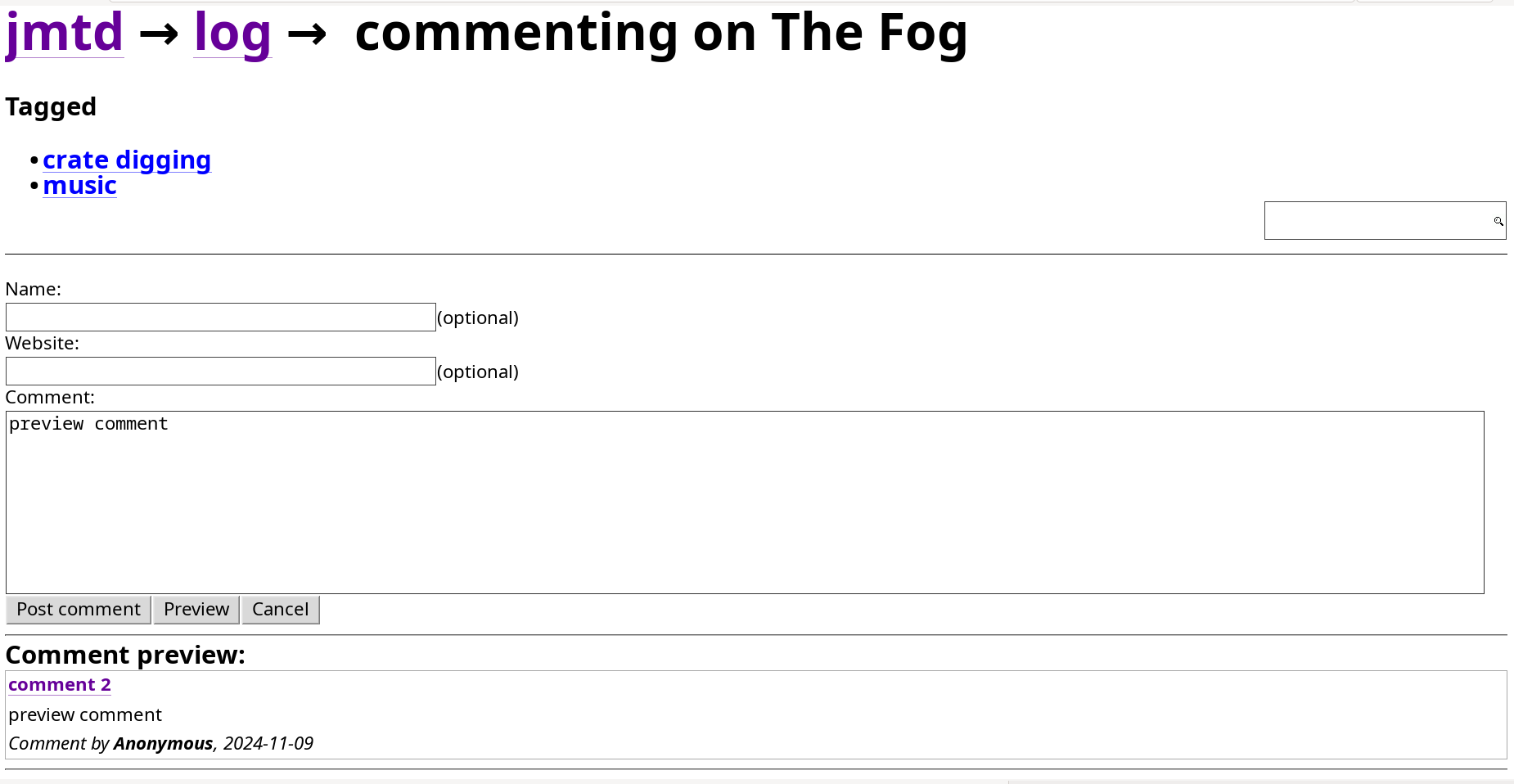
I was interested in learning about htmx, so I used it to improve the experience of posting comments on my blog. It seems much of modern web development is structured around having a JavaScript program on the front-end (browser) which exchanges data encoded in JSON asynchronously with the back-end servers. htmx uses a novel (or throwback) approach: it asynchronously fetches snippets of HTML from the back-end, and splices the results into the live page. For example, a htmx-powered button may request a URI on the server, receive HTML in response, and then the button itself would be replaced by the resulting HTML, within the page. I experimented with incorporating it into an existing, old-school CGI web app: IkiWiki, which I became a co-maintainer of this year, and powers my blog. Throughout this project I referred to the excellent book Server-Driven Web Apps with htmx. Comment posting workflow I really value blog comments, but the UX for posting them on my blog was a bit clunky. It went like this:
  1. you load a given page (such as this blog post), which is a static HTML document. There's a link to add a comment to the page.
  2. The link loads a new page which is generated dynamically and served back to you via CGI. This contains a HTML form for you to write your comment.
  3. The form submits to the server via HTTP POST. IkiWiki validates the form content. Various static pages (in particular the one you started on, in Step 1) are regenerated.
  4. the server response to the request in (3) is a HTTP 302 redirect, instructing the browser to go back to the page in Step 1.
First step: fetching a comment form First, I wanted the "add a comment" link to present the edit box in the current page. This step was easiest: add four attributes to the "comment on this page" anchor tag:
hx-get="<CGI ENDPOINT GOES HERE>"
suppresses the normal behaviour of the tag, so clicking on it doesn't load a new page.
issues an asynchronous HTTP GET to the CGI end-point, which returns the full HTML document for the comment edit form
hx-select=".editcomment form"
extract the edit-comment form from within that document
hx-swap=beforeend and hx-target=".addcomment"
append (courtesy of beforeend) the form into the source page after the "add comment" anchor tag (.addcomment)
Now, clicking "comment on this page" loads in the edit-comment box below it without moving you away from the source page. All that without writing any new code! Second step: handling previews
The old Preview Comment page The old Preview Comment page
In the traditional workflow, clicking on "Preview" loaded a new page containing the edit form (but not the original page or any existing comments) with a rendering of the comment-in-progress below it. I wasn't originally interested in supporting the "Preview" feature, but I needed to for reasons I'll explain later. Rather than load new pages, I wanted "Preview" to insert a rendering of the comment-in-progress being inserted into the current page's list of comments, marked up to indicate that it's a preview. IkiWiki provides some templates which you can override to customise your site. I've long overridden page.tmpl, the template used for all pages. I needed to add a new empty div tag in order to have a "hook" to target with the previewed comment. The rest of this was achieved with htmx attributes on the "Preview" button, similar to in the last step: hx-post to define a target URI when you click the button (and specify HTTP POST); hx-select to filter the resulting HTML and extract the comment; hx-target to specify where to insert it. Now, clicking "Preview" does not leave the current page, but fetches a rendering of your comment-in-progress, and splices it into the comment list, appropriately marked up to be clear it's a preview. Third step: handling submitted comments IkiWiki is highly configurable, and many different things could happen once you post a comment. On my personal blog, all comments are held for moderation before they are published. The page you were served after submitting a comment was rather bare-bones, a status message "Your comment will be posted after moderator review", without the original page content or comments. I wanted your comment to appear in the page immediately, albeit marked up to indicate it was awaiting review. Since the traditional workflow didn't render or present your comment to you, I had to cheat. handling moderated comments
Moderation message upon submitting a comment Moderation message upon submitting a comment
One of my goals with this project was not to modify IkiWiki itself. I had to break this rule for moderated comments. When returning the "comment is moderated" page, IkiWiki uses HTTP status code 200, the same as for other scenarios. I wrote a tiny patch to return HTTP 202 (Accepted, but not processed) instead. I now have to write some actual JavaScript. htmx emits the htmx:beforeSwap event after an AJAX call returns, but before the corresponding swap is performed. I wrote a function that is triggered on this event, filters for HTTP 202 responses, triggers the "Preview" button, and then alters the result to indicate a moderated, rather than previewed, comment. (That's why I bothered to implement previews). You can read the full function here: jon.js. Summary I've done barely any front-end web development for years and I found working with htmx to be an enjoyable experience. You can leave a comment on this very blog post if you want to see it in action. I couldn't resist adding an easter egg: Brownie points if you can figure out what it is. Adding htmx to an existing CGI-based website let me improve one of the workflows in a gracefully-degrading way (without JavaScript, the old method will continue to work fine) without modifying the existing application itself (well, almost) and without having to write very much code of my own at all: nearly all of the configuration was declarative.

8 November 2024

Freexian Collaborators: Debian Contributions: October s report (by Anupa Ann Joseph)

Debian Contributions: 2024-10 Contributing to Debian is part of Freexian s mission. This article covers the latest achievements of Freexian and their collaborators. All of this is made possible by organizations subscribing to our Long Term Support contracts and consulting services.

rebootstrap, by Helmut Grohne After significant changes earlier this year, the state of architecture cross bootstrap is normalizing again. More and more architectures manage to complete rebootstrap testing successfully again. Here are two examples of what kind of issues the bootstrap testing identifies. At some point, libpng1.6 would fail to cross build on musl architectures whereas it would succeed on other ones failing to locate zlib. Adding --debug-find to the cmake invocation eventually revealed that it would fail to search in /usr/lib/<triplet>, which is the default library path. This turned out to be a bug in cmake assuming that all linux systems use glibc. libpng1.6 also gained a baseline violation for powerpc and ppc64 by enabling the use of AltiVec there. The newt package would fail to cross build for many 32-bit architectures whereas it would succeed for armel and armhf due to -Wincompatible-pointer-types. It turns out that this flag was turned into -Werror and it was compiling with a warning earlier. The actual problem is a difference in signedness between wchar_t and FriBidChar (aka uint32_t) and actually affects native building on i386.

Miscellaneous contributions
  • Helmut sent 35 patches for cross build failures.
  • Stefano Rivera uploaded the Python 3.13.0 final release.
  • Stefano continued to rebuild Python packages with C extensions using Python 3.13, to catch compatibility issues before the 3.13-add transition starts.
  • Stefano uploaded new versions of a handful of Python packages, including: dh-python, objgraph, python-mitogen, python-truststore, and python-virtualenv.
  • Stefano packaged a new release of mkdocs-macros-plugin, which required packaging a new Python package for Debian, python-super-collections (now in NEW review).
  • Stefano helped the mini-DebConf Online Brazil get video infrastructure up and running for the event. Unfortunately, Debian s online-DebConf setup has bitrotted over the last couple of years, and it eventually required new temporary Jitsi and Jibri instances.
  • Colin Watson fixed a number of autopkgtest failures to get ansible back into testing.
  • Colin fixed an ssh client failure in certain cases when using GSS-API key exchange, and added an integration test to ensure this doesn t regress in future.
  • Colin worked on the Python 3.13 transition, fixing problems related to it in 15 packages. This included upstream work in a number of packages (postgresfixture, python-asyncssh, python-wadllib).
  • Colin upgraded 41 Python packages to new upstream versions.
  • Carles improved po-debconf-manager: now it can create merge requests to Salsa automatically (created 17, new batch coming this month), imported almost all the packages with debconf translation templates whose VCS is Salsa (currently 449 imported), added statistics per package and language, improved command line interface options. Performed user support fixing different issues. Also prepared an abstract for the talk at MiniDebConf Toulouse.
  • Santiago Ruano Rinc n continued the organization work for the DebConf 25 conference, to be held in Brest, France. Part of the work relates to the initial edits of the sponsoring brochure. Thanks to Benjamin Somers who finalized the French and English versions.
  • Rapha l forwarded a couple of zim and hamster bugs to the upstream developers, and tried to diagnose a delayed startup of gdm on his laptop (cf #1085633).
  • On behalf of the Debian Publicity Team, Anupa interviewed 7 women from the Debian community, old and new contributors. The interview was published in Bits from Debian.

6 November 2024

Bits from Debian: Bits from the DPL

Dear Debian community, this is Bits from DPL for October. In addition to a summary of my recent activities, I aim to include newsworthy developments within Debian that might be of interest to the broader community. I believe this provides valuable insights and foster a sense of connection across our diverse projects. Also, I welcome your feedback on the format and focus of these Bits, as community input helps shape their value. Ada Lovelace Day 2024 As outlined in my platform, I'm committed to increasing the diversity of Debian developers. I hope the recent article celebrating Ada Lovelace Day 2024 featuring interviews with women in Debian will serve as an inspiring motivation for more women to join our community. MiniDebConf Cambridge This was my first time attending the MiniDebConf in Cambridge, hosted at the ARM building. I thoroughly enjoyed the welcoming atmosphere of both MiniDebCamp and MiniDebConf. It was wonderful to reconnect with people who hadn't made it to the last two DebConfs, and, as always, there was plenty of hacking, insightful discussions, and valuable learning. If you missed the recent MiniDebConf, there's a great opportunity to attend the next one in Toulouse. It was recently decided to include a MiniDebCamp beforehand as well. FTPmaster accepts MRs for DAK At the recent MiniDebConf in Cambridge, I discussed potential enhancements for DAK to make life easier for both FTP Team members and developers. For those interested, the document "Hacking on DAK" provides guidance on setting up a local DAK instance and developing patches, which can be submitted as MRs. As a perfectly random example of such improvements some older MR, "Add commands to accept/reject updates from a policy queue" might give you some inspiration. At MiniDebConf, we compiled an initial list of features that could benefit both the FTP Team and the developer community. While I had preliminary discussions with the FTP Team about these items, not all ideas had consensus. I aim to open a detailed, public discussion to gather broader feedback and reach a consensus on which features to prioritize. Sometimes, packages are rejected not because of DFSG-incompatible licenses but due to other issues that could be resolved within an existing package (as discussed in my DebConf23 BoF, "Chatting with ftpmasters"[1]). During the "Meet the ftpteam" BoF (Log/transcription of the BoF can be found here), for the moment until the MR gets accepted, a new option was proposed for FTP Team members reviewing packages in NEW:
Accept + Bug Report This option would allow a package to enter Debian (in unstable or experimental) with an automatically filed RC bug report. The RC bug would prevent the package from migrating to testing until the issues are addressed. To ensure compatibility with the BTS, which only accepts bug reports for existing packages, a delayed job (24 hours post-acceptance) would file the bug.

When binary package names change, currently the package must go through the NEW queue, which can delay the availability of updated libraries. Allowing such packages to bypass the queue could expedite this process. A configuration option to enable this bypass specifically for uploads to experimental may be useful, as it avoids requiring additional technical review for experimental uploads. Previously, I believed the requirement for binary name changes to pass through NEW was due to a missing feature in DAK, possibly addressable via an MR. However, in discussions with the FTP Team, I learned this is a matter of team policy rather than technical limitation. I haven't found this policy documented, so it may be worth having a community discussion to clarify and reach consensus on how we want to handle binary name changes to get the MR sensibly designed. When a developer requests the removal of a package whether entirely or for specific architectures RM bugs must be filed for the package itself as well as for each package depending on it. It would be beneficial if the dependency tree could be automatically resolved, allowing either:
a) the DAK removal tooling to remove the entire dependency tree
   after prompting the bug report author for confirmation, or
b) the system to auto-generate corresponding bug reports for all
   packages in the dependency tree.
The latter option might be better suited for implementation in an MR for reportbug. However, given the possibility of large-scale removals (for example, targeting specific architectures), having appropriate tooling for this would be very beneficial. In my opinion the proposed DAK enhancements aim to support both FTP Team members and uploading developers. I'd be very pleased if these ideas spark constructive discussion and inspire volunteers to start working on them--possibly even preparing to join the FTP Team. On the topic of ftpmasters: an ongoing discussion with SPI lawyers is currently reviewing the non-US agreement established 22 years ago. Ideally, this review will lead to a streamlined workflow for ftpmasters, removing certain hurdles that were originally put in place due to legal requirements, which were updated in 2021. Contacting teams My outreach efforts to Debian teams have slowed somewhat recently. However, I want to emphasize that anyone from a packaging team is more than welcome to reach out to me directly. My outreach emails aren't following any specific orders--just my own somewhat na ve view of Debian, which I'm eager to make more informed. Recently, I received two very informative responses: one from the Qt/KDE Team, which thoughtfully compiled input from several team members into a shared document. The other was from the Rust Team, where I received three quick, helpful replies one of which included an invitation to their upcoming team meeting. Interesting readings on our mailing lists I consider the following threads on our mailing list some interesting reading and would like to add some comments. Sensible languages for younger contributors Though the discussion on debian-devel about programming languages took place in September, I recently caught up with it. I strongly believe Debian must continue evolving to stay relevant for the future. "Everything must change, so that everything can stay the same." -- Giuseppe Tomasi di Lampedusa, The Leopard I encourage constructive discussions on integrating programming languages in our toolchain that support this evolution. Concerns regarding the "Open Source AI Definition" A recent thread on the debian-project list discussed the "Open Source AI Definition". This topic will impact Debian in the future, and we need to reach an informed decision. I'd be glad to see more perspectives in the discussions particularly on finding a sensible consensus, understanding how FTP Team members view their delegated role, and considering whether their delegation might need adjustments for clarity on this issue. Kind regards Andreas.

4 November 2024

Ravi Dwivedi: Asante Kenya for a Good Time

In September of this year, I visited Kenya to attend the State of the Map conference. I spent six nights in the capital Nairobi, two nights in Mombasa, and one night on a train. I was very happy with the visa process being smooth and quick. Furthermore, I stayed at the Nairobi Transit Hotel with other attendees, with Ibtehal from Bangladesh as my roommate. One of the memorable moments was the time I spent at a local coffee shop nearby. We used to go there at midnight, despite the grating in the shops suggesting such adventures were unsafe. Fortunately, nothing bad happened, and we were rewarded with a fun time with the locals.
The coffee shop Ibtehal and me used to visit during the midnight
Grating at a chemist shop in Mombasa, Kenya
The country lies on the equator, which might give the impression of extremely hot temperatures. However, Nairobi was on the cooler side (10 25 degrees Celsius), and I found myself needing a hoodie, which I bought the next day. It also served as a nice souvenir, as it had an outline of the African map printed on it. I also bought a Safaricom SIM card for 100 shillings and recharged it with 1000 shillings for 8 GB internet with 5G speeds and 400 minutes talk time.

A visit to Nairobi s Historic Cricket Ground On this trip, I got a unique souvenir that can t be purchased from the market a cricket jersey worn in an ODI match by a player. The story goes as follows: I was roaming around the market with my friend Benson from Nairobi to buy a Kenyan cricket jersey for myself, but we couldn t find any. So, Benson had the idea of visiting the Nairobi Gymkhana Club, which used to be Kenya s main cricket ground. It has hosted some historic matches, including the 2003 World Cup match in which Kenya beat the mighty Sri Lankans and the record for the fastest ODI century by Shahid Afridi in just 37 balls in 1996. Although entry to the club was exclusively for members, I was warmly welcomed by the staff. Upon reaching the cricket ground, I met some Indian players who played in Kenyan leagues, as well as Lucas Oluoch and Dominic Wesonga, who have represented Kenya in ODIs. When I expressed interest in getting a jersey, Dominic agreed to send me pictures of his jersey. I liked his jersey and collected it from him. I gave him 2000 shillings, an amount suggested by those Indian players.
Me with players at the Nairobi Gymkhana Club
Cricket pitch at the Nairobi Gymkhana Club
A view of the cricket ground inside the Nairobi Gymkhana Club
Scoreboard at the Nairobi Gymkhana cricket ground

Giraffe Center in Nairobi Kenya is known for its safaris and has no shortage of national parks. In fact, Nairobi is the only capital in the world with a national park. I decided not to visit one, as most of them were expensive and offered multi-day tours, and I didn t want to spend that much time in the wildlife. Instead, I went to the Giraffe Center in Nairobi with Pragya and Rabina. The ticket cost 1500 Kenyan shillings (1000 Indian rupees). In Kenya, matatus - shared vans, usually decorated with portraits of famous people and play rap songs - are the most popular means of public transport. Reaching the Giraffe Center from our hotel required taking five matatus, which cost a total of 150 shillings, and a 2 km walk. The journey back was 90 shillings, suggesting that we didn t find the most efficient route to get there. At the Giraffe Center, we fed giraffes and took photos.
A matatu with a Notorious BIG portrait.

Inside the Giraffe Center
Train ride from Nairobi to Mombasa I took a train from Nairobi to Mombasa. The train is known as the SGR Train, where SGR refers to Standard Gauge Railway. The journey was around 500 km. M-Pesa was the only way to make payment for pre-booking the train ticket, and I didn t have an M-Pesa account. Pragya s friend Mary helped facilitate the payment. I booked a second-class ticket, which cost 1500 shillings (1000 Indian rupees). The train was scheduled to depart from Nairobi at 08:00 hours in the morning and arrive in Mombasa at 14:00 hours. The security check at the station required scanning our bags and having them sniffed by sniffer dogs. I also fell victim to a scam by a security official who offered to help me get my ticket printed, only to later ask me to get him some coffee, which I politely declined. Before boarding the train, I was treated to some stunning views at the Nairobi Terminus station. It was a seating train, but I wished it were a sleeper train, as I was sleep-deprived. The train was neat and clean, with good toilets. The train reached Mombasa on time at around 14:00 hours.
SGR train at Nairobi Terminus.
Interior of the SGR train

Arrival in Mombasa
Mombasa Terminus station.
Mombasa was a bit hotter than Nairobi, with temperatures reaching around 30 degrees Celsius. However, that s not too hot for me, as I am used to higher temperatures in India. I had booked a hostel in the Old Town and was searching for a hitchhike from the Mombasa Terminus station. After trying for more than half an hour, I took a matatu that dropped me 3 km from my hostel for 200 shillings (140 Indian rupees). I tried to hitchhike again but couldn t find a ride. I think I know why I couldn t get a ride in both the cases. In the first case, the Mombasa Terminus was in an isolated place, so most of the vehicles were taxis or matatus while any noncommercial cars were there to pick up friends and family. If the station were in the middle of the city, there would be many more car/truck drivers passing by, thus increasing my possibilities of getting a ride. In the second case, my hostel was at the end of the city, and nobody was going towards that side. In fact, many drivers told me they would love to give me a ride, but they were going in some other direction. Finally, I took a tuktuk for 70 shillings to reach my hostel, Tulia Backpackers. It was 11 USD (1400 shillings) for one night. The balcony gave a nice view of the Indian Ocean. The rooms had fans, but there was no air conditioning. Each bed also had mosquito nets. The place was walking distance of the famous Fort Jesus. Mombasa has had more Islamic influence compared to Nairobi and also has many Hindu temples.
The balcony at Tulia Backpackers Hostel had a nice view of the ocean.
A room inside the hostel with fans and mosquito nets on the beds

Visiting White Sandy Beaches and Getting a Hitchhike Visiting Nyali beach marked my first time ever at a white sand beach. It was like 10 km from the hostel. The next day, I visited Diani Beach, which was 30 km from the hostel. Going to Diani Beach required crossing a river, for which there s a free ferry service every few minutes, followed by taking a matatu to Ukunda and then a tuk-tuk. The journey gave me a glimpse of the beautiful countryside of Kenya.
Nyali beach is a white sand beach
This is the ferry service for crossing the river.

During my return from Diani Beach to the hostel, I was successful in hitchhiking. However, it was only a 4 km ride and not sufficient to reach Ukunda, so I tried to get another ride. When a truck stopped for me, I asked for a ride to Ukunda. Later, I learned that they were going in the same direction as me, so I got off within walking distance from my hostel. The ride was around 30 km. I also learned the difference between a truck ride and a matatu or car ride. For instance, matatus and cars are much faster and cooler due to air conditioning, while trucks tend to be warmer because they lack it. Further, the truck was stopped at many checkpoints by the police for inspections as it carried goods, which is not the case with matatus. Anyways, it was a nice experience, and I am grateful for the ride. I had a nice conversation with the truck drivers about Indian movies and my experiences in Kenya.
Diani beach is a popular beach in Kenya. It is a white sand beach.
Selfie with truck drivers who gave me the free ride

Back to Nairobi I took the SGR train from Mombasa back to Nairobi. This time I took the night train, which departs at 22:00 hours, reaching Nairobi at around 04:00 in the morning. I could not sleep comfortably since the train only had seater seats. I had booked the Zarita Hotel in Nairobi and had already confirmed if they allowed early morning check-in. Usually, hotels have a fixed checkout time, say 11:00 in the morning, and you are not allowed to stay beyond that regardless of the time you checked in. But this hotel checked me in for 24 hours. Here, I paid in US dollars, and the cost was 12 USD.

Almost Got Stuck in Kenya Two days before my scheduled flight from Nairobi back to India, I heard the news that the airports in Kenya were closed due to the strikes. Rabina and Pragya had their flight back to Nepal canceled that day, which left them stuck in Nairobi for two additional days. I called Sahil in India and found out during the conversation that the strike was called off in the evening. It was a big relief for me, and I was fortunate to be able to fly back to India without any changes to my plans.
Newspapers at a stand in Kenya covering news on the airport closure

Experience with locals I had no problems communicating with Kenyans, as everyone I met knew English to an extent that could easily surpass that of big cities in India. Additionally, I learned a few words from Kenya s most popular local language, Swahili, such as Asante, meaning thank you, Jambo for hello, and Karibu for welcome. Knowing a few words in the local language went a long way. I am not sure what s up with haggling in Kenya. It wasn t easy to bring the price of souvenirs down. I bought a fridge magnet for 200 shillings, which was the quoted price. On the other hand, it was much easier to bargain with taxis/tuktuks/motorbikes. I stayed at three hotels/hostels in Kenya. None of them had air conditioners. Two of the places were in Nairobi, and they didn t even have fans in the rooms, while the one in Mombasa had only fans. All of them had good Wi-Fi, except Tulia where the internet overall was a bit shaky. My experience with the hotel staff was great. For instance, we requested that the Nairobi Transit Hotel cancel the included breakfast in order to reduce the room costs, but later realized that it was not a good idea. The hotel allowed us to revert and even offered one of our missing breakfasts during dinner. The staff at Tulia Backpackers in Mombasa facilitated the ticket payment for my train from Mombasa to Nairobi. One of the staff members also gave me a lift to the place where I could catch a matatu to Nyali Beach. They even added an extra tea bag to my tea when I requested it to be stronger.

Food At the Nairobi Transit Hotel, a Spanish omelet with tea was served for breakfast. I noticed that Spanish omelette appeared on the menus of many restaurants, suggesting that it is popular in Kenya. This was my first time having this dish. The milk tea in Kenya, referred to by locals as white tea, is lighter than Indian tea (they don t put a lot of tea leaves).
Spanish Omelette served in breakfast at Nairobi Transit Hotel
I also sampled ugali with eggs. In Mombasa, I visited an Indian restaurant called New Chetna and had a buffet thali there twice.
Ugali with eggs.

Tips for Exchanging Money In Kenya, I exchanged my money at forex shops a couple of times. I received good exchange rates for bills larger than 50 USD. For instance, 1 USD on xe.com was 129 shillings, and I got 128.3 shillings per USD (a total of 12,830 shillings) for two 50 USD notes at an exchange in Nairobi, while 127 shillings, which was the highest rate at the banks. On the other hand, for smaller bills such as a one US dollar note, I would have got 125 shillings. A passport was the only document required for the exchange, and they also provided a receipt. A good piece of advice for travelers is to keep 50 USD or larger bills for exchanging into the local currency while saving the smaller US dollar bills for accommodation, as many hotels and hostels accept payment in US dollars (in addition to Kenyan shillings).

Missed Malindi and Lamu There were more places on my to-visit list in Kenya. But I simply didn t have time to cover them, as I don t like rushing through places, especially in a foreign country where there is a chance of me underestimating the amount of time it takes during transit. I would have liked to visit at least one of Kilifi, Watamu or Malindi beaches. Further, Lamu seemed like a unique place to visit as it has no cars or motorized transport; the only options for transport are boats and donkeys. That s it for now. Meet you in the next one :)

2 November 2024

Dirk Eddelbuettel: Rcpp 1.0.13-1 on CRAN: Hot Fix

rcpp logo A hot-fix release 1.0.13-1, consisting of two small PRs relative to the last regular CRAN release 1.0.13, just arrived on CRAN. When we prepared 1.0.13, we included a change related to the tightening of the C API of R itself. Sadly, we pinned an expected change to comes with next (minor) release 4.4.2 rather than now next (normal aka major) release 4.5.0 . And now that R 4.4.2 is out (as of two days ago) we accidentally broke building against the header file with that check. Whoops. Bugs happen, and we are truly sorry but this is now addressed in 1.0.13-1. The normal (bi-annual) release cycle will resume with 1.0.14 slated for January. As you can see from the NEWS file of the development branch, we have a number of changes coming. You can safely access that release candidate version, either off the default branch at github or via r-universe artifacts. The list below details all changes, as usual. The only other change concerns the now-mandatory use of Authors@R.

Changes in Rcpp release version 1.0.13-1 (2024-11-01)
  • Changes in Rcpp API:
    • Use read-only VECTOR_PTR and STRING_PTR only with with R 4.5.0 or later (Kevin in #1342 fixing #1341)
  • Changes in Rcpp Deployment:
    • Authors@R is now used in DESCRIPTION as mandated by CRAN

Thanks to my CRANberries, you can also look at a diff to the previous release Questions, comments etc should go to the rcpp-devel mailing list off the R-Forge page. Bugs reports are welcome at the GitHub issue tracker as well (where one can also search among open or closed issues). If you like this or other open-source work I do, you can sponsor me at GitHub.

This post by Dirk Eddelbuettel originated on his Thinking inside the box blog. Please report excessive re-aggregation in third-party for-profit settings.

Russell Coker: More About the Yoga Gen3

Two months ago I bought a Thinkpad X1 Yoga Gen3 [1]. I m still very happy with it, the screen is a great improvement over the FullHD screen on my previous Thinkpad. I have yet to discover what s the best resolution to have on a laptop if price isn t an issue, but it s at least 1440p for a 14 display, that s 210DPI. The latest Thinkpad X1 Yoga is the 7th gen and has up to 3840*2400 resolution on the internal display for 323DPI. Apple apparently uses the term Retina Display to mean something in the range of 250DPI to 300DPI, so my current laptop is below Retina while the most expensive new Thinkpads are above it. I did some tests on external displays and found that this Thinkpad along with a Dell Latitude of the same form factor and about the same age can only handle one 4K display on a Thunderbolt dock and one on HDMI. On Reddit u/Carlioso1234 pointed out this specs page which says it supports a maximum of 3 displays including the built in TFT [2]. The Thunderbolt/USB-C connection has a maximum resolution of 5120*2880 and the HDMI port has a maximum of 4K. The latest Yoga can support four displays total which means 2*5K over Thunderbolt and one 4K over HDMI. It would be nice if someone made a 8000*2880 ultrawide display that looked like 2*5K displays when connected via Thunderbolt. It would also be nice if someone made a 32 5K display, currently they all seem to be 27 and I ve found that even for 4K resolution 32 is better than 27 . With the typical configuration of Linux and the BIOS the Yoga Gen3 will have it s touch screen stop working after suspend. I have confirmed this for stylus use but as the finger-touch functionality is broken I couldn t confirm that. On r/thinkpad u/p9k told me how to fix this problem [3]. I had to set the BIOS to Win 10 Sleep aka Hybrid sleep and then put the following in /etc/systemd/system/thinkpad-wakeup-config.service :
# https://www.reddit.com/r/thinkpad/comments/1blpy20/comment/kw7se2l/?context=3
[Unit]
Description=Workarounds for sleep wakeup source for Thinkpad X1 Yoga 3
After=sysinit.target
After=systemd-modules-load.service
[Service]
Type=oneshot
ExecStart=/bin/sh -c "echo 'enabled' > /sys/devices/platform/i8042/serio0/power/wakeup"
ExecStart=/bin/sh -c "echo 'enabled' > /sys/devices/platform/i8042/serio1/power/wakeup"
ExecStart=/bin/sh -c "echo 'LID' > /proc/acpi/wakeup"
[Install]
WantedBy=multi-user.target
Now it works fine, for stylus at least. I still get kernel error messages like the following which don t seem to cause problems:
wacom 0003:056A:5146.0005: wacom_idleprox_timeout: tool appears to be hung in-prox. forcing it out.
When it wasn t working I got the above but also kernel error messages like:
wacom 0003:056A:5146.0005: wacom_wac_queue_insert: kfifo has filled, starting to drop events
This change affected the way suspend etc operate. Now when I connect the laptop to power it will leave suspend mode. I ve configured KDE to suspend when the lid is closed and there s no monitor connected.

1 November 2024

Taavi V n nen: Custom domains on the Wikimedia Cloud VPS web proxy

The shared web proxy used on Wikimedia Cloud VPS now has technical support for using arbitrary domains (and not just wmcloud.org subdomains) in proxy names. I think this is a good example of how software slowly evolves over time as new requirements emerge, with each new addition building on top of the previous ones. According to the edit history on Wikitech, the web proxy service has its origins in 2012, although the current idea where you create a proxy and map it to a specific instance and port was only introduced a year later. (Before that, it just directly mapped the subdomain to the VPS instance with the same name). There were some smaller changes in the coming years like the migration to acme-chief for TLS certificate management, but the overall logic stayed very similar until 2020 when the wmcloud.org domain was introduced. That was implemented by adding a config option listing all possible domains, so future domain additions would be as simple as adding the new domain to that list in the configuration. Then the changes start becoming more frequent:

Next.

Previous.