Here s my (sixteenth) monthly update about the activities I ve done in the F/L/OSS world.
Debian
This was my 25th month of contributing to Debian.
I became a DM in late March 2019 and a DD on Christmas 19! \o/
This month was bat-shit crazy. Why? We ll come to it later, probably 15th of this month?
Anyway, besides being crazy, hectic, adventerous, and the first of 2021, this month I was super-insanely busy. With what? Hm, more about this later this month! ^_^
However, I still did some Debian stuff here and there. Here are the following things I worked on:
Debian (E)LTS
Debian Long Term Support (LTS) is a project to extend the lifetime of all Debian stable releases to (at least) 5 years. Debian LTS is not handled by the Debian security team, but by a separate group of volunteers and companies interested in making it a success.
And Debian Extended LTS (ELTS) is its sister project, extending support to the Jessie release (+2 years after LTS support).
This was my sixteenth month as a Debian LTS and seventh month as a Debian ELTS paid contributor.
I was assigned 26.00 hours for LTS and 36.75 hours for ELTS and worked on the following things:
(however, I worked extra for 9 hours for LTS and 9 hours for ELTS this month, which I intend to balance from the next month!)
LTS CVE Fixes and Announcements:
Issued DLA 2518-1, fixing CVE-2020-35492, for cairo.
For Debian 9 Stretch, these problems have been fixed in version 1.14.8-1+deb9u1.
Prepared DSA 4831-1, fixing CVE-2020-26298, for ruby-redcarpet.
For Debian 10 Buster, these problems have been fixed in version 3.4.0-4+deb10u1. The announcement was released by the Security Team.
This January, on 23rd and 24th, we had Mini DebConf India 2021 online.
I had a talk as well, titled, Why Point Releases are important and how you can help
prepare them?".
It was a fun and a very short talk, where I just list out the reasons and ways to help in
the preparation of point releases . I did some experimentation with this talk, figuring
out what works for the audience and what doesn t and where can I improve for the next time
I talk about this topic! \o/
You can listen to the talk here
and let me know if you have any feedback!
Anyway, the conference lasted for 2 days and I also did some volunteering (talk director,
talk miester) in Hindi and English, both! It was all so fun and new. Anyway, here s the picture we took:
In another exciting news, I got my first CVE assigned!!! \o/
No, it is not something that I found, it was discovered by Tavis Ormandy. I just assigned
this a CVE ID, CVE-2021-3181.
This is my first, so I am very excited about this! ^_^
Besides, there s something more that is in the pipelines. Can t talk about it now, shh. But
hopefully very sooooooon!
Other $things! \o/
This month was tiresome, with most of the time being spent on the Debian stuff, I did
very little work outside it, really. The issues and patches that I sent are:
Issue #700 for redcarpet, asking for a reproducer for CVE-2020-26298 and some additional patch related queries.
Issue #7 for in-parallel, asking them to not use relative paths for tests.
Issue #8 for in-parallel, reporting a test failure for the library.
Issue #2 for rake-ant, asking them to bump their dependencies to a newer version.
PR #3 for rake-ant, bumping the dependencies to a newer version, fixing the above issue, heh.
Issue #4 for rake-ant, requesting to drop git from their gemspec.
PR #5 for rake-ant, dropping git from gemspec, fixing the above issue, heh.
Issue #95 for WavPack, asking for a review of past security vulnerabilites wrt v4.70.0.
Reviewed PR #128 for ruby-openid, addressing the past regression with CVE fix merge.
Reviewed PR #63 for cocoapods-acknowledgements, updating redcarpet to v3.5.1, as a safety measure due to recently discovered vulnerability.
Issue #1331 for bottle, asking for relevant commits for CVE-2020-28473 and clarifying other things.
Issue #5 for em-redis, reporting test failures on IPv6-only build machines.
Issue #939 for eventmachine, reporting test failures for em-redis on IPv6-only build machines.
The Debian Electronics Team is happy to announce that the latest version of
Arduino, probably the most widespread platform for programming AVR
micro-controllers, is now packaged and uploaded onto Debian unstable.
The last version of Arduino that was readily available in Debian was 1.0.5,
which dates back to 2013. It's been years of trying and failing but
finally, after a great months-long effort from Carsten Schoenert and Rock
Storm, we have got a working package for the latest Arduino. After over 7
years now, users will be able to install the Arduino IDE as easy as "apt
install arduino" again.
"The purpose of this post is not just to announce this new upload but
actually more of a request for testing" said Rock Storm. " The title could
very well be WANTED: Beta Testers for Arduino (dead or alive :P).". The
Debian Electronics Team would appreciate if anyone with the tools and
knowledge for it could give the package a try and let us know if he/she
finds any issues with it.
With this post we thank the Debian Electronics Team and all previous
contributors to the package. This feat would have not been achievable
without them.
One of the challenges I find about being fully remote is that one of the ways I think while I explain things is I draw diagrams. I m not artistic in any manner (my brothers got that skillset), but a set of boxes and lines and some text scribbled as I talk really helps. I do think even for myself, which is obviously as easy to replicate at home as in the office; I have plenty of paper and a whiteboard in my study. It s not so easy when having a design discussion with someone remotely.
Doodling with a mouse doesn t quite work; my art skills are bad enough without then factoring in the fact it s not a pen-like device I m using to do it. I ve previously tried a proper graphics tablet, but there s a disconnect between where you are writing and where the output appears. That makes doing things like labelling within a diagram, or going back to draw an update, quite difficult. Or it does if you re me anyway.
The modern solution is probably a laptop with a stylus capable touchscreen, but I ve shied away from such things because I don t want fingerprints all over my screen and don t want to pay extra for something I haven t previously thought I d use. An alternative is a tablet with a stylus capable screen, but those turn out to be premium models these days (remember when resistive was the cheap option because no one wanted to use the stylus?) and mine doesn t support it. You can get capacitive styli (styluses?) but then when you lean on the tablet it all gets confused.
When I m due a technology refresh of my laptop or tablet I ll perhaps factor such things in, but what to do now, when I m not entirely sure how much usage I ll get out of such a device and thus can t justify a major expense on it? Buy a random thing from the internet, of course!
It turns out there are a range of LCD writing tablets out there, which let you scribble on a screen and then erase it at the press of a button. An electronic etch-a-sketch, as it were. Most of them don t count as smart , with power only needed for the erase, but there appears to have been a device called the Boogie Board Sync in the past which offered some ability to save things. Searching around I found the NEWYES 10 Bluetooth Archive Writing Tablet from BangGood. Which looked like it had enough smarts to be able to send the images over bluetooth and therefore might be hackable in some manner. At 45 it seemed a reasonable punt, so I ordered one.
It arrived within 2 weeks and I was surprised to find that when plugged in as a USB device it actually presented as a tablet. So much for a hackery requirement! It was detected by the kernel fine:
kernel dmesg output
usb 1-1.2: new full-speed USB device number 19 using xhci_hcd
usb 1-1.2: New USB device found, idVendor=6161, idProduct=4d15, bcdDevice=30.00
usb 1-1.2: New USB device strings: Mfr=5, Product=6, SerialNumber=0
usb 1-1.2: Product: LetSketch
usb 1-1.2: Manufacturer: LetSketch
hid-generic 0003:6161:4D15.0010: hiddev0,hidraw4: USB HID v1.11 Device [LetSketch LetSketch] on usb-0000:00:14.0-1.2/input0
input: LetSketch LetSketch as /devices/pci0000:00/0000:00:14.0/usb1/1-1/1-1.2/1-1.2:1.1/0003:6161:4D15.0011/input/input35
hid-generic 0003:6161:4D15.0011: input,hidraw5: USB HID v1.11 Device [LetSketch LetSketch] on usb-0000:00:14.0-1.2/input1
(II) config/udev: Adding input device LetSketch LetSketch (/dev/input/event8)
(**) LetSketch LetSketch: Applying InputClass "libinput tablet catchall"
(II) Using input driver 'libinput' for 'LetSketch LetSketch'
(II) systemd-logind: got fd for /dev/input/event8 13:72 fd 34 paused 0
(**) LetSketch LetSketch: always reports core events
(**) Option "Device" "/dev/input/event8"
(**) Option "_source" "server/udev"
(II) event8  - LetSketch LetSketch: is tagged by udev as: Tablet
(EE) event8  - LetSketch LetSketch: libinput bug: missing tablet capabilities: resolution. Ignoring this device.
(II) event8  - LetSketch LetSketch: device is a tablet
(II) event8  - failed to create input device '/dev/input/event8'.
(EE) libinput: LetSketch LetSketch: Failed to create a device for /dev/input/event8
(EE) PreInit returned 2 for "LetSketch LetSketch"
(II) UnloadModule: "libinput"
I ended up digging into the libinput source to figure out what was going on here, and it turned out to be the fact there was no report of the physical size of the tablet, so no indication of what the resolution was. That s solvable with an entry in the udev hwdb for evdev devices, so I sent a patch upstream and with that applied (or just dropped into /etc/udev/hwdb.d/61-evdev-local.hwdb and then running systemd-hwdb update and replugging the device) everything looks much happier:
working Xorg log
(II) config/udev: Adding input device LetSketch LetSketch (/dev/input/event8)
(**) LetSketch LetSketch: Applying InputClass "libinput tablet catchall"
(II) Using input driver 'libinput' for 'LetSketch LetSketch'
(II) systemd-logind: got fd for /dev/input/event8 13:72 fd 86 paused 0
(**) LetSketch LetSketch: always reports core events
(**) Option "Device" "/dev/input/event8"
(**) Option "_source" "server/udev"
(II) event8  - LetSketch LetSketch: is tagged by udev as: Tablet
(II) event8  - LetSketch LetSketch: tablet 'LetSketch LetSketch' unknown to libwacom
(II) event8  - LetSketch LetSketch: device is a tablet
(II) event8  - LetSketch LetSketch: device removed
(**) Option "config_info" "udev:/sys/devices/pci0000:00/0000:00:08.1/0000:04:00.3/usb1/1-1/1-1.2/1-1.2:1.1/0003:6161:4D15.000A/input/input24/event8"
(II) XINPUT: Adding extended input device "LetSketch LetSketch" (type: TABLET, id 20)
(II) event8  - LetSketch LetSketch: is tagged by udev as: Tablet
(II) event8  - LetSketch LetSketch: tablet 'LetSketch LetSketch' unknown to libwacom
(II) event8  - LetSketch LetSketch: device is a tablet
(II) libinput: LetSketch LetSketch: needs a virtual subdevice
(**) LetSketch LetSketch Pen (0): Applying InputClass "libinput tablet catchall"
(II) Using input driver 'libinput' for 'LetSketch LetSketch Pen (0)'
(II) systemd-logind: returning pre-existing fd for /dev/input/event8 13:72
(**) LetSketch LetSketch Pen (0): always reports core events
(**) Option "Device" "/dev/input/event8"
(**) Option "_source" "_driver/libinput"
(II) libinput: LetSketch LetSketch Pen (0): is a virtual subdevice
(**) Option "config_info" "udev:/sys/devices/pci0000:00/0000:00:08.1/0000:04:00.3/usb1/1-1/1-1.2/1-1.2:1.1/0003:6161:4D15.000A/input/input24/event8"
(II) XINPUT: Adding extended input device "LetSketch LetSketch Pen (0)" (type: STYLUS, id 21)
(**) Option "AccelerationScheme" "none"
(**) LetSketch LetSketch Pen (0): (accel) selected scheme none/0
(**) LetSketch LetSketch Pen (0): (accel) acceleration factor: 2.000
(**) LetSketch LetSketch Pen (0): (accel) acceleration threshold: 4
The only additional piece I ve done is tie the tablet to a single screen, so I can then full screen whichever whiteboard system I m using on that screen and have it map to the tablet - haven t worked out how to tie it to just the application window yet, but the fullscreen approach works fine, using my smaller laptop screen. To do that I use xinput list to figure out the ID of the tablet and then xinput map-to-output 23 eDP-1 to map it to the eDP-1 output (the internal laptop screen), assuming the ID that comes out of the list is 23.
But is it any good? Well, the quality of the screen isn t fantastic - no fine art or anything here - but the tablet part seems fine (complete with some pressure sensitivity) and the fact I can see what I ve drawn where I m trying to draw something new makes it a lot more useful for me. I ve had a play with just screen sharing the GIMP and doodling in that, but equally work has an O365 subscription and the Microsoft Whiteboard turns out to be pretty good without anyone I m sharing with needing to install anything.
Of course my artistic skills are still dreadful, but I have actually managed to use it for drawing out a couple of things while discussing them, so I m considering that a win.
Some children are born with magic, which grows as they mature. Magic
attracts maleficaria: extremely deadly magical beasts that want to feast
on that magic. Having innate magical ability is therefore a recipe for
endless attacks from monsters and a death at a young age. This was true
even for the enclaves, which are the rich, gated communities of the
magical world.
Hence, the Scholomance. This is a boarding school for magic users placed
in the Void and protected against maleficaria as completely as possible
while still letting the students graduate and leave after their senior
year. Students are sent there via a teleportation spell with a weight
allowance, taught magic by automated systems and magical artifacts, and
left on their own to make alliances and survive. Or not survive;
protected as well as possible still means that there are maleficaria
everywhere, sneaking past the wards of the graduation hall and looking for
snacks. The school sends cleansing fire through the halls at certain
times; the rest of the time, the students either learn enough magic to
defeat maleficaria themselves, form alliances with those who can, or die
to feed the magic of the school.
Enter Galadriel, or El as she prefers. She's not an enclave kid; she's
the grumpy, misfit daughter of a hippie mother whose open-hearted devotion
to healing and giving away her abilities make her the opposite of the
jealously guarded power structures of the enclaves. El has no resources
other than what she can muster on her own. She also has her mother's
ethics, which means that although she has an innate talent for malia,
drawing magic from the death of other living things, she forces herself to
build her mana through rigorously ethical means. Like push-ups. Or,
worse, crochet.
At the start of the book, El is in her third year of four, and
significantly more of her classmates are alive than normally would be.
That's because of her classmate, Orion Lake, who has made a full-time
hobby of saving everyone from maleficaria. His unique magical ability
frees him from the constraints of mana or malia that everyone else is
subject to, and he uses that to be a hero, surrounded by adoring fans.
And El is thoroughly sick of it.
This book is so good in so many different ways that I don't know where to
start.
Obviously, A Deadly Education is a twist on the boarding school
novel, both the traditional and the magical kind. This is not a genre in
which I'm that well-read, but even with my lack of familiarity, I noticed
so many things Novik does to improve the genre tropes, starting with not
making the heroic character with the special powers the protagonist. And
getting rid of all the adults, which leaves way more space for rich social
dynamics between the kids (complex and interesting ones that are entangled
with the social dynamics outside of the school, not some simplistic
Lord of the Flies take). Going alone anywhere in the school is
dangerous, as is sitting at the bad tables in the cafeteria, so social
cliques become a matter of literal life and death. And the students
aren't just trying to survive; the ones who aren't part of enclaves are
jockeying for invitations or trying to build the power to help their
family and allies form their own.
El is the first-person narrator of the story and she's wonderful. She's
grumpy, cynical, and sarcastic, which is often good for first-person
narrators, but she also has a core of ethics from her mother, and from her
own decisions, that gives her so much depth. She is the type of person
who knows exactly how much an ethical choice will cost her and how
objectively stupid it is, and then will make it anyway out of sheer
stubbornness and refuse to take credit for it. I will happily read books
about characters like El until the end of time.
Her mother never appears in this book, and yet she's such a strong
presence because El's relationship with her matters, to both El and to the
book. El could not be more unlike her mother in both personality and in
magical focus, and she's exasperated by the sheer impracticality of some
of her mother's ideals. And yet there's a core of love and understanding
beneath that, a level at which El completely understands her mother's
goals, and El relies on it even when she doesn't realize she's doing so.
I don't think I've ever read a portrayal of a mother-daughter relationship
this good where one of the parties isn't even present.
And I haven't even gotten to the world-building, and the level to which
Novik chases down and explores all the implications of this ridiculous
murder machine of a school.
I will offer this caveat: If you poke at the justification for creating
this school in the way it was built, it's going to teeter a lot. That
society thought this school was the best solution to its child mortality
problem is just something you have to roll with. But once you accept
that, the implications are handled so very well. The school is an inhuman
character in its own right, with exasperating rules that the students
learn and warn each other about. It tries to distract you with rare
spellbooks or artifact materials because it's trying to kill you. The
language tapes whisper horrific stories of your death. The back wall of
your room is a window to the Void, from which you can demand spellbooks.
You'll even get them in languages that you understand, for a generous
definition of understand that may have involved glancing at one page of
text, so be careful not to do that! The school replaces all of the adult
teachers in the typical boarding school novel and is so much more
interesting than any of them because it adds the science fiction thrill of
setting as character.
The world-building does mean a lot of infodumping, so be prepared for
that. El likes to explain things, tell stories, and over-analyze her
life, and reading this book is a bit like reading the journal of a teenage
girl. For me, El's voice is so strong, authentic, stubborn, and
sarcastically funny that I scarcely noticed the digressions into
background material.
And the relationships! Some of the turns will be predictable, since of
course El's stubborn ethics will be (eventually) rewarded by the story,
but the dynamic that develops between El and Orion is something special.
It takes a lot to make me have sympathy with the chosen one boy hero, but
Novik pulls it off without ever losing sight of the dynamics of class and
privilege that are also in play. And the friendships El develops almost
accidentally by being stubbornly herself are just wonderful, and the way
she navigates them made me respect her even more.
The one negative thing I will say about this book is that I don't think
Novik quite nailed the climax. Some of this is probably because this is
the first book of a series and Novik wanted to hold some social
developments in reserve, but I thought El got a bit sidelined and ended up
along for the ride in an action-movie sequence. Still, it's a minor
quibble, and it's clear from the very end of the book that El is going to
get more attention and end up in a different social position in the next
book.
This was a wholly engrossing and enjoyable story with a satisfying climax
and only the barb of a cliffhanger in the very last line. It's the best
SFF novel published in 2020 that I've read so far (yes, even better than
Network Effect). Highly recommended,
and I hope it gets award recognition this year.
Followed by The Last Graduate (not yet published at the time of
this review).
Rating: 9 out of 10
Like each month, have a look at the work funded by Freexian s Debian LTS offering.
Debian project funding
In December, we put aside 2100 EUR to fund Debian projects. The first project proposal (a tracker.debian.org improvement for the security team) was received and quickly approved by the paid contributors, then we opened a request for bids and the bid winner was announced today (it was easy, we had only one candidate). Hopefully this first project will be completed until our next report.
We re looking forward to receive more projects from various Debian teams! Learn more about the rationale behind this initiative in this article.
Debian LTS contributors
In December, 12 contributors have been paid to work on Debian LTS, their reports are available:
Abhijith PA did 7.0h (out of 14h assigned), thus carrying over 7h to January.
Ben Hutchings did 16.5h (out of 16h assigned and 9h from November), thus carrying over 8.5h to January.
Evolution of the situation
December was a quiet month as we didn t have a team meeting nor any other unusual activity and we released 43 DLAs.
The security tracker currently lists 30 packages with a known CVE and the dla-needed.txt file has 25 packages needing an update.
This month we are pleased to welcome Deveryware as new sponsor!
Thanks to our sponsors
Sponsors that joined recently are in bold.
Amid all the conversation about Signal, and the debate over decentralization, one thing has often not been raised: all of these things require an Internet connection.
Of course, you might say. Internet is everywhere these days. Well, not so much, and it turns out there are some very good reasons that people might want messengers that work offline. Here are some examples:
Internet-using messengers leak certain metadata (eg, that a person is using it, or perhaps a sophisticated adversary could use timing analysis to determine that two people are talking using it)
Cell signal outages due to natural disaster, large influx of people (protests, unusual sporting events, festivals, etc), or other factors
Locations where cell signals are not available (rural areas, camping locations, wilderness areas, etc.)
Devices that don t have cell data capability (many tablets, phones that have had service expire, etc.)
How do they work?
These all use some form of local radio signal. Some, such as Briar, may use short-range Bluetooth and Wifi, while others use radios such as LoRa that can reach several miles with low power. I ve written quite a bit about LoRa before, and its unique low-speed but extreme-distance radio capabilities even on low power.
One common thread through these is that most of them are Android-only, though many are compatible with F-Droid and privacy-enhanced Android distributions.
Every item on this list uses full end-to-end encryption (E2EE).
Let s dive on in.
Briar
Of all the options mentioned here, Briar is the one that bridges the traditional Internet-based approach with alternative options the best. It offers three ways for distributing data:
Over the Internet, via Tor onion services
Via Bluetooth to nearby devices
Via Wifi, to other devices connected to the same access point, even if Internet isn t wokring on that AP
As far as I can tell, there is no centralized server in Briar at all. Your account , such as it is, lives entirely within your device; if you wipe your device, you will have to make a new account and re-establish contacts. The use of Tor is also neat to see; it ensures that an adversary can t tell, just from that, that you re using Briar at all, though of course timing analysis may still be possible (and Bluetooth and Wifi uses may reval some of who is communicating).
Briar features several types of messages (detailed in the manual), which really are just different spins on communication, which they liken to metaphors people are familiar with:
Basic 1-to-1 private messaging
Private groups , in which one particular person invites people to the chat group, and can dissolve it at any time
Forums , similar to private groups, but any existing member can invite more people to them, and they continue to exist until the last member leaves (founder isn t special)
Blogs , messages that are automatically shared with all your contacts
By default, Briar raises an audible notification for incoming messages of all types. This is configurable for each type.
Blogs have a way to reblog (even a built-in RSS reader to facilitate that), but framed a different way, they are broadcast messages. They could, for instance, be useful for a send help message to everyone (assuming that people haven t all shut off notifications of blogs due to others using them different ways).
Briar s how it works page has an illustration specifically of how blogs are distributed. I m unclear on some of the details, and to what extent this applies to other kinds of messages, but one thing that you can notice from this is that a person A could write a broadcast message without Internet access, person B could receive it via Bluetooth or whatever, and then when person B gets Internet access again, the post could be distributed more widely. However, it doesn t appear that Briar is really a full mesh, since only known contacts in the distribution path for the message would repeat it.
There are some downsides to Briar. One is that, since an account is fully localized to a device, one must have a separate account for each device. That can lead to contacts having to pick a specific device to send a message to. There is an online indicator, which may help, but it s definitely not the kind of seamless experience you get from Internet-only messengers. Also, it doesn t support migrating to a new phone, live voice/video calls, or attachments, but attachments are in the works.
All in all, a solid communicator, and is the only one on this list that works 100% with the hardware everyone already has. While Bluetooth and Wifi have far more limited range than the other entries, there is undeniably convenience in not needing any additional hardware, and it may be particularly helpful when extra bags/pockets aren t available. Also, Briar is fully Open Source.
Meshtastic
Meshtastic is a radio-first LoRa mesh project. What do I mean by radio-first? Well, basically cell phones are how you interact with Meshtastic, but they are optional. The hardware costs about $30 and the batteries last about 8 days. Range between nodes is a few miles in typical conditions (up to 11km / 7mi in ideal conditions), but nodes act as repeaters, so it is quite conceivable to just drop a node in the middle if you and contacts will be far apart. The project estimates that around 2000 nodes are in operation, and the network is stronger the more nodes are around.
The getting started site describes how to build one.
Most Meshtastic device builds have a screen and some buttons. They can be used independently from the Android app to display received messages, distance and bearing to other devices (assuming both have a GPS enabled), etc. This video is an introduction showing it off, this one goes over the hardware buttons. So even if your phone is dead, you can at least know where your friends are. Incidentally, the phone links up to the radio board using Bluetooth, and can provide a location source if you didn t include one in your build. There are ideas about solar power for Meshtastic devices, too.
Meshtastic doesn t, as far as I know, have an option for routing communication over the Internet, but the devices appear to be very thoughtfully-engineered and easy enough to put together. This one is definitely on my list to try.
Ripple-based devices
This is based on the LoRa Mesh Radio Instructables project, and is similar in concept to Meshtastic. It uses similar hardware, a similar app, but also has an option with a QWERTY hardware keyboard available, for those that want completely phone-free operation while still being able to send messages.
There are a number of related projects posted at Instructables: a GPS tracker, some sensors, etc. These are variations on the same basic concept.
These use the Ripple firmware, which is not open source, so I haven t pursued it further.
GoTenna
For people that want less of a DIY model, and don t mind proprietary solutions, there are two I ll mention. The first is GoTenna Mesh, which is LoRa-based and sells units for $90 each. However, there are significant community concerns about the longevity of the project, as GoTenna has re-focused on government and corporate work. The Android app hasn t been updated in 6 monnths despite a number of reviews citing issues, and the iOS app is also crusty.
Beartooth
Even more expensive at $125 each is the Beartooth. Also a proprietary option, I haven t looked into it more, but they are specifically targetting backwoods types of markets.
Do not use: Bridgefy
Bridgefy was briefly prominent since it was used during the Hong Kong protests. However, numerous vulnerabilities have been demonstrated, and the developers have said they are re-working the app to address them. I wouldn t recommend it for now.
Alternatives: GMRS handhelds
In the USA, GMRS voice handhelds are widely available. Although a license is required, it is simple (no exam) and cheap ($35) and extends to a whole family. GMRS radios also interoperate with FRS radios, which require no license and share some frequencies, but are limited to lower power (though are often sufficient).
Handheld GMRS radios that use up to 5W of power are readily available. A voice signal is a lot harder to carry for a long distance than a very low-bandwidth digital one, so even with much more power you will probably not get the same kind of range you will with something like Meshtastic, and they don t come with any kind of security or encryption at all. However, for basic communication, they are often a useful tool.
The ps program gives a snapshot of the processes running on your Unix-like system. On most Linux installations, this will be the ps program from the procps project.
While you can get a lot of information from the tool, a lot of the fields need further explanation or can give wrong or confusing information; or putting it another way, they provide the right information that looks wrong.
One of these confusing fields is the %CPU or pcpu field. You can see this as the third field with the ps aux command. You only really need the u option to see it, but ps aux is a pretty common invokation.
More than 100%?
This post was inspired by procps issue 186 where the submitter said that the sum of the processes cannot be more than the number of CPUs times 100%. If you have 1 CPU then the sum of %CPU for all processes should be 100% or less, have 16 CPUs then 1600% is your maximum number.
Some people reason for the oddity of over 100% CPU as some rounding thing gone wrong and at first I did think that; except I know we get a lot of reports about comparing the top header CPU load vs process load not lining up and its because they re different .
The trick here, is ps is reporting a percentage of what? Or, perhaps to give a better clue, a percentage of when?
PCPU Calculations
So to get to the bottom of this, let s look at the relevant code. In ps/output.c we have a function pr_pcpu that prints the percent CPU. The relevant lines are:
OK, ignoring the include _dead_time line (you get this from the S option and means you include the time this process waited for its children processes) and the scaling (process times are in Jiffies, we have the CPU as 0 to 999 for reasons) you can reduce this down to.
%CPU = ( Tutime + Tstime ) / Tetime
So we find the amount of time the CPU(s) have been busy either in userland or the system, add them together, then divide the sum by the total time. The utime and stime increment like a car s odometer. So if a process uses one Jiffy of CPU time in userland, that counter goes to 1. If it does it again a few seconds later, then that counter goes to 2.
To give an example, if a process has run for ten seconds and within those ten seconds the CPU has been busy in userland for that process, then we get 10/10 = 100% which makes sense.
Not all Start times are the same
Let s take another example, a process still consumes ten seconds CPU time but been running for twenty seconds, the answer is 10/20 or 50%. With our single CPU example system both of these cannot be running at the same time otherwise we have 150% CPU utilisation which is not possible.
However, let s adjust this slightly. We have assumed uniform utilisation. But take the following scenario:
At time T: Process P1 starts and uses 100% CPU
At time T+10 seconds: Process P1 stops using CPU but still runs, perhaps waiting for I/O or sleeping.
Also at time T+10 seconds: Process P2 starts and uses 100% CPU
At time T+20 we run the ps command and look at the %CPU column
The output for ps -o times,etimes,pcpu,comm would look something like:
What we will see is P1 has 10/20 or 50% CPU and P2 has 10/10 or 100% CPU. Add those up, and you have 150% CPU, magic!
The key here is the ELAPSED column. P1 has given you the CPU utilisation across 20 seconds of system time and P2 the CPU utilisation across only 10 seconds. You directly add them together you get the wrong answer.
What s the point of %CPU?
Probably the %CPU column gives results that a lot of people are not expecting, so what s the point of it? Don t use it to see why the CPU is running hot; you can see above those two processes were working the CPU hard at different times. What it is useful for is to see how busy a process is, but be warned its an average. It s helpful for something that starts busy but if the process idles or hardly uses CPU for a week then goes bananas you won t see it.
The top program, because a lot of its statistics are deltas from the last refresh, is a much better program for this sort of information about what is happening right now.
The other day, we went to a designer's fashion shop whose owner was
rather adamant that he was never ever going to wear a face mask, and
that he didn't believe the COVID-19 thing was real. When I argued for
the opposing position, he pretty much dismissed what I said out of hand,
claiming that "the hospitals are empty dude" and "it's all a lie". When
I told him that this really isn't true, he went like "well, that's just
your opinion". Well, no -- certain things are facts, not opinions. Even
if you don't believe that this disease kills people, the idea that this
is a matter of opinion is missing the ball by so much that I was pretty
much stunned by the level of ignorance.
His whole demeanor pissed me off rather quickly. While I disagree with
the position that it should be your decision whether or not to wear a
mask, it's certainly possible to have that opinion. However, whether or
not people need to go to hospitals is not an opinion -- it's something
else entirely.
After calming down, the encounter got me thinking, and made me focus on
something I'd been thinking about before but hadn't fully forumlated:
the fact that some people in this world seem to misunderstand the nature
of what it is to do science, and end up, under the claim of being
"sceptical", with various nonsense things -- see scientology, flat earth
societies, conspiracy theories, and whathaveyou.
So, here's something that might (but probably won't) help some people
figuring out stuff. Even if it doesn't, it's been bothering me and I
want to write it down so it won't bother me again. If you know all this
stuff, it might be boring and you might want to skip this post.
Otherwise, take a deep breath and read on...
Statements are things people say. They can be true or false; "the
sun is blue" is an example of a statement that is trivially false. "The
sun produces light" is another one that is trivially true. "The sun
produces light through a process that includes hydrogen fusion" is
another statement, one that is a bit more difficult to prove true or
false. Another example is "Wouter Verhelst does not have a favourite
color". That happens to be a true statement, but it's fairly difficult
for anyone that isn't me (or any one of the other Wouters Verhelst out
there) to validate as true.
While statements can be true or false, combining statements without more
context is not always possible. As an example, the statement "Wouter
Verhelst is a Debian Developer" is a true statement, as is the statement
"Wouter Verhelst is a professional Volleybal player"; but the statement
"Wouter Verhelst is a professional Volleybal player and a Debian
Developer" is not, because while I am a Debian Developer, I am not a
professional Volleybal player -- I just happen to share a name with
someone who is.
A statement is never a fact, but it can describe a fact. When a
statement is a true statement, either because we trivially know what it
states to be true or because we have performed an experiment that
proved beyond any possible doubt that the statement is true, then what
the statement describes is a fact. For example, "Red is a color" is a
statement that describes a fact (because, yes, red is definitely a
color, that is a fact). Such statements are called statements of
fact. There are other possible statements. "Grass is purple" is a
statement, but it is not a statement of fact; because as everyone knows,
grass is (usually) green.
A statement can also describe an opinion. "The Porsche 911 is a nice
car" is a statement of opinion. It is one I happen to agree with, but it
is certainly valid for someone else to make a statement that conflicts
with this position, and there is nothing wrong with that. As the saying
goes, "opinions are like assholes: everyone has one". Statements
describing opinions are known as statements of opinion.
The differentiating factor between facts and opinions is that facts are
universally true, whereas opinions only hold for the people who state
the opinion and anyone who agrees with them. Sometimes it's difficult or
even impossible to determine whether a statement is true or not. The
statement "The numbers that win the South African Powerball lottery on
the 31st of July 2020 are 2, 3, 5, 19, 35, and powerball 14" is not a
statement of fact, because at the time of writing, the 31st of July 2020
is in the future, which at this point gives it a 1 in 24,435,180 chance
to be true). However, that does not make it a statement of opinion; it
is not my opinion that the above numbers will win the South African
powerball; instead, it is my guess that those numbers will be correct.
Another word for "guess" is hypothesis: a hypothesis is a statement
that may be universally true or universally false, but for which the
truth -- or its lack thereof -- cannot currently be proven beyond doubt.
On Saturday, August 1st, 2020 the above statement about the South
African Powerball may become a statement of fact; most likely however,
it will instead become a false statement.
An unproven hypothesis may be expressed as a matter of belief. The
statement "There is a God who rules the heavens and the Earth" cannot
currently (or ever) be proven beyond doubt to be either true or false,
which by definition makes it a hypothesis; however, for matters of
religion this is entirely unimportant, as for believers the belief that
the statement is correct is all that matters, whereas for nonbelievers
the truth of that statement is not at all relevant. A belief is not an
opinion; an opinion is not a belief.
Scientists do not deal with unproven hypotheses, except insofar that
they attempt to prove, through direct observation of nature (either out
in the field or in a controlled laboratory setting) that the hypothesis
is, in fact, a statement of fact. This makes unprovable hypotheses
unscientific -- but that does not mean that they are false, or even
that they are uninteresting statements. Unscientific statements are
merely statements that science cannot either prove or disprove, and that
therefore lie outside of the realm of what science deals with.
Given that background, I have always found the so-called "conflict"
between science and religion to be a non-sequitur. Religion deals in one
type of statements; science deals in another. The do not overlap, since
a statement can either be proven or it cannot, and religious statements
by their very nature focus on unprovable belief rather than universal
truth. Sure, the range of things that science has figured out the facts
about has grown over time, which implies that religious statements have
sometimes been proven false; but is it heresy to say that "animals exist
that can run 120 kph" if that is the truth, even if such animals don't
exist in, say, Rome?
Something very similar can be said about conspiracy theories. Yes, it is
possible to hypothesize that NASA did not send men to the moon, and that
all the proof contrary to that statement was somehow fabricated.
However, by its very nature such a hypothesis cannot be proven or
disproven (because the statement states that all proof was
fabricated), which therefore implies that it is an unscientific
statement.
It is good to be sceptical about what is being said to you. People can
have various ideas about how the world works, but only one of those
ideas -- one of the possible hypotheses -- can be true. As long as a
hypothesis remains unproven, scientists love to be sceptical
themselves. In fact, if you can somehow prove beyond doubt that a
scientific hypothesis is false, scientists will love you -- it means
they now know something more about the world and that they'll have to
come up with something else, which is a lot of fun.
When a scientific experiment or observation proves that a certain
hypothesis is true, then this probably turns the hypothesis into a
statement of fact. That is, it is of course possible that there's a flaw
in the proof, or that the experiment failed (but that the failure was
somehow missed), or that no observance of a particular event happened
when a scientist tried to observe something, but that this was only
because the scientist missed it. If you can show that any of those
possibilities hold for a scientific proof, then you'll have turned a
statement of fact back into a hypothesis, or even (depending on the
exact nature of the flaw) into a false statement.
There's more. It's human nature to want to be rich and famous, sometimes
no matter what the cost. As such, there have been scientists who have
falsified experimental results, or who have claimed to have observed
something when this was not the case. For that reason, a scientific
paper that gets written after an experiment turned a hypothesis into
fact describes not only the results of the experiment and the observed
behavior, but also the methodology: the way in which the experiment
was run, with enough details so that anyone can retry the experiment.
Sometimes that may mean spending a large amount of money just to be able
to run the experiment (most people don't have an LHC in their backyard,
say), and in some cases some of the required materials won't be
available (the latter is expecially true for, e.g., certain chemical
experiments that involve highly explosive things); but the information
is always there, and if you spend enough time and money reading
through the available papers, you will be able to independently prove
the hypothesis yourself. Scientists tend to do just that; when the
results of a new experiment are published, they will try to rerun the
experiment, partially because they want to see things with their own
eyes; but partially also because if they can find fault in the
experiment or the observed behavior, they'll have reason to write a
paper of their own, which will make them a bit more rich and famous.
I guess you could say that there's three types of people who deal with
statements: scientists, who deal with provable hypotheses and
statements of fact (but who have no use for unprovable hypotheses and
statements of opinion); religious people and conspiracy theorists,
who deal with unprovable hypotheses (where the religious people deal
with these to serve a large cause, while conspiracy theorists only
care about the unprovable hypotheses); and politicians, who should
care about proven statements of fact and produce statements of
opinion, but who usually attempt the reverse of those two these days
Anyway...
[[!img Error: Image::Magick is not installed]]
I'm sorry to announce that I gave up on the Fairphone series and
switched to a Google Phone (Pixel 4a) running CalyxOS.
Problems in fairy land
My fairphone2, even if it is less than two years
old, is having major problems:
from time to time, the screen flickers and loses "touch" until I
squeeze it back together
the camera similarly disconnects regularly
even when it works, the camera is... pretty bad: low light is
basically unusable, it's slow and grainy
the battery can barely keep up for one day
the cellular coverage is very poor, in Canada: I lose signal at the
grocery store and in the middle of my house...
Some of those problems are known: the Fairphone 2 is old now. It was
probably old even when I got it. But I can't help but feel a little
sad to let it go: the entire point of that device was to make it easy
to fix. But alas, because it's sold only in Europe, local stores don't
carry replacement parts. To be fair, Fairphone did offer to fix the
device, but with a 2 weeks turnaround, I had to get another phone
anyways.
I did actually try to buy a fairphone3, from
Clove. But they did some crazy validation routine. By email, they
asked me to provide a photo copy of a driver's license and the credit
card, arguing they need to do this to combat fraud. I found that
totally unacceptable and asked them to cancel my order. And because
I'm not sure the FP3 will fix the coverage issues, I decided to just
give up on Fairphone until they officially ship to the Americas.
Do no evil, do not pass go, do not collect 200$
So I got a Google phone, specifically a Pixel 4a. It's a nice device,
all small and shiny, but it's "plasticky" - I would have prefered
metal, but it seems you need to pay much, much more to get that (in
the Pixel 5).
In any case, it's certainly a better form factor than the Fairphone 2:
even though the screen is bigger, the device itself is actually
smaller and thinner, which feels great. The OLED screen is beautiful,
awesome contrast and everything, and preliminary tests show that the
camera is much better than the one on the Fairphone 2. (The be fair,
again, that is another thing the FP3 improved significantly. And that
is with the stock Camera app from CalyxOS/AOSP, so not as good as the
Google Camera app, which does AI stuff.)
CalyxOS: success
The Pixel 4a not not supported by LineageOS: it seems every time
I pick a device in that list, I manage to miss the right device by one
(I bought a Samsung S9 before, which is also unsupported, even though
the S8 is). But thankfully, it is supported by CalyxOS.
That install was a breeze: I was hesitant in playing again with
installing a custom Android firmware on a phone after fighting with
this quite a bit in the past (e.g. htc-one-s,
lg-g3-d852). But it turns out their install
instructions, mostly using a AOSP alliancedevice-flasher
works absolutely great. It assumes you know about the commandline, and
it does require to basically curl sudo (because you need to
download their binary and run it as root), but it Just. Works. It
reminded me of how great it was to get the Fairphone with TWRP
preinstalled...
Oh, and kudos to the people in #calyxos on Freenode: awesome tech
support, super nice folks. An amazing improvement over the ambiance in
#lineageos!
Migrating data
Unfortunately, migrating the data was the usual pain in the back. This
should improve the next time I do this: CalyxOS ships with
seedvault, a secure backup system for Android 10 (or 9?) and
later which backs up everything (including settings!) with
encryption. Apparently it works great, and CalyxOS is also working on
a migration system to switch phones.
But, obviously, I couldn't use that on the Fairphone 2 running Android
7... So I had to, again, improvised. The first step was to install
Syncthing, to have an easy way to copy data around. That's easily
done through F-Droid, already bundled with CalyxOS (including the
privileged extension!). Pair the devices and boom, a magic portal to
copy stuff over.
The other early step I took was to copy apps over using the F-Droid
"find nearby" functionality. It's a bit quirky, but really helps in
copying a bunch of APKs over.
Then I setup a temporary keepassxc password vault on the
Syncthing share so that I could easily copy-paste passwords into
apps. I used to do this in a text file in Syncthing, but copy-pasting
in the text file is much harder than in KeePassDX. (I just picked
one, maybe KeePassDroid is better? I don't know.) Do keep a copy
of the URL of the service to reduce typing as well.
Then the following apps required special tweaks:
AntennaPod has an import/export feature: export on one end,
into the Syncthing share, then import on the other. then go to the
queue and select all episodes and download
the Signal "chat backup" does copy the secret key around, so
you don't get the "security number change" warning (even if it
prompts you to re-register) - external devices need to be relinked
though
AnkiDroid, DSub, Nextcloud, and Wallabag required copy-pasting
passwords
I tried to sync contacts with DAVx5 but that didn't work so well:
the account was setup correctly, but contacts didn't show up. There's
probably just this one thing I need to do to fix this, but since I
don't really need sync'd contact, it was easier to export a VCF file
to Syncthing and import again.
Known problems
One problem with CalyxOS I found is that the fragile little microg
tweaks didn't seem to work well enough for Signal. That was unexpected
so they encouraged me to file that as a bug.
The other "issue" is that the bootloader is locked, which makes it
impossible to have "root" on the device. That's rather unfortunate: I
often need root to debug things on Android. In particular, it made it
difficult to restore data from OSMand (see below). But I guess that
most things just work out of the box now, so I don't really need it
and appreciate the extra security. Locking the bootloader means full
cryptographic verification of the phone, so that's a good feature to
have!
OSMand still doesn't have a good import/export story. I ended up
sharing the Android/data/net.osmand.plus/files directory and
importing waypoints, favorites and tracks by hand. Even though maps
are actually in there, it's not possible for Syncthing to write
directly to the same directory on the new phone, "thanks" to the new
permission system in Android which forbids this kind of inter-app
messing around.Tracks are particularly a problem: my older OSMand setup had all those
folders neatly sorting those tracks by month. This makes it really
annoying to track every file manually and copy it over. I have mostly
given up on that for now, unfortunately. And I'll still need to
reconfigure profiles and maps and everything by hand. Sigh. I guess
that's a good clearinghouse for my old tracks I never use...
Update: turns out setting storage to "shared" fixed the issue, see
comments below!
Conclusion
Overall, CalyxOS seems like a good Android firmware. The install is
smooth and the resulting install seems solid. The above problems are
mostly annoyances and I'm very happy with the experience so far,
although I've only been using it for a few hours so this is very
preliminary.
In the comments on my post about Load Average Monitoring [1] an anonymous person recommended that I investigate PSI. As an aside, why do I get so many great comments anonymously? Don t people want to get credit for having good ideas and learning about new technology before others?
PSI is the Pressure Stall Information subsystem for Linux that is included in kernels 4.20 and above, if you want to use it in Debian then you need a kernel from Testing or Unstable (Bullseye has kernel 4.19). The place to start reading about PSI is the main Facebook page about it, it was originally developed at Facebook [2].
I am a little confused by the actual numbers I get out of PSI, while for the load average I can often see where they come from (EG have 2 processes each taking 100% of a core and the load average will be about 2) it s difficult to work out where the PSI numbers come from. For my own use I decided to treat them as unscaled numbers that just indicate problems, higher number is worse and not worry too much about what the number really means.
With the cgroup2 interface which is supported by the version of systemd in Testing (and which has been included in Debian backports for Buster) you get PSI files for each cgroup. I ve just uploaded version 1.3.5-2 of etbemon (package mon) to Debian/Unstable which displays the cgroups with PSI numbers greater than 0.5% when the load average test fails.
System CPU Pressure: avg10=0.87 avg60=0.99 avg300=1.00 total=20556310510
/system.slice avg10=0.86 avg60=0.92 avg300=0.97 total=18238772699
/system.slice/system-tor.slice avg10=0.85 avg60=0.69 avg300=0.60 total=11996599996
/system.slice/system-tor.slice/tor@default.service avg10=0.83 avg60=0.69 avg300=0.59 total=5358485146
System IO Pressure: avg10=18.30 avg60=35.85 avg300=42.85 total=310383148314
 full avg10=13.95 avg60=27.72 avg300=33.60 total=216001337513
/system.slice avg10=2.78 avg60=3.86 avg300=5.74 total=51574347007
/system.slice full avg10=1.87 avg60=2.87 avg300=4.36 total=35513103577
/system.slice/mariadb.service avg10=1.33 avg60=3.07 avg300=3.68 total=2559016514
/system.slice/mariadb.service full avg10=1.29 avg60=3.01 avg300=3.61 total=2508485595
/system.slice/matrix-synapse.service avg10=2.74 avg60=3.92 avg300=4.95 total=20466738903
/system.slice/matrix-synapse.service full avg10=2.74 avg60=3.92 avg300=4.95 total=20435187166
Above is an extract from the output of the loadaverage check. It shows that tor is a major user of CPU time (the VM runs a ToR relay node and has close to 100% of one core devoted to that task). It also shows that Mariadb and Matrix are the main users of disk IO. When I installed Matrix the Debian package told me that using SQLite would give lower performance than MySQL, but that didn t seem like a big deal as the server only has a few users. Maybe I should move Matrix to the Mariadb instance. to improve overall system performance.
So far I have not written any code to display the memory PSI files. I don t have a lack of RAM on systems I run at the moment and don t have a good test case for this. I welcome patches from people who have the ability to test this and get some benefit from it.
We are probably about 6 months away from a new release of Debian and this is probably the last thing I need to do to make etbemon ready for that.
RISC-V is the latest RISC architecture that s become popular. It is the 5th RISC architecture from the University of California Berkeley. It seems to be a competitor to ARM due to not having license fees or restrictions on alterations to the architecture (something you have to pay extra for when using ARM). RISC-V seems the most popular architecture to implement in FPGA.
When I first tried to run RISC-V under QEMU it didn t work, which was probably due to running Debian/Unstable on my QEMU/KVM system and there being QEMU bugs in Unstable at the time. I have just tried it again and got it working.
The Debian Wiki page about RISC-V is pretty good [1]. The instructions there got it going for me. One thing I wasted some time on before reading that page was trying to get a netinst CD image, which is what I usually do for setting up a VM. Apparently there isn t RISC-V hardware that boots from a CD/DVD so there isn t a Debian netinst CD image. But debootstrap can install directly from the Debian web server (something I ve never wanted to do in the past) and that gave me a successful installation.
Here are the commands I used to setup the base image:
I first tried running RISC-V Qemu on Buster, but even ls didn t work properly and the installation failed.
chroot /mnt/tmp bin/bash
# ls -ld .
/usr/bin/ls: cannot access '.': Function not implemented
When I ran it on Unstable ls works but strace doesn t work in a chroot, this gave enough functionality to complete the installation.
chroot /mnt/tmp bin/bash
# strace ls -l
/usr/bin/strace: test_ptrace_get_syscall_info: PTRACE_TRACEME: Function not implemented
/usr/bin/strace: ptrace(PTRACE_TRACEME, ...): Function not implemented
/usr/bin/strace: PTRACE_SETOPTIONS: Function not implemented
/usr/bin/strace: detach: waitpid(1602629): No child processes
/usr/bin/strace: Process 1602629 detached
When running the VM the operation was noticably slower than the emulation of PPC64 and S/390x which both ran at an apparently normal speed. When running on a server with equivalent speed CPU a ssh login was obviously slower due to the CPU time taken for encryption, a ssh connection from a system on the same LAN took 6 seconds to connect. I presume that because RISC-V is a newer architecture there hasn t been as much effort made on optimising the Qemu emulation and that a future version of Qemu will be faster. But I don t think that Debian/Bullseye will give good Qemu performance for RISC-V, probably more changes are needed than can happen before the freeze. Maybe a version of Qemu with better RISC-V performance can be uploaded to backports some time after Bullseye is released.
Here s the Qemu command I use to run RISC-V emulation:
Currently the program /usr/sbin/sefcontext_compile from the selinux-utils package needs execmem access on RISC-V while it doesn t on any other architecture I have tested. I don t know why and support for debugging such things seems to be in early stages of development, for example the execstack program doesn t work on RISC-V now.
RISC-V emulation in Unstable seems adequate for people who are serious about RISC-V development. But if you want to just try a different architecture then PPC64 and S/390 will work better.
Background
I usually don t mind ads, as not as they not very intrusive. I get that the current media model is basically ad-funded, and that unless I want to pay $1/month or so to 50 web sites, I have to accept ads, so I don t run an ad-blocker.
Sure, sometimes are annoying (hey YT, mid-roll ads are borderline), but I ve also seen many good ads, as in interesting or funny even. Well, I don t think I ever bought anything as direct result from ads, so I don t know how useful ads are for the companies, but hey, what do I care.
Except there a few ad networks that run what I would say are basically revolting ads. Things I don t want to ever accidentally see while eating, or things that are really make you go WTF? Maybe you know them, maybe you don t, but I guess there are people who don t know how to clean their ears, or people for whom a fast 7 day weight loss routine actually works.
Thankfully, most of the time I don t browse sites which use this networks, but randomly they do leak to even sites I do browse. If I m not very stressed already, I can ignore them, otherwise they really, really annoy me.
Case in point, I was on Slashdot, and because I was logged on and recently had mod points, the right side column had a check-box disable ads . That sidebar had some relatively meaningful ads, like a VPN subscription (not that I would use it, but it is a tech thing), or even a book about Kali Linux, etc. etc. So I click the disable ads , and the right column goes away. I scroll down happily, only to be met, at the bottom, by the best way to clean your ear , the most 50 useless planes ever built (which had a drawing of something that was for sure never ever built outside of in movies), you won t believe how this child actor looks today , etc.
Solving the problem
The above really, really pissed me off, so I went to search how to block ad network . To my surprise, the fix was not that simple, for standard users at least.
Method 1: hosts file
The hosts file is reasonable as it is relatively cross-platform (Linux and Windows and Mac, I think), but how the heck do you edit hosts on your phone?
And furthermore, it has some significant downsides.
First, /etc/hosts lists individual hosts, so for an entire ad network, the example I had had two screens of host names. This is really unmaintainable, since rotating host names, or having a gazillion of them is trivial.
Second, it cannot return negative answers. I.e. you have to give each of those hosts a valid IPv4/IPv6, and have something either reply with 404 or another 4xx response, or not listen on port 80/443. Too annoying.
And finally, it s a client-side solution, so one would have to replicate it across all clients in a home, and keep it in sync.
Method 2: ad-blockers
I dislike ad-blockers on principle, since they need wide permissions on all pages, but it is a recommended solution. However, to my surprise, one finds threads saying ad-blocker foo has whitelisted ad network bar, at which point you re WTF? Why do I use an ad-blocker if they get paid by the lowest of the ad networks to show the ads?
And again, it s a client-side solution, and one would have to deploy it across N clients, and keep them in sync, etc.
Method 3: HTTP proxy blocking
To my surprise, I didn t find this mentioned in a quick internet search. Well, HTTP proxies have long gone the way of the dodo due to HTTPs everywhere , and while one can still use them even with HTTPS, it s not that convenient:
you need to tunnel all traffic through them, which might result in bottlenecks (especially for media playing/maybe video-conference/etc.).
or even worse, there might be protocol issues/incompatibilities due to 100% tunneling.
running a proxy opens up some potential security issues on the internal network, so you need to harden the proxy as well, and maintain it.
you need to configure all clients to know about the proxy (via DHCP or manually), which might or might not work well, since it s client-dependent.
you can only block at CONNECT level (host name), and you have to build up regexes for the host name.
On the good side, the actual blocking configuration is centralised, and the only distributed configuration is pointing the clients through the proxy.
While I used to run a proxy back in HTTP times, the gains were significant back them (media elements caching, downloads caching, all with a slow pipe, etc.), but today is not worth it, so I ve stopped and won t bring a proxy back just for this.
Method 4: DNS resolver filtering
After thinking through all the options, I thought - hey, a caching/recursive DNS resolver is what most people with a local network run, right? How difficult is to block at resolver level?
and oh my, it is so trivial, for some resolvers at least. And yes, I didn t know about this a week ago
Response Policy Zones
Now, of course, there is a standard for this, called Response Policy Zone, and which is supported across multiple resolvers. There are many tutorials on how to use RPZs to configure things, some of them quite detailed - e.g. this one, or a simple/more straightforward one here.
The upstream BIND documentation also explains things quite well here, so you can go that route as well. It looks a bit hairy for me thought, but it works, and since it is a standard, it can be more easily deployed.
There are many discussions on the internet about how to configure RPZs, how to not even resolve the names (if you re going to return something explicitly/statically), etc. so there are docs, but again it seems a bit overdone.
Resolver hooks
There s another way too, if your resolver allows scripting. For example, the PowerDNS resolver allow Lua scripting, and has a relatively simple API at least, to me it looks way, way simpler than the RPZ equivalent.
After 20 minutes of reading the docs, I ended up with this, IMO trivial, solution (in a file named e.g. rules.lua):
and that s it. Well, enable it/load the file in the configuration, but nothing else. Syntax is pretty straightforward, matching by suffix here, and if you need more complex stuff, you can of course do it; it s just Lua and a simple API.
I don t see any immediate equivalent in Bind, so there s that, but if you can use PowerDNS, then the above solution seems simple for simple cases, and could be extended if needed (not sure in which cases).
The only other thing one needs to do is to serve the local/custom resolver to all clients, whether desktop or mobile, and that s it. DNS server is bread-and-butter in DHCP, so better support than proxy, and once the host name has been (mis)resolved, nothing is involved anymore in the communication path. True, your name server might get higher CPU usage, but for home network, this should not be a problem.
Can this filtering method (either RPZ or hooks) be worked around by ad networks? Sure, like anything. But changing the base domain is not fun. DNSSEC might break it (note Bind RPZ can be configure to ignore DNSSEC), but I m more worried about DNS-over-HTTPS, which I thought initially it s done for the user, but now I m not so sure anymore. Not being in control even of your own DNS resolver seems evil , but what do I know.
Combined authoritative + recursive solution
This solution was provided by Guillem Jover, who uses unbound, which is a combined authoritative name server and recursive resolver in one, and dnsmasq (which is even more things, I think):
For my LANs I use unbound, and then block this kind of thing in /etc/unbound/unbound.conf.d/block.conf, with stuff like:
server:
 local-zone: adsite.example.com refuse
But then for things that are mobile, and might get out of the LAN, such as laptops, I also block with dnsmasq in /etc/dnsmasq.d/block.conf, with stuff like:
address=/adsite.example.com/
I still use ublock-origin to block stuff at the browser level, though, for yet an extra layer of noise suppression. :)
Thanks for the info!
Happy browsing!
10 lines of Lua, and now for sure I m going to get even fatter without the this natural method will melt your belly fat in 7 days information. Or I will just throw away banana peels without knowing what I could do with hem.
After a few days, I asked myself but ads are not so bad, why did I and then realised that yes, ads are not so bad anymore. And Slashdot actually loads faster
So, happy browsing!
As a reader of Planet Debian I see a bunch of updates at the start of each month about what people are up to in terms of their Free Software activities. I m not generally active enough in the Free Software world to justify a monthly report, but I did a report of my Free Software Activities for 2019 and thought I d do another for 2020. I ended up not doing as much as last year; I put a lot of that down to fatigue about the state of the world and generally not wanting to spend time on the computer at the end of the working day.
Conferences
2020 was unsurprisingly not a great year for conference attendance. I was fortunate enough to make it to FOSDEM and CopyleftConf 2020 - I didn t speak at either, but had plenty of interesting hallway track conversations as well as seeing some good talks. I hadn t been planning to attend DebConf20 due to time constraints, but its move to an entirely online conference meant I was able to attend a few talks at least. I have to say I don t like virtual conferences as much as the real thing; it s not as easy to have the casual chats at them, and it s also harder to carve out the exclusive time when you re at home. That said I spoke at NIDevConf this year, which was also fully virtual. It s not a Free Software focussed conference, but there s a lot of crossover in terms of technologies and I spoke on my experiences with Go, some of which are influenced by my packaging experiences within Debian.
Debian
Most of my contributions to Free software happen within Debian.
As part of the Data Protection Team I responded to various inbound queries to that team. Some of this involved chasing up other project teams who had been slow to respond - folks, if you re running a service that stores personal data about people then you need to be responsive to requests about it.
The Debian Keyring was possibly my largest single point of contribution. We re in a roughly 3 month rotation of who handles the keyring updates, and I handled 2020.02.02, 2020.03.24, 2020.06.24, 2020.09.24 +
2020.12.24
For Debian New Members I m mostly inactive as an application manager - we generally seem to have enough available recently. If that changes I ll look at stepping in to help, but I don t see that happening. I continue to be involved in Front Desk, having various conversations throughout the year with the rest of the team, but there s no doubt Mattia and Pierre-Elliott are the real doers at present.
In terms of package uploads I continued to work on gcc-xtensa-lx106, largely doing uploads to deal with updates to the GCC version or packaging (5, 6 + 7). sigrok had a few minor updates, libsigkrok 0.5.2-2, libsigrokdecode 0.5.3-2 as well as a new upstream release of Pulseview 0.4.2-1 and a fix to cope with change to QT 0.4.2-2. Due to the sigrok-firmware requirement on sdcc I also continued to help out there, updating to 4.0.0+dfsg-1 and doing some fixups in 4.0.0+dfsg-2.
Despite still not writing an VHDL these days I continue to try and make sure ghdl is ok, because I found it a useful tool in the past. In 2020 that meant a new upstream release, 0.37+dfsg-1 along with a couple of more minor updates (0.37+dfsg-2 + 0.37+dfsg-3.
libcli had a new upstream release, 1.10.4-1, and I did a long overdue update to sendip to the latest upstream release, 2.6-1 having been poked about an outstanding bug by the Reproducible Builds folk.
OpenOCD is coming up to 4 years since its last stable release, but I did a snapshot upload to Debian experimental (0.10.0+g20200530-1) and a subsequent one to unstable (0.10.0+g20200819-1). There are also moves to produce a 0.11.0 release and I uploaded 0.11.0~rc1-1 as a result. libjaylink got a bump as a result (0.2.0-1) after some discussion with upstream.
OpenOCD
On the subject of OpenOCD I ve tried to be a bit more involved upstream. I m not familiar enough with the intricacies of JTAG/SWD/the various architectures supported to contribute to the core, but I pushed the config for my HIE JTAG adapter upstream and try and review patches that don t require in depth hardware knowledge.
Linux
I ve been contributing to the Linux kernel for a number of years now, mostly just minor bits here and there for issues I hit. This year I spent a lot of time getting support for the MikoTik RB3011 router upstreamed. That included the basic DTS addition, fixing up QCA8K to support SGMII CPU connections, adding proper 802.1q VLAN support to QCA8K and cleaning up an existing QCOM ADM driver that s required for the NAND. There were a number of associated bugfixes/minor changes found along the way too. It can be a little frustrating at times going round the review loop with submitting things upstream, but I do find it quite satisfying when it all comes together and I have no interest in weird vendor trees that just bitrot over time.
Software in the Public Interest
I haven t sat on the board of SPI since 2015 but I was still acting as the primary maintainer of the membership website (with Martin Michlmayr as the other active contributor) and hosting it on my own machine. I managed to finally extricate myself from this role in August. I remain a contributing member.
Personal projects
2020 finally saw another release (0.6.0, followed swiftly by 0.6.1 to allow the upload of 0.6.1-1 to Debian) of onak. This release finally adds various improvements to deal with the hostility shown to the OpenPGP keyserver network in recent years, including full signature verification as an option.
I fixed an oversight in my Digoo/1-wire temperature decoder and a bug that turned up on ARM but not MIPS in my mqtt-arp code. I should probably package it for Debian (even if I don t upload it), as I m running it on my RB3011 now.
Note: this is another article in my series on asynchronous communication in Linux with UUCP and NNCP.
In my previous post, I introduced a way to use ZFS backups over NNCP. In this post, I ll expand on that and also explore non-ZFS backups.
Use of nncp-file instead of nncp-exec
The previous example used nncp-exec (like UUCP s uux), which lets you pipe stdin in, then queues up a request to run a given command with that input on a remote. I discussed that NNCP doesn t guarantee order of execution, but that for the ZFS use case, that was fine since zfs receive would just fail (causing NNCP to try again later).
At present, nncp-exec stores the data piped to it in RAM before generating the outbound packet (the author plans to fix this shortly). That made it unusable for some of my backups, so I set it up another way: with nncp-file, the tool to transfer files to a remote machine. A cron job then picks them up and processes them.
On the machine being backed up, we have to find a way to encode the dataset to be received. I chose to do that as part of the filename, so the updated simplesnap-queue could look like this:
#!/bin/bash
set -e
set -o pipefail
DEST=" echo $1   sed 's,^tank/simplesnap/,,' "
FILE="bakfsfmt2- date "+%s.%N".$$ _ echo "$DEST"   sed 's,/,@,g' "
echo "Processing $DEST to $FILE" >&2
# stdin piped to this
zstd -8 - \
    gpg --compress-algo none --cipher-algo AES256 -e -r 012345...  \
    su nncp -c "/usr/local/nncp/bin/nncp-file -nice B -noprogress - 'backupsvr:$FILE'" >&2
echo "Queued $DEST to $FILE" >&2
I ve added compression and encryption here as well; more on that below.
On the backup server, we would define a different incoming directory for each node in nncp.hjson. For instance:
I ll present the scanning script in a bit.
Offsite Backup Rotation
Most of the time, you don t want just a single drive to store the backups. You d like to have a set. At minimum, one wouldn t be plugged in so lightning wouldn t ruin all your backups. But maybe you d store a second drive at some other location you have access to (friend s house, bank box, etc.)
There are several ways you could solve this:
If the remote machine is at a location with network access and you trust its physical security (remember that although it will store data encrypted at rest and will transport it encrypted, it will in most cases handle un-encrypted data during processing), you could of course send NNCP packets to it over the network at the same time you send them to your local backup system.
Alternatively, if the remote location doesn t have network access or you want to keep it airgapped, you could transport the NNCP packets by USB drive to the remote end.
Or, if you don t want to have any kind of processing capability remotely probably a wise move you could rotate the hard drives themselves, keeping one plugged in locally and unplugging the other to take it offsite.
The third option can be helped with NNCP, too. One way is to create separate NNCP installations for each of the drives that you store data on. Then, whenever one is plugged in, the appropriate NNCP config will be loaded and appropriate packets received and processed. The neighbor machine the spooler would just store up packets for the offsite drive until it comes back onsite (or, perhaps, your airgapped USB transport would do this). Then when it s back onsite, all the queued up ZFS sends get replayed and the backups replicated.
Now, how might you handle this with NNCP?
The simple way would be to have each system generating backups send them to two destinations. For instance:
You could probably also more safely use pee(1) (from moreutils) to do this.
This has an unfortunate result of doubling the network traffic from every machine being backed up. So an alternative option would be to queue the packets to the spooling machine, and run a distribution script from it; something like this, in part:
INCOMINGDIR="/var/local/nncp-bakfs-incoming"
LOCKFILE="$INCOMINGDIR/.lock"
printf -v EVAL_SAFE_LOCKFILE '%q' "$LOCKFILE"
if dotlockfile -r 0 -l -p "$ LOCKFILE "; then
  logit "Lock obtained at $ LOCKFILE  with dotlockfile"
  trap 'ECODE=$?; dotlockfile -u '"$ EVAL_SAFE_LOCKFILE "'; exit $ECODE' EXIT INT TERM
else
  logit "Could not obtain lock at $LOCKFILE; $0 likely already running."
  exit 0
fi
logit "Scanning queue directory..."
cd "$INCOMINGDIR"
for HOST in *; do
   cd "$INCOMINGDIR/$HOST"
   for FILE in bakfsfmt2-*; do
           if [ -f "$FILE" ]; then
                   for BAKFS in backupdisk1 backupdisk2; do
                           runcommand nncp-file -nice B+5 -noprogress "$FILE" "$BAKFS:$HOST/$FILE"
                   done
                   runcommand rm "$FILE"
           else
                   logit "$HOST: Skipping $FILE since it doesn't exist"
           fi
   done
done
logit "Scan complete."
Security Considerations
You ll notice that in my example above, the encryption happens as the root user, but nncp is called under su. This means that even if there is a vulnerability in NNCP, the data would still be protected by GPG. I ll also note here that many sites run ssh as root unnecessarily; the same principles should apply there. (ssh has had vulnerabilities in the past as well). I could have used gpg s built-in compression, but zstd is faster and better, so we can get good performance by using fast compression and piping that to an algorithm that can use hardware acceleration for encryption.
I strongly encourage considering transport, whether ssh or NNCP or UUCP, to be untrusted. Don t run it as root if you can avoid it. In my example, the nncp user, which all NNCP commands are run as, has no access to the backup data at all. So even if NNCP were compromised, my backup data wouldn t be. For even more security, I could also sign the backup stream with gpg and validate that on the receiving end.
I should note, however, that this conversation assumes that a network- or USB-facing ssh or NNCP is more likely to have an exploitable vulnerability than is gpg (which here is just processing a stream). This is probably a safe assumption in general. If you believe gpg is more likely to have an exploitable vulnerability than ssh or NNCP, then obviously you wouldn t take this particular approach.
On the zfs side, the use of -F with zfs receive is avoided; this could lead to a compromised backed-up machine generating a malicious rollback on the destination. Backup zpools should be imported with -R or -N to ensure that a malicious mountpoint property couldn t be used to cause an attack. I choose to use zfs receive -u -o readonly=on which is compatible with both unmounted backup datasets and zpools imported with -R (or both). To access the data in a backup dataset, you would normally clone it and access it there.
The processing script
So, put this all together and look at an example of a processing script that would run from cron as root and process the incoming ZFS data.
#!/bin/bash
set -e
set -o pipefail
# Log a message
logit ()
   logger -p info -t " basename "$0" [$$]" "$1"

# Log an error message
logerror ()
   logger -p err -t " basename "$0" [$$]" "$1"

# Log stdin with the given code.  Used normally to log stderr.
logstdin ()
   logger -p info -t " basename "$0" [$$/$1]"

# Run command, logging stderr and exit code
runcommand ()
   logit "Running $*"
   if "$@" 2> >(logstdin "$1") ; then
      logit "$1 exited successfully"
      return 0
   else
       RETVAL="$?"
       logerror "$1 exited with error $RETVAL"
       return "$RETVAL"
   fi

STORE=backups/simplesnap
INCOMINGDIR=/backups/nncp/incoming
if ! [ -d "$INCOMINGDIR" ]; then
        logerror "$INCOMINGDIR doesn't exist"
        exit 0
fi
LOCKFILE="/backups/nncp/.nncp-backups-zfs-scan.lock"
printf -v EVAL_SAFE_LOCKFILE '%q' "$LOCKFILE"
if dotlockfile -r 0 -l -p "$ LOCKFILE "; then
  logit "Lock obtained at $ LOCKFILE  with dotlockfile"
  trap 'ECODE=$?; dotlockfile -u '"$ EVAL_SAFE_LOCKFILE "'; exit $ECODE' EXIT INT TERM
else
  logit "Could not obtain lock at $LOCKFILE; $0 likely already running."
  exit 0
fi
EXITCODE=0
cd "$INCOMINGDIR"
logit "Scanning queue directory..."
for HOST in *; do
    HOSTPATH="$INCOMINGDIR/$HOST"
    # files like backupsfmt2-134.13134_dest
    for FILE in "$HOSTPATH"/backupsfmt2-[0-9]*_?*; do
        if [ ! -f "$FILE" ]; then
            logit "Skipping non-existent $FILE"
            continue
        fi
        # Now, $DEST will be HOST/DEST.  Strip off the @ also.
        DEST=" echo "$FILE"   sed -e 's/^.*backupsfmt2[^_]*_//' -e 's,@,/,g' "
        if [ -z "$DEST" ]; then
            logerror "Malformed dest in $FILE"
            continue
        fi
        HOST2=" echo "$DEST"   sed 's,/.*,,g' "
        if [ -z "$HOST2" ]; then
            logerror "Malformed DEST $DEST in $FILE"
            continue
        fi
        if [ ! "$HOST" = "$HOST2" ]; then
            logerror "$DIR: $HOST doesn't match $HOST2"
            continue
        fi
        logit "Processing $FILE to $STORE/$DEST"
            if runcommand gpg -q -d < "$FILE"   runcommand zstdcat   runcommand zfs receive -u -o readonly=on "$STORE/$DEST"; then
                logit "Successfully processed $FILE to $STORE/$DEST"
                runcommand rm "$FILE"
        else
                logerror "FAILED to process $FILE to $STORE/$DEST"
                EXITCODE=15
        fi
Applying These Ideas to Non-ZFS Backups
ZFS backups made our job easier in a lot of ways:
ZFS can calculate a diff based on an efficiently-stored previous local state (snapshot or bookmark), rather than a comparison to a remote state (rsync)
ZFS "incremental" sends, while less efficient than rsync, are reasonably efficient, sending only changed blocks
ZFS receive detects and enforces that the incremental source on the local machine must match the incremental source of the original stream, enforcing ordering
Datasets using ZFS encryption can be sent in their encrypted state
Incrementals can be done without a full scan of the filesystem
Some of these benefits you just won't get without ZFS (or something similar like btrfs), but let's see how we could apply these ideas to non-ZFS backups. I will explore the implementation of them in a future post.
When I say "non ZFS", I am being a bit vague as to whether the source, the destination, or both systems are running a non-ZFS filesystem. In general I'll assume that neither are ZFS.
The first and most obvious answer is to just tar up the whole system and send that every day. This is, of course, only suitable for small datasets on a fast network. These tarballs could be unpacked on the destination and stored more efficiently via any number of methods (hardlink trees, a block-level deduplicator like borg or rdedup, or even just simply compressed tarballs).
To make the network trip more efficient, something like rdiff or xdelta could be used. A signature file could be stored on the machine being backed up (generated via tee/pee at stream time), and the next run could simply send an rdiff delta over NNCP. This would be quite network-efficient, but still would require reading every byte of every file on every backup, and would also require quite a bit of temporary space on the receiving end (to apply the delta to the previous tarball and generate a new one).
Alternatively, a program that generates incremental backup files such as rdup could be used. These could be transmitted over NNCP to the backup server, and unpacked there. While perhaps less efficient on the network -- every file with at least one modified byte would be retransmitted in its entirety -- it avoids the need to read every byte of unmodified files or to have enormous temporary space. I should note here that GNU tar claims to have an incremental mode, but it has a potential data loss bug.
There are also some tools with algorithms that may apply well in this use care: syrep and fssync being the two most prominent examples, though rdedup (mentioned above) and the nascent asuran project may also be combinable with other tools to achieve this effect.
I should, of course, conclude this section by mentioning btrfs. Every time I've tried it, I've run into serious bugs, and its status page indicates that only some of them have been resolved. I would not consider using it for something as important as backups. However, if you are comfortable with it, it is likely to be able to run in more constrained environments than ZFS and could probably be processed in much the same way as zfs streams.
In 2020, I finished and reviewed 42 books, two more than 2019 (although I
had finished but not reviewed two books at the end of 2019, so the total
is even more similar than that). This is the best year for reading in
terms of book count since 2012, despite being seriously distracted by a
new job, a pandemic, and US political meltdowns. Those distractions do
show up in the drop in page count.
If it weren't for the pandemic, the count would have been higher. Just as
I got into a rhythm of reading while I exercised, gyms became a bad idea
for the rest of the year. Treadmills are good for reading; long walks
around the neighborhood not so much. That time went to podcasts instead,
which I'm not too sad about but which don't prompt reviews.
Finding the mental space and energy to write reviews proved as much of a
challenge as finding time to read this year, and I once again had to do
some catch-up at the end of the year. To the extent that I have goals for
2021, it's to tighten up the elapsed time between finishing a book and
writing a review so that the reviews don't pile up.
I read one book this year that I rated 10 out of 10: Michael Lewis's
The Fifth Risk,
which is partly about the US presidential transition and is really about
what the US government does and what sort of people make careers in civil
service. This book is brilliant, fascinating, and surprisingly touching,
and I wish it were four times as long. If anything, it's even more
relevant today as we enter another transition than it was when Lewis wrote
it or when I read it.
There were so many 9 out of 10 ratings this year that it's hard to know
where to start. I read the last Murderbot novella by Martha Wells
(Exit Strategy) and
then the first Murderbot novel
(Network Effect),
both of which were everything I was hoping for. Murderbot's sarcastic
first-person voice continues to be a delight, and I expect Network
Effect to take home several 2021 awards. I'm eagerly awaiting the next
novel, Fugitive Telemetry, currently scheduled for the end of
April, 2021.
Also on the fiction side were Alix E. Harrow's wonderful debut novel
The Ten Thousand Doors
of January, a fierce novel about family and claiming power that will
hopefully win the 2020 Mythopoeic
Award (which was delayed by the pandemic), and TJ Klune's heart-warming
The House in the
Cerulean Sea, my feel-good novel of the year. Finally, Tamsyn Muir's
Gideon the Ninth and
Harrow the Ninth
were a glorious mess in places, but I had more fun reading and discussing
those books than I've had with any novel in a very long time.
On the non-fiction side, Tressie McMillan Cottom's
Thick is the best
collection of sociology that I've read. It's not easy reading, but that
book gave me a new-found appreciation and understanding of sociology and
what it's trying to accomplish. Gretchen McCulloch's
Because Internet is
much easier reading but similarly perspective-enhancing, helping me
understand (among other things) how choice of punctuation and
capitalization expands the dynamic range of meaning in informal text
conversation. Finally, Nick Pettigrew's
Anti-Social is a
funny, enlightening, and sobering look at the process of addressing
low-level unwanted behavior that's directly relevant to the current
conflicts over the role of policing in society.
The full analysis includes some
additional personal reading statistics, probably only of interest to me.
Formal sector issues
Just today it was published that output from eight formal sectors of the economy who make the bulk of the Indian economy were down on a month to month basis . This means all those apologists for the Government who said that it was ok that the Govt. didn t give the 20 lakh crore package which was announced. In fact, a businessman from my own city, a certain Prafull Sarda had asked via RTI what happened to the 20 lakh crore package which was announced? The answers were in all media as well as newspapers but on the inside pages. You can see one of the article sharing the details here. No wonder Vivek Kaul also shared his take on the way things will hopefully go for the next quarter which seems to be a tad optimistic from where we are atm.
Eight Sectors declining in Indian Economy month-on-month CNBC TV 18The Informal economy
The informal economy has been strangulated by the current party in power since it came into power. And this has resulted many small businesses which informal are and were part of culture of cities and towns. I share an article from 2018 which only shows how good and on the mark it has aged in the last two years. The damage is all to real to ignore as I would share more of an anecdotes and experiences because sadly there never has been any interest shown especially by GOI to seek any stats. about informal economy. Although CMIE has done some good work in that even though they majorly look at formal, usually blue-collar work where again there is not good data. Sharing an anecdote and a learning from these small businesses which probably an MBA guy wouldn t know and in all honesty wouldn t even care.
Khau galli
Few years back, circa 2014 and on wards, when the present Govt. came into power, it did come with lot of promises. One of which was that lot of informal businesses would be encouraged to grow their businesses and in time hopefully, they become part of the formal economy. Or at least that was the story that all of us were told. Due to that they did lot of promises and also named quite a few places where street food was in abundance. Such lanes were named Khau galli for those who are from North India, it was be easily known and understood. This was just saying that here are some places where you could get a variety of food without paying obscene prices as you would have to vis-a-vis a restaurant. Slowly, they raised the rates of inputs (food grains), gas cylinder etc. which we know of as food inflation and via GST made sure that the restaurants were able to absorb some of the increased inputs (input credit) while still being more than competitive to the street food person/s. The restaurant F&B model is pretty well known so not going there at all. It is however, important to point out that they didn t make any new khau gallis or such, most or all the places existed for years and even decades before that. They also didn t take any extra effort either in marketing the khau gallis or get them with chefs or marketing folks so that the traditional can marry to the anew. They just named them, that was the only gain to be seen on the ground.
In its heyday, the khau galli near my home used to have anywhere between 20-30 Thelas or food carts. Most of the food carts would be of wood and having very limited steel. Such food carts would cost anywhere around INR 15-20k instead of the food cart you see here. The only reason I shared that link is to show how a somewhat typical thela or food cart looks in India. Of course YouTube or any other media platform would show many. On top of it, you need and needed permission from the municipality a license for the same which would be auctioned. Now that license could well run from thousands into lakhs depending on various factors or you gave something to the Municipal worker when he did his rounds/beat much like a constable every day or week. Apart from those, you also have raw material expenditure which could easily run into few thousands depending upon what sort of food you are vending. You also would typically have 2-3 workers so a typical Thela would feed not only its customers but also 2-3 families who are the laborer families as well as surrounding businesses.
As I used to be loyal and usually go to few whom I found to be either tasty or somehow they were good for me. In either case, a relationship was formed. As I have been never fond of crowds, I usually used to in their off-beat hours either when they are close to packing up of when I know they usually have a lull. That way I knew I would get complete attention of the vendor/s. Many a times I used to see money change hands between the vendors themselves and used to see both camaraderie as well as competition between them. This is years ago, once while sharing a chai (tea) with one of the street vendors I casually asked I have often seen you guys exchanging money with each other and most of the time quite a bit of the money is also given to the guy who didn t make that much sales or any sales at all.
The vendor replied sharing practical symbiotic knowledge. All of us are bound by a single thing called poverty. All of us are struggle. Do you know why so many people come here, because they know that there would be a variety of food to be had. Now if we stopped helping each other, the number of people who would make the effort would be also less, we know we are not the only game in town. Also whatever we give, sooner or later it gets adjusted. Also if one of us has good days, he knows hardship days are not far. Why, simply because people change tastes or want variety. So irrespective of good or bad the skills of the vendor is, she or he is bound to make some sales. The vendor either shares the food with us or whatever. Somehow these things just work out. And that doesn t mean we don t have our fights, we do have our fights, but we also understand this. Now you see this and you understand that these guys have and had a community. Even if they changed places due to one reason or the other, they kept themselves connected. Unlike many of us, who even find a hard time keeping up with friends let alone relatives.
Now cut to 2020, and where there used to be 20-30 thelas near my home, there are only 4-5. Of course, multiple reasons, but one of the biggest was of course demonetization. That was a huge shock to which many of thela walas succumbed. Their entire savings and capital were turned to dust. Many of their customers will turn up with either a INR 500 or INR 2000/- Re note where at the most a dish costed INR 100/- most times half or even 1/3rd of that amount. How and from where the thela walas could get that kind of cash. These are people who only if they earn, they and their family will have bread at night. Most of the loose change was tied up at middle to higher tier restaurants where they were giving between INR 20/- 30/- for every INR 100/- change of rupees and coins. Quite a few bankers made money by that as well as other means where the thela walas just could not compete. These guys also didn t have any black money even though they were and are part of the black/informal economy. Sadly, till date no economist or even sociologist as far as I know has attempted or done any work from what I know on this industry. If you want to formalize such businesses then at the very least understand their problems and devise solutions. And I suspect, what is and has happened near my house has also happened everywhere else, at least within the geographical confines of the Indian state. Whether it was the 2016 demonetization or the pandemic, the results and effects have been similar the same all over. Some states did do well and still do, the suffering still continues.
With the hope that the new year brings cheer to you as well some more ideas to remain in business by the thela walas, I bid you adieu and see you in new year
dkg's 2021 OpenPGP transition
As 2021 begins, I'm changing to a new OpenPGP certificate.
I did a similar transition two years ago, and a fair amount has changed since then.
You might know my old OpenPGP certificate as:
You can find a signed transition statement if you're into that sort of thing.
If you're interested in the rationale for why I'm making this transition, read on.
Dangers of Offline Primary Secret Keys
There are several reasons for transitioning, but one i simply couldn't argue with was my own technical failure.
I put the primary secret key into offline storage some time ago for "safety", and used ext4's filesystem-level encryption layered on top of dm-crypt for additional security.
But either the tools changed out from under me, or there were failures on the storage medium, or I've failed to remember my passphrase correctly, because I am unable to regain access to the cleartext of the secret key.
In particular, I find myself unable to use e4crypt add_key with the passphrase I know to get a usable working directory.
I confess I still find e4crypt pretty difficult to use and I don't use it often, so the problem may entirely be user error (either now, or two years ago when I did the initial setup).
Anyway, lesson learned: don't use cryptosystems that you're not comfortable with to encrypt data that you care about recovering.
This is a lesson I'm pretty sure I've learned before, sigh, but it's a good reminder.
Split User IDs
I'm trying to split out my User IDs again -- this way if you know me by e-mail address, you don't have to think/worry about certifying my name, and if you know me by name, you don't have to think/worry about certifying my e-mail address.
I think that's simpler and more sensible.
It's also nice because e-mail address-only User IDs can be used effectively in contexts like Autocrypt, which I think are increasingly important if we want to have usable encrypted e-mail.
Last time around I initially tried split User IDs but rolled them back and I think most of the bugs I discovered then have been fixed.
Certificate Flooding
Another reason for making a transition to a new certificate is that my older certificate is one of the ones that was "flooded" on the SKS keyserver network last year, which was one of the final straws for that teetering project.
Transitioning to a new certificate lets that old flooded cert expire and people can just simply move on from it, ideally deleting it from their local keyrings.
Hopefully as a community we can move on from SKS to key distribution mechanisms like WKD, Autocrypt, DANE, and keys.openpgp.org, all of which address some of the known problems with keyserver abuse.
Trying New Tools
Finally, I'm also interested in thinking about how key and certificate management might be handled in different ways.
While I'm reasonably competent in handling GnuPG, the larger OpenPGP community (which I'm a part of) has done a lot of thinking and a lot of work about how people can use OpenPGP.
I'm particularly happy with the collaborative work that has gone into the Stateless OpenPGP CLI (aka sop), which helps to generate a powerful interoperability test suite.
While sop doesn't offer the level of certificate management I'd need to use it to manage this new certificate in full, I wish something like it would!
Starting from a fresh certificate and actually using it helps me to think through what I might actually need from a tool that is roughly as straightforward and opinionated as sop is.
If you're a software developer who might use or implement OpenPGP, or a protocol designer, and you haven't played around with anyofthevariousimplementationsofsop yet, I recommend taking a look.
And feedback on the specification is always welcome, too, including ideas for new functionality (maybe even like certificate management).
Next Steps
If you're the kind of person who's into making OpenPGP certifications, feel free to check in with me via whatever channels you're used to using to verify that this transition is legit.
If you think it is, and you're comfortable, please send me (e-mail is probably best) your certifications over the new certficate.
I'll keep on working to make OpenPGP more usable and acceptable.
Hopefully, 2021 will be a better year ahead for all of us.
In my previous articles in the series on asynchronous communication with the modern NNCP tool, I talked about its use for asynchronous, potentially airgapped, backups. The first article, How & Why To Use Airgapped Backups laid out the foundations for this. Now let s dig into the details.
Today s post will cover ZFS, because it has a lot of features that make it very easy to support in this setup. Non-ZFS backups will be covered later.
The setup is actually about as simple as it is for SSH, but since people are less familiar with this kind of communication, I m going to try to go into more detail here.
Assumptions
I am assuming a setup where:
The machines being backed up run ZFS
The disk(s) that hold the backups are also running ZFS
zfs send / receive is desired as an efficient way to transport the backups
The machine that holds the backups may have no network connection whatsoever
Backups will be sent encrypted over some sort of network to a spooling machine, which temporarily holds them until they are transported to the destination backup system and ingested there. This system will be unable to decrypt the data streams it temporarily stores.
Hardware
Let s start with hardware for the machine to hold the backups. I initially considered a Raspberry Pi 4 with 8GB of RAM. That would probably have been a suitable machine, at least for smaller backup sets. However, none of the Raspberry Pi machines support hardware AES encryption acceleration, and my Pi4 benchmarks as about 60MB/s for AES encryption. I want my backups to be encrypted, and decided this would just be too slow for my purposes. Again, if you don t need encrypted backups or don t care that much about performance may people probably fall into this category you can have a fully-functional Raspberry Pi 4 system for under $100 that would make a fantastic backup server.
I wound up purchasing a Qotom-Q355G4 micro PC with a Core i5 for about $315. It has USB 3 ports and is designed as a rugged, long-lasting system. I have been using one of their older Celeron-based models as my router/firewall for a number of years now and it s been quite reliable.
For backup storage, you can get a USB 3 external drive. My own preference is to get a USB 3 toaster (device that lets me plug in SATA drives) so that I have more control over the underlying medium and can save the expense and hassle of a bunch of power supplies. In a future post, I will discuss drive rotation so you always have an offline drive.
Then, there is the question of transport to the backup machine. A simple solution would be to have a heavily-firewalled backup system that has no incoming ports open but makes occasional outgoing connections to one specific NNCP daemon on the spooling machine. However, for airgapped operation, it would also be very simple to use nncp-xfer to transport the data across on a USB stick or some such. You could set up automounting for a specific USB stick plug it in, all the spooled data is moved over, then plug it in to the backup system and it s processed, and any outbound email traffic or whatever is copied to the USB stick at that point too. The NNCP page has some more commentary about this kind of setup.
Both are fairly easy to set up, and NNCP is designed to be transport-agnostic, so in this article I m going to focus on how to integrate ZFS with NNCP.
Operating System
Of course, it should be no surprise that I set this up on Debian.
As an added step, I did all the configuration in Ansible stored in a local git repo. This adds a lot of work, but it means that it is trivial to periodically wipe and reinstall if any security issue is suspected. The git repo can be copied off to another system for storage and takes the system from freshly-installed to ready-to-use state.
Security
There is, of course, nothing preventing you from running NNCP as root. The zfs commands, obviously, need to be run as root. However, from a privilege separation standpoint, I have chosen to run everything relating to NNCP as a nncp user. NNCP already does encryption, but if you prefer to have zero knowledge of the data even to NNCP, it s trivial to add gpg to the pipeline as well, and in fact I ll be demonstrating that in a future post for other reasons.
Software
Besides NNCP, there needs to be a system that generates the zfs send streams. For this project, I looked at quite a few. Most were designed to inspect the list of snapshots on a remote end, compare it to a list on the local end, and calculate a difference from there. This, of course, won t work for this situation.
I realized my own simplesnap project was very close to being able to do this. It already used an algorithm of using specially-named snapshots on the machine being backed up, so never needed any communication about what snapshots were present where. All it needed was a few more options to permit sending to a stream instead of zfs receive. I made those changes and they are available in simplesnap 2.0.0 or above. That version has also been uploaded to sid, and will work fine as-is on buster as well.
Preparing NNCP
I m going to assume three hosts in this setup:
laptop is the machine being backed up. Of course, you may have quite a few of these.
spooler holds the backup data until the backup system picks it up
backupsvr holds the backups
The basic NNCP workflow documentation covers the basic steps. You ll need to run nncp-cfgnew on each machine. This generates a basic configuration, along with public and private keys for that machine. You ll copy the public key sets to the configurations of the other machines as usual. On the laptop, you ll add a via line like this:
This tells NNCP that data destined for backupsvr should always be sent via spooler first.
You can then arrange for the nncp-daemon to run on the spooler, and nncp-caller or nncp-call on the backupsvr. Or, alternatively, airgapped between the two with nncp-xfer.
Generating Backup Data
Now, on the laptop, install simplesnap (2.0.0 or above). Although you won t be backing up to the local system, simplesnap still maintains a hostlock in ZFS. Prepate a dataset for it:
zfs create tank/simplesnap
zfs set org.complete.simplesnap:exclude=on tank/simplesnap
Then, create a script /usr/local/bin/runsimplesnap like this:
#!/bin/bash
set -e
simplesnap --store tank/simplesnap --setname backups --local --host  hostname  \
   --receivecmd /usr/local/bin/simplesnap-queue \
   --noreap
su nncp -c '/usr/local/nncp/bin/nncp-toss -noprogress -quiet'
if ip addr   grep -q 192.168.65.64; then
  su nncp -c '/usr/local/nncp/bin/nncp-call -noprogress -quiet -onlinedeadline 1 spooler'
fi
The call to simplesnap sets it up to send the data to simplesnap-queue, which we ll create in a moment. The receivmd, plus noreap, sets it up to run without ZFS on the local system.
The call to nncp-toss will process any previously-received inbound NNCP packets, if there are any. Then, in this example, we do a very basic check to see if we re on the LAN (checking 192.168.65.64), and if so, will establish a connection to the spooler to transmit the data. If course, you could also do this over the Internet, with tor, or whatever, but in my case, I don t want to automatically do this in case I m tethered to mobile. I figure if I want to send backups in that case, I can fire up nncp-call myself. You can also use nncp-caller to set up automated connections on other schedules; there are a lot of options.
Now, here s what /usr/local/bin/simplesnap-queue looks like:
#!/bin/bash
set -e
set -o pipefail
DEST=" echo $1   sed 's,^tank/simplesnap/,,' "
echo "Processing $DEST" >&2
# stdin piped to this
su nncp -c "/usr/local/nncp/bin/nncp-exec -nice B -noprogress backupsvr zfsreceive '$DEST'" >&2
echo "Queued for $DEST" >&2
This is a pretty simple script. simplesnap will call it with a path based on the store, with the hostname after; so, for instance, tank/simplesnap/laptop/root or some such. This script strips off the leading tank/simplesnap (which is a local fragment), leaving the host and dataset paths. Then it just pipes it to nncp-exec. -nice B classifies it as low-priority bulk data (so if you have some more important interactive data, it would be sent first), then passes it to whatever the backupsvr defines as zfsreceive.
Receiving ZFS backups
In the NNCP configuration on the recipient s side, in the laptop section, we define what command it s allowed to run as zfsreceive:
The NNCP_SENDER is the public key ID of the sending node when nncp-toss processes the incoming data. We can use that for sanity checking later.
Now, here s a basic nncp-zfs-receive script:
#!/bin/bash
set -e
set -o pipefail
STORE=backups/simplesnap
DEST="$1"
# now process stdin
runcommand zfs receive -o readonly=on -x mountpoint "$STORE/$DEST"
And there you have it all the basics are in place.
Update 2020-12-30: An earlier version of this article had zfs receive -F instead of zfs receive -o readonly=on -x mountpoint . These changed arguments are more robust.
Update 2021-01-04: I am now recommending zfs receive -u -o readonly=on ; see my successor article for more.
Enhancements
You could enhance the nncp-zfs-receive script to improve logging and error handling. For instance:
#!/bin/bash
set -e
set -o pipefail
STORE=backups/simplesnap
# $1 will be the host/dataset
DEST="$1"
HOST=" echo "$1"   sed 's,/.*,,g' "
if [ -z "$HOST" ]; then
   echo "Malformed command line"
   exit 5
fi
# Log a message
logit ()
   logger -p info -t " basename "$0" [$$]" "$1"

# Log an error message
logerror ()
   logger -p err -t " basename "$0" [$$]" "$1"

# Log stdin with the given code.  Used normally to log stderr.
logstdin ()
   logger -p info -t " basename "$0" [$$/$1]"

# Run command, logging stderr and exit code
runcommand ()
   logit "Running $*"
   if "$@" 2> >(logstdin "$1") ; then
      logit "$1 exited successfully"
      return 0
   else
       RETVAL="$?"
       logerror "$1 exited with error $RETVAL"
       return "$RETVAL"
   fi

exiterror ()
   logerror "$1"
   echo "$1" 1>&2
   exit 10

# Sanity check
if [ "$HOST" = "laptop" ]; then
  if [ "$NNCP_SENDER" != "12345678" ]; then
    exiterror "Host $HOST doesn't match sender $NNCP_SENDER"
  fi
else
  exiterror "Unknown host $HOST"
fi
runcommand zfs receive -F "$STORE/$DEST"
Now you ll capture the ZFS receive output in syslog in a friendly way, so you can look back later why things failed if they did.
Further notes on NNCP
nncp-toss will examine the exit code from an invocation. If it is nonzero, it will keep the command (and associated stdin) in the queue and retry it on the next invocation. NNCP does not guarantee order of execution, so it is possible in some cases that ZFS streams may be received in the wrong order. That is fine here; zfs receive will exit with an error, and nncp-toss will just run it again after the dependent snapshots have been received. For non-ZFS backups, a simple sequence number can handle this issue.
Creating Beautiful Github Streaks
Github streaks are a pretty fun and harmless way of visualizing your
contributions on github or gitlab. Some people use them to brag a little, some
companies use them to check out potential candidates. It s all good as long as
everyone is aware how easily you can manipulate them.
In order to fake a commit date in the past, you have to set the
GIT_AUTHOR_DATE and GIT_COMMITTER_DATE environment variables on git
commit both, RFC 2822 and ISO 8601 formats are accepted (for more info see
here).
When generating hundreds of commits, the --allow-empty flag is very useful,
as we don t have to actually change the source tree in order to generate a commit.
So the command to generate a fake commit looks like this:
execute it on an empty git repository and push to github or gitlab and you ll
se the result after some time.
To automate this, I wrote me a little python script (github,
pypi). You can simply install it via:
pip install python-streak
and run it with:
streak
in an empty git repository. By default, streak will create 3 commits per day
with a probability of ~71% per commit for 100 years, starting from 1980-05-09.
These parameters can be tuned with:
--start START: Beginning of the commits (Format: YYYY-MM-DD)
--end END: End of the commits (Format: YYYY-MM-DD)
--max MAX: Maximum number of commits per day.
--proba PROBA: Probability for a commit to happen.
Generating a few commits per day for the range of 10 years, took roughly 2
minutes on my computer, and man was I a busy beaver in the 80s!
I know, I m for sure not the first one to discover this kind of thing, but it
was a fun afternoon project anyways!


 The Debian Electronics Team is happy to announce that the latest version of
Arduino, probably the most widespread platform for programming AVR
micro-controllers, is now

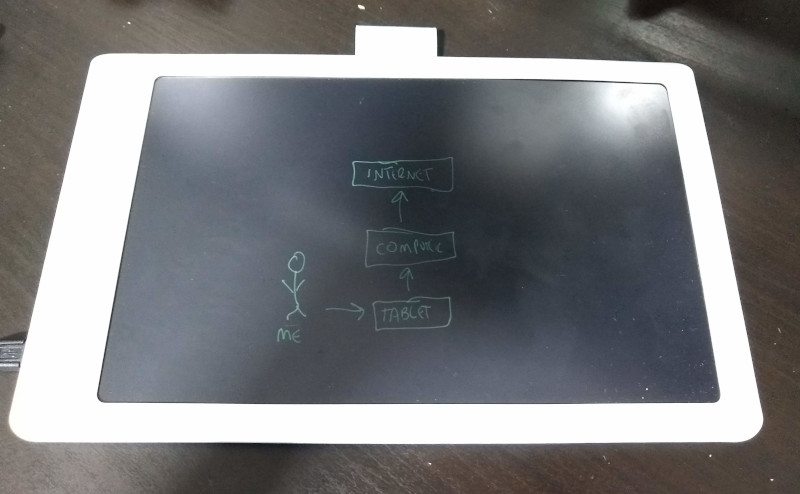 One of the challenges I find about being fully remote is that one of the ways I think while I explain things is I draw diagrams. I m not artistic in any manner (my brothers got that skillset), but a set of boxes and lines and some text scribbled as I talk really helps. I do think even for myself, which is obviously as easy to replicate at home as in the office; I have plenty of paper and a whiteboard in my study. It s not so easy when having a design discussion with someone remotely.
Doodling with a mouse doesn t quite work; my art skills are bad enough without then factoring in the fact it s not a pen-like device I m using to do it. I ve previously tried a proper graphics tablet, but there s a disconnect between where you are writing and where the output appears. That makes doing things like labelling within a diagram, or going back to draw an update, quite difficult. Or it does if you re me anyway.
The modern solution is probably a laptop with a stylus capable touchscreen, but I ve shied away from such things because I don t want fingerprints all over my screen and don t want to pay extra for something I haven t previously thought I d use. An alternative is a tablet with a stylus capable screen, but those turn out to be premium models these days (remember when resistive was the cheap option because no one wanted to use the stylus?) and mine doesn t support it. You can get capacitive styli (styluses?) but then when you lean on the tablet it all gets confused.
When I m due a technology refresh of my laptop or tablet I ll perhaps factor such things in, but what to do now, when I m not entirely sure how much usage I ll get out of such a device and thus can t justify a major expense on it? Buy a random thing from the internet, of course!
It turns out there are a range of LCD writing tablets out there, which let you scribble on a screen and then erase it at the press of a button. An electronic etch-a-sketch, as it were. Most of them don t count as smart , with power only needed for the erase, but there appears to have been a device called the Boogie Board Sync in the past which offered some ability to save things. Searching around I found the
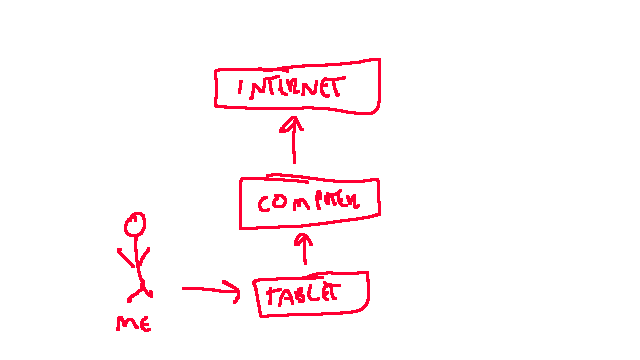

 Like
 The other day, we went to a designer's fashion shop whose owner was
rather adamant that he was never ever going to wear a face mask, and
that he didn't believe the COVID-19 thing was real. When I argued for
the opposing position, he pretty much dismissed what I said out of hand,
claiming that "the hospitals are empty dude" and "it's all a lie". When
I told him that this really isn't true, he went like "well, that's just
your opinion". Well, no -- certain things are facts, not opinions. Even
if you don't believe that this disease kills people, the idea that this
is a matter of opinion is missing the ball by so much that I was pretty
much stunned by the level of ignorance.
His whole demeanor pissed me off rather quickly. While I disagree with
the position that it should be your decision whether or not to wear a
mask, it's certainly possible to have that opinion. However, whether or
not people need to go to hospitals is not an opinion -- it's something
else entirely.
After calming down, the encounter got me thinking, and made me focus on
something I'd been thinking about before but hadn't fully forumlated:
the fact that some people in this world seem to misunderstand the nature
of what it is to do science, and end up, under the claim of being
"sceptical", with various nonsense things -- see scientology, flat earth
societies, conspiracy theories, and whathaveyou.
So, here's something that might (but probably won't) help some people
figuring out stuff. Even if it doesn't, it's been bothering me and I
want to write it down so it won't bother me again. If you know all this
stuff, it might be boring and you might want to skip this post.
Otherwise, take a deep breath and read on...
Statements are things people say. They can be true or false; "the
sun is blue" is an example of a statement that is trivially false. "The
sun produces light" is another one that is trivially true. "The sun
produces light through a process that includes hydrogen fusion" is
another statement, one that is a bit more difficult to prove true or
false. Another example is "Wouter Verhelst does not have a favourite
color". That happens to be a true statement, but it's fairly difficult
for anyone that isn't me (or any one of the other Wouters Verhelst out
there) to validate as true.
While statements can be true or false, combining statements without more
context is not always possible. As an example, the statement "Wouter
Verhelst is a Debian Developer" is a true statement, as is the statement
"Wouter Verhelst is a professional Volleybal player"; but the statement
"Wouter Verhelst is a professional Volleybal player and a Debian
Developer" is not, because while I am a Debian Developer, I am not a
professional Volleybal player -- I just happen to share a name with
someone who is.
A statement is never a fact, but it can describe a fact. When a
statement is a true statement, either because we trivially know what it
states to be true or because we have performed an experiment that
proved beyond any possible doubt that the statement is true, then what
the statement describes is a fact. For example, "Red is a color" is a
statement that describes a fact (because, yes, red is definitely a
color, that is a fact). Such statements are called statements of
fact. There are other possible statements. "Grass is purple" is a
statement, but it is not a statement of fact; because as everyone knows,
grass is (usually) green.
A statement can also describe an opinion. "The Porsche 911 is a nice
car" is a statement of opinion. It is one I happen to agree with, but it
is certainly valid for someone else to make a statement that conflicts
with this position, and there is nothing wrong with that. As the saying
goes, "opinions are like assholes: everyone has one". Statements
describing opinions are known as statements of opinion.
The differentiating factor between facts and opinions is that facts are
universally true, whereas opinions only hold for the people who state
the opinion and anyone who agrees with them. Sometimes it's difficult or
even impossible to determine whether a statement is true or not. The
statement "The numbers that win the South African Powerball lottery on
the 31st of July 2020 are 2, 3, 5, 19, 35, and powerball 14" is not a
statement of fact, because at the time of writing, the 31st of July 2020
is in the future, which at this point gives it a 1 in 24,435,180 chance
to be true). However, that does not make it a statement of opinion; it
is not my opinion that the above numbers will win the South African
powerball; instead, it is my guess that those numbers will be correct.
Another word for "guess" is hypothesis: a hypothesis is a statement
that may be universally true or universally false, but for which the
truth -- or its lack thereof -- cannot currently be proven beyond doubt.
On Saturday, August 1st, 2020 the above statement about the South
African Powerball may become a statement of fact; most likely however,
it will instead become a false statement.
An unproven hypothesis may be expressed as a matter of belief. The
statement "There is a God who rules the heavens and the Earth" cannot
currently (or ever) be proven beyond doubt to be either true or false,
which by definition makes it a hypothesis; however, for matters of
religion this is entirely unimportant, as for believers the belief that
the statement is correct is all that matters, whereas for nonbelievers
the truth of that statement is not at all relevant. A belief is not an
opinion; an opinion is not a belief.
Scientists do not deal with unproven hypotheses, except insofar that
they attempt to prove, through direct observation of nature (either out
in the field or in a controlled laboratory setting) that the hypothesis
is, in fact, a statement of fact. This makes unprovable hypotheses
unscientific -- but that does not mean that they are false, or even
that they are uninteresting statements. Unscientific statements are
merely statements that science cannot either prove or disprove, and that
therefore lie outside of the realm of what science deals with.
Given that background, I have always found the so-called "conflict"
between science and religion to be a non-sequitur. Religion deals in one
type of statements; science deals in another. The do not overlap, since
a statement can either be proven or it cannot, and religious statements
by their very nature focus on unprovable belief rather than universal
truth. Sure, the range of things that science has figured out the facts
about has grown over time, which implies that religious statements have
sometimes been proven false; but is it heresy to say that "animals exist
that can run 120 kph" if that is the truth, even if such animals don't
exist in, say, Rome?
Something very similar can be said about conspiracy theories. Yes, it is
possible to hypothesize that NASA did not send men to the moon, and that
all the proof contrary to that statement was somehow fabricated.
However, by its very nature such a hypothesis cannot be proven or
disproven (because the statement states that all proof was
fabricated), which therefore implies that it is an unscientific
statement.
It is good to be sceptical about what is being said to you. People can
have various ideas about how the world works, but only one of those
ideas -- one of the possible hypotheses -- can be true. As long as a
hypothesis remains unproven, scientists love to be sceptical
themselves. In fact, if you can somehow prove beyond doubt that a
scientific hypothesis is false, scientists will love you -- it means
they now know something more about the world and that they'll have to
come up with something else, which is a lot of fun.
When a scientific experiment or observation proves that a certain
hypothesis is true, then this probably turns the hypothesis into a
statement of fact. That is, it is of course possible that there's a flaw
in the proof, or that the experiment failed (but that the failure was
somehow missed), or that no observance of a particular event happened
when a scientist tried to observe something, but that this was only
because the scientist missed it. If you can show that any of those
possibilities hold for a scientific proof, then you'll have turned a
statement of fact back into a hypothesis, or even (depending on the
exact nature of the flaw) into a false statement.
There's more. It's human nature to want to be rich and famous, sometimes
no matter what the cost. As such, there have been scientists who have
falsified experimental results, or who have claimed to have observed
something when this was not the case. For that reason, a scientific
paper that gets written after an experiment turned a hypothesis into
fact describes not only the results of the experiment and the observed
behavior, but also the methodology: the way in which the experiment
was run, with enough details so that anyone can retry the experiment.
Sometimes that may mean spending a large amount of money just to be able
to run the experiment (most people don't have an LHC in their backyard,
say), and in some cases some of the required materials won't be
available (the latter is expecially true for, e.g., certain chemical
experiments that involve highly explosive things); but the information
is always there, and if you spend enough time and money reading
through the available papers, you will be able to independently prove
the hypothesis yourself. Scientists tend to do just that; when the
results of a new experiment are published, they will try to rerun the
experiment, partially because they want to see things with their own
eyes; but partially also because if they can find fault in the
experiment or the observed behavior, they'll have reason to write a
paper of their own, which will make them a bit more rich and famous.
I guess you could say that there's three types of people who deal with
statements: scientists, who deal with provable hypotheses and
statements of fact (but who have no use for unprovable hypotheses and
statements of opinion); religious people and conspiracy theorists,
who deal with unprovable hypotheses (where the religious people deal
with these to serve a large cause, while conspiracy theorists only
care about the unprovable hypotheses); and politicians, who should
care about proven statements of fact and produce statements of
opinion, but who usually attempt the reverse of those two these days
 Anyway...
[[!img





 Creating Beautiful Github Streaks
Github streaks are a pretty fun and harmless way of visualizing your
contributions on github or gitlab. Some people use them to brag a little, some
companies use them to check out potential candidates. It s all good as long as
everyone is aware how easily you can manipulate them.
In order to fake a commit date in the past, you have to set the
 I know, I m for sure not the first one to discover this kind of thing, but it
was a fun afternoon project anyways!
 I know, I m for sure not the first one to discover this kind of thing, but it
was a fun afternoon project anyways!