Search Results: "Dirk Eddelbuettel"

2 February 2013

Dirk Eddelbuettel: RcppExamples 0.1.6

A pure maintenance release 0.1.6 of RcppExamples was made two weeks ago, and never announced. We merely moved the NEWS.Rd file into the proper location in the inst/ directory, and, while were at it, mentioned the new Rcpp Gallery in the DESCRIPTION file. Thanks to CRANberries, there is the standard diff to the previous release 0.1.5. Questions, comments etc should go to the rcpp-devel mailing list off the R-Forge page.

Dirk Eddelbuettel: digest 0.6.2

digest version 0.6.2 came out a few days ago as an almost immediate follow-up to release 0.6.1. We used paste0() in a few places, and this is only available with newer versions of R. To not introduce as somewhat unnessecary dependency, we reverted this to plain old paste(). CRANberries provides the usual summary of changes to version 0.6.1. As usual, our package is available via the R-Forge page leading to svn and tarball access, my digest page, the local directory here as well as via Debian and its mirrors.

1 February 2013

Dirk Eddelbuettel: Introducing the BH package

Earlier today a new package BH arrived on CRAN. Over the years, Jay Emerson, Michael Kane and I had numerous discussions about a basic Boost infrastructure package providing Boost headers for other CRAN packages (and yes, we are talking packages using C++ here). JJ and Romain chipped in as well, and Jay finally took the lead by first creating a repo on R-Forge. And now the package is out, so I just put together a quick demo post over at the Rcpp Gallery. As that post notes, BH is still pretty new and rough, and we probably missed some other useful Boost packages. If so, let one of us know.

31 January 2013

Dirk Eddelbuettel: RcppArmadillo 0.3.6.2

A new Armadillo version 3.6.2 came out yesterday, and the corresponding RcppArmadillo version is now on CRAN. Changes are mostky incremental:
Changes in RcppArmadillo version 0.3.6.2 (2013-01-29)
  • Upgraded to Armadillo release Version 3.6.2
    • faster determinant for matrices marked as diagonal or triangular
    • more fine-grained handling of 64 bit integers
  • Added a new example of a Kalman filter implementation in R, and C++ using Armadillo via RcppArmadillo, complete with timing comparison
Courtesy of CRANberries, there is also a diffstat report for the most recent release As always, more detailed information is on the RcppArmadillo page. Questions, comments etc should go to the rcpp-devel mailing list off the R-Forge page.

24 January 2013

Dirk Eddelbuettel: Rcpp reaches 100 dependents on CRAN

With the arrival earlier today of the stochvol package onto the CRAN network for R, our Rcpp project reached a new milestone: 100 packages have either a Depends:, Imports: or LinkingTo: statement on it. The full list will always be at the bottom of the CRAN page for Rcpp; I also manually edit a list on my Rcpp page. But for the record as of today, here is the current list as produced by a little helper script I keep:
 acer                apcluster           auteur             
 bcp                 bfa                 bfp                
 bifactorial         blockcluster        ccaPP              
 cda                 classify            clusteval          
 ConConPiWiFun       EpiContactTrace     fastGHQuad         
 fdaMixed            forecast            fugeR              
 GeneticTools        gMWT                gof                
 gRbase              gRim                growcurves         
 GUTS                jaatha              KernSmoothIRT      
 LaF                 maxent              mets               
 minqa               mirt                mRMRe              
 multmod             mvabund             MVB                
 NetworkAnalysis     ngspatial           oem                
 openair             orQA                parser             
 pbdBASE             pbdDMAT             phom               
 phylobase           planar              psgp               
 quadrupen           Rchemcpp            Rclusterpp         
 RcppArmadillo       RcppBDT             rcppbugs           
 RcppClassic         RcppClassicExamples RcppCNPy           
 RcppDE              RcppEigen           RcppExamples       
 RcppGSL             RcppOctave          RcppRoll           
 RcppSMC             RcppXts             rforensicbatwing   
 rgam                RInside             Rmalschains        
 Rmixmod             robustgam           robustHD           
 rococo              RProtoBuf           RQuantLib          
 RSNNS               RSofia              rugarch            
 RVowpalWabbit       SBSA                sdcMicro           
 sdcTable            simFrame            spacodiR           
 sparseHessianFD     sparseLTSEigen      SpatialTools       
 stochvol            surveillance        survSNP            
 termstrc            tmg                 transmission       
 trustOptim          unmarked            VIM                
 waffect             WideLM              wordcloud          
 zic                
And not to be forgotten is BioConductor which has another 10:
 ddgraph            GeneNetworkBuilder GOSemSim          
 GRENITS            mosaics            mzR               
 pcaMethods         Rdisop             Risa              
 rTANDEM  
As developers of Rcpp, we are both proud and also a little humbled. The packages using Rcpp span everything from bringing new libraries to R, to implementing faster ways of doing things we have before to doing completely new things. It is an exciting time to be using R, and to be connecting R to C++, especially with so many exciting things happening in C++ right now. Follow the Rcpp links for more, and come join us on the Rcpp-devel mailing list to discuss and learn.

21 January 2013

Dirk Eddelbuettel: digest 0.6.1

digest version 0.6.1 is now on CRAN, and I will push the corresponding version into Debian shortly. Duncan Murdoch added AES support, and helped me fix two issues which (annoyingly) made the Rout.save output differ on another platform. CRANberries provides the usual summary of changes to version 0.6.0. As usual, our package is available via the R-Forge page leading to svn and tarball access, my digest page and the local directory here.

19 January 2013

Dirk Eddelbuettel: Sing The Truth at Symphony Center

Just back in from an amazing concert at the Chicago Symphony Center. Vocalists Angelique Kidjo, Dianne Reeves and Lizz Wright supported by all-star band of Geri Allen on piano, Romero Lubambo on electric and acoustic guitar, James Genus on electric bass guitar, Munyungo Jackson on percussion and Terri Lyne Carrington on drums (and musical director). The concert alternates between solos and joint pieces with more joy and soul than I heard in a long time. Great evening.

9 January 2013

Dirk Eddelbuettel: Annoucing the Rcpp Gallery

Earlier this morning, JJ announced what we had been working on for the last few weeks: the Rcpp Gallery. Now, as our luck will have it, the Rcpp-devel list received his message but did not transmit it for an apparent mail system outage at WU Vienna: no sign at the Gmane archive of rcpp-devel or in the personal mailboxen of myself or anybody I spoke to. Hence, so far, and preceding this blog announcement, the only way word got out was via this earlier tweet of mine from about 12 hours ago. The Rcpp Gallery is really the brainchild of JJ. It builds on what he contributed over the last few months in not one but two implementations: Rcpp Attributes. These are described in a vignette of their own. They provide very powerful new functions like sourceCpp which allow the easiest-yet way to get compiled code into R---see for example these posts from my blog about simulating pi in essentially five lines of R or five lines of C++, or this post about using the GSL with ease from R. The Rcpp Gallery also builds on Yihui's excellent knitr package which gained the ability to process C++ code just like R code, as well as some Ruby / Jekyll magic to build a website on the github infrastructure. I helped a little on the side by (at long last) learning how to do prettier websites thanks to Boostrap and its theming extensions. So what does it do, and what is it for? Have a look around the Rcpp Gallery site. Each post is based on a single C++ (or Markdown) file which gets digested by knitr and Rcpp, with the actual output shown alongside the marked up code and explanatory text. Raw sources are available, just pass them into the sourceCpp() function from a current Rcpp release and you should have the same output. Our idea is to have this as a repository for useful code: from simple and introductory to fancy and featureful. We already seeded it with several dozen posts covered anything from lesser known but powerful STL idioms, to Rcpp sugar, to tieing in Armadillo or GSL, random number generation and of course benchmarking---as we do love performance. The entire content is in this github repository, and our page on how to contribute details how you can get involved. We are looking forward to what is to come. In many ways, we are only just getting started.

1 January 2013

Dirk Eddelbuettel: Ragnar Relay Chicago 2012

One things I never quite got around to during 2012 was to blog about the awesome relay we ran in early June. This was the race formerly known as MC200 (for Madiston, WI, to Chicago, IL, by way of Milwaukee, WI, for about 200 miles) and is now part of the Ragnar Relay series: Ragnar Chicago. We ran as a so-called ultra team of six runners, as opposed to a regular ream of twelve. The course is cut into 36 segments; on regular teams you get 3, we each had twice that. My first leg was a combined 17 miles in what turned out to be pretty blistering heat in mid-to-late afternoon. My fellow team members were awesome in getting me lots of water an ice, and I managed to hold onto a pace of just over 8 min/miles. One of the harder runs I've had. Next was a wonderful run pretty much exactly at midnight under starry skies---about seven or so miles followed by ten more miles the next morning. We ended up coming third (yay!) beating the next time by about six or seven seconds (!!) over a total time of 25 or 26 hours. It was hard. It was fun. It was exhilirating. It may also have broken me as I haven't really run much since. So good intentions for 2013: get back into the groove.

30 December 2012

Dirk Eddelbuettel: RcppClassicExamples 0.1.1

Yesterday's initial upload of RcppClassicExamples was lacking a versioned Depends: to prevent builds on older versions of R. This has been added in a new upload 0.1.1. We also added a NEWS file (see below); no code changes were made.
Changes in version 0.1.1 (2012-12-30)
  • Added versioned Depends: in DESCRIPTION to not build under older versions of Rcpp and RcppClassic
Changes in version 0.1.0 (2012-12-27)
Thanks to CRANberries, you can also look at a diff to the previous release 0.1.0. Questions, comments etc should go to the rcpp-devel mailing list off the R-Forge page.

29 December 2012

Dirk Eddelbuettel: RcppExamples 0.1.5 and RcppClassicExamples 0.1.0

The recent releases of Rcpp 0.10.2 and RcppClassic 0.9.3 had one more repercussion. On that dreaded OS, the linker no longer wanted to instantiate a symbol present in both packages; seems to me that the linker in the other two OSs is a little smarter. Anyway -- I didn't fight this but at long last moved all remnands of the long-deprecated older Rcpp API (which is still maintained by package RcppClassic) out of package RcppExamples and into a new package RcppClassicExamples. And the updated version 0.1.5 of the RcppExamples package appeared on CRAN and has now been joined by the initial version 0.1.0 of the new package RcppClassicExamples. No code changed were made; manual pages and descriptions where brushed up and that is about it. Thanks to CRANberries, you can also look at a diff to the previous release 0.1.4 of RcppExamples. Questions, comments etc should go to the rcpp-devel mailing list off the R-Forge page.

22 December 2012

Dirk Eddelbuettel: RcppClassic 0.9.3

Yesterday's release of Rcpp 0.10.2 required a small change to RcppClassic, the package supporting the deprecated older classic Rcpp API defined in the earlier 2005 to 2006 releases. So version 0.9.3 of RcppClassic is now on CRAN. There is no new user-facing code. Courtesy of CRANberries, there is the set of changes relative to the previous release 0.9.2. Questions, comments etc should go to the rcpp-devel mailing list off the R-Forge page.

Dirk Eddelbuettel: Kurt Elling Quintet at the Green Mill

Kurt Elling is back in Chicago for two gigs at the Green Mill (where I last saw him in a wonderful big-band setting), along with his long-time collaborator Laurence Hobgood on piano, Clark Sommers on bass, Chicago's own John McLean on guitar, and the new kid Bryan Carter on drums. And they were, of course, awesome. Great mix of standards as well as new stuff from the Grammy-nominated new recording. If you can see Kurt Elling live, go. Now. They return for another gig tonight and I will have to see if I can swing that.

Dirk Eddelbuettel: Patricia Barber at Unity Temple

Forgot to blog about this (though I posted on Google+ about it), but we went to a neat little concert in the neighborhood on October 6. Chicago's own Patricia Barber came to the wonderful Unity Temple by Frank Lloyd Wright (more on the temple at Wikipedia and the foundation). This closed the 2012 series of the Unity Temple concerts and the setting was a little, well, weird. Look like mostly concert subscribers, with the commensurate age brackets, and not too many jazz folks. Not sure how many Patricia Barber, along with Larry Kohut on bass, won over, but I enjoyed it. I had secured front row (!!) seats in what is already an wonderfully intimate setting for such a duet concert. See the Google+ link for a YouTube recording by her.

21 December 2012

Dirk Eddelbuettel: Rcpp 0.10.2

Relase 0.10.2 of Rcpp provides the second update to the 0.10.* series, and has arrived on CRAN and in Debian. It brings another great set of enhancements and extensions, building on the recent 0.10.0 and 0.10.1 releases. The new Rcpp attributes were rewritten to not require Rcpp modules (as we encountered on issue with exceptions on Windows when built this way), code was reorganized to significantly accelerate compilation and a couple of new things such as more Rcpp sugar goodies, a new timer class, and a new string class were added. See below for full details. We also tested this fairly rigorously by checking about two thirds of the over 90 CRAN packages depending on Rcpp (and the remainder required even more package installs which we did not do as this was already taking about 12 total cpu hours to test). We are quite confident that no changes are required (besides one in our own RcppClassic package which we will update. The complete NEWS entry for 0.10.2 is below; more details are in the ChangeLog file in the package and on the Rcpp Changelog page.
Changes in Rcpp version 0.10.2 (2012-12-21)
  • Changes in Rcpp API:
    • Source and header files were reorganized and consolidated so that compile time are now significantly lower
    • Added additional check in Rstreambuf deletetion
    • Added support for clang++ when using libc++, and for anc icpc in std=c++11 mode, thanks to a patch by Yan Zhou
    • New class Rcpp::String to facilitate working with a single element of a character vector
    • New utility class sugar::IndexHash inspired from Simon Urbanek's fastmatch package
    • Implementation of the equality operator between two Rcomplex
    • RNGScope now has an internal counter that enables it to be safely used multiple times in the same stack frame.
    • New class Rcpp::Timer for benchmarking
  • Changes in Rcpp sugar:
    • More efficient version of match based on IndexHash
    • More efficient version of unique base on IndexHash
    • More efficient version of in base on IndexHash
    • More efficient version of duplicated base on IndexHash
    • More efficient version of self_match base on IndexHash
    • New function collapse that implements paste(., collapse= "" )
  • Changes in Rcpp attributes:
    • Use code generation rather than modules to implement sourceCpp and compileAttributes (eliminates problem with exceptions not being able to cross shared library boundaries on Windows)
    • Exported functions now automatically establish an RNGScope
    • Functions exported by sourceCpp now directly reference the external function pointer rather than rely on dynlib lookup
    • On Windows, Rtools is automatically added to the PATH during sourceCpp compilations
    • Diagnostics are printed to the console if sourceCpp fails and C++ development tools are not installed
    • A warning is printed if when compileAttributes detects Rcpp::depends attributes in source files that are not matched by Depends/LinkingTo entries in the package DESCRIPTION
Thanks to CRANberries, you can also look at a diff to the previous release 0.10.1. As always, even fuller details are on the Rcpp Changelog page and the Rcpp page which also leads to the downloads, the browseable doxygen docs and zip files of doxygen output for the standard formats. A local directory has source and documentation too. Questions, comments etc should go to the rcpp-devel mailing list off the R-Forge page

18 December 2012

Dirk Eddelbuettel: R / Finance 2013 Call for Papers

The text below just went out to r-sig-finance along with updates to the R/Finance website and its Call for Papers page.
Call for Papers: R/Finance 2013: Applied Finance with R
May 17 and 18, 2013
University of Illinois, Chicago, IL, USA
The fifth annual R/Finance conference for applied finance using R will be held on May 17 and 18, 2013 in Chicago, IL, USA at the University of Illinois at Chicago. The conference is expected to cover topics including portfolio management, time series analysis, advanced risk tools, high-performance computing, market microstructure, and econometrics. All will be discussed within the context of using R as a primary tool for financial risk management, portfolio construction, and trading. Over the past four years, R/Finance has included attendees from around the world. It featured presentations from prominent academics and practitioners, and we anticipate another exciting line-up for 2013. We invite you to submit complete papers in pdf format for consideration. We will also consider one-page abstracts (in txt or pdf format) although more complete papers are preferred. We welcome submissions for full talks and abbreviated "lightning talks". Both academic and practitioner proposals related to R are encouraged. Presenters are strongly encouraged to provide working R code to accompany the presentation/paper. Data sets should also be made public for the purposes of reproducibility (though we realize this may be limited due to contracts with data vendors). Preference may be given to presenters who have released R packages. The conference will award two (or more) $1000 prizes for best papers. A submission must be a full paper to be eligible for a best paper award. Extended abstracts, even if a full paper is provided by conference time, are not eligible for a best paper award. Financial assistance for travel and accommodation may be available to presenters at the discretion of the conference committee. Requests for assistance should be made at the time of submission. Please send submissions to: committee at RinFinance.com. The submission deadline is February 15, 2013. Submitters will be notified of acceptance via email by February 28, 2013. Notification of whether a presentation will be a long presentation or a lightning talk will also be made at that time. Additional details will be announced at this website as they become available. Information on previous year's presenters and their presentations are also at the conference website. For the program committee:
Gib Bassett, Peter Carl, Dirk Eddelbuettel, Brian Peterson,
Dale Rosenthal, Jeffrey Ryan, Joshua Ulrich
So see you in Chicago in May!

Dirk Eddelbuettel: RcppArmadillo 0.3.6.1

A first minor bug-fix update by Conrad to the 3.6 series of Armadillo arrived today as version 3.6.1, and we prepared a corresponding version 0.3.6.1 of RcppArmadillo, our wrapper for R and Armadillo. This is now on CRAN, and the changes are summarized below.
Changes in RcppArmadillo version 0.3.6.1 (2012-12-17)
  • Upgraded to Armadillo release Version 3.6.1
    • faster trace()
    • fix for handling sparse matrices by dot()
    • fixes for interactions between sparse and dense matrices
  • Now throws compiler error if Rcpp.h is included before RcppArmadillo.h (as the former is included automatically by the latter anyway, but template logic prefers this ordering).
Courtesy of CRANberries, there is also a diffstat report for the most recent release As always, more detailed information is on the RcppArmadillo page. Questions, comments etc should go to the rcpp-devel mailing list off the R-Forge page.

8 December 2012

Dirk Eddelbuettel: Rcpp attributes: Even easier integration of GSL code into R

Following the Rcpp 0.10.0 release, I had written about simulating pi easily by using the wonderful new Rcpp Attributes feature. Now with Rcpp 0.10.1 released a good week ago, it is time to look at how Rcpp Attributes can help with external libraries. As this posts aims to show, it is a breeze! One key aspect is the use of the plugins for the inline package. They provide something akin to a callback mechanism so that compilation and linking steps can be informed about header and library locations and names. We are going to illustrate this with an example from GNU Scientific Library (GSL). The example I picked uses B-Spline estimation from the GSL. This is a little redundant as R has its own spline routines and package, but serves well as a simple illustration---and, by reproducing an existing example, followed an established path. So we will look at Section 39.7 of the GSL manual which has a complete example as a standalone C program, generating both the data and the fit via cubic B-splines. We can decompose this two parts: data generation, and fitting. We will provide one function each, and then use both from R. These two function will follow the aforementioned example from Section 39.7 somewhat closely. We start with the first function to generate the data.
// [[Rcpp::depends(RcppGSL)]]
#include <RcppGSL.h>
#include <gsl/gsl_bspline.h>
#include <gsl/gsl_multifit.h>
#include <gsl/gsl_rng.h>
#include <gsl/gsl_randist.h>
#include <gsl/gsl_statistics.h>
const int N = 200;                              // number of data points to fit 
const int NCOEFFS = 12;                         // number of fit coefficients */
const int NBREAK = (NCOEFFS - 2);               // nbreak = ncoeffs + 2 - k = ncoeffs - 2 since k = 4 */
// [[Rcpp::export]]
Rcpp::List genData()  
    const size_t n = N;
    size_t i;
    double dy;
    gsl_rng *r;
    RcppGSL::vector<double> w(n), x(n), y(n);
    gsl_rng_env_setup();
    r = gsl_rng_alloc(gsl_rng_default);
    //printf("#m=0,S=0\n");
    /* this is the data to be fitted */
    for (i = 0; i < n; ++i)  
        double sigma;
        double xi = (15.0 / (N - 1)) * i;
        double yi = cos(xi) * exp(-0.1 * xi);
        sigma = 0.1 * yi;
        dy = gsl_ran_gaussian(r, sigma);
        yi += dy;
        gsl_vector_set(x, i, xi);
        gsl_vector_set(y, i, yi);
        gsl_vector_set(w, i, 1.0 / (sigma * sigma));
                
        //printf("%f %f\n", xi, yi);
     
    Rcpp::DataFrame res = Rcpp::DataFrame::create(Rcpp::Named("x") = x,
                                                  Rcpp::Named("y") = y,
                                                  Rcpp::Named("w") = w);
    x.free();
    y.free();
    w.free();
    gsl_rng_free(r);
    return(res);
 
We include a few header files, define (in what is common for C programs) a few constants and then define a single function genData() which returns and Rcpp::List as a list object to R. A primary importance here are the two attributes: one to declare a dependence on the RcppGSL package, and one to declare the export of the data generator function. That is all it takes! The plugin of the RcppGSL will provide information about the headers and library, and Rcpp Attributes will do the rest. The core of the function is fairly self-explanatory, and closely follows the original example. Space gets allocated, the RNG is setup and a simple functional form generates some data plus noise (see below). In the original, the data is written to the standard output; here we return it to R as three columns in a data.frame object familiar to R users. We then free the GSL vectors; this manual step is needed as they are implemented as C vectors which do not have a destructor. Next, we can turn the fitting function.
// [[Rcpp::export]]
Rcpp::List fitData(Rcpp::DataFrame ds)  
    const size_t ncoeffs = NCOEFFS;
    const size_t nbreak = NBREAK;
    const size_t n = N;
    size_t i, j;
    Rcpp::DataFrame D(ds);              // construct the data.frame object
    RcppGSL::vector<double> y = D["y"]; // access columns by name, 
    RcppGSL::vector<double> x = D["x"]; // assigning to GSL vectors
    RcppGSL::vector<double> w = D["w"];
    gsl_bspline_workspace *bw;
    gsl_vector *B;
    gsl_vector *c; 
    gsl_matrix *X, *cov;
    gsl_multifit_linear_workspace *mw;
    double chisq, Rsq, dof, tss;
    bw = gsl_bspline_alloc(4, nbreak);      // allocate a cubic bspline workspace (k = 4)
    B = gsl_vector_alloc(ncoeffs);
    X = gsl_matrix_alloc(n, ncoeffs);
    c = gsl_vector_alloc(ncoeffs);
    cov = gsl_matrix_alloc(ncoeffs, ncoeffs);
    mw = gsl_multifit_linear_alloc(n, ncoeffs);
    gsl_bspline_knots_uniform(0.0, 15.0, bw);   // use uniform breakpoints on [0, 15] 
    for (i = 0; i < n; ++i)                     // construct the fit matrix X 
        double xi = gsl_vector_get(x, i);
        gsl_bspline_eval(xi, B, bw);            // compute B_j(xi) for all j 
        for (j = 0; j < ncoeffs; ++j)           // fill in row i of X 
            double Bj = gsl_vector_get(B, j);
            gsl_matrix_set(X, i, j, Bj);
         
     
    gsl_multifit_wlinear(X, w, y, c, cov, &chisq, mw);  // do the fit 
    
    dof = n - ncoeffs;
    tss = gsl_stats_wtss(w->data, 1, y->data, 1, y->size);
    Rsq = 1.0 - chisq / tss;
    
    Rcpp::NumericVector FX(151), FY(151);       // output the smoothed curve 
    double xi, yi, yerr;
    for (xi = 0.0, i=0; xi < 15.0; xi += 0.1, i++)  
        gsl_bspline_eval(xi, B, bw);
        gsl_multifit_linear_est(B, c, cov, &yi, &yerr);
        FX[i] = xi;
        FY[i] = yi;
     
    Rcpp::List res =
      Rcpp::List::create(Rcpp::Named("X")=FX,
                         Rcpp::Named("Y")=FY,
                         Rcpp::Named("chisqdof")=Rcpp::wrap(chisq/dof),
                         Rcpp::Named("rsq")=Rcpp::wrap(Rsq));
    gsl_bspline_free(bw);
    gsl_vector_free(B);
    gsl_matrix_free(X);
    gsl_vector_free(c);
    gsl_matrix_free(cov);
    gsl_multifit_linear_free(mw);
    
    y.free();
    x.free();
    w.free();
    return(res);   
 
The second function closely follows the second part of the GSL example and, given the input data, fits the output data. Data structures are setup, the spline basis is created, data is fit and then the fit is evaluated at a number of points. These two vectors are returned along with two goodness of fit measures. We only need to load the Rcpp package and source a file containing the two snippets shown above, and we are ready to deploy this:
library(Rcpp)
sourceCpp("bSpline.cpp")                # compile two functions
dat <- genData()                        # generate the data
fit <- fitData(dat)                     # fit the model, returns matrix and gof measures
And with that, we generate a chart such as Spline fitting example from GSL manual redone with Rcpp Attributes via a simple four lines, or as much as it took to create the C++ functions, generate the data and fit it!
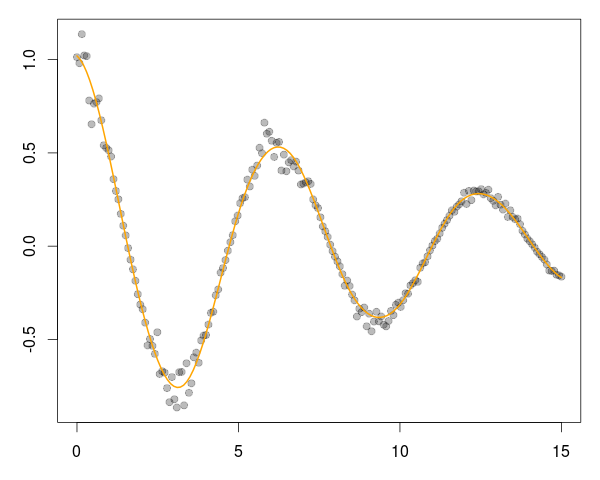
op <- par(mar=c(3,3,1,1))
plot(dat[,"x"], dat[,"y"], pch=19, col="#00000044")
lines(fit[[1]], fit[[2]], col="orange", lwd=2)
par(op)
The RcppArmadillo and RcppEigen package support plugin use in the same way. Add an attribute to export a function, and an attribute for the depends -- and you're done. Extending R with (potentially much faster) C++ code has never been easier, and opens a whole new set of doors.

Dirk Eddelbuettel: RcppArmadillo 0.3.6.0

Conrad launched the 3.6 series of Armadillo earlier today with a first 3.6.0 release. So RcppArmadillo, our wrapper for R and Armadillo, is now on CRAN with its corresponding version 0.3.6.0. No R level or interface changes were needed, and the upstream changes are summarized below.
Changes in RcppArmadillo version 0.3.6.0 (2012-12-07)
  • Upgraded to Armadillo release Version 3.6.0 (Piazza del Duomo)
    • faster handling of compound expressions with submatrices and subcubes
    • added support for loading matrices as text files with NaN and Inf elements
    • added stable_sort_index(), which preserves the relative order of elements with equivalent values
    • added handling of sparse matrices by mean(), var(), norm(), abs(), square(), sqrt()
    • added saving and loading of sparse matrices in arma_binary format
Courtesy of CRANberries, there is also a diffstat report for the most recent release As always, more detailed information is on the RcppArmadillo page. Questions, comments etc should go to the rcpp-devel mailing list off the R-Forge page.

6 December 2012

Dirk Eddelbuettel: RInside 0.2.10

The new maintenance release 0.2.10 of RInside is now on CRAN, including Windows binaries. RInside provides a set of convenience classes which facilitate embedding of R inside of C++ applications and programs, using the classes and functions provided by the Rcpp R and C++ integration package. This release helps with an update to stack checking, required by a recent change in R itself. The NEWS extract below has more details.
Changes in RInside version 0.2.10 (2012-12-05)
  • Adjusted to change in R which requires turning checking of the stack limit off in order to allow for access from multiple threads as in the Wt examples. As there are have been no side-effects, this is enabled by default on all platforms (with the exception of Windows).
  • Added new threads example directory with a simple example based on a Boost mutex example.
  • Disabled two examples (passing an external function down) which do not currently work; external pointer use should still work.
CRANberries also provides a short report with changes from the previous release. More information is on the RInside page. Questions, comments etc should go to the rcpp-devel mailing list off the Rcpp R-Forge page.

Next.

Previous.