Search Results: "tar"

13 September 2010

Amaya Rodrigo: Of inner peace and struggle

[Nothing related to Debian here, move on if you don't care about my recurring obsession with the end of the world, Cassandra pains, or Big Phat Living Room Revolution yearnings].

Although I am still looking for a community of anarcho-primitivists that want to accept me joining their frugal living, and simply slip off the social construct, the system, the fucking face of earth, call it what you will, I could find some comfort in my favourite feminist blogger's take on the subject of my midlife crisis regarding ecology, capitalism, patriarchy, child bearing, overpopulation, meat consumption and all the rumination of consuming thoughts that (still) make my life miserable and have kept me running away from human contact for a year.

[Emphasis mine]

At what point does human culture depart from the Natural? With the invention of computers? TV? Cars? The cotton gin? Electricity? Taco stands? Gunpowder? The printing press? Written language? Shoes? Crop cultivation? Yurts? The wheel? Did humans become unnatural when the good old days of picturesque, endless agrarian toil, feudal oppression, unchecked disease, ignorance, and death from dysentery at 35 turned into the bad new days of urban post-industrial capitalism where a pound of fair-trade organic coffee costs $12.99 and your email inbox is full of spam?

ah. Everything humans do, or have ever done, is natural. We can t do anything else. The idea that modern culture is un-natural is nostalgic and inaccurate. Living off the grid in a yurt is good in some absolute sense, whereas driving an SUV from a suburban bungalow to the stripmall is bad ? Come on. This a romantic, but misguided view. The cosmic reaction to a 20 Ford Expedition is the same as to a sanctimonious Prius: bupkis. The universe doesn t give a fuck about you or your lifestyle choices. It doesn t give a fuck about the economy, oil spills, or civil unrest in Blargistan. It doesn t give a fuck about katydids. Eventually our whole planet will be erased from space, and the galaxy won t bat an eye. The inevitable extinction of our species (imminent, according to research here at Spinster Laboratories) via the exhaustion of available resources is as natural as a fresh-picked peach. As Andre 3000 and other dude philosophers have observed, nothing is forever.

Yes, yes, when people use the word natural what they really mean is free of chemical additives and maybe some of the assorted hippie concepts that go with that narrative. Barter economies, home furnishings made from bamboo, vegan cookbooks, living in the country. While I would argue that it is just as natural for people to put chemical additives in things as it is to not put chemical additives in things, I admit that it is appealing to fantasize that the source of human misery is an unnatural isolation from Nature, and that doing yoga on an organic rubber mat and drinking organic spinach smoothies will put me back in sync with the cosmos.

But alas, I m already in sync with the cosmos, and so are you. In other words, this is it. This is what we ve become, and this is what we get. Which is not to say that a person can t fantasize about a verdant paradise full of songbirds and polar bears and Bengal tigers, untouched by human influence. Only, that world isn t a world we could actually live in. The minute you add contented children, lazy from a carefree day at the swimming hole, eating ripe plums on the porch at sunset to that scenario, natural history changes, and it s right back to our scorched-earth dystopia. Our giant brains use up resources, it s as simple as that.

As long as we re still here, though, we might as well try to make the best of it.

http://blog.iblamethepatriarchy.com/2010/06/19/heads-up-art-week-starts-on-monday/


Though the comfort is somewhat ephemeral, because deep inside, I know she's wrong, I know another way is feasible, but I have given up already, I have very well come to terms with extiction, I get an enormous pleasure from the thought of the very well deserved human mass suicide-by-cop^Wnature, and in fact, I trust and hope it will save me personally from facing the hard times ahead, as I am a damn coward, paralized by fear, hopeless about the flock ever getting it (is it so hard, really?), while doing as much as I can but completely overwhelmed by the need of changing a world everyone seems to like just as it is. I can certainly empathize with much more disturbed ways of airing similar anguish, among many other examples, such as The Unabomber, or The Weather Underground. I don't even want to go there as I know violence all too well and it is not fun to be on the receiving end. But I see the screaming desperation behind the motives of acts I am not at the liberty to discuss here. I wonder if consumption of resources in the form of books will numb the disorder or make it worse and what sort of medical arrangement the stablishment has for it. As you click away the previous links will mean nothing to you because a)it is Wikipedia after all, and b)you probably don't even understand what the problem of eating animal corpses is, humans are omnivores after all, and what is all this nonsense about dropping language altogether.

WTF, there was no comfort after all, and I am still a nutjob.

Robert Collins: What do I do @ work?

I recently moved withing Canonical from being a paid developer of Bazaar to take on a larger challenge Technical Architect for Launchpad. Its been two months now, and its time to put my head up out of the coal face, have a look around and regroup. When I worked on Bazaar, every day when I started work got up I was working on a tool anyone can use, designed for collaboration upon sourcecode, for people writing software. This is a toolchain component right at the heart of the free software world. Bazaar and tools like it get used everyday to manage, distribute and collaborate on the sourcecode that makes up the components of Ubuntu, Debian, Fedora and so forth. Every time someone new starts using Bazaar for a new free or open source project, well I felt happy happy that in my small part I m helping with this revolution we re carrying out. Launchpad is pretty similar to Bazaar in some ways. Obviously they are both free software, both are written in Python, and both are sponsored by Canonical, my employer. And they both are designed to assist in collaboration and communication between free software developers albeit in rather different ways. Bazaar is a tool anyone can install locally, run as a command line, GUI, or local webserver, and share code either centrally (e.g. by pushing to Launchpad), or in a peer to peer fashion, acting as their own server. Launchpad, by contrast is a website which (usually) folk will use as a service in their browser, from the comand line FTP (for package building), ssh (for Bazaar branch pushing or pulling), or even local GUI programs using the Launchpad API service. This makes it more approachable for first time collaborators, but its less able to be used offline, and it has all the usual caveats of web sites : it needs a username and password, it s availability depends on the operators on the team I m part of. So there s a lot less room for error: if we do something wrong, the system is unavailable, and users can t just apt-get install an older release. With Launchpad our goal is to to get all the infrastructure that open source need out of the way, so that they can focus on their code, collaboration within their team and almost uniquely collaboration with other teams. As well as being open source, Launchpad is free for all open source projects to use Ubuntu is our single biggest user they use it for all bugtracking, translation and package building, and have a hugefraction of the total storage overhead in the database. Launchpad is a pretty nice system, so people use it, and as a result (on a technical basis) it is suffering from its own success: small corner cases in the code turn up every day or two, code written years ago to deal with a relatively small data set now has to deal with data sets a thousand or more times larger (one table, for instance, has over 600,000,000 rows in it. For the last two months then, I ve been working on Launchpad. As Technical Architect, I need to ensure that the things that we (users, stakeholders and developers of Launchpad) want to do are supported by the structure of the system : the platform(s) we re building on, the way we approach problems, coding standards and diagnostic tools. That sounds pretty dry and hands off, but I m finding its actually very balanced. I wrote a presentation when I started the job, which encapsulated the challenges I saw in front of the team on this purely technical front, and what I thought I needed to do. I think I was about right in my expectations: On a typical day, I ll be hands on in a problem helping get it diagnosed, talking long term structural changes with someone around how to make things more efficient / flexible / maintainable, and writing a small patch here or there to help move things along. In the two months since I took on this challenge, we ve made significant headway on the problem of performance for Launchpad : many inefficient code paths have been identified and removed, some new infrastructure has been created as is being rolled out to make individual pages faster, and we ve massively increased the diagnostic data we get when things go wrong. We ve introduced facilities for responding more rapidly to issues in the software (but they have to be rolled out across the system) and I hope, over the next 4 months we ll reach the first of my performance goals: for any webpage in Launchpad, it will complete rendering in 99% of the time. (Note that we already meet this goal if you measure the whole system, but this is biased by some pages being very frequently hit and also being very small).

Eddy Petrișor: Fixing a bookmark corruption in Iceweasel/Firefox

At some point in the past my bookmarks broke in such a way that I wasn't able anymore to alter in any way the bookmarks, deletions, additions, reorganisation, nothing worked.


Way before this event I set up a git repo in my .mozilla directory and committed everything in the directory (except obvious cache files and such) in the repo. I didn't make a cronjob with this since I didn't thought of a proper way to make sure the browser wasn't started (the data might have been inconsistent at commit time), and, since most of the time I have the browser started, it seemed rather useless to try to automate for a very, very small window of time when the browser data would be in a consistent state. As a consequence, I did occasional manual commits in the git repo.

When the bookmarks issue appeared I realised that my last git commit was so old that it didn't made any sense to try to restore since I would have had lost bookmarks, passwords and plugins. So I made a checkpoint commit os the broken profile and resorted to all sorts of manual attempts at fixing the issue, but all my efforts of playing with the bookmarks.* files proved to be useless.

I concluded that icewesel/firefox 3.5.x was using some other mechanism and decided to dig into the issue at some latter time when time allowed me to analyse and fix it. Today was that day.

I began by creating a backup for the bookmarks via the Bookmarks Manager export function. After a hickup, it managed to save a proper bookmarks.html file. I tried to import that file, but the breakage remained.

Then I decided I should prepare for the worst, installed an addon which allowed me to save all stored passwords and created a new account (started firefox from the command line with 'firefox -ProfileManager') with the intention to transplant files from the old files into the new one. Short after that I realised that it would be smarter to commit the new profile, too, import the bookmarks from the backup file and replace the touched files back into the old profile.

After the import and closing the browser, git informed me that the modified files were:
XPC.mfasl
XUL.mfasl
cookies.sqlite
localstore.rdf
places.sqlite
pluginreg.dat
urlclassifier3.sqlite


At this point the modification of the binary .mfasl files looked very ugly to me, but I had a hunch that the only relevant file to my problem was the places.sqlite file and I went on to check the contents of the file with sqlitebrowser. After inspecting also the urlclassifier3.sqlite file (whose contents were unreadable), I decided to give it a try at simply placing the places.sqlite file in the old profile and see if the problem would be fixed that way. After all, I had the whole profile's state in git so any breakage could have been undone easily.

I started firefox using the old profile and the problem was fixed. Yay!

Now I have my bookmarks back and a suggestion for the mozilla people: please don't keep useless files like bookmarks.html in the profile once they become outdated, they are misleading.

P.S.: I still have to think of a way to make automated sane commits. Maybe I'll try to make an iceweasel/firefox addon. This could be a nice idea since I could learn something new, too.

12 September 2010

Theodore Ts'o: Moderate Muslims need a better PR Agency

There has been much made of recent reports that roughly half of Americans have an unfavorable view of Islam. And as usual, there are those who will try to claim that Muslims really aren t all that bad, and that Sharia is just set of nice, abstract principles which are all about the protection of life, family, education, religion, property, and human dignity. And on the other side, we have people pointing out that using Sharias as justification, there are countries which are stoning women and chopping off poor people s hands and then forbidding Muslims from arguing about whether such things are just. Worst yet, some of the more public moderate Muslims , such as Iman Rauf, refuse to criticize organizations such as Hamas, on the ground that he is a bridge builder , and it wouldn t help to criticize Hamas s terrorist activities as being anti-Isalmic. OK, so let s grant for the sake of argument the claims that Shariah really is far more than just criminal sanctions, but mainly about exhorting people to live a moral life, and that of the 1,081 pages of the two-volume Arabic text which Sherman A. Jackson (the Arthur F. Thurnau Prfessor of Arabic and Isalamic Studies at the University of Michigan) used to study Shariah, only 60 pages were devoted to criminal sanctions (i.e., the stoning and the cutting off of hands), and only 19 were devoted to Jihad. Let s even further grant the claims made by Humaira Awais Shahid that most Muslims reject Political Islam and are not even arabs. OK. But that case, wouldn t there be more Imans publically disavowing the people who advocate terrorism and suicide bombs as not being Islamic? Not all of them are bridge-builders, are they? And if so, some of them might be better deployed towards saying what Islam is not, and saying that perhaps people who espouse those beliefs are being profoundly unIslamic and saying this loudly outside of their Mosques. Oh, I understand that many Muslims feel that they shouldn t be asked to repudiate the sins of a few crazy terrorists ; just as all Christians shouldn t be held accountable for disturbed crazy rants of a small-time pastor from Gainsville, Florida. But at the same time, it seems to me that Islamic leaders should be eager to say, loudly, that what is being done in the name of their religion in Iran and Nigeria is wrong, and to denounce it. Maybe, some would say, that they are doing that and the media isn t paying attention to them. Well, the Media is surely paying attention to people like Iman Rauf, and he refuses to denounce Hamas! I would gently suggest to those Islamic leaders who feel that they and their faith haven t been given a fair shake, to hire a better PR agency; and make sure that active denunciations of that which they claim does not represent true Islam is shouted from the rooftops; published in press releases; made in press conferences. And actively denounce your fellow Muslims that you feel are shaming your religion, instead of complaining about American Islamophobia. Trying to pretend that there is absolutely no truth in why Americans might be afraid of terrorists who have been hiding under the mantle of your religion is not going to help your cause. There may be truth in the fact that many Americans don t know as much as they should about Islam and Shariah. And there may be truth that American unswerving support of Israel, despite the fact that they acted in profound and unjust ways against the Palestinians, is not only morally and ethically wrong, but has hurt American interests. I certainly believe that to be to true; I am no friend to fundamentalists of any stripe, whether they are Christian, Jewish, or Islamic; and I think the Jewish fundamentalists have almost completely taken over the Israeli political discourse. But all of that is irrelevant if the goal is reduce people e negative views towards Islam. And in any case, if you really believe that attacking innocents, and coercing religion by threatening Muslims who have fallen away from their faith with the death penalty is wrong, then it s wrong regardless of whether those innocents happened to vote for politicians who have been influenced by way too much money from AIPAC. So instead of trying to lecture Americans about their uncritical support of Israel, why not just stand witness to the fact that killing innocents is wrong, and that people who do that are not Islamic, no matter what they claim or how impressive their turban might happen to be? And maybe it might be a good idea to speak out against those who would lend support, whether moral, or financial or logistical, to people who do these unIslamic things in the name of Islam? And it may not be enough to say it once; it needs to be said again and again. Which is why it s important to hire a good PR agency. No related posts.

Clint Adams: U-Booting off of the SD card on the Sheevaplug

Finally (2010.09~rc1-2) I am running Debian's U-Boot on the Sheevaplug, and booting with this env:

bootcmd=run bootcmd_mmc; bootm 0x300000 0x0800000
bootargs=console=ttyS0,115200 root=/dev/mmcblk0p2
bootcmd_mmc=mmc init; mmc init; ext2load mmc 0 0x0800000 /uInitrd; ext2load mmc 0 0x300000 /uImage
Having to run mmc init twice is annoying, but it beats dealing with whichever fork I had on it last.

Christian Perrier: [running] Bois d'Arcy half-marathon

It is not as prestigious as Chicago half-marathon, but it turns out that the day Dirk ran one of his slowest halves in years (but, eh, I'm happy for him as ha had a very disappointing running year), I ran my fastest and completed the 600-runners Bois d'Arcy half-marathon, finishing 181th ou the 573 finishers. That one was planned to be one of the peaks in my preparation for the Seine-Eure marathon, my second official marathon run of the year (and my third marathon). 1h37'27", that's 4 minutes better than my best time as of now (this year's Paris half, back in March). So, it seems that now, I can safely target 3h35-3h40 for October 17th (3h30? A bit far, still...). We'll see... Anyway, it seems that my crazy summer (730km ran between June 1st and Sept 10th) is giving results. Not Dirk's "run less, run faster"....but it seems that it's working for me..:-)

Dirk Eddelbuettel: Chicago Half Marathon 2010

Second Sunday in September -- time for the annual Chicago Half Marathon now in its fourteenth edition (and I have been running it in 2003, 2004, 2005, 2006, 2007, 2008 and 2009 making this and the JPM Chase Corporate Challenge the races I've run most often). And the course was altered this year, alongside with an earlier start as the Bears have their season home opener today. So we started north towards 57th, then running down to 67th, turning east towards the lake at around three miles --- and having the remaining ten miles along the lakefront running up to 31st (the usual turn) and back down to 63rd. I like this course better; let's hope it sticks. Race conditions were fantastic. We had a rainy and gray day yesterday but today is pure bliss. Temperatures around 60 degrees at the 7:00am start, no wind, sunshine and not a cloud in the sky. The race itself went well. I had a pretty brutal running year suffering most of the time from some archilles tendon inflammation. It has gotten better in the last few weeks possibly thanks to some heel cups I now put in the shoes. But I had exactly one run longer than ten miles since the Boston Marathon. So I lost a lot of speed, as well as endurance and was a little nervous as to how I'd do. And considering all this, it went pretty well. I fininished in 1;41:50 or a 7:47 pace. While is easily the slowest half in a number of years, at least I got to run it evenly, pain free and with a negative split (== faster second half) and some gas left for a fast last half mile or so. So maybe I don't have to retire from running just yet. We'll see if I get some speed back in 2011.

Alastair McKinstry: Exoclimes: the diversity of planetary scientists

I'm just back from ExoClimes 2010: Exploring the Diversity of Planetary Atmospheres. An excellent conference: the PDFs of the talks and posters are now online, and they are putting the videos of the talks up soon. But in particular the organizers deserves thanks for bringing exoplanetary scientists and observers together with climate modelers doing Earth (and Mars, Titan, Venus, ...) models.
Model complexity graph Peter Cox on model complexity
The last talk on Friday was by Peter Cox on Climate change and exoplanet sciences that was far better than expected for the "graveyard shift". One theme of the conference was the need for a 'heirarchy' of models, from simple energy-balance models to full circulation (GCM) models: using progressively more complex models to understand more bits of whats going on. Exoplanet workers mostly use simpler models, progressing now to GCMs, while Earth modellers are moving beyond GCMs to "Earth system" models including biology, etc. Peter pointed out the two styles of work: the exoplanet modelers are short of data, and risk being too speculative. We know little of what the planets are like, and concentrate on implementing physics in the models to see what they might be like. Earth modelers on the other hand are if anything swamped with data: the tendency here is to make the model fit the data, by adjusting parameters until it does so. The danger of this approach is that the model will then not work away from current present-Earth conditions. Tim Lenton pointed out some work that was done with the Met Office model, where they took the radiative transfer part of the model and tested it for other planets, and paleo-Earth conditions. The model blew up : it wasn't capable of x2 or x4 current CO2 levels. (This has since been corrected). Over dinner there were interesting discussions on the different styles within the communities. While the underlying GCMs used come from the Earth sciences, its quite common within the exoplanetary community for a researcher to work on all parts of the model: dynamics one day, radiative transfer the next. In Earth climate work people have become more specialized and someone is a 'radiative transfer' person, and won't touch other parts of the code (even if they can follow them in the huge codes we have today!). On the other hand, there is a greater tradition of model inter-comparison in Earth sciences, where we compare the model outputs to each other for some known test cases ( Held & Suarez, the CMIP5 project, etc.) Apart from some initial work by Emily Rauscher, little has been done on this in exoplanetary models; it was agreed more of this would be a good idea. Radiative transfer (the interaction of 'sunlight' with the atmosphere, where it gets absorbed, scattered and re-radiated) in particular seems to be an area that could benefit from this. In this middle ground Francois Forget showed the work on the LMDZ model and applying GCMs to terrestrial planets. They've successfully applied this model to Mars, Titan, and partially to Venus (a much tougher problem, due to its heavy clouds giving a long radiative timescale). There are problems with correctly explaining super-rotation though. This is where the atmosphere rotates faster than the planet: on Venus for example the planet rotates every 243 days, while the clouds rotate around the planet every 4 days. Sebastian Lebonnois described the possible mechanisms for Venus and Titan; Johnathan Mitchell so did some interesting work on this recently. Different regimes are involved for different rotation rates of the planet. Ralph Lorenz pointed out the lack of "real paleo-Earth" climate work at the moment. While geology has inspired a lot of work on the atmospheric composition, what with the different gas mixtures (meaning earth-model radiative transfer codes don't work) and the faster dynamics meaning super-rotation could apply (Earth's day was about 8 hours long in the Archean era), we don't have a model of the climate yet. It looks like we should treat Earth as an exoplanet. Tags , , ,

Daniel Baumann: dosfstools 3.0.10

dosfstools did not correctly handle LFN (see Debian bug #596329 for more information) and had some false positives with bad filenames (see Debian bug #596327 for more information). Todays release of version 3.0.10 fixes this. Source tarballs can be downloaded as usual from its homepage.

Francois Marier: Setting up your own DNSSEC-aware resolver using Unbound

Now that the root DNS servers are signed, I thought it was time I started using DNSSEC on my own PC. However, not wanting to wait for my ISP to enable it, I decided to setup a private recursive DNS resolver for myself using Unbound.

Installing UnboundBeing already packaged in Debian and Ubuntu, unbound is only an apt-get away:
apt-get install unbound
though if you are running lenny, I suggest you grab the latest backport.

Once unbound is installed, follow these instructions to enable DNSSEC.

Optional settingsIn my /etc/unbound/unbound.conf, I enabled the following security options:
harden-referral-path: yes
use-caps-for-id: yes
and turned on prefetching to hopefully keep in cache the sites I visit regularly:
prefetch: yes
prefetch-key: yes
Finally, I also enabled statistics:
extended-statistics: yes
control-enable: yes
control-interface: 127.0.0.1
and ran sudo unbound-control-setup to generate the necessary keys.

Once unbound is restarted (sudo /etc/init.d/unbound restart) stats can be queried to make sure that the DNS resolver is working:
unbound-control stats

Overriding DHCP settingsIn order to use my own unbound server for DNS lookups and not the one received via DHCP, I added this line to /etc/dhcp/dhclient.conf:
supersede domain-name-servers 127.0.0.1;
and restarted dhclient:
sudo killall dhclient
sudo /etc/init.d/network-manager restart
If you're not using DHCP, then you simply need to put this in your /etc/resolv.conf:
nameserver 127.0.0.1

Testing DNSSEC resolutionOnce everything is configured properly, the best way I found to test that this setup was actually working is to use a web browser to visit these sites:
and using dig:
$ dig +dnssec A www.dnssec.cz   grep ad
;; flags: qr rd ra ad; QUERY: 1, ANSWER: 2, AUTHORITY: 3, ADDITIONAL: 1

Are there any other ways of making sure that DNSSEC is fully functional?

11 September 2010

Tim Retout: Debian Perl talk

Today I went to HantsLUG at IBM Hursley. I delivered a talk on the Debian Perl team aimed at end users, which was well received - I got a head start by getting people in #debian-perl to review the slides beforehand, which was very helpful. I'm told there will be a video uploaded in a month or so. I also plugged SmoothWall Express on Debian to some new people, and there was interest. My most recent discovery is that I probably need to extend netcfg in the debian installer to allow configuring more than one network interface.

Iustin Pop: New harddrive: WD6000HLHX

While SSDs are all the rage nowadays (and for good reason), I don't trust them yet for my important storage, as I'm not familiar with their failure behaviour. So when one of my hard-drives recently started misbehaving, I bought the new WD Raptor model. Since some people might be interested in how it performs in some synthetic tests under Linux, here are some fio results. Now, I admit that 10K RPM for desktop is a want versus need discussion, but nevertheless, these hard-drives are (for their capacity) quite affordable, compared to SSDs, and faster than a regular 7200 RPM drive. So:
# smartctl -i /dev/ 
 
Device Model:     WDC WD6000HLHX-01JJPV0
Serial Number:    WD-WXA1C20U0627
Firmware Version: 04.05G04
User Capacity:    600,127,266,816 bytes
The older hard-drive I'm comparing to is also a WD Raptor, the WD3000GLFS model (yes, I'm a sucker for shiny hardware). A few of the SMART capabilities seems to have changed (e.g. a new Phy Event Counter has been added, CRC errors within host-to-device FIS, and the SCT Status Version is now 3 instead of 2, the Temperature History Size is now 478 instead of 128), but nothing significantly different that I can see. First, the IOPS test: nothing changed here. To be honest, even the WD3000 model had pretty good performance. The fio job definition is:
[global]
filename=$ DRIVE 
iodepth=$ IODEPTH 
bs=$ BS 
ramp_time=10
runtime=120
[rate-iops]
rw=randread
ioscheduler=noop
ioengine=libaio
direct=1
I did tests for block sizes of 512 and 4096 bytes (but the results were so close that I only used the 512 bytes ones), and at queue depths of 1, 2, 4, 8, 16 and 24 (not 32 as AFAIK the SATA protocol only allows a max queue depth of 31, and I wanted to test only the drive's queue). So: IOPS graph As I said, nothing really changed, but starting at 130 IOPS and reaching more than 200 IOPS at queue depth 8 (which again, is not so much used at home) is nice. Next, the bandwidth tests. This uses the standard disk-zone-profile job shipped with fio:
[global]
bs=64k
direct=1
rw=read
ioengine=libaio
iodepth=2
zonesize=256m
zoneskip=2g
write_bw_log
[disk_zoning]
filename=$ DRIVE 
Here the changes are significant. Whereas the previous generation topped at around 110MB/s, the new model tops at over 140MB/s: Bandwidth graph I'm not sure what makes the old model vary so much at the start of the test (I repeated the measurement twice, and it looks the same), but in any case, there a few conclusions to be drawn: So, I can say I'm pretty happy. The 300GB model was a tiny bit too small for me, but the new size is great, and it seems the sequential read/write speed is also good. Let's see how long they will last though, HDD failures are (unwanted) friends of mine

Dirk Eddelbuettel: Billy Bragg

In the spur of the moment, I cycled over to Dominican, one of the two small colleges in town, to see if I could snag a remaining ticket to see Billy Bragg perform. Turned out I could, and it became a nice evening out. Darren Hanlon started up the evening as the opener for a good half hour, and was quite decent; somewhat charming in a good natured way, not taking himself too too seriously. I'd gladlt see him again. After a longer-than-needed break Billy Bragg came on stage and played for two straight hours, alternating between an electric and acoustic guitar. And also alternating between some newer material and (especially towards the end and the encore) some old crowd-pleasure. I don't know his material all that well but have of course know of his career over these last 25 years and am quite glad I went to see him. Nice way to end the week.

10 September 2010

Bernd Zeimetz: refactoring the guruplug server plus

As mentioned in my last blog post the GuruPlug Server Plus needs some major refactoring before it can be used. Not doing so will make you end up with a fried brick. There are various stories in the forums about cooling it properly, so you might want to have a look first instead of following mine blindly. And of course - whatever you do - it is your fault when you end up with a brick, not mine!.

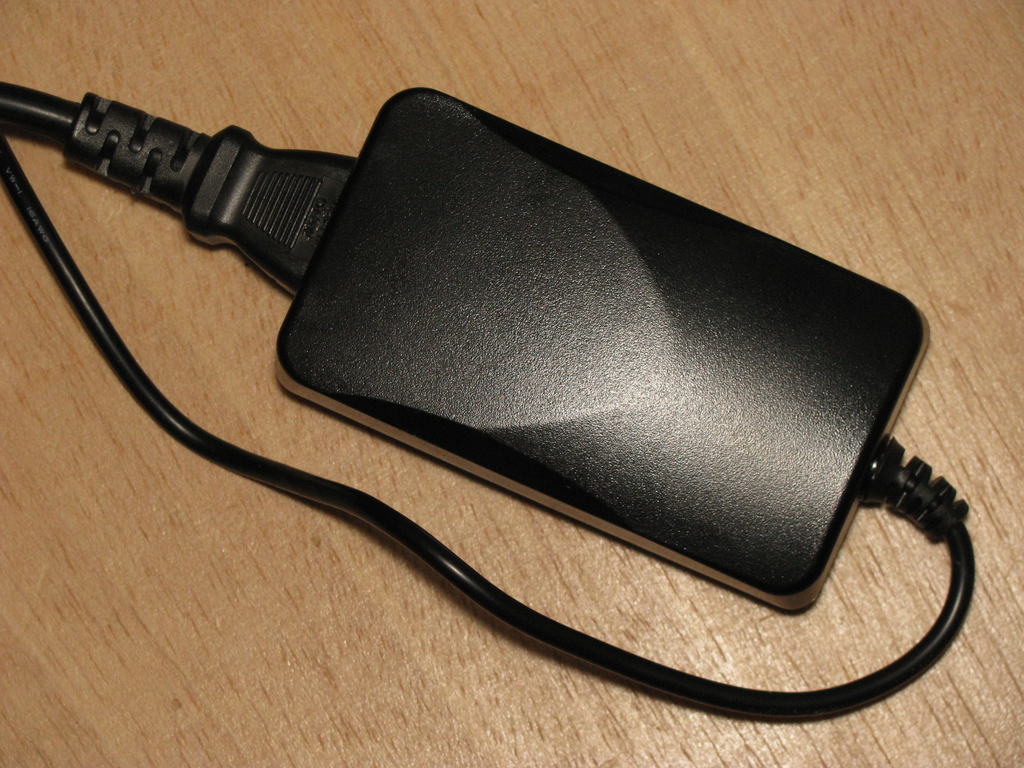
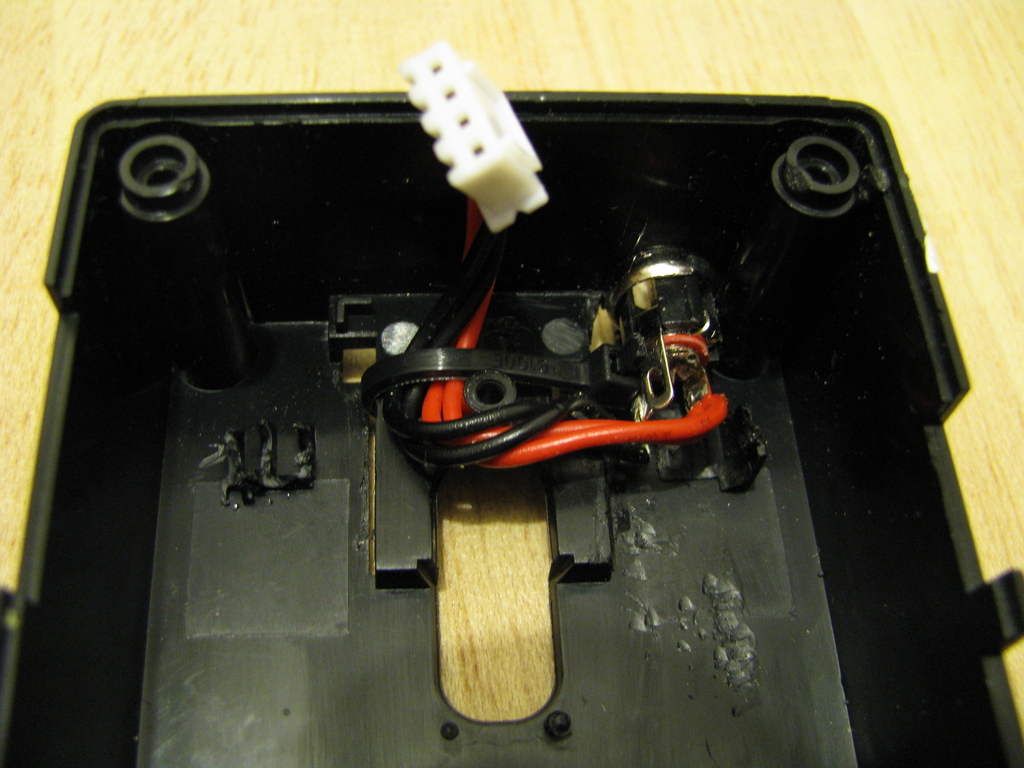
Replacing the power supply As I would never ever trust the PSU (see my last blog post for the gory details) and some additional free space in the case is necessary, it is time to rip it out. As replacement I've ordered an external 5V/20W PSU. To connect it to the plug I've drilled a hole into the case and added a proper connector after soldering the original cable from the old PSU to it. Make sure to add some retainer to stop the cable from touching the CPU/memory heat sinks later. GuruPlug Server Plus PSU replacement GuruPlug Server Plus PSU cabling

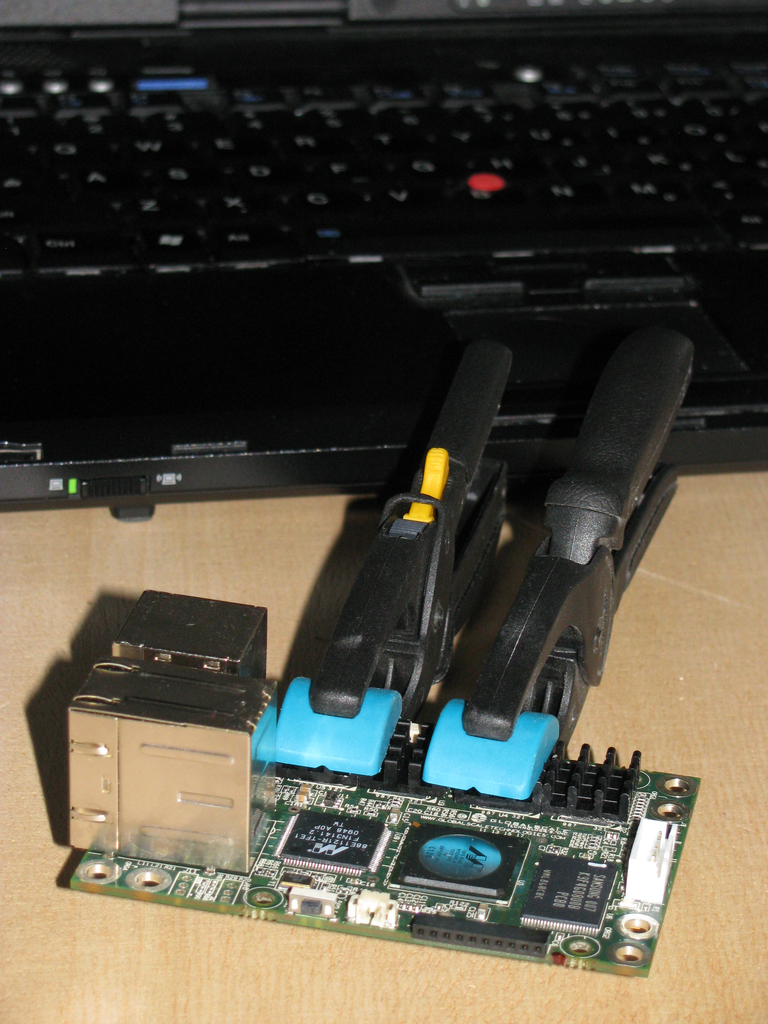
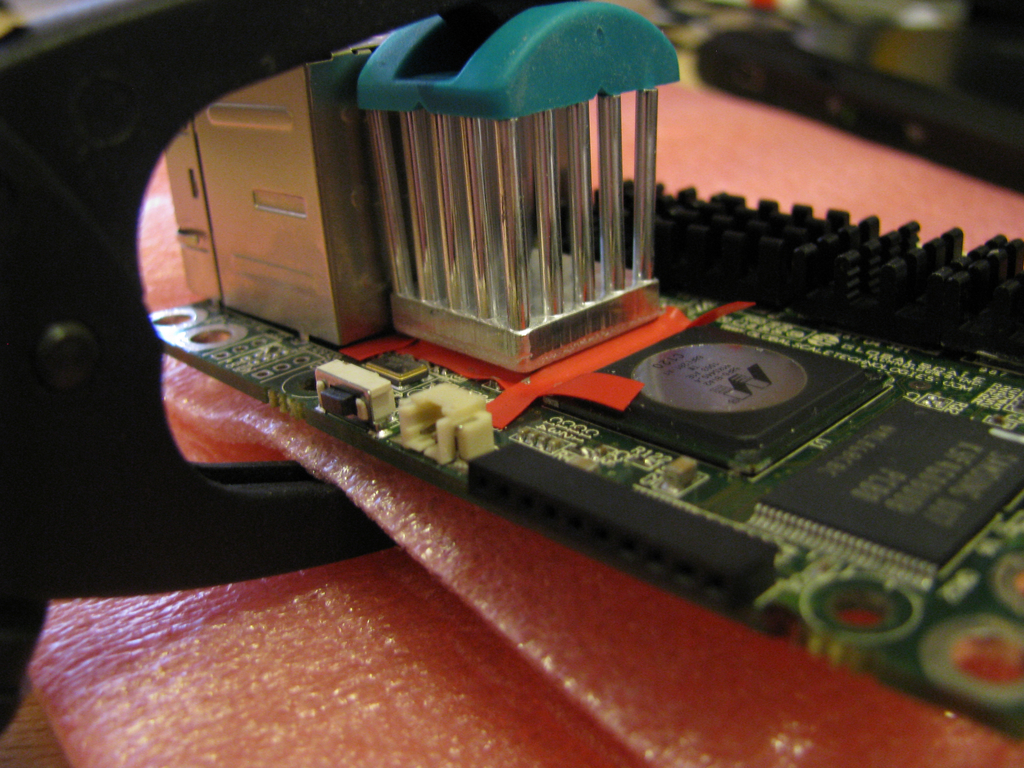
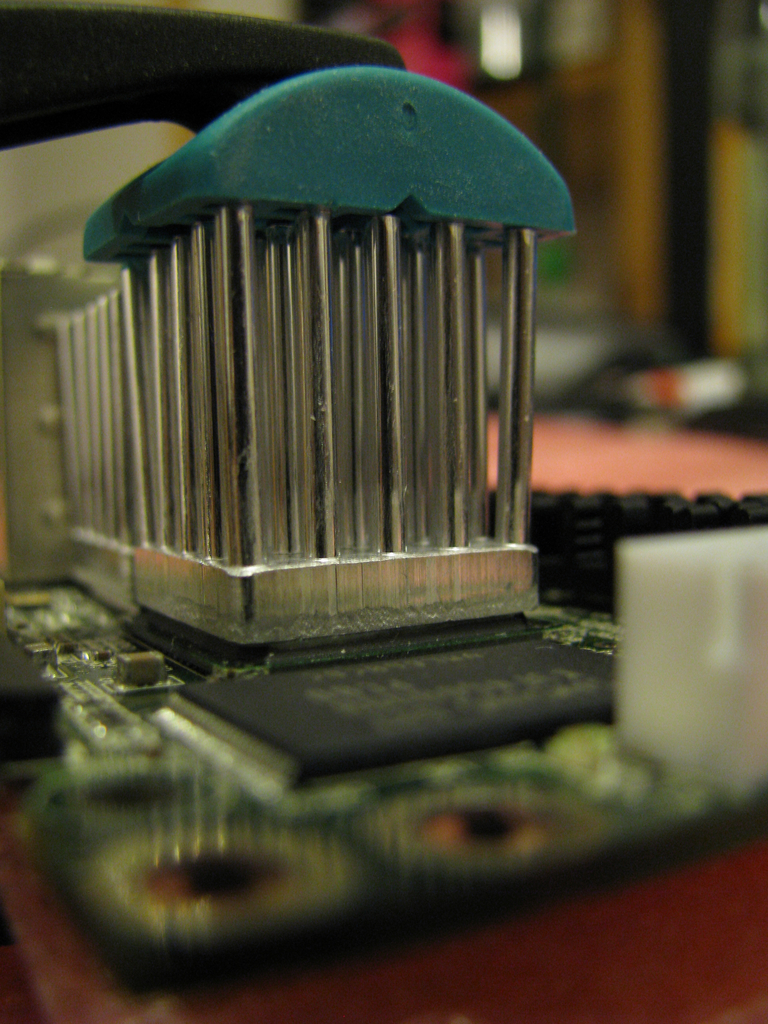
Proper heatsinks One of the biggest problems in the original GuruPlug design is the heat spreading and collecting piece of alloy, which probably makes things even worse than better. After some discussion in #debian-devel the idea came up, that the board should be able to run fine without a heatsink - at least when idling. That is the case, indeed. So let's get rid of that piece of alloy, together with the holders and springs. Unfortunately heat things are necessary to handle some work load. To mount them make sure you get some good thermal glue as you don't want to insulate the chips from their heat sinks. I've used Arctic Silver II thermal glue - not cheap, but working well. Make sure to clean the heat sinks and chips properly with alcohol (2-Propanol is my favourite for that), so there is no fat and dust left. When you use the glue be careful to read the documentation properly and make sure you apply only as much as necessary - a thin coating is enough. After applying the glue and mounting the heat sink you need a clamp to put some pressure on it while the glue dries.

Heat sinks for the memory As there is a lot of space around the memory chips, I've got some 14x14x6mm heat sinks. Luckily there are only small parts on the other side of the board, so it was not hard to attach clamps to ensure the glue is able to dry properly. In case largish amounts of glue are squeezing out between heat sink and chip you probably want to start from scratch and clean everything (quickly!) with alcohol again. GuruPlug Server Plus memory heat sink clamping

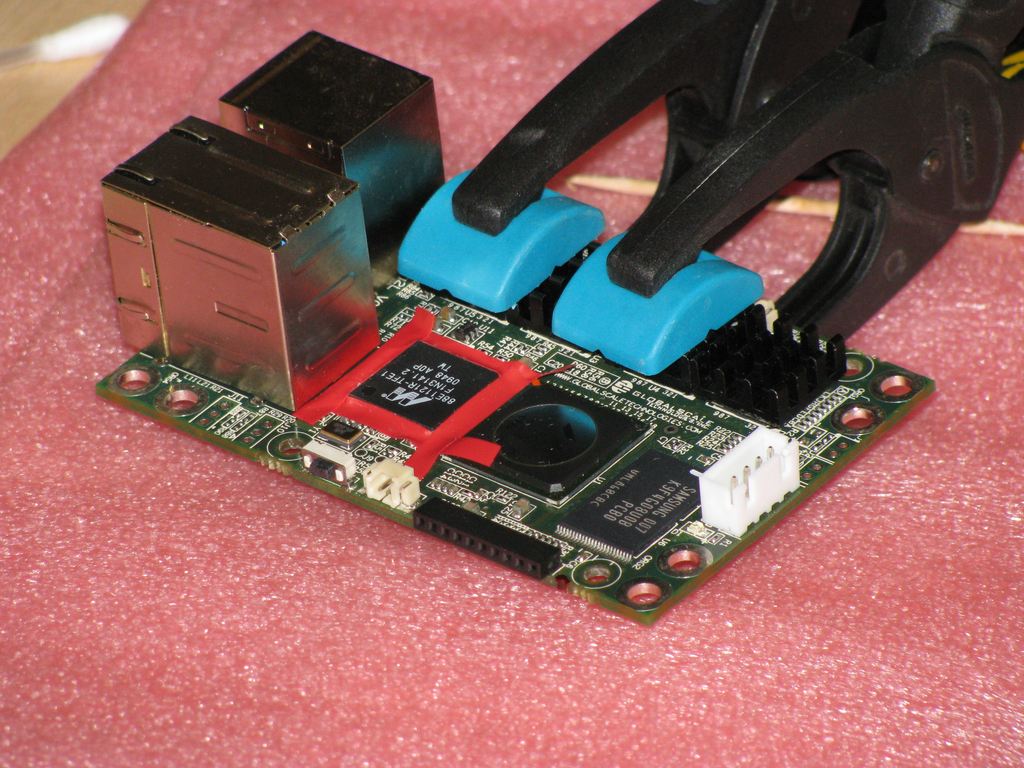
Gigabit Ethernet PHY and CPU heatsinks PHY and CPU need proper heatsinks as they're becoming pretty hot under load. Due to space limitations I had to stick with a 17x17x20mm heat sink for the PHY. I've tried to get a largish heat sink with BGA mount for the CPU, but I was not able to find one in short time and without ordering 1000 of them. So I've got another one of the 17x17x20mm model for the CPU. Later I found two other heat sinks which might fit on the GuruPlug's CPU: Malico 19x19x25mm or a Advanced Thermal Solutions Maxigrip. But for now the smaller one will have to do the job, also I'm scared to removed it without destroying the CPU. To mount the heat sink on the PHY a bit of preparation is necessary to ensure that the glue doesn't result in short cuts on the IC's pins. The arctic silver documentation recommends to use silicone on the pins to stop the glue. As I neither had the proper silicone nor did I want to make such a mess, I've decided to get a sticky insulating tape and some tooth picks to mount it properly on the IC pins. Make sure to do a proper job here! With good clamps you can work on the PHY while the memory heat sink glue is still drying. GuruPlug Server Plus - preparing the PHY The other problem on this side of the board is that some higher parts are mounted on the lower side of the board, so make sure to get some foam to protect them from your clamps. Except of the size of the heat sinks there is no real difference to the small ones: add glue, mount the heat sink and fix it with a clamp. GuruPlug Server Plus - mounting the PHY heatsink Before the glue dries completely make sure you remove the duct tape strips again. Be careful not to wipe any excess glue onto the IC pins. If you manage to do so you might want to remove and clean everything properly. So just be careful and everything should be fine. GuruPlug Server Plus - mounting the PHY heatsink 3 Mounting the heat sink on the CPU is easier as the CPU is a nice BGA package. No need to protect pins an there are none. GuruPlug Server Plus - mounting the CPU heatsink

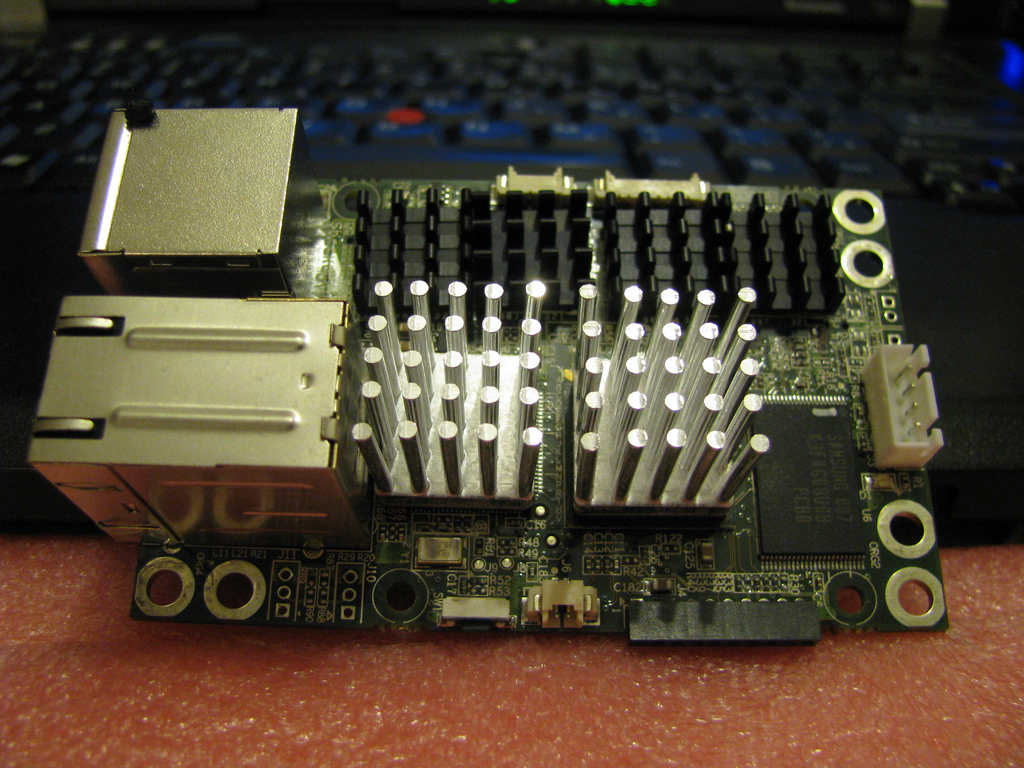
Finished As you're able to see on the photo I did not the very perfect job, but fine enough to work properly. GuruPlug Server Plus - heatsinks

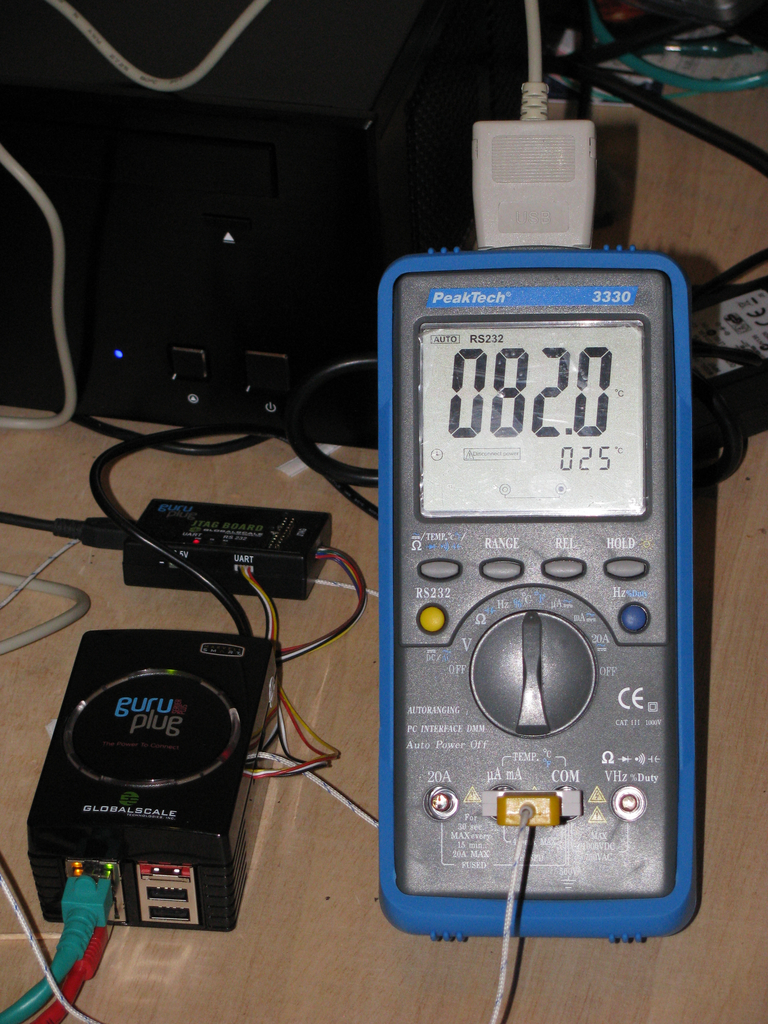
First tests with the new heatsinks Some tests with stress and some heavy network traffic showed quickly that the heat sinks are working well! But not well enough to be able to mount them into the original closed case (how the hell was this supposed to work before!?). Without any air to breath the temperature on the CPU heat sink went up to 85 deg C quickly. So on the CPU's die are > 100 deg C, which is at least close to the max allowed temperature. GuruPlug Server Plus - still too hot

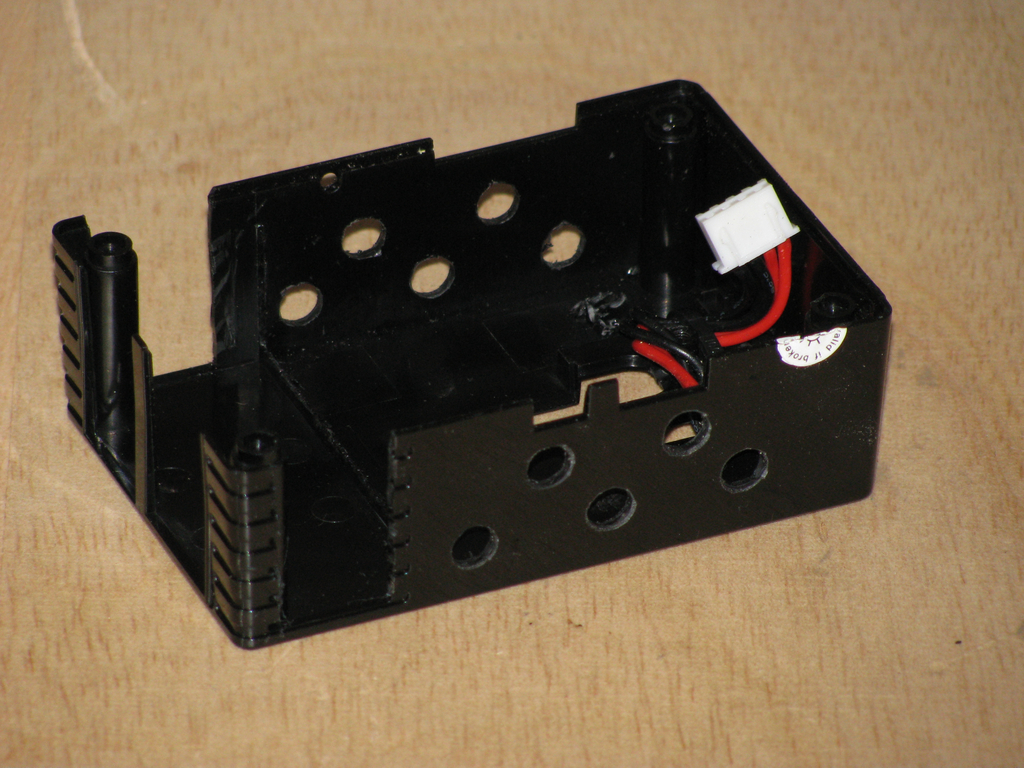
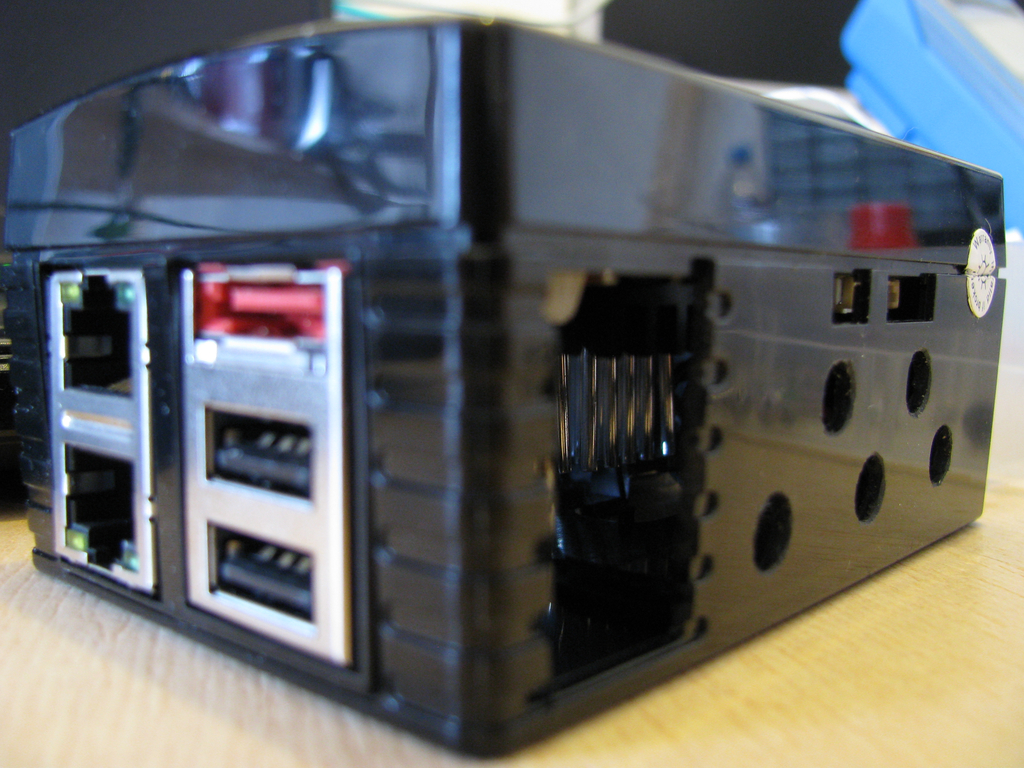
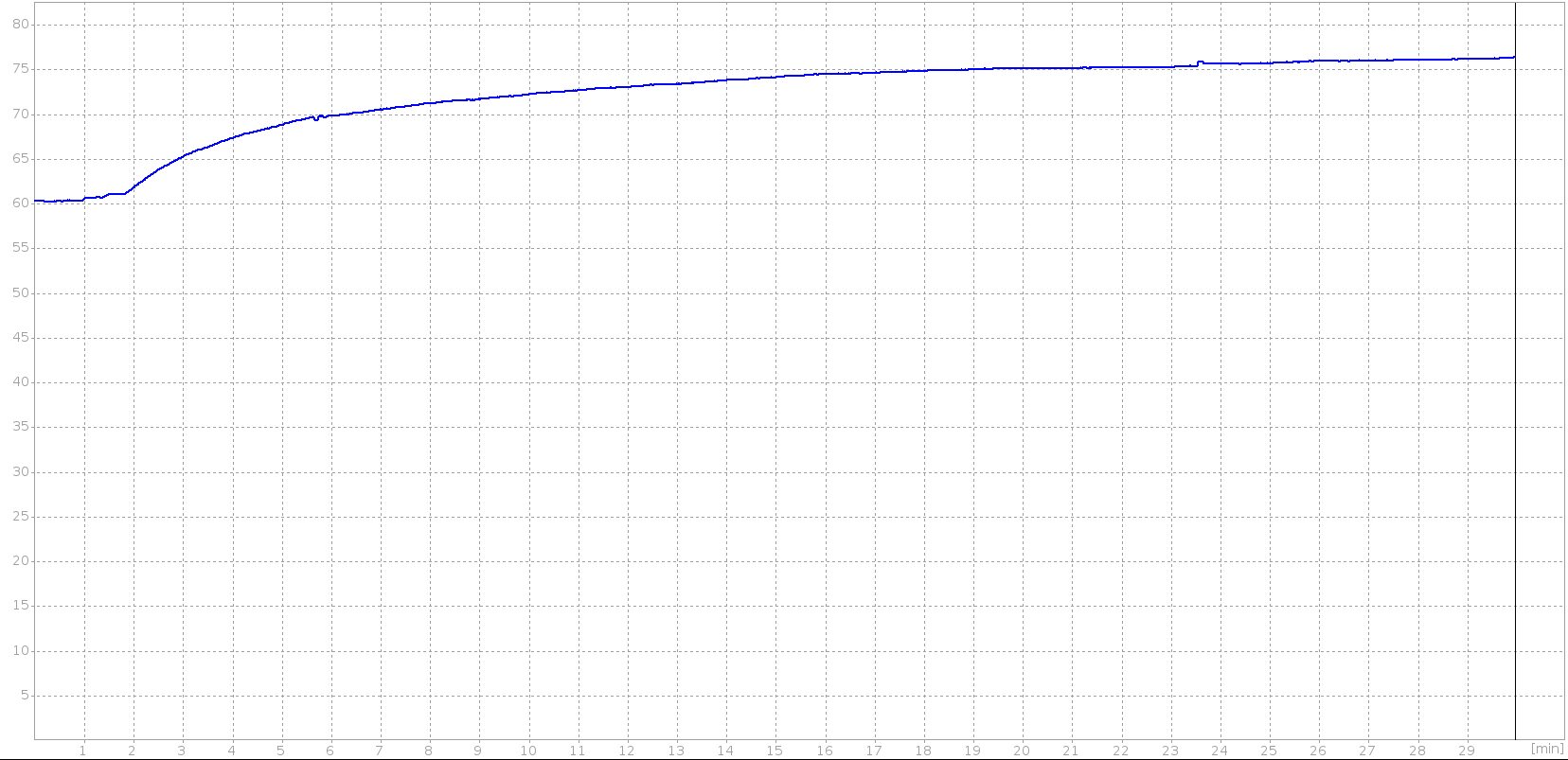
Adding air holes Obviously some additional air holes are necessary. After meeting my drill and cutter, the original case looks a bit like a piece of cheese now. GuruPlug Server Plus - case with air holes 1 GuruPlug Server Plus - case with air holes 2 Some more tests show that the temperature sticks around 76 deg C under heavy load now. That is still pretty hot, especially when the temperature in the room becomes hotter in summer. As I'm not going to run a lot of traffic trough it (my cable connection is limited to 20 MBit/s anyway), I guess it will work. Below is a graph I've recorded with my multimeter and qtdmm. It shows that the temperature rises to ~76 deg C and stays there. GuruPlug Server Plus - temperature curve Not sure if I could introuce some more load, the CPU had a load of 6 running stress. Network traffic was around 2x100MBit/s again. I could imagine with 2xGBit the CPU and PHY would become much hotter (no idea if it would be able to handle it at all, though). The PHY was usually a bit cooler than the CPU, so I didn't spend time to measure the temperature properly.

Conclusion My opinion is still the the original design of the plug is an insane QA and design failure. There is no way that it could ever work as shipped originally. If I'd have to design a new case for it, it should have a single insulated compartment for a PSU to ensure that no contact with high voltage is possible. The case around all other parts should be made of alloy with a lot of air holes. So the case could be used as heat sink (properly done, not with these insulating duct tape strips) and at the same time allow air circulation and a nice view on the LEDs on the board. Of course the case would be much more expensive than, but I'm sure it would work properly and would be worth the money. And if done peoperly, it would look much better than this blinking plastic thing. I could imagine it would sell well! So at the end I'm wondering what GlobalScale Technologies will do. I doubt it will be possible to create the 'professional upgrade kit' as they had announced before. Replacing all units is the only proper way. We'll see what happens. At least my GuruPlug is working well now and it will be used as replacement for my OpenWRT router soon. WiFi is not working, but that will be handled by my media center anyway. GuruPlug Server Plus - running plug

Gerfried Fuchs: Lenny: 900 RC bugs

It is a while since we managed to get below the 1000 stable RC mark. Last weekend we managed the next mark, that is we are below 900 now! Obviously my effort during the RCBC did take us a fair step in that direction, but I don't want to take full credit for it. The last bit that got us below the 900 happened through an event of last weekend: The current point release of lenny. Be aware that the BTS doesn't know about proposed-updates, so bugs closed through uploads to there only are seen when they hit the main pool which is the reason for point releases. It were something around 25 RC bugs that were closed by that. I haven't checked who exactly is to thank here, but looking at the non-DSA packages one finds some perl packages and at least two font packages. Thanks to the corresponding teams for their help! I plan to continue these efforts, so if you think it's a good idea you might want to flattr it. I think this quote sums up the motivation behind this pretty well:
<jwilk> Yay, only 900 bugs to fix and we can release lenny! Oh wait...

/debian permanent link Comments: 0 Flattr this

Adrian von Bidder: Some Fun

Watching the Star Wars Trilogies (both old and new) has finally closed one of the major (in at least some of my collegues' view) holes in my cinematographic education. (I've seen some of the new trilogy when it came out, but not all.) Oh well ... while it's quite enjoyable to watch, it's probably at least as important to have seen them just to spot the references all over the place. Repo Man was where I found myself literally laughing out loudly all by myself. And not only because of the vintage special effects (1984). The Straight Story (Lynch) is just beautiful. Alvin Straight is your proverbial old uncle who may be a bit funny in the head but you just have to like him... If you like mind control stories, The Manchurian Candidate is for you. Now that would be a way for Debian to achieve world domination. Worth thinking about? Speaking of american politics, this reminds me of All the President's Men, which I've seen (and liked) a long time ago. I don't know enough about history to tell how close it is to reality, but it's at least a well made political thriller. Based On A True Story is the term usually used, isn't it?

Dirk Eddelbuettel: Rcpp 0.8.6

After a somewhat longer than usual break, we now have a new release of Rcpp on CRAN and in Debian. This release adds quite few things. The main one may be the addition of density, distribution, quantile and random number functions for a rather large number of statistical distribution. Usage is pretty much as it would be in R, yet it is vectorised at the C++ level. A fair number of unit tests were added too, but some work is left to do there too.
Support for complex number was enhanced both in the expressive 'sugar' context and via a few binary operators that had been missing. We also started a new vignette to provide a 'quick reference'; unfortunately this is not quite complete yet. The NEWS entry follows below:
0.8.6   2010-09-09
    o	new macro RCPP_VERSION and Rcpp_Version to allow conditional compiling
        based on the version of Rcpp
    
           #if defined(RCPP_VERSION) && RCPP_VERSION >= Rcpp_Version(0,8,6)
           ...
           #endif
    o   new sugar functions for statistical distributions (d-p-q-r functions)
	with distributions : unif, norm, gamma, chisq, lnorm, weibull, logis,
	f, pois, binom, t, beta.
    o   new ctor for Vector taking size and function pointer so that for example
    	   NumericVector( 10, norm_rand )
	generates a N(0,1) vector of size 10
    o   added binary operators for complex numbers, as well as sugar support 
    o   more sugar math functions: sqrt, log, log10, exp, sin, cos, ...
    o	started new vignette Rcpp-quickref : quick reference guide of Rcpp API
        (still work in progress)
    o	various patches to comply with solaris/suncc stricter standards
    o	minor enhancements to ConvolutionBenchmark example
    o	simplified src/Makefile to no longer require GNU make; packages using
        Rcpp still do for the compile-time test of library locations
    
As always, even fuller details are in Rcpp Changelog page and the Rcpp page which also leads to the downloads, the browseable doxygen docs and zip files of doxygen output for the standard formats. A local directory has source and documentation too. Questions, comments etc should go to the rcpp-devel mailing list off the R-Forge page

Sylvain Le Gall: Dirty fix for omlet vim extension

omlet (or here) is a vim extension for writing OCaml code. In my opinion, it has a better indentation than the standard OCaml vim support. Unfortunately, it has a cost: the indentation vim code is more complex. And it has a few bugs :-( The main bug is that it doesn't like unbalanced comment opening "(*" and closing "*)" tags. From time to time, it enters an infinite (or very long) loop when there such a tag left in your file. It can be very far away from the point you are editing. It isn't too problematic, because unbalanced tags are a syntax error. But the problem is that it matches these tags inside strings also. So whenever you start using regular expression like "(.*)" the whole indentation fails. But there is a very ugly solution to this problem! Problematic code:
 let parse_rgxp =
   Pcre.regexp ~flags:[ CASELESS] 
     "^(?<license>[A-Z0-9\\-]*[A-Z0-9]+)\
      (?<version>-[0-9\\.]+)?(?<later>\\+)?\
      ( *with *(?<exception>.*) *exception)?$"
Solution, add ignore"(*":
 let parse_rgxp =
   ignore "(*";
   Pcre.regexp ~flags:[ CASELESS] 
     "^(?<license>[A-Z0-9\\-]*[A-Z0-9]+)\
      (?<version>-[0-9\\.]+)?(?<later>\\+)?\
      ( *with *(?<exception>.*) *exception)?$"
Very very ugly coder: you balance comment tags in dead code -- very very bad ;-) ps: another solution when the plugin enters the infinite loop, hit Ctrl-C. This will stop it and let you define your own indentation.

Lior Kaplan: Hebrew translation and Bidi issues in Openoffice 3.3 (beta)

In the last few years the Israeli government founded some work on openoffice.org by Tk Open Systems Ltd. During the years, the work has resulted with an Israeli version , released after the official release and includes a lot of patches to improve support for Bidi and Hebrew specifically. Although most patches were submitted to the hamburg , a lot of them weren t used and are still waiting for inclusion. The funding the that projects stopped a year ago (9/2009), and the last release of the Israeli version is 3.1.1. Since then we had a quiet period in which 3.2 and 3.2.1 were released. While still enjoying the fruits of the projects in these version, it seems that it s time for the community to take over, as we lost hopes for yet another funds from the government. In may Netanel and I started talking about taking over the Hebrew translation, and in June we got Hebrew added to the openoffice.org pootle server. We started with about 80%, and got to 86% in time to get to the list of languages getting a language pack built for. This was a first achievement as Hebrew didn t have a language pack since early on the 2.x versions. I believe that working as part of the openoffice.org l10n group and with openoffice.org release schedule will only benefit for the Hebrew translation process. We used the language pack to test the translation and improve it. We also were able to get to 89% with the help of more volunteers.I believe it s now much more consistent than before. In the process with manually checked Writer thoroughly, while Calc and Impress got less attention due to the time frame. But we fixed some major translation issues in all of the three components. While testing the translation we also started to report Bidi issues we saw in 3.3 beta, hoping they will be fixed for the final release. For example, the main openoffice.org screen on windows has is getting repainted wrongly when moving the mouse over the options (text, spreadsheet..). This looks very badly as this is the main screen! See issue #97556 for details
Openoffice.org main screen in RTL UI

In RTL UI the main screen doesn't get repaited properly.

In addition to report new issues, we also started to keep track of the already opened issues regarding Bidi and Hebrew. I m following the issue system for a few years now, but seeing the list of issues organized in the wiki gave me a better orientation in the problems we have. E.g. finding some related or similar issues and mention each other in the comments, when someone goes to first one, he could also fixed the other as the problem is similar and probably comes from the same code. Organizing also the already closed bugs in 3.x, gave me a some kind of a changelog for the Bidi and Hebrew related issues. In that manner, version 3.1 was a very good for Bidi, thanks for a lot of efforts and work with the Bidi meta issue #79434. The wiki page is in Hebrew, but looks quite OK with Google translate (see here). Hoping to have 3.4 a major release (Bidi wise), I ve opened issue #114236 as another meta issue for Bidi related issues. I ve kept Hebrew specific issues out, as to get it more general and also relevant for Bidi users in other languages. Any help of those issues will be more than welcome (starting with votes and ending with patches).
Filed under: i18n & l10n, Israeli Community, Openoffice.org

Keith Packard: altos-release

AltOS The Altus Metrum Operating System Altos is the core of the software for all of the Altus Metrum products. It runs on the 8051-based micro-controllers within both the flight computer and the ground station devices. AltOS a small cooperatively multi-tasking operating system. AltOS Version 0.7.1 Released Bdale and I have just released AltOS version 0.7.1. Version 0.7.1 is the first release to include the new Java-based ground station software which runs on Linux, Mac OS X and various Windows flavors. AltOS Changes in 0.7.1
  1. Deal with Windows and Mac OSX USB stacks. These two operating systems do interesting things with USB and found some boundary conditions within the AltOS USB stack which couldn t be tested on Linux. With test cases discovered, the panic calls were turned into code that dealt with these cases correctly.
  2. Increase packet mode payload size and add callsigns. The callsigns are set by the master end of the packet link (normally the TeleDongle) so that the entire radio conversation conforms to regulatory requirements. Increasing the payload size makes data transfers go faster.
  3. Place configuration data in fixed flash addresses. This change makes it possible to read the serial number and radio calibration data back out of the flash data when reprogramming a device.
TeleMetrum Changes in 0.7.1
  1. Ensure GPS date information is written to on-board data logger. The GPS date information is used when constructing eeprom log file names; without this, the eeprom downloading tool would generate a filename based on the current date.
  2. Allow TeleMetrum to be used as a programming dongle. This means the user can reprogram a TeleDongle or another TeleMetrum using the TeleMetrum as a programming dongle. Before this, only the TeleDongle could be used to program other devices.
AltosUI - Ground Station Software for Altus Metrum devices Version 0.7.1 is the first release containing our new cross-platform Java-based user interface. AltosUI can: Three Operating Systems, One AltosUI AltosUI provides all of these features on the three target operating systems, Linux, Mac OS X (version 10.5 or newer) and Windows (XP, Vista or 7). The bulk of the software is written in Java and is built once and tested and delivered on all three target platforms. A tiny shim library is built on each system to provide access to the Altus Metrum devices connected over the USB link. Thanks to our contributors! We ve gotten lots of help getting this software built and tested: Future Plans With the basic AltOS and AltosUI functionality running, we ve got lots of ideas about where to take the system in the future. And, we d love to hear ideas from you as well. Some of the ideas we ve like to get done include:
  1. Google Earth file export. We had a Linux-based C program to export a KML (Keyhole Markup Language) file that Google Earth can read and present to the user overlayed on satellite photo data.
  2. Data Plotting. Being able to plot flight data right in the UI would be nice, and there are several Java plotting packages available to try out.
  3. State-dependent display. When the rocket is on the pad, you only want to know if it s ready to fly. When the rocket is descending on a chute, you want to know where it is in the sky and how fast its falling. Presenting a limited amount of information that is most likely interesting to the user should make the display more useful.
  4. Ejection charge testing. The TeleMetrum firmware has the ability to fire ejection charges over the USB or radio links. Safely hooking this up to the user interface will allow for wireless ejection system testing. The key here is safely , of course, which means figuring out a fool proof user interface.
I m sure there are any number of additions that could be made to this list; feel free to send along ideas that you ve got. Of course, all of this software is licensed under the GNU General Public License, so you can get the source and hack on it in the comfort of your own home.

Next.

Previous.