Search Results: "mak"

21 January 2010

Robert Collins: LCA 2010 Thursday


Jeremy Allison on The elephant in the room free software and microsoft . While he works at Google, this talk was off the leash not about Google :) . As usual grab the video :) We should care about Microsoft because Microsoft s business model depends on a monopoly [the desktop]. Microsoft are very interested in Open Source Apache, MIT, BSD licenced software the GPL is intolerable. Jeremy models Microsoft as a collection of warring tribes that hate each other e.g. Word vs Excel. The first attack was on protocols make the protocols more complex and sophisticated. MS have done this on Kerberos, DCE/RPC, HTTP, and higher up the stack via MSIE rendering modes, ActiveX plugins, Silverlight The EU case was brought about this in the Workgroup Server Market . MS were fined 1 Billion Euros and forced to document their proprietary protocols. OOXML showed up rampant corruption in the ISO Standards process but it got through even though it was a battle against nearly everyone! On the good side it resulted into an investigation into MS dominance in file formats -> MS implemented ODF and MS have had to document their old formats. MS have an ongoing battle in the world wide web IE / Firefox, ajax applications/ silverlight. All of these things are long term failures for MS so what next? Patents :( . Patents are GPL incompatible, but fine with BSD/MIT. The Tom Tom is the first direct attack using MS s patent portfolio. This undermines all the outreach work done by the MS Open Source team which Jeremy tells us are true believers in open source, trying to change MS from the inside. Look for MS pushing RAND patented standards: such things lock us out. Netbooks are identified as a key point for MS to fight on lose that and the desktop position is massively weakened. We should:
  • Keep creating free software and content *under a copyleft license*.
  • Keep pressure on Governments and organisations to adopt open standards and investigate monopolies.
  • Lobby against software patents.
  • Search for prior art on relevant patents and destroy them.
  • Working for a corporation is a moral choice: respectfully call out MS employees.
Jonathan Oxer spoke about the google Moon X-prize and the lunarnumbat.org project it needs contributors: software and hardware hackers, arduino/beagleboard/[M]JPEG2000 gooks, code testers and reviewers, web coding, documentation, math heads & RF hackers. Sounds like fun now to find time! Paul McKenney did another RCU talk and as always it was interesting Optimisation Gone Bad (RCU in Linux 1993-2008). Linux 2.6 -rt patch made RCU much much much more complex with atomic operations, memory barriers, frequent cache misses, and since then it was slowly being whittled back, but there is now a new simpler RCU based around the concept of doing the accounting during context switches & tracking running tasks.

Benjamin Mako Hill: Annual Free Software Foundation Membership Drive Appeal

I wrote this for the FSF's annual membership drive where it was originally published. I am reposting it here.
At its core, I think of free software as about the ability of computer users to take control of their technology. Insofar as our software defines our experience of the world and each other, software freedom is an important part of what allows us to determine the way we live, work, and communicate. Free software is not really about software in this fundamental sense; it's about bringing freedom to users through software. In free software's incredible success over the last two decades, many people have lost sight of this simple fact. We have created an incredible array of applications, libraries, and tools. We have created vibrant development and support communities. We have created new development methodologies, powerful copyleft licenses, and massive collaborative projects. But these are all how we give users freedom. They are not freedom itself. They are not what we were trying to achieve. They are our instruments, not our goal. This distinction becomes central in a world where technology is in flux. Indeed, we live in such a world. We can see signs of this in how, as most users' primary computers become mobile phones and new types of network services make up most of many users' interactions with computers, the free software movement's old applications, communities, development methodologies, and licenses can become ill-suited to, or ineffective at, protecting user freedoms. And indeed, in the next few years, bringing freedom to computer users will need to involve new software and new forms of advocacy. It will need to involve new licenses and new techniques for their enforcement. It will need to involve new forms of collaboration and organization. If the free software movement is to succeed, it must stay focused on computer users' freedom -- on the question of why we do what we do -- and then work creatively on how to best respect and protect the freedom we are working toward. If we are overly focused on how we've done things in the past, we may lose sight of the most fundamental goal of supporting users' control over their technology in general. There are many organizations that support the how of today's free software in various ways -- they are law firms and companies and nonprofit organizations supporting various free software projects. The Free Software Foundation is, by far, the most important organization focused on why --- on the underlying principle of software freedom. As such, it plays an essential role in keeping our broader community focused on the key issues, threats, and challenges that will affect the success of every free software project, and every computer user, in the present and in the future. In this period of rapid change in computer technology, its role is more vital than ever. The consequence of any failure is more dire. Here are some of the ways that I will be encouraging the FSF to serve the free software movement in the coming year: Mobile Phones In a short essay I wrote earlier this year, I pointed out that there are now billions of mobile phones and that, although these phones are increasingly powerful computers, they represent one of the most locked-down, proprietary, and unfree technologies in wide use. The implications of this fact for users' control over their technology are dire. Although some widely used phones make extensive use of free software, most free phones are locked down and Tivoized and their users remain fettered, divided, and helpless. We must raise awareness of free software issues among users of phones, communicate to users that phones are powerful general purpose computers, and explain that control over these devices has critical implications for individual autonomy in the future. Toward this end, the FSF staff will launch an advocacy campaign around mobile phones and software freedom in the coming year. Network Services As network services -- like those built by Facebook, Google, and others -- have continued to grow both in scope and penetration over the last year, the importance of a meaningful free software responses grows as well. The launch of products like Google's network-centric ChromeOS offers one glimpse of what a future computing platform may look like. The implications for user freedom, and for the effectiveness of traditional free software approaches, are frightening. The fact that many network services are built using free software does not make the effect of these services on users' autonomy and freedom any less catastrophic. In the next year, the FSF is planning to release the first of what I hope will be several statements on software freedom and network services. Building off the work of the FSF-supported group Autonomous, the Foundation will help provide guidelines for those implementing network services, for users deciding whether to use services, and for developers trying to build services that go further to respect their users' freedom. Reaching beyond our traditional communities Successfully fighting for user freedom is going to mean successfully reaching out to users outside the FSF's historical base . The FSF continues to do so with its Defective By Design anti-DRM campaign and its End Software Patents work. In the last year, the FSF has also reached out to younger users through its "GNU Generation" campaign run by and for high school students. Additionally, the FSF convened a summit this year on women in free software. The FSF plans to build on these successes in the coming year and to expand similar outreach projects. Of course, fighting for and promoting software freedom is more work than today's FSF has the resources to accomplish. Each of my three points above represents an ambitious undertaking, and yet just a portion of the items on the plate of the FSF's small but dedicated staff. Even just continuing its existing projects will require that the FSF adds hundreds of new members by the end of this period. Your membership and donations help make goals like this possible. A strong free software movement focused on the principled issues of software freedom -- and a strong FSF in particular -- will determine what freedoms the next generation of computer users will enjoy. At stake is no less than that next generation's autonomy. I know that this is not the first fundraising appeal you've read this season and I know that the weakened economy makes giving difficult for many. I understand that the cost of a membership or donation may be less easy to afford this year. But we also cannot afford a weakened FSF at this important point of technological transition. If you are not an FSF associate member, now is the time to become one. If you've read my appeal the last two years and decided to wait, now is the time to take the plunge. Membership is $120 per year ($60 for students) and payable monthly. If you are already a member, please join me in giving generously through a tax-deductible donation, or encourage a friend to sign up. The FSF is a small, humble organization of passionate individuals working tirelessly for our software freedom. I've seen firsthand that even small gifts make a difference.

Join now with a $10 monthly donation

20 January 2010

Theodore Ts'o: The Transitive Grace Period Public Licence: good ideas come around

I recently came across the Transitive Grace Period Public License (alternate link) by Zooko Wilcox-O Hearn. I fonud it interesting because it s very similar almost identical to something I had first starting floating about ten years ago. I called it the Temporary Proprietary License (TPL). I m sure this is a case of great minds think alike . One things that I like about my write up is that I gave some of the rationale behind why this approach is a fruitful one:
A while ago, I was talking to Jim Gettys at the IETF meeting in Orlando, and the subject of software licensing issues came up, and he had a very interesting perspective to share about the X Consortium License, and what he viewed as bugs in the GPL. His basic observation was this: Many companies made various improvements to the X code, which they would keep as proprietary and give them a temporary edge in the marketplace. However, since the X code base was continually evolving, over time it became less attractive to maintain these code forks, since it would mean that they would have to be continually merging their enhancements into the evolving code base. Also, in general, the advantage in having the proprietary new feature or speed enhancement typically degraded over time. After all, most companies are quite happy if it takes 18-24 months for their competitor to match a feature in their release. So sometime later, the companies would very often donate their previously proprietary enhancement to the X consortium, which would then fold it into the public release of X. Jim Gettys complaint about the GPL was that by removing this ability for companies to recoup the investment needed to make major developmental improvements to Open Source code bases, companies might not have the incentive do this type of infrastructural improvements to GPL ed projects. Upon reflection, I think this is a very valid model. When Open Vision distributed the Kerberos Administration daemon to MIT, they wanted an 18 month sunset clause in the license which would prevent commercial competitors from turning around and bidding their work against them. My contract with Powerquest for doing the ext2 partition resizer had a similar clause which kept the resizing code proprietary until a suitable timeout period had occurred, at which point it would be released under the GPL. (Note that by releasing under the GPL, it prevents any of Partition Magic s commercial competitors from including it in their proprietary products!)
For more, read the full proposal. No related posts.

Thorsten Glaser: Various topics, and, at least *some* people think!

Marc Fleury, JBoss founder joins the ranks of Tonnerre, me, and other people requesting that MySQL (and MariaDB!) please finally die. Everyone, don't even fork it. Use a real database instead. Or, at least, SQLite. Really. We're going to FOSDEM 2010 (of course I've been at every FOSDEM that was not just an OSDEM, Benny and gecko2 are regular attendees as well, as are other projects of mine such as FreeWRT and Debian GNU/kFreeBSD, by proxy). There will be a recent MirBSD snapshot I've yet got to build, with the new floppy format ustarfs (idea, but no single line of their stinking ridiculously huge code, stolen from NetBSD ) and other improvements (albeit less than I wanted to get done by then). The days before, I'll attend the first FusionForge meeting to break up the French Cabal, with my work hat on. That is also my first time in France (outside of the Elsa ). People, make a good impression on me to overcome the classic prejudices ;-) This weekend I'm going to meet my Debian Application Manager zack, have some good beer (ugh... first this, then Paris, then good belgian beer...) and fix some bugs, all while learning even more. Sounds like fun, but I almost feel overwhelmed, in contrast to the years of much less travelling from my past. I've also started sort-of mentoring Simon, one of our apprentices at work, into the Debian processes. (On an unrelated side note, formorer recently said bpo will become bp.d.o soon. Great!) Please don't laugh at this excuse for a webpage, as I've yet to fill it in, but my CLI for the KDE Wallet is hereby deemed ready for public consumption, with a bug-fix release 2.01 (bugs actually found during preparation of a port to Debian sid and KDE 4, which is much much worse than KDE 3, plus it looks so absolutely disgusting I'm not even sure Windows Mistda is worse). I hope the package will end up in NEW soon (and once progressed to testing I may be able to make the KDE 3 variant official via lenny backports; my WTF *.deb repo will hold them until then.

There are more webpages I need to fill in... mksh's TaC, arc4random (which needs some major redesign as well) and BSD::arc4random, the RANDEX protocol (entropy exchange over IRC) and its plugins and patches, ... Not just Mac OSX (and, I hope, iPhoneOS) will soon come with mksh(1), but also Android (I prepared patches to make it /bin/sh, which works quite well although I need to find out how to make a hardlink so that #!/bin/mksh scripts will run) and Maemo, for which I wrote an mksh package in a garage project, which also needs some love w.r.t. testing on actual devices, menu integration, etc. (Please contact me if you can help with either of the three.) We also have lewellyn:#ksh making a package for the new OpenSolaris system (thanks again). People persuading Apple to put it on the jesusPhone are also welcome. (This does not mean I endorse any of these right now, I'd probably get the most of a WinCE PDA with built-in GPSr, WLAN and maybe GSM/GPRS.) English and French native speakers, please review, and Dutch native speakers may contribute a translation of, our flyers. (Source code for these is not available, sorry. Benny makes them in Quark on System 7 in Basilisk II, used to be Classic until Apple yanked it. But still, they use only free fonts, free imagery or such the MirOS Project is allowed to use, and beat every single other FOSS project flyer I've ever seen by far!) There's probably more I could write, I bet I forgot half of it anyway, but I'll leave it at that for now. Get yourself a nice cup of hot chocolate, pour an Espresso into it, and enjoy the mix with a piece of cake (I'd say strawberry or mousse-pear but all they had was cassis-cr me) and pity me for not knowing any French next month.

Julian Andres Klode: python-apt 0.7.93 just hit unstable.


I just uploaded python-apt 0.7.93 to unstable with support for Python 2.6 and Python 3.1, meaning that there is now a single development branch again. This uploads brings developers the new API with real classes in apt_pkg (you can now use pydoc to view documentation), C++ bindings for making apt-pkg applications scriptable (although they should be considered experimental), a test suite (although aptsources fails in one test for now) and many new context managers for enhanced Python 3 coding fun. And objects are now freed when their reference count reaches 0. A more complete list of news can be found in the What s New In python-apt 0.7.100 part of the documentation. For the next releases until 0.7.100 release, the focus is clearly on fixing bugs and improving the documentation. We need more tests of the Python 3 builds, especially in areas dealing with str and unicode stuff. Have fun, read the documentation, and code. Posted in Debian

MJ Ray: Get the Survey Monkey Off Your Back

I ve been asked why I dislike surveymonkey surveys, I don t want to reply fully in that forum (because it s off-topic there) and I want to publish this for your feedback now. surveymonkey really frustrates me. In short, it s often confusing, I think it doesn t follow UK accessiblity laws and I m unsure if it complies with our privacy laws. It seems like another triumph of marketing over good sense. It s a free market failure, possibly based on lack of information on the drawbacks of this option. If a survey is on Surveymonkey, it s easiest for able-bodied users of full-fat browsers with low security and privacy settings to answer. Using NoScript or a privacy tool? You ll get an error message (which contradicts the VPAT_SurveyMonkey.pdf description). Unable to see graphics clearly? The forms will be hard to read because they ve replaced the browser form widgets (such as checkboxes and radio buttons) with javascript-driven images for no good reason. Those sort of faults will probably bias results a bit how much will depend on the subject. It s a particular case of a problem I first mentioned in the last-but-one bullet point on my debian surveys page back in 2006. Basically, I think you should keep open surveys as open as possible. Statistics literature is littered with bizarre spurious results from when the survey method accidentally favours some particular subset of the population. Finally, surveymonkey surveys can be left with answer requirements which make no sense, such as ticking Other requiring a text input, but the text box not accepting input. Is that the fault of the survey owner not being able to work the admin interface, or the interface having some subtle flaws? I m not completely sure, but I ve had that experience a few times. So, can I persuade people to use limeservice, doodle or even Google Docs rather than Surveymonkey, please? I think Limeservice is better because it s based in Germany (so EU data protection and privacy laws apply) and is cooperatively-developed FOSS software. Doodle and Google aren t, but are quicker and easier to use for straw polls. If you want something to install on your own site and the downloadable limesurvey software seems a bit heavy, then askpeople seems another good option. Our co-op can host either of those if you re willing to pay. (If someone would be willing to sponsor it, we d host some free surveys too let me know.) Lots of people use surveymonkey, but popularity doesn t always mean it s the best tool. Please consider the alternatives and pick the best tool for the job.

Robert Collins: LCA 2010 Wednesday


Pandora-build. There for support I ve contributed patches. Pandora is a set of additional glue and layers to improve autotools and make it easier to work with things like gettext and gnulib, turn on better build flags and so forth. If you re using autotools its well worth watching this talk or hop on #drizzle and chat to mtaylor :) The open source database survey talk from Selena was really interesting a useful way of categorising databases and a list of what db s turned up in what category. E.g. high availability,community development model etc. Key takeaway: there is no one-true-db. I gave my subunit talk in the early afternoon, reasonably well received I think, though I wish I had been less sick last week: I would have loved to have made the talk more polished. Ceph seems to be coming along gangbusters. Really think it would be great to use for our bzr hosting backend. 0.19 will stablise the disk format! However we might not be willing to risk btrfs yet :( Next up, the worst inventions ever.. catch it live if you can!

19 January 2010

Lior Kaplan: Hamakor, the Israeli Free Software Society, calls for the annulment of Software Patents


Following a call for submissions from the Israeli Patent Authority, the Israeli Free Software Society, Hamakor, submitted a memorandum calling for the annulment of the Software Patents. A Memorandum drafted by Adv. Jonathan J. Klinger, Hamakor s chief legal counsel, presented a tough and strict approach claiming that software patents harm innovation and incur high legal costs on software developers.
protecting software through patents shall provide protection on ideas, which are usually expressible in more than one manner, and shall be the beginning to a race to the bottom where every person shall register as many patents possible and incur high costs on each player in the software field , said Klinger, and added that the chilling effect created by the fear of using software protected by patents, be it free software or proprietary software, and incur costs on the system solely in order to purchase insurance from the theoretical patent infringement. In such case, any independent development of software without legal assistance from the first day of development shall be problematic, and deter developers from developing free software or promote innovation .
Until recently, the Israeli patent authority rejected Software Patents and provided protection only regarding hardware (in re Eli Tamir). However, the recent call for submissions had raised the fear that software patents shall be used to deter innovation. Currently, Israeli venture capital funds and technology evangelists often see patents as the core asset when protecting software companies from competition, which creates a race to the bottom that requires startups and innovative companies to register patents in order to raise funds. Hamakor presents, in its memorandum, a new approach focusing on people and not patents, as the core asset of the Israeli Innovation. See Also: Posted in Israeli Community, Software Patents Tagged: Hamakor, israel, Software Patents

Robert Collins: LCA2010 Wednesday Keynote


Another must-grab-the-video talk : Mako s keynote. Antifeatures, principles vs pragmatism do come together. The principled side RMS & the FSF important to control ones technology because its important to control ones life. The pragmatic side quality, no vendor lock etc. False dichotomy.. freedom imparts pragmatic benefits even though it doesn t intrinsically import quality, good design: 95% of projects 5 contributors; median number of contributors 1, and such small collaborations are no different than a closed source one. Definition of antifeatures built functionality to make a product do something one does not want it to do. Great example of phone books: spammers pay for access to the lists, and thus we have to pay *not to be listed*, but its actually harder to list and print our numbers in the first place. Mako makes a lovely analogy to the mafia there. Similarly with Sony charging 50 dollars not to install trialware on windows laptops in the past. Cameras: Canon cameras disabled RAW saving . CHDK, an open source addon for the camera outputs RAW again. Panasonic are locking down their cameras to reject third party batteries. The tivo is an example of how focusing on licensing can miss the big picture: free stack, but still locked into a subscription to get an ongoing revenue stream. Dongles! Mako claimed there wasn t a facebook appreciation group for dongles there is. Github: paying for the billing model lots of code there to figure out how many projects in a repo, so that they can charge on that basis. DRM is the mother of all antifeatures 10K people writing DRM code that no users want!

Russell Coker: Taking my Thinkpad Apart and Cooling Problems

I ve been having some cooling problems with my Thinkpad recently. It s an old model T41p which is outside the service period so IBM/Lenovo won t help me (at least not unless I give them more money). If I run it for a few minutes at maximum CPU when the ambient temperature is about 20C then it gets to 90C, apparently 93C is the temperature at which it turns itself off, so obviously I need to do something to keep it cool. On the really hot days of summer my air-conditioners can t keep any part of my house below 30C, so on such days I can t do any compiles on my Thinkpad or watch videos. My Thinkpad seems to idle at a temperature that is about 35C higher than the ambient temperature. At this rate the system could get close to it s maximum temperature on a 45C day by just idling! Not that I plan to have a warm Thinkpad on my lap if I ever happen to be outside on such a hot day. I suspect that a large part of the problem is the dust that has accumulated inside the machine. I asked about this on the LUV mailing list and Andrew Chalmers suggested The Chaos Manor review of taking a Thinkpad T41p apart [1]. The Chaos Manor guy wanted to replace his CPU with a faster one so he had to get access to all the same bits. I followed the instructions until I got to the stage of prying the heatsink off the video chip. I figured that I will never be able to attach it as well as it is currently attached so I will get different cooling problems if I go any further. Taking it apart to that degree was a moderate amount of work, getting the keyboard bezel off was the most difficult part, and taking the palm-rest off required removing bits of plastic that were stuck in place to cover screw holes which will probably fall off in a week or two. Probably everyone who owns a T41p that they regularly use has a similar problem to me as all such machines have been out of support long enough to have accumulated a lot of dust. So I recommend that other T41p owners not disassemble their machine as much as I did, but instead go for my plan B which is to blow compressed air through the CPU cooling system. Doing this merely requires removing the keyboard. One tip that I have heard is that you should hold the fan in place when blowing compressed air as the pressure of the air may spin the fan fast enough to generate enough electricity to damage the motherboard or damage it s bearings. But you might want to wait until I ve got my Thinkpad done before you blow compressed air through yours, it could very well be destroyed. The other option is to try and use software to control the temperature. Patricia Fraser suggested controlling the fan speed [2]. I did some experiments and found that increasing the fan speed dramatically slowed the increase in the temperature. A 10 minute build is almost certain to bring the temperature to dangerous levels in a default configuration, but it seems that if I set the fan to maximum speed before starting the build then I can mitigate this problem. Most programs that I work on will compile in significantly less than 10 minutes. Another possibility that occurred to me is that of limiting the speed of the system. It seems that ACPI has support for reducing the CPU frequency when the temperature rises too much, but Matthew Garrett has pointed out that this effectively increases the amount of energy used (and heat dissipated) for any given quantity of work [3]. So what I want to do is to cause the CPU to idle periodically when it gets too hot. I ve been idly considering writing a program that uses SIGSTOP and SIGCONT to control the operation of programs such as make, or writing a program that creates a new pty (like script) and pauses the output whenever the CPU gets too hot. Of course the easy option would be to figure out how to set the threshold temperature where the CPU speed is limited. Which is made slightly more complicated by my choice of kernel 2.6.30 for Ext4 support. Now the kernel doesn t work with my acpid and I m starting to get forced into an upgrade to Debian/Testing. Does anyone have any ideas?

MJ Ray: Unable to Register .CN Domains

Our co-op registers domain names for others. Like most registrars, we now cannot register Chinese (.cn) domains. There s a bit of background discussion on WebmasterWorld. While it s always disappointing to offer fewer services, I don t think we ve ever registered a .cn domain and especially not for anyone in China. Most of the .cn domains we see are in spam. If this tighter control makes any dent in the amount of spam and scam sites, that s probably a good thing. I ve not felt any significant reduction in spam since this change, though. I suspect the scammers have just moved to another top-level domain with a long-time idle government, while a few legitimate users of cn domains will also be punished along with the scammers. Will we ever shut out the spammers? Even if we kick them out of all domains, they ll find some way of using IP addresses or something. The price of freedom is eternal vigilance.

Robert Collins: LCA 2010 Tuesday


Gabriella Colemans keynote was really good; grab it from the videos once they come online. WETA run Ubuntu for their render farm: 3700 machines, 35000 cores, 7kw per cold rack and 22kw per hot rack. (Hot racks are rendering, cold racks are storage). Wow. Another talk well worth watching if you are at all interested in the issues related to running large numbers of very active machines in a small space. And a classic thing from the samba4 talk at the start of the afternoon: MS AD domain controllers do no validation of updates from other domain controllers: classic crunchy surface security. (Discovered by samba4 borking AD while testing r/w replica mode). Blue-ray on linux is getting there, however one sad thing is that the Blue ray standard has no requirement that vendors make players be able to play un-encrypted content and there are some hints that in fact licences may require them to not play un-encrypted content. Peter Chubb s talk on Articulate was excellent for music geeks: midi that sounds like music from lillypond. Ben Balbo talked about Roll your own dropbox . Ben works at a multimedia agency, but the staff work locally and don t use the file server . use instant messenger to send files around! Tried using subversion too hard. Dropbox looked good but 3-7 hundred a month too pricey given an existing 1.4TB of spare capacity. He then considered svn + cron but deleted directories cause havoc & something automatic was wanted so git + cron instead. Key thing used in doing this was having a work area with absolutely no metadata. Conflicts dealt with by filename.conflict.DATESTAMP.HOSTNAME.origextention Doesn t trigger of inotify, no status bar widget, only single user etc at the moment, but was written to meet the office needs so is sufficient. Interestingly he hadn t looked at e.g. iFolder.

18 January 2010

Adam Rosi-Kessel: Free Tip: How to resize scanned PDFs with ghostscript for Adobe Acrobat OCR

I m unaware of any free tool to perform OCR on a PDF and embed the resulting data in the PDF itself so it is text-searchable. If anyone knows of one, let me know. In the meantime, I use Acrobat Professional for this essential functionality. High resolution PDFs produced by my scanner (HP Officejet Pro L7700) usually give the following error when I try to perform Acrobat OCR: This page is larger than the maximum page size of 45 inches by 45 inches. Surprisingly, there doesn t seem to be any way to resize the page size of a PDF within Acrobat. It s possible to print to a new PDF of the correct size, but this operation cannot easily be batched. If I apply the crop tool to resize the page in Acrobat, I get this error: Page size may not be reduced. Many report these issues in Adobe s forums. The most common responses suggest reconfiguring the scanner or buying a new one. I found nothing quick and easy after some googling for a simple ghostscript recipe to perform the batch pre-processing necessary to allow Acrobat to do the OCR. It s not hard to do, just a bit of a trial-and-error pain to get the right switches. For posterity, then, here is a simple command-line to make this happen (here under Windows, but could obviously easily be adapted for any other platform). First, download the latest ghostscript for your platform (at this time, 8.64 for Windows). Then: gswin32c -dQUIET -dNOPAUSE -dBATCH -sPAPERSIZE=letter -sDEVICE=pdfwrite -sOutputFile=OUTPUT.pdf -dPDFFitPage INPUT.pdf And a simple inelegant script to batch process (again, under Windows/cygwin, but easily adaptable). Feel free to make more elegant:
#!/bin/bash
for x in "$@"
do
echo -n Processing $x ...
if [ ! -e "$x" ]
then
echo File $x missing. Exiting.
exit 1
fi
if [ -e gs_shrink_to_letter.pdf ]
then
echo Tempfile gs_shrink_to_letter.pdf exists. Exiting.
exit 1
fi
if ( gswin32c -dQUIET -dNOPAUSE -dBATCH -sPAPERSIZE=letter -sDEVICE=pdfwrite -sOutputFile=gs_shrink_to_letter.pdf -dPDFFitPage "$x" )
then
echo Success.
mv gs_shrink_to_letter.pdf "$x"
else
echo Error occurred, exiting.
exit $?
fi
done

After converting your PDFs as above, you can then apply Acrobat batch OCR without a hitch.

Gunnar Wolf: 100 years of policletos

Among the many columns and lesser sections of my favorite national newspaper I enjoy reading the Centenaria column Notes published one hundred years ago in Mexico City local newspapers. A couple of decades ago, we started having policletos on the streets "Polic as bicicletos". Cops on bikes. I don't know if we had policletos as a continuous presence before that, but I do remember it being somewhat controversial in the late 1980s or early 1990s. Anyway, this snippet (and sadly I cannot capture the 1910 writing style in English) was a joy to read:

January 18, 1910 Good results of using bicycles for surveillance As we have come to know, the service the first-class policemen are doing on bike, mainly during night time, has yielded great results, as the street policemen often fell asleep and woke up upon hearing a horse approaching, which does not happen anymore because the first-class policemen make much quicker rounds, and before the street policemen even think of it, their superior is standing in front of them. It also seems that robberies, so frequent during the nights, have ceased because the burglars, hastily breaking the locks, are caught by the bike-riding policemen, given the machines barely make any noise, and besides, they cannot run away because they are chased with no effort.

Christine Spang: Quodlibet: looking for mentee comaintainer

Quodlibet is a GTK+ audio library manager / player. In Debian, it makes up four binary packages: quodlibet, quodlibet-ext, exfalso, and quodlibet-plugins. It's big/popular enough to get a few bugs filed against it and for people to yell when things break, but not so big as to be overwhelming. Since the previous comaintainer has been inactive for some time, I've been thinking that it might be nice to have a comaintainer again. During my academic term at MIT or if I'm on vacation, I don't get to things as quickly as I should. The package has also gone through a period of inactive Debian maintainers and a period of inactive upstream maintainers, so it's accumulated a fair number of ignored bugs in the BTS. And in general, having others to fall back on is a good thing, as long as it doesn't lead to no one taking responsibility. So, here's a deal: I want a comaintainer. There's a catch, though: this person doesn't need to be already involved in Debian. In fact, I'd prefer it if she weren't. If you have a good grasp on the English language, enthusiasm for Debian, and a willingness to learn some technical skills, contact me, preferably via email, and let me know who you are. Quodlibet is written in python, but I'm explicitly not saying that you need to know python in order to help out. You'll gain the benefit of having someone willing to answer your questions and direct your efforts and an automatic sponsor for uploads you prepare. I can't say I have a ton of time to put into mentoring someone, but I'm willing to put in some, so hopefully such an arrangement will turn out well for all parties involved: you, me, upstream, and Debian. :)

Russell Coker: Why Internet Access in Australia Sucks

In a comment on my post about (relatively) Cheap Net Access in Australia [1] sin from Romania said Somebody needs to whack the aussie ISP in the head with a cluebat. The prices that you pay are insane . In Eastern Europe you have optic fibers from Germany and other western European countries that carry vast amounts of data. As the demand for capacity increases it s not THAT difficult to lay more fibers. You also have competition between different companies that lay fiber. To get data to Australia you must lay cables under the sea, this is expensive and can t be done quickly. Therefore all international data transfers are expensive to cover the expense of laying the cables. I don t think that we have any real competition in the market for International connectivity from Australia either. Now the links between Europe and the US aren t cheap either, but I believe that there are economies of scale (as well as shorter distances) that make them significantly cheaper than the links to Australia. Also a good portion of the traffic that you generate as a customer of a European ISP will stay within Europe as there are heaps of good sites in Europe. The number of people living in Europe who speak English as their first language is more than twice that of Australia. The number of Europeans who communicate in English almost as fluently as the native speakers (such as about half the population of the Netherlands) is also quite significant. I expect that the amount of English-language material on the net that is published from the EU is more than three times greater than the quantity published from Australia. People who speak languages that have a more limited geographic spread (IE anything other than English, Spanish, French, and Portuguese) will have a higher portion of local traffic which is therefore cheaper for their ISP. So based on the relative population sizes we should expect to have Australians making a higher portion of their Internet bandwidth be expensive international data transfers than that of Europeans. Then of course there is the issue of server costs. Running servers in Australia is horribly expensive, while user access to the net is merely annoyingly expensive, the costs of hosting servers are significant and usually the offers have slower hardware and slower transfers (particularly to the important US and EU markets). My blog is hosted in Germany because the company that was offering me free hosting in Australia encouraged me to host it elsewhere due to the price. Also hosting in Germany gives me slightly lower ping times to the US and significantly lower ping times to Europe. As about half the readers of my blog are based in the US, a significant quantity of the readers are based in the EU, and Australia only contains a small portion of the readers the overall experience for readers of my blog is improved by having it hosted outside Australia. It would be better to have it hosted in the US (where most of my readers are located) but I was offered free hosting in the EU. It would be nice if there was a cheap and easy way of getting a mirror of my blog running in Australia with Geo-DNS so that people using Australian IP addresses would get a local server. Putting the static images on an Australian server would be trivial, setting up Geo-DNs would be painful and probably increase reliability issues later on but isn t insurmountable (I have root on both DNS servers). The Debian blog gives some basic information on how to setup GeoDNS [2]. Then I would need to set up a MySQL slave for Wordpress data and modify Wordpress to send it s writes to the master server which is probably impossible for me unless someone else has already written a Wordpress plugin for this, I m really not good at PHP programming. Another possibility would be one of the Wordpress cache plugins that maintain static files to avoid needless database lookups. Until/unless I do such things, every Australian reader of my web site (and those of my friends who do similar things to me regarding hosting) will slightly tilt the balance of Internet transfers in favor of expensive data from foreign servers instead of cheap content from local servers. Sometimes it just sucks to live on an island.

17 January 2010

Gustavo Noronha Silva: Cool hack - html5tube

Did I mention I hate flash? I do. It crashes a lot, and is overall a bad thing for the web, in my opinion. But I do enjoy watching videos on the web, and unfortunately, up to this day, flash is what most sites use to show videos. Months ago I read a couple of blog posts with nice hacks to make Firefox able to play youtube videos without using the flash player. Some recent discussions with colleagues at work got me itching to try my hand at something similar for Epiphany. HTML5Tube working So I went ahead, and wrote a new extension that does just that - in youtube video pages, it finds the flash player element, and replaces it with an HTML5 video tag pointing to the actual movie file. This causes the internal HTML5 media player built into WebKitGTK+, that is based on GStreamer, to play the movie. That means you only need to have the necessary GStreamer magic, and the extension enabled, to enjoy the movie. There are some caveats - in-video text messages are gone (though I m pretty sure we could get them added somehow), playlists, and other places which display videos other than the normal video watching page are not handled, youtube needs to think you have the flash plugin installed, at least, so the only way to make it work right now is to actually have a flash plugin installed. I think we could probably get away with the last problem somehow, by looking at what the totem youtube plugin code does, for instance, and replicating it.

Andreas Metzler: gnutls26 lenny update

I have prepared an update of gnutls26 for lenny, incorporating these changes: I would appreciate testing. Source and binaries for i386 and amd64 are available here.

Andrew Pollock: [life] A Prairie Home Companion

We listen pretty much exclusively to NPR in the car these days, and often when we're pottering around on the weekend, we catch A Prairie Home Companion. It's a light-hearted radio show, which makes us laugh. When we learned that it was coming to town, we lashed out on some tickets. We went to the recording of today's episode at the War Memorial Opera House. We had seats towards the back of the balcony on the fourth floor. The opera house is a beautiful building. The seating is incredibly steep. The stage was miles away, I wish I'd brought binoculars. The opera house normally holds 3200, but because there was no orchestra they could put in some extra seats. It was a full house. It was cool to get to see how the show is put together, and we had an entertaining time.

Mirco Bauer: Smuxi 0.7 Release + Smuxi 0.8 Plans + FOSDEM 2010

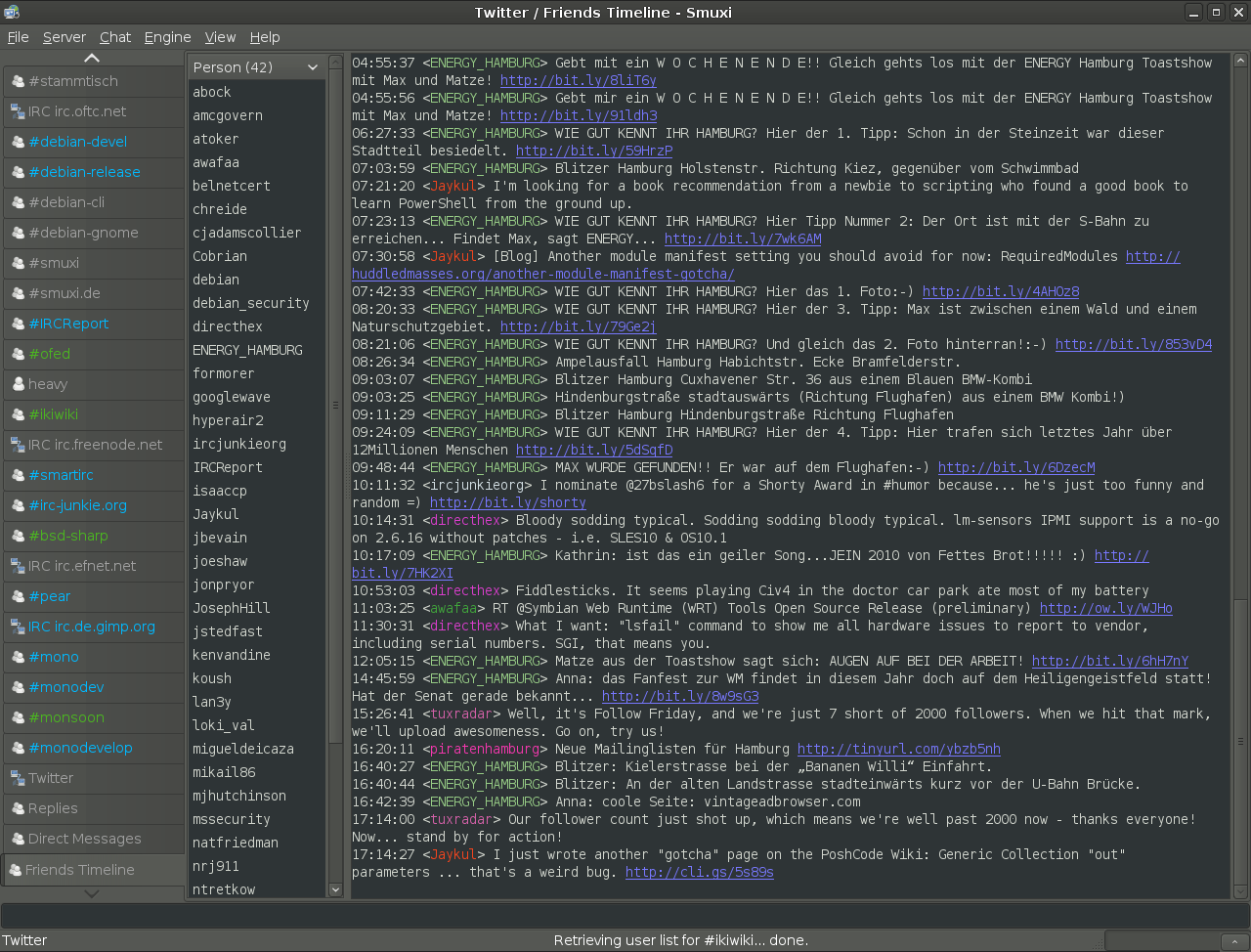
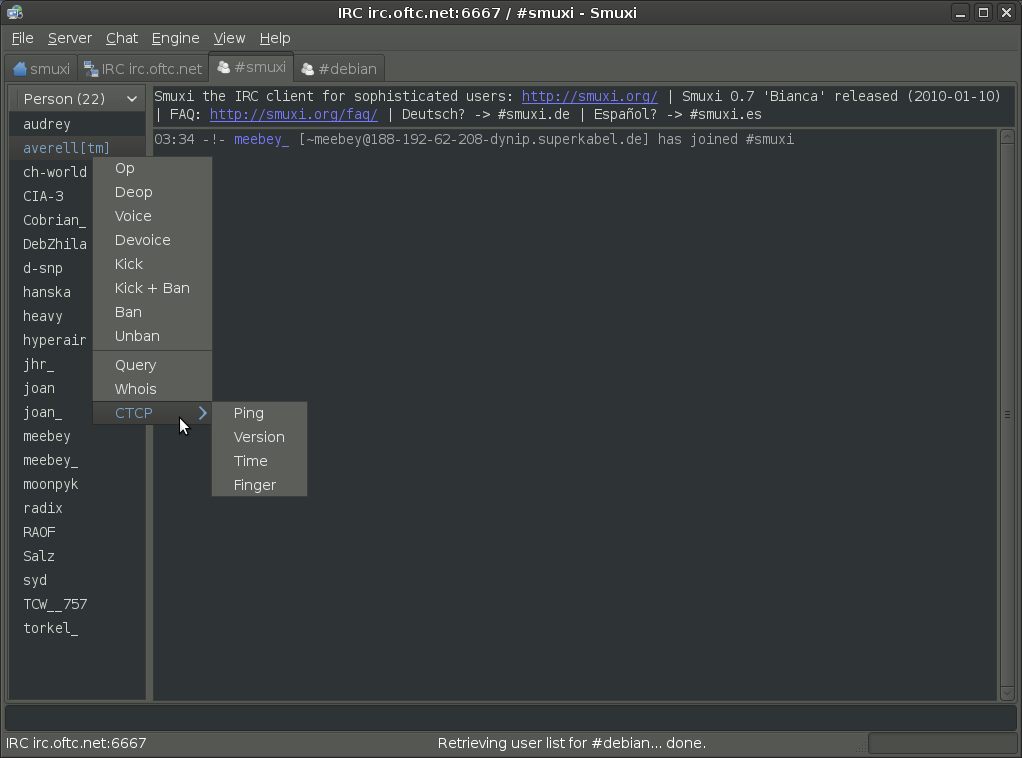
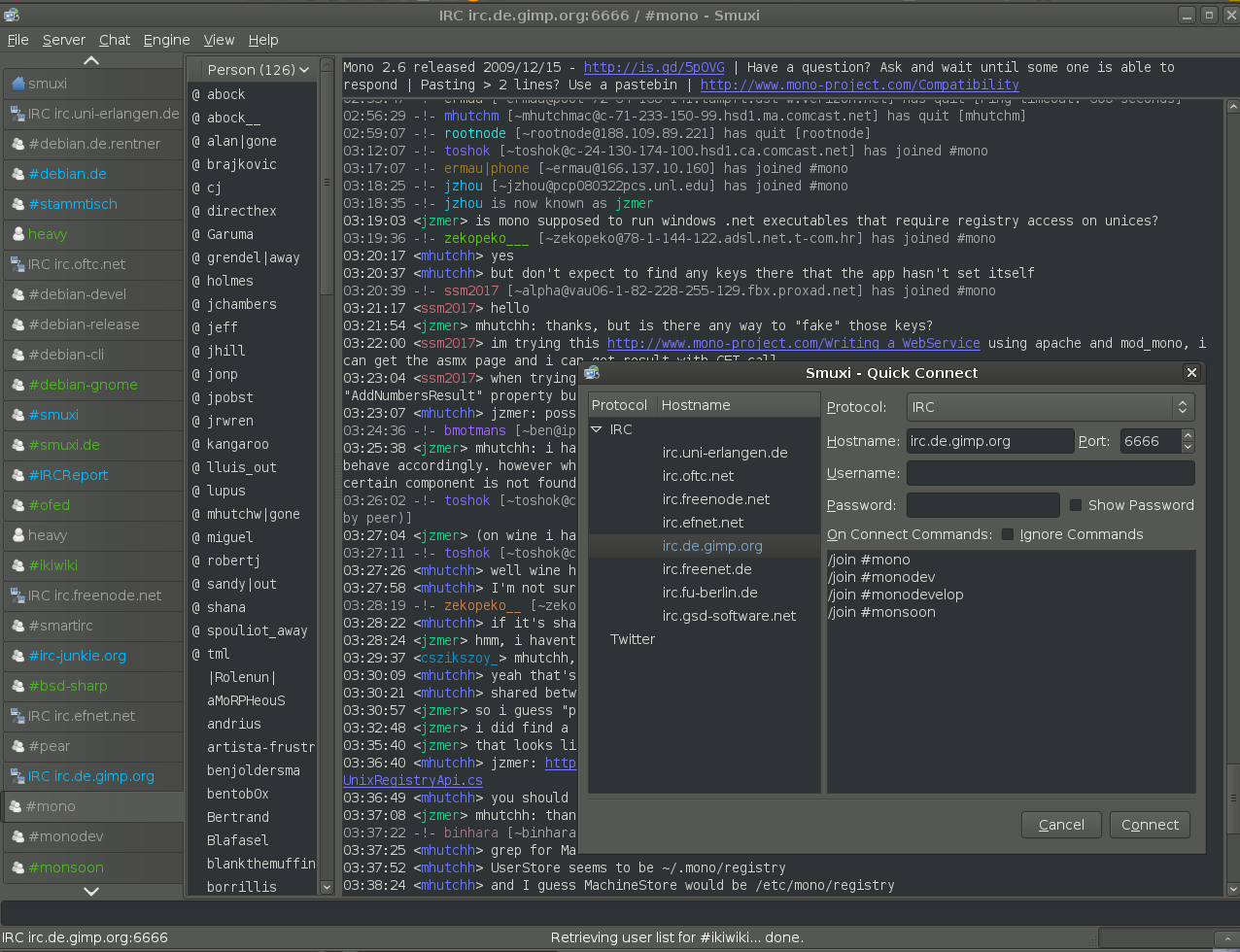
Merry Christmas! Happy New Year! Yeah, it's that time of year again, I am writing a blog post bigsmile.png. As some of you have probably already noticed I managed to get Smuxi 0.7 released a few days ago. Almost all of my Xmas vacation I was hacking on Smuxi. This is the best Smuxi release ever (guaranteed!). The most notable features I implemented in the 0.7 release are: Twitter support, handling for high latency networks (UTMS, WLAN, busy DSL) and an improved IRC experience through tweaks such as splitting oversized messages and new context menus. This release also contains very nice contributions from David Paleino [2] and Cl ment Bourgeois. Both joined the hackfest during my Xmas vacation and made the hacking sessions on Smuxi even more fun. Thanks for that guys! Here you can find a full list of changes. As everbody likes screenshots and as screenshots say a thousand words, here they are: Quick Connect
Twitter
User Menu
Which direction will Smuxi head in after the 0.7 release? For the 0.8 release, I plan to focus on making the IRC support feature complete. That means we will get DCC, SSL, IPv6 and logging support. Nothing of that sounds very special but I am already investigating how Smuxi can be integrated with the promising new Zeitgeist project. I interviewed one of the developers for potential communication between Smuxi and Zeitgeist. Last but not least, I want to announce that I will be attending FOSDEM 2010 in Brussels. I also will give a talk about Smuxi there, scheduled on 2010-02-07 at 16:30. If you want to have a chat, a beer, do some GPG keysigning, or ask me any questions, I am available bigsmile.png PS: If you want more updates than once per year, just follow me on Twitter

Next.

Previous.