Search Results: "ag"

2 October 2014

Matthew Garrett: Actions have consequences (or: why I'm not fixing Intel's bugs any more)

A lot of the kernel work I've ended up doing has involved dealing with bugs on Intel-based systems - figuring out interactions between their hardware and firmware, reverse engineering features that they refuse to document, improving their power management support, handling platform integration stuff for their GPUs and so on. Some of this I've been paid for, but a bunch has been unpaid work in my spare time[1].

Recently, as part of the anti-women #GamerGate campaign[2], a set of awful humans convinced Intel to terminate an advertising campaign because the site hosting the campaign had dared to suggest that the sexism present throughout the gaming industry might be a problem. Despite being awful humans, it is absolutely their right to request that a company choose to spend its money in a different way. And despite it being a dreadful decision, Intel is obviously entitled to spend their money as they wish. But I'm also free to spend my unpaid spare time as I wish, and I no longer wish to spend it doing unpaid work to enable an abhorrently-behaving company to sell more hardware. I won't be working on any Intel-specific bugs. I won't be reverse engineering any Intel-based features[3]. If the backlight on your laptop with an Intel GPU doesn't work, the number of fucks I'll be giving will fail to register on even the most sensitive measuring device.

On the plus side, this is probably going to significantly reduce my gin consumption.

[1] In the spirit of full disclosure: in some cases this has resulted in me being sent laptops in order to figure stuff out, and I was not always asked to return those laptops. My current laptop was purchased by me.

[2] I appreciate that there are some people involved in this campaign who earnestly believe that they are working to improve the state of professional ethics in games media. That is a worthy goal! But you're allying yourself to a cause that disproportionately attacks women while ignoring almost every other conflict of interest in the industry. If this is what you care about, find a new way to do it - and perhaps deal with the rather more obvious cases involving giant corporations, rather than obsessing over indie developers.

For avoidance of doubt, any comments arguing this point will be replaced with the phrase "Fart fart fart".

[3] Except for the purposes of finding entertaining security bugs

comment count unavailable comments

Raphaël Hertzog: My Free Software Activities in September 2014

This is my monthly summary of my free software related activities. If you re among the people who made a donation to support my work (26.6 , thanks everybody!), then you can learn how I spent your money. Otherwise it s just an interesting status update on my various projects. Django 1.7 Since Django 1.7 got released early September, I updated the package in experimental and continued to push for its inclusion in unstable. I sent a few more patches to multiple reverse build dependencies who had asked for help (python-django-bootstrap-form, horizon, lava-server) and then sent the package to unstable. At that time, I bumped the severity of all bug filed against packages that were no longer building with Django 1.7. Later in the month, I made sure that the package migrated to testing, it only required a temporary removal of mumble-django (see #763087). Quite a few packages got updated since then (remaining bugs here). Debian Long Term Support I have worked towards keeping Debian Squeeze secure, see the dedicated article: My Debian LTS report for September 2014. Distro Tracker The pace of development on tracker.debian.org slowed down a bit this month, with only 30 new commits in the repository, closing 6 bugs. Some of the changes are noteworthy though: the news now contain true links on bugs, CVE and plain URLs (example here). I have also fixed a serious issue with the way users were identified when they used their Alioth account credentials to login via sso.debian.org. On the development side, we re now able to generate the test suite code coverage which is quite helpful to identify parts of the code that are clearly missing some tests (see bin/gen-coverage.sh in the repository). Misc packaging Publican. I have been behind packaging new upstream versions of Publican and with the freeze approaching, I decided to take care of it. Unfortunately, it wasn t as easy as I had hoped and found numerous issues that I have filed upstream (invalid public identifier, PDF build fails with noNumberLines function available, build of the manual requires the network). Most of those have been fixed upstream in the mean time but the last issue seems to be a problem in the way we manage our Docbook XML catalogs in Debian. I have thus filed #763598 (docbook-xml: xmllint fails to identify local copy of docbook entities file) which is still waiting an answer from the maintainer. Package sponsorship. I have sponsored new uploads of dolibarr (RC bug fix), tcpdf (RC bug fix), tryton-server (security update) and django-ratelimit. GNOME 3.14. With the arrival of GNOME 3.14 in unstable, I took care of updating gnome-shell-timer and also filed some tickets for extensions that I use: https://github.com/projecthamster/shell-extension/issues/79 and https://github.com/olebowle/gnome-shell-timer/issues/25 git-buildpackage. I filed multiple bugs on git-buildpackage for little issues that have been irking me since I started using this tool: #761160 (gbp pq export/switch should be smarter), #761161 (gbp pq import+export should preserve patch filenames), #761641 (gbp import-orig should be less fragile and more idempotent). Thanks See you next month for a new summary of my activities.

No comment Liked this article? Click here. My blog is Flattr-enabled.

Sha Liu: Back again

I cannot believe I ll ever be here again.

Michal Čihař: Merging Weblate instances

For quite some time, I've been running translation server for projects where I am involved at l10n.cihar.com. Historically this used Pootle, but when we had more and more problems with that, I've written Weblate and started to use it there. As Weblate become more popular and I got requests to help people with running it, I've realized that it might be good idea to run server where I could host translations for other projects. This is when Hosted Weblate was born. After some time, I've realized that it really makes little sense to run and maintain separate servers for these sets of projects, so I've decided to move all translations from l10n.cihar.com to hosted.weblate.org. Today this move was completed by moving translations for phpMyAdmin.

Filed under: English phpMyAdmin Weblate 3 comments Flattr this!

1 October 2014

Thorsten Alteholz: My Debian Activities in September 2014

FTP assistant Starting an article with self laudation might be bad style, but this month I was busy as a bee and could accept 312 packages, 75 packages more than last month. 34 times I contacted the maintainer to ask a question and 51 times I had to reject a package. These numbers remain constant. The number of packages in NEW dropped to about 180. If you want your package included in Jessie, please double-check it and upload an improved version. Squeeze LTS This was my third month that I did some work for the Squeeze LTS initiative, started by Raphael Hertzog at Freexian. All in all I got assigned a workload of 11h for September and I spent these hours to upload new versions of I further tried to upload a new version of python-django. Unfortunately I could not figure out why some of the internal tests of the package failed. So I fowarded the package to Raphael, who could resolve all issues. The Squeeze version of PHP5 contains 140 patches. According to quilt 47 of them are identified to be already in 5.3.29 and 48 patches need to be revised. Some of them are really big, rather old and not really supported in the new 5.3.n version.
As nobody will talk about Squeeze LTS in a few months, I better better avoid the hassle of preparing a point release and concentrate only on security patches further on. Other packages This month I uploaded a new version of net-dns-fingerprint, which closes an RC bug. Unfortunately the package does not work with all DNS servers anymore. Patches or hints what happened are very welcome :-) . Support If you would like to support my Debian work you could either be part of the Freexian initiative (see above) or consider to send some bitcoins to 1JHnNpbgzxkoNexeXsTUGS6qUp5P88vHej. Contact me at donation@alteholz.eu if you prefer another way to donate. Every kind of support is most appreciated.

Matt Zimmerman: Join me in supporting The Ada Initiative

When I first read that Linux kernel developer Valerie Aurora would be changing careers to work full-time on behalf of women in open source communities, I never imagined it would lead so far so fast. Today, The Ada Initiative is a non-profit organization with global reach, whose programs have helped create positive change for women in a wide range of communities beyond open source. Building on this foundation, imagine how much more they can do in the next four years! That s why I m pledging my continuing support, and asking you to join me. For the next 7 days, I will personally match your donations up to $4,096. My employer, Heroku (Salesforce.com), will match my donations too, so every dollar you contribute will be tripled! My goal is that together we will raise over $12,000 toward The Ada Initiative s 2014 fundraising drive. Donate now Since about 1999, I had been working in open source communities like Debian and Ubuntu, where women are vastly underrepresented even compared to the professional software industry. Like other men in these communities, I had struggled to learn what I could do to change this. Such a severe imbalance can only be addressed by systemic change, and I hardly knew where to begin. I worked to raise awareness by writing and speaking, and joined groups like Debian Women, Ubuntu Women and Geek Feminism. I worked on my own bias and behavior to avoid being part of the problem myself. But it never felt like enough, and sometimes felt completely hopeless. Perhaps worst of all, I saw too many women burning out from trying to change the system. It was often taxing just to participate as a woman in a male-dominated community, and the extra burden of activism seemed overwhelming. They were all volunteers, doing this work in evenings and weekends around work or study, and it took a lot of time, energy and emotional reserve to deal with the backlash they faced for speaking out about sexism. Valerie Aurora and Mary Gardiner helped me to see that an activist organization with full-time staff could be part of the solution. I joined the Ada Initiative advisory board in February 2011, and the board of directors in April. founders_laughing Today, The Ada Initiative is making a difference not only in my community, but in my workplace as well. When I joined Heroku in 2012, none of the engineers were women, and we clearly had a lot of work to do to change that. In 2013, I attended AdaCamp SF along with my colleague Peter van Hardenberg, joining the first allies track , open to participants of any gender, for people who wanted to learn the skills to support the women around them. We ve gone on to host two ally skills workshops of our own for Heroku employees, one taught by Ada Initiative staff and another by a member of our team, security engineer Leigh Honeywell. These workshops taught interested employees simple, everyday ways to take positive action to challenge sexism and create a better workplace for women. The Ada Initiative also helped us establish a policy for conference sponsorship which supports our gender diversity efforts. Today, Heroku engineering includes about 10% women and growing. The Ada Initiative s programs are helping us to become the kind of company we want to be.leigh-eeoc-ally-skills-workshop
I attended the workshop with a group of Heroku colleagues, and it was a powerful experience to see my co-workers learning tactics to support women and intervene in sexist situations. Hearing them discuss power and privilege in the workplace, and the various a-ha! moments people had, were very encouraging and made me feel heard and supported.
Leigh Honeywell
If you want to see more of these programs from The Ada Initiative, please contribute now:
Donate now

Holger Levsen: 20141001-lts-september-2014

My LTS September In the beginning of September I spent quite some time fixing bugs in the Debian Security Tracker, which now, thanks to the awesome CSS from Ulrike looks really good and professional! There are still some bugs to fix and features I'd like to add, eg. the ability to in- and exclude (old)oldstable/lts/backports/nodsa/EOL everywhere. It was fun to squash #742382 #642987 #742855 #762214 #479727 #610220 #611163 and #755800! And then I also discovered dgit, as in "I've used it for the first time". It was so great, I immediatly did a backport of it and uploaded it to wheezy-backports. So during the last month these uploads I made to squeeze-lts: Plus I filed #762715, asking the devscripts maintainers to 'add an --lts option to dch' and #763339 against lintian: please 'recognize "squeeze-lts" as suite'. Here's three things you could do to contribute to Debian LTS: Thanks to everybody supporting LTS already! :-)

Keith Packard: chromium-dri3

Chromium (the browser) and DRI3 I got a note on IRC a week ago that Chromium was crashing with DRI3. The Google team working on Chromium eventually sent me a link to the bug report. That's secret Google stuff, so you won't be able to follow the link, even though it's a bug in a free software application when running on free software drivers. There's a bug report in the freedesktop bugzilla which looks the same to me. In both cases, the recommended fix was to switch from DRI3 back to DRI2. That's not exactly a great plan, given that DRI3 offers better security between GPU-using applications, which seems like a pretty nice thing to have when you're running random GL applications from the web. Chromium Sandboxing I'm not entirely sure how it works, but Chromium creates a process separate from the main browser engine to talk to the GPU. That process has very limited access to the operating system via some fancy library adventures. Presumably, the hope is that security bugs in the GL driver would be harder to leverage into a remote system exploit. Debugging in this environment is a bit tricky as you can't simply run chromium under gdb and expect to be able to set breakpoints in the GL driver. Instead, you have to run chromium with a magic flag which causes the GPU process to pause before loading the driver so you can connect to it with gdb and debug from there, along with a flag that lets you see crashes within the gpu process and the usual flag that causes chromium to ignore the GPU black list which seems to always include the Intel driver for one reason or another:
$ chromium --gpu-startup-dialog --disable-gpu-watchdog --ignore-gpu-blacklist
Once Chromium starts up, it will print out a message telling you to attach gdb to the GPU process and send that process a SIGUSR1 to continue it. Now you can happily debug and get a stack trace when the crash occurs. Locating the Bug The bug manifested with a segfault at the first access to a DRI3-allocated buffer within the application. We've seen this problem in the past; whenever buffer allocation fails for some reason, the driver ignores the problem and attempts to de-reference through the (NULL) buffer pointer, causing a segfault. In this case, Chromium called glClear, which tried (and failed) to allocate a back buffer causing the i965 driver to subsequently segfault. We should probably go fix the i965 driver to not segfault when buffer allocation fails, but that wouldn't provide a lot of additional information. What I have done is add some error messages in the DRI3 buffer allocation path which at least tell you why the buffer allocation failed. That patch has been merged to Mesa master, and should also get merged to the Mesa stable branch for the next stable release. Once I had added the error messages, it was pretty easy to see what happened:
$ chromium --ignore-gpu-blacklist
[10618:10643:0930/200525:ERROR:nss_util.cc(856)] After loading Root Certs, loaded==false: NSS error code: -8018
libGL: pci id for fd 12: 8086:0a16, driver i965
libGL: OpenDriver: trying /local-miki/src/mesa/mesa/lib/i965_dri.so
libGL: Can't open configuration file /home/keithp/.drirc: Operation not permitted.
libGL error: DRI3 Fence object allocation failure Operation not permitted
The first two errors were just the sandbox preventing Mesa from using my GL configuration file. I'm not sure how that's a security problem, but it shouldn't harm the driver much. The last error is where the problem lies. In Mesa, the DRI3 implementation uses a chunk of shared memory to hold a fence object that lets Mesa know when buffers are idle without using the X connection. That shared memory segment is allocated by creating a temporary file using the O_TMPFILE flag:
fd = open("/dev/shm", O_TMPFILE O_RDWR O_CLOEXEC O_EXCL, 0666);
This call cannot fail as /dev/shm is used by glibc for shared memory objects, and must therefore be world writable on any glibc system. However, with the Chromium sandbox enabled, it returns EPERM. Running Without a Sandbox Now that the bug appears to be in the sandboxing code, we can re-test with the GPU sandbox disabled:
$ chromium --ignore-gpu-blacklist --disable-gpu-sandbox
And, indeed, without the sandbox getting in the way of allocating a shared memory segment, Chromium appears happy to use the Intel driver with DRI3. Final Thoughts I looked briefly at the Chromium sandbox code. It looks like it needs to know intimate details of the OpenGL implementation for every possible driver it runs on; it seems to contain a fixed list of all possible files and modes that the driver will pass to open(2). That seems incredibly fragile to me, especially when used in a general Linux desktop environment. Minor changes in how the GL driver operates can easily cause the browser to stop working.

Vincent Sanders: It is a bad plan that admits of no modification

I find it somewhat interesting that thousands of years later that our society still uses Publilius Syrus sententiae though I imagine the tendency to leave well enough alone means such phrases stay in usage.

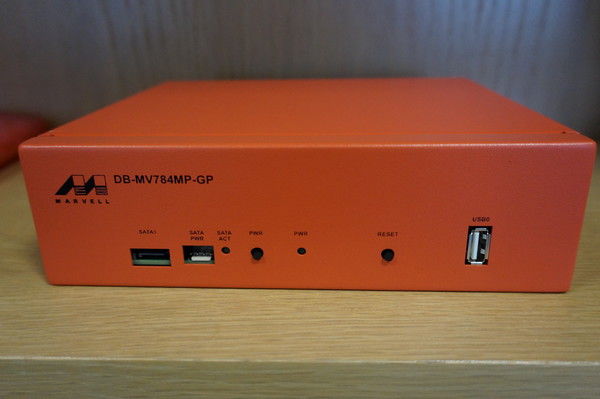
Marvell ARM system - Photo from Steve McIntyre
One weekend Steve McIntyre asked me if I could find a source of some of some 40mm fans for some systems with some pretty strict requirements. They needed to be long life and shift a lot of air to combat a persistent overheating issue.

I sat with him and went through the Farnell utterly hateful parametric web interface and eventually came up with a couple of options which were very expensive. Only then did I stop and ask what the actual problem was.

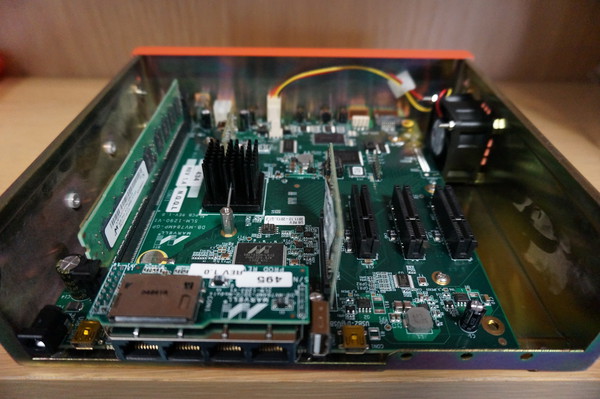
Marvell ARM system Original internal cooling arrangement - Photo from Steve McIntyre
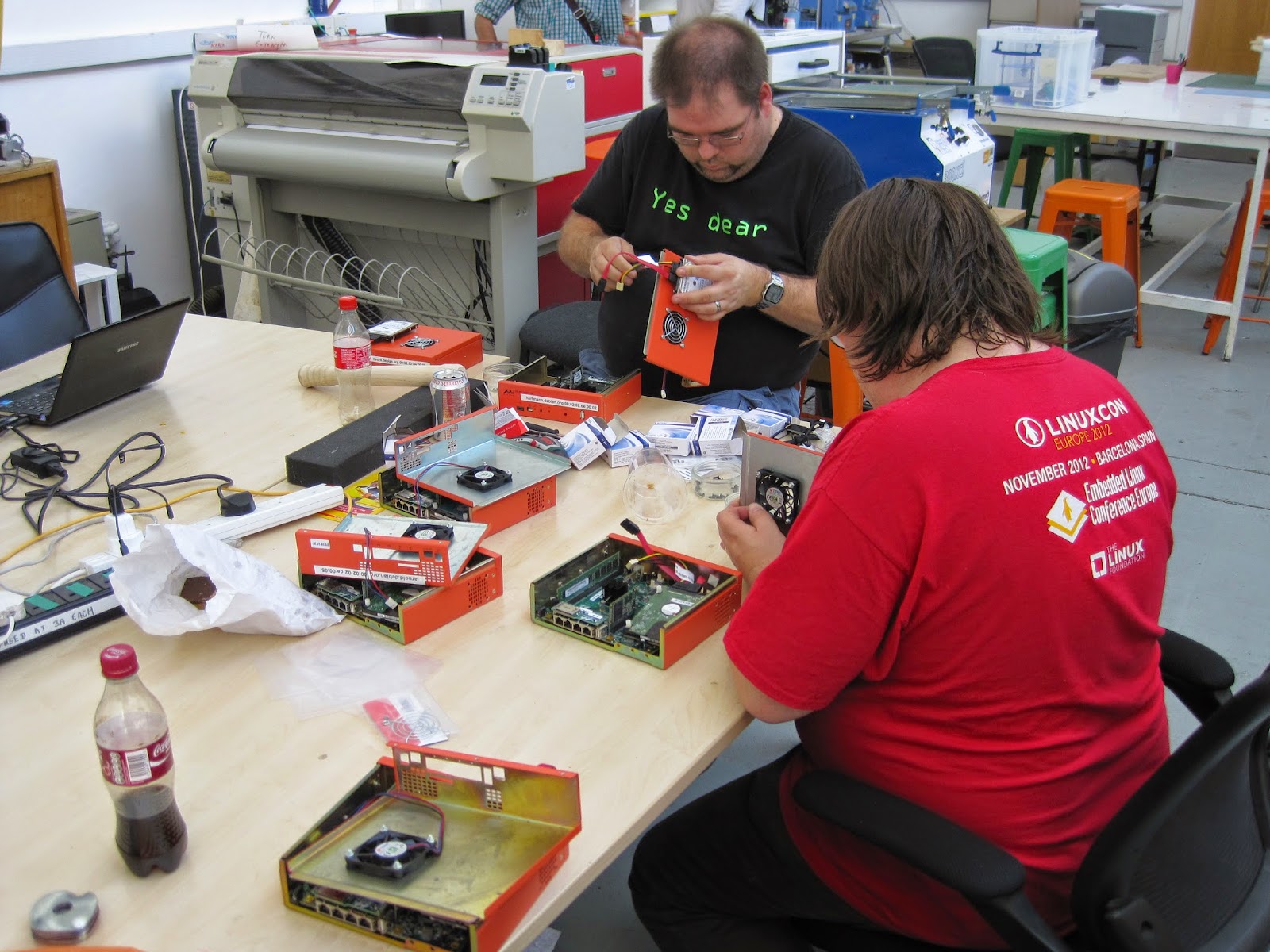
Steve showed me one of the Debian ARM buildd boxes which are Marvell development machines. These systems are powerful quad core machines housed in compact steel enclosures.

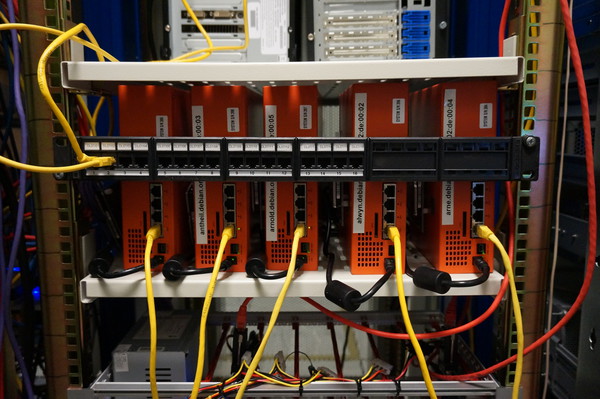
There is a single 40mm fan trying to provide cooling for the entire enclosure. When the units are placed horizontally and used intermittently this proves adequate. Unfortunately when the system are arranged vertically in a rack and run at full load continuously they often overheat and have to be restarted. In addition the small high speed fans need replacing frequently as their bearings wore out quickly.

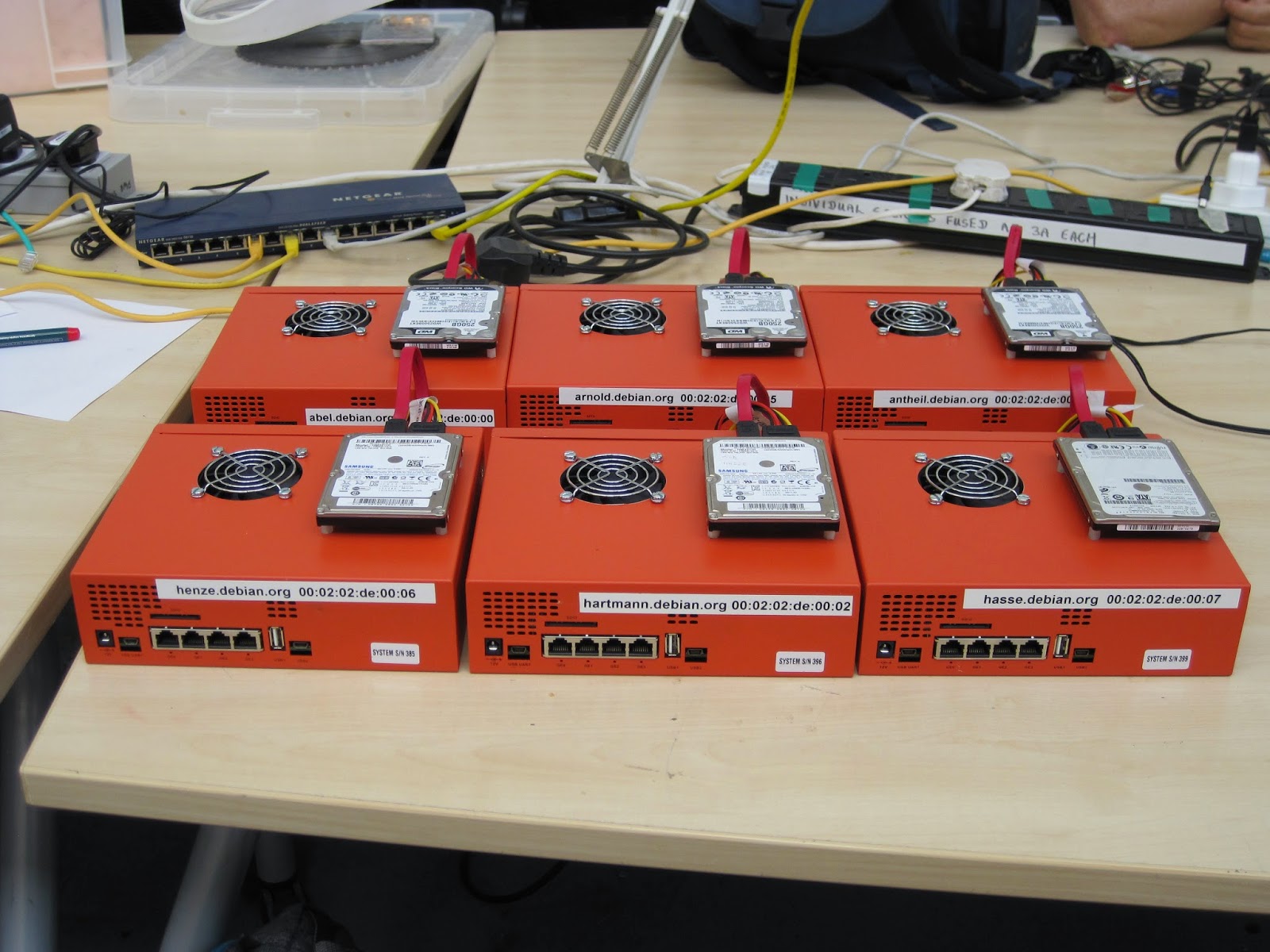
Debian ARM buildd systems - Photo from Steve McIntyreThis was obviously causing some issues for the ARM Debian ports which Steve wanted to rectify. After talking the problem through for a while we came to the conclusion we could use much larger 60mm fans to blow air directly through the top of the case onto the cpu heatsink.

Larger fans can be run much more slowly to move a similar volume of air to the smaller 40mm fans which gives a much longer service life.

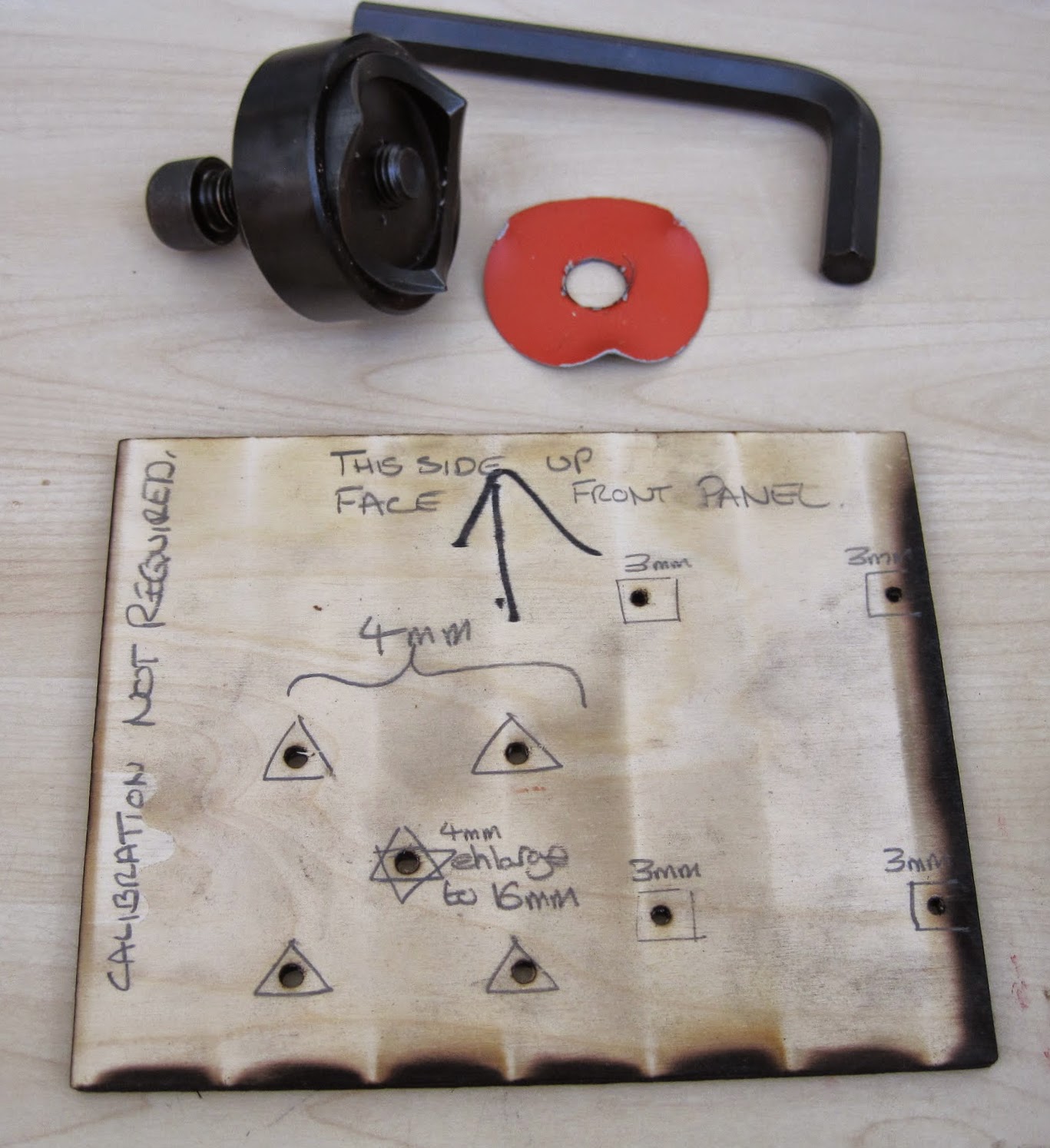
Hole punch and Drilling template
Steve proceeded to order enough parts to allow us to modify all the Debian systems, this worked out cheaper than a single "special" 40mm high volume fan.

I acquired a rather large steel hole punch, I chose this tool because it produces a much superior finish to a hole cutter and this project demanded a high level of finish (not to mention I loved having a valid excuse to own and use a huge allen key!)

If we had simply been modifying a single case I would have measured and marked up by hand. With the prospect of altering at least eight I laser cut a template from plywood which Andy Simpkins took great glee in excessively annotating.

We also used the opportunity to add bolt holes to securely attach the 2.5 inch SATA drives instead of using sticky pads.

Steve and I modified a single system to begin with both to check our alignment and the efficacy of the change. We were pleasantly surprised to discover that hoiby could now repeatedly do kernel compiles with all four cores flat out which was not possible before. The measured CPU temperature, which had previously been around 90 C, did not rise above 40 C

Steve and Andy on the assembly line
Steve, Andy and I then arranged a day where we took all the remaining units out of the rack at ARM, modified and returned them. We used the facilities at the Cambridge Makespace where I am a member to do the modifications.

I broke two 3mm drill bits and dulled a 4mm bit drilling all the holes, Roger Smith was good enough to loan us the use of his "Christmas tree bit" to ream the fan hole out to 16mm so we could thread the hole punch and cut the 60mm fan aperture out.

six modified systems ready to be re-racked.
We managed to get quite an assembly line going and, in my opinion, the results look pretty professional.

It has been several months since we did this work and these systems continue to run without issue. To complete the story we can see some graphs courtesy of the DSA munin instance.

CPU load on arnold.debian.org
You can clearly see the huge drop in temperature at the end of Week 25 despite the continuously high CPU load. Also there is only a single gap in the data after the changes (these indicate crashes where data was not recorded) where before there were frequent and extensive times where the systems were simply unusable.

CPU Temperature of arnold.debian.org
One reason I continue to enjoy Debian so much is the wide variety of ways in which I can contribute not only by maintaining my packages. Sometimes this kind of work does not receive the credit it deserves and hopefully highlights a small part of the frantic paddling that goes on under the serene surface of the Debian project to keep things "just working".

30 September 2014

Lisandro Damián Nicanor Pérez Meyer: Qt5 in Jessie: we will release with 5.3.2

Qt 5.3.2 has entered testing a few hours ago. This will be the version of Qt we will release with Debian Jessie, and it happens to be a nice coincidence, because upstream focused in stability for the 5.3 branch.

I'll now focus in fixing as many bugs as possible and in backporting Qt5 to Wheezy.

Let me warn you: if you are an upstream for a Qt4 based project be sure to be ready to switch to Qt5. If you are a maintainer of a Qt4 based project you better start asking your upstream to be ready for it :)

Russell Coker: Links September 2014

Matt Palmer wrote a short but informative post about enabling DNS in a zone [1]. I really should setup DNSSEC on my own zones. Paul Wayper has some insightful comments about the Liberal party s nasty policies towards the unemployed [2]. We really need a Basic Income in Australia. Joseph Heath wrote an interesting and insightful article about the decline of the democratic process [3]. While most of his points are really good I m dubious of his claims about twitter. When used skillfully twitter can provide short insights into topics and teasers for linked articles. Sarah O wrote an insightful article about NotAllMen/YesAllWomen [4]. I can t summarise it well in a paragraph, I recommend reading it all. Betsy Haibel wrote an informative article about harassment by proxy on the Internet [5]. Everyone should learn about this before getting involved in discussions about controversial issues. George Monbiot wrote an insightful and interesting article about the referendum for Scottish independence and the failures of the media [6]. Mychal Denzel Smith wrote an insightful article How to know that you hate women [7]. Sam Byford wrote an informative article about Google s plans to develop and promote cheap Android phones for developing countries [8]. That s a good investment in future market share by Google and good for the spread of knowledge among people all around the world. I hope that this research also leads to cheap and reliable Android devices for poor people in first-world countries. Deb Chachra wrote an insightful and disturbing article about the culture of non-consent in the IT industry [9]. This is something we need to fix. David Hill wrote an interesting and informative article about the way that computer game journalism works and how it relates to GamerGate [10]. Anita Sarkeesian shares the most radical thing that you can do to support women online [11]. Wow, the world sucks more badly than I realised. Michael Daly wrote an article about the latest evil from the NRA [12]. The NRA continues to demonstrate that claims about good people with guns are lies, the NRA are evil people with guns.

Raphaël Hertzog: My Debian LTS report for September

Thanks to the sponsorship of multiple companies, I have been paid to work 11 hours on Debian LTS this month. CVE triagingI started by doing lots of triage in the security tracker (if you want to help, instructions are here) because I noticed that the dla-needed.txt list (which contains the list of packages that must be taken care of via an LTS security update) was missing quite a few packages that had open vulnerabilities in oldstable. In the end, I pushed 23 commits to the security tracker. I won t list the details each time but for once, it s interesting to let you know the kind of things that this work entailed: And when I say I reviewed it s a simplification for this kind of process: CVE triaging is often almost half the work in the general process: once you know that you are affected and that you have a patch, the process to release an update is relatively straightforward (sometimes there s still work to do to backport the patch). Once I was over that first pass of triaging, I had already spent more than the 11 hours paid but I still took care of preparing the security update for python-django. Thorsten Alteholz had started the work but got stuck in the process of backporting the patches. Since I m co-maintainer of the package, I took over and finished the work to release it as DLA-65-1.

No comment Liked this article? Click here. My blog is Flattr-enabled.

Mario Lang: A simple C++11 concurrent workqueue

For a little toy project of mine (a wikipedia XML dump word counter) I wrote a little C++11 helper class to distribute work to all available CPU cores. It took me many years to overcome my fear of threading: In the past, whenever I toyed with threaded code, I ended up having a lot of deadlocks, and generally being confused. It appears that I finally have understood enough of this crazyness to be able to come up with the small helper class below.
The problem We want to spread work amongst all available CPU cores. There are no dependencies between items in our work queue. So every thread can just pick up and process an item as soon as it is ready.
The solution This simple implementation makes use of C++11 threading primitives, lambda functions and move semantics. The idea is simple: You provide a function at construction time which defines how to process one item of work. To pass work to the queue, simply call the function operator of the object, repeatedly. When the destructor is called (once the object reachs the end of its scope), all remaining items are processed and all background threads are joined. The number of threads defaults to the value of std::thread::hardware_concurrency(). This appears to work at least since GCC 4.9. Earlier tests have shown that std::thread::hardware_concurrency() always returned 1. I don't know when exactly GCC (or libstdc++, actually) started to support this, but at least since GCC 4.9, it is usable. Prerequisite on Linux is a mounted /proc. The number of maximum items per thread in the queue defaults to 1. If the queue is full, calls to the function operator will block. So the most basic usage example is probably something like:
int main()  
  typedef std::string item_type;
  distributor<item_type> process([](item_type &item)  
    // do work
   );
  while (/* input */) process(std::move(/* item */));
  return 0;
 
That is about as simple as it can get, IMHO. The code can be found in the GitHub project mentioned above. However, since the class template is relatively short, here it is.
#include <condition_variable>
#include <mutex>
#include <queue>
#include <stdexcept>
#include <thread>
#include <vector>
template <typename Type, typename Queue = std::queue<Type>>
class distributor: Queue, std::mutex, std::condition_variable  
  typename Queue::size_type capacity;
  bool done = false;
  std::vector<std::thread> threads;
public:
  template<typename Function>
  distributor( Function function
             , unsigned int concurrency = std::thread::hardware_concurrency()
             , typename Queue::size_type max_items_per_thread = 1
             )
  : capacity concurrency * max_items_per_thread 
   
    if (not concurrency)
      throw std::invalid_argument("Concurrency must be non-zero");
    if (not max_items_per_thread)
      throw std::invalid_argument("Max items per thread must be non-zero");
    for (unsigned int count  0 ; count < concurrency; count += 1)
      threads.emplace_back(static_cast<void (distributor::*)(Function)>
                           (&distributor::consume), this, function);
   
  distributor(distributor &&) = default;
  distributor &operator=(distributor &&) = delete;
  ~distributor()
   
     
      std::lock_guard<std::mutex> guard(*this);
      done = true;
      notify_all();
     
    for (auto &&thread: threads) thread.join();
   
  void operator()(Type &&value)
   
    std::unique_lock<std::mutex> lock(*this);
    while (Queue::size() == capacity) wait(lock);
    Queue::push(std::forward<Type>(value));
    notify_one();
   
private:
  template <typename Function>
  void consume(Function process)
   
    std::unique_lock<std::mutex> lock(*this);
    while (true)  
      if (not Queue::empty())  
        Type item   std::move(Queue::front())  ;
        Queue::pop();
        notify_one();
        lock.unlock();
        process(item);
        lock.lock();
        else if (done)  
        break;
        else  
        wait(lock);


 ;
If you have any comments regarding the implementation, please drop me a mail.

Francois Marier: Encrypted mailing list on Debian and Ubuntu

Running an encrypted mailing list is surprisingly tricky. One of the first challenges is that you need to decide what the threat model is. Are you worried about someone compromising the list server? One of the subscribers stealing the list of subscriber email addresses? You can't just "turn on encryption", you have to think about what you're trying to defend against. I decided to use schleuder. Here's how I set it up.

Requirements What I decided to create was a mailing list where people could subscribe and receive emails encrypted to them from the list itself. In order to post, they need to send an email encrypted to the list' public key and signed using the private key of a subscriber. What the list then does is decrypt the email and encrypts it individually for each subscriber. This protects the emails while in transit, but is vulnerable to the list server itself being compromised since every list email transits through there at some point in plain text.

Installing the schleuder package The first thing to know about installing schleuder on Debian or Ubuntu is that at the moment it unfortunately depends on ruby 1.8. This means that you can only install it on Debian wheezy or Ubuntu precise: trusty and jessie won't work (until schleuder is ported to a more recent version of ruby). If you're running wheezy, you're fine, but if you're running precise, I recommend adding my ppa to your /etc/apt/sources.list to get a version of schleuder that actually lets you create a new list without throwing an error. Then, simply install this package:
apt-get install schleuder

Postfix configuration The next step is to configure your mail server (I use postfix) to handle the schleuder lists. This may be obvious but if you're like me and you're repurposing a server which hasn't had to accept incoming emails, make sure that postfix is set to the following in /etc/postfix/main.cf:
inet_interfaces = all
Then follow the instructions from /usr/share/doc/schleuder/README.Debian and finally add the following line (thanks to the wiki instructions) to /etc/postfix/main.cf:
local_recipient_maps = proxy:unix:passwd.byname $alias_maps $transport_maps

Creating a new list Once everything is set up, creating a new list is pretty easy. Simply run schleuder-newlist list@example.org and follow the instructions After creating your list, remember to update /etc/postfix/transports and run postmap /etc/postfix/transports. Then you can test it by sending an email to LISTNAME-sendkey@example.com. You should receive the list's public key.

Adding list members Once your list is created, the list admin is the only subscriber. To add more people, you can send an admin email to the list or follow these instructions to do it manually:
  1. Get the person's GPG key: gpg --recv-key KEYID
  2. Verify that the key is trusted: gpg --fingerprint KEYID
  3. Add the person to the list's /var/lib/schleuder/HOSTNAME/LISTNAME/members.conf:
    - email: francois@fmarier.org
      key_fingerprint: 8C470B2A0B31568E110D432516281F2E007C98D1
    
  4. Export the public key: gpg --export -a KEYID
  5. Paste the exported key into the list's keyring: sudo -u schleuder gpg --homedir /var/lib/schleuder/HOSTNAME/LISTNAME/ --import

Dirk Eddelbuettel: Rcpp 0.11.3

A new release 0.11.3 of Rcpp is now on the CRAN network for GNU R, and an updated Debian package has been uploaded too. Rcpp has become the most popular way of enhancing GNU R with C++ code. As of today, 273 packages on CRAN depend on Rcpp for making analyses go faster and further. This release brings a fairly large number of continued enhancements, fixes and polishing to Rcpp. These were provided by a total of seven different contributors---which is a new record as well. See below for a detailed list of changes extracted from the NEWS file, but some highlights included in this release are One sore point, however, is that we missed that packages using Rcpp Modules appear to require a rebuild. We are sorry for the inconvenience; this has highlighted a shortcoming in our fairly robust and extensive tests. While we test our packages against all known CRAN dependents, such tests check for the ability to compile and run freshly and not whether previously built packages still run. We intend to augment our testing in this direction to avoid a repeat occurrence of such a misfeature.
Changes in Rcpp version 0.11.3 (2014-09-27)
  • Changes in Rcpp API:
    • The deprecation of RCPP_FUNCTION_* which was announced with release 0.10.5 last year is proceeding as planned, and the file macros/preprocessor_generated.h has been removed.
    • Timer no longer records time between steps, but times from the origin. It also gains a get_timers(int) methods that creates a vector of Timer that have the same origin. This is modelled on the Rcpp11 implementation and is more useful for situations where we use timers in several threads. Timer also gains a constructor taking a nanotime_t to use as its origin, and a origin method. This can be useful for situations where the number of threads is not known in advance but we still want to track what goes on in each thread.
    • A cast to bool was removed in the vector proxy code as inconsistent behaviour between clang and g++ compilations was noticed.
    • A missing update(SEXP) method was added thanks to pull request by Omar Andres Zapata Mesa.
    • A proxy for DimNames was added.
    • A no_init option was added for Matrices and Vectors.
    • The InternalFunction class was updated to work with std::function (provided a suitable C++11 compiler is available) via a pull request by Christian Authmann.
    • A new_env() function was added to Environment.h
    • The return value of range eraser for Vectors was fixed in a pull request by Yixuan Qiu.
  • Changes in Rcpp Sugar:
    • In ifelse(), the returned NA type was corrected for operator[].
  • Changes in Rcpp Attributes:
    • Include LinkingTo in DESCRIPTION fields scanned to confirm that C++ dependencies are referenced by package.
    • Add dryRun parameter to sourceCpp.
    • Corrected issue with relative path and R chunk use for sourceCpp.
  • Changes in Rcpp Documentation:
    • The Rcpp-FAQ vignette was updated with respect to OS X issues.
    • A new entry in the Rcpp-FAQ clarifies the use of licenses.
    • Vignettes build results no longer copied to /tmp to please CRAN.
    • The Description in DESCRIPTION has been shortened.
  • Changes in Rcpp support functions:
    • The Rcpp.package.skeleton() function will now use pkgKitten package, if available, to create a package which passes R CMD check without warnings. A new Suggests: has been added for pkgKitten.
    • The modules=TRUE case for Rcpp.package.skeleton() has been improved and now runs without complaints from R CMD check as well.
  • Changes in Rcpp unit test functions:
    • Functions from the RUnit package are now prefixed with RUnit::
    • The testRcppModule and testRcppClass sample packages now pass R CMD check --as-cran cleanly with NOTES or WARNINGS
Thanks to CRANberries, you can also look at a diff to the previous release As always, even fuller details are on the Rcpp Changelog page and the Rcpp page which also leads to the downloads page, the browseable doxygen docs and zip files of doxygen output for the standard formats. A local directory has source and documentation too. Questions, comments etc should go to the rcpp-devel mailing list off the R-Forge page.

This post by Dirk Eddelbuettel originated on his Thinking inside the box blog. Please report excessive re-aggregation in third-party for-profit settings.

29 September 2014

Marco d'Itri: CVE-2014-6271 fix for Debian woody, sarge, etch and lenny

Very old Debian releases like woody (3.0), sarge (3.1), etch (4.0) and lenny (5.0) are not supported anymore by the Debian Security Team and do not get security updates. Since some of our customers still have servers running these version, I have built bash packages with the fix for CVE-2014-6271 (the "shellshock" bug) and Florian Weimer's patch which restricts the parsing of shell functions to specially named variables: http://ftp.linux.it/pub/People/md/bash/ This work has been sponsored by my employer Seeweb, an hosting, cloud infrastructure and colocation provider.

Jonathan Dowland: Letter to Starburst magazine

I recently read a few issues of Starburst magazine which is good fun, but a brief mention of the Man Booker prize in issue 404 stoked the fires of the age old SF-versus-mainstream argument, so I wrote the following:
Dear Starburst, I found it perplexing that, in "Brave New Words", issue 404, whilst covering the Man-Booker shortlist, Ed Fortune tried to simultaneously argue that genre readers "read broadly" yet only Howard Jacobson's novel would be of passable interest. Asides from the obvious logical contradiction he is sadly overlooking David Mitchell's critically lauded and undisputably SF&F novel "The Bone Clocks", which it turned out was also overlooked by the short-listers. Still, Jacobson's novel made it, meaning SF&F represents 16% of the shortlist. Not too bad I'd say. All the best & keep up the good work!
As it happens I'm currently struggling through "J". I'm at around the half-way mark.

28 September 2014

Ean Schuessler: RoboJuggy at JavaOne

A few months ago I was showing my friend Bruno Souza the work I had been doing with my childhood friend and robotics genius, David Hanson. I had been watching what David was going through in his process of creating life-like robots with the limited industrial software available for motor control. I had suggested to David that binding motors to Blender control structures was a genuinely viable possibility. David talked with his forward looking CEO, Jong Lee, and they were gracious enough to invite me to Hong Kong to make this exciting idea a reality. Working closely the HRI team (Vytas, Gabrielos, Fabien and Davide) with David s friend and collaborators at OpenCog (Ben Goertzel, Mandeep, David, Jamie, Alex and Samuel) a month long creative hack-fest yielded pretty amazing results. Bruno is an avid puppeteer, a global organizer of java user groups and creator of Juggy the Java Finch, mascot of Java users and user groups everywhere. We started talking about how cool it would be to have a robot version of Juggy. When I was in China I had spent a little time playing with Mark Tilden s RSMedia and various versions of David s hobby servo based emotive heads. Bruno and I did a little research into the ROS Java bindings for the Robot Operating System and decided that if we could make that part of the picture we had a great and fun idea for a JavaOne talk. Hunting and gathering I tracked down a fairly priced RSMedia in Alaska, Bruno put a pair of rubber Juggy puppet heads in the mail and we were on our way.
We had decided that we wanted RoboJuggy to be able to run about untethered and the new RaspberryPi B+ seemed like the perfect low power brain to make that happen. I like the Debian based Raspbian distributions but had lately started using the netinst Pi images. These get your Pi up and running in about 15 minutes with a nicely minimalistic install instead of a pile of dependencies you probably don t need. I d recommend anyone interested I m duplicating our work to stay their journey there: Raspbian UA Net Installer Robots seem like an embedded application but ROS only ships packages for Ubuntu. I was pleasantly surprised that there are very good instructions for building ROS from source on the Pi. I ended up following these instructions: Setting up ROS Hydro on the Raspberry Pi Building from source means that all your install ends up being isolated (in ROS speak) and your file locations and build instructions end up being subtly current. As explained in the linked article, this process is also very time consuming. One thing I would recommend once you get past this step is to use the UNIX dd command to back up your entire SD card to a desktop. This way if you make a mess of things in later steps you can restore your install to a pristine Raspbian+ROS install. If your SD drive was on /dev/sdb you might use something like this to do the job:
sudo dd bs=4M if=/dev/sdb   gzip > /home/your_username/image date +%d%m%y .gz
Getting Java in the mix Once you have your Pi all set up with minimal Raspbian and ROS you are going to want a Java VM. The Pi runs the ARM CPU so you need the corresponding version of Java. I tried getting things going initially with OpenJDK and I had some issues with that. I will work on resolving that in the future because I would like to have a 100% Free Software kit for this but since this was for JavaOne I also wanted JDK8, which isn t available in Debian yet. So, I downloaded the Oracle JDK8 package for ARM. Java 8 JDK for ARM At this point you are ready to start installing the ROS Java packages. I m pretty sure the way I did this initially is wrong but I was trying to reconcile the two install procedures for ROS Java and ROS Hydro for Raspberry Pi. I started by following these directions for ROS Java but with a few exceptions (you have to click the install from source link in the page to see the right stuff: Installing ROS Java on Hydro Now these instructions are good but this is a Pi running Debian and not an Ubuntu install. You won t run the apt-get package commands because those tools were already installed in your earlier steps. Also, this creates its own workspace and we really want these packages all in one workspace. You can apparently chain workspaces in ROS but I didn t understand this well enough to get it working so what I did was this:
> mkdir -p ~/rosjava 
> wstool init -j4 ~/rosjava/src https://raw.github.com/rosjava/rosjava/hydro/rosjava.rosinstall
> source ~/ros_catkin_ws/install_isolated/setup.bash > cd ~/rosjava # Make sure we've got all rosdeps and msg packages.
> rosdep update 
> rosdep install --from-paths src -i -y
and then copied the sources installed into ~/rosjava/src into my main ~/ros_catkin_ws/src. Once those were copied over I was able to run a standard build.
> catkin_make_isolated --install
Like the main ROS install this process will take a little while. The Java gradle builds take an especially long time. One thing I would recommend to speed up your workflow is to have an x86 Debian install (native desktop, QEMU instance, docker, whatever) and do these same build from source installs there. This will let you try your steps out on a much faster system before you try them out in the Pi. That can be a big time saver. Putting together the pieces Around this time my RSMedia had finally showed up from Alaska. At first I thought I had a broken unit because it would power up, complain about not passing system tests and then shut back down. It turns out that if you just put the D batteries in and miss the four AAs that it will kind of pretend to be working so watch for that mistake. Here is a picture of the RSMedia when it first came out of the box: wpid-20140911_142904.jpg Other parts were starting to roll in as well. The rubber puppet heads had made their way through Brazilian customs and my Pololu Mini Maestro 24 had also shown up as well as the my servo motors and pan and tilt camera rig. I had previously bought a set of 10 motors for goofing around so I bought the pan and tilt rig by itself for about $5(!) but you can buy a complete set for around $25 from a number of EBay stores. Complete pan and tilt rig with motors for $25 A bit more about the Pololu. This astonishing little motor controller costs about $25 and gives you control of 24 motors with an easy to use and high level serial API. It is probably also possible to control these servos directly from the Pi and eliminate this board but that will be genuinely difficult because of the real-time timing issues. For $25 this thing is a real gem and you won t regret buying it. Now it was time to start dissecting the RSMedia and getting control of its brain. Unfortunately a lot of great information about the RSMedia has floated away since it was in its heyday 5 years ago but there is still some solid information out there that we need to round up and preserve. A great resource is the SourceForge based website here at http://rsmediadevkit.sourceforge.net. That site has links to a number of useful sites. You will definitely want to check out their wiki. To disassemble the RSMedia I followed their instructions. I will say, it would be smart to take more pictures as you are going because they don t take as many as they should. I took pictures of each board and its associated connections as dismantled the unit and that helped me get things back together later. Another important note is that if all you want to do is solder onto the control board and not replace the head then its feasible to solder the board in place without completely disassembling the unit. Here are some photos of the dis-assembly: wpid-20140921_114742.jpg wpid-20140921_113054.jpg wpid-20140921_112619.jpg Now I also had to start adjusting the puppet head, building an armature for the motors to control it and hooking it into the robot. I need to take some more photos of the actual armature. I like to use cardboard for this kind of stuff because it is so fast to work with and relatively strong. One trick I have also learned about cardboard is that if you get something going with it and you need it to be a little more production strength you can paint it down with fiberglass resin from your local auto store. Once it dries it becomes incredibly tough because it soaks through the fibers of the cardboard and hardens around them. You will want to do this in a well ventilated area but its a great way to build super tough prototypes. Another prototyping trick I can suggest is using a combination of Velcro and zipties to hook things together. The result is surprisingly strong and still easy to take apart if things aren t working out. Velcro self-adhesive pads stick to rubber like magic and that is actually how I hooked the jaw servo onto the mask. You can see me torturing its first initial connection here: Since the puppet head had come all the way from Brazil I decided to cook some chicken hearts in the churrascaria style while I worked on them in the garage. This may sound gross but I m telling you, you need to try it! I soaked mine in soy sauce, Sriracha and chinese cooking wine. Delicious but I digress. wpid-20140920_191551.jpg As I was eating my chicken hearts I was also connecting the pan and tilt armature onto the puppet s jaw and eye assembly. It took me most of the evening to get all this going but by about one in the morning things were starting to look good! I only had a few days left to hack things together before JavaOne and things were starting to get tight. I had so much to do and had also started to run into some nasty surprises with the ROS Java control software. It turns out that ROS Java is less than friendly with ROS message structures that are not built in . I had tried to follow the provided instructions but was not (and still have not) been able to get that working. Using unofficial messages with ROS Java I still needed to get control of the RSMedia. Doing that required the delicate operation of soldering to its control board. On the board there are a set of pins that provide a serial interface to the ARM based embedded Linux computer that controls the robot. To do that I followed these excellent instructions: Connecting to the RSMedia Linux Console Port After some sweaty time bent over a magnifying glass I had success: wpid-20140921_143327.jpg I had previously purchased the USB-TTL232 accessory described in the article from Dallas awesome Tanner Electronics store in Dallas. If you are a geek I would recommend that you go there and say hi to its proprietor (and walking encyclopedia of electronics knowledge) Jim Tanner. It was very gratifying when I started a copy of minicom, set it to 115200, N, 8, 1, plugged in the serial widget to the RSMedia and booted it up. I was greeted with a clearly recognizable Linux startup and console prompt. At first I thought I had done something wrong because I couldn t get it to respond to commands but I quickly realized I had flow control turned on. Once turned off I was able to navigate around the file system, execute commands and have some fun. A little research and I found this useful resource which let me get all kinds of body movements going: A collection of useful commands for the RSMedia At this point, I had a usable set of controls for the body as well as the neck armature. I had a controller running the industry s latest and greatest robotics framework that could run on the RSMedia without being tethered to power and I had most of a connection to Java going. Now I just had to get all those pieces working together. The only problem is that time was running out and I only had a couple of days until my talk and still had to pack and square things away at work. The last day was spent doing things that I wouldn t be able to do on the road. My brother Erik (and fantastic artist) came over to help paint up the juggy head and fix the eyeball armature. He used a mix of oil paint, rubber cement which stuck to the mask beautifully. I bought battery packs for the USB Pi power and the 6v motor control and integrated them into a box that could sit below the neck armature. I fixed up a cloth neck sleeve that could cover everything. Luckily during all this my beautiful and ever so supportive girlfriend Becca had helped me get packed or I probably wouldn t have made it out the door. Welcome to San Francisco THIS ARTICLE IS STILL BEING WRITTEN

Jonathan Dowland: Puppet and filesystem mounts

Well, not long after writing my last post I've found some time to write up some of my puppet adventures, sooner than I imagined... Outside work, I sys-admin a VPS instance that is shared by a few friends. We recently embarked in a project to migrate to a different VPS instance and I took the opportunity to revisit how we managed home directories. I've got all the disk space allocated to the VM set up as LVM physical volumes. This has proven very useful for later expansion: we can do it all live. Each user on the VM may have one or more UNIX accounts that they use. Therefore, in the old scheme, for the jon user, we mounted an allocation of disk space at /home/jons, put the account home directories under it at e.g. /home/jons/jon, symlinked /home/jon -> /home/jons/jon for brevity, and set that as the home field in the passwd entry. This worked surprisingly well, but I was always uncomfortable with having a symlink in the home path (and some software was, too.) For the new machine, I decided to try bind mounts. Short story: they just work. However, the mtab (and df output) can look a little cluttered, and mount order becomes quite important. To manage the set-up, I wrote a few puppet snippets. First, a convenience definition to make the actual bind-mounts a little less verbose.
define bindmount($device)  
  mount   $name:
    device  => $device,
    ensure  => mounted,
    fstype  => 'none',
    options => 'bind',
    dump    => 0,
    pass    => 2,
    require => File[$device],
   
 
Once that was in place, we then needed to ensure that the directories to which the LV were to be mounted, and to where the user's home would be bind-mounted, actually exist; we also need to mount the underlying LV and set up the bind mount. The dependency chain is actually a graph, but with the majority of dependencies quite linear:
define bindmounthome()  
  file   ["/home/$ name s", "/home/$ name "]:
    ensure  => directory,
    -> # depended upon by
  mount   "/home/$ name s":
    device  => "LABEL=$ name ",
    ensure  => mounted,
    fstype  => 'ext4',
    options => 'defaults',
    dump    => 0,
    pass    => 2,
    -> # depended upon by
  bindmount   "/home/$ name ":
    device  => "/home/$ name s/$ name ",
   
  file   "/home/$ name s/$ name ":
    ensure  => directory,
    owner   => $name,
    group   => $name,
    mode    => 0701, # 0701/drwx-----x
    require => [User[$name], Group[$name], Mount["/home/$ name s"]],
   
 
That covers the underlying mounts and the "primary" accounts. However, the point of this exercise was to support the secondary accounts for each user. There's a bit of repetition here, and with some refactoring both this and the preceding bindmounthome definition could be a bit shorter, but I'm not sure whether that would be at the expense of legibility:
define seconduser($parent)  
  file   "/home/$ name ":
    ensure => directory,
    -> # depended upon by
  bindmount   "/home/$ name ":
    device => "/home/$ parent s/$ name ",
   
  file   "/home/$ parent s/$ name ":
    ensure  => directory,
    owner   => $name,
    group   => $name,
    mode    => 0701, # 0701/drwx-----x
    require => [User[$name], Group[$name], Mount["/home/$ parent s"]],
   
 
I had to re-read the above a couple of times just now to convince myself that I hadn't missed the dependencies between the mount invocations towards the bottom, but they're there: so, puppet will always run the mount for /home/jons before /home/jons/jon. Since puppet is writing to the fstab, this means that the ordering is correct and a sequential start-up will work. If you want anything cleverer than serialised, one-at-a-time mounting at boot, I think one would have to use something other than trusty-old fstab for the job. I'm planning to look at Systemd's mount unit type, but there's no rush as this particular host is still running sysvinit for the time being.

Jonathan Dowland: What have I been up to?

It's been a little while since I've written about what I've been up to. The truth is I've been busy with moving house - and I'll write a bit more about that at another time. But asides from that there have been some bits and bobs. I use a little tool called archivemail to tidy up old listmail (my policy is to retain 30 days of listmail for most lists). If I unsubscribe to a list, then eventually I end up with an empty mail folder corresponding to that list. I decided it would be nice to extend archivemail to delete mailboxes if, after the archiving has taken place, the mailbox is empty. Doing this properly means adding delete routines to Python's "mailbox" library, which is part of the Python standard library. I've therefore started work on a patch for Python. Since this is an enhancement, Python would only accept a patch for Python 3. Therefore, eventually, I would also have to port archivemail from Python 2 to 3. "archivemail" is basically abandonware at the moment, and the principal Debian maintainer is MIA. There was a release critical bug filed against it, so I joined the Debian Python team to co-maintain archivemail in Debian. I've worked around the RC bug but a proper fix is still to come. In other Debian news, I've been mostly quiet. A small patch for squishyball to get it to build on Hurd, and a temporary fix patch for lhasa to get it to build on the build daemons for all architectures (problems with the test suite). All three of lhasa, squishyball and archivemail need a little bit of love to get them into shape before the jessie freeze. I've had plans to write up some of the more interesting technical things I've been up to at work, but with the huge successes of the School we've been so busy I haven't had time. Hopefully you can soon look forward to some of our further adventures with puppet, including evaluating Shibboleth modules, some stuff about handling user directories, bind mounts and LVM volumes and actually publishing some of our more useful internal modules; I hope we will also (soon) have some useful data to go with our experiments with Linux LXC containers versus KVM-powered virtual machines in some of our use-cases. I've also got a few bits and pieces on Systemd to write up.

Next.

Previous.