Search Results: "ed"

14 April 2015

Raphaël Hertzog: Freexian s report about Debian Long Term Support, March 2015

A Debian LTS logoLike each month, here comes a report about the work of paid contributors to Debian LTS. Individual reports In February, 61 work hours have been equally split among 4 paid contributors. Their reports are available: The remaining hours of Ben and Holger have been redispatched to other contributors for April (during which Mike Gabriel joins the set of paid contributors). BTW, if you want to join the team of paid contributors, read this and apply! Evolution of the situation April has seen no change in terms of sponsored hours but we have two new sponsors in the pipe and May should hopefully have a few more sponsored hours. For the need of a LTS presentation I gave during the Mini-DebConf Lyon I prepared a small graph showing the evolution of the hours sponsored through Freexian:
freexian-hours The growth is rather slow and it will take years to reach our goal of funding the equivalent a full time position (176 hours per month). Even the intermediary goal of funding the equivalent of a half-time position (88h/month) is more than 6 months away given the current growth rate. But the perspective of Wheezy-LTS should help us to convince more organizations and hopefully we will reach that goal sooner. If you want to sponsor the project, check out this page. In terms of security updates waiting to be handled, the situation looks similar to last month: the dla-needed.txt file lists 40 packages awaiting an update (exactly like last month), the list of open vulnerabilities in Squeeze shows about 56 affected packages in total (2 less than last month). Thanks to our sponsors The new sponsors of the month are in bold (none this month).

No comment Liked this article? Click here. My blog is Flattr-enabled.

Mario Lang: Bjarne Stoustrup talking about organisations that can raise expectations

At time index 22:35, Bjarne Stroustrup explains in this video what he thinks is very special about organisatrions like Cambridge or Bell Labs. When I just heard him explain this, I couldn't help but think of Debian. This is exactly how I felt (and actually still do) when I joined Debian as a Developer in 2002. This is, what makes Debian, amongst other things, very special to me. If you don't want to watch the video, here is the excerpt I am talking about:
One of the things that Cambridge could do, and later Bell Labs could do, is somehow raise peoples expectations of themselves. Raise the level that is considered acceptable. You walk in and you see what people are doing, you see how people are doing, you see how apparently easily they do it, and you see how nice they are while doing it, and you realize, I better sharpen up my game. This is something where you have to, you just have to get better. Because, what is acceptable has changed. And some organisations can do that, and well, most can't, to that extent. And I am very very lucky to be in a couple places that actually can increase your level of ambition, in some sense, level of what is a good standard.

Michal Čihař: Hacking Gammu

I've spent first day of SUSE Hackweek on Gammu. There are quite many tasks to be done and I wanted to complete at least some of them. First I started with the website. I did not really like the old layout and aggressive colors and while touching it's code it's good idea to make the website work well in mobile devices. I've started with conversion to Bootstrap and It turned out to be quite easy task. The next step was making the pages simpler as in many places there was too much information hidden in sidebar. While doing content cleanup, I've removed some features which really don't make much sense these days (such as mirror selection). Anyway read more in the news entry on the site itself. Second big task was to add support for Python 3 in python-gammu. It seems that world is finally slowly moving towards Python 3 and people started to request python-gammu to be available there as well. The porting itself took quite some time, but I've mostly completed it before Hackweek. Yesterday, there was just some time spent on polishing and releasing standalone python-gammu and Gammu without python bindings. Now you can build python-gammu using distutils or install it using pip install python-gammu.

Filed under: English Gammu python-gammu SUSE Wammu 0 comments

13 April 2015

Mehdi Dogguy: DPL campaign 2015

This year's DPL campaign is over and voting period is also almost over. Many did not vote yet and they really should consider doing so. This is meant as a reminder for them. If you didn't have time to dig into debian-vote's archives and read questions/answers, here is the list with links to candidates' replies:
Compared to past years, we had a comparable number of questions. All questions did not start big threads as it used to be the case sometimes in the past :-) The good side of this is that we are trolling DPL candidates less than we used to do :-P

Now, if you still didn't vote, it is really time to do so. The voting period ends on Tuesday, April 14th, 23:59:59 UTC, 2015. You have only a few hours left!

Santiago Garc a Manti n: haproxy as a very very overloaded sslh

After using haproxy at work for some time I realized that it can be configured for a lot of things, for example: it knows about SNI (on ssl is the method we use to know what host the client is trying to reach so that we know what certificate to present and thus we can multiplex several virtual hosts on the same ssl IP:port) and it also knows how to make transparent proxy connections (the connections go through haproxy but the ending server will think they are arriving directly from the client, as it will see the client's IP as the source IP of the packages).With this two little features, which are available on haproxy 1.5 (Jessie's version has them all), I thought I could give it a try to substitute sslh with haproxy giving me a lot of possibilities that sslh cannot do.Having this in mind I thought I could multiplex several ssl services, not only https but also openvpn or similar, on the 443 port and also allow this services to arrive transparently to the final server. Thus what I wanted was not to mimic sslh (which can be done with haproxy) but to get the semantic I needed, which is similar to sslh but with more power and with a little different behaviour, cause I liked it that way.There is however one caveat that I don't like about this setup and it is that to achieve the transparency one has to run haproxy as root, which is not really something one likes :-( so, having transparency is great, but we'll be taking some risks here which I personally don't like, to me it isn't worth it.Anyway, here is the setup, it basically consists of a setup on haproxy but if we want transparency we'll have to add to it a routing and iptables setup, I'll describe here the whole setupHere is what you need to define on /etc/haproxy/haproxy.cfg:frontend ft_ssl bind 192.168.0.1:443 mode tcp option tcplog tcp-request inspect-delay 5s tcp-request content accept if req_ssl_hello_type 1 acl sslvpn req_ssl_sni -i vpn.example.net use_backend bk_sslvpn if sslvpn use_backend bk_web if req_ssl_sni -m found default_backend bk_ssh backend bk_sslvpn mode tcp source 0.0.0.0 usesrc clientip server srvvpn vpnserver:1194 backend bk_web mode tcp source 0.0.0.0 usesrc clientip server srvhttps webserver:443 backend bk_ssh mode tcp source 0.0.0.0 usesrc clientip server srvssh sshserver:22 An example of a transparent setup can be found here but lacks some details, for example, if you need to redirect the traffic to the local haproxy you'll want to use the xt_TPROXY, there is a better doc for that at squid's wiki. Anyway, if you are playing just with your own machine, like we typically do with sslh, you won't need the TPROXY power, as packets will come straight to your 443, so haproxy will be able to get the without any problem. The problem will come if you are using transparency (source 0.0.0.0 usesrc clientip) because then packets coming out of haproxy will be carrying the ip of the real client, and thus the answers of the backend will go to that client (but with different ports and other tcp data), so it will not work. We'll have to get those packets back to haproxy, for that what we'll do is mark the packages with iptables and then route them to the loopback interface using advanced routing. This is where all the examples will tell you to use iptables' mangle table with rules marking on PREROUTING but that won't work out if you are having all the setup (frontend and backends) in just one box, instead you'll have to write those rules to work on the OUTPUT chain of the mangle table, having something like this:*mangle :PREROUTING ACCEPT :INPUT ACCEPT :FORWARD ACCEPT :OUTPUT ACCEPT :POSTROUTING ACCEPT :DIVERT - -A OUTPUT -s public_ip -p tcp --sport 22 -o public_iface -j DIVERT -A OUTPUT -s public_ip -p tcp --sport 443 -o public_iface -j DIVERT -A OUTPUT -s public_ip -p tcp --sport 1194 -o public_iface -j DIVERT -A DIVERT -j MARK --set-mark 1 -A DIVERT -j ACCEPT COMMIT Take that just as an example, better suggestions on how to know what traffic to send to DIVERT are welcome. The point here is that if you are sending the service to some other box you can do it on PREROUTIING, but if you are sending the service to the very same box of haproxy you'll have to mark the packages on the OUTPUT chain.Once we have the packets marked we just need to route them, something like this will work out perfectly:ip rule add fwmark 1 lookup 100 ip route add local 0.0.0.0/0 dev lo table 100 And that's all for this crazy setup. Of course, if, like me, you don't like the root implication of the transparent setup, you can remove the "source 0.0.0.0 usesrc clientip" lines on the backends and forget about transparency (connections to the backend will come from your local IP), but you'll be able to run haproxy with dropped privileges and you'll just need the plain haproxy.cfg setup and not the weird iptables and advanced routing setup.Hope you like the article, btw, I'd like to point out the main difference of this setup vs sslh, it is that I'm only sending the packages to the ssl providers if the client is sending SNI info, otherwise I'm sending them to the ssh server, while sslh will send ssl clients without SNI also to the ssl provider. If your setup mimics sslh and you want to comment on it, feel free to do it.

Andrew Shadura: UI translation tools and version control

Today I decided to try some translation tools I could install on my laptop locally to translate Kallithea, so I d not need to be on-line to use Michal iha s wonderful Weblate. The first tool I tried was Gtranslator. I edited about 5 strings, and then wanted to commit my changes. To my surprise, the diff was huge. Apart from obvious changes in the file header, like changing the team address or X-Generator field, Gtranslator has reformatted almost every other entry in the file, adding meaningless line breaks or reflowing the strings I didn t edit.
@@ -3092,8 +3093,8 @@ msgstr ""
 
 #: kallithea/templates/admin/permissions/permissions_globals.html:72
 msgid ""
-"Write permission to a repository group allows creating repositories "
-"inside that group."
+"Write permission to a repository group allows creating repositories inside "
+"that group."
 msgstr ""
 
 #: kallithea/templates/admin/permissions/permissions_globals.html:77
Apart from that it has quite a dumb user interface, so I most probably won t ever use it again unless things improve. Well, I thought, I need to try Lokalize which I understand is a Qt4 port of KBabel, which I remember was quite a reasonable translation tool. Just as with Gtranslator, I created a project, edited one line and hit Save . As I expected, Lokalize updated the file header, and also changed the formatting of some entries, though the number of changes was significantly lower. Yet the winner of this competition is Weblate, which indeed avoids unnecessary changes as much as it can, just as advertised. Probably, I ll just stick with it, setting up a local instance.

Dirk Eddelbuettel: inline 0.3.14

The inline package facilitates writing code in-line in simple string expressions or short files. The package is mature and in maintenance mode: Rcpp used it greatly for several years but then moved on to Rcpp Attributes so we have a much limited need for extensions to inline. But we now have a new inline version 0.3.14. It brings both a few minor code updates since the last release in 2013, but also new extensions to both support Fortran better (for several flavours including f95) and to make working with dynamic library files easier. These were contributed by long-time R author Karline Soetaert who thereby became a package co-author. Also, the package moved to GitHub sometime last year and now lives in this repo. See below for a detailed list of changes extracted from the NEWS file.
Changes in inline version 0.3.14 (2015-04-11)
  • Removed call to Rcpp::RcppLdFlags() which is no longer needed
  • With move of repository to GitHub, added a .travis.yml file and corresponding entry in .Rbuildignore
  • Replaced calls to require() with calls to requireNamespace(); also updated one call
  • Much improved support for Fortran and Fortran95 thanks to Karline Soetaert who became a package co-author
  • New helper functions writeDynLib and readDynLib as well as new methods print and code (also by Karline)
Courtesy of CRANberries, there is a comparison to the previous release.

This post by Dirk Eddelbuettel originated on his Thinking inside the box blog. Please report excessive re-aggregation in third-party for-profit settings.

Russ Allbery: Review: Zero Sum Game

Review: Zero Sum Game, by S.L. Huang
Series: Russell's Attic #1
Publisher: S.L. Huang
Copyright: 2014
ISBN: 0-9960700-1-X
Format: Kindle
Pages: 326
Cas Russell finds things for people, often involving some strategic violence. She belongs to that genre of action novel protagonists who have a rough code of ethics, but who don't exactly follow the law. Her friend Rio is much worse: a functioning sociopath with his own code of ethics, the derivation of which is a key plot point. When the book opens, Cas is on a mission to find a person and rescue them from a drug cartel not her normal mission, but her contact said she was referred by Rio. Oh, and Rio is currently hitting her in the face. This setup matches any number of present-day thrillers. The SFnal twist is that Cas is very good at numbers, in a completely unrealistic action hero way. (I found it unsurprising that Huang was inspired by the superhero genre; that's the right model to have in mind when reading about Cas.) She can calculate where bullets are going to go, knows just the right angle and velocity with which to throw things (and, even more notably, can get her body to do that), and, in one particularly memorable scene, sets up an eavesdropping sound concentrator by changing the angles of available random surfaces in the neighborhood, like trash cans. This ability is not without drawbacks. When she's not in a middle of a job, with something to focus on, she usually ends up drinking herself into a stupor to get her brain to stop working. But it's an extremely useful ability that requires the villains of this book go to great efforts to try to kill her. The plot starts out as fairly typical thriller material, involving threats and dire consequences to those Cas loves (or at least likes a lot) and an unfolding sense that this retrieval of a kidnapped woman is the tip of a very deep iceberg. The expected counterpart, a private investigator with a less casual attitude towards killing than Cas, shows up early on. (Rio does not play that role in the story. His role is much more complex.) But the superhero inspirations show up in the villains as well, in a twist that many on-line summaries spoil, but which I will leave unmentioned. Mostly, Zero Sum Game is a fast-moving story with lots of violence, lots of guns, shadowy conspiracies, and a hypercompetent protagonist. (Female, refreshingly, particularly since she doesn't fall in love with any of the other characters in the book.) It's a recipe for enjoyable brain candy, and I think that's the best attitude to bring to it. However, a couple of things set it apart for me. First, Cas spends quite a bit of time really thinking about her life and questioning her decisions, rather than just blithely enjoying her world of stress and violence. There's more introspection here than in the typical thriller plot, but she stops short of wallowing in angst and stays decisive. I liked that balance: a bit of inner discomfort, and a few hard ethical decisions, but not to the point of paralyzing her. Second, her relationship with Rio is something special. Rio himself is a character type that I've seen before in books like this, but I don't think I've seen the dynamic with a character like that handled this well before. I particularly liked that the focus of the book stayed on Cas, not on Rio, and the reader was encouraged to see that relationship as a reflection on Cas and her sense of internal ethics. Seeing Rio through Cas's eyes, and then seeing other characters react to him and react to their relationship, touched some chords that I really enjoyed reading. Unfortunately, the villains weren't as successful, at least for me. Partly this is a personal quirk: the nature of the threat posed (not revealed for about half the book) is a kind that I dislike reading about. It makes my skin crawl in a way that I don't enjoy. But, even putting that aside, the story ends on a very odd and disturbing anti-climax. It's clearly the first book of an ongoing series, and I hope later books will salvage this. (I certainly liked it well enough to read on.) But the ending left me unsettled and rather irritated at the author. Huang plays fair, and the ending is consistent with what we know by the end of the book, but I read this sort of action-thriller story for catharsis and the glory of competent people doing what they do well. I got deeply engrossed in this book and had a hard time putting it down. Both Cas and Rio are great characters, as are most of the supporting cast. I wish the ending wasn't quite as much of a letdown so that I could recommend it more strongly. But it's still a fun superhero thriller. If you're looking for something with unrealistic superpowers, a large helping of competence, and a high body count, this may be worth picking up. (And no, I don't know what the series title means. I know what the series title refers to, but I haven't yet figured out what connection it or the Axiom of Choice has to the plot.) Followed by Half Life. Rating: 7 out of 10

12 April 2015

Mark Brown: Acer Aspire E11

Recently I was in Seoul in the middle of three weeks of travel and my laptop died on me. Since I had some work that needed doing fairly urgently I took myself over to Yongsan Electronics Market and got myself a cheap replacement to tide myself over. What I ended up with was an Acer Aspire E11. There s a bunch of different models all with very similar plastics, I got one which has a N2940 SoC, 2G of RAM (upgraded to 4G in store), a 500G hard disk and no fans for just over 200000 Korean Won, or about $200. As you d expect at that price it s got shortcomings but overall I ve been extremely happy with it, it s worth looking at if you need something cheap. The keyboard in particular is probably the nicest I ve used 0n a laptop in a long time with a good, definite but not excessive click feel as you press. Battery life is about 5 hours as advertised which is not wonderful but basically fine for me most of the time, and while not exactly Retina it s clear with good viewing angles and generally pleasant to look at. Everything is plastic but feels very solid and robust, better than a lot of more expensive devices I ve used, and there s not much bezel around the screen which means it s the first laptop I ve had which has been comfortable to use in a standard economy seat on a plane. The biggest drawback is performance it s a little slow opening applications sometimes and kernel builds crawl with an x86 allmodconfig taking about one and three quarter hours. For e-mail and web browsing there s no problem at all, I did have to move from offlineimap to mbsync to get my mail to sync in a reasonable time but that s more to do with the performance of offlineimap than that of the system. Overall in use it feels like the Dell I was using from about 2008-2011 or so, comfortable in use outside of builds, and I do appreciate having a system with no fans. There were a couple of small tricks getting Debian installed this is the first system I ve seen with secure boot enabled by default which took me a few moments to work out (but is really good to see). Once that was disabled the install was smooth other than being bitten by Debian bug#778810 which meant I needed a manual fixup to actually get it to boot from the disk. It s also got a Broadcom WiFi module which means it doesn t work at all with mainline but it looked like that was on a standard mini PCI Express module so easily replaceable (I happened to have a USB dongle handy so haven t bothered) and the wired ethernet just worked. Like I say I ve been very happy with it, there s a bunch of other models with different specs for everything except the case (some touchscreen, some with small 32G eMMC drives) as well. Were it not for my need to do kernel builds I d probably be keeping it as my primary laptop.

Josselin Mouette: GNOME for system administrators - Jessie edition

The mini-Debconf Lyon 2015, in addition to being a great meeting to meet both friendly and new faces, has been the occasion for me to update and enrich the GNOME for system administrators course.

For those who couldn t be here, as well as those who were here and disappointed to see me cut through the last third for timing reasons, here are the slides:

Wouter Verhelst: LOADays 2015 talk done

I just uploaded my LOADays 2015 slides to slideshare. The talk seems to have been well received; I got a number of positive comments from some attendees, which is always nice. As an aside, during the talk I did a short demo of how to sign something from within Libreoffice using my eID card. Since the slides were made in Libreoffice Impress, the easiest thing to do was just to sign the slides themselves, which worked perfectly well. So, having uploaded, downloaded, and verified these slides, I can now say with 100% certainty that slideshare does not tamper with files you upload. They may reformat them so it's easier to view on a website, but if you click on the download link, you get the original, untampered version. At least that's the case if you sign documents, of course; it's always possible that they check for that and special-case such things. Would surprise me, though.

11 April 2015

Steve Kemp: Some things get moved, some things get doubled in size.

Relocation
We're about three months away from relocating from Edinburgh to Newcastle and some of the immediate panic has worn off. We've sold our sofa, our spare sofa, etc, etc. We've bought a used dining-table, chairs, and a small sofa, etc. We need to populate the second-bedroom as an actual bedroom, do some painting, & etc, but things are slowly getting done. I've registered myself as a landlord with the city council, so that I can rent the flat out without getting into trouble, and I'm in the process of discussing the income possabilities with a couple of agencies. We're still unsure of precisely which hospital, from the many choices, in Newcastle my wife will be stationed at. That's frustrating because she could be in the city proper, or outside it. So we need to know before we can find a place to rent there. Anyway moving? It'll be annoying, but we're making progress. Plus, how hard can it be?
VLAN Expansion
I previously had a /28 assigned for my own use, now I've doubled that to a /27 which gives me the ability to create more virtual machines and run some SSL on some websites. Using SNI I've actually got the ability to run SSL almost all sites. So I configured myself as a CA and generated a bunch of certificates for myself. (Annoyingly few tutorials on running a CA mentioned SNI so it took a few attempts to get the SAN working. But once I got the hang of it it was simple enough.) So if you have my certificate authority file installed you can browse many, many of my interesting websites over SSL.
SSL
I run a number of servers behind a reverse-proxy. At the moment the back-end is lighttpd. Now that I have SSL setup the incoming requests hit the proxy, get routed to lighttpd and all is well. Mostly. However redirections break. A request for:
  • https://lumail.org/docs
Gets rewritten to:
  • http://lumail.org/docs/
That is because lighttpd generates the redirection and it only sees the HTTP connection. It seems there is mod_extforward which should allow the server to be aware of the SSL - but it doesn't do so in a useful fashion. So right now most of my sites are SSL-enabled, but sometimes they'll flip to naked and unprotected. Annoying. I don't yet have a solution..

10 April 2015

Andrew Shadura: Kallithea 0.2 released

This post is almost a carbon copy of the Kallithea 0.2 release notes. Kallithea project have just released Kallithea 0.2. Kallithea is a Python-based GPLv3 source code management software for web-based hosting of Mercurial and Git repositories. This release brings many changes since 0.1. Notably, pull requests system have been improved, making contributing changes more robust. The visual appearance has also been refined: modern font-based symbolic icons from FontAwesome and GitHub Octicons have replaced the previously used bitmap icons, and revision graphs are now drawn with HiDPI display support. Kallithea now supports Mercurial 3.3 and Dulwich 0.9.9. Several fixes in the database code boosted performance significantly. We have also updated our Javascript libraries: jQuery, CodeMirror and Mergely. Javascript and CSS code have been cleaned up, with less and less code depending on Yahoo UI library. Since 0.1 we have discovered two security issues, so all users are strongly recommended to upgrade. For more details on these issues, please see our Security Notices page For more information, see https://kallithea-scm.org/ or http://docs.kallithea-scm.org/. The summary of the changes since 0.1 release is below. Bug fixes: Features and improvements: Changes (might influence workflows): Cleanup:

Richard Hartmann: Release Critical Bug report for Week 15

Still on the road with shittynet; sorry for missing last week. The UDD bugs interface currently knows about the following release critical bugs: How do we compare to the Squeeze and Wheezy release cycles?
Week Squeeze Wheezy Jessie
43 284 (213+71) 468 (332+136) 319 (240+79)
44 261 (201+60) 408 (265+143) 274 (224+50)
45 261 (205+56) 425 (291+134) 295 (229+66)
46 271 (200+71) 401 (258+143) 427 (313+114)
47 283 (209+74) 366 (221+145) 342 (260+82)
48 256 (177+79) 378 (230+148) 274 (189+85)
49 256 (180+76) 360 (216+155) 226 (147+79)
50 204 (148+56) 339 (195+144) ???
51 178 (124+54) 323 (190+133) 189 (134+55)
52 115 (78+37) 289 (190+99) 147 (112+35)
1 93 (60+33) 287 (171+116) 140 (104+36)
2 82 (46+36) 271 (162+109) 157 (124+33)
3 25 (15+10) 249 (165+84) 172 (128+44)
4 14 (8+6) 244 (176+68) 187 (132+55)
5 2 (0+2) 224 (132+92) 175 (124+51)
6 release! 212 (129+83) 161 (109+52)
7 release+1 194 (128+66) 147 (106+41)
8 release+2 206 (144+62) 147 (96+51)
9 release+3 174 (105+69) 152 (101+51)
10 release+4 120 (72+48) 112 (82+30)
11 release+5 115 (74+41) 97 (68+29)
12 release+6 93 (47+46)
13 release+7 50 (24+26)
14 release+8 51 (32+19)
15 release+9 39 (32+7)
16 release+10 20 (12+8)
17 release+11 24 (19+5)
18 release+12 2 (2+0)
Graphical overview of bug stats thanks to azhag:

Dirk Eddelbuettel: drat 0.0.3: More features, more fixes, more documentation

Several weeks ago we introduced the drat package. Its name stands for drat R Archive Template, and it helps with easy-to-create and easy-to-use repositories for R packages. Two early blog posts describe drat: First Steps Towards Lightweight Repositories, and Publishing a Package, and since the previous release, a a guest post on drat was also added to the blog. Several people have started to use drat to publish their packages, and this is a very encouraging sign. I also created a new repository and may have more to say about this in another post once I get time to write something up. Today version 0.0.3 arrived on CRAN. It rounds out functionality, adds some fixes and brings more documentation: The work on the vignettes is clearly in progress as Colin's guest post isn't really finished yet, and I am not too impressed with how the markdown is rendered at CRAN so some may still become pdf files instead. Courtesy of CRANberries, there is a comparison to the previous release. More detailed information is on the drat page.

This post by Dirk Eddelbuettel originated on his Thinking inside the box blog. Please report excessive re-aggregation in third-party for-profit settings.

9 April 2015

Mario Lang: A C++ sample collection

I am one of those people that best learns from looking at examples. No matter if I am trying to learn a programming pattern/idiom, or a completely new library or framework. Documentation is good (if it is good!) for diving into the details, but to get me started, I always want to look at a self contained example so that I can get a picture of the thing in my head. So I was very excited when a few days ago, CppSamples was announced on the ISO C++ Blog. While it is a very young site, it already contains some very useful gems. It is maintained over at GitHub, so it is also rather easy to suggest new additions, or improve the existing examples by submitting a pull request. Give it a try, it is really quite nice. In my book, the best resource I have found so far in 2015. BTW, Debian has a standard location for finding examples provided by a package. It is /usr/share/doc/<package>/examples/. I consider that very useful.

Lars Wirzenius: DPL elections for 2015 are going on

The Debian Project Leader electsions are going on. This is the yearly election for the leader, where members of the project vote for a new leader for a year. The debate this year seemed to me to be quite quiet, and voting activity seems to not be very high, either. Pity. Many years ago, the election period used to be quite energetic, bringing up some quite good viewpoints. There seems to also not have been the usual repeat of the voting announcement, not sure what's going there. There's time until next Tuesday midnight (in the UTC time zone) to vote. Below are links to the vote page (with instructions for voting) and the (corrected) initial announcment. I voted for Neil as my top candidate. I think he's got the best background and personality for being the leader of this project of ours.

Daniel Pocock: Never fly Etihad again?

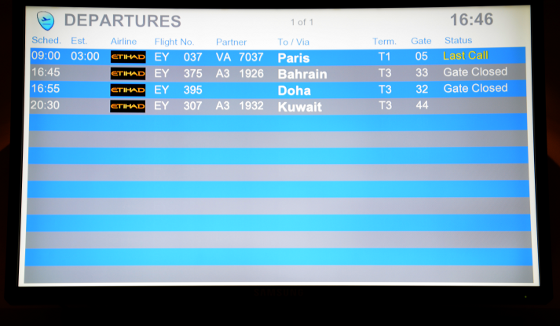
This is the first time we've flown out to Australia with Etihad and it may also be the last. We were due to fly back into Europe at CDG and head down to Lyon for the mini-DebConf this weekend. departure board, 18 hour delay for Paris Lets look at how our Etihad experience has worked out: 21:00 UTC Tuesday - waking up on Wednesday morning in Melbourne (UTC+10) 13:00 UTC Wednesday - leaving Melbourne about 11pm Wednesday night, a 12-13 hour flight to Abu Dhabi. We had heard about the air traffic control strikes in France (where we are going) and asked the airline if we should fly and they told us everything would be OK. 02:30 UTC Thursday - touchdown in Abu Dhabi, 6:30 am local time. Go to the transfer counter to ask for our boarding passes to CDG. At this stage, we were told that the connecting flight to CDG had been delayed 20 hours due to French strikes. As we are trying to reach Lyon for the mini-DebConf this weekend, we asked if we could leave Abu Dhabi on a 09:00 flight to Geneva. The Etihad staff told us to contact our travel agent (the flight was booked through Expedia) and for the next hour everybody's time was wasted making calls to Expedia who kept telling us to speak to Etihad. Whenever the Etihad customer service staff tried to speak to Expedia, the Expedia call center would hang up. Eventually, the Etihad staff told us that the deadline for putting us on the Geneva flight had passed and we would be stuck in Abu Dhabi for at least 20 hours. For flights to and from Europe, airlines have a responsibility to arrange hotels for passengers if there is a lengthy delay. If the airline is at fault, they must also pay some extra cash compensation but for a strike situation that is not applicable. Etihad has repeatedly fobbed us off. Initially we were given vouchers for Burger King or a pizza slice and told to hang around the transfer counter. By about 12:00 UTC (4pm local time, nine hours of waiting around the transfer counter) there was still no solution. One passenger was so upset that the airport security were called to speak to him and he was taken away. The airline staff kept giving excuses. Some passengers had been sent to a hotel but others left behind. I asked them again about our hotel and they kept trying to fob me off. Faced with the possibility that I would miss two nights of sleep and eight hours time difference coming into Europe, I continued asking the Etihad staff to own up to their responsibilities and they eventually offered us access to their airport lounge. We discovered some other passengers in the lounge too, including the passenger who had earlier been escorted away by security. This is unlike anything we've experienced with any other airline. At every opportunity (the check-in at Melbourne, or when the Geneva flight was boarding), the airline has failed to make arrangements that would have avoided cost and inconvenience. Assuming the flight goes ahead with a 20 hour delay, we will arrive in CDG some time Friday morning and not really sleep in a proper bed again until Friday night, about 70 hours after getting up in Melbourne on Wednesday morning. Thanks Etihad, you are a waking nightmare. The airline has been evasive about how they will deal with our onward travel from CDG to Lyon. We had booked a TGV train ticket already but it is not valid after such a long delay and it seems quite possible that trains will be busier than usual thanks to the air traffic control strike. So we don't even know if we will be loitering around a Paris airport or railway station for hours on Friday and nobody from the airline or Expedia really seems to care. Conclusion The only conclusion I can reach from this experience is that Etihad can't be trusted, certainly not for long journies such as Australia to Europe. Having flown through Singapore, Kuala Lumpur and Hong Kong, I know that air passengers have plenty of options available and there are many airlines that do go the extra mile to look after passengers especially on such long journeys. The airline missed opportunities to re-route us at every opportunity. It looks like they help some passengers (like those who did get to hotels) but leave many others high and dry just to stay within their budget.

8 April 2015

Gunnar Wolf: Guests in the classroom: C sar Y ez (@caesarcomptus) talks about memory assignation algorithms

Once again, on March 11 I had a great guest to save me some work and give a talk at my class! This time it was C sar Y ez, and he talked about memory management algorithms, emphasizing on ARC. The video is available, both at this server and in archive.org. Thanks a lot!

Steve McIntyre: More arm64 hardware for Debian - Applied Micro X-Gene

As a follow-up to my post about bootstrapping arm64 in Debian, we've had more hardware given to Debian for us to use in porting and building packages for arm64. Applied Micro sent me an X-Gene development machine to set up and use. Unfortunately, the timing was unlucky and the machine sat on my desk unopened for a few weeks while I was on long holiday in Australia. Once I was back, I connected it up and got it working. Out of the box, a standard Jessie arm64 installation worked using network boot (dhcp and tftp). I ran through d-i as normal and installed a working system, then handed it over to the DSA and buildd folks to get the machine integrated into our systems. Easy! The machine is now up and running as arm-arm-03.debian.org and has been building packages for a few weeks now. You can see the stats here on the buildd.debian.org site. In terms of installation, I also got the machine to boot using one of our netinst images on a USB stick, but that path didn't get very far. The USB drivers for this hardware have only quite recently gone into the mainline kernel, and haven't been backported to the Debian Jessie kernel yet. I'm hoping to get those included shortly. There's also an option to replace the U-Boot firmware that came with the X-Gene with UEFI instead, which would be much more helpful for a server platform like this. I'll look into doing that upgrade soon too, but probably after the Jessie release is done. I don't want to jinx things just now. *grin* Thanks to APM for their generous donation here, and particularly to Richard Zenkert for his help in getting this machine shipped to us.

Next.

Previous.