Search Results: "ron"

11 June 2007

John Goerzen: "You just never know when you're dealing with rodents"

The day after Memorial Day, when I got into my car, it reeked. A strong, foul odor greeted me that morning. It had rained a lot during the long weekend, and I hadn't driven the car. I figured it was just some water sitting somewhere. It ought to evaporate soon enough. The smell seemed to be coming from the vents, so I figured I could help it evaporate by running the fan as much as possible.

I've been dealing with the smell ever since then: windows open, fan on full blast, as often as possible.

This morning I noticed a chewed Kleenex with rodent droppings attached to it in the glove box. I also noticed Kleenex bits and more rodent droppings on the floor mat below the glove box.

So I have a more sinister enemy here.

I dropped by the mechanic over lunch to make an appointment. I explained the symptoms. He looked as me suspiciously.

"But how would a rodent get in there? Hmm... I forget -- do you live in the country?"

"Yes, I do."

"Oh, well that would explain it then."

It reminded him of other rodents he's done battle with -- pack rats that have chewed up wires and hoses, including one that was still alive and in the vehicle when he started working on it.

So I asked him how expensive this was going to be.

"Well, I don't know. It could be easy, or it could be interesting. You just never know when you're dealing with rodents."

He promised to call me if it looked like it might be interesting.

Biella Coleman: Blue Cross Blue Shield Chronicles: Blue Distinction, Not

A few weeks ago, I posted an account of my trials and tribulations with Blue Cross Blue Shield Horizon of New Jersey. Well now it is high time for an update, an update I think readers of this blog will be interested in because it tells a fascinating story about the Internet, blogging, and perhaps new uses of Google Alerts. My goal in writing the post was to inform readers of their options when faced with problems caused by their health insurance company. Well, I had no idea a response would arrive from Blue Cross Blue Shield, and so quickly. For within 2 hours of posting my blog entry, the Public Relations Director of Blue Cross Blue Shield of NJ wrote me an email, which basically said that he came across my blog posting and was offering his assistance. Needles to say, I was shocked. After months of getting some of the worst customer service I have ever received (when on the phone with Blue Cross, I always felt like I was talking to smarmy collection agency reps), I get an email from upper-level management, offering his assistance. At first, I thought some of my geek readers were playing a practical joke on me. While it seemed plausible that Blue Cross monitors links to their site, and probably do so with Google Alerts, I had a harder time believing that the Director of Public Relations would fire off an email to me, directly. Naturally, following the arrival of his message in my inbox, a small glimmer of hope flickered, especially after he had someone from the Appeals Department contact me. And this small intervention had a large noticeable effect: decent and transparent customer service became a reality, for the very first time. Instead of interactions that were opaque and frustrating, I finally had ones that were crystal clear and intelligible. According to the main Blue Cross Blue Shield Web Site, they pride themselves on Blue Distinction:
Blue DistinctionSM is the Blue Cross and Blue Shield companies’ nationwide program that will create an unprecedented level of transparency with two goals: engaging consumers to enable more informed healthcare decisions and collaborating with providers to improve quality outcomes and affordability.
The contrast of my service before and after having the Public Relations director contact me speaks volumes to the actual nature of Blue Distinction as it pertains to BCBS of NJ. For most of my interactions with Blue Cross Blue Shield, I encountered an unprecedented level of opaqueness and frustration until there was intervention from high-above. I actually appreciated the service I received and saw it as a laudable move. Unfortunately, the outcome has been far from my liking. I recently got word they are not paying up for any of the dermatological services. So perhaps the fact that a PR person contacted me was significant because in the end, it has panned out as a typical PR move: all gloss and lacking substance. What now? I am moving to an internal BCBS appeal process and if that does not work, I will move on to small claims court in NYC and perhaps a more organized web campaign. In the mean time I have basically have decided to blog about the process so look out for future updates!

Michael Koch: Icedtea for Debian and Ubuntu

I have built a package based on icedtea for Ubuntu and Debian.
You can apt-get it from
deb http://people.debian.org/~mkoch/java/ ./
Its currently very raw. E.g. it builds with GCJ but has wrong build
dependencies for it. And its only buildable for i386 currently. Patches are welcome. Please test and report back.

MJ Ray: Stopping the Nixforce.com Sploggers

I asked: Should we try to stop them, or just post that "Nixforce look like an unscrupulous load of swines trying to trade on Debian Developer names without permission" all over their site? Paul wrote:
"They are violating Google's Adsense policies by inviting people to click on their ads on their front page ("If you dont want to enter, at least go to one of our Advertisers below"). You could, at the very least, have this line of their income terminated by reporting them here "
Works for me. It said they'll respond within 24 hours. Brandon Holtsclaw suggested:
"Or set something to look for the referer pulling the feed and redirect just that nixforce domain to a 404 or some nasty pr0n feed :) just a thought."
I would, but I think most things will fail to pull if I send a 40x and I can't think how to do a redirect or proxy neatly without messing with RewriteRule or similar - nixforce aren't worth messing with RewriteRules. I also suspect they're pulling from Planet Debian, rather than my web host, so if I made a mistake, I'd be very unpopular. Also: Russell Coker and Antti-Juhani Kaijanaho

Sam Hocevar: Bits from the DPL: DebConf, DSA

on my way to EDI I m stopping for a few days in London before I continue to Edinburgh and I should arrive at DebCamp on Wednesday evening or Thursday morning, depending on whether we travel by train, bus or plane. I m really looking forward to seeing everyone and I hope to have enough time to talk about everything we want to do and set up this year, be it the game team or the core teams, the website or the technical committee... DSA team I eventually got feedback about DSA team candidacies from the various members of the current team. I am relieved that the very idea of adding more people was not met with too strong objections, but now who exactly is going to be accepted is a whole other story. I ll keep you informed.

Evan Prodromou: 21 Prairial CCXV

It was warm tonight, so I made nachos and a big salad for dinner. I took the opportunity to capture my Nachos recipe for you to enjoy. Yes, nachos are a really easy food to make, but so many people make them so wrong, I figured I should write a recipe for people to get them right. tags:

10 June 2007

Chris Lamb: Sudoku solver in PostScript

There seems to have been a bit of fuss over this Sudoku solver implemented in SQL. In Easter 2005, when Sudoku fever kicked off in a big way in England, my Dad started writing a solver implemented in PostScript which I then modified so that it could perform backtracking. I also wrote a C# solver for my phone around the same time and later sneakily won a competition with it - I am now barred from entering competitions in that paper. Anyway, here is an example PostScript board (PDF version). It was labelled “Fiendish” in The Times. The board can be easily changed at the top of the PostScript file. NB. Best results are achieved if you view the PostScript directly in a viewer such as gv or GSview as you actually see the process of backtracking in solving the puzzle, the recursion depth and the set of possible symbols for each square — most PDF viewers are terrible at displaying the process as they seem to render inside the wrong thread. (In terms of solving the puzzle, we both found that by enforcing the simplest constraints and then ‘guessing’ was far easier and more efficient than performing any of the complicated constraints typically employed by human solvers. I’m certain I am not the first to notice that attempting to emulate the brain’s method of solving a problem is usually a short-sighted approach for a computer.) There are few other goodies in the file: replacing the final autotest with autotestR will recurse using the right-most possible symbol - if you get the same board with both of these then the initial board has a unique solution. Also, if you can get your hands on a true PostScript printer, printing the file will mean the puzzle is solved in hardware. Enjoy :) . I’m looking forward to DebConf7! UPDATE: Added PDF version.

Christine Spang: And Straight On Til Morning

My internal clock is finding it hard to believe that it’s light outside right now, which might have something to do with the fact that I’m sitting in Shannon, Ireland. Since I only got maybe two hours of sleep on the plane, I wonder if I’m going to crash horribly later today. I haven’t flown internationally since 2000, so I was a little paranoid about it being a horrible nightmare, but so far it hasn’t been. I haven’t managed to trip any metal detectors yet, though I did accidentally leave my laptop in my bag when I sent it through the scanner at Logan. The security people were nice enough about it, however. I’m not carrying much in terms of carry-ons, so things have been smooth. I completely forgot that “long-haul” flights serve meals. Aer Lingus has a standard meal offering consisting of “chicken” or “beef”, neither of which are very good for vegans. Apparently if you call their reservations office in advance of your flight you can order special meals, of which vegan vegetarian is an option. But I definitely don’t remember this being mentioned at all (or at least very prominently) during the booking process, so I never thought of checking. I had just written off being able to eat the airline food and brought granola bars and snacks. Apparently this was a wrong assumption. I was originally going to FlyGlobespan, but ended up changing my mind after experiencing their entirely broken website which didn’t allow me to make a booking, and waiting a week for a response to their “feedback form” and never getting any, all the while watching their fares creep up as every day passed. Luckily the flight I ended up getting wasn’t too much more expensive, and even allowed me the flexibility to fly into London and out from Glasgow, making it easier to accomplish my plans of visiting Dafydd Harries, Hanna Wallach, and Matthew Garrett in the “other” Cambridge before ending up at Debconf!

Evan Prodromou: 20 Prairial CCXV

What a great day. The weather in Montreal has been fantastic the last few days -- we've had sunny, hot, clear days with showers at night to clean up the air. It's been really spectacular to be out. Of course, this is the time of year that Montreal really shines -- festival season. It kicks off this weekend with the Grand Prix du Canada, which includes a giant party in the downtown area, on St. Laurent, and in the rest of the city as well. In my neighborhood (old and new), we have the Nuit Blanche sur Tableau Noir, a street fair that closes down av. Mont-Royal for auto traffic from June 7 to June 10th. There are huge murals painted on the street itself, and every business, retail outlet and restaurant expands onto the street, while people rove up and down all day and all night. And soon we get the International Fireworks Festival, which kicks off in only two weeks. One of the hallmarks of summer in this city is that just about every Wednesday and Saturday there's a gigantic fireworks show on le Ste. H l ne, at La Ronde amusement park. You can see the lights all over the city, and feel the thumping in every house and bar. It's disconcerting and awe-inspiring. We've already started having Piknic lectronik events, with another going tomorrow. Wow. tags:

SXSW talk online So, my talk at South by Southwest 2007 is now available online as a podcast. You can get the audio at the sxsw.com site and you can follow along on the OpenOffice.org or Powerpoint slides at Talks/SXSW07. I liked listening to this recording, although I realize that I need to do some speech practice for future talks. I say "ummmmm..." after every sentence in this talk, which would probably drive me crazy if I were listening to it. I'm surprised that the applause at the end is so strong -- I'd probably have thrown food at this guy. tags:

Wikimania On that note, I'm glad to point out that my and Maj's talk for Wikimania 2007 was accepted. I guess that means we'll be going to deliver it in Taipei. The subject is Extending wikis with social networking tools. We're going to cover Wikitravel Extra: our motivations for it, implementation issues, and results. It's going to be pretty interesting. tags:

Russell Coker: submissions for LCA and other conferences

In this post I recommended that job seekers not publish their CV. In a comment Gunnar suggested having a special CV for conferences. I think that Gunnar’s idea is good and have started writing my conference CV at http://etbe.coker.com.au/conferences. When I complete it I will make it part of every submission for speaking at a conference. The LCA 2008 call for presentations is now open. One of the most interesting, noteworthy, and slightly controversial items is the suggestion that people submit a video. I think that the video submission is a great idea, either a video or testimony from audience members from past presentations should be required for all submissions (NB I’m not involved with organising LCA2008 so my opinion means little in this regard). The reason is that I have attended many presentations which fell far short of their potential due to poor speaking skills. I’ve been to great presentations by people with strong accents, by people with speech impediments, by people who are incredibly shy, and by people who just don’t have a clue about public speaking. However my observation is that if a speaker has more than one of these disadvantages then the presentation is likely to fail. I have previously written at length about how to give a good presentation to a technical audience (such as is found at LCA). Dave Hall blogs about Should I do a presentation at LCA 2008. He mentions lack of a web-cam as a disincentive, but I am happy to lend him my digital camera (which makes really high quality movies) to solve this problem. In fact I have considered recording some short Linux talks at the SGI office during lunch breaks (Dave and I both work for SGI). Dave also mentions a nightmare scenario about a laptop not working with presentation hardware. My post about getting laptops working for presentations will hopefully help some people in this regard. I’m not sure if I’ll make an offer for LCA this year, I haven’t been doing much cutting-edge work recently. Maybe I’ll just offer some talks for mini-confs, I could probably get several offers accepted by mini-conf organisers if I try.

Russell Coker: costs of driving to work

Mark Greenaway expresses surprise that someone could spend $8000 per annum on petol. I own a 1999 VW Passat 2.8L that does 12.8L/100Km (based on my average driving habits - I record the amount of petrol purchased and the distance driven). I spend an average of just over $60 a month on petrol, so I’m approaching $800 per year. I catch the tram and train to work most days (probably drive to work less than 10% of the time) and use my car very little apart from that (most places that I drive to are close to my house). If I was to exclusively drive to work then that alone would make my petrol expenses approach $8000 per annum. If I was to shop at locations that weren’t so convenient or do recreational driving then the petrol expenses could be significantly greater. The $1000 a year I spend on public transport doesn’t seem so expensive! The http://www.smh.com.au/news/national/hybrid-cars-the-go-as-fuel-price-rockets/2007/06/09/1181089388315.html about the increase in sales of hybrid cars due to fuel price increases. In that article they note that Toyota representatives claim that Prius drivers travel more than the average 15,000 KM per annum. Recently the RACV magazine published an article based on the CNW report (the bogus report paid for by Exxon which claims that the Jeep Wrangler is better for the environment than the Toyota Prius). In response to this I reviewed all adverts for second-hand Prius and Wrangler’s on www.drive.com.au to determine how much these vehicles are driven. I counted a 2006 model as a 1yo car for the purpose of the average. On the 29th of April when I looked at the web site there were 90 Prius and 127 Wrangler on sale for which both the model year and the distance driven were published. Of these vehicles the average distance driven per year for the Prius was 15995Km, and the average for the Wrangler was 11,658Km. Someone who purchases a Prius instead of a V6 car (such as my VW Passat) can expect to save at least 7L per 100KM (based on the assumption of 12L/100Km for a V6 and 5L/100Km for a Prius - this is a conservative estimate, the savings could be greater). That would be a saving of at least 1120L of petrol per annum for the average Prius owner, giving a saving of >$1500 per annum with current petrol prices. Over the 20 year life of the vehicle the average Prius owner can expect to save at least $30,000 on petrol at current prices - but we do expect petrol prices to increase…

9 June 2007

Axel Beckert: .org registration rules arbitrariness

For about nine years, my domain deuxchevaux.org was hosted (which means web, DNS and a catchall e-mail forward) by Internett at Saarbr cken. Although it was a sponsered hosting without much support I was quite happy with their service. But especially my ideas and demands regarding spam filtering grew out of the possibilities of a mass hosting solution. Since I run my own web, mail and name servers for a while now, it was no question that also deuxchevaux.org should become self-hosted. Since I run a root-server at Hetzner and their “robot” also offers domain handling, I planned to transfer deuxchevaux.org to them. Therefore I first had to register my two DNS servers (sym.noone.org and virt.noone.org) with them. In the documentation there was a note that for .org domains, name servers in a .org domain have to be registered with the same registrar. And just a few hours after registering the name servers via their web interface I got a mail from Hetzner Support that the domain of my name servers are not registered with Hetzner and so I cannot use them form .org domains. Asking for the cause of this rule, I got the answer that this is a rule by Hetzner’s upstream registrar, Cronos AG. Well, since I don’t understand such arbitrarily looking rules, I was looking around for another registrar with usable web interface. On the DaLUG mailing list, someone recommended eDNS. Since their single user account is free of setup and monthly fees, I signed up with them and started playing around with their web interface. When I tried to transfer deuxchevaux.org using the Auth-Code, I got the response that the transfer failed and when I clicked on “Details”, I got “$VAR1 = [];” as detailed information about the failure. Data::Dumper says hello. I wrote them and asked if they can tell me, what that should mean last Thursday and got no answer so far. I don’t think, I’ll register domains with them anymore. So where to try it now? Someone recommended GoDaddy, but I neither like their website (way too much targeted on beginners and mainstream) nor do I want to apply for a credit card or a PayPal account to be able to pay their bills. So a bill from my UML hoster Korypet (aka VD Server) caught my eye: They were lowering prices for registrations at some top level domains (and in comparison to the recent lowerings at eDNS the new prices also apply to existing contracts) including .at and .org (and I only have .at, .ch and .org domains). I didn’t knew they also do domains outside of selling them in packages with UML hosts. So I wrote to Korypet support, if they offer a web interface for domain handling and got a reply less than two hours later: Not yet, but they’re working on it. Until then, I can request domain handling tasks by e-mail to their support. Since I know their UML managing web interface – which works fine – and since I’m happy with their support, service and prices since years (I’m customer there since 2003), I replied with all the necessary data for the transfer. Well, the transfer failed, too. But in comparsion to Hetzner or eDNS, they made the effort to exactly find out, what happened. So what did happen? The rule which the Hetzner support guy told me that it was from their upstream registrar wasn’t from there but from Public Internet Registry (PIR) itself. And the rule seems to match not that often, so that many people involved in domain registration don’t know about it (and usually neither understand its existence when they hear about it). Also I have no understanding for this harassment and so I felt the strong urge to get one over on them. Korypet suggested several solutions fitting my needs (i.e. the usage of my DNS servers for my domains). They even offered A records under some of their PIR registrered domains pointing to the IP addresses of my DNS servers for no fee, but luckily some A records under my own .ch domain sufficed. So the transfer was successful on Friday evening, 6pm local time, my own mail server (running Postfix) was happily rejecting a lot of spam to (and even from) non-existing users (which came in over the catch-all before) as well as hosts greeting with not fully qualified or invalid HELOs and greylisting others via David Schweikert’s Postgrey. The number of accepted mails and recognized spam sunk immediately by approximately factor four on the whole mail server, although deuxchevaux.org isn’t the only domain that receives mail there (but was the only one which had a catch-all before). So in the long run, I’ll probably move all .org and .at domains over to Korypet since they have not only fair prices but also a competent and individual support. (And yes, this is a recommendation. ;-)

Russell Coker: configuring a Heartbeat service

In my last post about Heartbeat I gave an example of a script to start and stop a cluster service. In that post I omitted to mention that the script goes in the directory /usr/lib/ocf/resource.d/heartbeat. To actually use the script you need to write some XML configuration to tell Heartbeat which parameters should be passed to it via environment variables and which nodes may be candidates to run it. In the below example the type of web means that the script /usr/lib/ocf/resource.d/heartbeat/web will be called to do the work. The id attributes are all arbitrary, but you want to decide on some sort of consistent naming scheme. I have decided to name web server instances web-X where X is the IP address used for providing the service. The nvpair element contains a configuration option that will be passed to the script as an environment variable. The name of ip means that the environment variable will be named OCF_RESKEY_ip. Naming of such variables is arbitrary and a script may take many variables. A well written script (which incidentally does not mean my previous blog post) will have an option meta-data to give XML output describing all the variables that it accepts. An example of this can be seen by the command /usr/lib/ocf/resource.d/heartbeat/IPaddr2 meta-data. In the XML the resources section (as specified by --obj_type resources on the cibadmin command-line) describes resources that the Heartbeat system will run. The constraints section specifies a set of rules that determine where they will run. If the symmetric-cluster attribute in the cluster_property_set is set to true then resources will be permitted to run anywhere, if it is set to false then a resource will not run anywhere unless there is a constraint specifying that it should do so - which means that there must be at least one constraint rule for every resource that is permitted to run. In the below example I have constraint rules for the service giving node-0 and node-1 a priority of 9000 for running the service. In a future post I will describe the cluster_property_set and how it affects calculations of where resources should run.
(more…)

Matthew Palmer: Good DNS Hygiene

How sure are you that the DNS infrastructure for your domains is in good health? Are they all properly delegated to the right place, with correct NS records and glue? Are all of the domains that you rely on to get your names resolved properly configured themselves? Although everyone out there is probably saying "pfft, of course!", don't be so sure. Before you assume the best, try running one or two of your domains through Squishywishywoo's DNS checker, which does a recursive query for the given record from the root servers all the way down, giving you complete information on what's being checked and what the results are. From that report, you can easily work out what's wrong with your DNS lookups, and correct the problem at it's source. It's also handy for seeing exactly how a DNS lookup works (and explaining to random nitwits how DNS queries actually work). It's actually interesting to run a few domains (run by people who should know better) through the checker and see what actually happens. There's a surprisingly large amount of breakage in people's DNS setups. So the next time you find someone's website is slow to load, perhaps run their FQDN through this DNS checker and see if it's their server or their DNS lookups that is slowing things down.

8 June 2007

Riku Voipio: state of arm port

All doom and gloom? far away from that.

The good:

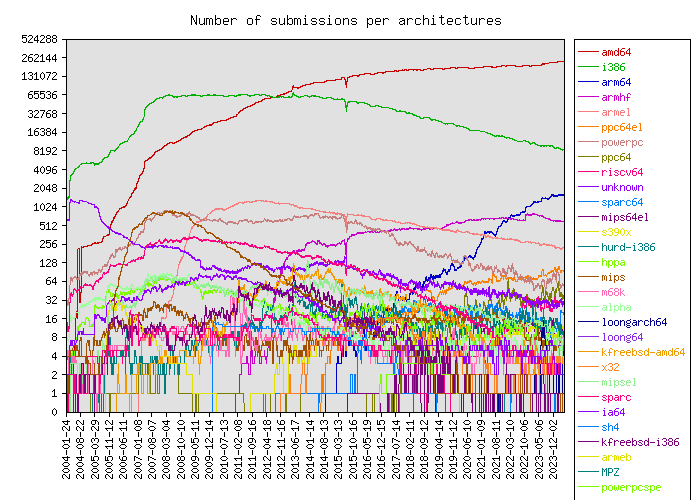
* Arm port is now third most popular port according to popcon.
* This mostly thanks to the popularity of Linksys NSLU-2, a tiny 80 computer able to run Debian. Do you have a old pentium sucking up electricity in your closet? Do a service to earth and replace it with a NSLU-2!
* Armel (Arm EABI) is now at "63.41% up-to-date. That's 4515 packages built out of 7121". See the fancy Graph for the progress. Catching up sid has been achieved with just two buildd's (Thecus N2100) in my apartment and Aurelien Jarno building selected packages. Plus of course pioneering work from Lennert Buytenhek and people who created EABI in upstream.
* All core packages except apt (which hasn't seen a upload to sid since etch) have now armel support in official Debian packages.
* the old arm port has started catching up in up-to-dateness again, now that all buildd's have a recent enough kernel for glibc 2.5 (2.6.12+)

The bad:

* We need someone to take responsibility on the toolchain for arm. Java is semi broken on arm, Fortran, Java and objc need work for armel.
* There is still communications problems. It took quite a while to find out why glibc 2.5 doesn't work on some buildd's.
* People have lost interest in Bigendian arm port after nslu-2 started working with the regular Little-Endian arm port. General consensus is that bigendian port would only matter for highend networking gear.

The future:

* More supported devices. Now we support NSLU-2, Thecus N2100 and a few related IOP based devices plus netwinders. Arm boasts their partners shipped 2450 Million units based Arm technology in 2006. Would you like to run Debian on your brand new scsi RAID card? mp3 player? Cellphone? Internet Tablet? Washing machine? Your choice!
* Better recovery options. Many arm devices are headless, and if it crashes or doesn't boot, figuring out what went wrong is tricky. This is not really arm specific, but comes up often enough in debian-arm list.
* Anti-bloat festival. Many arm devices have very little storage and RAM available. To run debian on these, we need to figure out who to get rid of extra FAT. Less bloated software is everyones advantage.

Ian Murdock: Where do I download OpenSolaris ?

Quick poll: What do you think of when you hear the name “OpenSolaris”? It’s an operating system? The community version of Solaris? Right? Not quite. Like Linux, OpenSolaris is a kernel. Except that it’s more than a kernel. Or, rather, more than a kernel but not quite a complete operating system. Are you confused yet? This comment from a recent Register article sums up the problem quite nicely:
If you go to the OpenSolaris web site, all bright eyed and eager to download a new operating system, you will walk away in bitter disappointment. Sure, it says the word “open” in two dozen languages on the web page, but when you go hunting for an installer disk to download, suddenly you are cast into a maze. Nevada builds? What the hell is Nevada? Oh, it’s what they’re calling the OpenSolaris code base. You’ll need to download these components and build them. Well, how do I install it? Oh, you can’t do that, you need to have a Solaris machine up already to build on. But you can get started if you go to Sun’s site and download their Solaris Express Enterprise Pro Champion Edition (after dutifully registering), and then enjoy that pleasant install experience. And when that’s done, you still have the work ahead of you of getting ON (what the hell is that? Oh, OS and Network. Sorry, I don’t work at Sun) built and updated. Did I miss anything? We haven’t gotten to packages to make the system usable yet.
Now, I’m willing to wager most of you reading this have probably heard about DTrace, ZFS, Zones, and the other great stuff Solaris has to offer, not to mention that Solaris is about as enterprise grade as they come, having been at the heart of the data center longer than many of the alternatives have even existed. And don’t forget about more mundane but critical things like backward compatibility, where Solaris has excelled for a very long time. But how many of you have actually experienced this great stuff first hand? How many hands go down if you’re under 30 and don’t remember the Sun workstation—i.e., you’re one of the many for whom Linux = Unix for as long as you’ve been in the computer business? How many of you would take Solaris for a spin if doing so was as easy as, say, downloading the latest version of Ubuntu and installing it? In other words, with all the buzz about making Solaris more familiar to Linux users, it turns out the widest part of the familiarity gap isn’t even technological. So, how do we bridge it? We need to make “OpenSolaris” something you can touch, something you can “Download Now!” and run on your laptop to try out the latest and greatest from the OpenSolaris community. We need to clearly articulate the link between Solaris and OpenSolaris in ways the industry understands—namely, that OpenSolaris is the rapidly moving version that delivers the latest innovations, and that Solaris is the enterprise-grade, supported-for-many-years, backward-compatibility- guaranteed version for the data center. Furthermore, the link needs to be more than just “OpenSolaris as upstream for Solaris”. Given how many more copies of Fedora and Ubuntu are running in the world than the enterprise Linuxes, there is significant opportunity here if we can get the model right. In short, to make OpenSolaris (and, by extension, Solaris) more familiar to Linux users, the first thing we need to do is make it a “distro” in the Linux sense of the word. After all, when people say they know “Linux”, that’s what they’re talking about—how many people really care about the Linux kernel underneath? What they care about is the GNU tools, the desktop, the development environment, and all the other things their favorite distro bundles—and the package system that holds it all together. There’s no reason in the world why (Open)Solaris can’t deliver those same things. Oh yeah, and DTrace, ZFS, Zones, enterprise grade security/scalability/performance/etc., backward compatibility, etc. too. Put this way, it’s easy to imagine what OpenSolaris needs to look like. That’s why the issues here are not primarily technological. This is the essence of the Project Indiana you’ve read so much about in the past several weeks. Our goal is to create a binary distribution of OpenSolaris that simultaneously delivers what people have come to expect from “Linux” alongside the great stuff that make Solaris unique. What comes next? We’re working that out in real time. If you’re interested in following along, participating, or just giving us your two cents, I encourage you to join the indiana-discuss mailing list we just created. We’re particularly interested in hearing from you if you consider yourself a “Linux user” and have been interested in taking Solaris for a spin but, for whatever reason, have considered the gap too wide. What would it take to get you running Solaris?

Evan Prodromou: 19 Prairial CCXV

It's been a topsy-turvy week, but I'm finally getting my head above water again here at our new home. A lot has happened, which I'll try to capture here, but I'm not sure I can get it all. On Tuesday, Maj, Amita June and I spent the morning in Central Park in New York City. It was a beautiful day -- the rains had cleared overnight, and it was warm and crisp everywhere. We went to the big playground near Columbus Circle, which had about 1000 kids from 2 to 14 running in every direction, and a huge water spray fountain which meant that most of those kids were soaking wet. We went and grabbed lunch at the Whole Foods Market on the circle itself, and ate it out on the grass. AJ and Maj went back to the hotel for a nap, and I got a haircut for the awards ceremony that night. Then I had coffee with Tim Wu, creator of the concept of net neutrality and a writer for Slate. We had a great talk about net neutrality, the future of Wikitravel (Tim wrote a critical piece in Slate in April), and new projects we're both working on. It was really pretty fun. Unfortunately, I took too long talking to Tim, and not enough time buying myself a pair of pants for the awards ceremony. So by the time we were done, I was in a huge hurry. I ran down to the Old Navy on W 34th, picked a pair of black khakis off the shelf, and jammed in a cab to get back to our hotel room in time. Maj was done up to the nines, so I jumped in the shower, shaved, threw on my sport jacket and slacks, cut off all the tags with nail clippers, and ran out the door. The event itself was pretty incredible, and I don't want to flood this blog post with all of my comments and recollections. So I'll add a more detailed report later today. tags:

Drive time Suffice it to say that we were out really, really late. We got up at 6AM the next morning to make our 8AM train back to Montreal, and it was clear to everyone (even Amita June) that if we tried to make this train it would be one of the worst days of our life. But there's only one train from NYC to Montreal per day, so we'd have to stay in town another night, and then have the same problem the next morning. So Maj canceled our Amtrak train tickets -- which were 100% refundable, even a couple of hours before the train leaves. Bravo, Amtrak! Then I got to work trying to rent us a car to drive home. It turns out that it's hard to get a rental car for a one-way trip from New York to Montreal. I tried Budget and Avis and National, and none of them would let me rent one-way into Canada. Annoyingly, none of their Web sites gave straight error messages on the subject -- I got "no cars available" or "unable to find your destination" (!) -- and I had to call the 1-800 numbers for each one in turn. I finally got a car from Hertz, on-line, and there was even a little note in my confirmation email to the effect of "ONE WAY TRAVEL CONFIRMED". I guess there's a reason that some companies get to be number one -- the more flexible you are, the more grateful your customers are going to be. I, for one, am planning to use Hertz in the future. I picked up the car at the W 55th Hertz office, and it took me 45 minutes to get back to our hotel at 7th and W 47th. The garage at Hertz goes onto W 54th, which is a "Thru Street" -- no turns allowed until you're halfway across town. And, it was bumper-to-bumper, of course. I finally gave up and made an illegal turn, and was promptly pulled over by a motorcycle cop. D'oh! Luckily, he let me off with a warning. Our trip out of New York was uneventful, but pleasant. It was a beautiful day, and the Catskills and Hudson Valley are a beautiful place to drive in the early summer. Deep, cool woods and bright green fields -- they're lush and fertile-looking. We stopped in Lake George for an early-afternoon dinner, and then had a pretty sunset drive through the Adirondacks up to the border. We got in late -- 10:30PM -- but it was overall a pretty good trip. And nice to have left at 2PM rather than 6AM. tags:

MANA Yesterday Mark, Allegra, No ma and Anoushka stopped back through Montreal as they wended their way home to Lausanne?. We had a nice lunch at Zyng and then took a walk down av Mont-Royal, where a pedestrian fair is going on this week. They got off yesterday evening, which makes the last of our RoCoCoCamp visitors to leave. tags:

Pecha Kucha Montreal I'm very interested to hear via Boris and James that we'll be having a Pecha Kucha night here in Montreal. It's going to be on 14 Jun 2007 at 20:20h (8:20PM) at the SAT. Pecha Kucha is an unconference for designers (not necessarily Web designers). I think it sounds like a really interesting event, and I hope to go. tags:

Russell Coker: Heartbeat service scripts

A service script for Heartbeat needs to support at least three operations, start, stop, and status. The operations will return 0 on success, 7 on failure (which in the case of the monitor script means that the service is not running) and any other value to indicate that something has gone wrong. In the second half of this post (not in the feed) I have included an example service script. It is a very brief script and does not support some of the optional parameters (monitor, validate-all, and meta-data). So this script is not of a quality that would be accepted for inclusion in a Heartbeat release but is adequate to demonstrate the concepts. The XML configuration for a service can have an arbitrary set of name-value pairs, and they are passed to the script as environment variables. For example the below script expects that the XML configuration item named ip will have the IP address used by the service, my script receives this as a variable named OCF_RESKEY_ip. My script doesn’t use the address, it merely allows it to be inherited by the IPaddr2 script (which is part of the Heartbeat distribution) and that script assigns the address to an Ethernet interface. The script is for testing Heartbeat, it mounts a filesystem and starts Apache (which is configured to serve web pages from the filesystem in question on the IP address supplied by the ip parameter). For test purposes the script looks for a file named /root/fail, if this file exists then the status check will always abort. An aborting status script means that Heartbeat can not be certain that the node in question has released all resources that it was using for the service. This means that Heartbeat will have to kill the node via the STONITH service. Such test scripts are the only way to test that STONITH works, and I believe that it’s a necessary part of pre-production testing of a Heartbeat cluster. Update: Made it display error messages in all cases and also reformatted it for better cut/paste.
(more…)

7 June 2007

Miriam Ruiz: Sponsorship of Debian Packages

One of the worse things for a maintainer that happens not to be a DD (Heh!) is finding a sponsor for the packages. I remember some time ago I preferred to send the packages I had developed to upstream so that they could hang them in their own pages, instead of Debian repositories, because it was much more effort for me (and more emotionally stressing) to deal with finding a sponsor than to develop and maintain the package itself. I still have that feeling when I need to find an sponsor for any of my packages. The fact that I’m maintaining much more of them now doesn’t help, and I seem to be needing a sponsor almost every day lately. Even though I might have been spending lots of hours in getting a package ready for Debian, solved the problems with upstream, replaced non-free stuff inside, getting everything ready so that other people can benefit from my work, I still have that strange feeling that they’re doing me a favor by letting me put that package into the repositories. I wonder if the people developing other distributions have that feeling too or if it’s Debian-specific. Of course, having a lot of friends as DDs, knowing them in person, knowing that they trust you, helps a lot. At least you don’t have the feeling that you’re being scrutinized that you have when you’re a newbie to Debian Development. Still, when I need sponsorship for any of my packages, I still have the feeling that I’m appealing to friendship to achieve it, and that I’m pestering my friends. I’ve even been directly accused by some of pestering them about sponsoring my packages. It makes me feel bad. I don’t like spending lots of hours doing something for other people, and afterwards feeling an egoist for wanting to share it. That’s how the current sponsorship process makes me feel, and I guess I’m not the only one out there feeling this way. Do people doing stuff from Ubuntu feel this way too? “Finish your NM, Become a DD“, I’m often told when I complain about this. Yup, it’s true, I agree. Anyway I’m mentioning this not as a personal problem I myself have, but something that many non-DD maintainers feel, and that might be one of the reasons why some of them might decide in the end to jump into another distribution that doesn’t make them feel kinda bad people just for doing stuff. It might be surprising to here, but I don’t feel myself ready for becoming a DD yet. It might be kinda Impostor Syndrome, dunno, but I cannot keep myself from feeling it.

Adam Rosi-Kessel: Religion, Secularism, and Mystery

To follow up on my early post Christopher Hitchens v. God, Jonah at the Frontal Cortex has some insightful comments on religion and secularism. The money quote:
When people like Dawkins attack wimpy agnostics or moderate believers, they forget that many atheists aren’t uber-rationalists. They carry around tarot cards, not The Selfish Gene.
Jonah also makes a good point that science and religion may not have irreconcilable differences:
It’s important to note that science isn’t necessarily in conflict with our need to believe in some sort of mystery. Modern science, after all, has discovered some of the craziest ideas around, from the principles of quantum physics to the fact that our head holds a trillion cells trafficking in minor jolts of electricity. These ideas are both materialist and mysterious, since they hint at a universe that exceeds the current capacities of our imagination. What Hamlet said to Horatio is still true.
This sort of analysis seems to me far more nuanced and interesting than that advanced by what I’ll call the “vulgar atheists” — Dawkins, Hitchens, Dennett, et al.

Next.

Previous.