Search Results: "sto"

13 December 2008

Adam Rosi-Kessel: Climate Hope

Via Steve (new domain name, otherwise as usual), this inspiring little PowerPoint-ish presentation from Dr. Steven Chu, Obama s choice for Secretary of Energy: This video features about as many charts per minute as did An Inconvenient Truth, but left me far more hopeful about our long-term prospects on Earth. It is reassuring to see so many powerful positions being filled by people with domain expertise, rather than partisan hacks. If this administration doesn t get us back on course, we might as well stop having children. Technorati Tags: , , , ,

Runa Sandvik: So You ve Been Buried Alive

Now, check your pockets and take stock of what resources are available. If you have a cell phone, see if you can get reception. If you get through to a friend, dispense with pleasantries quickly and state the situation calmly and clearly. The newer cell phones have GPS function, which will aid greatly in directing him or her to the right place. If you re worried about using valuable phone minutes, try texting, but keep it to essentials. HLY SHT BD ALV. GT HLP, BRG SHVL, OXY, BR (NT PBR)
Now these are the kinds of tips we need more of.

Mike Hommey: Shared subtrees and per-process namespaces

Now we have seen what per-process namespaces and shared subtrees are and how to operate them, we can try to combine these two features. We ll be using our newns tool from this earlier post to create new namespaces. And for practical reasons, let s say you have a terminal with a 1$ prompt and a second terminal with a 2$ prompt (that will allow me to skip go to the second terminal phrases). In the kernel, per-process namespaces are a bit like bind mounts, such that shared subtrees work with namespaces like they do with bind mounts. As with standard bind mounts, the default shared subtree mode is private, which means mounts done on either namespaces will be private to the namespace. Only mount points active at the time of the new namespace creation will be in both namespaces:
1$ ./newns
1$ mount /dev/sda1 /mnt
1$ ls /mnt
config-2.6.26-1-amd64 grub initrd.img-2.6.26-1-amd64 System.map-2.6.26-1-amd64 vmlinuz-2.6.26-1-amd64
2$ ls /mnt
2$ mount /dev/sda1 /cdrom
2$ ls /cdrom
config-2.6.26-1-amd64 grub initrd.img-2.6.26-1-amd64 System.map-2.6.26-1-amd64 vmlinuz-2.6.26-1-amd64
1$ ls /cdrom
1$ umount /mnt
1$ exit
# Exit from newns
2$ umount /cdrom
shared mode allows both namespaces to share subsequent mounts. As with bind mounts, and for obvious reasons, you need to change the subtree mode before creating the new namespace:
1$ mount --make-rshared /
1$ ./newns
1$ mount --bind /usr /mnt
1$ ls /mnt
bin games include lib lib32 lib64 local sbin share src X11R6
2$ ls /mnt
bin games include lib lib32 lib64 local sbin share src X11R6
Like with shared bind mounts, the new mount point can be unmounted from either namespace:
2$ umount /mnt
1$ ls /mnt
1$ exit
# Exit from newns
A slave subtree will have mount points under its master (shared) subtrees propagated, while propagation won t happen in the other direction. Again, very much like bind mounts:
1$ mount --make-rshared / # For completeness, we already did that earlier
1$ ./newns
1$ mount --make-rslave /
1$ mount --bind /usr /mnt
1$ ls /mnt
bin games include lib lib32 lib64 local sbin share src X11R6
2$ ls /mnt
2$ mount --bind /usr /cdrom
2$ ls /cdrom
bin games include lib lib32 lib64 local sbin share src X11R6
1$ ls /cdrom
bin games include lib lib32 lib64 local sbin share src X11R6
1$ exit
# Exit from newns
2$ umount /cdrom
Contrary to shared and slave, unbindable doesn t add value when used in two different namespaces. This is only something that will have impact on the current namespace:
1$ mount --make-rshared / # For completeness, we already did that earlier
1$ ./newns
2$ mount --make-runbindable /
2$ mount --bind /usr /mnt
mount: wrong fs type, bad option, bad superblock on /usr,
missing codepage or helper program, or other error
In some cases useful info is found in syslog - try
dmesg tail or so
1$ mount --bind /usr /mnt
bin games include lib lib32 lib64 local sbin share src X11R6
1$ exit
# Exit from newns
1$ mount --make-rprivate # Set back to default
Now we ve seen what can be done with namespaces and shared subtrees, let s see what nice features can be implemented with both. As Russell revealed, pam-namespace is able to polyinstanciate some directories following rules set in /etc/security/namespace.conf (see namespace.conf(5)). The sad thing is that it apparently can t just create a new namespace without polyinstanciating a directory, which could be useful if you only want separate namespaces, but no polyinstanciated directory. Russell s recipe goes as follows: What this means is that in the newly created namespace, a user reading in /tmp will actually be reading in /tmp-inst/$USER without the user knowing. Also, if root mounts something on the parent namespace, it will be propagated (/ being shared) to the user namespace. This means that mounting USB storage, for example, will be propagated to the user namespace. This also means that something mounted from the user namespace will also be propagated to the parent namespace. In both cases, this only applies to mounts occuring outside of /tmp, for which mounts don t get propagated. Note that without setting /tmp as private, when PAM would be mounting /tmp/inst/$USER, it would propagate as well, setting /tmp to /tmp/inst/$USER for everyone. So setting /tmp as private is mandatory. There is, however, a flaw in Russell s recipe: If any of the user mounts something under a submount of /, under /var for example, if /var is mounted, it won t be mounted to a user that already had a session opened. For that to be possible, you have to use --make-rshared instead of --make-shared in Russell s recipe. Some nice setup that can be done with all these, is the following: Add the following to /etc/security/namespace.conf:
/tmp tmpfs tmpfs root
Add the following to /etc/pam.d/common-session:
session required pam_namespace.so
Until here, it is pretty much the same as Russell s, except /tmp is a tmpfs instead of a real directory in /tmp-inst/, which can have some advantages. It doesn t seem to be possible to give pam-namespace a size for the tmpfs, though. Add the following to /etc/rc.local:
mount --make-rshared /
mount --bind /tmp /tmp
mount --make-private /tmp
Here again, this is the same as Russell s except for the correction for --make-rshared as seen above. If /tmp is already a mount point (on my systems, it is a tmpfs), you can remove mount --bind /tmp /tmp from above. Add the following to /etc/security/namespace.init:
mount --make-rslave /
Now, this is where it gets interesting: we re setting the whole tree as slave in the user namespace which means that if a user mounts a file system anywhere, it will only be seen in his session. Which means the user can more safely mount encrypted volumes: they won t be available to other users (root can still go wandering in /dev/kmem, though). And you don t even need SE linux for that. The caveat is that if you open a root session with su, from the user session, you are still inside the user boundaries, and don t have access to the virtual filesystem as it is for init. And if you mount something as root then, while it will appear in the user namespace, it won t appear neither in other users namespace nor in init s, which can be a good thing in some cases, but a burden in others. It means you may need to setup a special user that won t get a new namespace in /etc/security/namespace.conf. An alternative model would be to only set the user s home as slave, which means anything mounted by the user in his home directory would stay private in his namespace, while anything mounted outside would be shared with other namespaces. For that, you may want to replace the lines we added to /etc/security/namespace.init with the following:
HOME=$(getent passwd $3 cut -d: -f6)
mount --bind "$HOME" "$HOME"
mount --make-rslave "$HOME"
Either way, the remaining problem is that a root session opened with su from the user session won t get access to the original /tmp. As we saw, there are various use cases for namespaces and shared subtrees. I ll follow-up again on these features soon, as I ll be using them in yet another way to achieve a very different purpose.

David Welton: Startups and Work: Europe vs the US

Michael Arrington of Techcrunch comments on the US vs Europe in terms of startups: Joie De Vivre: The Europeans Are Out To Lunch It's a pretty rough and coarse-grained view of things, but there's a grain of truth there. I've written about this a little bit before. It's something that I feel qualified to talk about, having lived and worked in both the US and Europe (Italy and Austria to be precise), and in that time, generally gravitated towards startups. Here's my quick take on a list of what's good and bad about each. Please note that these are of course not true for everyone, that things are changing, but are still things I think are generally true, even when I could think of several counterexamples for some of them myself. Also, it's very important to keep in mind how diverse "Europe" is, so most of what I write is really about Italy, and to a much smaller degree, Austria. I'd be very curious to hear your own experiences in the comments. Europe Bad
  • Less of a startup culture and mentality. It's more typical to get a "job for life" and hang on to it for all you're worth. Many Italians are tremendously creative, industrious, inventive people, but are going to find it more difficult to express that in some form of business.
  • The side effects of this mean that there are fewer people to talk with, and network with, fewer potential employees willing to risk a startup, and so on. For instance, people are at times more suspicious of a new company - both clients and suppliers.
  • As I mentioned in my other article, it takes a lot more money to get started in many European countries - something like 10,000 Euro in Italy. Other places like the UK are cheaper, and apparently Germany is introducing some legislation to ease the burden on new companies. I really hope this changes in Europe because it's such an easy change to make: don't extract money from companies until they're making it.
  • More bureaucracy. I think that higher taxes, once you are profitable, might be worth paying for the social system you get in Europe, but the cost of sorting out paperwork falls inordinately on smaller, newer companies. Big, established firms can hire people to deal with all the rules and regulations, and probably have contacts in the government that can help them out in some cases. Smaller firms are the ones whose time is really going to be wasted running around to different offices trying to figure out what they have to do.
  • Smaller, fragmented markets. Localization is not a lot of fun in some ways, and trying to translate everything into all the languages of the European Union is a huge undertaking. In the US, you get a huge market with just English and the US Dollar. Even beyond language issues, the culture changes less in the US from place to place, meaning that you have a more homogeneous target.
  • Lack of acceptance of failure, both culturally and institutionally. If you go bankrupt in Italy, it's a very serious problem. Apparently (although this is second hand, I'm not 100% sure of it - maybe someone can confirm whether it's actually true?), you can even lose the right to vote. Plenty of people in the US try several times before they get it right.
Good
  • Even if your undertaking fails, you still have health care. Likewise, there are other bits and pieces of social support (that change from country to country) that mean you're probably not going to land quite so hard on your rear if things go wrong.
  • Lots of smart, educated people. I never lacked for plenty of smart people to talk shop with in Padova, and didn't miss the California bay area at all from that point of view. Open source is really big in Europe - perhaps, in part, because for many people it's a better avenue for their talents than creating a business, when doing so is difficult and less common.
  • Work/life balance. Sorry Mike, but the amount of people who are truly going to strike it rich is pretty small. If they want to work hard, great, but it's nice to have some other options, in terms of good, lasting friendships (rather than everything revolving around work), knowing plenty of people from outside your field, people living in and belonging to a community (how many people spend their whole lives in the bay area?). When I moved from San Francisco to Padova in 2000, I went from a world gone mad with money and the dot com craze to one where there were rich and poor, families, young people, old people, and many people who were not working for some dot com. That's not to say that people don't work quite hard in Italy - two hour lunches are a thing of the past for most anyone I know.
  • Smaller fragmented markets can be an advantage, too. By the time some valley-based startup finally gets around to noticing that languages other than English exist, it's possible to capture a smaller market. Ok, so you won't be the next Google that way, but there's good money to be had in doing so.
  • In some ways, the staid, established, don't rock the boat way of doing things in some industries may present big opportunities for outsiders to come in and pull the carpet out from under everyone. This is especially true of internet/web companies that can get started quickly and cheaply.
US Bad
  • If you're not careful, you can get completely sucked in to work - your life revolves around it, your friends are mostly work friends, and if something happens to your job, a lot of that goes poof. This is especially true in places like the bay area, where so many people are 'transients' - just there for a few years, without any real roots in the area. This is ok if you'll potentially make a big pile of money, but long term it's unhealthy.
  • Less of a sense of building for the long term. Personally, I don't want a "job for life", but I think there is some value in loyalty (the genuine sort, not the sort created by legally not being able to lose a job) between employer and employee that has been lost in the US. Being able to count on someone growing with your company, and as an employee, knowing that your company will do what it can to help you out even in tough times are things that capture some value. The US seems to be heading towards a "Coasian" world where everyone is a freelancer, and while that efficiency is hard to deny, I wonder what is lost in the process.
  • The competition is tough. Sure, it is in Europe too, but in Europe everyone may compete quite hard during the year, but still all take that one month vacation (although that is becoming a bit less common, especially amongst people my age), whereas in the US almost no one gets that kind of benefit - even if you wanted to take unpaid time off, people would look askance at that kind of behavior. That said, if you need to stay open in, say, August, in Italy, to compete, you are in big trouble, because for many businesses it's simply impossible because it's a chain reaction: all your suppliers and clients shut down, so you really have no choice.
Good
  • There are certainly bureaucratic obstacles in the US, but are much more maneageable, and don't hit smaller/newer companies quite so badly.
  • It's cheap to get started. As per my other article, the actual state filing fee in Oregon for an LLC is $55, and that's all you really need.
  • The culture is definitely there, especially in the right places like the Bay Area, but even in plenty of others.
  • You aren't bound to employees for life, and it's easy to find freelancers. I know I'm contradicting myself, but I think it's actually a complex issue, and there are definite advantages to not having people who expect or at least want to find that job for life.
  • A large target market. Go online in one state, and you can, for the most part, deal with customers all over the US, in one language.
  • Things turn around faster. I have more of a sense that when there are problems, they get fixed. Companies (the debacle of the automakers notwithstanding) are more often allowed to fail, or at least put in Chapter 11. Sometimes this means that when things are bad, they get really bad, but also turn around and get better sooner.
Conclusions An interesting example of all this from my own experience was Linuxcare. The company was, culturally, a Bay Area startup, with the headquarters in San Francisco, founded by very startup oriented guys (one of whom, Dave Sifry, went on to do technorati, and is currently working on yet another venture). However, most of the actual open source talent was in our satellite offices, in Australia, Italy and Canada, places where, perhaps, people were not so distracted by the prospect of "make money fast!!! hurry!!!" that they had time to work, learn, and create some really great open source code. To be honest, I find myself torn. Business-wise, I prefer the US. However, outside of that, there's a lot to be said for Europe. I also think that some of what's good about business in the US is coming to Europe, albeit slowly in some cases, in Europe. People my age here can see what's going on elsewhere, and try and copy what they like. A lot of what's good about Europe, though, might be more difficult to import into the US, especially the livability of the cities. In any case, I can conclude that it's a complex, difficult topic best discussed over a glass of wine.

David Welton: Startups and Work: Europe vs the US

Michael Arrington of Techcrunch comments on the US vs Europe in terms of startups: Joie De Vivre: The Europeans Are Out To Lunch It's a pretty rough and coarse-grained view of things, but there's a grain of truth there. I've written about this a little bit before. It's something that I feel qualified to talk about, having lived and worked in both the US and Europe (Italy and Austria to be precise), and in that time, generally gravitated towards startups. Here's my quick take on a list of what's good and bad about each. Please note that these are of course not true for everyone, that things are changing, but are still things I think are generally true, even when I could think of several counterexamples for some of them myself. Also, it's very important to keep in mind how diverse "Europe" is, so most of what I write is really about Italy, and to a much smaller degree, Austria. I'd be very curious to hear your own experiences in the comments. Europe Bad Good US Bad Good Conclusions An interesting example of all this from my own experience was Linuxcare. The company was, culturally, a Bay Area startup, with the headquarters in San Francisco, founded by very startup oriented guys (one of whom, Dave Sifry, went on to do technorati, and is currently working on yet another venture). However, most of the actual open source talent was in our satellite offices, in Australia, Italy and Canada, places where, perhaps, people were not so distracted by the prospect of "make money fast!!! hurry!!!" that they had time to work, learn, and create some really great open source code. To be honest, I find myself torn. Business-wise, I prefer the US. However, outside of that, there's a lot to be said for Europe. I also think that some of what's good about business in the US is coming to Europe, albeit slowly in some cases, in Europe. People my age here can see what's going on elsewhere, and try and copy what they like. A lot of what's good about Europe, though, might be more difficult to import into the US, especially the livability of the cities. In any case, I can conclude that it's a complex, difficult topic best discussed over a glass of wine.

Kartik Mistry: How much time it will take to deliver tshirt?


* I happily ordered foss.in tshirt from hepfly.com. But, but, it was my mistake! I am wondering how much time it will take to deliver tshirt with-in India? Its already 15 + days.. And, no proper reply or update from their customer care. PS: I got it on the day I post this! Nice quality :)

12 December 2008

Russell Coker: Christmas Toys for Children

It’s almost Christmas and time to buy scientific toys for children. Here are some random ideas, of course it’s probably too late for the online stores to deliver - but there’s always next year. The MikroKopter is a kit helicopter based on four propellors (two rotating in each direction) and is capable of semi-autonomous flight while carrying a decent payload (such as a digital camera) [1]. The parts cost over E700 and the skill involved in assembling it is significant, but it would be an excellent present for anyone who is 14+. Of course the type of helicopter described in my previous post [2] is a much more affordable present and can be used by a young child. The scitoys.com site has a good range of scientific toys for sale [3], they are assembled into kits. The United Nuclear site has a huge range of chemical supplies and related things [4] that can be used for making some great science experiments and toys. They also have really detailed information about the potential hazards of the things that they sell (not that I was planning to buy Cesium or Uranium anyway). If buying exotic alloys elsewhere it’s probably a good idea to check the United Nuclear site for the hazard information (not all sites provide as much information as they should). Professor Bunsen is an Australian site selling similar produces to SciToys [5]. The range is slightly different, and if you are in Australia then it’s safer to buy locally - there is a significant amount of stuff on the United Nuclear site that would be unlikely to pass Australian customs. The Spirograph is a good way to introduce mathematical concepts to children [6], it would probably be a good present for children who’s parents are not interested in maths and science. Lego [7] is always good, but there are also other similar products to consider. Meccano is good for older children, but the ranges for younger children have some deficiencies (the 2+ stuff requires the finger strength of an adult to assemble all parts). The Italian company Quercetti has some great products [9]. Unfortunately their web site is only in Italian and they have no links to sites in other countries/languages (they do have the names of some distributors who may have web sites). Their products includes a gears set (suitable for teaching children as young as 1yo) and a model car with an engine that has pistons moving inside a clear plastic case, a two-speed gearbox, and a fully functional differential (designed for 2yo+). For more hands-on tasks that require supervision (not something that can go under a tree) one good option for ages 3+ is to disassemble a variety of computers and computer parts. CD-ROM drives are good because you can connect a 9V battery to the head assembly motor or the tray eject motor to make it work. Hard disks have insanely strong magnets inside them - don’t give two such magnets to a child. A multi-meter is a great educational toy that can be used for many great experiements (as well as for practical tasks such as determining which battery of a set is flat) [10]. The parts from a hard disk can be used to demonstrate how a generator works (the mechanism to move the heads provides you with strong magnets and a coil that fits them). Note that an analogue meter is needed for such experiments as the amount of electricity generated is small and AC - a digital meter will average it out to zero (at least for the more affordable meters that I have used). It’s probably best to own both a digital meter and an analogue one, the minimum age for owning such a meter is probably about 10, the minimum age for using one with supervision is about 3. An oscilloscope is a great educational toy [11], unfortunately they are quite expensive (Ebay seems to have nothing below about $450). They can be used for all sort of fun tasks such as measuring the speed of sound. The wikipedia page notes that you can get PC based Oscilloscopes (PCO) which are cheaper. I wonder if they have Linux support for such things… The OLPC is a great computer for kids in developing countries [12]. They are now available in Australia [13]. For most children in first-world countries a second-hand laptop of a more traditional design is probably a better option. There are a significant number of old laptops gathering dust which can easily have Linux installed with a variety of educational software. Buying an OLPC on the “give one get one” deal costs $400US plus tax and shipping, while a second-hand laptop can be purchased for significantly less than that. While giving an OLPC to some random needy child is a good thing, as the person who gives a laptop locally is probably going to provide support for it there are some benefits to giving a regular laptop. Conferences often have bags of random junk to give out to delegates, and trade shows always have lots of little toys with company logos on them. Such things are usually of little use - but children like them. Also the trinkets that computer companies give away are often educational. If you have a cupboard filled with such things then unloading them on some children is a good idea - of course you have to make sure that anything you give to young children can’t be swallowed and has no sharp points.

Mike Hommey: Per-process namespaces

Linux has had this neat feature for quite some time now: since 2.4.19 according to the docs. Yet, it is neither very known nor very used. I couldn’t even find a program that would create a new namespace for its subprocesses, similar to what chroot does with the root of the file hierarchy. This neat feature allows each process to have a different set of mount points. While you most of the time want processes to share their mount points, there are some cases where you may want to have some processes have a different set of mount points. Combined with bind mounts, it can allow some useful setups. In case you are not familiar with bind mounts, they allow to “attach” a part of the file hierarchy to some place else. For example:
$ ls /mnt
$ ls /usr
bin games include lib lib32 lib64 local sbin share src X11R6
$ mount --bind /usr /mnt
$ ls /mnt
bin games include lib lib32 lib64 local sbin share src X11R6
Now, take pam-tmpdir, for example. It sets $TMPDIR and $TMP to point to a user-specific temporary directory. Sadly, it is pretty useless for applications that don’t follow the standards of using these environment variables. Without namespaces, if you’d create a temporary directory and bind-mount it to /tmp, this new /tmp would be visible to everyone, to every process. But with namespaces, you can make this new /tmp only available to subprocesses. If pam-tmpdir were to do this, it would also allow applications trying to write to /tmp without resorting to $TMP or $TMPDIR to be using the temporary space, without impacting external processes, that would still be using the original /tmp. On x86-64, you can run both 64-bits and 32-bits applications. 64-bits applications would take libraries from /usr/lib, and 32-bits applications would search libraries in /usr/lib32. But badly crafted 32-bits applications could be trying to load libraries from /usr/lib, where only 64-bits versions are available. With namespaces, the broken 32-bits application could have /usr/lib32 bind-mounted to /usr/lib without the 64-bits applications knowing. You could certainly get a similar result with the following set of commands:
$ mount --rbind / /chroot
$ mount --rbind /usr/lib32 /chroot/usr/lib
$ chroot /chroot $application
(–rbind also attaches submounts, contrary to –bind) The downside, here, is that external processes will see all this setup under /chroot. The whole setup would be invisible to external processes if namespaces were used. Another nice use of namespaces would be to mount encrypted volumes under a different namespace, so that only a limited set of processes would be allowed to read the decrypted data. The sad thing is that you need the admin capability to create a new namespace, so that would need to be done by a setuid root program. There are, as far as a few hours fiddling showed me, 2 system calls that will setup a new namespace: clone(2), and unshare(2). The second is easier to use, though only available since 2.6.16. But while etch ships 2.6.18, the glibc coming with it doesn’t implement unshare(2), so we need to use syscall(2) instead. The following code will run /bin/sh, or any command given as argument after creating a new namespace. The new process and its subprocesses will inherit the new namespace.
#include <sched.h>
#include <syscall.h>
#include <unistd.h>
int main(int argc, char *argv[])
  syscall(SYS_unshare, CLONE_NEWNS);
  if (argc > 1)
    return execvp(argv[1], &argv[1]);
  return execv("/bin/sh", NULL);

This tool, once built, is called newns in the following example.
$ mkdir /tmp/abc
$ ./newns
$ mount -n --bind /tmp/abc /tmp
$ touch /tmp/a
$ ls /tmp
a
<in another terminal>
$ ls /tmp
abc
$ ls /tmp/abc
a
When using namespaces, it is better not to have mount fill /etc/mtab, using the -n argument. /proc/mounts will contain the proper mount information about the namespace of the process reading it. /proc/PID/mounts will contain the mount information for the given process. As bind mounts also work on files, you can override some files. The following will run dash instead of bash (in subprocesses, too, obviously):
$ ./newns sh -c "mount -n --bind /bin/dash /bin/bash; /bin/bash"
Back to the idea of having encrypted volumes only available to some processes, the following should work (unverified):
$ ./newns sh -c "encfs /tmp/crypt-raw /tmp/crypt; /bin/bash"
Only the opened bash, and its subprocesses, would have access to /tmp/crypt. The newns tool used above could, to allow normal users to be able to fiddle with namespaces, be improved to be a setuid root program that would drop its privileges right after unshare(2) to take the same privileges as the calling process. As you can see, per-process namespaces have a wide range of possible uses ; it’s astonishing that it’s not more used yet, considering its age. Additionally to per-process namespaces, there are also a bunch of other (more recent) features that allow to implement vserver-like features with a vanilla kernel, such as networking netspaces (work under progress, though), PID namespaces and utsname (see uname(2)) namespaces. Actually, these features are designed to be used by vserver and openvz. I am looking forward to having unprivileged mounts implemented, so that users could fool around with bind mounts. Unprivileged namespaces would be a nice addition.

Romain Francoise: Pimp your git meme

Zack's post on git colors is a perfect opportunity to recycle this old post of mine on how to make git diff look more like quilt diff and vim.

For good mesure I'll also throw in this snippet (stolen here) which adds a git rlog alias, very handy when you just want to grab the short hash of a recent commit:
[alias]
rlog = log --pretty=format:\"%h %Cblue%cr%Creset %cn %Cgreen%s%Creset\"
It looks like this:

Julien Danjou: Using a Bluetooth headset under Linux

is a no. It just does not work. I mean, it does work if you want to listen to music using mplayer in 8 KHz quality, but don't even think to use it to phone using SIP. I've first tested with bluez 3 which is part of Debian. It roughly work, but sometimes it stops working and you have to restart hcid, or to clean its cache. Not very stable. I've then tried using bluez 4, compiled from scratch. It works much better, i.e. I can run mplayer a thousand of times without having it stopping to work, but I'm totally unable to use it with twinkle or ekiga. And I don't even talk about ekiga still unable to set a custom ALSA output. I even try to hack it via gconf-editor! That's really a shame.

Joey Hess: wherein I read too much

  1. Dishwasher, by Pete Jordan
  2. Windfalls, by Jean Hegland
  3. River of Gods, by Ian McDonald
  4. Powers, by Le Guin
  5. Real World Haskell, by O'Sullivan, Goerzen, Stewart
  6. Matter, by Iain M. Banks
  7. Ars Magica, by Tweet & Rein Hagen
Nice set of books. Pity I'm in the middle of all of them. Lately I have a hard time finishing many novels, I think because waiting for the plot to play out gets boring. Although River of Gods has mostly just confused me with too many viewpoint characters. And by this, where each box is a chapter, and that big box I'm just at the start of scares me: Dishwasher is fun light reading. If I'd thought to bring it to its owner, Jay, who misplaced it, I could have picked it up from where I left off months ago and read it on the plane. Double oops. Oh well, there's always my next doctor or dentist appointment. Powers is a probably great book by Le Guin. I hope there are many more to come, but the tendancy is to savor what's available. Also, I have it in dead tree edition, which I tend to save up for when I need them. Windfalls is such a dead tree book, hibernating in the yurt for me to get back to them some day. I may have to start it over, since it's pretty involved, and rather out of my usual comfort zone. Real World Haskell is coming along well, I hope. Matter hasn't pulled me in yet, oddly. Ars Magica I've been flipping through the PDF of idly.
Anyway, after all that, turning up a random story generator in 1 kilobyte of code couldn't help but feel like a relief.

Peter Makholm: Automatic reporting of worktime

Some time ago I used gtimelog to keep track of my working time. I added an entry when I arrived in the morning and an entry when I left work in the evening. But quite often I forgot to add an entry and after a while I stopped keeping track of how much I worked. Tracking login and logout times could be confusing, but normally I turn my work station off when I m leaving work. So if I keep track of it s uptime during a week I (almost) have my working hours. Fortunately Linux already keeps track of this with the wtmp file. So I just have to parse this and presto my working hours for the last week
makholm@makholm:~$ worktime "00:00 a week ago" "00:00 today"
Fri Dec  5 08:19 - worked 07:36
Mon Dec  8 07:05 - worked 09:03
Tue Dec  9 09:10 - worked 00:01
Tue Dec  9 09:11 - worked 08:40
Wed Dec 10 07:33 - worked 08:33
Thu Dec 11 07:04 - worked 02:51
Thu Dec 11 10:43 - worked 06:12
                          -----
             total worked 43:00
makholm@makholm:~$
A simple cron script called monday morning should provide me with a weekly mail reporting how much I ve worked the week before. The worktime script is quite simple and uses Sys::Utmp to parse wtmp. Update: improved version

11 December 2008

Russell Coker: Please Turn off Your Spam Protection

Hi, I’d like to send an email from a small domain that you’ve never heard of or from a big ISP that’s known for being slack about spam (*), I can’t send the mail to you because of your anti-spam measures. I think that this is unfair, it’s discrimination, and you are cutting off your nose to spite your face in rejecting my mail. So please reconfigure your mail server now and accept more spam in your inbox, my message is important enough to justify the extra time you will spend manually deleting mail and the risk of accidentally deleting legitimate mail while deleting heaps of spam (I am in fact more important than you). By not accepting my mail you are being an asshole. I only receive a dozen spam messages a day and I don’t mind it, without even knowing you or having bothered to do a web search to see how well your email address is known I’m sure that you don’t receive any more spam than me and therefore you too can turn off most anti-spam measures and manually sort through the spam. You don’t really have a problem with spam, you are just paranoid, I’m sure that you installed your anti-spam measures before receiving any spam and then never bothered to check the hit rates. My sys-admin knows that one of the DNSBLs has an old entry from when his server was broken, but he won’t request that it be removed - so you can change your server because my sys-admin doesn’t want to click on a URL that you sent him. The RFC-ignorant.org service is used and run by ignorant people - I know this without even reading their web site to discover how it works. The above is a summary of a number of complaints that I have received about my anti-spam measures. I’ve para-phrased them so that they make sense, I have not actually had someone directly say “I’m more important than you so you should just accept more spam”, but the implication is quite clear. Now there are some legitimate reasons for requesting that anti-spam measures be reduced. In the distant past almost everyone had working reverse DNS entries which matched the forward entries and it was common to reject mail from systems that didn’t have valid DNS. Nowadays there are many big ISPs that delegate IP address space without permitting reverse DNS entries, and there are companies that have one department in charge of IP addresses (who don’t have a clue about reverse DNS) and another department running mail servers (who are cluefull). So the environment has changed to make reverse DNS checks a non-viable anti-spam measure. Requesting that people remove such checks is reasonable. Anti-spam measures that attack innocent third parties are bad. Sending “warnings” about viruses has made no sense for many years as all modern viruses fake the sender address, an employee of one company once admitted to me that they were sending out anti-virus “warning” messages as a way of sending unsolicited advertising to random people (I reported them as a spam source). Some time ago on a routine upgrade of ClamAV I accidentally copied in a default configuration file that made it send such warnings - I was grateful when someone informed me of my mistake so that I could fix it. Challenge-response is another technology that causes harm to others. I think it makes a lot of sense for mailing lists (every modern list server will confirm subscription requests), while it does result in sending unwanted mail to innocent third parties (every time a new virus becomes prevalent I receive a number of confirmation messages from list servers), but it’s not something that I will use on a regular email account (but I am prepared to do paid work implementing CR for other people). Requesting that manually implemented blocks be removed is quite reasonable. Occasionally I find that mail from one of my servers is blocked because a previous owner of the IP address space did bad things. In such a situation it is quite reasonable to provide an assurance that the new owner takes abuse issues seriously and to request that the block be removed. Requesting that I make any change to my system without making a minimal effort to get your broken mail server fixed is totally unreasonable. If the system administrator is not prepared to click on a URL to get their system removed from a black-list or if the user is unwilling to report the problem to the sysadmin then I will probably be unwilling to make any change to my system. The only exceptions to this rule are for clients, colleagues, and for people who use mail services that are large and unresponsive to users (IE the users don’t directly pay). I recently made a white-list entry for a large European ISP that is used by a Debian Developer for their work, as the ISP is known to be unresponsive to requests and mail related to Debian work is important to me I added a white-list entry. One thing I am planning to do is to document my anti-spam measures and then allow people the opportunity of suggesting new anti-spam measures that I haven’t tried yet if they want me to turn off any of my current protections. (*) I’m not aware of any big ISP that takes strong measures against spamming customers and customers whose computers are trojaned. I am aware of one having done it in the past, but I suspect that they may have ceased doing so after their brush with bankruptcy. I suspect that many ISPs simply rate-limit their customers connections to the outbound mail relays and hope that they don’t get enough infected customers at any time to get themselves listed as a spam source.

Martin F. Krafft: Init7 and Transtec please me

Init Seven has once again established themselves high on my ranking of awesome service providers. After battling and not resolving the problems with crap nVidia hardware, I was ready to return the server to Transtec, despite having invested a full day of work into it. Having a machine in a rack across town, with the looming danger of simple network traffic taking out the network card along with the bridged IPMI remote console (thus requiring me to head out to the colocation centre each time there was a problem) was just not going to justify the expense for the server. Init Seven connected a second switch port to my VLAN, which now allows me to hook the IPMI card directly to the LAN. This does not solve the problem with the sub-zero-quality crap manufactured by nVidia, but at least it makes it possible to resurrect the machine remotely, until the problem with the hardware has been addressed and dealt with by the forcedeth driver. And if that is not possible (due to nVidia pile of shit), then the last option is a separate network card attached to the riser card slot. In related news: Transtec was quick to proxy to the Supermicro s support (the motherboard manufacturer), and within a few hours, I had a newer forcedeth.c file. I compiled the driver, which seemed to handle larger packets just fine at first. Unfortunately, just as my hopes were up, the problems came back even with the driver from Supermicro. Back to start, do not collect any money. Regardless, I ve been impressed by Transtec s support level so far. Yes, I did purchase a five year express warranty extension, but it wasn t very expensive, definitely nowhere near the price for a real SLA. And yet, my requests to date have each been answered within a day at most, including such extravagant things as them providing doanloadable floppy images of the BIOS update, which Supermicro only distributes as Windows .exe file. Now if only they (and everyone else) would stop shipping nVidia hardware NP: AC/DC: Dirty Deeds Done Dirt Cheap

Martin F. Krafft: Healthy home-order food in Zurich

If you re looking to set up a business in Zurich but lack an idea, here s one almost guaranteed to be successful or well, at least it fills a niche: Healthy home-order food. I d be your first customer, and quite a regular one too, if you delivered to my door freshly cooked, (ethnically) diverse meals with lots of vegetables, at reasonable prices, of course. I m happy to cook fancy dishes for guests, but cooking for the purpose of having something enjoyable to eat alone is just not my thing at all. I sometimes wish it were And before you wonder about my quest for healthy foods: yes, I wouldn t mind losing a bit of weight, but I am certainly not crazy about it. It s more that I ve simply developed a strong liking for vegetables, and quite like not suffering from a heavy stomach after a meal. NP: AC/DC: Ballbreaker

Alastair McKinstry: Splint - compiler warnings

I was installing SPlint - Secure Programming Lint - on our new machine at ICHEC yesterday, when:
Compiling flags.c...
flags.c(151): warning #1011: missing return statement at end of non-void function "argcode_unparse"
          
  ^
flags.c(265): warning #188: enumerated type mixed with another type
    allFlagCodes (code)
    ^
flags.c(292): warning #188: enumerated type mixed with another type
    allFlags (f)
    ^
flags.c(390): warning #188: enumerated type mixed with another type
    allFlags (f)
    ^
flags.c(459): warning #188: enumerated type mixed with another type
    allFlags (f)
    ^
...
Compiler warnings from a Lint tool. A commercial compiler (Intel) admittedly, but nevertheless.

read more

Tags , ,

Martin-&#201;ric Racine: xf86-video-geode 2.11.0: last call!

With yesterday's release of version 2.11.0 of the X.org driver for the Geode GX2/LX, a whole cycle was wrapped up for many of the developers involved: As such, remaining bugs and our milestone goal to merge back support for older GX1 Geodes might never be taken care of. From this perspective, we welcome active participation of new developers with access to a wide variety of Geode hardware to contribute and, eventually, take over upstream maintenance of xf86-video-geode.
Russell Coker: Toy Helicopter


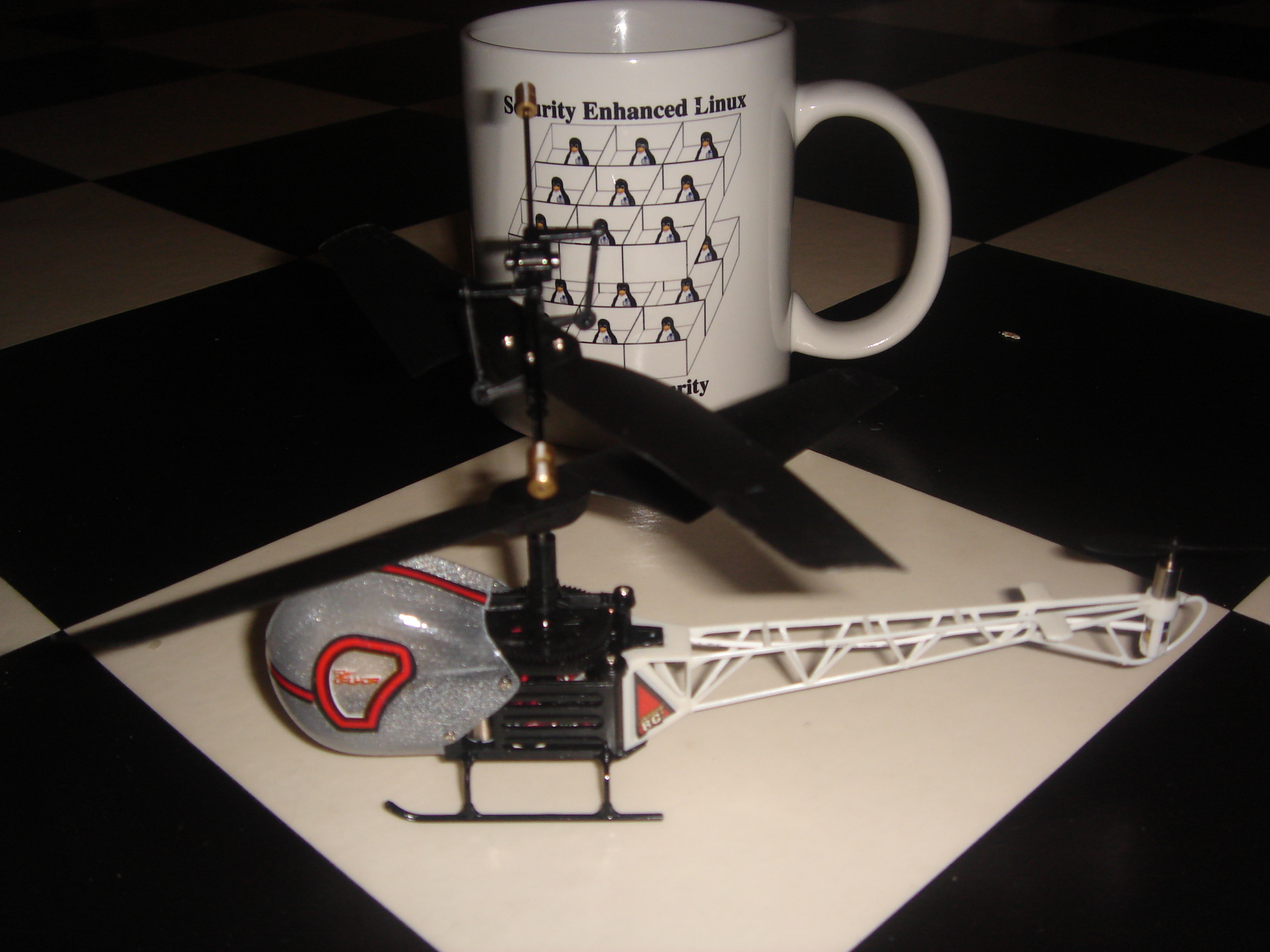
I have just bought myself a toy helicopter. I had been tempted to buy one for a while and when I saw them on sale for $30 I couldn’t resist. My helicopter is model FJ-702 from Flyor, it is controlled by infra-red and is designed for indoor use only. It seems that the trick to flying one is to control the rate of ascent and descent. If the helicopter rises too fast then it may bounce off the ceiling which results in it swaying uncontrollably and crash-landing. If it is allowed to descend too fast then it becomes impossible to slow the rate of descent, I suspect that this is the settling with power [2] problem that is documented in Wikipedia. The helicopter is very fragile, I broke one of the skids and part of the tail assembly before I learned how to control it properly. Probably the main thing to look for when buying a model helicopter is a solid design - some time after buying (and breaking) my helicopter I visited the shop which sold it and heard the owner advising other customers to buy the $45 model which is apparently more solid. It seems that an ideal design would be a frame made of spring-steel (not to make it springy but to avoid it breaking when it hits). I recommend flying in a room with a carpeted floor, bouncing off a solid surface such as a wood floor will break a helicopter. Controlling a helicopter is really difficult. The models that I have tried and seen demonstrated all have serious problems with unwanted rotation. My helicopter and the others I have seen have coaxial rotors to avoid rotation without a tail rotor. According to the Wikipedia page a lot of energy is used by a tail rotor [1], as there has been obvious difficulty in designing the helicopter with adequate power (in terms of the light and weak frame and the short battery life) it seems that they didn’t use the tail rotor design to save energy. It’s a pity that instead the designers couldn’t have skipped the flashing LEDs etc. One strange thing is that one pair of blades can have their angle changed (which appears to be similar to the “semirigid” design shown on the wikipedia page). I’m not sure how increasing the angle of one blade while simultaneously decreasing the angle of it’s pair will do any good. I expect that this has something to do with the fact that the helicopter will rotate at different rates when under different amounts of vertical thrust. This incidentally makes it almost impossible to maneuver the craft. It has a tail rotor on a vertical axis to control forward and reverse movements, but the extreme difficulty in keeping it facing in one direction makes this almost useless. I wonder what the minimum size at which a gyro-stabiliser becomes practical. But as Wikipedia doesn’t document the existence of an autopilot for full size helicopters the chance of getting one for a toy is small. In summary, while I have had $30 of fun, I think that a more solid helicopter would be a better investment.

10 December 2008

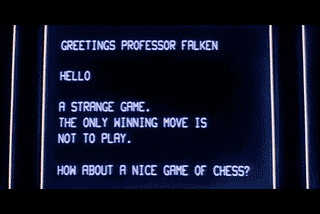
Biella Coleman: The Only Winning Move is Not To Play


nice-game-chess, originally uploaded by the biella.
Today I wrapped up both of my classes. Usually the end of class/semester represents and is experienced as nothing short of pure, unadulterated joy and at both ends of the stick (student and professors alike experience similar emotions :-). Like my students, I am pretty beat and more than ready for a break. But I have to admit, I experienced the end of my hacker class with a tinge of sadness. This is the third time I have taught this class and each time, it seems like it becomes harder and harder to contain the class conversation and I enjoy them through and through. The last few classes were brimming with talk, which is what should exactly happen because by the last month students are walking/talking on a foundation built over the course of many weeks. There is not much I would have changed about the syllabus (most of the readings were great-to-stellar) nor the class. But if there is one thing I am sorry about it is that we never watched War Games. The last time I taught the class, I was able to arrange various movie sessions and we watched War Games, Tron, and Sneakers (among a few others) and the students not only learned something about hacker media representations but did a little out-of-class bonding with the movies and lots of food. Since space is such an issue at NYU, I decided not to forage or hunt for a suitable room (I have since found a connection who I think can hook me up with a room). But by missing War Games, we missed an important event in the history of hackerdom. The movie undoubtedly led to many a kids asking for a modem for xmas and I am sure led to a spike in hacking and phreaking 9 months later (or however long it takes for a kid to plead for a modem, get it, learn some new tricks etc). It is also the case that while it helped usher in the image of the hacker as nefarious computer trickster, David Lightman was also a pretty cool, cute, and likable kid. Not a nerd but a geek. It perhaps represents the glimmerings of the transformation of the negative nerd into the positive geek (oh and the list keeps the list of girl geeks growing ), signaling the spread of the computer into mainstream society. So next time I teach the class, there will certainly be more movies, War Games on the top of the list so that we can learn that “the only winning move is not to play.”

Russell Coker: More about Australian Internet Censorship

As the Australian government wants to show how well they understand technology, they have started a blog about the “Digital Economy” [1]. So far they have hundreds of comments, most of which just tell them that their censorship ideas are wrong. In what may be related news, Barack Obama has announced details of some of his plans [2]. He will spend money on improving net access (something that the Australian government could learn from) and on improving schools (which will probably be about as effective as putting lipstick on a pig). I really hope that we don’t have someone in his administration deciding that improving schools requires censoring the Internet for the entire population (people tend to turn their brains off when it’s time to think about the children). He is also allocating money to road building (a stupid idea when cars are becoming increasingly expensive and world fuel supplies are running out - he should be building train and tram lines). But his idea about improving the energy efficiency of federal buildings is a really good idea, that will lead the development of technology that everyone can use to increase efficiency. He also wants to “modernise” the health-care system by moving to electronic medical records - this seems unlikely but I guess that all spending on IT is somehow good for those of us who are involved in the computer industry. One of his advisors has realised that there are economic benefits to really fixing the health-care system, so there is some hope that it will get fixed [3]. The FLOSS Manuals project has released a document about circumventing censorship systems [4], I expect that many people will be using them before the government even gets their Chinese-style filter installed (if they ever do).

Next.

Previous.