Search Results: "sto"

18 December 2008

Michal Čihař: Gammu stable version 1.22.0

After two and half months of development, new Gammu stable release is out. Since last testing version there are only minor changes in vCard export, but full changelog since 1.21.0 is quite long: You can download from usual place: http://cihar.com/gammu/, Binary packages will be available soon in all usual places (Debian Unstable, OpenSuse build service, Ubuntu PPA repository).

17 December 2008

Biella Coleman: Going, going (gone) Monastic


Not Ballistic, Monastic, originally uploaded by the biella.
Have you ever gone monastic, taken a step away from the rough tumble of life to throw yourself totally and completely in one or just a few things? I have been in this state a few times before, sometimes by my own volition, other times I was forced into such state, as when I spent nearly a year homebound, sick. The last time I went monastic, I did so to finish my dissertation in 2005 and it worked rather well. In fact, I recall those few months where I barely left home (and as result my PJs) with deep fondness. I just loved the intensity and simplicity of it all, which is why I loved my other periods of self-enforced solitude/simplicity and often yearn for those moments again. The pile of writing projects I am trying to complete (or start) are mounting and honestly, I want the pile to move from a mountain to at least a hill and in order to do so, I think I will have to retreat. So tonight, I declared that upon my return from PR, I will once again go monastic but given that I have a pretty demanding full time job, I can t really go full-on monastic. I can only go semi-monastic, shirking some of my extracurricular activities and duties but I still think that I can enter into a more seclusionary (I know not really a word) mode than has been my life for the last year. I will report back in a few months with a story of success or failure about entering Monastic Mode x

John Goerzen: More Wiki Annoyances

So today, I discovered that MoinMoin has an all or nothing attachment setting: either everyone with write permission to a page can upload attachments, or uploading attachments is disabled for the entire site. No exceptions. Period. Not only that, but there is no maximum attachment size setting unless the attachment was uploaded embedded in a ZIP file. How s that for irony? Not wanting to have my railroad site turn into a file trading site, I don t really want to let everyone upload attachments. Oh, also MoinMoin doesn t maintain a history of attachments. So if somebody drives by and vandalizes an attachment, you get to . restore the original version from tape. Yay? So I decided I d look back at MediaWiki, which has better attachment controls. I still had my test installation, so I went to use it. I edited the main page. I wanted to read about the markup, so I clicked the Editing help link. Whoops, broken link. It links to Help:Editing on the local wiki. Which MediaWiki does not install for you. I asked about it on #mediawiki. The answer was: copy from mediawiki.org. OK, fine. How? Cut and paste. Yes, that s right. Every time a new version of MediaWiki comes out, you get to cut and paste dozens of pages from mediawiki.org to your wiki, or else you ll have outdated help. Yay? The MediaWiki folks on IRC seem to like it this way. Not everyone wants the same help. Fine, but provide a sane default for those that don t care. Who thought running a wiki would be so hard? Update: since yesterday, I went to moinmo.in and fixed the ThemeMarket page to reflect what versions a MoinMoin theme works with. I m happy to help out with fixing Free Software though I don t really have time to add fundamental features like working syntax help links on this particular project.

Russ Allbery: Asking the wrong question

I'm posting way too much to debian-vote right now, which I realize and which I'm going to try to cut back on. (I at least did start the lintian.d.o upgrade process today, so I got non-discussion Debian work done.) The reason why I keep reacting, though, is that I'm finding it frustrating that people seem to be asking the wrong question for resolving the firmware freeness argument. We currently have a strong disagreement over what the implications of the Debian Social Contract and DFSG should be for our release process. Some Debian Developers believe that releasing lenny as-is requires a special exception to the Social Contract. Some Debian Developers believe that releasing lenny as-is is consistent with the Social Contract. We've tried and failed to achieve consensus. That's the first point of my frustration: some people don't seem willing to accept that this has happened. They are apparently having a hard time understanding how anyone couldn't agree with them, and are therefore repeatedly reopening the discussion on which we don't have consensus. Once it's clear that consensus doesn't exist, this is very counter-productive. The discussion is futile, which frustrates people, and then in that frustration they become increasingly angry and harsh. Once consensus fails, all interesting decision-making processes start. A decision-making process basically reduces to "who decides?". When you have a dispute and consensus is not possible, some body has to make a decision. If people believe in the decision-making process, they can then support, or at least live with, the decision because they respect the process, even if they disagree with that particular outcome. The most important output of a decision-making process is closure: you stop debating and move on. If that doesn't happen, the decision-making process has failed, even if it makes a decision. Why does this all matter and why am I going on at such length about it? It's simply this, which I think is so important I'll highlight it:
Even people who strongly disagree on some issues can work together cordially and well in the same project provided that they can agree on a decision-making process in those areas where they disagree.
Agreeing on how decisions are made in Debian is important because that's how we continue to work together when we disagree (and we will disagree). If we can agree on how disputes are resolved, we can all respect and honor the outcome even if it isn't what we would have wanted, and then move forward. If we don't agree on how disputes are resolved, we'll keep re-arguing them rather than accepting the outcome. The discussions will get more heated, more people will get upset, and more people will not have fun working on Debian. What I've been trying to analyze on debian-vote is the "who decides" part of this question. We have a decision-making process outlined in the Debian constitution for non-technical decisions (of which this is one). That process is somewhat scattered through the document, but bringing it together in one place, it seems to go like this:
  1. Developers are empowered to make decisions about their own work. That means that, according to the constitution, the primary people who get to decide how the SC and DFSG should apply are every Debian Developer in the tasks on which they're working.
  2. The project leader can define an area of ongoing responsibility and delegate to a developer or a group of developers responsibility for making decisions in that area. There are two relevant delegations here. The ftp team has the delegated authority to determine what packages may enter Debian given, among other things, licensing and DFSG issues. The release team has the delegated authority to decide what goes into the next stable release and when that release happens. (Let's put aside quibbles over whether or not that authority was formally delegated; I think that we can all agree in practice that it's close enough.) The ftp team has accepted the relevant firmware packages into Debian main and hence have made a decision in their area of responsibility. The release team, through the lenny-ignore tag, has decided that the relevant packages can be part of the next release. Those are delegate decisions that have already been made, and neither of those teams seem to want to change their mind.
  3. The final decision-making body in this case, therefore, is the developers at large, who can override any delegate decision via a GR. That's what Robert Millan proposed, although he doesn't seem to have realized he was doing that, and it's not marked as such on the ballot.
Now that this has happened, we all vote whether or not to override the delegate decision. The only option on the ballot that does so, by my reading, is the first one, so if the first option does not win the GR, the delegate decision is not overridden and both the ftp-master and release team decisions stand. This is why Further Discussion means we continue the release as previously planned. We have a decision-making process, which has been followed, and the current decision is to release including those packages. In order to change that decision, it has to be overridden. A result of Further Discussion on a GR means that GR does nothing, and hence the decision stands. The second point of frustration is the decision that option four on the ballot (delegate to the release team the power to make decisions about how DFSG issues affect what is included in the release) needs a 3:1 majority. They have already been delegated the authority to do that as part of their delegated authority to manage the release. The effect of option four on the project is therefore identical to Further Discussion; the only difference is whether we make a positive statement or fail to make a negative statement. It makes no sense to treat it as supersession of a foundation document when it just supports the existing decision-making process in the constitution. A third point of frustration is the apparent feeling that foundation documents like the DFSG are outside of the normal decision-making process described in the constitution. I can find no evidence of this in the constitution, but more fundamentally, the people arguing this are not stating what decision-making process they believe does apply other than "my view of the DFSG is obviously the only reasonable one and hence you should follow it." This reduces to a plea for consensus, which we've already established that we don't have, and hence, as mentioned above, is horribly unproductive to keep raising. There will never be a policy document that is so clear that everyone will agree on its implications in every situation. I find it much more useful to analyze governance processes by looking at who decides disputes rather than looking at position statements. The decision-making process is what will determine the outcome of all the really interesting cases.

16 December 2008

John Goerzen: Wiki Software

I used to run a website for traveling by rail in the United States. I let it falter, and eventually took it down. But I still have the domain, and am working to bring it back as a wiki. The first step in that process was selecting which wiki software to use. I have a few requirements for the site: I m frustrated that there is no wiki out there that does all of these. There are quite a few that do all but one, but which one they omit varies. My two finalists were MoinMoin and MediaWiki. MoinMoin MoinMoin will let you easily define arbitrary categories (by creating a wiki page following a certain name). The search screen automatically presents checkboxes for restricting searches to a particular category. Some reviews have complained about its anti-spam features, but they are all talking about older versions and they seem to have done some work on this lately. MoinMoin has tons of features and is easy to set up and maintain. But here s where it falls down: themes. Over at moinmo.in, there is a theme market for themes. Only most of the themes there haven t been compatible with the current MoinMoin release since about 2005. Most of the rest have one download, then a long discussion page full of mixed bug reports, diffs, and non-diff edit this to make it work comments. Most of these don t state what version of the theme they apply to. Most themes won t work with current browsers and Moin releases without them. UGH. After discussing on #moin, I ll probably go in there and at least organize the ThemeMarket page by release. MediaWiki Then there s MediaWiki. It s got a lot of features, and a lot of complexity. It has no current WYSIWYG feature, though apparently there is work on one. MediaWiki has an amazing category system. It can generate sorted lists of pages in a category, supports subcategories, etc. Surprisingly, though, you can t search in just one category. (Though it might be possible indirectly via some syntax; not sure.) Searching in MediaWiki overall is less capable that in MoinMoin. MediaWiki does offer namespaces, and namespaces are the sole way of searching just one part of a site. They re used well over at, say, uesp.net. But namespaces are heavy-handed. You have to edit config files to define them, and they bring with them other associated namespaces for discussion and whatnot. It s not as easy as creating a category in MoinMoin, and might not scale well to lots of future categories. MediaWiki does appear to have good spam prevention, and support recaptcha. Conclusions I eventually selected MoinMoin and have set up most of my content in it. But now that I am to the point of selecting themes, I m having some second thoughts. I also looked at DokuWiki. Its design makes me nervous. The user list is stored in a single file. You can t search by category. You can search by namespace, but there aren t checkboxes for it in the search screen; you have to know the syntax. WYSIWYG is a plugin. Categories are a plugin. So too many plugins to maintain, and no real features above MoinMoin.

Neil Williams: Emdebian Grip - Debian, only 25% smaller

I'm pleased to make Emdebian Grip unstable available - a smaller, binary-compatible, Debian without manpages, without unwanted translation files (uses Emdebian TDebs) and without package documentation. The current packages will be migrated into Emdebian Grip testing in due course and then be released alongside Lenny.
Emdebian now has two flavours with Grip taking the intermediate position in terms of size whilst retaining full compatibility with Debian. Grip "cherry-picks" packages from Debian but retains the unchanged Debian sources - the main binary and library packages will exist but -dev, -doc and -dbg packages may well be missing, as well as some of the more unusual OR dependencies).
I've just converted my Acer Aspire1 (i386) - running XFCE - from Debian Lenny to Emdebian Grip:
607 upgraded, 1 newly installed, 2 to remove and 0 not upgraded.
Need to get 184MB of archives.
After this operation, 278MB disk space will be freed.

Yes, update 600 packages and have nearly 300Mb more free space - that's a 400Kb space saving per package, on average. Gaining 90Mb more free space than the total size of the download is nice too. Comparisons are after using 'sudo apt-get clean' to remove downloaded archives:
Debian Lenny:
/dev/sda1 7.1G 1.2G 5.6G 17% /
Emdebian Grip (unstable)
/dev/sda1 7.1G 919M 5.8G 14% /

I make that about 25% smaller and not all packages installed on the machine have been "gripped" - (about 100 remain, many of which I should probably remove anyway).
Method: See http://www.emdebian.org/grip/index.html.
Add the Grip source to /etc/apt/sources.list.d/
deb http://buildd.emdebian.org/grip/ unstable main
$ sudo apt-get update
$ sudo apt-get install grip-config

This is a very important stage - Emdebian Grip is still in development and with the Lenny freeze, a few wrappers and helpers are needed to allow smooth migrations between Debian and Emdebian - grip-config is Architecture:all and contains the relevant scripts. (grip-config is Priority: required so debootstrap picks it up by default - this also means that grip-config cannot be part of Debian.) grip-config also includes the same key as the emdebian-archive-keyring package used by all Emdebian repositories.
Only after grip-config is installed should you use:
$ sudo apt-get dist-upgrade
Note that this is a complete replacement, including libc6, apt, coreutils, dpkg and (on i386) the stock kernel. As such, it can take a while to complete the installation once the download is complete. (As ever, if the kernel is updated, ensure you reboot before you next suspend to disk - even the minimal "gripping" changes to the kernel package may confuse grub when deciding whether to use the suspended image.)
A few packages are currently behind Debian Sid (notably ncurses) and I'm working on the scripts to enable full update automation.
One other problem is that /usr/share/locale/locale.alias has also disappeared which compromises localisation support right now but that's fairly easy to fix. (langupdate is also missing so there is no effective localisation support right now - I need to cross-build langupdate for the grip architectures.)
Note that this test install adds the Emdebian Grip repository to the existing Debian sources and relies on the em[0-9] version suffix to implement the upgrade - packages that are behind Debian get left at the Debian versions, you can also use normal pinning.
$ apt-cache policy
Package files:
100 /var/lib/dpkg/status
release a=now
500 http://buildd.emdebian.org unstable/main Packages
release v=0.1,o=Debian,a=sid,l=EmdebianGrip,c=main
origin buildd.emdebian.org
500 http://ftp.uk.debian.org sid/main Packages
release o=Debian,a=unstable,l=Debian,c=main
origin ftp.uk.debian.org
Pinned packages:

I've done some testing with debootstrap and a chroot works too - it should be possible to ally these packages with the normal Debian installer because there is no point "gripping" udebs that are already v.small and the packages that actually get installed are dictated by your choice of mirror. debian-live should be gaining support for Emdebian Grip in due course.
If someone fancies trying a test installation by choosing http://buildd.emdebian.org/grip as their mirror in d-i, let me know. ;-)
(Installing Grip is likely to result in further size gains as the Grip repository data does not support Recommends, so you don't have to try and get d-i to not use recommended packages).
Emdebian Grip (unstable) is now available for 7 architectures:
i386, amd64, arm, armel, mips, mipsel and powerpc.
(amd64 is only supported for debugging purposes, most of my development machines are amd64.)
Please report any and all bugs to the buildd.emdebian.org pseudo-package in the Debian BTS.
If you want more packages added, set up a Debian machine or chroot with all the packages you need (and only the ones you need) and send the
complete output of 'dpkg --get-selections' to the debian-embedded mailing list. Alternatively, file RFP bugs against buildd.emdebian.org at wishlist severity.
To see the current list of packages, use the search support
Headline packages:
coreutils, perl, python, apt, dpkg, grip-config, XFCE, debhelper, make, devscripts, sylpheed, iceweasel, drivel, xchat-gnome, gpe-tetris,
totem-gstreamer, liferea, thunar, evince, seahorse, gthumb, libsqlite3, pilot-link, python-gnome2, lua, tcl, gcc-4.3, binutils, libmysqlclient15off.
Currently, very few -dev packages exist in Grip. I'll make the emdebian-grip package available on Grip itself in due course so that new and bespoke packages can also be "gripped".
I'm migrating the current packages to Emdebian Grip testing soon and I'll be making a release of Emdebian Grip 1.0 (based on Debian 5.0 "Lenny") as well as Emdebian Crush 1.0 (based on Debian 5.0 "Lenny"), alongside the main Lenny release.
Finally, note that Grip is binary compatible with Debian - indeed, the binaries themselves are untouched - but bugs that appear in Emdebian Grip must only be filed against the buildd.emdebian.org pseudo-package. Right now, reportbug is not part of Emdebian Grip because I need a way of telling reportbug to only use the pseudo-package.
The main usability improvements will come in the development of Emdebian 2.0 (based on Debian 6.0 "Squeeze") - please consider Emdebian 1.0 as a "developer release", think back to what things were like with Slackware 1.0 or Debian buzz, rex or bo.
P.S. there is no concept of a release-critical bug in Emdebian Grip (at least, not yet) - the 1.0 release will happen as soon as Grip testing is in sync with the released Lenny (no matter what). Please do not file any bugs against buildd.emdebian.org with higher severity than important, it will just annoy people trying to fix RC bugs in Lenny.
If you are a maintainer in Debian and you inadvertently receive a bug report listed as 'found' in a version that ends in em[0-9], please reassign to buildd.emdebian.org, at severity no higher than important. Thanks.

Biella Coleman: Speaking of the Tactile/Tactical


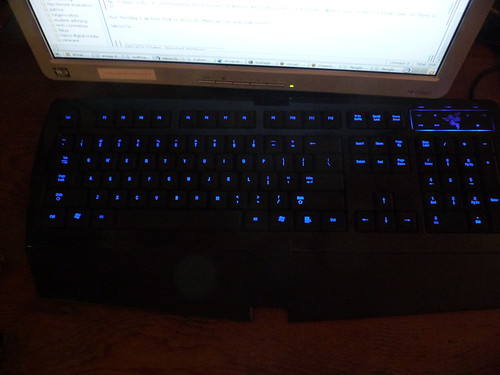
razer my new keyboard, which i LOVE, originally uploaded by the biella.
Speaking of the tactile and the tactical, after seeking some input, I settled on this keyboard a few months ago and I simply love it so much so, today I got another one for my office. I love the key strokes simply cuz they have just the right feel. It takes some, but not too much, pressure to type and it feels great on my finger tips. The fancy blue lighting is a plus but not a central feature. The overview/description on their website is pretty dramatic but I tend to agree it provides for some pretty hefty power, allowing me to launch my email assaults with perfection :

With an awesome host of features, the Razer Lycosa is on an unstoppable mission to destroy and dominate. Execute complex combat maneuvers with swift dexterity. Launch your assaults timed to perfection. Annihilate your enemies and reign supreme on the battlefield. You now have the tactical advantage on every terrain, and your enemies fates are in your hands.
<
I dare say I am fully content with the keyboard but I am still searching, however, for the perfect pen

Rapha&#235;l Hertzog: Dell Latitude E4300 with Debian

So I replaced my Latitude D410 with a shiny new Latitude E4300 (Intel Core 2 Duo SP9400 2.4 Ghz with 4 Gb RAM). Here are some notes about this laptop that might be interesting for others. SSD disk I now use an SSD drive for my main disk (Dell Ultra Performance SSD, it s the second generation of Samsung SSD) and I m satisfied with that choice, I can boot (an unmodified Debian desktop install) from the SSD in less than 30 seconds while the same system booting from a traditional hard-disk takes more than 45 seconds. X server The Intel GM45 graphic card is not auto-recognized by Xorg 7.3 (or rather by xserver-xorg-video-intel 2.3.2 which is in lenny) so you end up with the vesa driver by default. It s possible to force the usage of the intel driver by adding a Driver intel line in the device section of xorg.conf but I have opted to use Xorg 7.4 (available in experimental). With this version, I can successfully use the DVI output in the associated dock and I have working suspend/resume. It does create some interesting problems however since that version of the xserver relies on HAL to detect the keyboard layout and doesn t use the Keyboard section of xorg.conf. You have to create /etc/hal/fdi/policy/10-keymap.fdi by using /usr/share/hal/fdi/policy/10osvendor/10-keymap.fdi as template and reload HAL then restart X. Wifi support The Intel 5100 Wifi chipset requires Linux 2.6.27 at least for the new iwlagn driver. This driver also needs a new firmware (the iwlwifi-5000 one) that is not yet integrated in the non-free package firmware-iwlwifi (see #497717). Sound support It works ok with alsa and the version integrated in linux 2.6.27 but it still has some rough edges when used in combination with the dock. Using the output jack connector on the dock doesn t stop the output in the integrated loudspeakers and the volume on that connector is so low that you could think that it doesn t work at all if you don t pay attention. Using the microphone works fine. For reference, if you play in the mixer, Front mic means the microphone connected on the dock while Mic means the one connected on the laptop. Each Analog loopback X option goes pairwise with the corresponding Input source X setting. In order for the recording to work, I have to set Digital Input Source to Analog Input , Digital must be activated and Input source 1 defines the default input used for the recording. Bluetooth support Contrary to the previous laptop, Dell offered no choice on the bluetooth chipset, they only propose the Dell 365 Bluetooth Card so I took it but it doesn t seem to work out of the box. In fact I can t even see it with lspci or lsusb so I wonder if they did something wrong during the assembly. Googling on the topic didn t gave me any good result, let me a comment if you know how to get this working. Update: so apparently the bluetooth component is there (ID 0a5c:4500 Broadcom Corp.), it just appears as an USB hub so it s somewhat difficult to guess that it s effectively a bluetooth card. Freezes, in particular with an amd64 installation I first installed the system in 64 bits mode (amd64 architecture) but I had very regular freezes of the system (I couldn t finish a single kernel compilation for example). Since I switched to an i386 installation, the system is more stable but I still get an occasional freeze every other day. It might be that a more recent kernel fixes this or maybe it will be fixed with a future Dell Bios update we ll see, but it s my biggest complaint with this laptop so far. Links Lucas Nussbaum bought the same laptop, you might want to read his remarks as well. More details Load the full article only if you want to see the lspci and lsusb output on this laptop.


rhertzog@rivendell:~$ lspci -nnk
00:00.0 Host bridge [0600]: Intel Corporation Mobile 4 Series Chipset Memory Controller Hub [8086:2a40] (rev 07)
Kernel driver in use: agpgart-intel
Kernel modules: intel-agp
00:02.0 VGA compatible controller [0300]: Intel Corporation Mobile 4 Series Chipset Integrated Graphics Controller [8086:2a42] (rev 07)
00:02.1 Display controller [0380]: Intel Corporation Mobile 4 Series Chipset Integrated Graphics Controller [8086:2a43] (rev 07)
00:19.0 Ethernet controller [0200]: Intel Corporation 82567LM Gigabit Network Connection [8086:10f5] (rev 03)
Kernel driver in use: e1000e
Kernel modules: e1000e
00:1a.0 USB Controller [0c03]: Intel Corporation 82801I (ICH9 Family) USB UHCI Controller #4 [8086:2937] (rev 03)
Kernel driver in use: uhci_hcd
Kernel modules: uhci-hcd
00:1a.1 USB Controller [0c03]: Intel Corporation 82801I (ICH9 Family) USB UHCI Controller #5 [8086:2938] (rev 03)
Kernel driver in use: uhci_hcd
Kernel modules: uhci-hcd
00:1a.2 USB Controller [0c03]: Intel Corporation 82801I (ICH9 Family) USB UHCI Controller #6 [8086:2939] (rev 03)
Kernel driver in use: uhci_hcd
Kernel modules: uhci-hcd
00:1a.7 USB Controller [0c03]: Intel Corporation 82801I (ICH9 Family) USB2 EHCI Controller #2 [8086:293c] (rev 03)
Kernel driver in use: ehci_hcd
Kernel modules: ehci-hcd
00:1b.0 Audio device [0403]: Intel Corporation 82801I (ICH9 Family) HD Audio Controller [8086:293e] (rev 03)
Kernel driver in use: HDA Intel
Kernel modules: snd-hda-intel
00:1c.0 PCI bridge [0604]: Intel Corporation 82801I (ICH9 Family) PCI Express Port 1 [8086:2940] (rev 03)
Kernel driver in use: pcieport-driver
Kernel modules: shpchp
00:1c.1 PCI bridge [0604]: Intel Corporation 82801I (ICH9 Family) PCI Express Port 2 [8086:2942] (rev 03)
Kernel driver in use: pcieport-driver
Kernel modules: shpchp
00:1c.3 PCI bridge [0604]: Intel Corporation 82801I (ICH9 Family) PCI Express Port 4 [8086:2946] (rev 03)
Kernel driver in use: pcieport-driver
Kernel modules: shpchp
00:1d.0 USB Controller [0c03]: Intel Corporation 82801I (ICH9 Family) USB UHCI Controller #1 [8086:2934] (rev 03)
Kernel driver in use: uhci_hcd
Kernel modules: uhci-hcd
00:1d.1 USB Controller [0c03]: Intel Corporation 82801I (ICH9 Family) USB UHCI Controller #2 [8086:2935] (rev 03)
Kernel driver in use: uhci_hcd
Kernel modules: uhci-hcd
00:1d.2 USB Controller [0c03]: Intel Corporation 82801I (ICH9 Family) USB UHCI Controller #3 [8086:2936] (rev 03)
Kernel driver in use: uhci_hcd
Kernel modules: uhci-hcd
00:1d.7 USB Controller [0c03]: Intel Corporation 82801I (ICH9 Family) USB2 EHCI Controller #1 [8086:293a] (rev 03)
Kernel driver in use: ehci_hcd
Kernel modules: ehci-hcd
00:1e.0 PCI bridge [0604]: Intel Corporation 82801 Mobile PCI Bridge [8086:2448] (rev 93)
00:1f.0 ISA bridge [0601]: Intel Corporation ICH9M-E LPC Interface Controller [8086:2917] (rev 03)
00:1f.2 RAID bus controller [0104]: Intel Corporation Mobile 82801 SATA RAID Controller [8086:282a] (rev 03)
Kernel driver in use: ahci
Kernel modules: ahci
00:1f.3 SMBus [0c05]: Intel Corporation 82801I (ICH9 Family) SMBus Controller [8086:2930] (rev 03)
Kernel driver in use: i801_smbus
Kernel modules: i2c-i801
02:01.0 FireWire (IEEE 1394) [0c00]: Ricoh Co Ltd R5C832 IEEE 1394 Controller [1180:0832] (rev 05)
Kernel driver in use: firewire_ohci
Kernel modules: firewire-ohci
02:01.1 SD Host controller [0805]: Ricoh Co Ltd R5C822 SD/SDIO/MMC/MS/MSPro Host Adapter [1180:0822] (rev 22)
02:01.2 System peripheral [0880]: Ricoh Co Ltd R5C843 MMC Host Controller [1180:0843] (rev 12)
0c:00.0 Network controller [0280]: Intel Corporation Wireless WiFi Link 5100 [8086:4232]
Kernel driver in use: iwlagn
Kernel modules: iwlagn
$ lsusb
Bus 008 Device 001: ID 1d6b:0002 Linux Foundation 2.0 root hub
Bus 007 Device 001: ID 1d6b:0001 Linux Foundation 1.1 root hub
Bus 006 Device 001: ID 1d6b:0001 Linux Foundation 1.1 root hub
Bus 004 Device 019: ID 046d:c03d Logitech, Inc. M-BT69a Pilot Optical Mouse
Bus 004 Device 018: ID 0424:2228 Standard Microsystems Corp. 9-in-2 Card Reader
Bus 004 Device 017: ID 0424:2602 Standard Microsystems Corp.
Bus 004 Device 016: ID 0424:2502 Standard Microsystems Corp.
Bus 004 Device 007: ID 045e:00dd Microsoft Corp.
Bus 004 Device 006: ID 0c45:63fe Microdia
Bus 004 Device 004: ID 413c:2513 Dell Computer Corp.
Bus 004 Device 003: ID 413c:2513 Dell Computer Corp.
Bus 004 Device 001: ID 1d6b:0002 Linux Foundation 2.0 root hub
Bus 002 Device 001: ID 1d6b:0001 Linux Foundation 1.1 root hub
Bus 001 Device 005: ID 413c:8162 Dell Computer Corp.
Bus 001 Device 004: ID 413c:8161 Dell Computer Corp.
Bus 001 Device 003: ID 0a5c:4500 Broadcom Corp.
Bus 001 Device 001: ID 1d6b:0001 Linux Foundation 1.1 root hub
Bus 003 Device 002: ID 0a5c:5800 Broadcom Corp.
Bus 003 Device 001: ID 1d6b:0001 Linux Foundation 1.1 root hub
Bus 005 Device 001: ID 1d6b:0001 Linux Foundation 1.1 root hub
Partagez cet article / Share This

Lucas Nussbaum: membership status results

So, in the Membership Status GR, we sent a clear message that we wanted those decisions to be postponed. Now, we have a responsibility to prove that we were not just rejecting any change, but that our vote was really a vote against the way those decisions were announced, and/or those particular decisions. I m convinced that our management of membership needs to be improved. I hope that in the next weeks/months, we will be able to discuss proposals about membership status. There s Joerg s, there s Lars , there s Raphael s, and there might be other ideas. Ideally, each of them would be discussed and improved separately (because we can t be expected to agree on one proposal right from the start), and finally we would get to vote on a coherent set of proposals (with an unbiaised ballot ;) to choose in which direction we want to change our management of membership. It would be great to use the DEP process or something similar for that. It is also interesting to compare this whole story with our current issue: a secretary that ignored valid criticism about a ballot and went on with asking to vote on it. In both cases, someone that is generally trusted and respected by the project made a mistake, and failed to acknowledge it, requiring strong actions from other DDs. I wonder how the secretary crisis will end

15 December 2008

Anand Kumria: I told you so Exetel.

I use exetel for a number of services in Sydney. I have always found them to be the cheapest, even if their ability to support their service is sub-optimal. An example is right now, they are currently totally offline.
a2@eve:~$ dig +trace exetel.com.au
; <<>> DiG 9.5.0-P2 <<>> +trace exetel.com.au
;; global options:  printcmd
.           338458  IN  NS  G.ROOT-SERVERS.NET.
.           338458  IN  NS  H.ROOT-SERVERS.NET.
.           338458  IN  NS  I.ROOT-SERVERS.NET.
.           338458  IN  NS  J.ROOT-SERVERS.NET.
.           338458  IN  NS  K.ROOT-SERVERS.NET.
.           338458  IN  NS  L.ROOT-SERVERS.NET.
.           338458  IN  NS  M.ROOT-SERVERS.NET.
.           338458  IN  NS  A.ROOT-SERVERS.NET.
.           338458  IN  NS  B.ROOT-SERVERS.NET.
.           338458  IN  NS  C.ROOT-SERVERS.NET.
.           338458  IN  NS  D.ROOT-SERVERS.NET.
.           338458  IN  NS  E.ROOT-SERVERS.NET.
.           338458  IN  NS  F.ROOT-SERVERS.NET.
;; Received 228 bytes from 192.168.1.1#53(192.168.1.1) in 58 ms
au.         172800  IN  NS  ADNS2.BERKELEY.EDU.
au.         172800  IN  NS  AUDNS.OPTUS.NET.
au.         172800  IN  NS  NS1.AUDNS.NET.au.
au.         172800  IN  NS  NS2.AUDNS.NET.au.
au.         172800  IN  NS  DNS1.TELSTRA.NET.
au.         172800  IN  NS  SEC1.APNIC.NET.
au.         172800  IN  NS  SEC3.APNIC.NET.
au.         172800  IN  NS  ADNS1.BERKELEY.EDU.
;; Received 413 bytes from 2001:503:ba3e::2:30#53(A.ROOT-SERVERS.NET) in 620 ms
com.au.         259200  IN  NS  ns1.ausregistry.net.au.
com.au.         259200  IN  NS  ns2.ausregistry.net.au.
com.au.         259200  IN  NS  ns3.ausregistry.net.au.
com.au.         259200  IN  NS  ns3.melbourneit.com.
com.au.         259200  IN  NS  ns4.ausregistry.net.au.
com.au.         259200  IN  NS  dns1.telstra.net.
com.au.         259200  IN  NS  au2ld.CSIRO.au.
com.au.         259200  IN  NS  audns.optus.net.
com.au.         259200  IN  NS  ns1.audns.net.au.
;; Received 354 bytes from 2001:dc0:2001:a:4608::59#53(SEC1.APNIC.NET) in 1302 ms
exetel.com.au.      3600    IN  NS  ns2.exetel.com.au.
exetel.com.au.      3600    IN  NS  ns1.exetel.com.au.
;; Received 99 bytes from 128.242.113.189#53(ns3.ausregistry.net.au) in 193 ms
dig: couldn't get address for 'ns2.exetel.com.au': not found
This is something I reported (ticket #853640) to them around Oct 2008 (when they last had a failure), that the auDA has no in-balliwick glue for their DNS. I was told by their support supervisor, Dylan Friedewald, via email:
The DNS for helpdesk.exetel.com.au is operational and valid, I do not see the point in discussing that further.
It is interesting to note that Steve Waddington has blogged many times about customers being unable to identify issues, but it is even more interesting that when a customer does it is explicitly denied as being a problem and then ignored. Apart from no in-ballwick DNS glue, their nameservers are also open recursive ones. Great if you would like to perform a DoS attack against some unsuspecting person. I have raised other issues with them that warrant further investigation and corrective action, lest they affect all their customers. But I no longer have the time to continually ping them about things.

Miriam Ruiz: How to win online debates

From How to win online debates, by Adam Graham: You won t really influence the direction of what people think on a given issue. The prize is the satisfaction that you won the debate. You beat that guy. You showed him who was right! Congratz! As the author of the article says, quoting the film War Games: A strange game. The only winning move is not to play.

Sven Mueller: another vote

Well, following some other posts on Planet debian, I decided to also publish my vote on the GR regarding Firmware blobs in Debian. Here is my vote:
V: 7112113
In other words, I rank the first option as low as possible (7, below further discussion), ranked all options I think make sense above further discussion (which is at rank 3) and put all other options (except for the one empowering the release team to decide the issue) at the same, highest rank. The option empowering is ranked at the second level. My priority really is to get Lenny released. While I think we should do as much as we can removing non-free stuff from Debian, I really don t think it is sensible to delay Lenny because of this. Lenny has far less non-free bits in it than Etch, and I m also not really sure wether I really want to consider firmware (which doesn t run on the CPU Debian is for) as software in the sense of the DFSG. The reasoning here is that I don t see any difference between a hardware manufacturer A who embeds a (non-free) firmware in the hardware (for example in the sense of storing it in a flashable memory) and a hardware manufacturer B who allows us to distribute the firmware blob (and avoids storing it in the hardware). In my opinion, both are equally (non-)free. And following this, I don t see why we should support hardware created by A natively while not directly supporting hardware made by B. One could of course argue that we are providing more of a service for B (as we are distributing the firmware for them, while they save some money otherwise spent for the flash memory), but I would like to remind everyone that our foundation documents also include the following: Our priorities are our users and free software This puts free software and our users at the same level. So to cater for one, we might have to make sacrifices on the other priority. In my opinion, the best compromise here is to not consider firmware blobs as software in the sense of the DFSG, but alternatively, I would accept saying we want to remove all such firmware from Debian, but not to delay Lenny because of this process. Additionally, we should make it easy for users to add all effected drivers/firmwares before/during installation of a system (or even include them on our installation media as some proposed, with a short question to the user wether he wants those firmware blobs to be installed). Apart from my opinion on the subject itself, I must also mention my concerns about how this vote was written in a very manipulative way. Additionally, those wanting to get Lenny released were proposing too many different options. This is generally a bad idea.

Ingo Juergensmann: Voting

I've not followed the current voting closely, because I was moving from Berlin back to Rostock last weekeend. But I find it strange that the issue with firmwares is still not solved since Etch.

That's more than two years ago and within these two years nobody cared to solve the firmware blob issue. This leads me to the conclusion: nobody cares about unfree firmware in Debian except there is a release upcoming and then some people start shouting "UNFREE FIRMWARES!!! That's against the social contract!"

So, when it's against the SC, why hasn't this issues been resolved in the last two years? Apparently noone cared enough and therefore it's not that important to stop the current release, IMHO.
My point of view is: firmware blobs are part of the hardware and not some sort software that needs to be free. Of course it's nice if firmware blobs are actually free and open. But the alternative would be hardware with real ROMs that either can't be updated (because they're soldered onto the board) or, if they're socketed, extra costs because you'll need to buy ROM updates and exchange your little ROM chip by a newer version.

I prefer to have firmware blobs released with lenny soon, but maybe I'm missing some points...

MJ Ray: British Residential ISP Censorship News

Last week I reported that 95% of British Residential ISPs Censor - but I think I m OK, so I d like to quickly update on what I ve seen happen since then:-

14 December 2008

Biella Coleman: Thinking Responsibily about the Drugs among Us

Next semester I am teaching a new undergraduate course tentatively titled Technology, Society, and Media: The Body under Transition, in Movement, and under (Massive) Transformation(s). As designed, the course should address technology and media in fairly broad stokes (which I do) but I narrow and control what is a truly unwieldy subject by framing the issues/readings in relation to the human body. Generally speaking, we will interrogate the ways in which technology engenders or erases bodily/human possibilities/capacities and especially the ethical and political ramifications that precipitate from the use/abuse of technology. We traverse a wide range of topics from the telegraph (and how it was used to speak with the dead) to the role of human enhancement technologies of today, to questions of surveillance and privacy, among many other topics. I am pretty far along with the syllabus and pretty happy with it. So far I think I have struck a nice balance between fun/light/accessible readings and some which are bit more theoretically dense. I am still looking for one or two pieces, perhaps one on tattoos and body modification and another about karaoke. If anyone knows any great articles on these topics, do pass along the information. I am probably most excited about the cluster of issues that address eugenics (and most students know next to nothing about America s central role in unleashing the Eugenics movement), disability rights activism, human enhancement technologies, and transhumanism. Considering human enhancement in light of previous efforts to enhance our population brings into relief the similar and distinct ethical issues that haunt this field. One of the most hot button issues of today concern the use of human enhancing drugs. The prestigious journal Nature has just published an editorial on the topic of cognitive enhancement drugs,Towards responsible use of cognitive-enhancing drugs by the healthy, which is a fairly interesting read and covers some of the main controversies. For me, however, the interesting issue is not only whether human enhancement is right or wrong though this is certainly important but what our embrace of these drugs tell us about the conditions under which our bodies live and labor. That is, I think we are actually missing out on posing some other important questions simply by framing this int terms of human enhancement. I suspect, and this is where ethnography would really help out, that many people turning to enhancement drugs may not be medically sick, in the technical sense but I don t think they are healthy either. Many who turn to these drugs feel pretty worn, pretty exhausted, pretty frazzled (the perfect word, I think, is agotado, Spanish for exhausted) and use these drugs as crutches, as band-aids, as an elixir to help out one preserver in tough work circumstances. I am sure there are folks who take these drugs feel fine and are just trying to push their limits and capacities but I troll many many many patient support sites and it also seems to me that many people live under a state of low-grade chronic state of unwellness. Given the pace of society, given what and how we eat, given the extraordinary rates of depression in our society ,given the fact that babies are born with 200 + chemicals in their bodies (what a way to start out life) I am skeptical that enhancement really captures what is going on with these drugs. I have not yet come up with the right term, but I am trying to come up with a phrase that would reflect the ways in which these drugs are not used as therapies for a discrete condition (Type 1 diabetes) but how they are a collective response to a state of low grade chronic unwellness that seems to mark the lives of a whole lot of people. This, I think, would be one responsible approach to human enhancement technologies that would contextualize their use within a much broader frame, one that is attuned to how bodies have been made, remade, and limited under actual material conditions of labor and life in the 21st century.

Wouter Verhelst: -lgnodbify-gtk

A while back, I wrote about this GObject-based Object/Relational mapper that I wrote, which is called 'GNoDbify'. It isn't complete yet, but parts of the library work; I use it for a project that I'm supposed to commercially support. For those who don't know what that is: an O/R mapper builds objects out of database tuples; so I can run a 'lookup' function on the object class and get one (or more) objects representing data from the database, then perform some modifications on that object, and store it back in the database; my O/R mapper does all the SQL magic. Last week, I've been working on another object that takes an array of GNoDbify objects, and presents them using the GtkTreeModel interface, for easy viewing in a GtkTreeView:

my @customers = Vpbs::Db::Customer->get_all();
my $model = GNoDbify::ListStore->new_from_array(@customers);
my $view = Gtk2::TreeView->new_with_model($model);
my $renderer = Gtk2::CellRendererText->new();
my $column = Gtk2::TreeViewColumn->new_with_attributes("Name", $renderer, "text", $model->get_column("name"));
$view->append_column($column);
And there you have it: a treeview showing all the names of all the customers in the database. On the classical approach, one would have to use DBI or some such to fetch data from the database, create a GtkListStore or something similar, and then append the data one row at a time to that. Of course that still happens here, in a manner of speaking, but it all happens behind the scenes. It also means that in an application which wants to show a load of data, I don't have to do the same thing all the time. The magic happens in the second line, and in the second-to-last line. GNoDbify::ListStore->new_from_array is pretty much self-explanatory, really. It takes an array of GNoDbify objects, and returns a GNoDbify::ListStore. The second-to-last line shows how to add a column to a GtkTreeView. With GtkListStore and GtkTreeStore you basically define yourself what column gets what number; however, with GNoDbify, that isn't as easy (it depends on the implementation of the GNoDbify subclass), so the ->get_column returns the number of a column as represented by the model, and wants the name of the field that you want the column of. Everything else is really the same. It won't stop here, though. The original plan for GNoDbify was that it could detect changes in the database, and update the tree model accordingly. Most of that has already been implemented in GNoDbify (though not yet in the ListStore thing), but just needs some debugging. The fun thing is, the above six lines of code would not have to change at all for that. Of course all this juicyness comes at a price. In order to generalize this much, I had to do a lot of extra stuff; so there's some performance loss. Especially in perl; most of GNoDbify is written in C, and converting perl arrays to and from C arrays is a process that can only be done by looping over the perl array (or the C array) and creating the other side of the equation. Obviously, that's a costly approach, performance-wise; an obvious optimization of the above example could be to have a subroutine that returns Customer objects already in a GtkTreeView in one API call. We'll see.

Neil Williams: A Debian morning

A variety of Debian tasks all lined up in the top priority - get it done now or not at all - work queue this morning. Two GR's, one RC bug fix and one long overdue experimental upload.
All I'm saying about the first GR (the "anti-ganeff" vote) is 2212. That was the most ridiculous GR I've come across so far, until vote3 which is just politics gone insane. My own opinion? 7235146 which disagrees quite a lot with bubulle even though I have the same aims as bubulle - that alone indicates the nature of the vote. The options are illogical, the vote is pointless, the subject matter is moot, the initial proposal doesn't have any understanding or relation to the real world and the amendments have been unnecessarily divided in such a way to make it all but impossible to be logical in the vote priorities. The abuse of votes by a vocal minority undermines the process itself. All in all, we desperately need an option that basically says stop being pathetic and get something useful done in all future GR's - as well as making it harder to make a GR in the first place. Over use of referenda is as poisonous to democracy as under use - just ask Ireland.
After all that political spin and muck spreading, I had to just do something useful as a partial compensation. So, after a ping from the MIT BSP I've fixed 507316.
I've also made the tslib experimental upload that has been quietly developing on my own system for a few days.
Right, now I'm getting back to adding more packages to Emdebian Grip - so far, we have enough packages for a basic XFCE/Gtk system with an email client, a blog client, a few GPE games and Thunar as file manager. Now need to add iceweasel and dependencies. Once that is done, I'll be switching my Acer Aspire1 from Debian Lenny to Emdebian Grip unstable and creating a testing repository for Grip. Once I've got some figures from that switch, I'll post some more details to debian-embedded@lists.debian.org.
Sigh. Emdebian Grip was meant to go alongside Debian Squeeze - it looks now as if Emdebian Grip will be released before Debian Lenny - it's even likely to use the Lenny installer and debian-live support. I hope the pedants are happy because I'm not.

13 December 2008

Christian Perrier: GR about firmware and strategy about releasing

I am somewhat under the feeling that the Debian project is currently facing a critical moment of its history. The development momentum has slowed down a lot during last months (approximately since Debconf and even more since October. I feel just like we're facing a moment where either we release Lenny (which is technically a great progress over Etch and, being a little bit more than 18 months after Etch, well suited wrt "modernity")....or we delay it for several months and will suffer more and more from the long freeze process (remember sarge). The momentum is then very likely to continue moving elsewhere (should I say Ubuntu or did everybody understand already?). And now we have to vote about firmware blobs, a proposal that popped up because a few (*very* few) vocal folks who (in my opinion) live on a planet that has no connection with the real world, think that we should triple check the freeness of each and every bit that is likely to be run on a Debian machine. Moreover, the proposal is worded and was pushed in a way that all (but one) options that would allow us to release lenny will need a 3:1 majority, which is obviously very hard to achieve (and as, there are several such proposals, the vote will be spread out among all of them). So, those folks who make the release of lenny their priority are now facing an interesting tactical choice: how the ..... should we vote for this to happen? I personnally did choose to vote this way: 5462371. Yes, I ranked "reaffirm the Social Contract" after everything, which makes me sad....and I blame the play on words by the zealots who pushed that proposal for forcing me to do this. I think this is the best "tactical" choice for those (and I hope we are a strong majority) who still make the *release* of the best possible and most possibly free operating system their priority. Believe me or not: if we don't release lenny soon, we will die slowly and rot peacefully. We will rot being 150% free and proud to be 150% free on our little planet, outside the solar system and the real world. *This* is the choice we are facing. Ah, and before I forget: film at 11, of course. PS: no comment system on my blog (I don't want to deal with spam and put complicated systems there). Please comment in public in your own blog. I very much prefer this over private comments which will be mostly ignored.

Gunnar Wolf: Startups here and there

David Welgon has a nice post regarding his opinions on pros and cons on running a startup in Europe (Italy) and the USA (SF/Bay area). The first of the Italy cons got my attention:
Less of a startup culture and mentality. It's more typical to get a "job for life" and hang on to it for all you're worth. Many Italians are tremendously creative, industrious, inventive people, but are going to find it more difficult to express that in some form of business.
I know I am unlike many people, specially in this field... But anyway. I live in Mexico. Many factors in The Way Things Work are pushing people towards having an enterpeneur mentality - And what you see as a point against, I see as a very big advantage.
Some people have what it takes to run a business, and that's great. However, I think it is wrong to assume most people will benefit from running their own business - And specially in a country as mine. I cannot speak much about Europe, but from what you say, it confirms it is a good model of what I'd like Mexico to morph into.
Too many people start their companies with dreams of glory, thinking they have something to differentiate from the rest of the marketplace - and they lack it. So instead of enriching an existing company with more, and better focused, technical talent, they will end up making it poorer with yet another generic company with nothing new to offer, paying famelic wages to their employees, finding a way to skip the social security payments. And there are lots of legal ways to do so in Mexico - and a growing segment of the population has neither health care nor retirement savings, as this makes their day-to-day incomes substantially more juicy... But the future will bite them hard. Well, not only them - It will bite all of us. I still think we will inevitably, sooner or later, evolve into a more caring society, a society where the strong protects the weak, where it (via the State, the government) ensures nobody has under the minimum needed to have a decent life.
And, although I am essentialy a Socialist at heart, I do recognize there is place for people getting more money than others - After all, courage and creativity should be encouraged, and true enterpeneurs should get compensed for what they give to the society - But the ridiculous, stupid differences we get to see, specially in third world countries (remember that the world's richest man, Carlos Slim, lives on the same city I do, and around ~15 years ago even lived less than five blocks away from me... But I do have close family where having food daily on the table is far from a fact) are something that should disappear for good.
Loyalty to your employer and long-term job commitment are two values I hold very dear, and hope to be able to practice. So far, I have worked for eight years for UNAM (1999-2003 and 2005-present), and I hope to continue here for many years to come. I was just talking about this with a friend - The payment itself is far less than what I could get somewhere else, but the work conditions and long-term viability are more than enough to repay for the difference. And I am sure many of my friends and acquintances would be much better off if they stopped prioritizing getting more money now in respect to leading a better, richer life - And, of course, if we all valued more giving back to the society, as we will probably all need to ask from it sooner or later.

Tiago Bortoletto Vaz: BrDesktop is back


well, at least its website :) Since we got Trac 0.11 into Lenny, our great green theme has been broken. So this weekend I decided to spend some time migrating the old stuff to a Genshi template and adapting it for Trac 0.11. Fortunately it worked. Credits go to Skittlish Trac theme, the one BrDesktop s comes from. BrDesktop is a Debian Pure Blend* intended to give Brazilian desktop users an easier way of joining the Debian community.

* thanks very much to Andreas Tille for insisting on changing the former (and inadequate) Custom Debian Distribution term. Most important, thanks to Holger Levsen for being strongly opposed to the Andreas DISh suggestion! :)
Posted in english

Next.

Previous.