John Goerzen: Rudy Schmidt & Time Capsules
This evening, I arrived at church for mens chorus practice. I was surprised to see this sign on the door:
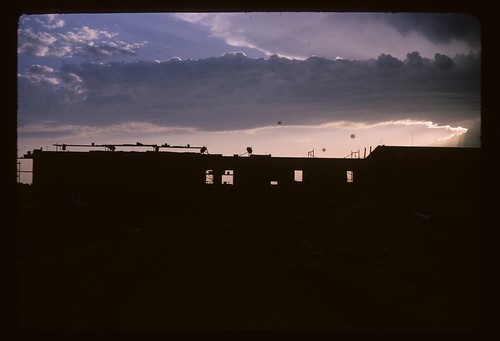
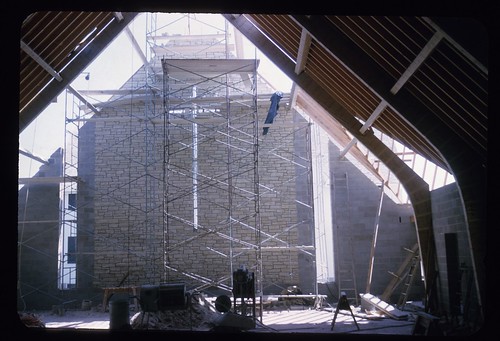
 I and a few others went to his home one time a few years ago and we had a wonderful evening. Rudy shared all sorts of stories with us which I am happy to say I recorded. But moreover, Rudy was an avid photographer. There were some rare and brilliant color slides of the church being built in his collection. He let me borrow and scan some of them. Here are my two favorites:
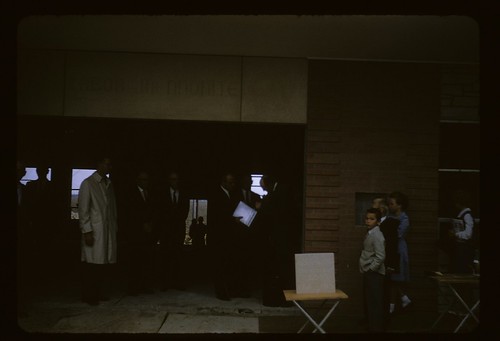
 Back in 1965, there was a ceremony at the setting of the cornerstone of Tabor Church. The people at the time assembled some papers and memorabilia and put them in a time capsule. Rudy Schmidt sealed the capsule and it was placed in the spot for it behind the cornerstone. Here is a photo of that ceremony.
 44 years later, on the occasion of Tabor s centennial, it was time to open the time capsule. The other building committee people, such as Jake Koehn, had passed away, so Rudy was the one to open it. He gave a few words in front of the large crowd, and mentioned that when he sealed it away, he smelled some smoke when he soldered it shut. Jake Koehn told him, Don t worry, nobody will ever see it again anyway and they had a little laugh about it. Now he was going to open it up and see if anything survived.
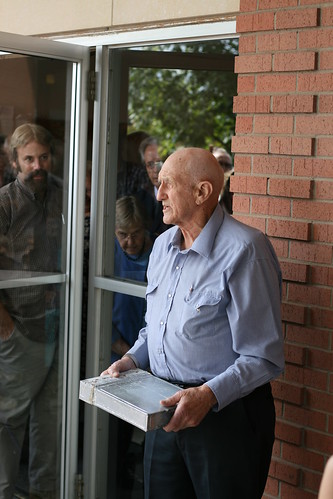 It all did just a few minor burn marks. We enjoyed looking at all the items. Then the church placed some new items into the capsule. It was closed up again, to be opened in maybe 50 years.
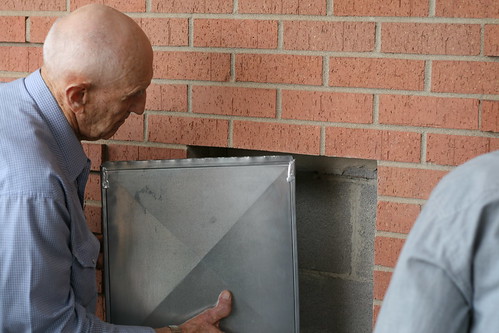
With luck, I ll still be around to see it opened again. Even if I m not, maybe Jacob and Oliver will be able to. And so it seems very fitting that the last hands to touch that box for the next 50 years were Rudy Schmidt s, when he placed it back in its spot on Oct. 12, 2008.
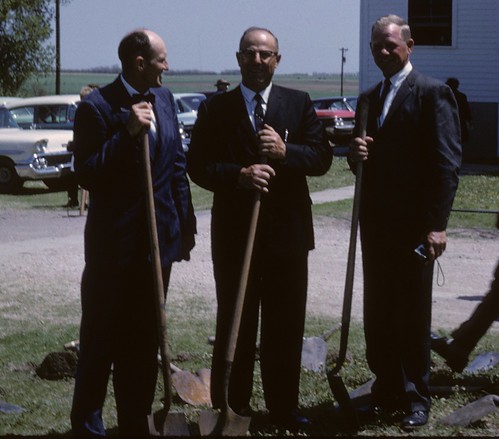
Rudy Schmidt died rather unexpectedly, but peacefully on Wednesday morning at his home .One of the benefits of living in a small community is that I get to know people of all ages around here. Not just people my own age, or coworkers. A few years ago, I worked on a history project for our church s centennial. Back in the 1960s, Rudy was one of the people in charge of building our current church. So he was a person I was interested in visiting with. Here he is, on the left, during the 1964 groundbreaking ceremony for the new building (the old one is visible in the background).
I and a few others went to his home one time a few years ago and we had a wonderful evening. Rudy shared all sorts of stories with us which I am happy to say I recorded. But moreover, Rudy was an avid photographer. There were some rare and brilliant color slides of the church being built in his collection. He let me borrow and scan some of them. Here are my two favorites:
Back in 1965, there was a ceremony at the setting of the cornerstone of Tabor Church. The people at the time assembled some papers and memorabilia and put them in a time capsule. Rudy Schmidt sealed the capsule and it was placed in the spot for it behind the cornerstone. Here is a photo of that ceremony.
44 years later, on the occasion of Tabor s centennial, it was time to open the time capsule. The other building committee people, such as Jake Koehn, had passed away, so Rudy was the one to open it. He gave a few words in front of the large crowd, and mentioned that when he sealed it away, he smelled some smoke when he soldered it shut. Jake Koehn told him, Don t worry, nobody will ever see it again anyway and they had a little laugh about it. Now he was going to open it up and see if anything survived.
It all did just a few minor burn marks. We enjoyed looking at all the items. Then the church placed some new items into the capsule. It was closed up again, to be opened in maybe 50 years.
With luck, I ll still be around to see it opened again. Even if I m not, maybe Jacob and Oliver will be able to. And so it seems very fitting that the last hands to touch that box for the next 50 years were Rudy Schmidt s, when he placed it back in its spot on Oct. 12, 2008.

 Three thousand lines of code is not a huge program, but it is enough
to get a pretty good feel for a language. Now that I've completed my
 A couple of month ago, my step-father-in-law encountered quite some
problems with the Windows installation on his Notebook and therefore
showed a great interest in
 In the past, I ve helped customers run native Windows applications using emulation (wine) and/or virtualization, and in few cases, native support for C# by open source projects such as Mono. But, as it s been said, there are great benefits of having source code, and I recently worked around an issue in Mono by recompiling a whole .NET project in Debian.
So here s a brief guide reviewing the issues that I found and how I solved each one of them leading to a natively-compiled C# application that runs seamlessly in Debian and Windows, and please remember I m not a C#/.NET/Mono developer:
 I use
 The

 Sunday. A good day to take some time to myself, and get some much needed excercise. And the pseudo-meditation that comes with it: That's one of the factors I love the most about cycling. It's possibly my favorite way of just idling, of allowing for the time to pass without me noticing, just watching the movie of life, watching the world go around me with very little effort. I just love cycling.
I have posted here several mentions of the Ciclot n: Every month, the last Sunday, our city government closes a ~32Km circuit to make it for cycling (and skating, and walking, and jogging, and other human-powered locomotion) use. Whenever I am in the city and have the possibility, I do the Ciclot n. Two months ago, I even did it twice in a row, for a total of almost 70Km.
But this Sunday was not the last Sunday of the month! So, why am I writing this? Well, because when I left home today at ~10AM, I thought it was. Only when I reached Circuito Interior and had a this is full of cars moment, I remembered October has 31 days. And next Sunday I'll very probably be in Oaxaca city (for the
 Kanzepharaz of the one thousand and eight spires. Kanzepharaz capital of the Empire of K'thorv and since the succesful end to the war that led to the annihilation of the Pleiadic Oligarchy in K'threl, the richest and most splendid city in the Middle World. Kanzepheraz whose real estate prices have soared e'en beyond the calculation of the rainbow abacus of Thobis Himself.
Anathomelis, a princeling of the Imperial Clan needs a location for his new and expanded orgy dome. Yet the only available and affordable on a seventh rank civil allowance place left in the city of one thousand and eight spires is the tomb of Pharaz the First and Subsequent, lich-emperor of the Jerelite dynasty and his eldritch retainers. Before the construction-serfs can move in, the tomb must be cleared of its unshriven and non-rent-paying denizens.
As His Principalities' chief swordbearer it has fallen to you to make the tomb of Pharaz safe for gentrification. Treasures and honors await you if you succeed. Aeons of torment in the Planes of Unlife await you if you fail.
 Two weeks ago,
 Dear Gnome people. Is there a reliable way to right-attach panel applets?
May laptop screen and my external monitor have different resolutions, and I
havn't found a reliable way (except making two panels) of getting some of my
applets to stick to the right. I usually keep my launchers on the left, while
vairous system status icons on the right part. But when switching to a higher
resolution, at most one will move to the right end of the panel at the new
resolition, while the others just stay in place (i.e. left-attached at a given
pixel position).
There are so many smart layout managers, GTK pretty much always uses flexible
layout managers, why is the Gnome panel relying pixel offsets?
It has been suggested to me a couple of times that I could achieve this
via gconf. However, since the gconf changes are not reflected at runtime but
frequently overwritten I did not get this to work reliably even just for two
applets.
Thank you. If you have any comments, please email me via

 While I have spent countless hours working on the new source format known as 3.0 (quilt) , I ve just realized that I have never blogged about its features and the reasons that lead me to work on it. Let s fix this.
The good old 1.0 format
Up to 2008, dpkg-source was only able to cope with a single source format (now named 1.0 ). That format was used since the inception of the project. While it worked fine for most cases, it suffered from a number of limitations mainly because it stored the Debian packaging files as a patch to apply on top of the upstream source tarball.
This patch can have two functions: creating the required files in the debian sub-directory and applying changes to the upstream sources. Over time, if the maintainer made several modifications to the upstream source code, they would end up entangled (and undocumented) in this single patch. In order to solve this problem, patch systems were created (dpatch, quilt, simple-patchsys, dbs, ) and many maintainers started using them. Each implementation is slightly different but the basic principle is always the same: store the upstream changes as multiple patches in the


 For some time now, we ve been gearing up to begin development on Ubuntu 11.04. While some folks have been putting the finishing touches on the 10.10 release, and bootstrapping the infrastructure for 11.04, others have been meeting with Canonical stakeholders, coordinating


 Debian NYC will be holding a workshop next week: