Search Results: "tar"

15 October 2010

Erich Schubert: Google Chrome rendering issues

If you are (like I do) experiencing issues with Google Chrome, in particular when it comes to applications such as Google Maps, try using the --disable-accelerated-compositing option.For me, the issues started with version 6.0 and resulted in various pages hanging at random, in particular graphics-heavy sites such as maps. For one of my own sites, markers started disappearing on maps at certain zoom levels. Only when it also occurred on the main Google Maps I stopped looking for bugs in my own site and started focusing on the browser ...

Gerfried Fuchs: Open Source Projectmanagement

I wrote the following as a foreword for the great German book Open Source Projektmanagement that Michael Prokop wrote. Unfortunately the foreword didn't manage it in time into the book because of various circumstances. As I'm not a person to throw away already written material, here is it for your reading pleasure. Maybe it makes you consider obtaining a copy of the German language book for yourself!
The Whole is more than the Sum of the Parts When I first met Mika at a Linux conference some years ago I quickly noticed that he had potential. The way he asked questions and tackled issues did impress me. We did meet again at various events, joined forces in various projects and knew that the result would be good. Back in the year 2004 the only real live CD was Knoppix. It always was too sluggish for me because I never really liked KDE and also OpenOffice.org was too bloated for me. I was working since a year at an Internet provider, felt comfortable in the shell and was missing the tools on Knoppix which I used daily. Often enough the frustration with the status quo starts the best projects. And so I had the idea spinning around to start a sysadmin live CD. There was just one problem here: Exactly at the same time Mika had already started such a project. And I knew one thing: it would had been a lost race to compete with him in creating the better live CD. So I joined his team and helped with the best of my knowledge. The name choice alone showed that he was the right person for the job: Grml an expression of the frustration that even he felt which spoke directly to the heart of so many. But it wasn't just the chosen name that showed that Mika was the right person for the job of the project leader. It's always the sum of the parts, no matter how minor they might look. He quickly managed a first release and in light of that also created an event which was fitting for the release of the first version: the OS04 an Open Source event which managed to get Jon Maddog Hall as keynote speaker. Mika managed through his welcoming way to lure more people into helping out. The team grew over the years, further regular releases increased the fan base, not only through the creative release names which are surely one of the parts that helped create the success. He always was open to suggestions for new tools that helped to extend the project. The lived openness did lead among other things to the case that other live CDs started to use the grml build system. JUXlala 2.0 (the system for preschool kids) is just one example. Why do I write primarily about Grml, one could get subliminal advertising probably cheaper? I do it because Grml is an extremely good example of the experience revealed in this book. And even though every project is different, it is still exactly the sum of the parts that leads to the success of a project. And exactly these parts are covered in this book and can be considered for the project at hand and get implemented accordingly. Good luck whether in large or small.
Rhonda

/debian permanent link Comments: 0 Flattr this

Dirk Eddelbuettel: Rcpp 0.8.7

With the scheduled R release of version 2.12.0 this morning, we have just uploaded version 0.8.7 of Rcpp to CRAN; Debian will follow shortly once the autobuilders have processed R 2.12.0 This Rcpp release depends on R 2.12.0 as two things have changed. First, we play along with change in R concerning the ordering of inheritance for time classes. But secondly, and more importantly, we support in Rcpp the corresponding change R itself which brings the new ReferenceClasses. Here is corresponding bit from R's NEWS file for R 2.12.0:
    o A facility for defining reference-based S4 classes (in the OOP
      style of Java, C++, etc.) has been added experimentally to
      package methods; see ?ReferenceClasses.
[...]
    o An experimental new programming model has been added to package
      methods for reference (OOP-style) classes and methods.  See
      ?ReferenceClasses.
This was made possible in large part by code committed by John Chambers (whom we had welcomed recently as a co-author to Rcpp) building on the changes he made to R 2.12.0 itself, as well on the work Romain had done with 'Rcpp Modules'. The R help page for ReferenceClasses carries a reference (bad pun) to Rcpp 0.8.7 so these two releases do go together. This should be a lot of fun over the next little while: S3, S4, and now ReferenceClasses. We also made a number of internal changes some of which leads to speed-ups and internal improvement. The NEWS entry follows below:
0.8.7   2010-10-15
    o   As of this version, Rcpp depends on R 2.12 or greater as it interfaces 
        the new reference classes (see below) and also reflects the POSIXt class
        reordering both of which appeared with R version 2.12.0
    o   new Rcpp::Reference class, that allows internal manipulation of R 2.12.0
        reference classes. The class exposes a constructor that takes the name
        of the target reference class and a field(string) method that implements
        the proxy pattern to get/set reference fields using callbacks to the 
        R operators "$" and "$<-" in order to preserve the R-level encapsulation
    o   the R side of the preceding item allows methods to be written
        in R as per ?ReferenceClasses, accessing fields by name and
        assigning them using "<<-".  Classes extracted from modules
        are R reference classes.  They can be subclassed in R, and/or R methods
        can be defined using the $methods(...) mechanism.
    o   internal performance improvements for Rcpp sugar as well as an added
        'noNA()' wrapper to omit tests for NA values -- see the included
        examples in inst/examples/convolveBenchmarks for the speedups
    o   more internal performance gains with Functions and Environments
As always, even fuller details are in Rcpp Changelog page and the Rcpp page which also leads to the downloads, the browseable doxygen docs and zip files of doxygen output for the standard formats. A local directory has source and documentation too. Questions, comments etc should go to the rcpp-devel mailing list off the R-Forge page

14 October 2010

Russ Allbery: pkg-config and Autoconf

Five different people asked or commented, in reply to my previous journal post about pkg-config files, why I didn't just have Autoconf generate the pkg-config configuration file directly. One could use the same template that I proposed in the previous post, but rather than adding the sed fragment to Makefile.am, instead add libfoo.pc to AC_CONFIG_FILES and let configure and config.status generate it directly. This is simpler, but it has two problems: I therefore prefer this approach, even though it's a bit more complex. I think it's more robust against both unusual ways in which people want to build my source packages and any future changes to Autoconf. Note, for example, that it's possible and sometimes useful to configure a package with a command like:
    ./configure --libdir='$ datadir '
(admittedly, more common to do that the other way arond) but that would fail with a pkg-config configuration file generated directly from Autoconf unless I'd anticipated that usage and added both datadir and datarootdir to the pkg-config template even though I wasn't using either. I've updated my build system coding style page to include this rationale.

Axel Beckert: Thoughts on Gitorious and GitHub plus a useful git hook

When I took over the developement of xen-tools, I looked around for an appropriate git hosting. I especially had a look at GitHub and Gitorious. If you just regard the features, GitHub is definitely more targetted on single developers and Gitorious more towards projects: At GitHub, every repository has its URL under the URL of a user page which makes it nearly impossible to have user independent, official repositories for projects which have more than one official developer. At Gitorious, every hosted repository needs to belong to a project, even if it s only a published configuration. But a project can have more than one git repository. You only seem to be able to have personal repositories if you clone some existing Gitorious repository. So from a feature point of view, the xen-tools git repositories fit way better to Gitorious hosting while the git repositories with zshrc, conkerorrc and desktop configuration files defintely have a more fitting addresses on GitHub, in my case http://github.com/xtaran/$repository. On Gitorious, they are now together under a project called Axel s configuration files at http://gitorious.org/abe which contains git repositories of my on grml s .zshrc based .zshrc, my configuration for Conkeror and all the files necessary for my ratpoison/xmobar based netbook/laptop desktop. I though feel a little bad for giving the project the very short slug name abe instead of abe-config (as I did initially) since abe is IMHO not a proper project name for my configuration files and possibly other projects would have a more reasonable claim for that project name on Gitorious. But that way it suites more its purpose: Gather some of my git repositories which don t belong to a proper project. But there s another important point when comparing Gitorious and GitHub: Free Software needs free tools as Benjamin Mako Hill posted recently on Planet Debian. Despite my (probably well known) distrust against Google and therefore also Google Code, and despite knowing the history of SourceForge becoming non-free, I was not that much aware that GitHub s software is only partially open source and therefore also not free software while Gitorious is both as it s licensed under the GNU Affero General Public License (like StatusNet/identi.ca for example) which is basically GPLv3, but its ideas applied to hosted web applications scenario (where the GPL itself doesn t grasp), too. Initially I just had the xen-tools git repositories on Gitorious and all my small one-repository projects as copies of the repositories on my own git server on GitHub to get some more publicity for them and allow social cloning . After reading Mako s article, I decided to at least have repository clones on Gitorious of all repositories I mirror at GitHub, too. That way I force nobody to use the non-free tools on GitHub for social cloning one of my git repositories. And of course I have copies of my code somewhere on the net as backup. Or to say it with Linus Torvalds (slightly updated) words: Only wimps use tape backup: real men just upload their important stuff on git, and let the rest of the world clone it. ;-) But isn t that tedious to always push your code to three repositories? No, it isn t. I just push my code to git.noone.org where I have configured the according remotes and the following post-receive hook:
#!/bin/sh
                                                                     
read oldrev newrev refname
git push gitorious $ refname:t 
git push github $ refname:t 
The only other thing necessary is to use ssh-agent and SSH agent forwarding to at least the host you re pushing to.

Rapha&#235;l Hertzog: Correctly renaming a conffile in Debian package maintainer scripts

After having dealt with the removal of obsolete conffiles, I ll now explain what you should do when a configuration file managed by dpkg must be renamed. The problem Let s suppose that version 1.2 of the software stopped providing /etc/foo.conf. Instead it provides /etc/bar.conf because the configuration file got renamed. If you do nothing special, the new conffile will be installed with the default configuration, and the old one will stay around. Any customization made by the administrator are lost in the process (in fact they are not lost, they are still in foo.conf but they are unused). Of course, you could do mv /etc/foo.conf /etc/bar.conf in the pre-installation script. But that s not satisfactory: it will generate a spurious conffile prompt that the end-user will not understand. The solution In the preinst script, you have to verify if the old conffile has been modified by the administrator. If yes, you want to keep the file around. Otherwise you know you will be able to ditch it once the upgrade is over, and you rename it to /etc/foo.conf.dpkg-remove to remember this fact. In the postinst script, you remove /etc/foo.conf.dpkg-remove. If the old conffile (/etc/foo.conf) still exists, it s because it was modified by the administrator. You make a backup of the new conffile in /etc/bar.conf.dpkg-dist and rename the old one into /etc/bar.conf. In the postrm, when called to abort an upgrade, you move /etc/foo.conf.dpkg-remove back to its original name. In practice, use dpkg-maintscript-helper dpkg-maintscript-helper can automate all those tasks. You just have to put the following snippet in the maintainer scripts (postinst, postrm, preinst):
if dpkg-maintscript-helper supports mv_conffile 2>/dev/null; then
    dpkg-maintscript-helper mv_conffile /etc/foo.conf /etc/bar.conf 1.1-3 -- "$@"
fi
In this example, I assumed that version 1.1-3 was the last version of the package that contained /etc/foo.conf (i.e. the last version released before 1.2-1 was packaged). You can avoid the preliminary test if you pre-depend on dpkg (>= 1.15.7.2) or if enough time has passed to assume that everybody has a newer version anyway. You can learn all the details in dpkg-maintscript-helper s manual page. Found it useful? Be sure to not miss other packaging tips (or lessons), click here to subscribe to my free newsletter and get new articles by email (just check Send me blog updates ).
Flattr this Share/Bookmark No comment Support my work

Jonathan Wiltshire: Dear CSI and other hi-tech television producers

Please stop perpetuating the myth that any old grainy image can be enhanced beyond all recognition. It s not possible to read a newspaper at a thousand paces any more than it is to see around corners, even with a Really Big Computer. Every time one of my users brings me a photo and asks, can you make it really detailed like they do in CSI , I die a little inside. Love and kisses.
Comments flattr this!

Russell Coker: Links October 2010

Bruce Schneier wrote an insightful post about why designing products for wiretapping is a bad idea [1]. It seems that large parts of the Internet will be easy to tap (for both governments and criminals) in the near future unless something is done. The bad results of criminal use will outweigh any benefits of government use. Sam Watkins wrote an informative post about Android security [2]. Among other things any application can read all stored data including all photos, that s got to be a problem for anyone who photographs themself naked Rebecca Saxe gave an interesting TED talk about how brains make moral judgements [3]. Somehow she managed to speak about the Theory of Mind without mentioning Autism once. The Guardian has an amusing article by Cory Doctorow about security policies in banks [4]. He advocates promoting statistical literacy (or at least not promoting a lack of it) as a sound government policy. He also suggests allowing regulators to fine banks that get it wrong. Steven Johnson gave an interesting TED talk about Where Good Ideas Come From [5]. It s a bit slow at the start but gets good at the end. Adam Grosser gave an interesting TED talk about a fridge that was designed for use in Africa [6]. The core of the Absorption Refrigerator is designed to be heated in a pot of water in a cooking fire and it can then keep food cool for 12 hours. It s a pity that they couldn t design it to work on solar power to avoid the fuel use for the cooking fire. Josh Silver gave an interesting TED talk about liquid filled spectacles [7]. The glasses are shipped with a syringe filled with liquid at each side that is used to inflate the lenses to the desired refractive index. The wearer can just adjust the syringes until they get to the right magnification, as there are separate syringes the glasses work well with people who s eyes aren t identical (which is most people). Once the syringes are at the right spots the user can tighten some screws to prevent further transfer of liquid and cut the syringes off to give glasses that aren t overly heavy but which can t be adjusted any more, I guess that a natural extension to this would be to allow the syringes to be re-attached so that the user could adjust them every year to match declining vision. One thing that this wouldn t do is counter for Astigmatism (where the lens of the eye doesn t focus light to a point), but I guess they could make lenses to deal with a few common varieties of Astigmatism so that most people who have that problem can get a reasonable approximation. The current best effort is to make the glasses cost $19, which is 19 days salary for some of the poorest people in the world. Glasses in Australia cost up to $650 for a pair (or a more common cost of $200 or about $100 after Medicare) which would be about one day s salary. Eben Bayer gave an inspiring TED talk about one of the ways that mushrooms can save the planet [8]. He has designed molds that can be filled with Pasteurised organic waste (seed husks etc) and then seeded with fungal spores. The fungus then grows mycelium (thin fungal root fibers) through the organic waste making it into a solid structure which fits the shape of the mold. This is currently being used to replace poly-styrene foam for packaging and can apparently be used for making tiles that are fire retardant and sound proof for constructing buildings. The main benefits of the material are that it can be cheaply made without petrochemicals and that it is bio-degradable, I m not sure how the bio-degradable part would work with constructing buildings maybe they would just replace the panels every few years. Annie Lennox gave a TED talk about her Sing foundation to care for women and children who are affected by AIDS [9]. She describes the effect of AIDS in Africa as Genocide. Robert Ballard gave a very informative TED talk about exploring the oceans [10]. This was one of the most informative TED talks I ve seen and Robert is also one of the most enthusiastic speakers I ve seen, it s really worth watching! We really need more money spent on exploring the oceans. Jessa Gamble gave an interesting TED talk which suggests that the best thing to do is to go to bed at about sunset and then have a couple of hours of relaxing time during the middle of the night [11]. Apparently the subjects of body-block experiments who live for a month in a bunker without natural light or access to a clock get better sleep in this manner than they ever had in their life and feel fully awake for the first time. World Changing is a blog that has a lot of interesting articles about climate change and related issues [12]. It s worth a read. Cynthia Schneider gave an interesting TED talk about how reality competition TV is affecting reality [13]. Shows that are derived from the American Idol concept are driving a resurgence in some traditional forms of performance art while also promoting equality among other things it s apparent that winning is more important than misogyny. The Ritual of the Calling of an Engineer is an interesting concept [14]. I think it would be good to have something similar for Computer Science. Benjamin Mako Hill wrote an interesting and insightful essay about Piracy and Free Software [15].

Russ Allbery: pkg-config Generation

A little while back, as part of a discussion on debian-devel, I spent some time bad-mouthing pkg-config, and then later realized (with the help of an IRC conversation) that I was doing so unfairly. So as penance here is some documentation for how to add a pkg-config configuration file to a typical Automake project. This information is also in my build system coding style and will be maintained there (so if you see this some time after I wrote it, check that page for more up-to-date information). pkg-config is a tool to provide the flags required to compile or link against a shared library. It's a replacement for complex Autoconf probes and for all of the incompatible and occasionally buggy *-config scripts. To install a pkg-config configuration file, provide a template pkg-config configuration in a file named after the library but with a .pc.in extension. Here is an example:
    prefix=@prefix@
    exec_prefix=@exec_prefix@
    includedir=@includedir@
    libdir=@libdir@
    Name: <library>
    Description: <short description>
    URL: <upstream url>
    Version: @PACKAGE_VERSION@
    Cflags: -I$ includedir 
    Libs: -L$ libdir  -l<library>
    Libs.private: @KRB5_LDFLAGS@ @KRB5_LIBS@
Replace <library> with the official name of the library (which isn't necessarily the library name with lib removed). This is only informational, may contain spaces, and isn't used to locate the file. Its filename is used for that. Replace <short description> with a short description of the purpose of the library. Often the short description of the package from the start of the README file works well here. Replace <upstream url> with the URL of the package's distribution page. Normally, all Cflags needs to contain is what's indicated above, which lets the compiler find the header files if installed in a non-standard location. For Libs, note that pkg-config distinguishes between the shared libraries that must be linked against on a system with proper transitive dependency support and the libraries that must be linked for a static build or on a system with poor support for shared libraries. For a well-designed shared library, one should rarely need anything in Libs other than what's listed above. Libs.private, on the other hand, needs all the LDFLAGS and LIBS of everything the library itself links with external to this package. In this example, the shared library is linked with the Kerberos libraries and therefore needs the Kerberos LDFLAGS and LIBS; modify as needed for your example. If the dependencies of the shared library also use pkg-config, just list the other pkg-config file names in Requires or Requires.private instead of using Libs or Libs.private for them. Finally, add the Automake code to build and install the pkg-config configuration file. It should look like this:
    pkgconfigdir = $(libdir)/pkgconfig
    nodist_pkgconfig_DATA = lib/libfoo.pc
    lib/libfoo.pc: $(srcdir)/lib/libfoo.pc.in
            sed -e 's![@]prefix[@]!$(prefix)!g' \
                -e 's![@]exec_prefix[@]!$(exec_prefix)!g' \
                -e 's![@]includedir[@]!$(includedir)!g' \
                -e 's![@]libdir[@]!$(libdir)!g' \
                -e 's![@]PACKAGE_VERSION[@]!$(PACKAGE_VERSION)!g' \
                -e 's![@]KRB5_LDFLAGS[@]!$(KRB5_LDFLAGS)!g' \
                -e 's![@]KRB5_LIBS[@]!$(KRB5_LIBS)!g' \
                $(srcdir)/lib/libfoo.pc.in > $@
Replace libfoo with the actual name of the library and change its path in the source package as needed. Note the pattern above and use it for any Autoconf substitution variables that you need to replace in the pkg-config template. The above example adds KRB5_LDFLAGS and KRB5_LIBS to the variables; you may have other ones you need, particularly to construct Libs.private. The above installs the pkg-config configuration file under $(libdir)/pkgconfig. $(datadir)/pkgconfig is appropriate instead if one is certain that the flags required to link with this library will never vary by architecture, but that's not the case for most libraries due to Libs.private. Note that the Automake documentation recommends using comma as the sed delimiter for doing this sort of trick, but LDFLAGS frequently contains a comma since it's the separator for parts of a linker-specific option. I use an exclamation point instead.

13 October 2010

Kees Cook: mountall umask

The recent CVE-2010-2961 mountall vulnerability got a nice write-up by xorl today. I ve seen a few public exploits for it, but those that I ve seen, including the one in xorl s post, miss a rather important point: udev events can be triggered by regular users without any hardware fiddling. While the bug that kept udev from running inotify correctly on the /dev/.udev/rules.d directory during initial boot kept this vulnerability exposure pretty well minimized, the fact that udev events can be triggered at will made it pretty bad too. If udev had already been restarted, an attacker didn t have to wait at all, nor have physical access to the system. While it is generally understood that udev events are related to hardware, it s important to keep in mind that it also sends events on module loads, and module loads can happen on demand from unprivileged users. For example, say you want to send an X.25 packet, when you call socket(AF_X25, SOCK_STREAM), the kernel will go load net-pf-9, which modules.alias lists as the x25 module. And once loaded, udev sends a module event. (Which, by the way, should serve as a reminder to people to block module loading if you can.) So, as I mentioned, here s yet another exploit for the mountall vulnerability: mountall-CVE-2010-2961.py. It writes to the vulnerable udev rule file and then attempts to trigger udev immediately by walking a list of possible socket() AF_* types.

MJ Ray: Report on TravelWatch SouthWest General Meeting 9 Oct 2010

I attended this meeting last Saturday, taking up the Cooperatives-SW invitation (we have been invited before, as reported on this blog). It was held, once again, at SCAT in Taunton. First, we had introductions from everyone. The Go! Co-op rail plan for Yeovil-Oxford and beyond got a mention by the chair after I introduced myself I didn t realise it at the time, but C-SW member Co-Cars were next door at an exhibition in the Genesis centre and are preparing to launch in Taunton. Then there was a formal welcome from Christopher Irwin, TravelWatch SouthWest CIC Chair and a keynote presentation from First Great Western s operations director Kevin Gale. Delays on the GW Main Line have returned in the last three months, with performance below targets. The blame was squarely laid at the door of not-for-profit infrastructure company Network Rail, but this area is still better than it used to be. The FGW 30 train fleet (refurbished Sprinters from London Midland and London Overground?) start arriving in about two weeks. There s a new consistent company organisation. In the Q+A, I think we were told: Then there was a discussion asking: what should be the SW transport priorities in the era of 30% cuts? I suggested co-op-friendly right-to-try measures should be in those priorities. Interestingly, a reply was given by Duncan Hames MP (Chippenham, LD), followed by a talking point from transport portfolio holder Richard Gamble of Wiltshire Council. After lunch came the just a minute speeches on: arctic oil, Devizes-Bath bus mistakes (change of operator, not serving Bath bus station), Local Enterprise Partnerships and bus cuts, a suggestion to require council transport officers to use public transport to get to meetings, the need for better integrated transport info for the Wessex area, senior citizen fares and CTAs (I don t remember what this stands for sorry), the big subsidy of High Speed 1, and the problem of Dorset s main towns having poor westward rail links. There was a quick summary of the report from the CIC board which can be downloaded from the TWSW website and a presentation on integrated smartcard ticketing system from Andrew Seedhouse of GO-SW. The West of England back-office system has been launched, but there is still more to do for the SW and to connect it to operators. The event ended with the second keynote address by TfL Commissioner Peter Hendy which I m sorry to say I don t really understand my notes about and have little recollection of the key points at the end of the day. As before, I felt that the best bits of the event were the morning question-and-answer sessions and the just a minute points immediately after lunch. So, in that line: what do you think are the biggest issues and the priorities for mass transport in the South West?

12 October 2010

Leo 'costela' Antunes: Calendar Server Woes

Another one of these technical reminder posts.
Calendar Server needs extented attributes on the filesystem it uses to store calendars. This fact has been very helpfully documented by the Debian maintainer, but since there are apparently still a couple consistency checks missing in the server, I ve spent the last couple of hours trying to find out why Sunbird (actually Lightning) would simply loop like crazy between PROPFINDs and OPTIONs, going nowhere.
It turns out the first time I started caldavd, the underlying filesystem didn t have xattr support, which meant some files and/or directories in the spool directory tree didn t get the needed attributes and after a restart the server would just gladly run as if nothing were amiss, driving the client slightly bonkers. I honestly wish I had the time right now to debug it a bit better and provide some patches upstream, but for now this post will have to suffice as help for any other poor soul out there facing this issue.

Gerfried Fuchs: sudo and timeouts

People start to wonder why the timeouts for the passwords in sudo seem to be so short recently in squeeze. The reason is a change in the defaults that causes it. The following option changed its default:
tty_tickets
If set, users must authenticate on a per-tty basis. Normally, sudo uses a directory in the ticket dir with the same name as the user running it. With this flag enabled, sudo will use a file named for the tty the user is logged in on in that directory. This flag is on by default.
To change it back you can add this line into your sudoers file:
Defaults !tty_tickets
Please be aware that the change in default is done because of security considerations. You might not always have all the ttys you are logged in directly visible and others might be able to access them (like, sudo on a remote SSH session). Use with caution, you though might consider disabling it on local systems with no remote users. Hope that helps! Actually this blog post was triggered by a question on ask.debian.net, a new service in the Debian eco system.

/debian permanent link Comments: 1 Flattr this

11 October 2010

Dirk Eddelbuettel: Chicago Marathon 2010

It's the Monday of the Columbus Day weekend here, so I must have been running a Chicago Marathon yesterday. Indeed -- the 34th annual Chicago Marathon took place yesterday but everything was about its 10/10/10 date. The symmetric set of numbers was in all advertisements, posters, street signs, on our bibs, the medals, the (nice, for once) race shirt. Everywhere, and yes, I will admit that it was also part of the reason I finally registered earlier in the year shortly before the race sold out. This was the sixth time I ran this race (and my 14th marathon overall). And I still can't run this course all that well: never got a Boston qualification here. As I had mentioned when I blogged about my third Boston Marathon earlier in the year and the recent Chicago Half-Marathon, I have had some recurrent issue with a sore achilles which limited my running throughout the year. It had gotten better but a quick summary of the miles in my running log showed that I had been running only about 80% of the training miles I had in prior years. And not a single 20-miler. I knew I'd have to pay for that. Plus, as so often, the weather. Not quite as hot as the record-heat of 2007. But close enough: high 60s at the start and high 70s or even low 80s towards the end. But I have to compliment to the race organisers. The race was very well organised (following the experience of 2007) with extra water stops, extra sponges handed out at several spots (!!) and very good communication when during the race the alert level was raised to yellow given the heat and humidity. The searchable results now show a fair number of non-finishers, but at least nobody seems to have died. But it looked ugly on the course. I think I ran by three or four sets of paramedics assisting runners who were 'down and out'.. So how did I do? Fair, I suppose -- I ran pretty well for sixteen miles, then needed a first short walking break and continued to run well towards and past the 18 mile waterstop where a bunch of friends and fellow Oak Park runners were helping. But not long after that, I crumbled and needed to alternate walking and running for most of the remainder. With that I came in at 3:41:41, or a 8:28 min/mile pace. And which is by two seconds slower than the previous 'worst' from 2007. But heck, at least it's still more than three minutes faster than Dubya in Houston in 1993 ... I also got beat by a few local running friends as well as by Chicago's own marathon juggler. So there. Maybe I'll train a bit more next time.

Jan Wagner: [bpo] new icinga 1.2 for lenny-backports-sloppy

Alexander Wirt was so kind to upload the latest icinga (1.2) release to unstable. This will be the next candidate for lenny-backports-sloppy.
If you can t wait, just grab the package from http://ftp.cyconet.org/debian/archive/bpo/icinga/1.2-1~bpo50+1/.
If you are using nagstamon and thinking about upgrading to icinga 1.2, I backported a working version from subversion r151, which you can grab from http://ftp.cyconet.org/debian/archive/bpo/nagstamon/0.9.4r151.1~bpo50+1/. P.S. If you like nagios and/or icinga related software, there is a Nagios Maintainers Group and we would like to invite you, if you want to improve or extend the nagios/icinga ecosystem in Debian.

Rapha&#235;l Hertzog: 5 reasons why I still contribute to Debian after 12 years

Debian is packaging the free sofware world.If you re using Debian, you know that this distribution is built entirely by volunteers that form a very diverse community. And you could be part of it. But why should you do that? I can t tell for you but I can share my own experience. It s been 12 years since I joined Debian and I m going to tell you what keeps me on board. 1. Technical excellence When facing a new challenge, Debian will strive to do the right thing. This pays off in the long term. In many cases, it means that we will take more time to implement our solution compared to other distributions out there, but this is also the reason why our packaging infrastructure allows us to offer painless upgrades and consistency across all packages. Debian is committed to quality and builds up on his experience thanks to the Debian Policy. My time is precious, I like to spend it on something useful in the long term. 2. Inspiring goals In its social contract, Debian has set out to create a 100% free as in freedom operating system. The criteria defining what constitutes a free work are listed in the Debian Free Software Guidelines (DFSG). While the above is relatively ambitious in itself, it doesn t inspire me much. What makes the difference to me is the emphasis given by the social contract on our users and free software. We don t build a free operating system in the void, we build it for people. Debian s motto the universal operating system can also be interpreted in multiple ways: universal as in for everybody on the world , on all kinds of computers , or for every possible usage . 3. High impact work Knowing that my work is useful to people is important, but it s even better when I know that it will benefit to lots of people. With Ubuntu and the hundreds of other derivatives, there are nowadays literally millions of users impacted by my work. Even an insignificant one second improvement experienced by 10 millions of people represent 115 days of time saved for something else, you get the idea 4. Working with great people Debian has the chance to have lots of smart people on board. There s always someone sharing valuable advice when you read Debian s mailing lists. When I joined in 1998, I was a real newbie and I learned a lot of things by reading and interacting with people more knowledgeable than me. You can still experience the same thing nowadays but there s one caveat: you must cope with various kinds of mailing list contributors including the smart but uncivilized (don t be offended too quickly!) and the occasional troll (best ignore it, don t feed it!). 5. Recognition of work When you contribute to Debian, people get to know you through your contributions. It s very rewarding to be thanked by your peers and by Debian s users. Check out thanks.debian.net to convince you that many people are grateful for the work we put into Debian. So that s it for me. But what about you? What motivates you to contribute year after year, or to start contributing if you re a prospective contributor?
Subscribe to this blog (it s free!) by RSS, by email, or on Facebook.
Flattr this Share/Bookmark 21 comments Support my work

Evgeni Golov: RC bugs 2010/40

Let s join gregora and zack (and others, too lazy to search for links/names) and fix some RC bugs in Debian!So what happened last week?What does that mean? Two bugs are (almost) closed, two need more work. And this leads me to a feature I miss from http://udd.debian.org/bugs.cgi: a comment field as http://bts.turmzimmer.net/ has it. Will ping lucas about this later today.Oh, and on a side-note, I joined http://ask.debian.net let s help our users :)

Benjamin Mako Hill: Piracy and Free Software

This essay is a summary of my presentation at the workshop Inlaws and Outlaws, held on August 19-20, 2010 in Split, Croatia. The workshop brought together advocates of piracy with participants in the free culture and free software movements.
In Why Software Should Not Have Owners, Richard Stallman explains that, if a friend asks you for a piece of software and the license of the software bars you from sharing, you will have to choose between being a bad friend or violating the license of the software. Stallman suggests that users will have to choose between the lesser of two evils and will choose to violate the license. He emphasizes that it's unfair to ask a user to make such a choice. Over the past few years, pirate parties have grown across much of the developed world. Of course, piracy remains the primary means of distributing media across most of the rest. Advocates of access to information have gathered and organized under the "pirate" banner, representing the choice of sharing with friends over compliance with license terms. The free/libre and open source software (FLOSS) and free culture movements seem to have a confused and conflicted reaction to all this. On one hand, major proponents of several pirate parties are FLOSS and free culture stalwarts and several pirate parties have made FLOSS advocacy a component of their political platforms. Pirate Parties' clear opposition to software patents and DRM resonates with both FLOSS and free culture communities. On the other hand, FLOSS leaders, including Stallman, have warned us about "pirate" anti-copyright policies. Free culture leaders, like Lawrence Lessig, have repeatedly and vociferously denounced piracy, treated even the intimation of an association with piracy as an affront, and systematically distanced themselves and their work from piracy. Should FLOSS and free culture advocates embrace pirates as comrades in arms or condemn them? Must we choose between being either with the pirates or against them? Our communities seem to have no clearly and consistently articulated consensus. I believe that, unintuitively, if you take a strong principled position in favor of information freedom and distinguish between principles and tactics, a more nuanced "middle ground" response to piracy is possible. In light of a principled belief that users should be able to share information, we can conclude there is nothing ethically wrong with piracy. Licenses have the power of the law but they are protected by unjust "intellectual property" laws. That said, principles are not the only reason activists choose to do things. Many political stunts are bad ideas not because they are wrong, but because they won't work and have negative side effects. Tactics matter too. Even though there might not be anything ethically wrong with piracy from the perspective of free software or free culture, it might still be a bad idea. There are at least three such tactical reasons that might motivate free software and culture to not support piracy or participate in pro-piracy movements and politics. First, a systematic disrespect for copyright undermines respect for all licenses which have been of a huge tactical benefit to free software and a increasingly important factor in the success of free culture. Copyleft licenses like the GPL or CC BY-SA have power only because copyright does. As Stallman has suggested, anti-copyright actions are anti-copyleft. That needn't be an argument against attempts to limit copyright. Indeed, I think we must limit and reduce copyright. But we must tread carefully. In the current copyright climate, I believe that copyleft offers a net advantage. Why should others respect our licenses if we don't respect theirs? Looking at the long term, we must weigh the benefits of promoting the systematic violation of proprietary licenses with the benefits of adherence to free software and free culture. Second, piracy is fundamentally reactionary. Part of its resonance as a political symbol comes from the fact that the piracy represents a way that consumers of media can fight back against a set of companies which have attacked them -- with lawsuits, DRM systems, and demonization in propaganda -- for sharing in ways that most consumers think are natural and socially positive. But piracy focuses on reaction rather the fundamental importance of sharing that drives it. As a result, most pirates do not support, or are even familiar with, a principled approach to access to information. As a result, many piracy advocates who speak out against DRM on DVDs will be as happy to use NetFlix to stream DRMed movies for $5 a month as they were to download for free. The best rallying cries do not always translate into be the most robust movements. Third, through its focus on a reaction, a dialog about piracy avoids engagement with the tough questions of what we will replace the current broken copyright system with. A principled position suggests that it is our ethical prerogative to create alternative models. The free software movement has succeeded because it created such a prerogative and then, slowly over time, provided examples of workable alternatives. A principled position on free software did not require that one provide working new systems immediately, but it makes the development of creative, sustainable approaches a priority. Attacking the system without even trying to speak about alternative modes of production is unsustainable. Free software and free culture call for a revolution. Piracy only calls for a riot. Piracy, in these three senses, can be seen as tactically unwise, without necessarily being unethical. By taking a principled position, one can go build on, and go beyond, RMS's comment. On free culture and free software's terms, we can suggest that piracy is not ethically wrong, but that it is an unwise way to try to promote sharing. Without being hypocritical, we can say: "I don't think piracy is unethical. But I also do not support it."

John Goerzen: Pump Organs and Music

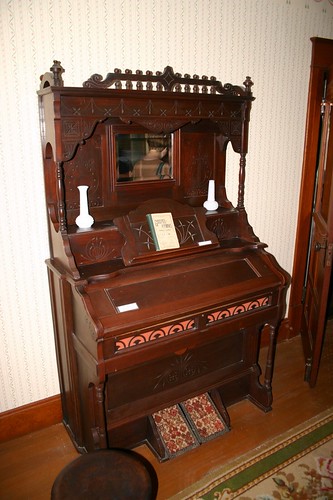
Two years ago, I wrote about Elvera Voth and the power of love. Back then I wrote about her memories of seeing of service workers, who would be away from their home for 7 years at a time. Elvera remembered a gathering of people at the train station to see them off, and how they sang some German hymns at the occasion. Elvera s done a lot since, including starting an arts in prison program. And today, she hosted a hymn sing at the pump organ in the Friesen House parlor. img_4305.jpg The Friesen House is nearly 100 years old, and was on my parents property before it got moved to the Mennonite Heritage and Agricultural Museum. We were among maybe 20 people that showed up for the event. We walked in a few minutes early and Elvera was sitting at the organ already, along with a few other early arrivals. Many of the people there were over 70, and the moment we walked in, she said, Oh good! Another generation! And, of course, asked about us, where we live, who we are related to, etc. The announcement in our church bulletin said to bring a copy of Gesangbuch mit Noten if you have one. That was a common hymn book in Mennonite churches in Kansas (songbook with notes and yes, there was one without notes that had only words.) I pulled out my copy, and just opened it up. I saw my grandma s beautiful handwriting saying it belonged to Mr. and Mrs. R. A. Klassen . This I brought along, but was perhaps the only one. Elvera recognized it and was pleased to hear where it came from. We had a great time, and it turned out to feel like the kind of afternoon people around here used to have: time with friends and family visiting and maybe singing on occasion. After some introduction and some stories, we got to the singing and started with hymn #1 in the 1969 (English) Mennonite Hymnal. That song had German words below as well, which we sang: Grosser Gott, wir loben dich! (Holy God, We Praise Thy Name) Elvera played the organ while we all sang. And then we turned to #556, O Have You Not Heard. We read through the German lyrics (to help those that don t speak German):
Ich weiss einen Strom, dessen herrliche Flut
fliesst wunderbar stille durchs Land,
doch strahlet und gl nzt er wie feurige Glut,
wem ist dieses W sser bekannt? O Seele, ich bitte dich: Komm!
Und such diesen herrlichen Strom!
Sein Wasser fliesst frei und m chtiglich,
o glaub s, es fliesset f r dich!
Elvera translated this herself, a much more powerful translation than we usually get in English. And then we sang, this time a cappella. Elvera told the story about the train station to this group, and then, of course, we sang O Power of Love, one of the songs sung on that occasion. For that, she asked us to stand up and form a circle around the organ, and again we sang mostly a cappella. Singing that song with Elvera left few dry eyes in the room for sure. Someone brought up Nun Ist Sie Erschienen, and so of course we sang that. It wasn t in any hymnal, but I suspect we were the only ones there that didn t have it completely memorized. Elvera told us the story of the museum s pump organ; it had been in her family, and she had paid to have it restored and eventually donated it to the museum. It had been used every evening at twilight for singing and devotions in the family. She also told us that the singing at the Newton train station the same one our family uses a few times a year was what inspired her to a career of choral music. In the end, we probably spent more time visiting than singing, but that was just fine. Next the group went over to the Preparatory School, an old schoolhouse also on the museum grounds. There we had a traditional Faspa, an afternoon meal with coffee, Zwieback and jam, cheese, and various cookies. We all visited for awhile longer and then went on our way. It was a wonderful afternoon, and I hope to have a chance to do that sort of thing again.

10 October 2010

Joey Hess: first real Haskell program

I've finally started writing my first real program in Haskell. I've been learning Haskell since 2007. That is to say, I've been reading about it, over and over. Progress learning has been annoyingly slow because I have not been able to commit to using it in a real program. Because when I'm writing a real program I want the program now, and I can code in other languages ten to one hundred times faster than I can currently code in Haskell. Nasty viscious cycle. Probably best to avoid getting really good at specific programming languages to avoid it, in hindsight. Writing a real program in Haskell is important because I mostly learn by doing real things. Exercises don't work well for me. Up till now the only real thing I did in Haskell was write a 250 line xmonad config file in it. Which really helped a lot, but mostly only with beating some of its syntax into my head. I have a few hundred lines of git-annex done. I don't need this urgently so I am willing to spend a week writing it instead of dashing off a perl version tonight. I seem to have had bad luck on the parts I tackled first, and run into some swampier parts of the Haskell platform. I hope these problems are behind me, they sure made the first 8 hours fun. time First thing I needed was a data structure with a time stamp. There are multiple modules to handle time, mostly seemingly incompatible, deprecated, and/or possibly broken. Data.DateTime seems to be the current choice, but I don't entirely trust it. Check this weird thing out, it thinks that 0 seconds and 1 second after the Unix epoch are the same second.
Data.DateTime> map (toSeconds . fromSeconds) [-1,0,1,2,100,1000,100000,100000,1000000,100000000,100000000,1000000000,10000000000]
[-2,0,0,1,99,999,99999,99999,999999,99999999,99999999,1000000000,10000000000]
Rounding error? (Now it's not all bad... it does support dates right up until the heat death of the universe, on 32 bit even. No Y2038 bug here.) locking Huh, I read RealWorld_Haskell_ twice and never noticed that it seems to omit POSIX file locking. Which in my Real World is a necessity. Probably because it's so hard in Haskell, with multiple gotchas. First there's the lazy IO problem, which means that if you explicitly close a file, code that read from it may not have really run yet. I ended up needing this scariness from System.IO.Strict, which is sadly not packaged in Debian or part of the Haskell Platform:
hGetContentsStrict h  = hGetContents h >>= \s -> length s  seq  return s
Then there's the Haskell's interface for fcntl locking, which exposes rather more of fcntl locking than I like to think about, being spoiled by perl's 2-parameter interface to it.
waitToSetLock lockfd (ReadLock, AbsoluteSeek, 0, 0)
And then there's that lockfd, which is not a regalar file handle, but a fd number, which has to be obtained by calling handleToFd. And then there's the crazy interface that has handleToFd close the input handle! Which is problimatic if you were going to use the file after you locked it..

Next.

Previous.