Luca Falavigna: My first GNOME patch

Yesterday I was sponsored my first GNOME patch! OK, it s small, very small but I m happy anyway

Kudos to Scott Balneaves for making that possible!


 The coffee place around the corner from where Penny and I lived for the past two months
Caff Mode offers to make your food using free-range eggs for
NZ$1. Free-range eggs are more expensive than normal ones, but the
price difference is not one dollar. Therefore, the cafe makes a
profit every time a customer makes the right choice.
I went in this morning to ask them about it, and the guy taking
my coffee order admitted stale-mate. When I suggested that the cafe
should use free-range eggs exclusively, he agreed. Let s hope that
he lets those making that decision know, and that the cafe soon
stops making money on ethical choices.
Regarding worship of the emperor, Christians responded with an unequivocal no. They claimed that Jesus Christ was God s kyrios ( anointed one in Greek), but since kyrios was one of the titles attributed to Caesar, they refused to participate in the imperial cult. They were willing to pray for the emperor and for his health, but they stubbornly refused to pray to him or offer ritual tribute. They recognized that one could not be a follower of Jesus while also honoring a rival to the loyalty their faith in him and his Kingdom required; therefore, not even one pinch of incense on the imperial altar. This defiance of the political religion of the empire, which led their critics to brand them subversive, landed many of them in arenas with salivating lions. Harvey Cox in The Future of FaithNow, you may be wondering, why am I asking if anyone still worships the emperor of a long-extinct empire? I maintain that this practice is still alive and well, just under a different name. I have been interested in some of the debates about American institutions that choose to perform neither the national anthem nor the pledge of allegiance. Many of these institutions are Mennonite, and their reason for not participating in these two particular acts mirrors that of the early Christians refusing to worship Caesar: namely, their goal is to bring about God s peaceful and just kingdom on earth, and no country, no human institution at all, can ever command greater loyalty than that cause. Moreover, the American national anthem is a particularly violent one, celebrating the taking of life right there at the beginning. Not completely compatible with the ethics of a church trying to bring about a more peaceful world, right? It is from that basis that many Mennonites, and our institutions, do not perform the national anthem or say the pledge of allegiance. For myself, when the national anthem is being performed, I will stand out of respect for those around me for whom the moment is important, but I do not sing. I am deeply appreciative that the United States, like many other countries, makes it legal to do this. I am heartened by the fact that I do not risk a confrontation with the lions over my religious stance today. Goshen College, a Mennonite institution, recently decided to go back on a century of history (which goes back farther than the anthem itself, which was only adopted in 1931) and will now be performing the anthem, followed by a prayer, before select sporting events. And by so doing, they fail both to act in accordance with the way of Christ, and to be a patriot. They fail to act for peace and justice by playing an anthem that supports and glorifies war and violence. And they fail to be patriotic. Patriotism and nationalism are different things. It s easy to be nationalistic to get up there and sing a song that everyone wants you to sing. It is far more difficult to be patriotic. Being patriotic in the United States means using the freedoms we have to improve our country. Goshen ought to use its freedom to not observe the national anthem as a way to try to draw a line in the sand against violence, to suggest that our anthem fails to adequately recognize the character of the American people and who we want to be, and to suggest a better alternative. After all, those people who are venerated today as patriots anyone from Martin Luther to Thomas Jefferson to Martin Luther King stood up to their fallible human governments to seek positive change. Instead of a route both religious and patriotic, Goshen College has chosen one that is neither. I am deeply disappointed that 300 phone calls have apparently cowed their leadership. What have we come to when our ancestors braved the lions, and we give up our principles over the fear of bad publicity? Ah, Goshen, perhaps you are thinking that you could spare a few pinches of incense for Caesar after all?
 Most times when I blog about WebKitGTK+ it s to talk about new features, and their usage in Epiphany. This time I d like to tell those who care more about our test infrastructure. Like I said in my previous post, testing is something we take very seriously in WebKit land. It would be hard to get such a complex project, with such diversity of platforms moving forward without automated testing.
Apple hosts a buildbot master that controls a whole lot of build slaves, for many platforms. Today we added the fourth WebKitGTK+ build slave to the family: 64bits release. This makes up for 4 build slaves in total, 2 release bots sponsored by Collabora, and 2 debug bots sponsored by Igalia. These bots build WebKitGTK+, and then run what we call the layout tests . I use quotes there because the name is a bit misleading. Despite being HTML/JavaScript tests, they cover a whole lot of functionality, and tests for regressions in many areas, including security, crashes, animations, media playing, DOM behaviour, and javascript API behaviour. WebKitGTK+ bots currently run 6397 tests, which represent about half the available tests.
Our bots are also, as of today, the first ones to run platform-specific API tests. Almost a year ago we started writing small tests based on glib s GTestSuite, and they have been very valuable in helping us make sure our API expectations aren t breaking (at least unknowingly), and to be able to test things that would be very hard to have Layout Tests for. So, yay! Thanks to everyone involved.
Back to layout tests, now: the other half is currently skipped because of one of three main reasons:

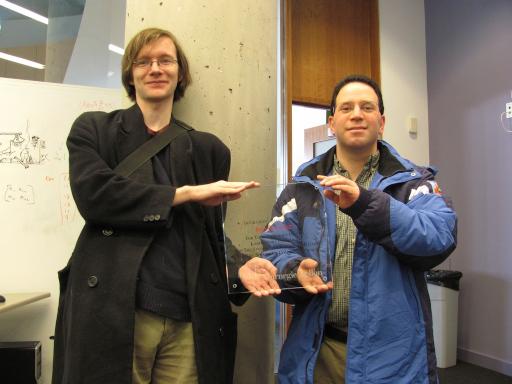 As I mentioned, I headed to Pittsburgh last week to give some talks at CMU and find out something about what they're doing there. Despite the dire weather that had closed the airport the day before, I had no trouble getting into town and was soon safely in a hotel room with a heater that seemed oddly enthusiastic about blasting cold air at me for ten seconds every fifteen minutes. Unfortunately, it seems that life wasn't as easy for everyone - ten minutes after I arrived, I got a phone call telling me that the city had asked CMU to cancel classes the next day.
 I've been overhauling the way that I am host a number of virtual websites upon my main box. Partly to increase security, and partly for a cleaner separation or roles, ownership, and control. (In general everything on my box is "mine", but some things are "ours"...)
After a fair amount of experimentation I decided that I wasn't willing or able to rewrite all my Apache mod_rewrite rules just yet. So my interim plan was to update each existing virtual host:
host=127.0.0.1
port=1008
dir=/home/www/static.steve.org.uk/htdocs/
chroot
user=s-static
throttles=/etc/thttpd/throttle.conf
logfile=/home/www/static.steve.org.uk/logs/thttpd.log
pidfile=/home/www/static.steve.org.uk/pid/file
(I wrote a trivial script to stop/start all the sites en mass, and removed the default thttpd init script, logrotation job, and similar things.) How did I decide which port to run this instance under? By taking the UID of the user:
steve@skx:~$ id s-static
uid=1008(s-static) gid=1009(s-static) groups=1009(s-static)
With this in place I could then update the Apache configuration file from serving the site directly to merely proxying to the back-end server:
<VirtualHost *>
    ServerName  static.steve.org.uk
    # Proxy ACL
    <Proxy *>
        Order allow,deny
        Allow from all
    </Proxy>
    # Proxy directives
    ProxyPass          /   http://localhost:1008/
    ProxyPassReverse   /   http://localhost:1008/
    ProxyPreserveHost on
</VirtualHost>
So was that all there is to it? Sadly not. There were a couple of minor issues, some of which were:
 Until today you could only use reportbug-ng to query the BTS with simple queries like packagename , bugnumber , tag:patch , etc. But the BTS actually supports composite queries like severity:grave tag:patch which returns bugreports with severity grave and a patch. The underlying Python library python-debianbts also supported this right from the start, but reportbug-ng did not make use of it.
Last weekend I finally had the time to fix that and the result is on it s way to unstable.
Composite queries provide a very convenient way to find cheap NMU candidates: the query
"severity:critical severity:grave severity:serious tag:patch" will return release critical bugs which have a patch. Now you can just go through this list, pick an open bug, test the patch and do what s necessary to release Squeeze in time.
Next item on my list is an option to hide closed bugs, maybe next weekend.
 9% of Ubuntu systems that were used to report bugs that included their
/proc/cpuinfo file need to fix their BIOS settings to gain the NX bit.
Check for yourself. (Run it with --verbose for useful details.)
Out of 7511 Ubuntu bugs Brian Murray collected for me that included /proc/cpuinfo files, there were 7270 unique contents (which surprised me I was expecting this to be much lower).
 Yesterday a silly oversight in the packaging of
udev in Ubuntu/Lucid produced a breakage that consistently makes dpkg barf. Here's a simple command line recipe to recover from it. In your terminal application, type:
sudo sed -i 's#copy_exec /lib/udev/firmware.sh#copy_exec /lib/udev/firmware#' /usr/share/initramfs-tools/hooks/udev && sudo dpkg -a --configure && sudo aptitude update && sudo aptitude safe-upgrade
...then press enter. You should be able to resume normal operation right after.
PS: as suggested by others, I revised the above snippet to use sed locally, since not everyone has patch installed.
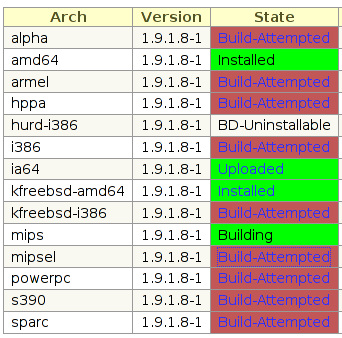 In there, a lot are due to
dh_auto_configure not doing the right thing for autoconf 2.13 generated configure files, others are due to make setting MAKEFLAGS to w , which prevents make -s to do what I expected it to do, armel has yet another crasher in the test suite (*sigh*), and I broke mipsel with the mips patch.
1.9.1.8-2 should fix the first two, and allow me to debug the armel issue (I disabled the test suite to be able to have the buildds generate the binaries, as they are much faster than the porterbox). Mipsel will have to wait for 1.9.1.8-3.
This also means 1.9.2 is delayed. Again. (and upstream releasing Firefox 3.5.8 one day later than scheduled didn t help either)
Update: I stand corrected, the one responsible for MAKEFLAGS setting to w seems to be make itself, not dh.
 Sarah got a call from the contractor on the weekend, saying he wanted to
make a start on the kitchen demolition on Wednesday. So we've moved
everything from the kitchen into the living room (fridge and stove
included), and they started work today.
Boy, did they start!
It's all gone already. All of the cabinets, and the existing lighting, and
the fan.
Here's how it looked last night:


 Unfortunately there's no working lights any more, so I couldn't take photos
of how things look tonight. I'll have to try and get some in the morning
before the contractor gets here.
It's sounding like it's going to take longer than one and a half weeks, so
we're going to be eating out for a while (or cooking with the microwave in
the living room). Conveniently (depending on how you want to look at it
given the temperature there) I have a work trip to New York next week, and
Sarah's going to come along for a few days as well, so that'll help kill
some time.
I think our next immediate need is to decide on what colour to paint the
walls. Some light shade of green is a current contender.
Tomorrow, Penny and I head off
back home, and two months of living in NZ come to an end. (did you
hear that, pleaserobme.com?)
Maybe I ll find the time to write about my impressions of living
on this side of the planet, and being immersed in Kiwi culture
while going after my daily routine and trying to work as much as I
could. But there is one thing that should not wait:
Thank you, Catalyst IT for
giving us workspaces! For the better part of 6 weeks, you gave us
our own room, monitors, keyboards, mice, and connectivity. And more
than that: you welcomed us, let us participate in sessions, invited
us to your parties, received our parcels, sent out letters, and
generally provided us with a great environment to work. This was
certainly well above what we had dreamed of.
At times, I was forced to stay into the middle of the night 12
hours time difference with Europe is not always easy and spent
waking hours in your building alone. Thank you for your trust!
Catalyst is a fully New Zealand owned company who deliver
critical open source business systems to some of NZ s largest
organisations, and organisations worldwide. Catalyst was also a
major enabler of LCA2010, and a
sponsor of Kiwi Foo Camp,
both events that I had the privilege to attend.
Let me know when you re in my part of the world. ;)
NP:
The Mamaku Project: Karekare

 Whee.
As usual, I'll be there the whole time, both for debcamp and debconf.
In addition, since I'll be halfway there anyway, I'll be paying my niece
a visit after the conference; she lives in Portland, OR.
Should make for a good holiday, I would say.
LC_ALL=C debian/rules debian/control
md5sum --check debian/control.md5sum --status   \
		/usr/bin/make -f debian/rules debian/control-real
make[1]: Entering directory  /home/wouter/debian/other-peoples-source/linux-2.6-2.6.32'
chmod +x debian/bin/gencontrol.py
debian/bin/gencontrol.py
Traceback (most recent call last):
  File "debian/bin/gencontrol.py", line 331, in <module>
    Gencontrol()()
  File "debian/bin/gencontrol.py", line 14, in __init__
    self.process_changelog()
  File "debian/bin/gencontrol.py", line 305, in process_changelog
    (distribution, version))
RuntimeError: Can't upload to unstable with a version of 2.6.32-8~local1
make[1]: *** [debian/control-real] Error 1
make[1]: Leaving directory  /home/wouter/debian/other-peoples-source/linux-2.6-2.6.32'
make: *** [debian/control] Error 2
The issue at hand was that I'd created a version of
'2.6.32-8~local1', to document that I'd locally branched version
2.6.32-7 with that one config option turned on, but that my version
should not be deemed larger than 2.6.32-8 (signalled by the ~ and
whatever follows that). However, something somewhere in the Debian
kernel build system (I was unable to figure out what, exactly) disliked
that version number and told me I could not upload to unstable with that
version. So it borked, and told me I had to fix my version.
Well, no, I don't want to do that. Instead, I wanted to disable that
check somehow. Turns out that isn't too hard; gencontrol.py not only
checks the version number, it also checks the target distribution. So if
you don't want to upload to unstable, you just need to tell the tool
that:
-linux-2.6 (2.6.32-8~local1) unstable; urgency=low
+linux-2.6 (2.6.32-8~local1) local; urgency=low
Simple, but you'd need to know.
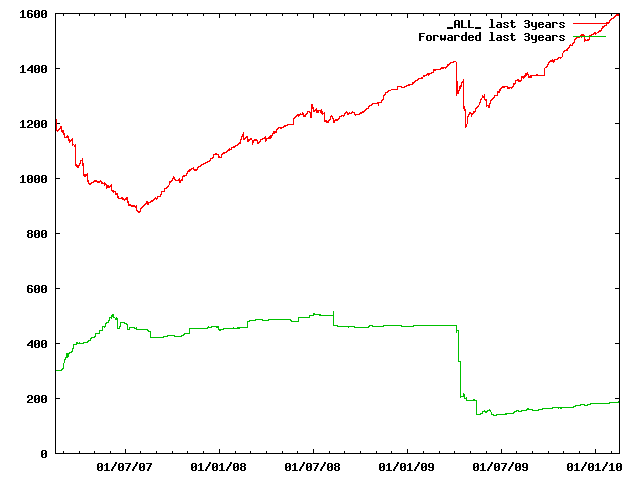 Olivier Vitrat, we miss you :)
One of the most heavy (and boring) talks that needs to be done for the KDE 4.4 packages is the copyright checking. I am not sure a total newbie can help with this, but if you have knowledge about licenses and you want to try helping, we are waiting for you.
About other areas of the packaging maintenance, if you are interested in start learning and helping with future releases, you are welcome to start lurking in the #debian-qt-kde channel in OFTC and in the mailing lists.
Update February 21th: 4.4.0 is for sure not being uploaded into the archive. Probably KDE SC 4.4.1 to be released 2nd March will be uploaded to unstable or experimental.
 I spent a few minutes trying out the new support for using the Facebook chat
with Jabber/XMPP, which is a great idea, since I hate to chat using the web
interface. Sadly, it doesn't support grouping your contacts (you set a group,
but it doesn't keep registered, probably they didn't implement that feature),
and that make my empathy client look quite untidy...
I'll keep my account setup for a while, but I guess it will not be long
until I remove it and continue not chatting with Facebook. Maybe some day they
can properly implement the protocol...
Update: As Tobias Wich and Clifford Hansen had kindly pointed out to me, you can actually group your contacts, but only from the web interface. I've tried it and it works, but it's not really comfortable.
Tags: Planet Debian
As part of some house-keeping I've been checking over my systems and ensuring they're all tickity-boo for the past couple of days.
One thing that I'm getting increasingly tempted by is converting my kvm guest to a 64-bit system.
I've not quite sold myself on the prospect of what will be a fair amount of downtime, but I'm 90% there.
I do think that a lot of my setup needs an overhaul, for example:
example.org: 127.0.0.1:8080
example.net: 127.0.0.1:9090
That has to be about the minimum necessary information to make the decision; a pair of vhost name & local destination. /me googles some.. Update
OK quick update I've added local users for some of my sites, and now have them running under thttpd.ObFilm: Cruel Intentionsskx:/etc/thttpd# ls -ltr /home/www/ tail -n 4 drwxr-sr-x 4 s-static s-static 4096 Jan 15 01:41 static.steve.org.uk drwxr-sr-x 5 s-openid s-openid 4096 Feb 16 21:31 openid.steve.org.uk drwxr-sr-x 6 s-images s-images 4096 Feb 16 21:52 images.steve.org.uk drwxr-sr-x 5 s-packages s-packages 4096 Feb 16 22:03 packages.steve.org.ukThat seems to work well, with a small wrapper script to start N instances of thttpd instead of a single one. Minor issues are that I'm using mod_proxy to forward requests to the thtpd instances running upon the loopback - and it was initially logging 127.0.0.1 as the source IP. A quick patch later all is well. I'll leave it running a couple of the simple sites for the next few days and see if it kills children. If it does I'll convert the rest. Probably will aim to have nginx in front of thttpd, instead of Apache, but this way I don't have to worry about mod_rewrite rules just yet.
Next.