Search Results: "ema"

17 February 2006

Uwe Hermann: Motorola A780 - My Shiny New Linux-Based Smartphone

Motorola A780
Motorola A780 Accessories It seems that I have become quite a gadget-whore lately. I'm spending all my money buying one gadget after the other, no end in sight... Anyways, I finally got one of those fabulous Motorola A780, a Linux-based smartphone. Getting one turned out to be way more complicated (and expensive!) than what I thought it would be. In the beginning, all sounded quite good: my cell phone contract with o2 is two years old soon, so I can get a new (cheap) cell phone. Stupidly enough, o2 doesn't offer the A780 in their shops and there seems to be no way to order one either (they do offer other Motorola phones, though). After asking the same questions in different o2 shops multiple times (and almost giving up), I accidentally saw the A780 in the local Saturn (a German electronics store). And indeed, they sell the phone, and they can even prolong my contract with o2 (there's a dedicated o2 employee working in the Saturn store), so that I can profit in the form of a cheaper phone. Or at least that's the theory... In practive, however, I have a student-contract (saves me some bucks) which has the stupid "feature" that it can only be prolonged in o2 shops. Guess what, the Saturn guys cannot give me the A780 as they can't prolong my contract, and the o2 shop simply doesn't have the A780 at all. Argh! After grumbling, asking around, googling, and even more grumbling, I finally decided to do the following: I got a new "dummy" o2 contract in the Saturn (yes, I'll have to pay that for 2 years) which enables me to get the A780 and to get it cheaper. I'll keep using my old contract and my old SIM card for simplicity and leave the new one untouched. If you take into account the money I'll spend on the new contract it doesn't save me too much money, but at least it's distributed across two years... I'll terminate my (new) o2 contract tomorrow, to make sure I don't forget about it (I don't want to have it any longer than the 2 years I'm forced to live with)... Stupid, stupid world we live in. Nobody should be required to perform such "hacks" in order to get the phone he/she wants... Enough ranting now, here's some juicy details about the phone: For details on the hardware see this wiki page. The only thing which I'm missing is WLAN, but once USB host support works (the hardware does support it), you can easily use a WLAN USB dongle... I'm pretty sure I'll be having lots of fun with this thing, and I'll quite probably be contributing to the OpenEZX project, which was started by Harald Welte (of gpl-violations.org fame) and tries to create the first 100% Free Software GSM-phone using the Motorola A780 and similar phones. Judging from these blog posts by Harald, running your own 2.6 kernel on the phone is not too unrealistic anymore, and telnetting into the phone (via USBnet) seems to work fine already... Expect more spammingblog posts about the A780 in future...

Holger Levsen: lost slides and videos on meetings-archive.d.n

Philipp, Joeys "slides" are published on meetings-archive.debian.net and I now have informed Wolfgang that he can update his page. Unfortunatly Joey's paper is written in german...

Also the round of introductions from the QA meeting in Darmstadt is now online (because of rsync-times you'll only be able to see it in three hours). I did not publish it earlier, because someone said something which should remain private. Instead of saying this in advance, so that the recording could have been stopped, this remark was made after saying these things, and therefore required post-processing.

Then it took me three months until I finally looked at that video to edit it. What I saw made me speechless (and smile), the video was already edited! But as nobody told me that, I didn't know :-) Or maybe I was told this when leaving Darmstadt, but it didn't reach my memory...

Now, about four weeks later, I got over my embarrassment not looking at it earlier...

David Nusinow: The March to SHINY

As of a few hours ago, I'm now running our xorg 7.0 packages on my main system. I'm ironing out a few niggling issues with the wonderful help of Zephaniah E. Hull before uploading the remainder of what I've got to experimental. There's still a few minor things left to package, but there's now a solid base that you can actually run and upgrade pretty cleanly from testing and unstable. It's still not for the faint of heart, but things are looking good for a quick move to unstable from experimental. Daniel Stone's previous work is a great base since he's worked out many of the issues beforehand.

As an aside, I know people are hungry to play with Xgl and compiz, and rest assured I'll get them to you ASAP. I haven't even tried to compile them myself yet, let alone run them, but I'll be working on it as soon as the 7.0 packages are in satisfactory shape.

16 February 2006

Jonathan McDowell: 8 years old

Last Saturday was the annual Earthlings dinner. We get very funny looks from the restaurant staff when we explain that we're celebrating the birthday of a domain. It's a good opportunity to see lots of people I don't see often enough though; sometimes it's hard to keep in touch with people. Actually, on that subject, there are a whole bunch of people I don't keep in touch with at all well. Mostly those who don't really do email and I don't really do the phone. I probably need to ring people more often; I used to be very good at running up my parents' phone bill. It's a bit hard to know what to say to people I haven't had any contact in years with. "Er, hi, please condense your entire life since we were at school and spoke regularly into a few minutes of conversation". And no one is near Norwich, so it's not like I can easily go and have coffee/beer with them. Meh. I've started having a regular dinner with people back home at Christmas, which helps a bit. And Burly's pretty good at telling me what people are up to. So, if you know me, and feel we don't see/speak to each other enough, sorry. If you think you see too much of me then tough. :P

15 February 2006

Erich Schubert: Are there good starters guides?

Dear Lazyweb,
I recently noticed that some people e.g. don't know the "mailq" command, which is fairly standard for email servers to print the current mail queue. Which is an essential command if you want to debug your mailserver. So I was looking for a good tutorial to recommend on "running" an email server, and had a hard time finding one... there is a large list of online books, but as far as I can tell, they don't even teach such basic things such as mailq, do they (I of course only checked those I could read online). Nor could I find this information easily accessible on the Postfix homepage. But there are a couple of things you should know at least where to find. Including showing whats stuck in your mail queue, why, and how to remove these messages. I guess this applies to many many things. Everbody assumes the basics to be clear, and just talks about how to pick certain configuration options...

Erich Schubert: When XSLT gets really messy...

XSLT is an outright ugly language. Thats why I often just hate it. In some (rare) cases it's very elegant, but most often incredibly clumsy. I've been redoing my homepage completely, and I'm using XSLT to render my data XML files to the XHTML output. That works quite well so far, but I hit more and more special cases. First I wanted to add a language chooser. This required finding out which lanuages my document supports (read: blocks with that language attribute exist) and check for uniqueness. Some things where rather easy to solve (with some experience in XSLT), so where extremely ugly. First of all, I want my template file to be a valid XHTML file, I don't want to have any layout parts in XSLT. Then I have a separate sitemap, needed for generating the menu. So I have to process three documents at the same time in XSLT. Ouch. But doable, using variables. Basically I have three modes - in one mode, the template is mostly copied over, unless I've specified some special rule, e.g. to insert the page title, meta information or content. A second mode uses the current chunk of the template document as template for the contents a couple of times to iterate over data chunks from the data source file (read: put text blocks from my source files into the output template format). The third mode does the same for the sitemap. Unfortunately, it started to get even messier... Big problem number one: Make a list of the available languages for the current page. Make this information reuseable throughout the page transformation. Part one: make a list of available languages by finding unique (!) @lang attributes. (usual approach: grab all nodes with @lang attributes, check if they have the same node id like the first occurence with this @lang value for uniquness, then output. Ugly as hell, but string magic sucks as much.) Big issue number two: Assume we now have a variable with en in there, access these nodes to transform them. Unfortunately, the generated nodes are "result nodes", and you cannot iterate over them with for-each. Luckily the exslt node-set extension to solve this. But now came the third big issue along... this is where I give up. I want my pages to have a nice modification date... my data pages are stored in subversion... Subversion has keywords expansion like CVS, which I can use nicely to automatically update the last modification date of the file. Unfortunately, the date will look like this: $Date: 2006-02-15 21:29:10 +0100 (Mi, 15 Feb 2006) $ Whereas in a web page meta information it's recommended to use ISO8601. Now if I only had regular expressions and proper date handling functions... I guess I'll stop writing ugly, hackish XSLT code and chose pretty Python code instead. Maybe use TAL or KID for XMLish templating...

Martin F. Krafft: A first glance at the Draytek Vigor 2900VG

I got myself the Draytek Vigor 2900VG, as announced, to handle my home office connection needs. I've been playing with the device all morning and am somewhat undecided as to whether I should keep it, or replace it with a tiny computer without moveable parts that runs Debian, simply for the benefit of greater control. But first, let me review the device. Don't get me wrong when I say that I am not sure whether I should keep it: the router seems solid and has a lot of functionality, and with few glitches, it mostly seems to work. Go read the specs yourself if you care, in the following I want to give my view on some of the pros and cons of the device after a few hours: The device is an all-in-one, combining WAN access (DHCP, PPPoE, PPTP) with NAT (with support for a DMZ), DHCP, VPN (PPTP, L2CAP, IPsec), a stateful packet filter, a 802.11g access point with support for WPA2 and 802.1x, VoIP gateway, a 4-port switch with VLAN and rate control, static routing and RIP, QoS, UPNP, dynamic DNS updates (e.g. no-ip.com), syslog or SMTP-based logging, and a printer server for USB printers. Basic HTTP URL and content filtering is provided, though most of it comes through the interface to SurfControl (no subscription included). Content control includes the most popular IM and P2P protocols. For all that functionality, the price is quite reasonable, if you ask me. Interaction is through a web interface that can be restricted to a couple of clients only, and is password protected (though in the clear). In any case, the device also comes with a telnet console that has a larger feature set than the web interface, but lacks documentation. Several forums exist, however, to fill this hole. The router also sports SNMP! The packet filter seems limited in what it can do: TCP, UDP, ICMP, IGMP, and only the basics for each (e.g. sockets for TCP). There are 12 filter sets with 7 rules each, and if/then logic can be implemented by branching to other filter sets. However, I can well imagine that the limit can be quickly reached. For QoS, you can define three classes, and to each assign services based on sockets and diffserv. That's it, but it should be enough for most basic use cases. VPN can be achieved with L2CAP, PPTP, or IPsec, but only pre-shared secrets are supported. Users can dial-in, up to 16 "Road Warrior" profiles can be created, and 32 LAN-to-LAN tunnels can coexist. A nice feature are the 16 schedules you can define and use throughout. For instance, certain filters can be restricted to only apply during working hours, some users may only be allowed to use the VPN to dial in during specific times, WLAN can be turned off at dusk, and VoIP devices can be routed based on the time of the day. NTP ensures this all happens accurately. I am really missing a RADIUS server on the device. As it stands, I am left to run a separate RADIUS server on the LAN, or resort to WPA2-PSK, which is a little less desirable but quite okay for my case. The device can separate LAN and WLAN clients and block any traffic between the two. I have not found a way to put LAN and WLAN into their own subnets and allow traffic inbetween. The DHCP server seems okay, it does not remember leases and will simply time out leases and use them for new requests. It is not possible to lock a MAC address to a specific IP through the web interface, one has to resort to the telnet prompt, and the limit is on 10 static leases. The device has no support for DNS updates for DHCP clients, nor is there any integration with a DNS server whatsoever. This means that for 10+ clients, you'll need ZeroConf stuff or you cannot use DNS between clients on the LAN/WLAN. All of the above are minor annoyances. I have also already found a bug (which has been known for more than a year now but remains unfixed in the latest firmware from December 2005): the device has a DNS relay without a cache (ugh!). If you request an A record, it all works. If you request an AAAA or MX record, it forgets to translate the source IP of the answer and feeds the upstream forwarder's packet straight throught. Thus, it is not possible to resolve AAAA or MX records without hard-coding the DNS servers to use in the DHCP server configuration to bypass the DNS relay. That's all for now. I have not gotten around to play with VoIP stuff yet, but one of these days...

Joey Hess: the slowly dying laptop

Yeah, my Fujitsu laptop has been dying for a year or so, it's had surgery for power, batteries, hard drive, sound, etc, it's lost every bit that could break off and still have a usable laptop (all the suede on the bottom, the lid fasteners, the pcmcia blcker, the case around the base of the lid.. the still working pcmcia eject button is my one remaining sacrificial breaky bit). It's got the marks to prove cats love it, along with all the results of throwing it in my book bag and taking off with no concern for carrying a laptop around. The screen has 4 or 5 dead pixels and recently one faint patial dead scan line. The lid is getting worryingly wobbly. The CD drive was once crushed in an airplane and then banged back into shape so it still fits in the machine and even ejects OK. I've rubbed the letters right off some of the keys on the keyboard. The speakers turned black and exuded some glue or something long ago during a hot summer, one of them is barely audible. The headphone jack broke. Oh and the laptop is also abused regularly by programs like firefox and openoffice that really didn't expect to run on a 900 mhz crusoe. All that, I can live with. The laptop bears its marks with pride, and amazingly, people still occasionally ooh and awe at it. Although more likely from a bit of a distance these days. The newest wrinkle is that I'm beginning to exceed the design specs for the keyboard. Apparently they just didn't design for it to be used so much. First some keys stopped working half the time on some days, yeilding the famous irc sessions where joeyh tlks without ny A's. Then the Function key's membrane stopped pushing it back up, so it always appears pressed, though still works. Now the Alt key is going the same route and the right side ofthespacebardoesn't work, leadingtoircsessions whereItalklike this. And it just feels like I can't touch type on it half the time anymore. A new keyboard is $100 or more. I think it's time to retire this to a d-i test machine and start looking for a new latop.
I looked at the IBM X-41 again, really like it, but still can't get past the low res display and fan. Especially with some reports that the fan runs constantly in linux. I looked at all the stuff on dynamism, but wasn't impressed enough to consider it. At the moment the Fujitsu P7120 is looking mighty appealing. Hey, it's even got the suede bottom again. And no fan.. Only problem is it has a touchpad.

14 February 2006

Zak B. Elep: Speaking, Packaging, and Writing, All in One Week

Two days from now, I’ll be pushing for Legaspi to be a speaker for the Bicol Open Source Forum. I’m going to talk about general FOSS and Linux stuff. I’ll also meet up with fellow Ubuntero Irvin Piraman and give away some Ubuntu CDs together :D . If you’re anywhere near Aquinas University, drop me a line. On the Debian side, my updates for opendchub and dbacl have hit Sid, thanks to the great Florian Ragwitz :) I’ve still yet to see ecb, xshisen, and rccp sponsored though :( I’ve seen some hope for ecb, thanks to Bart Martens, who was very helpful and put the updated URL for the latest ecb source package on the ITA. As for the writing, I’m now doing some final school reports for the year-ender. Ooh, just a month more, and here comes summer!!! I just hope there’s something like a local Google Summer of Code…
Andrew Pollock: [tech] My Asterisk configuration for use with Engin

This is the relevant bits of my sip.conf:
register => 073117xxxx:passwoid@byo.engin.com.au
[engin]
canreinvite=yes
dtmfmode=inband
fromdomain=voice.mibroadband.com.au
fromuser=073117xxxx
host=byo.engin.com.au
insecure=very
musiconhold=framed
nat=yes
port=5060
qualify=1000
realm=mobileinnovations.com.au
reinvite=yes
secret=passwoid
type=friend
username=073117xxxx
context=default
Obviously the number is the number provided by Engin, as is the password (as opposed to the password you provide when you create your website account). This sends inbound calls to the default context in extensions.conf, which for me looks like:
[default]
exten => s,1,Wait,1                     ; Wait a second, just for fun
exten => s,n,Answer                     ; Answer the line
exten => s,n,Goto(menu,s,1)
exten => t,1,Goto(s,1)
For routing outbound calls via Engin I have:
[internal]
; for standard Australian 8 digit numbers
exten => _01161XXXXXXXXX,1,Dial(SIP/engin/0$ EXTEN:5 ,60)
exten => _01161XXXXXXXXX,n,Hangup()
; for 1800/1300 style numbers (10 digits)
exten => _01161XXXXXXXXXX,1,Dial(SIP/engin/$ EXTEN:5 ,60)
exten => _01161XXXXXXXXXX,n,Hangup()
; for 13 style numbers (6 digits)
exten => _01161XXXXXX,1,Dial(SIP/engin/$ EXTEN:5 ,60)
exten => _01161XXXXXX,n,Hangup()
And I make my internal SIP handsets use the internal context like this:
[sipura]
type=friend
secret=passwoid
nat=yes
host=dynamic
reinvite=no     ; this
canreinvite=no  ; and this may be unnecessary
qualify=1000
dtmfmode=inband
regexten=1000
realm=andrew.net.au
disallow=all
allow=ulaw
allow=alaw
allow=gsm
context=internal
I'm fairly happy with everything now. When I get time, I'll implement QoS, for what it's worth, and tweak the dialplan to send telemarketers to hell. I also need to get a card to hook it up to the PSTN. So far an X100P via ebay seems the cheapest way to do it. I'm actually surprised at how difficult it seems to be to purchase a Wildcard TDM400P online (none of the resellers seem to offer online purchasing), and how expensive they are (at the Digium store).

13 February 2006

Benjamin Mako Hill: Debian: A Force To Be Reckoned With

I submitted the following proposal for a talk at Debconf6:
This talk offers a "Debian Themed" quick tour through the academic, legal, and business worlds. It overs insight into what everyone outside of Debian is saying about, doing with, and learning from the Debian project. In doing so, it hopes to give Debian participants some insight into fields and areas that they are largely unfamiliar with (e.g., management, sociology, anthropology, economics, computer supported collaborative work, etc.). It illuminates what others -- especially academics -- find useful or inspiring about the project and to facilitate self-reflection and self-improvement within Debian. It reflects on the impact that Debian has had in the world beyond the Debian project and, in particular, in those areas that many Debian developers may not be familiar with.
The good news is that the proposal was accepted. The bad news is that this means I actually have to finish doing the research to make the talk happen. To make the talk excellent, I wanted to solicit examples from you, great Debian community. I've already got my own list but I'd like to hear what you think I should talk about? What I'm not looking for is examples of people or organizations that use Debian. This talk is not about people who use the OS or the people who build it. This is about people who have learned from Debian as a community. Primarily, I'm looking for academic publications on Debian. However, anyone who has learned and designed a system or community based on such a paper or from observation would be good as well. People who use or have learned from our voting structure might be a good example as would communities with a Debian-derived social contract. Software engineering research is fair game. Be creative but remember that I've got a limited time on the podium and may be forced into the unpleasant position of being ruthlessly selective. Please add examples to this wiki page or just email mako@debian.org. That's if for now and I'll see you in... Umm... Oaxtepec.

12 February 2006

Andrew Pollock: [life] Massive road trip coming up

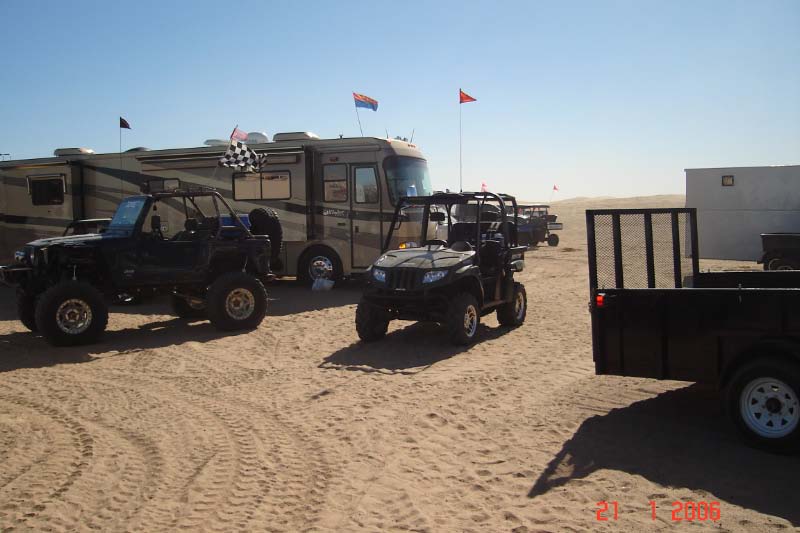
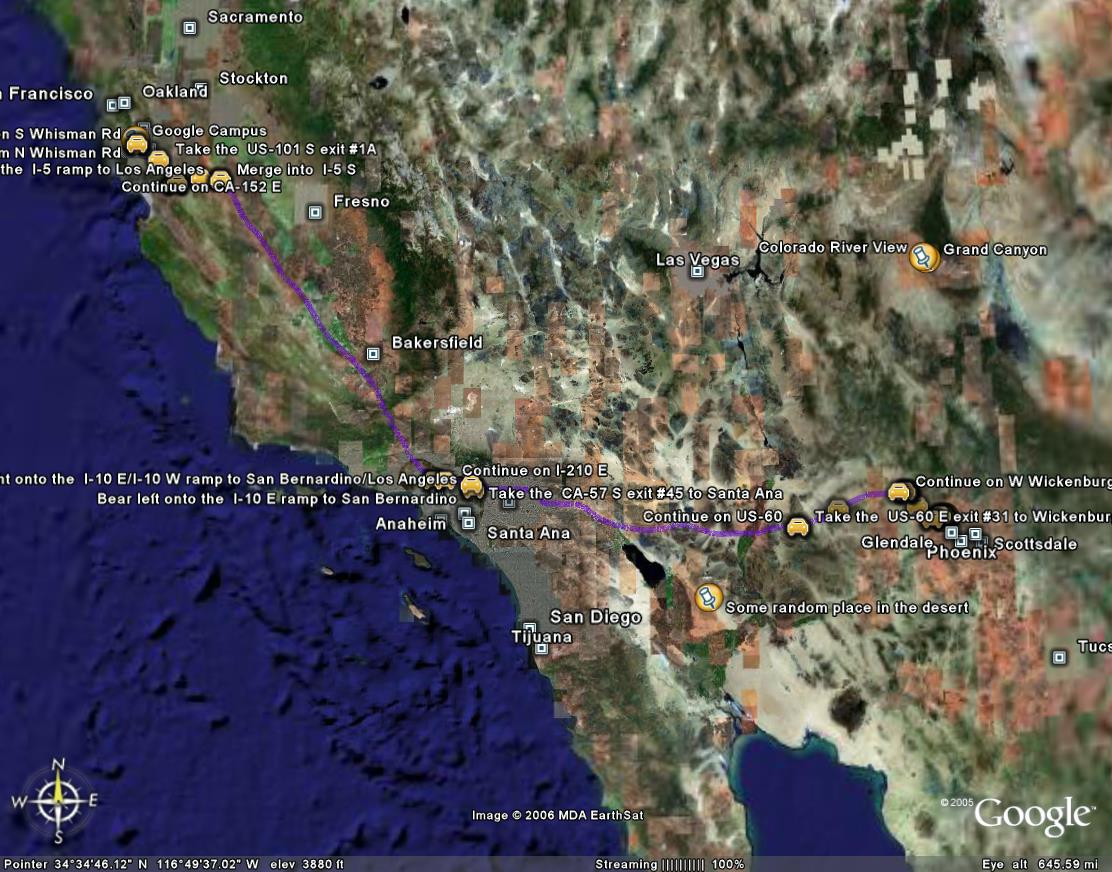
Given that next weekend is a long weekend on account of President's Day, we've decided to go visit our friends Craig and Sarah in Phoenix. My manager has kindly allowed me to work from Phoenix for the remainder of the week, so we'll head back again on the following weekend. I just fed all the relevant data into Google Earth, to get a bit of a perspective on how long and how big the trip is going to be (and it looks big). I've never used Earth for routing before, and it's really cool to "play" the trip's route and have it zoom into each turn. So from home to Craig and Sarah's place is 727 miles (1169 kilometres), but we're going to meet up in the desert, which is only 575 miles (925 kilometres), and then we'll do the remaining 216 miles (347 kilometres) on Sunday night after we've stayed with them in their enormous caravan (or trailer as I guess they call it over here) and fool around in their dune buggy. Here's the direct route from home to Craig and Sarah's place in Phoenix, for perspective. The desert stopover (marked) is a little bit south of this route: Route of our road trip to Phoenix We're planning on stopping over in Los Angeles (Hollywood to be precise) on the way back so we can briefly check it out.

Jose Carlos Garcia Sogo: Manuale D'Amore

I went to the cinema yesterday evening, and not having a clear idea of which film we wanted to watch, we decided for Manuale D'Amore, an Italian movie. It was great, funny almost all the time but with very emotive moments, all them mixed very well. The history is very simple. The movie introduces different couples that are in four different moments of their love: falling in love, the crisis, the traition and being abandoned. Every chapter is very well driven, and the actors play fairly well their roles. This movie, and the last one I watched, Los 2 lados de la cama, are good examples of European cinema very well made. In my opinion, if European cinema had followed this path more often, and with a bit more advertising, it will get more success than now, in which there are a lot of movies made trying to be different. P.S: I HATE people eating nachos in theaters.

11 February 2006

Andrew Pollock: [tech] SSL protected mailing lists are usually a waste of time

Amaya points out to Jonathan why people like to use SSL for their mailing list archives. The silly thing is that quite often people still have the monthly password reminder emails switched on, which go out in the clear. The same hypothetical bad guy who might be sniffing your password when you might log into the web management system just has to sniff at the right time of the month when everyone's password is being emailed out...

Wouter Verhelst: Bureaucracy.

I'm typing this blog entry on the train. Opposite of me is a gentleman of approximately 35 years old, who's got a paper lying on the table between us. That paper would seem to be approximately 20 pages thick, and is entitled...

Technical Specification

Sandbag With a header above that which tells me that it's from some government body to do with the "Civiele Bescherming", an agency which is mainly used when something happens in the country that could threaten the citizenship at large (natural disasters such as storms or flooding, large-scale electrical failure, water poisoning, etc). It's obvious why the civiele bescherming needs to have sandbags. It's quite funny to see how they need to write twenty-something pages on what a sandbag should look like. After all, it's just a bag filled with sand...

Amaya Rodrigo: Saturday Cat Blogging

I have been playing around with avidemux, Frank Sinatra and Chavela Vargas. This is the result. Excuse the poor, amateur quality and the terrible lighting, just enjoy the love (or plain lack of it) in these videos.

Lola hunts a Grass Hopper (June 2005).

Vi and Emacs have been with me for a little more that six months now. This is a summary of the greatest moments. (July 2005 - January 2006).

10 February 2006

Norbert Tretkowski: Donnie Darko

I really don't know why Donnie Darko never made it into the german cinemas. This movie is one of the best I've seen in the last years. It's on #96 in the IMDB top 250 movies list currently, so it seems I'm not alone with my opinion about this movie.

Gerfried Fuchs: PHP mail() Considered Harmful

I know for myself that picking up unparsed userdata is teh evil. But we also all know that the usual webpage and mailer script coder isn't thinking. And to my knowledge the php mail() function is the only one that perverted to parse the headers additional to an explicit given recipient list for additional recipients. Yes, you read right. Often enough people use things like mail("myown@addre.ss", "subject", $body, "From: $_POST['name'] <$_POST['email']>") without thinking about it, because, there is this extra to field anyway. Right?
Wrong! SPAMers will come and send things like email="some@jo.ke\nBcc: my@sp.am, list@is.bigg.er, than@you.rs". People that put up such webmail scripts usually don't notice it anyway, they just delete the spam right ahead, not noticing that it was an abuse of their form. And the ISP has to deal with having to get the system out of the blacklists again.... At least none of the hosts on which customers are able to put up such scripts directly affect our own mail system, it's just the shared hosts they use... Still, deadly annoying. And then people are claiming that such misfeatures aren't a problem in PHP but in the coders? If it would at least be documented in the description of the function, but if one can claim it that it is it's at most just very vague hinted...

Jacobo Tarr&#237;o Barreiro: Wesnoth for Spectrum

If they ever had a life, now it’s time for Spectrum lovers to lose any remains of it they may have left: Wesnoth for Spectrum +2

Kai Hendry: Linux for schools

So my sister is working at a school where the computers are in a shocking state. All infected with viruses, spyware and malware. The machines either crawl along or are incredibly unstable. Some of them run some sort of virus protection program and I’ve seen one or two computers running two different anti-virus programs. On my travels I have seen countless infected Windows machines. It’s incredible! And the worse thing about it, is that the Free Software geeks and outfits can’t seem to capitalise enough on it. So what can I do? The Computer Scientist. Well, not a lot. For example all the Windows machines are in Korean. I can’t figure out how to change win32 language. Can you? Plus, I don’t want to re-install Windows. I want to deploy some Linux based solution. So what are the requirements? They need to : That’s it. It also can’t be more complex. No username or passwords please. We don’t want to have to train people to use a new system. Must be simple. Oh diddums. Can Director macromedia kid games be played in Linux? I don’t think so. Oh I wish these kids’ software was on a N64 or something. There is only like 10 PCs in this school and installing them with Linux would take quite a bit of my time. I need some sort of centralised control tower where I can control deployment of my own customized Ubuntu based distro. I know very well about SkoleLinux but it is simply too complicated. No need for email. Outsource to Gmail and hosted service. Must be simple. All I can think of will be complex and painful. Grrr…

Next.

Previous.