Universal are one of my least favourite
companies because of their work on
bad laws like TPM and the French DADVSI.
Universal Music Group: iPod/MP3 device owners are thieves [drake.org.uk]
describes the creation of a Microsoft-Universal
axis of evil
as far as free culture is concerned.
These protectionists are stealing free culture
with lobbying for term extensions and
other cunning plans, yet they dare call the
population thieves.
Culture belongs to the people, not Universal.
However, there is a falling out among the band
of culture thieves,
with Universal taking on Murdoch in
MySpace sued by Universal Music [BBC NEWS]
I took some time today to learn about
OpenID.
Is it just me or are these newfangled web protocols both much harder to
learn and much more poorly specified than traditional internet protocols?
Alternately, perhaps I'm getting too old. :-)
Anyway, it's seems to be Not Evil, and I look foward to being able to log
into wikis and other sites without having to register separately on each
one. Although I note that it punts the spam and abuse problem to some
as-yet unimplemented policy layer. After all, there's no mapping between
an OpenID and an actual person, just between an OpenID and a web page
somewhere. Although there is the potential for someone to do something
interesting with an OpenID server that only gives out OpenIDs to people
with verified gpg keys.
As my own little gesture toward spreading OpenID, I've added an
openid plugin to
ikiwiki.
There's a
$5000 bounty
for implementing OpenID support in free software projects, but I don't think
I can collect on it, since it's limited to projects that have tens of thousands
of users, and with 30
registered ikiwiki users,
my userbase is a few magnitudes too small. Oh well..
FWIW, my personal OpenID is
http://joey.kitenet.net/.
Update after some more hacking: Even nicer, ikiwiki can now be set up to
use only OpenID for authentication, and not mess with passwords at all. I
also added support for the MyOpenID.com affiliate program, which lets users
jump from the wiki to creating an OpenID, and back smoothly. My personal
wiki is now configured like this.
According to
this article, also referred on
Slashdot, an European Union project has been developed aimed to check if streets free of any traffic signal
or other rules are viable. Seven cities and regions are involved, no one of them in Spain.
And I hope things to stay as now. Perhaps this can work in those civilized cultures in
which people try to respect others rights. But I am 100% comfident that this won't work in
Spain. If people does not respect signal even if they are there and can be fined for not
following them, I don't want to imagine what will people make if there are no signals
and no rules. The most used motto will be:
"And who the ***** are you to tell me that I can not
do this?".
yay!
In two weeks (Dec 3rd) there will be presidential elections in Venezuela. This will be the third time where Hugo Chavez, the current President, will be participating in the elections. The first time, in 1998, he won by 62%, then dropped to 59% in 2000 and currently some polls are giving him between 50 and 60 percent of vote intention. Since 1998, we’ve got a very active electoral movement and controversial situations which have raised very diverse opinions about our electoral system. If I recall correctly, in 1998 people voted using optic forms. In that moment, spanish Indra was the company in charge for the machines and most of the technology used in the elections. That was the time where the Supreme Electoral Council depended on the Executive power, i.e., the President. In 1999, Chavez proposed to rewrite the Constitution, and the National Electoral Council became an independent power. This Constitution was approved in two referenda in 1999, where touchscreen machines were used.
In 2000, after the new Constitution was approved, new presidential elections were made. The same touchscreen machines were used and we made a transition between Indra and a multinational holding named Smartmatic. In 2004, after two millions and a half of signatures were gathered to recall Chavez presidency, the revocatory referendum was made, using the Smartmatic machines. Almost six million people voted to maintain Chavez in power. Of course, after eight years of the same party in the power, as well as other problems (namely a national strike and a Coup d’Etat in 2002), several ideas arised regarding the legitimacy of the election process.
Today, the National Electoral Council released a flyer in the press, where they try to issue these topics. I must recognize that, being a newbie voter, I was unaware of several of the things they published today. For example, 8 of every 10 venezuelans over 18 are signed for voting in the elections. That’s one of the higher percentages of public awareness about elections in Latin America, higher than, for example, Colombia. That means 16 million people are able to vote, and we’re used to get around 60 percent of participation.
We do vote with touchscreen machines, and the results are completely computerized. The military guards all the equipment, and provides security to the randomly elected civilian which work as temporary personnel. Members of every involved party are present in all the election centers, as well as national and international observers. After you’re checked to vote, you have to give your fingerprint in a special biometric device. This is transmitted live, were possible, avoiding two people voting in the same day. After you vote, your finger is marked with silver nitrate, which goes away after two days or so. Of course, you’re only allowed to vote if you don’t have the mark in your fingers. The touchscreen machines prints a paper which you put into the traditional box. After the voting has concluded, more than half of the boxes will be opened and checked against the information in the machine. The boxes subject to this check are randomly selected, as well.
A brief thought about the software used in the machines. In 2004 or so, we (the Free Software Community in Venezuela) struggled and made pressure to the National Electoral Council to reveal the code and publish it wide open. This has been achieved until some point, since every interested person or organization is allowed to take a peek at the code. Dozens of organizations have already done so and are impressed by the features that are now present in the code. Before the first vote is registered, the machine prints a zero-vote confirmation, and then subsequently randomizes the order of the votes registered in memory. Only after all the election centers are closed, the machines start transmitting information.
This year, three hours past the closing time we’ll have the results. The final and most important, from my point of view, argument held to support our election system is the random queue organization at the election centres. The registry is sorted by ID number, the votes are randomly stored in the memory and the biometric device is used in a per-arrival basis. Therefore, since nobody takes the same time to vote, the queues will be unarranged therefore making it quite difficult to determine a possible vote sequence. This has been certified lately by the European Union, the Organization of American States and other organizations. Whoever wins this election, I’m quite confident about our election system. I just hope that other institutions in our Country start using reliable systems (for example, the national ID office) in order to give at least the feeling of being in a rightful State.
Prepared an upload for the new upstream version of tuxmath (two small bugfixes only), who thankfully got sponsored again and immediatly by by
Kari Pahula - thanks again! A new upstream maintainer for tuxtype has also been found, btw & yay!
Finished setting up
failive.debian.net, which in future will automatically build two fai-cds (currently only one), for fully automatatic installation of the booted system. To better reflect that those are not the usual live-cds, the vhost will soon be renamed to
faicd.debian.net...
I also want to mention
edulive.debian.net here, though I have done nothing about it today. This should become a replacement for the current
handmade live-cd, but currently its stalled by ENOTIME and
these two RC bugs.
Speaking of debian-edu, I spent some parts of this afternoon to create this
statuspage for the skolelinux repository which got me more familar with dak and which will hopefully help us keeping the archive in a good state :-)
Testing d-i RC1 on powerpc newworld was boring: d-i worked flawlessly and the g-i mini.iso didn't boot. Will reburn and retry, but I don't have great hopes on that one. The mini.iso from beginning of November worked nicely though, so it's a minor issue.
Since Debconf Mexico, parts of my blog have been published on
planet debian. To be exact, only the categories, Debian, Academic and (I think) Tech are included while a plethora of other ones, such as Canada are not. At times I feel pangs of guilt or discomfort because a number of my academic posts have, on the surface at least, little to do with Debian, F/OSS, tech or law. But many do have either to do with law or science more generally, so I hope they are of some interest to a group of folks who seem pretty keen on these topics.
Soon though, I am going to be in monk-mode, working like a hard working ox on my manuscript, full-time (now I am sharing my mindspace with an article on survivors and one that I have to present in January on the battles between hackers and scientologist, which I am pretty excited about too). I have just finished reading about 15 articles related to my book that have help to reignite the fire of interst, after burning out after years and years and can I add a few more years, on the same topic.
So bear with me as soon there will either be many posts related to just F/OSS or at least none at all as I will be so overtaken by the work!
Sound Juicer "Wish I Could Stop You From Talking" 2.16.2 is out.
Tarballs are available
on
burtonini.com, or from the
GNOME
FTP servers. Loads of fixes!
- "None" directory path shouldn't create blank directory name (#374831, Adam Petaccia)
- Don't disable re-read when playing (#347218, Stephen Cook)
- Update bacon volume (#369490)
- Set a11y relationships (Robin Sonefore, #364386)
- Fix prefs dialog spacing (#332561, Christian Persch)
- Fix dates with 0s in (#364976, Alex Lancaster).
- Replace spaces with underscores in path_patterns and file_patterns when "Strip
special characters" is selected (#357111, Luca Cavalli).
- Port to automake 1.9, update desktop file for new Bug Buddy (#357682,
Christian Persch)
- Reset the extract speed on every track just in case (#343544).
- Initialise the authentication manager (#356578)
- Show error messages when the pipeline doesn't link (Tim-Philipp Muller, #361151)
- Add 32x32 icon
Dear LazyWeb,
Why is Linux to Windows video conferencing so hard? I'm trying to communicate with
 ndusart
and we can't seem to make a go of it. For me under
Debian,
ekiga seems like the best bet, but the
windows port sounds a bit scary and hard to install, considering I'm not there to do it for her. We also tried
WengoPhone, which seems very promising, but was crashing a lot for me and although we appeared to be placing calls to each other, no sound or video was heard or seen by either of us.
So, has anyone done this and had success?
Update: I also tried Skype, but the Linux version doesn't appear to do video.
Amita June got her 12-month vaccinations two days ago. She had to get
four shots -- two in each chubby little thigh. She's really building up a phobia about going to the doctor's office, screaming her head off each time we go in. Maj thinks it's a bad memory from the time she was sick and Maj took her to the nurse for an emergency checkup, which required getting her temperature taken... from the wrong direction.
After her 12-month appointment (earlier last week), Maj bought her the book about
Caillou going to visit the doctor, and a little doctor's bag that she waddles around the apartment clutching. We did some practice "shots" with the syringe from the toy doctor's bag, and played with the stethoscope and such. I think it helped a little bit, but still... 4 shots in one day is too much for anybody.
Chuck Norris doesn't get 4 shots in one day without a few tears.
The worst part, I think, is that the vaccinations give her a little bit of a fever, and she's supposed to get some chicken-pox spots next week sometime. She's been a bit irritable -- easy to understand -- which has made everyone in the house a little tense. When the baby's mad, we're alllllll mad. She's not sleeping well? We're not sleeping well, then.
Anyways, hopefully this passes soon.
tags:
amitajune baby vaccinations
Web server twiddling for dummies
Two fun things I did on my server today. First, I finally got around to installing mod_redir_to_servname, which turns out to be rockingly simple and useful. Thanks to Simon Richter for the good insight.
The other thing I did was set up awstats for each of the domains hosted on the server. Much more fantastic than my grungy old Webalizer configuration, that's for sure. Even if it doesn't give me everything I want, it's pretty darn good.
tags: web server redirecttoservname simon richter awstats statistics
PmWiki upgrade
Another thing I did today was move the SonaUiki to my main server, and upgrade it from PmWiki 1.0 to version 2.1. That's something I've been waiting to do for a while -- the site has been really carpet-bombed by spammers, and I haven't been able to add any anti-spam extensions since the version was so old.
The upgrade process was pretty painless, and the site is now cookin' with gas. I'd like to go back and update some of the PmWiki Cookbook extensions I wrote a few years ago, like the 404-caching extension and the Dublin Core metadata one.
PmWiki's a neato piece of software -- well-crafted, compact, easy to extend and use. If someone bothered to configure Wikiwyg to work with it, I'd give it a serious thumbs-up.
tags: pmwiki sonauiki upgrade cookbook wiki wiki engine
Video interview in The Deal
I forgot to mention that there's an interview with me in the The Deal Blogs, the blog network for The Deal magazine. It's a pretty tough crowd at The Deal, so I'm pretty glad I came out looking as good as I did. We'll see how the print article looks, but for now I think I'm pretty OK.
tags: the deal video blog interview me
I tried to ask our cats if they felt
threatened by CDBS. They didn't seem
really worried.
I'm not sure if it is entirely fair to blame CDBS for complex packaging issues. If CDBS was not available, more maintainers would just cook up their own spaghetti packaging scripts. The balance needs to be somewhere between "everyone reinventing the wheel" and "frameworks that are harder to use than the raw stuff". Currently I would recommend only using CDBS for simple packages.
The last fashion in certain channel of IRC is disemboweling the Spanish translation of subversion. I refer myself to that is so strange and twisted and full of anglicisms, that it gives laughter.
In an opinion poll improvised, nobody has wanted to recognize that they use Linux in Spanish. I, personally, do not utilize those translations because my refined sensibility excites itself (negatively) at the time of seeing certain barbarities.
To share the pain, especially among the monolingual English speakers who never have seen software translated, I have written this story in Spanish and later I have translated it semiliterally to English utilizing techniques as advanced as the employed in the translation of subversion.
If wishes to rip your eyes out have entered you, I have accomplished my objective.
(It sees itself that I know the English too much well, for that my first sketch was too much correct and I had to revise it various times).
One more reason not to buy Apple: they spam.
Yesterday and today I received Spam from "insideapple.apple.com". The same
mail twice I think; and to the same old old email address. I can even trace
back that they bought the email address from the old
uni.de student portal site (which has since been
sold or relaunched, I don't know).
I unsubscribed yesterday, but received the same mail again today.
Apple, thats NOT the way to go.
Edge Eft breaks ldap
At work, we decided to test upgrading to Ubuntu's Edgy Eft on a spare machine. CRUNCH... that didn't go so well. The bug is here:
https://launchpad.net/distros/ubuntu/+source/libnss-ldap/+bug/51315
Also, it's no longer possible to boot with
init=/bin/bash, you have to use
init=/bin/dash. Single user mode brings up so much stuff that it's not really viable as a rescue mode, IMO.
require_gem ?
What is the deal with having a separate command to
require gem-installed packages in Ruby. Perhaps there is a logical reason for it, but it's ugly looking to me.
Rubyforge is down...again
Ruby's popular these days, isn't there someone who could invest a bit of money in setting up a system that stays up?
Harumph!

As
announced yesterday, Google has sponsored some work on the
LinuxBIOS project, a Free Software (GPL)
BIOS/
firmware implementation for various architectures (x86, PowerPC, Alpha, and others).
LinuxBIOS currently supports
more than 100 different mainboards from various vendors. A
list of supported chipsets, CPUs, and Super I/O chips is also available, so you can easily estimate how hard it will be to add support for a new mainboard.
Most of the mainboards currently supported are high-end server-type mainboards (e.g. from Tyan) and embedded boards. There are not too many cheap, mainstream motherboards supported, yet, but that is about to change soonish.
I've been contributing for a while now to the LinuxBIOS project in various areas (e.g. adding support for a bunch of Super I/O chips, which are required if you want to get LinuxBIOS debug output over the serial port). But one of my personal main goals for the project is to support a reasonably high number of cheap, standard desktop mainboards, and I'll concentrate my efforts in this area in the future.
Any help from further developers with experience in the hardware, embedded, or low-level firmware area is very appreciated! If you're interested, checkout
the website and say hi
on the mailling list.
But I digress. The Google funding was used to create an
automated, distributed test infrastructure, which will help...
...to significantly improve the project's Quality Assurance process by creating a completely automated and distributed testing environment. Every single commit results in BIOS images being built for all mainboards, and tested on real hardware located all over the world. So whenever you want to download a LinuxBIOS image, you can now know that it works on a reference machine before flashing it to your system.
A per-revision overview is available, as are test results for specific revisions, and you can even get detailed reports that include extensive logs for each motherboard. Developers can also use the build and test system without checking their code into the LinuxBIOS repository. The automatic build client has an option to submit BIOS images to the test system manually; you can see an overview of manually triggered builds. Anyone with a spare board supported by LinuxBIOS is welcome to put it into the automated test system, thus helping the LinuxBIOS project increase their quality on your hardware.


This is a great thing, and something which not many projects out there can claim to have. Automated test-suites in the software development "scene" are used seldomly enough (which is bad), but in the low-level hardware/embedded area you're usually stuck...
(See also
Golem and
Heise if you speak German)
Update 2006-11-15: Ok, the site is
slashdotted right now. Maybe you can try archive.org or the Google cache...
Thanks to
Mike Hommey we have another set of security updates for
our mozilla apps in sarge. The versions are:
mozilla-firefox 1.0.4-2sarge13
mozilla-thunderbird 1.0.2-2.sarge1.0.8d.1
mozilla 1.7.8-1sarge8
Please use my
security archive to get the preview packages and
test them as extensively as possible.
If you encounter any
NEW problems, please let us know at pkg-mozilla-maintainers@lists.alioth.debian.org.
Thanks for your support.
The stdarg API, which allows you to use a variable number
of arguments to a function in C, is pretty fun. However, it's also
pretty limited in what it allows, to a degree that it invites people to
try and find workarounds to things you can't do with the API as it is
documented.
Unfortunately, this almost always breaks when the software is
compiled on hardware that happens to be not your own, as there is a
reason why stdarg is implemented the way it is:
portability.
A (not so) recent discussion on #debian-devel on OFTC showed
to me how this confuses many people. Don't worry—it confused me
too, the first time I had to think about it.
The problem is that in order for stdarg to be able to do
what it does, it needs to read function arguments from whereever they
are stored. Where that actually is depends on the operating system and
the hardware you're using; it could be on the stack, but e.g., the SPARC
architecture actually has a mechanism to pass parameters using processor
registers (although those are most likely not used when stdarg
is in use, since the number of parameters that can be passed that way is
obviously pretty limited). If parameters are on the stack, then you may
be able to just access the memory as you would access any random
variable; but it could also be the case that you need to take some
specific steps to access the stack, or perhaps your architecture or
operating system has some protection for stack-based security attacks,
which would make it impossible to directly access memory on the stack
that is actually part of another subroutine.
So if you try to do anything that isn't defined in the
stdarg api (like trying to figure out the number of arguments
by peeking inside the va_list data type, or passing a
va_list to another function without using the C99
va_copy macro) will break. Yes. Very
sorry.
This is just a short note to remind everyone that the most wonderful woman in the world deserves birthday greetings. She's still only 4 years, 5 months, and 2 days older than me, and not 5 years older, which she would like you to believe. Despite that, she easily is beautiful enough to be younger than me, and I'm blessed that she can tolerate my ineptitude.
Happy birthday
ceilingsarecool!
iCommons's code of conduct states:
"iCommoners employ open and
transparent governance and processes"
The iCommons mailing list replies:
"You are not allowed to post to this mailing list, and your message has
been automatically rejected."
iCommons are good with words,
but not so good with deeds.
See more examples from Creative Commons
in
How to not run a consultation
and
iSummit.
At least iCommons lists aren't doing the
silent rejection trick from notconsult.
A small step forwards...
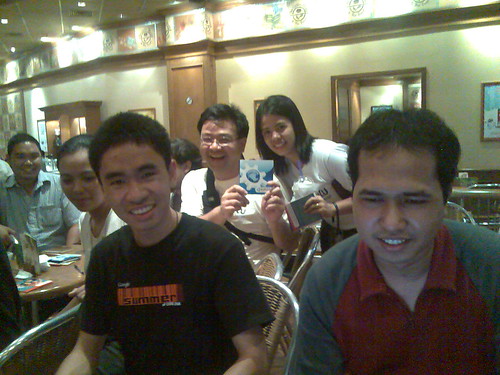
 Needless to say, the above photo doesn’t do great justice to what happened last night; it came from my elric which I didn’t get use much as a camera since I too was happily chatting away. That said, I expect RJ Ian will be posting his photos from his brand-spanking-new Kodak camera to the Ubuntu-PH site once he gets back to Mindanao with Yolynne and company. I also think the FOSS@Work folks also have their own photosite or wiki to post more photos, which we’ll be seeing sooner.
Jerome Gotangco and Ealden Esca an, the guys whom we all owe Ubuntu-PH to, were unfortunately unable to attend last night, as Jerome was off to Cebu to participate in the ICT congress there, while Ealden was quite busy at work. Hopefully they (as well as last night’s attendees!) can attend the next Release Party for 7.04 (aka Feisty Fawn,) and hopefully it will be just as fun, and be more meaningful if more Ubuntu-PH folks get involved in its development!
Update: Yolynne and RJ just posted
