Ritesh Raj Sarraf: VirtualBox 5.x
Yesterday, Wammu 0.39 has been released.
The list of changes is not really huge:
Filed under: English Gammu Wammu 0 comments
In a comment to my previous
post,
Daniele asked the entirely reasonable question,
Would you like to comment on why you think that DNSSEC+DANE are not a possible and much better alternative?Where DANE fails to be a feasible alternative to the current system is that it is not widely acknowledged to be superior in every possible way . A weak demonstration of this is that no browser has implemented DANE support, and very few other TLS-using applications have, either. The only thing I use which has DANE support that I m aware of is Postfix and SMTP is an application in which the limitations of DANE have far less impact. My understanding of the limitations of DANE, for large-scale deployment, are enumerated below.
But many (~4% in past tests) of users can t resolve a TXT record when they can resolve an A record for the same name. In practice, consumer DNS is hijacked by many devices that do a poor job of implementing DNS.Consider that
TXT records are far, far older than TLSA records. It seems
likely that TLSA records would fail to be retrieved greater than 4% of the
time. Extrapolate to the likely failure rate for lookup of TLSA records would
be, and imagine what that would do to the reliability of DANE verification.
It would either be completely unworkable, or else would cause a whole new
round of just click through the security error training. Ugh.
This also impacts DNSSEC itself. Lots of recursive resolvers don t validate
DNSSEC, and some providers mangle DNS responses in some way, which breaks
DNSSEC. Since OSes don t support DNSSEC validation by default (for
example, by having the name resolution APIs indicate DNSSEC validation
status), browsers would essentially have to ship their own validating
resolver code.
Some people have concerns around the single point of control for DNS
records, too. While the weakest link nature of the CA model is terribad,
there is a significant body of opinion that replacing it with a single,
minimally-accountable organisation like ICANN isn t a great trade.
Finally, performance is also a concern. Having to go out-of-band to
retrieve TLSA records delays page generation, and nobody likes slow page
loads.
TLSA records can be manipulated in that DNS control
panel. Those records would then automatically be DNSSEC signed by the DNS
provider and served up to anyone who comes along. Ouch.
In theory, of course, you should choose a suitably secure DNS provider, to
prevent this problem. Given that there are regular hijackings of
high-profile domains (which, presumably, the owners of those domains would
also want to prevent), there is something in the DNS service provider
market which prevents optimal consumer behaviour. Market for
lemons,
perchance?
quilt) was discussed and possible alternatives were shown (git-debcherry and git-dpm).dpt) and discussed how to get track of upstream git history and tags.src:perl plans for Stretch were discussed.autopkgtest whitelists were reviewed, new packages added, and IRC notificacions by KGB were discussed.POD_MAN_DATE were commented.
A new version of RcppGSL arrived on CRAN a couple of days ago. This package provides an interface from R to the GNU GSL using our Rcpp package.
In the course of preparation for the higher-performance R via C++ course I gave in Zuerich last month, I overhauled this package, its embedded package (!!) showing how to build a package which uses R, C++ and the GSL (and which can serve as a fine example of how to build and R and C++ package using an external library), and also overhauled the vignette which discusses all these aspect. All examples now consistently use Rcpp Attributes.
The NEWS file entries follows below:
Changes in version 0.2.5 (2015-07-05)Courtesy of CRANberries, a summary of changes to the most recent release is available. More information is on the RcppGSL page. Questions, comments etc should go to the rcpp-devel mailing list off the R-Forge page.
- The
colnormfunction in the included example package was rewritten to use Rcpp Attributes, the example package was updated and its version number increased to 0.0.3.- The unit tests also use the updated version of the example package.
- The package, and the included example package, were updated throughout to conform to the current
R CMD checkstandards.- The RcppGSL-intro vignette was updated throughout.
- The Travis CI integration now uses r-cran-* packages which leads to faster tests.
This post by Dirk Eddelbuettel originated on his Thinking inside the box blog. Please report excessive re-aggregation in third-party for-profit settings.
Debian is undertaking a huge effort to develop a reproducible builds system. I'd like to thank you for that. This could be Debian's most important project, with how badly computer security has been going.
PerniciousPunk in Reddit's Ask me anything! to Neil McGovern, DPL. What happened in the reproducible builds effort this week: Toolchain fixes More tools are getting patched to use the value of the SOURCE_DATE_EPOCH environment variable as the current time:
SOURCE_DATE_EPOCH to the time of the latest debian/changelog entry when exporting build flags, patch sent as #791823 (Dhole),texlive-bin (akira) and libxslt (Dhole) with the aforementioned support for SOURCE_DATE_EPOCH.debhelper exported TZ=UTC and this made packages capturing the current date (without the time) reproducible in the current test environment.
The following packages became reproducible after getting fixed:
debian/changelog date in the manpage.debian/changelog date as build date and use debian as the builder hostname.debian/changelog date as bui
ld date.reproducible.debian.net.
A small update to RcppRedis arrived on CRAN a few days ago. One of the unit tests failed as we (still) initialized the rredis package (loaded only for a comparison) in a form long-internalized by Bryan Lewis, its author. No actual changes to functionality were; the only other changes is cosmetic and in response a R CMD check requirement where the curl binary seemingly fails to follow redirects so we removed the (official !) redis.io URL.
Changes in version 0.1.4 (2015-07-04)Courtesy of CRANberries, there is also a diffstat report for the most recent release. More information is on the RcppRedis page.
- Minor update to unit test setup for rredis.
- No longer list URLs to Redis as automated CRAN tests for URL validity choke on redirects.
This post by Dirk Eddelbuettel originated on his Thinking inside the box blog. Please report excessive re-aggregation in third-party for-profit settings.
I've used Reddit for many years. I used it for many years without an
account, but eventually I made one. The site has always had its share
of unpleasantness, people who're more interested in tearing down than
in building. In recent years, it's gotten worse, and getting out of
hand.
During the fairly short reign of Ellen Pao as CEO, I found things to
be getting better. The site was starting to make it clear that
harrassment, for example, was unacceptable. Unsurprisingly, this made
some of the nastier people quite upset.
Pao has now resigned, and a new CEO has started. He had an "Ask Me
Anything" session yesterday, and made it clear that he's changing
things. From my point of view, it's changing to the worse. He made it
clear that as long as Reddit itself does not get into legal trouble,
and harrassment isn't too overt or particularly public, it's OK now.
I've closed my Reddit account.
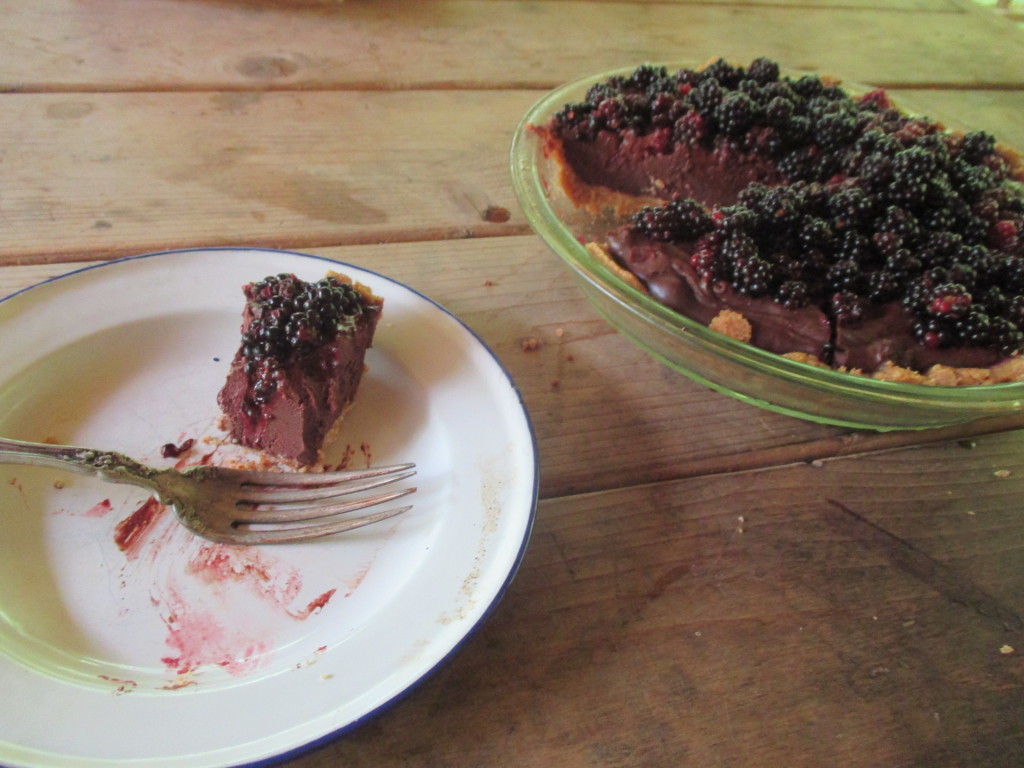
Having a wonderful summer, full of simple sweet pleasures. Mom visited
today, and I made her this blackberry chocolate tart. Picking berries,
swimming in the river, perfect summer day.
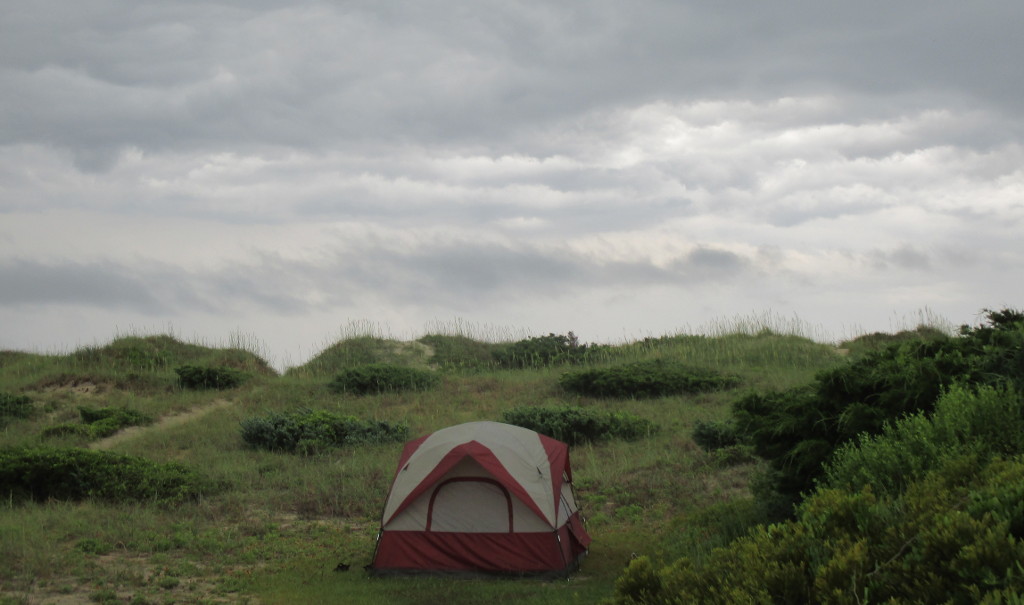
Earlier this summer, camped at in the dunes on Ocracoke island with many
family and friends. Thunderstorms away across the sound flashed and
grumbled long in the night, but mostly missed us. Jupiter and Venus in
conjunction overhead, and the arch of the milky way completed the show.
A few days ago and while we were traveling, an updated release of our random package for truly (hardware-based) random numbers as provided by random.org arrived on CRAN.
Brian Ripley had pointed out to us that some of the curl implementations (which must now be used as https is mandatory at random.org) did not follow redirects. Which was bad luck, given that I had used a shortform https://random.org as opposed to the fuller-length https://wwwrandom.org variant providing the service. This has been rectified, and we used the opportunity to also update the DESCRIPTION and NAMESPACE file as R CMD check --as-cran now mandates more explicit imports.
Courtesy of CRANberries comes a diffstat report for this release. Current and previous releases are available here as well as on CRAN.
This post by Dirk Eddelbuettel originated on his Thinking inside the box blog. Please report excessive re-aggregation in third-party for-profit settings.
The Independent reports that David Cameron wishes to ban the instant messaging application WhatsApp due its use of end-to-end encryption.
That we might merely be pawns in manoeuvring for some future political compromise (or merely susceptible to cheap clickbait) should be cause for some concern, but what should worry us more is that if it takes scare stories about WhatsApp for our culture to awaken on the issues of privacy and civil liberties, then the central argument against surveillance was lost a long time ago.
However, the situation worsens once you analyse the disapproval in more detail. One is immediately struck by a predominant narrative of technical considerations; a ban would be "unworkable" or "impractical". A robust defence of personal liberty or a warning about the insidious nature of chilling effects? Perhaps a prescient John Locke quote to underscore the case? No. An encryption ban would "cause security problems."
The argument proceeds in a tediously predictable fashion: it was already difficult to keep track whether one should ipso facto be in favour of measures that benefit the economy, but we are suddenly co-opted as technocrats to consider the "damage" it could to do the recovery or the impact on a now-victimised financial sector. The coup-de-gr ce finally appeals to our already inflated self-regard and narcissism: someone could "steal your identity."
Perhaps even more disappointing is the reaction from more technically-minded circles who, frankly, should know better. Here, they give the outward impression of metaphorically stockpiling copies of the GnuPG source code in their bunkers, perhaps believing the shallow techno-utopianist worldview that all social and cultural problems can probably be solved with Twitter and a JavaScript intepreter.
The tragedy here is that I suspect that this isn't what the vast majority of people really believe. Given a hypothetical ban that could, somehow, bypass all of the stated concerns, I'm pretty upbeat and confident that most people would remain uncomfortable with it on some level.
So what, exactly, does it take for us to oppose this kind of intervention on enduring principled grounds instead of transient and circumventable practical ones? Is the problem just a lack of vocabulary to discuss these issues on a social scale? A lack of courage?
Whilst it's certainly easier to dissect illiberal measures on technical merit than to make an impassioned case for abstract freedoms, every time we gleefully cackle "it won't work" we are, in essence, conceding the central argument to the authoritarian and the censorious. If one is right but for the wrong reasons, were we even right to begin with?
Here's an odd thing about the git bisect command: It has only 1 option
(--no-checkout). Compare with eg git commit, which has 36 options by my
count.
The difference is largely down to git having a pervasive culture of
carefully edited history. We need lots of git commit options to carefully
produce commits that look Just Right. Staging only some of the files we've
edited, perhaps even staging only some of the changes within a file. Amend
that commit if we notice we made a mistake. Create a whole series of beautiful
commits, and use rebase later to remix them into a more beautiful whole.
Beautiful fake histories. Because coding is actually messy; our actual
edit history contains blind alleys and doublings back on itself; contains
periods of many days the code isn't building properly. We want to sweep
that complexity away, hide it under the rug. This works well except when it
doesn't, when some detail airbrushed out of the only remaining history
turns out to be important.
Once we have these beautiful fake histories of changes, we can easily
bisect them and find the commit that introduced a bug. So bisect doesn't
need a lot of options to control how it works.
I'd like to suggest a new option though. At least as a thought experiment.
--merges-only would make bisect only check the merge commits in the
range of commits being bisected. The bisection would result in not a single
commit, but in the set of commits between two merges.
I suspect this would be useful for faster bisecting some histories of the
beautiful fake kind. But I know it would be useful when the history is
messy and organic and full of false starts and points where the code
doesn't build. Merges, in such histories, are often the points where things
reach a certian level of beauty, where that messy feature branch
got to the point it all built again (please let this happen today)
and was merged into master. Bisecting such points in a messy organic history
should work about as well as bisecting carefully gardened histories.
I think I'll save the full rant about beautiful fake history vs messy real
history for some other day. Or maybe I've already ranted that rant here
before, I can't remember.
Let's just say that I personally come down on the side of liking my git
history to reflect the actual code I was working on, even if it was broken
and even if I threw it away later. I've indeed taken this to extreme
lengths with propellor;
in its git history
you can see every time I've ever run it, and the version of my config
file and code at that point. Apologies to anyone who's been put off by that...
But oddly, propellor gets by far more contributions from others than any of my
other haskell programs.
All in the form of beaufiully constructed commits, naturally.
It took me ages to finish Portal (1), but Portal 2 was different I moved through the games in high speed. Actually playing time was the same, but I played a bit more often then before
More details below, but tl;dr: Nice extension of Portal, which feels a bit different. Graphics are great, but for my feeling the chambers are too easy and too short.
Image by user browen2o on the Steam Portal community center.
Portal 2, the successor of Portal, brings not only many new levels (test chambers) interspersed with funny running sequences and out of normal problems to solve, but adds also a set of new devices to solve the problems. But the basic mechanics are the same: Shoot portals to solve puzzles. The added devices are as follows (thanks to this blog):
They include light-rings that carry you over empty space, and also lift you up (first and second icon), light reflectors (forth), jumping and running color (9th and 10th), catapults (12th), light bands to walk on (lower left) and of course enough turrets and other devices that might find you smashed, shot, or drowned.
Things I liked at Portal 2:
All in all, a really great game, and I enjoyed it a lot.

A couple of months ago, I was invited to give the starting course for the Masters degree in Free Software in the Universidad Andina Sim n Bol var university. UASB is a multinational university, with campuses in (at least) Ecuador, Chile, Bolivia and Colombia; I was doubtful at first regarding the seriousness of this proposal and the viability of the program, but time made my doubts disappear.
Bolivia is going through an interesting process, as they have one of the strongest worded government mandates for migration to free software for the public administration in the next couple of years; this migration has prompted the interest of many professionals in the country. In particular, we have over 40 registered people for this Masters degree. Studying a Masters degree is a long-term commitment which signifies a big time investment, and although many of the student are quite new to the idea of free software, they are willing to spend this time (and money, as the university is privately owned and charges for its enrollment).
I gave this class together with Alejandro Miranda (a.k.a. @pooka), as we have a very good pair-teaching dynamics; we had already given many conferences together, but this is the first time we had the opportunity to share a whole course and the experience was very good. We have read the students' logs, and many of them clearly agree with this.
I had to skip two of the (ten) lessons, as I travelled from Mexico to Argentina halfway through it (of course, we brought the babies to meet my wife's family and friends!), so we had also the honor of having Esteban Lima fill in for those sessions.
I am very happy and grateful that the University took care to record our presentations and intend to record and put online all of the classes; as we were the first in the program, there were some understandable hiccups and some sessions were lost, but most are available. Here they are, in case you are interested in refering to them:
| Topic | Video (my server) | Video (Youtube) |
|---|---|---|
| Introduction to free software | Watch | Watch |
| History | Watch | Watch |
| Free culture | N/A | N/A |
| The effects of free software | Watch | Watch |
| Free software and open standards related to technologic soverignity | Watch | Watch |
| The free software ecosystem | Watch | Watch |
| Free software implementation in Bolivia | Watch | Watch |
| Introduction to intelectual property: Copyright, patents, trademarks, etc. | Watch | Watch |
| Who is "the community" and why do we speak about it? | Watch | Watch |
| Current status and challenges for the movement | N/A | N/A |
ifdown bond0 && ifup bond0
About an hour later I had a virtual machine running and found the same
bug in the pre-up ifenslave script which I later found to be already described in
LP1269921.
Apparantly Ubuntu integrated parts of the networking stuff with upstart and udev but
did not care about how to cater people with bonding setups. At least the
official
documentation is very sparse on that topic.
While someone from sysEleven rewrote the
ifenslave script,
I found that way too invasive and not well to handle.
You can either push it via a configuration management system and overwrite a package
owned script, or you roll you own package. So after some tinkering I decided to
go with a different dirty workaround and setup the bond itself via pre-up snippets.
In my test case it looks like this:
auto eth1 eth2 bond0
iface eth1 inet manual
bond-master bond0
iface eth2 inet manual
bond-master bond0
iface bond0 inet static
address 192.168.1.1
netmask 255.255.255.0
bond-primary eth1
bond-slaves eth1 eth2
pre-up echo +bond0 > /sys/class/net/bonding_masters true
pre-up ifenslave bond0 eth1 eth2
I'm not yet sure if that breaks some other features of the ifenslave integration in ifupdown, but it
seems to work so far. Let's see how far I can get with it.
After announcing the DUCK challenge last week the following packages were fixed and uploaded into unstable:
I have just released version 1.12 of Obnam, my backup program. See the
website at http://obnam.org for details on what it does. The new
version is available from git (see http://git.liw.fi) and as Debian
packages from http://code.liw.fi/debian, and uploaded to Debian,
and soon in unstable.
The NEWS file extract below gives the highlights of what's new in this
version. It includes the changes for version 1.11, which was a bug fix
for 1.10 and not announced separately.
Version 1.12, released 2015-07-08
Bug fixes:
--one-file-system would crash,
and it turned out to be a missing import.--exclude-caches no longer worked.
This was due to a bug introduced when the option was moved to its
own plugin (for cleaner code). The bug was masked by another bug, in
the Yarn test suite. Both bugs have now been fixed.setup.py. This has been fixed.Next.