When paultag recently announced a project to try to move debian infrastructure to python3, my first thought was how large that undertaking would likely be. It seems like a classic engineering task, full of work and nit-picky details to get right, useful/necessary in the long-term, painful in the short-term, and if you manage to pull it off successfully, the best you can usually hope for is that no one will notice that it was done at all. I always find that kind of task a little off-putting and difficult to tackle, but I was happy to see someone driving the project, since it does need to get done. Debian is potentially also in a position to help the upstream python community, because we have a pretty good view of what things are being used, at least within our own ecosystem. I'm happy to say that i also missed one of the other great benefits of paultag's audacious proposal, which is how it has engaged people who already knew about debian but who aren't yet involved. Evidence of this engagement is already visible on the py3porters-devel mailing list. But if that wasn't enough, I ran into a friend recently who told me, "Hey, I found a way to contribute to debian finally!" and pointed me to the py3-porters project. People want to contribute to the project, and are looking for ways in. So cheers to the people who propose audacious projects and make them inviting to everyone, newcomers included. And cheers to the people who step up to potentially daunting work, stake out a task, roll up their sleeves, and pitch in. Even if the py3porters project doesn't move all of debian's python infrastructure to pyt3 as fast as paultag wants it to, i think it's already a win for the project as a whole. I am looking forward to seeing what comes out of it (and it's reminding me i need to port some of my own python work, too!) The next time you stumble over something big that needs doing in debian, even something that might seem impossible, please make it inviting, and dive in. The rest of the project will grow and improve from the attempt.Tags: py3-porters
I love having guests give my classes :)
This time, we had Felipe Esquivel, a good friend who had been once before invited by me to the Faculty, about two years ago. And it was due time to invite him again!
Yes, this is the same Felipe I recently blogged about To give my blog some credibility, you can refer to Felipe's entry in IMDb and, of course, to the Indiegogo campaign page for Natura.
Felipe knows his way around the different aspects of animation. For this class (2015-04-15), he explained how traditional ray-tracing techniques work, and showed clear evidences on the promises and limits of parallelism Relating back to my subject and to academic rigor, he clearly shows the speed with which we face Amdahl's Law, which limits the efficiency of parallelization at a certain degree perprogram construct, counterpointed against Gustafson's law, where our problem will be able to be solved in better detail given more processing abilities (and will thus not hit Amdahl's hard ceiling).
This was my fifth month working on Debian LTS. I was assigned 16
hours
by Freexian's
Debian LTS initiative. I worked on several packages but haven't
uploaded updates yet.
linux-2.6
There is a steady stream of security issues in all Linux kernel
versions. As we don't want to prompt reboots too often, these won't
necessarily result in an update every month; it depends on the
severity of the issue(s). However, I triaged
the current
issues
and committed
the available fixes to version control.
dpkg
The PGP signature validation in dpkg-source has a number of
bugs,
including CVE-2015-0840
which allows the validation to be completely subverted. I
backported fixes for these from the 1.16 (wheezy) branch to the 1.15
(squeeze) branch. dpkg has a test suite and the fixes all came with
new regression tests, so this was easy to verify.
As dpkg is a native package (i.e. there is little separation between
the 'upstream' and Debian packaging), I preferred that the dpkg
maintainers would turn this into an 'upstream' release that I could
upload. Guillem Jover has now reviewed and (semi-)released my
changes, so I will complete this update soon.
tiff
A large number of bugs have been found in the venerable tiff library
and tools, mostly by 'fuzzing' them
with afl. The bugs
have been unhelpfully grouped into a smaller number of CVE IDs,
although it's not clear that these groups were introduced at the
same time and they certainly weren't fixed at the same time.
Most of the upstream bug reports come with samples to reproduce the
bug (crash or memory corruption detectable with valgrind), but
many of these did not turn out to be reproducible (either upstream
or with the version in 'squeeze'). Where they were reproducible,
I've verified that the patches fix the issue.
Unfortunately tiff does not have a test suite, so I made a
call
for testing on the debian-lts list. If I don't get any
responses soon, I'll run my own basic tests with programs that use
libtiff before uploading.
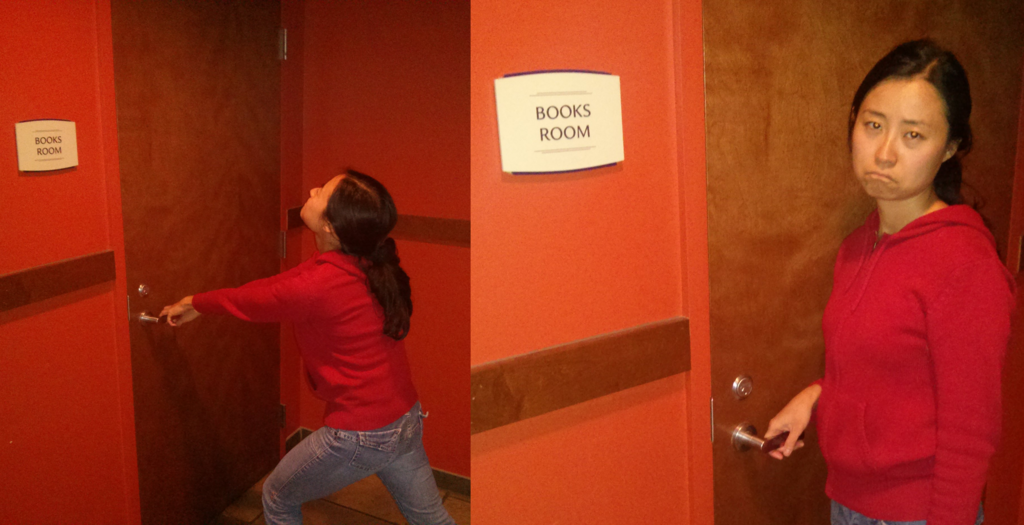
Is the locked books room at McMahon Hall at UW a metaphor for DRM in the academy? Could it be, like so many things in Seattle, sponsored by Amazon?
Mika noticed the room several weeks ago but felt that today s International Day Against DRM was a opportune time to raise the questions in front of a wider audience.
For the 2015 International Day Against DRM, I wrote a short essay on DRM for streaming services posted on the Defective by Design website. I m republishing it here. Between 2003 and 2009, most music purchased through Apple s iTunes store was locked using Apple s FairPlay digital restrictions management (DRM) software, which is designed to prevent users from copying music they purchased. Apple did not seem particularly concerned by the fact that FairPlay was never effective at stopping unauthorized distribution and was easily removed with publicly available tools. After all, FairPlay was effective at preventing most users from playing their purchased music on devices that were not made by Apple. No user ever requested FairPlay. Apple did not build the system because music buyers complained that CDs purchased from Sony would play on Panasonic players or that discs could be played on an unlimited number of devices (FairPlay allowed five). Like all DRM systems, FairPlay was forced on users by a recording industry paranoid about file sharing and, perhaps more importantly, by technology companies like Apple, who were eager to control the digital infrastructure of music distribution and consumption. In 2007, Apple began charging users 30 percent extra for music files not processed with FairPlay. In 2009, after lawsuits were filed in Europe and the US, and after several years of protests, Apple capitulated to their customers complaints and removed DRM from the vast majority of the iTunes music catalog. Fundamentally, DRM for downloaded music failed because it is what I ve called an antifeature. Like features, antifeatures are functionality created at enormous cost to technology developers. That said, unlike features which users clamor to pay extra for, users pay to have antifeatures removed. You can think of antifeatures as a technological mob protection racket. Apple charges more for music without DRM and independent music distributors often use DRM-free as a primary selling point for their products. Unfortunately, after being defeated a half-decade ago, DRM for digital music is becoming the norm again through the growth of music streaming services like Pandora and Spotify, which nearly all use DRM. Impressed by the convenience of these services, many people have forgotten the lessons we learned in the fight against FairPlay. Once again, the justification for DRM is both familiar and similarly disingenuous. Although the stated goal is still to prevent unauthorized copying, tools for stripping DRM from services continue to be widely available. Of course, the very need for DRM on these services is reduced because users don t normally store copies of music and because the same music is now available for download without DRM on services like iTunes. We should remember that, like ten years ago, the real effect of DRM is to allow technology companies to capture value by creating dependence in their customers and by blocking innovation and competition. For example, DRM in streaming services blocks third-party apps from playing music from services, just as FairPlay ensured that iTunes music would only play on Apple devices. DRM in streaming services means that listening to music requires one to use special proprietary clients. For example, even with a premium account, a subscriber cannot listen to music from their catalog using an alternative or modified music player. It means that their television, car, or mobile device manufacturer must cut deals with their service to allow each paying customer to play the catalog they have subscribed to. Although streaming services are able to capture and control value more effectively, this comes at the cost of reduced freedom, choice, and flexibility for users and at higher prices paid by subscribers. A decade ago, arguments against DRM for downloaded music focused on the claim that users should have control over the music they purchase. Although these arguments may not seem to apply to subscription services, it is worth remembering that DRM is fundamentally a problem because it means that we do not have control of the technology we use to play our music, and because the firms aiming to control us are using DRM to push antifeatures, raise prices, and block innovation. In all of these senses, DRM in streaming services is exactly as bad as FairPlay, and we should continue to demand better.
This evening I've been mostly playing with removing duplicate content. I've had this idea for the past few days about object-storage, and obviously in that context if you can handle duplicate content cleanly that's a big win.
The naive implementation of object-storage involves splitting uploaded files into chunks, storing them separately, and writing database-entries such that you can reassemble the appropriate chunks when the object is retrieved.
If you store chunks on-disk, by the hash of their contents, then things are nice and simple.
The end result is that you might upload the file /etc/passwd, split that into four-byte chunks, and then hash each chunk using SHA256.
This leaves you with some database-entries, and a bunch of files on-disk:
/tmp/hashed/ef267892ee080862c96a8d2d05de62f48e20f0875f27379e7d58c73ea4455bf1 /tmp/hashed/a378977155fb42bb006496321cbe31f74cbda803c3f6ca590f30e76d1afad921 .. /tmp/hashed/3805b0245bc8375be7125ae228eef711552ac082ffb9bf8756e2964a2393a9deIn my toy-code I wrote out the data in 4-byte chunks, which is grossly ineffeciant. But the value of using such small pieces is that there is liable to be a lot of collisions, and that means we save-space. It is a trade-off. So the main thing I was experimenting with was the size of the chunks. If you make them too small you lose I/O due to the overhead of writing out so many small files, but you gain because collisions are common. The rough testing I did involved using chunks of 16, 32, 128, 255, 512, 1024, 2048, and 4096 bytes. As sizes went up the overhead shrank, but also so did the collisions. Unless you could handle the case of users uploading a lot of files like /bin/ls which are going to collide 100% of the time with prior uploads using larger chunks just didn't win as much as I thought they would. I wrote a toy server using Sinatra & Ruby, which handles the splitting/hashing/and stored block-IDs in SQLite. It's not so novel given that it took only an hour or so to write. The downside of my approach is also immediately apparent. All the data must live on a single machine - so that reassmbly works in the simple fashion. That's possible, even with lots of content if you use GlusterFS, or similar, but it's probably not a great approach in general. If you have large capacity storage avilable locally then this might would well enough for storing backups, etc, but .. yeah.
mkdir /tmp/python-magic && wget https://raw.githubusercontent.com/file/file/master/python/magic.py -O /tmp/python-magic/magic.py && export PYTHONPATH=/tmp/python-magic/:$PYTHONPATH
ls -l
on a directory and stored in the DB was the right information. Inode
metadata was tested, such as name, permissions, type, or size.
Interestingly enough, the size of a directory was tested, and expected
to be 4096 bytes. The size of a directory actually depends on the
filesystem in use, and on the number of files this directory
contains. We often see 4096 because it's the size of a not-too-big
directory on ext4.
Travis-CI doesn't use ext4:
$ df -T
Filesystem Type 1K-blocks Used Available Use%
Mounted on
/vz/private/209140041 simfs 125829120 103460612 22368508 83% /
none devtmpfs 1572864 8 1572856 1% /dev
none tmpfs 314576 56 314520 1% /run
none tmpfs 5120 4 5116 1%
/run/lock
none tmpfs 1572864 0 1572864 0%
/run/shm
/dev/null tmpfs 786432 171584 614848 22%
/var/ramfs
$ ls -al /
total 0
drwxr-xr-x 23 root root 480 Feb 4 18:08 .
drwxr-xr-x 23 root root 480 Feb 4 18:08 ..
drwxr-xr-x 2 root root 2480 Feb 4 18:20 bin
drwxr-xr-x 2 root root 40 Apr 19 2012 boot
drwxr-xr-x 5 root root 660 Apr 30 13:56 dev
drwxr-xr-x 99 root root 3560 Apr 30 13:56 etc
-rw-r--r-- 1 root root 0 Feb 4 17:56 fastboot
drwxr-xr-x 3 root root 80 Feb 4 17:57 home
[...]
sources/non-free/m/make-doc-non-dfsg/4.0-2/.pc/applied-patches. It
is present in the filesystem in the container, is not the only empty
file over there, but still doesn't appear in the database, and make
fail the test which counts files.
The test has been commented out (booooooh), so that we still can use
Travis-CI's platform for our GSoC students, before it's fixed.
Conclusion
Making Debsources run automatically on a different platform as the one
we usually use permitted us to spot bugs, write dirty hacks, and
expand the filesystems it's supposed to run on.
Now, let's hope the continuous integration will help our GSoC
students, and let's wish them good luck!
I just dist-upgraded the blog server to jessie. A couple of errors from code with checks for which modules are enabled from .htaccess (deprecated and now obsolete behavior). Nothing all that rocky. Go team Debian!
We've spent beautiful weeks on Sri Lanka in January and February. On the way we've seen many different places - ancient cities, mountains, natural parks or beaches. Here comes selection of photos which I like most.
Filed under: English Photography Travelling 0 comments
Debian published Jessie last
month. Big congratulations to the release team and all the contributors;
quality is again at the rendez-vous!
This time, I could not contribute much, being busy with parental activities
(hello my son, if you read me), apart from making sure that my packages are
ready for the D Day. This work was made easy by the automated removals of
buggy packages set up by the release team. Many thanks for that
development.
I hope to use Jessie for a long time without the need of upgrading to
Testing. At the moment, it provides everything I need, including the
input of Japanese characters together with the possibility to switch between
Japanese (or American) and multilingual Canadian keyboard layouts, which was
not easy to do anymore in Wheezy.
Many thanks again.
Mail configuration.
Sometimes I send mail to root@some-domain-I-don't-own from cron or sudo or whatever system and wonder why that happened.
I approached the SuperTuxKart community fearing some backslash due to last week s discussion about their release 0.9, to find instead a nice, friendly and welcoming community. I have already had some very nice talks with them since then, and they have patiently explained to me the sequence of events that led to the situation that I mentioned and that, for the sake of fairness, I consider that I have to share here too. You can read the log of the first conversation I had with them (the log has been edited and cleared up for clarity and readability). I seriously recommend reading it, it s a honest friendly conversation, and it s first hand.
For those who don t already know the game:
All this story seems to start with the complain of a 6 yo girl, close relative of one of the developers and STK user, who explained that she always felt that Mario Kart was better because there was a princess in it. I m not particularly happy with princesses as role models for girls, but one thing I have always said is that we have to listen to kids and take their opinions into accounts, and I know that if I had such a request from one of the kids closer to me, I probably would have fulfilled it too. In any case, Free Software projects based on volunteer work are essentially a do-ocracy and it is assumed that whoever does the work, gets to decide about it.
So that is how Princess Sara was added to the game. While developing it, I was assured that they took extra care that her proportions were somehow realistic, and not as distorted as we re used to see in Barbie or many Disney films. Sara is inspired on an OpenGameArt s wizard and is not supposed to be a weak damsel in distress, but in fact a powerful character in the world s universe.
Sara is not the only female character playable. There are a few others: Suzanne (a monkey, Blender s mascot), Xue (XFCE s mouse) and Amanda (a panda, the mascot of windows maker). Sara happens to be the only human character playable, male or female. While it has been argued that by adding that character, a player might have the impression that the rest of the characters would be male by default, I have been told that the intention is exactly the opposite,and that the fact that the only human playable character in the game is female should make it more attractive to girls. To some, at least.
Here are some images of Sara:
So the fact is that they have invested a lot of time in developing Sara s model. I m not an artist myself, so I don t know first hand how much time and effort it takes to make such a model, but in any case it seems that quite a lot. When they designed the beach track Gran Paradiso, they wanted to add people to the beach. That track is, in fact, inspired on a real existing place: Princess Juliana Airport. Time was over and they wanted to publish a version with what they already had, so they used Sara s model in a bikini on the beach, with the intention of adding more people, male and female, later. The overall view of the beach would be:
This is how that track shows when the players are driving in it:
Now, about the poster of version 0.9, it is supposed to be inspired in the previous poster of version 0.8.1, only this time inspired in Carnival (which is, in fact, a celebration in which sexualization of both genders is a core part). I know that there are accusations of cultural apropriation, but I couldn t know, as my white privilege probably shields me from seeing that. Up to now, no one has said anything about that, only Gunnar explaining his point of view as a non-native mexican: While the poster does not strike as the most cautious possible, I do not see it as culturally offensive. It does not attempt to set a scene portraiting what were the cultures really like; the portrait it paints is similar to so many fantasy recreations . In my opinion, even when the model is done in good taste, with no superbig breasts and no unrealistic waist, it s still depicting a girl without much clothes as the main element of the scene, with an attire, a posture and an attitude that clearly resembles carnival and, thus, inevitably conveys a message of sexualization. Even though I can t deny that it s a cute poster, it s one I wouldn t be happy to see for example in a school, if someone wanted to promote the game there. The author of the poster, anyway, tells me that he had a totally different intention when doing it, and he wanted to depict a powerful princess, in the center of SuperTuxKart s universe, celebrating the new engine.
About the panties showing every now and then, I ve been told that it s something so hard to see that in fact you would really have to open the model itself to view them. I m not saying that I like them though, I think it would have been better if Sara would have had short pants under the skirt, if she was going to drive the snowmobile with a dress, but I m not sure if that s something important enough to condemn the game. The original girl mentioned at the beginning of this post seems to have found the animation funny, started laughing, and said that Sara is very silly, and that was all. It s probably something more silly than naughty, I guess. Even though, as I said, it s something I don t like too much. I don t have to agree with STK developers in everything. I guess.
There s one thing I would like to highlight about my conversations with the developers of SuperTuxKart, though. I like them. They seem to be as concerned about the wellbeing of kids as I am, they have their own ethic norms of what s acceptable and what s not, and they want to do something to be proud of. Sometimes, many of these conflicts arise from a lack of trust. When I first saw the screenshots with the girl in bikini and the panties showing, I was honestly concerned about the direction the project was taking. After having talked with the developers, I am more calmed about it, because they seem to have their heart in the right place, they care, they are motivated and they work hard. I don t know if a princess would be my first choice for a main female character, but at least their intention seems to be to give some girls a sensible role model in the game with who they can identify.
It randomly chooses an address and subnet from the private range defined by RFC 1918 that are not in use on the host machine, and assigns it to docker0. Docker made the choice 172.17.42.1/16 when I started it a few minutes ago...
It seems like RFC 1918 defines:
My monthly report covers a large part of what I have been doing in the free software world. I write it for my donators (thanks to them!) but also for the wider Debian community because it can give ideas to newcomers and it s one of the best ways to find volunteers to work with me on projects that matter to me.
Debian LTS
This month I have been paid to work 26.25 hours on Debian LTS. In that time I did the following:
No comment Liked this article? Click here. My blog is Flattr-enabled.
python3.
And with a new Annoy out, I updated RcppAnnoy to it. In the process I got another pull request into Annoy (use R's RNG rather than rand() which R CMD check really dislikes).
This new package is now on CRAN.
Courtesy of CRANberries, there is also a diffstat report for this release.
More detailed information is on the RcppAnnoy page page.
This post by Dirk Eddelbuettel originated on his Thinking inside the box blog. Please report excessive re-aggregation in third-party for-profit settings.
Next.