Search Results: "mak"

5 March 2010

Asheesh Laroia: What are you avoiding working on?

(Cross-posted from the OpenHatch blog.) I remember working on my first big group programming project back in college. The project involved some web scraping work; I enthusiastically took charge of that part. But a few weeks in, my code just wasn t working. I felt frustrated and helpless I m supposed to be the scraping expert, so why couldn t I fix the problems? I retreated into hiding and didn t want to think about the group of people or the project. A week later, I feebly ran svn update to see how the project had progressed. Oh! I exclaimed to myself. Someone made the data importer work! I felt a rush of relief. (While writing this paragraph, I sighed again remembering it.) When I talked to my teammate George, he mentioned off-handedly that he had fixed it. He didn t feel any of the anguish I felt or assign me the blame I thought I deserved. I guess if I had just asked for help earlier, I could have skipped the feelings of inadequacy entirely and George would have just fixed the bug. Half a decade later, I feel the same dread about the lack of Maildir support in Alpine. The bug is three years old! Ugh. This time, I m going to ask for help. So I listed the issue on the Alpine project page on OpenHatch. To put it there, here s what I did: For those of you who work on Free Software projects, what are the issues that drain you the same way? No bug tracker I ve seen has a field that says, I m avoiding working on this, and that sucks. To say that, list the issue on your project s OpenHatch page. So join in! What are the issues you don t want to think about? Once you share them, maybe a fellow developer or a new contributor will come by and help you out. Head to OpenHatch and let the world know. P.S. Do you have any ideas about how we can make these project pages more useful? Let us know! P.P.S. Dear Joey Hess and everyone else, sorry that Alpine still doesn t have Maildir support.

Julien Blache: Transitioning to a new RSA key

After weeks of trying to get around to doing that, I am finally starting the process of replacing my 10-year old 1024 bits DSA key with a shiny new 4096 bits RSA key. The old key ID is F5D65169, the new key ID is FA1E5292; it s available from the keyservers or my website. I have put up a transition document, signed with both keys; if you ve signed my old key, grab it, verify it and if all is OK on your end, please sign the new key. You ll notice that one of the old UIDs did not make it to the new key; that s because I m not using that email address and don t actually intend to use it in the future. Thanks!

Enrico Zini: Global trends

Global trends For some time I have been trying to pinpoint what it is that is brewing in Italy and risks spreading elsewhere, like it happened in the past. I don't need to be decent to stay in power While following a train of thought during a political/philosophical lecture I figured that a current growing trend is to have public figures that are more and more indecent. In Italy it is very hard to find a public figure you can look up to. It is hard to name a politician that is not involved in some shady exchange of favours or some abues of their powers, and we got used to seeing people in power implicated in major corruption scandals, perverted prostitution affairs, or dealings with international criminal organisations. They do not normally end up in jail, and in fact they keep being very firmly in power, because they manage to stretch or change the laws to get away, or at least to delay trials in order to trigger some statute of limitations. Is there a pattern here that, although maybe not as clearly defined as in Italy, can be found more or less globally? Yesterday I thought that this could be such a pattern:
I don't need to be decent to stay in power
If I think of it like that, then it is most definitely not just an Italian phenomenon. If you tell "one doesn't need to be decent to stay in power" to a British, or to a French, I would not expect them to see anything strange with it. We all find it depressing, but we are all used to it. It is a pattern with repercussions, though: once that becomes normal in a society, it means that people who get to be in power are free to abuse their power much as they want, as long as they are careful enough not to end up in jail. Because, well, nowadays one doesn't need to be decent to stay in power. I don't need to follow the law to stay in power That first pattern is already quite well accepted in Italy. So much well accepted, that I think we are starting to see what comes next. At the end of March we are going to have elections for some regional governors. Funnily enough, in Lazio, the very important region around Rome, the centre-right coalition failed to submit the paperwork on time, and is out of the elections. It is not just red tape: at some point someone will have to print out the ballots and dispatch them to the voting booths, so one expects to have the coalition logos and the names of the candidates submitted in time, together with signatures supporting the candidates and whatever else the election process needs. Well, they missed the deadline, they got there after closing time and the building was, well, closed. It was a fantastic opportunity for a laugh. Memes blossomed on the Italian intarwebs and we now have 2 or 3 new expressions to mean "stupid". However, now it's hard to tell what is going to happen. On one hand, you can't exclude one of the two major coalitions because of some bureaucratic detail like an office closing time. But on the other hand, several minor coalitions have been excluded in all sorts of past elections because of similar things, and it really would not be fair to start making exceptions now. But Lombardia, the region around Milan and Emilia Romagna, the one around Bologna, both very, very important, are having similar kinds of problems. In both regions the previous governors are running again, for the 3rd time in a row, and most likely they legally can't do it, and if elected one can sue and force them to resign, because they have been in power long enough. Lots of paper is being shuffled at the moment to figure if they can get away with it or not. Oh, and the lawyers of the candidate for the Milan region also managed to get to the tribunal after closing time, but apparently there was still someone inside and they managed to shout loud enough, or somesuch. Anyway, the situation is getting hot. The Lazio coalition that has been excluded because of their incompetence is now hard at work pushing their potential voters to mount a fracas. Chances are that eventually they'll get away with it, and manage to take part to the election. If that happens, they will likely get close to winning it. So this seems to be a new pattern that is emerging:
I don't need to follow the law to stay in power
Which, again, is a pattern with quite some repercussions. It is something much more radical than just an issue with morality: it means feudalism, it means we are culturally ready to accept dictatorship. So, please do me a favour: do not think for a moment that Italy is just a funny place with lemons and tomatoes, and watch out for these patterns emerging around you.

David Welton: Books vs "e-books" ?

I've been thinking about something for a while, and to be honest, still haven't reached any firm conclusions: what to think about self-published "e-books"? I'm curious to hear your opinions. For instance: These are all: electronic, in that they aren't distributed as real, paper books, have no ISBN number, and are generally only available via the author's web site (you won't find them on Amazon.com). They aren't simply on-line, PDF versions of real books. They're certainly a departure from the traditional model of having a publisher, editor, and real, physical books that could be purchased from book stores. They don't appear to have been through any kind of formal editing or quality control process. The prices seem to differ quite a bit; the first one is $19, the second one is $12, and the last one is $30.77. For the authors, the appeal is obvious: they get to keep all of the money, and don't have to fool around with a lot of "process". Consumers, on the other hand, have to consider different aspects: with a "real book", the bureacracy and process exist to guarantee some minimum standards of quality. If you buy an O'Reilly book, you know that it's probably like many of the other books they sell: perhaps it won't stand the test of time like something written by Knuth, but it'll be a pretty good guide to the technology it describes, most likely be someone who is indeed an expert in that area. If I buy some random PDF on the internet, it may come from someone who really knows their stuff, or it may be junk. On the other hand, were this market to grow, theoretically prices could come down. Since the people who are authoring the book don't have to fool around with editing, printing, and so on, and get to keep all the money themselves, they could in theory keep their prices significantly lower than someone creating a more 'traditional' book with a lot of overhead. That is, of course, if the book is one where there is competition in its niche. Right now a lot of these books that pop up on my radar are written by domain experts. However, what's to prevent a lot of people from jumping in and attempting to make a quick buck with a flashy looking web site? Buying books based only on reputation? That might lead to people who are really good authors, but perhaps not well known as "doers" (they didn't invent the technology in question) being left out in the cold. Also, there is something of an unknown quantity about "pdf books". For instance, after raking in a bunch of cash with theirs, 37signals put it on their web site, completely for free. That had to leave the guy who bought it the day before it went free feeling like a bit of a chump. At least with a 'real book', even if the contents are posted on the internet, you have a physical object that belongs to you. I wonder how bad piracy is, and how bad it might be were these to become more popular? Another thing worth noting is that, via services like Lulu.com, it *is* possible to print these out. In any case, I think things are likely to change with time, as we aren't dealing with a static situation, but rather one where a changing landscape maylead to different outcomes, as the key variables... vary. I am honestly unsure of what to make of this development. How do you see the market for "home brewed" pdf ebooks evolving?

4 March 2010

Russell Coker: Opera and Trusting Applications vs Trusting Servers

The Opera-Mini Dispute I have just read an interesting article about the Opera browser [1]. The article is very critical of Opera-Mini on the iPhone for many reasons most of which don t interest me greatly. There are lots of technical trade-offs that you can make when designing an application for a constrained environment (EG a phone with low resolution and low bandwidth). What does interest me is the criticism of the Opera Mini browser for proxying all Internet access (including HTTPS) through their own servers, this has been getting some traction around the Internet. Now it is obvious that if you have one server sitting on the net that proxies connections to lots of banks then there will be potential for abuse. What apparently isn t obvious to as many people is the fact that you have to trust the application. Causes of Software Security Problems When people think about computer security they usually think about worms and viruses that exploit existing bugs in software and about Trojan horse software that the user has to be tricked into running. These are both significant problems. But another problem is that of malicious software releases. I think that this is significantly different from Trojan horses because instead of having an application which was written for the sole purpose of tricking people (as is most similar to Greek history) you have an application that was written by many people who genuinely want to make a good product but you have a single person or small group that hijacks it. Rumor has it that rates well in excess of $10,000 are sometimes paid for previously unknown security vulnerabilities in widely used software. It seems likely that a programmer who was in a desperate financial situation could bolster their salary by deliberately putting bugs in software and then selling the exploits, this would not be a trivial task (making such bugs appear to be genuine mistakes would take some skill) but there are lots of people who could do it and plausibly deny any accusation other than carelessness. There have been many examples of gambling addicts who have done more foolish things to fund their habit. I don t think it s plausible to believe that every security flaw which has been discovered in widely used software was there purely as the result of a mistake. Given the huge number of programmers who have the skill needed to deliberately introduce a security flaw into the source of a program and conceal it from their colleagues I think it s quite likely that someone has done so and attempted to profit from it. Note that even if it could be proven that it was impossible to profit from creating a security flaw in a program that would not be sufficient to prove that it never happened. There is plenty of evidence of people committing crimes in the mistaken belief that it would be profitable for them. Should We Trust a Proprietary Application or an Internet Server? I agree with the people who don t like the Opera proxy idea, I would rather run a web browser on my phone that directly accesses the Internet. But I don t think that the web browser that is built in to my current smart-phone is particularly secure. It seems usual for a PC to need a security update for the base OS or the web browser at least once a year while mobile phones have a standard service life of two years without any updates. I suspect that there is a lot of flawed code running on smart phones that never get updated. It seems to me that the risks with Opera are the single point of failure of the proxy server in addition to the issues of code quality while the risks with the browser that is on my smart-phone is just the quality of the code. I suspect that Opera may do a better job of updating their software to fix security issues so this may mitigate the risk from using their proxy. At the moment China is producing a significant portion of the world s smart-phones. Some brands like LG are designed and manufactured in China, others are manufactured in China for marketing/engineering companies based in Europe and the US. A casual browse of information regarding Falun Gong makes the character of the Chinese leadership quite clear [2], I think that everything that comes out of China should be considered to be less trustworthy than equivalent products from Europe and the US. So I think that anyone who owns a Chinese mobile phone and rails against the Opera Mini hasn t considered the issue enough. I don t think it s possible to prove that an Opera Mini with it s proxy is more or less of a risk than a Chinese smart-phone. I m quite happy with my LG Viewty [3] but I wouldn t use it for Internet banking or checking my main email account. Also we have to keep in mind that mobile phones are really owned by telephone companies. You might pay for your phone or even get it unlocked so you can run it on a different network, but you won t get the custom menus of your telco removed. Most phones are designed to meet the needs of telcos not users and I doubt that secure Internet banking is a priority for a telco. Update: You can buy unlocked mobile phones. But AFAIK the Android is the only phone which might be described as not being designed for the needs of the telcos over the needs of the users. So while you can get a phone without custom menus for a telco, you probably can t get a phone that was specifically designed for what you want to do. The Scope of the Problem Mobile phones are not the extent of the problem, I think that anyone who buys a PC from a Chinese manufacturer and doesn t immediately wipe the hard drive and do a fresh OS install is taking an unreasonable risk. The same thing goes for anyone who buys a PC from a store where it s handled by low wage employees, I can imagine someone on a minimum income accepting a cash payment to run some special software on every PC before it goes out the door that wouldn t be any more difficult or risky than the employees who copy customer credit card numbers (a reasonably common crime). It s also quite conceivable that any major commercial software company could have a rogue employee who is deliberately introducing bugs into it s software. That includes Apple. If the iPhone OS was compromised before it shipped then the issue of browser security wouldn t matter much. I agree that having the minimum possible number of potential security weak points is a good idea. They should allow Opera Mini users to select that HTTPS traffic should not be proxied. But I don t think that merely not using a proxy would create a safe platform for Internet banking. In terms of mobile phones most things are done in the wrong way to try and get more money out of the users. Choose whichever phone or browser you want and it will probably still be a huge security risk. Harald Welte is doing some really good work on developing free software for running a GSM network [4]. But until that project gets to the stage of being widely usable I think that we just have to accept a certain level of security risk when using mobile phones.

Uwe Hermann: libopenstm32 - a Free Software firmware library for STM32 ARM Cortex-M3 microcontrollers

Olimex STM32-H103 eval board I guess it's time to finally announce libopenstm32, a Free Software firmware library for STM32 ARM Cortex-M3 microcontrollers me and a few other people have been working on in recent weeks. The library is licensed under the GNU GPL, version 3 or later (yes, that's an intentional decision after some discussions we had). The code is available via git:
 $ git clone git://libopenstm32.git.sourceforge.net/gitroot/libopenstm32/libopenstm32
 $ cd libopenstm32
 $ make
Building is done using a standard ARM gcc cross-compiler (arm-elf or arm-none-eabi for instance), see the summon-arm-toolchain script for the basic idea about how to build one. The current status of the library is listed in the wiki. In short: some parts of GPIOs, UART, I2C, SPI, RCC, Timers and some other basic stuff works and has register definitions (and some convenience functions, but not too many, yet). We're working on adding support for more subsystems, any help with this is highly welcome of course! Luckily ARM stuff (and especially the STM32) has pretty good (and freely available) datasheets. We have a few simple example programs, e.g. for the Olimex STM32-H103 eval board (see photo). JTAG flashing can be done using OpenOCD, for example. Feel free to join the mailing lists and/or the #libopenstm32 IRC channel on Freenode. The current list of projects where we plan to use this library is Open-BLDC (an Open Hardware / Free Software brushless motor controller project by Piotr Esden-Tempski), openmulticopter (an Open Hardware / Free Software quadrocopter/UAV project), openbiosprog (an Open Hardware / Free Software BIOS chip flash programmer I'm in the process of designing using gEDA/PCB), and probably a few more. If you plan to work on any new (or existing) microcontroller hardware- or software-projects involving an STM32 microcontroller, please consider using libopenstm32 (it's the only Free Software library for this microcontroller family I know of) and help us make it better and more complete. Thanks!

3 March 2010

Vincent Sanders: Limited Success

I spent the day working with Daniel. He has been trying to get the correct runes for a GCC build in a strange environment. Turns out all he needed was me to throw stupid ideas at him until one caused him to examine some of the generated intermediate symbol maps...

Turns out that busybox awk fails in an interesting way which (eventually) causes half the symbols to be missing in the stage 1 libgcc.so object. Switched to using gawk and managed a successful build.

Seems to be a relatively good time for solutions, last week I managed to make squashfs-tools work on ARM. Unfortunately the author seems to be completely unresponsive to my (repeated) emails (if anyone wants the patch series feel free to mail me). The main issue with the tools is their complete blind assumption that a c structure can simply be cast to an arbitrary character array and get sensible results.

The structure casting method simply does not work on ARM (or indeed any platform which has alignment restrictions) without at least adhering to some minimal rules, primary among these is that the structure *must* be aligned to a word (32bit) boundary and that if you have 16bit or 8bit quantities within the structure they may cause gaps between members i.e. the structures are not packed by default.

No this behaviour is not a bug, it is perfectly acceptable by the c standard. Just because on x86 the practice of arbitrary casting works does not mean it is safe or sensible. Nonetheless many programmers simply do not want to believe its wrong.

Anyhow, rant over, back to work!

Wouter Verhelst: dpkg vs RPM

Thomas blogs about some issues he had with his N900's facebook plugin. This post isn't about that, as I don't use facebook. But as part of his blog post, he mentions the following:
This reminded me of a pet peeve I have with those people who claim Debian s packaging system to be far superior to rpm apparently dpkg doesn t have any equivalent of rpm -qv which allows you to verify that the files that should be installed by a package are indeed on disk
True, probably because the script would be so trivial:
for i in $(cat /var/lib/dpkg/info/nbd-client.list)
do
	[ -f "$i" -o -d "$i" ]   echo "$i missing"
done
There, that wasn't hard, was it? Now I'm not sure whether rpm's -qv option actually checks the checksum of the files, too. If it does that, then the semantically similar way would be:
(cd / && md5sum -c var/lib/dpkg/info/nbd-client.md5sums)
... except that MD5 is totally and utterly useless these days, and that we should be changing to something else. And that md5sums is an optional feature, provided by some, but not all, packages. And it may also be that maemo packages don't have md5sums (which would make sense). But, anyway.

Maximilian Attems: 2.6.32 sid updated and 2.6.33 in experimental

Experimental 2.6.33 will do the switch to UUID based root args, if you haven't switched already. Please test it out and report bugs on it, before we add the libata switch to squeeze 2.6.32. 2.6.32-9 includes 2.6.32.9 and several other fixes. For the following 2.6.32-10 Ben Hutchings pulled in newer drm for lots of intel fixes: Status of kernel X drivers. It also features radeon and nouveau KMS modules. Current 2.6.32 is stabilizing well and we are seeing lots of external patches lining up. Update: Sorry due to jet lag got aboves version number wrong. You might want also to checkout: The season I have mostly been building kernels.

2 March 2010

Alexander Reichle-Schmehl: [CeBIT] Link to my Debian GNU/kFreeBSD talk

Sorry; I didn't made it in the promised 15 minutes (as someone turned the internet off), but here is finally the link to my (German) slides of my Debian GNU/kFreeBSD talk. (Sorry, no fancy website arround that, yet.) I would also like to make clear, that Debian does not plan to drop it's support for the Linux kernel. Debian will continue to release a linux based distribution. You may install the very same distribution based upon a FreeBSD kernel. It's your choice. A several people asked that at our booth, I guess there is somewhere a missunderstanding, but I don't know the root if that missunderstanding. If someone could tell me, why he thought so (maybe I missed a unclear formulation somewhere?) I would be very glad and try to improve it. So, thanks again for the kbsd people, who helped alot and really tried to answer every stupid question I came up with during preparing my talk :)

Matt Brubeck: The network is the human being

Nathanael Boehm wrote a nice essay last month called The Future of Employment?, about a disconnect between workers' and employers' views of social networks. (This post is based partly on my comment in the ensuing Hacker News thread.) Boehm wrote:
When I need help with a challenge at work or need to run some ideas past people I don t turn to my co-workers, I look to my network of colleagues beyond the walls of my workplace. Whilst my co-workers might be competent at their job they can t hope to compete with the hundreds of people I have access to through my social networks...
The late Sun Microsystems taught us that the network is the computer. It's true: we still use non-networked computers for specialized tasks, but nobody wants one on their desk it's just so useless compared to one that talks to the entire world. Boehm could have titled his essay The Network is the Employee. There are still tasks that people do in isolation, but the ability to contact a network of peers and experts makes the difference in my job, and many others. Alone together The lone computer programmer in a small business has thousands of colleagues on Stack Overflow, Reddit, and so on. It's a chaotic and messy way to find answers, but it's better than the days when your only choice was to call tech support or smack the box with your fist, whichever seemed more useful. I can't begin to list all the problems I've solved and things I've learned by Googling for others with relevant experiences, and getting help from a different expert for every problem. Decades before the web, computer geeks had virtual communities for on mailing lists, Usenet, and IRC. Now any job in the world has an online forum. Even the night clerk at the gas station has Not Always Right. Teaching has long been a solitary profession. Despite working in a crowded classroom, teachers are isolated; they rarely have colleagues observing or participating directly in their work. This has such an impact that teacher education sometimes includes training in meditation or reflection, to compensate for lack of external feedback. So I'm really curious what happens when teachers start to work together remotely the way programmers do. You will be assimilated Boehm's essay reminded me of a vague sci-fi-like idea I've been kicking around: the first group minds will evolve from the intersection of Mechanical Turk, virtual assistants, social networking, and augmented reality. Starting around the 1990s, it was possible to instantly "know" any fact that was published online. Since then, we've increased the amount of content online, our tools for searching it, and ways of connecting to the network. Today we have instant access to almost any published knowledge, anywhere. The number of people on the net has grown too, and the number of ways to find and talk to them. Most of us can contact dozens of friends at any given moment, plus friends-of-friends, co-workers, fellow members of communites like Hacker News or MetaFilter, and also complete strangers. Along with raw facts, we now have access to vast amounts of human judgement, experience, and skill. One result of this is the "virtual assistant," who provides a service that was once available only to high-powered executives. The new personal assistant can work remotely (often overseas), spread costs by serving many masters, and leverage the internet superpowers listed above. Today their services are targeted at small business owners and the Tim Ferriss crowd, but I'm sure someone soon will start marketing virtual personal assistance to all sorts of other creative workers, teachers, even stay-at-home parents. So, how long before I can simply touch a button to let a remote assistant see what I'm seeing in real-time and help me make transportation plans, translate foreign signs and speech, look up emails related to whatever I'm doing or thinking, or even advise me on what to say? Some of these queries will go to my circle of friends, others to the general public, and some to a personal assistant who is paid well to keep up with my specific needs. And that assistant of course will sub-contract out portions of each job as needed to computer programs, legions of cheap anonymous Turkers, or to his or her own network of assistants. At that point, I'm augmenting my own perception, memory, and judgement with a whole network of brains that I carry around ready to engage with any situation I meet. If nothing else, I hope someone writes a good sci-fi thriller story in which a rogue virtual assistant subtly manipulates the actions of unknowing clients, leading them to some unseen end.

1 March 2010

Adnan Hodzic: DebConf11 in Banja Luka, Bosnia and Herzegovina

This moment has finally arrived! Last Saturday (27-th) on #debconf-team decision was made, DebConf11 is coming to Bosnia and Herzegovina! Victory Our team and myself were working on this whole candidature for last ~9 months, and even though we put incredibly amounts on energy, hard work, enthusiasm and everything else that goes along with it, suspense and uncertainty were there until the very last minute! One of our local team members (trip0d s) wife almost gave a birth to their child during the decision process that lasted full 4 hours Clap As a remainder we were competing with Ecuador and Germany to win this bid, whole process was excruciating and very emotionally distressful in every possible aspect for every team member; at one point Germany took a slight lead ahead of Bosnian team, while in the end by points Bosnia was in slight lead by 0.25 points, and this is exactly what touched me the most about this whole bid/decision/process. This is not a great advantage or anything for that matter, but what happened is that in decision process Debian debconf team and its developers picked Bosnia and Herzegovina as a place where they want to have DebConf11! Our main competitors from M nchen, Germany showed a real fair play and at the end even yielded to our side; really to both of you, Michael Banck (azeem) and Andreas Barth (aba) it was a pleasure and honor to compete with you guys! High Five! See you in NYC for proper handshake and possibly a hug? Razz Also I d like to thank Jimmy Kaplowitz (Hydroxide), Moray Allan (moray) who had chairs and who did absolutely incredible job I guess I ll just have to thank the whole debconf orga team for all their amazing work ( can t name names individually because I ll definitely forget someone!) This bid really reunited whole Bosnia and Herzegovina, this whole process also united all of Balkans and whole of Ex Yugoslavia, which makes me especially happy since today (March 1st) we are celebrating the day we officially separated from Yugoslavia. Now this just one small step forward, since the real work is ahead of us and we re starting it all as soon as tomorrow since there s really a lot that needs to be done. Again thank you all, we ll give our best for this to be a DebConf you ll remember (as a great one of course!), in the meantime see you in New York City! Adnan Hodzic aka AbsintheSyringe team leader on behalf of whole debconf11-team. DebConf11 Banja Luka wiki Debconf11 decision log (#debconf-team log)

Erich Schubert: Geo-Temporal visualization

I've been playing around a bit with Geo-Temporal visualization. Here's a screenshot of an experimental visualization on Google Maps:Geo-Temporal visualizationThe icons are placed on approximate coordinates; multiple events in a small area are aggregated into a single marker. The red sectors correspond to temporal information: to the right is the current day, a full turn corresponds to a duration of 7 days. Typical events listed on this map cover 1 to 4 hours in the evening of a day, resulting in a rather small sectors in typical angles corresponding to the seven days of a week. There are three larger events, one being a weekend workshop in Hamburg (covering the saturday and sunday sectors), a Friday to Saturday in Leipzig and an event incorrectly set for all tuesday in Dresden. M nchen on the other hand seems to take a day off on Saturday (in fact they have a full-week workshop on Lanzarote, on a part of the map not shown ...).While this visualization is quite fancy and can scale to arbitrary time window, I will not be able to add it to the public version of this map (which can be tried out on http://swing.vitavonni.de/).The rendering of so many polygons with Google Maps is just way to slow for all the browsers I tried. Maybe I could use cached png images instead and traditional overlays to improve performance.For some visualizations, it would also make sense to turn the sectors into a spiral, for example where the angle corresponds to the day of the month and the distance from the center corresponds to the month.

Gregor Herrmann: RC bugs 2010/07, 2010/08

not many closed RC bugs in the last two weeks. it seems we're running out of easy-enough-for-me bugs does this mean the freeze is near? :)

28 February 2010

Jordi Mallach: Tinyproxy 1.8

A while ago, I was asked to recompile Tinyproxy to enable transparent proxying support, which was not being compiled in etch's Debian package. As it tends to happen, once I got the source and looked into doing a quick rebuild with --enable-transparent-proxy, I noticed the package was in such a bad shape, that I couldn't just leave it like that, so I found myself doing a few more changes, which mostly involved updating the packaging so it didn't suck a lot, and splitting the Debian patches so things could be sent upstream or dropped when new versions appeared. However, even if Ed had asked me to go ahead and take over the package, this was meant to be a one-day effort, and soon I had forgotten about Tinyproxy, except for the ocassional bug mail getting through the PTS. It also didn't help that Tinyproxy had been pretty much dead upstream for years. So lately, a few bug reports were reporting a gasp new major Tinyproxy release, after 7 years of basically nothing. OMG, what do I see, there's a Git repo! And an upstream Bugzilla! Somehow, feeling I owed Ed a reply to his unanswered request, I went ahead and tagged tinyproxy 1.6.3-3.2 in collab-maint, and started working on the new version. Adding myself to Uploaders, and getting rid of the make no unnecessary changes vetto, I rewrote most of the packaging. And for a change, I looked for and found a #tinyproxy channel on IRC and told muks and obnox that the days of Tinyproxy's stay in the Debian/Ubuntu limbo were over.
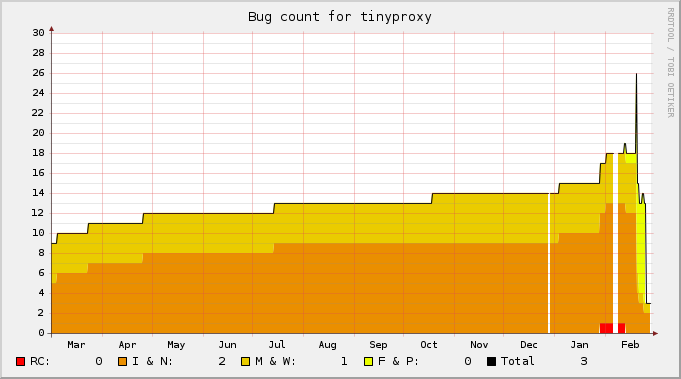
They were happy to get a few bugs and patches forwareded upstream, and asked me why all of this hadn't happened before. Pitty is that a few longstanding issues were well known in Debian but not so obvious for the new upstream maintainers, and are present in 1.8.0. Hopefully all will be dealt with in 1.8.1 or the next major version. The lesson is: if you work on an apparently abandoned package, after cleaning the mess in your NMU, try to spend 15 more minutes trying to contact upstream (if available), pointing them at the patch tracker and our list of bugs: chances are many are still useful. Also, contact the Debian maintainer, and if they ask you to take over, at least post a RFA so someone else can. If you're a Tinyproxy user, I'd be happy to hear if the current package in Debian unstable works for you. If you were having weird issues with 1.6.x, chances are 1.8 will fix them. The package can be installed on stable with no extra dependencies, so if you're feeling adventurous, go ahead and upgrade.
Russell Coker: Carpal Tunnel Syndrome

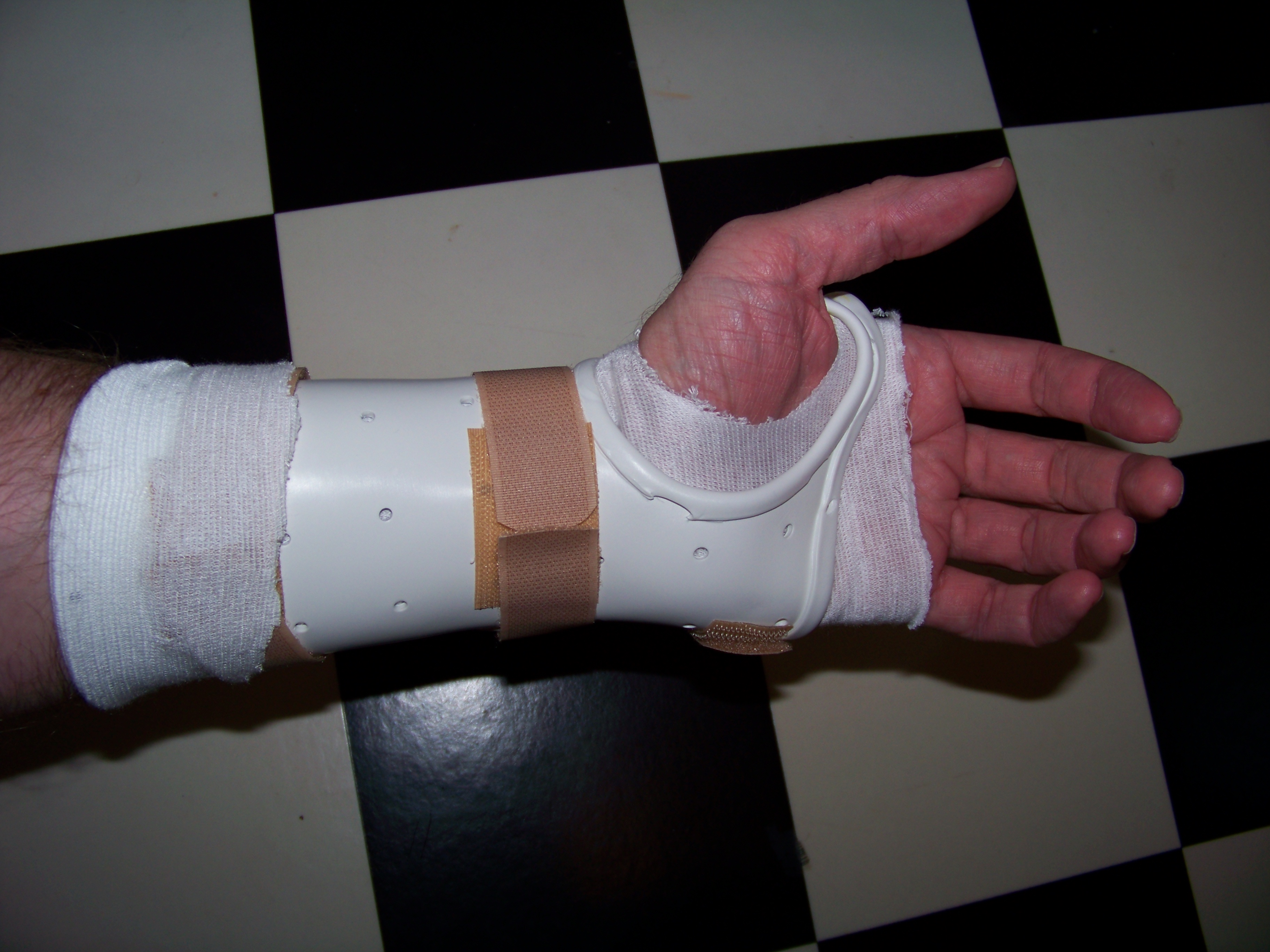
Wrist brace for Carpal Tunnel Syndrome Diagnosis A few weeks ago I was referred to a specialist for the treatment of Carpal Tunnel Syndrome. I first noticed the symptoms in early January, it started happening at night with a partial numbness in the fingers of my left hand. I didn t think much of it at first as it s the expected symptom of sleeping in a position that reduces the blood flow. But when it kept happening with my left hand and never happening with my right and then started getting worse (including happening during the day) I sought medical advice. The doctor asked me to bend my hand down (as if trying to touch my left elbow with the fingers of my left hand). Within about 10 seconds this caused numbness this result from bending one s wrist is a major symptom of CTS. Treatment On Thursday I saw a specialist about this, she agreed with the GP s diagnosis and made a wrist brace for me. She started by cutting off a length of a tube of elastic woven material (similar to a sock) and then cutting a thumb hole, that became the lining. Then to make the hard part she put a sheet of plastic in an electric saucepan (which had water simmering) until it started to melt and then used a spatula to fish it out. The melting temperature of the plastic wasn t that high (it was soft at about 50C when she put it on my arm), it wasn t at all sticky when it was partially melted, and it didn t seem to conduct heat well. After wearing the wrist brace non-stop for a few days I have noticed an improvement already. Hopefully I will make a full recovery in a matter of a month or so, I will probably have to wear a wrist brace when sleeping for the rest of my life, but that s no big deal it s more comfortable to sleep with a wrist brace than a partially numb hand. I ve also been prescribed a set of exercises to help remove scar tissue from the nerves. I haven t done them much yet. In terms of being annoying, the wrist-brace has 3mm diameter holes in a square grid pattern with a 25mm spacing. This doesn t let much air through and in warm weather my arm gets sweaty and starts to itch. I m thinking of drilling some extra holes to alleviate this the part which makes my arm itch doesn t need much mechanical strength. The only task which has been really impeded has been making peanut butter sandwiches, maybe it was making sandwiches not typing that caused CTS? ;) In any case I m not giving up typing but I would consider giving up peanut butter sandwiches. I really hope to avoid the surgical option, it doesn t seem pleasant at all. Other One final thing to note is that Repetitive Strain Injury (RSI) is entirely different. RSI is a non-specific pain associated with repetitive tasks while CTS is a specific problem in one or two nerves where they go through the wrist. RSI apparently tends to reduce the effective strength of the afflicted limb, while milder cases of CTS (such as mine) cause no decrease in strength of course a severe case of CTS results in muscle atrophy due to reduced nerve signals, but I shouldn t ever get that. Many people think that RSI and CTS are essentially the same thing I used to think that until a few weeks ago when I read the Wikipedia pages in preparation to seeing a doctor about it. I want to obtain some of the plastic that was used to make my wrist brace, it could be really handy to have something that convenient for making boxes, containers, and supports for various things among other things it doesn t appear to generate static. The low melting temperature will prevent certain computer uses (the hot air that comes out of a cooling system for a high-end CPU would probably melt it), but it could probably be used to make the case for an Opteron system with careful design. I m guessing that the cost of the plastic is a very small portion of the $150 I paid to the specialist so it shouldn t be that expensive and I m sure it would be even cheaper if it wasn t bought from a medical supply store. If I ever get time to do some work on an Arduino system or something similar then I will definitely try to get some of this plastic for the case. Also the Wikipedia page has a picture of what appears to be a mass-produced wrist brace. I think that it might be improved by having the picture of the custom one that I wear added to the page. I unconditionally license the picture for free use by Wikipedia and others under the CC by attribution license. So if anyone thinks that a picture of my hand would improve Wikipedia then they can make the change.

Steve Kemp: Fire and wind come from the sky, from the gods of the sky.

Recently I was flirting with the idea of creating an online game, but I got distracted by wondering how to make the back-end more flexible. To communicate the state of the game to N connected clients I figured I needed some kind of server which would accept "join"/"quit" requests and then make changes available. To that end I came up with the idea that a client would make requests via HTTP such as:
http://example.com/server/game/chess/join
This would regard the originating client as part of a new chess game, for example, and return a UID identifying the "game channel".
http://example.com/server/changes/1-2-3-4
This will retrieve a list of all events which had occurred in the game which had not already been sent. (Here 1-2-3-4 is obviously the UID previously allocated.)
http://example.com/server/submit/1-2-3-4/move
This would submit the move "move" to the server.
After mulling this over for a while it seemed like a great reusable solution, I'd make an initial "join" request, then repeated polling with the allocated UID would allow game moves to be observed. All using JSON over HTTP as the transport. It was only this morning that I realised I'd have saved a lot of time if I'd just proxied requests to a private IRC server, as the functionality is essentially the same. Still I'm sure this pattern of "join"/"poll"/"quit" could be useful for a lot of dynamic websites, even in the non-gaming world. So although the idea was mostly shelved it was an interesting thing to have experimented with. D'oh. ObFilm: Conan The Barbarian

Kees Cook: egosurfing with git

I m never sure when my commits to Linux actually make it into an official release. Luckily, since releases are tagged, I can use git tag --contains COMMIT to find them. So, in a stunning display of inefficiency, here s what I use to find my commits:

git log --author='Kees Cook' --pretty=oneline   \
while read commit name; do \
    echo $(git tag --contains $commit   head -n1): "$name"; \
done
Which lets me know where my code is with respect to releases:
v2.6.33: x86, mm: Report state of NX protections during boot
v2.6.33: sysctl: require CAP_SYS_RAWIO to set mmap_min_addr
v2.6.32: proc: fix reported unit for RLIMIT_CPU
v2.6.31: modules: sysctl to block module loading
...

Ben Hutchings: This season I have mostly been building kernels

As some people noticed, a driver update to support a major hardware release in my day job and a long series of trivial patches motivated by Debian kernel work combined to make me joint most prolific change author for Linux 2.6.33. This was a fluke, and 2.6.34 is likely to be fairly quiet for me. Team work Meanwhile the kernel team is still working hard on fixing bugs in Linux 2.6.32. As previously announced, this kernel version will be used in both Debian 6.0 'squeeze' and Ubuntu 10.04 LTS. It is also known to be the kernel version for RHEL 6 though this has not been officially announced. If you find a serious bug that was fixed in 2.6.33 or later, please ask the author to send the fix to stable@kernel.org so that it will be included in all these distributions. Note that this happens automatically for commits with the line 'Cc: stable@kernel.org' in their description. We are also continuing to backport new drivers and new hardware support in existing drivers into Debian 5.0 'lenny' (stable). Missing support for common hardware is considered an important bug and suitable for stable updates. However, if there were major changes to a driver before those that added new hardware support, we may be unable to produce a backport. We are not able to carry out comprehensive hardware testing and do not want to risk a regression existing hardware support. libata transition - call for testing Finally, a major change I have been working on is the transition from the old IDE drivers for PATA controllers to new drivers based on libata. The old IDE subsystem is no longer developed and some drivers do not properly support all the hardware that their libata-based counterparts do. However, while the IDE drivers generate device names beginning with 'hd', libata presents PATA devices as SCSI devices and generates device names beginning with 'sd'. In a system that already has other SCSI or SCSI-like disks, names may change somewhat unpredictably. Similar problems exist for PATA CD/DVD and tape devices. So, while the transition doesn't involve any kernel hacking, it does require a complex upgrade process. Any configuration files that refer to IDE or SCSI device names may need to be changed. It is not enough to switch to only SCSI device names, since we cannot know what they are in advance and the configuration files should continue to work with kernel versions from before and after the transition. In the case of disks we can normally use the partition label or UUID: many tools understand the LABEL= and UUID= syntax, and for others we can refer to the symlinks under /dev/disk created by udev. In the case of CD/DVD devices, we can use the aliases /dev/cdrom etc. created by udev. In the case of tape devices, however, you're on your own. In experimental, kernel image packages depend on a new package linux-base which implements this transition (from 2.6.33-1~experimental.2; the previous version was broken). The postinst script will prompt you to make changes automatically or manually. It can convert most bootloader configuration files, /etc/fstab, the udev CD aliases configuration and the initramfs-tools resume partition. It can also label partitions that don't have a label or UUID. Please do test it and verify that its changes are correct. All changed configuration files are backed up with a suffix of '.old' (or '^old' in one case).
Russell Coker: I have a Chocolate Fridge

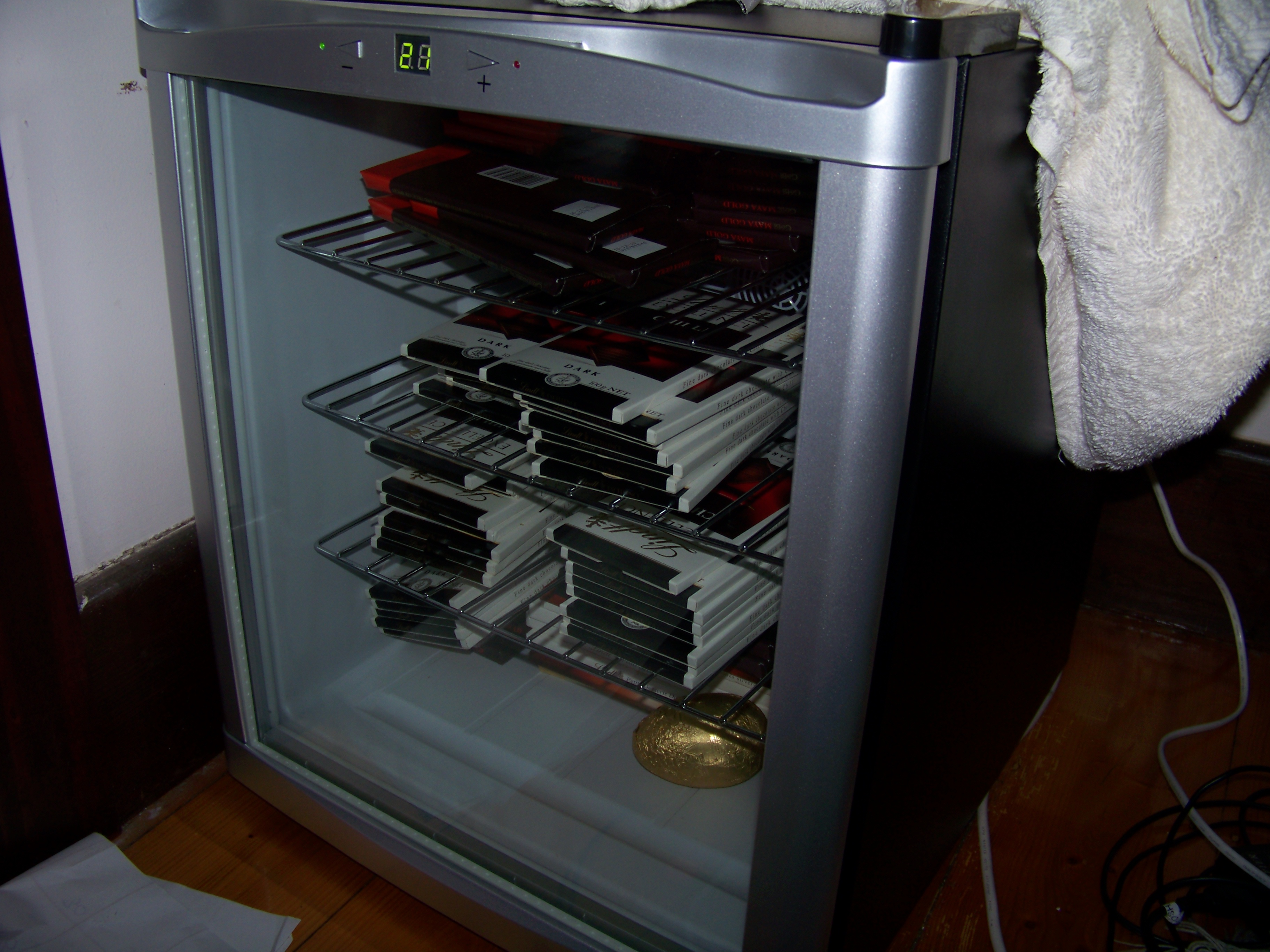
A small fridge full of chocolate
The German supermarket chain Aldi recently had a special deal of a wine-fridge for $99. A wine fridge really isn t that specialised for wine, it is merely a fridge that has a heater and is designed for temperatures in the 11C to 18C range. An good wine fridge will have special wood (or plastic if cheap) holders for wine bottles. A particularly cheap wine fridge (such as the one from Aldi) doesn t even have special holders for wine bottles. But this does however make it more convenient for storing other things. In the hotter days in summer outside temperatures of over 35C are common and it s possible for an uncommonly hot day to be in excess of 45C. My home air-conditioning system is only able to keep the ambient temperature about 10C cooler than the outside temperature if there are a few hot days in a row. According to the Wikipedia page the best chocolate is supposed to have type V crystals which melt at 34C [1]. So if the outside temperature is 45C then the temperature inside my home is almost guaranteed to be hot enough to melt chocolate. If I m not at home (and therefore the air-conditioner is off) during a moderately hot day then it s common to have a temperature of about 30C inside my house. The Wikipedia page also notes that moving chocolate between extremes of temperature can cause an oily texture and that storing chocolate in the fridge can cause a white discoloration. I ve experienced these effects and find that they significantly decrease the enjoyment of chocolate. So now I have a fridge in my computer room set to 16C because according to Wikipedia the ideal temperature range for storing chocolate is from 15C to 17C (the photo was taken shortly after turning it on and it hadn t reached the correct temperature). Every computer room should have a fridge full of chocolate! If my stockpile of chocolate reduces I may even put some wine in the fridge (I could probably fit some now if I organised the chocolate in a better way). But that depends on the supermarkets, if they have a special on Green and Black s Maya Gold organic fair-trade chocolate then my fridge will become full again.

Next.

Previous.

