Search Results: "uli"

11 February 2011

Julien Viard de Galbert: Triage X Bugs of the Week (TXBW12)

This report is 2 week late It was delayed by an important event, not the release of squeeze, but the birth of my first child: C lestine is born Monday the 31th of January. My wife and C lestine are both fine now but the firsts days were not that easy. I m starting to recover from the lack of sleep, but I m still very late on my debian tasks ;) So I guess I just drop Triaging for week 13, 14 and maybe 15 Now the bugs I triaged just before : The X Strike Force (still) needs you ! You can have a look at the X Strike Force Bug Closing Procedure and check XSF unstable bugs sorted by date.

8 February 2011

Cyril Brulebois: Debian XSF News #4

Here comes the forth Debian XSF News issue! I usually try to keep the items sorted chronologically (but grouped by topic when possible), so if you re wondering about the current status of X in unstable, make sure you read the last entry.

Julien Danjou: Announcing Org-contacts

When I started to use Emacs, I got hooked by many stuff like Gnus and Org-mode. One thing I quickly started to hate is how the Lisp code can be old and unmaintained. That especially applies to BBDB, which has been unmaintained for years, and has very very very old and obsolete code. Therefore I've decided to develop my own BBDB replacement based on my lovely Org-mode. It's called org-contacts, and it allows you to handle your contact like anything you would handle in Org. This way you can manage them the way you want, without any preset fields or any assumptions like BBDB has. I had the chance to present it at the Paris OrgCamp a couple of weeks ago, and due to the enthusiastic audience I had, I'm now releasing it to the wide Internet. Flattr this

5 February 2011

Julien Blache: pommed v1.36/v1.37: updates, fixes, MacBook7,1

pommed v1.36 is out and brings support for the MacBook7,1, along with a few fixes and updates. A typo in the pmac keyboard backlight has been fixed, so fading now works there too. Product IDs for the ANSI and JIS keyboard variants for pmac machines were also added. It s been like forever since I last touched that code; not a lot of people still use those (great) machines. This release also contains a small update that will make it compatible with future kernel releases as applesmc will no longer have a fixed a name and location in sysfs. Update: I just noticed a bug in 1.36, so 1.37 is out now. It also contains two patches that were submitted through Alioth.

1 February 2011

Cyril Brulebois: Debian XSF News #3

Time for a third Debian XSF News issue! Debian XSF News #3 It s been a year On a personal note, it s been a year to the day since I first looked into X. After having hacked on the Debian Installer to make it use X.Org instead of DirectFB, I did some heavy bug triaging, resulting in a drop in the xorg-server bug count in March. The same happened past week as written above, resulting in a second drop. In the meanwhile, the bug count remained more or less stable, since we try to reply quickly to new bugs, and since Julien Viard de Galbert does bug triaging on a weekly basis: BTS graph for xorg-server One might ask: what does maintaining X mean?

31 January 2011

Julien Danjou: Naquadah theme for Emacs

I often post Emacs screenshots on this blog, and consequently receive a bunch of request for my Emacs theme. Therefore I decided to publish it. Flattr this

28 January 2011

Amaya Rodrigo: Indignez Vous!

If There is any sort of food for thought worth reading, this is it.
INDIGNEZ-VOUS! GET ANGRY! CRY OUT by St phane Hessel


St phane Hessel, author of Indignez-vous!
After 93 years, it is almost the final act. The end for me is not very far off any more. But it still leaves me a chance to be able to remind others of what acted as the basis of my political engagement. It was the years of resistance to the Nazi occupation -- and the program of social rights worked out 66 years ago by the National Council of the Resistance!

It is to Jean Moulin [murdered founder of the Council] that we owe, as part of this Council, the uniting of all elements of occupied France -- the movements, the parties, the labor unions -- to proclaim their membership in Fighting France, and we owe this to the only leader that it acknowledged, General de Gaulle. From London, where I had joined de Gaulle in March 1941, I learned that this Council had completed a program and adopted it on March 15th, 1944, that offered for liberated France a group of principles and values on which would rest the modern democracy of our country.

These principles and these values, we need today more than ever. It is up to us to see to it, all together, that our society becomes a society of which we are proud, not this society of immigrants without papers -- expulsions, suspicion regarding the immigrants. Not this society where they call into question social security and national retirement and health plans. Not this society where mass media are in the hands of the rich. These are things that we would have refused to give in to if we had been the true heirs of the National Council of the Resistance.


From 1945, after a dreadful drama [WWII], it was an ambitious
resurrection of society to which the remaining contingent of the Council
of the Resistance devoted itself. Let us remember them while creating
national health and pensions plans such as the Resistance wished, as its
program stipulated, "a full plan of French national health and social
security, aimed at assuring all citizens the means of existence whenever
they are unable to obtain them by a job; a retirement allowing the old
workers to finish their days with dignity."

The sources of energy, electricity, and gas, mines, the big banks, were
nationalized. Now this was as the program recommended: "... the return
to the nation of big monopolized means of production, fruits of common
labor, sources of energy, wealth from the mines, from insurance
companies and from big banks; the institution of a true economic and
social democracy involving the ousting of the big economic and financial
fiefdoms from the direction of the economy."

General interest must dominate over special interest. The just man
believes that wealth created in the realm of labor should dominate over
the power of money.

The Resistance proposed, "a rational organization of the economy
assuring the subordination of special interests to general interest, and
the emancipation of 'slaves' of the professional dictatorship that was
instituted just as in the fascist states," which had used the interim
[for two years after the war] government of the Republic as an agent.

A true democracy needs an independent press, and the Resistance
acknowledged it, demanded it, by defending "the freedom of the press,
its honor, and its independence from the State, the power of money and
foreign influence." This is what relieved restrictions on the press from
1944 on. And press freedom is definitely what is in danger today.

The Resistance called for a "real possibility for all French children to
benefit from the most advanced education," without discrimination.
Reforms offered in 2008 go contrary to this plan. Young teachers, whose
actions I support, went so far as refusing to apply them, and they saw
their salaries cut by way of punishment. They were indignant,
"disobeyed," judging these reforms too far from the ideal of the
democratic school, too much in the service of a society of commerce and
not developing the inventive and critical mind enough. 2

All the foundations of the social conquests of the Resistance are
threatened today.

The motive of the Resistance: indignation (Indignez-vous!)

Some dare to say to us that the State cannot afford the expenses of
these measures for citizens any more. But how can there be today a lack
of money to support and extend these conquests while the production of
wealth has been considerably augmented since the Liberation period when
Europe was in ruins? On the contrary, the problem is the power of money,
so much opposed by the Resistance, and of the big, boldfaced, selfish
man, with his own servants in the highest spheres of the State.

Banks, since privatized again, have proved to be concerned foremost for
their dividends and for the very high salaries of their leaders, not the
general interest. The disparity between the poorest and the richest has
never been so great, and amassing money, competition, so encouraged.

The basic motive of the Resistance was indignation!

We, the veterans of the resistance movements and combat forces of Free
France, we call on the young generation to live by, to transmit, the
legacy of the Resistance and its ideals. We say to them: Take our place,
"Indignez-vous!" [Get angry! or Cry out!].

The political, economic, intellectual leaders, and the whole society do
not have to give in, nor allow oppression by an actual international
dictatorship of the financial markets, which threatens peace and
democracy.

I wish for you all, each of you, to have your own motive for
indignation. It is precious. When something outrages you as I was
outraged by Nazism, then people become militant, strong, and engaged.
They join this current of history, and the great current of history must
continue thanks to each individual. And this current goes towards more
justice, more freedom, but not this unbridled freedom of the fox in the
henhouse. The rights contained in the UN Universal Declaration of Human
Rights of 1948 are just that, universal.

If you meet somebody who does not benefit from it, feel sorry for them
but help them to win their rights.

Two visions of history

When I try to understand what caused fascism, what made it so we were
overcome by Hitler and the Vichy [French government that collaborated
with Hitler], I tell myself that the propertied, with their selfishness,
were terrifically afraid of Bolshevik revolution. They were allowed to
lead with their fear.

But if, today as then, an active minority stands up, it will be enough;
we shall be the leavening that makes the bread rise. Certainly, the
experience of a very old person like me, born in 1917, is different from
the experience of the today's young persons. I often ask professors for
the opportunity to interact with their students, and I say to them: You
don't have the same obvious reasons to engage you. For us, to resist was
not to accept German occupation, defeat. It was comparatively simple.
Simple as what followed, decolonization. Then the war in Algeria.

It was necessary that Algeria become independent, it was obvious. As for
Stalin, we all applauded the victory of the Red Army against the Nazis
in 1943. But already we had known about the big Stalinist trials of
1935, and even if it was necessary to keep an ear open towards communism
to compensate against American capitalism, the necessity to oppose this
unbearable form of totalitarianism had established itself as an
obviousness. My long life presented a succession of reasons to outrage
me.

These reasons were born less from an emotion than a deliberate
commitment. As a young student at normal school [teachers college] I was
very influenced by Sartre, a fellow student. His "Nausea" [a novel],
"The Wall," [play], and "The Being and Nothingness" [essay] were very
important in the training of my thought. Sartre taught us, "You are
responsible as individuals." It was a libertarian message. The
responsibility of a person can not be assigned by a power or an
authority. On the contrary, it is necessary to get involved in the name
of one's responsibility as a human being.

When I entered the French Ecole Normale Superieure, Ulm Street, in Paris
in 1939, I entered it as a fervent adherent of the philosopher Hegel,
and I adhered to the thought of Maurice Merleau-Ponty. His teaching
explored concrete experience, that of the body and of its relations with
the senses, one big singular sense faced with a plurality of senses. But
my natural optimism, which wants all that is desirable to be possible,
carried me rather towards Hegel. Hegelism interprets the long history of
humanity as having a meaning: It is the freedom of man progressing step
by step. History is made of successive shocks, and the taking into
account of challenges. The history of societies thus advances; and in
the end, man having attained his full freedom, we have the democratic
state in its ideal form.

There is certainly another understanding of history. It says progress is
made by "freedom" of competition, striving for "always more"; it can be
as if living in a devastating hurricane. That's what it represented to a
friend of my father, the man who shared with him an effort to translate
into German "The Search for Time Lost" [novel] by Marcel Proust.

That was the German philosopher Walter Benjamin. He had drawn a
pessimistic view from a painting by the Swiss painter Paul Klee,
"Angelus Novus," where the face of the angel opens arms as if to contain
and push back a tempest, which he identifies with progress. For
Benjamin, who would commit suicide in September 1940 to escape Nazism,
the sense of history is the overpowering progression of disaster upon
disaster.

Indifference: the worst of attitudes

It is true the reasons to be indignant can seem today less clearly
related or the world too complex. Who's doing the ordering, who decides?
It is not always easy to differentiate between all the currents that
govern us. We are not any more dealing with a small elite whose joint
activities can be clearly seen. It is a vast world, of which we have a
feeling of interdependence.

We live in an interconnectivity as never before. But in this world there
still are intolerable things. To see them, it is well and necessary to
look, to search. I say to the young people, Search little, and that is
what you are going to find. The worst of attitudes is indifference, to
say "I can do nothing there, I'll just manage to get by." By including
yourself in that, you lose one of the essential elements that makes the
human being: the faculty of indignation and the commitment that is a
consequence of it.

They [young people] can already identify two big new challenges:

1. The huge gap which exists between the very poor and the very rich and
that does not cease increasing. It is an innovation of the 20th and 21st
centuries. The very poor in the today's world earn barely two dollars a
day. The new generation cannot let this gap become even greater. The
official reports alone should provoke a commitment.

2. Human rights and state of the planet: I had the chance after the
Liberation to join in the writing of the Universal Declaration of Human
Rights, adopted by the United Nations organization, on December 10th,
1948, in Paris at the palace of Chaillot. It was as principal private
secretary of Henry Laugier, the adjunct general-secretary of the UN, and
as and secretary of the Commission on Human Rights that I with others
was led to participate in the writing of this statement. I wouldn't know
how to forget the role in its elaboration of Ren Cassin, who was
national commissioner of justice and education in the government of Free
France in London in 1941 and won the Nobel peace prize in 1968, nor that
of Pierre Mend s-France in the Economic and Social Council, to whom the
text drafts we worked out were submitted before being considered by the
Third Committee (Social, Humanitarian and Cultural) of the General
Assembly. It was ratified by the 54 member states in session of the
United Nations, and I certified it as secretary.

It is to Ren Cassin that we owe the term "universal rights" instead of
"international rights" as offered by our American and British friends.
This [universal versus international] was key because, at the end of the
Second World War, what was at stake was to becomeereignty," which a
nation can emphasize while it devotes itself to crimes against humanity
on its own soil. Such was the case of Hitler, who felt himself supreme
and authorized to carry out a genocide. This universal statement owed
much to universal revulsion towards Nazism, fascism, and totalitarianism
-- and owes a lot, in our minds, to the spirit of the Resistance.

I had a feeling that it was necessary to move quickly so as not to be
dupes of the hypocrisy that there was in the UN membership, some whom
claimed these values already won but had no intention at all to promote
them faithfully -- claimed that we were trying to impose values on them.

I can not resist the desire to quote Article 15 of the Universal
Declaration of Human Rights (1948): "Everyone has the right to a
nationality." Article 22 says, "Everyone, as a member of society, has
the right to social security and is entitled to realization, through
national effort and international cooperation and in accordance with the
organization and resources of each State, of the economic, social and
cultural rights indispensable for his dignity and the free development
of his personality." And if this statement has a declarative scope, and
not statutory, the Declaration nevertheless has played a powerful role
since 1948. It saw colonized people take it up in their fight for
independence; it sowed minds in a battle for freedom.

I note with pleasure that in the course of last decades there has been
an increase in nongovernmental organizations (NGOs) and social movements
such as ATTAC (Association for the Taxation of Financial Transactions);

also FIDH (International Federation for Human Rights) and Amnesty
International, which are active and competitive. It is obvious that to
be effective today it is necessary to act in a network, to use all
modern means of communication.

To the young people, I say: Look around you, you will find topics that
justify your indignation facts about treatment of immigrants, of
"illegal" immigrants, of the Roma [aka Gypsies]. You will find concrete
situations that lead you to strong citizen action. Search and you shall
find!

My indignation regarding Palestine outrages by Israel [Indignez-vous!]

Today, my main indignation concerns Palestine, the Gaza Strip, and the
West Bank of Jordan. This conflict is outrageous. It is absolutely
essential to read the report by Richard Goldstone, of September 2009, on
Gaza, in which this South African, Jewish judge, who claims even to be a
Zionist, accuses the Israeli army of having committed "acts comparable
to war crimes and perhaps, in certain circumstances, crimes against
humanity" during its "Operation Cast Lead," which lasted three weeks.

I went back to Gaza in 2009 myself, when I was able to enter with my
wife thanks to our diplomatic passports, to study first-hand what this
report said. People who accompanied us were not authorized to enter the
Gaza Strip. There and in the West Bank of Jordan. We also visited the
Palestinian refugee camps set up from 1948 by the United Nations agency
UNRWA, where more than three million Palestinians expelled off their
lands by Israel wait even yet for a more and more problematical return.

As for Gaza, it is a roofless prison for one and a half million
Palestinians. A prison where people get organized just to survive.
Despite material destruction such as that of the Red Crescent hospital
by Operation Cast Lead, it is the behavior of the Gazans, their
patriotism, their love of the sea and beaches, their constant
preoccupation for the welfare of their children, who are innumerable and
cheerful, that haunt our memory. We were impressed by how ingeniously
they face up to all the scarcities that are imposed on them. We saw them
making bricks, for lack of cement, to rebuild the thousands of houses
destroyed by tanks. They confirmed to us that there had been 1400 deaths
including women, children, and oldsters in the Palestinian camp
during this Operation Cast Lead led by the Israeli army, compared to
only 50 injured men on the Israeli side. I share conclusions of the
South African judge. That Jews can, themselves, perpetrate war crimes is
unbearable. Alas, history does not give enough examples of people who
draw lessons from their own history. [The author, St phane Hessel, had
a Jewish father.]

Terrorism, or exasperation?

I know that Hamas [party of Palestine freedom fighters], which had won
the last legislative elections, could not help it that rockets were
launched on Israeli cities in response to the situation of isolation and
blockade in which Gazans exist. I think, naturally, that terrorism is
unacceptable; but it is necessary to acknowledge (from experience in
France) that when people are occupied by forces immensely superior to
their own, popular reaction cannot be altogether bloodless.

Does it serve Hamas to send rockets onto the town of Sd rot [Israeli
town across the border from Gaza]?

The answer is no. This does not serve their purpose, but they can
explain this gesture by the exasperation of Gazans. In the notion of
exasperation, it is necessary to understand violence as the regrettable
conclusion of situations not acceptable to those who are subjected them.

Thus, they can tell themselves, terrorism is a form of exasperation. And
that this "terrorism" is a misnomer. One should not have to resort to
this exasperation, but it is necessary to have hope. Exasperation is a
denial of hope. It is comprehensible, I would say almost natural, but it
still is not acceptable. Because it does not allow one to acquire
results that hope can possibly, eventually produce.

Nonviolence: the way we must learn to follow

I am persuaded that the future belongs to nonviolence, to reconciliation
of different cultures. It is by this way that humanity will have to
enter its next stage. But on this I agree with Sartre: We cannot excuse
the terrorists who throw bombs, but we can understand them. Sartre wrote
in 1947: "I recognize that violence in whatever form it may manifest
itself is a setback. But it is an inevitable setback because we are in a
world of violence. And if it is true that recourse to violence risks
perpetuating it, it is also true it is the sure means to make it stop."

To that I would add that nonviolence is a surer means of making violence
stop. One can not condone the terrorism, using Sartre or in the name of
this principle, during the war of Algeria, nor during the Munich Games
of 1972 the murder attempt made against Israeli athletes. Terrorism is
not productive, and Sartre himself would end up wondering at the end of
his life about the sense of violence and doubt its reason for being.

However, to proclaim "violence is not effective" is more important than
to know whether one must condemn or not those who devote themselves to
it. Terrorism is not effective. In the notion of effectiveness, a
bloodless hope is needed. If there is a violent hope, it is in the poem
of William Apollinaire "that hope is violent," and not in policy.

Sartre, in March 1980, within three weeks of his death, declared: "It is
necessary to try to explain why the world of today, which is horrible,
is only an instant in a long historical development, that hope always
has been one of the dominant forces in revolutions and insurrections,
and how I still feel hope as my conception of the future." [Note 5]

It is necessary to understand that violence turns its back on hope. It
is necessary to prefer to it hope, hope over violence. Nonviolence is
the way that we must learn to follow. So must the oppressors.
10

It is necessary to arrive at negotiations to remove oppression; it is
what will allow you to have no more terrorist violence. That's why you
should not let too much hate pile up.

The message of Mandela and Martin Luther King finds all its pertinence
in the world that overcame the confrontation of ideologies [e.g.,
Nazism] and conquered totalitarianism [e.g.,Hitler]. It is also a
message of hope in the capacity of modern societies to overcome
conflicts by a mutual understanding and a vigilant patience. To reach
that point is necessarily based on rights, against es, such as the
military intervention in Iraq.

We had this economic crisis, but we still did not initiate a new policy
of development. Also, the summit of Copenhagen against climatic warming
did not bring about a true policy for the preservation of the planet.

We are on a threshold between the terror of the first decade and the
possibilities of following decades. But it is necessary to hope, it is
always necessary to hope. The previous decade, that of 1990s, had been a
time of great progress. The United Nations had enough wisdom to call
conferences such as those of Rio on environment, in 1992, and that of
Beijing on women, in 1995. In September 2000, on the initiative of the
general secretary of United Nations, Kofi Annan, the 191 member
countries adopted a statement on the "eight objectives of the millennium
for development," by which they notably promised to reduce poverty in
the world by half before 2015.

My big regret is that neither Obama nor the European Union has yet
committed themselves to what should be the provision for a useful forum
bearing on the fundamental values.

Conclusion

How to conclude this call to be indignant? By saying still what, on the
occasion of the sixtieth anniversary of the program of the National
Council of the Resistance, we said on March 8th, 2004 -- we veterans of
the resistance movements and combat forces of Free France (1940-1945) --
that certainly "Nazism was conquered, thanks to the sacrifice of our
brothers and sisters of the Resistance and United Nations against
fascist barbarism. But this threat did not completely disappear, and our
anger against injustice is ever intact." [Note 6] Also, let us always be
called in "a truly peaceful insurrection against means of mass
communication that offer as a vista for our youth only the consumption
of mass trivia, contempt of the weakest and the culture, a generalized
amnesia, and the hard competition of all against all."

To those who will make the 21st century, we say with our affection:

TO CREATE IS TO RESIST; TO RESIST IS TO CREATE.

Gunnar Wolf: Echoing Mohammed

For those of you who follow me through anything other than Planet Debian (who will surely tolerate this repetition): Interesting but frightful things are happening in North African countries. We saw what happened in Tunisia some days ago. Now, Egypt is a way larger, way more populous... And, dare I say, way more important country. Also, it is a country which borders Israel, where I lived in for ~18 months, and to which although I am today unaffiliated is very important for me. And what happens in Egypt will surely shape the whole mid-East. So, here goes a copy of Mohammed Sameer's post Not just a link to it, as he might have to take it down. Of course, Mohammed, if you in any way think I should delete this, please please tell me, and I will comply immediately.
Egypt has been fighting for freedom already for 3 days now. The whole country has experienced a large number of street demonstrations and protests within the last 3 days to be continued also on Friday, the 28th of January and afterwards. The protests' main goal is to oust dictator Hosni Mubarak's regime, which has been in power for almost 30 years. We want him out. A massacre has happened in Suez. Police used live ammunition and tear gas. There are unconfirmed rumors that the army might interfere. Even a bigger protest is supposed to take place a few hours from now. After the Prayer on Friday. The internet has been shutdown completely. Egypt is no longer online since Friday, the 28th of January 00:45 AM. Text messages to cell phones have been cut off too and all cell phones services will be following. No one knows exactly the intentions of the regime but it doesn't sound good. Please help us.
Please blog about it in English and in all languages.
Please spread the news everywhere.
Please talk to media.
Please petition your government if that will help. If there's anything that you can do, please do it and help us save the country and the people. More news from twitter #jan25.
...From what I read from Israeli sources, what worries them and many people around the world is that, although Egypt is formally a democratic country, the ruling party has seen towards having basically no oposition Besides the stubborn Islamic Brotherhood (very akin to Hamas). Now, the Islamic Brotherhood (as well as Hamas, and as well as most other Islamic regimes I know off, although I might be way mistaken) have got huge popular support because... They are true to their beliefs. In short, they are not corrupt Something that cannot be said about many political organizations around the globe. They are true to their word. And although many of us shiver at thinking of their word getting more power... It is only the Egyptians who should have a say on who rules Egypt. I honestly hope the Egyptian people get their long-owed self-determination. Of course, I hope Tunisians also get it, and not just a mirage of it. And every people, including us poor Mexicans who have neither had a chance to rule our destiny. And I hope it is a change for good, for tolerance, for peaceful coexistance with the neighbours, even if they are in many ways the rivals. [Update] I just found out that, as expected, the news have reached Slashdot: Egypt shuts off all Internet access. I'm sure you will find lots of more information there.

25 January 2011

John Goerzen: rdiff-backup, ZFS, and rsync scripts

rdiff-backup vs. ZFS As I ve been writing about backups, I ve gone ahead and run some tests with rdiff-backup. I have been using rdiff-backup personally for many years now probably since 2002, when I packaged it up for Debian. It s a nice, stable system, but I always like to look at other options for things every so often. rdiff-backup stores an uncompressed current mirror of the filesystem, similar to rsync. History is achieved by the use of compressed backwards binary deltas generated by rdiff (using the rsync algorithm). So, you can restore the current copy very easily a simple cp will do if you don t need to preserve permissions. rdiff-backup restores previous copies by applying all necessary binary deltas to generate the previous version. Things I like about rdiff-backup:
  1. Bandwidth-efficient
  2. Reasonably space-efficient, especially where history is concerned
  3. Easily scriptable and nice CLI
  4. Unlike tools such as duplicity, there is no need to periodically run full backups old backups can be deleted without impacting the ability to restore more current backups
Things I don t like about it:
  1. Speed. It can be really slow. Deleting 3 months worth of old history takes hours. It has to unlink vast numbers of files and that s pretty much it, but it does it really slowly. Restores, backups, etc. are all slow as well. Even just getting a list of your increment sizes so you d know how much space would be saved can take a very long time.
  2. The current backup copy is stored without any kind of compression, which is not at all space-efficient
  3. It creates vast numbers of little files that take forever to delete or summarize
So I thought I would examine how efficient ZFS would be. I wrote a script that would replay the rdiff-backup history first it would rsync the current copy onto the ZFS filesystem and make a ZFS snapshot. Then each previous version was processed by my script (rdiff-backup s files are sufficiently standard that a shell script can process them), and a ZFS snapshot created after each. This lets me directly compare the space used by rdiff-backup to that used by ZFS using actual history. I enabled gzip-3 compression and block dedup in ZFS. My backups were nearly 1TB in size and the amount of space I had available for ZFS was roughly 600GB, so I couldn t test all of them. As it happened, I tested the ones that were the worst-case scenario for ZFS: my photos, music collection, etc. These files had very little duplication and very little compressibility. Plus a backup of my regular server that was reasonably compressible. The total size of the data backed up with rdiff-backup was 583 GB. With ZFS, this came to 498GB. My dedup ratio on this was only 1.05 (meaning 5% or 25GB saved). The compression ratio was 1.12 (60GB saved). The combined ratio was 1.17 (85GB saved). Interestingly 498 + 85 = 583. Remember that the data under test here was mostly a worst-case scenario for ZFS. It would probably have done better had I had the time to throw the rest of my dataset at it (such as the 60GB backup of my iPod, which would have mostly deduplicated with the backup of my music server). One problem with ZFS is that dedup is very memory-hungry. This is common knowledge and it is advertised that you need to use roughly 2GB of RAM per TB of disk when using dedup. I don t have quite that much to dedicate to it, so ZFS got VERY slow and thrashed the disk a lot after the ARC grew to about 300MB. I found some tweakables in zfsrc and the zfs command that let me tweak the ARC cache to grow bigger. But the machine in question only has 2GB RAM, and is doing lots of other things as well, so this barely improved anything. Note that this dedup RAM requirement is not out of line with what is expected from these sorts of solutions. Even if I got absolutely stellar dedup ratio of 2:1, that would get me at most 1TB. The cost of buying a 1TB disk is less than the cost of upgrading my system to 4GB RAM, so dedup isn t worth it here. I think the lesson is: think carefully about where dedup makes sense. If you re storing a bunch of nearly-identical virtual machine images the sort of canonical use case for this go for it. A general fileserver well, maybe you should just add more disk instead of more RAM. Then that raises the question: if I don t need dedup from ZFS, do I bother with it at all, or just use ext4 and LVM snapshots? I think ZFS still makes sense, given its built-in support for compression and very fast snapshots LVM snapshots are known to cause serious degradation to write performance once enabled, which ZFS doesn t. So I plan to switch my backups to use ZFS. A few observations on this:
  1. Some testing suggests that the time to delete a few months of old snapshots will be a minute or two with ZFS compared to hours with rdiff-backup.
  2. ZFS has shown itself to be more space-efficient than rdiff-backup, even without dedup enabled.
  3. There are clear performance and convenience wins with ZFS.
  4. Backup Scripts So now comes the question of backup scripts. rsync is obviously a pretty nice choice here and if used with inplace perhaps even will play friendly with ZFS snapshots even if dedup is off. But let s say I m backing up a few machines at home, or perhaps dozens at work. There is a need to automate all of this. Specifically, there s a need to:
    1. Provide scheduling, making sure that we don t hammer the server with 30 clients all at once
    2. Provide for run before jobs to do things like snapshot databases
    3. Be silent on success and scream loudly via emails to administrators on any kind of error and keep backing up other systems when there is an error
    4. Create snapshots and provide an automated way to remove old snapshots (or mount them for reading, as ZFS-fuse doesn t support the .zfs snapshot directory yet)
    To date I haven t found anything that looks suitable. I found a shell script system called rsbackup that does a large part of this, but something about using a script whose homepage is a forum makes me less than 100% confident. On the securing the backups front, rsync comes with a good-looking rrsync script (inexplicably installed under /usr/share/doc/rsync/scripts instead of /usr/bin on Debian) that can help secure the SSH authorization. GNU rush also looks like a useful restricted shell.

24 January 2011

Julien Danjou: Emacs snapshot Ubuntu packages

Emacs snapshot packages for Ubuntu are now available, thanks to Dimitri Fontaine. Flattr this

23 January 2011

Julien Valroff: I m also going to

null It will be my first time there, I hope I'll manage to meet lots of people I only know through mailing-lists. See you there!

Julien Danjou: OrgCamp Paris 2011 review

Yesterday afternoon, I was at the first OrgCamp in Paris. It was my first attendance to a BarCamp, and I really liked it. It's basically the first geek event I do not find boring nor useless. There was about 18-20 persons participating, which was quite high, since we all initially though we would have been only 5. We had several presentations of various features and personal usages of Org-mode. For my part, I've quickly presented the agenda, and my BBDB replacement named org-contacts (I'll probably talk about it on this blog in another post later). The only downside was that Bastien (the new Org-mode maintainer) was not able to come and join us. On the other side, there were so much to tell for a first time, I did not have so much time to code. I only have been able to fix one bug reported during my agenda presentation. In the end, the overall atmosphere was very enthusiastic and friendly, which was extremely pleasant. The #org-mode-fr IRC channel has been created on Freenode, following this event. Feel free to join us. Since people liked it so badly, it seems there should be another barcamp in the next months. Stay tuned. Flattr this

22 January 2011

Matthew Palmer: Debugging Debian Installer

I've been doing a bit of work recently on the netcfg portion of Debian Installer, with the largest work so far being adding IPv6 support. Unlike most of the rest of d-i, netcfg is written in C, and as such suffers from some difficulties in the realm of debugging. Worse, the whole d-i environment is rather bereft of the usual debugging tools (strace, lsof, etc) -- but most importantly, in this case, gdb. Thanks to some hints from Julien Cristau, I was reminded of the existence of gdbserver, a small part of gdb that allows you to debug a program running on a remote machine, using a copy of gdb running on your local machine. It's designed for debugging embedded systems, I think, because all of the heavy lifting (symbol lookups, etc) happens on your local machine, not where gdbserver is running. Here are the steps I took to get a useful gdbserver session inside d-i:
  1. Get the gdb sources (apt-get source gdb) and drop into the gdbserver tree (cd gdb-x.y.z/gdb/gdbserver)
  2. Configure gdbserver to build a static binary (LDFLAGS=-static ./configure). This is necessary because you don't want to have to faff around with library dependencies inside the d-i environment. Then build gdbserver (make).
  3. Copy gdbserver over to your d-i machine/VM (I like using netcat; nc -l -p 31310 >/bin/gdbserver on the d-i machine, and nc IPADDR 31310 <gdbserver where you built gdbserver), then make it executable (chmod /bin/gdbserver)
  4. Fire up gdbserver in d-i, attaching it to the process you wish to debug: gdbserver host:31337 --attach PID
  5. Now things get a little trickier... on your local machine, you need to have an unstripped copy of the binary you're debugging. For me, this is easy, because I'm building netcfg myself (to keep the symbols, I just run DEB_BUILD_OPTIONS=noopt dpkg-buildpackage -b -rfakeroot) but I'm not sure what you'd do if you were just tracing around for fun.
  6. Once you've got your binary, just run gdb BINARY on your host machine to start gdb running.
  7. For the "even trickier" part of the show, your local machine also needs copies of all the libraries your binary is linked against. If you don't have this, when you try to debug you'll get all sorts of "wrong library or version mismatch?" errors, and your backtraces will likely break (amongst other things). Again, for me, this is easy, because I'm only running the d-i initrd, but if you're debugging something later in the installation process you might need to unpack some udebs somewhere. All I have to do is keep the initrd build tree around (which lives in the installer tree, under build/tmp/netboot/tree). Once you've got your tree of libraries, you can continue.
  8. You need to tell gdb about that tree of libraries, by running the following in gdb: set solib-absolute-prefix /path/to/library/tree
  9. Now, tell gdb to connect to your gdbserver: target remote IPADDR:31337 -- gdb should tell you "Remote debugging using IPADDR:31337", and the gdbserver should say "Remote debugging from host LOCALIP:31337".
  10. Now, you should be able to interact with the program being debugged just like any other. Enjoy!

Julien Viard de Galbert: Triage X Bugs of 2011 first Weeks (TXBW9-10-11)

I ve been lasy about the reporting lately, so this is a 3 weeks update at once ! The bug count according to udd is down to 818. I guess this is due to Kibi s triaging on input related bugs, but I helped to close a few one too ! I kept my week numbering as before, so now I know the first bugs I pinged are more that 11 weeks old. I guess if some submitter did not answer in that delay, they will probably never do it. I think the bug count will go down again ! ;) The X Strike Force (still) needs you ! You can have a look at the X Strike Force Bug Closing Procedure and check XSF unstable bugs sorted by date.

21 January 2011

Rapha&#235;l Hertzog: People behind Debian: Michael Vogt, synaptic and APT developer

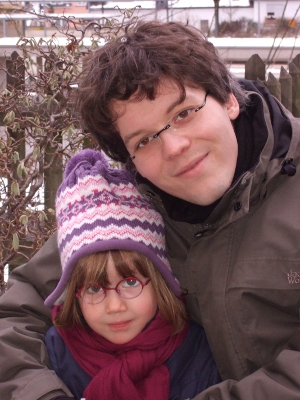
Michael and his daughter Marie

Michael has been around for more than 10 years and has always contributed to the APT software family. He s the author of the first real graphical interface to APT synaptic. Since then he created software-center as part of his work for Ubuntu. Being the most experienced APT developer, he s naturally the coordinator of the APT team. Check out what he has to say about APT s possible evolutions. My questions are in bold, the rest is by Michael. Who are you? My name is Michael Vogt, I m married and have two little daughters. We live in Germany (near to Trier) and I work for Canonical as a software developer. I joined Debian as a developer in early 2000 and started to contribute to Ubuntu in 2004. What s your biggest achievement within Debian or Ubuntu? I can not decide on a single one so I will just be a bit verbose. From the very beginning I was interested in improving the package manager experience and the UI on top for our users. I m proud of the work I did with synaptic. It was one of the earliest UIs on top of apt. Because of my work on synaptic I got into apt development as well and fixed bugs there and added new features. I still do most of the uploads here, but nowadays David Kalnischkies is the most active developer. I also wrote a bunch of tools like gdebi, update-notifier, update-manager, unattended-upgrade and software-properties to make the update/install situation for the user easier to deal with. Most of the tools are written in python so I added a lot of improvements to python-apt along the way, including the initial high level apt interface and a bunch of missing low-level apt_pkg features. Julian Andres Klode made a big push in this area recently and thanks to his effort the bindings are fully complete now and have good documentation. My most recent project is software-center. Its aim is to provide a UI strongly targeted for end-users. The goal of this project is to make finding and installing software easy and beautiful. We have a fantastic collection of software to offer and software-center tries to present it well (including screenshots, instant search results and soon ratings&reviews). This builds on great foundations like aptdaemon by Sebastian Heinlein, screenshots.debian.net by Christoph Haas, ddtp.debian.org by Michael Bramer, apt-xapian-index by Enrico Zini and many others (this is what I love about free software, it usually adds , rarely takes away ). What are your plans for Debian Wheezy? For apt I would love to see a more plugable architecture for the acquire system. It would be nice to be able to make apt-get update (and the frontends that use this from libapt) be able to download additional data (like debtags or additional index file that contains more end-user targeted information). I also want to add some scripts so that apt (optionally) creates btrfs snapshots on upgrade and provide some easy way to rollback in case of problems. There is also some interesting work going on around making the apt problem resolver a more plugable part. This way we should be able to do much faster development. software-center will get ratings&reviews in the upstream branch, I really hope we can get that into Wheezy. If you could spend all your time on Debian, what would you work on? In that case I would start with a refactor of apt to make it more robust about ABI breaks. It would be possible to move much faster once this problem is solved (its not even hard, it just need to be done). Then I would add a more complete testsuite. Another important problem to tackle is to make maintainer scripts more declarative. I triaged a lot of upgrade bug reports (mostly in ubuntu though) and a lot of them are caused by maintainer script failures. Worse is that depending on the error its really hard for the user to solve the problem. There is also a lot of code duplication. Having a central place that contains well tested code to do these jobs would be more robust. Triggers help us a lot here already, but I think there is still more room for improvement. What s the biggest problem of Debian? That s a hard question :) I mostly like Debian the way it is. What frustrated me in the past were flamewars that could have been avoided. To me being respectful to each other is important, I don t like flames and insults because I like solving problems and fighting like this rarely helps that. The other attitude I don t like is to blame people and complain instead of trying to help and be positive (the difference between it sucks because it does not support $foo instead of it would be so helpful if we had $foo because it enables me to let me do $bar ). For a long time, I had the feeling you were mostly alone working on APT and were just ensuring that it keeps working. Did you also had this feeling and are things better nowadays ? I felt a bit alone sometimes :) That being said, there were great people like Eugene V. Lyubimkin and Otavio Salvador during my time who did do a lot of good work (especially at release crunch times) and helped me with the maintenance (but got interested in other area than apt later). And now we have the unstoppable David Kalnischkies and Julian Andres Klode. Apt is too big for a single person, so I m very happy that especially David is doing superb work on the day-to-day tasks and fixes (plus big project like multiarch and the important but not very thankful testsuite work). We talk about apt stuff almost daily, doing code reviews and discuss bugs. This makes the development process much more fun and healthy. Julian Andres Klode is doing interesting work around making the resolver more plugable and Christian Perrier is as tireless as always when it comes to the translations merging. I did a quick grep over the bzr log output (including all branch merges) and count around ~4300 total commits (including all revisions of branches merged). Of that there ~950 commits from me plus an additional ~500 merges. It was more than just ensuring that it keeps working but I can see where this feeling comes from as I was never very verbose. Apt also was never my only project, I am involved in other upstream work like synaptic or update-manager or python-apt etc). This naturally reduced the time available to hack on apt and spend time doing the important day-to-day bug triage, response to mailing list messages etc. One the python-apt side Julian Andres Klode did great work to improve the code and the documentation. It s a really nice interface and if you need to do anything related to packages and love python I encourage you to try it. Its as simple as:
import apt
cache = apt.Cache()
cache["update-manager"].mark_install()
cache.commit()
Of course you can do much more with it (update-manager, software-center and lots of more tools use it). With pydoc apt you can get a good overview. The apt team always welcomes contributors. We have a mailing list and a irc channel and it s a great opportunity to solve real world problems. It does not matter if you want to help triage bugs or write documentation or write code, we welcome all contributors. You re also an Ubuntu developer employed by Canonical. Are you satisfied with the level of cooperation between both projects? What can we do to get Ubuntu to package new applications developed by Canonical directly in Debian? Again a tricky question :) When it comes to cooperation there is always room for improvement. I think (with my Canonical hat on) we do a lot better than we did in the past. And it s great to see the current DPL coming to Ubuntu events and talking about ways to improve the collaboration. One area that I feel that Debian would benefit is to be more positive about NMUs and shared source repositories (collab-maint and LowThresholdNmu are good steps here). The lower the cost is to push a patch/fix (e.g. via direct commit or upload) the more there will be. When it comes to getting packages into Debian I think the best solution is to have a person in Debian as a point of contact to help with that. Usually the amount of work is pretty small as the software will have a debian/* dir already with useful stuff in it. But it helps me a lot to have someone doing the Debian uploads, responding to the bugmail etc (even if the bugmail is just forwarded as upstream bugreports :) IMO it is a great opportunity especially for new packagers as they will not have to do a lot of packaging work to get those apps into Debian. This model works very well for me for e.g. gdebi (where Luca Falavigna is really helpful on the Debian side). Is there someone in Debian that you admire for his contributions? There are many people I admire. Probably too many to mention them all. I always find it hard to single out individual people because the project as a whole can be so proud of their achievements. The first name that comes to my mind is Jason Gunthorpe (the original apt author) who I ve never met. The next is Daniel Burrows who I met and was inspired by. David Kalnischkies is doing great work on apt. From contributing his first (small) patch to being able to virtually fix any problem and adding big features like multiarch support in about a year. Sebastian Heinlein for aptdaemon. Christian Perrier has always be one of my heroes because he cares so much about i18n. Christoph Haas for screenshots.debian.net, Michael Bramer for his work on debian translated package descriptions.
Thank you to Michael for the time spent answering my questions. I hope you enjoyed reading his answers as I did. Subscribe to my newsletter to get my monthly summary of the Debian/Ubuntu news and to not miss further interviews. You can also follow along on Identi.ca, Twitter and Facebook.

4 comments Liked this article? Click here. My blog is Flattr-enabled.

Cyril Brulebois: Debian XSF News #2

Time for a second Debian XSF News issue! I ll skip stuff related to the new katamari since I wrote about that already.

20 January 2011

John Goerzen: Research on deduplicating disk-based and cloud backups

Yesterday, I wrote about backing up to the cloud. I specifically was looking at cloud backup services. I ve been looking into various options there, but also various options for disk-based backups. I d like to have both onsite and offsite backups, so both types of backup are needed. Also, it is useful to think about how the two types of backups can be combined with minimal overhead. For the onsite backups, I d want to see:
  1. Preservation of ownership, permissions, etc.
  2. Preservation of symlinks and hardlinks
  3. Space-efficient representation of changes ideally binary deltas or block-level deduplication
  4. Ease of restoring
  5. Support for backing up Linux and Windows machines
Deduplicating Filesystems for Local Storage Although I initially thought of block-level deduplicating file systems as something to use for offsite backups, they could also make an excellent choice for onsite disk-based backups. rsync-based dedup backups One way to use them would be to simply rsync data to them each night. Since copies are essentially free, we could do (or use some optimized version of) cp -r current snapshot/2011-01-20 or some such to save off historic backups. Moreover, we d get dedup both across and within machines. And, many of these can use filesystem-level compression. The real upshot of this is that the entire history of the backups can be browsed as a mounted filesystem. It would be fast and easy to find files, especially when users call about that file that they deleted at some point in the past but they don t remember when, exactly what it was called, or exactly where it was stored. We can do a lot more with find and grep to locate these things than we could do with tools in Bacula (or any other backup program) restore console. Since it is a real mounted filesystem, we could also do fun things like make tarballs of it at will, zip parts up, scp them back to the file server, whatever. We could potentially even give users direct access to their files to restore things they need for themselves. The downside of this approach is that rsync can t store all the permissions unless it s running as root on the system. Wrappers such as rdup around rsync could help with that. Another downside is that there isn t a central scheduling/statistics service. We wouldn t want the backup system to be hammered by 20 servers trying to send it data at once. So there d be an element of rolling our own scripts, though not too bad. I d have preferred not to authorize a backup server with root-level access to dozens of machines, but may be inescapable in this instance. Bacula and dedup The other alternative I thought of system such as Bacula with disk-based volumes . A Bacula volume is normally a tape, but Bacula can just write them to disk files. This lets us use the powerful Bacula scheduling engine, logging service, pre-backup and post-backup jobs, etc. Normally this would be an egregious waste of disk space. Bacula, like most tape-heritage programs, will write out an entire new copy of a file if even one byte changes. I had thought that I could let block-level dedupe reduce the storage size of Bacula volumes, but after looking at the Bacula block format spec, this won t be possible as each block will have timestamps and such in it. The good things about this setup revolve around using the central Bacula director. We need only install bacula-fd on each server to be backed up, and it has a fairly limited set of things it can do. Bacula already has built-in support for defining simple or complicated retention policies. Its director will email us if there is a problem with anything. And its logs and catalog are already extensive and enable us to easily find out things such as how long backups take, how much space they consume, etc. And it backs up Windows machines intelligently and comprehensively in addition to POSIX ones. The downsides are, of course, that we don t have all the features we d get from having the entire history on the filesystem all at once, and far less efficient use of space. Not only that, but recovering from a disaster would require a more extensive bootstrapping process. A hybrid option may be possible: automatically unpacking bacula backups after they ve run onto the local filesystem. Dedupe should ensure this doesn t take additional space if the Bacula blocksize aligns with the filesystem blocksize. This is certainly not a given however. It may also make sense to use Bacula for Windows and rsync/rdup for Linux systems. This seems, however, rather wasteful and useless. Evaluation of deduplicating filesystems I set up and tested three deduplicating filesystems available for Linux: S3QL, SDFS, and zfs-fuse. I did not examine lessfs. I ran a similar set of tests for each:
  1. Copy /usr/bin into the fs with tar -cpf - /usr/bin tar -xvpf - -C /mnt/testfs
  2. Run commands to sync/flush the disk cache. Evaluate time and disk used at this point.
  3. Rerun the tar command, putting the contents into a slightly different path in the test filesystem. This should consume very little additional space since the files will have already been there. This will validate that dedupe works as expected, and provide a hint about its efficiency.
  4. Make a tarball of both directories from the dedup filesystem, writing it to /dev/zero (to test read performance)
I did not attempt to flush read caches during this, but I did flush write caches. The test system has 8GB RAM, 5GB of which was free or in use by a cache. The CPU is a Core2 6420 at 2.13GHz. The filesystems which created files atop an existing filesystem had ext4 mounted noatime beneath them. ZFS was mounted on an LVM LV. I also benchmarked native performance on ext4 as a baseline. The data set consists of 3232 files and 516MB. It contains hardlinks and symlinks. Here are my results. Please note the comments below as SDFS could not accurately complete the test.
Test ext4 S3QL SDFS zfs-fuse
First copy 1.59s 6m20s 2m2s 0m25s
Sync/Flush 8.0s 1m1s 0s 0s
Second copy+sync N/A 0m48s 1m48s 0m24s
Disk usage after 1st copy 516MB 156MB 791MB 201MB
Disk usage after 2nd copy N/A 157MB 823MB 208MB
Make tarball 0.2s 1m1s 2m22s 0m54s
Max RAM usage N/A 150MB 350MB 153MB
Compression none lzma none gzip-2
It should be mentioned that these tests pretty much ruled out SDFS. SDFS doesn t appear to support local compression, and it severely bloated the data store, which was much larger than the original data. Moreover, it permitted any user to create and modify files, even if the permissions bits said that the user couldn t. tar gave many errors unpacking symlinks onto the SDFS filesystem, and du -s on the result threw up errors as well. Besides that, I noted that find found 10 fewer files than in my source data. Between the huge memory consumption, the data integrity concerns, and inefficient disk storage, SDFS is out of the running for this project. S3QL is optimized for storage to S3, though it can also store its files locally or on an sftp server a nice touch. I suspect part of its performance problem stems from being designed for network backends, and using slow compression algorithms. S3QL worked fine, however, and produced no problems. Creating a checkpoint using s3qlcp (faster than cp since it doesn t have to read the data from the store) took 16s. zfs-fuse appears to be the most-used ZFS implementation on Linux at the moment. I set up a 2GB ZFS pool for this test, and set dedupe=on and compress=gzip-2. When I evaluated compression in the past, I hadn t looked at lzjb. I found a blog post comparing lzjb to the gzip options supported by zfs and wound up using gzip-2 for this test. ZFS really shone here. Compared to S3QL, it took 25s instead of over 6 minutes to copy the data over and took only 28% more space. I suspect that if I selected gzip -9 compression it would have been closer both in time and space to S3QL. But creating a ZFS snapshot was nearly instantaneous. Although ZFS-fuse probably doesn t have as many users as ZFS on Solaris, still it is available in Debian, and has a good backing behind it. I feel safer using it than I do using S3QL. So I think ZFS wins this comparison. I spent quite some time testing ZFS snapshots, which are instantaneous. (Incidentally, ZFS-fuse can t mount them directly as documented, so you create a clone of the snapshot and mount that.) They worked out as well as could be hoped. Due to dedupe, even deleting and recreating the entire content of the original filesystem resulted in less than 1MB additional storage used. I also tested creating multiple filesystems in the zpool, and confirmed that dedupe even works between filesystems. Incidentally wow, ZFS has a ton of awesome features. I see why you OpenSolaris people kept looking at us Linux folks with a sneer now. Only our project hasn t been killed by a new corporate overlord, so guess that maybe didn t work out so well for you <grin>. The Cloud Tie-In This discussion leaves another discussion: what to do about offsite backups? Assuming for the moment that I want to back them up over the Internet to some sort of cloud storage facility, there are about 3 options:
  1. Get an Amazon EC2 instance with EBS storage and rsync files to it. Perhaps run ZFS on that thing.
  2. Use a filesystem that can efficiently store data in S3 or Cloud Files (S3QL is the only contender here)
  3. Use a third-party backup product (JungleDisk appears to be the leading option)
There is something to be said for using a different tool for offsite backups if there is some tool-level issue, that could be helpful. One of the nice things about JungleDisk is that bandwidth is free, and disk is the same $0.15/GB-mo that RackSpace normally charges. JungleDisk also does block-level dedup, and has a central management interface. This all spells nice for us. The only remaining question would be whether to just use JungleDisk to back up the backup server, or to put it on each individual machine as well. If it just backs up the backup server, then administrative burdens are lower; we can back everything there up by default and just not worry about it. On the other hand, if there is a problem with our main backups, we could be really stuck. So I d say I m leaning towards ZFS plus some sort of rsync solution and JungleDisk for offsite. I had two people suggest CrashPlan Pro on my blog. It looks interesting, but is a very closed product which makes me nervous. I like using standard tools and formats gives me more peace of mind, control, and recovery options. CrashPlan Pro supports multiple destinations and says that they do cloud hosting, but don t list pricing anywhere. So I ll probably not mess with it. I m still very interested in what comments people may have on all this. Let me know!

Julien Danjou: Code fontification with Gnus and Org-mode

I've added code fontification using Org src blocks inside Gnus. This interprets the block as an Org buffer and fontify it accordingly if org-src-fontify-natively it set to t. Thanks to S bastien Vauban for the original idea and implementation. Now it works out of the box without any customization. Flattr this

Richard Darst: The DebConf talk selection and scheduling process

The DebConf talk selection process is in charge of selecting the talks at DebConf. Some of the reasons for having a talks team are to help ensure a high quality of talks, maintain a somewhat academic feeling for the conference, and to let attendees know what talks can be expected to be good.Even though there is a big talk selection process in advance, DebConf has always allowed attendees to schedule new talks during the conference - at DebConf10, these were called "ad-hoc" talks. At DC10, attendees could sign up for a room+time slot on a wiki page, and each night they would be added to the main schedule. In past years, this distinction had been called "official" (pre-selected) vs "non-official" (new ideas during DebConf) talks, which was extremely confusing to people. "Ad-hoc" talks are a very important part of DebConf: not all development meetings are pre-planned.Since we pretty much always surplus of talk rooms and times and we let people schedule talks during DebConf, people have asked: what is the purpose of talk selection? Are we going to let all talks be given? Are we going to reject talks just to say we selected them? When talks were "rejected" in the past, the speakers were told to just ask for a room during DebConf if they still wanted to give it. This question was raised on our mailing list. Even if there is a surplus of talk rooms, there are reasons for talk selection: it allows attendees to know what is most prepared, helps the video team to capture the best talks, lets talks be scheduled in the best room. You could also say it helps to organize talks into tracks and to collect abstracts for proceedings.For DebConf10, we introduced a "conference track" concept, a set of related talks which would be scheduled in the same room in sequence. This allowed a more structured conference for attendees, and perhaps recruiting speakers to fill in requested talks for the tracks. Example tracks from DebConf10 are Science, Enterprise, and Community Outreach. I would have liked to see some tracks more Debian related, such as: project infrastructure, project communication, project social issues, ..., but what we had was a good start that can be improved on, if the new team desires to.As for scheduling, there are two main parts: one phase before DebConf, assigning the selected talks to rooms and making the advance schedule. The other phase happens during DebConf and handles assigning rooms to people who want to do "ad-hoc" talks. The two phases aren't always done by the same person. The schedulers need to balance the expected audience and room capacity, need for video coverage, BOF vs auditorium style seating, not making talks overlap that are likely to appeal to the same audience, ... . The scheduling team works with the talk team, but doesn't necessarily have to be the same people.I'm very happy that there was good discussion about the selection and scheduling process for DebConf10. In the end, a talk selection and scheduling wiki page was created. This page had two main purposes. First, it discussed and documented the selection and scheduling process, so that it was transparent to people that year and provides a reference for future teams. Secondly, other people have added their proposed talks workflows, that they can be considered in future years.
Talk selection has many competing demands - because of the completeness of the wiki page, I'll just refer you there. The rest of this post mainly frames the types of questions the talks team has to face. If you have thoughts on the DebConf talk selection process, feel free to add your ideas to the talk selection process wiki page, or better yet, help out with the team this year.

19 January 2011

Evgeni Golov: funny spam

yes, I do collect funny spam ;)Today I will present you some spammy funny comments I got on my (wordpress-powered) blog in the last months.
  1. 2010/09/24 at 03:08
    I cant believe, Facebook is currently down with a DNS failure. I guess Facebook having some issues. Businesses are reporting a near impossible 480% increase in productivity
  2. 2010/10/25 at 11:07
    Not quite on topic BUT really important: Please guys, donate something for Haiti! I just came back from a trip down there and I have to say the situation is really terrible! It s soon christmas time, so please be so kind and do something good! Thanks
  3. 2010/10/27 at 11:07
    Hey, I can t view your site properly within Opera, I actually hope you look into fixing this.
  4. 2010/11/18 at 12:26
    Are you watch Sarah Palin s TV show? I saw the trailer & wtf? -__- She s like, This is so much better than being in politics. It s like she s doing this just because she is losser. o.O What do you think? Do you believe she can be the next american presiden? ..
  5. 2010/11/30 at 15:40
    Wende im Proze gegen J rg Kachelmann. Die des Publikumslieblings haben ihr Mandat niederlegt. Der Proze in Mannheim soll dennoch planm ig fortgesetzt werden. Es werde keinen Antrag auf Aussetzung des Prozesses geben, f gte Rechtsanwalt Ralf Hoecker hinzu. Der neue Strafverteidiger Johann Schwenn (Hamburg) und die seit Verfahrensbeginn anwesende Pflichtverteidigerin Andrea Comb werden top vorbereitet sein, sagte er weiter.
  6. 2010/12/09 at 17:31
    How I can download documents from WikiLeaks?
    Thanks
  7. 2010/12/10 at 10:09
    Hi, you should check out http://www.voteonwikileaks.com. It s sort of like a crowdsourced collection of arguments against Wikileaks. Considering you re a blogger, i think you d find it to be an interesting read
  8. 2010/12/16 at 18:38
    It appears as though Julian Assange will at least be out on bail any minute but what about Bradley Manning? Solitary confinement for seven months so far without being convicted of anything, without a trial, even. That s bad!
  9. 2010/12/24 at 09:03
    Gibt es ein Jailbreakme f r Nerdomaten? Gen gend Bugs sollte es im IE6 geben :D
  10. 2010/12/29 at 13:22
    Der hammer bei den dingern ist aber eigentlich, dass sie nicht mit win7 laufen sondern mit: XP!!!!!!! Das ist doch der Hammer oder? hab auch ein Beweisvideo vom Hochfahren des Teils
  11. 2010/12/30 at 05:03
    Widespread criticism of RealVNC vulnerability is fixed
    A security report claimed that RealVNC software virtual network a high-risk vulnerability could allow a malicious attacker does not need a password to login to a remote system
  12. 2011/01/05 at 18:10
    is it true that it is not possible to use that sky thing with verizon?
Sorry, some are in German ;)What s so funny about them you ask? Well, the do contain actual content (even if not always matching to the posts they were attached to), they look relevant to the time they were posted and still are spam: the links in the homepage field of the comment led to spamsites. Numbers 9 and 10 even funnier: they are exact copies of already present comments to the same post.And oh, I think WikiLeaks should leak a cable about downloading stuff from WikiLeaks ;)

Next.

Previous.