Search Results: "sten"

17 September 2017

Raphaël Hertzog: Freexian s report about Debian Long Term Support, August 2017

A Debian LTS logoLike each month, here comes a report about the work of paid contributors to Debian LTS. Individual reports In August, about 189 work hours have been dispatched among 12 paid contributors. Their reports are available: Evolution of the situation The number of sponsored hours is the same as last month. The security tracker currently lists 59 packages with a known CVE and the dla-needed.txt file 60. The number of packages with open issues decreased slightly compared to last month but we re not yet back to the usual situation. The number of CVE to fix per package tends to increase due to the increased usage of fuzzers. Thanks to our sponsors New sponsors are in bold.

No comment Liked this article? Click here. My blog is Flattr-enabled.

13 September 2017

Vincent Bernat: Route-based IPsec VPN on Linux with strongSwan

A common way to establish an IPsec tunnel on Linux is to use an IKE daemon, like the one from the strongSwan project, with a minimal configuration1:
conn V2-1
  left        = 2001:db8:1::1
  leftsubnet  = 2001:db8:a1::/64
  right       = 2001:db8:2::1
  rightsubnet = 2001:db8:a2::/64
  authby      = psk
  auto        = route
The same configuration can be used on both sides. Each side will figure out if it is left or right . The IPsec site-to-site tunnel endpoints are 2001:db8: 1::1 and 2001:db8: 2::1. The protected subnets are 2001:db8: a1::/64 and 2001:db8: a2::/64. As a result, strongSwan configures the following policies in the kernel:
$ ip xfrm policy
src 2001:db8:a1::/64 dst 2001:db8:a2::/64
        dir out priority 399999 ptype main
        tmpl src 2001:db8:1::1 dst 2001:db8:2::1
                proto esp reqid 4 mode tunnel
src 2001:db8:a2::/64 dst 2001:db8:a1::/64
        dir fwd priority 399999 ptype main
        tmpl src 2001:db8:2::1 dst 2001:db8:1::1
                proto esp reqid 4 mode tunnel
src 2001:db8:a2::/64 dst 2001:db8:a1::/64
        dir in priority 399999 ptype main
        tmpl src 2001:db8:2::1 dst 2001:db8:1::1
                proto esp reqid 4 mode tunnel
[ ]
This kind of IPsec tunnel is a policy-based VPN: encapsulation and decapsulation are governed by these policies. Each of them contains the following elements: When a matching policy is found, the kernel will look for a corresponding security association (using reqid and the endpoint source and destination addresses):
$ ip xfrm state
src 2001:db8:1::1 dst 2001:db8:2::1
        proto esp spi 0xc1890b6e reqid 4 mode tunnel
        replay-window 0 flag af-unspec
        auth-trunc hmac(sha256) 0x5b68[ ]8ba2904 128
        enc cbc(aes) 0x8e0e377ad8fd91e8553648340ff0fa06
        anti-replay context: seq 0x0, oseq 0x0, bitmap 0x00000000
[ ]
If no security association is found, the packet is put on hold and the IKE daemon is asked to negotiate an appropriate one. Otherwise, the packet is encapsulated. The receiving end identifies the appropriate security association using the SPI in the header. Two security associations are needed to establish a bidirectionnal tunnel:
$ tcpdump -pni eth0 -c2 -s0 esp
13:07:30.871150 IP6 2001:db8:1::1 > 2001:db8:2::1: ESP(spi=0xc1890b6e,seq=0x222)
13:07:30.872297 IP6 2001:db8:2::1 > 2001:db8:1::1: ESP(spi=0xcf2426b6,seq=0x204)
All IPsec implementations are compatible with policy-based VPNs. However, some configurations are difficult to implement. For example, consider the following proposition for redundant site-to-site VPNs: Redundant VPNs between 3 sites A possible configuration between V1-1 and V2-1 could be:
conn V1-1-to-V2-1
  left        = 2001:db8:1::1
  leftsubnet  = 2001:db8:a1::/64,2001:db8:a6::cc:1/128,2001:db8:a6::cc:5/128
  right       = 2001:db8:2::1
  rightsubnet = 2001:db8:a2::/64,2001:db8:a6::/64,2001:db8:a8::/64
  authby      = psk
  keyexchange = ikev2
  auto        = route
Each time a subnet is modified on one site, the configurations need to be updated on all sites. Moreover, overlapping subnets (2001:db8: a6::/64 on one side and 2001:db8: a6::cc:1/128 at the other) can also be problematic. The alternative is to use route-based VPNs: any packet traversing a pseudo-interface will be encapsulated using a security policy bound to the interface. This brings two features:
  1. Routing daemons can be used to distribute routes to be protected by the VPN. This decreases the administrative burden when many subnets are present on each side.
  2. Encapsulation and decapsulation can be executed in a different routing instance or namespace. This enables a clean separation between a private routing instance (where VPN users are) and a public routing instance (where VPN endpoints are).

Route-based VPN on Juniper Before looking at how to achieve that on Linux, let s have a look at the way it works with a JunOS-based platform (like a Juniper vSRX). This platform as long-standing history of supporting route-based VPNs (a feature already present in the Netscreen ISG platform). Let s assume we want to configure the IPsec VPN from V3-2 to V1-1. First, we need to configure the tunnel interface and bind it to the private routing instance containing only internal routes (with IPv4, they would have been RFC 1918 routes):
interfaces  
    st0  
        unit 1  
            family inet6  
                address 2001:db8:ff::7/127;


routing-instances  
    private  
        instance-type virtual-router;
        interface st0.1;
     
 
The second step is to configure the VPN:
security  
    /* Phase 1 configuration */
    ike  
        proposal IKE-P1  
            authentication-method pre-shared-keys;
            dh-group group20;
            encryption-algorithm aes-256-gcm;
         
        policy IKE-V1-1  
            mode main;
            proposals IKE-P1;
            pre-shared-key ascii-text "d8bdRxaY22oH1j89Z2nATeYyrXfP9ga6xC5mi0RG1uc";
         
        gateway GW-V1-1  
            ike-policy IKE-V1-1;
            address 2001:db8:1::1;
            external-interface lo0.1;
            general-ikeid;
            version v2-only;
         
     
    /* Phase 2 configuration */
    ipsec  
        proposal ESP-P2  
            protocol esp;
            encryption-algorithm aes-256-gcm;
         
        policy IPSEC-V1-1  
            perfect-forward-secrecy keys group20;
            proposals ESP-P2;
         
        vpn VPN-V1-1  
            bind-interface st0.1;
            df-bit copy;
            ike  
                gateway GW-V1-1;
                ipsec-policy IPSEC-V1-1;
             
            establish-tunnels on-traffic;


We get a route-based VPN because we bind the st0.1 interface to the VPN-V1-1 VPN. Once the VPN is up, any packet entering st0.1 will be encapsulated and sent to the 2001:db8: 1::1 endpoint. The last step is to configure BGP in the private routing instance to exchange routes with the remote site:
routing-instances  
    private  
        routing-options  
            router-id 1.0.3.2;
            maximum-paths 16;
         
        protocols  
            bgp  
                preference 140;
                log-updown;
                group v4-VPN  
                    type external;
                    local-as 65003;
                    hold-time 6;
                    neighbor 2001:db8:ff::6 peer-as 65001;
                    multipath;
                    export [ NEXT-HOP-SELF OUR-ROUTES NOTHING ];


The export filter OUR-ROUTES needs to select the routes to be advertised to the other peers. For example:
policy-options  
    policy-statement OUR-ROUTES  
        term 10  
            from  
                protocol ospf3;
                route-type internal;
             
            then  
                metric 0;
                accept;


The configuration needs to be repeated for the other peers. The complete version is available on GitHub. Once the BGP sessions are up, we start learning routes from the other sites. For example, here is the route for 2001:db8: a1::/64:
> show route 2001:db8:a1::/64 protocol bgp table private.inet6.0 best-path
private.inet6.0: 15 destinations, 19 routes (15 active, 0 holddown, 0 hidden)
+ = Active Route, - = Last Active, * = Both
2001:db8:a1::/64   *[BGP/140] 01:12:32, localpref 100, from 2001:db8:ff::6
                      AS path: 65001 I, validation-state: unverified
                      to 2001:db8:ff::6 via st0.1
                    > to 2001:db8:ff::14 via st0.2
It was learnt both from V1-1 (through st0.1) and V1-2 (through st0.2). The route is part of the private routing instance but encapsulated packets are sent/received in the public routing instance. No route-leaking is needed for this configuration. The VPN cannot be used as a gateway from internal hosts to external hosts (or vice-versa). This could also have been done with JunOS security policies (stateful firewall rules) but doing the separation with routing instances also ensure routes from different domains are not mixed and a simple policy misconfiguration won t lead to a disaster.

Route-based VPN on Linux Starting from Linux 3.15, a similar configuration is possible with the help of a virtual tunnel interface3. First, we create the private namespace:
# ip netns add private
# ip netns exec private sysctl -qw net.ipv6.conf.all.forwarding=1
Any private interface needs to be moved to this namespace (no IP is configured as we can use IPv6 link-local addresses):
# ip link set netns private dev eth1
# ip link set netns private dev eth2
# ip netns exec private ip link set up dev eth1
# ip netns exec private ip link set up dev eth2
Then, we create vti6, a tunnel interface (similar to st0.1 in the JunOS example):
# ip tunnel add vti6 \
   mode vti6 \
   local 2001:db8:1::1 \
   remote 2001:db8:3::2 \
   key 6
# ip link set netns private dev vti6
# ip netns exec private ip addr add 2001:db8:ff::6/127 dev vti6
# ip netns exec private sysctl -qw net.ipv4.conf.vti6.disable_policy=1
# ip netns exec private sysctl -qw net.ipv4.conf.vti6.disable_xfrm=1
# ip netns exec private ip link set vti6 mtu 1500
# ip netns exec private ip link set vti6 up
The tunnel interface is created in the initial namespace and moved to the private one. It will remember its original namespace where it will process encapsulated packets. Any packet entering the interface will temporarily get a firewall mark of 6 that will be used only to match the appropriate IPsec policy4 below. The kernel sets a low MTU on the interface to handle any possible combination of ciphers and protocols. We set it to 1500 and let PMTUD do its work. We can then configure strongSwan5:
conn V3-2
  left        = 2001:db8:1::1
  leftsubnet  = ::/0
  right       = 2001:db8:3::2
  rightsubnet = ::/0
  authby      = psk
  mark        = 6
  auto        = route
  keyexchange = ikev2
  keyingtries = %forever
  ike         = aes256gcm16-prfsha384-ecp384!
  esp         = aes256gcm16-prfsha384-ecp384!
  mobike      = no
The IKE daemon configures the following policies in the kernel:
$ ip xfrm policy
src ::/0 dst ::/0
        dir out priority 399999 ptype main
        mark 0x6/0xffffffff
        tmpl src 2001:db8:1::1 dst 2001:db8:3::2
                proto esp reqid 1 mode tunnel
src ::/0 dst ::/0
        dir fwd priority 399999 ptype main
        mark 0x6/0xffffffff
        tmpl src 2001:db8:3::2 dst 2001:db8:1::1
                proto esp reqid 1 mode tunnel
src ::/0 dst ::/0
        dir in priority 399999 ptype main
        mark 0x6/0xffffffff
        tmpl src 2001:db8:3::2 dst 2001:db8:1::1
                proto esp reqid 1 mode tunnel
[ ]
Those policies are used for any source or destination as long as the firewall mark is equal to 6, which matches the mark configured for the tunnel interface. The last step is to configure BGP to exchange routes. We can use BIRD for this:
router id 1.0.1.1;
protocol device  
   scan time 10;
 
protocol kernel  
   persist;
   learn;
   import all;
   export all;
   merge paths yes;
 
protocol bgp IBGP_V3_2  
   local 2001:db8:ff::6 as 65001;
   neighbor 2001:db8:ff::7 as 65003;
   import all;
   export where ifname ~ "eth*";
   preference 160;
   hold time 6;
 
Once BIRD is started in the private namespace, we can check routes are learned correctly:
$ ip netns exec private ip -6 route show 2001:db8:a3::/64
2001:db8:a3::/64 proto bird metric 1024
        nexthop via 2001:db8:ff::5  dev vti5 weight 1
        nexthop via 2001:db8:ff::7  dev vti6 weight 1
The above route was learnt from both V3-1 (through vti5) and V3-2 (through vti6). Like for the JunOS version, there is no route-leaking between the private namespace and the initial one. The VPN cannot be used as a gateway between the two namespaces, only for encapsulation. This also prevent a misconfiguration (for example, IKE daemon not running) from allowing packets to leave the private network. As a bonus, unencrypted traffic can be observed with tcpdump on the tunnel interface:
$ ip netns exec private tcpdump -pni vti6 icmp6
tcpdump: verbose output suppressed, use -v or -vv for full protocol decode
listening on vti6, link-type LINUX_SLL (Linux cooked), capture size 262144 bytes
20:51:15.258708 IP6 2001:db8:a1::1 > 2001:db8:a3::1: ICMP6, echo request, seq 69
20:51:15.260874 IP6 2001:db8:a3::1 > 2001:db8:a1::1: ICMP6, echo reply, seq 69
You can find all the configuration files for this example on GitHub. The documentation of strongSwan also features a page about route-based VPNs.

  1. Everything in this post should work with Libreswan.
  2. fwd is for incoming packets on non-local addresses. It only makes sense in transport mode and is a Linux-only particularity.
  3. Virtual tunnel interfaces (VTI) were introduced in Linux 3.6 (for IPv4) and Linux 3.12 (for IPv6). Appropriate namespace support was added in 3.15. KLIPS, an alternative out-of-tree stack available since Linux 2.2, also features tunnel interfaces.
  4. The mark is set right before doing a policy lookup and restored after that. Consequently, it doesn t affect other possible uses (filtering, routing). However, as Netfilter can also set a mark, one should be careful for conflicts.
  5. The ciphers used here are the strongest ones currently possible while keeping compatibility with JunOS. The documentation for strongSwan contains a complete list of supported algorithms as well as security recommendations to choose them.

12 September 2017

Markus Koschany: My Free Software Activities in August 2017

Welcome to gambaru.de. Here is my monthly report that covers what I have been doing for Debian. If you re interested in Java, Games and LTS topics, this might be interesting for you. DebConf 17 in Montreal I traveled to DebConf 17 in Montreal/Canada. I arrived on 04. August and met a lot of different people which I only knew by name so far. I think this is definitely one of the best aspects of real life meetings, putting names to faces and getting to know someone better. I totally enjoyed my stay and I would like to thank all the people who were involved in organizing this event. You rock! I also gave a talk about the The past, present and future of Debian Games , listened to numerous other talks and got a nice sunburn which luckily turned into a more brownish color when I returned home on 12. August. The only negative experience I made was with my airline which was supposed to fly me home to Frankfurt again. They decided to cancel the flight one hour before check-in for unknown reasons and just gave me a telephone number to sort things out. No support whatsoever. Fortunately (probably not for him) another DebConf attendee suffered the same fate and together we could find another flight with Royal Air Maroc the same day. And so we made a short trip to Casablanca/Morocco and eventually arrived at our final destination in Frankfurt a few hours later. So which airline should you avoid at all costs (they still haven t responded to my refund claims) ? It s WoW-Air from Iceland. (just wow) Debian Games Debian Java Debian LTS This was my eighteenth month as a paid contributor and I have been paid to work 20,25 hours on Debian LTS, a project started by Rapha l Hertzog. In that time I did the following: Non-maintainer upload Thanks for reading and see you next time.

10 September 2017

Adnan Hodzic: Secure traffic to ZNC on Synology with Let s Encrypt

I ve been using IRC since late 1990 s, and I continue to do so to this day due to it (still) being one of the driving development forces in various open source communities. Especially in Linux development and some of my acquintances I can only get in touch with via IRC :) My Setup On my Synology NAS I run ZNC (IRC bouncer/proxy) to which I connect using various IRC clients (irssi/XChat Azure/AndChat) from various platforms (Linux/Mac/Android). In this case ZNC serves as a gateway and no matter which device/client I connect from, I m always connected to same IRC servers/chat rooms/settings when I left off. This is all fine and dandy, but connecting from external networks to ZNC means you will hand in your ZNC credentials in plain text. Which is a problem for me, even thought we re only talking about IRC bouncer/proxy. With that said, how do we encrypt external traffic to our ZNC? HowTo: Chat securely with ZNC on Synology using Let s Encrypt SSL certificate For reference or more thorough explanation of some of the steps/topics please refer to: Secure (HTTPS) public access to Synology NAS using Let s Encrypt (free) SSL certificate

Requirements:

1: DNS setup Create A record for sub/domain you d like to use to connect to your ZNC and point it to your Synology NAS external (WAN) IP. For your reference, subdomain I ll use is: irc.hodzic.org 2: Create Let s Encrypt certificate
DSM: Control Panel > Security > Certificates > Add
Followed by:
Add a new certificate > Get a certificate from Let's Encrypt
Followed by adding domain name A record was created for in Step 1, i.e: Get a certificate from Let's Encrypt for irc.hodzic.org After certificate is created, don t forget to configure newly created certificate to point to correct domain name, i.e: Configure Let's Encrypt Certificate 3: Install ZNC In case you already have ZNC installed, I suggest you remove it and do a clean install. Mainly due to some problems with package in past, where ZNC wouldn t start automatically on boot which lead to creating projects like: synology-znc-autostart. In latest version, all of these problems have been fixed and couple of new features have been added. ZNC can be installed using Synology s Package Center, if community package sources are enabled. Which can simply be done by adding new package sources:
Name: SynoCommunity
Location: http://packages.synocommunity.com
Enable Community package sources in Synology Package Center To successfuly authenticate newly added source, under General tab, Trust Level should be set to Any publisher As part of installation process, ZNC config will be run with most sane/useful options and admin user will be created allowing you access to ZNC webadmin. 4: Secure access to ZNC webadmin Now we want to bind our sub/domain created in Step 1 to ZNC webadmin, and secure external access to it. This can be done by creating a reverse proxy. As part of this, you need to know which port has been allocated for SSL in ZNC Webadmin, i.e: ZNC Webadmin > Global settings - Listen Ports In this case, we can see it s 8251. Reverse Proxy can be created in:
DSM: Control Panel > Application Portal > Reverse Proxy > Create
Where sub/domain created in Step 1 needs to be point to ZNC SSL port on localhost, i.e: Reverse proxy: irc.hodzic.org setup ZNC Webadmin is now available via HTTPS on external network for the sub/domain you setup as part of Step 1, or in my case: ZNC webadmin (HTTPS) As part of this step, in ZNC webadmin I d advise you to create IRC servers and chatrooms you would like to connect to later. Step 5: Create .pem file from LetsEncrpyt certificate for ZNC to use On Synology, Let s Encrypt certificates are stored and located on:
/usr/syno/etc/certificate/_archive/
In case you have multiple certificates, based on date your certificate was created, you can determine in which directory is your newly generated certificated stored, i.e:
drwx------ 2 root root 4096 Sep 10 12:57 JeRh3Y
Once it s determined which certifiate is the one we want use, generate .pem by running following: sudo cat /usr/syno/etc/certificate/_archive/JeRh3Y/ privkey,cert,chain .pem > /usr/local/znc/var/znc.pem After this restart ZNC: sudo /var/packages/znc/scripts/start-stop-status stop && sudo /var/packages/znc/scripts/start-stop-status start 6: Configure IRC client In this example I ll use XChat Azure on MacOS, and same procedure should be identical for HexChat/XChat clients on any other platform. Altough all information is picked up from ZNC itself, user details will need to be filled in. In my setup I automatically connect to freenode and oftc networks, so I created two for local network and two for external network usage, later is the one we re concentrating on. On General tab of our newly created server, hostname for our server should be the sub/domain we ve setup as part of Step 1 , and port number should be the one we defined in Step 4 , SSL checkbox must be checked. Xchat Azure: Network list - General tab On Connecting tab Server password field needs to be filled in following format:
johndoe/freenode:password
Where, johndoe is ZNC username. freenode is ZNC network name, and password is ZNC password. Xchat Azure: Network list - Connecting tab freenode in this case must first be created as part of ZNC webadmin configuration, mentioned in step 4 . Same case is for oftc network configuration. As part of establishing the connection, information about our Let s Encrypt certificate will be displayed, after which connection will be established and you ll be automatically logged into all chatrooms. Happy hacking!

3 September 2017

Thorsten Alteholz: My Debian Activities in August 2017

FTP assistant This month I accepted 217 packages and rejected 16 uploads. Though this might seem to be a low number this month, I am very pleased about the total number of packages that have been accepted: 558. Debian LTS This was my thirty-eight month that I did some work for the Debian LTS initiative, started by Raphael Hertzog at Freexian. This month my all in all workload has been 20.25h. During that time I did LTS uploads of: I also did the upload and sent the DLA for [DLA 1061-1] newsbeuter security update Last but not least I also spent some time for frontdesk duties. Other stuff As announced last month I finished uploading all dependencies of glewlwyd and now we have an oauth2 server available in Debian. This month I am trying to really use it and will tell you about my experiences. As the severity of the gcc-7 bugs have been raised, I took care of: #853501, #853304, #853305, #853306, #853307, #853308 and #871088 I also uploaded a new version of duktape and now try to also provide a library that can be used in other packages. Last but not least my DOPOM of this month has been oysttyer. Actually it is a new package, but as ttytter has been abandonded upstream, this is the replacement. It is a fork so you should only get a new authorization key and simply use it as ttytter before.

31 August 2017

Paul Wise: FLOSS Activities August 2017

Changes

Issues

Review

Administration
  • myrepos: get commit/admin access from joeyh at DebConf17, add commit/admin access for other patch submitters, apply my stack of patches
  • Debian: fix weird log file issues, redirect hardware donor, cleaned up a weird dir, fix some OOB info, ask for TLS on meetings-archive.d.n, check an I/O error, restart broken stunnels, powercycle 1 borked machine,
  • Debian mentors: lintian/security updates & reboot
  • Debian wiki: remove some stray cache files, whitelist 3 email domains, whitelist some email addresses, disable 1 spammer account, disable 1 accounts with bouncing email,
  • Debian QA: apply patch to fix PTS watch file errors, deploy changes
  • Debian derivatives census: run scripts for Purism, remove some noise from logs, trigger a recheck, merge fix by Unit193, deploy changes
  • Openmoko: security updates, reboots, enable unattended-upgrades

Communication
  • Attended DebConf17 and provided some input in BoFs
  • Sent Misc Dev News #44
  • Invite Google gLinux (on IRC) to the Debian derivatives census
  • Welcome Sven Haardiek (of GreenboneOS) to the Debian derivatives census
  • Inquire about the status of Canaima

Sponsors The samba bug report was sponsored by my employer. All other work was done on a volunteer basis.

Chris Lamb: Free software activities in August 2017

Here is my monthly update covering what I have been doing in the free software world in August 2017 (previous month):
Reproducible builds

Whilst anyone can inspect the source code of free software for malicious flaws, most software is distributed pre-compiled to end users. The motivation behind the Reproducible Builds effort is to allow verification that no flaws have been introduced either maliciously or accidentally during this compilation process by promising identical results are always generated from a given source, thus allowing multiple third-parties to come to a consensus on whether a build was compromised. I have generously been awarded a grant from the Core Infrastructure Initiative to fund my work in this area. This month I:
  • Presented a status update at Debconf17 in Montr al, Canada alongside Holger Levsen, Maria Glukhova, Steven Chamberlain, Vagrant Cascadian, Valerie Young and Ximin Luo.
  • I worked on the following issues upstream:
    • glib2.0: Please make the output of gio-querymodules reproducible. (...)
    • gcab: Please make the output reproducible. (...)
    • gtk+2.0: Please make the immodules.cache files reproducible. (...)
    • desktop-file-utils: Please make the output reproducible. (...)
  • Within Debian:
  • Categorised a large number of packages and issues in the Reproducible Builds "notes" repository.
  • Worked on publishing our weekly reports. (#118, #119, #120, #121 & #122)

I also made the following changes to our tooling:
diffoscope

diffoscope is our in-depth and content-aware diff utility that can locate and diagnose reproducibility issues.

  • Use name attribute over path to avoid leaking comparison full path in output. (commit)
  • Add missing skip_unless_module_exists import. (commit)
  • Tidy diffoscope.progress and the XML comparator (commit, commit)

disorderfs

disorderfs is our FUSE-based filesystem that deliberately introduces non-determinism into directory system calls in order to flush out reproducibility issues.

  • Add a simple autopkgtest smoke test. (commit)


Debian
Patches contributed
  • openssh: Quote the IP address in ssh-keygen -f suggestions. (#872643)
  • libgfshare:
    • SIGSEGV if /dev/urandom is not accessible. (#873047)
    • Add bindnow hardening. (#872740)
    • Support nodoc build profile. (#872739)
  • devscripts:
  • memcached: Add hardening to systemd .service file. (#871610)
  • googler: Tidy long and short package descriptions. (#872461)
  • gnome-split: Homepage points to domain-parked website. (#873037)

Uploads
  • python-django 1:1.11.4-1 New upstream release.
  • redis:
    • 4:4.0.1-3 Drop yet more non-deterministic tests.
    • 4:4.0.1-4 Tighten systemd/seccomp hardening.
    • 4:4.0.1-5 Drop even more tests with timing issues.
    • 4:4.0.1-6 Don't install completions to /usr/share/bash-completion/completions/debian/bash_completion/.
    • 4:4.0.1-7 Don't let sentinel integration tests fail the build as they use too many timers to be meaningful. (#872075)
  • python-gflags 1.5.1-3 If SOURCE_DATE_EPOCH is set, either use that as a source of current dates or the UTC-version of the file's modification time (#836004), don't call update-alternatives --remove in postrm. update debian/watch/Homepage & refresh/tidy the packaging.
  • bfs 1.1.1-1 New upstream release, tidy autopkgtest & patches, organising the latter with Pq-Topic.
  • python-daiquiri 1.2.2-1 New upstream release, tidy autopkgtests & update travis.yml from travis.debian.net.
  • aptfs 2:0.10-2 Add upstream signing key, refer to /usr/share/common-licenses/GPL-3 in debian/copyright & tidy autopkgtests.
  • adminer 4.3.1-2 Add a simple autopkgtest & don't install the Selenium-based tests in the binary package.
  • zoneminder (1.30.4+dfsg-2) Prevent build failures with GCC 7 (#853717) & correct example /etc/fstab entries in README.Debian (#858673).

Finally, I reviewed and sponsored uploads of astral, inflection, more-itertools, trollius-redis & wolfssl.

Debian LTS

This month I have been paid to work 18 hours on Debian Long Term Support (LTS). In that time I did the following:
  • "Frontdesk" duties, triaging CVEs, etc.
  • Issued DLA 1049-1 for libsndfile preventing a remote denial of service attack.
  • Issued DLA 1052-1 against subversion to correct an arbitrary code execution vulnerability.
  • Issued DLA 1054-1 for the libgxps XML Paper Specification library to prevent a remote denial of service attack.
  • Issued DLA 1056-1 for cvs to prevent a command injection vulnerability.
  • Issued DLA 1059-1 for the strongswan VPN software to close a denial of service attack.

Debian bugs filed
  • wget: Please hash the hostname in ~/.wget-hsts files. (#870813)
  • debian-policy: Clarify whether mailing lists in Maintainers/Uploaders may be moderated. (#871534)
  • git-buildpackage: "pq export" discards text within square brackets. (#872354)
  • qa.debian.org: Escape HTML in debcheck before outputting. (#872646)
  • pristine-tar: Enable multithreaded compression in pristine-xz. (#873229)
  • tryton-meta: Please combine tryton-modules-* into a single source package with multiple binaries. (#873042)
  • azure-cli:
  • fwupd-tests: Don't ship test files to generic /usr/share/installed-tests dir. (#872458)
  • libvorbis: Maintainer fields points to a moderated mailing list. (#871258)
  • rmlint-gui: Ship a rmlint-gui binary. (#872162)
  • template-glib: debian/copyright references online source without quotation. (#873619)

FTP Team

As a Debian FTP assistant I ACCEPTed 147 packages: abiword, adacgi, adasockets, ahven, animal-sniffer, astral, astroidmail, at-at-clojure, audacious, backdoor-factory, bdfproxy, binutils, blag-fortune, bluez-qt, cheshire-clojure, core-match-clojure, core-memoize-clojure, cypari2, data-priority-map-clojure, debian-edu, debian-multimedia, deepin-gettext-tools, dehydrated-hook-ddns-tsig, diceware, dtksettings, emacs-ivy, farbfeld, gcc-7-cross-ports, git-lfs, glewlwyd, gnome-recipes, gnome-shell-extension-tilix-dropdown, gnupg2, golang-github-aliyun-aliyun-oss-go-sdk, golang-github-approvals-go-approval-tests, golang-github-cheekybits-is, golang-github-chzyer-readline, golang-github-denverdino-aliyungo, golang-github-glendc-gopher-json, golang-github-gophercloud-gophercloud, golang-github-hashicorp-go-rootcerts, golang-github-matryer-try, golang-github-opentracing-contrib-go-stdlib, golang-github-opentracing-opentracing-go, golang-github-tdewolff-buffer, golang-github-tdewolff-minify, golang-github-tdewolff-parse, golang-github-tdewolff-strconv, golang-github-tdewolff-test, golang-gopkg-go-playground-validator.v8, gprbuild, gsl, gtts, hunspell-dz, hyperlink, importmagic, inflection, insighttoolkit4, isa-support, jaraco.itertools, java-classpath-clojure, java-jmx-clojure, jellyfish1, lazymap-clojure, libblockdev, libbytesize, libconfig-zomg-perl, libdazzle, libglvnd, libjs-emojify, libjwt, libmysofa, libundead, linux, lua-mode, math-combinatorics-clojure, math-numeric-tower-clojure, mediagoblin, medley-clojure, more-itertools, mozjs52, openssh-ssh1, org-mode, oysttyer, pcscada, pgsphere, poppler, puppetdb, py3status, pycryptodome, pysha3, python-cliapp, python-coloredlogs, python-consul, python-deprecation, python-django-celery-results, python-dropbox, python-fswrap, python-hbmqtt, python-intbitset, python-meshio, python-parameterized, python-pgpy, python-py-zipkin, python-pymeasure, python-thriftpy, python-tinyrpc, python-udatetime, python-wither, python-xapp, pythonqt, r-cran-bit, r-cran-bit64, r-cran-blob, r-cran-lmertest, r-cran-quantmod, r-cran-ttr, racket-mode, restorecond, rss-bridge, ruby-declarative, ruby-declarative-option, ruby-errbase, ruby-google-api-client, ruby-rash-alt, ruby-representable, ruby-test-xml, ruby-uber, sambamba, semodule-utils, shimdandy, sjacket-clojure, soapysdr, stencil-clojure, swath, template-glib, tools-analyzer-jvm-clojure, tools-namespace-clojure, uim, util-linux, vim-airline, vim-airline-themes, volume-key, wget2, xchat, xfce4-eyes-plugin & xorg-gtest. I additionally filed 6 RC bugs against packages that had incomplete debian/copyright files against: gnome-recipes, golang-1.9, libdazzle, poppler, python-py-zipkin & template-glib.

27 August 2017

Jonathan McDowell: On my way home from OMGWTFBBQ

I started writing this while sitting in Stansted on my way home from the annual UK Debian BBQ. I m finally home now, after a great weekend catching up with folk. It s a good social event for a bunch of Debian folk, and I m very grateful that Steve and Jo continue to make it happen. These days there are also a number of generous companies chipping in towards the cost of food and drink, so thanks also to Codethink and QvarnLabs AB for the food, Collabora and Mythic Beasts for the beer and Chris for the coffee. And Rob for chasing us all for contributions to cover the rest. I was trying to remember when the first one of these I attended was; trawling through mail logs there was a Cambridge meetup that ended up at Steve s old place in April 2001, and we ve consistently had the summer BBQ since 2004, but I m not clear on what happened in between. Nonetheless it s become a fixture in the calendar for those of us in the UK (and a number of people from further afield who regularly turn up). We ve become a bit more sedate, but it s good to always see a few new faces, drink some good beer (yay Milton), eat a lot and have some good conversations. This year also managed to get me a SheevaPlug so I could investigate #837989 - a bug with OpenOCD not being able to talk to the device. Turned out to be a channel configuration error in the move to new style FTDI support, so I ve got that fixed locally and pushed the one line fix upstream as well.

25 August 2017

Reproducible builds folks: Reproducible Builds: Weekly report #121

Here's what happened in the Reproducible Builds effort between Sunday August 13 and Saturday August 19 2017: Reproducible Builds finally mandated by Debian Policy "Packages should build reproducibly" was merged into Debian policy! The added text is as follows and has been included into debian-policy 4.1.0.0:
Reproducibility
---------------
Packages should build reproducibly, which for the purposes of this
document [#]_ means that given
- a version of a source package unpacked at a given path;
- a set of versions of installed build dependencies;
- a set of environment variable values;
- a build architecture; and
- a host architecture,
repeatedly building the source package for the build architecture on
any machine of the host architecture with those versions of the build
dependencies installed and exactly those environment variable values
set will produce bit-for-bit identical binary packages.
It is recommended that packages produce bit-for-bit identical binaries
even if most environment variables and build paths are varied.  It is
intended for this stricter standard to replace the above when it is
easier for packages to meet it.
.. [#]
   This is Debian's precisification of the  reproducible-builds.org
   definition  _.
Reproducible work in other projects Bernhard M. Wiedemann's reproducibleopensuse scripts now work on Debian buster on the openSUSE Build Service with the latest versions of osc and obs-build. Toolchain development and fixes #872514 was opened on devscripts by Chris Lamb to add a reproducible-check program to report on the reproducibility status of installed packages. Packages reviewed and fixed, and bugs filed Upstream reports: Debian reports: Debian non-maintainer uploads: Reviews of unreproducible packages 47 package reviews have been added, 58 have been updated and 39 have been removed in this week, adding to our knowledge about identified issues. 4 issue types have been updated: Weekly QA work During our reproducibility testing, FTBFS bugs have been detected and reported by: diffoscope development Development continued in git, including the following contributions: disorderfs development Development continued in git, including the following contributions: reprotest development Development continued in git, including the following contributions: tests.reproducible-builds.org Mattia fixed the script which creates the HTML representation of our database scheme to not append .html twice to the filename. Misc. This week's edition was written by Ximin Luo, Chris Lamb and Holger Levsen & reviewed by a bunch of Reproducible Builds folks on IRC & the mailing lists.

23 August 2017

Antoine Beaupr : The supposed decline of copyleft

At DebConf17, John Sullivan, the executive director of the FSF, gave a talk on the supposed decline of the use of copyleft licenses use free-software projects. In his presentation, Sullivan questioned the notion that permissive licenses, like the BSD or MIT licenses, are gaining ground at the expense of the traditionally dominant copyleft licenses from the FSF. While there does seem to be a rise in the use of permissive licenses, in general, there are several possible explanations for the phenomenon.

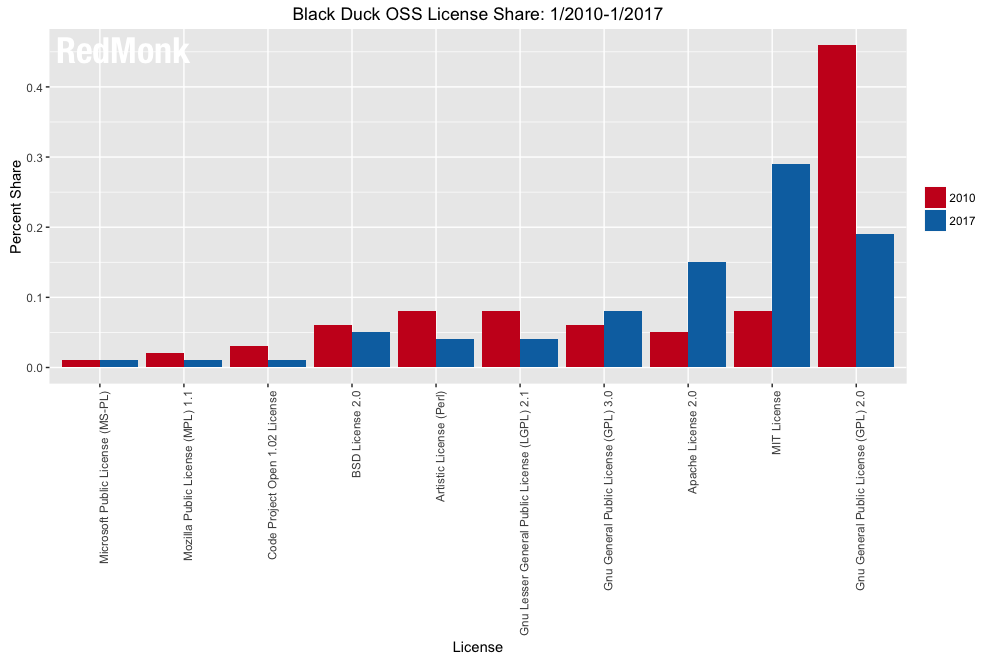
When the rumor mill starts Sullivan gave a recent example of the claim of the decline of copyleft in an article on Opensource.com by Jono Bacon from February 2017 that showed a histogram of license usage between 2010 and 2017 (seen below).
[Black Duck   histogram]
From that, Bacon elaborates possible reasons for the apparent decline of the GPL. The graphic used in the article was actually generated by Stephen O'Grady in a January article, The State Of Open Source Licensing, which said:
In Black Duck's sample, the most popular variant of the GPL version 2 is less than half as popular as it was (46% to 19%). Over the same span, the permissive MIT has gone from 8% share to 29%, while its permissive cousin the Apache License 2.0 jumped from 5% to 15%.
Sullivan, however, argued that the methodology used to create both articles was problematic. Neither contains original research: the graphs actually come from the Black Duck Software "KnowledgeBase" data, which was partly created from the old Ohloh web site now known as Open Hub. To show one problem with the data, Sullivan mentioned two free-software projects, GNU Bash and GNU Emacs, that had been showcased on the front page of Ohloh.net in 2012. On the site, Bash was (and still is) listed as GPLv2+, whereas it changed to GPLv3 in 2011. He also claimed that "Emacs was listed as licensed under GPLv3-only, which is a license Emacs has never had in its history", although I wasn't able to verify that information from the Internet archive. Basically, according to Sullivan, "the two projects featured on the front page of a site that was using [the Black Duck] data set were wrong". This, in turn, seriously brings into question the quality of the data:
I reported this problem and we'll continue to do that but when someone is not sharing the data set that they're using for other people to evaluate it and we see glimpses of it which are incorrect, that should give us a lot of hesitation about accepting any conclusion that comes out of it.
Reproducible observations are necessary to the establishment of solid theories in science. Sullivan didn't try to contact Black Duck to get access to the database, because he assumed (rightly, as it turned out) that he would need to "pay for the data under terms that forbid you to share that information with anybody else". So I wrote Black Duck myself to confirm this information. In an email interview, Patrick Carey from Black Duck confirmed its data set is proprietary. He believes, however, that through a "combination of human and automated techniques", Black Duck is "highly confident at the accuracy and completeness of the data in the KnowledgeBase". He did point out, however, that "the way we track the data may not necessarily be optimal for answering the question on license use trend" as "that would entail examination of new open source projects coming into existence each year and the licenses used by them". In other words, even according to Black Duck, its database may not be useful to establish the conclusions drawn by those articles. Carey did agree with those conclusions intuitively, however, saying that "there seems to be a shift toward Apache and MIT licenses in new projects, though I don't have data to back that up". He suggested that "an effective way to answer the trend question would be to analyze the new projects on GitHub over the last 5-10 years." Carey also suggested that "GitHub has become so dominant over the recent years that just looking at projects on GitHub would give you a reasonable sampling from which to draw conclusions".
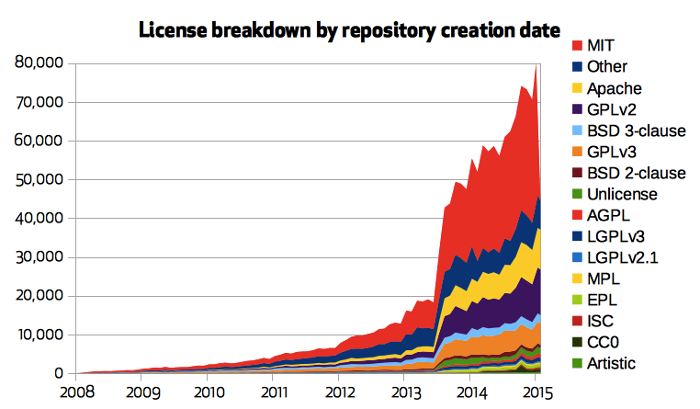
[GitHub   graph]
Indeed, GitHub published a report in 2015 that also seems to confirm MIT's popularity (45%), surpassing copyleft licenses (24%). The data is, however, not without its own limitations. For example, in the above graph going back to the inception of GitHub in 2008, we see a rather abnormal spike in 2013, which seems to correlate with the launch of the choosealicense.com site, described by GitHub as "our first pass at making open source licensing on GitHub easier". In his talk, Sullivan was critical of the initial version of the site which he described as biased toward permissive licenses. Because the GitHub project creation page links to the site, Sullivan explained that the site's bias could have actually influenced GitHub users' license choices. Following a talk from Sullivan at FOSDEM 2016, GitHub addressed the problem later that year by rewording parts of the front page to be more accurate, but that any change in license choice obviously doesn't show in the report produced in 2015 and won't affect choices users have already made. Therefore, there can be reasonable doubts that GitHub's subset of software projects may not actually be that representative of the larger free-software community.

In search of solid evidence So it seems we are missing good, reproducible results to confirm or dispel these claims. Sullivan explained that it is a difficult problem, if only in the way you select which projects to analyze: the impact of a MIT-licensed personal wiki will obviously be vastly different from, say, a GPL-licensed C compiler or kernel. We may want to distinguish between active and inactive projects. Then there is the problem of code duplication, both across publication platforms (a project may be published on GitHub and SourceForge for example) but also across projects (code may be copy-pasted between projects). We should think about how to evaluate the license of a given project: different files in the same code base regularly have different licenses often none at all. This is why having a clear, documented and publicly available data set and methodology is critical. Without this, the assumptions made are not clear and it is unreasonable to draw certain conclusions from the results. It turns out that some researchers did that kind of open research in 2016 in a paper called "The Debsources Dataset: Two Decades of Free and Open Source Software" [PDF] by Matthieu Caneill, Daniel M. Germ n, and Stefano Zacchiroli. The Debsources data set is the complete Debian source code that covers a large history of the Debian project and therefore includes thousands of free-software projects of different origins. According to the paper:
The long history of Debian creates a perfect subject to evaluate how FOSS licenses use has evolved over time, and the popularity of licenses currently in use.
Sullivan argued that the Debsources data set is interesting because of its quality: every package in Debian has been reviewed by multiple humans, including the original packager, but also by the FTP masters to ensure that the distribution can legally redistribute the software. The existence of a package in Debian provides a minimal "proof of use": unmaintained packages get removed from Debian on a regular basis and the mere fact that a piece of software gets packaged in Debian means at least some users found it important enough to work on packaging it. Debian packagers make specific efforts to avoid code duplication between packages in order to ease security maintenance. The data set covers a period longer than Black Duck's or GitHub's, as it goes all the way back to the Hamm 2.0 release in 1998. The data and how to reproduce it are freely available under a CC BY-SA 4.0 license.
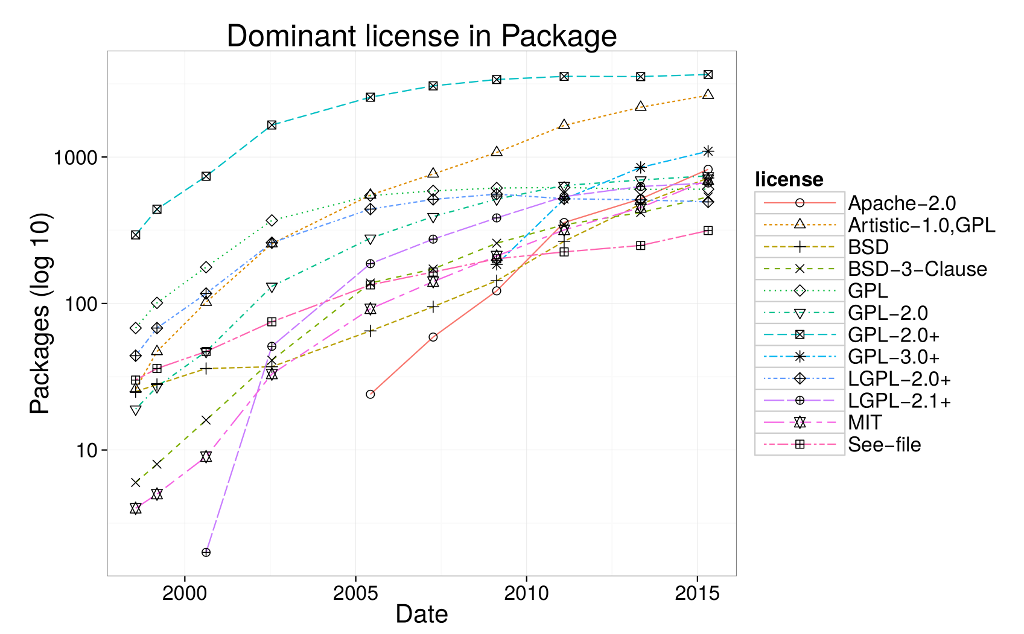
[Debsource   graph]
Sullivan presented the above graph from the research paper that showed the evolution of software license use in the Debian archive. Whereas previous graphs showed statistics in percentages, this one showed actual absolute numbers, where we can't actually distinguish a decline in copyleft licenses. To quote the paper again:
The top license is, once again, GPL-2.0+, followed by: Artistic-1.0/GPL dual-licensing (the licensing choice of Perl and most Perl libraries), GPL-3.0+, and Apache-2.0.
Indeed, looking at the graph, at most do we see a rise of the Apache and MIT licenses and no decline of the GPL per se, although its adoption does seem to slow down in recent years. We should also mention the possibility that Debian's data set has the opposite bias: toward GPL software. The Debian project is culturally quite different from the GitHub community and even the larger free-software ecosystem, naturally, which could explain the disparity in the results. We can only hope a similar analysis can be performed on the much larger Software Heritage data set eventually, which may give more representative results. The paper acknowledges this problem:
Debian is likely representative of enterprise use of FOSS as a base operating system, where stable, long-term and seldomly updated software products are desirable. Conversely Debian is unlikely representative of more dynamic FOSS environments (e.g., modern Web-development with micro libraries) where users, who are usually developers themselves, expect to receive library updates on a daily basis.
The Debsources research also shares methodology limitations with Black Duck: while Debian packages are reviewed before uploading and we can rely on the copyright information provided by Debian maintainers, the research also relies on automated tools (specifically FOSSology) to retrieve license information. Sullivan also warned against "ascribing reason to numbers": people may have different reasons for choosing a particular license. Developers may choose the MIT license because it has fewer words, for compatibility reasons, or simply because "their lawyers told them to". It may not imply an actual deliberate philosophical or ideological choice. Finally, he brought up the theory that the rise of non-copyleft licenses isn't necessarily at the detriment of the GPL. He explained that, even if there is an actual decline, it may not be much of a problem if there is an overall growth of free software to the detriment of proprietary software. He reminded the audience that non-copyleft licenses are still free software, according to the FSF and the Debian Free Software Guidelines, so their rise is still a positive outcome. Even if the GPL is a better tool to accomplish the goal of a free-software world, we can all acknowledge that the conversion of proprietary software to more permissive and certainly simpler licenses is definitely heading in the right direction.
[I would like to thank the DebConf organizers for providing meals for me during the conference.] Note: this article first appeared in the Linux Weekly News.

19 August 2017

Sean Whitton: Debian Policy call for participation -- August 2017

At the Debian Policy BoF at DebConf17, Solveig suggested that we could post summaries of recent activity in policy bugs to Planet Debian, as a kind of call for participation. Russ Allbery had written a script to generate such a summary some time ago, but it couldn t handle the usertags the policy team uses to progress bugs through the policy changes process. Today I enhanced the script to handle usertags and I m pleased to be able to post a summary of our bugs. Consensus has been reached and help is needed to write a patch #172436 BROWSER and sensible-browser standardization #273093 document interactions of multiple clashing package diversions #299007 Transitioning perms of /usr/local #314808 Web applications should use /usr/share/package, not /usr/share/doc/ #425523 Describe error unwind when unpacking a package fails #452393 Clarify difference between required and important priorities #476810 Please clarify 12.5, Copyright information #484673 file permissions for files potentially including credential informa #491318 init scripts should support start/stop/restart/force-reload - why #556015 Clarify requirements for linked doc directories #568313 Suggestion: forbid the use of dpkg-statoverride when uid and gid ar #578597 Recommend usage of dpkg-buildflags to initialize CFLAGS and al. #582109 document triggers where appropriate #587279 Clarify restrictions on main to non-free dependencies #587991 perl-policy: /etc/perl missing from Module Path #592610 Clarify when Conflicts + Replaces et al are appropriate #613046 please update example in 4.9.1 (debian/rules and DEB_BUILD_OPTIONS) #614807 Please document autobuilder-imposed build-dependency alternative re #616462 clarify wording of parenthetical in section 2.2.1 #628515 recommending verbose build logs #661928 recipe for determining shlib package name #664257 document Architecture name definitions #682347 mark editor virtual package name as obsolete #683222 say explicitly that debian/changelog is required in source packages #685506 copyright-format: new Files-Excluded field #685746 debian-policy Consider clarifying the use of recommends #688251 Built-Using description too aggressive #757760 please document build profiles #759316 Document the use of /etc/default for cron jobs #761219 document versioned Provides #767839 Linking documentation of arch:any package to arch:all #770440 policy should mention systemd timers #773557 Avoid unsafe RPATH/RUNPATH #780725 PATH used for building is not specified #793499 The Installed-Size algorithm is out-of-date #810381 Update wording of 5.6.26 VCS-* fields to recommend encryption #823256 Update maintscript arguments with dpkg >= 1.18.5 #833401 virtual packages: dbus-session-bus, dbus-default-session-bus #835451 Building as root should be discouraged #838777 Policy 11.8.4 for x-window-manager needs update for freedesktop menus #845715 Please document that packages are not allowed to write outside thei #853779 Clarify requirements about update-rc.d and invoke-rc.d usage in mai Wording proposed, awaiting review from anyone and/or seconds by DDs #542288 Versions for native packages, NMU s, and binary only uploads #582109 document triggers where appropriate #630174 forbid installation into /lib64 #645696 [copyright-format] clearer definitions and more consistent License: #648271 11.8.3 Packages providing a terminal emulator says xterm passes - #649530 [copyright-format] clearer definitions and more consistent License: #662998 stripping static libraries #732445 debian-policy should encourage verification of upstream cryptograph #737796 copyright-format: support Files: paragraph with both abbreviated na #756835 Extension of the syntax of the Packages-List field. #786470 [copyright-format] Add an optional License-Grant field #835451 Building as root should be discouraged #844431 Packages should be reproducible #845255 Include best practices for packaging database applications #850729 Documenting special version number suffixes Merged for the next release #587279 Clarify restrictions on main to non-free dependencies #616462 clarify wording of parenthetical in section 2.2.1 #732445 debian-policy should encourage verification of upstream cryptograph #844431 Packages should be reproducible

Vasudev Kamath: Writing a UDP Broadcast Receiver as Python Iterator

I had to write a small Python application to listen for some broadcast message and process the message. This broadcast messages are actually sort of discovery messages to find some peers in a network. Writing a simple UDP Server to listen on a particular port was easy; but while designing an application I was wondering how can I plugin this server into my main code. There are 2 possibility
  1. Use threading module of python to send the server code in back ground and give it a callback to communicate the data to main thread.
  2. Periodically read some messages from server code and then dispose of server.
I didn't like first approach because I need to pass a callback function and I some how will end up complicating code. Second approach sounded sane but I did want to make server more like iterator. I searched around to see if some one has attempted to write something similar, but did not find anything useful (may be my Googling skills aren't good enough). Anyway so I thought what is wrong in trying?. If it works then I'll be happy that I did something different :-). The first thing for making iterator in Python is having function __iter__ and __next__ defined in your class. For Python 2 iterator protocol wanted next to be defined instead of __next__. So for portable code you can define a next function which in return calls __next__. So here is my first shot at writing BroadCastReceiver class.
from socket import socket, AF_INET, SOCK_DGRAM
class BroadCastReceiver:
    def __init__(self, port, msg_len=8192):
        self.sock = socket(AF_INET, SOCK_DGRAM)
        self.sock.setsockopt(SOL_SOCKET, SO_REUSEADDR, 1)
        self.sock.bind(('', port))
        self.msg_len = msg_len
    def __iter__(self):
             return self
    def __next__(self):
             try:
                 addr, data = self.sock.recvfrom(self.msg_len)
                 return addr, data
             except Exception as e:
                 print("Got exception trying to recv %s" % e)
                 raise StopIteration
This version of code can be used in a for loop to read from socket UDP broadcasts. One problem will be that if no packet is received which might be due to disconnected network the loop will just block forever. So I had to modify the code slightly to add timeout parameter. So changed portion of code is below.
...
    def __init__(self, port, msg_len=8192, timeout=15):
        self.sock = socket(AF_INET, SOCK_DGRAM)
        self.sock.setsockopt(SOL_SOCKET, SO_REUSEADDR, 1)
        self.sock.settimeout(timeout)
        self.sock.msg_len = msg_len
        self.sock.bind(('', port))
 ...
So now if network is disconnected or no packet was received for timeout period we get a socket.timeout exception due to which StopIteration will be raised causing the for loop using server as iterator to exit. This avoids us just blocking our periodic code run forever when network is disconnected or no messages are received for long time. (may be due to connected to wrong network). Now every thing looks fine but only part is if we create the server object each time our periodic code is called we will have binding issue as we did not properly close the socket once iterator has stopped. So I added socket closing code in __del__ function for the class. __del__ will be called when garbage collector try to recollect object when it goes out of scope.
...
    def __del__(self):
        self.sock.close()
So the server can be used in for loop or by passing the object of server to next built-in function. Here are 2 examples.
r = BroadCastReceiver(5000, timeout=10)
count = 0
for (address, data) in r:
    print('Got packet from %s: %s' % address, data)
    count += 1
    # do whatever you want with data
    if count > 10:
        break
Here we use an counter variable to track iteration and after some iteration we exit for loop. Another way is use for loop with range of iteration like below.
r = BroadCastReceiver(5000,  timeout=10)
for i in range(20):
    try:
        address, data = next(r)
        # do whatever you want with data
    except:
        break
Here an additional try block was needed inside the for loop to card call to next, this is to handle the timeout or other exception and exit the loop. In first case this is not needed as StopIteration is understood by for. Both use cases I described above are mostly useful when it is not critical to handle each and every packet (mostly peer discovery) and packets will always be sent. So if we miss some peers in one iteration we will still catch them in next iteration. We just need to make sure we provide big enough counter to catch most peers in each iteration. If its critical to receive each packet we can safely send this iterating logic to a separate thread which keeps receiving packets and process data as needed. For now I tried this pattern mostly with UDP protocol but I'm sure with some modification this can be used with TCP as well. I'll be happy to get feed back from Pythonistas out there on what you think of this approach. :-)
Update I got a suggestion from Ryan Nowakowski to make the server object as context manager and close the socket in __exit__ as it can't be guaranteed that __del__ will be called for objects which exists during interpreter exits. So I slightly modified the class to add __enter__ and __exit__ method like below and removed __del__
...
    def __enter__(self):
        return self
    def __exit__(self, exc_type, exc_value, traceback):
        self.sock.close()
Usage pattern is slightly modified because of this and we need to use with statement while creating object.
with BroadCastReceiver(2000) as r:
    # use server object as you wish
    ...
It is also possible to cleanly close socket without adding context manager that is adding finally statement to our try and except block in __next__. The modified code without adding context manager looks like below.
def __next__(self):
    try:
        addr, data = self.sock.recvfrom(self.msg_len)
        return addr, data
    except Exception as e:
        print("Got exception trying to recv %s" % e)
        raise StopIteration
    finally:
        self.sock.close()
When we raise StopIteration again from except block, it will be temporarily saved and finally block is executed which will now close the socket.

18 August 2017

Raphaël Hertzog: Freexian s report about Debian Long Term Support, July 2017

A Debian LTS logoLike each month, here comes a report about the work of paid contributors to Debian LTS. Individual reports In July, about 181 work hours have been dispatched among 11 paid contributors. Their reports are available: Evolution of the situation The number of sponsored hours increased slightly with two new sponsors: Leibniz Rechenzentrum (silver sponsor) and Catalyst IT Ltd (bronze sponsor). The security tracker currently lists 74 packages with a known CVE and the dla-needed.txt file 64. The number of packages with open issues increased of almost 50% compared to last month. Hopefully this backlog will get cleared up when the unused hours will actually be done. In any case, this evolution is worth watching. Thanks to our sponsors New sponsors are in bold.

No comment Liked this article? Click here. My blog is Flattr-enabled.

17 August 2017

Shirish Agarwal: Composers are not given due recognition

Update Some youtube links are not viewable or even seen on planet.debian.org. Seems p.d.o. tries its best to remove external links, sorry for the breakage. Beware some youtube-links would be shared in this entry, sorry couldn t find a better/easier media platform to work with. If anyone knows any other platform or wants to suggest, feel free to either mail me or let me know in comments. I want to start today s sharing with a picture of Ganesha I saw today. It is and was public art hence sharing it without an issue. Sketch of Ganesha/Ganapati This is starting of festivities time in India and Ganesha or Ganpati is looked up as a good omen in India. The festival of Ganesh Chaturthi would be starting on the 25th of August and is a sight to behold. Just like Rio has its carnival, Ganesh Chaturthi is also a carnival. We also have parades where people come with Pandals (or temporary structures) The mythology says he has a sweet tooth (hence lot of distribution of sweets, especially modak) and anything which might be troubling people, he creates solutions for them. Here is one video of how people celebrate his immersion in India. This is from my home-town few years ago, every year the madness and the celebrations are becoming more and more. People from far off come to see how we celebrate and see how different people make their Pandals. While some are with music, others are with social messages. Usually people start going to see these structures after dusk and return home way after midnight or early morning. I hope to do this endeavour after many years. One is drunk from hearing all sorts of different kids of music, decoration, messages, a feast and a strain to all the senses. Ganesha immersion celebrations https://www.youtube.com/watch?v=hjWfpGUryho If one is interested one can find more info. at https://en.wikipedia.org/wiki/Ganesh_Chaturthi After quite a bit of time, I wrote an article about various foss internships which I knew besides GSOC over the years. I finally penned them down at https://itsfoss.com/best-open-source-internships/ Interestingly, I was amazed to see that all FOSS U.S. projects (outside of GSOC) are for students who are either living or studying in U.S. and have a student work visa (which from private discussions I came to know is lot harder to get nowadays than before). Except for the National Science Foundation (NSF) which probably has U.S. defence relations and hence they might be sensitive, I fail to understand other institutes preferences for only getting people from the U.S. and hence having a lesser talent pool of people. This also affects the growth of the projects themselves. Just think how limited Debian would have been if it had decided to only have people from only any one community develop it. Dunno if this is due to the present President Trump or these policies had been there before. It would be nice and interesting if people in the know can share. What has also been interesting to watch is Mr. Trump blaming low-cost manufacturing centres like India and China when as far as I recall, lot of manufacturing, specifically auto-mobiles manufacturing was shifted out of the U.S. to Ireland and other places years before which are relatively high-cost places (at least compared to India). I *believe* the change was as early as in 1980 s itself where India was insulated and had a limited market for everything (similar to Russian communism as shown in popular media but not so bad.) Interestingly, it took almost a month for the perl 2.56 to make the transition smoothly. It took quite a bit of time for all the components to work together and be installable. Also saw this few days back http://fortune.com/2017/04/12/auto-industry-decline/ While Tesla is expensive even by American standards the idea of lesser parts, lesser complexity and hence lower costs to use, maintain is good. I do hope that he and his team or any of the competitors do overcome the significant challenges. Any significant improvement in battery technology is bound to have huge impact in almost everything that is used in 21st century. Two recent articles tell me the future may become present very quickly. https://www.purdue.edu/newsroom/releases/2017/Q2/instantly-rechargeable-battery-could-change-the-future-of-electric-and-hybrid-automobiles.html Toyota could finally start mass producing electric cars thanks to China I do hope to see EV being prevalent before the next decade is over otherwise we don t have any hope due to climate change. As for my health, I am much better than before. Just to share some stats, before my illness for lack of better word, I was 120 kgs. , when I was kept in the hospital for about 2-2.5 weeks I came down to 95 kgs. and now back upto 108 kgs. Do go for exercising every other day and trying to get back the strength, stamina and increasing a bit of both. Doctors have given me another 4-5 months after which a brain scan will reveal if there are any remaining blood clots in the brain or not. Lastly, while it has become somewhat of a sensitive issue to love Muslims or to talk about their work in any field in the current political climate, there are 4-5 music pieces I listen whenever I can, especially before going to bed. While almost all the pieces have been sung and written by Muslims, sadly I don t know who the composers of these beautiful songs are. While it is much easier to get the names of the singer and the lyricist, one of the more important roles in my view is the composer or/and music arranger. Without them, the songs would not have the same haunting quality that the songs have. While I have been lucky to find the names of the composer/music arranger for the pieces below but this is not the case if and when the songs comes on television. I do remember in old times at least on Radio they used to mention about who has given the music as well, dunno in modern times. I am sharing the songs, and hopefully will also share the translations if I find on the web, please see the lyrics. The numbering is for convenience only and am torn in these 4-5 songs which is the best. Just to share these are all sufi love songs except the last one which I am sharing. 1. Lyrical song https://www.youtube.com/watch?v=ehqN6oTpmb8 Translation with video of song http://www.bollynook.com/en/lyrics/6443/aaj-din-chadheya/ While there probably are stories with each song, I was lucky to find the story about this one. The lyrics of the song are actually a love lost Punjabi poet who writes in the memory of his beloved to which he could not marry and he pens those when standing in line for his liquor. The story goes on that he marries a girl later in life who bears a resemblance to his beloved whom he couldn t forget till his dying day. 2. Lyrical song https://www.youtube.com/watch?v=uTC_2c83qn0 The same song has been sung by different people and I love them all the more for it. Another video https://www.youtube.com/watch?v=3G7Qg4LJ7WE Another video https://www.youtube.com/watch?v=kOsvNuR3m5Y Translation http://www.bollynook.com/en/lyrics/10703/o-re-piya/ 3. Lyrical song https://www.youtube.com/watch?v=qG7Kms_YA5Q The translation http://www.filmyquotes.com/songs/885 The translation of the song is a bit crude but then translations are supposed to be crude  Anyways, the above song is what would be called a perfect Sufi song. I hope people enjoy the longing and the silence which follows this piece. Another classic one 4. Lyrical song https://www.youtube.com/watch?v=Ube5XhN_lpM English translation http://www.ardhamy.com/song/aye-dil-e-naadan While the song is from the movie Razia Sultana and was a flop as the movie was about Race and controversial then as it probably would be now. As seen in the other songs of the same genre, it has strands of longing, loneliness as seen of the above. 5. Lyrical song https://www.youtube.com/watch?v=tv242qOnHJA This one is not a sufi song but I love all the women and the girls and the way they enhanced the song. I dunno how much they must have practised as it s a very fast and peppy song and doesn t give time to the singer to breathe except for that one section which has a bit of Carnatic music. At the very end I would like to share http://www.globalrhythm.net/ I have found some interesting sounds on the site. Hope the site enriches you as well. FWIW I have no links with the site except as somebody who likes to diversify his music listening. Lastly, for a long period of time, I had been hearing the criticism, especially for FOSS games that they don t have AAA quality assets. Recently I came across a game called Starship Theory (sadly its only for MS-Windows) Game video https://www.youtube.com/watch?v=imaL2pjNURg You look at the game and see the number of videos the guy has made. What FOSS game developers can learn from this, you don t need high-end 2.5/3d models, clipart will do but need depth in gameplay which can make FOSS games be popular and also earn a pretty bundle. I do hope some FOSS game upstream developers take note and use that game s inspiration to bring more depth. That doesn t mean games like 0ad are not liked by people but it takes huge amount of time and resources. 0ad video https://www.youtube.com/watch?v=DHx5XBtypcQ Hope you have a good time with all the ideas, anecdotes and videos I shared above.
Filed under: Miscellenous Tagged: #FOSS Internships, #Ganesh Chaturthi, #Ganeshji, #planet-debian, #Sufi Bollywood Music, FOSS, FOSS games, politics

14 August 2017

Michal Čihař: New projects on Hosted Weblate

Hosted Weblate provides also free hosting for free software projects. The hosting requests queue was over one month long, so it's time to process it and include new project. This time, the newly hosted projects include: If you want to support this effort, please donate to Weblate, especially recurring donations are welcome to make this service alive. You can do them on Liberapay or Bountysource.

Filed under: Debian English SUSE Weblate

13 August 2017

Enrico Zini: Consensually doing things together?

On 2017-08-06 I have a talk at DebConf17 in Montreal titled "Consensually doing things together?" (video). Here are the talk notes. Abstract At DebConf Heidelberg I talked about how Free Software has a lot to do about consensually doing things together. Is that always true, at least in Debian? I d like to explore what motivates one to start a project and what motivates one to keep maintaining it. What are the energy levels required to manage bits of Debian as the project keeps growing. How easy it is to say no. Whether we have roles in Debian that require irreplaceable heroes to keep them going. What could be done to make life easier for heroes, easy enough that mere mortals can help, or take their place. Unhappy is the community that needs heroes, and unhappy is the community that needs martyrs. I d like to try and make sure that now, or in the very near future, Debian is not such an unhappy community. Consensually doing things together I gave a talk in Heidelberg. Valhalla made stickers Debian France distributed many of them. There's one on my laptop. Which reminds me of what we ought to be doing. Of what we have a chance to do, if we play our cards right. I'm going to talk about relationships. Consensual relationships. Relationships in short. Nonconsensual relationships are usually called abuse. I like to see Debian as a relationship between multiple people. And I'd like it to be a consensual one. I'd like it not to be abuse. Consent From wikpedia:
In Canada "consent means the voluntary agreement of the complainant to engage in sexual activity" without abuse or exploitation of "trust, power or authority", coercion or threats.[7] Consent can also be revoked at any moment.[8] There are 3 pillars often included in the description of sexual consent, or "the way we let others know what we're up for, be it a good-night kiss or the moments leading up to sex." They are:
  • Knowing exactly what and how much I'm agreeing to
  • Expressing my intent to participate
  • Deciding freely and voluntarily to participate[20]
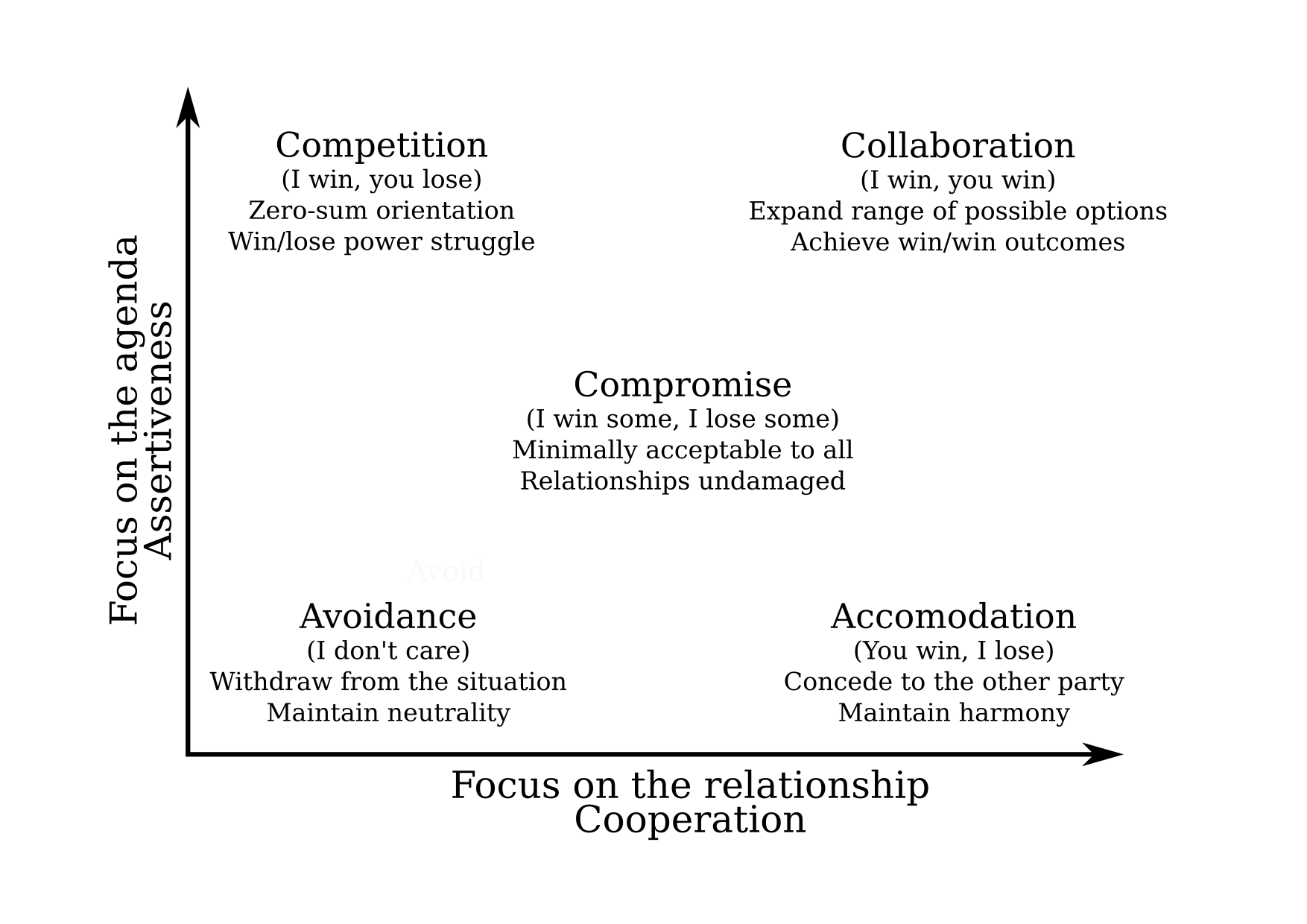
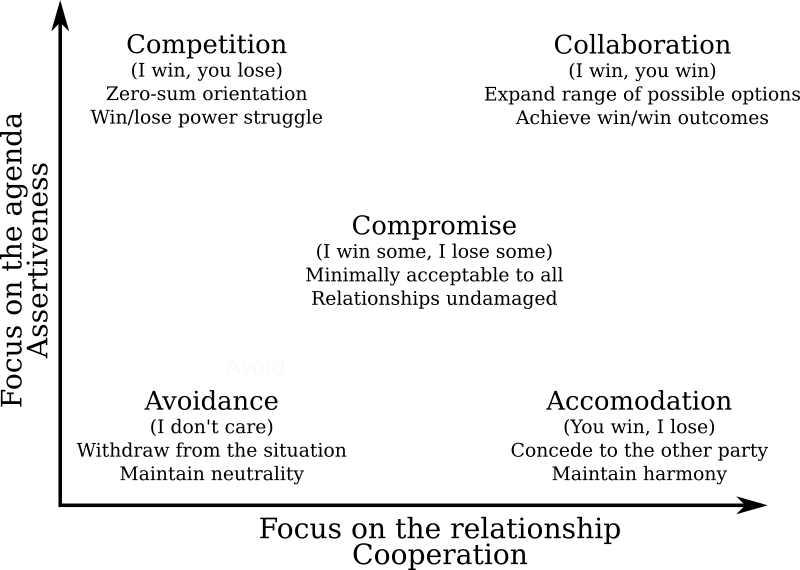
Saying "I've decided I won't do laundry anymore" when the other partner is tired, or busy doing things. Is different than saying "I've decided I won't do laundry anymore" when the other partner has a chance to say "why? tell me more" and take part in negotiation. Resources: Relationships Debian is the Universal Operating System. Debian is made and maintained by people. The long term health of debian is a consequence of the long term health of the relationship between Debian contributors. Debian doesn't need to be technically perfect, it needs to be socially healthy. Technical problems can be fixed by a healty community. graph showing relationship between avoidance, accomodation, compromise, competition, collaboration The Thomas-Kilmann Conflict Mode Instrument: source png. Motivations Quick poll: What are your motivations to be in a relationship? Which of those motivations are healthy/unhealthy? "Galadriel" (noun, by Francesca Ciceri): a task you have to do otherwise Sauron takes over Middle Earth See: http://blog.zouish.org/nonupdd/#/22/1 What motivates me to start a project or pick one up? What motivates me to keep maintaning a project? What motivates you? What's an example of a sustainable motivation? Is it really all consensual in Debian? Energy Energy that thing which is measured in spoons. The metaphore comes from people suffering with chronic health issues:
"Spoons" are a visual representation used as a unit of measure used to quantify how much energy a person has throughout a given day. Each activity requires a given number of spoons, which will only be replaced as the person "recharges" through rest. A person who runs out of spoons has no choice but to rest until their spoons are replenished.
For example, in Debian, I could spend: What is one person capable of doing? Have reasonable expectations, on others: Have reasonable expectations, on yourself: Debian is a shared responsibility When spoons are limited, what takes more energy tends not to get done As the project grows, project-wide tasks become harder Are they still humanly achievable? I don't want Debian to have positions that require hero-types to fill them Dictatorship of who has more spoons: Perfectionism You are in a relationship that is just perfect. All your friends look up to you. You give people relationship advice. You are safe in knowing that You Are Doing It Right. Then one day you have an argument in public. You don't just have to deal with the argument, but also with your reputation and self-perception shattering. One things I hate about Debian: consistent technical excellence. I don't want to be required to always be right. One of my favourite moments in the history of Debian is the openssl bug Debian doesn't need to be technically perfect, it needs to be socially healthy, technical problems can be fixed. I want to remove perfectionism from Debian: if we discover we've been wrong all the time in something important, it's not the end of Debian, it's the beginning of an improved Debian. Too good to be true There comes a point in most people's dating experience where one learns that when some things feel too good to be true, they might indeed be. There are people who cannot say no: There are people who cannot take a no: Note the diversity statement: it's not a problem to have one of those (and many other) tendencies, as long as one manages to keep interacting constructively with the rest of the community Also, it is important to be aware of these patterns, to be able to compensate for one's own tendencies. What happens when an avoidant person meets a narcissistic person, and they are both unaware of the risks? Resources: Note: there are problems with the way these resources are framed: Red flag / green flag http://pervocracy.blogspot.ca/2012/07/green-flags.html Ask for examples of red/green flags in Debian. Green flags: Red flags: Apologies / Dealing with issues I don't see the usefulness of apologies that are about accepting blame, or making a person stop complaining. I see apologies as opportunities to understand the problem I caused, help fix it, and possibly find ways of avoiding causing that problem again in the future. A Better Way to Say Sorry lists a 4 step process, which is basically what we do when in bug reports already: 1, Try to understand and reproduce the exact problem the person had. 2. Try to find the cause of the issue. 3. Try to find a solution for the issue. 4. Verify with the reporter that the solution does indeed fix the issue. This is just to say
My software ate
the files
that where in
your home directory and which
you were probably
needing
for work Forgive me
it was so quick to write
without tests
and it worked so well for me
(inspired by a 1934 poem by William Carlos Williams) Don't be afraid to fail Don't be afraid to fail or drop the ball. I think that anything that has a label attached of "if you don't do it, nobody will", shouldn't fall on anybody's shoulders and should be shared no matter what. Shared or dropped. Share the responsibility for a healthy relationship Don't expect that the more experienced mates will take care of everything. In a project with active people counted by the thousand, it's unlikely that harassment isn't happening. Is anyone writing anti-harassment? Do we have stats? Is having an email address and a CoC giving us a false sense of security?
When you get involved in a new community, such as Debian, find out early where, if that happens, you can find support, understanding, and help to make it stop. If you cannot find any, or if the only thing you can find is people who say "it never happens here", consider whether you really want to be in that community.
(from http://www.enricozini.org/blog/2016/debian/you-ll-thank-me-later/)
There are some nice people in the world. I mean nice people, the sort I couldn t describe myself as. People who are friends with everyone, who are somehow never involved in any argument, who seem content to spend their time drawing pictures of bumblebees on flowers that make everyone happy. Those people are great to have around. You want to hold onto them as much as you can. But people only have so much tolerance for jerkiness, and really nice people often have less tolerance than the rest of us. The trouble with not ejecting a jerk whether their shenanigans are deliberate or incidental is that you allow the average jerkiness of the community to rise slightly. The higher it goes, the more likely it is that those really nice people will come around less often, or stop coming around at all. That, in turn, makes the average jerkiness rise even more, which teaches the original jerk that their behavior is acceptable and makes your community more appealing to other jerks. Meanwhile, more people at the nice end of the scale are drifting away.
(from https://eev.ee/blog/2016/07/22/on-a-technicality/) Give people freedom If someone tries something in Debian, try to acknowledge and accept their work. You can give feedback on what they are doing, and try not to stand in their way, unless what they are doing is actually hurting you. In that case, try to collaborate, so that you all can get what you need. It's ok if you don't like everything that they are doing. I personally don't care if people tell me I'm good when I do something, I perceive it a bit like "good boy" or "good dog". I rather prefer if people show an interest, say "that looks useful" or "how does it work?" or "what do you need to deploy this?" Acknowledge that I've done something. I don't care if it's especially liked, give me the freedom to keep doing it. Don't give me rewards, give me space and dignity. Rather than feeding my ego, feed by freedom, and feed my possibility to create.

12 August 2017

Steve Kemp: A day in the life of Steve

I used to think I was a programmer who did "sysadmin-stuff". Nowadays I interact with too many real programmers to believe that. Or rather I can code/program/develop, but I'm not often as good as I could be. These days I'm getting more consistent with writing tests, and I like it when things are thoroughly planned and developed. But too often if I'm busy, or distracted, I think to myself "Hrm .. compiles? Probably done. Oops. Bug, you say?" I was going to write about working with golang today. The go language is minimal and quite neat. I like the toolset: Instead I think today I'm going to write about something else. Since having a child a lot of my life is different. Routine becomes something that is essential, as is planning and scheduling. So an average week-day goes something like this: In short I'm responsible for Oiva from 6ish-8ish in the morning, then from 6PM-10PM (with a little break while he's put to bed.) There are some exceptions to this routine - for example I work from home on Monday/Friday afternoons, and Monday evenings he goes to his swimming classes. But most working-days are the same. Weekends are a bit different. There I tend to take him 6AM-8AM, then 1PM-10PM with a few breaks for tea, and bed. At the moment we're starting to reach the peak-party time of year, which means weekends often involve negotiation(s) about which parent is having a party, and which parent is either leaving early, or not going out at all. Today I have him all day, and it's awesome. He's just learned to say "Daddy" which makes any stress, angst or unpleasantness utterly worthwhile.

11 August 2017

Thorsten Glaser: [PSA] Fixing CVE-2017-12836 (Debian #871810) in GNU cvs

Considering I ve become the de-facto upstream of cvs(GNU) even if not yet formally the de-iure upstream maintainer, fixing this bug obviously falls to me not quite the way I had planned passing this evening after coming home from work and a decent and, worse, very filling meal at the local Croatian restaurant. But, so s life. The problem here is basically that CVS invokes ssh(1) (well, rsh originally ) but doesn t add the argument separator -- before the (user-provided) hostname, which when starting with a hyphen-minus will be interpreted by ssh as an argument. (Apparently the other VCSes also had additional vulnerabilities such as not properly escaping semicoloi or pipes from the shell or unescaping percent-escaped fun characters, but that doesn t affect us.) The obvious fix and the one I implemented first is to simply add the dashes. This will also be backported to Debian , ,old old stable-security. Then I looked at other VCSes out of which only one did this, but they all added extra paranoia hostname checks (some of them passing invalid hostnames, such as those with underscores in them). OK, I thought, then also let s add extra checks to CVS repository reference handling. This will end up in Debian sid and MirBSD, pending passing the regression tests of course hah, while writing this article I had to fixup because a test failed. Anyway, it s not strictly necessary AFAICT to fix the issue. Update, about 2 hours past midnight (the testsuite runs for several hours): of course, the sanity testsuite (which itself is rather insane ) also needs adjustments, plus a bonus fix (for something that got broken when the recent allow-root-regex patch was merged and got fixed in the same go to night). tl;dr: a fix will end up in Debian *stable-security and can be taken out of my mail to the bugreport; another few changes for robustness are being tested and then added to both MirBSD and Debian sid. The impact is likely small, as it s hard to get a user (if you find one, in the first place) to use a crafted CVSROOT string, which is easy to spot as well. Update, Monday: apparently someone took care of the DSA and DLA yesterday after ACCEPTing the uploads thanks, I was outside during the day.

10 August 2017

John Goerzen: A new baby and deep smiles

IMG_2059 A month ago, we were waiting for our new baby; time seemed to stand still. Now she is here! Martha Goerzen was born recently, and she is doing well and growing! Laura and I have enjoyed moments of cuddling her, watching her stare at our faces, hearing her (hopefully) soft sounds as she falls asleep in our arms. It is also heart-warming to see Martha s older brothers take such an interest in her. Here is the first time Jacob got to hold her: IMG_1846 Oliver, who is a boy very much into sports, play involving police and firefighters, and such, has started adding aww and she s so cute! to his common vocabulary. He can be very insistent about interrupting me to hold her, too.

Thorsten Glaser: New mksh and jupp releases, mksh FAQ, jupprc for JOE 4.4; MuseScore

mksh R56 was released with experimental fixes for the history no longer persisted when HISTFILE near-full and interactive shell cannot wait on coprocess by PID issues (I hope they do not introduce any regressioins) and otherwise as a bugfix release. You might wish to know the $EDITOR selection mechanism in dot.mkshrc changed. Some more alias characters are allowed again, and POSIX character classes (for ASCII, and EBCDIC, only) appeared by popular vote. mksh now has a FAQ; enjoy. Do feel free to contribute (answers, too, of course). The jupp text editor has also received a new release; asides from being much smaller, and updated (mksh too, btw) to Unicode 10, and some segfault fixes, it features falling back to using /dev/tty if stdin or stdout is not a terminal (for use on GNU with find xargs jupp, since they don t have our xargs(1) -o option yet), a new command to exit nonzero (sometimes, utilities invoking the generic visual editor need this), and presentation mode . Presentation mode, crediting Natureshadow, is basically putting your slides as (UTF-8, with fancy stuff inside) plaintext files into one directory, with sorting names (so e.g. zero-padded slide numbers as filenames), presenting them with jupp * in a fullscreen xterm. You d hit F6 to switch to one-file view first, then present by using F8 to go forward (F7 to go backward), and, for demonstrations, F9 to pipe the entire slide through an external command (could be just sh ) offering the previous one as default. Simple yet powerful; I imagine Sven Guckes would love it, were he not such a vim user. The new release is offered as source tarball (as usual) and in distribution packages, but also, again, a Win32 version as PKZIP archive (right-click on setup.inf and hit I nstall to install it). Note that this comes with its own (thankfully local) version of the Cygwin32 library (compatible down to Windows 95, apparently), so if you have Cygwin installed yourself you re better off compiling it there and using your own version instead. I ve also released a new DOS version of 2.8 with no code patches but an updated jupprc; the binary (self-extracting LHarc archive) this time comes with all resource files, not just jupp s. Today, the jupprc drop-in file for JOE 3.7 got a matching update (and some fixes for bugs discovered during that) and I added a new one for JOE 4.4 (the former being in Debian wheezy, the latter in jessie, stretch and buster/sid). It s a bit rudimentary (the new shell window functionality is absent) but, mostly, gives the desired jupp feeling, more so than just using stock jstar would. CVS ability to commit to multiple branches of a file at the same time, therefore grouping the commit (by commitid at least, unsure if cvsps et al. can be persuaded to recognise it). If you don t know what cvs(GNU) is: it is a proper (although not distributed) version control system and the best for centralised tasks. (For decentral tasks, abusing git as pseudo-VCS has won by popularity vote; take this as a comparison.) If desired, I can make these new versions available in my WTF APT repository on request. (Debian buster/sid users: please change https to http there, the site is only available with TLSv1.0 as it doesn t require bank-level security.) I d welcome it very much if people using an OS which does not yet carry either to package it there. Message me when one more is added, too In unrelated news I uploaded MuseScore 2.1 to Debian unstable, mostly because the maintainers are busy (though I could comaintain it if needed, I d just need help with the C++ and CMake details). Bonus side effect is that I can now build 2.2~ test versions with patches of mine added I plan to produce to fix some issues (and submit upstream) (read more )

Next.

Previous.