Search Results: "reg"

18 June 2023

Dirk Eddelbuettel: RcppSpdlog 0.0.13 on CRAN: Small Extensions

Version 0.0.13 of RcppSpdlog is now on CRAN and will be soon be uploaded to Debian too. RcppSpdlog bundles spdlog, a wonderful header-only C++ logging library with all the bells and whistles you would want that was written by Gabi Melman, and also includes fmt by Victor Zverovich. You can learn more at the package documention site. This release adds a small (but handy) accessor generalisation: Instead of calling setup() with two arguments for a label and the logging level we now only require the desired level. We also cleaned up one implementation detail for the stopwatch feature added in January, and simplified the default C++ compilation standard setting. The NEWS entry for this release follows.

Changes in RcppSpdlog version 0.0.13 (2023-06-17)
  • Minor tweak to stopwatch setup avoids pulling in fmt
  • No longer set a C++ compilation standard as the default choices by R are sufficient for the package
  • Add convenience wrapper log_init omitting first argument to log_setup while preserving the interface from the latter
  • Add convenience setup wrappers init and log to API header file spdl.h

Courtesy of my CRANberries, there is also a diffstat report. More detailed information is on the RcppSpdlog page, or the package documention site. If you like this or other open-source work I do, you can sponsor me at GitHub.

This post by Dirk Eddelbuettel originated on his Thinking inside the box blog. Please report excessive re-aggregation in third-party for-profit settings.

16 June 2023

John Goerzen: Using git-annex for Data Archiving

In my recent post about data archiving to removable media, I laid out the difference between backing up and archiving, and also said I d evaluate git-annex and dar. This post evaluates git-annex. The next will look at dar, and then I ll make a comparison post. What is git-annex? git-annex is a fantastic and versatile program that does well, it s one of those things that can do so much that it s a bit hard to describe. Its homepage says:
git-annex allows managing large files with git, without storing the file contents in git. It can sync, backup, and archive your data, offline and online. Checksums and encryption keep your data safe and secure. Bring the power and distributed nature of git to bear on your large files with git-annex.
I think the particularly interesting features of git-annex aren t actually included in that list. Among the features of git-annex that make it shine for this purpose, its location tracking is key. git-annex can know exactly which device has which file at which version at all times. Combined with its preferred content settings, this lets you very easily say things like: git-annex can be set to allow a configurable amount of free space to remain on a device, and it will fill it up with whatever copies are necessary up until it hits that limit. Very convenient! git-annex will store files in a folder structure that mirrors the origin folder structure, in plain files just as they were. This maximizes the ability for a future person to access the content, since it is all viewable without any special tool at all. Of course, for things like optical media, git-annex will essentially be creating what amounts to incrementals. To obtain a consistent copy of the original tree, you would still need to use git-annex to process (export) the archives. git-annex challenges In my prior post, I related some challenges with git-annex. The biggest of them quite poor performance of the directory special remote when dealing with many files has been resolved by Joey, git-annex s author! That dramatically improves the git-annex use scenario here! The fixing commit is in the source tree but not yet in a release. git-annex no doubt may still have performance challenges with repositories in the 100,000+-range, but in that order of magnitude it now looks usable. I m not sure about 1,000,000-file repositories (I haven t tested); there is a page about scalability. A few other more minor challenges remain: I worked around the timestamp issue by using the mtree-netbsd package in Debian. mtree writes out a summary of files and metadata in a tree, and can restore them. To save: mtree -c -R nlink,uid,gid,mode -p /PATH/TO/REPO -X <(echo './.git') > /tmp/spec And, after restoration, the timestamps can be applied with: mtree -t -U -e < /tmp/spec Walkthrough: initial setup To use git-annex in this way, we have to do some setup. My general approach is this: Let's get started! I've set all these shell variables appropriately for this example, and REPONAME to "testdata". We'll begin by setting up the metadata-only tracking repo.
$ REPONAME=testdata
$ mkdir "$METAREPO"
$ cd "$METAREPO"
$ git init
$ git config annex.thin true
There is a sort of complicated topic of how git-annex stores files in a repo, which varies depending on whether the data for the file is present in a given repo, and whether the file is locked or unlocked. Basically, the options I use here cause git-annex to mostly use hard links instead of symlinks or pointer files, for maximum compatibility with non-POSIX filesystems such as NTFS and UDF, which might be used on these devices. thin is part of that. Let's continue:
$ git annex init 'local hub'
init local hub ok
(recording state in git...)
$ git annex wanted . "include=* and exclude=$REPONAME/*"
wanted . ok
(recording state in git...)
In a bit, we are going to import the source data under the directory named $REPONAME (here, testdata). The wanted command says: in this repository (represented by the bare dot), the files we want are matched by the rule that says eveyrthing except what's under $REPONAME. In other words, we don't want to make an unnecessary copy here. Because I expect to use an mtree file as documented above, and it is not under $REPONAME/, it will be included. Let's just add it and tweak some things.
$ touch mtree
$ git annex add mtree
add mtree
ok
(recording state in git...)
$ git annex sync
git-annex sync will change default behavior to operate on --content in a future version of git-annex. Recommend you explicitly use --no-content (or -g) to prepare for that change. (Or you can configure annex.synccontent)
commit
[main (root-commit) 6044742] git-annex in local hub
1 file changed, 1 insertion(+)
create mode 120000 mtree
ok
$ ls -l
total 9
lrwxrwxrwx 1 jgoerzen jgoerzen 178 Jun 15 22:31 mtree -> .git/annex/objects/pX/ZJ/...
OK! We've added a file, and it got transformed into a symlink. That's the thing I said we were going to avoid, so:
git annex adjust --unlock-present
adjust
Switched to branch 'adjusted/main(unlockpresent)'
ok
$ ls -l
total 1
-rw-r--r-- 2 jgoerzen jgoerzen 0 Jun 15 22:31 mtree
You'll notice it transformed into a hard link (nlinks=2) file. Great! Now let's import the source data. For that, we'll use the directory special remote.
$ git annex initremote source type=directory directory=$SOURCEDIR importtree=yes \
encryption=none
initremote source ok
(recording state in git...)
$ git annex enableremote source directory=$SOURCEDIR
enableremote source ok
(recording state in git...)
$ git config remote.source.annex-readonly true
$ git config annex.securehashesonly true
$ git config annex.genmetadata true
$ git config annex.diskreserve 100M
$ git config remote.source.annex-tracking-branch main:$REPONAME
OK, so here we created a new remote named "source". We enabled it, and set some configuration. Most notably, that last line causes files from "source" to be imported under $REPONAME/ as we wanted earlier. Now we're ready to scan the source.
$ git annex sync
At this point, you'll see git-annex computing a hash for every file in the source directory. I can verify with du that my metadata-only repo only uses 14MB of disk space, while my source is around 4GB. Now we can see what git-annex thinks about file locations:
$ git-annex whereis less
whereis mtree (1 copy)
8aed01c5-da30-46c0-8357-1e8a94f67ed6 -- local hub [here]
ok
whereis testdata/[redacted] (0 copies)
The following untrusted locations may also have copies:
9e48387e-b096-400a-8555-a3caf5b70a64 -- [source]
failed
... many more lines ...
So remember we said we wanted mtree, but nothing under testdata, under this repo? That's exactly what we got. git-annex knows that the files under testdata can be found under the "source" special remote, but aren't in any git-annex repo -- yet. Now we'll start adding them. Walkthrough: removable drives I've set up two 500MB filesystems to represent removable drives. We'll see how git-annex works with them.
$ cd $DRIVE01
$ df -h .
Filesystem Size Used Avail Use% Mounted on
acrypt/no-backup/annexdrive01 500M 1.0M 499M 1% /acrypt/no-backup/annexdrive01
$ git clone $METAREPO
Cloning into 'testdata'...
done.
$ cd $REPONAME
$ git config annex.thin true
$ git annex init "test drive #1"
$ git annex adjust --hide-missing --unlock
adjust
Switched to branch 'adjusted/main(hidemissing-unlocked)'
ok
$ git annex sync
OK, that's the initial setup. Now let's enable the source remote and configure it the same way we did before:
$ git annex enableremote source directory=$SOURCEDIR
enableremote source ok
(recording state in git...)
$ git config remote.source.annex-readonly true
$ git config remote.source.annex-tracking-branch main:$REPONAME
$ git config annex.securehashesonly true
$ git config annex.genmetadata true
$ git config annex.diskreserve 100M
Now, we'll add the drive to a group called "driveset01" and configure what we want on it:
$ git annex group . driveset01
$ git annex wanted . '(not copies=driveset01:1)'
What this does is say: first of all, this drive is in a group named driveset01. Then, this drive wants any files for which there isn't already at least one copy in driveset01. Now let's load up some files!
$ git annex sync --content
As the messages fly by from here, you'll see it mentioning that it got mtree, and then various files from "source" -- until, that is, the filesystem had less than 100MB free, at which point it complained of no space for the rest. Exactly like we wanted! Now, we need to teach $METAREPO about $DRIVE01.
$ cd $METAREPO
$ git remote add drive01 $DRIVE01/$REPONAME
$ git annex sync drive01
git-annex sync will change default behavior to operate on --content in a future version of git-annex. Recommend you explicitly use --no-content (or -g) to prepare for that change. (Or you can configure annex.synccontent)
commit
On branch adjusted/main(unlockpresent)
nothing to commit, working tree clean
ok
merge synced/main (Merging into main...)
Updating d1d9e53..817befc
Fast-forward
(Merging into adjusted branch...)
Updating 7ccc20b..861aa60
Fast-forward
ok
pull drive01
remote: Enumerating objects: 214, done.
remote: Counting objects: 100% (214/214), done.
remote: Compressing objects: 100% (95/95), done.
remote: Total 110 (delta 6), reused 0 (delta 0), pack-reused 0
Receiving objects: 100% (110/110), 13.01 KiB 1.44 MiB/s, done.
Resolving deltas: 100% (6/6), completed with 6 local objects.
From /acrypt/no-backup/annexdrive01/testdata
* [new branch] adjusted/main(hidemissing-unlocked) -> drive01/adjusted/main(hidemissing-unlocked)
* [new branch] adjusted/main(unlockpresent) -> drive01/adjusted/main(unlockpresent)
* [new branch] git-annex -> drive01/git-annex
* [new branch] main -> drive01/main
* [new branch] synced/main -> drive01/synced/main
ok
OK! This step is important, because drive01 and drive02 (which we'll set up shortly) won't necessarily be able to reach each other directly, due to not being plugged in simultaneously. Our $METAREPO, however, will know all about where every file is, so that the "wanted" settings can be correctly resolved. Let's see what things look like now:
$ git annex whereis less
whereis mtree (2 copies)
8aed01c5-da30-46c0-8357-1e8a94f67ed6 -- local hub [here]
b46fc85c-c68e-4093-a66e-19dc99a7d5e7 -- test drive #1 [drive01]
ok
whereis testdata/[redacted] (1 copy)
b46fc85c-c68e-4093-a66e-19dc99a7d5e7 -- test drive #1 [drive01]
The following untrusted locations may also have copies:
9e48387e-b096-400a-8555-a3caf5b70a64 -- [source]
ok
If I scroll down a bit, I'll see the files past the 400MB mark that didn't make it onto drive01. Let's add another example drive! Walkthrough: Adding a second drive The steps for $DRIVE02 are the same as we did before, just with drive02 instead of drive01, so I'll omit listing it all a second time. Now look at this excerpt from whereis:
whereis testdata/[redacted] (1 copy)
b46fc85c-c68e-4093-a66e-19dc99a7d5e7 -- test drive #1 [drive01]
The following untrusted locations may also have copies:
9e48387e-b096-400a-8555-a3caf5b70a64 -- [source]
ok
whereis testdata/[redacted] (1 copy)
c4540343-e3b5-4148-af46-3f612adda506 -- test drive #2 [drive02]
The following untrusted locations may also have copies:
9e48387e-b096-400a-8555-a3caf5b70a64 -- [source]
ok
Look at that! Some files on drive01, some on drive02, some neither place. Perfect! Walkthrough: Updates So I've made some changes in the source directory: moved a file, added another, and deleted one. All of these were copied to drive01 above. How do we handle this? First, we update the metadata repo:
$ cd $METAREPO
$ git annex sync
$ git annex dropunused all
OK, this has scanned $SOURCEDIR and noted changes. Let's see what whereis says:
$ git annex whereis less
...
whereis testdata/cp (0 copies)
The following untrusted locations may also have copies:
9e48387e-b096-400a-8555-a3caf5b70a64 -- [source]
failed
whereis testdata/file01-unchanged (1 copy)
b46fc85c-c68e-4093-a66e-19dc99a7d5e7 -- test drive #1 [drive01]
The following untrusted locations may also have copies:
9e48387e-b096-400a-8555-a3caf5b70a64 -- [source]
ok
So this looks right. The file I added was a copy of /bin/cp. I moved another file to one named file01-unchanged. Notice that it realized this was a rename and that the data still exists on drive01. Well, let's update drive01.
$ cd $DRIVE01/$REPONAME
$ git annex sync --content
Looking at the testdata/ directory now, I see that file01-unchanged has been renamed, the deleted file is gone, but cp isn't yet here -- probably due to space issues; as it's new, it's undefined whether it or some other file would fill up free space. Let's work along a few more commands.
$ git annex get --auto
$ git annex drop --auto
$ git annex dropunused all
And now, let's make sure metarepo is updated with its state.
$ cd $METAREPO
$ git annex sync
We could do the same for drive02. This is how we would proceed with every update. Walkthrough: Restoration Now, we have bare files at reasonable locations in drive01 and drive02. But, to generate a consistent restore, we need to be able to actually do an export. Otherwise, we may have files with old names, duplicate files, etc. Let's assume that we lost our source and metadata repos and have to restore from scratch. We'll make a new $RESTOREDIR. We'll begin with drive01 since we used it most recently.
$ mv $METAREPO $METAREPO.disabled
$ mv $SOURCEDIR $SOURCEDIR.disabled
$ git clone $DRIVE01/$REPONAME $RESTOREDIR
$ cd $RESTOREDIR
$ git config annex.thin true
$ git annex init "restore"
$ git annex adjust --hide-missing --unlock
Now, we need to connect the drive01 and pull the files from it.
$ git remote add drive01 $DRIVE01/$REPONAME
$ git annex sync --content
Now, repeat with drive02:
$ git remote add drive02 $DRIVE02/$REPONAME
$ git annex sync --content
Now we've got all our content back! Here's what whereis looks like:
whereis testdata/file01-unchanged (3 copies)
3d663d0f-1a69-4943-8eb1-f4fe22dc4349 -- restore [here]
9e48387e-b096-400a-8555-a3caf5b70a64 -- source
b46fc85c-c68e-4093-a66e-19dc99a7d5e7 -- test drive #1 [origin]
ok
...
I was a little surprised that drive01 didn't seem to know what was on drive02. Perhaps that could have been remedied by adding more remotes there? I'm not entirely sure; I'd thought would have been able to do that automatically. Conclusions I think I have demonstrated two things: First, git-annex is indeed an extremely powerful tool. I have only scratched the surface here. The location tracking is a neat feature, and being able to just access the data as plain files if all else fails is nice for future users. Secondly, it is also a complex tool and difficult to get right for this purpose (I think much easier for some other purposes). For someone that doesn't live and breathe git-annex, it can be hard to get right. In fact, I'm not entirely sure I got it right here. Why didn't drive02 know what files were on drive01 and vice-versa? I don't know, and that reflects some kind of misunderstanding on my part about how metadata is synced; perhaps more care needs to be taken in restore, or done in a different order, than I proposed. I initially tried to do a restore by using git annex export to a directory special remote with exporttree=yes, but I couldn't ever get it to actually do anything, and I don't know why. These two cut against each other. On the one hand, the raw accessibility of the data to someone with no computer skills is unmatched. On the other hand, I'm not certain I have the skill to always prepare the discs properly, or to do a proper consistent restore.

Valhalla's Things: Shawl Calculations

Posted on June 16, 2023
Update 2023-06-17: I had missed an N in the formulas, they have been updated, and since I was editing this I ve added the haskell bit. I ve just realized that I m not anywhere close to finishing the shawl I m knitting, so I ve done the perfectly logical and rational thing and started a new one. This one is using some yarn from the stash, so its size is limited by the available yarn, and I wanted to estimate how long it may be, so I weighted the ball of yarn at the beginning and then again after knitting 10 and 20 rows. It s a top-down crescent, with 6 increases every two rows (but these calculations should work for any uniform top-down shawl with a regular number of increases), so each block of 10 rows should use an approximately fixed weight of yarn more than the previous block of 10 rows. So, let w0 be the weight of the first block of rows, wr the (average) difference between two consecutive blocks and wT the total weight of the shawl. Then the weight used by block i should be wi = w0 + wr i and the total weight of the shawl should be:
$$w_T = \sum_ i=0 ^ N w_i = N w_0 + w_r \frac N ( N + 1) 2 $$
where N is the number of blocks in the whole shawl. This gives:
N2 + (1 + 2 w0/wr) N 2 * wT/wr = 0
and the only positive solution will be:
$$N = - 1/2 - w_0/w_r + \sqrt(1/4 + w_0^2/w_r^2 - w_0/w_r + 2 w_T/w_r)$$
or, in a few lines of python that can be easily copypasted (changing the values in ws and w_T, of course):
import math
import statistics
w_T = 200
ws = [2, 4, 6]
w_r = statistics.mean(map(lambda x: x[0] - x[1], zip(ws[1:], ws)))
-1/2 - ws[0] / w_r + math.sqrt(1/4 + ws[0]**2 / w_r**2 - ws[0]/w_r + 2 * w_T / w_r)
Or, in Haskell:
let ws = [2, 4, 6]
let w_T = 200
let w_0 = head ws
let w_r = ( sum (map (\(x,y) -> y-x) (zip ws (drop 1 ws))) ) / (fromIntegral (length ws - 1))
-1/2 - w_0 / w_r + sqrt (1/4 + (w_0/w_r)**2 - w_0/w_r + 2 * w_T / w_r)
Which right now (using the actual measured values) tells me I will have about 135 rows in my shawl, but I d really want to do a few more blocks of 10 rows and have more datapoints before I trust the numbers I ve put in. Which means that this shawl will also take forever.

Valhalla's Things: Shawl Calculations

Posted on June 16, 2023
I ve just realized that I m not anywhere close to finishing the shawl I m knitting, so I ve done the perfectly logical and rational thing and started a new one. This one is using some yarn from the stash, so its size is limited by the available yarn, and I wanted to estimate how long it may be, so I weighted the ball of yarn at the beginning and then again after knitting 10 and 20 rows. It s a top-down crescent, with 6 increases every two rows (but these calculations should work for any uniform top-down shawl with a regular number of increases), so each block of 10 rows should use an aproximately fixed weight of yarn more than the previous block of 10 rows. So, let w0 be the weight of the first block of rows, wr the (average) difference between two consecutive blocks and wT the total weight of the shawl. Then the weight used by block i should be wi = w0 + wr i and the total weight of the shawl should be:
$$w_T = \sum_ i=0 ^ N w_i = w_0 + w_r \frac N ( N + 1) 2 $$
where N is the number of blocks in the whole shawl. This gives:
N2 + N + 2/Wr (w0 wT)
and the only positive solution will be:
$$N = \frac -1 - \sqrt(1 - \frac 8 w_r (w_0 - w_T)) 2 $$
or, in a few lines of python that can be easily copypasted (changing the values in ws and w_T, of course):
import math
import statistics
w_T = 200
ws = [2, 4, 6]
w_r = statistics.mean(map(lambda x: x[0] - x[1], zip(ws[1:], ws)))
(-1 + math.sqrt(1 - 8 / w_r * (ws[0] - w_T))) / 2
Which right now (using the actual measured values) tells me I will have about 140 rows in my shawl, but I d really want to do a few more blocks of 10 rows and have more datapoints before I trust the numbers I ve put in. Which means that this shawl will also take forever.

15 June 2023

Jonathan Dowland: containers as first-class network citizens

I've moved to having containers be first-class citizens on my home network, so any local machine (laptop, phone,tablet) can communicate directly with them all, but they're not (by default) exposed to the wider Internet. Here's why, and how. After I moved containers from docker to Podman and systemd, it became much more convenient to run web apps on my home server, but the default approach to networking (each container gets an address on a private network between the host server and containers) meant tedious work (maintaining and reconfiguring a HTTP reverse proxy) to make them reachable by other devices. A more attractive arrangement would be if each container received an IP from the range used by my home LAN, and were automatically addressable from any device on it. To make the containers first-class citizens on my home LAN, first I needed to configure a Linux network bridge and attach the host machine's interface to it (I've done that many times before); then define a new Podman network, of type "bridge". podman-network-create (1) serves as reference, but the blog post Exposing Podman containers fully on the network is an easier read (skip past the macvlan bit). I've opted to choose IP addresses for each container by hand. The Podman network is narrowly defined to a range of IPs that are within the subnet that my ISP-provided router uses, but outside the range of IPs that it allocates. When I start up a container by hand for the first time, I choose a free IP from the sub-range by hand and add a line to /etc/avahi/hosts on the parent machine, e.g.

192.168.1.33 octoprint.local
I then start the container specifying that address, e.g.
podman run --rm -d --name octoprint \
        ...
        --network bridge_local --ip 192.168.1.33 \
        octoprint/octoprint
I can now access that container from any device in my house (laptop, phone, tablet...) via octoprint.local. What's next Although it's not a huge burden, it would be nice to not need to statically define the addresses in /etc/avahi/hosts (perhaps via "IPAM"). I've also been looking at WireGuard (which should be the subject of a future blog post) and combining this with that would be worthwhile.

14 June 2023

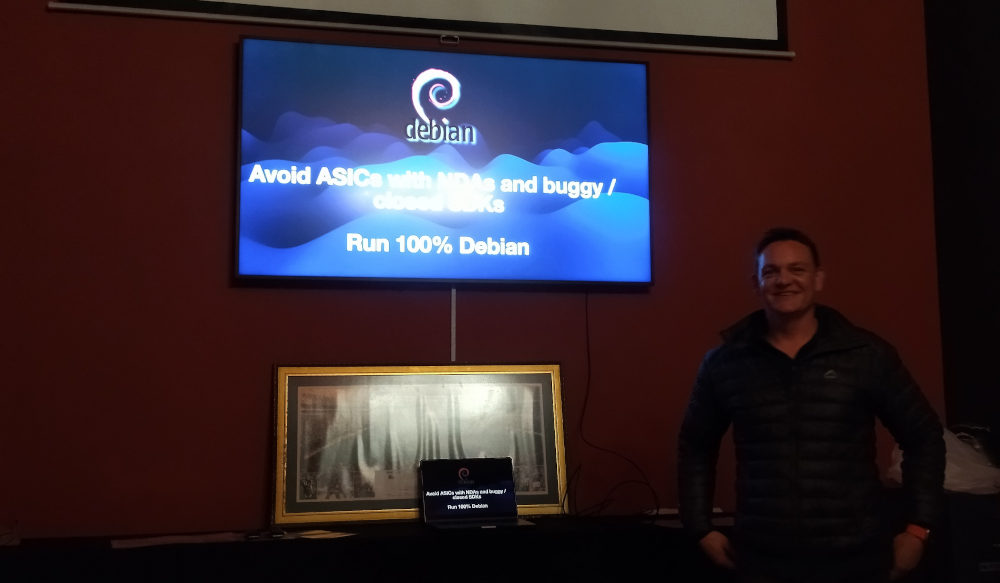
Jonathan Carter: CLUG Talk: Running Debian on a 100Gbps router

Last night I attended the first local Linux User Group talk since before the pandemic (possibly even long before the pandemic!) Topic: How and why Atomic Access runs Debian on a 100Gbps router Speaker: Joe Botha This is the first time CLUG used Woodstock Brewery as a venue. It s great, because now we can have snacks and beer during the talks :)

Joe has worked in the internet space for quite some time, and co-founded companies like Teraco, Frogfoot, Amobia, Octotel and Atomic Access. Through all of these he s done interesting and noteworthy work, which I ve only seen some glimpses of before in the few moments we ve interacted at CLUG events. It was nice seeing a lot more detail of a project that I wouldn t even know about if he didn t give this talk. It doesn t seem that anyone else is running Debian on big switches for commercial ISPs. He goes through these great lengths to run Debian so that he can have a decent set of tools and familiar commands on the switch, as apposed to the (my word here) crappy tooling that you would get on the brand name switches.
By total coincidence, David Plonka happened to be at the brewery too, he s a network expert who works at Akamai. He didn t know this talk was taking place, so this was a fun happenstance, he had some good inputs during the talk too. He also bought everyone a round of beer, thanks David! I asked Joe for his slides and I ll share them here when I get them. Unfortunately we don t have video for this talk, but I asked Joe to consider coming to DebConf23, I think this topic would be really interesting to the wider Debian crowd. By the way, both registration and the call for proposals are now officially open for DebConf23, it s taking place in September in Kochi, India this year. Updates (2023-06-07): Joe provided slides for his talk, you can get them here. He also provided some links:

12 June 2023

Bits from Debian: Registration and the Call for Proposals for DebConf23 are now open!

For DebConf23, we're pleased to announce opening of registration and call for proposal. Following is the info text -
Registration and the Call for Proposals for DebConf23 are now open. The 24th edition of the Debian annual conference will be held from September 10th to September 17th, 2023, in Infopark, Kochi, India. The main conference will be preceded by DebCamp, which will take place from September 3rd to September 9th, 2023. The registration form can be accessed by creating an account on the DebConf23 website and clicking on "register" in the profile section. The number of attendees is capped at 300 this year. All registrations will be reviewed by bursary team, and completing the registration form does not guarantee attendance. As always, basic registration for DebConf is free of charge for attendees. If you are attending the conference in a professional capacity or as a representative of your company, we kindly ask that you consider registering in one of our paid categories to help cover the costs of organizing the conference and to support subsidizing other community members. The last day to register with guaranteed swag is 5th August. We also encourage eligible individuals to apply for a diversity bursary. Travel, food, and accommodation bursaries are available. More details can be found on the bursary info page. The last day to apply for a bursary is 1st July. Applicants should receive feedback on their bursary application by 16th July. The call for proposals for talks, discussions and other activities is also open. To submit a proposal you need to create an account on the website, and then use the "Submit Talk" button in the profile section. The last day to submit and have your proposal be considered for the main conference schedule, with video coverage guaranteed, is 13th August. DebConf23 is also accepting sponsors. Interested companies and organizations may contact the DebConf team through sponsors@debconf.org or visit the DebConf23 website.

11 June 2023

Dirk Eddelbuettel: sanitizers 0.1.1 on CRAN: Updated and Expanded

bleach The second release of the sanitizers package is now on CRAN. sanitizers provides true positives for programming errors detected by Address Sanitizers and friends. This permits validation of the setup when chasing such bug reports: it allows us to ascertain that the compiler (and instrumented R version) are correctly set up and the errors we expect to be reported are in fact reported. Almost nine years (!!) since the first release, this update brings an added integer overflow sanitizer contributed by Greg Jeffries so long ago that I had thought it was part of the CRAN releases my bad for delaying this. It also updates programming practices by switching to symbol registration for the compiled functions. And of course several R packaging best practices have improved since the initial release so we updated a few small things throughout. A very good resources for all things sanitizers is the Google repo at GitHub and especially its wiki. The brief NEWS entry follows.

Changes in version 0.1.1 (2023-06-11)
  • Added integer overflow example kindly contributed by Greg Jeffries
  • Added continuous integration and badges
  • Updated package to use symbol registration for compiled code
  • Updated and edited DESCRIPTION, README and help pages for current packaging standards
  • Expanded README with usage example via r-devel-san Rocker container

Courtesy of my CRANberries, there is a diffstat report for this release. See the project page, the github repo, and the package documentation for more details. If you like the open-source work I do, you can sponsor me at GitHub.

This post by Dirk Eddelbuettel originated on his Thinking inside the box blog. Please report excessive re-aggregation in third-party for-profit settings.

10 June 2023

Freexian Collaborators: Debian Contributions: /usr-merge updates, tox 4 transition, and more! (by Utkarsh Gupta, Stefano Rivera)

Contributing to Debian is part of Freexian s mission. This article covers the latest achievements of Freexian and their collaborators. All of this is made possible by organizations subscribing to our Long Term Support contracts and consulting services.

/usr-merge, by Helmut Grohne, et al Towards the end of April, the discussion on DEP 17 on debian-devel@l.d.o initiated by Helmut Grohne took off, trying to deal with the fact that while Debian bookworm has a merged /usr, files are still being distributed to / and /usr in Debian binary packages, and moving them currently has some risk of breakage. Most participants of the discussion agreed that files should be moved, and there are several competing design ideas for doing it safely. Most of the time was spent understanding the practical implications of lifting the moratorium and moving all the files from / to /usr in a coordinated effort. With help from Emilio Pozuelo Monfort, Enrico Zini, and Raphael Hertzog, Helmut Grohne performed extensive analysis of the various aspects, including quantitative analysis of the original file move problem, analysis of effects on dpkg-divert, dpkg-statoverride, and update-alternatives, analysis of effects on filesystem bootstrapping tools. Most of the problematic cases spawned plausible workarounds, such as turning Breaks into Conflicts in selected cases or adding protective diversions for the symbolic links that enable aliasing. Towards the end of May, Andreas Beckmann reported a new failure scenario which may cause shared resources to inadvertently disappear, such as directories and even regular files in case of Multi-Arch packages, and our work on analyzing these problems and proposing mitigations is on-going. While the quantitative analysis is funded by Freexian, we wouldn t be here without the extensive feedback and ideas of many voluntary contributors from multiple areas of Debian, which are too many to name here. Thank you.

Preparing for the tox 4 transition, by Stefano Rivera While Debian was in freeze for the bookworm release, tox 4 has landed in Debian experimental, and some packages are starting to require it, upstream. It has some backwards-incompatible behavior that breaks many packages using tox through pybuild. So Stefano had to make some changes to pybuild and to many packages that run build-time tests with tox. The easy bits of this transition are now completed in git / experimental, but a few packages that integrate deeply into tox need upstream work.

Debian Printing, by Thorsten Alteholz Just before the release of Bookworm, lots of QA tools were used to inspect packages. One of these tools found a systemd service file in a wrong directory. So, Thorsten did another upload of package lprint to correct this. Thanks a lot to all the hardworking people who run such tools and file bugs. Thorsten also participated in discussions about the new Common Printing Dialog Backends (CPDB) that will be introduced in Trixie and hopefully can replace the current printing architecture in Forky.

Miscellaneous contributions
  • DebConf 23 preparations by Stefano Rivera. Some work on the website, video team planning, accounting, and team documentation.
  • Utkarsh Gupta started to prep the work on the bursary team s side for DC23.
  • Stefano spun up a website for the Hamburg mini-DebConf so that the video team could have a machine-readable schedule and a place to stream video from the event.
  • Santiago Ruano Rinc n reviewed and sponsored four python packages of a prospective Debian member.
  • Helmut Grohne supported Timo Roehling and Jochen Sprickerhof to improve cross building in 15 ROS packages.
  • Helmut Grohne supported Jochen Sprickerhof with diagnosing an e2fsprogs RC bug.
  • Helmut Grohne continued to maintain rebootstrap and located an issue with lto in gcc-13.
  • Anton Gladky fixed some RC-Bugs and uploaded a new stravalib python library.

6 June 2023

Russell Coker: PinePhonePro First Impression

Hardware I received my PinePhone Pro [1] on Thursday, it seems in many ways better than the Purism Librem 5 [2] that I have previously written about. The PinePhone is thinner, lighter, and yet has a much longer battery life. A friend described the Librem5 as the CyberTruck phone and not in a good way. In a test I had my PinePhone and my Librem5 fully charged, left them for 4.5 hours without doing anything much with them, and then the PinePhone was at 85% and the Librem5 was at 57%. So the Librem5 will run out of battery after about 10 hours of not being used while a PinePhonePro can be expected to last about 30 hours. The PinePhonePro isn t as good as some of the recent Android phones in this regard but it shows the potential to be quite usable. For this test both phones were connected to a 2.4GHz Wifi network (which uses less power than 5GHz) and doing nothing much with an out of the box configuration. A phone that is checking email, social networking, and a couple of IM services will use the battery faster. But even if the PinePhone has it s battery used twice as fast in a more realistic test that will still be usable. Here are the passmark results from the PinePhone Pro [3] which got a CPU score of 888 compared to 507 for the Librem 5 and 678 for one of the slower laptops I ve used. The results are excluded from the Passmark averages because they identified the CPU as only having 4 cores (expecting just 4*A72) while the PinePhonePro has 6 cores (2*A72+4*A53). This phone definitely has the CPU power for convergence [4]! Default OS By default the PinePhone has a KDE based GUI and the Librem5 has a GNOME based GUI. I don t like any iteration of GNOME (I have tried them all and disliked them all) and I like KDE so I will tend to like anything that is KDE based more than anything GNOME based. But in addition to that the PinePhone has an interface that looks a lot like Android with the three on-screen buttons at the bottom of the display and the way it has the slide up tray for installed apps. Android is the most popular phone OS and looking like the most common option is often a good idea for a new and different product, this seems like an objective criteria to determine that the default GUI on the PinePhone is a better choice (at least for the default). When I first booted it and connected it to Wifi the updates app said that there were 633 updates to apply, but never applied them (I tried clicking on the update button but to no avail) and didn t give any error message. For me not being Debian is enough reason to dislike Manjaro, but if that wasn t enough then the failure to update would be a good start. When I ran pacman in a terminal window it said that each package was corrupt and asked if I wanted to delete it. According to tar tvJf the packages weren t corrupt. After downloading them again it said that they were corrupt again so it seemed that pacman wasn t working correctly. When the screen is locked and a call comes in it gives a window with Accept and Reject buttons but neither of them works. The default country code for Spacebar (the SMS app) is +1 (US) even though I specified Australia on the initial login. It also doesn t get the APN unlike Android phones which seem to have some sort of list of APNs. Upgrading to Debian The Debian Wiki page about Installing on the PinePhone Pro has the basic information [5]. The first thing it covers is installing the TOW boot loader which is already installed by default in recent PinePhones (such as mine). You can recognise that TOW is installed by pressing the volume-up button in the early stages of boot up (described as before and during the second vibration ), then the LED will turn blue and the phone will act as a USB mass storage device which makes it easy to do other install/recovery tasks. The other TOW option is to press volume-down to boot from a MicroSD card (the default is to boot the OS on the eMMC). The images linked from the Debian wiki page are designed to be installed with bmaptool from the bmap-tools Debian package. After installing that package and downloading the pre-built Mobian image I installed it with the command bmaptool copy mobian-pinephonepro-phosh-bookworm-12.0-rc3.img.gz /dev/sdb where /dev/sdb is the device that the USB mapped PinePhone storage was located. That took 6 minutes and then I rebooted my PinePhone into Mobian! Unfortunately the default GUI for Mobian is GNOME/Phosh. Changing it to KDE is my next task.

Shirish Agarwal: Odisha Train Crash and Coverup, Demonetization 2.0 & NHFS-6 Survey

Just a few days back we came to know about the horrific Train Crash that happened in Odisha (Orissa). There are some things that are known and somethings that can be inferred by observance. Sadly, it seems the incident is going to be covered up  . Some of the facts that have not been contested in the public domain are that there were three lines. One loop line on which the Goods Train was standing and there was an up and a down line. So three lines were there. Apparently, the signalling system and the inter-locking system had issues as highlighted by an official about a month back. That letter, thankfully is in the public domain and I have downloaded it as well. It s a letter that goes to 4 pages. The RW is incensed that the letter got leaked and is in public domain. They are blaming everyone and espousing conspiracy theories rather than taking the minister to task. Incidentally, the Minister has three ministries that he currently holds. Ministry of Communication, Ministry of Electronics and Information Technology (MEIT), and Railways Ministry. Each Ministry in itself is important and has revenues of more than 6 lakh crore rupees. How he is able to do justice to all the three ministries is beyond me  The other thing is funds both for safety and relaying of tracks has been either not sanctioned or unutilized. In fact, CAG and the Railway Brass had shared how derailments have increased and unfulfilled vacancies but they were given no importance  In fact, not talking about safety in the recently held Chintan Shivir (brainstorming session) tells you how much the Govt. is serious about safety. In fact, most of the programme was on high speed rail which is a white elephant. I have shared a whitepaper done by RW in the U.S. that tells how high-speed rail doesn t make economic sense. And that is an economy that is 20 times + the Indian Economy. Even the Chinese are stopping with HSR as it doesn t make economic sense. Incidentally, Air Fares again went up 200% yesterday. Somebody shared in the region of 20k + for an Air ticket from their place to Bangalore  Coming back to the story itself. the Goods Train was on the loopline. Some say it was a little bit on the outer, some say otherwise, but it is established that it was on the loopline. This is standard behavior on and around Railway Stations around the world. Whether it was in the Inner or Outer doesn t make much of a difference with what happened next. The first train that collided with the goods train was the 12864 (SMVB-HWH) Yashwantpur Howrah Express and got derailed on to the next track where from the opposite direction 12841 (Shalimar- Bangalore) Coramandel Express was coming. Now they have said that around 300 people have died and that seems to be part of the cover-up. Both the trains are long trains, having between 23 odd coaches each. Even if you have reserved tickets you have 80 odd people in a coach and usually in most of these trains, it is at least double of that. Lot of money goes to TC and then above (Corruption). The Railway fares have gone up enormously but that s a question for perhaps another time  . So at the very least, we could be looking at more than 1000 people having died. The numbers are being under-reported so that nobody has to take responsibility. The Railways itself has told that it is unable to identify 80% of the people who have died. This means that 80% were unreserved ticket holders or a majority of them. There have been disturbing images as how bodies have been flung over on tractors and whatnot to be either buried or cremated without a thought. We are in peak summer season so bodies will start to rot within 24-48 hours  No arrangements made to cool the bodies and take some information and identifying marks or whatever. The whole thing being done in a very callous manner, not giving dignity to even those who have died for no fault of their own. The dissent note also tells that a cover-up is also in the picture. Apparently, India doesn t have nor does it feel to have a need for something like the NTSB that the U.S. used when it hauled both the plane manufacturer (Boeing) and the FAA when the 737 Max went down due to improper data collection and sharing of data with pilots. And with no accountability being fixed to Minister or any of the senior staff, a small junior staff person may be fired. Perhaps the same official that actually told them about the signal failures almost 3 months back  There were and are also some reports that some jugaadu /temporary fixes were applied to signalling and inter-locking just before this incident happened. I do not know nor confirm one way or the other if the above happened. I can however point out that if such a thing happened, then usually a traffic block is announced and all traffic on those lines are stopped. This has been the thing I know for decades. Traveling between Mumbai and Pune multiple times over the years am aware about traffic block. If some repair work was going on and it wasn t able to complete the work within the time-frame then that may well have contributed to the accident. There is also a bit muddying of the waters where it is being said that one of the trains was 4 hours late, which one is conflicting stories. On top of the whole thing, they have put the case to be investigated by CBI and hinting at sabotage. They also tried to paint a religious structure as mosque, later turned out to be a temple. The RW says done by Muslims as it was Friday not taking into account as shared before that most Railway maintenance works are usually done between Friday Monday. This is a practice followed not just in India but world over. There has been also move over a decade to remove wooden sleepers and have concrete sleepers. Unlike the wooden ones they do not expand and contract as much and their life is much more longer than the wooden ones. Funds had been marked (although lower than last few years) but not yet spent. As we know in case of any accident, it is when all the holes in cheese line up it happens. Fukushima is a great example of that, no sea wall even though Japan is no stranger to Tsunamis. External power at the same level as the plant. (10 meters above sea-level), no training for cascading failures scenarios which is what happened. The Days mini-series shares some but not all the faults that happened at Fukushima and the Govt. response to it. There is a difference though, the Japanese Prime Minister resigned on moral grounds. Here, nor the PM, nor the Minister would be resigning on moral grounds or otherwise :(. Zero accountability and that was partly a natural disaster, here it s man-made. In fact, both the Minister and the Prime Minister arrived with their entourages, did a PR blitzkrieg showing how concerned they are. Within 50 hours, the lines were cleared. The part-time Railway Minister shared that he knows the root cause and then few hours later has given the case to CBI. All are saying, wait for the inquiry report. To date, none of the accidents even in this Govt. has produced an investigation report. And even if it did, I am sure it will whitewash as it did in case of Adani as I had shared before in the previous blog post. Incidentally, it is reported that Adani paid off some of its debt, but when questioned as to where they got the money, complete silence on that part :(. As can be seen cover-up after cover-up  FWIW, the Coramandel Express is known as the Migrant train so has a huge number of passengers, the other one which was collided with is known as sick train as huge number of cancer patients use it to travel to Chennai and come back

Demonetization 2.0 Few days back, India announced demonetization 2.0. Surprised, don t be. Apparently, INR 2k/- is being used for corruption and Mr. Modi is unhappy about it. He actually didn t like the INR 2k/- note but was told that it was needed, who told him we are unaware to date. At that time the RBI Governor was Mr. Urjit Patel who didn t say about INR 2k/- he had said that INR 1k/- note redesigned would come in the market. That has yet to happen. What has happened is that just like INR 500/- and INR 1k/- note is concerned, RBI will no longer honor the INR 2k/- note. Obviously, this has made our neighbors angry, namely Nepal, Sri Lanka, Bhutan etc. who do some trading with us. 2 Deccan herald columns share the limelight on it. Apparently, India wants to be the world s currency reserve but doesn t want to play by the rules for everyone else. It was pointed out that both the U.S. and Singapore had retired their currencies but they will honor that promise even today. The Singapore example being a bit closer (as it s in Asia) is perhaps a bit more relevant than the U.S. one. Singapore retired the SGD $10,000 as of 2014 but even in 2022, it remains as legal tender. They also retired the SGD $1,000 in 2020 but still remains legal tender.

So let s have a fictitious example to illustrate what is meant by what Singapore has done. Let s say I go to Singapore, rent a flat, and find a $1000 note in that house somewhere. Both practically and theoretically, I could go down to any of the banks, get the amount transferred to my wallet, bank account etc. and nobody will question. Because they have promised the same. Interestingly, the Singapore Dollar has been pretty resilient against the USD for quite a number of years vis-a-vis other Asian currencies. Most of the INR 2k/- notes were also found and exchanged in Gujarat in just a few days (The PM and HM s state.). I am sure you are looking into the mental gymnastics that the RW indulge in :(. What is sadder that most of the people who try to defend can t make sense one way or the other and start to name-call and get personal as they have nothing else

Disability questions dropped in NHFS-6 Just came to know today that in the upcoming National Family Health Survey-6 disability questions are being dropped. Why is this important. To put it simply, if you don t have numbers, you won t and can t make policies for them. India is one of the worst countries to live if you are disabled. The easiest way to share to draw attention is most Railway platforms are not at level with people. Just as Mick Lynch shares in the UK, the same is pretty much true for India too. Meanwhile in Europe, they do make an effort to be level so even disabled people have some dignity. If your public transport is sorted, then people would want much more and you will be obligated to provide for them as they are citizens. Here, we have had many reports of women being sexually molested when being transferred from platform to coach irrespective of their age or whatnot  The main takeaway is if you do not have their voice, you won t make policies for them. They won t go away but you will make life hell for them. One thing to keep in mind that most people assume that most people are disabled from birth. This may or may not be true. For e.g. in the above triple Railways accidents, there are bound to be disabled people or newly disabled people who were healthy before the accident. The most common accident is road accidents, some involving pedestrians and vehicles or both, the easiest is Ministry of Road Transport data that says 4,00,000 people sustained injuries in 2021 alone in road mishaps. And this is in a country where even accidents are highly under-reported, for more than one reason. The biggest reason especially in 2 and 4 wheeler is the increased premium they would have to pay if in an accident, so they usually compromise with the other and pay off the Traffic Inspector. Sadly, I haven t read a new book, although there are a few books I m looking forward to have. People living in India and neighbors please be careful as more heat waves are expected. Till later.

3 June 2023

Ben Hutchings: FOSS activity in May 2023

2 June 2023

Matt Brown: Calling time on DNSSEC: The costs exceed the benefits

I m calling time on DNSSEC. Last week, prompted by a change in my DNS hosting setup, I began removing it from the few personal zones I had signed. Then this Monday the .nz ccTLD experienced a multi-day availability incident triggered by the annual DNSSEC key rotation process. This incident broke several of my unsigned zones, which led me to say very unkind things about DNSSEC on Mastodon and now I feel compelled to more completely explain my thinking: For almost all domains and use-cases, the costs and risks of deploying DNSSEC outweigh the benefits it provides. Don t bother signing your zones. The .nz incident, while topical, is not the motivation or the trigger for this conclusion. Had it been a novel incident, it would still have been annoying, but novel incidents are how we learn so I have a small tolerance for them. The problem with DNSSEC is precisely that this incident was not novel, just the latest in a long and growing list. It s a clear pattern. DNSSEC is complex and risky to deploy. Choosing to sign your zone will almost inevitably mean that you will experience lower availability for your domain over time than if you leave it unsigned. Even if you have a team of DNS experts maintaining your zone and DNS infrastructure, the risk of routine operational tasks triggering a loss of availability (unrelated to any attempted attacks that DNSSEC may thwart) is very high - almost guaranteed to occur. Worse, because of the nature of DNS and DNSSEC these incidents will tend to be prolonged and out of your control to remediate in a timely fashion. The only benefit you get in return for accepting this almost certain reduction in availability is trust in the integrity of the DNS data a subset of your users (those who validate DNSSEC) receive. Trusted DNS data that is then used to communicate across an untrusted network layer. An untrusted network layer which you are almost certainly protecting with TLS which provides a more comprehensive and trustworthy set of security guarantees than DNSSEC is capable of, and provides those guarantees to all your users regardless of whether they are validating DNSSEC or not. In summary, in our modern world where TLS is ubiquitous, DNSSEC provides only a thin layer of redundant protection on top of the comprehensive guarantees provided by TLS, but adds significant operational complexity, cost and a high likelihood of lowered availability. In an ideal world, where the deployment cost of DNSSEC and the risk of DNSSEC-induced outages were both low, it would absolutely be desirable to have that redundancy in our layers of protection. In the real world, given the DNSSEC protocol we have today, the choice to avoid its complexity and rely on TLS alone is not at all painful or risky to make as the operator of an online service. In fact, it s the prudent choice that will result in better overall security outcomes for your users. Ignore DNSSEC and invest the time and resources you would have spent deploying it improving your TLS key and certificate management. Ironically, the one use-case where I think a valid counter-argument for this position can be made is TLDs (including ccTLDs such as .nz). Despite its many failings, DNSSEC is an Internet Standard, and as infrastructure providers, TLDs have an obligation to enable its use. Unfortunately this means that everyone has to bear the costs, complexities and availability risks that DNSSEC burdens these operators with. We can t avoid that fact, but we can avoid creating further costs, complexities and risks by choosing not to deploy DNSSEC on the rest of our non-TLD zones.

But DNSSEC will save us from the evil CA ecosystem! Historically, the strongest motivation for DNSSEC has not been the direct security benefits themselves (which as explained above are minimal compared to what TLS provides), but in the new capabilities and use-cases that could be enabled if DNS were able to provide integrity and trusted data to applications. Specifically, the promise of DNS-based Authentication of Named Entities (DANE) is that with DNSSEC we can be free of the X.509 certificate authority ecosystem and along with it the expensive certificate issuance racket and dubious trust properties that have long been its most distinguishing features. Ten years ago this was an extremely compelling proposition with significant potential to improve the Internet. That potential has gone unfulfilled. Instead of maturing as deployments progressed and associated operational experience was gained, DNSSEC has been beset by the discovery of issue after issue. Each of these has necessitated further changes and additions to the protocol, increasing complexity and deployment cost. For many zones, including significant zones like google.com (where I led the attempt to evaluate and deploy DNSSEC in the mid 2010s), it is simply infeasible to deploy the protocol at all, let alone in a reliable and dependable manner. While DNSSEC maturation and deployment has been languishing, the TLS ecosystem has been steadily and impressively improving. Thanks to the efforts of many individuals and companies, although still founded on the use of a set of root certificate authorities, the TLS and CA ecosystem today features transparency, validation and multi-party accountability that comprehensively build trust in the ability to depend and rely upon the security guarantees that TLS provides. When you use TLS today, you benefit from:
  • Free/cheap issuance from a number of different certificate authorities.
  • Regular, automated issuance/renewal via the ACME protocol.
  • Visibility into who has issued certificates for your domain and when through Certificate Transparency logs.
  • Confidence that certificates issued without certificate transparency (and therefore lacking an SCT) will not be accepted by the leading modern browsers.
  • The use of modern cryptographic protocols as a baseline, with a plausible and compelling story for how these can be steadily and promptly updated over time.
DNSSEC with DANE can match the TLS ecosystem on the first benefit (up front price) and perhaps makes the second benefit moot, but has no ability to match any of the other transparency and accountability measures that today s TLS ecosystem offers. If your ZSK is stolen, or a parent zone is compromised or coerced, validly signed TLSA records for a forged certificate can be produced and spoofed to users under attack with minimal chances of detection. Finally, in terms of overall trust in the roots of the system, the CA/Browser forum requirements continue to improve the accountability and transparency of TLS certificate authorities, significantly reducing the ability for any single actor (say a nefarious government) to subvert the system. The DNS root has a well established transparent multi-party system for establishing trust in the DNSSEC root itself, but at the TLD level, almost intentionally thanks to the hierarchical nature of DNS, DNSSEC has multiple single points of control (or coercion) which exist outside of any formal system of transparency or accountability. We ve moved from DANE being a potential improvement in security over TLS when it was first proposed, to being a definite regression from what TLS provides today. That s not to say that TLS is perfect, but given where we re at, we ll get a better security return from further investment and improvements in the TLS ecosystem than we will from trying to fix DNSSEC.

But TLS is not ubiquitous for non-HTTP applications The arguments above are most compelling when applied to the web-based HTTP-oriented ecosystem which has driven most of the TLS improvements we ve seen to date. Non-HTTP protocols are lagging in adoption of many of the improvements and best practices TLS has on the web. Some claim this need to provide a solution for non-HTTP, non-web applications provides a motivation to continue pushing DNSSEC deployment. I disagree, I think it provides a motivation to instead double-down on moving those applications to TLS. TLS as the new TCP. The problem is that costs of deploying and operating DNSSEC are largely fixed regardless of how many protocols you are intending to protect with it, and worse, the negative side-effects of DNSSEC deployment can and will easily spill over to affect zones and protocols that don t want or need DNSSEC s protection. To justify continued DNSSEC deployment and operation in this context means using a smaller set of benefits (just for the non-HTTP applications) to justify the already high costs of deploying DNSSEC itself, plus the cost of the risk that DNSSEC poses to the reliability to your websites. I don t see how that equation can ever balance, particularly when you evaluate it against the much lower costs of just turning on TLS for the rest of your non-HTTP protocols instead of deploying DNSSEC. MTA-STS is a worked example of how this can be achieved. If you re still not convinced, consider that even DNS itself is considering moving to TLS (via DoT and DoH) in order to add the confidentiality/privacy attributes the protocol currently lacks. I m not a huge fan of the latency implications of these approaches, but the ongoing discussion shows that clever solutions and mitigations for that may exist. DoT/DoH solve distinct problems from DNSSEC and in principle should be used in combination with it, but in a world where DNS itself is relying on TLS and therefore has eliminated the majority of spoofing and cache poisoning attacks through DoT/DoH deployment the benefit side of the DNSSEC equation gets smaller and smaller still while the costs remain the same.

OK, but better software or more careful operations can reduce DNSSEC s cost Some see the current DNSSEC costs simply as teething problems that will reduce as the software and tooling matures to provide more automation of the risky processes and operational teams learn from their mistakes or opt to simply transfer the risk by outsourcing the management and complexity to larger providers to take care of. I don t find these arguments compelling. We ve already had 15+ years to develop improved software for DNSSEC without success. What s changed that we should expect a better outcome this year or next? Nothing. Even if we did have better software or outsourced operations, the approach is still only hiding the costs behind automation or transferring the risk to another organisation. That may appear to work in the short-term, but eventually when the time comes to upgrade the software, migrate between providers or change registrars the debt will come due and incidents will occur. The problem is the complexity of the protocol itself. No amount of software improvement or outsourcing addresses that. After 15+ years of trying, I think it s worth considering that combining cryptography, caching and distributed consensus, some of the most fundamental and complex computer science problems, into a slow-moving and hard to evolve low-level infrastructure protocol while appropriately balancing security, performance and reliability appears to be beyond our collective ability. That doesn t have to be the end of the world, the improvements achieved in the TLS ecosystem over the same time frame provide a positive counter example - perhaps DNSSEC is simply focusing our attention at the wrong layer of the stack. Ideally secure DNS data would be something we could have, but if the complexity of DNSSEC is the price we have to pay to achieve it, I m out. I would rather opt to remain with the simpler yet insecure DNS protocol and compensate for its short comings at higher transport or application layers where experience shows we are able to more rapidly improve and develop our security capabilities.

Summing up For the vast majority of domains and use-cases there is simply no net benefit to deploying DNSSEC in 2023. I d even go so far as to say that if you ve already signed your zones, you should (carefully) move them back to being unsigned - you ll reduce the complexity of your operating environment and lower your risk of availability loss triggered by DNS. Your users will thank you. The threats that DNSSEC defends against are already amply defended by the now mature and still improving TLS ecosystem at the application layer, and investing in further improvements here carries far more return than deployment of DNSSEC. For TLDs, like .nz whose outage triggered this post, DNSSEC is not going anywhere and investment in mitigating its complexities and risks is an unfortunate burden that must be shouldered. While the full incident report of what went wrong with .nz is not yet available, the interim report already hints at some useful insights. It is important that InternetNZ publishes a full and comprehensive review so that the full set of learnings and improvements this incident can provide can be fully realised by .nz and other TLD operators stuck with the unenviable task of trying to safely operate DNSSEC.

Postscript After taking a few days to draft and edit this post, I ve just stumbled across a presentation from the well respected Geoff Huston at last weeks RIPE86 meeting. I ve only had time to skim the slides (video here) - they don t seem to disagree with my thinking regarding the futility of the current state of DNSSEC, but also contain some interesting ideas for what it might take for DNSSEC to become a compelling proposition. Probably worth a read/watch!

1 June 2023

Russell Coker: Do Desktop Computers Make Sense?

Laptop vs Desktop Price Currently the smaller and cheaper USB-C docks start at about $25 and Dell has a new Vostro with 8G of RAM and 2*USB-C ports for $788. That gives a bit over $800 for a laptop and dock vs $795 for the cheapest Dell desktop which also has 8G of RAM. For every way of buying laptops and desktops (EG buying from Officeworks, buying on ebay, etc) the prices for laptops and desktops seem very similar. For all those comparisons the desktop will typically have a faster CPU and more options for PCIe cards, larger storage, etc. But if you don t want to expand storage beyond the affordable 4TB NVMe/SSD devices, don t need to add PCIe cards, and don t need much CPU power then a laptop will do well. For the vast majority of the computer work I do my Thinkpad Carbon X1 Gen1 (from 2012) had plenty of CPU power. If someone who s not an expert in PC hardware was to buy a computer of a given age then laptops probably aren t more expensive than desktops even disregarding the fact that a laptop works without the need to purchase a monitor, a keyboard, or a mouse. I can get regular desktop PCs for almost nothing and get parts to upgrade them very cheaply but most people can t do that. I can also get a decent second-hand laptop and USB-C dock for well under $400. Servers and Gaming Systems For people doing serious programming or other compute or IO intensive tasks some variation on the server theme is the best option. That may be something more like the servers used by the r/homelab people than the corporate servers, or it might be something in the cloud, but a server is a server. If you are going to have a home server that s a tower PC then it makes sense to put a monitor on it and use it as a workstation. If your server makes so much noise that you can t spend much time in the same room or if it s hosted elsewhere then using a laptop to access it makes sense. Desktop computers for PC gaming makes sense as no-one seems to be making laptops with moderately powerful GPUs. The most powerful GPUs draw 150W which is more than most laptop PSUs can supply and even if a laptop PSU could supply that much there would be the issue of cooling. The Steam Deck [1] and the Nintendo Switch [2] can both work with USB-C docks. The PlayStation 5 [3] has a 350W PSU and doesn t support video over USB-C. The Steam Deck can do 8K resolution at 60Hz or 4K at 120Hz but presumably the newer Steam games will need a desktop PC with a more powerful GPU to properly use such resolutions. For people who want the best FPS rates on graphics intensive games it could make sense to have a tower PC. Also a laptop that s run at high CPU/GPU use for a long time will tend to have it s vents clogged by dust and possibly have the cooling fan wear out. Monitor Resolution Laptop support for a single 4K monitor became common in 2012 with the release of the Ivy Bridge mobile CPUs from Intel in 2012. My own experience of setting up 4K monitors for a Linux desktop in 2019 was that it was unreasonably painful and that the soon to be released Debian/Bookworm will make things work nicely for 4K monitors with KDE on X11. So laptop hardware has handled the case of a single high resolution monitor since before such monitors were cheap or common and before software supported it well. Of course at that time you had to use either a proprietary dock or a mini-DisplayPort to HDMI adaptor to get 4K working. But that was still easier than getting PCIe video cards supporting 4K resolution which is something that according to spec sheets wasn t well supported by affordable cards in 2017. Since USB-C became a standard feature in laptops in about 2017 support of more monitors than most people would want through a USB-C dock became standard. My Thinkpad X1 Carbon Gen5 which was released in 2017 will support 2*FullHD monitors plus a 4K monitor via a USB-C dock, I suspect it would do at least 2*4K monitors but haven t had a chance to test. Cheap USB-C docks supporting this sort of thing have only become common in the last year or so. How Many Computers per Home Among middle class Australians it s common to have multiple desktop PCs per household. One for each child who s over the age of about 13 and one for the parents seems to be reasonably common. Students in the later years of high-school and university students are often compelled to have laptops so having the number of laptops plus the number of desktops be larger than the population of the house probably isn t uncommon even among people who aren t really into computers. As an aside it s probably common among people who read my blog to have 2 desktops, a laptop, and a cloud server for their own personal use. But even among people who don t do that sort of thing having computers outnumber people in a home is probably common. A large portion of the computer users can do everything they need on a laptop. For gamers the graphics intensive games often run well on a console and that s probably the most effective way of getting to playing the games. Of course the fact that there is RGB RAM (RAM with Red, Green, and Blue LEDs to light up) along with a lot of other wild products sold to gamers suggests that gaming PCs are not about what runs the game most effectively and that an art/craft project with the PC is more important than actually playing games. Instead of having one desktop PC per bedroom and laptops for school/university as well it would make more sense to have a laptop per person and have a USB-C dock and monitor in each bedroom and a USB-C dock connected to a large screen TV in the lounge. This gives plenty of flexibility for moving around to do work and sharing what s on your computer with other people. It also allows taking a work computer home and having work with your monitor, having a friend bring their laptop to your home to work on something together, etc. For most people desktop computers don t make sense. While I think that convergence of phones with laptops and desktops is the way of the future [4] for most people having laptops take over all functions of desktops is the best option today.

Jamie McClelland: Enough about the AI Apocalypse Already

After watching Democracy Now s segment on artificial intelligence I started to wonder - am I out of step on this topic? When people claim artificial intelligence will surpass human intelligence and thus threaten humanity with extinction, they seem to be referring specifically to advances made with large language models. As I understand them, large language models are probability machines that have ingested massive amounts of text scraped from the Internet. They answer questions based on the probability of one series of words (their answer) following another series of words (the question). It seems like a stretch to call this intelligence, but if we accept that definition then it follows that this kind of intelligence is nothing remotely like human intelligence, which makes the claim that it will surpass human intelligence confusing. Hasn t this kind of machine learning surpassed us decades ago? Or when we say surpass does that simply refer to fooling people into thinking an AI machine is a human via conversation? That is an important milestone, but I m not ready to accept the turing test as proof of equal intelligence. Furthermore, large language models hallucinate and also reflect the biases of their training data. The word hallucinate seems like a euphemism, as if it could be corrected with the right medication when in fact it seems hard to avoid when your strategy is to correlate words based on probability. But even if you could solve the here is a completely wrong answer presented with sociopathic confidence problem, reflecting the biases of your data sources seems fairly intractable. In what world would a system with built-in bias be considered on the brink of surpassing human intelligence? The danger from LLMs seems to be their ability to convince people that their answers are correct, including their patently wrong and/or biased answers. Why do people think they are giving correct answers? Oh right terrifying right wing billionaires (with terrifying agendas have been claiming AI will exceed human intelligence and threaten humanity and every time they sign a hyperbolic statement they get front page mainstream coverage. And even progressive news outlets are spreading this narrative with minimal space for contrary opinions (thank you Tawana Petty from the Algorithmic Justice League for providing the only glimpse of reason in the segment). The belief that artificial intelligence is or will soon become omnipotent has real world harms today: specifically it creates the misperception that current LLMs are accurate, which paves the way for greater adoption among police forces, social service agencies, medical facilities and other places where racial and economic biases have life and death consequences. When the CEO of OpenAI calls the technology dangerous and in need of regulation, he gets both free advertising promoting the power and supposed accuracy of his product and the possibility of freezing further developments in the field that might challenge OpenAI s current dominance. The real threat to humanity is not AI, it s massive inequality and the use of tactics ranging from mundane bureaucracy to deadly force and incarceration to segregate the affluent from the growing number of people unable to make ends meet. We have spent decades training bureaucrats, judges and cops to robotically follow biased laws to maintain this order without compassion or empathy. Replacing them with AI would be make things worse and should be stopped. But, let s be clear, the narrative that AI is poised to surpass human intelligence and make humanity extinct is a dangerous distraction that runs counter to a much more important story about the very real and very present exploitative practices of the [companies building AI], who are rapidly centralizing power and increasing social inequities. . Maybe we should talk about that instead?

31 May 2023

Russell Coker: Genesis GV60

I recently test drove a Genesis GV70, but the GV60 [1] which I didn t test drive is a nicer car. The GV70 and GV60 are all electric so they are quiet and perform well. The GV70 has a sun-roof that opens, it was the first car I ve driven like that and I decided I don t like it. Having the shade open so I can see the sky while stuck in a traffic jam is nice though. The GV60 has a non-opening sun-roof with a shade that can be retracted, this is a feature I d really like to have in my next car. Electric cars as a general rule have good acceleration and are quiet, the GV70 performed as expected in that regard. It has a head-up display projected on the windscreen for the speed and the speed limit on the road in question which is handy. When driving in a car park it showed images from all sides which is really handy, I wish I had explored that feature more. The console is all electronic with a TFT display instead of mechanical instruments but the only significant difference this makes in driving is that when a turn indicator is used the console display shows a video feed for the blind-spot that matches the lane change direction. This is a significant safety feature and will reduce the incidence of collisions. But the capabilities of the hardware seem under utilised, hopefully they will release a software update at some future time to do more with it. The most significant benefit of the GV60 over the GV70 is that it has cameras instead of mirrors at the sides of the car. This reduces drag and also removes the need to adjust mirrors to match the height of the driver. Also for driver instruction the instructor and learner get to see the same view. A logical development of such cars is an expansion pack for instruction that has displays in the passenger seat to show the instructor the same instrument view as the driver sees. The minimum list driveaway price for the GV60 is $117,171.50 and for the GV70 it is $138,119.89 both of which are more than I m prepared to pay for a car. The GV60 apparently can be started by fingerprint which seems like a bad idea given the poor security of fingerprint sensors, but as regular car keys tend not to be too difficult to work around it probably doesn t matter. The Genesis web site makes it difficult to find the ranges of electric cars which is surprising. A Google search suggests that the GV60 can do 466Km and the GV70 can do 410Km which are both reasonable numbers and nothing to be ashamed of. The GV70 was a fun car to drive and the GV60 looks like it would be even better. I recommend that everyone who likes technology take one for a test drive, but for my own use I m looking for something that costs less than half as much.

Russ Allbery: Review: Night Watch

Review: Night Watch, by Terry Pratchett
Series: Discworld #29
Publisher: Harper
Copyright: November 2002
Printing: August 2014
ISBN: 0-06-230740-1
Format: Mass market
Pages: 451
Night Watch is the 29th Discworld novel and the sixth Watch novel. I would really like to tell people they could start here if they wanted to, for reasons that I will get into in a moment, but I think I would be doing you a disservice. The emotional heft added by having read the previous Watch novels and followed Vimes's character evolution is significant. It's the 25th of May. Vimes is about to become a father. He and several of the other members of the Watch are wearing sprigs of lilac for reasons that Sergeant Colon is quite vehemently uninterested in explaining. A serial killer named Carcer the Watch has been after for weeks has just murdered an off-duty sergeant. It's a tense and awkward sort of day and Vimes is feeling weird and wistful, remembering the days when he was a copper and not a manager who has to dress up in ceremonial armor and meet with committees. That may be part of why, when the message comes over the clacks that the Watch have Carcer cornered on the roof of the New Hall of the Unseen University, Vimes responds in person. He's grappling with Carcer on the roof of the University Library in the middle of a magical storm when lightning strikes. When he wakes up, he's in the past, shortly after he joined the Watch and shortly before the events of the 25th of May that the older Watch members so vividly remember and don't talk about. I have been saying recently in Discworld reviews that it felt like Pratchett was on the verge of a breakout book that's head and shoulders above Discworld prior to that point. This is it. This is that book. The setup here is masterful: the sprigs of lilac that slowly tell the reader something is going on, the refusal of any of the older Watch members to talk about it, the scene in the graveyard to establish the stakes, the disconcerting fact that Vetinari is wearing a sprig of lilac as well, and the feeling of building tension that matches the growing electrical storm. And Pratchett never gives into the temptation to explain everything and tip his hand prematurely. We know the 25th is coming and something is going to happen, and the reader can put together hints from Vimes's thoughts, but Pratchett lets us guess and sometimes be right and sometimes be wrong. Vimes is trying to change history, which adds another layer of uncertainty and enjoyment as the reader tries to piece together both the true history and the changes. This is a masterful job at a "what if?" story. And, beneath that, the commentary on policing and government and ethics is astonishingly good. In a review of an earlier Watch novel, I compared Pratchett to Dickens in the way that he focuses on a sort of common-sense morality rather than political theory. That is true here too, but oh that moral analysis is sharp enough to slide into you like a knife. This is not the Vimes that we first met in Guards! Guards!. He has has turned his cynical stubbornness into a working theory of policing, and it's subtle and complicated and full of nuance that he only barely knows how to explain. But he knows how to show it to people.
Keep the peace. That was the thing. People often failed to understand what that meant. You'd go to some life-threatening disturbance like a couple of neighbors scrapping in the street over who owned the hedge between their properties, and they'd both be bursting with aggrieved self-righteousness, both yelling, their wives would either be having a private scrap on the side or would have adjourned to a kitchen for a shared pot of tea and a chat, and they all expected you to sort it out. And they could never understand that it wasn't your job. Sorting it out was a job for a good surveyor and a couple of lawyers, maybe. Your job was to quell the impulse to bang their stupid fat heads together, to ignore the affronted speeches of dodgy self-justification, to get them to stop shouting and to get them off the street. Once that had been achieved, your job was over. You weren't some walking god, dispensing finely tuned natural justice. Your job was simply to bring back peace.
When Vimes is thrown back in time, he has to pick up the role of his own mentor, the person who taught him what policing should be like. His younger self is right there, watching everything he does, and he's desperately afraid he'll screw it up and set a worse example. Make history worse when he's trying to make it better. It's a beautifully well-done bit of tension that uses time travel as the hook to show both how difficult mentorship is and also how irritating one's earlier naive self would be.
He wondered if it was at all possible to give this idiot some lessons in basic politics. That was always the dream, wasn't it? "I wish I'd known then what I know now"? But when you got older you found out that you now wasn't you then. You then was a twerp. You then was what you had to be to start out on the rocky road of becoming you now, and one of the rocky patches on that road was being a twerp.
The backdrop of this story, as advertised by the map at the front of the book, is a revolution of sorts. And the revolution does matter, but not in the obvious way. It creates space and circumstance for some other things to happen that are all about the abuse of policing as a tool of politics rather than Vimes's principle of keeping the peace. I mentioned when reviewing Men at Arms that it was an awkward book to read in the United States in 2020. This book tackles the ethics of policing head-on, in exactly the way that book didn't. It's also a marvelous bit of competence porn. Somehow over the years, Vimes has become extremely good at what he does, and not just in the obvious cop-walking-a-beat sort of ways. He's become a leader. It's not something he thinks about, even when thrown back in time, but it's something Pratchett can show the reader directly, and have the other characters in the book comment on. There is so much more that I'd like to say, but so much would be spoilers, and I think Night Watch is more effective when you have the suspense of slowly puzzling out what's going to happen. Pratchett's pacing is exquisite. It's also one of the rare Discworld novels where Pratchett fully commits to a point of view and lets Vimes tell the story. There are a few interludes with other people, but the only other significant protagonist is, quite fittingly, Vetinari. I won't say anything more about that except to note that the relationship between Vimes and Vetinari is one of the best bits of fascinating subtlety in all of Discworld. I think it's also telling that nothing about Night Watch reads as parody. Sure, there is a nod to Back to the Future in the lightning storm, and it's impossible to write a book about police and street revolutions without making the reader think about Les Miserables, but nothing about this plot matches either of those stories. This is Pratchett telling his own story in his own world, unapologetically, and without trying to wedge it into parody shape, and it is so much the better book for it. The one quibble I have with the book is that the bits with the Time Monks don't really work. Lu-Tze is annoying and flippant given the emotional stakes of this story, the interludes with him are frustrating and out of step with the rest of the book, and the time travel hand-waving doesn't add much. I see structurally why Pratchett put this in: it gives Vimes (and the reader) a time frame and a deadline, it establishes some of the ground rules and stakes, and it provides a couple of important opportunities for exposition so that the reader doesn't get lost. But it's not good story. The rest of the book is so amazingly good, though, that it doesn't matter (and the framing stories for "what if?" explorations almost never make much sense). The other thing I have a bit of a quibble with is outside the book. Night Watch, as you may have guessed by now, is the origin of the May 25th Pratchett memes that you will be familiar with if you've spent much time around SFF fandom. But this book is dramatically different from what I was expecting based on the memes. You will, for example see a lot of people posting "Truth, Justice, Freedom, Reasonably Priced Love, And a Hard-Boiled Egg!", and before reading the book it sounds like a Pratchett-style humorous revolutionary slogan. And I guess it is, sort of, but, well... I have to quote the scene:
"You'd like Freedom, Truth, and Justice, wouldn't you, Comrade Sergeant?" said Reg encouragingly. "I'd like a hard-boiled egg," said Vimes, shaking the match out. There was some nervous laughter, but Reg looked offended. "In the circumstances, Sergeant, I think we should set our sights a little higher " "Well, yes, we could," said Vimes, coming down the steps. He glanced at the sheets of papers in front of Reg. The man cared. He really did. And he was serious. He really was. "But...well, Reg, tomorrow the sun will come up again, and I'm pretty sure that whatever happens we won't have found Freedom, and there won't be a whole lot of Justice, and I'm damn sure we won't have found Truth. But it's just possible that I might get a hard-boiled egg."
I think I'm feeling defensive of the heart of this book because it's such an emotional gut punch and says such complicated and nuanced things about politics and ethics (and such deeply cynical things about revolution). But I think if I were to try to represent this story in a meme, it would be the "angels rise up" song, with all the layers of meaning that it gains in this story. I'm still at the point where the lilac sprigs remind me of Sergeant Colon becoming quietly furious at the overstep of someone who wasn't there. There's one other thing I want to say about that scene: I'm not naturally on Vimes's side of this argument. I think it's important to note that Vimes's attitude throughout this book is profoundly, deeply conservative. The hard-boiled egg captures that perfectly: it's a bit of physical comfort, something you can buy or make, something that's part of the day-to-day wheels of the city that Vimes talks about elsewhere in Night Watch. It's a rejection of revolution, something that Vimes does elsewhere far more explicitly. Vimes is a cop. He is in some profound sense a defender of the status quo. He doesn't believe things are going to fundamentally change, and it's not clear he would want them to if they did. And yet. And yet, this is where Pratchett's Dickensian morality comes out. Vimes is a conservative at heart. He's grumpy and cynical and jaded and he doesn't like change. But if you put him in a situation where people are being hurt, he will break every rule and twist every principle to stop it.
He wanted to go home. He wanted it so much that he trembled at the thought. But if the price of that was selling good men to the night, if the price was filling those graves, if the price was not fighting with every trick he knew... then it was too high. It wasn't a decision that he was making, he knew. It was happening far below the areas of the brain that made decisions. It was something built in. There was no universe, anywhere, where a Sam Vimes would give in on this, because if he did then he wouldn't be Sam Vimes any more.
This is truly exceptional stuff. It is the best Discworld novel I have read, by far. I feel like this was the Watch novel that Pratchett was always trying to write, and he had to write five other novels first to figure out how to write it. And maybe to prepare Discworld readers to read it. There are a lot of Discworld novels that are great on their own merits, but also it is 100% worth reading all the Watch novels just so that you can read this book. Followed in publication order by The Wee Free Men and later, thematically, by Thud!. Rating: 10 out of 10

29 May 2023

Shirish Agarwal: Pearls of Luthra, Dahaad, Tetris & Discord.

Pearls of Luthra Pearls of Luthra is the first book by Brian Jacques and I think I am going to be a fan of his work. This particular book you have to be wary of. While it is a beautiful book with quite a few illustrations, I have to warn that if you are somebody who feels hungry at the very mention of food, then you will be hungry throughout the book. There isn t a single page where food isn t mentioned and not just any kind of food, the kind of food that is geared towards sweet tooth. So if you fancy tarts or chocolates or anything sweet you will right at home. The book also touches upon various teas and wines and various liquors but food is where it shines in literally. The tale is very much like a Harry Potter adventure but isn t as dark as HP was. In fact, apart from one death and one ear missing rest of our heroes and heroines and there are quite a few. I don t want to give too much away as it s a book to be treasured.

Dahaad Dahaad (the roar) is Sonakshi Sinha s entry in OTT/Web Series. The stage is set somewhere in North India while the exploits are based on a real life person called Cyanide Mohan who killed 20 women between 2005-2009. In the web series however, the antagonist s crimes are done over a period of 12 years and has 29 women as his victims. Apart from that it s pretty much a copy of what was done by the person above. It s a melting pot of a series which quite a few stories enmeshed along with the main one. The main onus and plot of the movie is about women from lower economic and caste order whose families want them to be wed but cannot due to huge demands for dowry. Now in such a situation, if a person were to give them a bit of attention, promise marriage and ask them to steal a bit and come with him and whatever, they will do it. The same modus operandi was done by Cynaide Mohan. He had a car that was not actually is but used it show off that he s from a richer background, entice the women, have sex, promise marriage and in the morning after pill there will be cynaide which the women unwittingly will consume. This is also framed by the protagonist Sonakshi Sinha to her mother as her mother is also forcing her to get married as she is becoming older. She shows some of the photographs of the victims and says that while the perpetrator is guilty but so is the overall society that puts women in such vulnerable positions. AFAIK, that is still the state of things. In fact, there is a series called Indian Matchmaking that has all the snobbishness that you want. How many people could have a lifestyle like the ones shown in that, less than 2% of the population. It s actually shows like the above that make the whole thing even more precarious  Apart from it, the show also shows prejudice about caste and background. I wouldn t go much into it as it s worth seeing and experiencing.

Tetris Tetris in many a ways is a story of greed. It s also a story of a lone inventor who had to wait almost 20 odd years to profit from his invention. Forbes does a marvelous job of giving some more background and foreground info. about Tetris, the inventor and the producer that went to strike it rich. It also does share about copyright misrepresentation happens but does nothing to address it. Could talk a whole lot but better to see the movie and draw your own conclusions. For me it was 4/5.

Discord Discord became Discord 2.0 and is a blank to me. A blank page. Can t do anything. First I thought it was a bug. Waited for a few days as sometimes webservices do fix themselves. But two weeks on and it still wasn t fixed then decided to look under. One of the tools in Firefox is Web Developer Tools ( CTRL+Shift+I) that tells you if an element of a page is not appearing or at least gives you a hint. To me it gave me the following
Content Security Policy: Ignoring 'unsafe-inline' within script-src or style-src: nonce-source or hash-source specified
Content Security Policy: The page s settings blocked the loading of a resource at data:text/css,%0A%20%20%20%20%20%20%20%2 ( style-src ). data:44:30
Content Security Policy: Ignoring 'unsafe-inline' within script-src or style-src: nonce-source or hash-source specified
TypeError: AudioContext is not a constructor 138875 https://discord.com/assets/cbf3a75da6e6b6a4202e.js:262 l https://discord.com/assets/f5f0b113e28d4d12ba16.js:1ed46a18578285e5c048b.js:241:118 What is being done is dom.webaudio.enabled being disabled in Firefox. Then on a hunch, searched on reddit and saw the following. Be careful while visiting the link as it s labelled NSFW although to my mind there wasn t anything remotely NSFW about it. They do mention using another tool AudioContext Fingerprint Defender which supposedly fakes or spoofs an id. As this add-on isn t tracked by Firefox privacy team it s hard for me to say anything positive or negative. So, in the end I stopped using discord as the alternative was being tracked by them  Last but not the least, saw this about a week back. Sooner or later this had to happen as Elon tries to make money off Twitter.

John Goerzen: Recommendations for Tools for Backing Up and Archiving to Removable Media

I have several TB worth of family photos, videos, and other data. This needs to be backed up and archived. Backups and archives are often thought of as similar. And indeed, they may be done with the same tools at the same time. But the goals differ somewhat: Backups are designed to recover from a disaster that you can fairly rapidly detect. Archives are designed to survive for many years, protecting against disaster not only impacting the original equipment but also the original person that created them. Reflecting on this, it implies that while a nice ZFS snapshot-based scheme that supports twice-hourly backups may be fantastic for that purpose, if you think about things like family members being able to access it if you are incapacitated, or accessibility in a few decades time, it becomes much less appealing for archives. ZFS doesn t have the wide software support that NTFS, FAT, UDF, ISO-9660, etc. do. This post isn t about the pros and cons of the different storage media, nor is it about the pros and cons of cloud storage for archiving; these conversations can readily be found elsewhere. Let s assume, for the point of conversation, that we are considering BD-R optical discs as well as external HDDs, both of which are too small to hold the entire backup set. What would you use for archiving in these circumstances? Establishing goals The goals I have are: I would welcome your ideas for what to use. Below, I ll highlight different approaches I ve looked into and how they stack up. Basic copies of directories The initial approach might be one of simply copying directories across. This would work well if the data set to be archived is smaller than the archival media. In that case, you could just burn or rsync a new copy with every update and be done. Unfortunately, this is much less convenient with data of the size I m dealing with. rsync is unavailable in that case. With some datasets, you could manually design some rsyncs to store individual directories on individual devices, but that gets unwieldy fast and isn t scalable. You could use something like my datapacker program to split the data across multiple discs/drives efficiently. However, updates will be a problem; you d have to re-burn the entire set to get a consistent copy, or rely on external tools like mtree to reflect deletions. Not very convenient in any case. So I won t be using this. tar or zip While you can split tar and zip files across multiple media, they have a lot of issues. GNU tar s incremental mode is clunky and buggy; zip is even worse. tar files can t be read randomly, making it extremely time-consuming to extract just certain files out of a tar file. The only thing going for these formats (and especially zip) is the wide compatibility for restoration. dar Here we start to get into the more interesting tools. Dar is, in my opinion, one of the best Linux tools that few people know about. Since I first wrote about dar in 2008, it s added some interesting new features; among them, binary deltas and cloud storage support. So, dar has quite a few interesting features that I make use of in other ways, and could also be quite helpful here: Additionally, dar comes with a dar_manager program. dar_manager makes a database out of dar catalogs (or archives). This can then be used to identify the precise archive containing a particular version of a particular file. All this combines to make a useful system for archiving. Isolated catalogs are tiny, and it would be easy enough to include the isolated catalogs for the entire set of archives that came before (or even the dar_manager database file) with each new incremental archive. This would make restoration of a particular subset easy. The main thing to address with dar is that you do need dar to extract the archive. Every dar release comes with source code and a win64 build. dar also supports building a statically-linked Linux binary. It would therefore be easy to include win64 binary, Linux binary, and source with every archive run. dar is also a part of multiple Linux and BSD distributions, which are archived around the Internet. I think this provides a reasonable future-proofing to make sure dar archives will still be readable in the future. The other challenge is user ability. While dar is highly portable, it is fundamentally a CLI tool and will require CLI abilities on the part of users. I suspect, though, that I could write up a few pages of instructions to include and make that a reasonably easy process. Not everyone can use a CLI, but I would expect a person that could follow those instructions could be readily-enough found. One other benefit of dar is that it could easily be used with tapes. The LTO series is liked by various hobbyists, though it could pose formidable obstacles to non-hobbyists trying to aceess data in future decades. Additionally, since the archive is a big file, it lends itself to working with par2 to provide redundancy for certain amounts of data corruption. git-annex git-annex is an interesting program that is designed to facilitate managing large sets of data and moving it between repositories. git-annex has particular support for offline archive drives and tracks which drives contain which files. The idea would be to store the data to be archived in a git-annex repository. Then git-annex commands could generate filesystem trees on the external drives (or trees to br burned to read-only media). In a post about using git-annex for blu-ray backups, an earlier thread about DVD-Rs was mentioned. This has a few interesting properties. For one, with due care, the files can be stored on archival media as regular files. There are some different options for how to generate the archives; some of them would place the entire git-annex metadata on each drive/disc. With that arrangement, one could access the individual files without git-annex. With git-annex, one could reconstruct the final (or any intermediate) state of the archive appropriately, handling deltions, renames, etc. You would also easily be able to know where copies of your files are. The practice is somewhat more challenging. Hundreds of thousands of files what I would consider a medium-sized archive can pose some challenges, running into hours-long execution if used in conjunction with the directory special remote (but only minutes-long with a standard git-annex repo). Ruling out the directory special remote, I had thought I could maybe just work with my files in git-annex directly. However, I ran into some challenges with that approach as well. I am uncomfortable with git-annex mucking about with hard links in my source data. While it does try to preserve timestamps in the source data, these are lost on the clones. I wrote up my best effort to work around all this. In a forum post, the author of git-annex comments that I don t think that CDs/DVDs are a particularly good fit for git-annex, but it seems a couple of users have gotten something working. The page he references is Managing a large number of files archived on many pieces of read-only medium. Some of that discussion is a bit dated (for instance, the directory special remote has the importtree feature that implements what was being asked for there), but has some interesting tips. git-annex supplies win64 binaries, and git-annex is included with many distributions as well. So it should be nearly as accessible as dar in the future. Since git-annex would be required to restore a consistent recovery image, similar caveats as with dar apply; CLI experience would be needed, along with some written instructions. Bacula and BareOS Although primarily tape-based archivers, these do also also nominally support drives and optical media. However, they are much more tailored as backup tools, especially with the ability to pull from multiple machines. They require a database and extensive configuration, making them a poor fit for both the creation and future extractability of this project. Conclusions I m going to spend some more time with dar and git-annex, testing them out, and hope to write some future posts about my experiences.

Russell Coker: Considering Convergence

What is Convergence In 2013 Kyle Rankin (at the time Linux Journal columnist and CSO of Purism) wrote a Linux Journal article about Linux convergence [1] (which means using a phone and a dock to replace a desktop) featuring the Nokia N900 smart phone and a chroot environment on the Motorola Droid 4 Android phone. Both of them have very limited hardware even by the standards of the day and neither of which were systems I d consider using all the time. None of the Android phones I used at that time were at all comparable to any sort of desktop system I d want to use. Hardware for Convergence Comparing a Phone to a Laptop The first hardware issue for convergence is docks and other accessories to attach a small computer to hardware designed for larger computers. Laptop docks have been around for decades and for decades I haven t been using them because they have all been expensive and specific to a particular model of laptop. Having an expensive dock at home and an expensive dock at the office and then replacing them both when the laptop is replaced may work well for some people but wasn t something I wanted to do. The USB-C interface supports data, power, and DisplayPort video over the same cable and now USB-C docks start at about $20 on eBay and dock functionality is built in to many new monitors. I can take a USB-C device to the office of any large company and know there s a good chance that there will be a USB-C dock ready for me to use. The fact that USB-C is a standard feature for phones gives obvious potential for convergence. The next issue is performance. The Passmark benchmark seems like a reasonable way to compare CPUs [2]. It may not be the best benchmark but it has an excellent set of published results for Intel and AMD CPUs. I ran that benchmark on my Librem5 [3] and got a result of 507 for the CPU score. At the end of 2017 I got a Thinkpad X301 [4] which rates 678 on Passmark. So the Librem5 has 3/4 the CPU power of a laptop that was OK for my use in 2018. Given that the X301 was about the minimum specs for a PC that I can use (for things other than serious compiles, running VMs, etc) the Librem 5 has 3/4 the CPU power, only 3G of RAM compared to 6G, and 32G of storage compared to 64G. Here is the Passmark page for my Librem5 [5]. As an aside my Libnrem5 is apparently 25% faster than the other results for the same CPU did the Purism people do something to make their device faster than most? For me the Librem5 would be at the very low end of what I would consider a usable desktop system. A friend s N900 (like the one Kyle used) won t complete the Passmark test apparently due to the Extended Instructions (NEON) test failing. But of the rest of the tests most of them gave a result that was well below 10% of the result from the Librem5 and only the Compression and CPU Single Threaded tests managed to exceed 1/4 the speed of the Librem5. One thing to note when considering the specs of phones vs desktop systems is that the MicroSD cards designed for use in dashcams and other continuous recording devices have TBW ratings that compare well to SSDs designed for use in PCs, so swap to a MicroSD card should work reasonably well and be significantly faster than the hard disks I was using for swap in 2013! In 2013 I was using a Thinkpad T420 as my main system [6], it had 8G of RAM (the same as my current laptop) although I noted that 4G was slow but usable at the time. Basically it seems that the Librem5 was about the sort of hardware I could have used for convergence in 2013. But by today s standards and with the need to drive 4K monitors etc it s not that great. The N900 hardware specs seem very similar to the Thinkpads I was using from 1998 to about 2003. However a device for convergence will usually do more things than a laptop (IE phone and camera functionality) and software had become significantly more bloated in 1998 to 2013 time period. A Linux desktop system performed reasonably with 32MB of RAM in 1998 but by 2013 even 2G was limiting. Software Issues for Convergence Jeremiah Foster (Director PureOS at Purism) wrote an interesting overview of some of the software issues of convergence [7]. One of the most obvious is that the best app design for a small screen is often very different from that for a large screen. Phone apps usually have a single window that shows a view of only one part of the data that is being worked on (EG an email program that shows a list of messages or the contents of a single message but not both). Desktop apps of any complexity will either have support for multiple windows for different data (EG two messages displayed in different windows) or a single window with multiple different types of data (EG message list and a single message). What we ideally want is all the important apps to support changing modes when the active display is changed to one of a different size/resolution. The Purism people are doing some really good work in this regard. But it is a large project that needs to involve a huge range of apps. The next thing that needs to be addressed is the OS interface for managing apps and metadata. On a phone you swipe from one part of the screen to get a list of apps while on a desktop you will probably have a small section of a large monitor reserved for showing a window list. On a desktop you will typically have an app to manage a list of items copied to the clipboard while on Android and iOS there is AFAIK no standard way to do that (there is a selection of apps in the Google Play Store to do this sort of thing). Purism has a blog post by Sebastian Krzyszkowiak about some of the development of the OS to make it work better for convergence and the status of getting it in Debian [8]. The limitations in phone hardware force changes to the software. Software needs to use less memory because phone RAM can t be upgraded. The OS needs to be configured for low RAM use which includes technologies like the zram kernel memory compression feature. Security When mobile phones first came out they were used for less secret data. Loss of a phone was annoying and expensive but not a security problem. Now phone theft for the purpose of gaining access to resources stored on the phone is becoming a known crime, here is a news report about a thief stealing credit cards and phones to receive the SMS notifications from banks [9]. We should expect that trend to continue, stealing mobile devices for ssh keys, management tools for cloud services, etc is something we should expect to happen. A problem with mobile phones in current use is that they have one login used for all access from trivial things done in low security environments (EG paying for public transport) to sensitive things done in more secure environments (EG online banking and healthcare). Some applications take extra precautions for this EG the Android app I use for online banking requires authentication before performing any operations. The Samsung version of Android has a system called Knox for running a separate secured workspace [10]. I don t think that the Knox approach would work well for a full Linux desktop environment, but something that provides some similar features would be a really good idea. Also running apps in containers as much as possible would be a good security feature, this is done by default in Android and desktop OSs could benefit from it. The Linux desktop security model of logging in to a single account and getting access to everything has been outdated for a long time, probably ever since single-user Linux systems became popular. We need to change this for many reasons and convergence just makes it more urgent. Conclusion I have become convinced that convergence is the way of the future. It has the potential to make transporting computers easier, purchasing cheaper (buy just a phone and not buy desktop and laptop systems), and access to data more convenient. The Librem5 doesn t seem up to the task for my use due to being slow and having short battery life, the PinePhone Pro has more powerful hardware and allegedly has better battery life [11] so it might work for my needs. The PinePhone Pro probably won t meet the desktop computing needs of most people, but hardware keeps getting faster and cheaper so eventually most people could have their computing needs satisfied with a phone. The current state of software for convergence and for Linux desktop security needs some improvement. I have some experience with Linux security so this is something I can help work on. To work on improving this I asked Linux Australia for a grant for me and a friend to get PinePhone Pro devices and a selection of accessories to go with them. Having both a Librem5 and a PinePhone Pro means that I can test software in different configurations which will make developing software easier. Also having a friend who s working on similar things will help a lot, especially as he has some low level hardware skills that I lack. Linux Australia awarded the grant and now the PinePhones are in transit. Hopefully I will have a PinePhone in a couple of weeks to start work on this.

Next.

Previous.