Search Results: "pa"

27 July 2025

Kentaro Hayashi: Switching from NVIDIA GPU to AMD GPU

Introduction Recently, I've got a chance to try AMD GPU. I didn't have experience as a user with AMD GPU, but I felt it was very easy to switch.

How to switch from NVIDIA GPU to AMD GPU? Here is the steps to migrate from NVIDIA GPU. (I'm using Debian sid as a daily driver, but the following instructions are also applicable) Not only nvidia-driver, but also need to say good-bye to CUDA related packages. Anyway, it is important to clean it up.
  • Reboot it!
Ensure without nvidia-driver, it correctly boot with GUI desktop. Now you can see driver was changed to nouveau module. You can ensure it with lsmod command.
$ lsmod  grep nou
nouveau              3055616  16
mxm_wmi                12288  1 nouveau
drm_gpuvm              45056  1 nouveau
drm_exec               12288  2 drm_gpuvm,nouveau
gpu_sched              65536  1 nouveau
video                  81920  1 nouveau
i2c_algo_bit           16384  1 nouveau
drm_display_helper    274432  1 nouveau
drm_ttm_helper         16384  2 nouveau
ttm                   106496  2 drm_ttm_helper,nouveau
drm_kms_helper        253952  3 drm_display_helper,drm_ttm_helper,nouveau
drm                   774144  14 gpu_sched,drm_kms_helper,drm_exec,drm_gpuvm,drm_display_helper,drm_ttm_helper,ttm,nouveau
wmi                    28672  4 video,wmi_bmof,mxm_wmi,nouveau
button                 24576  1 nouveau
  • Install amdgpu related stuff
Install the following packages.
libdrm-amdgpu1 2.4.124-2
xserver-xorg-video-amdgpu 23.0.0-1
mesa-vulkan-drivers 25.0.7-2
mesa-utils 9.0.0-2+b2
firmware-amd-graphics 20250410-2
Now ready to switch GPU. I rarely had the opportunity to replace the GPU and in this time need to change power supply as well, it was a bit difficult to do. Then, graphic driver was changed from nouveau to amdgpu as expected.
$ lsmod   grep amd
amd_atl                57344  1
edac_mce_amd           28672  0
kvm_amd               217088  0
kvm                  1396736  1 kvm_amd
ccp                   163840  1 kvm_amd
amdgpu              14450688  33
amdxcp                 12288  1 amdgpu
drm_exec               12288  1 amdgpu
gpu_sched              65536  1 amdgpu
drm_buddy              20480  1 amdgpu
video                  81920  1 amdgpu
i2c_algo_bit           16384  1 amdgpu
drm_suballoc_helper    12288  1 amdgpu
drm_display_helper    274432  1 amdgpu
drm_ttm_helper         16384  2 amdgpu
ttm                   106496  2 amdgpu,drm_ttm_helper
drm_kms_helper        253952  3 drm_display_helper,amdgpu,drm_ttm_helper
drm                   774144  23 gpu_sched,drm_kms_helper,drm_exec,drm_suballoc_helper,drm_display_helper,drm_buddy,amdgpu,drm_ttm_helper,ttm,amdxcp
crc16                  12288  3 bluetooth,amdgpu,ext4
gpio_amdpt             16384  0
gpio_generic           20480  1 gpio_amdpt
That's all. Currently, I'm using it on linux-image-6.12.38+deb13-amd64 kernel. It seems that there is more newer release for firmware-amd-graphics, but no critical issue is found yet.

Conclusion By switching from NVIDIA GPU, there were some disadvantage that some application does not support AMD GPU yet. On the positive side, no need to worry about nvidia-driver issues such as #1089513 I just started using AMD GPU, I hope I could help to improve the AMD GPU experience on Debian. This article was written with Ultimate Hacking Keyboard 60 v2 with Riser 60.

Russ Allbery: Review: The Dragon's Banker

Review: The Dragon's Banker, by Scott Warren
Publisher: Scott Warren
Copyright: September 2019
ISBN: 0-578-55292-2
Format: Kindle
Pages: 263
The Dragon's Banker is a self-published stand-alone fantasy novel, set in a secondary world with roughly Renaissance levels of technology and primarily alchemical magic. The version I read includes an unrelated novelette, "Forego Quest." I have the vague impression that this novel shares a world with other fantasy novels by the same author, but I have not read them and never felt like I was missing something important. Sailor Kelstern is a merchant banker. He earns his livelihood by financing caravans and sea voyages and taking a cut of the profits. He is not part of the primary banking houses of the city; instead, he has a small, personal business with a loyal staff that looks for opportunities the larger houses may have overlooked. As the story opens, he has fallen on hard times due in part to a spectacular falling-out with a previous client and is in desperate need of new opportunities. The jewel-bedecked Lady Arkelai and her quest for private banking services for her father, Lord Alkazarian, may be exactly what he needs. Or it may be a dangerous trap; Sailor has had disastrous past experience with nobles attempting to strong-arm him into their service. Unbeknownst to Sailor, Lord Alkazarian is even more dangerous than he first appears. He is sitting on a vast hoard of traditional riches whose value is endangered by the rise of new-fangled paper money. He is not at all happy about this development. He is also a dragon. I, and probably many other people who read this book, picked it up because it was recommended by Matt Levine as a fantasy about finance instead of the normal magical adventuring. I knew it was self-published going in, so I wasn't expecting polished writing. My hope was for interesting finance problems in a fantasy context, similar to the kind of things Matt Levine's newsletter is about: schemes for financing risky voyages, complications around competing ideas of money, macroeconomic risks from dragon hoards, complex derivatives, principal-agent problems, or something similar that goes beyond the (annoyingly superficial) treatment of finance in most fantasy novels. Unfortunately, what I got was a rather standard fantasy setting and a plot that revolves mostly around creative uses for magical devices, some conventional political skulduggery, and a lot of energetic but rather superficial business hustling. The protagonist is indeed a merchant banker who is in no way a conventional fantasy hero (one of the most taxing parts of Sailor's occasional visits to the dragon is the long hike down to the hoard, or rather the long climb back out), but the most complex financial instrument that appears in this book is straightforward short-selling. Alas. I was looking forward to the book that I hoped this was. Given my expectations, this was a disappointment. I kept waiting for the finances to get more complicated and interesting, and that kept not happening. Without that expectation, this is... okay, I guess. The writing is adequate but kind of stilted, presumably in an effort to make it sound slightly archaic, and has a strong self-published feel. Sailor is not a bad protagonist, but neither is he all that memorable. I did like some of the world-building, which has an attention to creative uses of bits of magic that readers who like gadget fantasy may appreciate. There are a lot of plot conveniences and coincidences, though, and very little of this is going to feel original to a long-time fantasy reader. Putting some of the complexity of real Renaissance banking and finance systems into a fantasy world is a great idea, but I've yet to read one that lived up to the potential of the premise. (Neal Stephenson's Baroque Cycle comes the closest; unfortunately, the non-economic parts of that over-long series are full of Stephenson's worst writing habits.) Part of the problem is doubtless that I am reasonably well-read in economics, so my standards are high. Maybe the average reader would be content with a few bits on the perils of investment, a simple treatment of trust in currency, and a mention or two of short-selling, which is what you get in this book. I am not altogether sorry that I read this, but I wouldn't recommend it. I encourage Matt Levine to read more genre fiction and find some novels with more interesting financial problems! "Forego Quest": This included novelette, on the other hand, was surprisingly good and raised my overall rating for the book by a full point. Arturus Kingson is the Chosen One. He is not the Chosen One of a single prophecy or set of prophecies; no, he's the Chosen One of, apparently, all of them, no matter how contradictory, and he wants absolutely nothing to do with any of them. Magical swords litter his path. He has so many scars and birthmarks that they look like a skin condition. Beautiful women approach him in bars. Mysterious cloaked strangers die dramatically in front of him. Owls try to get into his bedroom window. It's all very exhausting, since the universe absolutely refuses to take no for an answer. There isn't much more to the story than this, but Warren writes it in the first person with just the right tone of exasperated annoyance and gives Arturus a real problem to solve and enough of a plot to provide some structure. I'm usually not a fan of parody stories because too many of them feel like juvenile slapstick. This one is sarcastic instead, which is much more to my taste. "Forego Quest" goes on perhaps a bit too long, and the ending was not as successful as the rest of the book, but this was a lot of fun and made me laugh. (7) Rating: 6 out of 10

26 July 2025

Bits from Debian: DebConf25 closes in Brest and DebConf26 announced

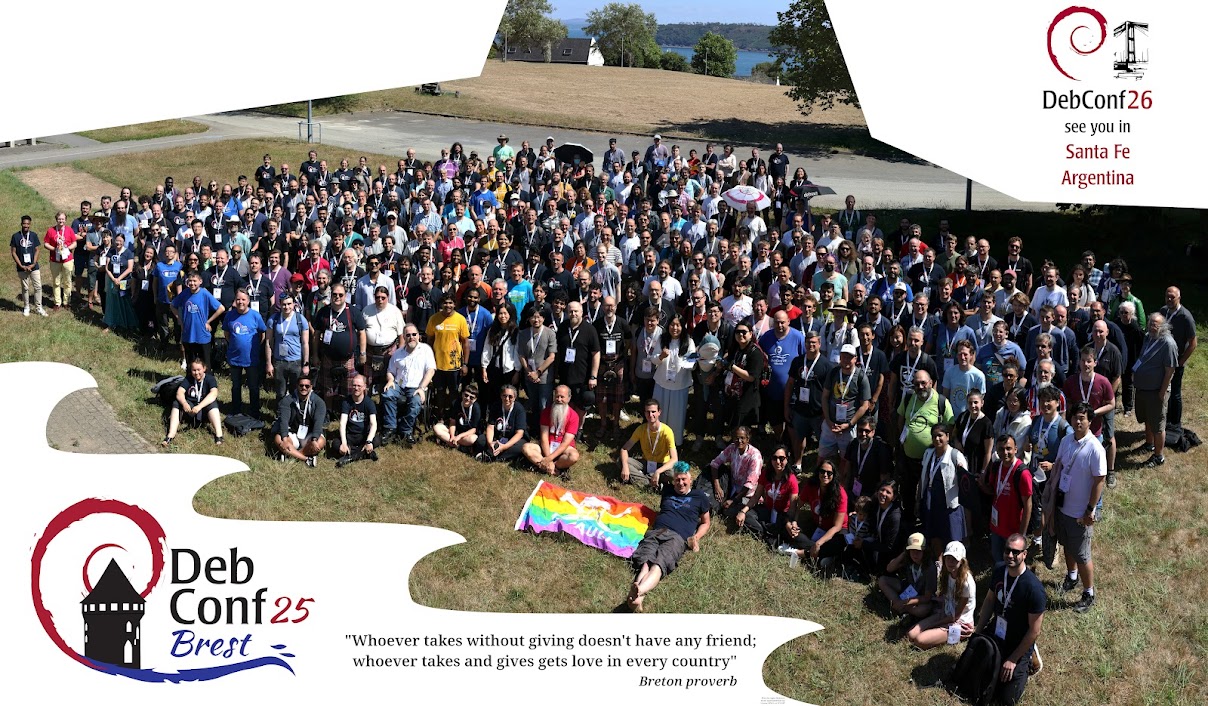
DebConf25 group photo - click to enlarge On Saturday 19 July 2025, the annual Debian Developers and Contributors Conference came to a close. Over 443 attendees representing 50 countries from around the world came together for a combined 169 events (including some which took place during the DebCamp) including more than 50 Talks, 39 Short Talks, 5 Discussions, 59 Birds of a Feather sessions ("BoF" informal meeting between developers and users), 10 workshops, and activities in support of furthering our distribution and free software, learning from our mentors and peers, building our community, and having a bit of fun. The conference was preceded by the annual DebCamp hacking session held 7 through 13 July where Debian Developers and Contributors convened to focus on their individual Debian-related projects or work in team sprints geared toward in-person collaboration in developing Debian. This year, a session was dedicated to prepare the BoF "Dealing with Dormant Packages: Ensuring Debian's High Standards"; another, at the initiative of our DPL, to prepare suggestions for the BoF Package Acceptance in Debian: Challenges and Opportunities"; and an afternoon around Salsa-CI. As has been the case for several years, a special effort has been made to welcome newcomers and help them become familiar with Debian and DebConf by organizing a sprint "New Contributors Onboarding" every day of Debcamp, followed more informally by mentorship during DebConf. The actual Debian Developers Conference started on Monday 14 July 2025. In addition to the traditional "Bits from the DPL" talk, the continuous key-signing party, lightning talks, and the announcement of next year's DebConf26, there were several update sessions shared by internal projects and teams. Many of the hosted discussion sessions were presented by our technical core teams with the usual and useful "Meet the Technical Committee", the "What's New in the Linux Kernel" session, and a set of BoFs about Debian packaging policy and Debian infrastructure. Thus, more than a quarter of the discussions dealt with this theme, including talks about our tools and Debian's archive processes. Internationalization and Localization have been the subject of several talks. The Python, Perl, Ruby, Go, and Rust programming language teams also shared updates on their work and efforts. Several talks have covered Debian Blends and Debian-derived distributions and other talks addressed the issue of Debian and AI. More than 17 BoFs and talks about community, diversity, and local outreach highlighted the work of various teams involved in not just the technical but also the social aspect of our community; four women who have made contributions to Debian through their artwork in recent years presented their work. The one-day session "DebConf 2025 Academic Track!", organized in collaboration with the IRISA laboratory was the first session welcoming fellow academics at DebConf, bringing together around ten presentations. The schedule was updated each day with planned and ad hoc activities introduced by attendees over the course of the conference. Several traditional activities took place: a job fair, a poetry performance, the traditional Cheese and Wine party (this year with cider as well), the Group Photos, and the Day Trips. For those who were not able to attend, most of the talks and sessions were broadcasted live and recorded; currently the videos are made available through this link. Almost all of the sessions facilitated remote participation via IRC and Matrix messaging apps or online collaborative text documents which allowed remote attendees to "be in the room" to ask questions or share comments with the speaker or assembled audience. DebConf25 saw over 441 T-shirts, 3 day trips, and up to 315 meals planned per day. All of these events, activities, conversations, and streams coupled with our love, interest, and participation in Debian and F/OSS certainly made this conference an overall success both here in Brest, France and online around the world. The DebConf25 website will remain active for archival purposes and will continue to offer links to the presentations and videos of talks and events. Next year, DebConf26 will be held in Santa Fe, Argentina, likely in July. As tradition follows before the next DebConf the local organizers in Argentina will start the conference activities with DebCamp with a particular focus on individual and team work towards improving the distribution. DebConf is committed to a safe and welcome environment for all participants. See the web page about the Code of Conduct on the DebConf25 website for more details on this. Debian thanks the commitment of numerous sponsors to support DebConf25, particularly our Platinum Sponsors: AMD, EDF, Infomaniak, Proxmox, and Viridien. We also wish to thank our Video and Infrastructure teams, the DebConf25 and DebConf committees, our host nation of France, and each and every person who helped contribute to this event and to Debian overall. Thank you all for your work in helping Debian continue to be "The Universal Operating System". See you next year! About Debian The Debian Project was founded in 1993 by Ian Murdock to be a truly free community project. Since then the project has grown to be one of the largest and most influential Open Source projects. Thousands of volunteers from all over the world work together to create and maintain Debian software. Available in 70 languages, and supporting a huge range of computer types, Debian calls itself the universal operating system. About DebConf DebConf is the Debian Project's developer conference. In addition to a full schedule of technical, social and policy talks, DebConf provides an opportunity for developers, contributors and other interested people to meet in person and work together more closely. It has taken place annually since 2000 in locations as varied as Scotland, Bosnia and Herzegovina, India, Korea. More information about DebConf is available from https://debconf.org/. About AMD The AMD ROCm platform includes programming models, tools, compilers, libraries, and runtimes for AI and HPC solution development on AMD GPUs. Debian is an officially supported platform for AMD ROCm and a growing number of components are now included directly in the Debian distribution. For more than 55 years AMD has driven innovation in high-performance computing, graphics and visualization technologies. AMD is deeply committed to supporting and contributing to open-source projects, foundations, and open-standards organizations, taking pride in fostering innovation and collaboration within the open-source community. About EDF EDF is a leading global utility company focused on low-carbon power generation. The group uses advanced engineering and scientific computing tools to drive innovation and efficiency in its operations, especially in nuclear power plant design and safety assessment. Since 2003, the EDF Group has been using Debian as its main scientific computing environment. Debian's focus on stability and reproducibility ensures that EDF's calculations and simulations produce consistent and accurate results. About Infomaniak Infomaniak is Switzerland's leading developer of Web technologies. With operations all over Europe and based exclusively in Switzerland, the company designs and manages its own data centers powered by 100% renewable energy, and develops all its solutions locally, without outsourcing. With millions of users and the trust of public and private organizations across Europe - such as RTBF, the United Nations, central banks, over 3,000 radio and TV stations, as well as numerous cities and security bodies - Infomaniak stands for sovereign, sustainable and independent digital technology. The company offers a complete suite of collaborative tools, cloud hosting, streaming, marketing and events solutions, while being owned by its employees and self-financed exclusively by its customers. About Proxmox Proxmox develops powerful, yet easy-to-use Open Source server software. The product portfolio from Proxmox, including server virtualization, backup, and email security, helps companies of any size, sector, or industry to simplify their IT infrastructures. The Proxmox solutions are built on Debian, we are happy that they give back to the community by sponsoring DebConf25. About Viridien Viridien is an advanced technology, digital and Earth data company that pushes the boundaries of science for a more prosperous and sustainable future. Viridien has been using Debian-based systems to power most of its HPC infrastructure and its cloud platform since 2009 and currently employs two active Debian Project Members. Contact Information For further information, please visit the DebConf25 web page at https://debconf25.debconf.org/ or send mail to press@debian.org.

Birger Schacht: My DebConf 25 review

DebConf 25 happened between 14th July and 19th July and I was there. It was my first DebConf (the big one, I was at a Mini DebConf in Hamburg a couple of years ago) and it was interesting. DebConf 25 happened at a Campus University at the outskirts of Brest and I was rather reluctant to go at first (EuroPython 25 was happening at the same time in Prague), but I decided to use the chance of DebConf happening in Europe, reachable by train from Vienna. We took the nighttrain to Paris, then found our way through the maze that is the Paris underground system and then got to Brest with the TGV. On our way to the Conference site we made a detour to a supermarket, which wasn t that easy because is was a national holiday in France and most of the shops were closed. But we weren t sure about the food situation at DebConf and we also wanted to get some beer. At the conference we were greeted by very friendly people at the badge station and the front desk and got our badges, swag and most important the keys to pretty nice rooms on the campus. Our rooms had a small private bathroom with a toilet and a shower and between the two rooms was a shared kitchen with a refrigerator and a microwave. All in all, the accommodation was simple but provided everything we needed and especially a space to have some privacy. During the next days I watched a lot of talks, met new people, caught up with old friends and also had a nice time with my travel buddies. There was a beach near the campus which I used nearly every day. It was mostly sunny except for the last day of the conference, which apparently was not common for the Brest area, so we got lucky regarding the weather. Landscape view of the sea at Dellec beach Given that we only arrived in the evening of the first day of DebConf, I missed the talk When Free Software Communities Unite: Tails, Tor, and the Fight for Privacy (recording), but I watched it on the way home and it was also covered by LWN. On Tuesday I started the day by visiting a talk about tag2upload (recording). The same day there was also an academic track and I watched the talk titled Integrating Knowledge Graphs into the Debian Ecosystem (recording) which presented a property graph showing relationships between various entities like packages, maintainers or bugs (there is a repository with parts of a paper, but not much other information). The speaker also mentioned the graphcast framework and the ontocast framework which sound interesting - we might have use for something liked this at $dayjob. In the afternoon there was a talk about the ArchWiki (recording) which gave a comprehensive insight in how the ArchWiki and the community behind it works. Right after that was a Debian Wiki BoF. There are various technical limitations with the current wiki software and there are not enough helping hands to maintain the service and do content curation. But the BoF had some nice results: there is now a new debian-wiki mailinglist, an IRC channel, a MediaWiki installation has been set up during DebConf, there are efforts to migrate the data and most importantly: and handful of people who want to maintain the service and organize the content of the wiki. I think the input from the ArchWiki folks gave some ideas how that team could operate. Tag at the wall at Dellec beach Wednesday was the day of the daytrip. I did not sign up for any of the trips and used the time to try out tag2upload, uploaded the latest labwc release to experimental and spent the rest of the day at the beach. Other noteworthy session I ve attended were the Don t fear the TPM talk (recording), which showed me a lot of stuff to try out, the session about lintian-ng (no recording), which is an experimental approach to make lintian faster, the review of the first year of wcurls existence (no recording yet) and the summary of Rust packaging in Debian (no recording yet). In between the sessions I started working on packaging wlr-sunclock (#1109230).


What did not work Vegan food. I might be spoiled by other conferences. Both at EuroPycon last year (definitely bigger, a lot more commercial) and at PyCon CZ 23 (similar in size, a lot more DIY) there was catering with explicitly vegan options. As I ve mentioned in the beginning, we went to a supermarket before we went to the conference and we had to go there one more time during the conference. I think there was a mixture between a total lack of awareness and a LOT of miscommunication. The breakfasts at the conference consisted of pastries and baguettes - I asked at the first day what the vegan options were and the answer was I don t know, maybe the baguette? and we were asked to only take as much baguette as the people who also got pastries. The lunch was prepared by the Restaurant associatif de Kern vent which is a canteen at the university campus. When we asked if there is vegan food, the people there said that there was only a vegetarian option so we only ate salad. Only later we heard via word of mouth that one has to explicitly ask for a vegan meal which was apparently prepared separatly and you had to find the right person that knows about it (I think thats very Debian-like ). But even then a person once got a vegetarian option offered as vegan food. One problem was also the missing / confusing labeling of the food. At the conference dinner there was apparently vegan food, but it was mixed with all the other food. There were some labels but with hundreds of hungry people around and caterers removing empty plates and dropping off plates with other stuff, everything gets mixed up. In the end we ate bread soaked in olive oil, until the olive oil got taken away by the catering people literally while we were dipping the bread in it. And when these issues were raised, some of the reactions can be summarized as You re holding it wrong which was really frustrating. The dinners at the conference hall were similar. At some point I had the impression that vegan and vegetarian was simply seen as the same thing. Dinner menu at the conference If the menus would be written like a debian/copyright file it would probably have looked like this:

Food: *
Diet: Vegan or Vegetarian
But the thing is that Vegan and Vegetarian cannot be mixed. Its similar to non compatible licenses. Once you mix vegan food with vegan food with vegetarian food it s not vegan anymore. Don t get me wrong, I know its hard to organize food for hundreds of people. But if you don t know what it means to provide a vegan option, just communicate the fact so people can look alternatives in advance. During the week some of the vegan people shared food, which was really nice and there were also a lot of non-vegan people who tried to help, organized extra food or simply listened to the hangry rants. Thanks for that!

Paris Saturday was the last day of DebConf and it was a rainy day. On Sunday morning we took the TGV back to Paris and then stayed there for one night because the next night train back to Vienna was on Monday. Luckily the weather was better in Paris. The first thing we did was to look up a vegan burger place. In the evening we strolled along the Seine and had a couple of beers at the Jardins du Trocad ro. Monday the rain also arrived in Paris and we mostly went from one cafe to the next, but also managed to visit Notre Dame.

Conclusio The next DebConf will be in Argentina and I think its likely that DebConf 27 will also not happen anywhere in trainvelling distance. But even if, I think the Mini DebConfs are more my style of happening (there is one planned in Hamburg next spring, and a couple of days ago I learned that there will be a Back to the Future musical show in Hamburg during that time). Nonetheless I had a nice time and I stumbled over some projects I might get more involved in. Thanks also to my travel buddies who put up with me

Matthew Palmer: Object deserialization attacks using Ruby's Oj JSON parser

tl;dr: there is an attack in the wild which is triggering dangerous-but-seemingly-intended behaviour in the Oj JSON parser when used in the default and recommended manner, which can lead to everyone s favourite kind of security problem: object deserialization bugs! If you have the oj gem anywhere in your Gemfile.lock, the quickest mitigation is to make sure you have Oj.default_options = mode: :strict somewhere, and that no library is overwriting that setting to something else.

Prologue As a sensible sysadmin, all the sites I run send me a notification if any unhandled exception gets raised. Mostly, what I get sent is error-handling corner cases I missed, but now and then things get more interesting. In this case, it was a PG::UndefinedColumn exception, which looked something like this:
PG::UndefinedColumn: ERROR:  column "xyzzydeadbeef" does not exist
This is weird on two fronts: firstly, this application has been running for a while, and if there was a schema problem, I d expect it to have made itself apparent long before now. And secondly, while I don t profess to perfection in my programming, I m usually better at naming my database columns than that. Something is definitely hinky here, so let s jump into the mystery mobile!

The column name is coming from outside the building! The exception notifications I get sent include a whole lot of information about the request that caused the exception, including the request body. In this case, the request body was JSON, and looked like this:
 "name":":xyzzydeadbeef", ... 
The leading colon looks an awful lot like the syntax for a Ruby symbol, but it s in a JSON string. Surely there s no way a JSON parser would be turning that into a symbol, right? Right?!? Immediately, I thought that that possibly was what was happening, because I use Sequel for my SQL database access needs, and Sequel treats symbols as database column names. It seemed like too much of a coincidence that a vaguely symbol-shaped string was being sent in, and the exact same name was showing up as a column name. But how the flying fudgepickles was a JSON string being turned into a Ruby symbol, anyway? Enter Oj.

Oj? I barely know aj A long, long time ago, the standard Ruby JSON library had a reputation for being slow. Thus did many competitors flourish, claiming more features and better performance. Strong amongst the contenders was oj (for Optimized JSON ), touted as The fastest JSON parser and object serializer . Given the history, it s not surprising that people who wanted the best possible performance turned to Oj, leading to it being found in a great many projects, often as a sub-dependency of a dependency of a dependency (which is how it ended up in my project). You might have noticed in Oj s description that, in addition to claiming fastest , it also describes itself as an object serializer . Anyone who has kept an eye on the security bug landscape will recall that object deserialization is a rich vein of vulnerabilities to mine. Libraries that do object deserialization, especially ones with a history that goes back to before the vulnerability class was well-understood, are likely to be trouble magnets. And thus, it turns out to be with Oj. By default, Oj will happily turn any string that starts with a colon into a symbol:

>> require "oj"
>> Oj.load(' "name":":xyzzydeadbeef","username":"bob","answer":42 ')
=>  "name"=>:xyzzydeadbeef, "username"=>"bob", "answer"=>42 

How that gets exploited is only limited by the creativity of an attacker. Which I ll talk about more shortly but first, a word from my rant cortex.

Insecure By Default is a Cancer While the object of my ire today is Oj and its fast-and-loose approach to deserialization, it is just one example of a pervasive problem in software: insecurity by default. Whether it s a database listening on 0.0.0.0 with no password as soon as its installed, or a library whose default behaviour is to permit arbitrary code execution, it all contributes to a software ecosystem that is an appalling security nightmare. When a user (in this case, a developer who wants to parse JSON) comes across a new piece of software, they have by definition no idea what they re doing with that software. They re going to use the defaults, and follow the most easily-available documentation, to achieve their goal. It is unrealistic to assume that a new user of a piece of software is going to do things the right way , unless that right way is the only way, or at least the by-far-the-easiest way. Conversely, the developer(s) of the software is/are the domain experts. They have knowledge of the problem domain, through their exploration while building the software, and unrivalled expertise in the codebase. Given this disparity in knowledge, it is tantamount to malpractice for the experts the developer(s) to off-load the responsibility for the safe and secure use of the software to the party that has the least knowledge of how to do that (the new user). To apply this general principle to the specific case, take the Using section of the Oj README. The example code there calls Oj.load, with no indication that this code will, in fact, parse specially-crafted JSON documents into Ruby objects. The brand-user user of the library, no doubt being under pressure to Get Things Done, is almost certainly going to look at this Using example, get the apparent result they were after (a parsed JSON document), and call it a day. It is unlikely that a brand-new user will, for instance, scroll down to the Further Reading section, find the second last (of ten) listed documents, Security.md , and carefully peruse it. If they do, they ll find an oblique suggestion that parsing untrusted input is never a good idea . While that s true, it s also rather unhelpful, because I d wager that by far the majority of JSON parsed in the world is untrusted , in one way or another, given the predominance of JSON as a format for serializing data passing over the Internet. This guidance is roughly akin to putting a label on a car s airbags that driving at speed can be hazardous to your health : true, but unhelpful under the circumstances. The solution is for default behaviours to be secure, and any deviation from that default that has the potential to degrade security must, at the very least, be clearly labelled as such. For example, the Oj.load function should be named Oj.unsafe_load, and the Oj.load function should behave as the Oj.safe_load function does presently. By naming the unsafe function as explicitly unsafe, developers (and reviewers) have at least a fighting chance of recognising they re doing something risky. We put warning labels on just about everything in the real world; the same should be true of dangerous function calls. OK, rant over. Back to the story.

But how is this exploitable? So far, I ve hopefully made it clear that Oj does some Weird Stuff with parsing certain JSON strings. It caused an unhandled exception in a web application I run, which isn t cool, but apart from bombing me with exception notifications, what s the harm? For starters, let s look at our original example: when presented with a symbol, Sequel will interpret that as a column name, rather than a string value. Thus, if our save an update to the user code looked like this:

# request_body has the JSON representation of the form being submitted
body = Oj.load(request_body)
DB[:users].where(id: user_id).update(name: body["name"])

In normal operation, this will issue an SQL query along the lines of UPDATE users SET name='Jaime' WHERE id=42. If the name given is Jaime O Dowd , all is still good, because Sequel quotes string values, etc etc. All s well so far. But, imagine there is a column in the users table that normally users cannot read, perhaps admin_notes. Or perhaps an attacker has gotten temporary access to an account, and wants to dump the user s password hash for offline cracking. So, they send an update claiming that their name is :admin_notes (or :password_hash). In JSON, that ll look like "name":":admin_notes" , and Oj.load will happily turn that into a Ruby object of "name"=>:admin_notes . When run through the above update the user code fragment, it ll produce the SQL UPDATE users SET name=admin_notes WHERE id=42. In other words, it ll copy the contents of the admin_notes column into the name column which the attacker can then read out just by refreshing their profile page.

But Wait, There s More! That an attacker can read other fields in the same table isn t great, but that s barely scratching the surface. Remember before I said that Oj does object serialization ? That means that, in general, you can create arbitrary Ruby objects from JSON. Since objects contain code, it s entirely possible to trigger arbitrary code execution by instantiating an appropriate Ruby object. I m not going to go into details about how to do this, because it s not really my area of expertise, and many others have covered it in detail. But rest assured, if an attacker can feed input of their choosing into a default call to Oj.load, they ve been handed remote code execution on a platter.

Mitigations As Oj s object deserialization is intended and documented behaviour, don t expect a future release to make any of this any safer. Instead, we need to mitigate the risks. Here are my recommended steps:
  1. Look in your Gemfile.lock (or SBOM, if that s your thing) to see if the oj gem is anywhere in your codebase. Remember that even if you don t use it directly, it s popular enough that it is used in a lot of places. If you find it in your transitive dependency tree anywhere, there s a chance you re vulnerable, limited only by the ingenuity of attackers to feed crafted JSON into a deeply-hidden Oj.load call.
  2. If you depend on oj directly and use it in your project, consider not doing that. The json gem is acceptably fast, and JSON.parse won t create arbitrary Ruby objects.
  3. If you really, really need to squeeze the last erg of performance out of your JSON parsing, and decide to use oj to do so, find all calls to Oj.load in your code and switch them to call Oj.safe_load.
  4. It is a really, really bad idea to ever use Oj to deserialize JSON into objects, as it lacks the safety features needed to mitigate the worst of the risks of doing so (for example, restricting which classes can be instantiated, as is provided by the permitted_classes argument to Psych.load). I d make it a priority to move away from using Oj for that, and switch to something somewhat safer (such as the aforementioned Psych). At the very least, audit and comment heavily to minimise the risk of user-provided input sneaking into those calls somehow, and pass mode: :object as the second argument to Oj.load, to make it explicit that you are opting-in to this far more dangerous behaviour only when it s absolutely necessary.
  5. To secure any unsafe uses of Oj.load in your dependencies, consider setting the default Oj parsing mode to :strict, by putting Oj.default_options = mode: :strict somewhere in your initialization code (and make sure no dependencies are setting it to something else later!). There is a small chance that this change of default might break something, if a dependency is using Oj to deliberately create Ruby objects from JSON, but the overwhelming likelihood is that Oj s just being used to parse ordinary JSON, and these calls are just RCE vulnerabilities waiting to give you a bad time.

Is Your Bacon Saved? If I ve helped you identify and fix potential RCE vulnerabilities in your software, or even just opened your eyes to the risks of object deserialization, please help me out by buying me a refreshing beverage. I would really appreciate any support you can give. Alternately, if you d like my help in fixing these (and many other) sorts of problems, I m looking for work, so email me.

25 July 2025

Valhalla's Things: Roll Top Backpack, Handsewn

Posted on July 25, 2025
Tags: madeof:atoms, craft:sewing, FreeSoftWear
a backpack in a cream fabric with a short dark brown bottom; it closes by rolling down the top and is kept closed by a strap that feeds through two D-rings. I might be slightly insane? Or am I going to prove something about the nature and accessibility of sewing and MYOG1 as a hobby? I love my modular backpack, but it has a very modern look that is maybe not the best thing when otherwise dressed in historybounding dress, and it s also a bit bigger than I planned or needed it to be. So, when one of the shops I buy from had some waterproof cotton canvas on sale I failed my saving throw against temptations and bought a few meters, with the intent to make myself a backpack in a different style. It needs to be a backpack, because my back doesn t like asymmetrical bags2, and as far as I know 19th century backpacks weren t the most comfortable things, so I decided to go for a vaguely timeless roll top model that has the added advantage not to require a lot of hardware for the closure, just a few D-rings. Leather straps would look cool, but also require some tools that I still don t have, so I decided to look for some cotton webbing, and when I finally found some in 25 mm and 50 mm width I could finally start on the project. Except for one thing: thread. As much as I believe that regular n 50 cotton thread got a bad reputation from sellers who decided to cut quality in favour of profit, it is not up to the task of sewing a backpack. Nor that I d use regular sew-all poly thread either. I do have some of the thread I used for my other backpack, which would have been strong enough, but it s also in black, which isn t exactly the look I was aiming for on the natural / ecru colour of both the canvas and the webbing. I also misremembered it as only being available in that colour (it isn t), so I wasn t tempted into doing a full online order of technical materials just for that. On the other hand, I did have in my stash some strong thread I could trust for this job, in natural / ecru. There was only one problem: it was 33 2 Tex linen, and not suitable for the sewing machine. You can t handsew a backpack. Or can you? Of course it s going to be much slower, but I m still in a situation where I have more time and space for handsewing than I have for machine sewing. And as for strength, my perception is that for the same stitch length an handsewn backstitch is stronger than a machine lockstitch, or at least it is more effort to unpick (and thus harder to accidentally unravel if the thread breaks). And so I tried. And it worked. a needle coming straight up through layers of fabric and webbing, in the motion called stabbing. Having to backstitch everything instead of being able to use a running backstitch of course meant that it was slower than other sewing projects, and any time there were more than two layers of fabric I had to use the stabbing motion rather than the sewing one, which is even slower, but other than a few places with many layers of both fabric and webbing it wasn t hard. And to be fair, the seams were fewer and shorter than other sewing projects, and with the usual interruptions and uneven time availability it was done in less than a month, which is somewhat typical for one of my handsewn projects. the layers of the base pinned into the sides, trying to keep everything properly aligned especially on the corners in a way that would be very messy if fed as-is to a sewing machine. It may have been because of the pattern, but I think it s relevant that it was also easier than other backpacks I ve made, with significantly less cursing, even when doing seams that would have been quite fiddly when sewn by machine. I have to admit that now I m tempted to plan another backpack using the same pattern or a slight variation, sewn by machine in a different fabric, to see the difference in the time it takes and to check if the changes I think would make it easier to sew by machine are actually the right thing to do. But maybe I ll wait a bit, other projects are in the queue. The pattern is as usual online, released as #FreeSoftWear. Having used it for a while, I have to say that it is just the right size to fit all the things I usually carry, The fact that it only opens from the top means that finding things that have fallen to the very bottom involves a bit of rummaging, but not having to change a zipper every few years when (not if) it breaks is also very nice, so I m not sure which shape of backpack I prefer. the back of the backpack, showing the shoulder straps made with wide webbing that end in two D-rings, and a pattern of horizontal webbing sewn at 4 cm intervals to attach accessories. The soft back of course is an issue when the backpack is filled with small items, but the molle webbing is there exactly because I have plans to solve it, beside the trivial put something flat towards the back . As an object, I m happy with the result. As a project, it was way more than successful, exceeding all expectations, especially for something somewhat experimental like this one was.


  1. Make Your Own Gear, i.e. sewing or otherwise constructing outdoorish equipment.
  2. at least not if I fill them with stuff as I usually do with my backpack :D

Reproducible Builds (diffoscope): diffoscope 302 released

The diffoscope maintainers are pleased to announce the release of diffoscope version 302. This version includes the following changes:
[ Chris Lamb ]
* Mask stderr from the extract-vmlinux script.
* Make it much more explicit that we return 'success' from the
  extract-vmlinux script instead of just falling through to the bottom of the
  script.
* Use Difference.from_operation in an attempt to pipeline the output of
  extract-vmlinux, potentially avoiding it all residing in memory. This is an
  attempt to prevent out of memory issues on try.diffoscope.org.
[ Siva Mahadevan ]
* Use --print-armap long option with nm in the "ar" comparator for wider
  compatibility.
You find out more by visiting the project homepage.

24 July 2025

Valhalla's Things: Things I Have Learnt At DebConf

Posted on July 24, 2025
Tags: madeof:bits
An unsorted list, including some I already knew, but was reminded of.
  • dpkg-mergechangelogs exists.
  • Sewing your own shirt, posting it on planet and wearing it on the first day of DebConf, is more effective than a badge for making people recognise you.
  • I need to look into a number of tools for testings things (and try to start using some of those at $DAYJOB).
  • Masks are good. masks protect you from debbugs. masks protect you from ring cameras in the hotel you re staying on the day after debconf.
  • It s really nice to be chatting of random topics during lunch and discover that you are talking to the maintainer of a package of which you are one of the very few users! (the latter bit needs to be changed :) ).
  • I need to look into sequoia and all of the modern OpenPGP stuff.
  • Even if I don t have a lot of money, apparently I have even less sense (there will be blog posts on the topic in the mid-term future).
  • I can go to a talk about AI and not hate the speaker (yeah, the bar is pretty low there :D ). The automatic subtitles still failed in the same way as automatic subtitles always fail.
  • Debian gets used in really cool places.
  • At times it is a bit or a lot dysfunctional, but Debian still feels like a family.
And I still haven t watched the recordings of those talks that I couldn t (or decided not to, because the hallway track was more interesting) attend.

23 July 2025

Peter Pentchev: Ringlet software updates (2025-03-23)

Ringlet software updates (2025-03-23)Recent initial releases of [Ringlet software][r-site] (a fancy name for my pet projects):

Peter Pentchev: mapec - my humble trivial tribute to Matt S Trout

mapec - my humble trivial tribute to Matt S TroutSo on Monday I learned from Perl Weekly that Matt S Trout ofPerl fame has passed away.I can't say I knew him, though I read a lot of his writings and discussions, andI used a lot of his software; I may have briefly met him at YAPC 2014 in Sofia,but that doesn't really count.So a silly little thing I did to honor his memory was to take a small program thatdoes one thing and does it well, polish it up a bit, and, I guess, try to preserve it fora little bit longer.So here is my version of mapec for what very little it's worth.

Dirk Eddelbuettel: qlcal 0.0.16 on CRAN: Regular Update

The sixteenth release of the qlcal package arrivied at CRAN today, once again following the QuantLib 1.39 release this morning. qlcal delivers the calendaring parts of QuantLib. It is provided (for the R package) as a set of included files, so the package is self-contained and does not depend on an external QuantLib library (which can be demanding to build). qlcal covers over sixty country / market calendars and can compute holiday lists, its complement (i.e. business day lists) and much more. Examples are in the README at the repository, the package page, and course at the CRAN package page. This releases mainly synchronizes qlcal with the QuantLib release 1.39.

Changes in version 0.0.16 (2025-07-23)
  • Synchronized with QuantLib 1.39 released today
  • Calendar updates for Israel, minor utility functions update
  • Minor package maintenance updates

Courtesy of my CRANberries, there is a diffstat report for this release. See the project page and package documentation for more details, and more examples.

This post by Dirk Eddelbuettel originated on his Thinking inside the box blog. If you like this or other open-source work I do, you can sponsor me at GitHub.

Sergio Cipriano: How I finally tracked my Debian uploads correctly

How I finally tracked my Debian uploads correctly A long time ago, I became aware of UDD (Ultimate Debian Database), which gathers various Debian data into a single SQL database. At that time, we were trying to do something simple: list the contributions (package uploads) of our local community, Debian Bras lia. We ended up with a script that counted uploads to unstable and experimental. I was never satisfied with the final result because some uploads were always missing. Here is an example:
debci (3.0) experimental; urgency=medium
...
   [ Sergio de almeida cipriano Junior ]
   * Fix Style/GlovalVars issue
   * Rename blacklist to rejectlist
...
I made changes in debci 3.0, but the upload was done by someone else. This kind of contribution cannot be tracked by that script. Then, a few years ago, I learned about Minechangelogs, which allows us to search through the changelogs of all Debian packages currently published. Today, I decided to explore how this was done, since I couldn't find anything useful for that kind of query in UDD's tables. That's when I came across ProjectB. It was my first time hearing about it. ProjectB is a database that stores all the metadata about the packages in the Debian archive, including the changelogs of those packages. Now that I'm a Debian Developer, I have access to this database. If you also have access and want to try some queries, you can do this:
$ ssh mirror.ftp-master.debian.org -N -L 15434:danzi.debian.org:5435
$ psql postgresql://guest@localhost:15434/projectb?sslmode=allow
In the end, it finally solved my problem. Using the code below, with UDD, I get 38 uploads:
import psycopg2

contributor = 'almeida cipriano'

try:
    connection = psycopg2.connect(
        user="udd-mirror",
        password="udd-mirror",
        host="udd-mirror.debian.net",
        port="5432",
        database="udd"
    )

    cursor = connection.cursor()

    query = f"SELECT source,version,date,distribution,signed_by_name \
FROM public.upload_history \
WHERE changed_by_name ILIKE '% contributor %' \
ORDER BY date;"

    cursor.execute(query)
    records = cursor.fetchall()

    print(f"I have  len(records)  uploads.")

    cursor.close()
    connection.close()

except (Exception, psycopg2.Error) as error:
    print("Error while fetching data from PostgreSQL", error)
Using the code bellow, with ProjectB, I get 43 uploads (the correct amount):
import psycopg2

contributor = 'almeida cipriano'

try:
    # SSH tunnel is required to access the database:
    # ssh <username>@mirror.ftp-master.debian.org -N -L 15434:danzi.debian.org:5435
    connection = psycopg2.connect(
        user="guest",
        host="localhost",
        port="15434",
        database="projectb",
        sslmode="allow"
    )
    connection.set_client_encoding('UTF8')

    cursor = connection.cursor()

    query = f"SELECT c.source, c.version, c.changedby \
FROM changes c \
JOIN changelogs ch ON ch.id = c.changelog_id \
WHERE c.source != 'debian-keyring' \
  AND (\
    ch.changelog ILIKE '% contributor %' \
    OR c.changedby ILIKE '% contributor %' \
  )\
ORDER BY c.seen;"

    cursor.execute(query)
    records = cursor.fetchall()

    print(f"I have  len(records)  uploads.")

    cursor.close()
    connection.close()

except (Exception, psycopg2.Error) as error:
    print("Error while fetching data from PostgreSQL", error)
It feels good to finally solve this itch I've had for years.

Abhijith PA: Removing spams from your local maildir

I have been using Disroot as my primary email ever since openmailbox.org stopped. I am very grateful for Disroot s service and I occasionally donate to them. Recently, my Disroot inbox has been flooded with spam. On an average day, I used to receive around 90% spams on entire email count. However, the situation has improved since then. I contacted the Disroot team, and they informed me that they are aware of the situation and planning to migrate to Rspamd from Spamassassin. I don t know whether they deployed Rspamd, even if so that only going to process incoming mails, I am looking for a way to identify spams and purge that are already entered my Imap folders. Later I found this script nh2/rspamd-move[1], which seems fit my need. I made couple of trivial changes in the script for my use case. I wasn t sure of directly running this on my Mail/ dir, so I cloned my entire local mail directory to another directory and made available to podman container where I script and rspamd instance exist. I trained rspamd from the /Spam. Later, I manually moved couple of mails to /spam folder/. I requested friends to share their spam folder in the #debian-in channel, but that didn t happen :P
$podman run -it --mount
type=bind,source=/home/abhijith/$MAILS/,target=/container-mail-clone
id:latest
$script.py
(It took some time since I have around 10000+ emails) Wow, it was quite a successful attempt, I was able to catch most of it and move to spam/ and couple of false positive in a different folder. Now I want to do the same in the actual maildir yet very skeptical. While going through the cloned folder with mutt -f I remembered that the mails are already indexed by notmuch. So all I need to do is operate tagging and deletion with notmuch and it will be synced back to the original mail dir. Ta-da. I cleaned by Inbox. [1] - https://github.com/nh2/rspamd-move

Russell Coker: Annoying Wrongness on TV

One thing that annoys me on TV shows and movies is getting the details wrong. Yes it s fiction and yes some things can t be done correctly and in some situations correctly portraying things goes against the plot. But otherwise I think they should try to make it accurate. I was just watching The Americans (a generally good show that I recommend watching) and in Season 4 Episode 9 there s a close up of a glass of wine which clearly shows that the Tears of Wine effect is missing, the liquid in the glass obviously has the surface tension of water not of wine. When they run a show about spies then have to expect that the core audience will be the type of detail oriented people who notice these things. Having actors not actually drink alcohol on set is a standard practice, if they have to do 10 takes of someone drinking a glass of wine then that would be a problem if they actually drank real wine. But they could substitute real wine for the close up shots and of course just getting it right the first time is a good option. Some ridiculous inaccuracy we just need to deal with, like knives making a schwing sound when pulled out of scabbards and silenced guns usually still being quite loud (so many people are used to it being wrong). Organisations like the KGB had guns that were actually silent, but they generally looked obviously different to regular guns and had a much lower effective range. The gold coins shown on TV are another ridiculous thing. The sound of metal hitting something depends on how hard it is and how dense it is. Surely most people have heard the sounds of dropping steel nuts and ball bearings and the sound of dropping lead sinkers and knows that the sounds of items of similar size and shape differ greatly based on density and hardness. A modern coin made of copper, cupro-nickel (the current silver coins), or copper-aluminium (the current gold coins) sounds very different to a gold coin when dropped on a bench. For a show like The Witcher it wouldn t be difficult to make actual gold coins of a similar quality to iron age coin production, any jeweller could make the blanks and making stamps hard enough to press gold isn t an engineering challenge (stamping copper coins would be much more difficult). The coins used for the show could be sold to fans afterwards. Once coins are made they can t be just heaped up. Even if you are a sorcerer you probably couldn t fill a barrel a meter high with gold coins and not have it break from the weight and/or have the coins at the bottom cold welded. Gold coins are supposed to have a precise amount of gold and if you pile them up too high then the cold welding process will transfer gold between coins changing the value. If someone was going to have a significant quantity of gold stored then it would be in gold ingots with separators between layers to prevent cold welding. Movies tend not to show coins close up, I presume that s because they considered it too difficult to make coins and they just use some random coins from their own country. Another annoying thing is shows that don t match up the build dates of objects used. It s nice when they get it right like the movie Titanic featuring a M1911 pistol which is something that a rich person in 1912 would likely have. The series Carnival Row (which I recommend) has weapons that mostly match our WW1 era, everything that doesn t involve magic seems legit. One of the worst examples of this is the movie Anna (by Luc Besson which is mostly a recreation of his film Nikita but in the early 90s and with the KGB). That film features laptops with color screens and USB ports before USB was invented and when color screens weren t common on laptops, as an aside military spec laptops tend to have older designs than consumer spec ones. I ve mostly given up on hoping that movies will get hacking scenes that are any more accurate than knives making a schwing sound. But it shouldn t be that hard for them to find computer gear that was manufactured in the right year to use for the film. Why can t they hire experts on technology to check everything?

22 July 2025

Iustin Pop: Watching website scanning bots

Ever since I put up http://demo.corydalis.io, and setup logcheck, I m inadvertently keeping up with recent exploits in common CMS frameworks, or maybe even normal web frameworks issues, by seeing what 404s I get from the logs. Now, I didn t indent to do this per se, I just wanted to make sure I don t have any 500s, and at one point, I did actually catch a bug by seeing seemingly valid URLs, with referrer my own pages, leading to 404s. But besides that, it s mainly a couple times per week, a bot finds the site, and then it tries in fast succession something like this (real log entries, with the source IP address removed):
[21/Jul/2025:09:27:09 +0200] "GET /pms?module=logging&file_name=../../../../../../~/.aws/credentials&number_of_lines=10000 HTTP/1.1" 404 - "" "Mozilla/5.0"
[21/Jul/2025:09:27:11 +0200] "GET /admin/config?cmd=cat+/root/.aws/credentials HTTP/1.1" 404 - "" "Mozilla/5.0"
[21/Jul/2025:09:27:11 +0200] "GET /.env HTTP/1.1" 404 - "" "Mozilla/5.0"
[21/Jul/2025:09:27:13 +0200] "GET /.env.local HTTP/1.1" 404 - "" "Mozilla/5.0"
[21/Jul/2025:09:27:13 +0200] "GET /.env.production HTTP/1.1" 404 - "" "Mozilla/5.0"
[21/Jul/2025:09:27:16 +0200] "GET /.env.dev HTTP/1.1" 404 - "" "Mozilla/5.0"
[21/Jul/2025:09:27:17 +0200] "GET /.env.development HTTP/1.1" 404 - "" "Mozilla/5.0"
[21/Jul/2025:09:27:19 +0200] "GET /.env.prod HTTP/1.1" 404 - "" "Mozilla/5.0"
[21/Jul/2025:09:27:19 +0200] "GET /.env.stage HTTP/1.1" 404 - "" "Mozilla/5.0"
[21/Jul/2025:09:27:22 +0200] "GET /.env.test HTTP/1.1" 404 - "" "Mozilla/5.0"
[21/Jul/2025:09:27:23 +0200] "GET /.env.example HTTP/1.1" 404 - "" "Mozilla/5.0"
[21/Jul/2025:09:27:25 +0200] "GET /.env.bak HTTP/1.1" 404 - "" "Mozilla/5.0"
[21/Jul/2025:09:27:26 +0200] "GET /.env.old HTTP/1.1" 404 - "" "Mozilla/5.0"
[21/Jul/2025:09:27:28 +0200] "GET /.envs/.production/.django HTTP/1.1" 404 - "" "Mozilla/5.0"
[21/Jul/2025:09:27:28 +0200] "GET /blog.env HTTP/1.1" 404 - "" "Mozilla/5.0"
[21/Jul/2025:09:27:31 +0200] "GET /wp-content/.env HTTP/1.1" 404 - "" "Mozilla/5.0"
[21/Jul/2025:09:27:32 +0200] "GET /application/.env HTTP/1.1" 404 - "" "Mozilla/5.0"
[21/Jul/2025:09:27:34 +0200] "GET /app/.env HTTP/1.1" 404 - "" "Mozilla/5.0"
[21/Jul/2025:09:27:35 +0200] "GET /apps/.env HTTP/1.1" 404 - "" "Mozilla/5.0"
[21/Jul/2025:09:27:37 +0200] "GET /config/.env HTTP/1.1" 404 - "" "Mozilla/5.0"
[21/Jul/2025:09:27:38 +0200] "GET /config/config.env HTTP/1.1" 404 - "" "Mozilla/5.0"
[21/Jul/2025:09:27:40 +0200] "GET /config/.env HTTP/1.1" 404 - "" "Mozilla/5.0"
[21/Jul/2025:09:27:41 +0200] "GET /api/.env HTTP/1.1" 404 - "" "Mozilla/5.0"
[21/Jul/2025:09:27:43 +0200] "GET /vendor/.env HTTP/1.1" 404 - "" "Mozilla/5.0"
[21/Jul/2025:09:27:44 +0200] "GET /backend/.env HTTP/1.1" 404 - "" "Mozilla/5.0"
[21/Jul/2025:09:27:46 +0200] "GET /server/.env HTTP/1.1" 404 - "" "Mozilla/5.0"
[21/Jul/2025:09:27:46 +0200] "GET /home/user/.aws/credentials HTTP/1.1" 404 - "" "Mozilla/5.0"
[21/Jul/2025:09:27:49 +0200] "GET /aws/credentials HTTP/1.1" 404 - "" "Mozilla/5.0"
[21/Jul/2025:09:27:50 +0200] "GET /.aws/credentials HTTP/1.1" 404 - "" "Mozilla/5.0"
[21/Jul/2025:09:27:52 +0200] "GET /.aws/config HTTP/1.1" 404 - "" "Mozilla/5.0"
[21/Jul/2025:09:27:52 +0200] "GET /config/aws.yml HTTP/1.1" 404 - "" "Mozilla/5.0"
[21/Jul/2025:09:27:55 +0200] "GET /config/aws.json HTTP/1.1" 404 - "" "Mozilla/5.0"
[21/Jul/2025:09:27:55 +0200] "GET /.env.production HTTP/1.1" 404 - "" "Mozilla/5.0"
[21/Jul/2025:09:27:58 +0200] "GET /config.json HTTP/1.1" 404 - "" "Mozilla/5.0"
[21/Jul/2025:09:27:59 +0200] "GET /config/config.json HTTP/1.1" 404 - "" "Mozilla/5.0"
[21/Jul/2025:09:28:01 +0200] "GET /config/settings.json HTTP/1.1" 404 - "" "Mozilla/5.0"
[21/Jul/2025:09:28:02 +0200] "GET /config/secrets.json HTTP/1.1" 404 - "" "Mozilla/5.0"
[21/Jul/2025:09:28:04 +0200] "GET /config.yaml HTTP/1.1" 404 - "" "Mozilla/5.0"
[21/Jul/2025:09:28:04 +0200] "GET /config.yml HTTP/1.1" 404 - "" "Mozilla/5.0"
[21/Jul/2025:09:28:07 +0200] "GET /config.py HTTP/1.1" 404 - "" "Mozilla/5.0"
[21/Jul/2025:09:28:08 +0200] "GET /secrets.json HTTP/1.1" 404 - "" "Mozilla/5.0"
[21/Jul/2025:09:28:10 +0200] "GET /secrets.yml HTTP/1.1" 404 - "" "Mozilla/5.0"
[21/Jul/2025:09:28:11 +0200] "GET /credentials.json HTTP/1.1" 404 - "" "Mozilla/5.0"
[21/Jul/2025:09:28:13 +0200] "GET /.git-credentials HTTP/1.1" 404 - "" "Mozilla/5.0"
[21/Jul/2025:09:28:14 +0200] "GET /.git/config HTTP/1.1" 404 - "" "Mozilla/5.0"
[21/Jul/2025:09:28:16 +0200] "GET /.gitignore HTTP/1.1" 404 - "" "Mozilla/5.0"
[21/Jul/2025:09:28:18 +0200] "GET /.gitlab-ci.yml HTTP/1.1" 404 - "" "Mozilla/5.0"
[21/Jul/2025:09:28:19 +0200] "GET /.github/workflows HTTP/1.1" 404 - "" "Mozilla/5.0"
[21/Jul/2025:09:28:22 +0200] "GET /.idea/workspace.xml HTTP/1.1" 404 - "" "Mozilla/5.0"
[21/Jul/2025:09:28:22 +0200] "GET /.vscode/settings.json HTTP/1.1" 404 - "" "Mozilla/5.0"
[21/Jul/2025:09:28:25 +0200] "GET /docker-compose.yml HTTP/1.1" 404 - "" "Mozilla/5.0"
[21/Jul/2025:09:28:25 +0200] "GET /docker-compose.override.yml HTTP/1.1" 404 - "" "Mozilla/5.0"
[21/Jul/2025:09:28:28 +0200] "GET /docker-compose.prod.yml HTTP/1.1" 404 - "" "Mozilla/5.0"
[21/Jul/2025:09:28:28 +0200] "GET /docker-compose.dev.yml HTTP/1.1" 404 - "" "Mozilla/5.0"
[21/Jul/2025:09:28:32 +0200] "GET /phpinfo HTTP/1.1" 404 - "" "Mozilla/5.0"
[21/Jul/2025:09:28:32 +0200] "GET /_profiler/phpinfo HTTP/1.1" 404 - "" "Mozilla/5.0"
[21/Jul/2025:09:28:34 +0200] "GET /phpinfo.php HTTP/1.1" 404 - "" "Mozilla/5.0"
[21/Jul/2025:09:28:34 +0200] "GET /info.php HTTP/1.1" 404 - "" "Mozilla/5.0"
[21/Jul/2025:09:28:37 +0200] "GET /storage/logs/laravel.log HTTP/1.1" 404 - "" "Mozilla/5.0"
[21/Jul/2025:09:28:37 +0200] "GET /storage/logs/error.log HTTP/1.1" 404 - "" "Mozilla/5.0"
[21/Jul/2025:09:28:40 +0200] "GET /logs/debug.log HTTP/1.1" 404 - "" "Mozilla/5.0"
[21/Jul/2025:09:28:40 +0200] "GET /logs/app.log HTTP/1.1" 404 - "" "Mozilla/5.0"
[21/Jul/2025:09:28:49 +0200] "GET /debug.log HTTP/1.1" 404 - "" "Mozilla/5.0"
[21/Jul/2025:09:28:51 +0200] "GET /error.log HTTP/1.1" 404 - "" "Mozilla/5.0"
[21/Jul/2025:09:28:53 +0200] "GET /.DS_Store HTTP/1.1" 404 - "" "Mozilla/5.0"
[21/Jul/2025:09:28:55 +0200] "GET /backup.zip HTTP/1.1" 404 - "" "Mozilla/5.0"
[21/Jul/2025:09:28:58 +0200] "GET /.backup HTTP/1.1" 404 - "" "Mozilla/5.0"
[21/Jul/2025:09:29:00 +0200] "GET /db.sql HTTP/1.1" 404 - "" "Mozilla/5.0"
[21/Jul/2025:09:29:03 +0200] "GET /dump.sql HTTP/1.1" 404 - "" "Mozilla/5.0"
[21/Jul/2025:09:29:06 +0200] "GET /database.sql HTTP/1.1" 404 - "" "Mozilla/5.0"
[21/Jul/2025:09:29:09 +0200] "GET /backup.tar.gz HTTP/1.1" 404 - "" "Mozilla/5.0"
Now, this example is actually trying to catch a bit more things, but many times it s focused on some specific thing, or two things. Here we have docker, MacOS .DS_Store (I m not sure how that s useful - to find more filenames?), VSCode settings, various secrets, GitHub workflows, log output, database dumps, AWS credentials, and still I guess from the wp filename WordPress settings. The first few years were full of WordPress scanners, now it seems it has quieted down, I haven t seen a bot scanning 200 WP potential filenames in ages. And this bot even bothers to put in Mozilla/5.0 as browser identification . Side-note: I don t think the filename path in the first log entry, i.e. ../../../../../../~/, ever properly resolves to the home directory of any user. So I m not that particular scanner ever works, but who knows? Maybe some framework does bad tilde expansion, but at least bash will not expand ~ inside a path, it seems that path is passed as-is to an invoked command (strace confirms it). What s surprising here is that these are usually plain dumb scanners, from the same IP address, no concern on throttling, no attempt to hide, just 2 minutes of brute-forcing a random list of known treasures , then moving on. For this to be worth, it means there are still victims found using this method, sadly. Well, sometimes I get a single, one-off "GET /wp-login.php HTTP/1.1, which is strange enough it might not be a bot even, who knows. But in general, periods of activity of this type are coming and going, probably aligned with new CVEs. And another surprising thing is that for this type of scanning to work (and I ve seen many over the years), the website framework/configuration must allow random file download. Corydalis itself is written in Haskell, using Yesod, and it has a hardcoded (built at compile time) list of static resources it will serve. I haven t made the switch to fully embedding in the binary, but at that point, it won t need to read from the filesystem at all. Right now it will serve a few CSS and JS files, plus fonts, but that s it, no arbitrary filesystem traversal. Strange that some frameworks allow it. This is not productively spent time, but it is fun, especially seeing how this changes over time. And probably the most use anyone gets out of http://demo.corydalis.io .

David Bremner: Hibernate on the pocket reform 10/n

Context

Finally applying the pci reset series.
$ b4 am 20250715-pci-port-reset-v6-0-6f9cce94e7bb@oss.qualcomm.com
$ git am -3 v6_20250715_manivannan_sadhasivam_pci_add_support_for_resetting_the_root_ports_in_a_platform_specifi.mbx
There is quite a scary looking conflict between the last patch in the series and https://lore.kernel.org/r/1744940759-23823-1-git-send-email-shawn.lin@rock-chips.com which is now upstream (collabora) in rockchip-devel. I resolved the second basically by taking both, as it seemed like two independent sets of additions to the same parts of the file. The first it looks like Shawn's commit referenced above should prevail.
  • If anyone is curious about the (possibly incorrectly) rebased patches, they are at https://salsa.debian.org/bremner/collabora-rockchip-3588 (reform-patches is the default, and relevant branch).

testing
  • The new (6.16~rc7+) kernel boots
  • It successfully reboots
  • devices test passes, although the UBSAN warning / error is still there
 174.559032] UBSAN: array-index-out-of-bounds in net/mac80211/rc80211_minstrel_ht.c:409:33
[  174.559830] index 15 is out of range for type 'minstrel_rate_stats [10]'
[  174.560462] CPU: 7 UID: 0 PID: 213 Comm: kworker/u32:10 Tainted: G        WC OE       6.16.0-rc7+ #6 NONE
[  174.560470] Tainted: [W]=WARN, [C]=CRAP, [O]=OOT_MODULE, [E]=UNSIGNED_MODULE
[  174.560472] Hardware name: MNT Pocket Reform with RCORE RK3588 Module (DT)
[  174.560474] Workqueue: mt76 mt76u_tx_status_data [mt76_usb]
[  174.560489] Call trace:
[  174.560491]  show_stack+0x34/0x98 (C)
[  174.560501]  dump_stack_lvl+0x60/0x80
[  174.560508]  dump_stack+0x18/0x24
[  174.560514]  ubsan_epilogue+0x10/0x48
[  174.560520]  __ubsan_handle_out_of_bounds+0xa0/0xd0
[  174.560526]  minstrel_ht_tx_status+0x890/0xc68 [mac80211]
[  174.560633]  rate_control_tx_status+0xbc/0x180 [mac80211]
[  174.560730]  ieee80211_tx_status_ext+0x1d8/0x9a0 [mac80211]
[  174.560822]  mt76_tx_status_unlock+0x188/0x2a0 [mt76]
[  174.560844]  mt76x02_send_tx_status+0x130/0x4a0 [mt76x02_lib]
[  174.560860]  mt76x02_tx_status_data+0x64/0xa8 [mt76x02_lib]
[  174.560872]  mt76u_tx_status_data+0x84/0x120 [mt76_usb]
[  174.560879]  process_one_work+0x178/0x3c8
[  174.560885]  worker_thread+0x208/0x400
[  174.560890]  kthread+0x120/0x220
[  174.560894]  ret_from_fork+0x10/0x20
[  174.560898] ---[ end trace ]---
  • "platform" test still fails with
[   88.484072] rk_gmac-dwmac fe1b0000.ethernet end0: Link is Down
[   88.597026] rockchip-dw-pcie a40c00000.pcie: Failed to receive PME_TO_Ack
[   88.598523] PM: hibernation: hibernation debug: Waiting for 5 second(s).
[   94.667723] rockchip-dw-pcie a40c00000.pcie: Phy link never came up
[   94.668281] rockchip-dw-pcie a40c00000.pcie: fail to resume
[   94.668783] rockchip-dw-pcie a40c00000.pcie: PM: dpm_run_callback(): genpd_restore_noirq returns -110
[   94.669594] rockchip-dw-pcie a40c00000.pcie: PM: failed to restore noirq: error -110
[  120.035426] watchdog: CPU4: Watchdog detected hard LOCKUP on cpu 5
[  120.035978] Modules linked in: xt_CHECKSUM xt_tcpudp nft_chain_nat xt_MASQUERADE nf_nat nf_conntrack nf_defrag_ipv6 nf_defrag_ipv4 nft_compat bridge stp llc nf_tables aes_neon_bs aes_neon_blk ccm snd_seq_dummy snd_hrtimer snd_seq snd_seq_device dwmac_rk binfmt_misc mt76x2_common mt76x02_usb mt76_usb mt76x02_lib mt76 mac80211 libarc4 snd_soc_simple_card rockchip_saradc industrialio_triggered_buffer cfg80211 snd_soc_tlv320aic31xx rk805_pwrkey kfifo_buf reform2_lpc(OE) industrialio rockchip_thermal rfkill rockchip_rng hantro_vpu cdc_acm rockchip_rga v4l2_vp9 snd_soc_rockchip_i2s_tdm rockchip_vdec2 panthor videobuf2_dma_sg v4l2_jpeg drm_gpuvm v4l2_h264 drm_exec snd_soc_audio_graph_card snd_soc_simple_card_utils joydev evdev dm_mod nvme_fabrics efi_pstore configfs nfnetlink ip_tables x_tables autofs4 ext4 crc16 mbcache jbd2 btrfs blake2b_generic xor xor_neon raid6_pq mali_dp snd_soc_meson_axg_toddr snd_soc_meson_axg_fifo snd_soc_meson_codec_glue panfrost drm_shmem_helper gpu_sched ao_cec_g12a meson_vdec(C)
[  120.036066]  videobuf2_dma_contig hid_generic videobuf2_memops v4l2_mem2mem videobuf2_v4l2 videodev videobuf2_common mc dw_hdmi_i2s_audio meson_drm meson_canvas meson_dw_mipi_dsi meson_dw_hdmi usbhid hid mxsfb mux_mmio panel_edp imx_dcss ti_sn65dsi86 nwl_dsi mux_core pwm_imx27 xhci_plat_hcd xhci_hcd onboard_usb_dev snd_soc_hdmi_codec snd_soc_core micrel snd_pcm_dmaengine nvme snd_pcm nvme_core snd_timer snd nvme_keyring nvme_auth soundcore stmmac_platform stmmac pcs_xpcs phylink mdio_devres of_mdio sdhci_of_dwcmshc fixed_phy sdhci_pltfm phy_rockchip_usbdp dw_mmc_rockchip fwnode_mdio ehci_platform typec phy_rockchip_samsung_hdptx phy_rockchip_naneng_combphy rk808_regulator pwm_rockchip dwc3 dw_wdt libphy fan53555 ohci_platform sdhci ehci_hcd ulpi rtc_pcf8523 dw_mmc_pltfm udc_core ohci_hcd dw_mmc cqhci mdio_bus rockchip_dfi rockchipdrm dw_hdmi_qp analogix_dp i2c_rk3x usbcore phy_rockchip_inno_usb2 dw_mipi_dsi dw_mipi_dsi2 usb_common cpufreq_dt drm_dp_aux_bus [last unloaded: mt76x2u]
[  120.036150] Sending NMI from CPU 4 to CPUs 5:
  • The results are similar if I uncomment the unloading of the dwc3 module
set -x
echo platform >  /sys/power/pm_test
echo reboot > /sys/power/disk
sleep 2
rmmod mt76x2u
sleep 2
#rmmod dwc3
#sleep 2
echo disk >  /sys/power/state
sleep 2
#modprobe dwc3
#sleep 2
modprobe mt76x2u
  • Unsurprisingly, if I try an actual resume (instead of a "platform" test), I get the same messages about "Phy link never came up" and the system needs a hard reboot after trying to resume.
  • Barring inspiration, my next move will be to report my lack of success to the appropriate kernel mailing list(s).
previous episode

David Bremner: Hibernate on the pocket reform 9/n

Context Sidequest: Install u-boot-menu Don't be like me and reboot without configuring u-boot-menu. Although the defaults make sense for most people, in my case I lost access to the serial console (because that custom config needed to be re-done), and the default delay was not enough to choose a backup kernel. In consfigurator notation:
  (on-change
      (file:has-content "/etc/u-boot-menu/conf.d/reform.conf"
        '("U_BOOT_TIMEOUT=50"
          "U_BOOT_PARAMETERS=\"ro no_console_suspend cryptomgr.notests \\$ bootargs  console=ttyS2,1500000 keep_bootcon console=tty1\""))
    (cmd:single "u-boot-update"))

The panel, alive.
  • Thanks to a hint from joschc (and a bit of luck) I realized the
    issue I filed was nonsense. Yay?
  • The panel driver is not added by the rk3588 patches (since the build process applies all the patches, this is not a problem for building from reform-debian-packages).
  • After applying the two patches in reform-debian-packages/linux/patches6.15/imx8mp-mnt-pocket-reform/pocket-panel, the patched 6.16 kernel boots, and seems to work, including the panel.
  • The updated source is on branch reform-patches at https://salsa.debian.org/bremner/collabora-rockchip-3588
  • Unsurprisingly hibernate is not working out of the box with 6.16. My next mission is to apply the recommended pci-reset patches on top of 6.16.
previous episode next episode

21 July 2025

Jonathan Dowland: Nine Inch Nails, Paris, 2025-07-07

On July 7th I did a quick one-day trip to Paris to watch Nine Inch Nails, who were performing one of their last shows for the European leg of the tour. I'd missed all the UK dates, which were announced after I was committed to a family holiday. The setup for these shows differs a lot from the norm. First, the support act was German-Iraqi techno DJ Boys Noize, who TR&AR had collaborated with on their soundtrack for the recent movie Challengers. BN did a 75-minute opening set:
Stripped down Set 1 Stripped down Set 1
The main gig was divided into four acts. Act 1 took place on a square "B Stage", situated in the middle of the main floor. Trent and 2-3 band members performed three stripped-down songs, with interpolations to other songs, alternative lyrics, and the like. I enjoyed this section more than I expected to.
Main stage lighting Main stage lighting
They then transition to the main stage for a six-song full-band set. The main stage was draped in layers of transparent curtains. One of the team was on-stage, walking around with a video camera, and the live camera footage was processed and projected onto the curtains in realtime. The visuals were truly fantastic. For the third act, Trent and Atticus returned to the B stage, to be joined by Boys Noize, who then performed four songs in a reworked, remixed, electronic dance format. This ended up being the highlight of the gig for me. I felt the reworkings breathed new life into some old songs.
remix Set 3 remix Set 3
Finally, back to the main stage to close out with a final seven songs. The traditional triad of closers was adjusted, substituting "The Hand That Feeds" for "The Perfect Drug"; a song that wasn't played at all from 1997 to 2018, and has now become a regular fixture. Several tapers recorded the show, and their recordings are up at nin.live. Overall it was great fun: I ended up flying via London and the airport time was a bit of a pain, but I did get a good start on my corrections. I was home the next afternoon. I'm trying not to think of the cost.

20 July 2025

Michael Prokop: What to expect from Debian/trixie #newintrixie

Trixie Banner, Copyright 2024 Elise Couper Update on 2025-07-28: added note about Debian 13/trixie support for OpenVox (thanks, Ben Ford!) Debian v13 with codename trixie is scheduled to be published as new stable release on 9th of August 2025. I was the driving force at several of my customers to be well prepared for the upcoming stable release (my efforts for trixie started in August 2024). On the one hand, to make sure packages we care about are available and actually make it into the release. On the other hand, to ensure there are no severe issues that make it into the release and to get proper and working upgrades. So far everything is looking pretty well and working fine, the efforts seemed to have payed off. :) As usual with major upgrades, there are some things to be aware of, and hereby I m starting my public notes on trixie that might be worth for other folks. My focus is primarily on server systems and looking at things from a sysadmin perspective. Further readings As usual start at the official Debian release notes, make sure to especially go through What s new in Debian 13 + issues to be aware of for trixie (strongly recommended read!). Package versions As a starting point, let s look at some selected packages and their versions in bookworm vs. trixie as of 2025-07-20 (mainly having amd64 in mind):
Package bookworm/v12 trixie/v13
ansible 2.14.3 2.19.0
apache 2.4.62 2.4.64
apt 2.6.1 3.0.3
bash 5.2.15 5.2.37
ceph 16.2.11 18.2.7
docker 20.10.24 26.1.5
dovecot 2.3.19 2.4.1
dpkg 1.21.22 1.22.21
emacs 28.2 30.1
gcc 12.2.0 14.2.0
git 2.39.5 2.47.2
golang 1.19 1.24
libc 2.36 2.41
linux kernel 6.1 6.12
llvm 14.0 19.0
lxc 5.0.2 6.0.4
mariadb 10.11 11.8
nginx 1.22.1 1.26.3
nodejs 18.13 20.19
openjdk 17.0 21.0
openssh 9.2p1 10.0p1
openssl 3.0 3.5
perl 5.36.0 5.40.1
php 8.2+93 8.4+96
podman 4.3.1 5.4.2
postfix 3.7.11 3.10.3
postgres 15 17
puppet 7.23.0 8.10.0
python3 3.11.2 3.13.5
qemu/kvm 7.2 10.0
rsync 3.2.7 3.4.1
ruby 3.1 3.3
rust 1.63.0 1.85.0
samba 4.17.12 4.22.3
systemd 252.36 257.7-1
unattended-upgrades 2.9.1 2.12
util-linux 2.38.1 2.41
vagrant 2.3.4 2.3.7
vim 9.0.1378 9.1.1230
zsh 5.9 5.9
Misc unsorted apt The new apt version 3.0 brings several new features, including: systemd systemd got upgraded from v252.36-1~deb12u1 to 257.7-1 and there are lots of changes. Be aware that systemd v257 has a new net.naming_scheme, v257 being PCI slot number is now read from firmware_node/sun sysfs file. The naming scheme based on devicetree aliases was extended to support aliases for individual interfaces of controllers with multiple ports. This might affect you, see e.g. #1092176 and #1107187, the Debian Wiki provides further useful information. There are new systemd tools available: The tools provided by systemd gained several new options: Debian s systemd ships new binary packages: Linux Kernel The trixie release ships a Linux kernel based on latest longterm version 6.12. As usual there are lots of changes in the kernel area, including better hardware support, and this might warrant a separate blog entry. To highlight some changes with Debian trixie: See Kernelnewbies.org for further changes between kernel versions. Configuration management For puppet users, Debian provides the puppet-agent (v8.10.0), puppetserver (v8.7.0) and puppetdb (v8.4.1) packages. Puppet s upstream does not provide packages for trixie, yet. Given how long it took them for Debian bookworm, and with their recent Plans for Open Source Puppet in 2025, it s unclear when (and whether at all) we might get something. As a result of upstream behavior, also the OpenVox project evolved, and they already provide Debian 13/trixie support (https://apt.voxpupuli.org/openvox8-release-debian13.deb). FYI: the AIO puppet-agent package for bookworm (v7.34.0-1bookworm) so far works fine for me on Debian/trixie. Be aware that due to the apt-key removal you need a recent version of the puppetlabs-apt for usage with trixie. The puppetlabs-ntp module isn t yet ready for trixie (regarding ntp/ntpsec), if you should depend on that. ansible is available and made it with version 2.19 into trixie. Prometheus stack Prometheus server was updated from v2.42.0 to v2.53, and all the exporters that got shipped with bookworm are still around (in more recent versions of course). Trixie gained some new exporters: Virtualization docker (v26.1.5), ganeti (v3.1.0), libvirt (v11.3.0, be aware of significant changes to libvirt packaging), lxc (v6.0.4), podman (v5.4.2), openstack (see openstack-team on Salsa), qemu/kvm (v10.0.2), xen (v4.20.0) are all still around. Proxmox already announced their PVE 9.0 BETA, being based on trixie and providing 6.14.8-1 kernel, QEMU 10.0.2, LXC 6.0.4, OpenZFS 2.3.3. Vagrant is available in version 2.3.7, but Vagrant upstream does not provide packages for trixie yet. Given that HashiCorp adopted the BSL, the future of vagrant in Debian is unclear. If you re relying on VirtualBox, be aware that upstream doesn t provide packages for trixie, yet. VirtualBox is available from Debian/unstable (version 7.1.12-dfsg-1 as of 2025-07-20), but not shipped with stable release since quite some time (due to lack of cooperation from upstream on security support for older releases, see #794466). Be aware that starting with Linux kernel 6.12, KVM initializes virtualization on module loading by default. This prevents VirtualBox VMs from starting. In order to avoid this, either add kvm.enable_virt_at_load=0 parameter into kernel command line or unload the corresponding kvm_intel / kvm_amd module. If you want to use Vagrant with VirtualBox on trixie, be aware that Debian s vagrant package as present in trixie doesn t support the VirtualBox package version 7.1 as present in Debian/unstable (manually patching vagrant s meta.rb and rebuilding the package without Breaks: virtualbox (>= 7.1) is known to be working). util-linux The are plenty of new options available in the tools provided by util-linux: Now no longer present in util-linux as of trixie: The following binaries got moved from util-linux to the util-linux-extra package: And the util-linux-extra package also provides new tools: OpenSSH OpenSSH was updated from v9.2p1 to 10.0p1-5, so if you re interested in all the changes, check out the release notes between those versions (9.3, 9.4, 9.5, 9.6, 9.7, 9.8, 9.9 + 10.0). Let s highlight some notable behavior changes in Debian: There are some notable new features: Thanks to everyone involved in the release, looking forward to trixie + and happy upgrading!
Let s continue with working towards Debian/forky. :)

19 July 2025

Jonathan Carter: DebConf25

The last two weeks I attended DebConf and DebCamp in Brest, France. Usually, I like to do a more detailed write-up of DebConf, but I was already quite burnt out when I got here, so I ll circle back to a few things that were important to me in later posts. In the meantime, thanks to everyone who made this DebConf possible, whether you volunteered for one task or were part of the organisation team. Also a special thanks to the wonderful sponsors who made this entire event possible! See you next year in Argentina!
Jellyfish taken during daytrip at aquarium.

Jellyfish, taken during daytrip at aquarium.

Next.

Previous.