Search Results: "otto"

27 February 2007

Michael Prokop: grml @ Chemnitzer Linux Days 2007

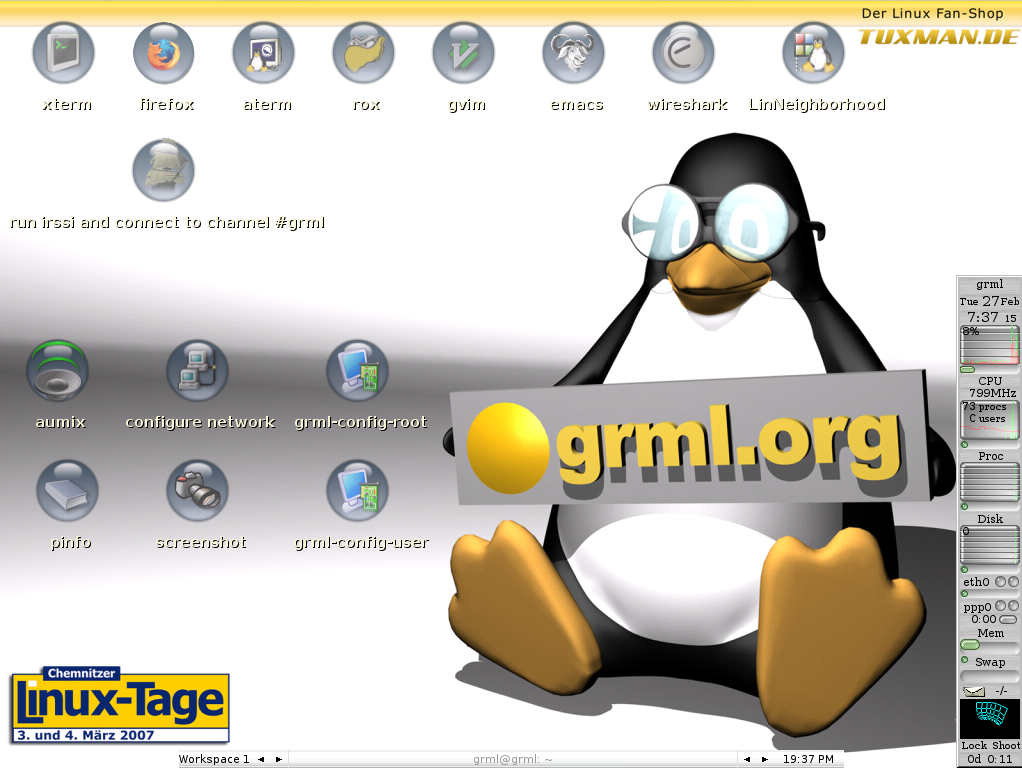
The countdown is running… On 3rd and 4th of March 2007 the Chemnitzer Linux Days will take place. We’ll present grml (Linux Live-CD for sysadmins / texttool-users / geeks) at a booth there! If everything works as intented we will have a demo system as well as CDs of a special grml release named “Dioptrienotto @ clt07″: Screenshot of grml clt07 release Several grml developers will be there and I’m looking forward to meet formorer for the first time in RL. 8-) Hope to see you there! :-)

Ian Murdock: Google Reader mobile interface is now usable

Another recent Google discovery: In Google Reader’s mobile interface, there’s now a link at the bottom of each page: “mark these items as read”. Previously, the mobile interface had been more or less unusable because there was no way to mark items read short of actually reading each and every one. Now, if only there were a mobile client a la Gmail for Mobile that would allow me to scroll through my feeds like I do in my browser, only with the Blackberry scroll wheel rather than the mouse scroll wheel, I’d be in information junkie nirvana.

Andrew McMillan: Switching to IPv6

From today my blog is available on IPv6. I've set it up so that http://debiana.org/ is only serving an AAAA record (for this server) and no IPv4 records (+/- DNS timeouts, of course...). Tomorrow I will work on getting a nameserver or two running on IPv6, to extend the IPv6 infrastructure another level. This is all me fiddling now that we have an IPv6 allocation at Catalyst, and are developing our IPv6 infrastructure in order to be able to deploy a couple of the .nz nameservers on IPv6 in due course. I'm not sure if I can point a .org domain at IPv6 nameservers so I might have to pick one of my .nz domains and use that to have a top to bottom IPv6 infrastructure. For IPv6 to start to work, I think people just have to start using it, so I'm going to change the systems that I can change. So I've also put a fixed IPv6 address onto my laptop, which is nice, and I will be converting all of my home systems to IPv6 addresses as well as time permits. Of course I can't get rid of IPv4 yet, but I think I will probably be trying to run that through a proxy somewhere non-local if I possibly can. If you can access this server via IPv6 I would be really interested to see a traceroute from you :-)

21 February 2007

Eddy Petrișor: tdebs - archive layout (updated)

(Some updates, see at the bottom).

Today I have moved the wiki page for TranslationDebs under i18n/TranslationDebs, since it seemed to be a more proper place.

I also read again my proposal, made some corrections and gave the layout proposal some thought. I realised that both compatible layout proposal and the incompatible layout proposal have disadvantages and/or are somewhat inconsistent with the current way the archive and apt work.

So I went on and added yet another proposal which should be some middle ground between the previous ones. Now I am not sure if this new one has any real benefits as opposed to the previous ones and I am not sure if I am still on the right track.

Now I need some help. I suggest interested people to look at the proposals and their advantages before answering the questions below.


So the questions are:
  1. which of the following archive layouts seems to be the "right" format?
    • f.d.o/debian/dists/DIST/SECT/l10n/LANG/
    • f.d.o/debian/dists/l10n/DIST/SECT/LANG/
    • f.d.o/debian/dists/DIST/l10n/LANG/SECT/
  2. Do we want a binary-$ARCH level at the end of this path? Is the lack of it an inconsistency? Do we want l10n material to be treated so differently? Do we consider the LANG some kind of replacement for $ARCH? Is there any or a significant part of l10n material that is arch dependent?
  3. Do we want to have a compatibility layer for older dpkg/apt, i.e do we want both an empty Packages and a Translations file in there?
  4. Which of the following looks the best for translation selection ? (note that the change of format leads one way or the other to incompatibilities)
    • deb-tdeb-$LANG http://ftp.debian.org/debian/ etch main
    • tdeb-$LANG http://ftp.debian.org/debian/ etch main
    • deb http://ftp.debian.org/debian/ etch main/l10n/$LANG
    • deb http://ftp.debian.org/debian/ etch l10n/$LANG/main/
  5. Does the package naming needs some rethinking since the current proposal doesn't allow translation installations to be installed via current dpkg implementation?
Update (20070221-1): Filipus Klutiero suggested that it would be nice not to need to add something in /etc/apt/sources.list . I agree, this is a very good idea. There was no suggestion how to do this, but I thought maybe /etc/default/locale can be used for translation selection via a new variable in there. I'll add this to the wiki page, too.

17 February 2007

Alexander Schmehl: Is there a mail client which doesn't suck?

Until recently I was a quite happy user of the mail client mutt. I used to receive mails on my own mail server, check them for spam, and at home I used fetchmail to pull them all down, where they where sorted in different folders via procmail. Not very elegant, but working. Sometime I read the mails directly on my server, which wasn't as comfortable as possible, since the mails where all in one big pile. So I needed to change something to sort them on the server and sync them home. Not a big problem, you might think? Well... Sorting mails on my server wasn't a big problem (beside the fact that I needed to tweak my procmailrc a bit; I used real folders at home, but dovecot wants to have the folder hierarchy separated by dots in the names of the physical folders). First I tried to use mbsync, from the isync package. First problem was, that mbsync doesn't like subfolders (which I didn't found out via the documentation, but from a friend using it, too). So I needed to rename all my folders (nearly 100) again to something mbsync would understand. I worked quite well and did, what I wanted to do: Syncing mails from my home computer to my mail server and the other way around. It was nearly perfect, and I would be able to read mails even without net connection. Perfect for boring train rides! But after only one week something went wrong. mbsync started to segfault. Beside receiving new mails and doing the usual stuff (reading them, moving them to other folders) I changed nothing. But it kept on segfaulting; I didn't found out why (see #411120). Obviously I need a working mail setup, so I searched something new... like my old mutt! Why not use mutt to access the imap server directly? Okay, I wouldn't be able to read mails while traveling around in a train... but hopefully mbsync would be fixed in the meantime. But using mutt with imap sucks, too. While it is perfectly possible to read my mails, it seems impossible for mutt to check, which folder has new mails. No, that won't work. Thanks, I'll have a look at something else... Perhaps I should try something new? My girlfriend likes thunderbird icedove. Nice user interface... no problem accessing my imap server... and it has some kind of offline mode. But... NO! It seems it's impossible to make system wide folder settings! Like... displaying new mails on the top instead of the bottom... or using the thread view... or setting this damn "check this folder for new messages" flag, so the folder will be checked for new mails. Damn! I won't click through every single one of my nearly 100 mail folders to set the settings I want. Sigh... isn't there a mail setup which doesn't suck? It isn't that complicate: I want to use gpg, I want to have threading, I want my folders to be displayed properly (preferably in some kind of tree), I want to see which folders have new mails and it shouldn't be that huge (which kicks out kmail and gnus); bonus points if I can continue using my favourite editor and for some kind of offline mode. Update: icedoves threading sucks, too. It seems to be based on the subject of the mails, not mail headers. Leading to quite iritating views on a mailfolder containing a lot of auto generated messages with similar subject. PS: No, I haven't tried offlineimap, yet. Some people warned me to not use it. Well... perhaps I'll give it a try.

9 February 2007

Erich Schubert: XML schema datatypes

... suck. The XML Schema "datetime" format can't be handled by Java's SimpleFormat (ok, that probably is more Javas fault, of not being able to handle hours:minutes in the timezone specification, anyway, this is mildy annoying). The XSLT2 parsers are very intolerant about the format of the time specification, too. They could have made more stuff optional such as the specification of seconds; an error here will make the whole XSLT fail with an exception. Some compact form of error handling would be nice... as would be a smart parser which can handle various formats. The XML Schema "duration" is even worse. First of all, it was completely forgotton when doing XSLT 2; there are no functions to format or disassemble it (except by regular expressions, which could also use a zero-width lookahead). Secondly, it's lacking common specifications such as "next week". While "next week" is computationally equivalent to "in 7 days", it can have different semantics in some contexts (especially when not being aligned): If I'm looking for the week February 9th 2007 is in, the result is February 5th two February 11th. If I'm looking at a 7 day interval containing this day, there are infinite possibilities (aligned on milliseconds and below...). So it does make sense to make a difference between 7 days and a week.

8 February 2007

Steinar H. Gunderson: Gngngn

Don't you just hate it when you pick up some software, start using it and immediately crop into three distinct bugs? Today's frustration is brought to you by ESR. Our motto: It's not my design that's broken, it's the equipment. And if you try to add configuration options to adjust better to the equipment, I will refuse your patch.

6 February 2007

Miriam Ruiz: About the NM process

There’s a huge problem with the educational system as we know it. It doesn’t teach people how to think, to be creative, or even to improve their knowledge. When a kid goes to school, the first thing they learn is that the answers they must give are not what they consider to be truth, but what they think the teachers want to hear. When you’re in high school, or at university, you have the inner feeling that you must behave, or else. I had personal problems with a teacher at university, and learnt that you’re helpless in that situation. The motto would be that if you want to finish university, you should take care about getting on with the teachers. The result are submissive citizens that won’t face authority even if they know they’re right, in order to avoid problems. One of the best things in Debian is that is revolutionary, belief-guided. People do what they feel they should do, according to their own beliefs, and mostly don’t care about having trouble with the “authority”. That’s something I really like a lot, and respect. Of course that is also the source of multiple fights and disagreements, but usually the result of those is a better solution that whatever could be achieved by an authority imposition from the power-handling people. I like the revolutionary face of Debian as much as I like the technical one, and wouldn’t like losing it. The NM process is Debian’s “university”. It’s the process in which new generations of developers will enter the project. Therefore, whatever is done with it will highly influence middle-term evolution of Debian. Of course, the NM process must assure that people becoming developers have enough technical skills, and also that they’re ideologically aligned with the Social Contract. Otherwise it wouldn’t make sense. What should be taken care about is that the NM process don’t filter side thinking, creativeness, confrontation with authority or the will to make a better world. I wouldn’t like an NM process that promoted the same submissive values that the educational system does.

13 January 2007

Adam Rosi-Kessel: Lawyer Bashing: Bad Politics?

The New York Times reports that the Pentagon has gone on the offensive against the pro bono attorneys representing Guantánamo detainees. Although there is a lot to criticize in U.S. detainee policy, these attacks represent a new low:
The senior Pentagon official in charge of military detainees suspected of terrorism said in an interview this week that he was dismayed that lawyers at many of the nation’s top firms were representing prisoners at Guantánamo Bay, Cuba, and that the firms’ corporate clients should consider ending their business ties. … The same point appeared Friday on the editorial page of The Wall Street Journal, where Robert L. Pollock, a member of the newspaper’s editorial board, cited the list of law firms and quoted an unnamed “senior U.S. official” as saying, “Corporate C.E.O.’s seeing this should ask firms to choose between lucrative retainers and representing terrorists.” In his radio interview, Mr. Stimson said: “I think the news story that you’re really going to start seeing in the next couple of weeks is this: As a result of a FOIA request through a major news organization, somebody asked, ‘Who are the lawyers around this country representing detainees down there?’ and you know what, it’s shocking.” The F.O.I.A. reference was to a Freedom of Information Act request submitted by Monica Crowley, a conservative syndicated talk show host, asking for the names of all the lawyers and law firms representing Guantánamo detainees in federal court cases. Mr. Stimson, who is himself a lawyer, then went on to name more than a dozen of the firms listed on the 14-page report provided to Ms. Crowley, describing them as “the major law firms in this country.” He said, “I think, quite honestly, when corporate C.E.O.’s see that those firms are representing the very terrorists who hit their bottom line back in 2001, those C.E.O.’s are going to make those law firms choose between representing terrorists or representing reputable firms, and I think that is going to have major play in the next few weeks. And we want to watch that play out.”
Perhaps the worst part is the following statement, which as best I can tell has no basis in truth:
When asked in the radio interview who was paying for the legal representation, Mr. Stimson replied: “It’s not clear, is it? Some will maintain that they are doing it out of the goodness of their heart, that they’re doing it pro bono, and I suspect they are; others are receiving moneys from who knows where, and I’d be curious to have them explain that.”
Deval Patrick, the recently-elected governor of Massachusetts, endured similar attacks for his work representing criminal defendants. Fortunately, that strategy backfired and Patrick was elected in a landslide. Although others in the administration have attempted to distance themselves from Stimson’s comments (including the Attorney General), the suggestion that large corporate clients should boycott these attorneys as punishment for representing detainees remains disgusting. The right to counsel is not a political issue. You could hold the unlikely belief that each and every Guantánamo detainee is a confirmed terrorist and still advocate for fair treatment. These attacks represent a new brand of McCarthyism. I hope that this strategy is as unsuccessful nationally as it was in Massachusetts. It strikes me that attacking the partners of some of the largest firms in the country is also bad political strategy. These attorneys are the type of people who may be major campaign donors and well-connected in both parties. I would think twice before attempting to vilify them. They are unlikely to drop their representation (and might be ethically barred from doing so) in light of these statements. If anything, I suspect their determination to ensure the detainees are accorded due process will intensify. Update: abovethelaw.com speculates that this may be an intentional good cop/bad cop strategy.

12 January 2007

Gustavo Franco: iPhone random thoughts and multitouch on iMacs someday?

iPhone is cool in a lot of ways (except in the freedom side, but not too different than the current iPods). I wish to buy one until the xmas and replace my now obsolete looking LG model. I think if Apple is trying to promote this product as 'more an iPod than a phone' - as Steve Jobs said in an inteview. They give it the wrong name, it should be called: iPod Phone. Yes, same deal as they did with the iPod video thing until they 'merged' the feature on the iPod brand. Remember that it would save them from the current trouble with Cisco/Linksys too.

The multitouch screen on that thing looks promising. I'm sure that there are a lot of cooler screens in development out there right now, but if Apple (or the real manufacturer behind the screen) can manage to make larger ones, i can see some time in the next year the motto: "Do you remember where did the computer go?" "Where did the keyboard and mouse go now?". Ok, maybe a bit too optimistic (they could keep the keyboard and throw away the mouse), but i think the iMacs could be a interesting target for the multitouch thing. Considering they've iSight already in place, with a larger multitouch screen in a good position and shiny cool gestures software, there we've minority report ready desktops, some time after laptops. Can you hear chairs?

9 January 2007

Steve McIntyre: Weekend in Helsinki

Just spent a long weekend (Thursday night to Monday afternoon) in Finland. Hanna invited me over a while ago with a promise of sauna and ice swimming, and I'm a sucker for travelling to parties these days... *grin*. Unfortunately, the weather in Finland (just like in the UK) at the moment is ridiculously warm for the time of year. When I visited in November for the BSP, there was some snow on the ground and temperatures were as cold as I expected. This time, there was no sign of any snow and I was worried that we might not get any ice...! Lars was kind enough to offer me some crash space at short notice for my visit (there's nothing like last-minute organisation for this kind of jaunt!). On Friday we met up with Jesus, Jeroen, Hanna, Pixie and Dave for lunch and some wandering around in the middle of Helsinki. Then on to some bars later for some drinks and food. I could get used to this... :-) On Saturday, we got up early, bought large amounts of food and drink to take with us, and caught the bus north-west out of Helsinki towards central Finland. 90 minutes on the bus and in a taxi, and we were dropped off at Hanna's family's cottage by the lake below: As we got there, the temperature was dropping just enough that we could actually see the ice forming on the lake. Beautiful! In the middle of nowhere in the forest, things were incredibly quiet and peaceful. We lit the fire for the the sauna, and wandered off for a walk through the forest. Later on, beer, sauna and (almost) ice swimming. Naked geeks! I must admit that I chickened out a little - coming out of the sauna into freezing temperatures slowed me down a little. By the time I reached the bottom of the steps to the lake surface, I couldn't force myself into the lake fully. I got three toes wet, then ran back inside into the warm... :-) Dave was more resilient (in and out FIVE times!), but it looks like he maybe overdid things. He crashed out later and was acting quite oddly for a while - we worked out that he was probably dehydrated. We carried on drinking and snacking at the cottage, then headed back into Helsinki for the bars and clubs later that night. More of the same on Sunday along with a cinema visit, and I was thoroughly exhausted and ready to head back to the UK on Monday. Thanks very much to Hanna, Lars, Jesus and the others for making my trip so much fun. Helsinki is a lovely place to visit, although probably too expensive for me to manage it too often. I'm saving already for the next time! I've put my photos online as usual.

7 January 2007

Ross Burton: Asynchronous Flickr Library, version 0.1

I'm finally releasing version 0.1 of my Flickr library, flickrpc. The name is actually misleading, and I should change it for 1.0, as the class name is flickrest and the transport protocol is HTTP/REST, not XML-RPC (as was the original plan, thus the name). This library is written in Python and uses Twisted.
Why another Flickr library?
Because Postr required it. All of the existing libraries that I know of are blocking (I used to use Beej's flickrapi, which was based upon Michele Campeotto's flickrclient), which makes using them in GUI applications painful. Early versions of Postr used threads so that uploading could be done in the background without blocking the UI, but as Postr makes more calls to Flickr whilst being used interactively these threads will become a maintaince nightmare. By using Twisted all of the network operations are handled in the main loop, and I can write callback-based network code just like I write callback-based UI code.
Why Twisted?
Because it works, and is popular. If someone has a HTTP client library that integrated into the GLib mainloop and will expose callbacks when operations complete, please tell me. I love what Twisted gives me, but at the end of the day if there is a simplier solution, I'll consider it.
Sounds excellent! Where can I get it?
There is a tarball of 0.1 available here: flickrpc-0.1.tar.gz. If you want to track the latest development, or contribute patches, there is also a Bazaar archive.

6 January 2007

Uwe Hermann: Five things I plan to do in 2007

This is sort of a New Year's resolution... In no particular order:
  1. Write a book.
  2. Learn at least one new programming language.
  3. Donate money to (or become member of) either the EFF, the FSF, the CCC, or another similarly important organization.
  4. Make use of my rights as a citizen and write letters to elected politicians, urging them to promote certain topics/issues/laws (privacy, democracy, transparency) and to combat others (software patents, voting computers, data retention, mass surveillance and lots more comes to mind).
  5. Work on and support selected Free Software projects in my spare time, especially projects which are of a greater importance to the Free Software movement (or the Free Culture movement; or freedom; or privacy; or anonymity; or democracy) than the 158th IRC client or the 276th tetris clone. Some examples: LinuxBIOS, Nouveau, Tor, Gnash, and Democracy Player to name just a few projects. General motto: Choose your battles!
Oh, and one more thing: Do the most important duty as a citizen of any democratic country — help to save democracy by killing voting computers. Yeah, so that makes six things I plan to do in 2007. Sue me.

3 January 2007

Simon Huggins: Best feed readers

I think I need to change the way I read RSS/ATOM feeds. At the moment I run a local planet partly because I'm a control freak and it meant that when Planet Debian was down I could still read those feeds and partly because I want to add other people's feeds to it and want to read them all in the same place. This is mostly fine apart from planet's "feature" of ignoring the dates in feeds and occasional either broken feeds or broken parsing causing me to see literal HTML in the generated page. Until recently I didn't have any further problems but a while back I added a very verbose machine generated feed which it would be nice to be able to look at separately. Planet doesn't cope well with this; this feed's entries tend to push interesting ones off so either I have to tell planet to generate a huge page (including much stuff I've already read) or setup separate planet configs. It also just feels inefficient for me to have all the stuff I've already read at the bottom of the page and to be loading any linked images (well ok, getting a 304 Not Modified hopefully) every time I want to look at my planet page. So I think I want a standalone reader or possibly to use an independent service like the google reader or bloglines. Though am I still a control freak so the former sounds better for me. I just tried liferea (from unstable, 1.0.27) and was clicking around and it segfaulted. Not exactly a glowing recommendation. It'd be neat if there was one that presented posts a bit like planet does - all expanded ready for reading one after the other in date order - so all I have to do is read and scroll and things get marked as read. It'd be really neat if I could then mark things as unread or file them some how. Dear lazyweb, does something like this exist? love and kisses, huggie

29 December 2006

Adrian von Bidder: Email disclaimers

Russel pointed me to Andre Pang's blog entry.  Yep, I share this annoyance.  Especially because I recently received an email with a 3 or 4 line disclaimer at the top of the email, and an additional, longer one at the bottom.  Occasionally, I use that one:
The content of this message may or may not reflect the opinion of me, my
employer, my girlfriend, my cat or anybody else, regardless of the fact
whether such an employer, girlfriend, cat, or anybody else exists.  I
(or my employer, girlfriend, cat or whoever) disclaim any legal
obligations resulting from the above message.  You, as the reader of
this message, may or may not have the permission to redistribute this
message as a whole or in parts, verbatim or in modified form, or to
distribute any message at all.
(Daniel Baumann: Please note the spaces I've added in this post, extra for you!)

Steve Kemp: You say those thousand things

Only three things to say today:
Second anniversary
Today marks the second anniversary of the Debian Administration website. (I think that this is the first public mention of my intention to setup the site. It was the earliest I could find anyway.)
Edinburgh Trivia
Doing my own small bit for Debconf I went for a walk on Christmas Day. For two years I’ve lived in the area of Edinburgh known as Leith. (Famous for being a port, and being a port of call for hookers) During that time I’ve taken buses, and walked, up and down Leith walk hundreds of times. Almost every time I do I notice a large chimney by The Edinburgh Playhouse Theatre.. The top 20/30ft of the chimney can be seen from peeking over the top of local buildings, assuming you’re not blocked by other buildings. And now? Now I know what it sits upon. My little adventure in getting to know the city I’ve been living in; I wanted to find the bottom of the chimney and see what it was attached to. So if anybody coming to Debconf next year gets massively lost and curious about a large chimney en route to my house .. I can tell them all about it. It is the little things in life ..
Xen Shell
I’m not sure that there are many people using this, the freshmeat listing has a few subscribers but I’m never sure how well that translates. (Plus of course nobody rated the software so it might be they hate it?). Anyway there are almost certainly far fewer users of the shell than the main xen-tools package - but as of last night the shell now allows you to control more than one Xen instance. This is quite a large change, since previously it explicitly only supported one user controlling one Xen instance. Expect a new release shortly once I’ve tested it more, and updated the documentation.

20 December 2006

Ian Murdock: Software installation on Linux: Tomorrow, it won t (with some cooperation) (part 2)

In part 1, I described the problem of software installation on Linux; in part 2, I’ll describe the solution we came up with at the recent LSB Packaging Summit. After reading through the comments to part 1, let me first point out that our goal is to create a vibrant third party software ecosystem around Linux—you know, like the one Microsoft has built around Windows. No, it’s not about imitating Microsoft. It’s about being competitive. A platform is only as good as the applications that run on it. Bottom line: Many third parties have built their businesses around proprietary software, and we can’t just ignore them. And “ecosystem” implies decentralized, which I argued in part 1 was a key tenet of open source development anyway, i.e., this should be playing to one of our core strengths. So, if your “solution” is to tell ISVs (independent software vendors) to give us their source code so the distributions can include it because that’s just how we do things, you can safely skip the rest of the post below. You’re simply not going to agree that any of this is a problem. Ok. Assuming our goal is to create a vibrant third party software ecosystem (and everyone still reading agrees that’s a good goal, right?), we have the following challenges. First of all, the distribution vendors are hugely invested in their existing package systems, and for the most part, those package systems work extremely well. As I said in part 1, “if [an application] is in your distro of choice, you re only an apt-get or a yum install away from running it.” (I’m saying it again here because some of the commenters apparently didn’t see that. The tricky bit is “in your distro of choice”, which by definition is not the case with third party software.) Furthermore, a variety of highly sophisticated systems management solutions are built above those package systems, such as Red Hat Network and Novell ZENworks. This is a pretty important consideration, because these days, the “software management problem” largely involves managing software across the entire infrastructure, not just a single system. What problem then? This: ISVs have thus far been reluctant to use the native package systems. Why? THEY’RE hugely invested in “package systems” for other platforms, and every Linux specific thing they have to support costs money. In a world where decisions are ruled by cost vs. benefit, this is a pretty important consideration too. How do ISVs handle this today? For the most part, they ignore the package systems on Linux and do their own thing. Trouble is, while doing their own thing gives ISVs the flexibility to work cross platform, it ultimately makes their products integrate poorly in the broader systems management context because the package systems know nothing about them. What is needed is a way to bridge the gap between what the distros provide and what the ISVs want. But how? First off, we have to understand what ISVs want. The answer is simple: ISVs want to treat Linux as a single platform, which means they want to offer a single package for Linux, much as they do for Windows. So, if one commenter is right that “[t]he problem is that people (including software distributors) believe there s such [a] thing as ‘Linux’ as a target platform” and that “[i]f you re distributing software for ‘Linux’ then it won t be simple to install it, ever”, well, then Linux is destined to suffer the fate of UNIX. I’m not ready to give up so easily. Several commenters suggested that what we need is a brand new package system. That’s a non-starter—for one thing, the distros aren’t going to be too keen on replacing something they’re hugely invested in, and if ISVs aren’t going for RPM today, why would they go for something different tomorrow? No, to find a way forward, we need an evolutionary step from where we are today. From there, perhaps we can do more, but even the first steps can be quite valuable in their own right. To help find those first steps, we put some of the leading minds in Linux packaging in the same room (including the maintainers of RPM at Red Hat and Novell and the authors/maintainers of APT, yum, alien, and klik) along with ISVs large and small, server and desktop. The discussion pretty quickly converged on constructing a single API that could be implemented across the various package systems, because APIs make for nice evolutionary steps and can, done right, mask underlying implementation differences. Question is, what do ISVs need in such an API? Limiting the scope is key here, because providing an API that spans all the functionality of, say, RPM and dpkg is overwhelming to the point of being unworkable, not to mention more work to implement, which in turn makes it less likely to get into the distros so that ISVs can count on it being there, the whole point of this exercise in the first place. Fortunately, the ISVs don’t really need much. At the most basic level, an installer just needs to be able to query the system to see if it’s LSB compliant, and if it is, what version of the LSB it’s compliant with; and it needs to be able to “register” with the package system, so the package system knows about it, including what files it has installed. And that’s really about it. Importantly, because we assume an environment that’s LSB compliant, we don’t have to worry about dependencies, because everything is covered by the single LSB dependency, and dependency management is 95% of the package systems right there. We still need minimal dependency support—components can extend the LSB, and applications can depend on those other components being installed—but we’re talking on the order of a handful of components, not the tens of thousands of components typical package systems have to deal with. We only had a day, so we obviously don’t have a complete solution yet. For one thing, we barely touched on the issue of uninstallation (should we allow applications to register GUI uninstallers?), and the issue of how applications go about changing the system configuration still needs discussion (in a lot of cases, the assumption of LSB compliance means the installer is going to be well behaved, but there’s undoubtedly corner cases to be explored). And it’s going to take time for the API to be implemented and put into widespread enough use that ISVs can depend on it. However, everyone in the room did come to consensus pretty quickly that this was an important problem, and that providing a simple API that provides the minimum necessary functionality was the way to go. Perhaps most exciting, the very people whose support are needed to put the API into widespread use were in that room, and active participants in the discussion too. Everyone is certainly motivated: The distros get more applications, which makes the shared platform more attractive; and ISVs get lower cost, which tilts the cost vs. benefit equation in their favor, making Linux versions more economically attractive and potentially opening new markets. Because this is just a start, the FSG is launching a Packaging workgroup to continue the discussion we started at the Packaging Summit. If you’re interested in this topic, I’d encourage you to join the mailing list and get involved. There’s still plenty to be done. Update: One more thing: In addition to making it easier for ISVs to better support Linux by simply extending their existing installation scripts, the API approach really comes into its own when you imagine it implemented in things like Autopackage and InstallAnywhere. Let the market decide!
18 December 2006

Alexander Sack: a new face for Icedove

Thanks to Ricardo Fernandez we have a great new and consistent artwork for our ice-lizard applications. For icedove they will land with the next upload … so here some screens.
icedove about box
icedove credits dialog with new motto: “Icedoves are Free!”

Manoj Srivastava: I am now an Ikiwiki user!

Ikiwiki
Well, this is first post. I have managed to migrate my blog over to Ikiwiki, including all the historical posts. The reasons for migration was that development on my older blogging mechanism, Blosxom, entered a hiatus, though recently it has been revived on sourceforge. I like the fact that IkiWiki is based on a revision control system, and that I know the author pretty darned well :-). One of my primary requirements for the migration was that I be able to replicate all the functionality of my existing Blog, and this included the look and feel (which I do happen to like, despite wincing I see from some visitors to my pages) of my blog. This meant replicating the page template and CSS from my blog. I immediately ran into problems: for example, my CSS markup for my blogs was based on being able to markup components of the date of the entry (day, day of week, month, etc) and achieve fancy effects; and there was no easy way to use preexisting functionality of IkiWiki to present the information to the page template. Thus was born the varioki plugin; which attempts to provide a means to add variables for use in ikiwiki templates, based on variables set by the user in the ikiwiki configuration file. This is fairly powerful, allowing for uses like:
    varioki =>  
      'motto'    => '"Manoj\'s musings"',
      'toplvl'   => 'sub  return $page eq "index" ',
      'date'     => 'sub   return POSIX::strftime("%d", gmtime((stat(srcfile($pagesources $page )))[9]));  '
      'arrayvar' => '[0, 1, 2, 3]',
      'hashvar'  => ' 1, 1, 2, 2 '
     ,

The next major stumbling block was archive browsing for older postings; Blosxom has a nice calendar plugin that uses a calendar interface to let the user navigate to older blog postings. Since I really liked the way this looks, I set about scratching this itch as well; and now ikiwiki has attained parity vis. a vis. calendar plugins with Blosxom. The calendar plugin, and the archive index pages, led me start thinking about the physical layout of the blog entries on the file system. Since the tagging mechanism used in ikiwiki does not depend on the location in the file system (an improvement over my Blosxom system), I could layout the blog postings in a more logical fashion. I ended up taking Roland Mas' advice and arranging for the blog postings to be created in files like:
 blog/year/month/date/simple_title.mdwn

The archives contain annual and monthly indices, and the calendar front end provides links to recent postings and to recent monthly indices. So, a few additions to the arch hook scripts, and perhaps an script to automatically create the directory structure for new posts, and to automatically create annual and monthly indices as needed, and I'll have a low threshold of effort blogging work flow for blog entries, and I might manage to blog more often than the two blog postings I have had all through the year so far.

17 December 2006

Clint Adams: Next week: why everyone should go to tech shows topless

Kathy Sierra writes about how conference T-shirt distributors are not trying to make their attendees look sexy enough, by providing tees that attempt to hide breasts. She doesn't mention underwear though, and this suffers from exactly the same problem. The free logo-branded boxers you get at these things are almost always poorly-made and ill-fitting. Why not provide Speedos or bikini bottoms or anything which will tightly-hug the pubic region and showcase one's junk? Does this guy want to hide his genitalia? No, he wants to strut, proud and trouserless, across the expo floor, knowing full well how much the conference organizers care about him. Bless his courage and rejection of societal norms.

Next.

Previous.