Search Results: "eric"

4 September 2013

Andrew Pollock: [life] Six years without Joshua

I think of Joshua often, and wonder how life might be different were he with us today. The long day of his delivery is one of the most poignant memories that I will carry with me forever. This year is the first year I've been back in Australia for Father's Day. Father's Day in the US is in June, so it's never really been the constant reminder that it will be back here (although I guess it'll vary year to year). The US Labor Day long weekend tended to be the trigger holiday for me. It's also the first year I've been separated, so this Father's Day was particularly difficult for me, but I found I enjoyed the day with Zoe all the more for it. Now that I'm no longer in the US, I miss seeing Eric and Katie's daughter, as she was my physical yardstick of how big Joshua would be today.

31 August 2013

Christian Perrier: DebConf 13: running outcome

This DebConf has been the first one where I ran every day. That proved to be kinda hard on some mornings, but I found a way to circumvent that by proposing group runs at the end of the relevant days. In total, I managed to run 12 days in a row, for a grand total of 186.88km, in 21h22', for a total height difference of 6972m. In short, I nearly climbed Mount Aconcagua, Americas highest peak..:-) Most of these runs were quite slow ones and rather "short" ones (around 15km), because of the nature of the paths around (nearly impossible to find something flat except by running around the football field). The longest run was for the DayTrip, with about 25km in about 4 hours (including some pauses) and 1600m height difference. I'm definitely working on my moutain running skills more than marathon and other kind of "speed" races. That followed a great results for my last race, the "EDF Cenis Tour" 50km trail race in Lanslebourg, French Alps, where I completed the race in 6h38, nearly the sametime than Mont-Blanc marathon, 1 month earlier....which was 8 kilometers shorter. I'm apparently ready for very long distance mountain races, now, as it seems. Thanks you DebConf 13 organizers for choosing such a great locations for us, crazy runners. And, despite that, my next running goal is a "classical" marathon, the Toulouse marathon in late October, where I expect breaking the 3h30 barrier, that would indeed be a qualifier for the Boston Marathon, one of my dreams for the future (and, yes, it is still a dream, despite this year's events).

Russell Coker: Links August 2013

Mark Cuban wrote an interesting article titled What Business is Wall Street In about the failure of Wall Street to fulfill it s stated purpose of providing capital for businesses [1]. His proposed solution is extreme, but so is the problem. PopSci has an interesting article by Peter Nonacs about allowing students to collaborate (which is often known as cheating ) in an exam on a Game Theory exam [2]. So the Game Theory exam became a practical exercise. It s more interesting than I can describe in a paragraph. Salon has an interesting article suggesting that mealtime routines and rituals improve flavor [3]. I wonder whether that applies to other things. Does the ritual of compiling software make one enjoy it more? Would the food at a Linux conference taste better if we sang the Free Software Song first?

23 August 2013

Thorsten Glaser: FrOSCon 2013, or, why is there no MirBSD exhibit?

FrOSCon is approaching, and all MirBSD developers will attend but why s there no MirBSD exhibit? The answer to that is a bit complex. First let s state that of course we will participate in the event as well as the Open Source world. We ll also be geocaching around the campus with other interested (mostly OSS) people (including those we won for this sport) and helping out other OSS projects we ve become attached to. MirOS BSD, the operating system, is a niche system. The conference on the other hand got younger and more mainstream. This means that almost all conference visitors do not belong to the target group of MirOS BSD which somewhat is an ancient solution : the most classical BSD around (NetBSD loses because they have rc.d and PAM and lack sendmail(8), sorry guys, your attempt at being not reformable doesn t count) and running on restricted hardware (such as my 486SLC with 12 MiB RAM) and exots (SPARCstation). It s viable even as developer workstation (if your hardware is supported otherwise just virtualise it) but its strength lies with SPARC support and embedded x86 . And being run as virtual machine: we re reportedly more stable and more performant than OpenBSD. MirBSD is not cut off from modern development and occasionally takes a questionable but justified choice (such as using 16-bit Unicode internally) or a weird-looking but beneficial one (such as OPTU encoding saving us locale(1) hassles) or even acts as technological pioneer (64-bit time_t on ILP32 platforms) or, at least, is faster than OpenBSD (newer GNU toolchain, things like that), but usually more conservatively, and yes, this is by design, not by lack of manpower, most of the time. The MirPorts Framework, while technically superiour in enough places, is something that just cannot happen without manpower. I (tg@) am still using it exclusively, continuing to update ports I use and occasionally creating new ones (mupdf is in the works!), but it s not something I d recommend someone (other than an Mac OSX user) to use on a n n-MirBSD system (Interix is not exactly thriving either, and the Interix support was only begun; other OSes are not widely tested). The MirBSD Korn Shell is probably the one thing I will be remembered for. But I have absolutely no idea how one would present it on a booth at such an exhibition. A talk is much more likely. So no on that front too. jupp, the editor which sucks less, is probably something that does deserve mainstream interest (especially considering Natureshadow is using it while teaching computing to kids) but probably more in a workshop setting. And booth space is precious enough in the FH so I think that d be unfair. All the other subprojects and side projects Benny and I have, such as mir c , josef stalin, FreeWRT, Lunix Ewe, Shellsnippets, the fonts, etc. are interesting but share few, if any, common ground. Again, this does not match the vast majority of visitors. While we probably should push a number of these more, but a booth isn t it here, either. MirOS Linux ( MirLinux ) and MirOS Windows are, despite otherwise-saying rumours called W*k*p*d*a, only premature ideas that will not really be worked on (though MirLinux concepts are found in mir c and stalin). As you can see, despite all developers having full-time dayjobs, The MirOS Project is far from being obsolete. We hope that our website visitors understand our reasons to not have an exhibition booth of our own (even if the SPARCstation makes for a way cool one, it s too heavy to lift all the time), and would like to point out that there are several other booths (commercial ones, as well as OSS ones such as AllBSD, Debian and (talking to) others) and other itineries we participate in. This year both Benny and I have been roped into helping out the conference itself, too (not exactly unvoluntarily though). The best way to talk to us is IRC during regular European geek hours (i.e. until way too late into the night which Americans should benefit from), semi-synchronously, or mailing lists. We sort of expect you to not be afraid to RTFM and look up acronyms you don t understand; The MirOS Project is not unfriendly but definitely not suited for your proverbial Aunt Tilly, newbies, desktop users, and people who aren t at least somewhat capable of using written English (this is by design).

22 August 2013

Matthew Garrett: Re: Default offerings, target audiences, and the future of Fedora

Eric (a fellow Fedora board member) has a post describing his vision for what Fedora as an end goal should look like. It's essentially an assertion that since we have no idea who our users are or what they want, we should offer them everything on an equal footing.

Shockingly enough, I disagree.

At the most basic level, the output of different Special Interest Groups is not all equal. We've had issues over the past few releases where various spins have shipped in a broken state, because the SIG responsible for producing them doesn't have the resources to actually test them. We're potentially going to end up shipping F20 with old Bluetooth code because the smaller desktops aren't able to port to the new API in time[1]. Promoting these equally implies that they're equal, and doing so when we know it isn't the case is a disservice to our users.

But it's not just about our users. Before I joined the Fedora project, I'd worked on both Debian and Ubuntu. Debian is broadly similar to the current state of Fedora - no strong idea about what is actually being produced, and a desire among many developers to cater to every user's requirements. Ubuntu's pretty much the direct opposite, with a strongly defined goal and a willingness to sacrifice some use cases in order to achieve that goal.

This leads to an interestingly different social dynamic. Ubuntu contributors know what they're working on. If a change furthers the well-defined aim of the project, that change happens. Moving from Ubuntu to Fedora was a shock to me - there were several rough edges in Fedora that simply couldn't be smoothed out because fixing them for one use case would compromise another use case, and nobody could decide which was more important[2]. It's basically unthinkable that such a situation could arise in Ubuntu, not just because there was a self appointed dictator but because there was an explicit goal and people could prioritise based on that[3].

Bluntly, if you have a well-defined goal, people are more likely to either work towards that goal or go and do something else. If you don't, people will just do whatever they want. The risk of defining that goal is that you'll lose some of your existing contributors, but the benefit is that the existing contributors will be more likely to work together rather than heading off in several different directions.

But perhaps more importantly, having a goal can attract people. Ubuntu's Bug #1 was a solid statement of intent. Being freer than Microsoft wasn't enough. Ubuntu had to be better than Microsoft products on every axis, and joining Ubuntu meant that you were going to be part of that. Now it's been closed and Ubuntu's wandered off into convergence land, and signing up to spend your free time on producing something to help someone sell phones is much less compelling than doing it to produce a product you can give to your friends.

Fedora should be the obvious replacement, but it's not because it's unclear to a casual observer what Fedora actually is. The website proudly leads with a description of Fedora as a fast, stable and powerful operating system, but it's obvious that many of the community don't think of Fedora that way - instead it's a playground to produce a range of niche derivatives, with little consideration as to whether contributing to Fedora in that way benefits the project as a whole. Codifying that would actively harm our ability to produce a compelling product, and in turn reduce our ability to attract new contributors even further.

Which is why I think the current proposal to produce three first-class products is exciting. Offering several different desktops on the download page is confusing. Offering distinct desktop, server and cloud products isn't. It makes it clear to our users what we care about, and in turn that makes it easier for users to be excited about contributing to Fedora. Let's not make the mistake of trying to be all things to all people.

[1] Although clearly in this case the absence of a stable ABI in BlueZ despite it having had a dbus interface for the best part of a decade is a pretty fundamental problem.
[2] See the multi-year argument over default firewall rules and the resulting lack of working SMB browsing or mDNS resolving
[3] To be fair, one of the reasons I was happy to jump ship was because of the increasingly autocratic way Ubuntu was being run. By the end of my involvement, significant technical decisions were being made in internal IRC channels - despite being on the project's Technical Board, I had no idea how or why some significant technical changes were being made. I don't think this is a fundamental outcome of having a well-defined goal, though. A goal defined by the community (or their elected representatives) should function just as well.

comment count unavailable comments

20 August 2013

Erich Schubert: Google turning evil

I used to be a fan of the Google company. I used to think of this as a future career opportunity, as I've received a number of invitations to apply for a job with them.
But I am no longer a fan.
Recently, the company has in my opinion turned to the "evil" side; they probably became worse than Microsoft ever was and the "do no evil" principle is long gone.
So what has changed? In my perception, Google:
  • Is much more focused on making money now, than making technology happen.
  • Instead of making cool technology, it tries more and more to be a "hipster" thing and following the classic old 80-20 rule: get 80% of the users with 20% of the effort. Think of the GMail changes that received so much hate and the various services it shuts down (Code search, Reader, Googlecode downloads) and how much Google is becoming a walled garden.
  • Google leverages its search market dominance as well as Android to push their products that don't perform as good as desired. Plus for example. There is a lot of things I like about plus. In particular when you use it as a "blog" type of conversation tool instead of a site for sharing your private data, then it's much better than Facebook because of the search function and communities. (And I definitely wouldn't cry if a Facebook successor emerges). But what I hate is how Google tries hard to leverage their Android and YouTube power to force people to Plus. And now they are spreading even further, into TV (ChromeCast) and ISP (Google Fiber) markets.
  • Hangups, oops, Hangouts is another such example. I've been using XMPP for a long time. At some point, Google started operating an XMPP server, and it would actually "federate" with other servers, and it worked quite nicely. But at some point they decided they need to have more "hipster" features, like ponies. Or more likely, they decided that they want all these users to use Plus. So now they are moving it away from an open standard towards a walled garden. But since 90% of my use is XMPP outside of Google, I will instead just move away from them. Worse.
  • Reader. They probably shut this down to support Currents and on the long run move people over to Plus, too. Fortunately here, there now exist a number of good alternatives such as Feedly. But again: Google failed my needs.
  • Maps. Again an example where they moved from "works good" to "hipster crap". The first thing the new maps always greets me with is a gray screen. The new 3D view looks like an earthquake happened, without offering any actual benefit over the classic (and fast) satellite imagery. Worse. In fact my favorite map service right now is an OpenStreetmap offline map.
  • Google Glass is pure hipsterdom crap. I have yet to see an actual use case for it. People use it to show off, and that's about it. If you are serious about photos, you use a DSLR camera with a large objective and sensor. But face it: it's just distraction. If you want productive, it's actually best to turn of all chat and email and focus. Best productivity tip ever: Turn off email notifications. And turn of chat, always-on and Glass, too.
  • Privacy. When privacy-aware US providers actually recommend against anyone trusting their private data to a company with physical ties to the United States, then maybe it's time to look out for services in countries that value freedom higher than spying. I cannot trust Google on keeping my data private.
We are living in worrisome times. The U.S.A., once proud defenders of freedom, have become the most systematic spies in the world, even on their own people. The surveillance in the Eastern Bloc is no match for this machinery built the last decade. Say hello to Nineteen Eighty-Four. Surveillance, in a mixture of multi-state and commercial surveillance has indeed become omnipresent. Wireless sensors in trash cans track your device MACs. Your email is automatically scanned both by the NSA and Google. Your social friendships are tracked by Facebook and your iPhone.
I'm not being paranoid. These things are real, and it can only be explained with a "brainwashing" with both the constantly raised fear of terror (note that you are much more likely to be killed in a traffic accident or by a random gun crazy in the U.S.A. than by terrorists) and the constant advertisement for useless technology such as Google Glass. Why have so many people stopped fighting for their freedom?
So what now? I will look into options to move away stuff from Google (that is mostly, my email -- although I'd really like to see a successor to email finally emerge). Maybe I can find a number of good services located e.g. in Switzerland or Norway (who still seem to hold freedom in high respect - neither the UK nor Germany are an alternative these days). And I hope that some politicians will have the courage to openly discuss whether it may be necessary to break up Google into "Boogles" (Baby-Googles), just as Reagan did with AT&T. But unfortunately, todays politicians are really bad at such decisions, in particular when it might lower their short-run popularity. They are only good at making excuses.

17 August 2013

Daniel Pocock: DebConf13: breakthroughs in OTP and WebRTC

Saturday, 17 August was a day that saw groundbreaking new work revealed at DebConf13 and may have been a watershed moment in the emergence of WebRTC for the free software community.
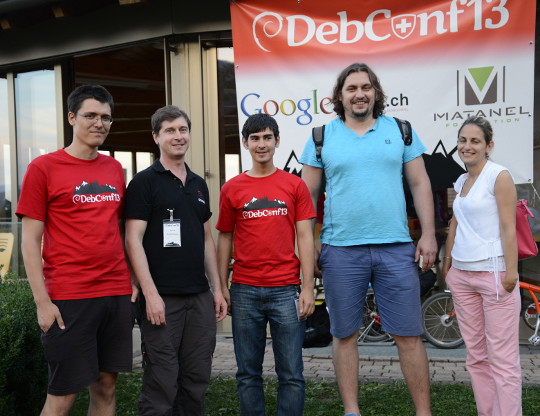
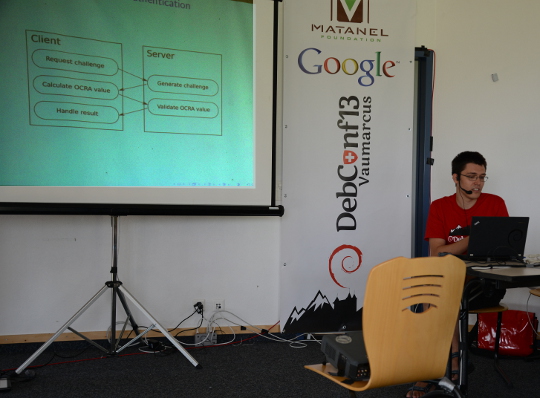
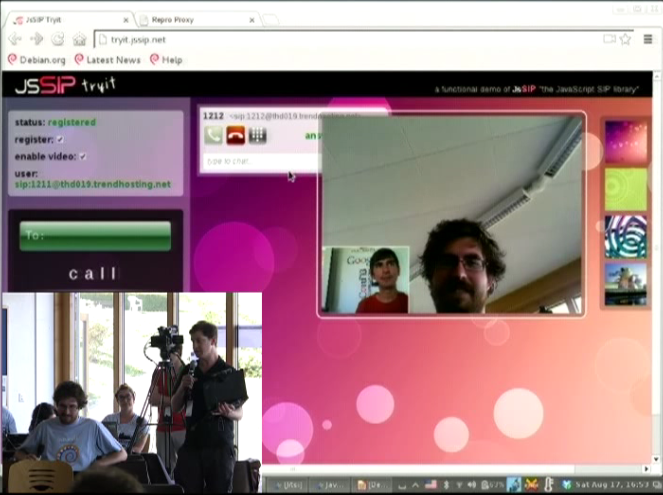
Fabian Gr nbichler, Daniel Pocock, Catalin Constantin Usurelu, Emil Ivov, Yana Stamcheva Advancing the use of One Time Passwords with free software Google Summer of Code (GSoC) student Fabian Gr nbichler has spent the summer enhancing oath-toolkit and dynalogin to support a more diverse range of One Time Password schemes. dynalogin's original 1.0 release supports vanilla HOTP and TOTP authentication schemes. Fabian's work has extended the framework to support the more generic and powerful OCRA approach. To find out about all the benefits this brings, I would strongly encourage you to review his slides and video presentation, with a demo where it is explained thoroughly. While there are existing hardware tokens that support HOTP and TOTP using this open algorithm (Gooze has been kind enough to donate some which were on display), the mutual challenge-response schemes are yet to be widely supported in hardware and this means that Fabian's work is now at the cutting edge of development in this area. WebRTC: premium voice/video chat in modern browsers, no plugin required Another member of Debian's GSoC program, Catalin Constantin Usurelu helped organise and run one of the must-see sessions of DebConf13 (video available). In a demonstration that had all the hallmarks of a magic show, Catalin and I took random members of the audience and invited them to wave a magic wand over their web browsers and effortlessly turn them into Skype-busting softphones. As the grand finale, we took Wookey's blog and showed him how to add a WebRTC "call-me" page in less than 20 seconds, less time than it takes to hand over all your private data to the registration process of those rather uncomfortable alternatives. Anybody else seeking to duplicate this effort is encourage to review options like Drucall for Drupal or just directly use JsSIP Jitsi and the Jitsi Video-bridge The grand-finale of the DebConf13 real-time communications track was our guest speaker, Emil Ivov, founder of the Jitsi softphone project. Jitsi itself has recently been accepted into Debian and is easier than ever before to install and use. Emil's talk (video and slides available) went into some detail about the cutting edge development activities of his team, particularly the new Jitsi Video bridge Subsequent to the talk, we had some out-of-bands discussion about ways to potentially integrate Jitsi Video bridge with the open source dvswitch system used to produce streams and recordings from free software events such as DebConf and FOSDEM. It is hoped that this will provide an additional option for remote participation at free software events of all sizes. Upcoming events Emil and I have been invited to participate in the WebRTC Conference Paris 2013 in December. This will be an excellent opportunity to have further discussion about progress with WebRTC and do more to raise the compelling case for premium quality free software to meet the demanding needs of modern business communications. There are a series of talks for both technical and business-oriented audiences.

Paul Tagliamonte: debile (formerly debuild.me)

Due to the extremely righteous contributions of Leo and Sylvestre, we ve opted to make the name more generic (and hilarious), to make sure people understand that this will be a more general purpose tool. Cutting edge code is currently living at debile.debian.net - my debuild.me instance will soon follow when I ve got a chance to sit down with it :) Wish I was at DebConf, have a great DC, everyone!

13 August 2013

Russell Coker: Nexus 4 Ringke Fusion Case

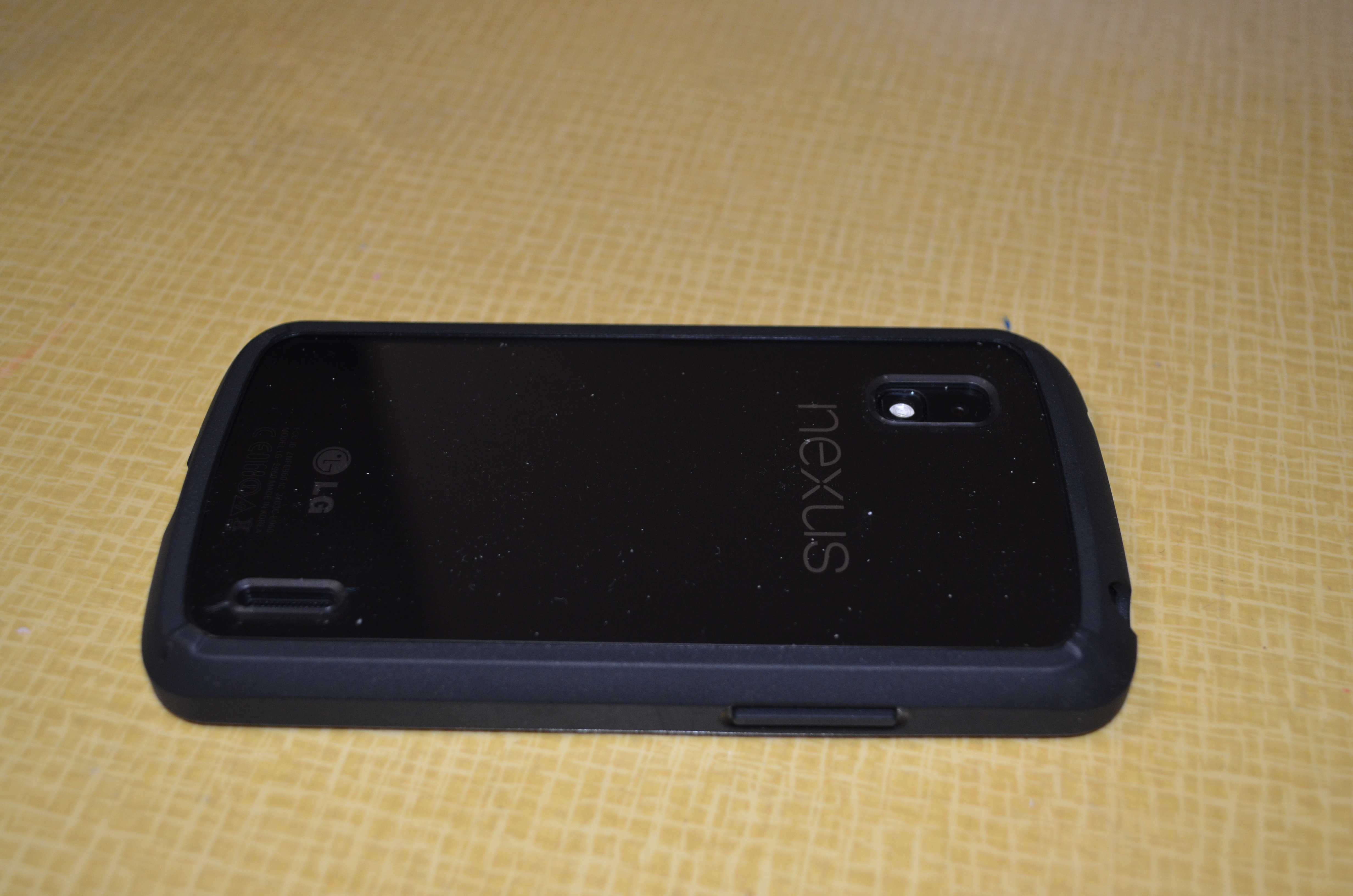
LG Nexus 4 phone with Ringke Fusion case I ve been using Android phones for 2.5 years and for all my phones (Sony-Ericsson Xperia X10, Samsung Galaxy S, Samsung Galaxy S3, and LG Nexus 4) I ve bought gel cases. The gel cases are made of soft rubber which allows phones to bounce rather than break if dropped and also provide better grip (both for holding the phone and for resting it on a vibrating surface such as a tray in a car or plane). The cases have cost me between $12.50 and $15, I haven t felt inclined to pay any more because a case has always seemed like a needless expense, something that merely compensates for deficiencies in phone design. There are some problems with the gel cases, the first one is that they are rather ugly, while I m not really interested in decorating my phones it seems a waste to have a nice phone like the Nexus 4 which has a neat sparkling pattern on the back and then use a case that entirely covers it. The next problem is the fact that the gel cases tend to restrict access to the buttons on the outside of the case. I have been given a Rearth Ringke Fusion case for my Nexus 4 by MobileZap (this is a link for the Nexus 4 cases they sell) [1]. The case features a transparent layer of plastic at the back which protects the phone against having the rear glass of the case break (a known risk with the Nexus 4) while still allowing the user to admire it. With good lighting the sparkling pattern on the back of the phone can still be enjoyed, unfortunately this doesn t show up at all in my photo. It s impossible for a photo to capture a shimmering effect although other photographers have done a better job at showing off a Nexus 4. Also the transparent back to the case gives the option of putting any form of decoration between the phone and the case, for example one could print the logo of their Ingress team and put it between the phone and the case. One thing that is visible in the photo is the feet on the back of the case. With small feet at the corners the transparent back usually won t touch a surface that it rests on, this should prevent unsightly scratches to the back of the case. Also the feet can get some grip on the surface that it rests on, my car has a tray suitable for resting a phone which has a pattern of dimples that catch the feet of the Ringke case and prevent it from sliding. Finally the external buttons for power and volume control are not obstructed in any way. After using 7 phones of 4 different models with gel cases I ve become accustomed to buttons either being difficult to press or easy to press accidentally. The Ringke case allows the buttons to be pressed easily when needed but doesn t seem prone to accidental presses. I m not about to buy a new case for my Galaxy Note 2 (my main phone at the moment) because I don t like paying to replace something that works. But next time I buy a case I ll look for something better than a plain gel case, it s worth paying an extra $9 to get a good case for a phone that costs $350 (the current discount rate for a Nexus 4) or more. I definitely recommend the Ringke case for a Nexus 4.

10 August 2013

Matthew Garrett: When to add a platform-specific quirk to a Linux driver

If you're tempted to add a platform-specific quirk to a Linux driver, pause and do the following:

  1. Check whether the platform works correctly with the generic Windows driver for the hardware in question. If it requires a platform-specific driver rather than the generic one, adding a quirk is probably ok.
  2. If the generic Windows driver works, check whether there's any evidence of platform-specific code in the Windows driver. This will typically be in the .inf file, but occasionally you'll want to run strings against the Windows driver and see whether any functions or strings match the platform in question. If there's evidence of special-casing in the generic Windows driver, adding a quirk is probably ok
  3. If the generic Windows driver works and doesn't appear to have any platform-specific special casing, don't add a quirk. You'll plausibly fix the machine you care about, but you won't fix any others that have the same behaviour. Even worse, if someone does eventually fix the problem properly, there's a risk that your special-casing will now break your system.

The moral to this story is: if you think adding a quirk is the right solution, you're almost certainly wrong.

comment count unavailable comments

7 August 2013

Keith Packard: embedded cpus

Choosing Embedded Processors for AltOS When Bdale and I started building rocketry hardware together, we had already picked out a target processor, the TI cc1111. We picked that chip almost entirely based on the digital transceiver that is built in to the chip, and not because we had any particular love for the 8051 microcontroller. At that time, I d seen people struggle with PIC processors, battle AVR to a draw and spend a lot of time trying to get various ARM processors running. So, the 8051 didn t seem all that far from normal, and the cc1111 implementation of it is pretty reasonable, including credible USB support and a built-in DMA engine. Since those early days, we ve gone on to build boards with a slightly wider range of processors: Bdale thinks we should reduce the number of components we use to focus our efforts better. He s probably right, but I have to admit that I ve had way too much fun getting each of these chips running. I thought I d spend a bit of time describing our general process for selecting a new CPU. CC1111 involved a lot of software hacking The 8051 processor in the CC1111 is very well documented, including the two-wire debugging interface. What was missing was a canned solution for programming and debugging the chip from Debian. However, with sufficient motivation and accurate docs, I was able to create a programmer from a USB device with a couple of GPIOs and a lot of ugly software on Linux. That sufficed to get the USB stack limping along, at which point I wrote a much faster programmer that ran on the cc1111 itself and could program another cc1111. With that, I created an assembly-level debugger that could be hooked to the existing SDCC source level debugger and had a full source-level debugging environment for the 8051. This turned out to be way better than what I could get on the Atmel processors, where I ve got a program loader and a whole lot of printf debugging. STM has been great The STM32L-Discovery board has a standard STM debugging setup for the Cortex SWD interface right on the same board as a target CPU. That made for completely self-contained development, with no jumper wires (a first for me, for sure). There s free software, stlink which can talk over the debugger USB connection to drive the SWD interface. This is sufficient to flash and debug applications using GDB. Of course, GCC supports ARM quite well; the only hard part was figuring out what to do for a C library. I settled on pdclib, which is at least easy to understand, if not highly optimized for ARM. We ve built a ton of boards with the STM32L151 and STM32L152; at this point I m pretty darn comfortable with the architecture and our tool chain. Adventures with NXP The NXP LPC11U14 is a very different beast. I m using this because: The LPCXpresso board looks much like the STM32L-Discovery, with a debugger interface wired to the CPU directly on the board. However, I haven t found free software tools to drive this programmer; all I ve found are binary-only tools from NXP. No thanks. Fortunately, the LPC11U14 uses exactly the same SWD interface as the STM32L, so I was able to sever the link between the programmer and the target on the LPCXpresso board and hook the target to an ST-Link device (either the one on the STM32L-Discovery board, or the new stand-along programming dongle I bought). With that, I wrote an openocd script to talk to the LPC11U14 and was in business. What I found in the NXP processor was a bit disturbing though there s a mask ROM that contains a boot loader, which always runs when the chip starts, and a bunch of utility code, including the only documented interface to programming the flash memory. I cannot fathom why anyone thought this was a good idea I don t want a BIOS in my embedded CPU, thankyouverymuch; I d really like my code to be the first instructions executed by the CPU. And, any embedded developer is more than capable of programming flash using a register specification, and calling some random embedded code in ROM from the middle of my operating system is more than a bit scary. NXP could do two simple things to make me like their parts a whole lot more: Right now, I m hoping the STM32L100C6 parts become available in small quantities so I can try them out; they promise to be as cheap as the LPC11U14, but are better supported by free software and offer more complete hardware documentation. Yeah, they re a bit larger; that will probably be annoying.

Keith Packard: Cursor tracking

Tracking Cursor Position I spent yesterday morning in the Accessibility BOF here at Guadec and was reminded that one persistent problem with tools like screen magnifiers and screen readers is that they need to know the current cursor position all the time, independent of which window the cursor is in and independent of grabs. The current method that these applications are using to track the cursor is to poll the X server using XQueryPointer. This is obviously terrible for at least a couple of reasons: These two problems also conflict with one another. Reducing input latency comes at the cost of further reducing the opportunities for power saving, and vice versa. XInput2 to the rescue (?) XInput2 has the ability to deliver raw device events right to applications, bypassing the whole event selection mechanism within the X server. This was designed to let games and other applications see relative mouse motion events and drawing applications see the whole tablet surface. These raw events are really raw though; they do not include the cursor position, and so cannot be directly used for tracking. However, we do know that the cursor only moves in response to input device events, so we can easily use the arrival of a raw event to trigger a query for the mouse position. A better plan? Perhaps what we should do is to actually create a new event type to report the cursor position and the containing window so that applications can simply track that. Yeah, it s a bit of a special case, but it s a common requirement for accessibility tools.
 
    CursorEvent
        EVENTHEADER
        detail:                    CARD32
        sourceid:                  DEVICEID
        flags:                     DEVICEEVENTFLAGS
    root:                      WINDOW
    window:                    WINDOW
    root-x, root-y:            INT16
    window-x, window-y:        INT16
 
A CursorEvent is sent whenever a sprite moves on the screen. sourceid is the master pointer which is moving. root is the root window containing the cursor, window is the window that the pointer is in. root-x and root-y indicate the position within the root window, window-x and window-y indicate the position within window . Demo Application Here s a short application, hacked from Peter Hutterer s part1.c
/* cc -o track_cursor track_cursor.c  pkg-config --cflags --libs xi x11  */
#include <stdio.h>
#include <string.h>
#include <X11/Xlib.h>
#include <X11/extensions/XInput2.h>
/* Return 1 if XI2 is available, 0 otherwise */
static int has_xi2(Display *dpy)
 
    int major, minor;
    int rc;
    /* We support XI 2.2 */
    major = 2;
    minor = 2;
    rc = XIQueryVersion(dpy, &major, &minor);
    if (rc == BadRequest)  
    printf("No XI2 support. Server supports version %d.%d only.\n", major, minor);
    return 0;
      else if (rc != Success)  
    fprintf(stderr, "Internal Error! This is a bug in Xlib.\n");
     
    printf("XI2 supported. Server provides version %d.%d.\n", major, minor);
    return 1;
 
static void select_events(Display *dpy, Window win)
 
    XIEventMask evmasks[1];
    unsigned char mask1[(XI_LASTEVENT + 7)/8];
    memset(mask1, 0, sizeof(mask1));
    /* select for button and key events from all master devices */
    XISetMask(mask1, XI_RawMotion);
    evmasks[0].deviceid = XIAllMasterDevices;
    evmasks[0].mask_len = sizeof(mask1);
    evmasks[0].mask = mask1;
    XISelectEvents(dpy, win, evmasks, 1);
    XFlush(dpy);
 
int main (int argc, char **argv)
 
    Display *dpy;
    int xi_opcode, event, error;
    XEvent ev;
    dpy = XOpenDisplay(NULL);
    if (!dpy)  
    fprintf(stderr, "Failed to open display.\n");
    return -1;
     
    if (!XQueryExtension(dpy, "XInputExtension", &xi_opcode, &event, &error))  
       printf("X Input extension not available.\n");
          return -1;
     
    if (!has_xi2(dpy))
    return -1;
    /* select for XI2 events */
    select_events(dpy, DefaultRootWindow(dpy));
    while(1)  
    XGenericEventCookie *cookie = &ev.xcookie;
    XIRawEvent      *re;
    Window          root_ret, child_ret;
    int         root_x, root_y;
    int         win_x, win_y;
    unsigned int        mask;
    XNextEvent(dpy, &ev);
    if (cookie->type != GenericEvent  
        cookie->extension != xi_opcode  
        !XGetEventData(dpy, cookie))
        continue;
    switch (cookie->evtype)  
    case XI_RawMotion:
        re = (XIRawEvent *) cookie->data;
        XQueryPointer(dpy, DefaultRootWindow(dpy),
                  &root_ret, &child_ret, &root_x, &root_y, &win_x, &win_y, &mask);
        printf ("raw %g,%g root %d,%d\n",
            re->raw_values[0], re->raw_values[1],
            root_x, root_y);
        break;
     
    XFreeEventData(dpy, cookie);
     
    return 0;
 
Hacks in xeyes Of course, one common mouse tracking application is xeyes, so I ve hacked up that code (on top of my present changes) here:
git clone git://people.freedesktop.org/~keithp/xeyes.git

4 August 2013

Ond&#345;ej &#268;ert&iacute;k: How to support both Python 2 and 3

I'll start with the conclusion: making backwards incompatible version of a language is a terrible idea, and it was bad a mistake. This mistake was somewhat corrected over the years by eventually adding features to both Python 2.7 and 3.3 that actually allow to run a single code base on both Python versions --- which, as I show below, was discouraged by both Guido and the official Python documents (though the latest docs mention it)... Nevertheless, a single code base fixes pretty much all the problems and it actually is fun to use Python again. The rest of this post explains my conclusion in great detail. My hope is that it will be useful to other Python projects to provide tips and examples how to support both Python 2 and 3, as well as to future language designers to keep languages backwards compatible. When Python 3.x got released, it was pretty much a new language, backwards incompatible with Python 2.x, as it was not possible to run the same source code in both versions. I was extremely unhappy about this situation, because I simply didn't have time to port all my Python code to a new language. I read the official documentation about how the transition should be done, quoting:
You should have excellent unit tests with close to full coverage.
  1. Port your project to Python 2.6.
  2. Turn on the Py3k warnings mode.
  3. Test and edit until no warnings remain.
  4. Use the 2to3 tool to convert this source code to 3.0 syntax. Do not manually edit the output!
  5. Test the converted source code under 3.0.
  6. If problems are found, make corrections to the 2.6 version of the source code and go back to step 3.
  7. When it's time to release, release separate 2.6 and 3.0 tarballs (or whatever archive form you use for releases).
I've also read Guido's blog post, which repeats the above list and adds an encouraging comment:
Python 3.0 will break backwards compatibility. Totally. We're not even aiming for a specific common subset.
In other words, one has to maintain a Python 2.x code base, then run 2to3 tool to get it converted. If you want to develop using Python 3.x, you can't, because all code must be developed using 2.x. As to the actual porting, Guido says in the above post:
If the conversion tool and the forward compatibility features in Python 2.6 work out as expected, steps (2) through (6) should not take much more effort than the typical transition from Python 2.x to 2.(x+1).
So sometime in 2010 or 2011 I started porting SymPy, which is now a pretty large code base (sloccount says over 230,000 lines of code, and in January 2010 it said almost 170,000 lines). I remember spending a few full days on it, and I just gave up, because it wasn't just changing a few things, but pretty fundamental things inside the code base, and one cannot just do it half-way, one has to get all the way through and then polish it up. We ended up using one full Google Summer of Code project for it, you can read the final report. I should mention that we use metaclasses and other things, that make such porting harder. Conclusion: this was definitely not "the typical transition from Python 2.x to 2.(x+1)". Ok, after months of hard work by a lot of people, we finally have a Python 2.x code base that can be translated using the 2to3 tool and it works and tests pass in Python 3.x. The next problem is that Python 3.x is pretty much like a ghetto -- you can use it as a user, but you can't develop in it. The 2to3 translation takes over 5 minutes on my laptop, so any interactivity is gone. It is true that the tool can cache results, so the next pass is somewhat faster, but in practice this still turns out to be much much worse than any compilation of C or Fortran programs (done for example with cmake), both in terms of time and in terms of robustness. And I am not even talking about pip issues or setup.py issues regarding calling 2to3. What a big mess... Programming should be fun, but this is not fun. I'll be honest, this situation killed a lot of my enthusiasm for Python as a platform. I learned modern Fortran in the meantime and with admiration I noticed that it still compiles old F77 programs without modification and I even managed to compile a 40 year old pre-F77 code with just minimal modifications (I had to port the code to F77). Yet modern Fortran is pretty much a completely different language, with all the fancy features that one would want. Together with my colleagues I created a fortran90.org website, where you can compare Python/NumPy side by side with modern Fortran, it's pretty much 1:1 translation and a similar syntax (for numerical code), except that you need to add types of course. Yet Fortran is fully backwards compatible. What a pleasure to work with! Fast forward to last week. A heroic effort by Sean Vig who ported SymPy to single code base (#2318) was merged. Earlier this year similar pull requests by other people have converted NumPy (#3178, #3191, #3201, #3202, #3203, #3205, #3208, #3216, #3223, #3226, #3227, #3231, #3232, #3235, #3236, #3237, #3238, #3241, #3242, #3244, #3245, #3248, #3249, #3257, #3266, #3281, #3191, ...) and SciPy (#397) codes as well. Now all these projects have just one code base and it works in all Python versions (2.x and 3.x) without the need to call the 2to3 tool. Having a single code base, programming in Python is fun again. You can choose any Python version, be it 2.x or 3.x, and simply submit a patch. The patch is then tested using Travis-CI, so that it works in all Python versions. Installation has been simplified (no need to call any 2to3 tools and no more hacks to get setup.py working). In other words, this is how it should be, that you write your code once, and you can use any supported language version to run it/compile it, or develop in. But for some reason, this obvious solution has been discouraged by Guido and other Python documents, as seen above. I just looked up the latest official Python docs, and that one is not upfront negative about a single code base. But it still does not recommend this approach as the one. So let me fix that: I do recommend a single code base as the solution. The newest Python documentation from the last paragraph also mentions
Regardless of which approach you choose, porting is not as hard or time-consuming as you might initially think.
Well, I encourage you to browse through the pull requests that I linked to above for SymPy, NumPy or SciPy. I think it is very time consuming, and that's just converting from 2to3 to single code base, which is the easy part. The hard part was to actually get SymPy to work with Python 3 (as I discussed above, that took couple months of hard work), and I am pretty sure it was pretty hard to port NumPy and SciPy as well. The docs also says:
It /single code base/ does lead to code that is not entirely idiomatic Python
That is true, but our experience has been, that with every Python version that we drop, we also delete lots of ugly hacks from our code base. This has been true for dropping support for 2.3, 2.4 and 2.5, and I expect it will also be true for dropping 2.6 and especially 2.7, when we can simply use the Python 3.x syntax. So not a big deal overall. To sum this blog post up, as far as I am concerned, pretty much all the problems with supporting Python 2.x and 3.x are fixed by having a single code base. You can read the pull requests above to see how to implemented things (like metaclasses, and other fancy stuff...). Python is still quite the same language, you write your code, you use a Python version of your choice and things will just work. Not a big deal overall. The official documentation should be fixed to recommend this approach, and deprecate the other approaches. I think that Python is great and I hope it will be used more in the future.
Written with StackEdit.

3 August 2013

R&#233;mi Vanicat: Xorg and special keys

Xorg and special keys: one solution for keycode>255 An historic I've buy an IR receiver, and an universal controller to control my multimedia computer, my TV, my ADSL box and my 2.1 Home cinema. I've been pleased to see that my universal controller do now more control than the remote that was sold with my IR receiver. But a lot of those control didn't work with Xorg, so I had to find someway to use them. At first, my logs where spamed with line like:
imon 4-4:1.0: imon_incoming_packet: unknown keypress, code 0x100000e
(imon is the real builder of the IR receiver). I looked for this on the internet and found So I waited, and Linux 3.10 was released, and the Debian Kernel Team did include it in debian sid, so I could easily use it. But some command was still unrecognized as key by Xorg, so I had to find how to let X know them. Reading documentation on internet, and trying some command lead nowhere: the kernel did in fact understood very well the command, but X did ignore them. After two day of trying to understood XKB, I found this bug: those key was unavailable to X and XKB because their keycode was bigger than 255. The first solution to this problem is this patch, but I prefer to use standard tool. I finally found that udev can remap key, hence my solution: The Solution To use key that have keycode bigger than 255, you need to have keycode smaller than 255. keycode are determined by a map in the kernel, that udev can set when the receiver is plugged. You need a keymap. input-kbd from the input-utils package will list the available scancode, and their current keycode (to know the number of your input device, use lsinput):
% sudo input-kbd 6
0x100007f = 106  # KEY_RIGHT
0x1000080 = 105  # KEY_LEFT
0x1007f00 = 108  # KEY_DOWN
0x1008000 = 103  # KEY_UP
0x1010000 = 272  # BTN_LEFT
0x1010080 = 272  # BTN_LEFT
0x1020000 = 273  # BTN_RIGHT
0x1020080 = 273  # BTN_RIGHT
0x200001e = 513  # KEY_NUMERIC_1
0x200001f = 514  # KEY_NUMERIC_2
(There is more, I just cut it there). Putting this in some file (say keymap), editing it, and running sudo input-kbd -f keymap 6 should change the kernel mapping. But it don't. It's not a problem, because the best solution is to use udev. Wrote a keyboard mapping in say /etc/udev/imon:
0x200001e  KP1
0x200001f  KP2
0x2000020  KP3
0x2000021  KP4
0x2000022  KP5
0x2000023  KP6
0x2000024  KP7
0x2000025  KP8
0x2000026  KP9
0x2000027  KP0
0x2800000  MENU
0x288795b7 PAGEDOWN
0x289395b7 PAGEUP
You then need to tell udev to load this mapping, with /etc/udev/rules.d/96-local-keymap.rules:
ACTION=="remove", GOTO="mykeyboard_end"
KERNEL!="event*", GOTO="mykeyboard_end"
ENV ID_INPUT_KEY =="", GOTO="mykeyboard_end"
SUBSYSTEMS=="bluetooth", GOTO="mykeyboard_end"
SUBSYSTEMS=="usb", IMPORT builtin ="usb_id"
ENV ID_VENDOR =="15c2", ENV ID_MODEL_ID =="0042", RUN+="keymap $name /etc/udev/imon"
LABEL="mykeyboard_end"
You will need to adapt 15c2 and 0042 to you own remote. I've found those using lsusb
Bus 004 Device 014: ID 15c2:0042 SoundGraph Inc.
I could now use xkb to further refine the way those key are used by xorg...

Benjamin Mako Hill: Doctor of Philosophy

On Wednesday, I successfully defended my PhD dissertation in front of a ridiculously packed house at the MIT Media Lab. I am humbled by the support shown by the MIT Sloan, Media Lab, and Harvard communities. Earlier today, I finished up paperwork and submitted my archival copies. I m done. Although I ve often heard PhDs described as emotional roller coasters, I feel enormously blessed in that I honestly can t relate. My eight years at MIT and Harvard have been almost universally positive and I have learned and grown indescribably. As excited as I am about my next chapter at the University of Washington, I m going to miss my life here. Deeply. My dissertation was three essays on volunteer mobilization in peer production. Once I have a chance to catch up and recover, I ll be posting the previously unpublished pieces. The Remixing Dilemma was included in the dissertation and is already online. The Media Lab AV team shot professional video of the talk. When I get a copy of the video, I ll post that too. But because I think it s important, I ve formatted and published the acknowledgments section of the dissertation today. Although there are too many folks to thank, I ve highlighted the contributions of my co-authors, and friends, Aaron Shaw and Andr s Monroy Hern ndez and my almost unbelievably incredible group of advisors: Eric von Hippel, Yochai Benkler, Mitch Resnick, and Tom Malone.

28 July 2013

Francois Marier: FISL for foreigners HOWTO

FISL (pronounced FIZZ lay by the locals) is a large Free and Open Source software gathering in Porto Alegre, Brazil. While the primary audience of that conference is the Latin America "libre software" community, a number of overseas speakers also participate in that conference. This is my contribution to them: a short guide for international guests visiting the F rum Internacional do Software Livre.

Planning Before you fly out, make sure you look up the visa requirements for your country of citizenship. Many western countries will require a visa and you will need to visit the local Brazillian embassy ahead of time to get one. Next, have a look at the list of recommended immunizations. As with most destinations, it is recommended that your routine immunizations be up to date, but there are also other specialized ones such as Yellow Fever that are recommended by the Brazillian government. You should therefore visit a travel clinic a few weeks ahead of time. Other than that, I suggest reading up on the country and keeping an eye on the various travel advisories.

Arrival You will be flying at the Porto Alegre airport. If you need to exchange overseas money for Brazilian Reals, you can do that there. You'll probably also want to pick up a power adapter at the airport if you intend to charge your laptop while you're in the country :) Brazil has both 127V and 220V outlets using Type N sockets. Privacy note: using the free airport wifi will require giving your Passport details as part of the registration process.

Language If you don't speak Portuguese, expect a few challenges since most of the people you'll meet (including taxi drivers, many airport workers, some hotel staff) won't speak English. I highly recommend getting a phrase book before you leave and printing paper maps of where you are planning to go (to show to taxi drivers when you get lost). Native Spanish speakers seem to get by speaking Spanish to Portuguese speakers and understanding enough Portuguese to hold a conversation. I wouldn't count on it unless your Spanish is quite good though. Also, the official conference blog posts get eventually translated to English, but there is a delay, so you may want to subscribe to the Portuguese feed and use Google Translate to keep up with FISL news before you get there.

The conference FISL is a large conference and it has a very "decentralized" feel to it. From the outside, it looks like it's organized by an army of volunteers where everyone is taking care of some portion of it without a whole lot of top-down direction. It seems to work quite well! What this means for you as a foreign speaker however is that you're unlikely to be provided with a lot of information or help finding your way around the conference (i.e. no "speaker liaison"). There is a separate registration desk for speakers but that's about all of the attention you'll receive before you deliver your talk. So make sure you know where to go and show up in your assigned room early to speak with the person introducing you. If your talk is in English, it will be live-transated by an interpreter. It's therefore a good idea to speak a bit more slowly and to pause a bit more. Other than that, the organizers make an effort to schedule an English talk in each timeslot so non-Portuguese speakers should still be able to get a lot out of the conference. FISL was a lot of fun for me and I hope that some of these tips will help you enjoy the biggest FLOSS gathering in the southern hemisphere!

27 July 2013

Christian Perrier: Developers per country (July 2013)

This is time again for my annual report about the number of developers per country. This is now the fifth edition of this report, after the 2012, 2011, 2010 and 2009 editions. So, here we are with the July 2013 version, sorted by the ratio of *active* developers per million population for each country.
Act: number of active developers
Dev: total number of developers
A/M: number of active devels per million pop.
D/M: number of devels per million pop.
2009: rank in 2009
2010: rank in 2010
2011: rank in 2011 (June)
2011: rank in 2012 (June)
2013: rank now
Code Name Population Act Dev Dev Act/Million Dev/Million 2009 2010 June 2011 June 2012 July 2013
fi Finland 5259250 19 31 3,61 5,89 1 1 1 1 1
ie Ireland 4670976 12 15 2,57 3,21 13 9 6 2 2
ch Switzerland 7870134 20 27 2,54 3,43 2 2 2 3 3
mq Martinique 396404 1 1 2,52 2,52

3 4 4
se Sweden 9088728 22 37 2,42 4,07 3 6 7 5 5
no Norway 4973029 12 15 2,41 3,02 5 4 4 6 6
nz New Zealand 4331600 10 15 2,31 3,46 4 3 5 7 7
de Germany 81471834 165 235 2,03 2,88 7 7 9 9 8 *
lu Luxemburg 503302 1 1 1,99 1,99 8 5 8 8 9 *
at Austria 8217280 16 26 1,95 3,16 6 8 10 10 10
fr France 65350000 100 130 1,53 1,99 12 12 11 11 11
au Australia 22607571 31 59 1,37 2,61 9 10 12 12 12
be Belgium 11071483 14 17 1,26 1,54 10 11 13 13 13
uk United-Kingdom 62698362 73 114 1,16 1,82 14 14 14 14 14
nl Netherlands 16728091 19 40 1,14 2,39 11 13 15 15 15
ca Canada 33476688 32 61 0,96 1,82 15 15 17 16 16
dk Denmark 5529888 5 10 0,9 1,81 17 17 16 17 17
es Spain 46754784 35 56 0,75 1,2 16 16 19 18 18
it Italy 59464644 36 51 0,61 0,86 23 22 22 19 19
cz Czech Rep 10190213 6 6 0,59 0,59 21 20 21 21 20 *
lt Lithuania 3535547 2 2 0,57 0,57 28 19 20 22 21 *
us USA 313232044 173 378 0,55 1,21 19 21 25 24 22 *
il Israel 7740900 4 6 0,52 0,78 24 24 24 25 23 *
hu Hungary 10076062 5 10 0,5 0,99 18 25 26 20 24 *
hr Croatia 4290612 2 2 0,47 0,47 20 18 18 26 25 *
lv Latvia 2204708 1 1 0,45 0,45 26 26 27 27 26 *
bg Bulgaria 7364570 3 3 0,41 0,41 25 23 23 23 27 *
uy Uruguay 3477778 1 2 0,29 0,58 22 27 28 28 28
jp Japan 127078679 35 50 0,28 0,39 30 28 29 29 29
pl Poland 38441588 10 14 0,26 0,36 29 29 30 30 30
cr Costa Rica 4301712 1 1 0,23 0,23 31 30 31 31 31
by Belarus 9577552 2 2 0,21 0,21 35 36 39 39 32 *
sg Singapore 5183700 1 1 0,19 0,19


33 33
pt Portugal 10561614 2 4 0,19 0,38 27 32 32 34 34
gr Greece 10787690 2 3 0,19 0,28 33 38 34 35 35
sk Slovakia 5477038 1 1 0,18 0,18 32 31 33 36 36
ar Argentina 40677348 6 8 0,15 0,2 34 33 35 32 37 *
rs Serbia 7186862 1 1 0,14 0,14


38 *
tw Taiwan 23040040 3 3 0,13 0,13 37 34 37 37 39 *
br Brazil 192376496 21 23 0,11 0,12 36 35 38 38 40 *
cu Cuba 11241161 1 1 0,09 0,09
38 41 41 41
kr South Korea 48754657 4 6 0,08 0,12 39 39 42 42 42
gt Guatemala 13824463 1 1 0,07 0,07


43 *
ve Venezuela 28047938 2 2 0,07 0,07 40 45 50 49 44 *
ec Ecuador 15007343 1 1 0,07 0,07
40 43 43 45 *
co Colombia 45566856 3 4 0,07 0,09 41 44 46 47 46 *
cl Chile 16746491 1 2 0,06 0,12 42 41 44 44 47 *
za South Africa 50590000 3 10 0,06 0,2 38 48 48 48 48
ru Russia 143030106 7 8 0,05 0,06 43 42 47 45 49 *
mg Madagascar 21281844 1 1 0,05 0,05 44 37 40 40 50 *
ro Romania 21904551 1 2 0,05 0,09 45 43 45 46 51 *
my Malaysia 28250000 1 1 0,04 0,04

49 50 52 *
pe Peru 29907003 1 1 0,03 0,03 46 46 51 51 53 *
tr Turkey 74724269 2 2 0,03 0,03 47 47 52 52 54 *
ua Ukraine 45134707 1 1 0,02 0,02 48 53 58 59 55 *
th Thailand 66720153 1 2 0,01 0,03 50 50 54 54 56 *
eg Egypt 80081093 1 3 0,01 0,04 51 51 55 55 57 *
mx Mexico 112336538 1 1 0,01 0,01 49 49 53 53 58 *
cn China 1344413526 10 14 0,01 0,01 53 53 57 56 59 *
in India 1210193422 9 9 0,01 0,01 52 52 56 57 60 *
sv El Salvador 7066403 0 1 0 0,14

36 58 61 *


957 1535 62,35%


A few interesting facts:

26 July 2013

Ian Wienand: Converting an American propane appliance to Australian gas bottles

Here's something I just spent too much time figuring out... If you have an Australian "gas" or "LPG bottle"; the type you'd pick-up at any "service" or "petrol" station in Australia, it has a female POL connector. I'm not sure what POL stands for; possibly related to some company who made connectors long ago and it became standard. If you have an American "propane" device such as a grill, turkey fryer or smoker, or indeed something that plugs into a "propane bottle" you would pick-up at a "gas station" -- it will have a "Type 1", "ACME", "ACME Type 1", "QCC", "QCC1" or "QCC Type 1" connector (each seems to be an interchangeable term for the other). The appliance side of this has a big (usually black) plastic nut that is apparently safer or something. Once you have figured this out, you can buy something like the "Grillpro Model 11051 Universal Fit Propane Tank Adapter" and I can attest, based upon empirical evidence, that things will "just work". Of course your other choice might be just to replace the regulator, hoses, etc.; however if everything seems super-glued together the adapter is much easier. In other empirical evidence you won't find anywhere else on the internet : the Vizio M3D550KD LCD television works just fine on 240V, despite not being rated for it on the back.

22 July 2013

Matthew Garrett: ARM and firmware specifications

Jon Masters, Chief ARM Architect at Red Hat, recently posted a description of his expectations for baseline arm64 servers. The quick summary is that systems should implement UEFI and ACPI, and any more traditional ARM boot mechanisms should be ignored. This is an interesting departure from the status quo in the ARM world, and it's worth thinking about the benefits and drawbacks of this approach.

It's very easy to build a generic kernel for most x86 systems, since the PC platform is fairly well defined even if not terribly well specified. Where system hardware does vary, it's almost always exposed on an enumerable bus (such as PCI or USB) which allows the OS to bind appropriate drivers. Things are different in the ARM world. Even once you're past the point of different SoC vendors requiring different kernel setup code and drivers, you still have to cope with the fact that system vendors can wire these SoCs up very differently. Hardware is often attached via GPIO lines without any means to enumerate them. The end result is that you've traditionally needed a different kernel for every ARM board. This is viable if you're selling the OS and hardware as a single product, but less viable if there's any desire to run a generic OS on the hardware.

The solution that's been adopted for this in the Linux world is called Device Tree. Device Tree actually has significant history, having been used as the device descriptor format in Open Firmware. Since there was already support for it in the Linux kernel, adapting it for use in ARM devices was straightforward. Device Tree aware devices can pass a descriptor blob to the kernel at startup[1], and devices without that knowledge can have a blob build into the kernel.

So, if this problem is already solved, why the push to move to UEFI and ACPI? This push didn't actually originate in the Linux world - Microsoft mandate that Windows RT devices implement UEFI and ACPI, and were they to launch a Windows ARM server product would probably carry that over. That makes sense for Microsoft, since recent versions of Windows have been x86 only and so have grown all kinds of support for ACPI and UEFI. Supporting Device Tree would require Microsoft to rewrite large parts of Windows, whereas mandating UEFI and ACPI allowed them to reuse most of their existing Windows boot and driver code. As a result, largely at Microsoft's behest, ACPI 5 has grown a range of additional features for describing things like GPIO pinouts and I2C connections. Whatever your weird device layout, you can probably express it via ACPI.

This argument works less well for Linux. Linux already supports Device Tree, whereas it currently doesn't support ACPI or UEFI on ARM[2]. Hardware vendors are already used to working with Device Tree. Moving to UEFI and ACPI has the potential to uncover a range of exciting new kernel issues and vendor bugs. It's not obviously an engineering win.

So how about users? There's an argument that since server vendors are now mostly shipping ACPI and UEFI systems, having ARM support these technologies makes it easier for customers to replace x86 systems with ARM systems. This really doesn't fly for ACPI, which is entirely invisible to the user. There are no standard ACPI entry points for system configuration, and the bits of ACPI that are generically useful (such as configuring system wakeup times) are already abstracted away to a standard interface by the kernel. It's somewhat more compelling for UEFI. UEFI supports a platform-independent bytecode language (EFI Byte Code, or EBC), which means that customers can write their own system management utilities, build them for EBC and then deploy them to their servers without caring about whether they're x86 or ARM. Want a bootloader that'll hit an internal HTTP server in order to determine which system image to deploy, and which works on both x86 and ARM? Straightforward.

Arnd Bergmann has a interesting counterargument. In a nutshell, ARM servers aren't currently aiming for the same market as x86 servers, and as a result customers are unlikely to gain any significant benefit from shared functionality between the two.

So if there's no real benefit to users, and if there's no benefit to kernel developers, what's the point? The main one that springs to mind is that there is a benefit to distributions. Moving to UEFI means that there's a standard mechanism for distributions to interact with the firmware and configure the bootloader. The traditional ARM approach has been for vendors to ship their own version of u-boot. If that's in flash then it's not much of a problem[3], but if it's on disk then you have to ship a range of different bootloaders and know which one to install (and let's not even talk about initial bootstrapping).

This seems like the most compelling argument. UEFI provides a genuine benefit for distributions, and long term it probably provides some benefit to customers. The question is whether that benefit is worth the flux. The same distribution benefit could be gained by simply mandating a minimum set of u-boot functionality, which would seem much more straightforward. The customer benefit is currently unclear.

In the end it'll probably be a market decision. If Red Hat produce an ARM product that has these requirements, and if Suse produce an ARM product that will work with u-boot and Device Tree, it'll be up to vendors to decide whether the additional work to support UEFI/ACPI is worth it in order to be able to sell to customers who want Red Hat. I expect that large vendors like HP and Dell will probably do it, but the smaller ones may not. The customer demand issue is also going to be unclear until we learn whether using UEFI is something that customers actually care about, rather than a theoretical benefit.

Overall, I'm on the fence as to whether a UEFI requirement is going to stick, and I suspect that the ACPI requirement is tilting at windmills. There's nothing stopping vendors from providing a Device Tree blob from UEFI, and I can't think of any benefits they gain from using ACPI instead. Vendor interest in the generic parts of the ACPI spec has been tepid even in the x86 world (the vast majority of ACPI spec updates come from Microsoft and Intel, not any of the system vendors), and I don't see that changing with the introduction of a range of ARM vendors who are already happy with Device Tree.

We'll see. Linux is going to need to gain the support for UEFI and ACPI on ARM in any case, since there's already hardware shipping in that configuration. But with ARM vendors still getting to grips with Device Tree, forcing them to go through another change in how they do things is going to be hard work. Red Hat may be successful in enforcing these requirements at the cost of some vendor unhappiness, or Red Hat may find that their product doesn't boot on most of the available hardware. It's an aggressive gamble, and while it'll be interesting to see how it plays out, I'm not that optimistic.

[1] The blob could be pulled from the firmware, but it's not uncommon for it to be built into u-boot instead. This does mean that you have a device-specific u-boot even if you have a generic kernel, but that's typically true anyway.
[2] Patches have been posted for ARM UEFI support. They're not mergeable in their current form, but they should be in the near future. ACPI support is in development.
[3] Although not all u-boots are created equal - some vendors ship versions that will only boot off FAT, some vendors ship versions that will only boot off ext2. Having to special case this stuff in your installer is a pain.

comment count unavailable comments

21 July 2013

Benjamin Mako Hill: The Wikipedia Gender Gap Revisited

In a new paper, recently published in the open access journal PLOSONE, Aaron Shaw and I build on new research in survey methodology to describe a method for estimating bias in opt-in surveys of contributors to online communities. We use the technique to reevaluate the most widely cited estimate of the gender gap in Wikipedia. A series of studies have shown that Wikipedia s editor-base is overwhelmingly male. This extreme gender imbalance threatens to undermine Wikipedia s capacity to produce high quality information from a full range of perspectives. For example, many articles on topics of particular interest to women tend to be under-produced or of poor quality. Given the open and often anonymous nature of online communities, measuring contributor demographics is a challenge. Most demographic data on Wikipedia editors come from opt-in surveys where people respond to open, public invitations. Unfortunately, very few people answer these invitations. Results from opt-in surveys are unreliable because respondents are rarely representative of the community as a whole. The most widely-cited estimate from a large 2008 survey by the Wikimedia Foundation (WMF) and UN University in Maastrict (UNU-MERIT) suggested that only 13% of contributors were female. However, the very same survey suggested that less than 40% of Wikipedia s readers were female. We know, from several reliable sources, that Wikipedia s readership is evenly split by gender a sign of bias in the WMF/UNU-MERIT survey. In our paper, we combine data from a nationally representative survey of the US by the Pew Internet and American Life Project with the opt-in data from the 2008 WMF/UNU-MERIT survey to come up with revised estimates of the Wikipedia gender gap. The details of the estimation technique are in the paper, but the core steps are:
  1. We use the Pew dataset to provide baseline information about Wikipedia readers.
  2. We apply a statistical technique called propensity scoring to estimate the likelihood that a US adult Wikipedia reader would have volunteered to participate in the WMF/UNU-MERIT survey.
  3. We follow a process originally developed by Valliant and Dever to weight the WMF/UNU-MERIT survey to correct for estimated bias.
  4. We extend this weighting technique to Wikipedia editors in the WMF/UNU data to produce adjusted estimates of the demographics of their sample.
Using this method, we estimate that the proportion of female US adult editors was 27.5% higher than the original study reported (22.7%, versus 17.8%), and that the total proportion of female editors was 26.8% higher (16.1%, versus 12.7%). These findings are consistent with other work showing that opt-in surveys tend to undercount women. Overall, these results reinforce the basic substantive finding that women are vastly under-represented among Wikipedia editors. Beyond Wikipedia, our paper describes a method online communities can adopt to estimate contributor demographics using opt-in surveys, but that is more credible than relying entirely on opt-in data. Advertising-intelligence firms like ComScore and Quantcast provide demographic data on the readership of an enormous proportion of websites. With these sources, almost any community can use our method (and source code) to replicate a similar analysis by: (1) surveying a community s readers (or a random subset) with the same instrument used to survey contributors; (2) combining results for readers with reliable demographic data about the readership population from a credible source; (3) reweighting survey results using the method we describe. Although our new estimates will not help us us close the gender gap in Wikipedia or address its troubling implications, they give us a better picture of the problem. Additionally, our method offers an improved tool to build a clearer demographic picture of other online communities in general.

Next.

Previous.