Search Results: "beh"

28 March 2017

Joachim Breitner: Birthday greetings communication behaviour

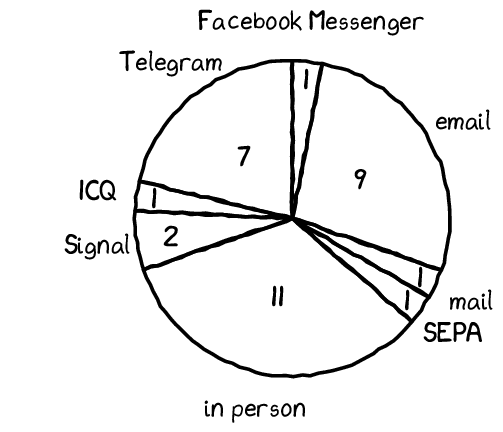
Randall Munroe recently mapped how he communicated with his social circle. As I got older recently, I had an opportunity to create a similar statistics that shows how people close to me chose to fulfil their social obligations (given the current geographic circumstances):
Communication variants

Communication variants

(Diagram created with the xkcd-font and using these two stackoverflow answers.) In related news: Heating 3 US cups of water to a boil takes 7 minutes and 40 seconds on one particular gas stove, but only 3 minutes and 50 seconds with an electric kettle, despite the 110V-induced limitation to 1.5kW. (Diagram updated on March 30, as the actual mail is slower than the other channels.)

25 March 2017

Urvika Gola: Speaking at FOSSASIA 17 Seasons of Debian : Summer of Code & Winter of Outreachy

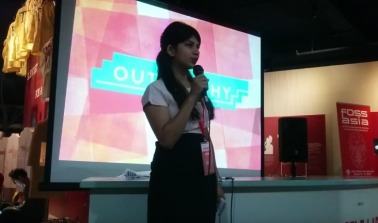
I got an amazing chance to speak at FOSSASIA 2017 held at Singapore on Seasons of Debian Summer of Code and Winter of Outreachy . I gave a combined talk with my co-speaker Pranav Jain, who contributed to Debian through GSoC. We talked about two major open source initiatives Outreachy and Google Summer of Code and the work we did on a common project Lumicall under Debian. WhatsApp Image 2017-03-23 at 11.32.33 PM The excitement started even before the first day! On 16th March, there was a speakers meetup at Microsoft office in Singapore. There, I got the chance to connect with other speakers and learn about their work The meetup was concluded by Microsoft Office tour! As a student it was very exciting to see first hand the office of a company that I had only dreamt of being at. On 17th March, i.e the first day of the three days long conference, I met Hong Phuc Dang, Founder of FOSSASIA. She is very kind and just talking to her just made me cheerful!
Meeting so many great developers from different organizations was exciting. On 18th March, was the day of our talk! I was a bit nervous to speak in front of amazing developers but, that s how you grow  Our talk was preceded by a lovely introduction by Mario Behling. WhatsApp Image 2017-03-25 at 2.32.01 PM.jpeg I talked about how Outreachy Programme has made a significant impact in increasing the participation of women in Open Source, with one such woman being me I also talked about Android Programming concepts which I used in while adding new features into Lumicall. Pranav talked about Debian Organization and how to get started with GSoC by sharing his journey! After our talk, students approached us asking questions about how to participate in Outreachy and GsOC. I felt that a lot more students were receptive to knowing about this new opportunity. Our own talk was part of the mini DebConf track. Under this track, there were two other amazing sessions namely, Debian The best Linux distribution and Open Build Service in Debian . The variety of experiences I gained from FOSSASIA was very diverse. I learned how to speak at a huge platform, learned from other interesting talks, share ideas with smart developers and saw an exciting venue and wonderful city! I would not be able to experience this without the continuous support of Debian and Outreachy !

23 March 2017

Simon McVittie: GTK hackfest 2017: D-Bus communication with containers

At the GTK hackfest in London (which accidentally became mostly a Flatpak hackfest) I've mainly been looking into how to make D-Bus work better for app container technologies like Flatpak and Snap. The initial motivating use cases are: At the moment, Flatpak runs a D-Bus proxy for each app instance that has access to D-Bus, connects to the appropriate bus on the app's behalf, and passes messages through. That proxy is in a container similar to the actual app instance, but not actually the same container; it is trusted to not pass messages through that it shouldn't pass through. The app-identification mechanism works in practice, but is Flatpak-specific, and has a known race condition due to process ID reuse and limitations in the metadata that the Linux kernel maintains for AF_UNIX sockets. In practice the use of X11 rather than Wayland in current systems is a much larger loophole in the container than this race condition, but we want to do better in future. Meanwhile, Snap does its sandboxing with AppArmor, on kernels where it is enabled both at compile-time (Ubuntu, openSUSE, Debian, Debian derivatives like Tails) and at runtime (Ubuntu, openSUSE and Tails, but not Debian by default). Ubuntu's kernel has extra AppArmor features that haven't yet gone upstream, some of which provide reliable app identification via LSM labels, which dbus-daemon can learn by querying its AF_UNIX socket. However, other kernels like the ones in openSUSE and Debian don't have those. The access-control (AppArmor mediation) is implemented in upstream dbus-daemon, but again doesn't work portably, and is not sufficiently fine-grained or flexible to do some of the things we'll likely want to do, particularly in dconf. After a lot of discussion with dconf maintainer Allison Lortie and Flatpak maintainer Alexander Larsson, I think I have a plan for fixing this. This is all subject to change: see fd.o #100344 for the latest ideas. Identity model Each user (uid) has some uncontained processes, plus 0 or more containers. The uncontained processes include dbus-daemon itself, desktop environment components such as gnome-session and gnome-shell, the container managers like Flatpak and Snap, and so on. They have the user's full privileges, and in particular they are allowed to do privileged things on the user's session bus (like running dbus-monitor), and act with the user's full privileges on the system bus. In generic information security jargon, they are the trusted computing base; in AppArmor jargon, they are unconfined. The containers are Flatpak apps, or Snap apps, or other app-container technologies like Firejail and AppImage (if they adopt this mechanism, which I hope they will), or even a mixture (different app-container technologies can coexist on a single system). They are containers (or container instances) and not "apps", because in principle, you could install com.example.MyApp 1.0, run it, and while it's still running, upgrade to com.example.MyApp 2.0 and run that; you'd have two containers for the same app, perhaps with different permissions. Each container has an container type, which is a reversed DNS name like org.flatpak or io.snapcraft representing the container technology, and an app identifier, an arbitrary non-empty string whose meaning is defined by the container technology. For Flatpak, that string would be another reversed DNS name like com.example.MyGreatApp; for Snap, as far as I can tell it would look like example-my-great-app. The container technology can also put arbitrary metadata on the D-Bus representation of a container, again defined and namespaced by the container technology. For instance, Flatpak would use some serialization of the same fields that go in the Flatpak metadata file at the moment. Finally, the container has an opaque container identifier identifying a particular container instance. For example, launching com.example.MyApp twice (maybe different versions or with different command-line options to flatpak run) might result in two containers with different privileges, so they need to have different container identifiers. Contained server sockets App-container managers like Flatpak and Snap would create an AF_UNIX socket inside the container, bind() it to an address that will be made available to the contained processes, and listen(), but not accept() any new connections. Instead, they would fd-pass the new socket to the dbus-daemon by calling a new method, and the dbus-daemon would proceed to accept() connections after the app-container manager has signalled that it has called both bind() and listen(). (See fd.o #100344 for full details.) Processes inside the container must not be allowed to contact the AF_UNIX socket used by the wider, uncontained system - if they could, the dbus-daemon wouldn't be able to distinguish between them and uncontained processes and we'd be back where we started. Instead, they should have the new socket bind-mounted into their container's XDG_RUNTIME_DIR and connect to that, or have the new socket set as their DBUS_SESSION_BUS_ADDRESS and be prevented from connecting to the uncontained socket in some other way. Those familiar with the kdbus proposals a while ago might recognise this as being quite similar to kdbus' concept of endpoints, and I'm considering reusing that name. Along with the socket, the container manager would pass in the container's identity and metadata, and the method would return a unique, opaque identifier for this particular container instance. The basic fields (container technology, technology-specific app ID, container ID) should probably be added to the result of GetConnectionCredentials(), and there should be a new API call to get all of those plus the arbitrary technology-specific metadata. When a process from a container connects to the contained server socket, every message that it sends should also have the container instance ID in a new header field. This is OK even though dbus-daemon does not (in general) forbid sender-specified future header fields, because any dbus-daemon that supported this new feature would guarantee to set that header field correctly, the existing Flatpak D-Bus proxy already filters out unknown header fields, and adding this header field is only ever a reduction in privilege. The reasoning for using the sender's container instance ID (as opposed to the sender's unique name) is for services like dconf to be able to treat multiple unique bus names as belonging to the same equivalence class of contained processes: instead of having to look up the container metadata once per unique name, dconf can look it up once per container instance the first time it sees a new identifier in a header field. For the second and subsequent unique names in the container, dconf can know that the container metadata and permissions are identical to the one it already saw. Access control In principle, we could have the new identification feature without adding any new access control, by keeping Flatpak's proxies. However, in the short term that would mean we'd be adding new API to set up a socket for a container without any access control, and having to keep the proxies anyway, which doesn't seem great; in the longer term, I think we'd find ourselves adding a second new API to set up a socket for a container with new access control. So we might as well bite the bullet and go for the version with access control immediately. In principle, we could also avoid the need for new access control by ensuring that each service that will serve contained clients does its own. However, that makes it really hard to send broadcasts and not have them unintentionally leak information to contained clients - we would need to do something more like kdbus' approach to multicast, where services know who has subscribed to their multicast signals, and that is just not how dbus-daemon works at the moment. If we're going to have access control for broadcasts, it might as well also cover unicast. The plan is that messages from containers to the outside world will be mediated by a new access control mechanism, in parallel with dbus-daemon's current support for firewall-style rules in the XML bus configuration, AppArmor mediation, and SELinux mediation. A message would only be allowed through if the XML configuration, the new container access control mechanism, and the LSM (if any) all agree it should be allowed. By default, processes in a container can send broadcast signals, and send method calls and unicast signals to other processes in the same container. They can also receive method calls from outside the container (so that interfaces like org.freedesktop.Application can work), and send exactly one reply to each of those method calls. They cannot own bus names, communicate with other containers, or send file descriptors (which reduces the scope for denial of service). Obviously, that's not going to be enough for a lot of contained apps, so we need a way to add more access. I'm intending this to be purely additive (start by denying everything except what is always allowed, then add new rules), not a mixture of adding and removing access like the current XML policy language. There are two ways we've identified for rules to be added: Initially, many contained apps would work in the first way (and in particular sockets=session-bus would add a rule that allows almost everything), while over time we'll probably want to head towards recommending more use of the second. Related topics Access control on the system bus We talked about the possibility of using a very similar ruleset to control access to the system bus, as an alternative to the XML rules found in /etc/dbus-1/system.d and /usr/share/dbus-1/system.d. We didn't really come to a conclusion here. Allison had the useful insight that the XML rules are acting like a firewall: they're something that is placed in front of potentially-broken services, and not part of the services themselves (which, as with firewalls like ufw, makes it seem rather odd when the services themselves install rules). D-Bus system services already have total control over what requests they will accept from D-Bus peers, and if they rely on the XML rules to mediate that access, they're essentially rejecting that responsibility and hoping the dbus-daemon will protect them. The D-Bus maintainers would much prefer it if system services took responsibility for their own access control (with or without using polkit), because fundamentally the system service is always going to understand its domain and its intended security model better than the dbus-daemon can. Analogously, when a network service listens on all addresses and accepts requests from elsewhere on the LAN, we sometimes work around that by protecting it with a firewall, but the optimal resolution is to get that network service fixed to do proper authentication and access control instead. For system services, we continue to recommend essentially this "firewall" configuration, filling in the $ variables as appropriate:
<busconfig>
    <policy user="$ the daemon uid under which the service runs ">
        <allow own="$ the service's bus name "/>
    </policy>
    <policy context="default">
        <allow send_destination="$ the service's bus name "/>
    </policy>
</busconfig>
We discussed the possibility of moving towards a model where the daemon uid to be allowed is written in the .service file, together with an opt-in to "modern D-Bus access control" that makes the "firewall" unnecessary; after some flag day when all significant system services follow that pattern, dbus-daemon would even have the option of no longer applying the "firewall" (moving to an allow-by-default model) and just refusing to activate system services that have not opted in to being safe to use without it. However, the "firewall" also protects system bus clients, and services like Avahi that are not bus-activatable, against unintended access, which is harder to solve via that approach; so this is going to take more thought. For system services' clients that follow the "agent" pattern (BlueZ, polkit, NetworkManager, Geoclue), the correct "firewall" configuration is more complicated. At some point I'll try to write up a best-practice for these. New header fields for the system bus At the moment, it's harder than it needs to be to provide non-trivial access control on the system bus, because on receiving a method call, a service has to remember what was in the method call, then call GetConnectionCredentials() to find out who sent it, then only process the actual request when it has the information necessary to do access control. Allison and I had hoped to resolve this by adding new D-Bus message header fields with the user ID, the LSM label, and other interesting facts for access control. These could be "opt-in" to avoid increasing message sizes for no reason: in particular, it is not typically useful for session services to receive the user ID, because only one user ID is allowed to connect to the session bus anyway. Unfortunately, the dbus-daemon currently lets unknown fields through without modification. With hindsight this seems an unwise design choice, because header fields are a finite resource (there are 255 possible header fields) and are defined by the D-Bus Specification. The only field that can currently be trusted is the sender's unique name, because the dbus-daemon sets that field, overwriting the value in the original message (if any). To make it safe to rely on the new fields, we would have to make the dbus-daemon filter out all unknown header fields, and introduce a mechanism for the service to check (during connection to the bus) whether the dbus-daemon is sufficiently new that it does so. If connected to an older dbus-daemon, the service would not be able to rely on the new fields being true, so it would have to ignore the new fields and treat them as unset. The specification is sufficiently vague that making new dbus-daemons filter out unknown header fields is a valid change (it just says that "Header fields with an unknown or unexpected field code must be ignored", without specifying who must ignore them, so having the dbus-daemon delete those fields seems spec-compliant). This all seemed fine when we discussed it in person; but GDBus already has accessors for arbitrary header fields by numeric ID, and I'm concerned that this might mean it's too easy for a system service to be accidentally insecure: It would be natural (but wrong!) for an implementor to assume that if g_message_get_header (message, G_DBUS_MESSAGE_HEADER_FIELD_SENDER_UID) returned non-NULL, then that was guaranteed to be the correct, valid sender uid. As a result, fd.o #100317 might have to be abandoned. I think more thought is needed on that one. Unrelated topics As happens at any good meeting, we took the opportunity of high-bandwidth discussion to cover many useful things and several useless ones. Other discussions that I got into during the hackfest included, in no particular order: More notes are available from the GNOME wiki. Acknowledgements The GTK hackfest was organised by GNOME and hosted by Red Hat and Endless. My attendance was sponsored by Collabora. Thanks to all the sponsors and organisers, and the developers and organisations who attended.

22 March 2017

Mike Hommey: When the memory allocator works against you, part 2

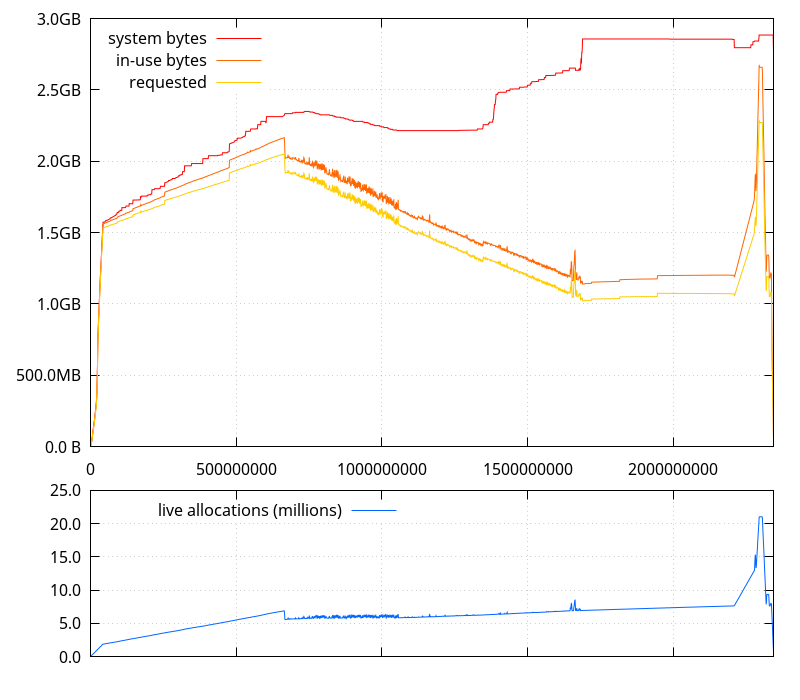
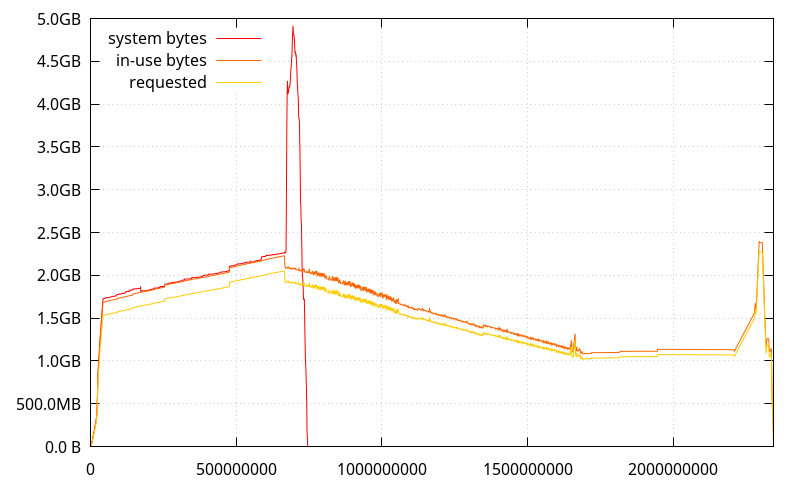
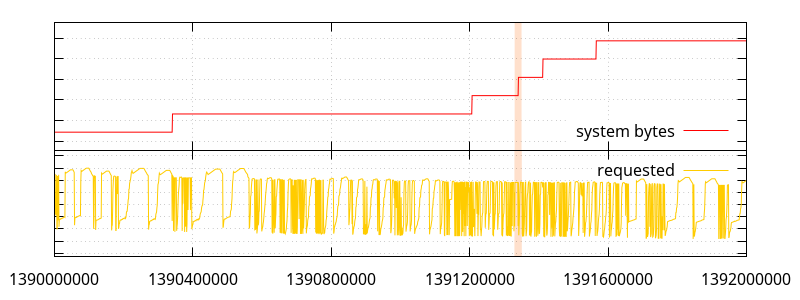
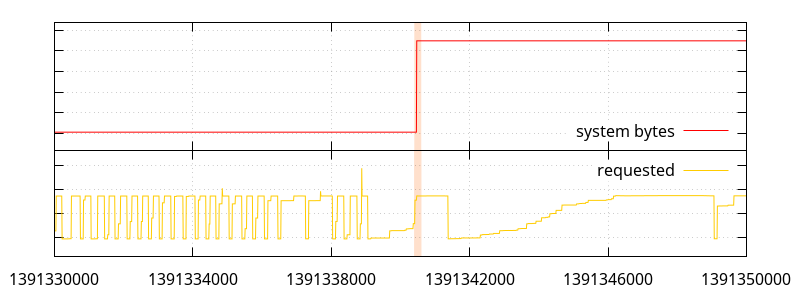
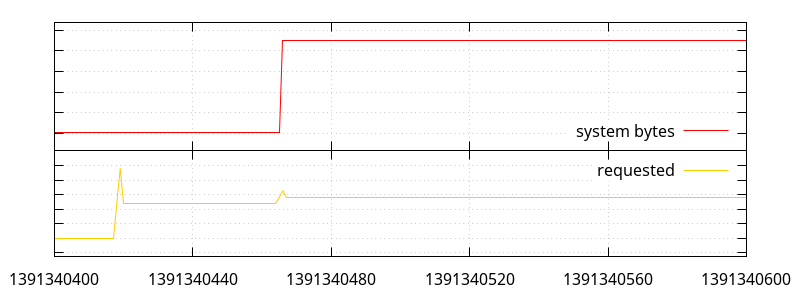
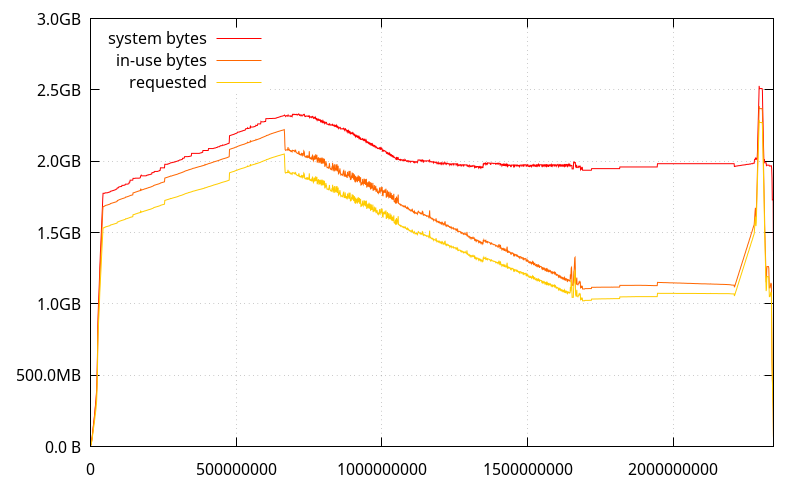
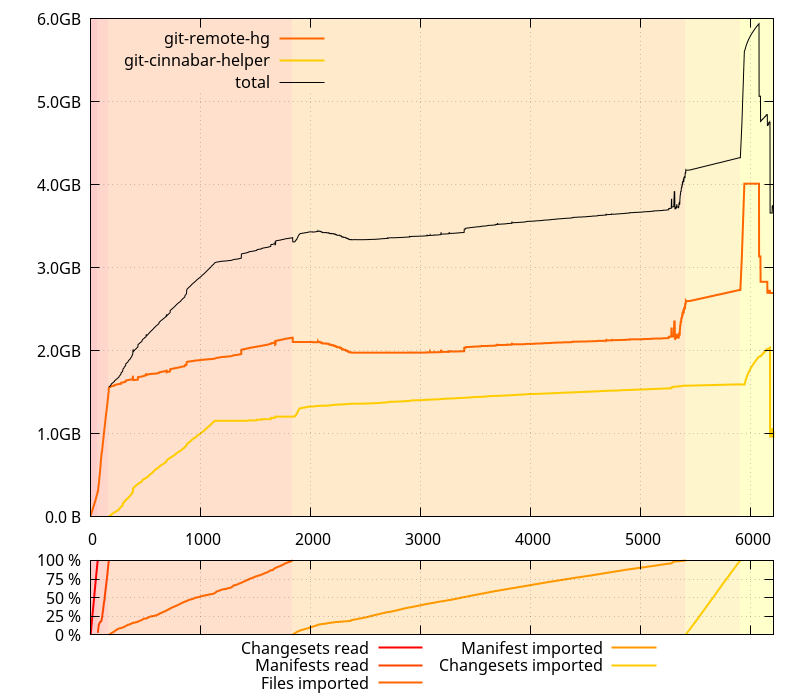
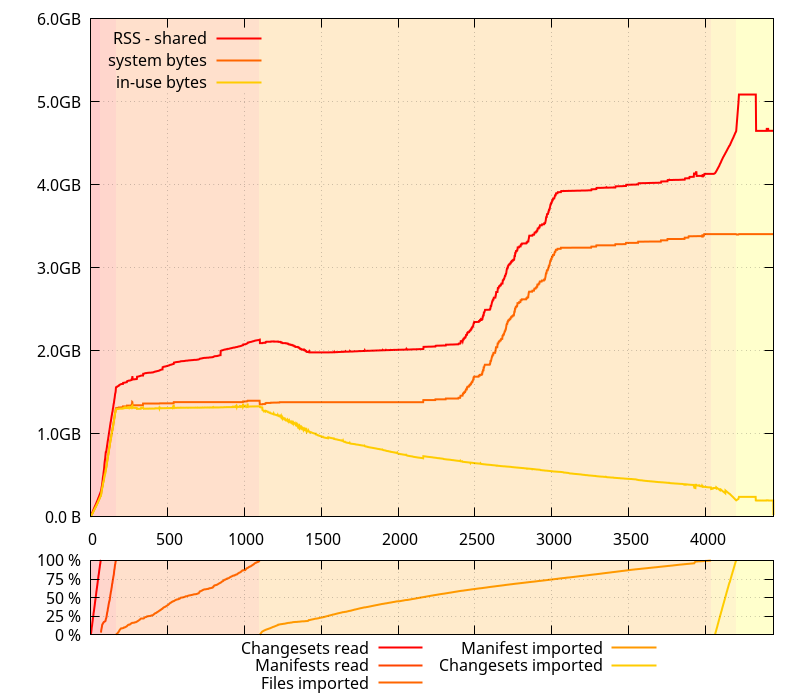
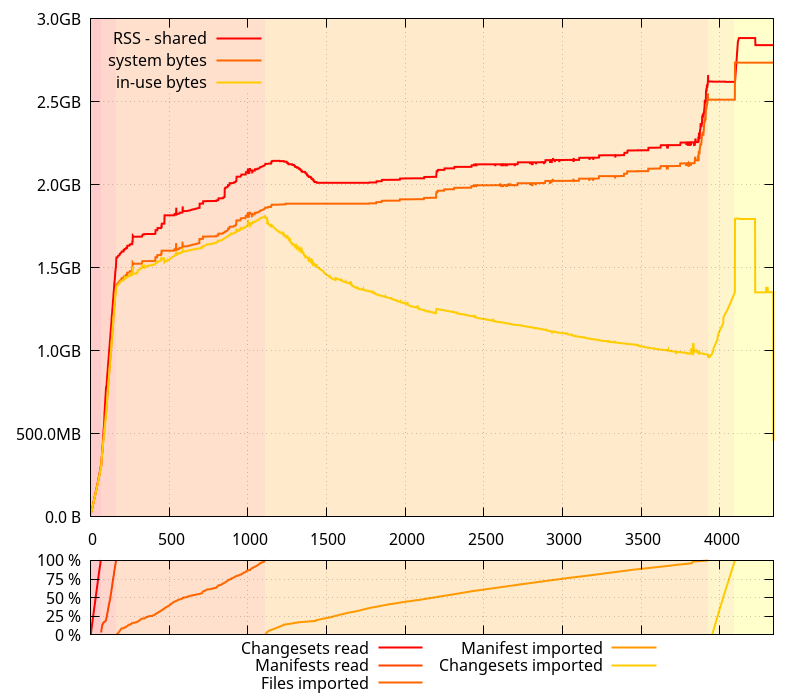
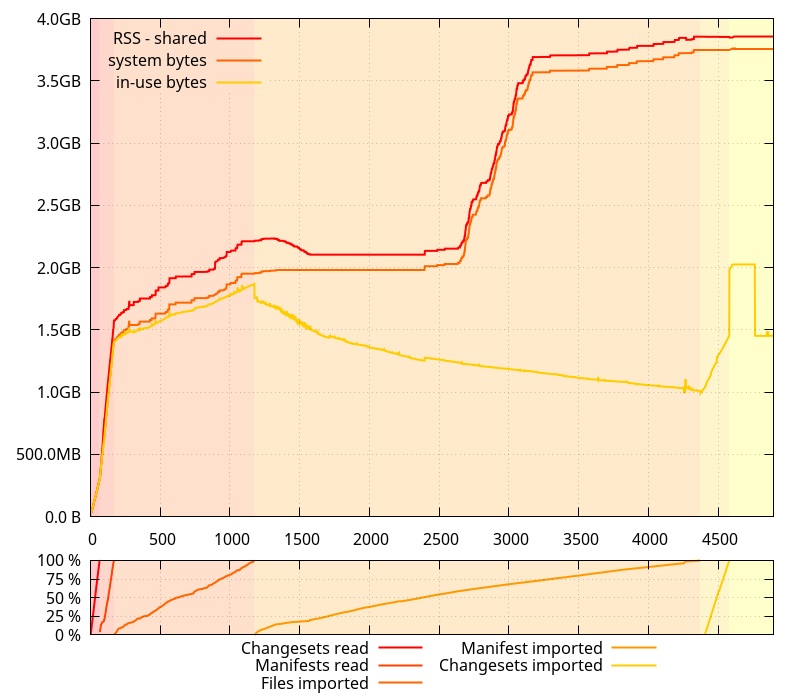
This is a followup to the When the memory allocator works against you post from a few days ago. You may want to read that one first if you haven t, and come back. In case you don t or didn t read it, it was all about memory consumption during a git clone of the mozilla-central mercurial repository using git-cinnabar, and how the glibc memory allocator is using more than one would expect. This post is going to explore how/why it s happening. I happen to have written a basic memory allocation logger for Firefox, so I used it to log all the allocations happening during a git clone exhibiting the runaway memory increase behavior (using a python that doesn t use its own allocator for small allocations). The result was a 6.5 GB log file (compressed with zstd ; 125 GB uncompressed!) with 2.7 billion calls to malloc, calloc, free, and realloc, recorded across (mostly) 2 processes (the python git-remote-hg process and the native git-cinnabar-helper process ; there are other short-lived processes involved, but they do less than 5000 calls in total). The vast majority of those 2.7 billion calls is done by the python git-remote-hg process: 2.34 billion calls. We ll only focus on this process. Replaying those 2.34 billion calls with a program that reads the log allowed to reproduce the runaway memory increase behavior to some extent. I went an extra mile and modified glibc s realloc code in memory so it doesn t call memcpy, to make things faster. I also ran under setarch x86_64 -R to disable ASLR for reproducible results (two consecutive runs return the exact same numbers, which doesn t happen with ASLR enabled). I also modified the program to report the number of live allocations (allocations that haven t been freed yet), and the cumulated size of the actually requested allocations (that is, the sum of all the sizes given to malloc, calloc, and realloc calls for live allocations, as opposed to what the memory allocator really allocated, which can be more, per malloc_usable_size). RSS was not tracked because the allocations are never filled to make things faster, such that pages for large allocations are never dirty, and RSS doesn t grow as much because of that. Full disclosure: it turns out the system bytes and in-use bytes numbers I had been collecting in the previous post were smaller than what they should have been, and were excluding memory that the glibc memory allocator would have mmap()ed. That however doesn t affect the trends that had been witnessed. The data below is corrected. (Note that in the graph above and the graphs that follow, the horizontal axis represents the number of allocator function calls performed) While I was here, I figured I d check how mozjemalloc performs, and it has a better behavior (although it has more overhead). What doesn t appear on this graph, though, is that mozjemalloc also tells the OS to drop some pages even if it keeps them mapped (madvise(MADV_DONTNEED)), so in practice, it is possible the actual RSS decreases too. And jemalloc 4.5: (It looks like it has better memory usage than mozjemalloc for this use case, but its stats are being thrown off at some point, I ll have to investigate) Going back to the first graph, let s get a closer look at what the allocations look like when the system bytes number is increasing a lot. The highlights in the following graphs indicate the range the next graph will be showing. So what we have here is a bunch of small allocations (small enough that they don t seem to move the requested line ; most under 512 bytes, so under normal circumstances, they would be allocated by python, a few between 512 and 2048 bytes), and a few large allocations, one of which triggers a bump in memory use. What can appear weird at first glance is that we have a large allocation not requiring more system memory, later followed by a smaller one that does. What the allocations actually look like is the following:
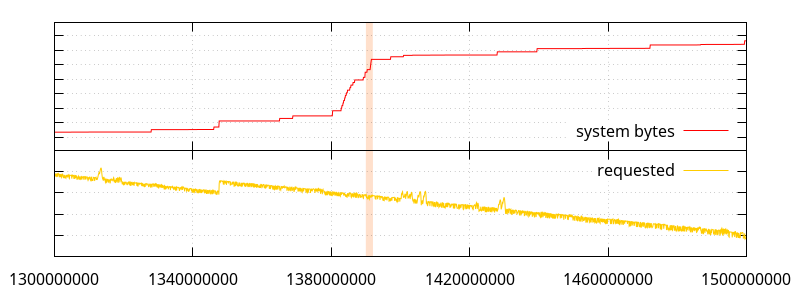
void *ptr0 = malloc(4850928); // #1391340418
void *ptr1 = realloc(some_old_ptr, 8000835); // #1391340419
free(ptr0); // #1391340420
ptr1 = realloc(ptr1, 8000925); // #1391340421
/* ... */
void *ptrn = malloc(879931); // #1391340465
ptr1 = realloc(ptr1, 8880819); // #1391340466
free(ptrn); // #1391340467
As it turns out, inspecting all the live allocations at that point, while there was a hole large enough to do the first two reallocs (the second actually happens in place), at the point of the third one, there wasn t a large enough hole to fit 8.8MB. What inspecting the live allocations also reveals, is that there is a large number of large holes between all the allocated memory ranges, presumably coming from previous similar patterns. There are, in fact, 91 holes larger than 1MB, 24 of which are larger than 8MB. It s the accumulation of those holes that can t be used to fulfil larger allocations that makes the memory use explode. And there aren t enough small allocations happening to fill those holes. In fact, the global trend is for less and less memory to be allocated, so, smaller holes are also being poked all the time. Really, it s all a straightforward case of memory fragmentation. The reason it tends not to happen with jemalloc is that jemalloc groups allocations by sizes, which the glibc allocator doesn t seem to be doing. The following is how we got a hole that couldn t fit the 8.8MB allocation in the first place:

ptr1 = realloc(ptr1, 8880467); // #1391324989; ptr1 is 0x5555de145600
/* ... */
void *ptrx = malloc(232); // #1391325001; ptrx is 0x5555de9bd760 ; that is 13 bytes after the end of ptr1.
/* ... */
free(ptr1); // #1391325728; this leaves a hole of 8880480 bytes at 0x5555de145600.
All would go well if ptrx was free()d, but it looks like it s long-lived. At least, it s still allocated by the time we reach the allocator call #1391340466. And since the hole is 339 bytes too short for the requested allocation, the allocator has no other choice than request more memory to the system. What s bothering, though, is that the allocator chose to allocate ptrx in the space following ptr1, when it allocated similarly sized buffers after allocating ptr1 and before allocating ptrx in completely different places, and while there are plenty of holes in the allocated memory where it could fit. Interestingly enough, ptrx is a 232 bytes allocation, which means under normal circumstances, python itself would be allocating it. In all likeliness, when the python allocator is enabled, it s allocations larger than 512 bytes that become obstacles to the larger allocations. Another possibility is that the 256KB fragments that the python allocator itself allocates to hold its own allocations become the obstacles (my original hypothesis). I think the former is more likely, though, putting back the blame entirely on glibc s shoulders. Now, it looks like the allocation pattern we have here is suboptimal, so I re-ran a git clone under a debugger to catch when a realloc() for 8880819 bytes happens (the size is peculiar enough that it only happened once in the allocation log). But doing that with a conditional breakpoint is just too slow, so I injected a realloc wrapper with LD_PRELOAD that sends a SIGTRAP signal to the process, so that an attached debugger can catch it. Thanks to the support for python in gdb, it was then posible to pinpoint the exact python instructions that made the realloc() call (it didn t come as a surprise ; in fact, that was one of the places I had in mind, but I wanted definite proof):

new = ''
end = 0
# ...
for diff in RevDiff(rev_patch):
    new += data[end:diff.start]
    new += diff.text_data
    end = diff.end
    # ...
new += data[end:]
What happens here is that we re creating a mercurial manifest we got from the server in patch form against a previous manifest. So data contains the original manifest, and rev_patch the patch. The patch essentially contains instructions of the form replace n bytes at offset o with the content c . The code here just does that in the most straightforward way, implementation-wise, but also, it turns out, possibly the worst way. So let s unroll this loop over a couple iterations:
new = ''
This allocates an empty str object. In fact, this doesn t actually allocate anything, and only creates a pointer to an interned representation of an empty string.
new += data[0:diff.start]
This is where things start to get awful. data is a str, so data[0:diff.start] creates a new, separate, str for the substring. One allocation, one copy. Then appends it to new. Fortunately, CPython is smart enough, and just assigns data[0:diff.start] to new. This can easily be verified with the CPython REPL:
>>> foo = ''
>>> bar = 'bar'
>>> foo += bar
>>> foo is bar
True
(and this is not happening because the example string is small here ; it also happens with larger strings, like 'bar' * 42000) Back to our loop:
new += diff.text_data
Now, new is realloc()ated to have the right size to fit the appended text in it, and the contents of diff.text_data is copied. One realloc, one copy. Let s go for a second iteration:
new += data[diff.end:new_diff.start]
Here again, we re doing an allocation for the substring, and one copy. Then new is realloc()ated again to append the substring, which is an additional copy.
new += new_diff.text_data
new is realloc()ated yet again to append the contents of new_diff.text_data. We now finish with:
new += data[new_diff.end:]
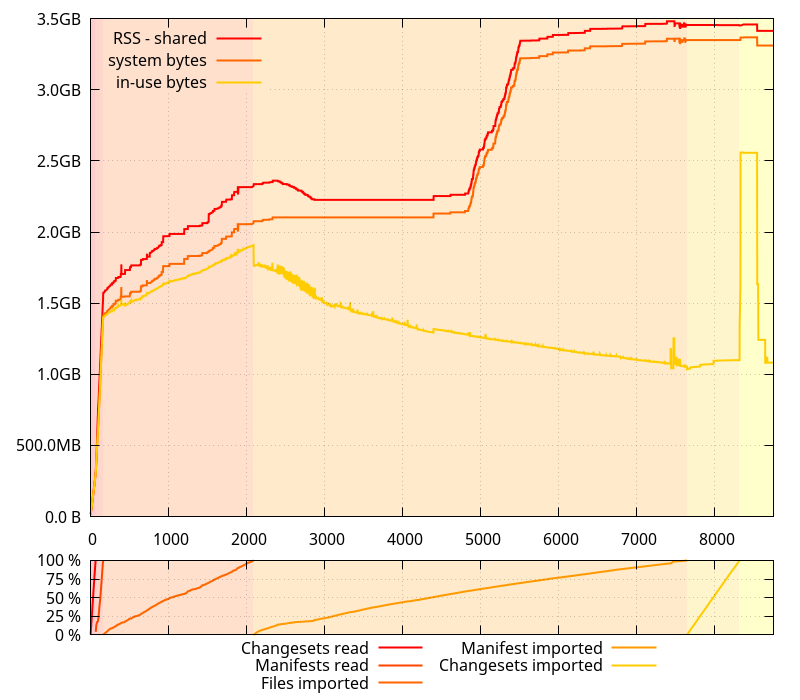
which, again creates a substring from the data, and then proceeds to realloc()ate new one freaking more time. That s a lot of malloc()s and realloc()s to be doing After modifying the code to implement the first and fifth items, memory usage during a git clone of mozilla-central looks like the following (with the python allocator enabled): (Note this hasn t actually landed on the master branch yet) Compared to what it looked like before, this is largely better. But that s not the only difference: the clone was also about 1000 seconds faster. That s more than 15 minutes! But that s not all so surprising when you know the volumes of data handled here. More insight about this coming in an upcoming post. But while the changes outlined above make the glibc allocator behavior less likely to happen, it doesn t totally obliviate it. In fact, it seems it is still happening by the end of the manifest import phase. We re still allocating increasingly large temporary buffers because the size of the imported manifests grows larger and larger, and every one of them is the result of patching a previous one. The only way to avoid those large allocations creating holes would be to avoid doing them in the first place. My first attempt at doing that, keeping manifests as lists of lines instead of raw buffers, worked, but was terribly slow. So slow, in fact, that I had to stop a clone early and estimated the process would likely have taken a couple days. Iterating over multiple generators at the same time, a lot, kills performance, apparently. I ll have to try with significantly less of that.

19 March 2017

Clint Adams: Measure once, devein twice

Ophira lived in a wee house in University Square, Tampa. It had one floor, three bedrooms, two baths, a handful of family members, a couple pets, some plants, and an occasional staring contest. Mauricio lived in Lowry Park North, but Ophira wasn t allowed to go there because Mauricio was afraid that someone would tell his girlfriend. Ophira didn t like Mauricio s girlfriend and Mauricio s girlfriend did not like Ophira. Mauricio did not bring his girlfriend along when he and Ophira went to St. Pete Beach. They frolicked in the ocean water, and attempted to have sex. Mauricio and Ophira were big fans of science, so Somewhat quickly they concluded that it is impossible to have sex underwater, and absconded to Ophira s car to have sex therein. I hate Mauricio s girlfriend, Ophira told Amit on the telephone. She s not even pretty. Hey, listen, said Amit. I m going to a wedding on Captiva. Oh, my family used to go to Captiva every year. There s bioluminescent algae and little crabs and stuff. Yeah? Do you want to come along? You could pick me up at the airport. Why would I want to go to a wedding? Well, it s on the beach and they re going to have a bouncy castle. A bouncy castle Are you serious? Yes. Well, okay. Amit prepared to go to the wedding and Ophira became terse then unresponsive. After he landed at RSW, he called Ophira, but instead of answering the phone she startled and fell out of her chair. Amit arranged for other transportation toward the Sanibel Causeway. Ophira bit her nails for a few hours, then went to her car and drove to Cape Coral. Ophira cruised around Cape Coral for a while, until she spotted a teenager cleaning a minivan. She parked her car and approached him. Whatcha doing? asked Ophira, pretending to chew on imaginary gum. The youth slid the minivan door open. I m cleaning, he said hesitantly. Didn t your parents teach you not to talk to strangers? I could do all kinds of horrible things to you. They conversed for a bit. She recounted a story of her personal hero, a twelve-year-old girl who seduced and manipulated older men into ruin. She rehashed the mysteries of Mauricio s girlfriend. She waxed poetic on her love of bouncy castles. The youth listened, hypnotized. What s your name, kid? Ophira yawned. Arjun, he replied. How old are you? Arjun thought about it. 15, he said. Hmm, Ophira stroked her chin. Can you sneak me into your room so that your parents never find out about it? Arjun s eyes went wide. MEANWHILE, on Captiva Island, Amit had learned that even though the Tenderly had multiple indoor jacuzzis, General Fitzpatrick and Mrs. Fitzpatrick had decided it prudent to have sex in the hot tub on the deck; that the execution of this plan had somehow necessitated a lengthy cleaning process before the hot tub could be used again; that that s why workmen were cleaning the hot tub; and that the Fitzpatrick children had gotten General Fitzpatrick and Mrs. Fitzpatrick to agree to not do that again, with an added suggestion that they not be seen doing anything else naked in public. A girl walked up to Amit. Hey, I heard you lost your plus-one. Are you here alone? What a loser! she giggled nervously, then stared. Leave me alone, Darlene, sighed Amit. Darlene s face reddened as she spun on her heels and stormed over to Lisette. Oh my god, did you see that? I practically threw myself at him and he was abusive toward me. He probably has all the classic signs of being an abuser. Did you hear about that girl he dated in Ohio? I bet I know why that ended. Oh really? said Lisette distractedly, looking Amit up and down. So he s single now? Darlene glared at Lisette as Amit wandered back outside to stare at the hot tub. Hey kid, said Ophira, bring me some snacks. I don t bring food into my room, said Arjun. It attracts pests. Is that what your parents told you? scoffed Ophira. Don t be such a wuss. Three minutes later, Ophira was finishing a bag of paprika puffs. These are great, Arjun! Where do you get these? My cousin sends them from Europe, he explained. Now get me a diet soda. Amit strolled along the beach, then yelped. What s biting my legs? he cried out. Those are sand fleas, said Nessarose. What are sand fleas? asked Amit incredulously. Nessarose rolled her eyes. Stop being a baby and have a drink. After the sun went down, Amit began to notice the crabs, and this made him drink more. When everyone was soused, General Fitzpatrick announced that they were going for a swim in the Gulf, in direct contravention of safety guidelines. Most of the guests were wise enough to refuse, but an eightsome swam out, occasionally stopping to slap the algae, but continuing until they reached the sandbar that General Fitzpatrick correctly claimed was there. Then screams echoed through the night as all the jellyfish attacked everyone invading their sandbar. The crestfallen swimming party eventually made it back to shore. Pee on the jellyfish sting, commanded Nessarose. It s the best cure. No! shouted General Fitzpatrick s daughter. Urine makes it worse. Things quickly escalated from Nessarose and General Fitzpatrick s daughter screaming at each other to the beach dividing into three factions: those siding with Nessarose, those siding with General Fitzpatrick s daughter, and those who had no idea what was going on. General Fitzpatrick had no interest in any of this, and went straight to bed. It s getting late, kid, said Ophira. I m taking your bed. What? squeaked Arjun. Look, said Ophira, your bed is small and there isn t room for both of us. You may sleep on the floor if you re quiet and don t bother me. What? squeaked Arjun. Are you deaf, kid? Ophira grunted and then went to bed. Arjun blinked in confusion, then tried to fall asleep on the floor, without much success. Ophira got up in the morning and said, Before I go, I want to teach you a valuable lesson. What? groaned Arjun, getting to his feet. You should be careful talking to strangers. Now, I told you that I could do horrible things to you, so this is not my fault; it s yours, she announced, then sucker-punched him in the gut. Ophira climbed out the window as Arjun doubled over. As the ceremony began, only a small minority of the wedding party was visibly suffering from jellyfish stings, which may or may not have helped with ignoring the sand fleas. The ceremony ended shortly thereafter, and now that marriage had been accomplished, everyone turned their attention to food and drink and swimming less irresponsibly than the night before. Guests that needed to return home sooner departed in waves and Amit started to appreciate the more peaceful environment. He heard the deck door slide open behind him and turned his attention away from the hot tub. Hey, mofo, Ophira shouted as strode stylishly out onto the deck. Where s this bouncy castle? Amit blinked in surprise. That was yesterday. You missed it. Oh, she frowned. So I met this South Slav guy with a really sexy forehead, and I need some advice. I don t know if I should call him or wait. Amit pointed to the hot tub and told her the story of General Fitzpatrick and Mrs. Fitzpatrick and the hot tub. What? said Ophira. How could they have sex underwater? What do you mean? asked Amit. Well, it s impossible, she replied.
Posted on 2017-03-19
Tags: mintings

18 March 2017

Vincent Sanders: A rose by any other name would smell as sweet

Often I end up dealing with code that works but might not be of the highest quality. While quality is subjective I like to use the idea of "code smell" to convey what I mean, these are a list of indicators that, in total, help to identify code that might benefit from some improvement.

Such smells may include:
I am most certainly not alone in using this approach and Fowler et al have covered this subject in the literature much better than I can here. One point I will raise though is some programmers dismiss code that exhibits these traits as "legacy" and immediately suggest a fresh implementation. There are varying opinions on when a rewrite is the appropriate solution from never to always but in my experience making the old working code smell nice is almost always less effort and risk than a re-write.
TestsWhen I come across smelly code, and I decide it is worthwhile improving it, I often discover the biggest smell is lack of test coverage. Now do remember this is just one code smell and on its own might not be indicative, my experience is smelly code seldom has effective test coverage while fresh code often does.

Test coverage is generally understood to be the percentage of source code lines and decision paths used when instrumented code is exercised by a set of tests. Like many metrics developer tools produce, "coverage percentage" is often misused by managers as a proxy for code quality. Both Fowler and Marick have written about this but sufficient to say that for a developer test coverage is a useful tool but should not be misapplied.

Although refactoring without tests is possible the chances for unintended consequences are proportionally higher. I often approach such a refactor by enumerating all the callers and constructing a description of the used interface beforehand and check that that interface is not broken by the refactor. At which point is is probably worth writing a unit test to automate the checks.

Because of this I have changed my approach to such refactoring to start by ensuring there is at least basic API code coverage. This may not yield the fashionable 85% coverage target but is useful and may be extended later if desired.

It is widely known and equally widely ignored that for maximum effectiveness unit tests must be run frequently and developers take action to rectify failures promptly. A test that is not being run or acted upon is a waste of resources both to implement and maintain which might be better spent elsewhere.

For projects I contribute to frequently I try to ensure that the CI system is running the coverage target, and hence the unit tests, which automatically ensures any test breaking changes will be highlighted promptly. I believe the slight extra overhead of executing the instrumented tests is repaid by having the coverage metrics available to the developers to aid in spotting areas with inadequate tests.
ExampleA short example will help illustrate my point. When a web browser receives an object over HTTP the server can supply a MIME type in a content-type header that helps the browser interpret the resource. However this meta-data is often problematic (sorry that should read "a misleading lie") so the actual content must be examined to get a better answer for the user. This is known as mime sniffing and of course there is a living specification.

The source code that provides this API (Linked to it rather than included for brevity) has a few smells:
While some of these are obvious the non-use of the global string table and the API complexity needed detailed knowledge of the codebase, just to highlight how subjective the sniff test can be. There is also one huge air freshener in all of this which definitely comes from experience and that is the modules author. Their name at the top of this would ordinarily be cause for me to move on, but I needed an example!

First thing to check is the API use

$ git grep -i -e mimesniff_compute_effective_type --or -e mimesniff_init --or -e mimesniff_fini
content/hlcache.c: error = mimesniff_compute_effective_type(handle, NULL, 0,
content/hlcache.c: error = mimesniff_compute_effective_type(handle,
content/mimesniff.c:nserror mimesniff_init(void)
content/mimesniff.c:void mimesniff_fini(void)
content/mimesniff.c:nserror mimesniff_compute_effective_type(llcache_handle *handle,
content/mimesniff.h:nserror mimesniff_compute_effective_type(struct llcache_handle *handle,
content/mimesniff.h:nserror mimesniff_init(void);
content/mimesniff.h:void mimesniff_fini(void);
desktop/netsurf.c: ret = mimesniff_init();
desktop/netsurf.c: mimesniff_fini();

This immediately shows me that this API is used in only a very small area, this is often not the case but the general approach still applies.

After a little investigation the usage is effectively that the mimesniff_init API must be called before the mimesniff_compute_effective_type API and the mimesniff_fini releases the initialised resources.

A simple test case was added to cover the API, this exercised the behaviour both when the init was called before the computation and not. Also some simple tests for a limited number of well behaved inputs.

By changing to using the global string table the initialisation and finalisation API can be removed altogether along with a large amount of global context and pre-processor macros. This single change removes a lot of smell from the module and raises test coverage both because the global string table already has good coverage and because there are now many fewer lines and conditionals to check in the mimesniff module.

I stopped the refactor at this point but were this more than an example I probably would have:
ConclusionThe approach examined here reduce the smell of code in an incremental, testable way to improve the codebase going forward. This is mainly necessary on larger complex codebases where technical debt and bit-rot are real issues that can quickly overwhelm a codebase if not kept in check.

This technique is subjective but helps a programmer to quantify and examine a piece of code in a structured fashion. However it is only a tool and should not be over applied nor used as a metric to proxy for code quality.

16 March 2017

Wouter Verhelst: Codes of Conduct

These days, most large FLOSS communities have a "Code of Conduct"; a document that outlines the acceptable (and possibly not acceptable) behaviour that contributors to the community should or should not exhibit. By writing such a document, a community can arm itself more strongly in the fight against trolls, harassment, and other forms of antisocial behaviour that is rampant on the anonymous medium that the Internet still is. Writing a good code of conduct is no easy matter, however. I should know -- I've been involved in such a process twice; once for Debian, and once for FOSDEM. While I was the primary author for the Debian code of conduct, the same is not true for the FOSDEM one; I was involved, and I did comment on a few early drafts, but the core of FOSDEM's current code was written by another author. I had wanted to write a draft myself, but then this one arrived and I didn't feel like I could improve it, so it remained. While it's not easy to come up with a Code of Conduct, there (luckily) are others who walked this path before you. On the "geek feminism" wiki, there is an interesting overview of existing Open Source community and conference codes of conduct, and reading one or more of them can provide one with some inspiration as to things to put in one's own code of conduct. That wiki page also contains a paragraph "Effective codes of conduct", which says (amongst others) that a good code of conduct should include
Specific descriptions of common but unacceptable behaviour (sexist jokes, etc.)
The attentive reader will notice that such specific descriptions are noticeably absent from both the Debian and the FOSDEM codes of conduct. This is not because I hadn't seen the above recommendation (I had); it is because I disagree with it. I do not believe that adding a list of "don't"s to a code of conduct is a net positive to it. Why, I hear you ask? Surely having a list of things that are not welcome behaviour is a good thing, which should be encouraged? Surely such a list clarifies the kind of things your does not want to see? Having such a list will discourage that bad behaviour, right? Well, no, I don't think so. And here's why.

Enumerating badness A list of things not to do is like a virus scanner. For those not familiar with these: on some operating systems, there is specific piece of software that everyone recommends you run, which checks if particular blobs of data appear in files on the disk. If they do, then these files are assumed to be bad, and are kicked out. If they do not, then these files are assumed to be not bad, and are left alone (for the most part). This works if we know all the possible types of badness; but as soon as someone invents a new form of badness, suddenly your virus scanner is ineffective. Additionally, it also means you're bound to continually have to update your virus scanner (or, as the case may be, code of conduct) to a continually changing hostile world. For these (and other) reasons, enumerating badness is listed as number 2 in security expert Markus Ranum's "six dumbest ideas in computer security," which was written in 2005. In short, a list of "things not to do" is bound to be incomplete; if the goal is to clarify the kind of behaviour that is not welcome in your community, it is usually much better to explain the behaviour that is wanted, so that people can infer (by their absense) the kind of behaviour that isn't welcome. This neatly brings me to my next point...

Black vs White vs Gray. The world isn't black-and-white. We could define a list of welcome behaviour -- let's call that the whitelist -- or a list of unwelcome behaviour -- the blacklist -- and assume that the work is done after doing so. However, that wouldn't be true. For every item on either the white or black list, there's going to be a number of things that fall somewhere in between. Let's call those things as being on the "gray" list. They're not the kind of outstanding behaviour that we would like to see -- they'd be on the white list if they were -- but they're not really obvious CoC violations, either. You'd prefer it if people don't do those things, but it'd be a stretch to say they're jerks if they do. Let's clarify that with an example: Is it a code of conduct violation if you post links to pornography websites on your community's main development mailinglist? What about jokes involving porn stars? Or jokes that denigrate women, or that explicitly involve some gender-specific part of the body? What about an earring joke? Or a remark about a user interacting with your software, where the women are depicted as not understanding things as well as men? Or a remark about users in general, that isn't written in a gender-neutral manner? What about a piece of self-deprecating humor? What about praising someone else for doing something outstanding? I'm sure most people would agree that the first case in the above paragraph should be a code of conduct violation, whereas the last case should not be. Some of the items in the list in between are clearly on one or the other side of the argument, but for others the jury is out. Let's call those as being in the gray zone. (Note: no, I did not mean to imply that the list is ordered in any way ;-) If you write a list of things not to do, then by implication (because you didn't mention them), the things in the gray area are okay. This is especially problematic when it comes to things that are borderline blacklisted behaviour (or that should be blacklisted but aren't, because your list is incomplete -- see above). In such a situation, you're dealing with people who are jerks but can argue about it because your definition of jerk didn't cover teir behaviour. Because they're jerks, you can be sure they'll do everything in their power to waste your time about it, rather than improving their behaviour. In contrast, if you write a list of things that you want people to do, then by implication (because you didn't mention it), the things in the gray area are not okay. If someone slips and does something in that gray area anyway, then that probably means they're doing something borderline not-whitelisted, which would be mildly annoying but doesn't make them jerks. If you point that out to them, they might go "oh, right, didn't think of it that way, sorry, will aspire to be better next time". Additionally, the actual jerks and trolls will have been given less tools to argue about borderline violations (because the border of your code of conduct is far, far away from jerky behaviour), so less time is wasted for those of your community who have to police it (yay!). In theory, the result of a whitelist is a community of people who aspire to be nice people, rather than a community of people who simply aspire to be "not jerks". I know which kind of community I prefer.

Giving the wrong impression During one of the BOFs that were held while I was drafting the Debian code of conduct, it was pointed out to me that a list of things not to do may give the impression to people that all these things on this list do actually happen in the code's community. If that is true, then a very long list may produce the impression that the given community is a community with a lot of problems. Instead, a whitelist-based code of conduct will provide the impression that you're dealing with a healthy community. Whether that is the case obviously depends on more factors than just the code of conduct itself, but it will put people in the right mindset for this to become something of a self-fulfilling prophecy.

Conclusion Given all of the above, I think a whitelist-based code of conduct is a better idea than a blacklist-based one. Additionally, in the few years since the Debian code of conduct was accepted, it is my impression that the general atmosphere in the Debian project has improved, which would seem to confirm that the method works (but YMMV, of course). At any rate, I'm not saying that blacklist-based codes of conduct are useless. However, I do think that whitelist-based ones are better; and hopefully, you now agree, too ;-)

15 March 2017

Michal &#268;iha&#345;: Life of free software project

During last week I've noticed several interesting posts about challenges being free software maintainer. After being active in open source for 16 years I can share much of the feelings I've read and I can also share my dealings with the things. First of all let me link some of the other posts on the topic: I guess everybody involved in in some popular free software project knows it - there is much more work to be done than people behind the project can handle. It really doesn't matter it those are bug reports, support requests, new features or technical debt, it's simply too much of that. If you are the only one behind the project it can feel even more pressing. There can be several approaches how to deal with that, but you have to choose what you prefer and what is going to work for you and your project. I've used all of the below mentioned approaches on some of the projects, but I don't think there is a silver bullet. Finding more people Obviously if you can not cope with the work, let's find more people to do the work. Unfortunately it's not that easy. Sometimes people come by, contribute few patches, but it's not that easy to turn them into regular contributor. You should encourage them to stay and to care about the part of the project they have touched. You can try to attract completely new contributors through programs as Google Summer of Code (GSoC) or Outreachy, but that has it's own challenges as well. With phpMyAdmin we're participating regularly in GSoC (we've only missed last year as we were not chosen by Google that year) and it indeed helps to bring new people on the board. Many of them even stay around your project (currently 3 of 5 phpMyAdmin team members are former GSoC students). But I think this approach really works only for bigger organizations. You can also motivate people by money. It's way which is not really much used on free software projects, partly because lack of funding (I'll get to that later) and partly because it doesn't necessarily bring long time contributors, just cash hunters. I've been using Bountysource for some of my projects (Weblate and Gammu) and so far it mostly works other way around - if somebody posts bounty on the issue, it means it's quite important for him to get that fixed, so I use that as indication for myself. On attracting new developers it never really worked well, even when I've tried to post bounties to some easy to fix issues, where newbies could learn our code base and get paid for that. These issues stayed opened for months and in the end I've fixed them myself because they annoyed me. Don't care too much I think this is most important aspect - you simply can never fix all the problems. Let's face it and work according to that. There can be various levels of don't caring. I find it always better to try to encourage people to fix their problem, but you can't expect big success rate in that, so you might find it not worth of the time. What I currently do: If you still can't handle that, you should consider abandoning the project as well. Does it bring something to you other than frustration of not completed work? I know it can be hard decision, in the end it is your child, but sometimes it's the best think you can do. Get paid to do the work Are you doing your fulltime job and then work on free software on nights or weekends? It can probably work for some time, but unless you find some way to make these two match, you will lack free time to relax and spend with friends or family. There are several options to make these work together. You can find job where doing free software will be natural part of it. This worked for me pretty well at SUSE, but I'm sure there are more companies where it will work. It can happen that the job will not cover all your free software activities, but this still helps. You can also make your project to become your employer. This can be sometimes challenging to make volunteers and paid contractors to work on one project, but I think this can be handled. Such setup currently works currently quite well for phpMyAdmin (we will announce second contractor soon) and works quite well for me with Weblate as well. Funding free software projects Once your project is well funded, you can fix many problems by money. You can pay yourself to do the work, hire additional developers, get better infrastructure or travel to conferences to spread word about it. But the question is how to get to the point of being well funded. There are several crowdfunding platforms which can help you with that (Liberapay, Bountysource salt, Gratipay or Snowdrift to mention some). You can also administer the funding yourself or using some legal entity such as Software Freedom Conservancy which handles this for phpMyAdmin. But the most important thing is to persuade people and companies to give back. You know there are lot of companies relying on your project, but how to make them fund the project? I really don't know, I still struggle with this as I don't want to be too pushy in asking for money, but I'd really like to see them to give back. What kind of works is giving your sponsors logo / link placement on your website. If your website is well ranked, you can expect to get quite a lot of SEO sponsors and the question is where to draw a line what you still find acceptable. Obviously the most willing to pay companies will have nothing to do with what you do and they just want to get the link. The industry you can expect is porn, gambling, binary options and various MFA sites. You will get some legitimate sponsors related to your project as well. We felt we've gone too far with phpMyAdmin last year and we've stricten the rules recently, but the outcome is still not visible on our website (as we've just limited new sponsors, but existing contracts will be honored). Another option is to monetize your project more directly. You can offer consulting services or provide it as a service (this is what I currently do with Weblate). It really depends on the product if you can build customer base on that or not, but certainly this is not something what would work well for all projects. Thanks for reading this and I hope it's not too chaotic, as I've moved parts there and back while writing and I'm afraid it got too long in the end.

Filed under: Debian English Gammu phpMyAdmin SUSE Weblate 0 comments

13 March 2017

Sean Whitton: Initial views of 5th edition DnD

I ve been playing in a 5e campaign for around two months now. In the past ten days or so I ve been reading various source books and Internet threads regarding the design of 5th edition. I d like to draw some comparisons and contrasts between 5th edition, and the 3rd edition family of games (DnD 3.5e and Paizo s Pathfinder, which may be thought of as 3.75e). The first thing I d like to discuss is that wizards and clerics are no longer Vancian spellcasters. In rules terms, this is the idea that individual spells are pieces of ammunition. Spellcasters have a list of individual spells stored in their heads, and as they cast spells from that list, they cross off each item. Barring special rules about spontaneously converting prepared spells to healing spells, for clerics, the only way to add items back to the list is to take a night s rest. Contrast this with spending points from a pool of energy in order to use an ability to cast a fireball. Then the limiting factor on using spells is having enough points in your mana pool, not having further castings of the spell waiting in memory. One of the design goals of 5th edition was to reduce the dominance of spellcasters at higher levels of play. The article to which I linked in the previous paragraph argues that this rebalancing requires the removal of Vancian magic. The idea, to the extent that I ve understood it, is that Vancian magic is not an effective restriction on spellcaster power levels, so it is to be replaced with other restrictions adding new restrictions while retaining the restrictions inherent in Vancian magic would leave spellcasters crippled. A further reason for removing Vancian magic was to defeat the so-called five minute adventuring day . The compat ability of a party that contains higher level Vancian spellcasters drops significantly once they ve fired off their most powerful combat spells. So adventuring groups would find themselves getting into a fight, and then immediately retreating to fully rest up in order to get their spells back. This removes interesting strategic and roleplaying possibilities involving the careful allocation of resources, and continuing to fight as hit points run low. There are some other related changes. Spell components are no longer used up when casting a spell. So you can use one piece of bat guano for every fireball your character ever casts, instead of each casting requiring a new piece. Correspondingly, you can use a spell focus, such as a cool wand, instead of a pouch full of material components since the pouch never runs out, there s no mechanical change if a wizard uses an arcane focus instead. 0th level spells may now be cast at will (although Pathfinder had this too). And there are decent 0th level attack spells, so a spellcaster need not carry a crossbow or shortbow in order to have something to do on rounds when it would not be optimal to fire off one of their precious spells. I am very much in favour of these design goals. The five minute adventuring day gets old fast, and I want it to be possible for the party to rely on the cool abilities of non-spellcasters to deal with the challenges they face. However, I am concerned about the flavour changes that result from the removal of Vancian magic. These affect wizards and clerics differently, so I ll take each case in turn. Firstly, consider wizards. In third edition, a wizard had to prepare and cast Read Magic (the only spell they could prepare without a spellbook), and then set about working through their spellbook. This involved casting the spells they wanted to prepare, up until the last few triggering words or gestures that would cause the effect of the spell to manifest. They would commit these final parts of the spell to memory. When it came to casting the spell, the wizard would say the final few words and make the required gestures, and bring out relevant material components from their component pouch. The completed spell would be ripped out of their mind, to manifest its effect in the world. We see that the casting of a spell is a highly mentally-draining activity it rips the spell out of the caster s memory! not to be undertaken lightly. Thus it is natural that a wizard would learn to use a crossbow for basic damage-dealing. Magic is not something that comes very naturally to the wizard, to be deployed in combat as readily as the fighter swings their sword. They are not a superhero or video game character, pew pew ing their way to victory. This is a very cool starting point upon which to roleplay an academic spellcaster, not really available outside of tabletop games. I see it as a distinction between magical abilities and real magic. Secondly, consider clerics. Most of the remarks in the previous paragraph apply, suitably reworked to be in terms of requesting certain abilities from the deity to whom the cleric is devoted. Additionally, there is the downgrading of the importance of the cleric s healing magic in 5th edition. Characters can heal themselves by taking short and long rests. Previously, natural healing was very slow, so a cleric would need to convert all their remaining magic to healing spells at the end of the day, and hope that it was enough to bring the party up to fighting shape. Again, this made the party of adventurers seem less like superheroes or video game characters. Magic had a special, important and unique role, that couldn t be replaced by the abilities of other classes.
There are some rules in the back of the DMG Slow Natural Healing , Healing Kit Dependency , Lingering Wounds which can be used to make healing magic more important. I m not sure how well they would work without changes to the cleric class.
I would like to find ways to restore the feel and flavour of Vancian clerics and wizards to 5th edition, without sacrificing the improvements that have been made that let other party members do cool stuff too. I hope it is possible to keep magic cool and unique without making it dominate the game. It would be easy to forbid the use of arcane foci, and say that material component pouches run out if the party do not visit a suitable marketplace often enough. This would not have a significant mechanical effect, and could enhance roleplaying possibilities. I am not sure how I could deal with the other issues I ve discussed without breaking the game. The second thing I would like to discuss is bounded accuracy. Under this design principle, the modifiers to dice rolls grow much more slowly. The gain of hit points remains unbounded. Under third edition, it was mechanically impossible for a low-level monster to land a hit on a higher-level adventurer, rendering them totally useless even in overwhelming numbers. With bounded accuracy, it s always possible for a low-level monster to hit a PC, even if they do insigificant damage. That means that multiple low-level monsters pose a threat. This change opens up many roleplaying opportunities by keeping low-level character abilities relevant, as well as monster types that can remain involves in stories without giving them implausible new abilities so they don t fall far behind the PCs. However, I m a little worried that it might make high level player characters feel a lot less powerful to play. I want to cease a be a fragile adventurer and become a world-changing hero at later levels, rather than forever remain vulnerable to the things that I was vulnerable to at the start of the game. This desire might just be the result of the video games which I played growing up. In the JRPGs I played and in Diablo II, enemies in earlier areas of the map were no threat at all once you d levelled up by conquering higher-level areas. My concerns about bounded accuracy might just be that it clashes with my own expectations of how fantasy heroes work. A good DM might be able to avoid these worries entirely. The final thing I d like to discuss is the various simplifications to the rules of 5th edition, when it is compared with 3rd edition and Pathfinder. Attacks of opportunity are only provoked when leaving a threatened square; you can go ahead and cast a spell when in melee with someone. There is a very short list of skills, and party members are much closer to each other in skills, now that you can t pump more and more ranks into one or two abilities. Feats as a whole are an optional rule. At first I was worried about these simplifications. I thought that they might make character building and tactics in combat a lot less fun. However, I am now broadly in favour of all of these changes, for two reasons. Firstly, they make the game so much more accessible, and make it far more viable to play without relying on a computer program to fill in the boxes on your character sheet. In my 5th edition group, two of us have played 3rd edition games, and the other four have never played any tabletop games before. But nobody has any problems figuring out their modifiers because it is always simply your ability bonus or penalty, plus your proficiency bonus if relevant. And advantage and disadvantage is so much more fun than getting an additional plus or minus two. Secondly, these simplifications downplay the importance of the maths, which means it is far less likely to be broken. It is easier to ensure that a smaller core of rules is balanced than it is to keep in check a larger mass of rules, constantly being supplemented by more and more addon books containing more and more feats and prestige classes. That means that players make their characters cool by roleplaying them in interesting ways, not making them cool by coming up with ability combos and synergies in advance of actually sitting down to play. Similarly, DMs can focus on flavouring monsters, rather than writing up longer stat blocks. I think that this last point reflects what I find most worthwhile about tabletop RPGs. I like characters to encounter cool NPCs and cool situations, and then react in cool ways. I don t care that much about character creation. (I used to care more about this, but I think it was mainly because of interesting options for magic items, which hasn t gone away.) The most important thing is exercising group creativity while actually playing the game, rather than players and DMs having to spend a lot of time preparing the maths in advance of playing. Fifth edition enables this by preventing the rules from getting in the way, because they re broken or overly complex. I think this is why I love Exalted: stunting is vital, and there is social combat. I hope to be able to work out a way to restore Vancian magic, but even without that, on balance, fifth edition seems like a better way to do group storytelling about fantasy heroes. Hopefully I will have an opportunity to DM a 5th edition campaign. I am considering disallowing all homebrew and classes and races from supplemental books. Stick to the well-balanced core rules, and do everything else by means of roleplaying and flavour. This is far less gimmicky, if more work for unimaginative players (such as myself!). Some further interesting reading:

12 March 2017

Mike Hommey: When the memory allocator works against you

Cloning mozilla-central with git-cinnabar requires a lot of memory. Actually too much memory to fit in a 32-bits address space. I hadn t optimized for memory use in the first place. For instance, git-cinnabar keeps sha-1s in memory as hex values (40 bytes) rather than raw values (20 bytes). When I wrote the initial prototype, it didn t matter that much, and while close(ish) to the tipping point, it didn t require more than 2GB of memory at the time. Time passed, and mozilla-central grew. I suspect the recent addition of several thousands of commits and files has made things worse. In order to come up with a plan to make things better (short or longer term), I needed data. So I added some basic memory resource tracking, and collected data while cloning mozilla-central. I must admit, I was not ready for what I witnessed. Follow me for a tale of frustrations (plural). I was expecting things to have gotten worse on the master branch (which I used for the data collection) because I am in the middle of some refactoring and did many changes that I was suspecting might have affected memory usage. I wasn t, however, expecting to see the clone command using 10GB(!) memory at peak usage across all processes. (Note, those memory sizes are RSS, minus shared ) It also was taking an unexpected long time, but then, I hadn t cloned a large repository like mozilla-central from scratch in a while, so I wasn t sure if it was just related to its recent growth in size or otherwise. So I collected data on 0.4.0 as well. Less time spent, less memory usage ok. There s definitely something wrong on master. But wait a minute, that slope from ~2GB to ~4GB on the git-remote-hg process doesn t actually make any kind of sense. I mean, I d understand it if it were starting and finishing with the Import manifest phase, but it starts in the middle of it, and ends long before it finishes. WTH? First things first, since RSS can be a variety of things, I checked /proc/$pid/smaps and confirmed that most of it was, indeed, the heap. That s the point where you reach for Google, type something like python memory profile and find various tools. One from the results that I remembered having used in the past is guppy s heapy. Armed with pdb, I broke execution in the middle of the slope, and tried to get memory stats with heapy. SIGSEGV. Ouch. Let s try something else. I reached out to objgraph and pympler. SIGSEGV. Ouch again. Tried working around the crashes for a while (too long while, retrospectively, hindsight is 20/20), and was somehow successful at avoiding them by peaking at a smaller set of objects. But whatever I did, despite being attached to a process that had 2.6GB RSS, I wasn t able to find more than 1.3GB of data. This wasn t adding up. It surely didn t help that getting to that point took close to an hour each time. Retrospectively, I wish I had investigated using something like Checkpoint/Restore in Userspace. Anyways, after a while, I decided that I really wanted to try to see the whole picture, not smaller peaks here and there that might be missing something. So I resolved myself to look at the SIGSEGV I was getting when using pympler, collecting a core dump when it happened. Guess what? The Debian python-dbg package does not contain the debug symbols for the python package. The core dump was useless. Since I was expecting I d have to fix something in python, I just downloaded its source and built it. Ran the command again, waited, and finally got a backtrace. First Google hit for the crashing function? The exact (unfixed) crash reported on the python bug tracker. No patch. Crashing code is doing:
((f)->f_builtins != (f)->f_tstate->interp->builtins)
And (f)->f_tstate is NULL. Classic NULL deref. Added a guard (assessing it wouldn t break anything). Ran the command again. Waited. Again. SIGSEGV. Facedesk. Another crash on the same line. Did I really use the patched python? Yes. But this time (f)->f_tstate->interp is NULL. Sigh. Same player, shoot again. Finally, no crash but still stuck on only 1.3GB accounted for. Ok, I know not all python memory profiling tools are entirely reliable, let s try heapy again. SIGSEGV. Sigh. No debug info on the heapy module, where the crash happens. Sigh. Rebuild the module with debug info, try again. The backtrace looks like heapy is recursing a lot. Look at %rsp, compare with the address space from /proc/$pid/maps. Confirmed. A stack overflow. Let s do ugly things and increase the stack size in brutal ways. Woohoo! Now heapy tells me there s even less memory used than the 1.3GB I found so far. Like, half less. Yeah, right. I m not clear on how I got there, but that s when I found gdb-heap, a tool from Red Hat s David Malcolm, and the associated talk Dude, where s my RAM? A deep dive into how Python uses memory (slides). With a gdb attached, I would finally be able to rip python s guts out and find where all the memory went. Or so I thought. The gdb-heap tool only found about 600MB. About as much as heapy did, for that matter, but it could be coincidental. Oh. Kay. I don t remember exactly what went through my mind then, but, since I was attached to a running process with gdb, I typed the following on the gdb prompt:
gdb> call malloc_stats()
And that s when the truth was finally unvealed: the memory allocator was just acting up the whole time. The ouput was something like:
Arena 0:
system bytes    =  some number above (but close to) 2GB
in use bytes    =  some number above (but close to) 600MB
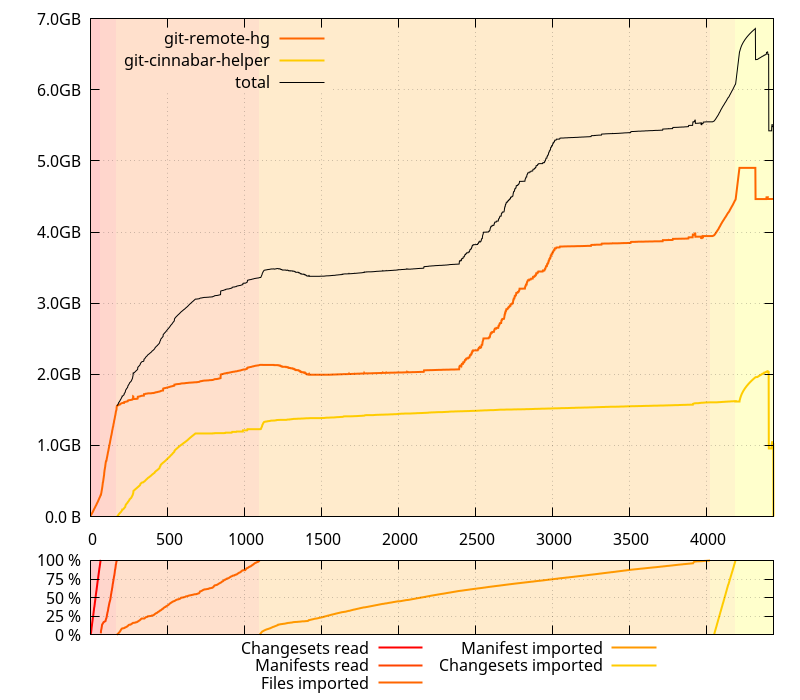
Yes, the glibc allocator was just telling it had allocated 600MB of memory, but was holding onto 2GB. I must have found a really bad allocation pattern that causes massive fragmentation. One thing that David Malcolm s talk taught me, though, is that python uses its own allocator for small sizes, so the glibc allocator doesn t know about them. And, roughly, adding the difference between RSS and what glibc said it was holding to to the use bytes it reported somehow matches the 1.3GB I had found so far. So it was time to see how those things evolved in time, during the entire clone process. I grabbed some new data, tracking the evolution of system bytes and in use bytes . There are two things of note on this data: In fact, the latter is exactly how git-cinnabar is supposed to work: It reads changesets and manifests chunks, and holds onto them while importing files. Then it throws away those manifests and changesets chunks one by one while it imports them. There is, however, some extra bookkeeping that requires some additional memory, but it s expected to be less memory consuming than keeping all the changesets and manifests chunks in memory. At this point, I thought a possible explanation is that since both python and glibc are mmap()ing their own arenas, they might be intertwined in a way that makes things not go well with the allocation pattern happening during the Import manifest phase (which, in fact, allocates and frees increasingly large buffers for each manifest, as manifests grow in size in the mozilla-central history). To put the theory at work, I patched the python interpreter again, making it use malloc() instead of mmap() for its arenas. Aha! I thought. That definitely looks much better. Less gap between what glibc says it requested from the system and the RSS size. And, more importantly, no runaway increase of memory usage in the middle of nowhere. I was preparing myself to write a post about how mixing allocators could have unintended consequences. As a comparison point, I went ahead and ran another test, with the python allocator entirely disabled, this time. Heh. It turns out glibc was acting up all alone. So much for my (plausible) theory. (I still think mixing allocators can have unintended consequences.) (Note, however, that the reason why the python allocator exists is valid: without it, the overall clone took almost 10 more minutes) And since I had been getting all this data with 0.4.0, I gathered new data without the python allocator with the master branch. This paints a rather different picture than the original data on that branch, with much less memory use regression than one would think. In fact, there isn t much difference, except for the spike at the end, which got worse, and some of the noise during the Import manifests phase that got bigger, implying larger amounts of temporary memory used. The latter may contribute to the allocation patterns that throw glibc s memory allocator off. It turns out tracking memory usage in python 2.7 is rather painful, and not all the tools paint a complete picture of it. I hear python 3.x is somewhat better in that regard, and I hope it s true, but at the moment, I m stuck with 2.7. The most reliable tool I ve used here, it turns out, is pympler. Or rebuilding the python interpreter without its allocator, and asking the system allocator what is allocated. With all this data, I now have some defined problems to tackle, some easy (the spike at the end of the clone), and some less easy (working around glibc allocator s behavior). I have a few hunches as to what kind of allocations are causing the runaway increase of RSS. Coincidentally, I m half-way through a refactor of the code dealing with manifests, and it should help dealing with the issue. But that will be the subject of a subsequent post.
8 March 2017

Thorsten Glaser: Updated Debian packaging example: PHP webapp with dbconfig-common

Since I use this as base for other PHP packages like SimKolab, I ve updated my packaging example with: The old features (Apache 2.2 and 2.4 support, dbconfig-common, etc.) are, of course, still there. Support for other webservers could be contributed by you, and I could extend the autoloader to work at runtime (using dpkg triggers) to include dependencies as packaged in other Debian packages. See, nobody needs composer ! Feel free to check it out, play around with it, install it, test it, send me improvement patches and feature requests, etc. it s here with a mirror at GitHub (since I wrote it myself and the licence is permissive enough anyway). This posting and the code behind it are sponsored by my employer tarent.

Antoine Beaupr : An update to GitHub's terms of service

On February 28th, GitHub published a brand new version of its Terms of Service (ToS). While the first draft announced earlier in February didn't generate much reaction, the new ToS raised concerns that they may break at least the spirit, if not the letter, of certain free-software licenses. Digging in further reveals that the situation is probably not as dire as some had feared. The first person to raise the alarm was probably Thorsten Glaser, a Debian developer, who stated that the "new GitHub Terms of Service require removing many Open Source works from it". His concerns are mainly about section D of the document, in particular section D.4 which states:
You grant us and our legal successors the right to store and display your Content and make incidental copies as necessary to render the Website and provide the Service.
Section D.5 then goes on to say:
[...] You grant each User of GitHub a nonexclusive, worldwide license to access your Content through the GitHub Service, and to use, display and perform your Content, and to reproduce your Content solely on GitHub as permitted through GitHub's functionality

ToS versus GPL The concern here is that the ToS bypass the normal provisions of licenses like the GPL. Indeed, copyleft licenses are based on copyright law which forbid users from doing anything with the content unless they comply with the license, which forces, among other things, "share alike" properties. By granting GitHub and its users rights to reproduce content without explicitly respecting the original license, the ToS may allow users to bypass the copyleft nature of the license. Indeed, as Joey Hess, author of git-annex, explained :
The new TOS is potentially very bad for copylefted Free Software. It potentially neuters it entirely, so GPL licensed software hosted on Github has an implicit BSD-like license
Hess has since removed all his content (mostly mirrors) from GitHub. Others disagree. In a well-reasoned blog post, Debian developer Jonathan McDowell explained the rationale behind the changes:
My reading of the GitHub changes is that they are driven by a desire to ensure that GitHub are legally covered for the things they need to do with your code in order to run their service.
This seems like a fair point to make: GitHub needs to protect its own rights to operate the service. McDowell then goes on to do a detailed rebuttal of the arguments made by Glaser, arguing specifically that section D.5 "does not grant [...] additional rights to reproduce outside of GitHub". However, specific problems arise when we consider that GitHub is a private corporation that users have no control over. The "Services" defined in the ToS explicitly "refers to the applications, software, products, and services provided by GitHub". The term "Services" is therefore not limited to the current set of services. This loophole may actually give GitHub the right to bypass certain provisions of licenses used on GitHub. As Hess detailed in a later blog post:
If Github tomorrow starts providing say, an App Store service, that necessarily involves distribution of software to others, and they put my software in it, would that be allowed by this or not? If that hypothetical Github App Store doesn't sell apps, but licenses access to them for money, would that be allowed under this license that they want to my software?
However, when asked on IRC, Bradley M. Kuhn of the Software Freedom Conservancy explained that "ultimately, failure to comply with a copyleft license is a copyright infringement" and that the ToS do outline a process to deal with such infringement. Some lawyers have also publicly expressed their disagreement with Glaser's assessment, with Richard Fontana from Red Hat saying that the analysis is "basically wrong". It all comes down to the intent of the ToS, as Kuhn (who is not a lawyer) explained:
any license can be abused or misused for an intent other than its original intent. It's why it matters to get every little detail right, and I hope Github will do that.
He went even further and said that "we should assume the ambiguity in their ToS as it stands is favorable to Free Software". The ToS are in effect since February 28th; users "can accept them by clicking the broadcast announcement on your dashboard or by continuing to use GitHub". The immediacy of the change is one of the reasons why certain people are rushing to remove content from GitHub: there are concerns that continuing to use the service may be interpreted as consent to bypass those licenses. Hess even hosted a separate copy of the ToS [PDF] for people to be able to read the document without implicitly consenting. It is, however, unclear how a user should remove their content from the GitHub servers without actually agreeing to the new ToS.

CLAs When I read the first draft, I initially thought there would be concerns about the mandatory Contributor License Agreement (CLA) in section D.5 of the draft:
[...] unless there is a Contributor License Agreement to the contrary, whenever you make a contribution to a repository containing notice of a license, you license your contribution under the same terms, and agree that you have the right to license your contribution under those terms.
I was concerned this would establish the controversial practice of forcing CLAs on every GitHub user. I managed to find a post from a lawyer, Kyle E. Mitchell, who commented on the draft and, specifically, on the CLA. He outlined issues with wording and definition problems in that section of the draft. In particular, he noted that "contributor license agreement is not a legal term of art, but an industry term" and "is a bit fuzzy". This was clarified in the final draft, in section D.6, by removing the use of the CLA term and by explicitly mentioning the widely accepted norm for licenses: "inbound=outbound". So it seems that section D.6 is not really a problem: contributors do not need to necessarily delegate copyright ownership (as some CLAs require) when they make a contribution, unless otherwise noted by a repository-specific CLA. An interesting concern he raised, however, was with how GitHub conducted the drafting process. A blog post announced the change on February 7th with a link to a form to provide feedback until the 21st, with a publishing deadline of February 28th. This gave little time for lawyers and developers to review the document and comment on it. Users then had to basically accept whatever came out of the process as-is. Unlike every software project hosted on GitHub, the ToS document is not part of a Git repository people can propose changes to or even collaboratively discuss. While Mitchell acknowledges that "GitHub are within their rights to update their terms, within very broad limits, more or less however they like, whenever they like", he sets higher standards for GitHub than for other corporations, considering the community it serves and the spirit it represents. He described the process as:
[...] consistent with the value of CYA, which is real, but not with the output-improving virtues of open process, which is also real, and a great deal more pleasant.
Mitchell also explained that, because of its position, GitHub can have a major impact on the free-software world.
And as the current forum of preference for a great many developers, the knock-on effects of their decisions throw big weight. While GitHub have the wheel and they ve certainly earned it for now they can do real damage.
In particular, there have been some concerns that the ToS change may be an attempt to further the already diminishing adoption of the GPL for free-software projects; on GitHub, the GPL has been surpassed by the MIT license. But Kuhn believes that attitudes at GitHub have begun changing:
GitHub historically had an anti-copyleft culture, which was created in large part by their former and now ousted CEO, Preston-Warner. However, recently, I've seen people at GitHub truly reach out to me and others in the copyleft community to learn more and open their minds. I thus have a hard time believing that there was some anti-copyleft conspiracy in this ToS change.

GitHub response However, it seems that GitHub has actually been proactive in reaching out to the free software community. Kuhn noted that GitHub contacted the Conservancy to get its advice on the ToS changes. While he still thinks GitHub should fix the ambiguities quickly, he also noted that those issues "impact pretty much any non-trivial Open Source and Free Software license", not just copylefted material. When reached for comments, a GitHub spokesperson said:
While we are confident that these Terms serve the best needs of the community, we take our users' feedback very seriously and we are looking closely at ways to address their concerns.
Regardless, free-software enthusiasts have other concerns than the new ToS if they wish to use GitHub. First and foremost, most of the software running GitHub is proprietary, including the JavaScript served to your web browser. GitHub also created a centralized service out of a decentralized tool (Git). It has become the largest code hosting service in the world after only a few years and may well have become a single point of failure for free software collaboration in a way we have never seen before. Outages and policy changes at GitHub can have a major impact on not only the free-software world, but also the larger computing world that relies on its services for daily operation. There are now free-software alternatives to GitHub. GitLab.com, for example, does not seem to have similar licensing issues in its ToS and GitLab itself is free software, although based on the controversial open core business model. The GitLab hosting service still needs to get better than its grade of "C" in the GNU Ethical Repository Criteria Evaluations (and it is being worked on); other services like GitHub and SourceForge score an "F". In the end, all this controversy might have been avoided if GitHub was generally more open about the ToS development process and gave more time for feedback and reviews by the community. Terms of service are notorious for being confusing and something of a legal gray area, especially for end users who generally click through without reading them. We should probably applaud the efforts made by GitHub to make its own ToS document more readable and hope that, with time, it will address the community's concerns.
Note: this article first appeared in the Linux Weekly News.

Clint Adams: Oh, little boy, pick up the pieces

Chris sat in the window seat in the row behind his parents. Actually he also sat in half of his neighbor s seat. His neighbor was uncomfortable but said nothing and did not attempt to lower the armrest to try to contain his girth. His parents were awful human beings: selfish, self-absorbed and controlling. Chris, his dad would say, look out the window! His dad was the type of officious busybody who would snitch on you at work for not snitching on someone else. What? Chris would reply, after putting down The Handmaid s Tale and removing one of his earbuds. Then his dad would insist that it was very important that he look out the window to see a very important cloud or glacial landform. Chris would comply and then return to his book and music. Chris, his mom would say, you need to review our travel itinerary. His mom cried herself to sleep when she heard that Nigel Stock died, gave up on ever finding True Love, and resolved to achieve a husband and child instead. What? Chris would reply, after putting down The Handmaid s Tale and removing one of his earbuds. Then his mom would insist that it was very important that review photos and prose regarding their managed tour package in Costa Rica, because he wouldn t want to show up there unprepared. Chris would passive-aggressively stare at each page of the packet, then hand it back to his mother. It was already somewhat clear that due to delays in taking off they would be missing their connecting flight to Costa Rica. About of the passengers on the aeroplane were also going to Costa Rica, and were discussing the probable missed connection amongst themselves and with the flight staff. Chris s parents were oblivious to all of this, despite being native speakers of English. Additionally, just as they were unaware of what other people were discussing, they imagined that no one else could hear their private family discussions. Everyone on the plane missed their connecting flights. Chris s parents continued to be terrible human beings.
Posted on 2017-03-08
Tags: etiamdisco

7 March 2017

Daniel Stender: Remotely deploy a WSGI application (as a Debian package) with Ansible

This is a mini workshop as an introduction into using Ansible for the administration of Debian systems. As an example it s shown how this configuration management tool can be used to remotely set up a simple WSGI application running on an Apache web server on a Debian installation to make it available on the net. The application which is used as an example is httpbin by Runscope. This is an useful HTTP request service for the development of web software or any other purposes which features a number of specific endpoints that can be used for different testing matters. For example, the address http://<address>/user-agent of httpbin returns the user agent identification of the client program which has been used to query it (that s taken from the header of the request). There are official instances of this request server running on the net, like the one at http://httpbin.org/. WSGI is a widespread standard for programming web application in Python, and httpbin is implemented in Python using the Flask web framework. The basis of the workshop is a simple base installation of an up-to-date Debian 8 Jessie on a demonstration host, and the latest official release of that is 8.7. As a first step, the installation has to be switched over to the testing branch of Debian, because the Debian packages of httpbin are comparatively new and are going to be introduced into the stable branch of the archive the first time with the upcoming major release number 9 Stretch . After that, the Apache packages which are needed to make it available (apache2 and libapache2-mod-wsgi other web servers of course could be used instead), and which are not part of a base installation, are installed from the archive. The web server then gets launched remotely, and the httpbin package will be also pulled and the service is going to be integrated into Apache to run on that. To achieve that, two configuration files must be deployed on the target system, and a few additional operations are needed to get everything working together. Every step is preconfigured within Ansible so that the whole process could be launched by a single command on the control node, and could be run on a single or a number of comparable target machines automatically and reproducibly. If a server is needed for trying this workshop out, straightforward cloud server instances are available on the net for example at DigitalOcean, but let me underline this there are other cloud providers which offer the same things, too! If it s needed for experiments or other purposes only for a limited time, low priced droplets are available here which are billed by the hour. After being registered, the machine(s) which is/are wanted could be set up easily over the web interface (choose Debian 8.7 as OS), but there are also command line clients available like doctl (which is not yet available as a Debian package). For the convenient use of a droplet the user should generate a SSH key pair on the local machine, first:
$ ssh-keygen -t rsa -b 4096 -C "john@doe.com" -f ~/.ssh/mykey
The public part of the key ~/.ssh/mykey.pub then can be uploaded into the user account before the droplet is going to be created, it then could be integrated automatically. There is a good introduction on the whole process available in the excellent tutorial series serversforhackers.com, here. Ansible then can use the SSH keypair to login into a droplet without the need to type in the password every time. On a cloud server like this carrying a Debian base system, the examples in this workshop can be tried well. Ansible works client-less and doesn t need to be installed on the remote system but only on the control node, however a Python 2.7 interpreter is needed there (the base system of DigitalOcean includes that). For that Ansible can do anything on them, remote servers which are going to be controlled must be added to /etc/ansible/hosts. This is a configuration file in the INI format for DNS names and IP addresses. For a flexible organisation of the server inventory it s possible to group hosts here, IP ranges could be given, and optional variables can be used among other useful things (the default file contains a couple of examples). One or a couple of servers (in Ansible they are called hosts ) on which something particular is going to be happening (like httpbin is going to be installed) could be added like this (the group name is arbitrary):
[httpbin]
192.0.2.0
Whether Ansible could communicate with the hosts in the group and actually can operate on them can be verified by just pinging them like this:
$ ansible httpbin -m ping -u root --private-key=~/.ssh/mykey
192.0.2.0   SUCCESS =>  
    "changed": false, 
    "ping": "pong"
 
The command succeeded well, so it appears there isn t no significant problem regarding this machine. The return value changed:false indicates that there haven t been any changes on that host as a result of the execution of this command. Next to ping there are several other modules which could be used with the command line tool ansible the same way, and these modules are actually something like the core components of Ansible. The module shell for example can be used to execute shell commands on the remote machine like uname to get some system information returned from the server:
$ ansible httpbin -m shell -a "uname -a" -u root --private-key=~/.ssh/mykey
192.0.2.0   SUCCESS   rc=0 >>
Linux debian-512mb-fra1-01 3.16.0-4-amd64 #1 SMP Debian 3.16.36-1+deb8u2 (2016-10-19) x86_64 GNU/Linux
In the same way, the module apt could be used to remotely install packages. But with that there s no major advantage over other software products that offer a similar functionality, and using those modules on the command line is just the basics of Ansible usage. Playbooks in Ansible are YAML scripts for the manipulation of the registered hosts in /etc/ansible/hosts. Different tasks can be defined here for successive processing, like a simple playbook for changing the package source from stable to testing for example goes like this:
---
 - hosts: httpbin
   tasks:
   - name: remove "jessie" package source
     apt_repository: repo='deb http://mirrors.digitalocean.com/debian jessie main' state=absent
   - name: add "testing" package source
     apt_repository: repo='deb http://httpredir.debian.org/debian testing main contrib non-free' state=present
   - name: upgrade packages
     apt: update_cache=yes upgrade=dist
First, like used with the CLI tool ansible above, the targeted host group httpbin is chosen. The default user root and the SSH key could be fixed here, too, to spare the need to give them on the command line. Then there are three tasks defined to get worked down consecutively: With the module apt_repository the preset package source jessie is removed from /etc/apt/sources.list. Then, a new package source for the testing archive gets added to /etc/apt/sources.list.d/ by using the same module (by the way, mirrors.digitalocean.org also provides testing, though, and that might be faster). After that, the apt module is used to upgrade the package inventory (it performs apt-get dist-upgrade), after an update of the package cache has taken place (by running apt-get update) A playbook like this (the filename is arbitrary, but commonly carries the suffix .yml) can be run by the CLI tool ansible-playbook, like this:
$ ansible-playbook httpbin.yml -u root --private-key=~/.ssh/mykey
Ansible then works down the individual plays of the tasks on the remote server(s) top-down, and due to a high speed net connection and SSD block device hardware the change of the system to being a Debian Testing base installation only takes around a minute to complete in the cloud. While working, Ansible puts out status reports for the individual operations. If certain changes on the base system have been taken place already like when a playbook is run through one more time, the modules of course sense that and return just the information that the system haven t been changed because it s already there what have been wanted to change to. Beyond the basic playbook which is shown here there are more advanced features like register and when available to bind the execution of a play to the error-free result of a previous one. The apt module then can be used in the playbook to install the three needed binary packages one after another:
   - name: install apache2
     apt: pkg=apache2 state=present
   - name: install mod_wsgi
     apt: pkg=libapache2-mod-wsgi state=present
   - name: install httpbin
     apt: pkg=python-httpbin state=present
The Debian packages are configured in a way that the Apache web server is running immediately after installation, and the Apache module mod_wsgi is automatically integrated. If that would be otherwise desired, there are Ansible modules available for operating on Apache which can reverse this if that is wanted. By the way, after the package have been installed the httpbin server can be launched with python -m httpbin.core, but this runs only a mini web server which is not suitable for productive use. To get httpbin running on the Apache web server two configuration files are needed. They could be set up in the project directory on the control node and then uploaded onto the remote machine with another Ansible module. The file httpbin.wsgi (the name is again arbitrary) contains only a single line which is the starter for the WSGI application to run:
from httpbin import app as application
The module copy can be used to deploy that script on the host, while the target folder /var/www/httpbin must be set up before that by the module file. In addition to that, a separate user account like httpbin (the name is also arbitrary but picked up in the other config file) is needed to run it, and the module user can set this up. The demonstrational playbook continues, and the plays which are performing these three operations are going like this:
   - name: mkdir /var/www/httpbin
     file: path=/var/www/httpbin state=directory
   - name: set up user "httpbin"
     user: name=httpbin
   - name: copy WSGI starter
     copy: src=httpbin.wsgi dest=/var/www/httpbin/httpbin.wsgi owner=httpbin group=httpbin mode=0644 
Another configuration script httpbin.conf is needed for Apache on the remote server to include the WSGI application httpbin running as a virtual host. It goes like this:
<VirtualHost *>
 WSGIDaemonProcess httpbin user=httpbin group=httpbin threads=5
 WSGIScriptAlias / /var/www/httpbin/httpbin.wsgi
 <Directory /var/www/httpbin>
  WSGIProcessGroup httpbin
  WSGIApplicationGroup % GLOBAL 
  Order allow,deny
  Allow from all
 </Directory>
</VirtualHost>
This file needs to be copied into the folder /etc/apache2/sites-available on the host, which already exists when the apache2 package is installed. The remaining operations which are missing to get anything running together are: The default welcome screen of Apache blocks anything else and should be disabled by Apache s CLI tool a2dissite. And after that, the new virtual host needs to be activated with the complementary tool a2ensite both could be run remotely by the module command. Then the Apache server on the remote machine must be restarted to read in the new configuration. You ve guessed it already, that s all easy to perform with Ansible:
   - name: deploy configuration script
     copy: src=httpbin.conf dest=/etc/apache2/sites-available owner=root group=root mode=0644
   - name: deactivate default welcome screen
     command: a2dissite 000-default.conf
     
   - name: activate httpbin virtual host
     command: a2ensite httpbin.conf
   - name: restart Apache
     service: name=apache2 state=restarted 
That s it. After this playbook has been performed by Ansible on a (or several) freshly set up remote Debian base installation completely, then the httpbin request server is available running on the Apache web server and could be queried from anywhere by a web browser, or for example by curl:
$ curl http://192.0.2.0/user-agent
 
  "user-agent": "curl/7.50.1"
 
With the broad set of Ansible modules and the playbooks a lot of tasks can be accomplished like the example problem which has been explained here. But the range of functions of Ansible however is still even more comprehensive, but to discuss that would have blown the frame of this blog post. For example the playbooks offer more advanced features like event handler which can be used for recurring operations like the restart of Apache in more extensive projects. And beyond playbooks, templates could be set up in the roles which can behave differently on selected machine groups Ansible uses Jinja2 as template engine for that. And the scope of functions of the basic modules could be expanded by employing external tools. To drop a word on why it could be useful in certain situations to run own instances of the httpbin request server instead of using the official ones which are provided on the net by Runscope: Like some people would prefer to run a private instance for example in the local network instead of querying the one on the internet. Or for some development reasons a couple or even a large number of identical instances might be needed Ansible is ideal for setting them up automatically. Anyway, the Javascript bindings to the tracking services like Google Analytics in httpbin/templates/trackingscripts.html are patched out in the Debian package. That could be another reason to prefer to set up an own instance on a Debian server.

4 March 2017

intrigeri: Contribute your skills to Debian in Paris, May 13-14 2017

(There is a French translation of this announcement.) Join us in Paris, on May 13-14 2017, and we will find a way in which you can help Debian with your current set of skills! You might even learn one or two things in passing (but you don't have to). Debian is a free operating system for your computer. An operating system is the set of basic programs and utilities that make your computer run. Debian comes with dozens of thousands of packages, precompiled software bundled up for easy installation on your machine. A number of other operating systems, such as Ubuntu and Tails, are based on Debian. The upcoming version of Debian, called Stretch, will be released later this year. We need you to help us make it awesome :) Whether you're a computer user, a graphics designer, or a bug triager, there are many ways you can contribute to this effort. We also welcome experience in consensus decision-making, anti-harassment teams, and package maintenance. No effort is too small and whatever you bring to this community will be appreciated. Here's what we will be doing: Goals and principles Before diving into the exact content of this event, a few words from the organization team. This is a work in progress, and a statement of intent. Not everything is organized and confirmed yet. We want to bring together a heterogeneous group of people. This goal will guide our handling of sponsorship requests, and will help us make decisions if more people want to attend than we can welcome properly. In other words: if you're part of a group that is currently under-represented in computer communities, we would like you to be able to attend. We are committed to providing a friendly, safe and welcoming environment for all, regardless of level of experience, gender, gender identity and expression, sexual orientation, disability, personal appearance, body size, race, ethnicity, age, religion, nationality, or other similar personal characteristic. Attending this event requires reading and respecting our Code of Conduct, that sets the standards in terms of behaviour for the whole event, including communication (public and private) before, while and after. There will be a team ready to act if you feel you have been or are being harassed or made uncomfortable by an attendee. We believe that money should not be a blocker for contributing to Debian. We will sponsor travel and find a place to sleep for as many enthusiastic attendees as possible. The space where this event will take place is accessible to wheelchairs. We are trying to organize a translation into (probably French) sign language. Vegan food should be provided for lunch. If you have any specific needs regarding food, please let us know when registering, and we will do our best. What we will be doing There will be a number of stations, i.e. physical space dedicated to people with a given set of skills, hosted by someone who is ready to make this space welcoming and productive. A few stations are already organized, and are described below. If you want to host a station yourself, or would like us to organize another one, please let us know. For example, you may want to assess the state of Debian Stretch for a specific field of interest, be it audio editing, office work, network auditing or whatever you are doing with Debian :) Test the upcoming version of Debian We will test Debian Stretch and gather feedback. We are particularly interested in: Experienced Debian contributors will be ready to relay this feedback to the relevant teams so it is put to good use. Hypra collaborators will be there to bring a focus on universal access technologies. Design and graphics Truth be told, Debian lacks people who are good at design and graphics. There are definitely a good number of low-hanging fruits that can be tackled in a week-end, either in Debian per-se, or in upstream) projects, or in Debian derivatives. This station will be hosted by Juliette Belin. She designed the themes for the last two versions of Debian. Triage Release Critical bugs Bugs flagged as Release Critical are blocking the release of the upcoming version of Debian. To fix them, it helps to make sure the bug report documents the up-to-date status of the bug, and of its resolution. One does not need to be a programmer to do this work! For example, you can try and reproduce bugs in software you use... or in software you will discover. This helps package maintainers better focus their work. This station will be hosted by Solveig. She has experience in bug triaging, in Debian and elsewhere. Cyril Brulebois, a long-time Debian developer, will provide support and advice upon request. Fix Release Critical bugs There will be a Bug Squashing Party. Where? When? How to register? See https://wiki.debian.org/BSP/2017/05/fr/Paris for the exact address and time. Please register by the end of March if you want to attend this event! If you have any questions, please get in touch with us.

3 March 2017

Michal &#268;iha&#345;: Weblate 2.12

Weblate 2.12 has been released today, few days behind schedule. It brings improved screenshots management, better search and replace features or improved import. Many of the new features were already announced in previous post, where you can find more details about them. Full list of changes: If you are upgrading from older version, please follow our upgrading instructions. You can find more information about Weblate on https://weblate.org, the code is hosted on Github. If you are curious how it looks, you can try it out on demo server. You can login there with demo account using demo password or register your own user. Weblate is also being used on https://hosted.weblate.org/ as official translating service for phpMyAdmin, OsmAnd, Aptoide, FreedomBox, Weblate itself and many other projects. Should you be looking for hosting of translations for your project, I'm happy to host them for you or help with setting it up on your infrastructure. Further development of Weblate would not be possible without people providing donations, thanks to everybody who have helped so far! The roadmap for next release is just being prepared, you can influence this by expressing support for individual issues either by comments or by providing bounty for them.

Filed under: Debian English phpMyAdmin SUSE Weblate 0 comments

28 February 2017

Chris Lamb: Free software activities in February 2017

Here is my monthly update covering what I have been doing in the free software world (previous month):
Reproducible builds

Whilst anyone can inspect the source code of free software for malicious flaws, most software is distributed pre-compiled to end users. The motivation behind the Reproducible Builds effort is to permit verification that no flaws have been introduced either maliciously or accidentally during this compilation process by promising identical results are always generated from a given source, thus allowing multiple third-parties to come to a consensus on whether a build was compromised. (I have been awarded a grant from the Core Infrastructure Initiative to fund my work in this area.) This month I:
I also made the following changes to our tooling:
diffoscope

diffoscope is our in-depth and content-aware diff utility that can locate and diagnose reproducibility issues.

  • New features:
    • Add a machine-readable JSON output format. (Closes: #850791).
    • Add an --exclude option. (Closes: #854783).
    • Show results from debugging packages last. (Closes: #820427).
    • Extract archive members using an auto-incrementing integer avoiding the need to sanitise filenames. (Closes: #854723).
    • Apply --max-report-size to --text output. (Closes: #851147).
    • Specify <html lang="en"> in the HTML output. (re. #849411).
  • Bug fixes:
    • Fix errors when comparing directories with non-directories. (Closes: #835641).
    • Device and RPM fallback comparisons require xxd. (Closes: #854593).
    • Fix tests that call xxd on Debian Jessie due to change of output format. (Closes: #855239).
    • Add missing Recommends for comparators. (Closes: #854655).
    • Importing submodules (ie. parent.child) will attempt to import parent. (Closes: #854670).
    • Correct logic of module_exists ensuring we correctly skip the debian.deb822 tests when python3-debian is not installed. (Closes: #854745).
    • Clean all temporary files in the signal handler thread instead of attempting to pass the exception back to the main thread. (Closes: #852013).
    • Fix behaviour of setting report maximums to zero (ie. no limit).
  • Optimisations:
    • Don't uselessly run xxd(1) on non-directories.
    • No need to track libarchive directory locations.
    • Optimise create_limited_print_func.
  • Tests:
    • When comparing two empty directories, ensure that the mtime of the directory is consistent to avoid non-deterministic failures.
    • Ensure we can at least import the "deb_fallback" and "rpm_fallback" modules.
    • Add test for symlink differing in destination.
    • Add tests for --progress, --status-fd and profiling output options as well as the Deb Changes,Buildinfo,Dsc and RPM fallback comparisons.
    • Add get_data and @skip_unless_module_exists test helpers.
    • Mark impossible-to-reach code to improve test coverage.

buildinfo.debian.net

buildinfo.debian.net is my experiment into how to process, store and distribute .buildinfo files after the Debian archive software has processed them.

  • Drop raw_text fields now as we've moved these to Amazon S3.
  • Drop storage of Installed-Build-Depends and subsequently-orphaned Binary package instances to recover diskspace.

strip-nondeterminism

strip-nondeterminism is our tool to remove specific non-deterministic results from a completed build.

  • Print log entry when fixing a file. (Closes: #777239).
  • Run our entire testsuite in autopkgtests, not just the first test. (Closes: #852517).
  • Don't test for stat(2)'s blksize and block attributes. (Closes: #854937).
  • Use error() from Dh_Lib.pm over "manual" die().


Debian
Debian LTS

This month I have been paid to work 13 hours on Debian Long Term Support (LTS). In that time I did the following:
  • "Frontdesk" duties, triaging CVEs, etc.
  • Issued DLA 817-1 for libphp-phpmailer, correcting a local file disclosure vulnerability where insufficient parsing of HTML messages could potentially be used by attacker to read a local file.
  • Issued DLA 826-1 for wireshark which fixes a denial of service vulnerability in wireshark, where a malformed NATO Ground Moving Target Indicator Format ("STANAG 4607") capture file could cause a memory exhausion/infinite loop.

Uploads
  • python-django (1:1.11~beta1-1) New upstream beta release.
  • redis (3:3.2.8-1) New upstream release.
  • gunicorn (19.6.0-11) Use $ misc:Pre-Depends to populate Pre-Depends for dpkg-maintscript-helper.
  • dh-virtualenv (1.0-1~bpo8+1) Upload to jessie-backports.

I sponsored the following uploads: I also performed the following QA uploads:
  • dh-kpatches (0.99.36+nmu4) Make kernel kernel builds reproducible.
Finally, I made the following non-maintainer uploads:
  • cpio (2.12+dfsg-3) Remove rmt.8.gz to prevent a piuparts error.
  • dot-forward (1:0.71-2.2) Correct a FTBFS; we don't install anything to /usr/sbin, so use GNU Make's $(wildcard ..) over the shell's own * expansion.


FTP Team

As a Debian FTP assistant I ACCEPTed 116 packages: autobahn-cpp, automat, bglibs, bitlbee, bmusb, bullet, case, certspotter, checkit-tiff, dash-el, dash-functional-el, debian-reference, el-x, elisp-bug-hunter, emacs-git-messenger, emacs-which-key, examl, genwqe-user, giac, golang-github-cloudflare-cfssl, golang-github-docker-goamz, golang-github-docker-libnetwork, golang-github-go-openapi-spec, golang-github-google-certificate-transparency, golang-github-karlseguin-ccache, golang-github-karlseguin-expect, golang-github-nebulouslabs-bolt, gpiozero, gsequencer, jel, libconfig-mvp-slicer-perl, libcrush, libdist-zilla-config-slicer-perl, libdist-zilla-role-pluginbundle-pluginremover-perl, libevent, libfunction-parameters-perl, libopenshot, libpod-weaver-section-generatesection-perl, libpodofo, libprelude, libprotocol-http2-perl, libscout, libsmali-1-java, libtest-abortable-perl, linux, linux-grsec, linux-signed, lockdown, lrslib, lua-curses, lua-torch-cutorch, mariadb-10.1, mini-buildd, mkchromecast, mocker-el, node-arr-exclude, node-brorand, node-buffer-xor, node-caller, node-duplexer3, node-ieee754, node-is-finite, node-lowercase-keys, node-minimalistic-assert, node-os-browserify, node-p-finally, node-parse-ms, node-plur, node-prepend-http, node-safe-buffer, node-text-table, node-time-zone, node-tty-browserify, node-widest-line, npd6, openoverlayrouter, pandoc-citeproc-preamble, pydenticon, pyicloud, pyroute2, pytest-qt, pytest-xvfb, python-biomaj3, python-canonicaljson, python-cgcloud, python-gffutils, python-h5netcdf, python-imageio, python-kaptan, python-libtmux, python-pybedtools, python-pyflow, python-scrapy, python-scrapy-djangoitem, python-signedjson, python-unpaddedbase64, python-xarray, qcumber, r-cran-urltools, radiant, repo, rmlint, ruby-googleauth, ruby-os, shutilwhich, sia, six, slimit, sphinx-celery, subuser, swarmkit, tmuxp, tpm2-tools, vine, wala & x265. I additionally filed 8 RC bugs against packages that had incomplete debian/copyright files against: checkit-tiff, dash-el, dash-functional-el, libcrush, libopenshot, mkchromecast, pytest-qt & x265.

Kees Cook: security things in Linux v4.10

Previously: v4.9. Here s a quick summary of some of the interesting security things in last week s v4.10 release of the Linux kernel: PAN emulation on arm64 Catalin Marinas introduced ARM64_SW_TTBR0_PAN, which is functionally the arm64 equivalent of arm s CONFIG_CPU_SW_DOMAIN_PAN. While Privileged eXecute Never (PXN) has been available in ARM hardware for a while now, Privileged Access Never (PAN) will only be available in hardware once vendors start manufacturing ARMv8.1 or later CPUs. Right now, everything is still ARMv8.0, which left a bit of a gap in security flaw mitigations on ARM since CONFIG_CPU_SW_DOMAIN_PAN can only provide PAN coverage on ARMv7 systems, but nothing existed on ARMv8.0. This solves that problem and closes a common exploitation method for arm64 systems. thread_info relocation on arm64 As done earlier for x86, Mark Rutland has moved thread_info off the kernel stack on arm64. With thread_info no longer on the stack, it s more difficult for attackers to find it, which makes it harder to subvert the very sensitive addr_limit field. linked list hardening
I added CONFIG_BUG_ON_DATA_CORRUPTION to restore the original CONFIG_DEBUG_LIST behavior that existed prior to v2.6.27 (9 years ago): if list metadata corruption is detected, the kernel refuses to perform the operation, rather than just WARNing and continuing with the corrupted operation anyway. Since linked list corruption (usually via heap overflows) are a common method for attackers to gain a write-what-where primitive, it s important to stop the list add/del operation if the metadata is obviously corrupted. seeding kernel RNG from UEFI A problem for many architectures is finding a viable source of early boot entropy to initialize the kernel Random Number Generator. For x86, this is mainly solved with the RDRAND instruction. On ARM, however, the solutions continue to be very vendor-specific. As it turns out, UEFI is supposed to hide various vendor-specific things behind a common set of APIs. The EFI_RNG_PROTOCOL call is designed to provide entropy, but it can t be called when the kernel is running. To get entropy into the kernel, Ard Biesheuvel created a UEFI config table (LINUX_EFI_RANDOM_SEED_TABLE_GUID) that is populated during the UEFI boot stub and fed into the kernel entropy pool during early boot. arm64 W^X detection As done earlier for x86, Laura Abbott implemented CONFIG_DEBUG_WX on arm64. Now any dangerous arm64 kernel memory protections will be loudly reported at boot time. 64-bit get_user() zeroing fix on arm
While the fix itself is pretty minor, I like that this bug was found through a combined improvement to the usercopy test code in lib/test_user_copy.c. Hoeun Ryu added zeroing-on-failure testing, and I expanded the get_user()/put_user() tests to include all sizes. Neither improvement alone would have found the ARM bug, but together they uncovered a typo in a corner case. no-new-privs visible in /proc/$pid/status
This is a tiny change, but I like being able to introspect processes externally. Prior to this, I wasn t able to trivially answer the question is that process setting the no-new-privs flag? To address this, I exposed the flag in /proc/$pid/status, as NoNewPrivs. That s all for now! Please let me know if you saw anything else you think needs to be called out. :) I m already excited about the v4.11 merge window opening

2017, Kees Cook. This work is licensed under a Creative Commons Attribution-ShareAlike 3.0 License.
Creative Commons License

27 February 2017

Matthew Garrett: The Fantasyland Code of Professionalism is an abuser's fantasy

The Fantasyland Institute of Learning is the organisation behind Lambdaconf, a functional programming conference perhaps best known for standing behind a racist they had invited as a speaker. The fallout of that has resulted in them trying to band together events in order to reduce disruption caused by sponsors or speakers declining to be associated with conferences that think inviting racists is more important than the comfort of non-racists, which is weird in all sorts of ways but not what I'm talking about here because they've also written a "Code of Professionalism" which is like a Code of Conduct except it protects abusers rather than minorities and no really it is genuinely as bad as it sounds.

The first thing you need to know is that the document uses its own jargon. Important here are the concepts of active and inactive participation - active participation is anything that you do within the community covered by a specific instance of the Code, inactive participation is anything that happens anywhere ever (ie, active participation is a subset of inactive participation). The restrictions based around active participation are broadly those that you'd expect in a very weak code of conduct - it's basically "Don't be mean", but with some quirks. The most significant is that there's a "Don't moralise" provision, which as written means saying "I think people who support slavery are bad" in a community setting is a violation of the code, but the description of discrimination means saying "I volunteer to mentor anybody from a minority background" could also result in any community member not from a minority background complaining that you've discriminated against them. It's just not very good.

Inactive participation is where things go badly wrong. If you engage in community or professional sabotage, or if you shame a member based on their behaviour inside the community, that's a violation. Community sabotage isn't defined and so basically allows a community to throw out whoever they want to. Professional sabotage means doing anything that can hurt a member's professional career. Shaming is saying anything negative about a member to a non-member if that information was obtained from within the community.

So, what does that mean? Here are some things that you are forbidden from doing:
Now, clearly, some of these are unintentional - I don't think the authors of this policy would want to defend the idea that you can't report something to the police, and I'm sure they'd be willing to modify the document to permit this. But it's indicative of the mindset behind it. This policy has been written to protect people who are accused of doing something bad, not to protect people who have something bad done to them.

There are other examples of this. For instance, violations are not publicised unless the verdict is that they deserve banishment. If a member harasses another member but is merely given a warning, the victim is still not permitted to tell anyone else that this happened. The perpetrator is then free to repeat their behaviour in other communities, and the victim has to choose between either staying silent or warning them and risk being banished from the community for shaming.

If you're an abuser then this is perfect. You're in a position where your victims have to choose between their career (which will be harmed if they're unable to function in the community) and preventing the same thing from happening to others. Many will choose the former, which gives you far more freedom to continue abusing others. Which means that communities adopting the Fantasyland code will be more attractive to abusers, and become disproportionately populated by them.

I don't believe this is the intent, but it's an inevitable consequence of the priorities inherent in this code. No matter how many corner cases are cleaned up, if a code prevents you from saying bad things about people or communities it prevents people from being able to make informed choices about whether that community and its members are people they wish to associate with. When there are greater consequences to saying someone's racist than them being racist, you're fucking up badly.

comment count unavailable comments

23 February 2017

Lucas Nussbaum: Implementing right to disconnect by delaying outgoing email?

France passed a law about right to disconnect (more info here or here). The idea of not sending professional emails when people are not supposed to read them in order to protect their private lifes, is a pretty good one, especially when hierarchy is involved. However, I tend to do email at random times, and I would rather continue doing that, but just delay the actual sending of the email to the appropriate time (e.g., when I do email in the evening, it would actually be sent the following morning at 9am). I wonder how I could make this fit into my email workflow. I write email using mutt on my laptop, then push it locally to nullmailer, that then relays it, over an SSH tunnel, to a remote server (running Exim4). Of course the fallback solution would be to use mutt s postponing feature. Or to draft the email in a text editor. But that s not really nice, because it requires going back to the email at the appropriate time. I would like a solution where I would write the email, add a header (or maybe manually add a Date: header in all cases that header should reflect the time the mail was sent, not the time it was written), send the email, and have nullmailer or the remote server queue it until the appropriate time is reached (e.g., delaying while current_time < Date header in email ). I don t want to do that for all emails: e.g. personal emails can go out immediately. Any ideas on how to implement that? I m attached to mutt and relaying using SSH, but not attached to nullmailer or exim4. Ideally the delaying would happen on my remote server, so that my laptop doesn t need to be online at the appropriate time. Update: mutt does not allow to set the Date: field manually (if you enable the edit_headers option and edit it manually, its value gets overwritten). I did not find the relevant code yet, but that behaviour is mentioned in that bug. Update 2: ah, it s this code in sendlib.c (and there s no way to configure that behaviour):
 /* mutt_write_rfc822_header() only writes out a Date: header with
 * mode == 0, i.e. _not_ postponment; so write out one ourself */
 if (post)
   fprintf (msg->fp, "%s", mutt_make_date (buf, sizeof (buf)));

Next.

Previous.