Search Results: "vela"

6 February 2015

Daniel Pocock: Lumicall's 3rd Birthday

Today, 6 February, is the third birthday of the Lumicall app for secure SIP on Android. Happy birthday Lumicall's 1.0 tag was created in the Git repository on this day in 2012. It was released to the Google Play store, known as the Android Market back then, while I was in Brussels, the day after FOSDEM. Since then, Lumicall has also become available through the F-Droid free software marketplace for Android and this is the recommended way to download it. An international effort Most of the work on Lumicall itself has taken place in Switzerland. Many of the building blocks come from Switzerland's neighbours:
  • The ice4j ICE/STUN/TURN implementation comes from the amazing Jitsi softphone, which is developed in France.
  • The ZORG open source ZRTP stack comes from PrivateWave in Italy
  • Lumicall itself is based on the Sipdroid project that has a German influence, while Sipdroid is based on MjSIP which comes out of Italy.
  • The ENUM dialing logic uses code from ENUMdroid, published by Nominet in the UK. The UK is not exactly a neighbour of Switzerland but there is a tremendous connection between the two countries.
  • Google's libPhoneNumber has been developed by the Google team in Zurich and helps Lumicall format phone numbers for dialing through international VoIP gateways and ENUM.
Lumicall also uses the reSIProcate project for server-side infrastructure. The repro SIP proxy and TURN server run on secure and reliable Debian servers in a leading Swiss data center. An interesting three years for free communications Free communications is not just about avoiding excessive charges for phone calls. Free communications is about freedom. In the three years Lumicall has been promoting freedom, the issue of communications privacy has grabbed more headlines than I could have ever imagined. On 5 June 2013 I published a blog about the Gold Standard in Free Communications Technology. Just hours later a leading British newspaper, The Guardian, published damning revelations about the US Government spying on its own citizens. Within a week, Edward Snowden was a household name. Google's Eric Schmidt had previously told us that "If you have something that you don't want anyone to know, maybe you shouldn't be doing it in the first place.". This statement is easily debunked: as CEO of a corporation listed on a public stock exchange, Schmidt and his senior executives are under an obligation to protect commercially sensitive information that could be used for crimes such as insider trading. There is no guarantee that Lumicall will keep the most determined NSA agent out of your phone but nonetheless using a free and open source application for communications does help to avoid the defacto leakage of your conversations to a plethora of marketing and profiling companies that occurs when using a regular phone service or messaging app. How you can help free communications technology evolve As I mentioned in my previous blog on Lumicall, the best way you can help Lumicall is by helping the F-Droid team. F-Droid provides a wonderful platform for distributing free software for Android and my own life really wouldn't be the same without it. It is a privilege for Lumicall to be featured in the F-Droid eco-system. That said, if you try Lumicall and it doesn't work for you, please feel free to send details from the Android logs through the Lumicall issue tracker on Github and they will be looked at. It is impossible for Lumicall developers to test every possible phone but where errors are obvious in the logs some attempt can be made to fix them. Beyond regular SIP Another thing that has emerged in the three years since Lumicall was launched is WebRTC, browser based real-time communications and VoIP. In its present form, WebRTC provides tremendous opportunities on the desktop but it does not displace the need for dedicated VoIP apps on mobile handsets. WebRTC applications using JavaScript are a demanding solution that don't integrate as seamlessly with the Android UI as a native app and they currently tend to be more intensive users of the battery. Lumicall users can receive calls from desktop users with a WebRTC browser using the free calling from browser to mobile feature on the Lumicall web site. This service is powered by JSCommunicator and DruCall for Drupal.

29 October 2014

Rhonda D'Vine: Feminist Year

If someone would have told me that I would visit three feminist events this year I would have slowly nodded at them and responded with "yeah, sure..." not believing it. But sometimes things take their own turns. It all started with the Debian Women Mini-Debconf in Barcelona. The organizers did ask me how they have to word the call for papers so that I would feel invited to give a speech, which felt very welcoming and nice. So we settled for "people who identify themselves as female". Due to private circumstances I didn't prepare well for my talk, but I hope it was still worth it. The next interesting part though happened later when there were lightning talks. Someone on IRC asked why there are male people in the lightning talks, which was explicitly allowed for them only. This also felt very very nice, to be honest, that my talk wasn't questioned. Those are amongst the reasons why I wrote My place is here, my home is Debconf. Second event I went to was the FemCamp Wien. It was my first event that was a barcamp, I didn't know what to expect organization wise. Topic-wise it was set about Queer Feminism. And it was the first event that I went to which had a policy. Granted, there was an extremely silly written part in it, which naturally ended up in a shit storm on twitter (which people from both sides did manage very badly, which disappointed me). Denying that there is sexism against cis-males is just a bad idea, but the background of it was that this wasn't the topic of this event. The background of the policy was that usually barcamps but events in general aren't considered that save of a place for certain people, and that this barcamp wanted to make it clear that people usually shying away from such events in the fear of harassment can feel at home there.
And what can I say, this absolutely was the right thing to do. I never felt any more welcomed and included in any event, including Debian events sorry to say that so frankly. Making it clear through the policy that everyone is on the same boat with addressing each other respectfully totally managed to do exactly that. The first session of the event about dominant talk patterns and how to work around or against them also made sure that the rest of the event was giving shy people a chance to speak up and feel comfortable, too. And the range of the sessions that were held was simply great. This was the event that I came up with the pattern that I have to define the quality of an event on the sessions that I'm unable to attend. The thing that hurt me most in the afterthought was that I couldn't attend the session about minorities within minorities. :/ Last but not least I attended AdaCamp Berlin. This was a small unconference/barcamp dedicated to increase women's participation in open technology and culture named after Ada Lovelace who is considered the first programmer. It was a small event with only 50 slots for people who identify as women. So I was totally hyper when I received the mail that was accepted. It was another event with a policy, and at first reading it looked strange. But given that there are people who are allergic to ingredients of scents, it made sense to raise awareness of that topic. And given that women are facing a fair amount of harassment in the IT and at events, it also makes sense to remind people to behave. After all it was a general policy for all AdaCamps, not for this specific one with only women.
I enjoyed the event. Totally. And that's not only because I was able to meet up with a dear friend who I haven't talked to in years, literally. I enjoyed the environment, and the sessions that were going on. And quite similar to the FemCamp, it started off with a session that helped a lot for the rest of the event. This time it was about the Impostor Syndrome which is extremely common for women in IT. And what can I say, I found myself in one of the slides, given that I just tweeted the day before that I doubted to belong there. Frankly spoken, it even crossed my mind that I was only accepted so that at least one trans person is there. Which is pretty much what the impostor syndrome is all about, isn't it. But when I was there, it did feel right. And we had great sessions that I truly enjoyed. And I have to thank one lady once again for her great definition on feminism that she brought up during one session, which is roughly that feminism for her isn't about gender but equality of all people regardless their sexes or gender definition. It's about dropping this whole binary thinking. I couldn't agree more. All in all, I totally enjoyed these events, and hope that I'll be able to attend more next year. From what I grasped all three of them think of doing it again, the FemCamp Vienna already has the date announced at the end of this year's event, so I am looking forward to meet most of these fine ladies again, if faith permits. And keep in mind, there will always be critics and haters out there, but given that thy wouldn't think of attending such an event anyway in the first place, don't get wound up about it. They just try to talk you down. P.S.: Ah, almost forgot about one thing to mention, which also helps a lot to reduce some barrier for people to attend: The catering during the day and for lunch both at FemCamp and AdaCamp (there was no organized catering at the Debian Women Mini-Debconf) did take off the need for people to ask about whether there could be food without meat and dairy products by offering mostly Vegan food in the first place, even without having to query the participants. Often enough people otherwise choose to go out of the event or bring their own food instead of asking for it, so this is an extremely welcoming move, too. Way to go!

/personal permanent link Comments: 2 Flattr this

6 September 2014

Russ Allbery: Accumulated hauls

I haven't made one of these in a long time, so I have some catching from random purchases to do, which includes a (repurposed) nice parting gift from my previous employer and a trip to Powell's since I was in the area for DebConf14. This also includes the contents of the Hugo voter's packet, which contained a wide variety of random stuff even if some of the novels were represented only by excerpts. John Joseph Adams (ed.) The Mad Scientist's Guide to World Domination (sff anthology)
Roger McBride Allen The Ring of Charon (sff)
Roger McBride Allen The Shattered Sphere (sff)
Iain M. Banks The Hydrogen Sonata (sff)
Julian Barnes The Sense of an Ending (mainstream)
M. David Blake (ed.) 2014 Campbellian Anthology (sff anthology)
Algis Budrys Benchmarks Continued (non-fiction)
Algis Budrys Benchmarks Revisited (non-fiction)
Algis Budrys Benchmarks Concluded (non-fiction)
Edgar Rice Burroughs Carson of Venus (sff)
Wesley Chu The Lives of Tao (sff)
Ernest Cline Ready Player One (sff)
Larry Correia Hard Magic (sff)
Larry Correia Spellbound (sff)
Larry Correia Warbound (sff)
Sigrid Ellis & Michael Damien Thomas (ed.) Queer Chicks Dig Time Lords (non-fiction)
Neil Gaiman The Ocean at the End of the Lane (sff)
Max Gladstone Three Parts Dead (sff)
Max Gladstone Two Serpents Rise (sff)
S.L. Huang Zero Sum Game (sff)
Robert Jordan & Brandon Sanderson The Wheel of Time (sff)
Drew Karpyshyn Mass Effect: Revelation (sff)
Justin Landon & Jared Shurin (ed.) Speculative Fiction 2012 (non-fiction)
John J. Lumpkin Through Struggle, the Stars (sff)
L. David Marquet Turn the Ship Around! (non-fiction)
George R.R. Martin & Raya Golden Meathouse Man (graphic novel)
Ramez Naam Nexus (sff)
Eiichiro Oda One Piece Volume 1 (manga)
Eiichiro Oda One Piece Volume 2 (manga)
Eiichiro Oda One Piece Volume 3 (manga)
Eiichiro Oda One Piece Volume 4 (manga)
Alexei Panshin New Celebrations (sff)
K.J. Parker Devices and Desires (sff)
K.J. Parker Evil for Evil (sff)
Sofia Samatar A Stranger in Olondria (sff)
John Scalzi The Human Division (sff)
Jonathan Straham (ed.) Fearsome Journeys (sff anthology)
Vernor Vinge The Children of the Sky (sff)
Brian Wood & Becky Cloonan Demo (graphic novel)
Charles Yu How to Live Safely in a Science Fictional Universe (sff) A whole bunch of this is from the Hugo voter's packet, and since the Hugos are over, much of that probably won't get prioritized. (I was very happy with the results of the voting, though.) Other than that, it's a very random collection of stuff, including a few things that I picked up based on James Nicoll's reviews. Now that I have a daily train commute, I should pick up the pace of reading, and as long as I can find enough time in my schedule to also write reviews, hopefully there will be more content in this blog shortly.

4 August 2014

Russ Allbery: Review: Parasite

Review: Parasite, by Mira Grant
Series: Parasitology #1
Publisher: Orbit
Copyright: October 2013
ISBN: 0-316-21893-6
Format: Kindle
Pages: 504
It's 2027, and a company named Symbogen has revolutionized medicine and health. They manufacture a genetically-engineered parasite based on a tapeworm that can stabilize and protect the health of just about anyone. It can synthesize medication, fix chronic medical problems, and be adapted to different conditions. (Yes, I know biological systems don't work this way. That's not going to be the only suspension of disbelief problem.) This has made Symbogen one of the most powerful corporations in the country, aided by the skill at marketing and self-promotion shown by one of the founders. Sal, the protagonist of the novel, is one of Symbogen's most famous success stories. Sally was the victim of a horrible car crash that put her into an apparently irreversible coma. But as her family was debating whether to turn off life support, she woke up. She had no memory of her previous life at all, and had to relearn fine motor control, reading, and many other skills. She was essentially a new person. But she was alive; her symbiont had saved her. When the story proper starts, Sal is still a ward of her parents. She has generally adult skills despite still struggling with reading, but she still has occasional attacks and is under intensive monitoring by Symbogen. That means periodic mandatory appointments with Symbogen, which she hates, but she's otherwise started building a life for herself: a job in an animal shelter, an interest in exotic predatory plants, and, most notably, a boyfriend. There are things about her life she doesn't like, and she wants to be free of Symbogen, but she doesn't have a bad life. But then a mysterious illness begins sweeping through the population, causing people to go blank, apparently lose their minds, and then start attacking those near them. Some of you have doubtless already figured out the key plot revelation. It's not hard; even if you didn't from the summary, you will probably figure it out shortly into the book. And therein lies a large problem with this novel: it's hopelessly predictable. Creepy evil corporation that supposedly has your best interests at heart, check. Plucky mad scientist opposition who understands exactly what's going on, check. Well-meaning but heavy-handed government agents who try to get involved but mostly make everything worse, check. (Although it's unusual to have those agents as part of the protagonist's family, and I thought that added some additional depth.) Mostly clueless protagonist sucked into the plot and becoming critical to its resolution, check. Very few readers are going to be surprised by this story. This is not, by itself, a fatal flaw. Predictable story structures can carry satisfying variations, or introduce the reader to enjoyable characters. And I think Grant manages both here. Seanan McGuire, both as herself and under her Mira Grant pseudonym, tends to write damaged and struggling characters. Both her Newsflesh and October Daye series feature protagonists that have been hurt badly, but are coping and muddling through in their own ways. In Parasite, I think she takes a more daring and intriguing approach: a protagonist that other people in the story perceive as damaged and struggling, but who actually isn't. Sal is not a badly injured Sally, and she's quite a bit healthier than those around her think she is. Her thought processes don't work quite the same as those around her, but that's not because she's hurt. That's because she's a different person. This makes Parasite partly a novel about identity, about Sal claiming ownership of her own life. Grant drags this out longer than I wish she had, but I liked the idea. In Sal, she strikes a good balance between gratitude and genuine affection for her family and the need to become her own person unconstrained by other people's expectations. As with the Newsflesh series, Grant uses quotes and excerpts from interviews to fill in the world background: a few at the start of each chapter, and more around each part boundary. I like this technique, and Grant uses it well. By the end of the book, the Rolling Stone interview with the head of Symbogen has added a lot of insight into how Symbogen manages its public relations. Grant also throws in a few of her trademark dangerously off-beat characters: hyper-competent, wise-cracking, but eerily skewed. I loved those in Blackout and I loved Tansy and Dr. Cale here. (Adam was much less successful.) A whole book from Tansy's perspective wouldn't work, since she needs Sal as a straight woman, but I thought she stole every scene she was in. However, I agree wholeheartedly with Tansy on another point: Sal is remarkably, irritatingly dim about what is apparently intended to be the critical revelation of the book. I won't state it outright; given its significant presence in the final scene, apparently it is intended to be a spoiler. But I figured it out about 50 pages into the book. Grant telegraphs this revelation heavily, and Tansy considers it painfully obvious (with quite a bit of justification). But Sal doesn't figure it out for the entire book, ignores all the signs, and is apparently willfully blind. In a book written from the first-person perspective by an otherwise-reliable narrator, this is highly annoying. It significantly undermined my enjoyment of the book. I spent much of the novel ahead of the narrator in my understanding of the plot and waiting, in vain, for her to get on with it already. That unfortunately makes Parasite a mixed bag. I really liked many of the characters, and I think Grant did some interesting things with family dynamics and with claiming one's own identity. But this is undermined by a very predictable plot, the protagonist deciding to be dumber than a sack of hammers about a critical plot point, and some rather dubious world logic. (For example, why is Sal terrified of bad driving? It makes sense as a post-traumatic stress reaction... except it's a critical point to her characterization that she never went through that stress.) Sometimes I wanted to like this book and sometimes I wanted to shake it, and sometimes I felt both reactions at the same time. I like Grant's writing and characterization well enough that I will probably read the sequel, but this is more like the later books in the Newsflesh series than it is like the spectacular Feed. Worth reading, at least for me, but it could have been better. Rating: 7 out of 10

28 July 2014

Daniel Pocock: Secure that Dictaphone

2014 has been a big year for dictaphones so far. First, it was France and the secret recordings made by Patrick Buisson during the reign of President Sarkozy. Then, a US court ordered the release of the confidential Boston College tapes, part of an oral history project. Originally, each participant had agreed their recording would only be released after their death. Sinn Fein leader Gerry Adams was arrested and questioned over a period of 100 hours and released without charge. Now Australia is taking its turn. In #dictagate down under, a senior political correspondent from a respected newspaper recorded (most likely with consent) some off-the-record comments of former conservative leader Ted Baillieu. Unfortunately, this journalist misplaced the dictaphone at the state conference of Baillieu's arch-rivals, the ALP. A scandal quickly errupted. Secure recording technology There is no question that electronic voice recordings can be helpful for people, including journalists, researchers, call centers and many other purposes. However, the ease with which they can now be distributed is only dawning on people. Twenty years ago, you would need to get the assistance of a radio or TV producer to disseminate such recordings so widely. Today there is email and social media. The Baillieu tapes were emailed directly to 400 people in a matter of minutes. Just as technology brings new problems, it also brings solutions. Encryption is one of them. Is encryption worthwhile? Coverage of the Snowden revelations has revealed that many popular security technologies are not one hundred percent safe. In each of these dictaphone cases, however, NSA-level expertise was not a factor. Even the most simplistic encryption would have caused endless frustration to the offenders who distributed the Baillieu tape. How can anybody be sure encryption is reliable? Part of the problem is education. Everybody using the technology needs to be aware of the basic concepts, for example, public key cryptography. Another big question mark is back doors. There is ongoing criticism of Apple iPhone/iPod devices and the many ways that their encryption can be easily disabled by Apple engineers and presumably many former staff, security personnel and others. The message is clear: proprietary, closed-source solutions should be avoided. Free and open source technologies are the alternative. If a company does not give you the source code, how can anybody independently audit their code for security? With encryption software, what use is it if nobody has verified it? What are the options? However, given that the majority of people don't have a PhD in computer science or mathematics, are there convenient ways to get started with encryption? Reading is a good start. The Code Book by Simon Singh (author of other popular science books like Fermat's Last Theorem) is very accessible, not classified and assumes no formal training in mathematics. Even for people who do know these topics inside out, it is a good book to share with friends and family. The Guardian Project (no connection with Guardian Media of Edward Snowden fame) aims to provide a secure and easy to use selection of apps for pocket devices. This project has practical applications in business, journalism and politics alike. How should a secure dictaphone app work? Dictaphone users typically need to take their dictaphones in the field, so there is a risk of losing it or having it stolen. A strong security solution in this situation may involve creating an RSA key pair on a home/office computer, keeping the private key on the home computer and putting the public key on the dictaphone device. Configured this way, the dictaphone will not be able to play back any of the recordings itself - the user will always have to copy them to the computer for decryption.

13 July 2014

Russ Allbery: Review: Neptune's Brood

Review: Neptune's Brood, by Charles Stross
Series: Freyaverse #2
Publisher: Ace
Copyright: July 2013
ISBN: 1-101-62453-1
Format: Kindle
Pages: 325
Neptune's Brood is set in the same universe as Saturn's Children, but I wouldn't call it a sequel. It takes place considerably later, after substantial expansion of the robot civilization to the stars, and features entirely different characters (or, if there was overlap, I didn't notice). It also represents a significant shift in tone: while Saturn's Children is clearly a Heinlein pastiche and parody, Neptune's Brood takes its space opera more seriously. There is some situational humor assault auditors, for example but this book is played mostly straight, and I detected little or no Heinlein. This is Stross fleshing out his own space opera concept. This being Stross, that concept is not exactly conventional. This is a space opera about economics. Specifically, it's a space opera about interstellar economics, a debt pyramid, and a very interesting remapping of the continual growth requirements of capitalism to the outward expansion of colonization. The first-person protagonist comes from a "family" (as in Saturn's Children, the concept exists but involves rather more aggressive control of the instantiated "children") of bankers, but she is a forensic accountant and historian who specializes in analysis of financial scams. As you might expect, this is a significant clue about the plot. Neptune's Brood opens with Krina in search of her sister. She is supposed to be an itinerant scholar, moving throughout colonized space to spend some time with various scattered sisters, spreading knowledge and expanding her own. But it's clear from the start of the book that something else is going on, even before an assassin with Krina's face appears on her trail. Unfortunately, it takes roughly a third of the book to learn just what is happening beneath the surface, and most of that time is spent in a pointless interlude on a flying cathedral run by religious fanatics. The religion is a callback to Saturn's Children: robots who are trying to spread original humanity (the Fragiles) to the stars. This mostly doesn't go well, and is going particularly poorly for the ship that Krina works for passage on. But this is a brief gag that I thought went on much too long. The plot happens to Krina for this first section of the book rather than the other way around, little of lasting significance other than some character introductions occurs, and the Church itself, while playing a minor role in the later plot, is not worth the amount of attention that it gets. The best parts of the early book are the interludes in which Krina explains major world concepts to the reader. These are absolutely blatant infodumping, and I'm not sure how Stross gets away with them, but somehow he does, at least for me. They remind me of some of his blog posts, except tighter and fit into an interesting larger structure. Thankfully, once Krina finally arrives on Shin-Tethys, the plot improves considerably. There was a specific moment for me when the book became interesting: when Krina finds her sib's quarters in Shin-Tethys and analyzes what she finds there. It's the first significant thing in the book that she does rather than have done to her or thrust upon her, and she's a much better character when she's making decisions. This is also about the point where Stross starts fully explaining slow money, which is key to both the economics and the plot, and the plot starts to unwind its various mysteries and identify the motives of the players. Even then, Krina suffers from a lack of agency. Only at rare intervals does she get a chance to affect the story. Most of what she did of relevance to this book she did in the past, and while those descriptions of the backstory are interesting, they don't entirely make up for a passive protagonist. Thankfully, the other characters are varied and interesting enough, and the political machinations and cascading revelations captivating enough, that the last part of the book was very satisfying even with Krina on for the ride. This is a Stross novel, so it's full of two-dollar technical words mixed with technobabble. However, it shares with Saturn's Children the recasting of robots as the norm and fleshy humans as the exception, which means much of the technobabble is a straight substitution for our normal babble about meaty bodies and often works as an alienation technique. That makes it a bit more tolerable for me, although I still wished Stross would turn down the manic vocabulary in places. This bothers some people more than others; if you had no trouble with Accelerando, Neptune's Brood will pose no problems. I don't think the first section of this book was successful, but I liked the rest well enough to recommend it. If you like your space opera with a heavy dose of economics, a realistic attitude towards deep space exploration without faster-than-light technology, and a realistic perspective on the hostility of alien planets to Earth life, Neptune's Brood is a good choice. And any book that quotes David Graeber's Debt, and whose author has clearly paid attention to its contents, wins bonus points from me. Rating: 8 out of 10

2 July 2014

Russ Allbery: Review: Lockstep

Review: Lockstep, by Karl Schroeder
Publisher: Tor
Copyright: March 2014
ISBN: 0-7653-3726-6
Format: Hardcover
Pages: 351
Toby McGonigal's family fled an Earth dominated by trillionaires and vicious class conflict, and attempt, instead, a very risky and precarious settlement on a trans-Neptunian object. It's the last unclaimed but marginally habitable space left in the solar system, and securing their claim requires constant bureaucratic hoop-jumping. That's what sent Toby on a solo mission to a distant moon of their home to claim it and solidify their title. But, while in cold sleep, his craft hits a small chunk of rock, and he wakes up near another world: cold, silent, dead... but apparently with lifeless cities. Another trip through suspended animation in a desperate attempt to conserve resources against the distant hope of rescue has him awakening in a society both utterly foreign and yet strangely familiar. Schroeder is one of the better big idea writers in science fiction, but I found Lockstep to be a mixed bag. He does a surprisingly good job with the core conceit of the novel (more on that in a moment), even though it's a tricky one to make believable. Surrounding that, though, are a lot of less convincing bits that I kept having to not think about too hard, such as Toby crossing the path of another trans-Neptunian object after the accident (space is really, really big and really, really empty), or the implications of later revelations about the time scales involved in parts of the plot. Some parts of the world building, even if scientifically plausible, struck me as sloppy; for example, a religion plays a prominent role in the plot, but the nature of that religion was not particularly believable, nor was its interaction with the plot climax. I won't go into details about the religion, since it's a major plot point, but the short version is that religions tend to mature from the concrete to the abstract, not the other way around. That said, the core conceit is both surprising and considerably better-defended in the book than I thought it could be. The world into which Toby awakes is the world of the locksteps: a society that uses suspended animation in a universal and coordinated way to build a functional society on the far outskirts of the solar system. Humans emerge for some short period of time, like a month, and build, trade, interact, and consume. They welcome ships traveling from other trans-Neptunian worlds and prepare for their own journeys. And then they go into suspended animation for an extended period 15 years and 30 years are common choices while robots slowly gather more resources and energy, and repair and replace what's consumed in the month of active life. Ships travel with passengers in suspended animation, allowing the vast distances between these cold worlds to be reached during the sleep period. And, since all members of the lockstep sleep and wake on the same schedule, there is no wrenching desynchronization with the surrounding society during travel. One may spend thirty years in transit, but no time passes for anyone else in the lockstep while you're traveling either. A world can effectively trade with all other worlds within a thirty year travel radius without noticing the elapsed time. This is a technological system that at first doesn't sound like it would work, but Schroeder does a great job defending it and chasing down implications. The lockstep civilization serves as a sort of anchor and time capsule separate from the more frantic pace of the so-called fast worlds. The trans-Neptunian lockstep worlds are remote enough and poor enough to not attract too much unwanted attention, and are thus tolerated by fast societies that may have more available resources. (Although, to be sure, automated robot defenses have to carry a lot of weight here given how helpless the locksteps are during a sleep cycle.) I'm not sure I completely bought the sociology, but it works well enough to carry the weight of the story, and I've never seen a science fiction construction that uses the common technology of suspended animation in quite this way before. Schroeder sets up some nice stabilizing tensions between resources and time, adds some believable political reasons for this fragile society to survive, and uses some of its obvious political vulnerabilities as story drivers. The plot, unfortunately, isn't as good as the big idea, and particularly suffers at the start of the book. Toby is a teenager without much experience (Lockstep is marketed as young adult), and is immediately thrown into a strange and quickly hostile environment. This means that he spends the first half of the book reacting to a blizzard of new information, and the plot tends to revert to a tour of Schroeder's constructed world. Toby is also a bit of a cipher and a bit of an everyman, without many feelings or opinions beyond the obvious feelings that any teenage boy would go through in this situation. That makes the sense of a world tour even stronger. This flaw does not persist through the whole book. Toby does eventually start making decisions and doing things, some of the supporting characters add additional depth, and I found the unwinding of the plot surprisingly satisfying. The nature of time in this world lets Schroeder have both epic sweep and personal connection at the same time, which lets him pull off some neat contrasts between the personal and the political. I also liked Toby's gradual piecing together of what actually happened while he was asleep, both in the construction of society as a whole and in the personal conflicts between people he knew well. Some of the ease of grand manipulation seemed dubious to me, but, in Schroeder's defense, people do develop a reverence for and stories about things that have lasted a very long time, and Schroeder's setup gives him quite a lot to work with in that department. So, a mixed bag. The core concept is thought-provoking and up to Schroeder's usual standards. The surrounding world-building isn't as much, and I think Schroeder reaches for some too-easy explanations and still underplays just how many disruptive things can happen over the span of time that this book covers. The characterization I found weak and unsatisfying for much of the book, but it gets moderately better in the end. There's a bit too much tour, and a bit too much world exploration instead of plot, but it's a fascinating world and I still enjoyed the tour. With stronger characters and a few fewer dubious supporting pillars in the world background, I think this would have been an excellent book. As is, it's an enjoyable novel set firmly in the big idea and deep future end of science fiction, and I'm always happy to see more stories like that. It's not the best that Schroeder has done, but I still recommend it. Rating: 7 out of 10

12 May 2014

Benjamin Mako Hill: Google Has Most of My Email Because It Has All of Yours

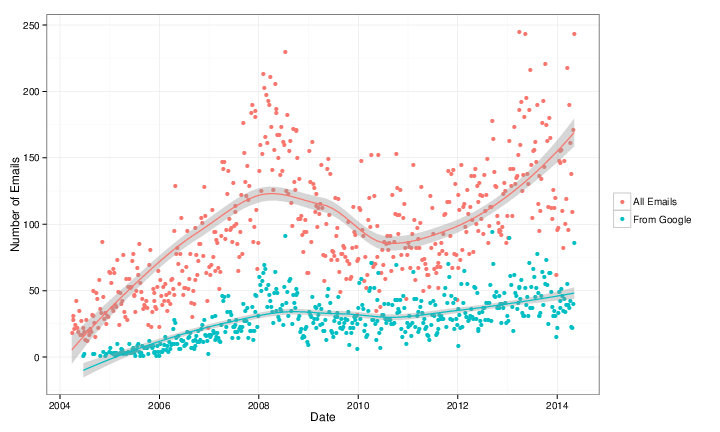
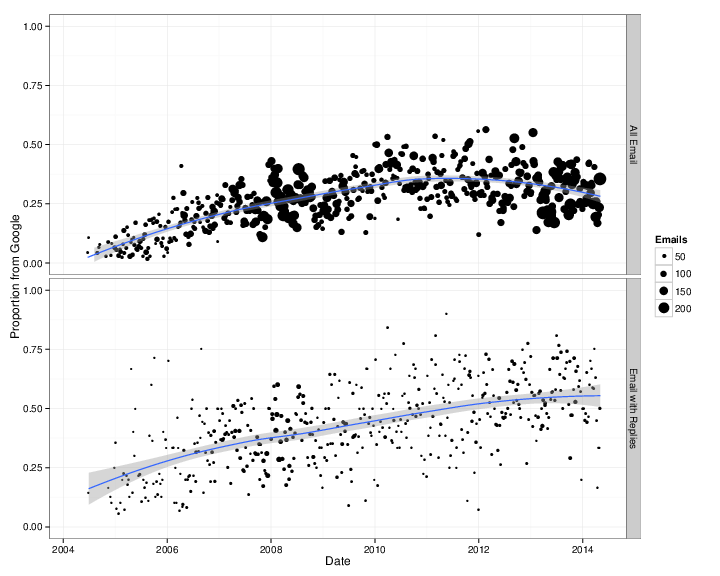
Republished by Slate. Translations available in French (Fran ais), Spanish (Espa ol), Chinese ( ) For almost 15 years, I have run my own email server which I use for all of my non-work correspondence. I do so to keep autonomy, control, and privacy over my email and so that no big company has copies of all of my personal email. A few years ago, I was surprised to find out that my friend Peter Eckersley a very privacy conscious person who is Technology Projects Director at the EFF used Gmail. I asked him why he would willingly give Google copies of all his email. Peter pointed out that if all of your friends use Gmail, Google has your email anyway. Any time I email somebody who uses Gmail and anytime they email me Google has that email. Since our conversation, I have often wondered just how much of my email Google really has. This weekend, I wrote a small program to go through all the email I have kept in my personal inbox since April 2004 (when Gmail was started) to find out. One challenge with answering the question is that many people, like Peter, use Gmail to read, compose, and send email but they configure Gmail to send email from a non-gmail.com From address. To catch these, my program looks through each message s headers that record which computers handled the message on its way to my server and to pick out messages that have traveled through google.com, gmail.com, or googlemail.com. Although I usually filter them, my personal mailbox contains emails sent through a number of mailing lists. Since these mailing lists often hide the true provenance of a message, I exclude all messages that are marked as coming from lists using the (usually invisible) Precedence header. The following graph shows the numbers of emails in my personal inbox each week in red and the subset from Google in blue. Because the number of emails I receive week-to-week tends to vary quite a bit, I ve included a LOESS smoother which shows a moving average over several weeks. Emails, total and from GMail, over timeFrom eyeballing the graph, the answer to seems to be that, although it varies, about a third of the email in my inbox comes from Google! Keep in mind that this is all of my personal email and includes automatic and computer generated mail from banks and retailers, etc. Although it is true that Google doesn t have these messages, it suggests that the proportion of my truly personal email that comes via Google is probably much higher. I would also like to know how much of the email I send goes to Google. I can do this by looking at emails in my inbox that I have replied to. This works if I am willing to assume that if I reply to an email sent from Google, it ends up back at Google. In some ways, doing this addresses the problem with the emails from retailers and banks since I am very unlikely to reply to those emails. In this sense, it also reflects a measure of more truly personal email. I ve broken down the proportions of emails I received that come from Google in the graph below for all email (top) and for emails I have replied to (bottom). In the graphs, the size of the dots represents the total number of emails counted to make that proportion. Once again, I ve included the LOESS moving average. Proportion of emails from GMail over timeThe answer is surprisingly large. Despite the fact that I spend hundreds of dollars a year and hours of work to host my own email server, Google has about half of my personal email! Last year, Google delivered 57% of the emails in my inbox that I replied to. They have delivered more than a third of all the email I ve replied to every year since 2006 and more than half since 2010. On the upside, there is some indication that the proportion is going down. So far this year, only 51% of the emails I ve replied to arrived from Google. The numbers are higher than I imagined and reflect somewhat depressing news. They show how it s complicated to think about privacy and autonomy for communication between parties. I m not sure what to do except encourage others to consider, in the wake of the Snowden revelations and everything else, whether you really want Google to have all your email. And half of mine. If you want to run the analysis on your own, you re welcome to the Python and R code I used to produce the numbers and graphs.

31 March 2014

Russ Allbery: Review: Sundiver

Review: Sundiver, by David Brin
Series: Uplift #1
Publisher: Bantam
Copyright: February 1980
Printing: September 1995
ISBN: 0-553-26982-8
Format: Mass market
Pages: 340
Sundiver is the first book of Brin's Uplift series, which I think it's fair to say are the books that made his reputation as an author. It's less well-known than the later sequels Startide Rising and The Uplift War for reasons that I'll get into in a moment. This was a re-read; I've read the first Uplift series before (and Startide Rising separately before that), but not in many years, and I wanted to re-read them and review them. I haven't finished doing that yet, several months after I re-read Sundiver, largely because this book wasn't as enjoyable as I remembered. The Uplift series is set in a heavily populated galaxy with a multitude of alien races. It follows the SF alien life pattern where the galaxy was well-populated and fully developed long before humans discovered it. The Earth is a relatively obscure backwater, and humans are expected to adopt to and follow the rules and restrictions that the other races had long-since established. This primarily means a complex and very formal system of caste and patronage: species brought to sapience by the technology of their patrons are expected to serve their patron races for millennia, and one's status in the galaxy is determined by the length of those patronage chains and the number of species one has fostered in turn. As is typical for stories of this sort, humans break the rules in unexpected ways. They have no known patrons, having apparently evolved sapience entirely on their own (although the galactic races are quite dubious of this theory). And they have uplifted two species to sapience (chimpanzees and dolphins) before their discovery by the rest of galactic civilization, although in fairly primitive ways and not properly by galactic standards. Set against this background, Sundiver is a science fiction puzzle story of a fairly old style. The protagonist, Jacob Demwa, is a scientific investigator who retired after a tragedy that killed his love. He's recruited out of that retirement and into this plot by an alien who is sympathetic to humans. A human exploration mission into the chromosphere of the Sun, treated as ridiculous by most of the galactics since the shared Library Institute certainly contains more information about stars than human technology could possibly uncover, has found strange and apparently sapient creatures living there: flocks of cattle-like creatures that are apparently being herded. There is no reference to such star-dwellers in the Library, which raises the possibility that humans have discovered something novel. That would be quite a coup against the galactics. But after the destruction of one of the solar exploration ships, it starts looking like these creatures are hostile. Jacob reminded me of a mix between a Larry Niven short story protagonist, working through the practical impact of a physics puzzle, and Isaac Asimov's Elijah Baley. What exactly is going on, both scientifically and politically, remains unclear for nearly the entire book. Both Jacob and the reader are constantly forming and then discarding hypotheses as events overtake them. The stakes are more interesting than a lot of science fiction novels: rather than survival or war, the stakes are prestige, influence, and status, with subtle but possibly vital effects on what position humans will take among the other species of the galaxy. All this sounds promising, and is why I remembered this book fondly. Unfortunately, re-reading it was a disappointing experience on several fronts. First, the characterization varies between trite and stereotyped. The aliens suffer from the standard alien characterization problem: each of them is an exemplar of their species, and all of the aliens feel like archetypes. While there are some twists in the inter-alien politics, one never gets a sense of the aliens as varied and complex societies in their own right. The humans are more varied, but that primarily means varieties of irritating. The worst is Peter LaRoque, a journalist who is set up as a villain of the story, and who is such an unremitting and over-the-top stereotype of everything possibly bad about journalists (and French people) that every scene containing him felt like someone scraping fingernails on a chalkboard. The other characters are a bit better, but not by much. Jacob himself has a bizarre, semi-mystical psychological problem from trauma that seems to give his amoral subconscious a life of its own. Brin appears to be setting this up to have major plot significance, but it never made any sense to me, didn't matter much in the end, and seems to mostly be an excuse for Jacob's hypercompetence. Sundiver's treatment of female characters also annoyed me enough to be worth a mention. The primary female character, Helene, is clearly intended to be a strong character with her own agency (she's both station commander and a starship captain), and Brin makes a lot of the humans switching to different words than male and female as a sign of a more egalitarian future. But this all feels skin-deep. The inevitable romance is all about Helene's attractiveness and ability to listen to Jacob, her logic is described as unscientific, and I got more and more annoyed by her portrayal as the book went along. She's not entirely without agency in the story, but she's much closer to a damsel in distress than the independent character Brin appeared to be trying for. It's hard to shake the feeling that she's being persistently belittled by the story. But this is a scientific puzzle story more than a mystery; characterization would be nice, but isn't strictly required. On re-read, the part of Sundiver that annoyed me the most was how much of a letdown the plot resolution was. I'm going to avoid any specific spoilers here, but I found the ending of both quite disappointing and a sign of the major problem with this series as a whole. The setup over-promises and Brin fails to deliver, a pattern that will repeat itself in this series. We get tantalizing hints of a new solar species, of revelations about the past of humanity, of deep galactic politics, and of vast knowledge contained in the Library that humans don't yet have access to. We get superficial archetypes for characters, politics that seem more like the bickering of children, plot twists that persistently take the story in more mundane and less interesting directions, and a sense of wonder, or lack thereof, that feels more like a Scooby Doo story than what I expect from science fiction. Some of the plot twists are unexpected and almost add some interest to the story, but don't make enough sense in the context of the story to be satisfying. And, of course, there's an climactic action sequence involving physical combat, as is required of all good Star Trek (original series) episodes. (I was waiting for Jacob's shirt to fall off.) The problem I have always had with Brin as a writer is that his ideas are far better than his ability to write characters and plots. In the hands of a better author, the Uplift universe background has so much potential. And I think Brin is a better author a few years later; my recollection is that both Startide Rising and The Uplift War do a better job of delivering on their promises. But Sundiver is deservedly forgettable. The good ideas rarely go anywhere beyond the obvious, the characters are irritating and often don't make sense, and the story is disappointing. I can't say I'm sorry to have read it, since my memory edited it down into a much better story, but I can only recommend it as background for later, better books. Rating: 4 out of 10

29 March 2014

Dirk Eddelbuettel: R / Finance 2014 Open for Registration

The annoucement below just went to the R-SIG-Finance list. More information is as usual at the R / Finance page:
Now open for registrations: R / Finance 2014: Applied Finance with R
May 16 and 17, 2014
Chicago, IL, USA
The registration for R/Finance 2014 -- which will take place May 16 and 17 in Chicago -- is now open! Building on the success of the previous conferences in 2009, 2010, 2011, 2012 and 2013, we expect around 300 attendees from around the world. R users from industry, academia, and government will joining 30+ presenters covering all areas of finance with R. We are very excited about the four keynotes by Bill Cleveland, Alexios Ghalanos, Bob McDonald and Luke Tierney. The main agenda (currently) includes sixteen full presentations and twenty-one shorter "lightning talks". We are also excited to offer four optional pre-conference seminars on Friday morning. To celebrate the sixth year of the conference in style, the dinner will be returning to The Terrace of the Trump Hotel. Overlooking the Chicago River and skyline, it is a perfect venue to continue conversations while dining and drinking. More details of the agenda are available at:
http://www.RinFinance.com/agenda/
Registration information is available at
http://www.RinFinance.com/register/
and can also be directly accessed by going to
http://www.regonline.com/RFinance2014
We would to thank our 2014 Sponsors for the continued support enabling us to host such an exciting conference:
International Center for Futures and Derivatives at UIC Revolution Analytics
MS-Computational Finance at University of Washington OneMarketData
RStudio
On behalf of the committee and sponsors, we look forward to seeing you in Chicago!
Gib Bassett, Peter Carl, Dirk Eddelbuettel, Brian Peterson,
Dale Rosenthal, Jeffrey Ryan, Joshua Ulrich
See you in Chicago in May!

This post by Dirk Eddelbuettel originated on his Thinking inside the box blog. Please report excessive re-aggregation in third-party for-profit settings.

14 February 2014

Mario Lang: Type erasure

Andrzej's C++ blog has a nice series on type erasure. I found it interesting to read and have learnt some things from it. For instance, I vaguely guessed, but did not fully realize, that std::function<> is of course a performance hit, since the way how std::function<> is implemented makes it impossible for the compiler to do anything useful with that function call. Inlining is totally out of the question, since we have just erased the type information. You might say, "of course!", but for me it was sort of a revelation. The series is in four parts: part I, part II, part III, part IV.

29 January 2014

Daniel Pocock: Lumicall: giving you choice when you dial

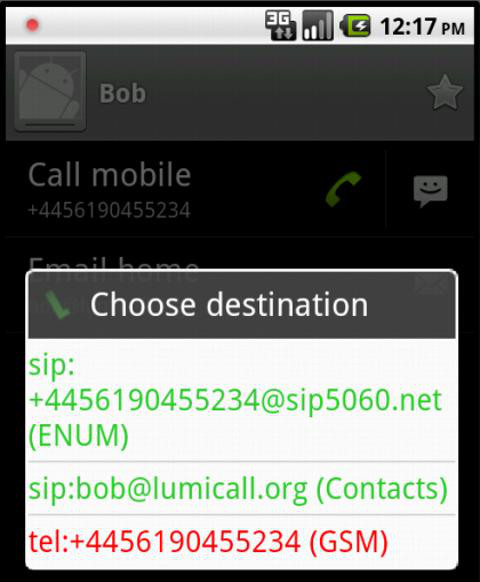
One of the distinguishing features of Lumicall, the free and open SIP/VoIP app for Android, is the unique dialing experience. In fact, even regular softphones for the desktop/laptop don't currently offer the same power when you want to make a call. In my previous blog, I looked at the ENUM technology that underpins part of this compelling new user experience. Here we can step back and look at the bigger picture. Choice is important, sneak preview of Sunday's talk at FOSDEM The fundamental reason for the dialing popup is to give the user choice. Choice is important. With that in mind, one of the key revelations that I will discuss during my talk about Lumicall this Sunday at FOSDEM is that I would like to give users the opportunity to use the Lumicall dialer with other VoIP apps, including Jitsi for Android and CSipSimple. To facilitate this, I hope to separate the dialing logic from the app and make it available as a standalone app or library module that can be used in any free communications software. Users expect convenience, Lumicall tries to deliver Have you noticed how many people will pick up their mobile phone to make a call even when they have a regular phone within reach? Have you found yourself calling your friends' mobile numbers even though you have their home and office numbers in your address book too? These mobile network calls are often at least ten times more expensive than landline calls and by definition they are infinitely more expensive than free calls made over the Internet. So why do people behave this way? The answer is simple: convenience. The caller does not want to make multiple efforts to dial, nor does he want to lose one or two minutes speaking to a secretary, colleague or spouse of the person he is trying to call. Dialing from the address book in his own mobile phone and calling the mobile number of the person he wants to speak with is the shortest path to success. It is efficient, it is compelling and it is what users expect. Free software products wanting to make an impact need to carefully align themselves with these user expectations and that is exactly what Lumicall tries to do. Choose your own adventure: dial the digits, use the address book or surf your call history Any of these everyday dialing practices triggers the Lumicall dialer. In this example, the user is trying to call Bob from the address book: While the user may have simply pressed the "call" button, Lumicall alerts them to several ways that they may proceed:
  • The first choice is a SIP address found in the ENUM directory, sip:+4456190455234@sip5060.net. Lumicall will take all the phone numbers associated with Bob in the address book and report any ENUM results associated with them. Here, just a single ENUM result is display.
  • The second choice is a SIP address constructed from Bob's email address. Lumicall found the email address in the address book entry and discovered that Bob's domain, lumicall.org, has a NAPTR record for SIP. Based on this discovery, Lumicall feels there is a good probability the email address is also a SIP address. If multiple email addresses are in the address book, they will all be checked for NAPTR.
  • (Not shown in the picture) if Lumicall has been configured to use a SIP-to-PSTN gateway account, it will display the option to call Bob's number through the gateway in blue
  • Finally, at the bottom of the list, Lumicall offers the option to call Bob's number in the normal manner, through the GSM network. This option is colour-coded in red to emphasize that it is usually the most expensive.
The tip of the iceberg This experience is a big improvement over the experience of the old rotary dial but it could also be taken even further. People don't always respond to their SIP address, especially if they live in a country where mobile data is not yet the norm. These are areas where Lumicall could be improved. For example, we could use SIP presence to make sure that Bob really is online before displaying the SIP option. This would reduce frustration and boost confidence in SIP. We could even go beyond that: Bob could use the SIP presence mechanism to advertise whether or not he is on a slow mobile data network or a fast network like 4G or wifi. You may choose to defer your call to Bob until he enters wifi coverage where the call quality is likely to be better and maybe video will be possible. This latter opportunity also has privacy implications: Bob may only choose to share that live insight into his network coverage with contacts he trusts. Try it at FOSDEM I will spend some time around the real-time lounge at FOSDEM and would be delighted to get feedback from users who are trying Lumicall, FreePhoneBox.net, JSCommunicator, DruCall or the new Debian SIP service.

17 January 2014

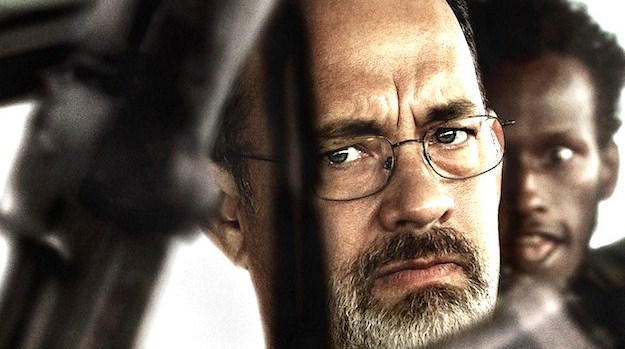
Chris Lamb: Captain Phillips: Pontius Pirate

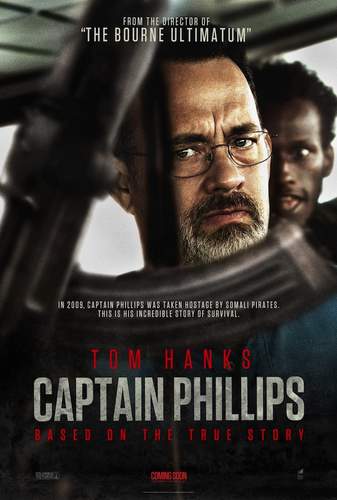
https://chris-lamb.co.uk/wp-content/2014/phillips_b.jpg Somalia's chief exports appear to be morally-ambiguous Salon articles about piracy and sophomoric evidence against libertarianism. However, it is the former topic that Captain Phillips concerns itself with, inspired by the hijacking of the Maersk Alabama container ship in 2009. What is truth? In the end, Captain Phillips does not rise above Pontius Pilate in providing an answer, but it certainly tries using more refined instruments than irony or leaden sarcasm. This motif pervades the film. Obviously, it is based on a "true story" and brings aboard that baggage, but it also permeates the plot in a much deeper sense. For example, Phillips and the US Navy lie almost compulsively to the pirates, whilst the pirates only really lie once (where they put Phillips in greater danger). Notice further that Phillips only starts to tell the truth when he thinks all hope is lost. These telling observations become even more fascinating when you realise that they must be based on the testimony of the, well, liars. Clearly, deception is a weapon to be monopolised and there are few limits on what good guys can or should lie about if they believe they can save lives.
https://chris-lamb.co.uk/wp-content/2014/phillips_c.jpg

Even Phillip's nickname ("Irish") is a falsehood he straight-up admits he is an American citizen.

Futhermore, there is an utterly disarming epilogue where Phillips is being treated for shock by clinical efficient medical staff. Not only will this scuttle any "blanket around the shoulders" clich but is probably a highly accurate portrayal of what actually happens post-trauma. This echoes the kind of truth Werner Herzog aims for in his filmmaking as well his guilt-inducing duality between uncomfortable lingering and compulsive viewing. Lastly, a starter for a meta-discussion: can a film based on real-world events even be "spoilered"? Hearing headlines on the radio before you read your newspaper hardly robs you of a literary journey... Captain Phillips does have some quotidian problems. Firstly, the only tool for ratcheting up tension is for the Somalians to launch verbal broadsides at the Americans, with each compromise somehow escalating the situation. This technique is effective but well before the climatic rescue scene where it is really needed it has been subject to the most extreme diminishing returns. (I cannot be the first to notice the "Africans festooned with guns shouting incomphensively" trope I hope it is based on a Babel-esque mechanism of disorientation from miscommunication rather than anything more unsavoury.)
https://chris-lamb.co.uk/wp-content/2014/phillips_a.jpg

The racist idea that Africans prefer an AK-47 rotated about the Z-axis is socially constructed.

Secondly, the US Navy acts like a teacher with an Ofsted inspector observing quietly from the corner of the classroom; far too well-behaved it suspends belief, with no post-kill gloating or even the tiniest of post-arrest congratulations. Whilst nobody wants to see the Navy overreact badly to other military branches getting all the glory, nobody wants to see a suspiciously bland recruitment vehicle either. Paradoxically, this hermetic treatment made me unduly fascinated by them as if they were part of some military "uncanny valley". Two quick observations:
https://chris-lamb.co.uk/wp-content/2014/phillips_d.jpg

The drone footage: I'd love to write an essay about how Call of Duty might have influenced (or even be) cinema.

Finally, despite the title, the film is actually about two captains; the skillful liar Phillips and ... well, that's the real problem. Whilst Captain Muse is certainly no caricatured Hook, we are offered little depth beyond a "You're not just a fisherman" faux-revelation that leads nowhere. I was left inventing reasons for his akrasia so that he made any sense whatsoever. One could charitably argue that the film attempts to stay objective on Muse, but the inability for the film to take any obvious ethical stance actually seems to confuse and then compromise the narrative. What deeper truth is actually being revealed? Is this film or documentary? Worse still, the moral vacuum is invariably filled by the viewer's existing political outlook: are Somali pirates victims of circumstance who are forced into (alas, regrettable) swashbuckling adventures to pacify plank-threatening warlords? Or are they violent and dangerous criminals who habour an irrational resentment against the West, flimsily represented by material goods in shipping containers? Your improvised answer to this Rorschach test will always sit more haphazardly in the film than any pre-constructed treatment ever could. 6/10

Chris Lamb: Review: Captain Phillips (2013)

https://chris-lamb.co.uk/wp-content/2014/phillips_b.jpg Somalia's chief exports appear to be morally-ambiguous Salon articles about piracy and sophomoric evidence against libertarianism. However, it is the former topic that Captain Phillips concerns itself with, inspired by the hijacking of the Maersk Alabama container ship in 2009. What is truth? In the end, Captain Phillips does not rise above Pontius Pilate in providing an answer, but it certainly tries using more refined instruments than irony or leaden sarcasm. This motif pervades the film. Obviously, it is based on a "true story" and brings aboard all that well-travelled baggage, but it also permeates the plot in a much deeper sense. For example, Phillips and the US Navy lie almost compulsively to the pirates, whilst the pirates only really lie once where they put Phillips in greater danger. Notice further that Phillips only starts to tell the truth when he thinks all hope is lost. These telling observations become even more fascinating when you realise that they must be based on the testimony of the, well, liars. Clearly, deception is a weapon to be monopolised and there are few limits on what good guys can or should lie about if they believe they can save lives.
https://chris-lamb.co.uk/wp-content/2014/phillips_c.jpg

Even Phillip's nickname ("Irish") is a falsehood he straight-up admits he is an American citizen.

Lastly, there is an utterly disarming epilogue where Phillips is being treated for shock by clinical efficient medical staff. Not only will it scuttle any "blanket around the shoulders" clich but is probably a highly accurate portrayal of what actually happens post-trauma. This echoes the kind of truth Werner Herzog often aims for in his filmmaking as well his guilt-inducing duality between uncomfortable lingering and compulsive viewing. Another angle worthy of discussion: can a film based on real-world events even be "spoilered"? Hearing headlines on the before you read the newspaper hardly robs you of a literary journey... Captain Phillips does have some quotidian problems. Firstly, the only tool for ratcheting up tension is for the Somalians to launch verbal broadsides at the Americans, with each compromise somehow escalating the situation further. This technique is genuinely effective but well before the climatic rescue scene where it is really needed it has been subject to the most extreme diminishing returns. (I cannot be the first to notice the "Africans festooned with guns shouting incomphensively" trope I hope it is based on a Babel-esque mechanism of disorientation and miscommunication rather than anything, frankly, unsavoury.)
https://chris-lamb.co.uk/wp-content/2014/phillips_a.jpg

The racist idea that Africans prefer a AK-47 rotated about the Z-axis is socially constructed.

Secondly, the US Navy acts like a teacher with an Ofsted inspector observing quietly from the corner of the classroom; far too well-behaved it suspends belief, with no post-kill gloating or even the tiniest of post-arrest congratulations. Whilst nobody wants to see the Navy overreact badly to other military branches getting all the glory, nobody wants to see a suspiciously bland recruitment vehicle either. Paradoxically, this hermetic treatment made me unduly fascinated by them, as if they were part of some military "uncanny valley". Two quick observations:
https://chris-lamb.co.uk/wp-content/2014/phillips_d.jpg

The drone footage: I'd love to read (or write) an essay about how Call of Duty might have influenced cinema.

Finally, despite the title, the film is actually about two captains; the skillful liar Phillips and ... well, that's the real problem. Whilst Captain Muse is certainly no caricatured Hook, we are offered little depth beyond a "You're not just a fisherman" faux-revelation that leads nowhere. I was left inventing reasons for his akrasia so that he made any sense whatsoever. One could charitably argue that the film attempts to stay objective on Muse, but the inability for the film to take any obvious ethical stance actually seems to confuse and then compromise the narrative. What deeper truth is actually being revealed? Is this film or documentary? Worse still, the moral vacuum is invariably filled by the viewer's existing political outlook: are Somali pirates victims of circumstance who are forced into (alas, regrettable) swashbuckling adventures to pacify plank-threatening warlords? Or are they violent and dangerous criminals who habour an irrational resentment against the West, flimsily represented by material goods in shipping containers? Your improvised answer to this Rorschach test will always sit more haphazardly in the film than any pre-constructed treatment ever could. 6/10

1 January 2014

Debian Sysadmin Team: Martin Zobel-Helas: RFH: ferm integration into dsa-puppet.git

The Debian Project currently runs about 100 machines all over the world with different services. Those are mainly managed by the Debian System Administration team. For central configuration management we use Puppet. The Puppet config we use is publicly available here. Our next goal is to have a more or less central configuration of our iptables rules on all those machines. Some of the machines have home-brewed firewall scripts, some use ferm. Your mission, if you choose to accept it, is to provide us with a new dsa-puppet git branch with a module "ferm" that we can roll out to all our hosts. It might want to use information from the other puppet modules like "apache2_security_mirror" or "buildd" to decide which incoming traffic should be allowed. DSA will of course provide you with all necessary further information.

24 December 2013

Gergely Nagy: Some free software are really free

I read a post titled "Free software is NOT Free", and that triggered a few thoughts, which I would like to share here. While the post has some good thoughts, there are points in it which I disagree with strongly. You see, I've been writing free software almost half my life, most of the things I contributed to various projects, and the vast majority of my own projects, were made because it made me feel good. Because I scratched an itch, and sharing filled me with a sense of accomplishment.I always had bills to pay, and I have a day job to get that kind of thing sorted, yet, I do not believe that the quality of my free software work suffers because of that. Do I have less time? Yes, I do. But slower pace does not mean lesser quality - more often than not, I found that slower pace leads to better considerations, more care given to each change, because fixing it later, fast, is much more costly, so you make sure that your improvements will stand the trial of time.But I digress. I want to share a different view on the topic, based on my own experiences.When I first got into free software, I was young, bright-eyed, full of hopes and illusions of grandieur. I did my part of small contributions here and there, and every bit of "Thanks!", every bit of feedback - be it criticism or rejection - contributed to my development. This part of the free software culture is still important to me, and remains a major factor behind my desire to work on free software. Later on, there came another revelation: people actually use the stuff I write! That's an awesome feeling too, but with it, comes a burden too: supporting users, and trying to cater to every need that arises. To combat this, to not drown, you need to learn to say "No". It is hard, but as maintainer of a project, it's your task to keep it maintainable, and you need to know your limits. Would it be better if you could fulfil every wish? If you could do everything you ever dreamed of? You may think the answer is yes, but you're wrong. The answer is "No".Not everything needs to be done, not every wish needs to come true. As always, there's a balance. Limiting the amount of time that can be spent on a project helps keep that balance. And when balance is found, the project becomes more mature, maintenance stops being a chore you do not want to do, but have to, and instead becomes something you actually enjoy. We are human beings, we dream and wish for a lot, and we have a hard time realising our limits. That makes us feel sad, sometimes even inadequate. Having less time puts us into a different position, where were are forced to reevaluate how we spend the little free time we have. In the long run, I believe that is good for free software.But there's an even better way to approach the problem! You want to work on your projects, right? Yet, you also want to pay your bills. And you are a fan of free (as in freedom) software. When I found myself in a position like that, when I was looking for work, I was looking at companies which are friendly towards free software, and even have a few on their portfolio. Working for such a company allows me to be happy with myself, by not betraying my own beliefs, and on the side, still spend time on my own things.When I spend my day working on free software, I feel energised, and during lunch break, I can look through my plans for my own projects (some of which are related to my work too, which makes it even easier to spend time on them), plan ahead, and go home with a head full of ideas. No exhaustion after a daunting day of hacking proprietary software, with a sinking heart. No feeling guilty of not taking good care of your projects, because you do take care! You just do it on your own terms.So this is my suggestion to independent free software hackers: find a free software friendly company, that allows - or even encourages - you to work on your own things too. That way, you can pay your bills, and work on your hobbies, and best of all: keep them as hobbies, so it does not become a burden. When a hobby becomes your job, that often leaves a sour taste behind, when you can't fulfil every need, or fix every issue.Get a free software day-job, and keep your hobby as such, and everyone benefits. You get to keep your sanity, and users will receive better care, because the developers do what they love, and not what they have to.You give up some of your freedoms, yes, by not being independent. But being independent is not always the right choice. For some people, it may well be, for some, not so much. My experience over the past 15 years or so, is that independence brings a lot more headache than I'm willing to deal with. I'd rather work for a free software friendly company, where, after three years, I get paid to write and contribute to free software, and take care of my personal projects on the side, than try do all of it on my own.None of the software I wrote is worth a full salary, and none of them requires me to work full time on them, either. I could, mind you, I have enough ideas lined up to keep me busy for years. But do I want to? Do I want to burn myself out?No. The day job satisfies my hunger for contributing to a widely used piece of software, and my hobby projects satisfy my exploratory needs. I'm happy this way, and I'm very happy that thanks to the work and dedication of some amazing people, we got this far, that one can have a day job and independent projects too, that are all free software, without having to depend on fairly unreliable sources, such as donations (mind you, donations are a nice extra).There are, of course, different situations, and different people. What works for one, may not work for the other. This is what worked for me, and I felt the need to share it, lest anyone thinks that the world's darker than it really is.

18 November 2013

Russ Allbery: Review: Anathem

Review: Anathem, by Neal Stephenson
Publisher: William Morrow
Copyright: 2008
ISBN: 0-06-147409-6
Format: Hardcover
Pages: 935
Fraa Erasmas is a little less than twenty years old and is an avout of the decade math of the Concent of Saunt Edhar. As Anathem opens, he's approaching his first apert. All of those words are left for the reader to puzzle out for themselves, unless you cheat and read the glossary (which I would recommend doing only with caution, but more on that in a moment), since Erasmas, the first-person narrator of this story, writes (mostly) as if the reader is familiar with the mathic world and its concepts. Translated into English, it means that Erasmas was brought into something akin to a scientific monastery (the "math") at around the age of nine and has been there for ten years, since his math is a decade math and therefore remains closed to all outside (s cular) ideas and contact for periods of ten years at a time. He is still a student there, not yet declaring allegiance to one of the chapters. That's something that he will be expected to do after the first apert. Every ten years, the decade math opens its doors to the outside world for a period of ten days (apert), and the fraas and suurs can leave the math and travel through the outside world as they wish. The start of Anathem is an exercise in alienation and reorientation. Stephenson has constructed a complex society with a long history and its own specific technical jargon and throws the reader into it with a minimum of orientation. Despite being familiar with SF novels that use this technique, I did read the preface and recommend that other readers do as well unless they particularly love piecing together a world from hints and clues. The timeline, in particular, was invaluable and something I referred to throughout the story. But even with the preface, you should expect to read the first part of Anathem interpolating meanings from context or just letting things slip past until you later come to understand them. A lot of people bounce off of Anathem here, and it's one of the reasons why I'd been postponing reading it (the other being that it's a substantial doorstop and I wanted to give it my undivided attention). But it's really not as bad as I feared. One gets a feel for the terms fairly quickly, and the more difficult ones Stephenson defines as he goes with excerpts from a dictionary of the mathic world. I found it slightly disorienting for a chapter or two, and then it started growing on me. The terminology is sometimes different just for the sake of being different (jeejahs are indistinguishable from smartphones for all practical purposes), but usually the invented words provide either important links to the past of the constructed world of Arbre or are technical terms that add precision and clarity once you know their meanings. It can be a little bit frustrating to remember the mapping of famous theories and theorems to the Orth names, but only mildly. (And Diax's Rake is so useful of a name for something that English doesn't name that I may start using it myself.) This is also why I recommend against reading the glossary. The definitions of terms are linked to important parts of history, which are, in turn, linked to important parts of the plot, and the glossary therefore risks spoilers. I liked having the term introduced by the frequent dictionary excerpts scattered through the chapters, and enjoyed the feeling of the terminology unfolding with the plot. The glossary is there if you really get lost, but I think the experienced SF reader (particularly if you have enough history background to pick up on the obvious parallels and start mapping bits to Greece, Rome, the Catholic Church, etc.) will be able to navigate the language without that much difficulty. I also stopped caring about the terminology because the story is so engrossing that it pulled me right into the book, closed over me, and made Erasmas's world feel real, precious, and fascinating. Whether that's going to be true of other people is a surprisingly difficult question, and one that I'll try to tackle as part of this review. But I will say up-front that I think this is the best book that Stephenson has ever written, even better than Snow Crash, despite some undeniable flab and one extremely irritating choice. Anathem is, at its heart, a novel about the scientific method. I think it's the first book by Stephenson that elegantly mingles his tendencies (and obsessions) as a writer with the interests (and obsessions) of the characters and makes the whole novel feel coherent. All of Stephenson's books are prone to discursive infodumps, but they've usually had to be shoehorned in around the characters. Even with the Baroque Cycle, a series full of natural philosophers, the digressions are jammed in around the plot like the filling of an over-packed box and frequently stick out at odd angles or dribble out on the floor. With Anathem, Stephenson has populated a book full of characters who have completely believable and engrossing reasons to digress into scientific debate and analysis, can put them into dialogue and thereby avoid some of the strain of the infodump, and (most importantly) largely restrains himself from narrative digressions via first-person narration and careful attention to when the characters themselves would follow the same digression. In short, this is a book full of very smart and very well-educated people who figure things out from first principles using agreed-upon theory, thrown into an unknown and dangerous situation that requires a great deal of deep thinking, science, engineering, and philosophy. All of Stephenson's quirks are still here, on prominent display, but rarely have I ever seen a better match of writer, characters, plot, and world background than this book. I would go so far as to say that, if you don't like this book, you're unlikely to like any long Stephenson. I haven't said a lot about the plot. Erasmas's apert is only the first part, and barely touches on any significant plot elements. It's mostly there to set some groundwork, introduce characters, and get the reader oriented. I'm not going to say much more, since the way the novel transitions from routine to unusual to emergency, and the resulting scramble to understand the emergency, is the heart and soul of this book and should not be spoiled. (I spoiled myself slightly by reading some analysis that I shouldn't have and regretted it, although it wasn't too much of a problem.) This is one of Stephenson's best-plotted novels. It develops slowly enough for the reader (and the characters) to think hard about it and make some good and bad guesses, but fast enough to stay engrossing. Most of it is very well-paced provided that you find the background of science and philosophy of science interesting. (If you don't, this is probably not a book you're going to enjoy.) I say "most of it" because, as mentioned earlier, this book is a bit flabby. There are a couple of sections where the theory and analysis are pushed aside by exigent circumstances and more action-oriented plot elements, both of which reminded me that Stephenson is very bad at writing action sequences and both of which I wished were shorter. And there are a couple of sections where Erasmas is getting oriented to a new situation or working up the courage to do something where I wished he'd get on with it already. But for a novel of nearly 1,000 pages, the amount of tension and reader interest Stephenson maintained for me was quite impressive. But as good as the plot is, the best part of this book is its full-bore, no-apologies embrace of understanding things. This is a book about making sense of the world, and about what it means to make sense of the world, and how you go about it, and what preconditions are required to do so. It is not, contrary to so much science fiction, a book about knowing things. The people who are already experts appear in this book, but generally only in the context of figuring out new things they've not previously been exposed to. Rather, it's a book about learning things, the thrill that comes from applying theory to understand something new, and the satisfaction of working through something from first principles or previously-established theory, arriving at testable predictions, and then testing them. It's the first novel I've read that captures some of the joy and delight that I got from reading George Gamow's One Two Three... Infinity as a child. Stephenson novels have always been about showing the reader neat things he learned, but I think previous books relied on the reader to bring their own enthusiasm. Anathem, at least for me, goes a step farther and uses the passion and approach of its characters to create that enthusiasm. It's one of those books that I not only enjoyed but went away from feeling like it made me a better person in some subtle but detectable way. Sadly, this is also where the irritating part comes in. I'm going to be very careful and indirect here, since the details are all extremely significant spoilers. You may want to skip to the last paragraph of this review if you want to avoid any knowledge about the end of Anathem. Stephenson pulls several rabbits out of the hat in this book, but most of them are well-defended and nicely handled bits of misdirection. There are a few where I thought the science or engineering was dubious, but even those are usually backed with enough hand-waving about Arbre technology that I could swallow it enough for the purposes of this book. (The timeline here is very helpful in allowing one to write off a few things as unknown technology.) But he puts, at the core of the plot, one of the most scientifically dubious bits of the whole book, and there's simply no avoiding that by the end of the story. Now, this doesn't mean that he just expects the reader to swallow it. Much of Anathem is a carefully-constructed defense of the bits he uses for the plot, and the defense is not half-bad within his fictional world. There are substantial in-book justifications for believing these techniques will work on Arbre even if they wouldn't in our scientific domain. So it's not so much the plausibility that bothered me; the idea is at least as plausible as some of the FTL drive concepts that I've swallowed without complaint. I do hold Anathem to a higher standard because the book is about science in a way that most science fiction isn't, but even with that, I think Stephenson mostly managed to dance across the thin ice he built. The problem is more subtle but more serious: if taken seriously on its own terms, the approach Stephenson takes to the plot destroys science in his universe. I can't really say more than that, since all of the details are huge spoilers, but the more I thought about it, the more irritated and annoyed I got. Anathem is otherwise a brilliant defense of the scientific method, and it felt like Stephenson injected a poison pill in the center of it, leading necessarily to a world where the scientific method no longer works. This does not happen on camera, or even between the pages of the book; you have to think about the implications for a while before you realize that's what happened. But once you do, it's a bitter pill to swallow, and it's hard to escape the feeling that it fundamentally undermines Stephenson's whole project here. And, to make it worse (although also oddly better in a way), I think it was unnecessary. He would have had to reconstruct the ending, but I can't shake the feeling that there were ways to write the ending, even maintaining the same character strengths, without having to pull that particular rabbit out of the hat. Because I think it's, in the end, unnecessary, I was still able to enjoy the whole book, including the ending, despite this, but while the rest of Anathem is a wholehearted 10, that choice knocked a full point off my impression of the book. It's profoundly irritating precisely because Stephenson did such an excellent job with the rest of it. But, that said, this book is still exceptional. I think it's the book that Stephenson was meant to write. Not only did he get the overall construction nearly perfect, he gets so many of the details right, from the history (which for a while I thought was merely clever, once I started seeing the correspondences that moved it out of the realm of pure invention, but which transitioned back to profound with later revelations in the book) to the language to the way that he excerpted some theoretic digressions into very well-done appendices. If you've ever thought of a theory as beautiful, or like reading about smart people debating the nature of understanding and knowledge, I cannot recommend this book too highly. Despite the highly irritating flaw at its center, and despite a few sections that show Stephenson is not a well-rounded writer, I think it's brilliant. Rating: 9 out of 10

16 November 2013

Russ Allbery: Review: Blue Remembered Earth

Review: Blue Remembered Earth, by Alastair Reynolds
Series: Poseidon's Children #1
Publisher: Ace
Copyright: January 2012
Printing: June 2012
ISBN: 0-441-02071-2
Format: Hardcover
Pages: 505
Geoffrey Akinya is one heir to the vast Akinya business empire, which straddles the solar system and has created vast riches from exploration and mining. He wants nothing to do with it. His passion is elephants: long and methodical study of wild herds in Africa, including a slow and careful investigation into their thought processes. His obnoxious and superior cousins have a passion for business and finance and can have the running of the company for all he cares. But Geoffrey's grandmother Eunice, the family matriarch and driving force behind much of their business expansion, has died. Her ashes are brought back to Africa from the Winter Palace in orbit around the Moon where she lived out her final days and scattered in a family ceremony. And, shortly thereafter, Geoffrey's cousins convince him to investigate a safe-deposit box left on the Moon by Eunice to ensure that it doesn't contain anything damaging to the family. What it contains is the first step in a puzzle. Despite himself, Geoffrey and his sister Sunday an artist and family black sheep who lives in a region of the Moon that is one of the sole holdouts against the ubiquitous monitoring common in the rest of the inhabited solar system are slowly pulled into unraveling that puzzle. This leads them into an uneasy alliance with one of the major political forces in the solar system and some startling revelations about their grandmother's actual plans. Blue Remembered Earth is another entry in the currently-popular sub-genre of solar system SF. Interstellar travel is still a dream, but a combination of improved technology, suspended animation, and heavy use of robots and robotic factories has let humans slowly expand into more of the solar system. On Earth, powers have risen and fallen, and the leap into the solar system coincided with a surging and powerful Africa. Extensive undersea colonization has established a new international consortium of sea-floor countries, and Earth politics have realigned into a diplomatic and business struggle between surface and oceanic nations. Unusually for this sort of fiction, most characters of significance in this story are African. The United States and Europe have quietly disappeared in the way that all non-US countries tend to in most other SF. Reynolds doesn't do very much with this setup (and the characters don't seem distinctly African to me). It's just there as the unremarked normal. I liked that. I kind of wish more of African culture had come through in the story, but there are enough SF novels with an assumed and unremarked white (and usually US) future that an assumed and unremarked black African culture is a nice change of pace. I picked up this book in part because it was described as a better 2312. That's a fairly accurate summary (although only helpful to those who have read Kim Stanley Robinson's novel). The scope and setting are similar, although Reynolds's future cuts back on the scope of off-world human colonization, relies more heavily on robotics, and keeps the power base on Earth. Both books are structured as a mystery, although in Blue Remembered Earth that mystery is deliberately planted for the characters. Reynolds is nowhere near as good at set pieces as Robinson, sadly. There's nothing here at the level of some of the scenes on Mercury in 2312. But he is much better at plotting and characterization, and Blue Remembered Earth tells a coherent story with increasing tension and a satisfying ending. Reynolds here uses an interesting strategy for spinning a mystery out of pieces of knowledge and discovery: set the discovery process prior to the novel, use protagonists who were unaware of it, and turn the details into a mystery that they have to investigate. This is an interesting way to address the problem that most discovery processes are slow and not particularly dramatic. It is artificial Eunice creates the plot for the novel but that worked for me. By the end of the book, I think I understand her reasons for doing so, and both Geoffrey and Sunday have good reasons to not be aware of any of the details before they start following the clues that Eunice leaves behind. The mystery of course sends Geoffrey and Sunday on a bit of a tour of the solar system as well as a tour of the past of their family business and the politics of the present. Here, Reynolds draws on an old SF idea: a conflict between groups that want to mechanize space exploration and groups that want to adapt humans for space. Long-time SF readers will be familiar with this approach, and I don't think Reynolds does anything startlingly new with it, but I thought it was a well-executed side plot. And, for once, an SF author realizes that Earth's oceans are as compelling of a place for that conflict to play out as outer space. There are, of course, significant mysteries to be uncovered, but it takes much of the book before those revelations start (even if one of them is almost spoiled in the dust jacket summary). The story up until that point is driven by character, particularly Geoffrey's stubborn annoyance at the rest of his family and his complete lack of interest in being the protagonist of a novel. I should probably warn here that many of the Amazon reviews disliked this book because of the characters, particularly Geoffrey. Apparently he comes across to some as whiny, resentful, and annoying. I, however, didn't have this reaction at all, possibly in part because I wholeheartedly share his opinion of both big business and his cousins. I thoroughly enjoyed reading an SF novel whose main characters are not driven either typical capitalist motives or a desire for personal exploration, but instead are pulled into the plot through a sense of loyalty and an inability to get out of the way of the problem. I also liked the way Reynolds manages to broaden and deepen the reader's appreciation for the characters as the story unfolds, and even salvages some characters I thought were unsalvageable. The last third of the book features some excellent plot twists and some very nicely-handled revelations. This is apparently the first book of a trilogy, and I had a suspicion at the end of the book that sequels were coming, but I think it stands on its own quite well. Most of the questions raised by the plot are resolved by the end of the book, and those that remain are of a size that other books have left unanswered intentionally. Despite not reaching the same moments of awe-inspiring beauty, and despite more workman-like descriptions, the stronger plot and more interesting characters do make Blue Remembered Earth a better 2312 for me. Given that 2312 won a Nebula, that's saying something (although I don't agree with that award). It's a bit deliberate in its pacing, and the plot built around a constructed puzzle can feel a bit artificial, but I think it's a solid and satisfying near-space SF novel. Followed by On the Steel Breeze. Rating: 7 out of 10

15 October 2013

Daniel Pocock: Debian Outreach Program for Women 2013

Debian's Outreach Program for Women (OPW) is underway. This is a huge thing and not just something that female developers need to be concerned with. Untapped potential Many computer science schools see about twenty percent of places occupied by female students. In the Debian community, however, about one percent of developers are female. As there are about one thousand male developers, this suggests there are another one hundred potential female developers and contributors out there who are not aware of the fact that they could be part of Debian. Finding these people and helping them fulfil their potential makes the project better for everybody. Women are heavy lifters People should not assume that these women are going to need their hands held. When the Jitsi project recently moved to Github, the Github repository reports made the surprise revelation that Yana is the top contributor - by a fifty percent margin. Will women save the world this week? It is not just in software engineering that women have significant potential. As the men running the US bumble around with their high-stakes game of chicken, it is notable that last week the US Federal Reserve appointed their first female chairman, Janet Yellen. It is unlikely that her first meeting with female IMF boss Christine Lagarde would have satisfied stereotypes about casual gossip or shopping; more likely, they would be contemplating how to save the world economy if rogue congressmen push the US into default - a possibility that is no longer just an outlier. Integrating financial software in Debian With that in mind, one of the projects I've offered to mentor under OPW involves creating further integration between free software for finance and accounting on Debian. Several applicants have already contact me about this. Fundraising to support OPW 2013 Debian is currently raising funds to support this program. The project administrators are hopefully going to provide more details soon about how funding will be allocated and how many projects will proceed.

14 October 2013

Bits from Debian: Ada Lovelace Day: meet some of the "women behind Debian"!

Today is Ada Lovelace Day:
"Ada Lovelace Day is about sharing stories of women - whether engineers, scientist, technologists or mathematicians - who have inspired you to become who you are today. The aim is to create new role models for girls and women in these male-dominated fields by raising the profile of other women in STEM". source
To celebrate, we asked to some of the "women behind Debian" to share their stories with us. Enjoy! Alt Ada Lovelace portrait Ana Guerrero Lopez (ana) Who are you? I'm a 30-something years old geek. I'm from Andalusia, Spain but live in France. What do you do in Debian? I work mostly on my packages, in sponsoring new people's packages and in this very blog you're reading now. I also maintain an unofficial Google+ page about Debian. At $PAID job, I work in an internal Debian distribution so from time to time, I get the opportunity to contribute back some of the stuff we do there. How and why did you start contributing to Debian? I started using Debian around 2003 switching from Mandrake. I was a happy Debian user when the Debian Women project started in the summer 2004. When I saw the project announced, I asked myself why I wasn't contributing to Debian and the rest is history... in a couple of weeks it'll be my 7 years DD-versary! If for some reason you want a longer reply to this question, read here. Beatrice Who are you? I am a PhD student with a degree in Biology. I am a computer fan since my first C64 and I am a self-taught computer geek wanna-be. And I am a bug fan - not software bugs, real bugs :) What do you do in Debian? I work on translations - doing the translation work itself, but also reviewing other translators' work and helping in coordinating the translation effort. How and why did you start contributing to Debian? I started using Linux because I liked the idea of an open source operative system based on collaboration and I began reviewing open source software translations. Since my first Linux system was Debian Potato and I sticked to Debian ever since, it only seemed natural to focus my translation work on Debian. Christine Caulfield Who are you? My name is Christine Caulfield. My day job is principal software engineer at Red Hat working on the cluster infrastructure components corosync & pacemaker. Outside computing I'm a musician and sound engineer. I play violin with lots of technology attached, and love avant garde music. What do you do in Debian? I'm not that active on Debian any more due to pressure of time, and maturity of the packages I work on. I currently maintain the, little-used, DECnet userspace packages and the, even less used I suspect, mopd bootloader. I used to maintain lvm2 for a while but dropped that a few years ago. How and why did you start contributing to Debian? My initial reasons for joining Debian were slightly selfish, to find a home for the DECnet project that I was heavily involved in at the time. I was a keep Debian user and people wanted a distribution where the software was easy to set up. DECnet is quite complicated for users to configure, being a totally independant networking stack to IP and so OS support is needed. Debian seemed like the logical place to make this happen. As mentioned above I got quite involved for a time and maintained other packages too. I picked up lvm2 because I was on the lvm2 dev team at work in Red Hat and as it was a new package at that time I seemed a logical choice. Elena Grandi (valhalla) Who are you? I'm a 30-something years old geek and Free Software enthusiast from Italy. What do you do in Debian? I'm currently maintaining a few packages (2 python modules and a python program) as a sponsored uploader; I'm also slowly looking around for other things to do (by preference technical, but not limited to packaging), with the aim to spend more time contributing to Debian. How and why did you start contributing to Debian? For a while I had being distro-hopping between "fun" distributions (the ones that break now and then) on the desktop while using Debian stable on the home server and in chroots. I was already doing marginal contributions to those distributions, where finding stuff that was missing was easy, but my perception as a stable user was that Debian was already working fine and probably didn't really need any help. Then I started to socialize on IRC with some DDs and DMs, and realized that my perception was superficial and that in reality there were dark holes in the depths of the archive where Evil festered and prospered and... ok, sorry, I got carried away :) Anyway, since I was actually using Debian more and more I decided to start contributing: I read documentation, I attended the useful IRC sessions on #debian-women and decided that it was probably best not to add new stuff, but look for things that I used and that needed help. Then nothing happened for a while, because finding stuff that doesn't work is hard (at least on my mostly textual systems). Then one day I was trying to write a python script that needed to verify gpg signed messages; it had to run on my Debian server, so I was trying to use python-pyme and its documentation was painful to use, while I remembered an earlier attempt using python-gnupg that was much more pythonic, but not available in Debian. In a fit of anger I decided to forgo all of my good intentions and actually add a new package: I checked the sources for problems, packaged, sent it to mentors@d-o, got reviews, fixed problems, resent and finally got sponsored and well, everything started. Francesca Ciceri (madamezou) Who are you? I'm Francesca, a 30-something Italian graduated in Social Sciences. What do you do in Debian? I'm a (non uploading) Debian Developer since 2011 and have been DPN editor, press officer, webmaster for www.debian.org and translator for the Italian l10n team. Recently, due to time constraints, I had to reduce my involvement and now only work on two things: writing/editing articles for bits.debian.org together with Ana Guerrero, and creating subtitles for the DebConf talks, in the DebConf Subs team. How and why did you start contributing to Debian? Basically thanks to the sudden abundance of free time - due to an health problem - and the desire to give something back to this wonderful operating system. After that, I found out that Debian is not only a great OS but also a very special community. Today, some of my dearest friends are people I met through Debian. :) Laura Arjona Who are you? I live in Madrid (Spain), and work as IT Assistant in the Technical University of Madrid (UPM). I'm married and I have a 4-years-old son. What do you do in Debian? In 2012 I started to clean spam and to translate Debian web pages into Spanish. I also follow the work of the web and publicity team, I hope I'll get more involved there too. And of course, I'm in Debian Women :) How and why did you start contributing to Debian? I'm using Debian at work since 2007 (servers), and in my desktops since 2010. I like very much that it is a community distro and I wanted to participate. I was already doing translations in other (small) free software projects, so I began here too. The Debian-Women list, the planet, and people in identi.ca helped me to learn a lot and feel part of the community even when I was not contributing yet. M nica Ram rez Arceda (monica) Who are you? My name is M nica Ram rez Arceda and I am an enthusiast of free software and sharing knowledge cultures: for me it's a kind of philosophy of life. I studied Maths a long time ago but ended up working as a developer for some years. Now I'm working as an IT teacher. What do you do in Debian? Debian is a huge project, so you can help in various scopes. Mainly, I work on packaging, fixing wnpp bug inconsistencies in BTS and helping in spam cleaning of the mailing lists. But I also enjoy doing some non-technical work from time to time: the project I am just now involved is organizing, with the rest of Debian Catalan community, a local team to propose Barcelona as the venue for a minidebconf where all the speakers will be women. How and why did you start contributing to Debian? In 2000 I discovered Free Software world and I fell deeply in love with its philosophy. Since then, I've been trying to do my best in different activities, like spreading the word, giving free courses, helping collectives and friends in technical stuff (from installing Debian to developing some helping apps for them)... but two years ago I was looking forward to join a free software project and I decided to try Debian, since it has been my first and only distro in my day-to-day life for about ten years. So, I wanted to give back Debian all what it had offered to me, but.... I thought I couldn't (hey, Debian is for real hackers, not for you little ant!), but I started to adopt some orphaned packages, do some QA uploads, fix some RC bugs, talk with some Debian Developers that helped me and encouraged me more than I expected, I traveled to my first Debconf... And one thing takes you to the other, and on March 2012 I became a DD. Now, I'm glad to see that everything that frightened me is not so scary :-)

Next.

Previous.