Search Results: "tb"

19 June 2026

Wouter Verhelst: Agentic coding and Free Software

Through work, I have paid license to windsurf (recently renamed to "devin"), an application for LLM-based (aka, "Agentic") development. I hadn't been using it that much, but in an effort to more clearly understand how this whole AI development thing works, I decided to give it a closer look recently. My conclusions: In its current form, this whole LLM wave is problematic for multiple reasons. But ignoring that, and looking at the technology only, I can say that:

Problems Lest someone (incorrectly) assume that I am arguing in favour of the current state of affairs with regards to LLMs, let me state this first. The way LLMs are built today is highly parasitic. Websites are downloaded in whole, at unsustainable rates, regardless of the consent of the people who made the original content. The result is predictable: servers get overloaded, server administrators attempt to implement various mitigations. Some of these mitigations work; some do, for a while; some are entirely useless. In actual fact, the mitigations are an arms race -- if too many people implement the same mitigation, then the people who try to build yet another LLM so they can extract rent will just try to work around the mitigation, eventually they will succeed, and you'll just have to come up with another mitigation. It's a bit like spam; you introduce regex-based spam filters, they introduce spelling mistakes, you introduce bayesian filters, they add a large batch of markov chain-generated semi-nonsense words made invisible by markup, you add filters to block emails with such markup, they move the text into an image. We have working mitigations today, but eventually we'll run out of ideas. LLMs glob up everything they can while ignoring the license of the source material. The people who push those LLMs claim that pushing the source material through the machine learning algorithms makes the output of the algorithm distinct enough from the source material that the license no longer applies; I'm not so sure that this is true. I guess the New York Times v OpenAI lawsuit will teach us some of the answer to that question here, but even so the ethical questions about "is it OK to bring down another server just so we can download the internet for another for-pay LLM" are still open. And regardless of what the law states, my opinion on "you're using my copyleft code to generate code under a different license" is not something you might like if you agree with the rent seekers' opinion on the subject. That all being said and true, the technology works. You can have a "conversation" with an LLM that resembles a human one. If you pass it some data, you can use plain english to ask it questions about that data, which is a lot easier than to ask it about that in a formal way. You can request it to generate some code, and it will generate something that looks like what you need and that will be mostly correct for like 95% of the time. Now, yes, 95% of the time is not 100% of the time, and no, you can't ask it to "write me a piece of software that implements this 300-page requirements document and get back to me when you're done", because it will fail, and you won't know where it has failed, and you'll take it into production and expect everything to be fine because it won't and this one minor logic bug will cause half your servers to spin and consume credits with your infrastructure provider with nothing to show for it. But that doesn't mean you can't use an LLM to build a large piece of software. It just means you have to understand the LLMs limitations and strenghts, and use them correctly. Here's what an LLM is good at:
  • Generating plausible text
  • Interpreting text to figure out what a plausible meaning or summary of that text is
  • Giving vague indications as to what the probable context of a given body of text is.
It turns out that that's enough to use the LLM to build a reliable piece of software, provided you do it right.

Paradigm shift An LLM can generate text by the truckful. The generated text could be code. Given a good enough LLM, the generated text might even run and do something useful. You can try to blindly run the code, and if it doesn't run correctly, you can paste the error message to the LLM, and it can tell you what went wrong and how you could possibly fix it. This creates a feedback loop: you ask it for an amount of code, you run the code, you receive an error, you tell it that the code is problematic and give it the error message, it makes changes to the code, now you have something that at least no longer fails at startup. If you ask it to add tests to make sure that your code acts as per your specification, now you get an error if and when the code doesn't act as per your specification. Or, well, at least not as per the part of the specification that was correctly turned into a unit test by the LLM. LLMs have a context window, so if the error message is pasted in the same conversation as where the code was generated, it is able to reuse the earlier prompts to refine how it should interpret the error message that you received. You can't really paste the source code of an entire application into the prompt of your LLM, that would quickly overrun its context window. But LLMs also allow you to provide some form of background information -- a document, say -- on which you ask it to reason. It will interpret that document, but doing so uses less of the LLMs context window. So providing the LLM with your application's source code as background information can help it understand better how your code interacts. This is especially helpful if you only provide the LLM the background information relevant to the actual question. So now if you are able to:
  • Create background context with your application's source code
  • Have the LLM generate a first draft of your requested change, plus the tests to make sure it works
  • Compile (if applicable) the generated code (and tests) and run said tests
  • Return any error messages to the LLM with a request to correct the error
Then the combination of "getting it 95% right off the bat" and the above feedback loop means you can generate syntactically correct code, that probably does what you need, in minutes. I say "probably" for a reason. There are going to be cases where you specify a request without a number of details (because they are implied), and the LLM will get most of those details right but just not implement the one bit because it's an automaton and it doesn't think. Or you will ask it to make sure that two bits of the application look exactly the same, without specifying that they must act the same, now and in the future, and it will just generate the same block of code twice and then in a future change it will change one but not the other. But if you review the changes, and you have experience as a programmer, you will be able to spot most cases where the LLM got it wrong. And so it's possible, if not necessarily easy at first, to use an LLM to generate mostly correct code. There are certain places where "mostly correct" code is not desireable. But equally, there are also cases where, "mostly correct" is good enough. After all, most of the software you run today -- the bits of it that weren't, yet, generated by an LLM -- is only "mostly correct", too, because to err is human and we all make mistakes. If not, there wouldn't be any CVEs and your software would never do anything wrong. Now, doing the feedback loop described above is certainly something you could do manually. You could open an account on one of the LLM websites, upload the source code of your application, ask it to generate some new feature, download the newly generated feature, run it, and then copy/paste any error messages back into the LLM. But that's a lot of manual work of the type that computers are pretty good at. So that's what the "windsurf" tool helps you with: you run it inside your IDE -- either a VSCode-based tool that you download from their website which comes with their product preinstalled, or a separate JetBrains plugin that you can install. You can then open your entire relevant codebase in a workspace in your IDE. You then ask the LLM, through the IDE, to generate a new feature in your codebase, and to also generate the test while it's at it. It will use a mixture of LLM interpretation and non-LLM functionality to scoop out the relevant bits of your codebase to send to the LLM as background information, will send it your prompt, will download the generated code and patch or create files, will compile (if required) and run the newly generated code and tests, and will refine the generated code if the tests produce any errors. All mostly automatic; by default, running anything requires explicit confirmation. You can turn that off completely (probably not a good idea), or you can give it a whitelist of things that you don't want to confirm (perhaps OK), and the tool also passes standing instructions to the LLM to never generate any command that deletes a file (which, like with any LLM, can be overridden, but it requires you to be very stubborn and to use more credits than you'd probably like). All this put together means you can build something without writing any piece of code, provided you do it right.

A technically positive evolution Don't go and say, "here's a 300-page document, read it and write whatever the document says". It will get it wrong, it will write a massive test suite that it will only run at the end, it will choke itself up trying to interpret the massive amount of failures it encounters, it will fill up its context window and it will start to forget some of the requirements. That won't work. But what you can do -- what I did, in fact -- is this. First, create an empty workspace. Don't put any code in it. Then, tell the LLM to generate a backend framework using technology X and a frontend framework using technology Y that initially only says "hello, world". Also add tests to it, and run the tests. It will do that. You'll not get much, but it will work. Then, ask it to add some UI elements. A login page, perhaps. A navigation bar. Small things. Most of it doesn't have to be functional -- but tests must be there for the bits that are, and have it run the tests and evaluate the results. Rinse, repeat, until you have a working application. Importantly, in between the steps, you should also run the application yourself and see if the change was implemented correctly. Sometimes it won't be. Sometimes there will be a subtle bug -- I at one point had a the application hang after a few minutes. Sometimes you tell it that there's a subtle bug, and it will discover it more quickly than you could, and it will fix it, and in implementing the fix it will uncover another bug, and then you have to fix that one -- the fix it came up with for the hang was to move something to an async process on the server, which caused the application to start spinning while trying to create hundreds of async jobs (this is when I realized that the hang was a deadlock due to some part of the codebase doing something that indirectly triggered itself). Sometimes it will try to fix the bug you tell it about, and you'll see that it's going off on a tangent that has nothing to do with what you're seeing. It's important to keep an eye on what it's doing, so you can guide it back on track when that happens -- when I told it about the hang, it started investigating the part of the code which sends out emails, thinking that it could hang while waiting for sendmail to finish, but the hang was happening when the application was idle, not when it was sending out emails, and only when I told it about it happening when it was idle did it find the deadlock. So it's not a fully automatic process, and it needs to be guided by someone who knows what they're doing. But if that is the case, you can come up with something that works. I spent evenings and breaks for about a week, and I managed to create a working application which, had I written it by hand, would have taken me a few months of full-time work to come up with. And I now have a side project, fully complete and working, that I had been thinking about doing for more than a decade, but never got around to actually doing, because of all the work that would be involved and I just didn't see myself having the time for. It's not perfect code. But it's mostly good enough, and it will perform the job it needs to. And it looks far slicker than most of the side projects I've done in the past, because in the past I would prioritize between implementing new features or making something look slick, and I would decide that the new feature was more important because it's only for me and there's only me and nobody cares if it looks good or not and I don't have three weeks to come up with something that looks better. But here, I found myself sometimes spending 10 minutes writing a prompt with instructions on making things look better. Because what's 10 minutes when you just spent an hour writing down and refining specifications for functionality and tests? There are a number of other things in which an LLM can help a programmer. For instance. I received a bug report recently in a project I'm paid to maintain that I couldn't make heads or tails of. I opened the source code in my windsurf IDE, pasted the bug report in the prompt, and then requested the tool to analyze the source code and the associated logs and tell me how the described behavior could be happening. It turned out that I had overlooked something, but with the help of the tool, I found the bug in minutes. I was trying to understand a particular part of a large codebase that I didn't really grasp very well. I loaded the codebase in the tool, and asked it to explain to me how a particular action is performed by the code. I requested specific functions and line numbers. I now have a far better understanding of how the code works, and will be able to write that patch that I've been wanting to write for years -- without using the LLM. I have been struggling for, literally, years with understanding why another tool that I maintain was misbehaving in a particular way but only in Firefox. I opened the codebase in Firefox, explained the buggy behavior in plain English, and asked it to explain how this could be happening. It picked up some obscure corner case behavior of ffmpeg and mp4 containers that I was not aware of and that perfectly explained why things were misbehaving in the way that they were. At the same time, there are limitations. Giving an LLM a codebase that was originally generated by an LLM (either the same one or another one) seems to work well. Giving it a codebase that was written by a human and expecting it to correctly update it seems to be more error-prone. I did one or two of those as a trial, and it is more problematic than anything. An LLM is also not intelligent, notwithstanding the popular term of "Artificial Intelligence". On multiple occasions, I've asked it to write a test case for some code that was not set up to do so; and rather than suggesting a refactor is required, it would instead copy the code that needed to be tested and then test the copy, rather than the original. The tool has made multiple similar errors. I have sometimes people describe agentic coding as "similar to interacting with junior programmers", but that is not the case. A junior programmer will either fill in the gaps in your specifications, or ask for clarification when something seems off. The LLM will not do that; it will do what you ask, exactly that and nothing more. If you missed a corner case in your specification, then all bets are off. I remember learning about programming language generations in college. A first-generation language is "machine code", a second-generation language is "assembler", a third-generation language is any high-level language such as C, Perl, or Pascal. I've forgotten what set a 3rd-generation language apart from a 4th-generation language. But I remember the definition they gave me for a 5th-generation language: "you tell the computer what to do, and it will do it". At the time, I thought it was ridiculous. Nobody could ever write something like that. But it's here. And it's a threat to free software.

A threat to free software? Yes. There is the obvious part where most of the well-known LLMs are non-free software. I mean, there are some "open source" LLM models. The windsurf tool that I used doesn't allow you to use them (directly), but they're there. There are also open source applications that implement what the windsurf editor does. So it's definitely possible to work like this without resorting to non-free software and non-free services, even though the non-free LLMs might be a bit ahead of the curve of the free ones. But that's not what I mean. And there is also the obvious thing which I mentioned earlier in this post, which is that the people who try to build LLMs are doing it in unethical, disgusting ways, causing downtimes and disregarding licenses for whatever they can get their grubby hands on. Ideally we wouldn't be in that situation, and ideally this wouldn't be a problem, but we are where we are. And there's the obvious thing where the OSI sold itself out and declared that a machine learning program can be open source even when the very things it was built from -- the training data -- is not available. That's a major issue that the free software community needs to fight against, but there's not really anything that that is a threat to free software. You just build your own, free software, LLM, and you're done. The actual threat is in funding and developer support. Most large businesses do not care about free-as-in-freedom software. They like the free-as-in-beer part, and they appreciate that the free-as-in-freedom bits can make the software more customizable. They are (mostly) happy to do sponsorships of the free-as-in-freedom projects that they use if that means their free-as-in-beer usage of the software gets improved. But why would you care about all that when you can just generate the code you need, rather than interacting with an open source community that may or may not care about your business's interests?

Where to go from here Although I think the moral and environmental issues with LLMs are real and problematic, given the experiments I did I am not convinced that the concept of interacting with a computer system in natural language and to use it to generate code is necessarily deficient. There are pitfalls, but they can be managed. It is possible to use such a system to create throwaway, proof-of-concept type "good enough" code bases. It can be used to interpret code bases and to understand bug reports. I believe that the major issue with LLMs has to do with that saying about hammers and nails:
If all you have is a hammer, then everything looks like a nail.
LLMs are an outgrowth of machine learning, pushed by large corporations. These large corporations have a lot of money. If all you have is money, then every problem can be fixed by throwing more money at it. The initial language models were promising but not (yet) good enough, and it seemed that one way in which they could be improved was to increase the scale of the statistics: throw more hardware (and thus money) at it, and rather than improving the efficiency of the models, just scale up. Scaling up is something that megacorporations are very good at. It's only a money problem, after all. Does that mean that "scaling up" is the only way to improve the models, though? I'm not convinced. Some hardware, such as most modern Apple and Samsung devices, ship with accelerator hardware for machine learning algorithms. There are some models that are small enough to be able to run on these devices. I don't see why it should not be possible to create a small(er) language model that can do some useful part of the above-described use cases; if not locally, then at least on a server that one can run on-prem rather than requiring that you pay rent to one of the LLM companies. The Software Freedom Conservancy has published an aspirational statement on machine learning-assisted programming that, I think, gets a lot right. It's not quite a definition, but it's something to keep in mind. Perhaps that's the way forward? More questions than answers at this point, anyway.

16 June 2026

Vincent Bernat: Building a Soviet Nail Factory: how KPIs killed efficiency

In 2008, I landed my second job, in the network team at Orange Portails1, the division behind the websites and search engine of the French telecom operator Orange. The place ran like clockwork: a comprehensive technical setup, a dedicated team for every part of the business, and room to focus on what I do best. A few years later, none of that mattered: thanks to an obsession with the numbers, we could no longer deliver new services on time.

Disclaimer This is a story I like to tell to warn people about Goodhart s law.2 As these events happened almost 15 years ago, my recollection is a bit fuzzy. I left in 2012.

The first years During my first years, the department operated like a startup. Its cradle was the French company Echo. They built a search engine. France T l com bought it and renamed it Voila. It was the most visited search engine in France in the early 2000s. France T l com consolidated the portal activities into the Wanadoo Portails division, later renamed Orange Portails. The technical environment was excellent. We had many internal tools:3 a ticket system, an RRD-based graphing tool, an IPAM, a reporting tool, and an SNMP-based alerting tool.4 We deployed our Linux servers with CFEngine. We installed systems and applications from internal Debian repositories. We documented everything in a private MediaWiki instance. Supervision was performed with an ancestor of Xymon. The network architecture was clean and scalable with little legacy. We onboarded new people in a day. It was a nurturing environment for me. I developed several tools: lldpd, an 802.1AB implementation, Snimpy, a pythonic binding for Net-SNMP, Wiremaps, a layer-2 discovery tool with a time machine to know which device is connected where, Kit r , a tool to simulate network conditions, QCSS-3, a controller for load-balancers, and ipoo, a service available through a Jabber chatbot and a Greasemonkey script to expose IP-related information. I added SNMP support for Keepalived and Quagga. I also started this blog, with articles like Anycast DNS, TLS-related articles like TLS computational DoS mitigation, SNMP-related articles like Integration of Net-SNMP into an event loop, Linux-related articles like Tuning Linux IPv4 route cache, and an article about VXLAN long before it was cool.

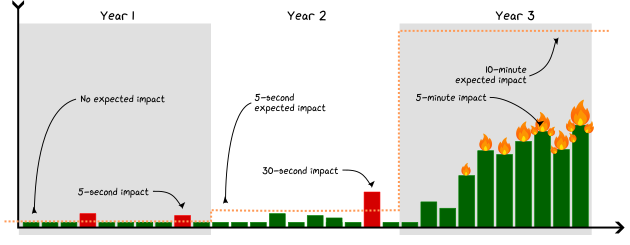
The collapse When we needed new servers, the on-site team would take a set from the inventory, install our base Linux distribution on them, put them in the datacenter, and cable them to the top-of-the-rack switches. We opened a ticket describing the servers we needed, and one week later, our servers were available. Orange wanted to know if this team was performing well, so they asked for KPIs. They decided to use the number of tickets completed in a year. They asked to double this number. So instead of one ticket for a new service, we would open six tickets one per server. By the end of the year, the KPIs had more than doubled. Everybody saw it as a success for performance management. So, they asked to do the same for the next year. Now, we needed to open a ticket per server and per step. Again, the KPIs doubled. Behind the scenes, the tickets went to different people and were no longer handled in order. So, for the next year, it was decided to have meta-tickets and meetings to follow the progress of these tickets. Of course, all these extra steps pushed the KPI even higher. This performance management method spread to the other teams.5 Everything became slower. Instead of a couple of weeks, a new service now took six months. We built a Soviet nail factory. But the KPIs were good, and we stopped caring. Let me give you another example. We had to estimate the impact of each night operation. We weren t half bad: we declared most operations without any expected impact. Most of the time, there was no impact. One time out of five, there was a 5-second impact. We were told to try harder to meet our expected impact. What did we do? We started declaring a 5-second expected impact. One day, we got a 30-second impact and were told we failed to match the expected impact. In the end, we declared most operations with a 10-minute expected impact, and we stopped caring: instead of carefully shifting traffic around, we allowed ourselves a 5-minute impact. And our KPIs were never better.
Graph showing the impact of night operations. Year after year, the impact tolerance has been increased. In the final year, the expected impact is 10 minutes, and all operations remain under this threshold. However, the impacts are much more significant than they were in the first year.
An artist's rendering of the evolution of impacts over the years.

KPIs are not bad, but they are easy to break. Use them carefully: let the people doing the work help choose the metrics, and tie those metrics to the quality of the service for example, with service level objectives. Otherwise, even dedicated people stop caring, game the system, and eventually quit.6

  1. Internally, this division was named Hebex. It was located in Bagnolet (next to Paris) and Sophia-Antipolis (near Nice).
  2. Goodhart s law often gets the credit, but Campbell s law describes my experience even better: the more you lean on a number to make decisions, the faster people corrupt it.
  3. At the time, SaaS was not really a thing. I remember we considered, with a couple of colleagues, selling Wiremaps as a SaaS, with homomorphic encryption for the database. But who would outsource their observability stack?
  4. Snalert was a metacircular alerting tool in Perl. It was able to poll a very large number of SNMP targets in a short timespan. All our monitoring was SNMP-based, including system monitoring.
  5. My team also managed the rules of many Linux-based firewalls. To increase our KPIs, we used the same method: rather than accepting one ticket with a flow matrix, we requested one ticket per flow.
  6. Orange is not unique. Google s promotion process is another well-known example of a broken KPI. Michael Lynch explains it in Why I Quit Google to Work for Myself.

10 June 2026

Colin Watson: Free software activity in May 2026

My Debian contributions this month were all sponsored by Freexian. You can also support my work directly via Liberapay or GitHub Sponsors. OpenSSH I backported various security fixes from 10.3 to trixie, bookworm, bullseye, buster, and stretch. For trixie, I also backported several IPQoS fixes to line up with upstream s traffic management settings and drop a rather hacky Debian-specific patch; this needed a quick follow-up fix. I upgraded trixie-backports to 10.3. I fixed openssh uses pidof but does not depend on procps. PuTTY I upgraded from 0.83 to 0.84. Python packaging New upstream versions: Other build/test failures: Other bugs: I updated python-treq upstream to stop vendoring multipart, now that the packaging issues with that have been sorted out. Code reviews Other bits and pieces I contributed a debian-policy patch to fix several links related to build profiles.

9 June 2026

Vincent Bernat: Blogging with LLMs as a non-native speaker

AI slop is invading the web. A recent story about disallowing LLM-generated submissions on Lobsters triggered a lot of debate. My personal worst offenders are LinkedIn articles with AI-generated images and uninspired articles filled with emojis from people trying to masquerade as experts on a subject they don t care enough to write themselves. While I am unhappy about this situation, I rely on LLMs for grammar, copyediting, and translation. I don t see this as a contradiction. I am a native French speaker, but I blog in both English and French. When I started writing this blog in 2011, I was composing in French and translating to English, but I found it was better to work in the reverse order to avoid unnatural and non-idiomatic constructions. One of my goals is to write good English but I never felt it was my strong point.1 For example, verb tenses are often an issue, even if I mostly stick with the present tense. I learn the rules and forget them right away. I also don t feel like hiring an editor for something I see as a hobby. As an example, I have kept the history of the successive iterations when writing Scaling Akvorado BMP RIB with sharding :
  1. the first draft, authored with the help of a thesaurus,2
  2. the edited copy revised by the copyediting skill,
  3. the translation to French generated with the translation skill, and
  4. the human proofread of the French translation, with minor edits to the English version.
I know that LLMs may alter the author s voice when editing, but the corrections in the second step are minor. The prompt asks to apply light stylistic edits, with some guidance around avoiding passive voice, long sentences, bland verbs, and filler words. It also defines the target audience: technical with a B2 level in English. In the following excerpt, I used long time instead of long-standing. The former is missing a hyphen and applies to people a long-time friend, while the later relates to a situation a long-standing agreement. I had a hard time understanding the reason of the second change: the LLM prefers a defining relative clause to provide the definition of RIB sharding.
As the Internet routing table contains more than 1 million routes, Akvorado needs to scale to tens of millions of routes. This has been a long time long-standing challenge, but I expect this issue is now fixed by using RIB sharding, a method to split that splits the routing database into several parts to enable concurrent updates.
In the next modification, the LLM puts device instead of equipment. This is correct as equipment is an uncountable noun. I know that, but I still fall into this trap.
When Akvorado does not find a route from a specific device, it falls back to a route sent by another equipment device.
I ask the LLM to use descriptive verbs and it complies by replacing a multi-word predicate with a lexically rich verb:
The benchmarks demonstrate it has better performance than outperforms other packages, both packages for lookups, insertions, and memory usage.
It also fixes grammar errors. In the next excerpt, a list of routes is a singular expression. Moreover, stored is a state and I should not use into as it expresses a change.
The list of routes for each prefix are is not stored directly into in the prefix tree.
As a last example, consider the following snippet. The require verb accepts a noun or an object followed by a to-infinitive. I can t use it with just a to-infinitive.
An alternative would be to have one prefix tree for each peer but it would require to configure configuring all routers to export their routes.
As someone who didn t grow up speaking English, I struggle with these grammar rules despite reading a lot of English material.3 French is more complex to get started but more systematic. English is full of irregularities.
On each page, I disclose in the footer whether an AI modified the content. There are three levels: Hover or tap the icon to reveal the AI s name and its role in the document.
Screenshot of the footer containing the "sparkles" emoji
Example of AI usage disclosure: Claude Sonnet 4.5 edited this article.
The graph below shows which tool altered each post, year by year. Recently, I applied the grammar skill to past articles. Since 2018, French articles have been translated with the help of DeepL first, then of an LLM. Since 2024, English articles are copyedited.
🖼 Graph showing the AI usage over the years. Each level get its own color.
AI usage over the years. Hover or tap a band for the details.

If you are strongly against any usage of LLMs specifically for writing, I hope you accept my more nuanced position on the usage of these tools as a trade-off to provide clearer and more engaging articles. Years of literature on improving English told us it is important to choose the right word to keep the reader engaged.
[ ] Good writing consists of mastering the fundamentals (vocabulary, grammar, the elements of style) and then filling the third level of your toolbox with the right instruments. Stephen King, On Writing

Note Unlike other recent articles, I did not use an LLM to edit this post: an unnamed person kindly accepted to proofread it. I translated it to French without using an LLM either.

Update (2026-06) See the story associated to this post on Lobsters, as well as the article How developers react to AI-scented blog posts by Cynthia Dunlop, one of the coauthor of Writing for Developers.


  1. I recently read cover to cover Writing for Developers and I found it stimulating. Michael Lynch is currently writing Refactoring English on the same topic and I have subscribed to the early access.
  2. I am quite happy with the writing tools provided by Kagi. Both the translate tool and the dictionary are a valuable help to find different wordings. I also lean on Kagi s research assistant when researching a topic.
  3. When I was ten, I played Monkey Island 2 in English without having taken any classes. I used a dictionary to translate word by word and I found the irregular verbs confusing and not in the dictionary.

Otto Kek l inen: SpacemiT K3 is a compelling RISC-V AI CPU, but difficult to buy

Featured image of post SpacemiT K3 is a compelling RISC-V AI CPU, but difficult to buyThe RISC-V CPU architecture has been gaining a lot of popularity since it launched in 2014, and now that the industry is standardizing on the RVA23 level that includes vector support as a mandatory extension, we are likely to see a lot more edge- and IoT devices with the ability to run local LLMs at reasonable speed, and most importantly at very compelling prices. SpacemiT is a Chinese RISC-V CPU manufacturer that launched on May 11th, 2026, their long-anticipated next-gen RISC-V AI chip K3. It is among the earliest RISC-V CPUs that adhere to the RVA23 standard and performance-wise it is quite capable, providing 130 KDMIPS general computing power, 60 TOPS on INT4 which translates to about 15 tokens per second when running a 30 billion parameter large language model. The aspect that really makes it stand out is: SpacemiT also develops their own Debian-based Linux distribution Bianbu OS, and seems to have collaboration going on with the wider community. Their community site seems active, and they also have a dedicated X account @spacemit_riscv and Reddit account r/spacemit_riscv posting relevant progress info on Linux kernel upstreaming activities. The X account is also responsive, as evidenced by its replies to my questions. Canonical lists the SpacemiT K3 pico-ITX and K3 CoM260 Kit on its official Ubuntu for RISC-V partner-built hardware page, which strengthens the perception that upstream Linux support is being taken seriously. The SpacemiT folks also gave an interesting talk at the 2026 Ubuntu Summit that includes a peek into their roadmap with future K3, K7 and K9 models. For technical details, see SpacemiT s K3 pico-ITX documentation, the Jetson Orin Nano-compatible K3 CoM260 board documentation and documentation of the K3 processor itself. The SpacemiT K3 pico-ITX board and the K3 CoM260 board side-by-side (not to scale)

Comparing the resellers SpacemiT does not sell anything directly to consumers. Instead you need to buy a board that includes the K3 chip from an integrator. Currently the main resellers are: All of the above are Chinese companies that ship to customers both inside and outside China. DeepComputing stands out as the only one that actually has done real integration and ships the K3 on a custom board, while the others simply resell the SpacemiT-produced K3 pico-ITX and K3 CoM260 Kit.

Milk-V Milk-V is a RISC-V specialized integrator, as the name already implies. They sell the K3 under the name Jupiter2. Of all the K3 pico-ITX reseller product pages, the Jupiter2 presentation is the nicest and most detailed. Unfortunately their order page at arace.tech only states that it is a pre-order with no information about shipping schedule, taxes, or other details like what SSD is included (if any). Based on the pictures it does ship with a Milk-V branded case. The 32 GB RAM lists at 504 EUR, which is a very reasonable price. The @MilkV_Official account on X recently promoted the K3.

Documentation and support As of this writing, the Milk-V Jupiter2 documentation site is just a stub and has no actual content, and only two links to the SpacemiT K3 documentation site. For support there is a web forum with a dedicated Jupiter2 section. There is also a Matrix space, but unlike their other products, there is no dedicated Jupiter (neither v1 nor v2) channel.

Community size and open source involvement At least one prior Milk-V product was certified by Canonical, which indicates there is some collaboration in progress. Canonical also lists the Milk-V Titan on its official Ubuntu for RISC-V partner-built hardware page.

Sipeed The Sipeed K3 announcement is well written (in English) with all the relevant details and links to additional PDF manuals. However, their main page at sipeed.com says nothing about the K3, so one must know the subpage URL to access it. They offer both the K3 CoM260 kit compatible with Jetson Orin Nano carrier boards, and the stand-alone K3 pico-ITX-sized motherboard. The CoM260 kit is only 10 USD cheaper than the full pico-ITX motherboard, so choosing the latter is a no-brainer if starting from scratch. The pico-ITX model with 32 GB DDR5 RAM sells for 639 USD. The product page does not mention anything about hard disk size, so you don t really know exactly what you will be getting if placing an order. There is no indication about case, Wi-Fi antennas or power supply either, so most likely they are not included. Their store.sipeed.com website does not work at all, and their Taobao and AliExpress stores are not public and only accessible to registered users. The order page also says nothing about shipping time, delivery time, or taxes. The X account @SipeedIO is active and recently posted pictures of shipments in progress.

Documentation and support The main documentation wiki does not yet have any K3 content at the time of writing. There is a Discord channel for general RISC-V discussion, and their MaixHub also has a discussion board, but I didn t find anything K3-specific.

Community size and open source involvement Sipeed has had at least one of their previous devices certified by Canonical, which indicates they are active in the community. Note that the other RISC-V company SiFive that also has had hardware certified and officially supported by Canonical is a different company, despite the very similar name.

Banana Pi Banana Pi announced that they offer both the K3 CoM260 kit and the K3 pico-ITX motherboard version. Their product page for the K3 confusingly shows a MediaTek product in the page banner rather than the SpacemiT K3. Based on the product description and the fact they renamed the product as BPI-SM10, it seems to ship with some carrier board. The product pictures look identical to the SpacemiT documentation and there is no picture of the carrier board, and details are very sparse. The pico-ITX version with 8 GB RAM and 128 GB SSD sells for 293 USD and the CoM260 developer kit with the same specs sells for 287 USD and the 32 GB RAM with 128 GB SSD model sells for 595 USD. The shop page shows only five orders so far and items are currently out of stock. As there was no 32 GB RAM version of the pico-ITX available at all, this isn t an option for me as I want to run 30B parameter models that need the larger memory version. Of all of these resellers, the Banana Pi website seems the most outdated. It does not have a search feature, it is not mobile-friendly, pictures can t be pinched to zoom in and so forth. Product names are also almost all identical, and as the product listings only show the beginning of the product name, figuring out what product is what requires extra effort that just makes the online purchase experience plain bad.

Documentation and support I was only able to find the documentation page for the CoM260 kit, but none for the pico-ITX version. For support there is a forum, but the category list does not show any section for K3, and the forum search prohibits using the search term k3 as too short.

Community size and open source involvement Banana Pi has a long history in the ARM single-board computer market, but their presence in the RISC-V ecosystem is still growing. Their X account @sinovoip has posted only once about the K3 and otherwise promotes their ARM boards. However, their community culture page does express a commitment to open hardware in general, but there is no visible K3-specific community activity.

Firefly Firefly s K3 product page is comprehensive. Based on the details, they do not offer the K3 pico-ITX variant at all, but only the K3 CoM260 board inside the AIBOX-K3 Firefly RISC-V Edge Mini PC product. This is a feature-complete offering with a Jetson Orin Nano carrier board and case. The AIBOX-K3 with 32 GB RAM and 128 GB SSD in a case sells for 689 USD in their own Firefly.store. Unfortunately it only has HDMI and there is no USB-C with DisplayPort support, which is a deal-breaker for me personally. Interestingly, Firefly also offers rack-mounted servers with K3 as the CPU.

Documentation and support The wiki link on the product page is broken. The Firefly wiki does have a section for the AIBOX-K3, but it too has a broken link. It seems that as of the time of writing, there is no wiki section for this product yet. For support there is a web forum, which does have at least one K3 thread covering guides such as Hermes Agent installation, though broader K3-specific sections are still sparse.

Community size and open source involvement Firefly s X account @TeeFirefly has had no posts since 2024, and their GitLab/T-Firefly shows mostly 2024 activity, with only one repository updated in 2025 and nothing in 2026. Historically they have built a moderate community around their ARM-based Rockchip boards, with active forums and wiki contributions for those product lines. Their RISC-V K3 offerings are newer, and likely need a lot more polish to be attractive products overall.

DeepComputing Last, but certainly not least, is the laptop manufacturer DeepComputing that offers a Framework laptop compatible motherboard with the SpacemiT K3 chip. They also sell the plain motherboard, or with the Cooler Master case, which allows one to easily connect it to an external monitor and keyboard and use it as a desktop computer. The plain board with 32 GB RAM and no SSD sells for about 882 EUR. Shipping of the first batch is expected to start by end of June 2026. Their X account @DeepComputingio promotes this DC-ROMA RISC-V Mainboard III as their flagship product, so they seem to put a lot of effort into it. The overall product design and packaging seems good. Of all the K3 resellers and integrators that I was able to find, DeepComputing is the only one that actually designs their own boards with the K3 processor, while all the other vendors above are simply reselling the vanilla K3 boards with or without a case. After reviewing all these options I decided to buy the DC-ROMA RISC-V Mainboard III for Framework Laptop 13 with 32 GB RAM, 1 TB SSD and the Cooler Master case, totalling about 1100 EUR.

Documentation and support DeepComputing maintains product information for their RISC-V hardware at github.com/DC-DeepComputing/Framework, with documentation of the newest Mainboard III (FML13V05) still being finalized ahead of the first batch shipment. They provide community support through Discord and web forum, although the latter has very little activity.

Community size and open source involvement DeepComputing has established itself as a pioneer in RISC-V laptops, beginning with the DC-ROMA. I have seen their stand at FOSDEM, which shows they are genuinely active in the open source community. Canonical lists DeepComputing s first mainboard / FML13V01 on its official Ubuntu for RISC-V partner-built hardware page, and it seems likely that they will continue to collaborate with Canonical with the new model once it ships. While the underlying Linux enablement depends on SpacemiT s upstream efforts, DeepComputing s involvement helps bridge the gap between reference hardware and consumer-ready products. DeepComputing K3 board in the Cooler Master case

Conclusion After weighing all the options, I ended up placing an order with DeepComputing for their custom K3 board with the Cooler Master case. Despite the premium price, the active community support and the properly documented promise of a complete, working system made it easy to place an order with confidence. The SpacemiT K3 is poised to be one of the most significant RISC-V chips for local AI workloads, thanks to its RVA23 compliance and high tokens per second potential. Yet the buying experience in mid-2026 remains fragmented and incomplete. Hopefully this is just because the product is new, and they will get the purchase experience polished soon. What struck me most during this process was how poor the customer experience is across nearly all of these vendor websites: broken links, missing search functions, outdated product banners, pages that show the wrong product entirely, and no information about shipping times, stock levels, taxes, and so on. One wonders why these companies don t fully invest in their web presence. Personally I would assume they likely have enough customers already, primarily through domestic channels like Taobao and JD.com, that they do not feel any pressure to improve their international-facing sites. However, I did also review what was offered on Taobao, and the product details were very incomplete there too. Taobao, however, has a built-in live chat with almost all sellers, which can be used to ask questions and thus compensate for missing product details. I don t fully understand why the sales process seems unpolished. The websites feel almost like an afterthought a checkbox to claim global reach while the real business apparently happens elsewhere via closed platforms or via inaccessible reseller channels. It is a frustrating reminder that in the RISC-V hardware world, the technology may be open and global, but the purchase experience is less so.

5 June 2026

Russell Coker: CPUs and Debian Package Building

Introduction I have just bought a HP Z4 G4 with W-2125 CPU for $320 and I decided it was a good time to do some benchmarks on Debian package building to see which system I should use for that. The W-2125 CPU scores only 9,954 on the passmark multithread test but scores 2,546 on single thread [1]. Passmark seems to have some limitations as the only DDR3 system that s important to me at the moment (the HP Z420 workstation my parents use which cost me $750 in 2021) with a E5-2620 CPU scoring 5,325 for multithread and 1,113 for single thread [2]. From the passmark results one would expect that the system is slightly more than twice as fast as the Z420 for operations that involve less than 4 CPU cores. For the initial tests of the Z4 G4 I ran them with hyper-threading enabled as 4 cores isn t much by today s standards and also the machine in question is going to be less exposed to hostile data and contain less secret data than most of my systems so the security risks of hyper-threading are less of a concern. I did some tests with a couple of tasks that are very important to me, building SE Linux policy packages (something I may do a dozen times in a day) and building Warzone 2100 (which I do less often but is the most intensive build process I regularly run). At the bottom of this post there are tables with the results from building these packages on my Z640 workstation with a E5-2696 v4 CPU [3], the Z420, and the new machine. For the Warzone 2100 package I tested building on my Z840 dual CPU system [4]. I didn t test building the SE Linux policy on the Z840 this time because that package can t take advantage of even 22 cores. When I initially got the Z840 running it built the policy packages faster because the Z640 had an older CPU that was slower for single core operations than the CPUs in the Z840. BTRFS Compression For some time I have noticed significant differences in compile time on my workstation, a factor of more than 2. I did more tests and noticed that top showed something like the following, those kernel threads are all BTRFS related, except for gfx which is probably something graphical caused by running Chrome with about 300 tabs open.
2144316 root      20   0       0      0      0 I  26.6   0.0   0:36.76 kworker/u88:20-btrfs-endio-write                                                                                                                                                                             
2221470 root      20   0       0      0      0 I  23.7   0.0   0:01.85 kworker/u88:12-gfx                                                                                                                                                                                           
2221436 root      20   0       0      0      0 I  15.1   0.0   0:07.48 kworker/u88:8-btrfs-compressed-write                                                                                                                                                                         
2166191 root      20   0       0      0      0 I  12.8   0.0   0:15.80 kworker/u88:23-btrfs-compressed-write                                                                                                                                                                        
2126387 root      20   0       0      0      0 I  10.2   0.0   1:29.11 kworker/u88:4-events_unbound 
I had been running BTRFS with the mount option compress=zstd:15 which caused much of the performance problems when building. It was also a random performance issue which I think happened due to the BTRFS 30 second write-back sometimes taking more than 30 seconds during the build process which then caused a second write-back. I did tests on ZSTD compression levels 5, 8, 10, and 15. 15 was never good and often really bad. 10 was not unbearable but consistently slower. 8 was sometimes as fast as 5 and sometimes quite a bit slower. I didn t test levels below 5 because I need to have some compression and it seemed that the benefits of reducing compression were dropping off below 8. I found that the BTRFS compression delay is not counted in system time for the process. I think it s the fsync() system calls in the semodule and dpkg-deb programs that cause the delays related to BTRFS compression waiting for kernel threads. BOINC I have all my systems other than laptops running BOINC in the background so that CPU power is used for scientific research when I don t have any personal use for it [5]. I believe that it s immoral to waste CPU power when it could be used for research. In the below table which has test results from building the package with and without BOINC, and with different ZSTD compression levels in BTRFS all the worst entries were from when BOINC was running apart from one where ZSTD level 15 compression was used. The really poor performance with ZSTD level 15 was an outlier, but it wasn t an uncommon outlier so I left it in. Running BOINC in the background configured to use all CPU cores caused a significant increase in user CPU time (the time a CPU core spent actually running the program). My initial thought was that it s partly related to turbo boost . The Intel ARK page for the CPU in the Z420 shows that it s main clock speed is 2.0GHz with a 2.5GHz turbo boost [6]. The turbo boost is apparently largely based on temperature and apparently limited to one core, so if the other CPU cores are all being used then the CPU will probably be too hot to have the turbo boost and if it happens it might not happen for my compile processes. The ARK page for the E5-2699 v4 (which is a similar CPU to the E5-2696 v4 that I m using but is officially documented by Intel) [7] shows that it has a base clock speed of 2.2GHz and a turbo boost speed of 3.6 GHz. 322 vs 244 seconds of user CPU time means running 32% slower which can plausibly be explained by the lack of a 64% turbo boost with a bit of help from the 55MB L3 cache being thrashed. Turbo boost would only be a noticeable issue for building packages like the SE Linux policy packages which doesn t take much advantage of multi-core CPUs. For a build process to average at best 362% CPU use there has to be large parts of the process that are limited to one or two cores which can potentially give a benefit from turbo-boost. When building the Warzone 2100 packages most of the build time is running basis-universal which is a multi-threaded program to compress GPU texture data. This usually causes a load average of 300+ on the Z640 or 600+ on the Z840. But the build time is still increased by more than 50% on both the Z640 and the Z840 when BOINC is running in the background, which seems to be an indication that it s not related to turbo boost. I verified that BOINC is running at IDLE schedule priority with the following command:
# chrt -p $(pidof -s einstein_O4MD_2.01_x86_64-pc-linux-gnu)
pid 2974874's current scheduling policy: SCHED_IDLE
pid 2974874's current scheduling priority: 0
In theory this means that BOINC won t affect foreground processes. Hyper Threading on the W-2125 The best claims I ve seen about HT are 15% to 30% performance boost. The best I ve actually seen in the past is about 18%. Seeing a 10% benefit for building Warzone 2100 is at the low end of the range I expected. 8 virtual cores is not many for a build process that causes a load average of 600+ when running on a system with 44 real cores. I was surprised to see a 6% performance benefit in hyper-threading for building the SE Linux policy as I didn t think there was enough use of threading or multiple processes to allow that. Many build scripts use a number of processes that match the number of apparent CPU cores. While make -j 88 might give a theoretical performance benefit on a 44 core system it will also take a lot of RAM and any paging will outweigh the benefits of hyper-threading. On a system with only 4 real cores there s less potential for using too much RAM and as security isn t so important on that system I will leave it on. Comparing the CPUs The best results of the Z640 and Z4G4 are only 50% faster than the best results of the Z420. The Z420 has a E5-2620 CPU which is far from the fastest CPU available for that system the E5-2687W has 8 cores and rates 10,021/1,669 on passmark [8] which is far better than the 5,331/1,114 the E5-2620. The E5-2687W is the fastest CPU that HP lists as supported by the Z420 and it supports DDR3-1666 RAM as opposed to the DDR3-1333 that is the fastest that the E5-2620 supports. With suitable hardware upgrades the Z420 would probably only take about 20% longer to do builds of the SE Linux policy and other packages that can t take advantage of more than 8 CPU cores. The Z4G4 system has 4 RAM channels which means that you should get some performance benefits from having 4 DIMMs, my system currently has 2 and I haven t yet managed to get more DDR4-2666 DIMMs. But I d still expected a W-2125 CPU with 2*DDR4-2666 DIMMs outperform any E5-26xx CPU with 4*DDR4-DDR-2400 DIMMs for tasks that average less than 4 CPU cores. In retrospect I would have been better off getting a HP Z820 (two socket server with DDR3 RAM) than the first DDR4 systems I got. It seems that for reasonable size builds a two socket system comes close to twice the speed of a single socket system. I did briefly own a HP ML350 two CPU system with DDR3 RAM but it was too noisy for my intended use as a deskside workstation so I sold it. Things to Investigate I plan to do more investigation on BTRFS compression, how to get the best compression without excessive delays and how to recognise when delays are happening. I have some SSDs that have sustained write speeds as low as 15MB/s (Crucial P1 series) so for those I could probably have very high compression levels without slowing the system down. The fact that BIONC slows things down so much seems to be a bug. When processes are running with the IDLE scheduling class there shouldn t be such significant delays. Is it due to cache thrashing? How can I best get BOINC suitably throttled when I m sitting at my workstation, I don t want BOINC connecting to the local X server (which it repeatedly tries to do). Do I need to tune my kernel for better handling of IDLE scheduling? When I get more DIMMs in the Z4G4 I need to do more tests to see if it gives an overall performance boost. Also the Z4G4 system has a BIOS option for sub NUMA which basically means treating the different RAM channels on a single CPU as NUMA zones, I enabled that option which does nothing presumably because I only have 2 DIMMs, the results when I have 4 DIMMs will be interesting. I will also do some NUMA tests on the Z840 to see what benefits it gives. I have a selection of RAM speeds that will work in the Z4G4, if I have enough spare time I ll test what difference that makes for CPU bound tasks that matter to me. For package building fsync() is not helpful, if the system crashes before it s done then I will just do the build again. For a build cluster it is probably a good feature and probably doesn t affect aggregate performance when multiple packages are built at the same time, but for the single user case probably not. I will investigate libeatmydata for package building [9]. Conclusion The progress in CPUs seems to have slowed down a lot recently. The main benefits seem to be in more CPU cores and for newer sockets with more RAM channels. The CPUs that do have improvements in single core performance are the i9 series (which mostly doesn t come with motherboards supporting ECC) and AMD CPUs (which is rare in enterprise class hardware). Maybe I should get a server with an i9 or AMD CPU for tasks that need a fast turn around with a small number of cores. That would probably outperform any CPU designed for large core counts for things like building the policy and setting up test VMs (which depends on package installation speed that is single core bottlenecked). The W-21xx CPUs seem to offer little benefit over the E5-26xxv4 CPUs and not a lot of benefit over E5-26xx CPUs (with DDR3). Even the W-22xx CPUs look like they aren t going to offer a lot as they are only an incremental improvement over the W-21xx series. I had considered making the Z4G4 my main desktop workstation after the high end W CPUs become affordable, but it looks like that won t be worth it until such CPUs drop from the current ebay price of $900 to $100. I think I ll keep waiting for a decent socket LGA3647 or DDR5 based server [10] for my next significant upgrade. Tables Building SE Linux Refpolicy
System BOINC Compression CPU Time Elapsed CPU%
Z640 no 8 248.82user 55.58system 1:23.88elapsed 362%CPU
Z4G4 no 5 245.15user 34.63system 1:24.93elapsed 329%CPU
Z640 no 5 244.75user 34.87system 1:25.98elapsed 325%CPU
Z4G4 no 10 245.21user 35.64system 1:29.63elapsed 313%CPU
Z640 no 8 248.71user 55.90system 1:33.01elapsed 327%CPU
Z640 no 10 250.90user 55.78system 1:42.12elapsed 300%CPU
Z640 yes 8 298.19user 69.30system 1:59.77elapsed 306%CPU
Z640 yes 10 300.58user 68.90system 2:01.53elapsed 304%CPU
Z420 no 5 359.01user 44.95system 2:07.33elapsed 317%CPU
Z640 yes 5 322.40user 71.82system 2:34.66elapsed 254%CPU
Z420 yes 5 372.03user 42.95system 2:42.15elapsed 255%CPU
Z640 yes 15 299.26user 67.18system 2:59.77elapsed 203%CPU
Z640 no 15 250.05user 54.60system 3:07.61elapsed 162%CPU
Building Warzone 2100
System BOINC Compression CPU Time Elapsed CPU%
Z840 no 10 6549.21user 89.46system 4:18.90elapsed 2564%CPU
Z840 no 5 6533.81user 90.50system 4:19.24elapsed 2555%CPU
Z640 no 5 7040.87user 183.12system 7:13.50elapsed 1666%CPU
Z840 yes 5 8039.52user 169.62system 8:02.86elapsed 1700%CPU
Z640 yes 5 7486.44user 205.03system 11:09.97elapsed 1148%CPU
Z4G4 no 5 7891.32user 74.45system 17:48.03elapsed 745%CPU
Z4G4 no 10 7942.10user 77.43system 17:58.72elapsed 743%CPU
Hyper-Threading
Build HT Compression CPU Time Elapsed CPU%
Warzone yes 5 7891.32user 74.45system 17:48.03elapsed 745%CPU
Warzone yes 10 7942.10user 77.43system 17:58.72elapsed 743%CPU
Warzone no 5 4492.45user 59.09system 19:59.01elapsed 379%CPU
Warzone no 10 4497.28user 59.46system 20:07.15elapsed 377%CPU
Refpolicy yes 5 245.15user 34.63system 1:24.93elapsed 329%CPU
Refpolicy yes 10 245.21user 35.64system 1:29.63elapsed 313%CPU
Refpolicy no 5 180.84user 29.74system 1:32.30elapsed 228%CPU
Refpolicy no 10 180.29user 30.07system 1:35.01elapsed 221%CPU

3 June 2026

Emmanuel Kasper: Running Linux i386 binary (steamcmd) via debootstrap foreign chroot

The Steam command line client, which I need to download the game data for the Doom3 BFG shooter, is only available as an Linux i386 binary. As my main home computer is an arm64 box, this could be an issue, but today we have no less than three different ways to run a Linux i386 binary on arm64: Fex, Box32/64 and the older qemu-user mode. According to the Box64 benchmarks, qemu-user is the slowest of the three. But since this is only to run a command line tool downloader, where network speed is the bottleneck, this doesn t matter a lot. Running steamcmd outside of a chroot via qemu-user and dpkg multiarch support was failing me with the error i386-binfmt-P: Could not open '/lib/ld-linux.so.2': No such file or directory even after installing the i386 libc. So I went the way of qemu-user and a chroot environment, a bit more convoluted but I can run any i386 binaries there in the future. Create a debian-i386 chroot environment via deboostrap:
$ sudo apt install qemu-user qemu-user-binfmt debootstrap
$ fakeroot debootstrap --foreign --arch=i386 debian-i386
$ sudo chroot debian-i386
# inside the chroot 
# /debootstrap/debootstrap --second-stage 
# exit
Add needed mounts to run binaries inside the chroot:
$ sudo mount --bind /dev/ debian-i386/dev/
$ sudo mount --bind /dev/pts debian-i386/dev/pts
$ sudo mount -t proc none  debian-i386/proc/
Install steamcmd in the chroot client:
$ sudo chroot debian-i386
# export LANG=C
# cat /etc/apt/sources.list
deb http://deb.debian.org/debian stable main contrib non-free
# apt update && apt install --yes steamcmd 
# useradd --create-home --shell /bin/bash steam
# su - steam
$ steamcmd 
... will download an updated version of the tool, and print a lot of tracing information
Steam> quit
From now on you can follow the Doom3 BFG instructions to download the game data. Once you exit the chroot, the game data will be available at debian-i386/home/steam/

31 May 2026

Russell Coker: Links May 2026

Ron Garrett wrote an interesting blog post about the mathematical possibility of abiogenesis [1]. Cory Doctorow wrote an interesting blog post about the way the current antics of right wing extremists are forcing permanent changes in society away from the old systems [2]. William Angel wrote an insightful blog post comparing the costs of a Macbook and the Openrouter hosted service for LLMs [3]. The Register has an informative article about the threat that management systems built in to Intel and AMD CPUs pose to data sovereignty in EU owned cloud providers [4]. But this is just the first stage of building sovereign clouds, all significaant cloud services run at least 2 types of CPU and adding EU manufactured CPUs at a future time will be easy. Benn Jordan made an interesting YouTube video about the infrasound problems caused by data centers, we need FOSS to measure infrasound [5]. amarok on the Purism forum made a great post about how to setup profiles in Firefox for different uses [6]. fralb5 wrote an informative post on the Purism forum about how to use a Librem 5 (or any other FOSS Linux phone) to firewall spyware on an Android phone [7]. Michael Prokop wrote an interesting blog post about debugging input event problems on Linux which turned out to be due to an analogue headphone connection [8]. This gave me some useful pointers to investigating an input device problem which is probably very different. Patrick Boyle made an insightful youtube video about the ridiculous IPO of SpaceX, it seems like a scam from start to finish [9]. Anarcat wrote an insightful blog post about the LLM apocalypse comparing it to the horsemen of the apocalypse [10]. The Wikimedia Foundation (that runs wikipedia.org among other things) is sacking union organisers and trying to corporatise the organisation which means stealing the donations from the community [11]. Tianon Gravi wrote an informative blog post about containers, Debian, and Docker options [12]. We need a lot more work on these sorts of things in Debian. Memory Tagging and how it improves C/C++ memory safety is an interesting paper from Google researchers giving an overview of the benefits of tagged memory hardware for pointer validation on SPARC and ARM64 [13]. In 2013 a faulty beer fridge motor acted as a spark gap transmitter and blocked mobile phone service for several Melbourne suburbs [14].

29 May 2026

Ravi Dwivedi: Budapest Travel

In September 2025, I attended the annual LibreOffice conference in Budapest, Hungary. This gave me an opportunity to explore the city, which I will cover in this post. Let s start with the currency. Although Hungary is a part of the European Union (EU), it doesn t use the euro as its currency. Instead, it uses Hungarian forints (denoted by Ft ). During my time in Hungary, 1 Indian rupee was equal to 4 Hungarian forints. After reaching the Budapest airport, I bought a 15-day public transport pass. The public transport counter is after you pass customs and immigration. The pass allows unlimited use of public transport in the city. I had to show my passport and pay 5950 Ft to get the pass. The pass had my passport number mentioned on it. The public transport passes can also be bought at any of the tram stations as well.
This is the counter from where I bought my public transport pass. This is the counter from where I bought my public transport pass.

Budapest pass. My unlimited public transport pass for Budapest. I have redacted my passport number from it.

An automatic ticket machine An automatic ticket machine at a tram station in Budapest.

Budapest is a union of two cities Buda and Pest lying on opposite sides of the Danube River. My hotel Corvin Hotel was on the Pest side. Budapest had good public transport. The buses, metros, and trams complemented each other. For example, the airport didn t have metro or tram connectivity, but it was served by the bus. Most of the metro was on the Pest side, with only a couple of stations falling in Buda. However, both sides had an extensive network of trams. Furthermore, the information about the public transport was easily accessible. For instance, the map of tram stops inside the trams also included the bus routes one could get after alighting at those stops. From the airport, I took a bus followed by taking a metro on the M3 line to reach within walking distance of my hotel.
An M3 line metro in Budapest. An M3 line metro in Budapest.

During the conference I would take the tram to the conference venue. The trams were modern and fast. They also had a smiley face at the front, which gave them a friendly look. It seemed like the trams were happily doing their job. The city also had a good pedestrian infrastructure along with separate cycling tracks.
A tram in Budapest. A tram in Budapest having a smiley face at the front.

Budapest s tap water is officially safe to drink, which was mentioned on a sticker posted on the wall of the bathroom of my hotel room. So, I did not need to buy any water bottles while I was there. On the 6th of September, I went on a sightseeing tour of Budapest with my Dione. Our friend Attila, who was a local (from Hungary), joined us. We went to the central market from our hotel by metro. If you read my post on Vienna, I mentioned that the metro stations don t have AFC gates but ticket validators instead. Budapest s metro also has the same system. If you buy individual tickets, you need to validate them using the validators on the station before boarding the metro. If you are using a public transport pass like I was, then you do not need to validate, and you can board the metro directly.
A ticket validator at a metro station in Budapest. A ticket validator at a metro station in Budapest.

In 10-15 minutes, we reached the central market. Attila showed us around. I bought a fridge magnet and paprika powder as souvenirs. Paprika powder is a signature spice of Hungary. It is mainly available in two forms one is sweet and the other being spicy. I wanted the spicy one, but I didn t get that in that market. Therefore, I had to contend with buying the sweet version. The sweet version isn t sweet though, it is just not spicy. After bringing that paprika powder home, it is mainly used for food coloring. I like it though and use it frequently in my omelets and other dishes.
Central Market. Central market.
A building with a tram in front of it. The building right behind the tram is the central market building.

At some point, Atilla had to join the The Document Foundation (TDF) sightseeing group, so we parted ways at the central market. Dione and I continued our sightseeing and decided to start with visiting the Hungarian parliament, which is a tourist attraction. It was because we were on the Pest side and the parliament was also on the same side, while other tourist attractions were on the Buda side. So, Dione and I hopped on a tram and went to the parliament. We got off at a tram station just outside the parliament. The parliament is the icon of Budapest. The building has a gothic architecture and colored brown and white. One can buy tickets and take an inside tour. However, we didn t have a lot of time, so we stayed outside the building.
Hungarian Parliament building. Hungarian Parliament building.

After spending some time outside the parliament building, we took a tram to the Chain Bridge. As I mentioned earlier, Budapest has two parts Buda and Pest separated by the Danube River. To go from one of the sides to the other requires crossing a bridge. Although Budapest has many bridges linking the two sides, the main one is the Chain Bridge. We walked on the chain bridge to get to the other side. The bridge gave a good view of the Danube River. It also had a statue of a lion. The Buda Castle (another major landmark of Budapest) was visible from the bridge.
Chain Bridge. A shot of Chain Bridge.
A lion statue The lion statue on the Chain Bridge.
After reaching the other side of the bridge (the Buda side), we sat on a bench for some time and then planned on where to go next. We decided to go to Fisherman s Bastion, which is another tourist attraction. We used the OSMAnd~ app to figure out which bus to take and hopped on one. Soon we reached Fisherman s Bastion, where we found a flight of stairs that led upwards. Upon climbing the stairs, we got a panoramic view of the city. It also gave us a good view of the Hungarian parliament across the river. Going further upstairs, we found a statue of Stephen I of Hungary. He was the first king of Hungary, getting the crown in the year 1900.
A view of Hungarian parliament from Fisherman's bastion A view of Hungarian parliament from Fisherman s bastion.

I found Fisherman s Bastion to be the best tourist attraction in the city. As mentioned earlier, it offers a panoramic view of the city, which I liked. I liked the arhitecture and open space there. If you find yourself in Budapest, I would highly recommend that you visit Fisherman s Bastion.
Fisherman's Bastion. Fisherman s Bastion.
A green colored statue of King Stephen Statue of Stephen I of Hungary at Fisherman s Bastion.

Next, we went downstairs and returned to where the bus dropped us. From here on, we walked in random streets to see the residential and non-touristy side of Budapest. It was not so random as we walked towards Batthy ny t r metro station. Upon reaching the metro station, we found a caf where we stopped for a while for some coffee. After injecting some caffeine into our blood, we proceeded to find a place to have lunch.
A metro station Batthy ny t r metro station.
For lunch, we decided to go to R k czi t r metro station after reading on the internet about the food options there. Upon exiting the metro station, we found a market inside a building that had a lot of shops, but most of them were closed. After roaming around inside a bit, we found an Italian place open and decided to eat there. The name of this place was Matteos. We ordered an eggplant parmigiana, a lasagna artichoke, and a classic tiramisu. It wasn t very tasty but filled us up for the day.
The Italian place we had our lunch at. A picture of Matteos, where we had our lunch.

Budapest has four metro lines, and we had been to three of them, so we decided to try the remaining line, which was the M1 line. It is the oldest line in the city and has a different vibe than the modern lines. This line was opened in 1896, one of the oldest subway systems in the world. The coaches were much smaller than the other metro lines, and the seating arrangement was something you would expect from a bus than a typical metro train. We rode all the way to the last stop, Mexik i t. Upon going outside, we found out there wasn t much to do here. At this point, I checked the map and realized that Heroes Square is just a couple of metro stations away. Heroes Square is a tourist attraction in Budapest. It is located in Zugl a and is a historically significant place in Budapest. It has a monument which features the Seven chieftains of the Magyars.
M1 line station and tracks. M1 line station and tracks. It is the oldest metro transit of Budapest and one of the oldest in the world. It started operations in 1896.

Here, our unlimited public transport pass was handy because if it was paid per trip, we would think of the stop as a wasted one because we would have to buy a ticket again, but in this case we could just hop on again without any regrets.
A metro train entering a station. An M1 line metro train entering the station.

So we took the M1 line again and deboarded at H s k tere station, followed by walking to the square. After roaming around for a while, we saw a trolleybus and decided to ride on that.
Heroes' Square Heroes Square.
A trolleybus This is the trolleybus we took in Budapest.

A trolleybus is an electric bus that is powered by overhead electric cables. It is like a tram but runs on roads instead of tracks. We got down at D zsa Gy rgy t metro station. Then we took a metro to our hotel. Before going to the hotel, we went to a place to eat something. We had coffee and l ngos. L ngos is a deep-fried Hungarian dish, which looks exactly like the Indian flatbread bhatura. I found it tasty, but since it was deep-fried, that was almost a given.
A deep friend dish called L ngos. L ngos a dish which looks like the Indian flatbread bhatura.

The next day we went to Vienna the capital of Austria which I have already posted about. Check it out here. I had a good time in Budapest, and it is a beautiful city with good public transport and some amazing sites to visit. That s it for now, and see you next time! Credits: Thanks Dione and Badri for proofreading.

Russell Coker: Zswap

Zswap vs Zram Last year I blogged about using Zram for VMs [1]. That setup is still working well for VMs and for phones and laptops with no swap device. I have just read Chris Down s insightful blog post about Zswap vs Zram [2] which convinced me to setup Zswap on some systems. I have had some of the problems that were described in his blog post when trying to run Zram on workstation and server systems. One limitation of zswap is that it doesn t allow specifying the compression level. For zram I can put the following in /etc/systemd/zram-generator.conf to set the zstd compression level (this works well on my Thinkpad X1 Carbon Gen6):
[zram0]
compression-algorithm=zstd(level=10)
For the BTRFS filesystem I can put compress=zstd:13 in the mount options to specify the compression level. They really should support different compression levels in zswap. The ideal compression level depends on the speed of the CPU and new CPUs keep getting faster. Setup The documentation says to use something like the following on the kernel command-line to enable zswap:
zswap.enabled=1 zswap.compressor=zstd zswap.max_pool_percent=20 zswap.shrinker_enabled=1
The max_pool_percent=20 setting is the default which means to use up to 20% of system RAM for compressed data. I ve seen documentation sugesting up to 50% which seems a little excessive. Note that a lot of documentation says to use zswap.zpool=z3fold, but z3fold is going to be removed and zsmalloc (the default) is recommended [3]. There is documentation about changing the compression algorithm via command line parameters, on Debian only lzo is linked in to the kernel and zstd (my preferred option) is a module so the kernel command line can t be used to set zstd, but the following command works:
echo zstd > /sys/module/zswap/parameters/compressor
The shrinker_enabled option is to allow the kernel to evict cold pages without waiting for memory pressure. You can enable zswap without rebooting by running commands like the following. You could even put them in /etc/rc.local or something, but I think putting it in the kernel command line is a good idea as it makes it obvious to the next sysadmin what is happening.
echo 1 > /sys/module/zswap/parameters/enabled
echo zstd > /sys/module/zswap/parameters/compressor
echo 1 > /sys/module/zswap/parameters/shrinker_enabled
Monitoring The following command is documented as a way of finding out what zswap is doing:
# grep -r . /sys/kernel/debug/zswap/
/sys/kernel/debug/zswap/stored_pages:262541
/sys/kernel/debug/zswap/pool_total_size:455266304
/sys/kernel/debug/zswap/written_back_pages:384
/sys/kernel/debug/zswap/reject_compress_poor:0
/sys/kernel/debug/zswap/reject_compress_fail:160911
/sys/kernel/debug/zswap/reject_kmemcache_fail:0
/sys/kernel/debug/zswap/reject_alloc_fail:0
/sys/kernel/debug/zswap/reject_reclaim_fail:0
/sys/kernel/debug/zswap/pool_limit_hit:0
The following command gives the zswap compression level which gives a result of 2.36 for this example:
echo "scale=2; " $(</sys/kernel/debug/zswap/stored_pages) " * $(getconf PAGESIZE) /" $(</sys/kernel/debug/zswap/pool_total_size)   bc
This table documents my current understanding of the debug values. The difference between reject_compress_fail and reject_compress_poor isn t clear in a lot of the documentation, even reading the source didn t make it easy to understand.
File Meaning (LC is lifetime count)
pool_limit_hit LC pool limit hit and pages are forced to the swap partition
pool_total_size RAM used for zswap data
reject_alloc_fail LC can t allocate memory because max_pool_percent has been reached
reject_compress_fail LC of pages with a compression algorithm failure so go straight to swap partition
reject_compress_poor LC of pages that can t compress so go straight to swap partition
reject_kmemcache_fail LC kernel malloc failure (serious problem?)
reject_reclaim_fail LC failure to move a page from compressed RAM to disk serious problem!
stored_pages Swapped pages stored by zswap
written_back_pages LC of pages written back to swap partition from zswap
All of this is not nearly as easy to understand as the following command for zram:
# zramctl 
NAME       ALGORITHM DISKSIZE  DATA COMPR TOTAL STREAMS MOUNTPOINT
/dev/zram0 zstd          7.7G  2.1G  375M  386M       4 [SWAP]
Debian Wiki The Debian Wiki page about Zswap is very brief [4] and needs more description about this, I think a lot of Debian users will use zram instead of zswap because setting up zram is just a single apt command. I m not planning to immediately add to that wiki page because I m not an expert on this, I would appreciate comments on this blog post from others who have got zswap working. I will update the wiki if others report matching experiences to mine. Conclusion I m now using zswap on a few systems including my main home workstation which had performed poorly with zram and a swap device in the past. If that goes well I ll put it on other systems. I wrote the following shell script to display zswap stats, consider it GPL if you want to use it:
#!/bin/bash
if [ ! -f /sys/kernel/debug/zswap/stored_pages ]; then
  echo "ZSwap not enabled"
  exit 0
fi
PAGES=$(</sys/kernel/debug/zswap/stored_pages)
PAGESIZE=$(getconf PAGESIZE)
RAM=$(echo "$PAGESIZE * " $(getconf _PHYS_PAGES)   bc)
POOL=$(</sys/kernel/debug/zswap/pool_total_size)
if [ "$POOL" == "0" ]; then
  echo "ZSwap not used yet"
  exit 0
fi
COMP=$(</sys/module/zswap/parameters/compressor)
echo -n "$COMP compression ratio: "
echo "scale=2; $PAGES * $PAGESIZE / $POOL"   bc
echo -n "RAM%: "
echo "100 * $POOL / $RAM"   bc

26 May 2026

Russ Allbery: Review: The Keeper of Magical Things

Review: The Keeper of Magical Things, by Julie Leong
Publisher: Ace
Copyright: 2025
ISBN: 0-593-81593-9
Format: Kindle
Pages: 353
The Keeper of Magical Things is a cozy fantasy novel. It is set in the same universe as The Teller of Small Fortunes, but it doesn't share any characters or plot, they're not marketed as a series, and so far as I can remember neither book would spoil the other. It is Julie Leong's second novel. Certainty Bulrush is a novice mage with one reliable magical ability: She can talk to objects and occasionally convince them to do small things. This ability is clearly magical, which means Certainty is indeed a mage, but this appears to be all that her magic can do. The Guild has requirements for the level of magical ability required to become a full mage that go beyond talking stained quilts into unstaining themselves, which is why Certainty has been a novice for six years. This by itself is a problem, since Certainty's cohort keeps passing her by. Worse, though, is that she was counting on the wages of a full mage to pay for her brother's training to become an apothecary. The thought of failing him is extremely upsetting. Certainty therefore jumps at an offered mission to take a cartload of excess magical objects that are causing a dangerous build-up of energies in the Guildtower to safe storage in the small and very unmagical village of Shpelling. Successful completion of that mission will earn Certainty a promotion to Deputy Keeper and therefore to a full mage. This is the opportunity she didn't know to hope for. The only drawback is that she will have to work with Mage Aurelia, the famously off-putting farspeaker and magical scholar the other novices refer to as the ice witch. Aurelia is every bit as icy, formal, and condescending as Certainty was afraid she would be, Shpelling grows nothing but garlic, and the inhabitants are suspicious and hostile. The mission could be a disaster if it weren't for Certainty's stubborn good nature. It's arguably a spoiler to say that there's an enemies to lovers romance, but it's hinted at on the cover, mentioned in the publisher's blurb and, honestly, if you aren't expecting an enemies to lovers romance by a few chapters in, you probably haven't read many books of this sort. I found The Keeper of Magical Things quietly enjoyable but extremely predictable. If you're in the mood for what it's offering, the predictability may not be a problem, but it was the kind of book where the direction the plot was headed was so obvious that I got a bit bored waiting for it to arrive. Certainty has a good heart, humble origins, limited but specialized magical ability, and a self-esteem problem, and if you've read much fantasy, you've probably read two or three or a dozen other books with variations of this protagonist. You know how they generally turn out, and that is indeed what you're going to get after the obligatory setbacks and tragedies and looming catastrophes. Aurelia, similarly, is a variation on a character you've probably met before. Certainty discovers, not long into the book, that the brilliant over-achieving mage wears a necklace (supposedly to help her focus) that constantly whispers to her how inadequate she is and how much harder she needs to work. The necklace was given to her by her parents. This book is not exactly subtle. That said, there's nothing wrong with the characterization. Both Certainty and Aurelia are interesting characters with rounded-out personalities, although it takes a while before Certainty (or the reader) is allowed to see Aurelia's. Their interactions with the inhabitants of Shpelling are fun to watch in the same way that it can be fun to watch people play PowerWash Simulator. You're not in overwhelming suspense about what's going to happen, but the details are amusing and it is satisfying to watch people with good intentions slowly fix things. There is a plot, and a villain, and a not-subtle message about how everyone deserves acknowledgment and respect, and the hours I spent reading about these characters were enjoyable. The problem with this book isn't that there's anything wrong with it, but that it may not give you more enjoyment than another book you could have been reading. I quite liked The Teller of Small Fortunes in part because it surprised me in a few places and the main character felt a bit different than the typical fantasy protagonist. The Keeper of Magical Things felt less original and a bit more obvious and predictable. It was still quietly good-hearted and occasionally charming, and I think I'll still remember Certainty in a few months, but I'm not feeling the urge to push it into anyone's hands. If you're in the mood for a gentle fantasy about finding solutions to people's problems and waiting out the prickliness of people who desperately need a friend, you may enjoy this a great deal. Just don't expect unpredictable twists and turns or a surprising plot structure. An apparent third book in this loose series, The Isle of Lonely Monsters, is currently scheduled for publication in 2027. Rating: 6 out of 10

24 May 2026

Russell Coker: Debian SE Linux and PinTheft

We have a new Linux exploit called PinTheft [1]. I did some tests of it with Debian kernel 6.12.74+deb13+1-amd64. user_t When I run the exploit as user_t I see the following in the audit log:
type=PROCTITLE msg=audit(1779615031.043:15540): proctitle="./exp"
type=AVC msg=audit(1779615031.043:15541): avc:  denied    create   for  pid=1360 comm="exp" scontext=user_u:user_r:user_t:s0 tcontext=user_u:user_r:user_t:s0 tclass=rds_socket permissive=0
type=SYSCALL msg=audit(1779615031.043:15541): arch=c000003e syscall=41 success=no exit=-13 a0=15 a1=5 a2=0 a3=0 items=0 ppid=879 pid=1360 auid=1000 uid=1000 gid=1000 euid=1000 suid=1000 fsuid=1000 egid=1000 sgid=1000 fsgid=1000 tty=pts0 ses=1 comm="exp" exe="/home/test/b/pocs/pintheft/exp" subj=user_u:user_r:user_t:s0 key=(null)ARCH=x86_64 SYSCALL=socket AUID="test" UID="test" GID="test" EUID="test" SUID="test" FSUID="test" EGID="test" SGID="test" FSGID="test"
The last of the output of running the exploit is the following:
[-] only stole 0/1024 refs   may not be enough
[-] too few stolen refs, aborting
[-] attempt 5 failed, retrying...
[-] all 5 attempts failed
unconfined_t When I run it as unconfined_t it gave the same output and stracing it had many of the following:
socket(AF_RDS, SOCK_SEQPACKET, 0)       = -1 EAFNOSUPPORT (Address family not supported by protocol)
After I ran modprobe rds the exploit worked as unconfined_t with the following output:
[*] verifying page cache overwrite...
[*] page cache page 0 AFTER overwrite (our shellcode) (129 bytes):
  0000:  7f 45 4c 46 02 01 01 00  00 00 00 00 00 00 00 00   .ELF............ 
  0010:  03 00 3e 00 01 00 00 00  68 00 00 00 00 00 00 00   ..>.....h....... 
  0020:  38 00 00 00 00 00 00 00  00 00 00 00 00 00 00 00   8............... 
  0030:  00 00 00 00 40 00 38 00  01 00 00 00 05 00 00 00   ....@.8......... 
  0040:  00 00 00 00 00 00 00 00  00 00 00 00 00 00 00 00   ................ 
  0050:  2f 62 69 6e 2f 73 68 00  81 00 00 00 00 00 00 00   /bin/sh......... 
  0060:  81 00 00 00 00 00 00 00  31 ff b0 69 0f 05 48 8d   ........1..i..H. 
  0070:  3d db ff ff ff 6a 00 57  48 89 e6 31 d2 b0 3b 0f   =....j.WH..1..;. 
  0080:  05                                                 . 
[+] verification PASSED   page cache overwritten with SHELL_ELF
[+] executing /usr/bin/su (now contains setuid(0) + execve /bin/sh)...
=== RESTORE: sudo cp /tmp/.backup_su_13294 /usr/bin/su && sudo chmod u+s /usr/bin/su ===
# 
Conclusion SE Linux in a strict configuration stops this exploit. The test VM is running Debian/Testing, I haven t bothered investigating whether it s a default setting for Debian to not load the rds module or whether it was some change that I made either directly or indirectly. Security via SE Linux is of more interest to me than security via controlling module load.

18 May 2026

Sergio Durigan Junior: Fixing a 20+ year old bug in Debian curl

I have been helping co-maintain the Debian curl package for a few years now, and even though Samuel and Charles do most of the work, I'm happy to jump in and help when needed. This is one of those cases. Nowadays the package is maintained by 3 people (with help from others occasionally), but it hasn't always been like this. Samuel adopted the package back in 2021, and since then it has received a lot of love and care to make sure it lives up to Debian's standards. Again, kudos to both him and Charles who have been doing great work on this front. But a little more than 20 years ago, the situation in Debian (and curl!) was "a bit" different.

Once upon a time... According to d/changelog, the Debian curl maintainer in 2005 introduced changes to the packaging that allowed it to generate a version of libcurl for each TLS backend available: OpenSSL and GnuTLS. This meant that curl would have two binary library packages:
  • libcurl3-openssl and its respective -dev variant, for libcurl linked against OpenSSL; and
  • libcurl3-gnutls and its respective -dev variant, for libcurl linked against GnuTLS.
But then, around 2006/2007 or so, upstream curl decided to bump the SONAME version of libcurl from 3 to 4. At the time, they apparently did not version their library symbols like they do now, which was... less than ideal. I don't judge them: curl and a lot of other important projects have come a long way when we consider best practices to write shared libraries. Meanwhile, on Debian land, the release team was having trouble with other transitions going on at the time. For those who are not versed in Debian's vocabulary, a transition happens when a shared library gets its SONAME version bumped: when this happens, we have to make sure that all reverse dependencies of that library still build with the new version, and fix things that fail. The more reverse dependencies the library has, the harder this work gets. When upstream curl bumping the SONAME version of libcurl, the Debian curl maintainer at the time correctly renamed the binary packages from libcurl3- openssl,gnutls (and their -dev variants) to libcurl4- openssl,gnutls (and their -dev variants), which obviously triggered a transition. And a big one, because libcurl is used by several projects. Long story short, the Debian release team found themselves between a rock and a hard place. According to the late Steve Langasek at the time:
We talked a while back about the curl transition, and about how upstream's change from libcurl.so.3 to libcurl.so.4 is gratuitously painful for us in light of the large number of reverse dependencies. The libcurl transition has at this point gotten tangled with soname transitions in jasper, exiv2, kexiv2, and God only knows what else. So I'd like to revisit this question, because tracking this transition is costing the release team a lot of time that would be better spent elsewhere, and removing the need for a libcurl transition promises to reduce the complexity of the other components by an order of magnitude. On looking at the curl package, I've come to understand that the symbol versioning in place in this library is the result of a Debian-local patch. That's great news, because it suggests a solution to this quandary that doesn't require an unreasonable amount of developer time.
Yeah, it wasn't pretty. Here's what was proposed:
I am proposing the following:
  • Keep the library soname the same as it currently is upstream. Because upstream uses unversioned symbols, our package will be binary-compatible with applications built against the upstream libcurl regardless of what we do with symbol versioning, so leaving the soname alone minimizes the amount of patching to be done against upstream code here.
  • Revert the Debian symbol versioning to the libcurl3 version, and make libcurl.so.3 a symlink to libcurl.so.4. We have already established that libcurl.so.4 is still API-compatible with libcurl.so.3, in spite of the soname change upstream; reverting the symbol versioning will make it fully ABI-compatible with libcurl.so.3, and adding the symlink lets previously-built binaries find it.
  • Revert the Debian package names to the curl 7.15.5 versions. Because compatibility has been restored with libcurl3 and libcurl3-gnutls, restoring the package names provides the best upgrade path from etch to lenny; and because the symbol versions have been reverted, the libraries are not binary-compatible with the Debian packages currently named libcurl4/libcurl4-gnutls/libcurl4-openssl (in spite of being binary-compatible with upstream), so it would be wrong to keep the current names regardless.
  • Drop the SSL-less variant of the library, which was not present in curl 7.15.5; AFAICS, there is no use case where a user of curl needs to not have SSL support, so this split seems to be unnecessary overhead. Please correct me if I'm mistaken.
  • Leave the -dev package names alone otherwise, to simplify binNMUing of the reverse-dependencies (some packages have already added versioned build-deps on libcurl4.*-dev -- I have no idea why -- so reverting the names would mean more work to chase down those packages). Drop libcurl4-dev as a binary package, though, in favor of being Provided by libcurl4-gnutls-dev. Many of the packages currently build-depending on libcurl4-dev -- including some that wrongly used libcurl3-dev before -- are GPL, and these are apparently all packages where having SSL support missing in libcurl4 wasn't hurting them, so libcurl4-gnutls-dev seems to be the reasonable "default" here.
  • Schedule binNMUs for all reverse-dependencies.
Again, no judgement here: this was what needed to be done at the time, and I believe it was a good solution given the circumstances. In the end, the binary library packages got renamed again: from libcurl4- openssl,gnutls back to libcurl3- openssl,gnutls (but not their -dev variants!), but they continued shipping libcurl libraries whose SONAME version was 4. This solved the immediate problem of untangling the transitions mentioned by Steve, but introduced a technical debt that would stick with the package literally for decades. The situation at the end of 2007 was:
  • libcurl3-openssl with libcurl4-openssl-dev; and
  • libcurl3-gnutls with libcurl4-gnutls-dev.

More discrepancy is added Eventually the libcurl3-openssl package got renamed to libcurl3, but aside from that the situation with mismatched library names vs. SONAME versions stayed relatively unchanged until around 2018, when the Debian curl maintainer at the time (a different person) renamed libcurl3 to libcurl4 to fix a bug. This was the right thing to do for libcurl3, and at the time upstream curl was already properly versioning their symbols, but for some reason libcurl3-gnutls got left behind. So now we had:
  • libcurl4 with libcurl4-dev; and
  • libcurl3-gnutls with libcurl4-gnutls-dev.
In other words, we now have a discrepancy between the OpenSSL and GnuTLS variants' names. Yeah, confusing. And this is the situation right now, on May 2026, while I write this post. To make matters worse, the Debian curl package has been carrying a patch to facilitate the split of OpenSSL and GnuTLS flavours for decades now, and, for some reason I didn't bother to investigate, the patch pins the SONAME version of libcurl3-gnutls to CURL_GNUTLS_3, effectively overriding upstream's decision to version the symbols as CURL_GNUTLS_4.

A call to make things right Back in 2022, Simon McVittie filed a Debian bug to try and call our attention to the fact that we were shipping this messy set of curl packages. I had just started to get involved in the package maintenance and Samuel asked me to take a look at the bug. I noticed it was going to take more time than I had available, so I decided to put it in my TODO list (TM). Simon was generous enough to lay out a possible plan to tackle the problem, but I had a feeling that this was going to be harder than it looked. I kept postponing working on the bug, but also kept thinking about it now and then because it's an interesting thing to solve. Then, a month or so ago the Debian Brasil community got together for MiniDebConf Campinas 2026 and we decided to do a bug squashing party there. I started working on a few FTBFS bugs with GCC 16, but then got remembered about the curl bug and thought that that was the perfect time and place to start working on it, for a few reasons:
  • Samuel and Charles were also attending the conference, so I could talk to them about my plans and show them a PoC.
  • I was going to give a presentation about symbols (in pt_BR), so I could use this bug as an example of symbol versioning.
  • I wanted to have fun.

The initial plan The plan I had in mind was a variant of Simon's proposed plan:
  • I would have to adjust our GnuTLS-specific patch so that it did not override the SONAME version for libcurl-gnutls. Then,
  • For each symbol from libcurl3-gnutls I would have to:
    • Explicitly version it as curl_symbol_name@@CURL_GNUTLS_4.
    • Create an alias for the symbol (let's call it __curl_compat_symbol_name).
    • Explicitly version this alias as __curl_compat_symbol_name@CURL_GNUTLS_3.
  • Have a separate version of curl's linker script to make it possible to create a hierarchy between CURL_GNUTLS_3 and CURL_GNUTLS_4 symbols.
Note that this whole dance is needed because it is a hard requirement that programs linked against libcurl3-gnutls keep working when we ship libcurl4-gnutls, without needing to recompile them. Due to the fact that we will not really bump the SONAME of libcurl-gnutls (but instead fix the symbol versions shipped by it), we cannot expect programs to break given that they are actually using the exact same ABI as before. Unfortunately (as it is common with low level tools) the documentation for ld's versioning syntax is quite incomplete and hard to find. One of the best sources I found was this blog post. For this reason, let me quickly explain the different notations for symbol versioning used above.

curl_symbol_name@@CURL_GNUTLS_4 When we use curl_symbol_name@@CURL_GNUTLS_4 (note the @@) we are telling the linker that this should be considered the default version of curl_symbol_name. In other words, when a binary that links against libcurl-gnutls calls curl_symbol_name, the linker should use curl_symbol_name@@CURL_GNUTLS_4 to resolve the symbol. There are a few ways to specify a symbol version in C/C++:
__attribute__((__symver__("curl_symbol_name@@CURL_GNUTLS_4")))
void curl_symbol_name()
 
  /* ... */
 

/* or... */
void curl_symbol_name()
 
  /* ... */
 
__asm__(".symver curl_symbol_name, curl_symbol_name@@CURL_GNUTLS_4");

Function alias Creating an alias for a function is basically saying that a function can be called by another name. You can do that in C/C++ like:
void curl_symbol_name()
 
  /* ... */
 

void __curl_compat_symbol_name()
  __attribute__((alias("curl_symbol_name")));

__curl_compat_symbol_name@CURL_GNUTLS_3 Finally, when we use __curl_compat_symbol_name@CURL_GNUTL_3 (note the single @) we are telling the linker that this symbol exists, but it should not be used as the default symbol. In fact, this notation will basically hide the symbol and make it only available for those programs that have already been linked against it. It's a way of saying "don't offer this symbol when linking, but it's here in case a program needs it to run" (it's a bit more complicated than that, but you get the point). The reason I had to create an alias to the function before versioning the symbol with @CURL_GNUTLS_3 is because, once I've versioned the main symbol as @@CURL_GNUTLS_4, I can't create another version of it. It's also important to mention that to be able to create a version for the alias I also had to change its visibility to default. In the end, the alias ended up being defined as:
extern void __curl_compat_symbol_name()
  __attribute__((alias("curl_symbol_name"), visibility("default")));

First attempt and lessons learned For my PoC I decided to tackle a small subset of the problem. The symbols file for libcurl3-gnutls contains around 100 symbols that need to be fixed, so I chose two of them and started trying to write a patch to see if I could make things work. And after some time struggling with GCC's syntax and inspecting nm -D's output I finally got something that looked like it was going to work. The two symbols I had chosen to work with got correctly versioned (both as @@CURL_GNUTLS_4 and @CURL_GNUTLS_3), and a quick-and-dirty C program that used those symbols correctly compiled and ran with the expected symbols. I showed the results to Samuel and Charles, we got excited about what we saw, and then the conference ended.

Second attempt and some adjustments After getting back home I resumed the work on my branch and wrote an Emacs function that semi-automatically adjusted all 100+ symbols listed in the symbols file so that they all looked like:
__attribute__((__symver__("curl_symbol_name@@CURL_GNUTLS_4")))
void curl_symbol_name()
 
  /* ... */
 

extern void __curl_compat_symbol_name()
  __attribute__((alias("curl_symbol_name"), visibility("default"),
                 symver("__curl_compat_symbol_name@CURL_GNUTLS_3")));
The patch was big but mostly repetitive, and I was happy to have come up with a solution that looked clean. Until I tried to build the package, that is. I started seeing some strange errors that happened when ld was trying to link the final libcurl4-gnutls object (yes, at that point I had already renamed the binary package). This is one of the errors I was getting from ld (I got variants of this error as I was trying to fix the approach):
/usr/bin/x86_64-linux-gnu-ld.bfd: .libs/libcurl_gnutls_la-easy.o: in function  dupeasy_meta_freeentry':
./debian/build-gnutls/lib/./debian/build-gnutls/lib/easy.c:1024: multiple definition of  curl_easy_cleanup'; .libs/libcurl_gnutls_la-easy.o:./debian/build-gnutls/lib/./debian/build-gnutls/lib/easy.c:908: first defined here
/usr/bin/x86_64-linux-gnu-ld.bfd: .libs/libcurl-gnutls.so.4.8.0: version node not found for symbol curl_easy_duphandle@CURL_GNUTLS3
/usr/bin/x86_64-linux-gnu-ld.bfd: failed to set dynamic section sizes: bad value
This was strange. I did some tests with very simple versions of a shared library using the versioning mechanism I had implemented and it all worked. I could not reproduce the problem, and that's not a great feeling to have. Then, after reading a lot of documentation and blog posts throughout the internet I found something interesting. Apparently ld has a limitation when it comes to dealing with symbols versioned with @@. If there is a single symbol versioned like that in a source file (the actual term is TU, which means Translation Unit, but let's simplify), then ld is happy and generates the expected version without issues. But when we're dealing with multiple definitions of @@ symbols in a source file (which is exactly what happens in curl), then ld can get confused and start giving errors during the link stage. To solve that limitation, we have to resort to yet another symbol versioning notation: @@@. Yes, three at signs. For example:
void curl_symbol_name()
 
  /* ... */
 
__asm__(".symver curl_symbol_name, curl_symbol_name@@@CURL_GNUTLS_4");
Note that we have to use __asm__ because GCC's __attribute__ doesn't support the triple-at notation. What this does is tell the linker to create a versioned symbol for curl_symbol_name, set it as the default symbol when linking, but also remove the unversioned curl_symbol_name symbol. This makes ld happy and allows it to successfully link libcurl-gnutls. As usual, you won't find any mention of the @@@ notation inside ld's documentation. With libcurl-gnutls compiling again, I had to adjust libcurl's linker script to create a hierarchy between CURL_GNUTLS_3 and CURL_GNUTLS_4 symbols. Here's the final version of the file:
CURL_GNUTLS_3
 
  global:
    curl_easy_cleanup;
    /* lots of other symbols here */
  local: *;
 ;

CURL_GNUTLS_4
 
  global: curl_*;
  local: *;
  CURL_GNUTLS_3;

Debian package adjustments After getting the hard part out of the way, the rest was easy. It was time to finally rename libcurl3-gnutls to libcurl4-gnutls. Initially I was thinking that I'd need to ask the release team for a transition to happen, but as it turns out that won't be necessary. Because we are effectively shipping the same exact library/ABI and the only difference is the inclusion of the extra CURL_GNUTLS_4 versioned symbols, and given that we will be shipping CURL_GNUTLS_3 versioned symbols to guarantee backwards compatibility, packages won't need to get rebuild just to pick up the new dependency. Instead, we can safely turn libcurl3-gnutls into a transitional package that depends on libcurl4-gnutls.

Merge request and next steps This is the merge request where I am working on the fix. As of this writing it is in a draft state, but I expect to merge in the next couple of days. Once the fixed curl package is uploaded, we should keep an eye on the archive to make sure no unexpected bugs happen. I would like to carry this patch downstream at least until forky is released. It doesn't make sense to propose it upstream because this problem is Debian-specific and should be fixed there. We will need to make sure that all reverse dependencies of libcurl3-gnutls are recompiled before we can get rid of the transitional package, too. This was a fun bug to investigate and fix, and I am happy that we will finally have sensible names (and symbol versions!) for both of our libcurl variants. Stay tuned for the next challenge!

17 May 2026

Russ Allbery: Review: Unwinding Anxiety

Review: Unwinding Anxiety, by Judson Brewer
Publisher: Avery
Copyright: 2021
ISBN: 0-593-33045-5
Format: Kindle
Pages: 268
Unwinding Anxiety is a non-fiction self-help book about how to reduce anxiety. The author is a board-certified psychiatrist specializing in addiction and substance abuse, who has subsequently done clinical and research (and commercial, more on that later) work in anxiety. His previous book, The Craving Mind, was a pop science treatment of addiction research. This book is more deliberately structured as a self-help guide. (The cover will assure you that he has an M.D. and a Ph.D. I don't include honorifics and degrees in author listings as a small protest against the weird social rules about which degrees count and which don't.) There are a lot of self-help books out there about anxiety. There are a lot fewer that say something relatively original. I think this is one of the latter, but I certainly have not done a survey of the subgenre, and it's possible the ideas here are only new to me. Brewer makes three basic claims in this book, all of which I found personally useful:
  1. Anxiety can be usefully analyzed as a habit. The rumination loop and other related anxiety behaviors such as excessive analysis, reassurance-seeking, and negative anticipation take the form of deeply ingrained habits triggered by stimuli.
  2. Raw willpower is not a useful way to break habits in general and anxiety habits in particular. In order to displace the habit, you have to retrain the part of your brain that runs habits on autopilot. Attempting to override it with willful effort is exhausting and likely to fail.
  3. Habit loops in general, and anxiety loops in particular, can be defused and replaced using mindfulness techniques.
This is not the way Brewer lays out the book. He goes to some effort to lead the reader slowly through three techniques for handling anxiety (for which he uses the metaphor of "gears," like for a bicycle or car) by introducing them one at a time and encouraging the reader to become thoroughly familiar with each one before moving on to the next. Since this is a book review, I'm going to give you the whole argument at once so that you know where this book is going. This may be less helpful in practice; if you're trying to use this technique on your own anxiety, you may want to read the book instead and not jump ahead. Brewer's three gears are:
  1. Identify your habit loops and recognize when they're happening. (This part felt the most similar to traditional cognitive behavioral therapy to me.)
  2. Focus on how those habit loops make you feel. Rather than trying to force the habit loop to stop, let it happen but pay very close attention to the outcome and its effects on you.
  3. Find and focus on a different reaction that provides better rewards than the anxiety habit loop. Brewer suggests curiosity.
For me, the point where I thought "okay, you have my attention" is when Brewer described the way many people, particularly people without anxiety, tell people with anxiety to "just stop thinking about it" or "just do the thing you're anxious about anyway and you'll see it will be fine" and then described in detail why he believes that doesn't work. This is one of the few discussions of anxiety I've read where the author goes out of his way to stress that you cannot simply think your way out of anxiety and that repeatedly trying to do so and failing is exhausting and demoralizing. Everyone is different and I know some people find cognitive behavioral therapy very helpful, but I find the constant effort to challenge cognitive distortions more draining and demoralizing than useful. His second gear, of not directly confronting the habit loop but instead watching its effect and thinking about its outcome, feels so much more approachable to me. Assuming, of course, it works. Brewer's approach is essentially just mindfulness, although he mostly avoids the (to me at least) somewhat off-putting typical introduction to mindfulness via religious practice or general well-being and instead ties it to a theorized model of how habits work in the human brain. His contention is that habits, including anxiety, exist because at some point they provided a reward that was sufficiently compelling to make the habit-following part of your brain seek that reward. You were getting some benefit (a sense of control, a sense of being prepared, temporary reassurance, etc.) out of the anxiety reaction, which is why the anxiety habit formed in the first place. Once that habit is in place, it can continue without the reward. (Although in my experience there is probably still some short-term reward.) Rather than trying to force yourself to stop following the habit, Brewer instead suggests letting the habit happen but then focusing (via mindfulness) on how following the habit makes you feel, whether it improves your sense of well-being or worsens it, and whether other actions produce different feelings. The goal, in other words, is to undermine the assumption of reward and to challenge any short-term reward with the long-term discomfort that made you want to stop being anxious. This avoids using your conscious brain to exert direct willpower, which is exhausting and usually unsuccessful since the habit-following part of your brain is stronger (for various evolutionary psychology reasons he explains and that I found at least partly credible). Instead, you are using its strengths of observation and classification. You pay close attention to the ways in which the habit loop makes you feel bad, which in theory provides feedback to the habit-following part of your brain that can dislodge the habit. If the habit is recognized as no longer rewarding, it will weaken. Brewer's background is in addiction treatment, so he is predisposed to see addiction in everything and one should probably be a bit cautious about his enthusiasm. He claims a great deal of success with this approach in clinical settings, mostly with addiction but also with anxiety, but this is always hard to verify. (Few doctors who write self-help books rigorously document their failures.) He apparently also has a company that produces various phone apps that assist with this technique. I'm rather cynical about anyone who talks about products their company has produced in self-help books of this type, and I'm also rather cynical about anyone who calls himself "Dr. Jud," but the book doesn't seem to be a sales pitch and there's no direct information in it about how to get the apps. For me, the first two parts of the book were the most useful and the conception of anxiety reactions as habits made a surprising amount of intuitive sense. I thought the third part of the book, where he tries to describe a better in-the-moment reaction that you can try to build into a more beneficial habit, to be the weakest. It's mostly stock mindfulness advice that I've seen in other places, and you will be entirely unsurprised to learn that Brewer meditates and has studied meditation. I think it's clear that, for him, a feeling of curiosity works as an anxiety replacement; I'm not sure that's universal and I'm not sure it works for me. That core idea that anxiety reactions are a type of addictive habit that have outlived their useful rewards but continue because habits are hard to change felt both useful and at least a little bit true, though. Your mileage may, of course, vary, but I've been trying out various ideas from this book since I first started reading it, and I think it's helping. If any of this clicks with you and you're also prone to anxiety, it might be worth a read. One warning, though: Brewer's previous work on addiction includes binge eating, and while it's not a primary focus, he uses several weight loss and disordered eating examples and has a very traditional medical attitude towards weight. I'm somewhat dubious of the addiction model of weight gain in general, but more to the point, it's rather off-putting in a book supposedly about anxiety. It's something I was able to skim over, but be aware going in if you're likely to find this obnoxious. I do think this book is a case of an addiction researcher seeing everything through the lens of addiction, and I'm a little dubious this is the right model for everyone's anxiety. But this is one of the good reasons why there are a lot of books about anxiety: Different approaches suit different people. This one made more sense to me than most; maybe you are similar. I can't really recommend or not recommend a book like this, since I think so much will depend on whether you are one of the people for whom this specific explanation will click, but I'm glad that I read it and I think it's good to know that this model of anxiety exists. Rating: 8 out of 10

Otto Kek l inen: Balancing persistence vs pivoting is grit a virtue or wasteful?

Featured image of post Balancing persistence vs pivoting   is grit a virtue or wasteful?Being persistent, sticking to a plan and showing up to work every day is generally valued highly across all cultures as virtuous behavior. It is obvious that anything of value and worth achieving is also not easy, but requires significant and recurring effort. Learning a new language, winning a sports competition or building a successful business are all typical scenarios where grit plays a central role above everything else. However, sometimes the virtue of tenacity can result in just a waste of energy. The question is then: how does one recognize that true progress is being blocked by stubbornness and a pivot would be the correct decision, as opposed to being close to breakthrough where doing more of the same would actually be the right choice?

What is persistence actually? To think clearly about this topic, one must first grasp the concept of grit and what it looks like in practice. Research by psychologist Angela Duckworth on grit shows that sustained effort in the face of setbacks separates high achievers from those who quit too soon. Entrepreneurs who iterated through dozens of failed prototypes or writers who revised manuscripts for years understand this truth. Persistence builds resilience, deep expertise, and the kind of compounding results that shortcuts cannot deliver. It also protects against the distraction of shiny new ideas that pull focus from what actually works. Persistence is about:
  1. Believing in an outcome and working towards it despite people around you not sharing the belief, and despite your own work and experiments not being successful.
  2. Continuing to hold the belief and sticking to the decision despite other ideas, solutions and competing alternatives surfacing.
  3. The more time passes, the firmer the conviction becomes. Time, money, and emotional energy invested in a failing direction create psychological pressure to continue (sunk-cost fallacy).
Simply following through on a plan or upholding a contract is not true persistence. Grit is a personal trait one can cultivate to actually become more energized to do something precisely because it turns out to be harder than expected.

Pivoting: a calculated choice The opposite of being persistent is giving up. Pivoting is not about giving up, but about redirecting the energy and momentum towards a new goal. Pivoting requires coming to the realization that you were wrong, and going through the painful process of discovering a new truth. Ideas tend to be abundant, and doing something new isn t hard as such. The hard part is to abandon a previously held belief and adopt a new one with equal conviction. To have that conviction you need to have data and metrics. This is also the key to how to decide between persisting vs pivoting at any moment in time.

Key metrics of success Any decision is only as good as the information available at the time it was made. To be set up for success one needs to start by deciding on what the actual goal is, what one values and how progress is measured. Key metrics are usually easiest to discover by working backwards from the goal. If you want to build an electric car, you might decide that the goal is to have a car that costs 30,000 euros and can drive 300 km on one charge. From that goal you can break down what the cost structure should be, what volume of production is needed to break even, what raw materials are needed and what the battery chemistry needs to achieve to meet the goal. That can further be broken down into a rate of progress. Suppose the plan requires battery energy density to reach 150 Wh/kg to be viable. If the state of the art starts at 100 Wh/kg and funding lasts a maximum of five years, the team needs at least an 8% improvement every year (1.08^5 100 Wh/kg 150 Wh/kg). This can then be used as a guideline. Sometimes progress is not steady, but happens in jumps. Even in those cases there should be a trajectory to benchmark the jumps against. In an online business, the key metric could, for example, be one of these:
  • 7- or 30-day retention rate: Do new users who try the service actually like it?
  • Weekly or monthly active users: Is usage trending up?
  • Feature adoption rate: In an existing service, how many users are using the new feature?
  • Product-Market Fit Score (from Sean Ellis test): Percentage of users who say they would be very disappointed if the product disappeared. Above 40% is a strong early indicator. A number below that (after multiple iterations) is a good data point to pivot.
  • Revenue run rate or burn rate: The most generic metric everything eventually boils down to. Healthy markets reward good products.
Weekly metrics are better than monthly, as they make the feedback loop faster and allow you to get validation quickly and do minor course corrections along the way. A complete pivot should, however, be based on long-term data, driven by the key metric and supported by additional data points. Metrics are also needed because they can t be bribed or convinced to be anything other than what they are. Listening to other people is good, but just relying on the opinion of others is extremely dangerous because people are biased either for you or against you depending on whether they see you as a trusted leader or an outcast. Key metrics are of course domain-specific and everyone needs to come up with their own. However, you must have some key metric. You can t have the excuse that what you are doing can t be measured. If you are part of a larger organization and you need to advocate for a difficult decision for example, to kill your darlings when facing a pivot you need to have the metrics to back up your views, and those metrics need to have been established way before as something the organization values, and not cherry-picked just for this one decision. It does not matter if you are on a personal improvement journey, running a political campaign, inventing a new product, or growing a business you need to have some metric you can check at any given time to see if things are improving fast enough to predict success. Metrics can and should also be used in daily work to validate that you are on the correct path, and to optimize execution.

Famous examples of persistence and pivoting that led to breakthroughs In all of the cases below it is of course in hindsight easy to say they made the right decision. However, take a minute to try to imagine yourself in their shoes at the time of the decision. What metrics might they have had available to support their decision? What would you have wanted to measure or find out if you were in the same situation?
  • Frustrated that his vacuum lost suction, James Dyson spent five years and built thousands of failed prototypes in a backyard shed. He remortgaged his home, lived on savings, and faced rejection from every major manufacturer who wanted to protect their bag-replacement business. The 5,127th prototype based on an idea from a sawmill with a cyclone finally worked. Launched in 1993, the Dyson DC01 became Britain s best-selling vacuum within two years.
  • As a single mother on welfare in the mid-1990s, J.K. Rowling finished her manuscript for Harry Potter and the Philosopher s Stone while battling depression and poverty. She hand-typed copies and mailed them to publishers. Twelve rejected it outright, with comments like children s books about magic don t sell. She nearly quit multiple times but kept revising and submitting. Bloomsbury finally accepted it after the CEO s eight-year-old daughter read the first chapter and demanded the rest. The series has since sold hundreds of millions of copies worldwide.
  • Founded in 1997 as a mail-order DVD rental service, Netflix added unlimited subscriptions in 1999 to compete with Blockbuster. By 2007, broadband growth and declining DVD sales signaled a shift. CEO Reed Hastings pivoted aggressively toward streaming, investing in bandwidth deals and original content while de-emphasizing physical media. The move faced skepticism, but eventually changed the whole culture of how entertainment is consumed.
  • YouTube launched in 2005 as a video-dating site. Founders offered money to women who uploaded dating videos, but almost no one did. Meanwhile, users uploaded random clips. The team recognized the mismatch and pivoted within months to a general-purpose video-sharing platform with easy uploading. Google bought it just 18 months later.
  • Instagram began in 2010 as Burbn, a location-based check-in app that let users post plans, earn points, and share photos. Co-founders Kevin Systrom and Mike Krieger quickly noticed users ignored most features and mainly used it for photo-sharing. They made the tough call: scrap everything else. Within weeks, they rebuilt the app around clean, simple photography with filters. The pivot launched as Instagram in October 2010. It gained 1 million users in two months and was acquired by Facebook just 18 months later.

Insanity or conviction? English has several proverbs that warn against excessive persistence, such as banging your head against the wall . Insanity is commonly defined as Doing the same thing over and over again and expecting different results. In Finland, the national identity is practically built on the concept of sisu . It means much more than just grit . The word is derived from the word for inside or guts and represents an unexplained, almost superhuman force that makes one stoically take action despite seemingly impossible odds and somehow succeed anyway. It became a defining national mythos during the Winter War (1939 1940), where a force 10 times larger than the Finnish army tried to invade the country but was stopped and Finland just barely managed to keep its independence. The word sisu transitioned from a character trait to a pillar of national survival. I think Finns survived because the more you believe in persistence, the more likely you are to persist. I view persistence as a religion that requires faith, while pivoting is a science where you derive the truth from the numbers. When in doubt, I would always choose persistence over pivoting. Perhaps it is because of my genetic tendency towards having sisu , but I would also rather keep on going a bit more and try one more time before giving up and pivoting in order to get more data, so that when I pivot, I know it is absolutely the right thing to do at that point. Depending on the situation, the costs of postponing the pivot vary. Of course, if the main metric is the burn rate and a company is running out of money, a pivot must be done early enough that the remaining runway is enough to execute the pivot, and then some more. In some situations a business idea might simply be ahead of its time. If that is the conviction and the key metrics support it, the best way to navigate the situation is to cut down on costs and wait for competitors to appear, help build general awareness, and then ramp up again to ride the wave. Remember that success does not come from grit alone there is always an element of timing and luck as well. But if you are not persistent and stop showing up every day, you won t be able to seize the opportunities if and when they arise.

Failure is the likely outcome you have to avoid it at any cost One must also realize that most attempts end in failure. Failure is the baseline, and success is the exception. To reach a breakthrough, one must be stubbornly persistent. In particular, if you are a leader, you need to be so high in conviction that it almost becomes an aura that radiates to those around you. Postponing the decision to pivot allows you to get a bit more data for the decision, so that once you pivot, you have full belief in the new direction. Once you pivot, there is no looking back, otherwise you will undermine morale and most certainly fail with the new thing as people will execute it with hesitation. Failure is statistically always the more likely outcome. Most things end in failure and we never hear about them. If someone on your team does not believe in what you are doing, it is very easy for them to prove that something is a failure by spreading negativity, putting in less effort (perhaps unconsciously due to lack of conviction) and thus actually contributing to a self-fulfilling failure. In most areas of life, ideas are cheap and the only thing that matters is execution. To be good at executing, you need to be good at making decisions. When drafting plans it is good to have alternatives and a lot of consideration. However, when execution starts, there is no room for doubt, otherwise the chances of success decrease. Therefore, the best way of balancing persistence vs pivoting is to
  1. plan well ahead,
  2. establish the key metrics,
  3. have thresholds established for what would trigger a pivot, and
  4. do everything you can to move the metrics in the direction you want them to go.
Finally, if you decide to pivot, you must do so only with very high conviction, as you can t undo a pivot, and you should not be doing multiple pivots in a row either. If you are fully convinced yourself about the pivot, you will also be able to convince others about it, and carry the momentum.

15 May 2026

Russell Coker: Debian SE Linux and ssh-keysign-pwn

I just tested out the ssh-keysign-pwn exploit [1] on Debian kernel 6.12.74+deb13+1-amd64 which was released before these exploits. When sshkeysign_pwn is run as user_t the following is logged in the audit log and it fails to exploit anything:
type=SYSCALL msg=audit(1778831599.951:22353257): arch=c000003e syscall=438 success=no exit=-1 a0=3 a1=c a2=0 a3=1b8020 items=0 ppid=5632 pid=6654 auid=1000 uid=1000 gid=1000 euid=1000 suid=1000 fsuid=1000 egid=1000 sgid=1000 fsgid=1000 tty=pts0 ses=144 comm="sshkeysign_pwn" exe="/home/test/a/ssh-keysign-pwn/sshkeysign_pwn" subj=user_u:user_r:user_t:s0 key=(null)ARCH=x86_64 SYSCALL=pidfd_getfd AUID="test" UID="test" GID="test" EUID="test" SUID="test" FSUID="test" EGID="test" SGID="test" FSGID="test"
type=PROCTITLE msg=audit(1778831599.951:22353257): proctitle="./sshkeysign_pwn"
type=AVC msg=audit(1778831599.951:22353258): avc:  denied    ptrace   for  pid=6654 comm="sshkeysign_pwn" scontext=user_u:user_r:user_t:s0 tcontext=user_u:user_r:user_t:s0 tclass=process permissive=0
When it is run as unconfined_t the contents of the /etc/ssh/ssh_host_ecdsa_key file are correctly displayed on standard out in about 10ms, the file in question is only readable by root and a non-root user can use this exploit to read it. It wouldn t be uncommon to have a system configured to allow users to trace their own processes. The following policy addition grants access for the user to trace their own processes:
allow user_t self:process ptrace;
With that in place the sshkeysign_pwn exploit still doesn t work and there are logs like the following:
type=AVC msg=audit(1778833455.726:57355191): avc:  denied    read   for  pid=6941 comm="ssh-keysign" name="ssh_host_rsa_key" dev="vda" ino=15492 scontext=user_u:user_r:user_t:s0 tcontext=system_u:object_r:sshd_key_t:s0 tclass=file permissive=0
type=SYSCALL msg=audit(1778833455.726:57355191): arch=c000003e syscall=257 success=no exit=-13 a0=ffffffffffffff9c a1=55eadec43061 a2=0 a3=0 items=0 ppid=6933 pid=6941 auid=1000 uid=1000 gid=1000 euid=0 suid=0 fsuid=0 egid=1000 sgid=1000 fsgid=1000 tty=pts0 ses=144 comm="ssh-keysign" exe="/usr/lib/openssh/ssh-keysign" subj=user_u:user_r:user_t:s0 key=(null)ARCH=x86_64 SYSCALL=openat AUID="test" UID="test" GID="test" EUID="root" SUID="root" FSUID="root" EGID="test" SGID="test" FSGID="test"
So if you could find some secret data in a file that s only restricted by Unix permissions and user_t is granted ptrace access then a variant of that exploit could work. When user_t is allowed ptrace access the chage_pwn exploit fails with the following log entries, so any binary that runs in a different domain can t be used in that situation.
type=AVC msg=audit(1778833908.020:57434896): avc:  denied    ptrace   for  pid=7037 comm="chage_pwn" scontext=user_u:user_r:user_t:s0 tcontext=user_u:user_r:passwd_t:s0 tclass=process permissive=0
type=SYSCALL msg=audit(1778833908.020:57434896): arch=c000003e syscall=438 success=no exit=-1 a0=3 a1=5 a2=0 a3=1b7e00000000 items=0 ppid=5632 pid=7037 auid=1000 uid=1000 gid=1000 euid=1000 suid=1000 fsuid=1000 egid=1000 sgid=1000 fsgid=1000 tty=pts0 ses=144 comm="chage_pwn" exe="/home/test/a/ssh-keysign-pwn/chage_pwn" subj=user_u:user_r:user_t:s0 key=(null)ARCH=x86_64 SYSCALL=pidfd_getfd AUID="test" UID="test" GID="test" EUID="test" SUID="test" FSUID="test" EGID="test" SGID="test" FSGID="test"
Conclusion In a strict configuration with users having the user_t domain a Debian system is not vulnerable to these exploits unless there is some configuration error or some unusual configuration choices. Users with the unconfined_t domain can successfully run the exploits.

9 May 2026

Russell Coker: Packaging Amazfish for Debian

I have done some packaging work on Amazfish (the smart-watch software that works with the PineTime among others) for Debian. Here is my Git repository for libnemodbus (a dependency for Amazfish that isn t in Debian) [1]. Here is my Git repository for Amazfish itself [2]. These packages are currently using QT5 which is a good reason to not upload them now as the transition to QT6 is in progress. Patching them to work with QT6 (as the libnemodbus upstream is apparently not migrating to QT6 yet) shouldn t be that difficult but is something that needs some care and communication to get it right. Running this package on my laptop with my PineTime (which worked very reliably when run by GadgetBridge on Android) wasn t reliable and the PineTime would disconnect and refuse to connect again. Doing it on the Furilabs FLX1s gave a similar result. If Amazfish was the only Bluetooth program having problems on my laptop and on my FLX1s then I d blame it, but both those systems have some other Bluetooth issues. Running this on my laptop Amazfish would send it s own test notifications to my watch but system notifications (from notify-send among others) wouldn t get sent. Running this on my FLX1s I got ONE notification from my network monitoring system sent to my watch before my phone and watch stopped talking to each other. To make things even more difficult for me the harbour-amazfish-ui program doesn t work correctly with the libraries installed on my FLX1s and doesn t display the content of many screens but it works correctly when running in a container environment with stock Debian/Testing. Below is the script that I m currently using to launch apps in a Debian/Testing container on my FLX1s. The comment about unshare-user doesn t apply to this version of the script but I left it in to avoid the potential for future confusion. The Furilabs people diverted the bwrap binary and have a wrapper that removes a set of parameters that they think will cause problems.
#!/bin/bash
set -e
BUILDBASE=/chroot/testing
# bwrap: Can't mount proc on /newroot/proc: Device or resource busy
# get the above with --unshare-user and --unshare-pid
exec bwrap.real --bind /tmp /tmp --bind /run /run --bind $HOME $HOME --ro-bind $BUILDBASE/etc /etc --ro-bind $BUILDBASE/usr /usr --ro-bind $BUILDBASE/var/lib /var/lib --symlink usr/bin /bin --symlink usr/sbin /sbin --symlink usr/lib /lib --proc /proc --dev-bind /dev /dev --die-with-parent --new-session "$@"
Due to the range of problems I m having I think it would be best to pass this package on to someone else who has a different test setup. It could be that further testing will reveal that my issues are related to bugs in Amazfish but I can t prove it either way at this time. Maybe when using a smart watch other than a Pine Time it will work more reliably but it seems most likely that my laptop and phone are to blame. I can t make more progress on this now.

Russell Coker: Bad Criticism of LLMs (not AI)

Discussion of AI systems seems to be dominated by fears of uncommon and unlikely threats. I think that we should be focusing more on real issues with LLMs and with society in general and put the most effort towards the biggest problems. It s Not AI True Artificial Intelligence [1] (IE a computer that has the mental capacity of a household pet) is something that I think can be developed, but it hasn t been developed and we don t have good plans for developing it. We seem to be a lot further away from achieving that goal than we were from landing on the moon in 1962 when JFK gave his historic speech. What we have is a variety of pattern recognition systems that can predict what fits into a pattern. The most well known type of Machine Learning (ML) is the Large Language Model (LLM) which means ChatGPT and similar systems which predict which text would be likely to come next and can make an essay from it. They can give interesting and useful output, but there is no thought behind it, it s just a better form of Eliza (the famous program from 1964 that simulates conversation by pattern matching) [2]. By analysing billions of documents, storing the data in a condensed mathematical way, and then using computation to extract from that record LLMs can produce output that is unfortunately considered by some people to be good enough to include in legal documents submitted to courts, university assignments, and many other documents. But they do so without even having the thinking ability of a mouse. To call current systems AIs without any significant qualifiers when criticising them is to concede the debate about the worth of such things. If we develop AIs that can actually think we will have to deal with the issues in the SciFi horror short story Lena by qntm [3]. The Bad Arguments Here is a list of some of the most unreasonable arguments I ve seen against AI which distract attention from real problems both related to AI and other problems in society. Suicide and Homicide Wikipedia has a page listing Deaths Linked to Chatbots [4] which right now has 16 entries from 2023 to Feb 2026. They are all tragedies and as a society we should try to prevent such things. But what I would like to see from the media is some analysis of overall trends, yes it gets people s attention when someone dies in an unusual way but we need to have attention paid to the more numerous deaths which are preventable. It has become a standard practice to give information on Lifeline in media referencing suicide, it would be good if they also developed a practice of mentioning the relative incidence of a problem when publishing an article about it. One of the many factors that cause more suicides than chatbots is school, Scientific American has an informative article from 2022 about the correlation between child suicide and school [5]. It is based on US statistics and shows that the lowest suicide rate is in July (a no-school month in the US) which has a rate of 2.3 per 100,000 person years. So if kids had a quality of life equivalent to July all year around then there would be 2.3 suicides per 100,000 kids every year while if they had a quality of life equivalent to a Monday in January or November it would be 3.9 suicides per 100,000 kids every year. The article states Any time I present these data to teachers, parents, principals or school administrators, they are shocked. This should be common knowledge. It is common knowledge to anyone who takes any notice of what happens in schools, but paying attention to serious problems is unpleasant, it s more fun to pretend that school is good for everyone. No parent wants to think that they sent their child to a place that was horrible, no teacher wants to think that they are part of a system that harms kids. The US CDC has an informative article about youth suicide [6] which documents it as the 3rd largest cause of death in the 14-18 age range fro 2021. This article was published in 2024 and based on statistics from 2023 and earlier. It notes significant differences in suicides, attempts, and persistent feelings of sadness or hopelessness which had girls at more than twice the rate of boys and LGBQ+ kids at more than twice the rate of heterosexual students. It seems obvious that misogyny and homophobia is correlated with suicide and that s something that could and should be addressed in schools. My state has a Safer Schools program [7] to try and alleviate the problems related to homophobia, but I expect that things are getting worse in the US in that regard. 39.7% of kids in US high schools had persistent feelings of sadness or hopelessness before LLMs became popular, school could and should be a happy time for the vast majority of kids but instead almost half of the kids don t enjoy it and a majority of girls and LGBQ+ kids don t. Having no mention of trans kids is a significant omission from that article, based on everything I ve heard from trans people I expect that their statistics would be even worse. One could argue that the small number of deaths inspired by use or misuse of LLMs is an indication of a larger number of people suffering in ways that don t result in death and don t get noticed. But I don t think that can compare to the fact that the majority of girls and LGBQ+ kids have persistent feelings of sadness or hopelessness in the current school system. Regarding homicide, the Australian Institute of Criminology has an article showing that in the 2003-2004 time period 49% of women who were killed were listed as a domestic argument [8], that s something that could and should be addressed. That article claimed 308 homicide victims in that time period which is larger than the world-wide death toll from LLMs but also less than 1/3 the death toll from car accidents in Australia. Australia has less than 0.4% of the world population, a fairly low homicide rate, and a number of homicides that vastly outnumbers all world homicides related to LLMs. I think it s great to address any cause of suicide or homicide, but devoting government resources and legislation towards very uncommon causes instead of things that happen every day is not a good strategy. It would be fine to address all factors leading to suicide, but problems with the school system have been a major factor for decades with little effort applied to fix it. Fraud and Other Crime There is evidence of criminals using LLMs to help prepare for crimes, the ability to generate large amounts of text quickly can be used for fraud and extortion. This is going to be a serious problem and we need structural changes to society to deal with it. There is an ongoing issue of scammers convincing older people that their child or other young relative is in trouble and a large amount of cash is required to address it. This sort of scam as well as the more well known Nigerian scams will probably become more common as the cost of running them decreases. This may be more of a problem for people in developing countries as currently a common scam business model is to have people in regions where wages are low (such as Pakistan for one who I spoke to) scamming people in relatively wealthy countries like Australia so an attack with a low probability of success is financially viable. Cheaper attacks will make less affluent victims financially viable to the scammers. While writing this post I received a financial scam phone call trying to get me to invest in SpaceX that was run by an AI chat system, I expect to receive more of them and this is something that needs to be dealt with via both technical measures and legislation. Do we have to accept less freedom and less anonymity in finances as a cost of reducing financial crime? Greater restrictions on the use of cash would make some crimes more difficult or less profitable for criminals. As a society I think we need to have a discussion about a balance between financial freedom and freedom from criminal exploitation, failing to have such a discussion is likely to lead to policies which don t work well. Also one thing that ML systems are good at is recognising patterns in data. Banks could scan all their transactions and look for patterns that correlate with fraud. They currently do this badly and do things like locking credit cards when someone goes to another country and spends money. They could do a better job of that and involve the police in cases of obvious fraud even when the customer doesn t realise that they are a victim. This isn t a reason to criticise AIs , it s a reason to plan defensive technology that matches the capabilities of attackers. As an aside I used to work for a company that was developing AI software to scan bank phone calls and allow banks to recognise employees who acted illegally. Unfortunately the Royal Commission into banking misconduct [9] didn t impose any penalties that gave the banks a financial reason to avoid criminal activity. Unemployment and Inequality There are many claims about AI systems making large numbers of jobs obsolete, some of them are outlandish such as the claims that all white-collar jobs will be obsolete in the near future. There are some reasonable claims like the ability to replace some mundane jobs. Replacing jobs that suck with computers, robots, and other machinery is a good thing! Very few people wish that they were working on a farm without a tractor. In 1900 it s estimated that between 60% and 70% of the world labour force worked in agriculture and 40% of the US labour force did so. Now it s something like 27% globally and between 1% and 3% in developed countries. Automated factories are also a good thing, it s best to avoid boring and dangerous work. The most plausible claims about job replacement from AI is jobs that involve analysing and summarising documents. One example that comes to mind is the worst kind of journalism where press releases from companies are massaged into the format of a feature article. I don t think anyone wants that sort of job and doing it with AI hopefully means no human has to sign their name to it. For work like programming few people will be directly replaced by AI but if people can do their work more efficiently while using it then less people are required. I don t think that any programmer likes the part of their job where they have to skim read long documents looking for a clue about how to solve a problem with a library or protocol. A LLM processing the document and finding the potentially useful things will take away the drudgery from the work and allow greater productivity. The trend in replacing people has been making people work longer. If you force all employees to work 60 hour weeks then that can theoretically allow hiring fewer people than having 40 hour weeks. For some work that applies but for skilled work it mostly doesn t as productivity and work quality on average drops when people work more than 40 hours in a week. Another trend for exploiting people is having a low minimum wage and making accommodation expensive so that many people need to work two jobs. What we need is legislation to restore the situation in the 70s where a single full time job was sufficient to provide for a family. The low minimum wage and high expenses for many things is a problem that s been slowly developing over the course of decades while being mostly ignored by journalists. If they could concentrate on the real issues that are hurting workers today they could incite political action to fix these problems. Academic Cheating There is no shortage of ways of cheating in school and university. There are people who are paid to write essays, mobile phones are used for cheating in exams, etc. Getting an AI to write essays makes it easier to cheat for the essay writing part but does so with lower quality and in a less stealthy way. What s the worst case scenario? That we have to change to oral exams for all university subjects? In the US the average annual price for tuition at a university is apparently $25,000, if each student had individually supervised assessment for their exams at a cost of $100 per hour it would make the degree cost 4% more. The cost of university in the US is unreasonably high and that s a problem that needs to be fixed, but a hypothetical case of increasing the price by 4% isn t going to be a major part of it. Weak Arguments Against AI Computer Security Attacks There have been many claims made that AI will break the security of all systems and cause the type of disruption that was previously predicted for year 2000. Bruce Schneier has written a good analysis of the issues including how AI can be used by both attackers and defenders [10], he doesn t have a strong conclusion on whether the net result will be good or bad but his article does make it clear that the result is not going to be a total disaster. While I was working on this post I read another post by Bruce Schneier that was significantly more negative about this issue [11]. While I still don t think this will destroy civilisation I found his other post convincing enough to move computer security from the bad argument section to the weak argument section. Spidering the Web to Death There are issues of bots from AI companies doing a bad job of trying to download all the Internet s content and using a lot of resources. When it was just the major search engines and the Wayback Machine doing it the load was small due to having a small number of organisations that were very good at the way they did it having evolved practices over many years. Now we have a lot of idiots doing it badly and repeatedly hitting generated content. This is really annoying but is something that we can deal with. Currently my blog and many other sites are hosted on a Hetzner server with a E3-1271 v3 CPU with 32G of RAM and there are occasions where more than half the CPU power is being used to service web requests from such systems. Even on the server bidding (renting servers previously used by other customers) Hetzner isn t offering systems so slow nowadays, the slowest they offer is about 20% faster than that. This is something that can be dealt with by spending a little more on hosting until the companies doing that go bankrupt. I m sure this is a serious problem for some people, but for most people it s not a big deal. Also hostile traffic on the Internet is something we have all had to deal with as a part of life since the mid to late 90s. RAM Prices The unreasonably high prices for RAM are annoying and hurt the development of useful computer projects. Big companies can afford it, even with current high prices and large quantities of RAM used for some servers it s still not significant. But it is a major issue for hobbyists and small projects. Things like setting up a dozen test VMs for FOSS development are now too expensive for many people who develop software in their spare time. But this is a temporary thing, if AI companies were to keep buying RAM at high rates for a few years companies would just manufacture more of it to meet demand. In some situations capitalism can work. Environmental Damage There are many people claiming that power used by data centers for AI will lead to environmental damage, using power and water when there isn t enough. The trend of computer hardware is to get smaller and faster. It hasn t been going as fast as it used to in many areas but it hasn t stopped either and it s an exponential trend. There has been an increase in data centers (DCs) for AI use as the use has been increasing faster than the hardware gets smaller. Eventually they will stop increasing faster than advances in hardware and software can match and the size of DCs will decrease. As the production of renewable energy is increases the environmental cost of energy hungry industries decreases. In a few years this won t be an issue anyone is bothered about. False Claims About Danger as PR Jamie McClelland makes an interesting claim that the AI companies are pushing dangers of AI as a method of PR [12]. That seems plausible and combined with the tendency of many journalists to just massage press releases from companies into articles could be the reason for a lot of the bad arguments against AI. Good Arguments Against AI Spam Everywhere I ve previously written about Communication and Hostile AIs [13]. I think that filling all communication channels with rubbish is a denial of service attack against society. In the past communication took some effort, even the simplest email that was directly targeted at the recipient took some human effort and that reduced it s frequency. I get a lot of spam saying something like I see your web site doesn t rank in the top for Google searches while my web site in fact rates well and the actor named Russell Coker is ranking below me, so I know that such spam hasn t had the minimum of human involvement. Now a spammer who wanted to do a better job could get an LLM written spam for every target so the message was specifically aimed at them and would take much longer to be recognised by a human as spam and would also avoid most anti-spam software. Searching for businesses used to be easy, the phone book had listings for them and there was a real cost to being in the book as well as humans actively trying to stop fraud. Creating fake web sites to get business isn t too difficult but it s also not trivial at the moment and such fake sites won t look complete. Now with LLMs it s possible to create hundreds of sites that have content and look reasonable without human involvement. Instead of the small number of suicides and homicides inspired by AI chat systems we should probably be concerned about people who need psychological or medical advice being misled by bogus web sites created as part of fraud campaigns. Imagine people searching for mental health assistance finding web sites run by cults who oppose psychology as a profession. Imagine people searching for basic medical advice such as how to cook a healthy meal getting sucked in to web sites that start sane and then lead people to Ivermectin as a universal medicine. LLMs have the potential to take spam from quick and simple attacks to large scale targeted fraud aimed at people and organisations that don t have the resources to defend against it. There have been many reports of CEO impersonation fraud against major corporations aiming to steal hundreds of thousands of dollars and fraud against individuals who are persuaded to get amounts like $50,000 to help a relative who is allegedly in a difficult situation. But if every corner store experienced the same type of attack that CEOs experience and if every child had someone trying to steal the pocket money in the same way that relatively wealthy people are being targeted now it would really change things. David Brin wrote an insightful and informative blog post about this focusing on how AI generated content is being allowed to destroy YouTube [14]. Deep Fakes There is some overlap between filling all communications channels with rubbish (fake news etc) and deep fake. Making a fake photo of a politician or celebrity to lobby for legislative changes is a real issue but it s not what most people think of when the term deep fake is used. Using photo and video faking targeting non-consenting people is a serious issue. It s not just fake porn (which is a major issue and will cause some suicides) as there are many other possibilities. Fake videos showing behaviour that justifies sacking people from their jobs is going to become an issue, for people in public facing positions even proof that the videos are fake won t necessarily help them. Will we find ourselves in a situation where every politician gets deep-fake porn made of them and the only people who run for public office are ones who are cool with that? Will positions of leadership in the technology industry be restricted to people who aren t bothered by having the most depraved fake porn made of them? The Justice System We have seen a lot of evidence of law enforcement and the court system based on bias leading to bad results. The Innocence Project attempts to correct that and it s web site documents some of the things that have gone wrong [15]. Using AI systems to do some of the work of law enforcement by training computers on the flawed results of current systems can entrench bias and also make it harder to spot. When determining whether someone should be considered a suspect or whether a prisoner should be eligible for parole the number of factors that a human can use is limited. But a computer can take many more factors into account so the issues of whether inappropriate factors are being used can be masked. Computers are also unable to explain decisions that they made and are also able to come up with better fake reasons. In the past there have been racist policies in the US about banks not lending to people living in suburbs where most houses were owned by non-white people, these policies were documented and the documents have become part of the historical record showing racist policies. If a LLM decides not to lend money to people based on mathematical correlations it determined based on historical banking practices it could assign negative weights to factors such as non-English names and implement the racism in a large array of numbers with no proof. The current cases of lawyers getting LLM systems to do some of their work and having their incompetence revealed when the computer generated work is shown to be ridiculously bad are amusing. But that is not the real problem. The real problems will start when the computers in police cars start flagging every car owned by a non-write person as having a probable cause for a drug stop. Technically Not Financial Fraud The majority of the ecosystem around AI is a financial scam [16]. There are companies and individuals doing good things with machine learning some of which is based on hardware and software developed as part of this ecosystem. But the majority of it has no plausible path to profits and a the future of it inevitably ends with some bankruptcies. There are circular flows of money that have the major cloud providers and NVidia looped in, when the values of these companies correct it will become apparent that they have all burned a lot of money keeping this running and all the senior people have got a share of it (the entire purpose of stock options is to allow senior people to suck money out of the company). Then every cloud provider will increase costs while under chapter 11 and all the companies that depend on them will pay whatever it takes. That includes all major companies and most governments. Unlike the dot-com boom and crash and the housing crash the coming financial crash will impact every company that we deal with and most governments. So the people in first-world countries will effectively be taxed to pay for this scam while the executives go party in Monaco. This may seem like an extreme claim but it all happened before with the dot com crash and the housing market crash. The CEO class has an ongoing practice of doing things that aren t crimes because they lobby (bribe) politicians to make them legal. So the current stock market shenanigans around AI don t seem to involve things that governments consider to be crimes. But any normal person might be surprised to learn that such things are legal and most people would vote for such things to be crimes if they had the opportunity. A global financial crisis is the least of the problems that seem likely to afflict society from AI systems. But it will be more immediately obvious when it happens which could be this year! Propaganda Creating art requires skills that the type of people who want to create propaganda tend to lack. AI technologies allow creating art that is based on mathematical models of actual art to the requirements of the person running the program. I have seen the term AI Fascism used to describe the use of AI to help authoritarian governments. I am dubious about whether it deserves that term and while every article I ve read about the topic has had some good points I thought that they were all weak points. But there are lots of ways that governments can abuse their populations without going full fascist. In the last century there were lots of truly terrible governments that didn t even make the top 10 of fascism. AI Sycophants Bruce Schneier wrote an informative blog post about AI Chatbots and Trust which focused on sycophantic chatbots [17]. We have seen a lot of evidence of terrible behaviour and stupid decisions from rich people due to having no negative consequences for bad choices. The vast majority of the history of kings concerns bad decisions made by such people. A future where middle class and poor people can make the same bad decisions as rich people wouldn t be good. Good Things About ML Machine Learning (abbreviated as ML) can do useful things. It s not just Large Language Models (LLMs) such as ChatGPT etc. There are also ML systems that can analyse images and other data sets. I have found ChatGPT to be very useful for making suggestions for improving blog posts. I don t get it to write anything just ask for suggestions. It has pointed out things that I missed such as when I didn t include the price when reviewing a car because the car in question was much more expensive than I will ever pay, the price wasn t relevant to me but would be to some readers. It has also made useful suggestions about structure of blog posts, repeating points, and having a good conclusion. It has some downsides which include trying to erase my voice from my writing, suggesting that the rhetorical question does email suck? is unprofessional. I have worked for a company that used ML systems to analyse driver performance and alert people if a driver is falling asleep, using a phone, or otherwise seems unable to drive safely. Their business model involved a human reviewing the images from the drivers the computer flagged and then determining who is actually doing the wrong thing. This seems a good use of the technology. I have also worked for a company that used ML systems to analyse the performance of bank employees and detect potentially fraudulent behaviour. Preventing crime seems to be clearly a good thing and in this case the manager of the employee in question would review the evidence to make sure that they weren t being falsely accused. Conclusion I don t think that the problems with managing the changes that so called AI is introducing are particularly new. An example of how society handles change that s worth considering is car safety. The seat belt first became mandatory for aeroplanes in some jurisdictions in 1928. The Model T Ford is widely regarded as the first vehicle to start a mass market for cars and it was released in 1925. So if society acted in a reasonable way then for the majority of mass market cars seat belts would have been a standard feature. However seat belts were first made compulsory in 1970 in Victoria Australia and there are still people who think that they are safer without seat belts! The delay in adoption of car seat belts is only one example of needless deaths caused by not taking reasonable measures for car safety but it s one that s easy to demonstrate and measure. The difference between past problems like car safety and the current problems of AI is that the AI problems will be more pervasive. Most of my history as a car driver and car passenger was in cars that are much less safe than cars made in the last 10 years. But partly through luck I ve never been in a serious crash so being in cars that wouldn t have given me a low probability of surviving a freeway speed crash didn t affect me. There is no possibility that through any combination of luck and skill someone could avoid the downsides of AI . If nothing else the results of elections will be affected and no-one can avoid that. As a society we really need to address the real issues related to AI which in some cases requires legislation.

Russell Coker: Systemd, Mobile Linux, and Containers

I ve had some problems running apps I want on my Furilabs FLX1s [1], so I decided to install some container environments to test various versions. I started with Debian/Testing so I can test the build process for some packages I m about to upload to Unstable. Systemd Issues When running debootstrap testing testing to setup the chroot the process aborted with errors including the following from the systemd postinst:
Failed to enable units: Protocol driver not attached.
Cannot open '/etc/machine-id': Protocol driver not attached
This turned out to be from trying to run systemctl in the postinst, I just removed the set -e line from /chroot/testing/var/lib/dpkg/info/systemd.postinst and kept on going (I m not planning to actually use systemd so it s failure to setup wasn t a problem). Then I installed a bunch of -dev packages needed to build my package which had a dependency chain that included udev leading to the following error:
Setting up udev (260.1-1) ...
Failed to chase and open directory '/etc/udev/hwdb.d', ignoring: Protocol driver not attached
Failed to chase and open directory '/usr/lib/udev/hwdb.d', ignoring: Protocol driver not attached
Udev is also a part of systemd. Googling for this turned up a closed systemd bug about this indicating that it has a minimum kernel version of 5.10 [2]. The Furiphone has kernel 4.19.325-furiphone-radon due to being based on Android. Checking the kernel version isn t that hard to do, if the systemd programs in question checked the version and reported can t run on kernels prior to 5.10 then it would avoid a lot of confusion and also bug reports that the systemd developers don t want. Some Debian package dependencies can probably do with revision. Installing the packages libkdb3-dev libkf5archive-dev qtdeclarative5-dev qtpositioning5-dev qttools5-dev ideally wouldn t have a dependency chain leading to udev. The Furilabs people appear to have patched the latest Debian version of systemd to work with the older kernels, the version is currently 260.1-1+furios0+git20260425023744.8401044.forky.production. Compile Times I got this working by just editing every postinst script and either removing the set -e or adding an exit 0 at the top, I don t need things to be configured properly for a running OS I just need the files in the right locations for a container. One issue I discovered when I started compiling is that it was only running on 1 core and the nprocs program was returning 1 . The lscpu program showed that only 1 of the 8 cores was online, it was a single Cortex-A78 core. Some combination of putting it in caffeine mode and having the screen on enabled all 6*Cortex-A55 and 2*Cortex-A78 cores. The below table compares compiling Harbour-Amazfish on the Furiphone with all 8 CPU cores active, my E5-2696 v4 workstation (almost the fastest socket 2011-3 CPU ever made), running ARM64 software emulation on a system with two E5-2699A v4 CPUs, and a Radxa 8 core ARM SBC (which I will review in a future blog post). Given that the source apparently limits the parallelism to less than 7 cores on average it s pretty impressive for the elapsed time to be only 2.5* longer on the phone. Emulating the ARM64 build at about 4* the system CPU time is impressive too, as the system has 4.5* as many CPU cores it could theoretically compile ARM code faster than the native ARM hardware I own for any project that uses enough cores.
System User time System time Elapsed %CPU
Furiphone 2252.76 164.51 7:00.88 574
E5-2696 v4 workstation 679.64 119.07 1:58.63 673
2*22core Intel CPUs (qemu) 8476.65 113.14 10:24.57 1375
Radxa 2011.45 239.40 6:25.55 583

Next.

Previous.