Search Results: "tach"

23 October 2024

Michael Ablassmeier: qmpbackup 0.33

In the last weeks qmpbackup has seen a bit more improvements. Ive been running it lately to backup Virtual machines on proxmox systems, where the proxmox backup server is not an option.

21 October 2024

Russ Allbery: California general election

As usual with these every-two-year posts, probably of direct interest only to California residents. Maybe the more obscure things we're voting on will be a minor curiosity to people elsewhere. I'm a bit late this year, although not as late as last year, so a lot of people may have already voted, but I've been doing this for a while and wanted to keep it up. This post will only be about the ballot propositions. I don't have anything useful to say about the candidates that isn't hyper-local. I doubt anyone who has read my posts will be surprised by which candidates I'm voting for. As always with Calfornia ballot propositions, it's worth paying close attention to which propositions were put on the ballot by the legislature, usually because there's some state law requirement (often that I disagree with) that they be voted on by the public, and propositions that were put on the ballot by voter petition. The latter are often poorly written and have hidden problems. As a general rule of thumb, I tend to default to voting against propositions added by petition. This year, one can conveniently distinguish by number: the single-digit propositions were added by the legislature, and the two-digit ones were added by petition. Proposition 2: YES. Issue $10 billion in bonds for public school infrastructure improvements. I generally vote in favor of spending measures like this unless they have some obvious problem. The opposition argument is a deranged rant against immigrants and government debt and fails to point out actual problems. The opposition argument also claims this will result in higher property taxes and, seriously, if only that were true. That would make me even more strongly in favor of it. Proposition 3: YES. Enshrines the right to marriage without regard to sex or race into the California state constitution. This is already the law given US Supreme Court decisions, but fixing California state law is a long-overdue and obvious cleanup step. One of the quixotic things I would do if I were ever in government, which I will never be, would be to try to clean up the laws to make them match reality, repealing all of the dead clauses that were overturned by court decisions or are never enforced. I am in favor of all measures in this direction even when I don't agree with the direction of the change; here, as a bonus, I also strongly agree with the change. Proposition 4: YES. Issue $10 billion in bonds for infrastructure improvements to mitigate climate risk. This is basically the same argument as Proposition 2. The one drawback of this measure is that it's kind of a mixed grab bag of stuff and probably some of it should be supported out of the general budget rather than bonds, but I consider this a minor problem. We definitely need to ramp up climate risk mitigation efforts. Proposition 5: YES. Reduces the required super-majority to pass local bond measures for affordable housing from 67% to 55%. The fact that this requires a supermajority at all is absurd, California desperately needs to build more housing of any kind however we can, and publicly funded housing is an excellent idea. Proposition 6: YES. Eliminates "involuntary servitude" (in other words, "temporary" slavery) as a legally permissible punishment for crimes in the state of California. I'm one of the people who think the 13th Amendment to the US Constitution shouldn't have an exception for punishment for crimes, so obviously I'm in favor of this. This is one very, very tiny step towards improving the absolutely atrocious prison conditions in the state. Proposition 32: YES. Raises the minimum wage to $18 per hour from the current $16 per hour, over two years, and ties it to inflation. This is one of the rare petition-based propositions that I will vote in favor of because it's very straightforward, we clearly should be raising the minimum wage, and living in California is absurdly expensive because we refuse to build more housing (see Propositions 5 and 33). The opposition argument is the standard lie that a higher minimum wage will increase unemployment, which we know from numerous other natural experiments is simply not true. Proposition 33: NO. Repeals Costa-Hawkins, which prohibits local municipalities from enacting rent control on properties built after 1995. This one is going to split the progressive vote rather badly, I suspect. California has a housing crisis caused by not enough housing supply. It is not due to vacant housing, as much as some people would like you to believe that; the numbers just don't add up. There are way more people living here and wanting to live here than there is housing, so we need to build more housing. Rent control serves a valuable social function of providing stability to people who already have housing, but it doesn't help, and can hurt, the project of meeting actual housing demand. Rent control alone creates a two-tier system where people who have housing are protected but people who don't have housing have an even harder time getting housing than they do today. It's therefore quite consistent with the general NIMBY playbook of trying to protect the people who already have housing by making life harder for the people who do not, while keeping the housing supply essentially static. I am in favor of rent control in conjunction with real measures to increase the housing supply. I am therefore opposed to this proposition, which allows rent control without any effort to increase housing supply. I am quite certain that, if this passes, some municipalities will use it to make constructing new high-density housing incredibly difficult by requiring it all be rent-controlled low-income housing, thus cutting off the supply of multi-tenant market-rate housing entirely. This is already a common political goal in the part of California where I live. Local neighborhood groups advocate for exactly this routinely in local political fights. Give me a mandate for new construction that breaks local zoning obstructionism, including new market-rate housing to maintain a healthy lifecycle of housing aging into affordable housing as wealthy people move into new market-rate housing, and I will gladly support rent control measures as part of that package. But rent control on its own just allocates winners and losers without addressing the underlying problem. Proposition 34: NO. This is an excellent example of why I vote against petition propositions by default. This is a law designed to affect exactly one organization in the state of California: the AIDS Healthcare Foundation. The reason for this targeting is disputed; one side claims it's because of the AHF support for Proposition 33, and another side claims it's because AHF is a slumlord abusing California state funding. I have no idea which side of this is true. I also don't care, because I am fundamentally opposed to writing laws this way. Laws should establish general, fair principles that are broadly applicable, not be written with bizarrely specific conditions (health care providers that operate multifamily housing) that will only be met by a single organization. This kind of nonsense creates bad legal codes and the legal equivalent of technical debt. Just don't do this. Proposition 35: YES. I am, reluctantly, voting in favor of this even though it is a petition proposition because it looks like a useful simplification and cleanup of state health care funding, makes an expiring tax permanent, and is supported by a very wide range of organizations that I generally trust to know what they're talking about. No opposition argument was filed, which I think is telling. Proposition 36: NO. I am resigned to voting down attempts to start new "war on drugs" nonsense for the rest of my life because the people who believe in this crap will never, ever, ever stop. This one has bonus shoplifting fear-mongering attached, something that touches on nasty local politics that have included large retail chains manipulating crime report statistics to give the impression that shoplifting is up dramatically. It's yet another round of the truly horrific California "three strikes" criminal penalty obsession, which completely misunderstands both the causes of crime and the (almost nonexistent) effectiveness of harsh punishment as deterrence.

16 September 2024

Russ Allbery: Review: The Wings Upon Her Back

Review: The Wings Upon Her Back, by Samantha Mills
Publisher: Tachyon
Copyright: 2024
ISBN: 1-61696-415-4
Format: Kindle
Pages: 394
The Wings Upon Her Back is a political steampunk science fantasy novel. If the author's name sounds familiar, it may be because Samantha Mills's short story "Rabbit Test" won Nebula, Locus, Hugo, and Sturgeon awards. This is her first novel. Winged Zemolai is a soldier of the mecha god and the protege of Mecha Vodaya, the Voice. She has served the city-state of Radezhda by defending it against all enemies, foreign and domestic, for twenty-six years. Despite that, it takes only a moment of errant mercy for her entire life to come crashing down. On a whim, she spares a kitchen worker who was concealing a statue of the scholar god, meaning that he was only pretending to worship the worker god like all workers should. Vodaya is unforgiving and uncompromising, as is the sleeping mecha god. Zemolai's wings are ripped from her back and crushed in the hand of the god, and she's left on the ground to die of mechalin withdrawal. The Wings Upon Her Back is told in two alternating timelines. The main one follows Zemolai after her exile as she is rescued by a young group of revolutionaries who think she may be useful in their plans. The other thread starts with Zemolai's childhood and shows the reader how she became Winged Zemolai: her scholar family, her obsession with flying, her true devotion to the mecha god, and the critical early years when she became Vodaya's protege. Mills maintains the separate timelines through the book and wraps them up in a rather neat piece of symbolic parallelism in the epilogue. I picked up this book on a recommendation from C.L. Clark, and yes, indeed, I can see why she liked this book. It's a story about a political awakening, in which Zemolai slowly realizes that she has been manipulated and lied to and that she may, in fact, be one of the baddies. The Wings Upon Her Back is more personal than some other books with that theme, since Zemolai was specifically (and abusively) groomed for her role by Vodaya. Much of the book is Zemolai trying to pull out the hooks that Vodaya put in her or, in the flashback timeline, the reader watching Vodaya install those hooks. The flashback timeline is difficult reading. I don't think Mills could have left it out, but she says in the afterword that it was the hardest part of the book to write and it was also the hardest part of the book to read. It fills in some interesting bits of world-building and backstory, and Mills does a great job pacing the story revelations so that both threads contribute equally, but mostly it's a story of manipulative abuse. We know from the main storyline that Vodaya's tactics work, which gives those scenes the feel of a slow-motion train wreck. You know what's going to happen, you know it will be bad, and yet you can't look away. It occurred to me while reading this that Emily Tesh's Some Desperate Glory told a similar type of story without the flashback structure, which eliminates the stifling feeling of inevitability. I don't think that would not have worked for this story. If you simply rearranged the chapters of The Wings Upon Her Back into a linear narrative, I would have bailed on the book. Watching Zemolai being manipulated would have been too depressing and awful for me to make it to the payoff without the forward-looking hope of the main timeline. It gave me new appreciation for the difficulty of what Tesh pulled off. Mills uses this interwoven structure well, though. At about 90% through this book I had no idea how it could end in the space remaining, but it reaches a surprising and satisfying conclusion. Mills uses a type of ending that normally bothers me, but she does it by handling the psychological impact so well that I couldn't help but admire it. I'm avoiding specifics because I think it worked better when I wasn't expecting it, but it ties beautifully into the thematic point of the book. I do have one structural objection, though. It's one of those problems I didn't notice while reading, but that started bothering me when I thought back through the story from a political lens. The Wings Upon Her Back is Zemolai's story, her redemption arc, and that means she drives the plot. The band of revolutionaries are great characters (particularly Galiana), but they're supporting characters. Zemolai is older, more experienced, and knows critical information they don't have, and she uses it to effectively take over. As setup for her character arc, I see why Mills did this. As political praxis, I have issues. There is a tendency in politics to believe that political skill is portable and repurposable. Converting opposing operatives to the cause is welcomed not only because they indicate added support, but also because they can use their political skill to help you win instead. To an extent this is not wrong, and is probably the most true of combat skills (which Zemolai has in abundance). But there's an underlying assumption that politics is symmetric, and a critical reason why I hold many of the political positions that I do hold is that I don't think politics is symmetric. If someone has been successfully stoking resentment and xenophobia in support of authoritarians, converts to an anti-authoritarian cause, and then produces propaganda stoking resentment and xenophobia against authoritarians, this is in some sense an improvement. But if one believes that resentment and xenophobia are inherently wrong, if one's politics are aimed at reducing the resentment and xenophobia in the world, then in a way this person has not truly converted. Worse, because this is an effective manipulation tactic, there is a strong tendency to put this type of political convert into a leadership position, where they will, intentionally or not, start turning the anti-authoritarian movement into a copy of the authoritarian movement they left. They haven't actually changed their politics because they haven't understood (or simply don't believe in) the fundamental asymmetry in the positions. It's the same criticism that I have of realpolitik: the ends do not justify the means because the means corrupt the ends. Nothing that happens in this book is as egregious as my example, but the more I thought about the plot structure, the more it bothered me that Zemolai never listens to the revolutionaries she joins long enough to wrestle with why she became an agent of an authoritarian state and they didn't. They got something fundamentally right that she got wrong, and perhaps that should have been reflected in who got to make future decisions. Zemolai made very poor choices and yet continues to be the sole main character of the story, the one whose decisions and actions truly matter. Maybe being wrong about everything should be disqualifying for being the main character, at least for a while, even if you think you've understood why you were wrong. That problem aside, I enjoyed this. Both timelines were compelling and quite difficult to put down, even when they got rather dark. I could have done with less body horror and a few fewer fight scenes, but I'm glad I read it. Science fiction readers should be warned that the world-building, despite having an intricate and fascinating surface, is mostly vibes. I started the book wondering how people with giant metal wings on their back can literally fly, and thought the mentions of neural ports, high-tech materials, and immune-suppressing drugs might mean that we'd get some sort of explanation. We do not: heavier-than-air flight works because it looks really cool and serves some thematic purposes. There are enough hints of technology indistinguishable from magic that you could make up your own explanations if you wanted to, but that's not something this book is interested in. There's not a thing wrong with that, but don't get caught by surprise if you were in the mood for a neat scientific explanation of apparent magic. Recommended if you like somewhat-harrowing character development with a heavy political lens and steampunk vibes, although it's not the sort of book that I'd press into the hands of everyone I know. The Wings Upon Her Back is a complete story in a single novel. Content warning: the main character is a victim of physical and emotional abuse, so some of that is a lot. Also surgical gore, some torture, and genocide. Rating: 7 out of 10

14 September 2024

Evgeni Golov: Fixing the volume control in an Alesis M1Active 330 USB Speaker System

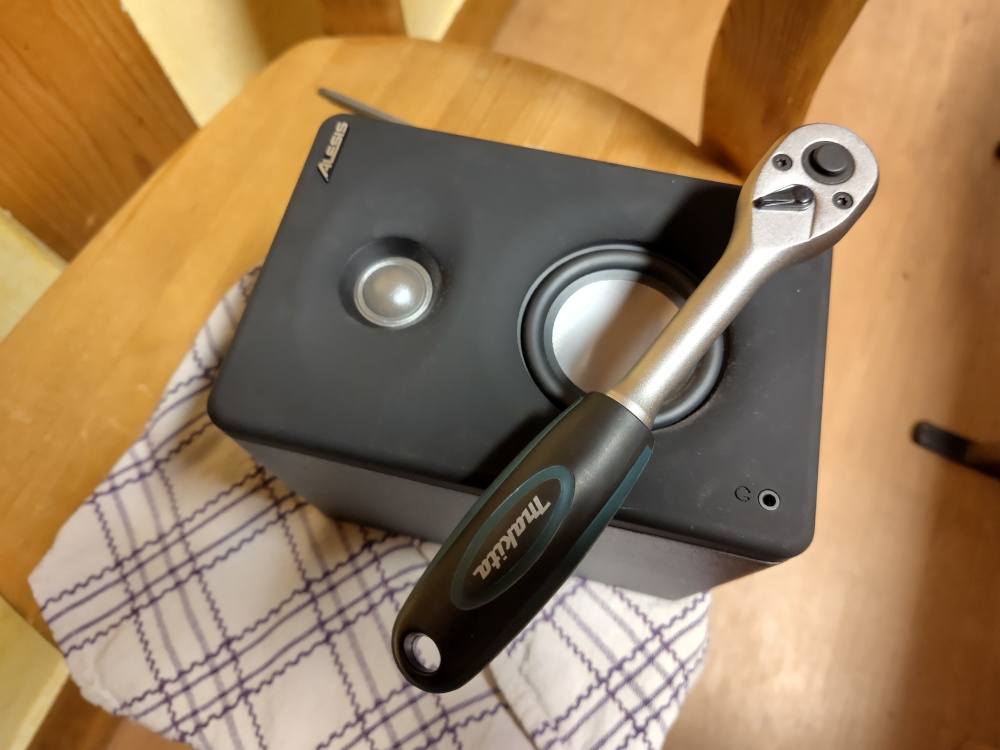
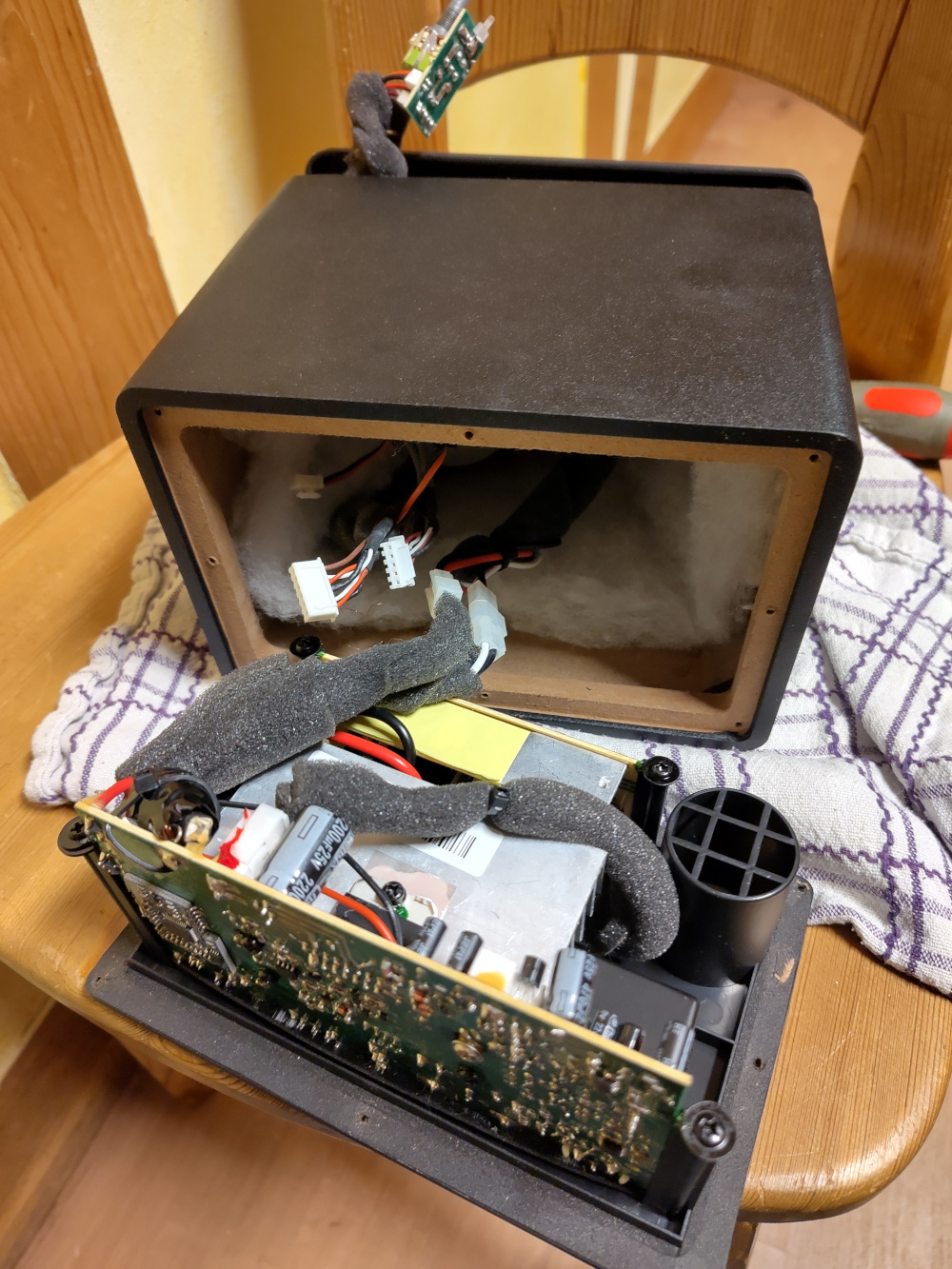
I've a set of Alesis M1Active 330 USB on my desk to listen to music. They were relatively inexpensive (~100 ), have USB and sound pretty good for their size/price. They were also sitting on my desk unused for a while, because the left speaker didn't produce any sound. Well, almost any. If you'd move the volume knob long enough you might have found a position where the left speaker would work a bit, but it'd be quieter than the right one and stop working again after some time. Pretty unacceptable when you want to listen to music. Given the right speaker was working just fine and the left would work a bit when the volume knob is moved, I was quite certain which part was to blame: the potentiometer. So just open the right speaker (it contains all the logic boards, power supply, etc), take out the broken potentiometer, buy a new one, replace, done. Sounds easy? Well, to open the speaker you gotta loosen 8 (!) screws on the back. At least it's not glued, right? Once the screws are removed you can pull out the back plate, which will bring the power supply, USB controller, sound amplifier and cables, lots of cables: two pairs of thick cables, one to each driver, one thin pair for the power switch and two sets of "WTF is this, I am not going to trace pinouts today", one with a 6 pin plug, one with a 5 pin one. Unplug all of these! Yes, they are plugged, nice. Nope, still no friggin' idea how to get to the potentiometer. If you trace the "thin pair" and "WTF1" cables, you see they go inside a small wooden box structure. So we have to pull the thing from the front? Okay, let's remove the plastic part of the knob Right, this looks like a potentiometer. Unscrew it. No, no need for a Makita wrench, I just didn't have anything else in the right size (10mm). right Alesis M1Active 330 USB speaker with a Makita wrench where the volume knob is Still, no movement. Let's look again from the inside! Oh ffs, there are six more screws inside, holding the front. Away with them! Just need a very long PH1 screwdriver. Now you can slowly remove the part of the front where the potentiometer is. Be careful, the top tweeter is mounted to the front, not the main case and so is the headphone jack, without an obvious way to detach it. But you can move away the front far enough to remove the small PCB with the potentiometer and the LED. right Alesis M1Active 330 USB speaker open Great, this was the easy part! The only thing printed on the potentiometer is "A10K". 10K is easy -- 10kOhm. A?! Wikipedia says "A" means "logarithmic", but only if made in the US or Asia. In Europe that'd be "linear". "B" in US/Asia means "linear", in Europe "logarithmic". Do I need to tap the sign again? (The sign is a print of XKCD#927.) My multimeter says in this case it's something like logarithmic. On the right channel anyway, the left one is more like a chopping board. And what's this green box at the end? Oh right, this thing also turns the power on and off. So it's a power switch. Where the fuck do I get a logarithmic 10kOhm stereo potentiometer with a power switch? And then in the exact right size too?! Of course not at any of the big German electronics pharmacies. But AliExpress saves the day, again. It's even the same color! Soldering without pulling out the cable out of the case was a bit challenging, but I've managed it and now have stereo sound again. Yay! PS: Don't operate this thing open to try it out. 230V are dangerous!

11 August 2024

Ravi Dwivedi: My Austrian Visa Refusal Story

Vienna - the capital of Austria - is one of the most visited cities in the world, popular for its rich history, gardens, and cafes, along with well-known artists like Beethoven, Mozart, G del, and Freud. It has also been consistently ranked as the most livable city in the world. For these reasons, I was elated when my friend Snehal invited me last year to visit Vienna for a few days. We included Christmas and New Year s Eve in my itinerary due to the city s popular Christmas markets and lively events. The festive season also ensured that Snehal had some days off for sightseeing. Indians require a visa to visit Austria. Since the travel dates were near, I rushed to book an appointment online with VFS Global in Delhi, and quickly arranged the required documents. However, at VFS, I found out that I had applied in the wrong appointment category (tourist), which depends on the purpose of the visit, and that my travel dates do not allow enough time for visa authorities to make a decision. Apparently, even if you plan to stay only for a part of the trip with the host, you need to apply under the category Visiting Friends and Family . Thus, I had to book another appointment under this category, and took the opportunity to shift my travel dates to allow at least 15 business days for the visa application to be processed, removing Christmas and New Year s Eve from my itinerary. The process went smoothly, and my visa application was submitted by VFS. For reference, here s a list of documents I submitted - The following charges were collected from me.
Service Description Amount (Indian Rupees)
Cash Handling Charge - SAC Code: (SAC:998599) 0
VFS Fee - India - SAC Code: (SAC:998599) 1,820
VISA Fee - India - SAC Code: 7,280
Convenience Fee - SAC Code: (SAC:998599) 182
Courier Service - SAC Code: (SAC:998599) 728
Courier Assurance - SAC Code: (SAC:998599) 182
Total 10,192
I later learned that the courier charges (728 INR) and the courier assurance charges (182 INR) mentioned above were optional. However, VFS didn t ask whether I wanted to include them. When the emabssy is done processing your application, it will send your passport back to VFS, from where you can either collect it yourself or get it couriered back home, which requires you to pay courier charges. However, courier assurance charges do not add any value as VFS cannot assure anything about courier and I suggest you get them removed. My visa application was submitted on the 21st of December 2023. A few days later, on the 29th of December 2023, I received an email from the Austrian embassy asking me to submit an additional document -
Subject: AUSTRIAN VISA APPLICATION - AMENDMENT REQUEST: Ravi Dwivedi VIS 4331 Dear Applicant, On 22.12.2023 your application for Visa C was registered at the Embassy. You are requested to kindly send the scanned copies of the following documents via email to the Embassy or submit the documents at the nearest VFS centre, for further processing of your application:
  • Kindly submit Electronic letter of guarantee EVE- Elektronische Verpflichtungserkl rung obtained from the Fremdenpolizeibeh rde of the sponsor s district in Austria. Once your host company/inviting company has obtained the EVE, please share the reference number (starting from DEL_____) received from the authorities, with the Embassy.
Kindly Note: It is in your own interest to fulfil the requirements as indicated above and submit the missing documents within 14 days of the receipt of this email. Otherwise a decision will be taken based on the documentation available. Sie werden in Ihrem Interesse ersucht, die gekennzeichneten M ngel so schnell wie m glich zu beheben bzw. fehlende Unterlagen umgehend nachzureichen, um die weitere Bearbeitung des Antrages zu erm glichen. Sollten Sie innerhalb 14 Tagen die gekennzeichneten M ngel nicht beheben bzw. die fehlenden Unterlagen nicht nachreichen, wird ber den vorliegenden Antrag ohne diese Unterlagen bzw. M ngelbehebung entschieden. Austrian Embassy New Delhi R.J/ Consular Section +91 11 2419 2700 EP-13, Chandragupta Marg, Chanakyapuri, New Delhi 110 021, India bmeia.gv.at/botschaft/new-delhi facebook.at/AustrianEmbassyNewDelhihttp://www.facebook.at/AustrianEmbassyNewDelhi twitter.com/MFA_Austriahttp://www.twitter.com/MFA_Austria [refocus1][Signatur_V+30]https://www.bmeia.gv.at/en/european-foreign-policy/foreign-trade/refocus-austria/[Logo_AT_IN_22px]
I misunderstood the required document (the EVE) to be a scanned copy of the letter of guarantee form signed by Snehal, and responded by attaching it. Upon researching, Snehal determined that the document is an electronic letter of guarantee, and is supposed to be obtained at a local police station in Vienna. He visited a police station the next day and had a hard time conversing due to the language barrier (German is the common language in Austria, whereas Snehal speaks English). That day was a weekend, so he took an appointment for Monday, but in the meantime the embassy had finished processing my visa. My visa was denied, and the refusal letter stated:
The Austrian embassy in Delhi examined your application; the visa has been refused. The decision is based on the following reason(s):
  • The information submitted regarding the justification for the purpose and conditions of the intended stay was not reliable.
  • There are reasonable doubts as to your intention to leave the territory of the Member States before the expiry of the visa.
Other remarks: You have been given an amendment request, which you have failed to fulfil, or have only fulfilled inadequately, within the deadline set. You are a first-time traveller. The social and economic roots with the home country are not evident. The return from Schengen territory does therefore not seem to be certain.
I could have reapplied after obtaining the EVE, but I didn t because I found the following line
The social and economic roots with the home country are not evident.
offensive for someone who was born and raised in India, got the impression that the absence of electronic guarantee letter was not the only reason behind the refusal, had already wasted 12,000 INR on this application, and my friend s stay in Austria was uncertain after January. In fact, my friend soon returned to India. To summarize -
  1. If you are visiting a host, then the category of appointment at VFS must be Visiting Friends and Family rather than Tourist .
  2. VFS charged me for courier assurance, which is an optional service. Make sure to get these removed from your bill.
  3. Neither my travel agent nor the VFS application center mentioned the EVE.
  4. While the required documents list from the VFS website does mention it in point 6, it leads to a dead link.
  5. Snehal informed me that a mere two months ago, his wife s visa was approved without an EVE. This hints at inconsistency in processing of applications, even those under identical categories.
Such incidents are a waste of time and money for applicants, and an embarrassment to VFS and the Austrian visa authorities. I suggest that the Austrian visa authorities fix that URL, and provide instructions for hosts to obtain the EVE. Credits to Snehal and Contrapunctus for editing, Badri for proofreading.

10 August 2024

Bits from Debian: DebConf24 closes in Busan and DebConf25 dates announced

DebConf24 group photo - click to enlarge On Saturday 3 August 2024, the annual Debian Developers and Contributors Conference came to a close. Over 339 attendees representing 48 countries from around the world came together for a combined 108 events made up of more than 50 Talks and Discussions, 37 Birds of a Feather (BoF informal meeting between developers and users) sessions, 12 workshops, and activities in support of furthering our distribution and free software (25 patches submitted to the Linux kernel), learning from our mentors and peers, building our community, and having a bit of fun. The conference was preceded by the annual DebCamp hacking session held July 21st through July 27th where Debian Developers and Contributors convened to focus on their Individual Debian-related projects or work in team sprints geared toward in-person collaboration in developing Debian. This year featured a BootCamp that was held for newcomers with a GPG Workshop and a focus on Introduction to creating .deb files (Debian packaging) staged by a team of dedicated mentors who shared hands-on experience in Debian and offered a deeper understanding of how to work in and contribute to the community. The actual Debian Developers Conference started on Sunday July 28 2024. In addition to the traditional 'Bits from the DPL' talk, the continuous key-signing party, lightning talks and the announcement of next year's DebConf25, there were several update sessions shared by internal projects and teams. Many of the hosted discussion sessions were presented by our technical core teams with the usual and useful meet the Technical Committee and the ftpteam and a set of BoFs about packaging policy and Debian infrastructure, including talk about APT and Debian Installer and an overview about the first eleven years of Reproducible Builds. Internationalization and localization have been subject of several talks. The Python, Perl, Ruby, and Go programming language teams, as well as Med team, also shared updates on their work and efforts. More than fifteen BoFs and talks about community, diversity and local outreach highlighted the work of various team involved in the social aspect of our community. This year again, Debian Brazil shared strategy and action to attract and retain new contributors and members and opportunities both in Debian and F/OSS. The schedule was updated each day with planned and ad-hoc activities introduced by attendees over the course of the conference. Several traditional activities took place: a job fair, a poetry performance, the traditional Cheese and Wine party, the group photos and the Day Trips. For those who were not able to attend, most of the talks and sessions were broadcast live and recorded and the videos made available through a link in their summary in the schedule. Almost all of the sessions facilitated remote participation via IRC messaging apps or online collaborative text documents which allowed remote attendees to 'be in the room' to ask questions or share comments with the speaker or assembled audience. DebConf24 saw over 6.8 TiB (4.3 TiB in 2023) of data streamed, 91.25 hours (55 in 2023) of scheduled talks, 20 network access points, 1.6 km fibers (1 broken fiber...) and 2.2 km UTP cable deployed, more than 20 country Geoip viewers, 354 T-shirts, 3 day trips, and up to 200 meals planned per day. All of these events, activities, conversations, and streams coupled with our love, interest, and participation in Debian and F/OSS certainly made this conference an overall success both here in Busan, South Korea and online around the world. The DebConf24 website will remain active for archival purposes and will continue to offer links to the presentations and videos of talks and events. Next year, DebConf25 will be held in Brest, France, from Monday, July 7 to Monday, July 21, 2025. As tradition follows before the next DebConf the local organizers in France will start the conference activities with DebCamp with particular focus on individual and team work towards improving the distribution. DebConf is committed to a safe and welcome environment for all participants. See the web page about the Code of Conduct in DebConf24 website for more details on this. Debian thanks the commitment of numerous sponsors to support DebConf24, particularly our Platinum Sponsors: Infomaniak, Proxmox, and Wind River. We also wish to thank our Video and Infrastructure teams, the DebConf24 and DebConf committees, our host nation of South Korea, and each and every person who helped contribute to this event and to Debian overall. Thank you all for your work in helping Debian continue to be "The Universal Operating System". See you next year! About Debian The Debian Project was founded in 1993 by Ian Murdock to be a truly free community project. Since then the project has grown to be one of the largest and most influential open source projects. Thousands of volunteers from all over the world work together to create and maintain Debian software. Available in 70 languages, and supporting a huge range of computer types, Debian calls itself the universal operating system. About DebConf DebConf is the Debian Project's developer conference. In addition to a full schedule of technical, social and policy talks, DebConf provides an opportunity for developers, contributors and other interested people to meet in person and work together more closely. It has taken place annually since 2000 in locations as varied as Scotland, Argentina, Bosnia and Herzegovina, and India. More information about DebConf is available from https://debconf.org/. About Infomaniak Infomaniak is an independent cloud service provider recognized throughout Europe for its commitment to privacy, the local economy and the environment. Recording growth of 18% in 2023, the company is developing a suite of online collaborative tools and cloud hosting, streaming, marketing and events solutions. Infomaniak uses exclusively renewable energy, builds its own data centers and develops its solutions in Switzerland, without relocating. The company powers the website of the Belgian radio and TV service (RTBF) and provides streaming for more than 3,000 TV and radio stations in Europe. About Proxmox Proxmox provides powerful and user-friendly Open Source server software. Enterprises of all sizes and industries use Proxmox solutions to deploy efficient and simplified IT infrastructures, minimize total cost of ownership, and avoid vendor lock-in. Proxmox also offers commercial support, training services, and an extensive partner ecosystem to ensure business continuity for its customers. Proxmox Server Solutions GmbH was established in 2005 and is headquartered in Vienna, Austria. Proxmox builds its product offerings on top of the Debian operating system. About Wind River Wind River For nearly 20 years, Wind River has led in commercial Open Source Linux solutions for mission-critical enterprise edge computing. With expertise across aerospace, automotive, industrial, telecom, and more, the company is committed to Open Source through initiatives like eLxr, Yocto, Zephyr, and StarlingX. Contact Information For further information, please visit the DebConf24 web page at https://debconf24.debconf.org/ or send mail to press@debian.org.

8 August 2024

Jonathan Carter: DebConf24 Busan, South Korea

I m finishing typing up this blog entry hours before my last 13 hour leg back home, after I spent 2 weeks in Busan, South Korea for DebCamp24 and DebCamp24. I had a rough year and decided to take it easy this DebConf. So this is the first DebConf in a long time where I didn t give any talks. I mostly caught up on a bit of packaging, worked on DebConf video stuff, attended a few BoFs and talked to people. Overall it was a very good DebConf, which also turned out to be more productive than I expeced it would. In the welcome session on the first day of DebConf, Nicolas Dandrimont mentioned that a benefit of DebConf is that it provides a sort of caffeine for your Debian motivation. I could certainly feel that affect swell as the days went past, and it s nice to be excited about some ideas again that would otherwise be fading.

Recovering DPL It s a bit of a gear shift being DPL for 4 years, and DebConf Committee for nearly 5 years before that, and then being at DebConf while some issue arise (as it always does during a conference). At first I jump into high alert mode, but then I have to remind myself it s not your problem anymore and let others deal with it. It was nice spending a little in-person time with Andreas Tille, our new DPL, we did some more handover and discussed some current issues. I still have a few dozen emails in my DPL inbox that I need to collate and forward to Andreas, I hope to finish all that up by the end of August. During the Bits from the DPL talk, the usual question came up whether Andreas will consider running for DPL again, to which he just responded in a slide Maybe . I think it s a good idea for a DPL to do at least two terms if it all works out for everyone, since it takes a while to get up to speed on everything. Also, having been DPL for four years, I have a lot to say about it, and I think there s a lot we can fix in the role, or at least discuss it. If I had the bandwidth for it I would have scheduled a BoF for it, but I ll very likely do that for the next DebConf instead!

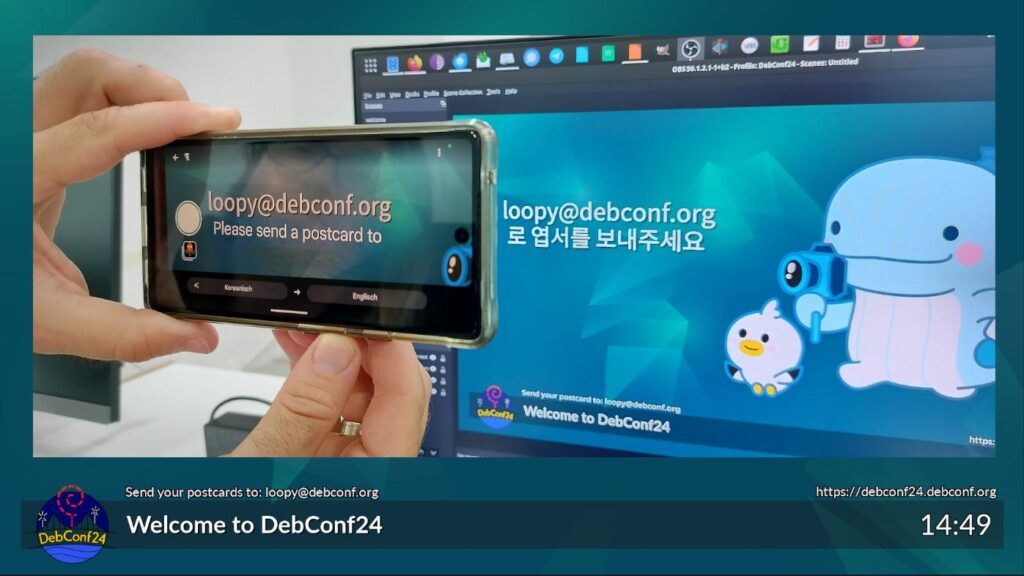
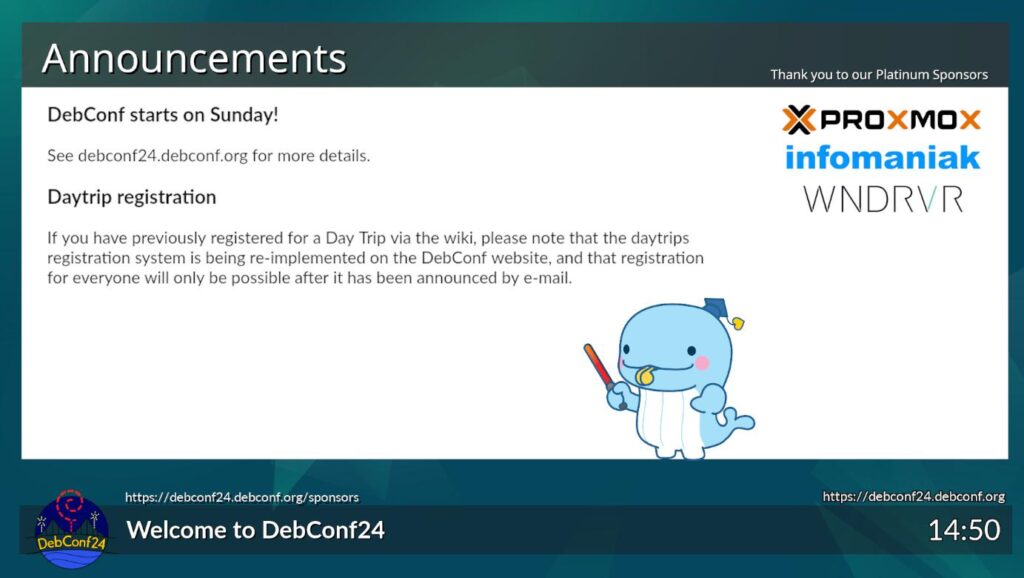
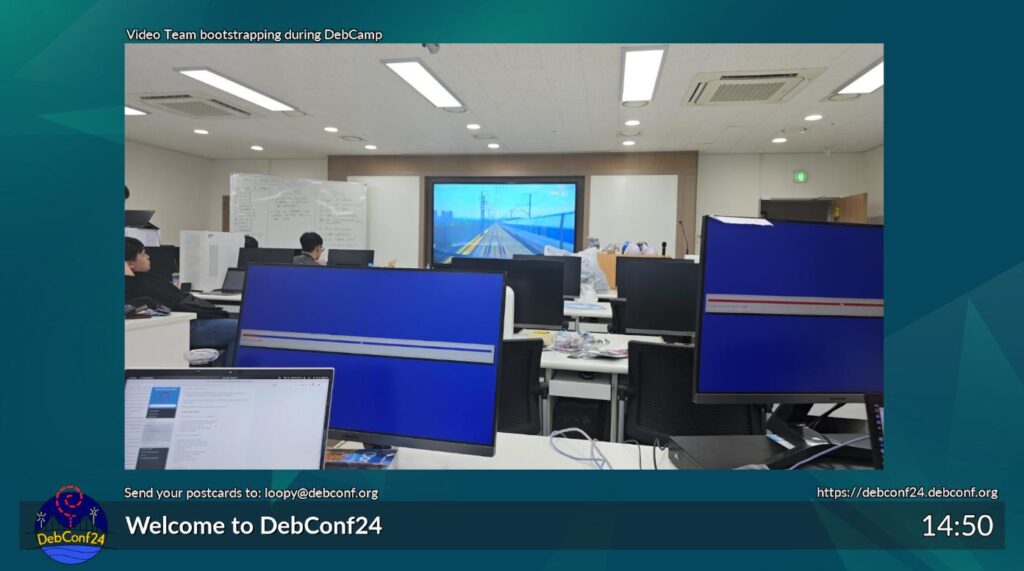
Video team I set up the standby loop for the video streaming setup. We call it loopy, it s a bunch of OBS scenes that provide announcements, shows sponsors, the schedule and some social content. I wrote about it back in 2020, but it s evolved quite a bit since then, so I m probably due to write another blog post with a bunch of updates on it. I hope to organise a video team sprint in Cape Town in the first half of next year, so I ll summarize everything before then.

It would ve been great if we could have some displays in social areas that could show talks, the loop and other content, but we were just too pressed for time for that. This year s DebConf had a very compressed timeline, and there was just too much that had to be done and that had to be figured out on the last minute. This put quite a lot of strain on the organisers, but I was glad to see how, for the most part, most attendees were very sympathetic to some rough edges (but I digress ). I added more of the OBS machine setup to the videoteam s ansible repository, so as of now it just needs an ansible setup and the OBS data and it s good to go. The loopy data is already in the videoteam git repository, so I could probably just add a git pull and create some symlinks in ansible and then that machine can be installed from 0% to 100% by just installing via debian-installer with our ansible hooks. This DebConf I volunteered quite a bit for actual video roles during the conference, something I didn t have much time for in recent DebConfs, and it s been fun, especially in a session or two where nearly none of the other volunteers showed up. Sometimes chaos is just fun :-)
Baekyongee is the university mascot, who s visible throughout the university. So of course we included this four legged whale creature on the loop too!

Packaging I was hoping to do more packaging during DebCamp, but at least it was a non-zero amount:
  • Uploaded gdisk 1.0.10-2 to unstable (previously tested effects of adding dh-sequence-movetousr) (Closes: #1073679).
  • Worked a bit on bcachefs-tools (updating git to 1.9.4), but has a build failure that I need to look into (we might need a newer bindgen) update: I m probably going to ROM this package soon, it doesn t seem suitable for packaging in Debian.
  • Calamares: Tested a fix for encrypted installs, and uploaded it.
  • Calamares: Uploaded (3.3.8-1) to backports (at the time of writing it s still in backports-NEW).
  • Backport obs-gradient-source for bookworm.
  • Did some initial packaging on Cambalache, I ll upload to unstable once wlroots (0.18) hits unstable.
  • Pixelorama 1.0 I did some initial packaging for Pixelorama back when we did the MiniDebConf Gaming Edition, but it had a few stoppers back then. Version 1.0 seems to fix all of that, but it depends on Godot 4.2 and we re still on the 3 series in Debian, so I ll upload this once Godot 4.2 hits at least experimental. Godot software/games is otherwise quite easy to run, it s basically just source code / data that is installed and then run via godot-runner (godot3-runner package in Debian).

BoFs Python Team BoF Link to the etherpad / pad archive link and video can be found on the talk page: https://debconf24.debconf.org/talks/31-python-bof/ The session ended up being extended to a second part, since all the issues didn t fit into the first session. I was distracted by too many thing during the Python 3.12 transition (to the point where I thought that 3.11 was still new in Debian), so it was very useful listening to the retrospective of that transition. There was a discussion whether Python 3.13 could still make it to testing in time for freeze, and it seems that there is consensus that it can, although, likely with new experimental features like disabling the global interpreter lock and the just in time compiler disabled. I learned for the first time about the dead batteries project, PEP-0594, which removes ancient modules that have mostly been superseded, from the Python standard library. There was some talk about the process for changing team policy, and a policy discussion on whether we should require autopkgtests as a SHOULD or a MUST for migration to testing. As with many things, the devil is in the details and in my opinion you could go either way and achieve a similar result (the original MUST proposal allowed exceptions which imho made it the same as the SHOULD proposal). There s an idea to do some ongoing remote sprints, like having co-ordinated days for bug squashing / working on stuff together. This is a nice idea and probably a good way to energise the team and also to gain some interest from potential newcomers. Louis-Philipe V ronneau was added as a new team admin and there was some discussion on various Sphinx issues and which Lintian tags might be needed for Python 3.13. If you want to know more, you probably have to watch the videos / read the notes :)
    Debian.net BoF Link to the etherpad / pad archive link can be found on the talk page: https://debconf24.debconf.org/talks/37-debiannet-team-bof Debian Developers can set up services on subdomains on debian.net, but a big problem we ve had before was that developers were on their own for hosting those services. This meant that they either hosted it on their DSL/fiber connection at home, paid for the hosting themselves, or hosted it at different services which became an accounting nightmare to claim back the used funds. So, a few of us started the debian.net hosting project (sometimes we just call it debian.net, this is probably a bit of a bug) so that Debian has accounts with cloud providers, and as admins we can create instances there that gets billed directly to Debian. We had an initial rush of services, but requests have slowed down since (not really a bad thing, we don t want lots of spurious requests). Last year we did a census, to check which of the instances were still used, whether they received system updates and to ask whether they are performing backups. It went well and some issues were found along the way, so we ll be doing that again. We also gained two potential volunteers to help run things, which is great. Debian Social BoF Link to the etherpad / pad archive link can be found on the talk page: https://debconf24.debconf.org/talks/34-debiansocial-bof We discussed the services we run, you can view the current state of things at: https://wiki.debian.org/Teams/DebianSocial Pleroma has shown some cracks over the last year or so, and there are some forks that seem promising. At the same time, it might be worth while considering Mastodon too. So we ll do some comparison of features and maintenance and find a way forward. At the time when Pleroma was installed, it was way ahead in terms of moderation features. Pixelfed is doing well and chugging along nicely, we should probably promote it more. Peertube is working well, although we learned that we still don t have all the recent DebConf videos on there. A bunch of other issues should be fixed once we move it to a new machine that we plan to set up. We re removing writefreely and plume. Nice concepts, but it didn t get much traction yet, and no one who signed up for these actually used it, which is fine, some experimentation with services is good and sometimes they prove to be very popular and other times not. The WordPress multisite instance has some mild use, otherwise haven t had any issues. Matrix ended up to be much, much bigger than we thought, both in usage and in its requirements. It s very stateful and remembers discussions for as long as you let it, so it s Postgres database is continuously expanding, this will also be a lot easier to manage once we have this on the new host. Jitsi is also quite popular, but it could probably be on jitsi.debian.net instead (we created this on debian.social during the initial height of COVID-19 where we didn t have the debian.net hosting yet), although in practice it doesn t really matter where it lives. Most of our current challenges will be solved by moving everything to a new big machine that has a few public IPs available for some VMs, so we ll be doing that shortly. Debian Foundation Discussion BoF This was some brainstorming about the future structure of Debian, and what steps might be needed to get there. It s way too big a problem to take on in a BoF, but we made some progress in figuring out some smaller pieces of the larger puzzle. The DPL is going to get in touch with some legal advisors and our trusted organisations so that we can aim to formalise our relationships a bit more by the time it s DebConf again. I also introduced my intention to join the Debian Partners delegation. When I was DPL, I enjoyed talking with external organisations who wanted to help Debian, but helping external organisations help Debian turned out to be too much additional load on the usual DPL roles, so I m pursuing this with the Debian Partners team, more on that some other time. This session wasn t recorded, but if you feel like you missed something, don t worry, all intentions will be communicated and discussed with project members before anything moves forward. There was a strong agreement in the room though that we should push forward on this, and not reach another DebConf where we didn t make progress on formalising Debian s structure more.

    Social Conference Dinner
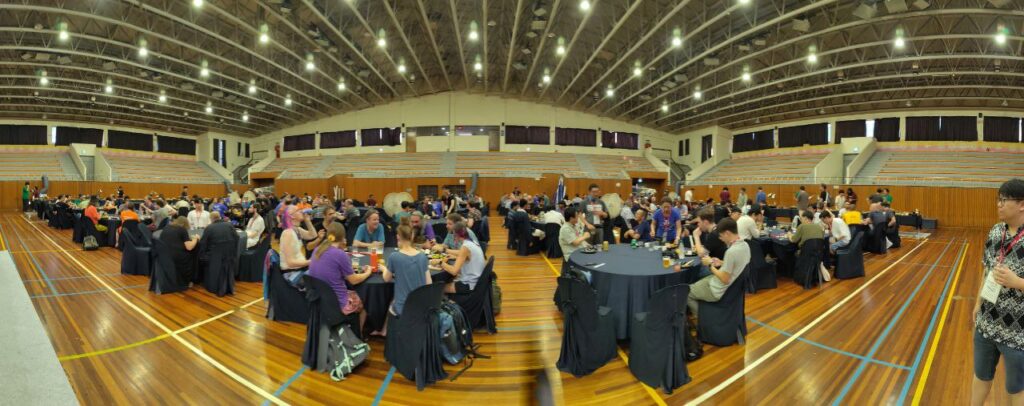
    Conference Dinner Photo from Santiago
    The conference dinner took place in the university gymnasium. I hope not many people do sports there in the summer, because it got HOT. There was also some interesting observations on the thermodynamics of the attempted cooling solutions, which was amusing. On the plus side, the food was great, the company was good, and the speeches were kept to a minimum, so it was a great conference dinner, even though it was probably cut a bit short due to the heat. Cheese and Wine Cheese and Wine happened on 1 August, which happens to be the date I became a DD at DebConf17 in Montr al seven years before, so this was a nice accidental celebration of my Debiversary :) Since I m running out of time, I ll add some more photos to this post some time after publishing it :P Group Photo As per DebConf tradition, Aigars took the group photo. You can find the high resolution version on Debian s GitLab instance.
    Debian annual conference Debconf 24, Busan, South Korea
    Photography: Aigars Mahinovs aigarius@debian.org
    License: CC-BYv3+ or GPLv2+
    Talking Ah yes, talking to people is a big part of DebConf, but I didn t keep track of it very well.
    • I mostly listened to Alper a bit about his ideas for his talk about debian installer.
    • I talked to Rhonda a bit about ActivityPub and MQTT and whether they could be useful for publicising Debian activity.
    • Listened to Gunnar and Julian have a discussion about GPG and APT which was interesting.
    • I learned that you can learn Hangul, the Korean alphabet, in about an hour or so (I wish I knew that in all my years of playing StarCraft II).
    • We had the usual continuous keysigning party. Besides it s intended function, this is always a good ice breaker and a way to for shy people to meet other shy people.
    • and many other fly-by discussions.

    Stuff that didn t happen this DebConf
    • loo.py A simple Python script that could eventually replace the obs-advanced-scene-switcher sequencer in OBS. It would also be extremely useful if we d ever replace OBS for loopy. I was hoping to have some time to hack on this, and try to recreate the current loopy in loo.py, but didn t have the time.
    • toetally This year videoteam had to scramble to get a bunch of resistors to assemble some tally light. Even when assembled, they were a bit troublesome. It would ve been nice to hack on toetally and get something ready for testing, but it mostly relies on having something like a rasbperry pi zero with an attached screen in order to work on further. I ll try to have something ready for the next mini conf though.
    • extrepo on debian live I think we should have extrepo installed by default on desktop systems, I meant to start a discussion on this, but perhaps it s just time I go ahead and do it and announce it.
    • Live stream to peertube server It would ve been nice to live stream DebConf to PeerTube, but the dependency tree to get this going got a bit too huge. Following our plans discussed in the Debian Social BoF, we should have this safely ready before the next MiniDebConf and should be able to test it there.
    • Desktop Egg there was this idea to get a stand-in theme for Debian testing/unstable until the artwork for the next release is finalized (Debian bug: #1038660), I have an idea that I meant to implement months ago, but too many things got in the way. It s based on Juliette Taka s Homeworld theme, and basically transforms the homeworld into an egg. Get it? Something that hasn t hatched yet? I also only recently noticed that we never used the actual homeworld graphics (featuring the world image) in the final bullseye release. lol.
    So, another DebConf and another new plush animal. Last but not least, thanks to PKNU for being such a generous and fantastic host to us! See you again at DebConf25 in Brest, France next year!

      21 July 2024

      Mike Gabriel: Polis - a FLOSS Tool for Civic Participation -- Issues extending Polis and adjusting our Goals

      Here comes the 3rd article of the 5-episode blog post series on Polis, written by Guido Berh rster, member of staff at my company Fre(i)e Software GmbH. Enjoy also this read on Guido's work on Polis,
      Mike
      Table of Contents of the Blog Post Series
      1. Introduction
      2. Initial evaluation and adaptation
      3. Issues extending Polis and adjusting our goals (this article)
      4. Creating (a) new frontend(s) for Polis
      5. Current status and roadmap
      Polis - Issues extending Polis and adjusting our Goals After the initial implementation of limited branding support, user feedback and the involvement of an UX designer lead to the conclusion that we needed more far-reaching changes to the user interface in order to reduce visual clutter, rearrange and improve UI elements, and provide better integration with the websites in which conversations are embedded. Challenges when visualizing Data in Polis Polis visualizes groups using a spatial projection of users based on similarities in voting behavior and places them in two to five groups using a clustering algorithm. During our testing and evaluation users were rarely able to interpret the visualization and often intuitively made incorrect assumptions e.g. by associating the filled area of a group with its significance or size. After consultation with a member of the Multi-Agent Systems (MAS) Group at the University of Groningen we chose to temporarily replace the visualization offered by Polis with simple bar charts representing agreement or disagreement with statements of a group or the majority. We intend to revisit this and explore different forms of visualization at a later point in time. The different factors playing into the weight attached to statements which determine the pseuodo-random order in which they are presented for voting ( comment routing ) proved difficult to explain to stakeholders and users and the admission of the ad-hoc and heuristic nature of the used algorithm1 by Polis authors lead to the decision to temporarily remove this feature. Instead, statements should be placed into three groups, namely
      1. metadata questions,
      2. seed statements,
      3. and participant statements
      Statements should then be sorted by group but in a fully randomized order within the group so that metadata questions would be presented before seed statements which would be presented before participant s statements. This simpler method was deemed sufficient for the scale of our pilot projects, however we intend to revisit this decision and explore different methods of comment routing in cooperation with our scientific partners at a later point in time. An evaluation of the requirements for implementing mandatory authentication and adding support for additional authentication methods to Polis showed that significant changes to both the administration and participation frontend were needed due to a lack of an abstraction layer or extension mechanism and the current authentication providers being hardcoded in many parts of the code base. A New Frontend is born: Particiapp Based on the implementation details of the participation frontend, the invasive nature of the changes required, and the overhead of keeping up with active upstream development it became clear that a different, more flexible approach to development was needed. This ultimately lead to the creation of Particiapp, a new Open Source project providing the building blocks and necessary abstraction layers for rapid protoyping and experimentation with different fontends which are compatible with but independent from Polis.
      1. Small, Christopher T., Bjorkegren, Michael, Erkkil , Timo, Shaw, Lynette and Megill, Colin (2021). Polis: Scaling deliberation by mapping high dimensional opinion spaces. Recerca. Revista de Pensament i An lisi, 26(2), pp. 1-26.

      14 July 2024

      Ravi Dwivedi: Kenya Visa Process

      Prior to arrival in Kenya, you need to apply for an Electronic Travel Authorization (eTA) on their website by uploading all the required documents. This system is in place since Jan 2024 after the country abolished the visa system, implementing the eTA portal. The required documents will depend on the purpose of your visit, which in my case, was to attend a conference. Here is the list of documents I submitted for my eTA: Reservation means I didn t book the flights and hotels, but rather reserved them. Additionally, optional means that those documents were not mandatory to submit, but I submitted them in the Other Documents section in order to support my application. After submitting the eTA, I had to make a payment of around 35 US Dollars (approximately 3000 Indian Rupees). It took 40 hours for me to receive an email from Kenya stating that my eTA has been approved, along with an attached PDF, making this one of my smoothest experiences of obtaining travel documents to travel to a country :). An eTA is technically not a visa, but I put the word visa in the title due to familiarity with the term.

      1 July 2024

      Abhijith PA: A lazy local file sharing setup

      At home, I have both a laptop and a *desktop PC. Most of my essential things, such as emails, repositories, password managers, contacts, and calendars are synced between the two devices. However, when I need to share some documents and I am lazy enough to go pick a flash drive, my only option is to push them to the Internet and download them on the other system, which is sitting at 20~ meters away. Typically, I do this either through email attachments or a matrix client. Occasionally, I think about setting up a network storage solution at home. But then I ask myself do I really need one. In my home network, I already have a Raspberry Pi running as my Wi-Fi router, doing DNS level ad blocking with Dnsmasq and DNS over TLS with stubby. Rpi has a 16GB memory card. I can mount RPi remote directory to both machines. I use pcmanfm as my file manager. It has the ability (like every other file managers) to mount remote storage over ssh. But one annoying thing is that whenever I open the mount directory, by default it shows the root file system of the remote device even when I explicitly mentioned the path. Then I discovered sshfs. I wrote the following script, which mount remote directory and open that in pcmanfm.
      #!/bin/bash
      LOCMOUNT="/home/user/Public"
      sshfs raspberrypi:Public $LOCMOUNT
      pcmanfm $MOUNT
      
      I haven t enabled any encryption for the memory until now since other than some logs RPi wasn t writing anything to it. I set up fscrypt on Rpi storage now. And ta-da, a lazy person s local sharing solution. *Desktop - Well, technically it s an old laptop with a broken keyboard and trackpad, connected to a monitor, keyboard and mouse. I don t feel keeping it on a shelf.

      20 June 2024

      Daniel Lange: Fixing esptool read_flash above 2MB on some cheap ESP32 boards

      esptool, the Espressif SoC serial bootloader utility, tends to dislike cheap Flash chips attached to the various incarnations of the ESP32 chip family. And it seems to dislike them even more when running esptool on Linux than on other OSs. The common error mode is seeing it break at the 2MB barrier when trying to dump (esptool read_flash) a 4MB flash configuration.
      esptool -p /dev/ttyUSB0 -b 921600 read_flash 0 0x400000 flash_dump.bin
      will fail with
      esptool.py v4.7.0
      Serial port /dev/ttyUSB0
      Connecting....
      Detecting chip type... ESP32
      Chip is ESP32-D0WD-V3 (revision v3.1)
      Features: WiFi, BT, Dual Core, 240MHz, VRef calibration in efuse, Coding Scheme None
      Crystal is 40MHz
      [..]
      Detected flash size: 4MB
      [..]
      2097152 (50 %)
      A fatal error occurred: Failed to read flash block (result was 01090000: CRC or checksum was invalid)
      
      typically at the 2MB barrier. I found the solution in a rather unrelated esptool Github issue: Create an esptool.cfg file in the project directory (from where you will run esptool):
      [esptool]
      timeout = 30
      max_timeout = 240
      erase_write_timeout_per_mb = 40
      mem_end_rom_timeout = 0.2
      serial_write_timeout = 10
      The timeout = 30 is the setting that fixed reading flash memory via esptool read_flash for me. When your esptool.cfg is read, esptool will tell you so in its second line of output:
      $ esptool flash_id
      esptool.py v4.7.0
      Loaded custom configuration from /home/dl/[..]/Embedded_dev/ESP-32_Wemos/esptool.cfg
      Found 1 serial ports
      Serial port /dev/ttyUSB0
      Connecting......
      [..]
      
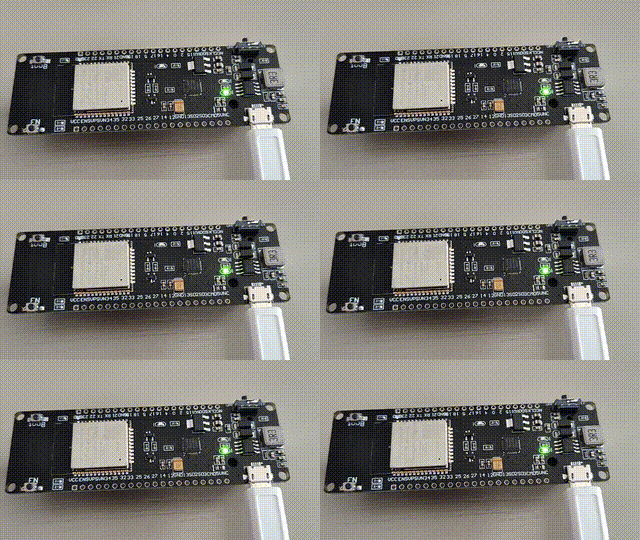
      Animated GIF of an ESP32 board Thank you Radim Karnis and wibbit from the Github issue linked above.

      24 May 2024

      Freexian Collaborators: Discover release 0.3.0 of the debusine software factory (by Colin Watson)

      Debusine is a Free Software project developed by Freexian to manage scheduling and distribution of Debian-related tasks to a network of worker machines. It was started some time back, but its development pace has recently increased significantly thanks to funding from the Sovereign Tech Fund. You can read more about it in its documentation. For more background, Enrico Zini and Carles Pina i Estany gave a talk on Debusine in November 2023 at the mini-DebConf in Cambridge. We described the work from our first funded milestone in a post to debian-devel-announce in March. We ve recently finished work on our second funded milestone, culminating in releasing version 0.3.0 to unstable. Our focus on this milestone was on new building blocks to allow us to automatically orchestrate QA tasks in bulk. Full details are in our release history document. As usual, debusine.debian.net is up to date with our latest work.

      Collections In the previous milestone, debusine could store artifacts and run tasks against those artifacts. However, on its own this required the user to do a lot of manual work, because the only way to refer to an artifact was by its ID. We now have the concept of a collection, which can store references to other artifacts (or indeed to other collections) with some attached metadata. These are structured by category, so for example a debian:suite collection contains references to source and binary package artifacts with their names, versions, and architectures as metadata. This allows us to look up artifacts using a simple query language instead of just by ID. At the moment, the main visible effect of this is that our Getting started with debusine tutorial no longer needs users of debusine.debian.net to create their own build environments before being able to submit other work requests: they can refer to existing environments using something like debian/match:codename=trixie:variant=sbuild instead. We also have a basic user interface allowing you to browse existing collections, accessible via the relevant workspace (such as the default System workspace).

      Workflows We ve always known that individual tasks were just a starting point: real-world requirements often involve chaining many tasks together, as many Debian developers already do using the Salsa CI pipeline. debusine intends to approach a similar problem from a different angle, defining common workflows that can be applied at the scale of a whole distribution without being tightly coupled to where each package s code is hosted. In time we intend to define a way for users to specify their own workflows, but rather than getting too bogged down in this we started by building a couple of predefined workflows into debusine. The update_environments workflow is used to create multiple build environments in bulk, while the sbuild workflow builds a source package for all the architectures that it supports and for which debusine has workers. (debusine.debian.net currently has amd64 and arm64 workers, supporting the amd64, arm64, armel, armhf, and i386 architectures between them.) Upcoming work will build on this by adding more workflows that chain tasks together in various ways, such as workflows that build a package and run QA tasks on the results, or a workflow that builds a package and uploads the result to an upload queue.

      Next steps Our next planned milestone involves expanding debusine s capability as a build daemon. For that, we already know that there are a number of specific extra workflow steps we need to add, and we ve reached out to some members of Debian s buildd team to ask for feedback on what they consider necessary. We hope to be able to replace some of Freexian s own build infrastructure with debusine in the near future.

      12 May 2024

      Elana Hashman: I am very sick

      I have not been able to walk since February 18, 2023. When people ask me how I'm doing, this is the first thing that comes to mind. "Well, you know, the usual, but also I still can't walk," I think to myself. If I dream at night, I often see myself walking or running. In conversation, if I talk about going somewhere, I'll imagine walking there. Even though it's been over a year, I remember walking to the bus, riding to see my friends, going out for brunch, cooking community dinners. But these days, I can't manage going anywhere except by car, and I can't do the driving, and I can't dis/assemble and load my chair. When I'm resting in bed and follow a guided meditation, I might be asked to imagine walking up a staircase, step by step. Sometimes, I do. Other times, I imagine taking a little elevator in my chair, or wheeling up ramps. I feel like there is little I can say that can express the extent of what this illness has taken from me, but it's worth trying. To an able-bodied person, seeing me in a power wheelchair is usually "enough." One of my acquaintances cried when they last saw me in person. But frankly, I love my wheelchair. I am not "wheelchair-bound" I am bed-bound, and the wheelchair gets me out of bed. My chair hasn't taken anything from me. *** In October of 2022, I was diagnosed with myalgic encephalomyelitis. Scientists and doctors don't really know what myalgic encephalomyelitis (ME) is. Diseases like it have been described for over 200 years.1 It primarily affects women between the ages of 10-39, and the primary symptom is "post-exertional malaise" or PEM: debilitating, disproportionate fatigue following activity, often delayed by 24-72 hours and not relieved by sleep. That fatigue has earned the illness the misleading name of "Chronic Fatigue Syndrome" or CFS, as though we're all just very tired all the time. But tired people respond to exercise positively. People with ME/CFS do not.2 Given the dearth of research and complete lack of on-label treatments, you may think this illness is at least rare, but it is actually quite common: in the United States, an estimated 836k-2.5m people3 have ME/CFS. It is frequently misdiagnosed, and it is estimated that as many as 90% of cases are missed,4 due to mild or moderate symptoms that mimic other diseases. Furthermore, over half of Long COVID cases likely meet the diagnostic criteria for ME,5 so these numbers have increased greatly in recent years. That is, ME is at least as common as rheumatoid arthritis,6 another delightful illness I have. But while any doctor knows what rheumatoid arthritis is, not enough7 have heard of "myalgic encephalomylitis." Despite a high frequency and disease burden, post-viral associated conditions (PASCs) such as ME have been neglected for medical funding for decades.8 Indeed, many people, including medical care workers, find it hard to believe that after the acute phase of illness, severe symptoms can persist. PASCs such as ME and Long COVID defy the typical narrative around common illnesses. I was always told that if I got sick, I should expect to rest for a bit, maybe take some medications, and a week or two later, I'd get better, right? But I never got better. These are complex, multi-system diseases that do not neatly fit into the Western medical system's specializations. I have seen nearly every specialty because ME/CFS affects nearly every system of the body: cardiology, nephrology, pulmonology, neurology, opthalmology, and, many, many more. You'd think they'd hand out frequent flyer cards, or a medical passport with fun stamps, but nope. Just hundreds of pages of medical records. And when I don't fit neatly into one particular specialist's box, then I'm sent back to my primary care doctor to regroup while we try to troubleshoot my latest concerning symptoms. "Sorry, can't help you. Not my department." With little available medical expertise, a lot of my disease management has been self-directed in partnership with primary care. I've read hundreds of articles, papers, publications, CME material normally reserved for doctors. It's truly out of necessity, and I'm certain I would be much worse off if I lacked the skills and connections to do this; there are so few ME/CFS experts in the US that there isn't one in my state or any adjacent state.9 So I've done a lot of my own work, much of it while barely being able to read. (A text-to-speech service is a real lifesaver.) To facilitate managing my illness, I've built a mental model of how my particular flavour of ME/CFS works based on the available research I've been able to read and how I respond to treatments. Here is my best attempt to explain it: The best way I have learned to manage this is to prevent myself from doing activities where I will exceed that aerobic threshold by wearing a heartrate monitor,12 but the amount of activity that permits in my current state of health is laughably restrictive. Most days I'm unable to spend more than one to two hours out of bed. Over time, this has meant worsening from a persistent feeling of tiredness all the time and difficulty commuting into an office or sitting at a desk, to being unable to sit at a desk for an entire workday even while working from home and avoiding physically intense chores or exercise without really understanding why, to being unable to leave my apartment for days at a time, and finally, being unable to stand for more than a minute or two or walk. But it's not merely that I can't walk. Many folks in wheelchairs are able to live excellent lives with adaptive technology. The problem is that I am so fatigued, any activity can destroy my remaining quality of life. In my worst moments, I've been unable to read, move my arms or legs, or speak aloud. Every single one of my limbs burned, as though I had caught fire. Food sat in my stomach for hours, undigested, while my stomach seemingly lacked the energy to do its job. I currently rely on family and friends for full-time caretaking, plus a paid home health aide, as I am unable to prep meals, shower, or leave the house independently. This assistance has helped me slowly improve from my poorest levels of function. While I am doing better than I was at my worst, I've had to give up essentially all of my hobbies with physical components. These include singing, cooking, baking, taking care of my houseplants, cross-stitching, painting, and so on. Doing any of these result in post-exertional malaise so I've had to stop; this reduction of activity to prevent worsening the illness is referred to as "pacing." I've also had to cut back essentially all of my volunteering and work in open source; I am only cleared by my doctor to work 15h/wk (from bed) as of writing. *** CW: severe illness, death, and suicide (skip this section) The difficulty of living with a chronic illness is that there's no light at the end of the tunnel. Some diseases have a clear treatment path: you take the medications, you complete the procedures, you hit all the milestones, and then you're done, perhaps with some long-term maintenance work. But with ME, there isn't really an end in sight. The median duration of illness reported in one 1997 study was over 6 years, with some patients reporting 20 years of symptoms.13 While a small number of patients spontaneously recover, and many improve, the vast majority of patients are unable to regain their baseline function.14 My greatest fear since losing the ability to walk is getting worse still. Because, while I already require assistance with nearly every activity of daily living, there is still room for decline. The prognosis for extremely ill patients is dismal, and many require feeding tubes and daily nursing care. This may lead to life-threatening malnutrition;15 a number of these extremely severe patients have died, either due to medical neglect or suicide.16 Extremely severe patients cannot tolerate light, sound, touch, or cognitive exertion,17 and often spend most of their time lying flat in a darkened room with ear muffs or an eye mask.18 This is all to say, my prognosis is not great. But while I recognize that the odds aren't exactly in my favour, I am also damn stubborn. (A friend once cheerfully described me as "stubbornly optimistic!") I only get one shot at life, and I do not want to spend the entirety of it barely able to perceive what's going on around me. So while my prognosis is uncertain, there's lots of evidence that I can improve somewhat,19 and there's also lots of evidence that I can live 20+ years with this disease. It's a bitter pill to swallow, but it also means I might have the gift of time something that not all my friends with severe complex illnesses have had. I feel like I owe it to myself to do the best I can to improve; to try to help others in a similar situation; and to enjoy the time that I have. I already feel like my life has been moving in slow motion for the past 4 years there's no need to add more suffering. Finding joy, as much as I can, every day, is essential to keep up my strength for this marathon. Even if it takes 20 years to find a cure, I am convinced that the standard of care is going to improve. All the research and advocacy that's been happening over the past decade is plenty to feel hopeful about.20 Hope is a discipline,21 and I try to remind myself of this on the hardest days. *** I'm not entirely sure why I decided to write this. Certainly, today is International ME/CFS Awareness Day, and I'm hoping this post will raise awareness in spaces that aren't often thinking about chronic illnesses. But I think there is also a part of me that wants to share, reach out in some way to the people I've lost contact with while I've been treading water, managing the day to day of my illness. I experience this profound sense of loss, especially when I think back to the life I had before. Everyone hits limitations in what they can do and accomplish, but there is so little I can do with the time and energy that I have. And yet, I understand even this precious little could still be less. So I pace myself. Perhaps I can inspire you to take action on behalf of those of us too fatigued to do the advocacy we need and deserve. Should you donate to a charity or advocacy organization supporting ME/CFS research? In the US, there are many excellent organizations, such as ME Action, the Open Medicine Foundation, SolveME, the Bateman Horne Center, and the Workwell Foundation. I am also happy to match any donations through the end of May 2024 if you send me your receipts. But charitable giving only goes so far, and I think this problem deserves the backing of more powerful organizations. Proportionate government funding and support is desperately needed. It's critical for us to push governments22 to provide the funding required for research that will make an impact on patients' lives now. Many organizers are running campaigns around the world, advocating for this investment. There is a natural partnership between ME advocacy and Long COVID advocacy, for example, and we have an opportunity to make a great difference to many people by pushing for research and resources inclusive of all PASCs. Some examples I'm aware of include: But outside of collective organizing, there are a lot of sick individuals out there that need help, too. Please, don't forget about us. We need you to visit us, care for us, be our confidantes, show up as friends. There are a lot of people who are very sick out here and need your care. I'm one of them.

      1 May 2024

      Matthew Palmer: The Mediocre Programmer's Guide to Rust

      Me: Hi everyone, my name s Matt, and I m a mediocre programmer. Everyone: Hi, Matt. Facilitator: Are you an alcoholic, Matt? Me: No, not since I stopped reading Twitter. Facilitator: Then I think you re in the wrong room.
      Yep, that s my little secret I m a mediocre programmer. The definition of the word hacker I most closely align with is someone who makes furniture with an axe . I write simple, straightforward code because trying to understand complexity makes my head hurt. Which is why I ve always avoided the more academic languages, like OCaml, Haskell, Clojure, and so on. I know they re good languages people far smarter than me are building amazing things with them but the time I hear the word endofunctor , I ve lost all focus (and most of my will to live). My preferred languages are the ones that come with less intellectual overhead, like C, PHP, Python, and Ruby. So it s interesting that I ve embraced Rust with significant vigour. It s by far the most complicated language that I feel at least vaguely comfortable with using in anger . Part of that is that I ve managed to assemble a set of principles that allow me to almost completely avoid arguing with Rust s dreaded borrow checker, lifetimes, and all the rest of the dark, scary corners of the language. It s also, I think, that Rust helps me to write better software, and I can feel it helping me (almost) all of the time. In the spirit of helping my fellow mediocre programmers to embrace Rust, I present the principles I ve assembled so far.

      Neither a Borrower Nor a Lender Be If you know anything about Rust, you probably know about the dreaded borrow checker . It s the thing that makes sure you don t have two pieces of code trying to modify the same data at the same time, or using a value when it s no longer valid. While Rust s borrowing semantics allow excellent performance without compromising safety, for us mediocre programmers it gets very complicated, very quickly. So, the moment the compiler wants to start talking about explicit lifetimes , I shut it up by just using owned values instead. It s not that I never borrow anything; I have some situations that I know are borrow-safe for the mediocre programmer (I ll cover those later). But any time I m not sure how things will pan out, I ll go straight for an owned value. For example, if I need to store some text in a struct or enum, it s going straight into a String. I m not going to start thinking about lifetimes and &'a str; I ll leave that for smarter people. Similarly, if I need a list of things, it s a Vec<T> every time no &'b [T] in my structs, thank you very much.

      Attack of the Clones Following on from the above, I ve come to not be afraid of .clone(). I scatter them around my code like seeds in a field. Life s too short to spend time trying to figure out who s borrowing what from whom, if I can just give everyone their own thing. There are warnings in the Rust book (and everywhere else) about how a clone can be expensive . While it s true that, yes, making clones of data structures consumes CPU cycles and memory, it very rarely matters. CPU cycles are (usually) plentiful and RAM (usually) relatively cheap. Mediocre programmer mental effort is expensive, and not to be spent on premature optimisation. Also, if you re coming from most any other modern language, Rust is already giving you so much more performance that you re probably ending up ahead of the game, even if you .clone() everything in sight. If, by some miracle, something I write gets so popular that the expense of all those spurious clones becomes a problem, it might make sense to pay someone much smarter than I to figure out how to make the program a zero-copy masterpiece of efficient code. Until then clone early and clone often, I say!

      Derive Macros are Powerful Magicks If you start .clone()ing everywhere, pretty quickly you ll be hit with this error:
      
      error[E0599]: no method named  clone  found for struct  Foo  in the current scope
      
      
      This is because not everything can be cloned, and so if you want your thing to be cloned, you need to implement the method yourself. Well sort of. One of the things that I find absolutely outstanding about Rust is the derive macro . These allow you to put a little marker on a struct or enum, and the compiler will write a bunch of code for you! Clone is one of the available so-called derivable traits , so you add #[derive(Clone)] to your structs, and poof! you can .clone() to your heart s content. But there are other things that are commonly useful, and so I ve got a set of traits that basically all of my data structures derive:
      
      #[derive(Clone, Debug, Default)]
      struct Foo  
          // ...


      Every time I write a struct or enum definition, that line #[derive(Clone, Debug, Default)] goes at the top. The Debug trait allows you to print a debug representation of the data structure, either with the dbg!() macro, or via the :? format in the format!() macro (and anywhere else that takes a format string). Being able to say what exactly is that? comes in handy so often, not having a Debug implementation is like programming with one arm tied behind your Aeron. Meanwhile, the Default trait lets you create an empty instance of your data structure, with all of the fields set to their own default values. This only works if all the fields themselves implement Default, but a lot of standard types do, so it s rare that you ll define a structure that can t have an auto-derived Default. Enums are easily handled too, you just mark one variant as the default:
      
      #[derive(Clone, Debug, Default)]
      enum Bar  
          Something(String),
          SomethingElse(i32),
          #[default]   // <== mischief managed
          Nothing,


      Borrowing is OK, Sometimes While I previously said that I like and usually use owned values, there are a few situations where I know I can borrow without angering the borrow checker gods, and so I m comfortable doing it. The first is when I need to pass a value into a function that only needs to take a little look at the value to decide what to do. For example, if I want to know whether any values in a Vec<u32> are even, I could pass in a Vec, like this:
      
      fn main()  
          let numbers = vec![0u32, 1, 2, 3, 4, 5];
          if has_evens(numbers)  
              println!("EVENS!");
           
       
      fn has_evens(numbers: Vec<u32>) -> bool  
          numbers.iter().any( n  n % 2 == 0)


      Howver, this gets ugly if I m going to use numbers later, like this:
      
      fn main()  
          let numbers = vec![0u32, 1, 2, 3, 4, 5];
          if has_evens(numbers)  
              println!("EVENS!");
           
          // Compiler complains about "value borrowed here after move"
          println!("Sum:  ", numbers.iter().sum::<u32>());
       
      fn has_evens(numbers: Vec<u32>) -> bool  
          numbers.iter().any( n  n % 2 == 0)


      Helpfully, the compiler will suggest I use my old standby, .clone(), to fix this problem. But I know that the borrow checker won t have a problem with lending that Vec<u32> into has_evens() as a borrowed slice, &[u32], like this:
      
      fn main()  
          let numbers = vec![0u32, 1, 2, 3, 4, 5];
          if has_evens(&numbers)  
              println!("EVENS!");
           
       
      fn has_evens(numbers: &[u32]) -> bool  
          numbers.iter().any( n  n % 2 == 0)


      The general rule I ve got is that if I can take advantage of lifetime elision (a fancy term meaning the compiler can figure it out ), I m probably OK. In less fancy terms, as long as the compiler doesn t tell me to put 'a anywhere, I m in the green. On the other hand, the moment the compiler starts using the words explicit lifetime , I nope the heck out of there and start cloning everything in sight. Another example of using lifetime elision is when I m returning the value of a field from a struct or enum. In that case, I can usually get away with returning a borrowed value, knowing that the caller will probably just be taking a peek at that value, and throwing it away before the struct itself goes out of scope. For example:
      
      struct Foo  
          id: u32,
          desc: String,
       
      impl Foo  
          fn description(&self) -> &str  
              &self.desc


      Returning a reference from a function is practically always a mortal sin for mediocre programmers, but returning one from a struct method is often OK. In the rare case that the caller does want the reference I return to live for longer, they can always turn it into an owned value themselves, by calling .to_owned().

      Avoid the String Tangle Rust has a couple of different types for representing strings String and &str being the ones you see most often. There are good reasons for this, however it complicates method signatures when you just want to take some sort of bunch of text , and don t care so much about the messy details. For example, let s say we have a function that wants to see if the length of the string is even. Using the logic that since we re just taking a peek at the value passed in, our function might take a string reference, &str, like this:
      
      fn is_even_length(s: &str) -> bool  
          s.len() % 2 == 0


      That seems to work fine, until someone wants to check a formatted string:
      
      fn main()  
          // The compiler complains about "expected  &str , found  String "
          if is_even_length(format!("my string is  ", std::env::args().next().unwrap()))  
              println!("Even length string");


      Since format! returns an owned string, String, rather than a string reference, &str, we ve got a problem. Of course, it s straightforward to turn the String from format!() into a &str (just prefix it with an &). But as mediocre programmers, we can t be expected to remember which sort of string all our functions take and add & wherever it s needed, and having to fix everything when the compiler complains is tedious. The converse can also happen: a method that wants an owned String, and we ve got a &str (say, because we re passing in a string literal, like "Hello, world!"). In this case, we need to use one of the plethora of available turn this into a String mechanisms (.to_string(), .to_owned(), String::from(), and probably a few others I ve forgotten), on the value before we pass it in, which gets ugly real fast. For these reasons, I never take a String or an &str as an argument. Instead, I use the Power of Traits to let callers pass in anything that is, or can be turned into, a string. Let us have some examples. First off, if I would normally use &str as the type, I instead use impl AsRef<str>:
      
      fn is_even_length(s: impl AsRef<str>) -> bool  
          s.as_ref().len() % 2 == 0


      Note that I had to throw in an extra as_ref() call in there, but now I can call this with either a String or a &str and get an answer. Now, if I want to be given a String (presumably because I plan on taking ownership of the value, say because I m creating a new instance of a struct with it), I use impl Into<String> as my type:
      
      struct Foo  
          id: u32,
          desc: String,
       
      impl Foo  
          fn new(id: u32, desc: impl Into<String>) -> Self  
              Self   id, desc: desc.into()  


      We have to call .into() on our desc argument, which makes the struct building a bit uglier, but I d argue that s a small price to pay for being able to call both Foo::new(1, "this is a thing") and Foo::new(2, format!("This is a thing named name ")) without caring what sort of string is involved.

      Always Have an Error Enum Rust s error handing mechanism (Results everywhere), along with the quality-of-life sugar surrounding it (like the short-circuit operator, ?), is a delightfully ergonomic approach to error handling. To make life easy for mediocre programmers, I recommend starting every project with an Error enum, that derives thiserror::Error, and using that in every method and function that returns a Result. How you structure your Error type from there is less cut-and-dried, but typically I ll create a separate enum variant for each type of error I want to have a different description. With thiserror, it s easy to then attach those descriptions:
      
      #[derive(Clone, Debug, thiserror::Error)]
      enum Error  
          #[error(" 0  caught fire")]
          Combustion(String),
          #[error(" 0  exploded")]
          Explosion(String),


      I also implement functions to create each error variant, because that allows me to do the Into<String> trick, and can sometimes come in handy when creating errors from other places with .map_err() (more on that later). For example, the impl for the above Error would probably be:
      
      impl Error  
          fn combustion(desc: impl Into<String>) -> Self  
              Self::Combustion(desc.into())
           
          fn explosion(desc: impl Into<String>) -> Self  
              Self::Explosion(desc.into())


      It s a tedious bit of boilerplate, and you can use the thiserror-ext crate s thiserror_ext::Construct derive macro to do the hard work for you, if you like. It, too, knows all about the Into<String> trick.

      Banish map_err (well, mostly) The newer mediocre programmer, who is just dipping their toe in the water of Rust, might write file handling code that looks like this:
      
      fn read_u32_from_file(name: impl AsRef<str>) -> Result<u32, Error>  
          let mut f = File::open(name.as_ref())
              .map_err( e  Error::FileOpenError(name.as_ref().to_string(), e))?;
          let mut buf = vec![0u8; 30];
          f.read(&mut buf)
              .map_err( e  Error::ReadError(e))?;
          String::from_utf8(buf)
              .map_err( e  Error::EncodingError(e))?
              .parse::<u32>()
              .map_err( e  Error::ParseError(e))


      This works great (or it probably does, I haven t actually tested it), but there are a lot of .map_err() calls in there. They take up over half the function, in fact. With the power of the From trait and the magic of the ? operator, we can make this a lot tidier. First off, assume we ve written boilerplate error creation functions (or used thiserror_ext::Construct to do it for us)). That allows us to simplify the file handling portion of the function a bit:
      
      fn read_u32_from_file(name: impl AsRef<str>) -> Result<u32, Error>  
          let mut f = File::open(name.as_ref())
              // We've dropped the  .to_string()  out of here...
              .map_err( e  Error::file_open_error(name.as_ref(), e))?;
          let mut buf = vec![0u8; 30];
          f.read(&mut buf)
              // ... and the explicit parameter passing out of here
              .map_err(Error::read_error)?;
          // ...
      
      
      If that latter .map_err() call looks weird, without the e and such, it s passing a function-as-closure, which just saves on a few characters typing. Just because we re mediocre, doesn t mean we re not also lazy. Next, if we implement the From trait for the other two errors, we can make the string-handling lines significantly cleaner. First, the trait impl:
      
      impl From<std::string::FromUtf8Error> for Error  
          fn from(e: std::string::FromUtf8Error) -> Self  
              Self::EncodingError(e)
           
       
      impl From<std::num::ParseIntError> for Error  
          fn from(e: std::num::ParseIntError) -> Self  
              Self::ParseError(e)


      (Again, this is boilerplate that can be autogenerated, this time by adding a #[from] tag to the variants you want a From impl on, and thiserror will take care of it for you) In any event, no matter how you get the From impls, once you have them, the string-handling code becomes practically error-handling-free:
      
          Ok(
              String::from_utf8(buf)?
                  .parse::<u32>()?
          )
      
      
      The ? operator will automatically convert the error from the types returned from each method into the return error type, using From. The only tiny downside to this is that the ? at the end strips the Result, and so we ve got to wrap the returned value in Ok() to turn it back into a Result for returning. But I think that s a small price to pay for the removal of those .map_err() calls. In many cases, my coding process involves just putting a ? after every call that returns a Result, and adding a new Error variant whenever the compiler complains about not being able to convert some new error type. It s practically zero effort outstanding outcome for the mediocre programmer.

      Just Because You re Mediocre, Doesn t Mean You Can t Get Better To finish off, I d like to point out that mediocrity doesn t imply shoddy work, nor does it mean that you shouldn t keep learning and improving your craft. One book that I ve recently found extremely helpful is Effective Rust, by David Drysdale. The author has very kindly put it up to read online, but buying a (paper or ebook) copy would no doubt be appreciated. The thing about this book, for me, is that it is very readable, even by us mediocre programmers. The sections are written in a way that really clicked with me. Some aspects of Rust that I d had trouble understanding for a long time such as lifetimes and the borrow checker, and particularly lifetime elision actually made sense after I d read the appropriate sections.

      Finally, a Quick Beg I m currently subsisting on the kindness of strangers, so if you found something useful (or entertaining) in this post, why not buy me a refreshing beverage? It helps to know that people like what I m doing, and helps keep me from having to sell my soul to a private equity firm.

      26 April 2024

      Russell Coker: Humane AI Pin

      I wrote a blog post The Shape of Computers [1] exploring ideas of how computers might evolve and how we can use them. One of the devices I mentioned was the Humane AI Pin, which has just been the recipient of one of the biggest roast reviews I ve ever seen [2], good work Marques Brownlee! As an aside I was once given a product to review which didn t work nearly as well as I think it should have worked so I sent an email to the developers saying sorry this product failed to work well so I can t say anything good about it and didn t publish a review. One of the first things that caught my attention in the review is the note that the AI Pin doesn t connect to your phone. I think that everything should connect to everything else as a usability feature. For security we don t want so much connecting and it s quite reasonable to turn off various connections at appropriate times for security, the Librem5 is an example of how this can be done with hardware switches to disable Wifi etc. But to just not have connectivity is bad. The next noteworthy thing is the external battery which also acts as a magnetic attachment from inside your shirt. So I guess it s using wireless charging through your shirt. A magnetically attached external battery would be a great feature for a phone, you could quickly swap a discharged battery for a fresh one and keep using it. When I tried to make the PinePhonePro my daily driver [3] I gave up and charging was one of the main reasons. One thing I learned from my experiment with the PinePhonePro is that the ratio of charge time to discharge time is sometimes more important than battery life and being able to quickly swap batteries without rebooting is a way of solving that. The reviewer of the AI Pin complains later in the video about battery life which seems to be partly due to wireless charging from the detachable battery and partly due to being physically small. It seems the phablet form factor is the smallest viable personal computer at this time. The review glosses over what could be the regarded as the 2 worst issues of the device. It does everything via the cloud (where the cloud means a computer owned by someone I probably shouldn t trust ) and it records everything. Strange that it s not getting the hate the Google Glass got. The user interface based on laser projection of menus on the palm of your hand is an interesting concept. I d rather have a Bluetooth attached tablet or something for operations that can t be conveniently done with voice. The reviewer harshly criticises the laser projection interface later in the video, maybe technology isn t yet adequate to implement this properly. The first criticism of the device in the review part of the video is of the time taken to answer questions, especially when Internet connectivity is poor. His question who designed the Washington Monument took 8 seconds to start answering it in his demonstration. I asked the Alpaca LLM the same question running on 4 cores of a E5-2696 and it took 10 seconds to start answering and then printed the words at about speaking speed. So if we had a free software based AI device for this purpose it shouldn t be difficult to get local LLM computation with less delay than the Humane device by simply providing more compute power than 4 cores of a E5-2696v3. How does a 32 core 1.05GHz Mali G72 from 2017 (as used in the Galaxy Note 9) compare to 4 cores of a 2.3GHz Intel CPU from 2015? Passmark says that Intel CPU can do 48GFlop with all 18 cores so 4 cores can presumably do about 10GFlop which seems less than the claimed 20-32GFlop of the Mali G72. It seems that with the right software even older Android phones could give adequate performance for a local LLM. The Alpaca model I m testing with takes 4.2G of RAM to run which is usable in a Note 9 with 8G of RAM or a Pixel 8 Pro with 12G. A Pixel 8 Pro could have 4.2G of RAM reserved for a LLM and still have as much RAM for other purposes as my main laptop as of a few months ago. I consider the speed of Alpaca on my workstation to be acceptable but not great. If we can get FOSS phones running a LLM at that speed then I think it would be great for a first version we can always rely on newer and faster hardware becoming available. Marques notes that the cause of some of the problems is likely due to a desire to make it a separate powerful product in the future and that if they gave it phone connectivity in the start they would have to remove that later on. I think that the real problem is that the profit motive is incompatible with good design. They want to have a product that s stand-alone and justifies the purchase price plus subscription and that means not making it a phone accessory . While I think that the best thing for the user is to allow it to talk to a phone, a PC, a car, and anything else the user wants. He compares it to the Apple Vision Pro which has the same issue of trying to be a stand-alone computer but not being properly capable of it. One of the benefits that Marques cites for the AI Pin is the ability to capture voice notes. Dictaphones have been around for over 100 years and very few people have bought them, not even in the 80s when they became cheap. While almost everyone can occasionally benefit from being able to make a note of an idea when it s not convenient to write it down there are few people who need it enough to carry a separate device, not even if that device is tiny. But a phone as a general purpose computing device with microphone can easily be adapted to such things. One possibility would be to program a phone to start a voice note when the volume up and down buttons are pressed at the same time or when some other condition is met. Another possibility is to have a phone have a hotkey function that varies by what you are doing, EG if bushwalking have the hotkey be to take a photo or if on a flight have it be taking a voice note. On the Mobile Apps page on the Debian wiki I created a section for categories of apps that I think we need [4]. In that section I added the following list:
      1. Voice input for dictation
      2. Voice assistant like Google/Apple
      3. Voice output
      4. Full operation for visually impaired people
      One thing I really like about the AI Pin is that it has the potential to become a really good computing and personal assistant device for visually impaired people funded by people with full vision who want to legally control a computer while driving etc. I have some concerns about the potential uses of the AI Pin while driving (as Marques stated an aim to do), but if it replaces the use of regular phones while driving it will make things less bad. Marques concludes his video by warning against buying a product based on the promise of what it can be in future. I bought the Librem5 on exactly that promise, the difference is that I have the source and the ability to help make the promise come true. My aim is to spend thousands of dollars on test hardware and thousands of hours of development time to help make FOSS phones a product that most people can use at low price with little effort. Another interesting review of the pin is by Mrwhostheboss [5], one of his examples is of asking the pin for advice about a chair but without him knowing the pin selected a different chair in the room. He compares this to using Google s apps on a phone and seeing which item the app has selected. He also said that he doesn t want to make an order based on speech he wants to review a page of information about it. I suspect that the design of the pin had too much input from people accustomed to asking a corporate travel office to find them a flight and not enough from people who look through the details of the results of flight booking services trying to save an extra $20. Some people might say if you need to save $20 on a flight then a $24/month subscription computing service isn t for you , I reject that argument. I can afford lots of computing services because I try to get the best deal on every moderately expensive thing I pay for. Another point that Mrwhostheboss makes is regarding secret SMS, you probably wouldn t want to speak a SMS you are sending to your SO while waiting for a train. He makes it clear that changing between phone and pin while sharing resources (IE not having a separate phone number and separate data store) is a desired feature. The most insightful point Mrwhostheboss made was when he suggested that if the pin had come out before the smartphone then things might have all gone differently, but now anything that s developed has to be based around the expectations of phone use. This is something we need to keep in mind when developing FOSS software, there s lots of different ways that things could be done but we need to meet the expectations of users if we want our software to be used by many people. I previously wrote a blog post titled Considering Convergence [6] about the possible ways of using a phone as a laptop. While I still believe what I wrote there I m now considering the possibility of ease of movement of work in progress as a way of addressing some of the same issues. I ve written a blog post about Convergence vs Transferrence [7].

      Russell Coker: Convergence vs Transference

      I previously wrote a blog post titled Considering Convergence [1] about the possible ways of using a phone as a laptop. While I still believe what I wrote there I m now considering the possibility of ease of movement of work in progress as a way of addressing some of the same issues. Currently the expected use is that if you have web pages open on Chrome on Android it s possible to instruct Chrome on the desktop to open the same page if both instances of Chrome are signed in to the same GMail account. It s also possible to view the Chrome history with CTRL-H, select tabs from other devices and load things that were loaded on other devices some time ago. This is very minimal support for moving work between devices and I think we can do better. Firstly for web browsing the Chrome functionality is barely adequate. It requires having a heavyweight login process on all browsers that includes sharing stored passwords etc which isn t desirable. There are many cases where moving work is desired without sharing such things, one example is using a personal device to research something for work. Also the Chrome method of sending web pages is slow and unreliable and the viewing history method gets all closed tabs when the common case is get the currently open tabs from one browser window without wanting the dozens of web pages that turned out not to be interesting and were closed. This could be done with browser plugins to allow functionality similar to KDE Connect for sending tabs and also the option of emailing a list of URLs or a JSON file that could be processed by a browser plugin on the receiving end. I can send email between my home and work addresses faster than the Chrome share to another device function can send a URL. For documents we need a way of transferring files. One possibility is to go the Chromebook route and have it all stored on the web. This means that you rely on a web based document editing system and the FOSS versions are difficult to manage. Using Google Docs or Sharepoint for everything is not something I consider an acceptable option. Also for laptop use being able to run without Internet access is a good thing. There are a range of distributed filesystems that have been used for various purposes. I don t think any of them cater to the use case of having a phone/laptop and a desktop PC (or maybe multiple PCs) using the same files. For a technical user it would be an option to have a script that connects to a peer system (IE another computer with the same accounts and access control decisions) and rsync a directory of working files and the shell history, and then opens a shell with the HISTFILE variable, current directory, and optionally some user environment variables set to match. But this wouldn t be the most convenient thing even for technical users. For programs that are integrated into the desktop environment it s possible for them to be restarted on login if they were active when the user logged out. The session tracking for that has about 1/4 the functionality needed for requesting a list of open files from the application, closing the application, transferring the files, and opening it somewhere else. I think that this would be a good feature to add to the XDG setup. The model of having programs and data attached to one computer or one network server that terminals of some sort connect to worked well when computers were big and expensive. But computers continue to get smaller and cheaper so we need to think of a document based use of computers to allow things to be easily transferred as convenient. With convenience being important so the hacks of rsync scripts that can work for technical users won t work for most people.

      13 April 2024

      Paul Tagliamonte: Domo Arigato, Mr. debugfs

      Years ago, at what I think I remember was DebConf 15, I hacked for a while on debhelper to write build-ids to debian binary control files, so that the build-id (more specifically, the ELF note .note.gnu.build-id) wound up in the Debian apt archive metadata. I ve always thought this was super cool, and seeing as how Michael Stapelberg blogged some great pointers around the ecosystem, including the fancy new debuginfod service, and the find-dbgsym-packages helper, which uses these same headers, I don t think I m the only one. At work I ve been using a lot of rust, specifically, async rust using tokio. To try and work on my style, and to dig deeper into the how and why of the decisions made in these frameworks, I ve decided to hack up a project that I ve wanted to do ever since 2015 write a debug filesystem. Let s get to it.

      Back to the Future Time to admit something. I really love Plan 9. It s just so good. So many ideas from Plan 9 are just so prescient, and everything just feels right. Not just right like, feels good like, correct. The bit that I ve always liked the most is 9p, the network protocol for serving a filesystem over a network. This leads to all sorts of fun programs, like the Plan 9 ftp client being a 9p server you mount the ftp server and access files like any other files. It s kinda like if fuse were more fully a part of how the operating system worked, but fuse is all running client-side. With 9p there s a single client, and different servers that you can connect to, which may be backed by a hard drive, remote resources over something like SFTP, FTP, HTTP or even purely synthetic. The interesting (maybe sad?) part here is that 9p wound up outliving Plan 9 in terms of adoption 9p is in all sorts of places folks don t usually expect. For instance, the Windows Subsystem for Linux uses the 9p protocol to share files between Windows and Linux. ChromeOS uses it to share files with Crostini, and qemu uses 9p (virtio-p9) to share files between guest and host. If you re noticing a pattern here, you d be right; for some reason 9p is the go-to protocol to exchange files between hypervisor and guest. Why? I have no idea, except maybe due to being designed well, simple to implement, and it s a lot easier to validate the data being shared and validate security boundaries. Simplicity has its value. As a result, there s a lot of lingering 9p support kicking around. Turns out Linux can even handle mounting 9p filesystems out of the box. This means that I can deploy a filesystem to my LAN or my localhost by running a process on top of a computer that needs nothing special, and mount it over the network on an unmodified machine unlike fuse, where you d need client-specific software to run in order to mount the directory. For instance, let s mount a 9p filesystem running on my localhost machine, serving requests on 127.0.0.1:564 (tcp) that goes by the name mountpointname to /mnt.
      $ mount -t 9p \
      -o trans=tcp,port=564,version=9p2000.u,aname=mountpointname \
      127.0.0.1 \
      /mnt
      
      Linux will mount away, and attach to the filesystem as the root user, and by default, attach to that mountpoint again for each local user that attempts to use it. Nifty, right? I think so. The server is able to keep track of per-user access and authorization along with the host OS.

      WHEREIN I STYX WITH IT Since I wanted to push myself a bit more with rust and tokio specifically, I opted to implement the whole stack myself, without third party libraries on the critical path where I could avoid it. The 9p protocol (sometimes called Styx, the original name for it) is incredibly simple. It s a series of client to server requests, which receive a server to client response. These are, respectively, T messages, which transmit a request to the server, which trigger an R message in response (Reply messages). These messages are TLV payload with a very straight forward structure so straight forward, in fact, that I was able to implement a working server off nothing more than a handful of man pages. Later on after the basics worked, I found a more complete spec page that contains more information about the unix specific variant that I opted to use (9P2000.u rather than 9P2000) due to the level of Linux specific support for the 9P2000.u variant over the 9P2000 protocol.

      MR ROBOTO The backend stack over at zoo is rust and tokio running i/o for an HTTP and WebRTC server. I figured I d pick something fairly similar to write my filesystem with, since 9P can be implemented on basically anything with I/O. That means tokio tcp server bits, which construct and use a 9p server, which has an idiomatic Rusty API that partially abstracts the raw R and T messages, but not so much as to cause issues with hiding implementation possibilities. At each abstraction level, there s an escape hatch allowing someone to implement any of the layers if required. I called this framework arigato which can be found over on docs.rs and crates.io.
      /// Simplified version of the arigato File trait; this isn't actually
      /// the same trait; there's some small cosmetic differences. The
      /// actual trait can be found at:
      ///
      /// https://docs.rs/arigato/latest/arigato/server/trait.File.html
      trait File  
      /// OpenFile is the type returned by this File via an Open call.
       type OpenFile: OpenFile;
      /// Return the 9p Qid for this file. A file is the same if the Qid is
       /// the same. A Qid contains information about the mode of the file,
       /// version of the file, and a unique 64 bit identifier.
       fn qid(&self) -> Qid;
      /// Construct the 9p Stat struct with metadata about a file.
       async fn stat(&self) -> FileResult<Stat>;
      /// Attempt to update the file metadata.
       async fn wstat(&mut self, s: &Stat) -> FileResult<()>;
      /// Traverse the filesystem tree.
       async fn walk(&self, path: &[&str]) -> FileResult<(Option<Self>, Vec<Self>)>;
      /// Request that a file's reference be removed from the file tree.
       async fn unlink(&mut self) -> FileResult<()>;
      /// Create a file at a specific location in the file tree.
       async fn create(
      &mut self,
      name: &str,
      perm: u16,
      ty: FileType,
      mode: OpenMode,
      extension: &str,
      ) -> FileResult<Self>;
      /// Open the File, returning a handle to the open file, which handles
       /// file i/o. This is split into a second type since it is genuinely
       /// unrelated -- and the fact that a file is Open or Closed can be
       /// handled by the  arigato  server for us.
       async fn open(&mut self, mode: OpenMode) -> FileResult<Self::OpenFile>;
       
      /// Simplified version of the arigato OpenFile trait; this isn't actually
      /// the same trait; there's some small cosmetic differences. The
      /// actual trait can be found at:
      ///
      /// https://docs.rs/arigato/latest/arigato/server/trait.OpenFile.html
      trait OpenFile  
      /// iounit to report for this file. The iounit reported is used for Read
       /// or Write operations to signal, if non-zero, the maximum size that is
       /// guaranteed to be transferred atomically.
       fn iounit(&self) -> u32;
      /// Read some number of bytes up to  buf.len()  from the provided
       ///  offset  of the underlying file. The number of bytes read is
       /// returned.
       async fn read_at(
      &mut self,
      buf: &mut [u8],
      offset: u64,
      ) -> FileResult<u32>;
      /// Write some number of bytes up to  buf.len()  from the provided
       ///  offset  of the underlying file. The number of bytes written
       /// is returned.
       fn write_at(
      &mut self,
      buf: &mut [u8],
      offset: u64,
      ) -> FileResult<u32>;


      Thanks, decade ago paultag! Let s do it! Let s use arigato to implement a 9p filesystem we ll call debugfs that will serve all the debug files shipped according to the Packages metadata from the apt archive. We ll fetch the Packages file and construct a filesystem based on the reported Build-Id entries. For those who don t know much about how an apt repo works, here s the 2-second crash course on what we re doing. The first is to fetch the Packages file, which is specific to a binary architecture (such as amd64, arm64 or riscv64). That architecture is specific to a component (such as main, contrib or non-free). That component is specific to a suite, such as stable, unstable or any of its aliases (bullseye, bookworm, etc). Let s take a look at the Packages.xz file for the unstable-debug suite, main component, for all amd64 binaries.
      $ curl \
      https://deb.debian.org/debian-debug/dists/unstable-debug/main/binary-amd64/Packages.xz \
        unxz
      
      This will return the Debian-style rfc2822-like headers, which is an export of the metadata contained inside each .deb file which apt (or other tools that can use the apt repo format) use to fetch information about debs. Let s take a look at the debug headers for the netlabel-tools package in unstable which is a package named netlabel-tools-dbgsym in unstable-debug.
      Package: netlabel-tools-dbgsym
      Source: netlabel-tools (0.30.0-1)
      Version: 0.30.0-1+b1
      Installed-Size: 79
      Maintainer: Paul Tagliamonte <paultag@debian.org>
      Architecture: amd64
      Depends: netlabel-tools (= 0.30.0-1+b1)
      Description: debug symbols for netlabel-tools
      Auto-Built-Package: debug-symbols
      Build-Ids: e59f81f6573dadd5d95a6e4474d9388ab2777e2a
      Description-md5: a0e587a0cf730c88a4010f78562e6db7
      Section: debug
      Priority: optional
      Filename: pool/main/n/netlabel-tools/netlabel-tools-dbgsym_0.30.0-1+b1_amd64.deb
      Size: 62776
      SHA256: 0e9bdb087617f0350995a84fb9aa84541bc4df45c6cd717f2157aa83711d0c60
      
      So here, we can parse the package headers in the Packages.xz file, and store, for each Build-Id, the Filename where we can fetch the .deb at. Each .deb contains a number of files but we re only really interested in the files inside the .deb located at or under /usr/lib/debug/.build-id/, which you can find in debugfs under rfc822.rs. It s crude, and very single-purpose, but I m feeling a bit lazy.

      Who needs dpkg?! For folks who haven t seen it yet, a .deb file is a special type of .ar file, that contains (usually) three files inside debian-binary, control.tar.xz and data.tar.xz. The core of an .ar file is a fixed size (60 byte) entry header, followed by the specified size number of bytes.
      [8 byte .ar file magic]
      [60 byte entry header]
      [N bytes of data]
      [60 byte entry header]
      [N bytes of data]
      [60 byte entry header]
      [N bytes of data]
      ...
      
      First up was to implement a basic ar parser in ar.rs. Before we get into using it to parse a deb, as a quick diversion, let s break apart a .deb file by hand something that is a bit of a rite of passage (or at least it used to be? I m getting old) during the Debian nm (new member) process, to take a look at where exactly the .debug file lives inside the .deb file.
      $ ar x netlabel-tools-dbgsym_0.30.0-1+b1_amd64.deb
      $ ls
      control.tar.xz debian-binary
      data.tar.xz netlabel-tools-dbgsym_0.30.0-1+b1_amd64.deb
      $ tar --list -f data.tar.xz   grep '.debug$'
      ./usr/lib/debug/.build-id/e5/9f81f6573dadd5d95a6e4474d9388ab2777e2a.debug
      
      Since we know quite a bit about the structure of a .deb file, and I had to implement support from scratch anyway, I opted to implement a (very!) basic debfile parser using HTTP Range requests. HTTP Range requests, if supported by the server (denoted by a accept-ranges: bytes HTTP header in response to an HTTP HEAD request to that file) means that we can add a header such as range: bytes=8-68 to specifically request that the returned GET body be the byte range provided (in the above case, the bytes starting from byte offset 8 until byte offset 68). This means we can fetch just the ar file entry from the .deb file until we get to the file inside the .deb we are interested in (in our case, the data.tar.xz file) at which point we can request the body of that file with a final range request. I wound up writing a struct to handle a read_at-style API surface in hrange.rs, which we can pair with ar.rs above and start to find our data in the .deb remotely without downloading and unpacking the .deb at all. After we have the body of the data.tar.xz coming back through the HTTP response, we get to pipe it through an xz decompressor (this kinda sucked in Rust, since a tokio AsyncRead is not the same as an http Body response is not the same as std::io::Read, is not the same as an async (or sync) Iterator is not the same as what the xz2 crate expects; leading me to read blocks of data to a buffer and stuff them through the decoder by looping over the buffer for each lzma2 packet in a loop), and tarfile parser (similarly troublesome). From there we get to iterate over all entries in the tarfile, stopping when we reach our file of interest. Since we can t seek, but gdb needs to, we ll pull it out of the stream into a Cursor<Vec<u8>> in-memory and pass a handle to it back to the user. From here on out its a matter of gluing together a File traited struct in debugfs, and serving the filesystem over TCP using arigato. Done deal!

      A quick diversion about compression I was originally hoping to avoid transferring the whole tar file over the network (and therefore also reading the whole debug file into ram, which objectively sucks), but quickly hit issues with figuring out a way around seeking around an xz file. What s interesting is xz has a great primitive to solve this specific problem (specifically, use a block size that allows you to seek to the block as close to your desired seek position just before it, only discarding at most block size - 1 bytes), but data.tar.xz files generated by dpkg appear to have a single mega-huge block for the whole file. I don t know why I would have expected any different, in retrospect. That means that this now devolves into the base case of How do I seek around an lzma2 compressed data stream ; which is a lot more complex of a question. Thankfully, notoriously brilliant tianon was nice enough to introduce me to Jon Johnson who did something super similar adapted a technique to seek inside a compressed gzip file, which lets his service oci.dag.dev seek through Docker container images super fast based on some prior work such as soci-snapshotter, gztool, and zran.c. He also pulled this party trick off for apk based distros over at apk.dag.dev, which seems apropos. Jon was nice enough to publish a lot of his work on this specifically in a central place under the name targz on his GitHub, which has been a ton of fun to read through. The gist is that, by dumping the decompressor s state (window of previous bytes, in-memory data derived from the last N-1 bytes) at specific checkpoints along with the compressed data stream offset in bytes and decompressed offset in bytes, one can seek to that checkpoint in the compressed stream and pick up where you left off creating a similar block mechanism against the wishes of gzip. It means you d need to do an O(n) run over the file, but every request after that will be sped up according to the number of checkpoints you ve taken. Given the complexity of xz and lzma2, I don t think this is possible for me at the moment especially given most of the files I ll be requesting will not be loaded from again especially when I can just cache the debug header by Build-Id. I want to implement this (because I m generally curious and Jon has a way of getting someone excited about compression schemes, which is not a sentence I thought I d ever say out loud), but for now I m going to move on without this optimization. Such a shame, since it kills a lot of the work that went into seeking around the .deb file in the first place, given the debian-binary and control.tar.gz members are so small.

      The Good First, the good news right? It works! That s pretty cool. I m positive my younger self would be amused and happy to see this working; as is current day paultag. Let s take debugfs out for a spin! First, we need to mount the filesystem. It even works on an entirely unmodified, stock Debian box on my LAN, which is huge. Let s take it for a spin:
      $ mount \
      -t 9p \
      -o trans=tcp,version=9p2000.u,aname=unstable-debug \
      192.168.0.2 \
      /usr/lib/debug/.build-id/
      
      And, let s prove to ourselves that this actually mounted before we go trying to use it:
      $ mount   grep build-id
      192.168.0.2 on /usr/lib/debug/.build-id type 9p (rw,relatime,aname=unstable-debug,access=user,trans=tcp,version=9p2000.u,port=564)
      
      Slick. We ve got an open connection to the server, where our host will keep a connection alive as root, attached to the filesystem provided in aname. Let s take a look at it.
      $ ls /usr/lib/debug/.build-id/
      00 0d 1a 27 34 41 4e 5b 68 75 82 8E 9b a8 b5 c2 CE db e7 f3
      01 0e 1b 28 35 42 4f 5c 69 76 83 8f 9c a9 b6 c3 cf dc E7 f4
      02 0f 1c 29 36 43 50 5d 6a 77 84 90 9d aa b7 c4 d0 dd e8 f5
      03 10 1d 2a 37 44 51 5e 6b 78 85 91 9e ab b8 c5 d1 de e9 f6
      04 11 1e 2b 38 45 52 5f 6c 79 86 92 9f ac b9 c6 d2 df ea f7
      05 12 1f 2c 39 46 53 60 6d 7a 87 93 a0 ad ba c7 d3 e0 eb f8
      06 13 20 2d 3a 47 54 61 6e 7b 88 94 a1 ae bb c8 d4 e1 ec f9
      07 14 21 2e 3b 48 55 62 6f 7c 89 95 a2 af bc c9 d5 e2 ed fa
      08 15 22 2f 3c 49 56 63 70 7d 8a 96 a3 b0 bd ca d6 e3 ee fb
      09 16 23 30 3d 4a 57 64 71 7e 8b 97 a4 b1 be cb d7 e4 ef fc
      0a 17 24 31 3e 4b 58 65 72 7f 8c 98 a5 b2 bf cc d8 E4 f0 fd
      0b 18 25 32 3f 4c 59 66 73 80 8d 99 a6 b3 c0 cd d9 e5 f1 fe
      0c 19 26 33 40 4d 5a 67 74 81 8e 9a a7 b4 c1 ce da e6 f2 ff
      
      Outstanding. Let s try using gdb to debug a binary that was provided by the Debian archive, and see if it ll load the ELF by build-id from the right .deb in the unstable-debug suite:
      $ gdb -q /usr/sbin/netlabelctl
      Reading symbols from /usr/sbin/netlabelctl...
      Reading symbols from /usr/lib/debug/.build-id/e5/9f81f6573dadd5d95a6e4474d9388ab2777e2a.debug...
      (gdb)
      
      Yes! Yes it will!
      $ file /usr/lib/debug/.build-id/e5/9f81f6573dadd5d95a6e4474d9388ab2777e2a.debug
      /usr/lib/debug/.build-id/e5/9f81f6573dadd5d95a6e4474d9388ab2777e2a.debug: ELF 64-bit LSB shared object, x86-64, version 1 (SYSV), dynamically linked, interpreter *empty*, BuildID[sha1]=e59f81f6573dadd5d95a6e4474d9388ab2777e2a, for GNU/Linux 3.2.0, with debug_info, not stripped
      

      The Bad Linux s support for 9p is mainline, which is great, but it s not robust. Network issues or server restarts will wedge the mountpoint (Linux can t reconnect when the tcp connection breaks), and things that work fine on local filesystems get translated in a way that causes a lot of network chatter for instance, just due to the way the syscalls are translated, doing an ls, will result in a stat call for each file in the directory, even though linux had just got a stat entry for every file while it was resolving directory names. On top of that, Linux will serialize all I/O with the server, so there s no concurrent requests for file information, writes, or reads pending at the same time to the server; and read and write throughput will degrade as latency increases due to increasing round-trip time, even though there are offsets included in the read and write calls. It works well enough, but is frustrating to run up against, since there s not a lot you can do server-side to help with this beyond implementing the 9P2000.L variant (which, maybe is worth it).

      The Ugly Unfortunately, we don t know the file size(s) until we ve actually opened the underlying tar file and found the correct member, so for most files, we don t know the real size to report when getting a stat. We can t parse the tarfiles for every stat call, since that d make ls even slower (bummer). Only hiccup is that when I report a filesize of zero, gdb throws a bit of a fit; let s try with a size of 0 to start:
      $ ls -lah /usr/lib/debug/.build-id/e5/9f81f6573dadd5d95a6e4474d9388ab2777e2a.debug
      -r--r--r-- 1 root root 0 Dec 31 1969 /usr/lib/debug/.build-id/e5/9f81f6573dadd5d95a6e4474d9388ab2777e2a.debug
      $ gdb -q /usr/sbin/netlabelctl
      Reading symbols from /usr/sbin/netlabelctl...
      Reading symbols from /usr/lib/debug/.build-id/e5/9f81f6573dadd5d95a6e4474d9388ab2777e2a.debug...
      warning: Discarding section .note.gnu.build-id which has a section size (24) larger than the file size [in module /usr/lib/debug/.build-id/e5/9f81f6573dadd5d95a6e4474d9388ab2777e2a.debug]
      [...]
      
      This obviously won t work since gdb will throw away all our hard work because of stat s output, and neither will loading the real size of the underlying file. That only leaves us with hardcoding a file size and hope nothing else breaks significantly as a result. Let s try it again:
      $ ls -lah /usr/lib/debug/.build-id/e5/9f81f6573dadd5d95a6e4474d9388ab2777e2a.debug
      -r--r--r-- 1 root root 954M Dec 31 1969 /usr/lib/debug/.build-id/e5/9f81f6573dadd5d95a6e4474d9388ab2777e2a.debug
      $ gdb -q /usr/sbin/netlabelctl
      Reading symbols from /usr/sbin/netlabelctl...
      Reading symbols from /usr/lib/debug/.build-id/e5/9f81f6573dadd5d95a6e4474d9388ab2777e2a.debug...
      (gdb)
      
      Much better. I mean, terrible but better. Better for now, anyway.

      Kilroy was here Do I think this is a particularly good idea? I mean; kinda. I m probably going to make some fun 9p arigato-based filesystems for use around my LAN, but I don t think I ll be moving to use debugfs until I can figure out how to ensure the connection is more resilient to changing networks, server restarts and fixes on i/o performance. I think it was a useful exercise and is a pretty great hack, but I don t think this ll be shipping anywhere anytime soon. Along with me publishing this post, I ve pushed up all my repos; so you should be able to play along at home! There s a lot more work to be done on arigato; but it does handshake and successfully export a working 9P2000.u filesystem. Check it out on on my github at arigato, debugfs and also on crates.io and docs.rs. At least I can say I was here and I got it working after all these years.

      Russell Coker: Software Needed for Work

      When I first started studying computer science setting up a programming project was easy, write source code files and a Makefile and that was it. IRC was the only IM system and email was the only other communications system that was used much. Writing Makefiles is difficult but products like the Borland Turbo series of IDEs did all that for you so you could just start typing code and press a function key to compile and run (F5 from memory). Over the years the requirements and expectations of computer use have grown significantly. The typical office worker is now doing many more things with computers than serious programmers used to do. Running an IM system, an online document editing system, and a series of web apps is standard for companies nowadays. Developers have to do all that in addition to tools for version control, continuous integration, bug reporting, and feature tracking. The development process is also more complex with extra steps for reproducible builds, automated tests, and code coverage metrics for the tests. I wonder how many programmers who started in the 90s would have done something else if faced with Github as their introduction. How much of this is good? Having the ability to send instant messages all around the world is great. Having dozens of different ways of doing so is awful. When a company uses multiple IM systems such as MS-Teams and Slack and forces some of it s employees to use them both it s getting ridiculous. Having different friend groups on different IM systems is anti-social networking. In the EU the Digital Markets Act [1] forces some degree of interoperability between different IM systems and as it s impossible to know who s actually in the EU that will end up being world-wide. In corporations document management often involves multiple ways of storing things, you have Google Docs, MS Office online, hosted Wikis like Confluence, and more. Large companies tend to use several such systems which means that people need to learn multiple systems to be able to work and they also need to know which systems are used by the various groups that they communicate with. Microsoft deserves some sort of award for the range of ways they have for managing documents, Sharepoint, OneDrive, Office Online, attachments to Teams rooms, and probably lots more. During WW2 the predecessor to the CIA produced an excellent manual for simple sabotage [2]. If something like that was written today the section General Interference with Organisations and Production would surely have something about using as many incompatible programs and web sites as possible in the work flow. The proliferation of software required for work is a form of denial of service attack against corporations. The efficiency of companies doesn t really bother me. It sucks that companies are creating a demoralising workplace that is unpleasant for workers. But the upside is that the biggest companies are the ones doing the worst things and are also the most afflicted by these problems. It s almost like the Bureau of Sabotage in some of Frank Herbert s fiction [3]. The thing that concerns me is the effect of multiple standards on free software development. We have IRC the most traditional IM support system which is getting replaced by Matrix but we also have some projects using Telegram, and Jabber hasn t gone away. I m sure there are others too. There are also multiple options for version control (although github seems to dominate the market), forums, bug trackers, etc. Reporting bugs or getting support in free software often requires interacting with several of them. Developing free software usually involves dealing with the bug tracking and documentation systems of the distribution you use as well as the upstream developers of the software. If the problem you have is related to compatibility between two different pieces of free software then you can end up dealing with even more bug tracking systems. There are real benefits to some of the newer programs to track bugs, write documentation, etc. There is also going to be a cost in changing which gives an incentive for the older projects to keep using what has worked well enough for them in the past, How can we improve things? Use only the latest tools? Prioritise ease of use? Aim more for the entry level contributors?

      11 April 2024

      Reproducible Builds: Reproducible Builds in March 2024

      Welcome to the March 2024 report from the Reproducible Builds project! In our reports, we attempt to outline what we have been up to over the past month, as well as mentioning some of the important things happening more generally in software supply-chain security. As ever, if you are interested in contributing to the project, please visit our Contribute page on our website. Table of contents:
      1. Arch Linux minimal container userland now 100% reproducible
      2. Validating Debian s build infrastructure after the XZ backdoor
      3. Making Fedora Linux (more) reproducible
      4. Increasing Trust in the Open Source Supply Chain with Reproducible Builds and Functional Package Management
      5. Software and source code identification with GNU Guix and reproducible builds
      6. Two new Rust-based tools for post-processing determinism
      7. Distribution work
      8. Mailing list highlights
      9. Website updates
      10. Delta chat clients now reproducible
      11. diffoscope updates
      12. Upstream patches
      13. Reproducibility testing framework

      Arch Linux minimal container userland now 100% reproducible In remarkable news, Reproducible builds developer kpcyrd reported that that the Arch Linux minimal container userland is now 100% reproducible after work by developers dvzv and Foxboron on the one remaining package. This represents a real world , widely-used Linux distribution being reproducible. Their post, which kpcyrd suffixed with the question now what? , continues on to outline some potential next steps, including validating whether the container image itself could be reproduced bit-for-bit. The post, which was itself a followup for an Arch Linux update earlier in the month, generated a significant number of replies.

      Validating Debian s build infrastructure after the XZ backdoor From our mailing list this month, Vagrant Cascadian wrote about being asked about trying to perform concrete reproducibility checks for recent Debian security updates, in an attempt to gain some confidence about Debian s build infrastructure given that they performed builds in environments running the high-profile XZ vulnerability. Vagrant reports (with some caveats):
      So far, I have not found any reproducibility issues; everything I tested I was able to get to build bit-for-bit identical with what is in the Debian archive.
      That is to say, reproducibility testing permitted Vagrant and Debian to claim with some confidence that builds performed when this vulnerable version of XZ was installed were not interfered with.

      Making Fedora Linux (more) reproducible In March, Davide Cavalca gave a talk at the 2024 Southern California Linux Expo (aka SCALE 21x) about the ongoing effort to make the Fedora Linux distribution reproducible. Documented in more detail on Fedora s website, the talk touched on topics such as the specifics of implementing reproducible builds in Fedora, the challenges encountered, the current status and what s coming next. (YouTube video)

      Increasing Trust in the Open Source Supply Chain with Reproducible Builds and Functional Package Management Julien Malka published a brief but interesting paper in the HAL open archive on Increasing Trust in the Open Source Supply Chain with Reproducible Builds and Functional Package Management:
      Functional package managers (FPMs) and reproducible builds (R-B) are technologies and methodologies that are conceptually very different from the traditional software deployment model, and that have promising properties for software supply chain security. This thesis aims to evaluate the impact of FPMs and R-B on the security of the software supply chain and propose improvements to the FPM model to further improve trust in the open source supply chain. PDF
      Julien s paper poses a number of research questions on how the model of distributions such as GNU Guix and NixOS can be leveraged to further improve the safety of the software supply chain , etc.

      Software and source code identification with GNU Guix and reproducible builds In a long line of commendably detailed blog posts, Ludovic Court s, Maxim Cournoyer, Jan Nieuwenhuizen and Simon Tournier have together published two interesting posts on the GNU Guix blog this month. In early March, Ludovic Court s, Maxim Cournoyer, Jan Nieuwenhuizen and Simon Tournier wrote about software and source code identification and how that might be performed using Guix, rhetorically posing the questions: What does it take to identify software ? How can we tell what software is running on a machine to determine, for example, what security vulnerabilities might affect it? Later in the month, Ludovic Court s wrote a solo post describing adventures on the quest for long-term reproducible deployment. Ludovic s post touches on GNU Guix s aim to support time travel , the ability to reliably (and reproducibly) revert to an earlier point in time, employing the iconic image of Harold Lloyd hanging off the clock in Safety Last! (1925) to poetically illustrate both the slapstick nature of current modern technology and the gymnastics required to navigate hazards of our own making.

      Two new Rust-based tools for post-processing determinism Zbigniew J drzejewski-Szmek announced add-determinism, a work-in-progress reimplementation of the Reproducible Builds project s own strip-nondeterminism tool in the Rust programming language, intended to be used as a post-processor in RPM-based distributions such as Fedora In addition, Yossi Kreinin published a blog post titled refix: fast, debuggable, reproducible builds that describes a tool that post-processes binaries in such a way that they are still debuggable with gdb, etc.. Yossi post details the motivation and techniques behind the (fast) performance of the tool.

      Distribution work In Debian this month, since the testing framework no longer varies the build path, James Addison performed a bulk downgrade of the bug severity for issues filed with a level of normal to a new level of wishlist. In addition, 28 reviews of Debian packages were added, 38 were updated and 23 were removed this month adding to ever-growing knowledge about identified issues. As part of this effort, a number of issue types were updated, including Chris Lamb adding a new ocaml_include_directories toolchain issue [ ] and James Addison adding a new filesystem_order_in_java_jar_manifest_mf_include_resource issue [ ] and updating the random_uuid_in_notebooks_generated_by_nbsphinx to reference a relevant discussion thread [ ]. In addition, Roland Clobus posted his 24th status update of reproducible Debian ISO images. Roland highlights that the images for Debian unstable often cannot be generated due to changes in that distribution related to the 64-bit time_t transition. Lastly, Bernhard M. Wiedemann posted another monthly update for his reproducibility work in openSUSE.

      Mailing list highlights Elsewhere on our mailing list this month:

      Website updates There were made a number of improvements to our website this month, including:
      • Pol Dellaiera noticed the frequent need to correctly cite the website itself in academic work. To facilitate easier citation across multiple formats, Pol contributed a Citation File Format (CIF) file. As a result, an export in BibTeX format is now available in the Academic Publications section. Pol encourages community contributions to further refine the CITATION.cff file. Pol also added an substantial new section to the buy in page documenting the role of Software Bill of Materials (SBOMs) and ephemeral development environments. [ ][ ]
      • Bernhard M. Wiedemann added a new commandments page to the documentation [ ][ ] and fixed some incorrect YAML elsewhere on the site [ ].
      • Chris Lamb add three recent academic papers to the publications page of the website. [ ]
      • Mattia Rizzolo and Holger Levsen collaborated to add Infomaniak as a sponsor of amd64 virtual machines. [ ][ ][ ]
      • Roland Clobus updated the stable outputs page, dropping version numbers from Python documentation pages [ ] and noting that Python s set data structure is also affected by the PYTHONHASHSEED functionality. [ ]

      Delta chat clients now reproducible Delta Chat, an open source messaging application that can work over email, announced this month that the Rust-based core library underlying Delta chat application is now reproducible.

      diffoscope diffoscope is our in-depth and content-aware diff utility that can locate and diagnose reproducibility issues. This month, Chris Lamb made a number of changes such as uploading versions 259, 260 and 261 to Debian and made the following additional changes:
      • New features:
        • Add support for the zipdetails tool from the Perl distribution. Thanks to Fay Stegerman and Larry Doolittle et al. for the pointer and thread about this tool. [ ]
      • Bug fixes:
        • Don t identify Redis database dumps as GNU R database files based simply on their filename. [ ]
        • Add a missing call to File.recognizes so we actually perform the filename check for GNU R data files. [ ]
        • Don t crash if we encounter an .rdb file without an equivalent .rdx file. (#1066991)
        • Correctly check for 7z being available and not lz4 when testing 7z. [ ]
        • Prevent a traceback when comparing a contentful .pyc file with an empty one. [ ]
      • Testsuite improvements:
        • Fix .epub tests after supporting the new zipdetails tool. [ ]
        • Don t use parenthesis within test skipping messages, as PyTest adds its own parenthesis. [ ]
        • Factor out Python version checking in test_zip.py. [ ]
        • Skip some Zip-related tests under Python 3.10.14, as a potential regression may have been backported to the 3.10.x series. [ ]
        • Actually test 7z support in the test_7z set of tests, not the lz4 functionality. (Closes: reproducible-builds/diffoscope#359). [ ]
      In addition, Fay Stegerman updated diffoscope s monkey patch for supporting the unusual Mozilla ZIP file format after Python s zipfile module changed to detect potentially insecure overlapping entries within .zip files. (#362) Chris Lamb also updated the trydiffoscope command line client, dropping a build-dependency on the deprecated python3-distutils package to fix Debian bug #1065988 [ ], taking a moment to also refresh the packaging to the latest Debian standards [ ]. Finally, Vagrant Cascadian submitted an update for diffoscope version 260 in GNU Guix. [ ]

      Upstream patches This month, we wrote a large number of patches, including: Bernhard M. Wiedemann used reproducibility-tooling to detect and fix packages that added changes in their %check section, thus failing when built with the --no-checks option. Only half of all openSUSE packages were tested so far, but a large number of bugs were filed, including ones against caddy, exiv2, gnome-disk-utility, grisbi, gsl, itinerary, kosmindoormap, libQuotient, med-tools, plasma6-disks, pspp, python-pypuppetdb, python-urlextract, rsync, vagrant-libvirt and xsimd. Similarly, Jean-Pierre De Jesus DIAZ employed reproducible builds techniques in order to test a proposed refactor of the ath9k-htc-firmware package. As the change produced bit-for-bit identical binaries to the previously shipped pre-built binaries:
      I don t have the hardware to test this firmware, but the build produces the same hashes for the firmware so it s safe to say that the firmware should keep working.

      Reproducibility testing framework The Reproducible Builds project operates a comprehensive testing framework running primarily at tests.reproducible-builds.org in order to check packages and other artifacts for reproducibility. In March, an enormous number of changes were made by Holger Levsen:
      • Debian-related changes:
        • Sleep less after a so-called 404 package state has occurred. [ ]
        • Schedule package builds more often. [ ][ ]
        • Regenerate all our HTML indexes every hour, but only every 12h for the released suites. [ ]
        • Create and update unstable and experimental base systems on armhf again. [ ][ ]
        • Don t reschedule so many depwait packages due to the current size of the i386 architecture queue. [ ]
        • Redefine our scheduling thresholds and amounts. [ ]
        • Schedule untested packages with a higher priority, otherwise slow architectures cannot keep up with the experimental distribution growing. [ ]
        • Only create the stats_buildinfo.png graph once per day. [ ][ ]
        • Reproducible Debian dashboard: refactoring, update several more static stats only every 12h. [ ]
        • Document how to use systemctl with new systemd-based services. [ ]
        • Temporarily disable armhf and i386 continuous integration tests in order to get some stability back. [ ]
        • Use the deb.debian.org CDN everywhere. [ ]
        • Remove the rsyslog logging facility on bookworm systems. [ ]
        • Add zst to the list of packages which are false-positive diskspace issues. [ ]
        • Detect failures to bootstrap Debian base systems. [ ]
      • Arch Linux-related changes:
        • Temporarily disable builds because the pacman package manager is broken. [ ][ ]
        • Split reproducible_html_live_status and split the scheduling timing . [ ][ ][ ]
        • Improve handling when database is locked. [ ][ ]
      • Misc changes:
        • Show failed services that require manual cleanup. [ ][ ]
        • Integrate two new Infomaniak nodes. [ ][ ][ ][ ]
        • Improve IRC notifications for artifacts. [ ]
        • Run diffoscope in different systemd slices. [ ]
        • Run the node health check more often, as it can now repair some issues. [ ][ ]
        • Also include the string Bot in the userAgent for Git. (Re: #929013). [ ]
        • Document increased tmpfs size on our OUSL nodes. [ ]
        • Disable memory account for the reproducible_build service. [ ][ ]
        • Allow 10 times as many open files for the Jenkins service. [ ]
        • Set OOMPolicy=continue and OOMScoreAdjust=-1000 for both the Jenkins and the reproducible_build service. [ ]
      Mattia Rizzolo also made the following changes:
      • Debian-related changes:
        • Define a systemd slice to group all relevant services. [ ][ ]
        • Add a bunch of quotes in scripts to assuage the shellcheck tool. [ ]
        • Add stats on how many packages have been built today so far. [ ]
        • Instruct systemd-run to handle diffoscope s exit codes specially. [ ]
        • Prefer the pgrep tool over grepping the output of ps. [ ]
        • Re-enable a couple of i386 and armhf architecture builders. [ ][ ]
        • Fix some stylistic issues flagged by the Python flake8 tool. [ ]
        • Cease scheduling Debian unstable and experimental on the armhf architecture due to the time_t transition. [ ]
        • Start a few more i386 & armhf workers. [ ][ ][ ]
        • Temporarly skip pbuilder updates in the unstable distribution, but only on the armhf architecture. [ ]
      • Other changes:
        • Perform some large-scale refactoring on how the systemd service operates. [ ][ ]
        • Move the list of workers into a separate file so it s accessible to a number of scripts. [ ]
        • Refactor the powercycle_x86_nodes.py script to use the new IONOS API and its new Python bindings. [ ]
        • Also fix nph-logwatch after the worker changes. [ ]
        • Do not install the stunnel tool anymore, it shouldn t be needed by anything anymore. [ ]
        • Move temporary directories related to Arch Linux into a single directory for clarity. [ ]
        • Update the arm64 architecture host keys. [ ]
        • Use a common Postfix configuration. [ ]
      The following changes were also made by:
      • Jan-Benedict Glaw:
        • Initial work to clean up a messy NetBSD-related script. [ ][ ]
      • Roland Clobus:
        • Show the installer log if the installer fails to build. [ ]
        • Avoid the minus character (i.e. -) in a variable in order to allow for tags in openQA. [ ]
        • Update the schedule of Debian live image builds. [ ]
      • Vagrant Cascadian:
        • Maintenance on the virt* nodes is completed so bring them back online. [ ]
        • Use the fully qualified domain name in configuration. [ ]
      Node maintenance was also performed by Holger Levsen, Mattia Rizzolo [ ][ ] and Vagrant Cascadian [ ][ ][ ][ ]

      If you are interested in contributing to the Reproducible Builds project, please visit our Contribute page on our website. However, you can get in touch with us via:

      14 March 2024

      Matthew Garrett: Digital forgeries are hard

      Closing arguments in the trial between various people and Craig Wright over whether he's Satoshi Nakamoto are wrapping up today, amongst a bewildering array of presented evidence. But one utterly astonishing aspect of this lawsuit is that expert witnesses for both sides agreed that much of the digital evidence provided by Craig Wright was unreliable in one way or another, generally including indications that it wasn't produced at the point in time it claimed to be. And it's fascinating reading through the subtle (and, in some cases, not so subtle) ways that that's revealed.

      One of the pieces of evidence entered is screenshots of data from Mind Your Own Business, a business management product that's been around for some time. Craig Wright relied on screenshots of various entries from this product to support his claims around having controlled meaningful number of bitcoin before he was publicly linked to being Satoshi. If these were authentic then they'd be strong evidence linking him to the mining of coins before Bitcoin's public availability. Unfortunately the screenshots themselves weren't contemporary - the metadata shows them being created in 2020. This wouldn't fundamentally be a problem (it's entirely reasonable to create new screenshots of old material), as long as it's possible to establish that the material shown in the screenshots was created at that point. Sadly, well.

      One part of the disclosed information was an email that contained a zip file that contained a raw database in the format used by MYOB. Importing that into the tool allowed an audit record to be extracted - this record showed that the relevant entries had been added to the database in 2020, shortly before the screenshots were created. This was, obviously, not strong evidence that Craig had held Bitcoin in 2009. This evidence was reported, and was responded to with a couple of additional databases that had an audit trail that was consistent with the dates in the records in question. Well, partially. The audit record included session data, showing an administrator logging into the data base in 2011 and then, uh, logging out in 2023, which is rather more consistent with someone changing their system clock to 2011 to create an entry, and switching it back to present day before logging out. In addition, the audit log included fields that didn't exist in versions of the product released before 2016, strongly suggesting that the entries dated 2009-2011 were created in software released after 2016. And even worse, the order of insertions into the database didn't line up with calendar time - an entry dated before another entry may appear in the database afterwards, indicating that it was created later. But even more obvious? The database schema used for these old entries corresponded to a version of the software released in 2023.

      This is all consistent with the idea that these records were created after the fact and backdated to 2009-2011, and that after this evidence was made available further evidence was created and backdated to obfuscate that. In an unusual turn of events, during the trial Craig Wright introduced further evidence in the form of a chain of emails to his former lawyers that indicated he had provided them with login details to his MYOB instance in 2019 - before the metadata associated with the screenshots. The implication isn't entirely clear, but it suggests that either they had an opportunity to examine this data before the metadata suggests it was created, or that they faked the data? So, well, the obvious thing happened, and his former lawyers were asked whether they received these emails. The chain consisted of three emails, two of which they confirmed they'd received. And they received a third email in the chain, but it was different to the one entered in evidence. And, uh, weirdly, they'd received a copy of the email that was submitted - but they'd received it a few days earlier. In 2024.

      And again, the forensic evidence is helpful here! It turns out that the email client used associates a timestamp with any attachments, which in this case included an image in the email footer - and the mysterious time travelling email had a timestamp in 2024, not 2019. This was created by the client, so was consistent with the email having been sent in 2024, not being sent in 2019 and somehow getting stuck somewhere before delivery. The date header indicates 2019, as do encoded timestamps in the MIME headers - consistent with the mail being sent by a computer with the clock set to 2019.

      But there's a very weird difference between the copy of the email that was submitted in evidence and the copy that was located afterwards! The first included a header inserted by gmail that included a 2019 timestamp, while the latter had a 2024 timestamp. Is there a way to determine which of these could be the truth? It turns out there is! The format of that header changed in 2022, and the version in the email is the new version. The version with the 2019 timestamp is anachronistic - the format simply doesn't match the header that gmail would have introduced in 2019, suggesting that an email sent in 2022 or later was modified to include a timestamp of 2019.

      This is by no means the only indication that Craig Wright's evidence may be misleading (there's the whole argument that the Bitcoin white paper was written in LaTeX when general consensus is that it's written in OpenOffice, given that's what the metadata claims), but it's a lovely example of a more general issue.

      Our technology chains are complicated. So many moving parts end up influencing the content of the data we generate, and those parts develop over time. It's fantastically difficult to generate an artifact now that precisely corresponds to how it would look in the past, even if we go to the effort of installing an old OS on an old PC and setting the clock appropriately (are you sure you're going to be able to mimic an entirely period appropriate patch level?). Even the version of the font you use in a document may indicate it's anachronistic. I'm pretty good at computers and I no longer have any belief I could fake an old document.

      (References: this Dropbox, under "Expert reports", "Patrick Madden". Initial MYOB data is in "Appendix PM7", further analysis is in "Appendix PM42", email analysis is "Sixth Expert Report of Mr Patrick Madden")

      comment count unavailable comments

      Next.

      Previous.