Search Results: "sf"

15 May 2026

Russell Coker: Debian SE Linux and ssh-keysign-pwn

I just tested out the ssh-keysign-pwn exploit [1] on Debian kernel 6.12.74+deb13+1-amd64 which was released before these exploits. When sshkeysign_pwn is run as user_t the following is logged in the audit log and it fails to exploit anything:
type=SYSCALL msg=audit(1778831599.951:22353257): arch=c000003e syscall=438 success=no exit=-1 a0=3 a1=c a2=0 a3=1b8020 items=0 ppid=5632 pid=6654 auid=1000 uid=1000 gid=1000 euid=1000 suid=1000 fsuid=1000 egid=1000 sgid=1000 fsgid=1000 tty=pts0 ses=144 comm="sshkeysign_pwn" exe="/home/test/a/ssh-keysign-pwn/sshkeysign_pwn" subj=user_u:user_r:user_t:s0 key=(null)ARCH=x86_64 SYSCALL=pidfd_getfd AUID="test" UID="test" GID="test" EUID="test" SUID="test" FSUID="test" EGID="test" SGID="test" FSGID="test"
type=PROCTITLE msg=audit(1778831599.951:22353257): proctitle="./sshkeysign_pwn"
type=AVC msg=audit(1778831599.951:22353258): avc:  denied    ptrace   for  pid=6654 comm="sshkeysign_pwn" scontext=user_u:user_r:user_t:s0 tcontext=user_u:user_r:user_t:s0 tclass=process permissive=0
When it is run as unconfined_t the contents of the /etc/ssh/ssh_host_ecdsa_key file are correctly displayed on standard out in about 10ms, the file in question is only readable by root and a non-root user can use this exploit to read it. It wouldn t be uncommon to have a system configured to allow users to trace their own processes. The following policy addition grants access for the user to trace their own processes:
allow user_t self:process ptrace;
With that in place the sshkeysign_pwn exploit still doesn t work and there are logs like the following:
type=AVC msg=audit(1778833455.726:57355191): avc:  denied    read   for  pid=6941 comm="ssh-keysign" name="ssh_host_rsa_key" dev="vda" ino=15492 scontext=user_u:user_r:user_t:s0 tcontext=system_u:object_r:sshd_key_t:s0 tclass=file permissive=0
type=SYSCALL msg=audit(1778833455.726:57355191): arch=c000003e syscall=257 success=no exit=-13 a0=ffffffffffffff9c a1=55eadec43061 a2=0 a3=0 items=0 ppid=6933 pid=6941 auid=1000 uid=1000 gid=1000 euid=0 suid=0 fsuid=0 egid=1000 sgid=1000 fsgid=1000 tty=pts0 ses=144 comm="ssh-keysign" exe="/usr/lib/openssh/ssh-keysign" subj=user_u:user_r:user_t:s0 key=(null)ARCH=x86_64 SYSCALL=openat AUID="test" UID="test" GID="test" EUID="root" SUID="root" FSUID="root" EGID="test" SGID="test" FSGID="test"
So if you could find some secret data in a file that s only restricted by Unix permissions and user_t is granted ptrace access then a variant of that exploit could work. When user_t is allowed ptrace access the chage_pwn exploit fails with the following log entries, so any binary that runs in a different domain can t be used in that situation.
type=AVC msg=audit(1778833908.020:57434896): avc:  denied    ptrace   for  pid=7037 comm="chage_pwn" scontext=user_u:user_r:user_t:s0 tcontext=user_u:user_r:passwd_t:s0 tclass=process permissive=0
type=SYSCALL msg=audit(1778833908.020:57434896): arch=c000003e syscall=438 success=no exit=-1 a0=3 a1=5 a2=0 a3=1b7e00000000 items=0 ppid=5632 pid=7037 auid=1000 uid=1000 gid=1000 euid=1000 suid=1000 fsuid=1000 egid=1000 sgid=1000 fsgid=1000 tty=pts0 ses=144 comm="chage_pwn" exe="/home/test/a/ssh-keysign-pwn/chage_pwn" subj=user_u:user_r:user_t:s0 key=(null)ARCH=x86_64 SYSCALL=pidfd_getfd AUID="test" UID="test" GID="test" EUID="test" SUID="test" FSUID="test" EGID="test" SGID="test" FSGID="test"
Conclusion In a strict configuration with users having the user_t domain a Debian system is not vulnerable to these exploits unless there is some configuration error or some unusual configuration choices. Users with the unconfined_t domain can successfully run the exploits.


9 May 2026

Jelmer Vernoo : Remove-after Annotations for Debian Files

deb-scrub-obsolete is a tool in the debian-codemods suite that tries to identify and remove cruft automatically. It knows about dummy transitional packages, superseded alternatives, and similar patterns it can detect by querying the archive. But some workarounds are too project-specific for a generic tool to recognise on its own. Developers can leave structured comments in their packaging files that tell deb-scrub-obsolete when a particular line or block can be removed. The Debian Janitor regularly runs various codemods like deb-scrub-obsolete on all vcs-accessible Debian packages. This means that if you leave a remove-after: trixie annotation in your package, you will automatically get a pull request to remove the annotated code once trixie has been released, without needing to remember to do it yourself.
The Comment Format The annotations take the form of specially-formatted comments. For shell files (and by extension most maintainer scripts), a line-level annotation looks like this:
install -m 755 compat-wrapper /usr/lib/foo/  # remove-after: trixie
When trixie has been released, deb-scrub-obsolete will remove that line entirely. The comment can appear anywhere on the line before or after other comments and additional explanatory text can follow:
blah  # Trixie comes with blah built in # remove-after: trixie
For larger sections, block-level annotations bracket the code to remove:
# begin-remove-after: trixie
alternatives --add foo bar
alternatives --add foo bar1
# end-remove-after
These blocks can be nested, which is useful when one outer condition wraps several inner ones with finer-grained timing.
Expressions The initial set of supported expressions is deliberately small. The main one is a Debian release name: remove-after: trixie means once trixie has been released . The condition is checked against distro-info <https://manpages.debian.org/trixie/distro-info/distro-info.1.en.html>_, the same data source that other Debian tooling uses to track release status. The expression language is designed to be monotonic conditions should only ever go from false to true, not back. A workaround that needs to be re-introduced after removal belongs in a new commit, not in an annotation. If deb-scrub-obsolete cannot parse an annotation it finds in a file, it leaves all annotations in that file untouched, to avoid a situation where related blocks are only partially removed. Annotations can also carry a marker name an arbitrary label with no spaces, commas, or the word after which can then be passed to deb-scrub-obsolete on the command line. This makes it possible to trigger removal of a named set of annotations together, useful for coordinated transitions where several packages need to be cleaned up at the same time.
Future Extensions The initial expression set is minimal; the design leaves room for richer conditions. Some candidates under consideration:
  • Whether a particular suite has a new enough version of a package (removing a Build-Depends version constraint once it is satisfied everywhere)
  • Whether a package has been removed from the archive
  • Whether all currently-supported releases contain a new enough version
  • Whether a Debian transition has completed
Compound expressions using and / or are also on the list, for cases where removal depends on multiple conditions being true simultaneously.
Status The annotation format is specified but not yet implemented in deb-scrub-obsolete - it is planned for a future release. If you maintain Debian packages and have opinions on the annotation format or the expression language, feedback is welcome. The specification lives in scrub-obsolete/doc/scrub-annotations.md in the lintian-brush repository. Many thanks to Helmut Grohne for the initial suggestion and feedback on the design.

3 May 2026

Birger Schacht: Status update, February - April 2026

Due to health reasons I did not have the energy to write individual status updates for February & March, so I ll just combine them with the April update: In February I cleaned out my GitHub account and moved all remaining projects to Codeberg. I archived the repositories on GitHub and added links to the new repositories on Codeberg. GitHub is a platform that is more and more frustrating to use. I still have to use it for my dayjob, though. The number of pull requests and issues that are written either by bots or by users that use bots increased in the last two years. Combined with that, GitHub provides a very low barrier for entitled users who do not want to contribute to a productive environment. GitHub now feels like the Twitter/X of git forges. Codeberg on the other hand is a community project. I feel a lot more at home there and the platform itself feels a lot more responsive than GitHub.

Debian Related Work
  • Uploaded wayback 0.3-1 to experimental
  • Uploaded slurp 1.6.0-1 to unstable
  • Uploaded first a prerelease of sway to experimental to be able to test wlroots 0.20.0 and then uploaded rc1, rc2 and rc3 of the upcoming 1.12 release
  • Uploaded waybar 0.15.0-1 to unstable
  • Uploaded kanshi 1.9.0-1 to unstable, which was possible because the dependency libscfg finally went through NEW
  • Uploaded libscfg 0.2.0-1 to unstable
  • Uploaded swaybg 1.2.2-1 to unstable
  • Uploaded labwc 0.9.4-1, 0.9.5 & 0.9.6 to unstable
  • Fixed the packaging of vali and uploaded version 0.1.1-1 to unstable; then added vali to the build dependencies of kanshi and reuploaded 1.9.0-2 thereof
  • Uploaded swaylock 1.8.5-1 to unstable
  • Uploaded fcft 3.3.3-1 to unstable
  • Uploaded foot 1.26.1-1 to unstable
  • Uploaded swayimg 5.0-1 and 5.1-1 to unstable
  • Fixed some packaging metadata in libsfdo and uploaded 0.1.4-2 to unstable
  • Reverted the upload of slurp from 1.6.0-1 to 1.6.0really1.5.0-1 because the upstream release of 1.6.0 was made by mistake and yanked a week later. Maybe I should add a cooldown period before uploading new releases ;)
  • Uploaded mako-notifier 1.11.0-1 to unstable
  • Uploaded cage 0.3.0-1 to experimental which uses wlroots 0.20.0
  • Uploaded xdg-desktop-portal-wlr 0.8.2-1 to unstable
  • Voted

DH Related Work I took part in the DHD 2026 Conference in Vienna, including a hands-on workshop of the dhinfra project. I released 0.60.0, 0.61.0 and 0.62.0 of apis-core-rdf. We rewrote the configuration format for the importer. We previously used TOML files, but that does not give us inheritance. So we now use simply Python classes as configuration format. I implemented a new backend for our apis-bibsonomy Django package. The package is meant to provide a datamodel for storing reference data that links to Bibsonomy or Zotero. Given that we don t use Bibsonomy anymore we now dropped the Bibsonomy backend but added a Zotero backend that allows to cache the entries locally.

2 May 2026

Bits from Debian: Debian welcomes the 2026 GSoC interns

GSoC logo We are very excited to announce that Debian has been assigned seven contributors to work under mentorship on a variety of projects with us during the Google Summer of Code. Here is a list of the projects and contributors, along with details of the tasks to be performed.

Project: Automated Debian Packaging with debianize Deliverables of the project: Debianize is a tool that aims to automatically create debian packages from scratch from upstream source trees. As for the current version, it works for some of the packages but it is not reliable. This project aims at making it production ready such that it can work with most of the projects. Along with that improving its reliability, coverage, integration with the broader ecosystem and other enhancements.
Project: Linux Livepatching Deliverables of the project: Linux Kernel Livepatching is the process of replacing functions in the kernel code affected by CVEs with the patch-applied functions during system runtime. It's basically a method to apply security kernel patches to a running system.
Project: DebNet: Visualising the Bus Factor Graph Analysis of Debian's Infrastructure Deliverables of the project: DebNet models the Debian archive as a graph to identify critical packages maintained by too few people. Using data from the Ultimate Debian Database (UDD), it builds a package dependency graph and a maintainer-package graph to compute practical metrics like the Bus Factor, Fragility Score, and Dependency Impact for every source package.
Project: Attack of the Clones: Fight Back Using Code Duplication Detection From Security Patches Deliverables of the project: This project aims to detect vulnerable code clones in the Debian archive by automatically extracting signatures from security patches. Using a two-signal approach that separates vulnerable patterns from fix patterns, the system generates high-specificity queries to search the entire archive via Debian CodeSearch.
Project: Debusine: debuginfod server Deliverables of the project: This project implements a debuginfod-compatible server within Debusine to provide automated debug symbol resolution for Debian developers.
Project: Debian-LSP: Improve File Format Support Deliverables of the project: The Debian LSP Language Server currently provides only basic features field completion, parse-error diagnostics, and simple quick fixes leaving Debian maintainers without the rich IDE experience available in other ecosystems.
Project: Debusine: live log streaming Deliverables of the project: Debusine currently only shows task logs after a task has fully completed. This means developers working with long-running jobs (such as package builds or test pipelines) have no way to monitor progress in real time or catch failures early. This project adds live log streaming to Debusine.
Congratulations and welcome to all the contributors! The Google Summer of Code program is possible in Debian thanks to the efforts of Debian Developers and Debian Contributors that dedicate part of their free time to mentor contributors and outreach tasks. Join us and help extend Debian! You can follow the contributors' weekly reports on the debian-outreach mailing-list, chat with us on our IRC channel or reach out to the individual projects' team mailing lists.

27 April 2026

Russ Allbery: Review: What We Are Seeking

Review: What We Are Seeking, by Cameron Reed
Publisher: Tor
Copyright: 2026
ISBN: 1-250-36474-4
Format: Kindle
Pages: 339
What We Are Seeking is a bit hard to classify beyond science fiction. I think I would call it anthropological science fiction, but it's also a first contact story and a planetary colony story. It is a standalone novel (well, so far as I know; see later in the review for caveats). This is Cameron Reed's second novel after the excellent and memorable cyberpunk novel The Fortunate Fall, first published in 1996 under Reed's former name of Raphael Carter. John Maraintha is a doctor from the world of Essius. He took what he thought was a temporary job on the Free Ship Edgar's Folly, where he's endured considerable culture shock. As the novel opens, John learns that the colonists on Scythia have requested a translator to talk to one of the native life forms, and a doctor since they're down to only one. John will be that doctor. The captain has decided, and by the rules of the free ships, John does not get a choice in the matter. The Scythian colony is about four hundred people, now located in a desert climate since the complex native life forms destroyed their previous settlement. The colonists are a split between Ischnurans and Zandaheans, two other human civilizations from the scatter of colony worlds left after Earth embraced AIs (aiyis here) and turned inward. Both of those groups marry, something John considers a moral abomination. Neither of them seem likely to understand Essian sexual ethics. More devastatingly, John had intended to spend some time as a ship doctor and then return home to a new place in Essian society. Once he lands on Scythia, the chances of that are gone; it is highly unlikely any ship would pick him up again and take him home. I have been trying to find the right books to compare What We Are Seeking with ever since I read it. The best I've come up with are Ursula K. Le Guin (particularly The Dispossessed), Eleanor Arnason's A Woman of the Iron People, and Becky Chambers's To Be Taught, If Fortunate. The start of the book felt like an intentional revisiting of an earlier era of science fiction, with somewhat updated science and politics, but the last half of the book, where the action picks up considerably, is a meditation on gender, social systems, religion, and small-group politics. All of that is mixed with biological exploration and a first-contact story with some quite-alien aliens. This is the sort of novel where the protagonist's culture is as foreign to the reader as any of the other cultures he counters, so the reader is assembling several jigsaw puzzles at once. John is dropped into an established colony with its own social norms and established hierarchies. The one other outsider, the translator Sudharma Jain, is, as his name implies, a Jain who keeps very strict religious observances. Half of the colony is from something akin to a fundamentalist Christian religious sect that practices patriarchy and strict marriage codes. The other half is more gently sexist (but still sexist) and has its own tradition of a third gender that becomes central to the story. John, meanwhile, is a strong believer in the Essian approach to social organization: Any two partners of any gender freely have sex by mutual consent and without obligation, and family is based solely on blood relations. These beliefs do not fit comfortably together, even when people are trying (as they mostly do) to be welcoming. The first half of this book is very slow. This gives all of the characters space to breathe and become comfortable, and the characterization is superb, but it is a book to start when you're in the mood for something slow and observational. There is a plot that gradually becomes apparent, or rather there are several plots that are intertwined, but tension and urgency are mostly reserved for the second half of the book. Instead, the book opens with a lot of close observation of alien flora and fauna and the untangling of subtle social dynamics among the Scythians. There is also a visitor from earth, much to the distress of the Scythians. Earth presence means the ships will not return and the colony may be cut off from any sort of technological resupply. Despite speaking a common language, that visitor is as mutually alien to the other groups as they are to the native flora. Her life is fully integrated with aiyis, giving her essentially godlike powers and the ability to turn off inconvenient emotions and disregard anything she doesn't want to see. What she and the Earth aiyis are doing on the planet is one of the early mysteries. The dialogue in this book is truly excellent. Each characters has their own voice, there are fascinating digressions on different words that lead to tidbits of world-building, and some of the culture-specific idioms are delightful.
"I'm making a mess of this. None of that matters. Let me fall out the window and come in the door again. This is how my story ought to start:"
The challenges for the characters in this story are slow but deep ones: belonging and self-definition, the conflict between cultural tradition and personal circumstance, and the sacrifices required to live with small groups in situations where civil war is viscerally attractive. It has one of the most comprehensive and fascinating treatments of transgender issues that I've read in science fiction. Its commentary on current politics is subtle and estranged in the way that science fiction does best, but still pointed and satisfying. And, well, there are passages like this that I absolutely adore:
"I wouldn't go that far. It could be they are right, the universe we see exists because a mind like ours created it at least, a mind enough like ours that we can say it wants one thing and not another, and when it acts it does so with intent. That's as good an idea as any. But it is certainly not plausible that such a being believes that people everywhere should marry, or that men should never visit men, or no one should become a jess. Look at what they have created. The universe could have been nothing at all, or one atom of hydrogen floating in a void, or a diamond crystal infinite in all directions, if their mind cared for simplicity or tidiness. Instead we have stars and planets and black holes and nebulas. It could have all been cold and dead, but there is life. They could have made one species for each world, or just a few, which could have stayed the same forever, but instead we have millions and millions, all of which are changing every moment, varying among themselves and boiling off in all directions. Such a god is like an artist who fills up a library of sketchbooks with their drawings of strange creatures, and when every scrap of paper in the place is used up, goes back with a different color ink and scribbles over them again. They are obsessed with variation they gorge themselves with it and never grow full. Do you really think a mind like that could want us all to live in the same way?"
I had one problem with this book, though, and for me it was a big one: There is no ending. Reed effectively builds tension, gets me caring about all of the characters, sets up several problems, starts down a path towards resolution, and then the book just... ends. Long-time readers of my reviews will know that I'm a denouement fanatic. I want the scouring of the shire, I want the chapter set in the happily ever after, I want the catharsis of an ending. This made me so grumpy! To be clear, this is not sequel bait (at least so far as I can tell). I can write a philosophical defense of the ending. The types of problems and lives that Reed set up don't have clear endings; this is, to some extent, the point. We muddle through, and then those who come after us muddle through some more, and the cumulative effect is called human civilization. And there is some denouement; Reed doesn't leave the reader at a cliffhanger or anything that egregious. But still, I wanted the happy ending, even though that was unrealistic for the style of story this is, because I'm a happy ending reader. This is not an ending sort of book; it's the sort of book where I get a sinking feeling at the 95% mark because there aren't enough pages left for the number of remaining unresolved problems. I've gotten less annoyed in the days since I finished the book, and I can appreciate the thematic point made by how the book ends, but I still feel like it's worth an advance warning if you're a reader like I am. I would be delighted by a sequel, but it didn't feel like that was the intent. Apart from that, this was both excellent and rather unlike a lot of current science fiction. I think the closest comparison I can make among recent novels I've read is Sue Burke's Semiosis. What We Are Seeking has a similar sort of world-building, but I liked these characters so much more. It felt like a classic literary science fiction novel, but very much written in 2026. Highly recommended, just beware of the lack of closure. Content notes: Sexism, homophobia, stomach illness, and some religious abuse. Rating: 8 out of 10

25 April 2026

Russ Allbery: Review: The Genocidal Healer

Review: The Genocidal Healer, by James White
Series: Sector General #8
Publisher: Orb
Copyright: 1991
Printing: May 2003
ISBN: 0-7653-0663-8
Format: Trade paperback
Pages: 255
The Genocidal Healer is the eighth book in James White's medical science fiction series about the Sector General hospital. As with the rest of the series, detailed memory of the previous books is not required and the books could be read out of order if you didn't mind spoilers. I read this as part of the Orb General Practice omnibus. Surgeon-Captain Lioren is a Tarlan doctor who was in charge of the medical response to a newly-discovered civilization. The aliens were suffering from an apparently universal plague and an ongoing vicious war waged entirely through hand-to-hand combat, putting them on the edge of extinction. Lioren rushed the distribution of a possible cure against the advice of the doctors working on developing it, with catastrophic results. As The Genocidal Healer opens, Lioren is insisting on a court-martial in the hope of receiving the sentence it believes it deserves and was denied: death. (It pronouns are the convention in the Sector General series for all alien races and formal discussions, because even someone prone to bouts of gender essentialism such as White understood the need for avoiding gender assumptions in a science fiction medical context.) Predictably, both Sector General and the Monitor Corps that technically runs the hospital are flatly unwilling to execute Lioren. Instead, he is assigned as a new apprentice in the psychology department under the legendary O'Mara, where he is ordered to investigate the psychological fitness of a senior doctor named Seldal. This leads him to talk to Seldal's patients, which in turn leads to a challenging set of ethical dilemmas. The first five chapters (and more than sixty pages) are the story of Lioren's trial and a recounting of the events on Cromsag. The series is full of medical and cultural puzzles like this, and usually I like them, but I thought this one was less successful. We know the vague (and horrible) outline of the ending in advance, and the massive simplification and artificial universality that is required to make this puzzle work is particularly blatant. A universally infectious disease is more of a fiction plot than a believable biological concept, and the number of failures of communication, analysis, and misunderstanding that have to line up to create White's predetermined outcome were a bit much for me. Once the story gets past that and into Lioren's psychological work, the novel improves. Lioren is guilt-ridden and irrational, but also rather arrogant about his guilt and his concepts of professional responsibility in a way that I think mostly worked. Most of the novel consists of Lioren slowly discovering that people like him and enjoy talking to him, much to his bafflement. In that, it has the gentle kindness and sense of universal basic decency that is characteristic of this series. There are, of course, medical puzzles to solve, although this time they are primarily psychological in nature. Various characters from previous books make an appearance, but White re-explains their background in sufficient detail that you don't need to remember (or have read) those previous books. There are a lot of similarities between this book and the previous one, Code Blue Emergency. Both feature nonhuman viewpoint protagonists and amusing descriptions of human facial expressions from an alien perspective. Both feature protagonists with overly rigid ethical structures that partly clash with the generally human policies of Sector General. The Genocidal Healer is a bit more subtle and nuanced, although a lot of Lioren's psychological evaluation rests on an ethical difference that I found somewhat unbelievable. This book, though, tackles a subject the previous book did not: religion. The treatment isn't horrible, but I have some complaints. My primary issue is that Lioren, who starts as an atheist, does extensive research into religion to help a patient and then starts making statements summarizing the religions beliefs of the majority of known species that are just... Christianity. As someone raised Christian, I recognized it immediately as the sort of abstracted Christianity that Christians claim is universal while completely ignoring the opinions of the adherents of any other religion. Key components of this majority galactic religious pattern, according to Lioren, include an omnipotent and omnibenevolent creator god, a religious figure who preaches forgiveness and mercy and is persecuted, and emphasis on redemption. This simply is not some abstract universal religion. This is just Christianity in disguise. Even in religions that have some of those elements in their traditions, they do not get the same emphasis and are not handled the way that Lioren describes them. I therefore found Lioren's extended discussions of religion rather annoying, since he kept claiming as relatively universal principles beliefs that are not even held by the majority of religious adherents on Earth, let alone a wildly varying collection of alien races with entirely different biology and societal constructions. It caused a lot of problems for my suspension of disbelief, on top of the annoyance at this repetition of, frankly, Christian propaganda. Lioren goes, from that research, into theodicy (the problem of evil). The interesting part of this is White's earnest portrayal of a doctor's approach to societal problems: a desire to find workarounds and patches and fixes for anything that makes people unhappy, whether medical or social. It makes sense, given the horrible biologic hands that some of the aliens in this series have been dealt, that they would question the idea of a benevolent god, so this philosophical digression is justified in that sense. But you might guess that a mid-list science fiction author is not going to say something new about one of the oldest problems in Christianity, and indeed he does not. Lioren arrives at the standard handwaving about the unknowability of divine intent, which I found tedious to read but at least not fatal to the plot. White, thankfully, doesn't take the religious material too far. The characters recognize how sensitive of an issue religion is in a hospital, Lioren never adopts religion fully, and the resolution of the plot is as much biological as philosophical. White is going somewhere with the introduction of religion, and although some of the path there annoyed me, I think the destination worked. White was from Northern Ireland, and therefore well aware of the drawbacks of religion, and he abhorred violence (hence Sector General as a setting), so the reader is in better hands with him than with most authors who might attempt this plot. I think I know a bit too much about religion to be the best audience for this entry in the series, and I'm not sure the introductory five chapters quite worked. But as with all of the other books in the series, this kept me turning the pages and I'm glad I read it. The Genocidal Healer probably isn't worth seeking out unless you're reading the whole series, but if you're enjoying the rest of the series, you'll probably like this too. Followed by The Galactic Gourmet. Rating: 6 out of 10

20 April 2026

Russ Allbery: Review: Surface Detail

Review: Surface Detail, by Iain M. Banks
Publisher: Orbit
Copyright: October 2010
Printing: May 2011
ISBN: 0-316-12341-2
Format: Trade paperback
Pages: 627
Surface Detail is the ninth novel in Banks's Culture science fiction (literary space opera?) series. As with most of the Culture novels, it can be read in any order, although this isn't the best starting point. There is an Easter egg reference to Use of Weapons that would be easier to notice if you have read that book recently, but which is not that important to the story. Lededje Y'breq is an Indented Intagliate from the Sichultian Enablement. Her body is patterned from her skin down to her bones, covered with elaborate markings similar to tattoos that extend to her internal organs. As an intagliate, she is someone's property. In her case, she is the property of Joller Veppers, the richest man in the Enablement and her father's former business partner. Intagliates are a tradition of great cultural pride in the Enablement. They are a living representation of the seriousness with which debts and honor are taken, up to and including one's not-yet-born children becoming the property of one's debtor. Such children are decorated as living works of art of the highest skill and technical sophistication; after all, the Enablement are not barbarians. As the story opens, Lededje is attempting, not for the first time, to escape. This attempt is successful in an unexpected way. Prin and Chay are Pavulean researchers and academics who, as this story opens, are in Hell. They are not dead; they have infiltrated the Hell that Pavuleans are shown to scare them into proper behavior in order to prove that it is not an illusion and their society does indeed torture people in an afterlife, in more awful ways than people dare imagine. They have reached the portal through which temporary visitors exit, hoping to escape with firm evidence of the existence and horrors of the Pavulean afterlife. They will not be entirely successful. Yime Nsokyi is a Culture agent for Quietus, the part of Contact that concerns itself with the dead. Many advanced societies throughout the galaxy have invented and reinvented the ability to digitize a mind and then run it in a virtual environment. Once a society can capture the minds of every person in that society from that point forward, it faces the question of whether to do so and, if it does, what to do with those minds. More specifically, it faces the moral question of whether to punish the minds of people who were horrible in life. It faces the question of whether to create Hell. Vatueil is a soldier in a contestation, a limited and carefully monitored virtual war. The purpose of that war game is to, once and for all, resolve the question of whether civilizations should be allowed to create Hells. Some civilizations consider them integral to their religion or self-conception. Others consider them morally abhorrent, and that conflict was in danger of spilling over into war in the Real. Hence the War in Heaven: Both sides committed to fight in a virtual space under specific and structured rules, and the winner decides the fate of the galaxy's Hells. Vatueil is fighting for the anti-Hell side. The anti-Hell side is losing. There are very few authors who were better at big-idea science fiction than Iain M. Banks. I've been reading a few books about AI ships and remembered that I had two unread Culture novels that I was saving. It felt like a good time to lose myself in something sprawling. Surface Detail does sprawl. Even by Banks's standards, there was an impressive amount of infodumping in this book. Banks always has huge and lovingly described set pieces, and this book is no exception, but there are also paragraphs and pages of background and cultural musings and galactic politics. We are introduced to not one but three new Contact divisions; as well as the already-mentioned Quietus, there is Numina, which concerns itself with the races that have sublimed (transcended), and Restoria, which deals with hegemonizing swarms (grey goo nanotech, paperclip maximizers, and their equivalents). Infodumping is both a feature and a bane of big-idea science fiction, and it helps to be in the right mood. It also helps if the info being dumped is interesting, and this is where Banks shines. This is a huge, sprawling book, but it deals with some huge, sprawling questions and it has interesting and non-reductive thoughts about them. The problems posed by the plot come with history, failed solutions, multi-sided political disputes, strategies and tactics of varying morality and efficacy, and an effort to wrestle with the irreducible complexity of trying to resolve political and ethical disagreements in a universe full of profound disagreements and moral systems that one cannot simply steamroll. It also helps that the characters are interesting, even when they're not likable. Surface Detail has one fully hissable villain (Veppers) as a viewpoint character, but even Veppers is interesting in a "let me check the publication date to see if Banks was aware of Peter Thiel" sort of way. The Culture ships, of which there are several in this story, tend towards a gently sarcastic kindness that I find utterly charming. Lededje provides the compelling motive force of someone who has no involvement in the broader philosophical questions and instead intends to resolve one specific problem through lethal violence. Vatueil and Yime were a bit bland in personality, more exposition generators than characters I warmed to, but their roles and therefore the surrounding exposition were fascinating enough that I still enjoyed their sections. I'm sure this is not an original observation, but I was struck reading this book in the first half of 2026 that the Culture functions as an implementation of what the United States likes to think it is but has never been. It has a strong sense of shared ethics and moral principles, it tries to export them to the rest of the galaxy through example, persuasion, and careful meddling, but it tries to follow some combination of pragmatic and moral rules while doing so, partly to avoid a backlash and partly to avoid becoming its own sort of hegemonizing swarm. That is a powerfully attractive vision of how to be an advanced civilization, and the fact that every hegemon that has claimed that mantle has behaved appallingly just makes it more intriguing as a fictional concept. In this book, like in many Culture books, the Culture is painfully aware of the failure modes of meddling, and the story slowly reveals the effort the Culture put into staying just on a defensible side of their own moral lines. This is, in a sense, a Prime Directive story, but with a level of hard-nosed pragmatism and political sophistication that the endless Star Trek Prime Directive episodes never reach. Surface Detail does tend to sprawl, and I'm not sure Banks pulled together all the pieces of the plot. For example, if there was a point to the subplot involving the Unfallen Bulbitian, it was lost on me. (There is always a possibility with Banks that I wasn't paying close enough attention.) But the descriptions are so elaborate and the sense of politics and history are so deep that I was never bored, even when following a plot thread that meandered off into apparent irrelevance. The main plot line comes to a satisfying conclusion that may be even more biting social commentary today than it was in 2010. A large part of the plot does involve Hell, so a warning for those who haven't read much Banks: He adores elaborate descriptions of body horror and physical torture. The sections involving Prin and Chay are rather grim and horrific, probably a bit worse than Dante's Inferno. I have a low tolerance for horror and I was able to read past and around the worst bits, but be warned that Banks indulges his love for the painfully grotesque quite a bit. This was great, and exactly what I was hoping for when I picked it up. It's not the strongest Culture novel (for me, that's either The Player of Games or Excession), but it's one of the better ones. Highly recommended, although if you're new to the Culture, I would start with one of the earlier books that provide a more gradual introduction to the Culture and Special Circumstances. Followed, in the somewhat disconnected Culture series sense, by The Hydrogen Sonata. Content warnings: Rape (largely off-screen), graphic violence, lots of Bosch-style grotesque torture, and a lot of Veppers being a thoroughly awful human being as a viewpoint character. Rating: 8 out of 10

19 April 2026

Russ Allbery: Review: Collision Course

Review: Collision Course, by Michelle Diener
Series: Class 5 #6
Publisher: Eclipse
Copyright: November 2024
ISBN: 1-7637844-0-1
Format: Kindle
Pages: 289
Collision Course is the sixth novel in the Class 5 science fiction series and the first that doesn't use the Dark X naming convention. There are lots of spoilers in this story for the earlier books, but you don't have to remember all the details of previous events. Like the novella, Dark Ambitions, this novel returns to Rose, Sazo, and Dav instead of introducing another Earth woman and Class 5 ship. In Dark Class, Ellie discovered an interesting artifact of a previously-unknown space-faring civilization. Rose, Sazo, and Dav are on their way to make first contact when, during a routine shuttle flight between the Class 5 and Dav's Grih military ship, Rose is abducted. The aliens they came to contact have an aggressive, leverage-based negotiating strategy. They're also in the middle of a complicated war with more sides than are readily apparent. What I liked most about Dark Horse, the first book of this series and our introduction to Rose, was the revealed ethical system and a tense plot that hinged primarily on establishing mutual trust when there were excellent reasons for the characters to not trust each other. As the series has continued, I think the plots have become more complicated but the ethical dilemmas and revealing moments of culture shock have become less common. That is certainly true of Collision Course; this is science fiction as thriller, with a complex factional conflict, a lot of events, more plot reversals than the earlier books, but also less ethics and philosophy. I'm not sure if this is a complaint. I kind of miss the ethics and philosophy, but Diener also hasn't had much new to say for the past few books. The plot of Collision Course is quite satisfyingly twisty for a popcorn-style science fiction series. I was kept guessing about the merits of some of the factions quite late into the book, although admittedly I was in the mood for light entertainment and was not trying too hard to figure out where the book was going. I did read nearly the entire book in one sitting and stayed up until 2am to finish it, which is a solid indication that something Diener was doing worked. I do have quibbles, though. One is that the ending is a bit unsatisfying. Like Sazo, I was getting quite annoyed at the people capturing (and recapturing) Rose and would have enjoyed somewhat more decisive consequences. Also, and here I have to be vague to avoid spoilers, I was expecting a bit more of a redemption arc for one of the players in the multi-sided conflict. The ending I did get was believable but rather sad, and I wish Diener had either chosen a different outcome (this is light happily-ever-after science fiction, after all) or wrestled more directly with the implications. There were a bit too many "wait, one more thing" ending reversals and not quite enough emotional payoff for me. The other quibble is that Collision Course was a bit too damsel in distress for this series. Rose is pregnant, which Diener uses throughout the book as a way to raise the stakes of the plot and also make Rose more annoyed but also less capable than she was in her earlier novel. Both Sazo and Dav are in full heroic rescue mode, and while Diener still ensures Rose is primarily responsible for her own fate, there is some "military men attempt to protect the vulnerable woman" here. One of the things I like about this series is that it does not use that plot, so while the balance between Rose rescuing herself and other people rescuing her is still tilted towards Rose, I would have liked this book more if Rose were in firmer control of events. I will mostly ignore the fact that a human and a Grih sexually reproducing makes little to no biological sense, since Star Trek did similar things routinely and it's an established genre trope. But I admit that it still annoys me a bit that the alien hunk is essentially human except that he's obsessed with Rose's singing and has pointy ears. Diener cares about Rose's pregnancy a lot more than I did, which added to my mild grumpiness at how often it came up. Overall, this was fine. I prefer a bit more of a protagonist discovering how powerful she is by making ingenious use of the ethical dilemmas her captors have trapped themselves in, and a bit less of Rose untangling a complicated political situation by getting abducted by every player serially, but it still kept the pages turning. Any book that is sufficiently engrossing for me to read straight through is working at some level. Collision Course was highly readable, undemanding, and distracting, which is what I was looking for when I read it. I would put it about middle of pack in the series. If Rose's pregnancy is more interesting to you than it was to me, that might push it a bit higher. If you have gotten this far in the series, you will probably enjoy this, although it does feel like Diener is running out of new things to say about this universe. That's unfortunate given the number of threads about AI sentience and rights that could still be followed, but I think tracing them properly would require more philosophical meat than Diener intends for these books. Which is why the next book I grabbed was a Culture novel. Currently this is the final book in the Class 5 series, but there is no inherent reason why Diener couldn't write more of them. Rating: 7 out of 10

18 April 2026

Yifei Zhan: CommBank hardware MFA token

A while ago, CommBank started asking for MFA confirmation on its mobile app for every NetBank login on a browser. Previously, there was an option to use SMS for MFA, which isn t as secure as I would like, but it was at least usable. Since I m switching away from Android to Mobian and won t be able to use the CommBank app for much longer, I applied for a physical NetCode token. The hardware is made by Digipass and looks disposable. It is a small, battery powered gadget with a screen and a button. When pressed, it shows a temporary NetCode for authentication. Such a NetCode is required both for NetBank logins and approving online transactions. The letter that came with it has the wrong link for activation, the correct link is under NetBank -> Settings -> NetCode (under the Security section) To apply for a physical token, call the NetBank team, mention you can t use the app and need a physical NetCode token, and make sure they actually submit your request for a token. It took me 2 calls to get them to ship me a token. The hardware is free of charge but can only be applied for via phone call; unfortunately staff members at my local branch are unable to do anything in relation to NetBank. I was told privately by a CommBank employee that they are deprecating the hardware token in favor of the mobile app, I hope that won t happen anytime soon, or that they add support for passkeys before they do. The last time I checked, the CommBank app was LineageOS-friendly, but I don t want to configure WayDroid just to do online banking. PayID, the thing that allows you to receive payment via a phone number or email address, is not compatible with the hardware token, and existing PayID will be silently deactivated if you use hardware token. This looks to be an artificial restriction; I don t see why it has to be this way. Regular CommBank mobile app sessions will also be de-activated once the hardware token is activated (I was told so but my sessions weren t deactivated until I wiped my Android phone), and you won t be able to sign into mobile app again until you manually disable the NetCode token. Online banking has been getting progressively more invasive and anti-user over the last decade, from demanding remote attestation to requiring real time location data, each time locking certain features when those demands are not satisfied; all based on the flawed assumptions that everyone owns a phone running a certain flavor of iOS or Android, and has it ready all the time. I m not sure what can be done to reverse this trend, but on the personal level I will use NetBank less and go back to cash.

16 April 2026

Sahil Dhiman: What is Life (to you)?

It started with a thought: to understand people s perspectives on life and its meaning. So I texted folks, What is life (to you)? . Each of the following list items (-) is a response from a different individual, mostly verbatim.
- A lot
- Everyone has a few universal basic qualities, and some special qualities. To me life is pursuit of exploring world based on those qualities and maturing those qualities as one goes on about exploring world/life with those qualities.
Discovering and enhancing experiences as one goes through them.
- life is endless suffering
- my answer might change daily, but this is what I ve noticed and feel recently. Life is a spectrum with two distinct ends: what we control and what we don t. At birth, the spectrum is largely tilted toward control, but throughout our lives, it gradually shifts toward the other side. Ultimately, as we approach death, we lose all control over any aspect of our existence, reaching the other end of the spectrum.
tho this isn t universal, privilege plays a huge part in what you control tho i believe it holds true for the majority
but yeah man, meaning and purpose are dynamic, it s in their nature to change i can give you a different answer this evening itself xD
- Funeral Monologue from Synecdoche, New York. https://www.youtube.com/watch?v=Z9PzSNy3xj0
- Zindagi ek nadiya hai, Aur mujhe tairna nahi aata
(translation - Life is a river, and I don t know how to swim)
On a more serious note, Life is what you make it out for yourself. The only established truth is that it will end. We can never know if there is something after or if there was something before. So try to live a life that you feel aspired by? But this question was beautifully answered by that book which you had about that dying professor
(Me - He was talking about Tuesday s with Morrie)
- My answer is 42
- One, it s living on your own terms, you define everything for yourself, success, normal, whatever. You get to curate your version of it no matter the societal norms.
It s an accumulation of experiences - friends, parents, work, activities, doing shit loads. Sab try karo- travel, zumba, art, music, workout, sports, dil kara ye karna hai karlo. (translation - If your heart wants to do it, just do it.)
Then I think relationships - all that you ve nurtured, people forget maintaining people because of work. It takes efforts to keep people in your life, everyone that comes has a place in yours, how well thats stays is upto you. You also get to curate your people, who stays who don t. Family toh hai hi (translation - family is there) but everyone else that comes along can make it pretty good.
So I don t want to be 50 and be like chalo ab kuch apne liye karte hai (translation - Come on, now let s do something for ourselves) Do whatever shit you want today. Not everything costs money, and if it does get thrifty
But do keep healthy while doing all of that
- Being alive so that my daughter can grow up and i can help raising her kids as well. Raising kids without mother is tough :P
- Definitively, I feel like Life is a by product of proteins and energy working together. But in a more personal sense, Life is a dumb joke played onto us. It s a rat race. But rats exists because of life and then it becomes a chicken-egg problem
Honestly, I don t give good answers to life questions. I m generally the one asking
Life can be like a box of chocolates, you don t know what you re gonna get untill you experience the chocolate(assuming the chocolates are heterogenous and contains a mix of everything)
Camus once said, Life is a revolt , and one of his students added more spice to it like Life is a revolt against the meaninglessness of existence"
I kinda feel like Life is the pursuit of every person s search for meaning
- Imprisonment waiting for execution
I have one more thought while we are on the topic , game with pre defined starting position and predefined destination , path to reach is a maze
- A phase where you can have a really good time or really bad one, usually the mix of both. A phase where you are prisoner to responsibility and materialistic wants.
It s a hell for you, where you try to create heaven for others. Being born was never your choice, but ending is always in your hands but you are a prisoner. You fear that leaving this world behind will destroy the heavens you created for others and they will be back to hell. But eventually everyone moves on watching the hourglass of their life.
Once you are left with no desires or no one to create heavens for, you look arround yourself. You see everyone chasing something, everyone scared of their limitted life time sliping away yet you want it to end sooner.
Doesn t matter if it was all good till now, or all bad. The other half is waiting for redemption. If it was all good, it s best time to die don t wait for the bad to start. If was all bad, it s still the best time to die what if it was the good one and more worst is waiting for you. We desire to be remembered, yet we want to free from this loop of suffering.
Someone once said, life is a suffering, chose your sufferings.
- Life to me is to live without regrets and live with freedom.
Life is always unpredictable and this unpredictability makes it more interesting and worth it.
- As of now, for the state of mind that I am in , I think for me life is about subtle struggle, subtle inconveniences and yet moving forward cause that s all I know.
I am not sure if any of this has any meaning, but sometimes I feel I was born of a purpose and that the universe has my back.
For me it s about raising my consciousness, understanding people to their depths, gaining moderate material success and helping people to some extend.
I have tried to seek a grander meaning but I have failed.
Life for me is what I make out it.
In my times of great success i rarely think about life for I am busy enjoying it, whatever you may call that state of mind.
- For me its the little things that you enjoy with YOUR people
- Life to me is about living and loving, and doing it in a way that sustains. It s the people who shape you, the work you get absorbed in, the quiet moments in between. There s also the wanting, the drive to figure out what s worth going after and how to get there, but that s just one part of it, not the point of it. And none of it happens in a vacuum. I m aware of the privileges that let me live this way, and I try to hold on to that gratitude. In the end, life has both a material and a non-material side, and a lot of what we do is chasing material things in an attempt to satisfy something non-material within us
- Mere liye (translation - for me) life is staying at my home and studying random economics papers. That s when I enjoy myself the most.
- Very complicated
Some days I wish this life never ended and some time I feel it would be better if it stopped at that moment.
It all depends on the events that happen in the so called life .
So life to me is a string of events that happen anyway and you get to make some decisions which can turn it in any direction and then you wonder how did that happen.
- not forgetting to breathe, learn, eat, game, take a good shit, love, sleep.
- To be honest it changed with time! At 19 it was about freedom, wasn t sure what freedom meant but i wanted that! To be free from everything, maybe because parents still controlled a part of my life. Then came 22-24 where i was working, trying to figure out what i want, the meaning changed from freedom to living for myself. To earn more, to be greedy about myself and pursue whatever would help me gain more steps in my career.
Came my mba life, switched my life from doing for myself to trying everything out to have no regrets. Life meaning was just about living with no regrets, invested, gambled, did everything to earn that tag of yeah, have tried that . Now it has all switched to, it was all just a fake facade. Life turned to having a meaningful life rather than finding meaning in what i am doing. Living for people around me, chhoti chhoti cheezo m khushi (translation - happiness in small things(?)) isn t really a topic of conversation but more of happy thing for me. So it changed, and m quite happy to be honest. Life did show me a lot of failures, but was privileged enough to face those failures. Gained a lot of learnings if not money
Hopeful for more learnings and change meaning of life with time
- A task.
- You have different answers at different times You learn different meanings at different times When you are studying, basically it is about job, finding a partner then it becomes, house, car other things based on your income in between, there can be passion too
Free Software was a passion, electoral politics too, but both kind of faded and I want cooperative and user driven development now (prav - something that motivates me every day) and these days learning Chinese and watching Cdrama takes a huge part of my leisure time it is heavily subjective and also influences by previous experiences people around you, how much influence they have on you
it also depends on if they had to struggle in their life or not, for some life did not give much troubles and trouble itself can be relative people who never had to struggle may find even smallest challenges as troubles like if you own a car, your worry is finding a parking slot
- I am too young to think about lyfe
- A ticket to see the show on earth, I guess
I guess life is different depending on the mood. It is a very broad question.
(Me - What is it in this present mood?)
Learning stuff (like I am learning a new language) and being happy but also to regulate emotions in a world where being optimistic is getting harder each day.
Life is also having a unique set of glasses you wear. Both in terms of looking from your eyeballs and your psychological perspective. Both are unique and cannot be replicated.
It is interesting what people on their deathbed think of life. If I know I am dying, my perspective would change a whole lot.
Life is finishing reading books while we are alive
Life is sleeping after a good XMPP chat
- Dukh dard peeda (translation - surrow pain suffering)
- uhh to word it? life is just like a journey from A to somewhere and its all about what paths you take and what line you get on to me, just a series of short adventures that all connect to a larger sequence until you can t have any more adventures-
(Me - eee, THE END. drop dead, like a coin)
yeaaaah- I am not really for spirituality of an afterlife, to me life just ends at some point, after which point there fails to remain a discernable you, and some X time after which, you will be last remembered, try to make that last time a good one I guess?
(Me - no soul?)
uhhh not in the way most people think of it i guess?
theres just a lot of yous, theres the physical you, there is the idea of you, there is the expectation of you, and one of the undefinable you I would label as the soul maybe? like the part thats not physically you, but also certainly you
(Me - can t say I understood part, but I get you in this sense)
mhm- well its about just questioning who you are more so questioning what life is-, I have sadly spent way too much time trying to figure that out
- Making the best of the time you have
- living a full range of experiences and embracing the good ones, seeing all that the world has to offer. In the end we were always just stardust. Might as well enjoy it when we are stardust with a consciousness of our own.
- For some reason or the Universe s /dev/random I was born here as a biological being, and from my experience I understood living is hard and the best way to live is by embracing it. Loving everyone and everything around you. Be happy and joyful until you naturally say good bye to this world.
- Life is being fucked by everything and you just have to figure out and try to stick to the things worth being fucked for
Note: Following was transcribed from a audio message.
- There are five conditions to become a life to survive in the environment. I think there s five conditions by the biological definitions and reproduction is one of the factor virus is not considered a life form because it cannot reproduce on its own but technically it s kind of a life because it reproduces using the DNA ability this is the biological definition. Do you want a philosophical definition?
My definition is kind of the same except that you get life experiences along with it as a human. Extra benefits is that you are not an NPC. All other organisms are NPCs. But humans can interpret the world and change it to their liking. That is life in the case of a human. But then many humans are mostly NPCs. But they still can change the life. Okay, fuck this. Where is this even going?
A human is an exception in the case of life, because human is not an NPC. Human can interrupt the world, human can change it to its liking, which is why we are such a successful organism on this planet. That is life to me. That s a human. But all of this is kind of meaningless, because the biological impurity of a human being still exists, so you still have the urges to reproduce, which kind of makes it like just another organism. But then, humans are yet to evolve to overcome that biological imperative.
I m grateful for all the replies, outlooks, and subsequent conversations I got to have after this question with everyone. After all, it was a deeply personal question. It does fit in nicely with my definition of life:
Life is all about experiences and all the transient relationships one gets to have with folks we meet on the way.

12 April 2026

Russ Allbery: Review: The Teller of Small Fortunes

Review: The Teller of Small Fortunes, by Julie Leong
Publisher: Ace
Copyright: November 2024
ISBN: 0-593-81590-4
Format: Kindle
Pages: 324
The Teller of Small Fortunes is a cozy found-family fantasy with a roughly medieval setting. It was Julie Leong's first novel. Tao is a traveling teller of small fortunes. In her wagon, pulled by her friendly mule Laohu, she wanders the small villages of Eshtera and reads the trivial fortunes of villagers in the tea leaves. An upcoming injury, a lost ring, a future kiss, a small business deal... she looks around the large lines of fate and finds the small threads. After a few days, she moves on, making her solitary way to another village. Tao is not originally from Eshtera. She is Shinn, which means she encounters a bit of suspicion and hostility mixed with the fascination of the exotic. (Language and culture clues lead me to think Shinara is intended to be this world's not-China, but it's not a direct mapping.) Tao uses the fascination to help her business; fortune telling is more believable from someone who seems exotic. The hostility she's learned to deflect and ignore. In the worst case, there's always another village. If you've read any cozy found-family novels, you know roughly what happens next. Tao encounters people on the road and, for various reasons, they decide to travel together. The first two are a massive mercenary (Mash) and a semi-reformed thief (Silt), who join Tao somewhat awkwardly after Tao gives Mash a fortune that is far more significant than she intended. One town later, they pick up an apprentice baker best known for her misshapen pastries. They also collect a stray cat, because of course they do. It's that sort of book. For me, this sort of novel lives or dies by the characters, so it's good news that I liked Tao and enjoyed spending time with her. She's quiet, resilient, competent, and self-contained, with a difficult past and some mysteries and emotions the others can draw over time. She's also thoughtful and introspective, which means the tight third-person narration that almost always stays on Tao offers emotional growth to mull over. I also liked Kina (the baker) and Mash; they're a bit more obvious and straightforward, but Kina adds irrepressible energy and Mash is a good example of the sometimes-gruff soldier with a soft heart. Silt was a bit more annoying and I never entirely warmed to him, but he's tolerable and does get a bit of much-needed (if superficial) character development. It takes some time for the reader to learn about the primary conflict of the story (Tao does not give up her secrets quickly), so I won't spoil it, but I thought it worked well. I was momentarily afraid the story would develop a clear villain, but Leong has some satisfying alternate surprises in store. The ending was well-done, although it is very happily-ever-after in a way that may strike some readers as too neat. The Teller of Small Fortunes aims for a quiet and relaxed mood rather than forcing character development through difficult choices; it's a fine aim for a novel, but it won't match everyone's mood. I liked the world-building, although expect small and somewhat disconnected details rather than an overarching theory of magic. Tao's ability gets the most elaboration, for obvious reasons, and I liked how Leong describes it and explores its consequences. Most of the attention in the setting is on the friction, wistfulness, and small reminders of coming from a different culture than everyone around you, but so long ago that you are not fully a part of either world. This, I thought, was very well-done and is one of the places where the story is comfortable with complex feelings and doesn't try to reach a simplifying conclusion. There is one bit of the story that felt like it was taken directly out of a Dungeons & Dragons campaign to a degree that felt jarring, but that was the only odd world-building note. This book felt like a warm cup of tea intended to comfort and relax, without large or complex thoughts about the world. It's not intended to be challenging; there are a few plot twists I didn't anticipate, but nothing that dramatic, and I doubt anyone will be surprised by the conclusions it reaches. It's a pleasant time with some nice people and just enough tension and mystery to add some motivation to find out what happens next. If that's what you're in the mood for, recommended. If you want a book that has Things To Say or will put you on the edge of your seat, maybe save this one for another mood. All the on-line sources I found for this book call it a standalone, but The Keeper of Magical Things is set in the same world, so I would call it a loose series with different protagonists. The Teller of Small Fortunes is a complete story in one book, though. Rating: 7 out of 10

10 April 2026

Reproducible Builds: Reproducible Builds in March 2026

Welcome to the March 2026 report from the Reproducible Builds project! These reports outline what we ve been up to over the past month, highlighting items of news from elsewhere in the increasingly-important area of software supply-chain security. As ever, if you are interested in contributing to the Reproducible Builds project, please see the Contribute page on our website.

  1. Linux kernel hash-based integrity checking proposed
  2. Distribution work
  3. Tool development
  4. Upstream patches
  5. Documentation updates
  6. Two new academic papers
  7. Misc news

Linux kernel hash-based integrity checking proposed Eric Biggers posted to the Linux Kernel Mailing List in response to a patch series posted by Thomas Wei schuh to introduce a calculated hash-based system of integrity checking to complement the existing signature-based approach. Thomas original post mentions:
The current signature-based module integrity checking has some drawbacks in combination with reproducible builds. Either the module signing key is generated at build time, which makes the build unreproducible, or a static signing key is used, which precludes rebuilds by third parties and makes the whole build and packaging process much more complicated.
However, Eric s followup message goes further:
I think this actually undersells the feature. It s also much simpler than the signature-based module authentication. The latter relies on PKCS#7, X.509, ASN.1, OID registry, crypto_sig API, etc in addition to the implementations of the actual signature algorithm (RSA / ECDSA / ML-DSA) and at least one hash algorithm.

Distribution work In Debian this month,
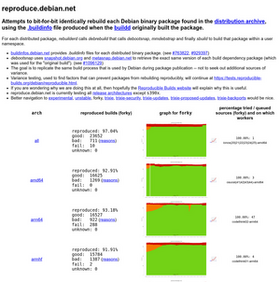
  • Lucas Nussbaum announced Debaudit, a new service to verify the reproducibility of Debian source packages :
    debaudit complements the work of the Reproducible Builds project. While reproduce.debian.net focuses on ensuring that binary packages can be bit-for-bit reproduced from their source packages, debaudit focuses on the preceding step: ensuring that the source package itself is a faithful and reproducible representation of its upstream source or Vcs-Git repository.
  • kpcyrd filed a bug against the librust-const-random-dev package reporting that the compile-time-rng feature of the ahash crate uses the const-random crate in turn, which uses a macro to read/generate a random number generator during the build. This issue was also filed upstream.
  • 60 reviews of Debian packages were added, 4 were updated and 16 were removed this month adding to our knowledge about identified issues. One new issue types was added, pkgjs_lock_json_file_issue.
Lastly, Bernhard M. Wiedemann posted another openSUSE monthly update for their work there.

Tool development diffoscope is our in-depth and content-aware diff utility that can locate and diagnose reproducibility issues. This month, Chris Lamb made a number of changes, including preparing and uploading versions, 314 and 315 to Debian.
  • Chris Lamb:
    • Don t run test_code_is_black_clean test in the autopkgtests. (#1130402). [ ]
    • Add some debugging info for PyPI debugging. [ ]
  • Jelle van der Waa:
    • Fix compatibility with LLVM version 22. [ ]
    • Adjust the PGP file detection regular expression. [ ]
  • Michael R. Crusoe:
    • Reformat the source code using Black version 26.1.0 [ ][ ]
In addition, Vagrant Cascadian updated diffoscope in GNU Guix to version 315.
rebuilderd, our server designed monitor the official package repositories of Linux distributions and attempt to reproduce the observed results there; it powers, amongst other things, reproduce.debian.net. A new version, 0.26.0, was released this month, with the following improvements:
  • Much smoother onboarding/installation.
  • Complete database redesign with many improvements.
  • New REST HTTP API.
  • It s now possible to artificially delay the first reproduce attempt. This gives archive infrastructure more time to catch up.
  • And many, many other changes.

Upstream patches The Reproducible Builds project detects, dissects and attempts to fix as many currently-unreproducible packages as possible. We endeavour to send all of our patches upstream where appropriate. This month, we wrote a large number of such patches, including:

Documentation updates Once again, there were a number of improvements made to our website this month including:
  • kpcyrd:
    • Add a new page about Rust specifics. [ ][ ][ ]
  • Robin Candau:
    • Add link to the diffoci Arch Linux package on the Tools page. [ ]
  • Timo Pohl:

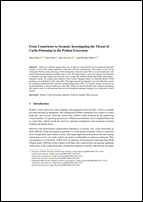
Two new academic papers Marc Ohm, Timo Pohl, Ben Swierzy and Michael Meier published a paper on the threat of cache poisoning in the Python ecosystem: Attacks on software supply chains are on the rise, and attackers are becoming increasingly creative in how they inject malicious code into software components. This paper is the first to investigate Python cache poisoning, which manipulates bytecode cache files to execute malicious code without altering the human-readable source code. We demonstrate a proof of concept, showing that an attacker can inject malicious bytecode into a cache file without failing the Python interpreter s integrity checks. In a large-scale analysis of the Python Package Index, we find that about 12,500 packages are distributed with cache files. Through manual investigation of cache files that cannot be reproduced automatically from the corresponding source files, we identify classes of reasons for irreproducibility to locate malicious cache files. While we did not identify any malware leveraging this attack vector, we demonstrate that several widespread package managers are vulnerable to such attacks. A PDF of the paper is available online.
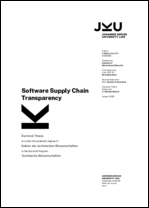
Mario Lins of the University of Linz, Austria, has published their PhD doctoral thesis on the topic of Software supply chain transparency: We begin by examining threats to the software distribution stage the point at which artifacts (e.g., mobile apps) are delivered to end users with an emphasis on mobile ecosystems [and] we next focus on the operating system on mobile devices, with an emphasis on mitigating bootloader-targeted attacks. We demonstrate how to compensate lost security guarantees on devices with an unlocked bootloader. This allows users to flash custom operating systems on devices that no longer receive security updates from the original manufacturer without compromising security. We then move to the source code stage. [Also,] we introduce a new architecture to ensure strong source-to-binary correspondence by leveraging the security guarantees of Confidential Computing technology. Finally, we present The Supply Chain Game, an organizational security approach that enhances standard risk-management methods. We demonstrate how game-theoretic techniques, combined with common risk management practices, can derive new criteria to better support decision makers. A PDF of the paper is available online.

Misc news On our mailing list this month:
  • Holger Levsen announced that this year s Reproducible Builds summit will almost certainly be held in Gothenburg, Sweden, from September 22 until 24, followed by two days of hacking. However, these dates are preliminary and not 100% final an official announcement is forthcoming.
  • Mark Wielaard posted to our list asking a question on the difference between debugedit and relative debug paths based on a comment on the Build path page: Have people tried more modern versions of debugedit to get deterministic (absolute) DWARF paths and found issues with it?


Finally, if you are interested in contributing to the Reproducible Builds project, please visit our Contribute page on our website. However, you can get in touch with us via:

4 April 2026

Isoken Ibizugbe: Post Outreachy Activities

It s been about a month since I wrapped up my Outreachy internship, but my journey with Debian is far from over. I planned to keep contributing and exploring the community, and these past few weeks have been busy

Testing Locales and Solving Bug #1111214

For the openQA project, we decided to explore how accurate local language installations are and see if we can improve the translations. While exploring this, I started working on automating a test for a specific bug report: Debian Bug #1111214

This is a test I had started by writing a detailed description of the installation process to confirm that selecting the Spanish_panama locale works accurately. I spent time studying previous language installation tests, and I learned that I needed to add a specific tag (LANGUAGE-) to the needles (visual test markers).

Since the installation wasn t in English anymore, taking the correct screenshots and defining the areas took quite some time. I used the following command on the CLI to run the test:

openqa-cli api -X POST isos ISO=debian-live-testing-amd64-gnome.iso DISTRI=debian-live VERSION=forky FLAVOR=gnome LANGUAGE=spanish_panama ARCH=x86_64 BUILD=1311 CHECKSUM=unknown

While working on this, I got stuck at the complete_installation step. Because the keyboard layout had changed to Spanish, the commands required to confirm a successful install weren t working as expected. Specifically, we had an issue typing the greater than sign (>).

My mentor, Roland Clobus, worked on a clever maneuver for the keys (AltGr-Shift-X), which was actually submitted upstream to openSUSE.

In this step, I also had to confirm that the locale was correctly set to LANG= es_PA.UTF-8 . I had to dig into the scripts and Linux commands to make this work. It was a bit intimidating at first, but it turned out to be a great learning experience. You can follow my progress on this Merge Request here. I m currently debugging a small issue where the home key seems to click twice in the final step, and after that, the test would be complete  .

Community & Connections

Beyond the code, I ve been getting more involved in the social side of Debian:

  • Debian Women: I attended the monthly meeting and met Sruthi Chandran. I ve always seen her name as an Outreachy organizer, so it was great to meet her! She is currently running for Debian Project Leader (DPL). We also discussed starting technical sessions to introduce members to packaging, which I am very excited to learn.
  • DebConf Preparation: I am officially preparing for my first DebConf! My mentors, Tassia and Roland, along with my fellow intern Hellen, have been incredibly supportive in guiding me through the application and presentation process.

31 March 2026

Benjamin Mako Hill: Quote #75514

Although I never submitted to it, I made several appearances in the now-defunct quote database on bash.org (QDB). I m dealing with a broken keyboard now, and went to dig hard to find this classic in the Wayback machine. I thought I would put it back on the web:

<mako> my letter "eye" stopped worng <luca> k, too? <mako> yeah <luca> sounds like a mountain dew spill <mako> and comma <mako> those three <mako> ths s horrble <luca> tme for a new eyboard <luca> 've successfully taen my eyboard apart and fxed t by cleanng t wth alcohol <mako> stop mang fun of me <mako> ths s a laptop!

It was, in fact, horrble.

Russ Allbery: Review: Code Blue Emergency

Review: Code Blue Emergency, by James White
Series: Sector General #7
Publisher: Orb
Copyright: 1987
Printing: May 2003
ISBN: 0-7653-0663-8
Format: Trade paperback
Pages: 252
Code Blue Emergency (annoying em-dash in original title) is the seventh book of James White's Sector General science fiction series about a vast multi-species hospital station. While there are some references to (and spoilers for) earlier books in the series, you don't have to remember the previous books to read this one. I had no trouble despite a nine-year gap. I read this as part of the Orb General Practice omnibus, which collects this novel and The Genocidal Healer. Cha Thrat is a Sommaradvan warrior-surgeon, member of a newly-discovered species that is beginning the process of contact with the Federation. She saved a Monitor corps human after an accident on her world, performing some some highly competent surgery on a species she had never seen before. That plus her somewhat outcast status on her own world due to her very traditional attitude towards medical ethics led Sector General to extend an offer of medical internship, and led her to leap into the unknown by accepting. This may have been a mistake; there is a great deal that Sector General does not understand about Sommaradvan medical ethics. This series entry is another proper (if somewhat episodic) novel and the first book of the series that doesn't primarily focus on Conway. He makes an appearance in his new role as Diagnostician, but only as a supporting character. Code Blue Emergency is told in the tight third-person perspective of Cha Thrat, an alien who finds many things about Sector General baffling, confusing, and ethically troubling (and who therefore provides a good reader surrogate for reintroducing the basics of how the hospital works). Using an alien viewpoint is a more sophisticated narrative technique than White has used previously. I'm glad he tried it, and it mostly works, although I have some complaints. Cha Thrat comes from the middle caste of a strictly hierarchical society of three castes, but is also immensely stubborn and used to a medical system in which doctors take sole responsibility for their patients. This creates a lot of cultural conflicts, and I do enjoy science fiction where the human attitudes are portrayed as the strange ones, but the cultural analysis offered by this novel is not very deep. The pattern of this book is for Cha Thrat to stumble into a successful approach to a problem while being either oblivious to or hostile to the normal hierarchical structure expected of medical trainees. This is believable as far as it goes. She is a skilled and intelligent doctor with some good instincts and a strong commitment to patient care, but is also culturally inclined to not ask for help. It makes sense for that to be a serious problem in a hospital. Unfortunately, no one says this directly. Sector General staff get quite upset in ways that seem more territorial than oriented towards patient safety, no one directly explains to Cha Thrat why following a process is important or shows examples of what could go wrong, and plot armor means that her mistakes usually have positive outcomes. One can extrapolate the reasons why she is not a good medical student, but the reader is forced to do the extrapolation. This is the sort of book where the narration makes clear there are unresolved cultural clashes that are going to cause problems but hides the details. To Cha Thrat, her perspective is so obvious she never bothers to explain it to the reader, so the specifics come as a surprise. As with the alien perspective, I've seen this technique used with more subtlety and sophistication in other books, but White's version mostly works. Cha Thrat is a sympathetic protagonist because she is truly trying to take the most ethical and empathetic action in every situation and is clearly competent. Most of my frustration as a reader, ironically, lands on the other Sector General doctors who seem to make little to no effort to understand her perspective when she fails to conform to their expectations. This is believable in the abstract, but the whole point of Sector General is that they're supposed to be wiser about interspecies difference than this. Also, sometimes their reactions just seem petty. Cha Thrat has a very hierarchical concept of medicine that matches the social classes of her culture. For her, the highest tier of doctor are wizards who treat rulers, because the work of rulers is mostly mental and intellectual and therefore the diseases of rulers are treated with magic spells performed with words to reshape their thinking rather than surgery on their bodies. O'Mara and the other Sector General psychologists take great offense at this, muttering about being called witch doctors, which I found completely absurd. This is a comprehensible, if odd, description of psychology from a wholly alien species. Surely one's first reaction should be that words like "wizard" or "magic" are translation errors. Don't get offended; look to see if the underlying substance matches, which it clearly does. Apart from cultural and psychological clashes, Code Blue Emergency has the standard episodic Sector General structure of interesting medical mysteries that require lateral thinking. I find this sort of puzzle story satisfying, particularly given the firm belief of every character in an essentially pacifist and empathetic approach to even the most alien of creatures. This determined non-violence is one of the more interesting things about this series, and it continues here. White does tend towards both biological and gender essentialism for everyone other than the protagonist and main supporting characters, but he seemed to be walking back some of the more outrageous limitations on women that appeared in previous books. There is still some nonsense in here about how females of any species can't be Diagnosticians, but then Cha Thrat, who is female, seems to violate the justification for that rule over the course of this novel (sadly without comment). Perhaps he's setting up for proving Sector General wrong about this prejudice. I picked this up after reading Elizabeth Bear's Machine, which is essentially a (better written) Sector General novel that got me in the mood for reading more. I wouldn't give Code Blue Emergency any awards, but it delivered exactly what I was looking for. This series is not as deep or well-written as some more recent SF, but it is reliably itself and reliably entertaining. There are worse things in a series. Recommended if you're in the mood for alien ER in space. The omnibus edition that I read has an introduction to both novels by John Clute. It does add some interesting insights, but (as is somewhat typical for Clute) it also spoils parts of both books. You may want to read it after you read the novels. Followed by The Genocidal Healer. Rating: 7 out of 10

30 March 2026

Jamie McClelland: Mailman3 has 2 databases. Whoops.

At May First we have been carefully planning our migration of about 1200 lists from mailman2 to mailman3 for almost six months now. We did a lot of user communications, had several months of beta testing with a handful of lists ported over, and everything was looking good. So we kicked off the migration! But, about 15% of the way through I started seeing sqlite lock errors. Wait, what? I carefully re-configured mailman3 to use postgres, not sqlite. Well, yes, but apparently that was for the database managing the email list configuration, not the database powering the django web app, which, incidentally, also includes hundresds of gigabytes of archives. In other words, the one we really need in postgres, not sqlite.

Moving from sqlite to postgres Well that sucks. We immediately stopped the migration to deal with this. I noticed that the web is full of useful django instructions on how to migrate your database from one database to antoher. However, if you read the fine print, those convenient looking dumpdata loaddata workflows are designed to move the table definitions and a small amount of data. In our case, even after just 15% of our lists moved, our sqlite database was about 30GB. I considered some of the hacks to manage memory and try to run this via django, but eventually decided that pgloader was a more robust option. This option also allowed me to more easily test things out on a copy of our sqlite database (made while mailman was turned off). This way I could migrate and re-migrate the sqlite database over and over without impacting our live installation until I was satisfied it was all working. My first decision was to opt out of pgloader s schema creation. I used django s schema creation tool by:
  • Turning off mailman3 and mailman3-web and changing the mailman web configuration to use the new postgresql database.
  • Running mailman-web migrate
  • Changing the mailman web configuration back to sqlite and starting everything again.
Note: I tried just adding new database settings in the mailman web configuration indexed to new - django has the ability to define different databases by name, then you can run mailman-web migrate --database new. But, during the migration, I caught django querying the sqlite database for some migrations that required referencing existing fields (specifically hyperkitty s 0003_thread_starting_email). I didn t want any of these steps to touch the live database so I opted for the cleaner approach. Once I had a clean postgres schema, I dumped it so I could easily return to this spot. Next I started working on our pgloader load file. After a lot of trial and error, I ended with:
LOAD DATABASE
    FROM sqlite:///var/lib/mailman3/sqlite-postgres-migration/mailman3web.clean.backup.db
    INTO postgresql://mailmanweb:xxxxxxxxxxx@localhost:5432/mailmanweb

WITH data only,
    reset sequences,
    include no drop,
    disable triggers,
    create no tables,
    batch size = 5MB,
    batch rows = 500,
    prefetch rows = 50,
    workers = 2,
    concurrency = 1

SET work_mem to '64MB',
    maintenance_work_mem to '512MB'

CAST type datetime to timestamptz drop default drop not null,
    type date to date drop default drop not null,
    type int when (= precision 1) to boolean using tinyint-to-boolean,
    type text to varchar using remove-null-characters;
The batch, prefetch, workers and concurreny settings are all there to ensure memory doesn t blow up. I also discovered that I had to make some changes to the schema before loading data. Mostly truncating tables that the django migrate command populated to avoid duplicate key errors:
TRUNCATE TABLE django_migrations CASCADE;
TRUNCATE TABLE django_content_type CASCADE;
TRUNCATE TABLE auth_permission CASCADE;
TRUNCATE TABLE django_site CASCADE;
And also, I had to change a column type. Apparently the mailman import process allowed an attachment file name that exceeds the limit for postgres, but was allowed into sqlite:
ALTER TABLE hyperkitty_attachment ALTER COLUMN name TYPE text
When pgloader runs, we still get a lot of warnings from pgloader, which wants to cast columns differently than django does. These are harmless (I was able to import the data without a problem). And there are still a lot of warnings along the lines of:
2026-03-30T14:08:01.691990Z WARNING PostgreSQL warning: constraint hyperkitty_vote_email_id_73a50f4d_fk_hyperkitty_email_id of relation hyperkitty_vote does not exist, skipping
These are harmless as well. They appear because disable triggers disables foreign key constraints. Without it, we wouldn t be able to load tables that require values in tables that have not yet been populated. After all the tweaking, the import of our 30GB sqlite database took about 40 minutes.

Final Steps I think the reset sequences from pgloader should take care of this, but just in case:
mailman-web sqlsequencereset hyperkitty mailman_django auth   mailman-web dbshell
And, just to ensure postgres is optimized, run this in the psql shell:
ANALYZE VERBOSE;

Last thoughts I understand very well all the decisions the mailman3 devs made in designing the next version of mailman, and if I was in the same place I may have made them the same ones. For example, separating the code running the mailing list from the code managing the archives and the web interface makes perfectly good sense - many people might want to run just the mailing list part without a web interface. And building the web interface in django makes a lot of sense as well - why re-invent the wheel? I m sure a lot of time and effort was saved by simply using the built in features you get for free with django. But the unfortunate consequence of these decisions is that sys admins have a much harder time. Almost everyone wants the email lists along with the web interface and the archives. But nobody wants two different configuration files with different syntaxes and logic, not to mention two different command lines to use for maintenance and configuration with completely different APIs. Trying to understand how to change a default template or set list defaults requires a lot of research and usually you have to write a python script to do it. I have finally come to the conclusion that mailman2 is designed for sys admins, while mailman3 is designed for developers. Despite these short comings, I am impressed with the community and their quick and friendly responses to the questions of a confused sys admin. That might be more valuable than anything else.

Utkarsh Gupta: FOSS Activites in March 2026

Here s my monthly but brief update about the activities I ve done in the FOSS world.

Debian
Whilst I didn t get a chance to do much, here are still a few things that I worked on:
  • A quick exchange with Xavier about node-lodash fixes for stable releases.
  • Uploaded ruby-rack to CVE-2026-25500 & CVE-2026-22860 to sid, trixie, and bookworm.
  • Started to work on the DebConf Bursary team along with PEB.
  • Assited a few folks in getting their patches submitted via Salsa.
  • Mentoring for newcomers.
  • Moderation of -project mailing list.

Ubuntu
I joined Canonical to work on Ubuntu full-time back in February 2021. Whilst I can t give a full, detailed list of things I did, here s a quick TL;DR of what I did:
  • Successfully released 26.04 LTS Beta!
  • Worked further on the whole artifact signing story for cdimage.
  • Assisted a bunch of folks with my Archive Admin and Release team hats to:
    • Review and grant FFes.
    • Coordinating weekly syncs.
    • Promoting/demoting binaries to/from main.
    • Taking care of package removals and so on.
  • Was pretty occupied with the new release processs architecture and design.
  • Preparing for the 26.04 LTS final release.

Debian (E)LTS
This month I have worked 50 hours on Debian Long Term Support (LTS) and on its sister Extended LTS project and did the following things:

Released Security Updates

Work in Progress
  • knot-resolver: Affected by CVE-2023-26249, CVE-2023-46317, and CVE-2022-40188, leading to Denial of Service.
  • node-lodash: Affected by CVE-2025-13465, prototype pollution in the baseUnset function.
    • [stable]: Xavier from the JS team ACK d the patch. The trixie and bookworm uploads will follow.
    • [LTS]: The bullseye test and upload will follow in April once the stable uploads are in and ACK d by the SRMs.
  • vlc: Affected by CVE-2025-51602, an out-of-bounds read and denial of service via a crafted 0x01 response from an MMS server.
    • [LTS]: 3.0.23 backport is ready but not tested. I ll get this over the line in March.
    • [ELTS]: 3.0.23 backport is ready but not very clean. Would like to complete LTS and get back to this.

Other Activities
  • [ELTS] Continued to review ruby-rack for ELTS it has since received about 13 new CVEs, making it even more chaotic. Might consider releasing in batches.
  • [E/LTS] Monitored discussions on mailing lists, IRC, and all the documentation updates.
  • [E/LTS] Attended the monthly LTS meeting on IRC. Summary here.
  • [Other] Spent quite some time debugging a bug in debusine. Filed https://salsa.debian.org/freexian-team/debusine/-/issues/1412 for the same. Have worked on a preliminary patch but would like to submit something for Colin to review. Will follow up in April.

Until next time.
:wq for today.

Russ Allbery: Review: The Cloak and Its Wizard

Review: The Cloak and Its Wizard, by R.Z. Nicolet
Publisher: UpLit Press
Copyright: February 2026
ISBN: 1-917849-15-X
Format: Kindle
Pages: 423
The Cloak and Its Wizard is a standalone (at least so far) urban fantasy superhero (sort of) novel. R.Z. Nicolet is the marketing pseudonym for Rachel Reddick. This is her first novel.
I'm picky about wizards. The wizards themselves will complain about that, but of course I'm picky. When I choose a wizard, barring utter abandonment of moral scruples, it's a till-death-do-us-part situation. (Their death, not mine. I'm the next best thing to indestructible.)
The Cloak of Sunset and Starlight is a major artifact, meaning that it has its own preferences and is capable of independent action. It has been sitting in a glass case in the wizards' library for about a hundred years, waiting for someone interesting. (Well, mostly sitting. Occasionally it sneaks out to eavesdrop or move the books around.) Veronica Noble is interesting. She's older than most initiates, thoughtful, observant, and clearly had some mundane career before joining the Order. Her aura is appealing, and her mental shields and resistance to influence are intriguing. Normally, the Cloak would take its time investigating a new potential wizard, but the Sword was making thoughtful rattling sounds, and no way is the Cloak going to let the Sword claim her first. Time to choose a new wizard!
It was nice, being draped over warm shoulders, and feeling a heartbeat again. I could tell she closed her eyes without even looking. She sighed. "I just got picked by the intransigent one, didn't I?"
The last time I picked a book from the Big Idea feature in Scalzi's Whatever blog, it didn't go that well, but if you're going to write a book specifically for me, I'm going to read it. There are very few tropes of SFF that I love more than intelligent companion objects, and Nicolet's introduction to the story was compelling. So I gave this book discovery method another chance. I'm glad I did, because this was exactly what I was in the mood for and a delight from cover to cover. Veronica Noble is not a typical wizard. She's a surgeon and was quite happy to be a surgeon until an unexpected encounter with a magical creature killed her brother. The forgetting spell cast by the wizards who came to handle the Cassandra wyrm didn't work on her, so she was dragged reluctantly into the secret magical world of the Order. This long-lived society of wizards quietly defends the world against magical intrusions from other planes of existence. Now she's a wizard with a magical cloak, which she is not at all sure she wants. Veronica is not the protagonist, though. The Cloak of Sunset and Starlight is. As far as it is concerned, its job is to assist its wizard, enjoy watching interesting feats of magic, and look fabulous doing so. It's protective, dramatic, rather vain, endlessly curious, easily bored, and intensely loyal. When it becomes clear that the Order has some serious problems, the Cloak knows what side it's on. This sounds a bit like urban fantasy, so I was surprised when the first superheroes showed up, although given the explicit Doctor Strange inspiration I probably should have expected them. The Order and the superheroes do not mix, at least at the start of the novel. The wizards view the superheroes as a loud and irritating intrusion and hide magical activities from them the same as they do the rest of the world. Veronica's opening opinion on superheroes is based on being a trauma surgeon in a hospital dealing with the aftermath of their fights (which makes me wonder if the author has read Hench, although the idea is older than that book). As with the Order, the role of superheroes in this world gets more complicated as the plot develops. There is a surprising amount of plot and some very nice world-building here, including multiple twists that I was not expecting. Veronica is the sort of stubborn and deeply ethical person who will not leave a problem alone if she has the ability to fix it, which is a good recipe for getting deeper and deeper into a complex plot. She's believable as a surgeon: somewhat taciturn, calm in emergencies, detail-oriented, methodical, and not at all dramatic. This makes the Cloak a perfect foil and complement. Watching their partnership develop was very satisfying. This is a sidekick novel, and like the best sidekick novels it makes the not-protagonist more interesting and more relatable by showing them from an outside and skewed perspective. Piecing together what Veronica must be thinking is part of the fun, as is sharing the Cloak's protectiveness towards her as it becomes clear how much she's been through and how good of a person she is. The Cloak's personality was a little too much like a cat for me I would have preferred a more unique viewpoint, fewer cat-coded shenanigans, and a bit less of the running laundry machine joke. But that's a quibble. Its endless curiosity drives the plot forward and uncovers more of the world-building, and I just love reading stories from the perspective of this sort of loyal and protective magical creature. I had so much fun with this book. It's a popcorn sort of book, and I thought the ending sputtered a little, but overall it was great. Parts of it could have been designed in a lab to appeal to me specifically, so I'm not sure if other people will enjoy it as much, but its hit rate with my friends so far has been good. Highly recommended, and I will be watching for any further novels from Nicolet. The Cloak and Its Wizard reaches a satisfying conclusion and doesn't advertise itself as part of a series, but there is room for a sequel. If Nicolet ever writes one, I'd read it. Rating: 8 out of 10

29 March 2026

Russ Allbery: Review: The Sovereign

Review: The Sovereign, by C.L. Clark
Series: Magic of the Lost #3
Publisher: Orbit
Copyright: September 2025
ISBN: 0-316-54286-5
Format: Kindle
Pages: 575
The Sovereign is the third and concluding book of C.L. Clark's Magic of the Lost high fantasy trilogy. I recommend reading the books of this series close together, since there are a lot of characters and a lot of continuity between books that is helpful to remember, but it was not quite as difficult this time to remember where the story left off. At the end of The Faithless, the political situation in Balladaire (not-France) was more stable, but the threat of a plague lay on the horizon. That threat arrives in earnest in this book, along with new threats from both Balladaire's former colonial conscript soldiers and from neighboring Taargen (not-Germany, sort of, although the parallel isn't as close). Luca and Touraine have finally admitted that they're deeply in love, but they are still very different people with different goals and ethics. Luca is determined to do anything necessary to save her kingdom, but her definition of her kingdom is sharp and brittle. Touraine is torn between far too many loyalties, plus the lingering worry that her morals and Luca's may not be compatible. I think the hardest part of this sort of series is finding an ending the reader will find satisfying. This one, unfortunately, did not work for me, but that may be more due to personal preference than objective flaws. There have been two threads through this series: an improbable romance embedded in a network of complex personal relationships, and a political commentary on colonialism and post-colonial wars. I was enjoying the former, but it was the latter that felt fresh and interesting to me. The plot threads in The Faithless outside of Balladaire expanded that complexity, and I was hoping the final volume would continue in that direction. How could a colonial power atone for its history? How does the former colony establish its own governance? Is there a path to freedom without violence? Are attempts to chart a more moral course doomed to open lines of attack for one's other enemies? It's clear that Clark was thinking about similar themes, but The Sovereign narrows the field instead of widens it, restricts the political options, and then resolves most questions in a massive war. This is not that surprising of a conclusion, but it's one that I found unsatisfying and, honestly, a little boring. Yes, one way to resolve all the competing tensions is for everyone to try to kill each other and whoever survives wins, and historically that's one of the more likely outcomes, but that ending doesn't wrestle with the politics as much as it collapses them. Clark instead focuses this concluding volume on the romance, which becomes even more fraught, tragic, and dramatic than it was in previous books (and that's saying something). The hard questions of divided loyalties and moral conflicts are mostly framed by questions about Touraine's loyalty to Luca and Luca's trust of Touraine. This is all very Shakespearean, full of hard choices, sudden reversals, miscommunication, and a very deep conflict between Luca's realpolitik and Touraine's stubborn personal morality. If this is what you were reading the series for, if you were hoping for a maximum-drama sapphic relationship, you may thoroughly enjoy this. I thought it had its moments, but I wish they had been balanced by more moments of cool-headed practicality and creative political ingenuity. My biggest frustration with this ending is that the characters largely stop doing politics. The political complexity was the strength of both The Unbroken and The Faithless: People who intensely dislike each other negotiate because there is something larger to be gained, personal decisions made without considering the political ramifications have costs, and multiple characters are trying hard to find a way to turn a nasty, exploitative world into something better without simply killing everyone who disagrees. Many of the characters were objectively bad at politics, inexperienced and immature, but they stumbled or dragged or fought their way into political solutions anyway. I thought Clark moved too far away from that in The Sovereign. Everyone goes deep into their own emotions and desire for vengeance or conquest or revolution and stops compromising. To a depressingly large extent, the story is resolved by killing everyone who disagrees. I think the story is poorer for it. One of the other threads of the series is Balladairan magic, or rather its odd absence. Luca has one understanding of it, the rebels introduced in The Faithless have a different understanding of it, and its pursuit is set up as critical to resolving the threat of a plague. We do get an explanation of sorts, but it's not as complete or as satisfying as I was hoping, and the symbolism of Balladaire's missing magic is left frustratingly murky. For me, this has some of the same problems as the political conclusion: I wanted an intellectual catharsis alongside the emotional catharsis, but that was not the direction Clark was taking the story. I like reading about these characters. All of Luca, Touraine, and Pruett are complex, comprehensible, flawed, and often intriguing. But my favorite character in the story, the person I latched on to as an emotional path through the story, was Sabine. Her refreshingly straightforward loyalty and lack of drama was a breath of fresh air. She has some great moments in this book, but there too I got wrong-footed by the direction Clark went with her arc and found its conclusion deeply unsatisfying. I'm not sure how many of these complaints are because of missed opportunities in the novel, how many were due to a mismatch of taste, and how many were due to not being in the right mood to read this conclusion. I'm sure that it didn't help that I read this simultaneous with another novel in which the characters were always miserable, or that I read it in early 2026 with, uh, all that entails. I suspect that if you came away from the first two books invested in the messy romance and wanting MOAR DRAMA, you may get exactly what you were hoping for. That, sadly, was not what I was hoping for. I can't really recommend this. I thought it dragged in places and didn't deliver the ending I wanted. But it has some great moments, it does wrap up the threads of the trilogy as advertised, and at least the romance gets a dramatic climax worthy of the tension that has been built through the previous books. If that matches what you were enjoying in the previous books, you may well enjoy this more than I did. Rating: 5 out of 10

27 March 2026

Samuel Henrique: I use curl with ECH btw (in Debian)

tl;dr This is an experimental feature that, for the first time, brings full ECH support to curl on Debian using OpenSSL. Starting with curl 8.19.0-3+exp2 (Debian Experimental), you can now use ECH, with HTTPS-RR and DoH for maximum privacy. curl 8.19.0-3+exp2 is quite fresh at the time of writing, bear in mind that your repository might not have synced the package yet, all mirrors should have it by March 27th 14:00 UTC.
# defo.ie is a test server that confirms whether ECH was successfully used
curl -v --ech hard https://defo.ie/ech-check.php
# For Encrypted Client Hello (ECH) + DNS over HTTPS (DoH)
curl -v --ech hard --doh-url https://1.1.1.1/dns-query https://defo.ie/ech-check.php
"--ech hard" tells curl to refuse the connection entirely if ECH cannot be negotiated. Or, if you would like to try it out in a container:
podman run debian:experimental /bin/bash -c 'apt install --update -t experimental -y curl && curl -v --ech hard --doh-url https://1.1.1.1/dns-query https://defo.ie/ech-check.php'
(in case you haven't noticed, apt now has the --update option for the upgrade and install commands)

For Privacy CloudFlare calls it "the last puzzle piece to privacy" in their must-read announcement: https://blog.cloudflare.com/announcing-encrypted-client-hello/. Encrypted Client Hello (rfc9849) encrypts the "which website are you connecting to?" part of the TLS handshake that was previously visible in plaintext. HTTPS-RR (rfc9460) is a DNS record type that publishes connection parameters for a service, including the public key clients need to perform ECH. DNS Over HTTPS (rfc8484) encrypts DNS queries by tunneling them over HTTPS, hiding what domains you're looking up from network observers. When all three operate together over a CDN with shared IP space, the target domain name is hidden from passive observers; the HTTPS-RR record is queried over DoH in order to retrieve the ECH key (rfc9848) for the TLS handshake. Seems like quite an important feature, and in fact the major browsers have it enabled for some time now, the trick is that they do not use OpenSSL (Chrome uses BoringSSL and Firefox uses NSS). For everyone else, the only option is to patch OpenSSL or wait until 4.0.0 is released, and so part of the reason Debian is the first distro to enable it (curl + OpenSSL + ECH) is that the OpenSSL maintainer (Sebastian Andrzej Siewior) packaged the alpha release just 3 days after it was published. Do not forget that ECH support is experimental and currently relies on the alpha release of OpenSSL.

wcurl Gets It Too Considering wcurl is just a wrapper on curl, it gets the feature for free:
wcurl --curl-options="--ech hard --doh-url https://1.1.1.1/dns-query" $URL
If you're using wcurl, you don't want to have to set parameters, this is just to show that the feature is there and if you have a .curlrc file, it can enable the feature seamlessly.

Other Debian Releases Given the ECH feature requires OpenSSL >= 4, it will not make it to Debian 13, having a small chance of going to Debian 13 Backports (emphasis on small). It should get to Debian Unstable and Debian Testing within the next couple of months as the OpenSSL GA release happens and gets packaged, but you should be able to install the package from Experimental in your Unstable and Testing systems without issues. It will also be in Debian 14 once it becomes the new Stable.

Shoulders of Giants Stephen Farrell's presentation from OpenSSL Conference 2025 has a lot of background on the work involved: Encrypted Client Hello Lessons learned from trying to do something that was probably too complicated They have been working on implementing ECH in open-source projects for years, something as big as this doesn't happen without lots of people dedicating both their paid and free times over it. I ended up being the person who enabled it on Debian, which was pretty much the least amount of work between everyone involved, but hey it's fun flipping the switch and telling you about it.

Background Since 2025, the curl developers started organizing an yearly meeting with all maintainers of curl in Operating Systems. The 2026 edition happened in March 26th: https://github.com/curl/curl/wiki/curl-distro-discussion-2026. Attendance was really good, and as you can imagine one of the topics of discussion was ECH, in which it was pointed out that having OpenSSL 4 was the main requirement but besides it nothing unusual was needed. In Debian Experimental, we have been enabling HTTPS-RR since March 2025, and OpenSSL 4.0.0 alpha was packaged just recently (2026-03-13) by Sebastian Andrzej Siewior, it's time for the next step. The curl distro meeting was just the motivation I needed to go ahead and enable it in Debian Experimental, so as part of our Debian Brasil Weekly Meetings I've prepared and uploaded the changes, while Carlos Henrique Lima Melara worked on addressing a recent test regression for Debian Unstable. Unfortunately sergiodj couldn't join and I'm sure he's jealous of the hacking session now.

Appendix While writing this, I've noticed one of the authors of the CloudFlare blogpost is the previous curl maintainer on Debian; Alessandro Ghedini let me take over the maintenance back in 2021 and today curl is maintained by a team of 4 people, it's nice to see Alessandro's involvement.

Next.

Previous.