Search Results: "roland"

29 November 2012

Roland Mas: Wii(gh2)midi yet again

Not that I'm bored or anything, but I spent some more time on this since last month, and apparently some people are interested enough, so here's the recent news about wiigh2midi. Also, since the code moved (and it doesn't harm mentioning it again): Wiimidi is developed with Bazaar, and the public branch is at https://alioth.debian.org/~lolando/bzr/wiimidi/trunk/. So, to grab a copy:
 bzr checkout https://alioth.debian.org/~lolando/bzr/wiimidi/trunk/
Patches welcome, of course! Also, I'll be interested to hear about your applications. I've been told about a Wiimote-powered foot controller, which is exactly the kind of unpredictable results I was hoping to achieve by publishing my code. Keep it up, I want to hear about Wiimote-controlled robot dinosaurs next! Update: Wiimidi now has its dedicated page at Wiimidi.

6 November 2012

Raphaël Hertzog: My Free Software Activities in October 2012

This is my monthly summary of my free software related activities. If you re among the people who made a donation to support my work (120.46 , thanks everybody!), then you can learn how I spent your money. Otherwise it s just an interesting status update on my various projects. Dpkg At the start of the month, I reconfigured dpkg s git repository to use KGB instead of the discontinued CIA to send out commit notices to IRC (on #debian-dpkg on OFTC, aka irc.debian.org). I didn t do anything else that affects dpkg and I must say that Guillem does not make it easy for others to get involved. He keeps all his work hidden in his private for 1.17.x branch and refuses to open an official jessie branch as can be seen from the lack of answer to this mail. On the bright side, he deals with almost all incoming bugs even before I have a chance to take care of them. But it s a pity that I can never review any of his fixes because they are usually pushed shortly before an upload. Misc packaging I helped to get #689336 fixed so that the initrd properly setups the keymap before asking for a passphrase for an encrypted partition. Related to this I filed #689722 so that cryptsetup gains a dependency ensuring that the required tools for keymap setup are available. I packaged a new upstream version of zim (0.57) and also a security update for python-django that affected both Squeeze and Wheezy. I uploaded an NMU of revelation (0.4.13-1.2) so that it doesn t get dropped from Wheezy (it was on the release team list of leaf packages that would be removed if unfixed) since my wife is using it to store her passwords. I sponsored a new upstream version of ledgersmb. Debian France We managed to elect new officers for Debian France. I m taking over the role of president, Sylveste Ledru is the new treasurer and Julien Danjou is the new secretary. Thank you very much to the former officers: Carl Chenet, Aur lien Jarno and Julien Cristau. We re in the process of managing this transition which will be completed during the next mini-Debconf in Paris so that we can exchange some papers and the like. In the first tasks that I have set myself, there s recruiting two new members for the boards of directors since we re only 7 and there are 9 seats. I made a call for volunteers and we have two volunteers. If you want to get involved and help Debian France, please candidate by answering that message as soon as possible. The Debian Handbook I merged the translations contributed on debian.weblate.org (which led me to file this wishlist bug on Weblate itself) and I fixed a number of small issues that had been reported. I made an upload to Debian to incorporate all those fixes But this is still the book covering Squeeze so I started to plan the work to update it for Wheezy and with Roland we have decided who is going to take care of updating each chapter. Librement Progress is annoyingly slow on this project. Handling money for others is highly regulated, at least in the EU apparently. I only wanted an escrow account to secure the money of users of the service but opening this account requires either to be certified as a payment institution by the Autorit de contr le prudentiel or to get an exemption from the same authority (covering only some special cases) or to sign a partnership with an established payment institution. Being certified is out of scope for now since it requires a minimum of 125000 EUR in capital (which I don t have). My bank can t sign the kind of partnership that I would need. So I have to investigate whether I can make it fit in the limited cases of exemption or I need to find another payment institution that is willing to work with me. Gittip uses Balanced a payment service specialized in market places but unfortunately it s US-only if you want to withdraw money from the system. I would love a similar service in Europe If I can t position Librement as a market place for the free software world (and save each contributor the hassle to open a merchant account), then I shall fallback to the solution where Librement only provides the infrastructure but no account, and developers who want to collect donations will have to use either Paypal or any other supported merchant account to collect funds. That s why my latest spec updates concerning the donation service and the payment service mentions Paypal and the possibility of choosing your payment service for your donation form. Thanks See you next month for a new summary of my activities.

5 comments Liked this article? Click here. My blog is Flattr-enabled.

28 October 2012

Roland Mas: Guitar Hero drumkits and MIDI, again

Almost a year after my previous post, I felt inclined to spend another Sunday (this one was chilly rather than rainy) working on my script to integrate the drumkit of Guitar Hero World Tour for Wii within a MIDI environment. And wiigh2midi got, if not a rewrite, then at least a few enhancements since I last mentioned it here. It's still not something that I'd put in everyone's hands, but it's coming to be seriously usable. I wonder if there'd be any interest in me packaging that and uploading it to Debian? It would need some cleanup first (and a more generic name, since it's far from restricted to Guitar Hero controllers or drumkits), but I guess it could be useful. Ping me if you're interested.

28 September 2012

Roland Mas: FusionForge news, September 2012

Hey, long time no see! Okay, so what's new in FusionForge land these days? Well, I guess the most prominent news is that we've just declared 5.2 stable. It's been uploaded to fusionforge.org already, and Debian packages are on their way to Debian unstable. Yay! Not-yay: the final weeks convinced us that the state of the 5.2 release candidates, and especially the packages in Debian Wheezy, wasn't near good enough for inclusion in a stable Debian release. So the packages won't be officially part of Wheezy when it comes out, to our great shame. The packages from unstable should work fine however, and we'll provide backports via the official Debian channel, backports.debian.org as soon as possible. And finally: the developers (and some users) of FusionForge will gather for a work session in Paris on the 10th of October, as described on the Meeting/Oct2012 page on the FusionForge wiki. Join us if you're interested!

31 August 2012

Roland Mas: Integrating FWbuilder with fail2ban and port-knocking

This article documents how I'm currently building my firewalls. It builds on netfilter-based-port-knocking, and tries to integrate several components of a firewall as gracefully as possible. For some context: I'm getting involved with servers where the firewall policy goes beyond a handful of SSH from my home and my other servers rules. There are many different network streams that need to be policed, some of them are common across several (potentially many) servers, and so on. So I'm gradually giving up on my hand-made scripts, and trying out higher-level tools. I settled on FWbuilder, which seems nice. However, it only allows static policies, and I still want to keep dynamic policies such as what fail2ban provides, as well as my own port-knocking system. The problem I had was that fail2ban isn't really made to play nice as part of a complex firewalling setup, my port-knocking system was too tightly integrated within my firewall script, and FWbuilder wasn't too flexible when it came to delegating part of the firewall policy to something external. Fortunately, this was only a perceived problem (or a real problem in my understanding), because it is actually possible to have all three blocks playing nicely together. More context: as usual, I'm focusing on Debian-like systems. More precisely, on those with a Linux kernel; it may be that FreeBSD's firewalling subsystem has a feature comparable to Linux's recent module, but I don't know. Let's start with FWbuilder. This is not the place for a manual, the official documentation is rather complete. I'll assume you have defined most relevant blocks in there: firewall, hosts, IP addresses, services, and so on. You define your static policy with the standard rules. From then on, we want to integrate the external tools for dynamic rules. Step 1: Integrating fail2ban We want fail2ban to have its own playground, so that it doesn't overwrite anything in the standard policy. The trick is to define a new policy rule set named fail2ban. Leave it empty in FWbuilder. So far so good, but fail2ban (the daemon) still operates on the INPUT chain in the firewall, and could therefore still mangle the static rules. Fortunately, starting with fail2ban 0.8.5 (available from Debian Wheezy, or in the backports for Squeeze), you can define what chain to operate on: with a configuration item such as chain = fail2ban, fail2ban (the daemon) will now only add its rules to fail2ban (the firewall chain), and won't be able do damage the other chains. The missing part is to send some of the traffic to it using the standard policy: i defined a rule sending the incoming SSH connections to the fail2ban policy ( branching in FWbuilder jargon). Voil : the static policy delegates part of the decision-making to a sub-policy controlled by the fail2ban daemon. Step 2: Integrating port-knocking This is a bit trickier, but we'll use a similar method. First, the traffic used for port-knocking needs to be directed to the chain that does the listening. Define a policy rule set named portknocking, and leave it empty in FWbuilder. It'll be used by the dynamic rules to track progression of source IP addresses through the port-knocking sequence, so you'll need to send ( branch ) incoming traffic there, probably after the rules allowing incoming connections from known hosts. The dynamic part of this will only concern the refreshing of this listening chain , which we assume will do its work and mark IP addresses with PK_ESTABLISHED once the sequence is completed. What we do with these marked IP addresses will still be defined within the FWbuilder policy. We're going to need some complex rules since we want to filter according to this PK_ESTABLISHED bit and according to destination port, for instance; unfortunately FWbuilder doesn't allow combining filter criteria with and, so we define a new policy rule set called accept_if_pk_ok. This ruleset has two rules: the second is an ACCEPT and should be easy to understand. The first rule needs to ensure the ACCEPT is only reached for connections coming from PK_ESTABLISHED addresses, so it's going to be a bit tricky. (Explanation: the first rule matches packets coming from IP addresses not marked as PK_ESTABLISHED, and returns them to the calling policy. Packets remaining after this rule are those coming from the appropriate addresses, and they go on to the ACCEPT. We could have had the first rule match on IP addresses that are marked, and branch to yet another ruleset with the ACCEPT part, but that would make it harder to read, I feel.) Now let's get back to the main policy and add rules concerning what kind of traffic we want to allow once the port-knocking sequence completed. For instance, we define a rule matching on the SSH service , where the action is to branch to accept_if_pk_ok. When an incoming packet tries to establish a connection to the SSH port, it's passed to the accept_if_pk_ok ruleset. If it comes from the same IP as a recent port-knocking sequence, it goes on to be ACCEPTed. If not, it returns to the main policy. Maybe static rules further on will allow it to go through. Step 3: tying it all together Now that we have all the pieces, the rest is plumbing. With this setup, at boot time, the $hostname.fw script creates the static policy and the extra playgrounds; then the port-knocking script implements the listening for the magic sequence; then fail2ban inserts its own rules. And there we are: three different parts for the firewall policy, all integrating nicely. Mission accomplished! Note: (Mostly copy-and-pasted from the previous article) This article is deliberately short on details and ready-to-run scripts. Firstly because firewall scripts vary wildly so any script would have to be adapted anyway, but mostly because security is best handled with one's brain switched on. Fiddling with a firewall can easily open gaping holes or lock everyone out. So please make sure you understand what goes on before blindly pasting stuff into your own setup. Some bits are left as an exercise to the reader.

1 August 2012

Raphaël Hertzog: My Debian Activities in July 2012

This is my monthly summary of my Debian related activities. If you re among the people who made a donation to support my work (72.65 , thanks everybody!), then you can learn how I spent your money. Otherwise it s just an interesting status update on my various projects. This month has been a short one since I have been away for 2 weeks of vacation. Dpkg My dpkg work encompasses a bunch of small tasks: Packaging I updated nautilus-dropbox to version 1.4.0 and python-django-registration to version 0.8. Both have been uploaded to unstable and I initially wanted to request an unblock for the latter, but it turns out it has gained reverse dependencies and version 0.8 introduces API changes so it s not an option at this point of the freeze. QA work I investigated and fixed #678356 where it had been reported that the PTS static news were no longer working as expected. At the start of the month, I also unblocked the mostly-unknown but important mole service it was out of date of several weeks and several people were annoyed that the information about new upstream versions was no longer up-to-date. Vacation Almost no Debian work during my vacation but the lack of Wifi nearby made me look for solutions to connect my computer through my Nokia N900 3G/GPRS connection. I discovered the Mobile Hotspot application (homepage) and it worked like a charm (although it required Maemo s non-default devel repository to be able to install the alternative kernel for power users ). The Debian Handbook Michal iha proposed us to host a Weblate instance to help translate the book with a web interface. He kindly agreed to implement some improvements to better suit my requirements. Those have been completed and the weblate instance is now live at debian.weblate.org. There s no requirement to use Weblate for translations teams but for those that do, it sure makes it easier to recruit volunteers who have no prior knowledge of Git and PO files. If you want to help, please checkout this page first though, you should not start using Weblate without getting in touch with the respective translations teams. Apart from translations, I also had the pleasure to merge some patches from Philipp Kern who improved the section covering IPv6 and a few other parts. We can make the book even better if more people share their expertise in the part of the book where they know better than me and Roland. :-) Thanks See you next month for a new summary of my activities.

No comment Liked this article? Click here. My blog is Flattr-enabled.

2 July 2012

Raphaël Hertzog: My Debian Activities in June 2012

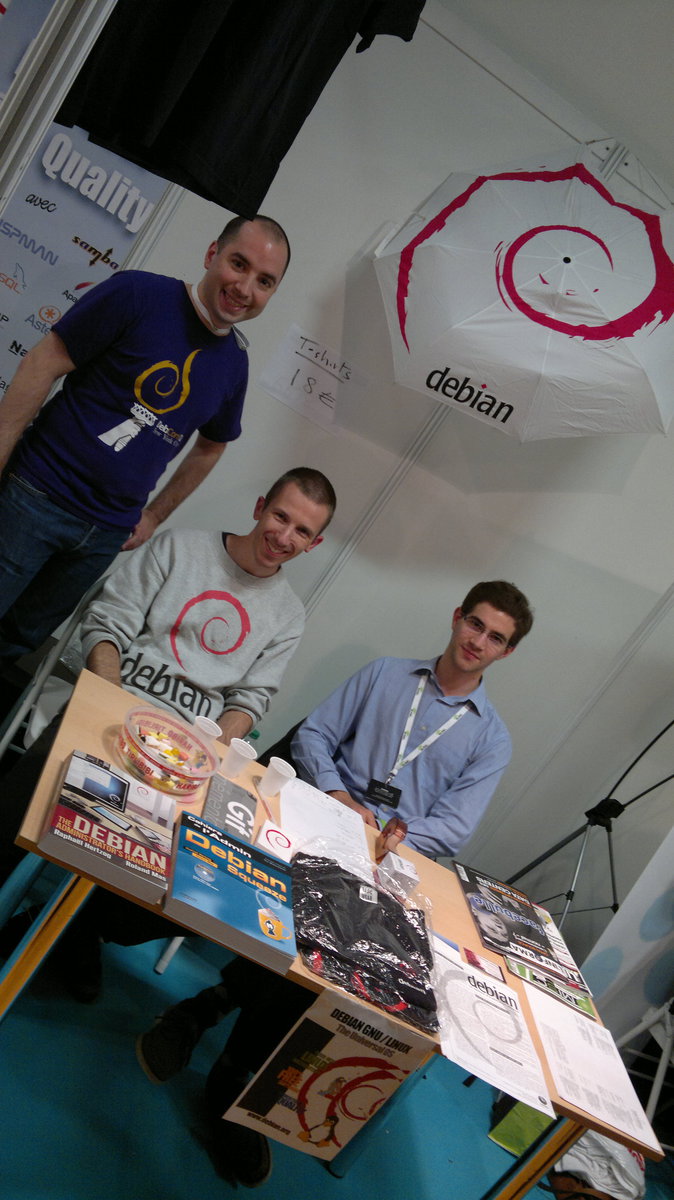
This is my monthly summary of my Debian related activities. If you re among the people who made a donation to support my work (168.12 , thanks everybody!), then you can learn how I spent your money. Otherwise it s just an interesting status update on my various projects. Dpkg This month, I resumed my work on dpkg. I concentrated my efforts on some polishing of the 3.0 (quilt) format. With the latest version (1.16.6 which was uploaded to unstable shortly before the freeze), dpkg-source restores the source tree in a clean state after a failed patch application (#652970), doesn t overwrite the patch header from the pre-existing automatic patch, updates automatically debian/source/include-binaries during dpkg-source commit, and supports a new no-unapply-patches option for those who dislike the auto-unapplication at the end of the process when the patches were not applied at the start. I wanted to go further and offer a new feature that could insert the automatic patch at the bottom of the quilt series but I have been short on time to complete this feature. I just managed to factorize all the quilt handling in a dedicated Perl module (Dpkg::Source::Quilt) to have cleaner code in the module handling the source format (Dpkg::Source::Package::V3::quilt). For those who wonder, this feature is meant primarily for the X Strike Force team which maintains packages in Git and are doings lots of upstream cherry-picks (to fix regressions, etc.). But they also use quilt on top of that tree to keep some lasting Debian specific changes. With the 1.0 format, the automatic diff is a bit messy but at least it gets smaller automatically when a new upstream release gets out, there s nothing to clean out. I d like them to be able to use 3.0 (quilt) while keeping their workflow. I m leaning towards allowing --auto-commit=first:cherry-picks that would name the automatic patch cherry-picks and put it in the first position in the quilt series. (Opinions welcome on that feature, BTW) Packaging There s been quite some packaging in this last month before the freeze: While doing all this packaging work, I found 2 possible improvements that I filed as bug reports: Debian France Booth at Solutions Linux From June 19th to June 21th, I manned the Debian France booth at Solutions Linux together with Carl Chenet, Tanguy Ortolo and other members of the association. We answered lots of questions, sold all t-shirts and umbrellas that Carl imported from Germany and Switzerland (we really need to get our own merchandising stuff produced in France!), got people to join the association. We also presented a printed copy of the Debian Administrator s Handbook and of the corresponding French book. You can see Carl, me and Tanguy on this picture (click on it to see a bigger picture, thanks to S bastien Dubois of Evolix for this one!):
I know lots of people are preparing for Debconf but I decided to not attend this year, the price of the air plane ticket was a bit too hefty for me and it was also in partial conflict with our family vacations. I thought about attending the Libre Software Meeting instead but alas I won t go there either (but Roland Mas will be there!), I have too much work to complete before my own vacation in 2 weeks. Thanks See you next month for a new summary of my activities.

2 comments Liked this article? Click here. My blog is Flattr-enabled.

10 May 2012

Raphaël Hertzog: The Debian Administrator s Handbook is available

The Debian Administrator's Handbook CoverI am so glad that we managed to complete this project. Roland and I have spent countless hours on this book since December, both for the translation itself and also for all the things that we tend to forget: a nice book cover, a great book layout for the print version, coordinating the work of reviewers, registering as an editor to get an ISBN, etc. I think I will come back to this in a future article because some parts of the story are interesting. In the mean time, enjoy the DFSG-free Debian Administrator s Handbook: Check out the official announce (there s a discount for early buyers of the paperback).

12 comments Liked this article? Click here. My blog is Flattr-enabled.

29 March 2012

Carl Chenet: Debian developer

I received the email yesterday and was like wow, I m in . I would like to thank: Sorry for the other readers who will find this post boring, but it means a lot to me :)

28 March 2012

Roland Mas: FusionForge news, March 2012

The winter has been busy everywhere, and not much happened in FusionForge land. However, this is over, and we've started pushing again, with a focus on making our next 5.2 release ready. We've started a stabilisation branch and set up Jenkins jobs to run our various testsuites on it. Packages built from that branch have also been uploaded to the "experimental" suite in Debian (they need a manual approval before they actually appear there, but that shouldn't take too long). They should be installable and working even on Debian Squeeze (stable), although they focus mostly on Wheezy (testing). My personal goal is to have a solid 5.2 release and include it in Wheezy so it can be part of an official Debian system. What this all means is that we welcome tests and reports of breakage; users of 5.1 or earlier versions in particular are encouraged to test upgrades (in virtual machines or development environments, obviously, if the production server is sensitive). We also welcome translators; there are many new plugins, which means many new translatable strings. We'll probably do release candidates before the final release; I'll announce them here (in addition to the fusionforge.org website). Stay tuned!

1 March 2012

Roland Mas: Looking for the ultimate distributed filesystem, take 2

This follows up on a previous post, and tries to summarize the corrections and suggestions I received. First, a reminder: yes, I'm really looking for a filesystem, not a storage system. Even if I only consider the music files use case, there are just too many things that want to access the files, and there's no way I'm going to port these things to use the storage system's API instead of plain old file access. Examples? The Rhythmbox player. The XMMS2 player. The mt-daapd/forked-daapd DAAP server. My script to backup or restore metadata (tags). Ex-Falso, to do mass edits on these tags. abcde, to add new files when I buy a new CD. Any kind of shell one-liners I currently do without thinking because find, xargs, cp, ln, and so on all operate on files. I understand that providing filesystem semantics on top of a storage system is hard, but that doesn't change my requirements, and saying otherwise is patronising. So, on to the meat of the matter. Apparently my understanding of Tahoe-LAFS was mostly correct. It seems that multiple introducers are on their way to become a reality, which would mean the one remaining central point would go away. Most of my other complaints seem to be on their way to be resolved, too, except that it's still targeted as a storage system, and the FUSE/sshfs layer on top still has its drawbacks (quoting from the wiki, Before uploading a file to a Tahoe filesystem, the whole file has to be available , mutable parts of a filesystem should only be accessed via a single sshfs mount [...] data loss may result for concurrently accessed files if this restriction is not followed and so on). From what I read, the position is that nobody publicly uses Tahoe's filesystem integration, therefore there's no need to fix its shortcomings; my understanding is that nobody uses it precisely because of its shortcomings. Ceph: apparently does repair/rebalance automatically contrary to what I thought. However, two persons told me that it's really expecting all nodes on the same LAN, and geographically distributed setups aren't really targeted. XtreemFS: I don't think I got any comments on my evaluation, so I'll assume it still stands. git-annex: storage system, not a filesystem. Yes, the files can be made available in the filesystem, but if I need to manually retrieve them before accessing them, this doesn't work. GlusterFS: I'd like to read more docs on how it works, but I haven't been able to find them. Apart from the installation manuals, the only documentation I found was a very short Concepts page, which described some of the concepts but didn't give me the big picture on how the who thing works. (I'm turning a blind eye on the Red Had advertisements and the requiremets that everything be installed on RH machines; the hardware requirements are also quite out of line with what I want to do.) HekaFS (aka CloudFS): I found even fewer docs about this one than about GlusterFS, and apparently HekaFS is on its way to being merged into GlusterFS anyway. PlasmaFS: I didn't know about this one previously, but the one email I got about it was mainly full of this won't work and this won't work either . I didn't feel inclined to read further docs after that. In summary, I guess the replies I got didn't cause me to change my mind too much. Tahoe-LAFS still seems to be, if not the best solution, then at least the least bad . Hopefully the drawbacks will be fixed soonish; the main sticking point (at least from my point of view) still seems to be the lack of focus on proper filesystem integration. I'll try setting it all up at some point; I may report further if I end up finding interesting things. Thanks to all who responded!

15 January 2012

Roland Mas: Looking for the ultimate distributed filesystem

(This is not quite a Dear lazyweb post. If anything, it's Dear lazyweb, I've done my homework, now what? ) I'm looking for the ultimate distributed filesystem. Something that's simple to use, redundant, fault-tolerant, and still smart enough to avoid the more obvious performance chokepoints. Ideally, it should work for all of the following sets of files: The requirements on the ultimate distributed filesystem (which I'll call UDFS for short, otherwise you'll get bored and go look at pictures of kittens) are as follows: Quite a few constraints, eh? I have a feeling they are not mutually incompatible though, so I had a look at several candidates. I started with Wikipedia, and I followed the links to Tahoe-LAFS, XtreemFS and Ceph. The following is my evaluation of these candidates based on much reading of docs and websites and wikis, some questioning on IRC, and very little testing. The overall picture seems full of good things scattered across different solutions, but unfortunately none of the existing ones seems to address the whole problem; at least, not my whole problem. It would be good if each focused on one layer and did that layer well, but that seems not to be the case either, so they can't be combined to get the best of all worlds. It may be that I'm missing something, or that I failed to read some docs properly, or that I misunderstood the docs, or that the docs themselves are simply lacking; but my ideal UDFS currently doesn't seem to exist as a turn-key solution. However, the main pieces are available, and implementing the remaining parts may be doable. My humble idea of a way forward would be based on Tahoe-LAFS, with the following three changes: Also nice to have would be a way to work with multiple introducer nodes, but that seems to be in the works already. This would be pretty damn close to my UDFS; read/write performance would certainly be far from what can be obtained on native filesystems stored on local disks, but my use cases involve reasonably small files for which instant access is not compulsory, and the filesystem cache would probably absorb most of the access times. In case anyone is looking for ideas of things to do in their spare time, here are rough sketches of other possible UDFS implementations I thought of. These are wild ideas, and I'm not even sure they could be doable in practice: Such is the state of my research so far. I would welcome feedback, pointers to things I neglected to read, corrections for things I misread or misunderstood, comments on the ideas and so on. I'll probably post an update if my search goes significantly forward. Update: I've already received two pieces of feedback, including a lengthy one with corrections about Tahoe-LAFS. For the sake of fairness, I'll solicit (and wait for) the same from the other candidates I looked at. I was also pointed at HekaFS, GlusterFS and git-annex, which I'll have to look at in more details. Other suggestions are still welcome, but the more I get, the more the full update will be delayed. Thanks already!

22 November 2011

Raphaël Hertzog: People behind Debian: Stefano Zacchiroli, Debian Project Leader

picture by Tiago Bortoletto Vaz, CC BY-NC-SA 2.0


It s been one year since the first People behind Debian interview. For this special occasion, I wanted a special guest and I m happy that our Debian Project Leader (DPL) Stefano Zacchiroli accepted my invitation. He has a difficult role in the community, but he s doing a really great job of it. He s a great mediator in difficult situations, but he s also opinionated and can push a discussion towards a conclusion. Read on to learn how he became a Debian developer and later DPL, what he s excited about in the next Debian release, and much more. Raphael: Who are you? Stefano: I m Stefano Zacchiroli, but I prefer to be called Zack, both on the Internet and in real life. I m 32, Italian, emigrated to France about 4 years ago. I live in Paris, and I find it to be one of the most gorgeous and exciting cities in the world. As my day job I m a Computer Science researcher and teacher at University Paris Diderot and IRILL. In my copious free time I contribute to Debian, and I m firmly convinced that doing so is an effective way to help the cause of Free Software. Besides, I find it to be a lot of fun! Raphael: How did you start contributing to Debian? Stefano: Flash back to 1999, when I was a 2nd year student in Computer Science at the University of Bologna. Back then in Italy it was uncommon for young geeks to get exposed to Free Software: Internet was way less pervasive than today and most computer magazines didn t pay much attention to GNU/Linux. Luckily for me, the professor in charge of the student lab was a Free Software enthusiast and all students machines there were running Debian. Not only that, but there was also a student program that allowed volunteers to become sysadmins after having shown their skills and convinced the director they were trustworthy. Becoming one of those volunteer Debian admins quickly became one of my top objectives for the year, and that is were I ve learned using Debian. The year after that, I got in touch with a research group that was to become the happy bunch of hackers with whom I would have done both my master and PhD theses. They were designing a new proof assistant. Most of the development was in OCaml and happened on Debian. OCaml was available in Debian, but many of the libraries we needed were not. So I approached the Debian OCaml Team offering to help. Before I realize what was going on I was (co-)maintainer of tens of OCaml-related packages. At some point I got told I think you should apply as a Debian Developer . So I did and in a couple of months I went through the New Member (NM) process, that was back then in its infancy. I still remember my happiness while reading the account created mail, the day after my 22nd birthday. I know the NM process went through some bad publicity in the past, but I m happy to see that nowadays the process can be as swift as it has been for me 10 years ago. Raphael: It s your second year as Debian Project Leader (DPL). Are you feeling more productive in the role? Do you fear to burn out? Stefano: I m feeling way more productive, no doubts. The task of the Debian Project Leader is not necessarily difficult, but it is a complex and scarcely documented one. It is also profoundly different from any other task that Debian people usually work on, so that experience doesn t help much in getting started. Before becoming effective as DPL one needs to get to know many people and mechanisms he is not familiar with. More importantly, one needs to set up a personal work-flow that allows to keep up with day-to-day DPL tasks (which are aplenty) as well as with urgencies (that tend to pop-up in the leader@debian.org INBOX at the least convenient time). Finally, one also needs to do proper traffic shaping and always retain enough motivation bandwidth to keep the Project informed about what is going on in DPL-land. Finding the right balance among all these ingredients can take some time. Once one is past it, everything goes way more smoothly. The above is why I m constantly encouraging people interested in running for DPL in the future to reach out to me and work on some tasks of the current DPL s TODO list. I swear it is not just a cheap attempt at slavery!. It is rather an attempt at DPL mentoring that could be beneficial: both to give future candidates more awareness of the task, and to reduce the potential downtime when handing over from one DPL to the next. Regarding burn out, I don t feel prone to its risk these days. If I look back, I can say that my contributions as DPL have been pretty constant in volume over time; my enthusiasm for the task, if anything, is on the rise. The effectiveness of my contributions as DPL are, on the other hand, not mine to judge. Raphael: If you had to single out two achievements where you were involved as DPL, what would they be? Stefano: I d go for the following two, in no particular order: OK, let me cheat and add a third one I m also proud of having been able to report to the Project my whereabouts as DPL, thoroughly and periodically, since the very beginning is first term. People annoyed by my reporting logorrhea now have all my sympathies. Raphael: Among the possible new features of Debian Wheezy, which one gets you excited most? Stefano: It s multi-arch, no doubt. Even though it is not a directly user visible change, it s a very far reaching one. It is also one of those changes that make me feel that moment of truth of coders, when you realize you are finally doing the right thing and ditching piles of ugly hacks.
It s multi-arch [ ] you realize you are finally doing the right thing and ditching piles of ugly hacks.
Raphael: If you were not DPL and could spend all your time on Debian, what project would you do? Stefano: I would sit down and do software development for Debian. It s impressive how many important and beneficial changes for Debian could be delivered by specific software improvements in various parts of our infrastructure. We tend to attract many packagers, but not so many people willing to maintain Debian infrastructure softwares like dak, britney, debbugs, the PTS, etc. Their maintenance burden then falls on the shoulders of the respective teams which are generally very busy with other important tasks. As a project, we seem to be more appealing to packagers than to software developers. That is a pity given the amount of exciting coding tasks that are everywhere in Debian. Part of the reason we are not appealing to developers is that we are not particularly good at collecting coding tasks in a place where interested developers could easily pick them up. It also takes quite a bit of inside knowledge to spot infrastructure bugs and understand how to fix them. I long for some spare hacking time to check if I m still good enough of a coder to hunt down longstanding bugs in our infrastructure, which have ended up being my pet peeves. I d also love to dive again into RCBW. It s less committing than package maintenance, more diverse and challenging, and also an immensely useful activity to get Debian releases done. Raphael: Martin Michlmayr is worried that there is so few paid opportunities around Debian. Do you agree with his sentiment, and if yes do you have ideas on how to improve this situation? Stefano: The idealistic me wishes Debian to be a community made only of volunteers that devote their free time to the Project. Oh, and that me also wishes Debian to be competitive with similar projects, no matter how many full-time employees others have! That is coherent with a view of society where everyone has a day job, but also engages in volunteering activities ensuring that public interest is pursued by people motivated by interests other than profit. But I do realize that for Free Software to succeed companies, employees, and salaries should all have a role. I admire projects that strike a good balance between volunteer and paid work. The Linux kernel is emblematic in that respect: many developers are paid by companies that have a commercial or strategic interest in Linux. Nevertheless volunteers contributions are aplenty and the Linux community gives a convincing impression that choices are driven by the community itself (or by its benevolent dictator) without money-driven impositions.
I do realize that for Free Software to succeed companies, employees, and salaries should all have a role.
Such an ecosystem does not exist around Debian. We do have a partner program that allows for it to happen, but we have very few partners with an interest in doing distribution development work. Like Martin, I m worried by this state of affairs, because it de facto means we lag behind in terms of available people power. In a community of volunteers, that might frustrate people and that is not good. To improve over the status quo the first step is to federate together small and medium companies that have a strategic interest in Debian and listen to their needs. I m already in touch with representatives of such companies that, in many cases, already employ Debian Developers to do some distribution work in Debian. We will be soon sending out a call to reach out to more such companies, but since we are discussing this, why waiting? If some of our readers here are representative of such companies, I encourage them to get in touch with me about this. Raphael: You know that the fundraising campaign for the Debian Administrator s Handbook is on good track but the liberation of the book is not yet assured. What do you think of this project? Stefano: I m happy about the project, to the point that I ve accepted writing a testimonial for it :-) . I m sad about the scarce availability of up to date and high quality (DFSG-)Free books about Debian and I welcome any initiative that might help closing that gap.
I m sad about the scarce availability of up to date and high quality (DFSG-)Free books about Debian.
Free Culture is a great offspring of Free Software and I m convinced we need to stand up against double standards in the two camps. Letting aside software-specific licensing details, the basic freedoms to be defended are the same. They are those freedoms that ensure that a reader is in full control of his book, pretty much as they ensure that a computer user is in full control of the software that runs on it. I m therefore proud that Debian has long resolved that the Debian Free Software Guidelines (DFSG) apply not only to software but also to books and other pieces of documentation. But the status quo implies that not only we have very few up to date, high quality books about Debian. It also implies that, at present, we have no such book that we can distribute in the Debian archive, showing off the Free Software (and Free Culture!) values we stand for.
Crowdfunding is considered to be a good mate for Free Culture, where the services model that applies to Free Software is more difficult to exploit. I so wish any luck to yours and Roland s initiative. A different matter is whether Debian, as a project, should endorse the initiative and actively campaign for it. As you know, I think it should not. While we do advertise general project donations, we don t do mission-specific fundraising campaign for Debian itself. Coherently with that, I don t think we should relay crowdfunding campaigns for 3rd parties, even when the result would be beneficial to Debian. Raphael: Is there someone in Debian that you admire for their contributions? Stefano: There are two classes of people that I particularly admire in Debian:
Thank you to Zack for the time spent answering my questions. I hope you enjoyed reading his answers as I did.

Subscribe to my newsletter to get my monthly summary of the Debian/Ubuntu news and to not miss further interviews. You can also follow along on Identi.ca, Google+, Twitter and Facebook .

7 comments Liked this article? Click here. My blog is Flattr-enabled.

7 November 2011

Roland Mas: Guitar Hero Controller (Wii) to MIDI

This is a follow-up on a previous post: I used a bit of a rainy Sunday to read some docs and write some Python, and I now have a script that converts events from a Guitar Hero World Tour drums controller to MIDI. A brief explanation of how it works: in its standard configuration, the drums controller has five pads and a pedal, and it uses a Wiimote to communicate the events (what pad was hit with what force, or what button was pressed/released, or the position of the mini-stick) to the Wii itself. This communication happens over Bluetooth and not over a dedicated cable or protocol, so it is possible to remove the Wii and use a standard computer with Bluetooth (built-in or via a dongle) instead, and the computer will receive messages. There's some decoding to do, but fortunately people have reverse-engineered the frames, and come up with the libcwiid library and its Python binding, which hides the complexity of the decoding and just delivers structured data to the programs that use it. Then we analyze this data and extract the relevant info from it (with some juggling of bits): "the X pad was hit with force Y". From there, it's a simple matter of mapping the pads to a MIDI note and the force to a MIDI velocity, and of sending the appropriate MIDI message to the target, for instance with the libportmidi library. What you do with the MIDI output is your call: I use it to add more pads to my electronic drum kit, but it could equally be used to drive a software synthetizer, or an external sound module. Or a light-show machine. Or fireworks. Or a model railway. Or whatever. Here's the current version of the wiigh2midi.py script (for updated versions, see the Bazaar repository).
#! /usr/bin/python
import cwiid, time, asyncore, pypm
class Wiimidi:
    wiimote = None
    midiout = None
    lastaction = time.time()
    wii2color =   27: 'kick',
                  25: 'red',
                  17: 'yellow',
                  15: 'blue',
                  14: 'orange',
                  18: 'green'  
    color2midi =   'kick': 36, # Bass drum
                   'red': 38, # Snare drum
                   'blue': 48, # High tom
                   'green': 43, # Low tom
                   'yellow': 42, # Closed hi-hat
                   'orange': 52, # Crash cymbal
                    
    def connect_wiimote(self):
        print "Press 1+2 on the Wiimote..."
        try:
            self.wiimote = cwiid.Wiimote()
        except:
            self.wiimote = None
            return None
        print "Connected."
        self.lastaction = time.time()
        self.wiimote.rumble=1
        time.sleep(.2)
        self.wiimote.rumble=0
        return self.wiimote
    def disconnect_wiimote(self):
        if self.wiimote is not None:
            print "Closing connection to the Wiimote."
            self.wiimote.close()
            self.wiimote = None
        return
    def connect_midi(self):
        for i in range(pypm.CountDevices()):
            interf,name,inp,outp,opened = pypm.GetDeviceInfo(i)
            if outp == 1:
                if name == 'UM-1G MIDI 1':
                    self.midiout = pypm.Output(i, 0)
                    return
        for i in range(pypm.CountDevices()):
            interf,name,inp,outp,opened = pypm.GetDeviceInfo(i)
            if outp == 1:
                print i, name," ",
                print
        dev = int(raw_input("Type output number: "))
        self.midiout = pypm.Output(dev, 0)
    def wiimote_callback(self, messages, timestamp):
        self.lastaction = time.time()
        m = messages[0][1]
        # rx = m['r_stick'][0]
        ry = m['r_stick'][1]
        l = m['l']
        # r = m['r']
        which = ( (l << 1) & 16) + (ry >> 1)
        softness = l & 7
        if softness == 7 or which == 0:
            return
        # print "rx=%d\t ry=%d\t l=%d\t r=%d\t rest=%d" % (rx,ry,l,r,rest)
        # print "which = %d, softness = %d" % (which, softness)
        strength = 7-softness
        color = self.wii2color[which]
        midi_vel = 16*strength
        midi_note = self.color2midi[color]
        self.midiout.WriteShort(0x9a,midi_note,midi_vel)
        self.midiout.WriteShort(0x9a,midi_note,0)
        # print "%s %d -> %d %d" % (color, strength, midi_note, midi_vel)
    def main(self):
        self.connect_midi()
        while True:
            if self.wiimote is None:
                self.connect_wiimote()
                if self.wiimote:
                    # Tell Wiimote to display rock sign
                    self.wiimote.led = cwiid.LED1_ON   cwiid.LED4_ON
                    # We only care for the extension data
                    self.wiimote.rpt_mode = cwiid.RPT_EXT
                    self.wiimote.enable(cwiid.FLAG_MESG_IFC   cwiid.FLAG_REPEAT_BTN)
                    self.wiimote.mesg_callback = self.wiimote_callback
                    self.lastaction = time.time()
                else:
                    print "Retrying... "
                    print
            asyncore.loop(timeout=0, count=1)
            if self.lastaction < time.time() - 3600:
                print "An hour passed since last action..."
                self.disconnect_wiimote()
            time.sleep(0.05)
        print "Exited safely."
# Instantiate and run
inst = Wiimidi()
inst.main()
There are a few obvious improvements to be made: first, handling guitar controllers in addition to drums. Second, handling the buttons could provide extra "pads", to trigger sound effects for instance (thunder, lasers, voices ), or to initiate program changes, or to change the mappings of the pads. Maybe storing the mutable parts (default MIDI adapter, pad-to-note mapping) in a configuration file. Maybe add a user interface to ease the configuration. Patches welcome, otherwise maybe I'll do that myself on another rainy Sunday. Notes and references (in other words, the giants on whose shoulders this program stands): More cowbell!

5 November 2011

Christian Perrier: People behind Debian: Rapha l Hertzog, dpkg maintainer, book author

It's about time that Rapha l is interviewed in the "People behind Debian" series he initiated on his blog. Indeed, when he interviews people, Rapha l asks about other people they could suggest for next interviews. So, during mine, I suggested him to be a next "victim". As he couldn't interview himself, I volunteered for this. As you'll see below, Rapha l (who's a friend of mine as I'm a friend of his) likes to speak and that shows in the length of his answers :-) but you always know more about Debian when reading his blog posts, books, mails, etc. I personnally think that he is among the best promoters of the project for years and it was a pleasure for me to conduct this interview. My questions are in bold, the rest is by Rapha l. Who are you? Hi, Rapha l Hertzog, I'm a 32 years old French Debian developer who is married and who has a 2-year old son. I'm running my own company (Freexian) since 2005, I started it 3 years after the end of my computer science studies. I'm also a very proud author of the Cahier de l'Admin Debian, a French book about Debian. You often wrote about your attempts to make your living partly, if not completely, out of your Debian work. Can you describe the way you're trying to do this? My first try has been with Freexian. I always advertised this company as being specialized in Debian GNU/Linux. While Freexian is successful enough to provide me a decent income, I'm not really satisfied with the result because very few of my contracts are about improving Debian. I use Debian daily for the benefit of my customers, writing new customer specific (embedded) software, deploying a service on Debian servers, etc. But except for the occasional bugfix, all this work does not improve Debian (the only exception has been the dpkg multiarch implementation work sponsored by Linaro). The positive side is that I don't need to fill my entire schedule to earn enough money to live. So I'm regularly taking some days off work to be able to contribute to Debian. This is a freedom that I enjoy... My French book has also been a bestseller and depending on the years the royalties represented between 1 and 2 months of supplementary time that I can spend on Debian (that is between 2000 and 4000 EUR of income). Now since last year, I decided to actively work towards my goal of making a living out of my Debian work. I want to build on what has been most successful for me up to now, that is my book. My strategy has been to build an audience around my blog: with a direct contact with my readers I have the opportunity to sell e-books, and without any intermediary taking the biggest part of the price, I don't need a very large audience to be successful. I have also been experiencing micro-donations with Flattr, people who are enjoying my articles on my blog can use it to give a few cents for each article they find useful. With a large enough userbase, this could fund free documentation and would avoid the need for commercial e-books but we're not there currently and I don't know if it will ever reach the critical mass. Last but not least, I'm soliciting donations for my Debian work on the sidebar of my blog, and I have the chance to a have a few (regular) donators. You're a proud father since last year. How do you manage your commitment to the project with your family life? There are few things that I put above Debian in my life, but my family certainly is. I try to handle most of my Debian duties during work hours so that I can spend time with my family on evenings and during week-ends but in truth I never really disconnect from Debian. It happens quite often that I say to my wife I'll come in a few minutes, let me finish this and then I end up responding to a Debian mail, or an IRC query and take 30 minutes instead of the 5 expected ones. I try hard to avoid this but it's difficult. Luckily for me, my wife is very supportive of my Debian involvement and knows me well... By the way my wife is using Debian on her computer, and my son has already played with DoudouLinux (a Debian derivative!). Have you already been accused of self-promotion in your writings? If that would ever happen, what would you answer to that? Yes, more than once. I am proud of what I do for Debian, I enjoy sharing the result of my work. Because of this, some people believe that I'm selfish and egocentric. And this has somewhat increased since I have been soliciting donations: for me it's important to be transparent towards donators so that they see what I really do for Debian. But some people have the feeling that I'm getting undeserved attention and that I bring everything towards my own person. On the other side, as an author, I'm a public figure who is definitely seeking some attention... I don't have any miraculous answer, we are a large and diverse community, it's next to impossible to please everybody. I listen to all the concerns that people bring forward, I take them into account as much as possible, in particular when I believe they are reasonable/well justified, or when they come from people that I highly respect. But sometimes I have to plainly ignore them too... in particular when they are trying to impose their own political view on a topic that's not directly related to the only value that we all share: the social contract. Contributing to Debian is a challenge, we all have to make efforts to put aside our differences and to concentrate on the work that brings us closer to the best free software operating system ever built. You recently launched a campaign to free out the soon-to-be-published "Debian Administrator Handbook", an English version of your well-known book about Debian in French. Can you tell us more about this project? My French book has been very successful at helping people to get started with Debian, and like I already explained, it was also effective to fund a part of my Debian work. So I wanted to make it available world-wide by publishing an English translation of it. I tried to find an English-speaking editor willing to take on the challenge but I found none interested. Not put off by a setback, Roland (my co-author) and I decided to negotiate with our French editor Eyrolles to recuperate the necessary rights to translate the book into English. Handling everything ourselves represents a lot of work, but it also means that we have the freedom required to decide of the license of the resulting book. We would love to see it under a license compatible with the Debian Free Software Guidelines. But at the same time we firmly believe that we deserve a reasonable monetary compensation for the work on the book, so we conditioned its liberation to a predefined amount of money (25 K ) in what we call the "liberation fund". And since we wanted to be sure that we would have the required means to complete the translation, we used a crowfunding platform to seek support of people interested by the book. With such a platform you're only debited if the minimal requested amount is reached. Anyone can participate, pre-order the book and/or put some money in the liberation fund. As of today, we already reached the minimal funding goal (15 K ) so the book translation will happen. But the liberation target has not yet been reached so we don't know yet if the book will be free from the start... you can follow the progress right on the fundraising page or on the website dedicated to the book. PS: If you want to contribute to this project and also make a donation to Debian at the same time, you should check out this page. You're one of the main developers of dpkg, a critical tool for Debian systems. Can you tell us more about the current development challenges it is facing? What will be the new dpkg features for wheezy? The current challenges are not really technical. dpkg is a relatively mature piece of software and it will continue to work for the foreseeable future without needing much maintenance work. The real challenge is trying to setup a healthy developement community around it so that we can keep tackling new interesting problems (there are many listed in the roadmap and in the 225 wishlist bugs). There is a real problem of leadership and communication in the current team. We used to be three, and we're only two nowadays. Guillem is the legitimate leader since he's involved in dpkg's developement since early 2006 while I joined only in late 2007. But in the last 4 years, we did not manage to recruit anyone else on the team. Some persons tried to contribute significant new features (like Sean Finney with a rework of the way we handle configuration files) but they gave up frustrated after a while because we did not manage to review their work (and discuss the design) in any reasonable timeframe. Another famous case is Ian Jackson with his trigger work. His work got merged, but so late that in the mean time he blew up while trying to hijack the maintenance of dpkg. For a long time I was concentrating my work on the Perl part of dpkg (aka dpkg-dev mainly), so I did not feel qualified to review and merge work related to the C part and I was just a worried observator of this situation. I tried to improve it by setting up some basic review infrastructure, it should have brought some lisibility to the status of each change left to be reviewed... but it has not been used and it changed nothing. Over the years, I became much more interested in the C part. My first big contribution in C has been the rewrite of update-alternatives (from Perl to C). I made other small changes in between, but at the start of this year I had this great opportunity to work on the multiarch implementation (FYI, multiarch is the possibility to mix packages from several architectures on a single system). This really forced me to jump into the C codebase and learn a lot about how dpkg is implemented. Thanks to this I have been able to tackle other small projects (like the improved triggers). This would be all great if my multiarch work was already merged, but it's not. It's a large work, I do not mind waiting a bit in particular since Guillem is a highly skilled C programmer. His sharp analysis of new designs are invaluable, when he reviews code he always finds something to improve. I learnt a lot just by reviewing the code he wrote over the years. That said I have been waiting since April without almost no updates from him. With the release team asking us to hurry up, the situation is getting somewhat strained as I really want to see multiarch in Wheezy and I do not really want to short-circuit Guillem. Hum, I may have drifted a bit from your original question... what great new features can people expect? Well multiarch is supposed to be the big new feature, apart from that there aren't many things that matter to the end users. But there are already quite a few changes that are of interest to package maintainers (like hardened build flags, source package improvements, improved triggers, ). What's the biggest problem of Debian? Manicheism and a tendency to quickly polarize the discussions. In reality, there are very few situations where everything is all good or all bad. Ever since I have read The 7 Habits of Highly Effective People I try hard to put into practice the habits of interdependence . Instead of having only my point of view in mind, I try to understand the motivations from the other party ( Seek First to Understand, Then to be Understood ) in order to be able to put forward solutions acceptable to both parties ( Think Win-Win ). I highly recommend this book to anyone. And I invite everybody to at least try to follow those simple advices. Is there someone in Debian you admire for their contributions? There are many and I can't give an exhaustive list... here are some that I would like to highlight (in no particular order): Most of those people are working on improving Debian's infrastructure so that we can all be more effective and do an even better work. This kind of work is not always very visible but it's crucial to Debian's future. Thank you to Rapha l for the time spent answering my questions. I hope you enjoyed reading his answers as I did. And, anyway, it was fun to just play the game "the other way".
28 October 2011

Roland Mas: FusionForge, October 2011

As usual, a brief roundup of what happened in FusionForge land this month.

29 September 2011

Roland Mas: Non-FusionForge, September 2011

Besides FusionForge stuff, I also kept busy with other things.

Roland Mas: Fusionforge, September 2011

A summary of my FusionForge-ish activities this month:

27 September 2011

Rapha&#235;l Hertzog: Do You Want a Free Debian Book? Read This.

A bit more than a year elapsed since we announced our plans to translate our Debian book into English and to try to get it published under a license compatible with the Debian Free Software Guidelines. But we re now ready to go to the next step. Completing the translation of 450 pages book is a huge work, we estimate it s going to take roughly 3 full time months for both Roland and me. Since we re freelancers, we can take the required time provided that we have a minimum income during that period. That s where you come into play: we have setup a crowdfunding campaign on Ulule.com and we need your support to raise 15000 (this is the absolute minimum for us to be able to commit the required time). Even if a good and up-to-date book on Debian is a great perspective, we want to go further than that by adding the perspective of getting a DFSG-free Debian book. That s why we have transformed the crowfunding campaign in a liberation campaign. When you support the project, you can pledge money towards a liberation fund and if this fund reaches 25000 then the book will be published under the GPL-2+ and CC-BY-SA 3.0 licenses. On top of this, when you support this project you can select a reward that goes from a copy of the ebook to a dinner with the authors (only 10 places for the latter)! Among the other rewards, there s obviously a paperback version of the book, but also an individual one-hour mentoring session with me a nice way to get you hooked as a new Debian contributor (limited to 40 persons, don t miss the opportunity!).
Wait no longer, click here and pledge some money to bring this reference book to Debian and the rest of the world.
We also need your help to spread the news and get as many supporters as possible. Share the link with your friends, write an article on your blog, put a widget on your website, etc. Thank you very much!

Click here to go to the fundraising page and to learn more about this project.

10 comments Liked this article? Click here. My blog is Flattr-enabled.

25 August 2011

Roland Mas: Hack of the day: wondershaper vs. SSH shared connections vs. SCP

We all hate the A in ADSL, but most of us are stuck with it. So there are any number of workarounds that keep our link to the Internet working with a certain amount of perceived fluidity, by way of "traffic shaping". Many of us use wondershaper for that purpose: it's a magic tool that keeps the latency low for interactive traffic by ensuring that the bulk traffic doesn't interfere too much with it. We all hate the A in ADSL, but most of us are stuck with it. So there are any number of workarounds that make the establishment of new connections to external servers feel faster. Many of us use the SSH "ControlMaster" series of options for that purpose: it's a set of options that allow new connections to a server to reuse an existing one if there is already a connection open (or if there was one until not too long ago), so some time is saved becaused the handshake to establish the connection is only needed once. Now combine both. SSH to an external server, for instance, work on it. Since it's meant to be an interactive connection, slogin will set some appropriate flags on the IP packets, and wondershaper will give these packets priority over whatever bulk traffic is happening at the time. At some point, you realise you need to transfer a large set of files to there, so you start an SCP transfer. scp, being part of the SSH suite, will reuse the existing connection. Suddenly, your bulk transfer will not only get priority over the other kinds of traffic you might have, but also get intermingled with your keystrokes in the slogin session to the same server. Which means your keystrokes will be delayed significantly, and working interactively becomes even more of a pain. In my case, the priority boost given to the SCP transfer is sometimes enough to cause other unrelated sockets to time out. After reading some docs, I found my solution. It isn't much, but it's going to change my way of working significantly enough that I'm going to share it anyway.
alias scp='scp -oControlPath=none'
Also, since I use dput extensively, and it invokes scp in many cases without reusing my shell aliases, part of my ~/.dput.cf file reads:
[DEFAULT]
ssh_config_options = ControlPath=none
[ ]
This means I keep the advantages of traffic shaping for interactive sessions, but SCP stuff won't interfere anymore, and I can continue working on the server while the new version of the packages that I need to get there are in transit. One small improvement at a time, progress!

Next.

Previous.