
Search Results: "noodles"

3 July 2016

Jonathan McDowell: Confirming all use of an SSH agent

For a long time I ve wanted an ssh-agent setup that would ask me before every use, so I could slightly more comfortably forward authentication over SSH without worrying that my session might get hijacked somewhere at the remote end (I often find myself wanting to pull authenticated git repos on remote hosts). I m at DebConf this week, which is an ideal time to dig further into these things, so I did so today. As is often the case it turns out this is already possible, if you know how. I began with a setup that was using GNOME Keyring to manage my SSH keys. This isn t quite what I want (eventually I want to get to the point that I can sometimes forward a GPG agent to remote hosts for signing purposes as well), so I set about setting up gpg-agent. I used Chris excellent guide to GnuPG/SSH Agent setup as a starting point and ended up doing the following:
$ echo use-agent >> ~/.gnupg/options
$ echo enable-ssh-support >> ~/.gnupg/gpg-agent.conf
$ sudo sed -i.bak "s/^use-ssh-agent/# use-ssh-agent/" /etc/X11/Xsession.options
$ sudo rm /etc/xdg/autostart/gnome-keyring-ssh.desktop
The first 2 commands setup my local agent, and told it to do SSH agent foo. The next stopped X from firing up ssh-agent, and the final one prevents GNOME Keyring from being configured to be the SSH agent, without having to remove libpam-gnome-keyring as Chris did. After the above I logged out of and into X again, and could see ~/.gnupg/S.gpg-agent.ssh getting created and env grep SSH showing SSH_AUTH_SOCK pointing to it (if GNOME Keyring is still handling things it ends up pointing to something like /run/user/1000/keyring/ssh). [Update: Luca Capello emailed to point out this was a bad approach; there s thankfully no need to do the last 2 commands that require root. #767341 removed the need to edit Xsession.options and you can prevent GNOME Keyring starting on a per user basis with:
(cat /etc/xdg/autostart/gnome-keyring-ssh.desktop ;
 echo 'X-GNOME-Autostart-enabled=false') > \
 ~/.config/autostart/gnome-keyring-ssh.desktop
] After this it turned out all I need to do was ssh-add -c <ssh keyfile>. The -c says confirm use and results in the confirm flag being appended to the end of ~/.gnupg/sshcontrol (so if you ve already done the ssh-add you can go and add the confirm if that s the behaviour you d like). Simple when you know how, but I ve had conversations with several people in the past who wanted the same thing and hadn t figured out how, so hopefully this is helpful to others.

27 June 2016

Jonathan McDowell: Hire me!

It s rare to be in a position to be able to publicly announce you re looking for a new job, but as the opportunity is currently available to me I feel I should take advantage of it. That s especially true given the fact I ll be at DebConf 16 next week and hope to be able to talk to various people who might be hiring (and will, of course, be attending the job fair). I m coming to the end of my Masters in Legal Science and although it s been fascinating I ve made the decision that I want to return to the world of tech. I like building things too much it seems. There are various people I ve already reached out to, and more that are on my list to contact, but I figure making it more widely known that I m in the market can t hurt with finding the right fit. I m on LinkedIn and OpenHUB, which should give a bit more info on my previous experience and skill set. I know I m light on details here, so feel free to email me to talk about what I might be able to specifically bring to your organisation.

23 June 2016

Jonathan McDowell: Fixing missing text in Firefox

Every now and again I get this problem where Firefox won t render text correctly (on a Debian/stretch system). Most websites are fine, but the odd site just shows up with blanks where the text should be. Initially I thought it was NoScript, but turning that off didn t help. Daniel Silverstone gave me a pointer today that the pages in question were using webfonts, and that provided enough information to dig deeper. The sites in question were using Cantarell, via:
src: local('Cantarell Regular'), local('Cantarell-Regular'), url(cantarell.woff2) format('woff2'), url(cantarell.woff) format('woff');
The Firefox web dev inspector didn t show it trying to fetch the font remotely, so I removed the local() elements from the CSS. That fixed the page, letting me pinpoint the problem as a local font issue. I have fonts-cantarell installed so at first I tried to remove it, but that breaks gnome-core. So instead I did an fc-list grep -i cant to ask fontconfig what it thought was happening. That gave:
/usr/share/fonts/opentype/cantarell/Cantarell-Regular.otf.dpkg-tmp: Cantarell:style=Regular
/usr/share/fonts/opentype/cantarell/Cantarell-Bold.otf.dpkg-tmp: Cantarell:style=Bold
/usr/share/fonts/opentype/cantarell/Cantarell-Bold.otf: Cantarell:style=Bold
/usr/share/fonts/opentype/cantarell/Cantarell-Oblique.otf: Cantarell:style=Oblique
/usr/share/fonts/opentype/cantarell/Cantarell-Regular.otf: Cantarell:style=Regular
/usr/share/fonts/opentype/cantarell/Cantarell-Bold-Oblique.otf: Cantarell:style=Bold-Oblique
/usr/share/fonts/opentype/cantarell/Cantarell-Oblique.otf.dpkg-tmp: Cantarell:style=Oblique
/usr/share/fonts/opentype/cantarell/Cantarell-BoldOblique.otf: Cantarell:style=BoldOblique
Hmmm. Those .dpkg-tmp files looked odd, and sure enough they didn t actually exist. So I did a sudo fc-cache -f -v to force a rebuild of the font cache and restarted Firefox (it didn t seem to work before doing so) and everything works fine now. It seems that fc-cache must have been run at some point when dpkg had not yet completed installing an update to the fonts-cantarell package. That seems like a bug - fontconfig should probably ignore .dpkg* files, but equally I wouldn t expect it to be run before dpkg had finished its unpacking stage fully.

18 May 2016

Jonathan McDowell: First steps with the ATtiny45

1 port USB Relay
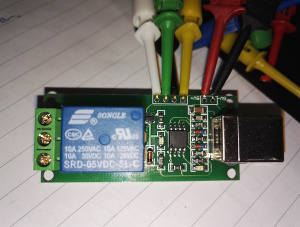
These days the phrase embedded usually means no console (except, if you re lucky, console on a UART for debugging) and probably busybox for as much of userspace as you can get away with. You possibly have package management from OpenEmbedded or similar, though it might just be a horrible kludged together rootfs if someone hates you. Either way it s rare for it not to involve some sort of hardware and OS much more advanced than the 8 bit machines I started out programming on. That is, unless you re playing with Arduinos or other similar hardware. I m currently waiting on some ESP8266 dev boards to arrive, but even they re quite advanced, with wifi and a basic OS framework provided. A long time ago I meant to get around to playing with PICs but never managed to do so. What I realised recently was that I have a ready made USB relay board that is powered by an ATtiny45. First step was to figure out if there were suitable programming pins available, which turned out to be all brought out conveniently to the edge of the board. Next I got out my trusty Bus Pirate, installed avrdude and lo and behold:
$ avrdude -p attiny45 -c buspirate -P /dev/ttyUSB0
Attempting to initiate BusPirate binary mode...
avrdude: Paged flash write enabled.
avrdude: AVR device initialized and ready to accept instructions
Reading   ##################################################   100% 0.01s
avrdude: Device signature = 0x1e9206 (probably t45)
avrdude: safemode: Fuses OK (E:FF, H:DD, L:E1)
avrdude done.  Thank you.
Perfect. I then read the existing flash image off the device, disassembled it, worked out it was based on V-USB and then proceeded to work out that the only interesting extra bit was that the relay was hanging off pin 3 on IO port B. Which led to me knocking up what I thought should be a functionally equivalent version of the firmware, available locally or on GitHub. It s worked with my basic testing so far and has confirmed to me I understand how the board is set up, meaning I can start to think about what else I could do with it

26 April 2016

Jonathan McDowell: Notes on Kodi + IR remotes

This post is largely to remind myself of the details next time I hit something similar; I found bits of relevant information all over the place, but not in one single location. I love Kodi. These days the Debian packages give me a nice out of the box experience that is easy to use. The problem comes in dealing with remote controls and making best use of the available buttons. In particular I want to upgrade the VDR setup my parents have to a more modern machine that s capable of running Kodi. In this instance an AMD E350 nettop, which isn t recent but does have sufficient hardware acceleration of video decoding to do the job. Plus it has a built in fintek CIR setup. First step was finding a decent remote. The fintek is a proper IR receiver supported by the in-kernel decoding options, so I had a lot of flexibility. As it happened I ended up with a surplus to requirements Virgin V Box HD remote (URC174000-04R01). This has the advantage of looking exactly like a STB remote, because it is one. Pointed it at the box, saw that the fintek_cir module was already installed and fired up irrecord. Failed to get it to actually record properly. Googled lots. Found ir-keytable. Fired up ir-keytable -t and managed to get sensible output with the RC-5 decoder. Used irrecord -l to get a list of valid button names and proceed to construct a vboxhd file which I dropped in /etc/rc_keymaps/. I then added a
fintek-cir * vboxhd
line to /etc/rc_maps.cfg to force my new keymap to be loaded on boot. That got my remote working, but then came the issue of dealing with the fact that some keys worked fine in Kodi and others didn t. This seems to be an issue with scancodes above 0xff. I could have remapped the remote not to use any of these, but instead I went down the inputlirc approach (which is already in use on the existing VDR box). For this I needed a stable device file to point it at; the /dev/input/eventN file wasn t stable and as a platform device it didn t end up with a useful entry in /dev/input/by-id. A quick
udevadm info -a -p $(udevadm info -q path -n /dev/input/eventN)
provided me with the PNP id (FIT0002) allowing me to create /etc/udev/rules.d/70-remote-control.rules containing
KERNEL=="event*",ATTRS id =="FIT0002",SYMLINK="input/remote"
Bingo, a /dev/input/remote symlink. /etc/defaults/inputlirc ended up containing:
EVENTS="/dev/input/remote"
OPTIONS="-g -m 0"
The options tell it to grab the device for its own exclusive use, and to take all scancodes rather than letting the keyboard ones through to the normal keyboard layer. I didn t want anything other than things specifically configured to use the remote to get the key presses. At this point Kodi refused to actually do anything with the key presses. Looking at ~kodi/.kodi/temp/kodi.log I could see them getting seen, but not understood. Further searching led me to construct an Lircmap.xml - in particular the piece I needed was the <remote device="/dev/input/remote"> bit. The existing /usr/share/kodi/system/Lircmap.xml provided a good starting point for what I wanted and I dropped my generated file in ~kodi/.kodi/userdata/. (Sadly it turns out I got lucky with the remote; it seems to be using the RC-5x variant which was broken in 3.17; works fine with the 3.16 kernel in Debian 8 (jessie) but nothing later. I ve narrowed down the offending commit and raised #117221.) Helpful pages included:

18 April 2016

Jonathan McDowell: Going to DebConf 16

Going to DebConf16 Whoop! Looking forward to it already (though will probably spend it feeling I should be finishing my dissertation). Outbound:
2016-07-01 15:20 DUB -> 16:45 LHR BA0837
2016-07-01 21:35 LHR -> 10:00 CPT BA0059
Inbound:
2016-07-10 19:20 CPT -> 06:15 LHR BA0058
2016-07-11 09:20 LHR -> 10:45 DUB BA0828
(image stolen from Gunnar)

13 April 2016

Jonathan McDowell: Software in the Public Interest contributing members: Check your activity status!

That s a longer title than I d like, but I want to try and catch the attention of anyone who might have missed more directed notifications about this. If you re not an SPI contributing member there s probably nothing to see here Although I decided not to stand for re-election at the Software in the Public Interest (SPI) board elections last July, I haven t stopped my involvement with the organisation. In particular I ve spent some time working on an overhaul of the members website and rolling it out. One of the things this has enabled is implementation of 2009-11-04.jmd.1: Contributing membership expiry, by tracking activity in elections and providing an easy way for a member to indicate they consider themselves active even if they haven t voted. The plan is that this will run at some point after the completion of every board election. A first pass of cleanups was completed nearly a month ago, contacting all contributing members who d never been seen to vote and asking them to update their status if they were still active. A second round, of people who didn t vote in the last board election (in 2014), is currently under way. Affected members will have been emailed directly and there was a mail to spi-announce, but I m aware people often overlook these things or filter mail off somewhere that doesn t get read often. If you are an SPI Contributing member who considers themselves an active member I strongly recommend you login to the SPI Members Website and check the Last active date displayed is after 2014-07-14 (i.e. post the start of the last board election). If it s not, click on the Update link beside the date. The updated date will be shown once you ve done so. Why does pruning inactive members matter? The 2015 X.Org election results provide at least one indication of why ensuring you have an engaged membership is important - they failed to make a by-laws change that a vast majority of votes were in favour of, due to failing to make quorum. (If you re an X.org member, go vote!)

26 March 2016

Jonathan McDowell: Dr Stoll: Or how I learned to stop worrying and love the GPL

[I wrote this as part of BelFOSS but I think it s worth posting here.] My Free Software journey starts with The Cuckoo s Egg. Back in the early 90s a family friend suggested I might enjoy reading it. He was right; I was fascinated by the world of interconnected machines it introduced me to. That helped start my involvement in FidoNet, but it also got me interested in Unix. So when I saw a Linux book at the Queen s University bookshop (sadly no longer with us) with a Slackware CD in the back I had to have it. The motivation at this point was to have a low cost version of Unix I could run on the PC hardware I already owned. I had no knowledge of the GNU Project before this point, and as I wasn t a C programmer I had no interest in looking at the source code. I spent some time futzing around with it and that partition (I was dual booting with DOS 6.22) fell into disuse. It wasn t until I d learnt some C and turned up to university, which provided me with an internet connection and others who were either already using Linux or interested in doing so, that I started running a Linux box full time. Once I was doing that I became a lot more interested in the Open Source side of the equation. Rather than running a closed operating system that even the API for wasn t properly specified (or I wouldn t have needed my copy of Undocumented DOS) I had the complete source to both the underlying OS and all the utilities that it was using. For someone doing a computer science degree this was invaluable. Minix may have been the OS discussed in the OS Design module I studied, but Linux was a much more feature complete option that I was running on my desktop and could also peer under the hood of. In my professional career I ve always welcomed the opportunities to work with Open Source. A long time ago I experienced a particularly annoying issue when writing a device driver under QNX. The documentation didn t seem to match the observed behaviour of the subsystem I was interfacing with. However due to licensing issues only a small number of people in the organisation were able to actually look at the QNX source. So I ended up wasting a much more senior engineer s time with queries like I think it s actually doing x, y and z instead of a, b and c; can you confirm? . Instances where I can look directly at the source code myself make me much more productive. Commercial development also started to make me more understanding of the Free Software nature of the code I was running. It wasn t just the ability to look at the code which was useful, but also the fact there was no need to reinvent the wheel. Need a base OS to build an appliance on? Debian ensures that the main component is Free for all usage. No need to worry about rolling your own compilers, base libraries etc. From a commercial perspective that allows you to concentrate on the actual product. And when you hit problems, the source is available and you can potentially fix it yourself or at least more easily find out if there s been a fix for that issue released (being able to see code development in version control systems rather than getting a new upstream release with a whole heap on unrelated fixes in it really helps with that). I had thus progressed from using FLOSS because it was free-as-in-beer, to appreciating the benefits of Open Source in my own learning and employment experiences, to a deeper understanding of the free-as-in-speech benefits that could be gained. However at this point I was still thinking very much from a developer mindset. Even my thoughts about how users can benefit from Free Software were in the context of businesses being able to easily switch suppliers or continue to maintain legacy software because they had the source to their systems available. One of the major factors that has helped me to see beyond this is the expansion of the Internet of Things (IoT). With desktop or server software there is by and large a choice about what to use. This is not the case with appliances. While manufacturers will often produce a few revisions of software for their devices, usually eventually there is a newer and shiny model and the old one is abandoned. This is problematic for many reasons. For example, historically TVs have been long lived devices (I had one I bought second hand that happily lasted me 7+ years). However the smart capabilities of the TV I purchased in 2012 are already of limited usefulness, and LG have moved on to their current models. I have no intention of replacing the device any time soon, so have had to accept it is largely acting as a dumb display. More serious is the lack of security updates. For a TV that doesn t require a network connection to function this is not as important, but the IoT is a trickier proposition. For example Matthew Garrett had an awful experience with some intelligent light bulbs, which effectively circumvented any home network security you might have set up. The manufacturer s defence? No longer manufactured or supported. It s cases like these that have slowly led me to a more complete understanding of the freedom that Free Software truly offers to users. It s not just about cost free/low cost software. It s not just about being able to learn from looking at the source to the programs you are running. It s not even about the freedom to be able to modify the programs that we use. It s about giving users true Freedom to use and modify their devices as they see fit. From this viewpoint it is much easier to understand the protections against Tivoization that were introduced with GPLv3, and better appreciate the argument sometimes made that the GPL offers more freedom than BSD style licenses.

21 November 2015

Jonathan McDowell: Updating a Brother HL-3040CN firmware from Linux

I have a Brother HL-3040CN networked colour laser printer. I bought it 5 years ago and I kinda wish I hadn t. I d done the appropriate research to confirm it worked with Linux, but I didn t realise it only worked via a 32-bit binary driver. It s the only reason I have 32 bit enabled on my house server and I really wish I d either bought a GDI printer that had an open driver (Samsung were great for this in the past) or something that did PCL or Postscript (my parents have an Xerox Phaser that Just Works). However I don t print much (still just on my first set of toner) and once setup the driver hasn t needed much kicking. A more major problem comes with firmware updates. Brother only ship update software for Windows and OS X. I have a Windows VM but the updater wants the full printer driver setup installed and that seems like overkill. I did a bit of poking around and found reference in the service manual to the ability to do an update via USB and a firmware file. Further digging led me to a page on resurrecting a Brother HL-2250DN, which discusses recovering from a failed firmware flash. It provided a way of asking the Brother site for the firmware information. First I queried my printer details:
$ snmpwalk -v 2c -c public hl3040cn.local iso.3.6.1.4.1.2435.2.4.3.99.3.1.6.1.2
iso.3.6.1.4.1.2435.2.4.3.99.3.1.6.1.2.1 = STRING: "MODEL=\"HL-3040CN series\""
iso.3.6.1.4.1.2435.2.4.3.99.3.1.6.1.2.2 = STRING: "SERIAL=\"G0JXXXXXX\""
iso.3.6.1.4.1.2435.2.4.3.99.3.1.6.1.2.3 = STRING: "SPEC=\"0001\""
iso.3.6.1.4.1.2435.2.4.3.99.3.1.6.1.2.4 = STRING: "FIRMID=\"MAIN\""
iso.3.6.1.4.1.2435.2.4.3.99.3.1.6.1.2.5 = STRING: "FIRMVER=\"1.11\""
iso.3.6.1.4.1.2435.2.4.3.99.3.1.6.1.2.6 = STRING: "FIRMID=\"PCLPS\""
iso.3.6.1.4.1.2435.2.4.3.99.3.1.6.1.2.7 = STRING: "FIRMVER=\"1.02\""
iso.3.6.1.4.1.2435.2.4.3.99.3.1.6.1.2.8 = STRING: ""
iso.3.6.1.4.1.2435.2.4.3.99.3.1.6.1.2.9 = STRING: ""
iso.3.6.1.4.1.2435.2.4.3.99.3.1.6.1.2.10 = STRING: ""
iso.3.6.1.4.1.2435.2.4.3.99.3.1.6.1.2.11 = STRING: ""
iso.3.6.1.4.1.2435.2.4.3.99.3.1.6.1.2.12 = STRING: ""
iso.3.6.1.4.1.2435.2.4.3.99.3.1.6.1.2.13 = STRING: ""
iso.3.6.1.4.1.2435.2.4.3.99.3.1.6.1.2.14 = STRING: ""
iso.3.6.1.4.1.2435.2.4.3.99.3.1.6.1.2.15 = STRING: ""
iso.3.6.1.4.1.2435.2.4.3.99.3.1.6.1.2.16 = STRING: ""
I used that to craft an update file which I sent to Brother via curl:
curl -X POST -d @hl3040cn-update.xml https://firmverup.brother.co.jp/kne_bh7_update_nt_ssl/ifax2.asmx/fileUpdate -H "Content-Type:text/xml" --sslv3
This gave me back some XML with a URL for the latest main firmware, version 1.19, filename LZ2599_N.djif. I downloaded that and took a look at it, discovering it looked like a PJL file. I figured I d see what happened if I sent it to the printer:
cat LZ2599_N.djf   nc hl3040cn.local 9100
The LCD on the front of printer proceeded to display something like Updating Program and eventually the printer re-DHCPed and indicated the main firmware had gone from 1.11 to 1.19. Great! However the PCLPS firmware was still at 1.02 and I d got the impression that 1.04 was out. I didn t manage to figure out how to get the Brother update website to give me the 1.04 firmware, but I did manage to find a copy of LZ2600_D.djf which I was then able to send to the printer in the same way. This led to:
$ snmpwalk -v 2c -c public hl3040cn.local iso.3.6.1.4.1.2435.2.4.3.99.3.1.6.1.2
iso.3.6.1.4.1.2435.2.4.3.99.3.1.6.1.2.1 = STRING: "MODEL=\"HL-3040CN series\""
iso.3.6.1.4.1.2435.2.4.3.99.3.1.6.1.2.2 = STRING: "SERIAL=\"G0JXXXXXX\""
iso.3.6.1.4.1.2435.2.4.3.99.3.1.6.1.2.3 = STRING: "SPEC=\"0001\""
iso.3.6.1.4.1.2435.2.4.3.99.3.1.6.1.2.4 = STRING: "FIRMID=\"MAIN\""
iso.3.6.1.4.1.2435.2.4.3.99.3.1.6.1.2.5 = STRING: "FIRMVER=\"1.19\""
iso.3.6.1.4.1.2435.2.4.3.99.3.1.6.1.2.6 = STRING: "FIRMID=\"PCLPS\""
iso.3.6.1.4.1.2435.2.4.3.99.3.1.6.1.2.7 = STRING: "FIRMVER=\"1.04\""
iso.3.6.1.4.1.2435.2.4.3.99.3.1.6.1.2.8 = STRING: ""
iso.3.6.1.4.1.2435.2.4.3.99.3.1.6.1.2.9 = STRING: ""
iso.3.6.1.4.1.2435.2.4.3.99.3.1.6.1.2.10 = STRING: ""
iso.3.6.1.4.1.2435.2.4.3.99.3.1.6.1.2.11 = STRING: ""
iso.3.6.1.4.1.2435.2.4.3.99.3.1.6.1.2.12 = STRING: ""
iso.3.6.1.4.1.2435.2.4.3.99.3.1.6.1.2.13 = STRING: ""
iso.3.6.1.4.1.2435.2.4.3.99.3.1.6.1.2.14 = STRING: ""
iso.3.6.1.4.1.2435.2.4.3.99.3.1.6.1.2.15 = STRING: ""
iso.3.6.1.4.1.2435.2.4.3.99.3.1.6.1.2.16 = STRING: ""
Cool, eh? [Disclaimer: This worked for me. I ve no idea if it ll work for anyone else. Don t come running to me if you brick your printer.]

9 November 2015

Jonathan McDowell: The Joy of Recruiters

Last week Simon retweeted a link to Don t Feed the Beast the Great Tech Recruiter Infestation. Which reminded me I d been meaning to comment on my own experiences from earlier in the year. I don t entertain the same level of bile as displayed in the post, but I do have a significant level of disappointment in the recruitment industry. I had conversations with 3 different agencies, all of whom were geographically relevant. One contacted me, the other 2 (one I d dealt with before, one that was recommended to me) I contacted myself. All managed to fail to communicate with any level of acceptability. The agency hat contacted me eventually went quiet, after having asked if they could put my CV forward for a role and pushing very hard about when I could interview. The contact in the agency I d dealt with before replied to say I was being passed to someone else who would get in contact. Who of course didn t. And the final agency, who had been recommended, passed me between 3 different people, said they were confident they could find me something, and then went dark except for signing me up to their generic jobs list which failed to have anything of relevance on it. As it happens my availability and skill set were not conducive to results at that point in time, so my beef isn t with the inability to find a role. Instead it s with the poor levels of communication presented by an industry which seems, to me, to have communication as part of the core value it should be offering. If anyone had said at the start Look, it s going to be tricky, we ll see what we can do or Look, that s not what we really deal in, we can t help , that would have been fine. I m fine with explanations. I get really miffed when I m just left hanging. I d love to be able to say I ll never deal with a recruiter again, but the fact of the matter is they do serve a purpose. There s only so far a company can get with word of mouth recruitment; eventually that network of personal connections from existing employees who are considering moving dries up. Advertising might get you some more people, but it can also result in people who are hugely inappropriate for the role. From the company point of view recruiters nominally fulfil 2 roles. Firstly they connect the prospective employer with a potentially wider base of candidates. Secondly they should be able to do some sort of, at least basic, filtering of whether a candidate is appropriate for a role. From the candidate point of view the recruiter hopefully has a better knowledge of what roles are out there. However the incentives to please each side are hugely unbalanced. The candidate isn t paying the recruiter. If you re not paying for it, you re the product may be bandied around too often, but I believe this is one of the instances where it s very applicable. A recruiter is paid by their ability to deliver viable candidates to prospective employers. The delivery of these candidates is the service. Whether or not the candidate is happy with the job is irrelevant beyond them staying long enough that the placement fee can be claimed. The lengthy commercial relationship is ideally between the company and the recruitment agency, not the candidate and the agency. A recruiter wants to be able to say Look at the fine candidate I provided last time, you should always come to me first in future . There s a certain element of wanting the candidate to come back if/when they are looking for a new role, but it s not a primary concern. It is notable that the recommendations I d received were from people who had been on the hiring side of things. The recruiter has a vested interest in keeping the employer happy, in the hope of a sustained relationship. There is little motivation for keeping the candidate happy, as long as you don t manage to scare them off. And, in fact, if you scare some off, who cares? A recruiter doesn t get paid for providing the best possible candidate. Or indeed a candidate who will fully engage with the role. All they re required to provide is a hire-able candidate who takes the role. I m not sure what the resolution is to this. Word of mouth only scales so far for both employer and candidate. Many of the big job websites seem to be full of recruiters rather than real employers. And I m sure there are some decent recruiters out there doing a good job, keeping both sides happy and earning their significant cut. I m sad to say I can t foresee any big change any time soon. [Note I m not currently looking for employment.] [No recruitment agencies were harmed in the writing of this post. I have deliberately tried to avoid outing anyone in particular.]

31 October 2015

Jonathan McDowell: Thoughts on the LG G Watch R Android smartwatch

Back in March I was given an LG G Watch R, the first Android Wear smartwatch to have a full round display (the Moto 360 was earlier, but has a bit cut off the bottom of the actual display). I d promised I d get round to making some comments about it once I d had it for a while and have failed to do so until now. Note that this is very much comments on the watch from a user point of view; I haven t got to the point of trying to do any development or other hacking of it. Firstly, it s important to note I already was wearing a watch and have been doing so for all of my adult life. Just a basic, unobtrusive analogue watch (I ve had a couple since I was 18, before that it was pretty much every type of calculator watch available at some point), but I can t remember a period where I didn t. The G Watch R is bulkier than what I was previously wearing, but I haven t found it obtrusive. And I love the way it looks; if you don t look closely it doesn t look like a smart watch (and really it s only the screen that gives it away). Secondly, I already would have taken my watch off at night and when I was showering. So while the fact that the battery on the G Watch R will really only last a day and a half is by far and away its most annoying problem, it s not as bad as it could be for me. The supplied charging dock is magnetic, so it lives on my beside table and I just drop the watch in it when I go to bed. With those details out of the way, what have I thought of it? It s certainly a neat gadget. Being able to see my notifications without having to take my phone out of my pocket is more convenient than I expected - especially when it s something like an unimportant email that I can then easily dismiss by swiping the watch face. My agenda being just a flick away, very convenient, particularly when I m still at the stage of trying to remember where my next lecture is. Having walking directions from Google Maps show up on the watch (and be accompanied by a gentle vibration when I need to change direction) is pretty handy too. The ability to take pictures via the phone camera, not so much. Perhaps if it showed me roughly what I was about to photograph, but without that it s no easier than using the phone interface. It s mostly an interface for consuming information - I ve tried the text to SMS interface a few times, but it s just not reliable enough that I d choose to use it. I ve also been pleased to see it get several updates from LG in the time I ve had it. First the upgrade from Wear 4.4 to Wear 5.1 (probably via 5.0 but I forget), but also the enabling of wifi support. The hardware could always support this, but initially Android Wear didn t and then there was some uncertainty about the FCC certification for the G Watch R. I can t say I use it much (mostly the phone is within range) but it s nice to see the improvements in support when they re available. What about the downsides? Battery life, as mentioned above, is definitely the major one. Mostly a day is fine, but the problem comes if I m ever away. There s no way to charge without the charging dock, so that becomes another things I have to pack. And it s really annoying to have your watch go dead on you midday when you forget to do so. I also had a period where I d frequently (at least once a week) find an Android Wear isn t responding. Wait/Restart? error on the watch screen. Not cool, but thankfully seems to have stopped happening. Finally there s the additional resource requirements it puts on the phone. I have a fairly basic Moto G 4G that already struggles with Ingress and Chrome at the same time, so adding yet another thing running all the time doesn t help. I m sure I could make use of a few more apps if I was more comfortable with loading the phone. The notable point for me with the watch was DebConf. I d decided not to bring it, not wanting the hassle of dealing with the daily charging. I switched back to my old analogue watch (a Timex, if you care). And proceeded to spend 3 days looking at it every time my phone vibrated before realising that I couldn t do that. That marked the point where I accepted that I was definitely seeing benefits from having a smart watch. So when I was away for a week at the start of September, I brought the charger with me (at some point I ll get round to a second base for travel). I was glad I d done so. I m not sure I m yet at the point I d replace it in the event it died, but on the whole I m more of a convert that I was expecting to be.

8 October 2015

Jonathan McDowell: The sad state of home entertainment software platforms

I got home from a law lecture[1] today and took apart my TV. As you do. I d a couple of motivations for this. The TV is an LG 55LM8600-UC. That -UC is important - it means it s the US model. I shipped it back to the UK along with the rest of my belongings at the start of the year. It s a lovely TV, and I m very happy with the picture quality. Up until now I ve been running it through a 240v->120v transformer, because the back clearly states 120v 50/60Hz. Having had success converting my Roomba PSU to UK voltage I was wondering if it might be easy enough to do the same for the TV. So the first reason for taking it apart was to look at the PSU board and work out if I could replace it with a UK version, or fix up a handful of components myself. Turns out its rated for 100-240v 50/60Hz so it looks like it should be fine to plug into UK mains directly. And, having done so, it all seems fine. However I don t take any responsibility if you try this yourself and it all goes up in smoke. The other reason was to have a general poke at trying to get access to the onboard CPU - the firmware updates are signed and encrypted so I m a bit stuck working from just those. My TV is from the US; it therefore has an ATSC tuner, and is no good for picking up the DVB-T/T2 broadcast in the UK. It also has a range of smart apps built in. Of course are also tailored to the US, so the Amazon Instant Video app connects to amazon.com and is no use with my Amazon UK account. Netflix is smarter about this and detects where you re located rather than requiring logging in to the appropriate geographic site. However the Netflix app is old and doesn t support user profiles. Which causes a problem when I spend an afternoon watching Unbreakable Kimmy Schmidt and it screws up the recommendations for my girlfriend. In an ideal world I d easily be able to update the apps on my TV to recent versions appropriate for my geographic location. Instead, the current state of home entertainment software platforms is at least 10 years behind mobile phones. Some devices allow you to get hold of SDKs even as an end user, but you re stuck with a multiple ecosystems even between different models from the same manufacturer. LG has no interest in updating my 2012-era TV. They d rather I buy a nice new 2015 TV. Which means at present my TV is mostly a really nice monitor for my XBMC/Kodi box. I can get away with using my Blu-ray player for Netflix, as it does user profile, but it s also a US model and again Amazon Instant Video doesn t work with a UK account. I should point out /that/ box is from Panasonic, just in case anyone thinks I m needlessly picking on LG. My amp is an Onkyo and it would be nice if it could stream music from Amazon/Google as well (it supports Spotify and a couple of others already), but again no joy there. I understand there are DRM issues around video and audio content, but these problems seem to have largely been solved in the Android world while still providing a fairly standard development environment and allowing end users to install their own software. It would seem to make more sense if there was a standard TV / Blu-ray platform that the likes of Netflix and Amazon could write apps once for, reducing the effort required on both sides to get the latest and greatest services on end user equipment. I guess this is some of what Google was trying to achieve with Google TV, but it s probably less interesting to them than mobile devices as I certainly don t tend to do things like search on my TV; I just want to view content and would be mighty pissed off if it started advertising things at me unexpectedly. While I m not planning to buy a new TV any time soon, I could do with a UK spec 3D-capable Blu-ray player. Is there anything out there with some commitment to open apps / proper updates? I haven t found anything, but I d love to be proved wrong. [1] It was on the duty of care and negligence, if you care.

24 September 2015

Jonathan McDowell: New GPG key

Just before I went to DebConf15 I got around to setting up my gnuk with the latest build (1.1.7), which supports 4K RSA keys. As a result I decided to generate a new certification only primary key, using a live CD on a non-networked host and ensuring the raw key was only ever used in this configuration. The intention is that in general I will use the key via the gnuk, ensuring no danger of leaking the key material. I took part in various key signings at DebConf and the subsequent UK Debian BBQ, and finally today got round to dealing with the key slips I had accumulated. I m sure I ve missed some people off my signing list, but at least now the key should be embedded into the strong set of keys. Feel free to poke me next time you see me if you didn t get mail from me with fresh signatures and you think you should have. Key details are:
pub   4096R/0x21E278A66C28DBC0 2015-08-04 [expires: 2018-08-03]
      Key fingerprint = 3E0C FCDB 05A7 F665 AA18  CEFA 21E2 78A6 6C28 DBC0
uid                 [  full  ] Jonathan McDowell <noodles@earth.li>
I have no reason to assume my old key (0x94FA372B2DA8B985) has been compromised and for now continue to use that key. Also for the new key I have not generated any subkeys as yet, which caff handles ok but emits a warning about unencrypted mail. Thanks to those of you who sent me signatures despite this. [Update: I was asked about my setup for the key generation, in particular how I ensured enough entropy, given that it was a fresh boot and without networking there were limited entropy sources available to the machine. I made the decision that the machine s TPM and the use of tpm-rng and rng-tools was sufficient (i.e. I didn t worry overly about the TPM being compromised for the purposes of feeding additional information into the random pool). Alternative options would have been flashing the gnuk with the NeuG firmware or using my Entropy Key.]

21 September 2015

Jonathan McDowell: Getting a Dell E7240 working with a dock + a monitor

I have a Dell E7240. I m pretty happy with it - my main complaint is that it has a very shiny screen, and that seems to be because it s the touchscreen variant. While I don t care about that feature I do care about the fact it means I get FullHD in 12.5 Anyway. I ve had issues with using a dock and an external monitor with the laptop for some time, including getting so far as mentioning the problems on the appropriate bug tracker. I ve also had discussions with a friend who has the same laptop with the same issues, and has some time trying to get it reliably work. However up until this week I haven t had a desk I m sitting at for any length of time to use the laptop, so it s always been low priority for me. Today I sat down to try and figure out if there had been any improvement. Firstly I knew the dock wasn t at fault. A Dell E6330 works just fine with multiple monitors on the same dock. The E6330 is Ivybridge, while the E7240 is Haswell, so I thought potentially there might be an issue going on there. Further digging revealed another wrinkle I hadn t previously been aware of; there is a DisplayPort Multi-Stream Transport (MST) hub in play, in particular a Synaptics VMM2320. Dell have a knowledge base article about Multiple external display issues when docked with a Latitude E7440/E7240 which suggests a BIOS update (I was already on A15) and a firmware update for the MST HUB. Sadly the firmware update is Windows only, so I had to do a suitable dance to be able to try and run it. I then discovered that the A05 update refused to work, complaining I had an invalid product ID. The A04 update did the same. The A01 update thankfully succeeded and told me it was upgrading from 2.00.002 to 2.15.000. After that had completed (and I d power cycled to switch to the new firmware) I tried A05 again and this time it worked and upgraded me to 2.22.000. Booting up Linux again I got further than before; it was definitely detecting that there was a monitor but it was very unhappy with lots of [drm:intel_dp_start_link_train] *ERROR* too many full retries, give up errors being logged. This was with 4.2, and as I d been meaning to try 4.3-rc2 I thought this was a good time to give it a try. Lo and behold, it worked! Even docking and undocking does what I d expect, with the extra monitor appearing / disappearing as you d expect. Now, I m not going to assume this means it s all happy, as I ve seen this sort-of work in the past, but the clue about MST, the upgrade of that firmware (and noticing that it made things better under Windows as well) and the fact that there have been improvements in the kernel s MST support according to the post 4.2 log gives me some hope that things will be better from here on.

25 August 2015

Richard Hartmann: Tor-enabled Debian mirror, part 2

Well, that was quite some feedback to my last post; via blog, email, irc, and in person. I actually think this may be the most feedback I ever got to any single blog post. If you are still waiting for a reply after this new post, I will get back to you. To handle common question/information at once: So this whole thing is a lot easier now:
# apt-get install torsocks apt-transport-tor
# mv /etc/apt/sources.list /etc/apt/sources.list--backup2
# > /etc/apt/sources.list << EOF
deb tor+http://vwakviie2ienjx6t.onion/debian/ unstable main contrib non-free
deb tor+http://earthqfvaeuv5bla.onion/debian/ unstable main contrib non-free
EOF
# apt-get update
# apt-get install vcsh

Richard Hartmann: Tor-enabled Debian mirror

During Jacob Applebaum's talk at DebConf15, he noted that Debian should TLS-enable all services, especially the mirrors. His reasoning was that when a high-value target downloads a security update for package foo, an adversary knows that they are still using a vulnerable version of foo and try to attack before the security update has been installed. In this specific case, TLS is not of much use though. If the target downloads 4.7 MiB right after a security update with 4.7 MiB has been released, or downloads from security.debian.org, it's still obvious what's happening. Even padding won't help much as the 5 MiB download will also be suspicious. The mere act of downloading anything from the mirrors after an update has been released is reason enough to try an attack. The solution, is, of course, Tor. weasel was nice enough to set up a hidden service on Debian's infrastructure; initally we agreed that he would just give me a VM and I would do the actual work, but he went the full way on his own. Thanks :) This service is not redundant, it uses a key which is stored on the local drive, the .onion will change, and things are expected to break. But at least this service exists now and can be used, tested, and put under some load:
http://vwakviie2ienjx6t.onion/

I couldn't get apt-get to be content with a .onion in /etc/apt/sources.list and Acquire::socks::proxy "socks://127.0.0.1:9050"; in /etc/apt/apt.conf, but the torify wrapper worked like a charm. What follows is, to the best of my knowledge, the first ever download from Debian's "official" Tor-enabled mirror:
~ # apt-get install torsocks
~ # mv /etc/apt/sources.list /etc/apt/sources.list.backup
~ # echo 'deb http://vwakviie2ienjx6t.onion/debian/ unstable main non-free contrib' > /etc/apt/sources.list
~ # torify apt-get update
Get:1 http://vwakviie2ienjx6t.onion unstable InRelease [215 kB]
Get:2 http://vwakviie2ienjx6t.onion unstable/main amd64 Packages [7548 kB]
Get:3 http://vwakviie2ienjx6t.onion unstable/non-free amd64 Packages [91.9 kB]
Get:4 http://vwakviie2ienjx6t.onion unstable/contrib amd64 Packages [58.5 kB]
Get:5 http://vwakviie2ienjx6t.onion unstable/main i386 Packages [7541 kB]
Get:6 http://vwakviie2ienjx6t.onion unstable/non-free i386 Packages [85.4 kB]
Get:7 http://vwakviie2ienjx6t.onion unstable/contrib i386 Packages [58.1 kB]
Get:8 http://vwakviie2ienjx6t.onion unstable/contrib Translation-en [45.7 kB]
Get:9 http://vwakviie2ienjx6t.onion unstable/main Translation-en [5060 kB]
Get:10 http://vwakviie2ienjx6t.onion unstable/non-free Translation-en [80.8 kB]
Fetched 20.8 MB in 2min 0s (172 kB/s)
Reading package lists... Done
~ # torify apt-get install vim
Reading package lists... Done
Building dependency tree       
Reading state information... Done
The following extra packages will be installed:
  vim-common vim-nox vim-runtime vim-tiny
Suggested packages:
  ctags vim-doc vim-scripts cscope indent
The following packages will be upgraded:
  vim vim-common vim-nox vim-runtime vim-tiny
5 upgraded, 0 newly installed, 0 to remove and 661 not upgraded.
Need to get 0 B/7719 kB of archives.
After this operation, 2048 B disk space will be freed.
Do you want to continue? [Y/n] 
Retrieving bug reports... Done
Parsing Found/Fixed information... Done
Reading changelogs... Done
(Reading database ... 316427 files and directories currently installed.)
Preparing to unpack .../vim-nox_2%3a7.4.826-1_amd64.deb ...
Unpacking vim-nox (2:7.4.826-1) over (2:7.4.712-3) ...
Preparing to unpack .../vim_2%3a7.4.826-1_amd64.deb ...
Unpacking vim (2:7.4.826-1) over (2:7.4.712-3) ...
Preparing to unpack .../vim-tiny_2%3a7.4.826-1_amd64.deb ...
Unpacking vim-tiny (2:7.4.826-1) over (2:7.4.712-3) ...
Preparing to unpack .../vim-runtime_2%3a7.4.826-1_all.deb ...
Unpacking vim-runtime (2:7.4.826-1) over (2:7.4.712-3) ...
Preparing to unpack .../vim-common_2%3a7.4.826-1_amd64.deb ...
Unpacking vim-common (2:7.4.826-1) over (2:7.4.712-3) ...
Processing triggers for man-db (2.7.0.2-5) ...
Processing triggers for mime-support (3.58) ...
Processing triggers for desktop-file-utils (0.22-1) ...
Processing triggers for hicolor-icon-theme (0.13-1) ...
Setting up vim-common (2:7.4.826-1) ...
Setting up vim-runtime (2:7.4.826-1) ...
Processing /usr/share/vim/addons/doc
Setting up vim-nox (2:7.4.826-1) ...
Setting up vim (2:7.4.826-1) ...
Setting up vim-tiny (2:7.4.826-1) ...
~ # 

More services will follow. noodles, weasel, and me agreed that the project as a whole should aim to Tor-enable the complete package lifecycle, package information, and the website. Maybe a more secure install option on the official images which, amongst others, sets up apt, apt-listbugs, dput, reportbug, et al up to use Tor without further configuration could even be a realistic stretch goal.

24 August 2015

Jonathan McDowell: Random post-DebConf 15 thoughts

There are a bunch of things I mean to blog about, but as I have just got fully home from Heidelberg and DebConf15 this afternoon that seems most appropriate to start with. It s a bit of a set of disjoint thoughts, but I figure I should write them down while they re in my head. DebConf is an interesting conference. It s the best opportunity the Debian project has every year to come together and actually spend a decent amount of time with each other. As a result it s a fairly full on experience, with lots of planned talks as a basis and a wide range of technical discussions and general social interaction filling in whatever gaps are available. I always find it a thoroughly enjoyable experience, but equally I m glad to be home and doing delightfully dull things like washing my clothes and buying fresh milk. I have always been of the opinion that the key aspect of DebConf is the face time. It was thus great to see so many people there - we were told several times that this was the largest DebConf so far (~ 570 people IIRC). That s good in the sense that it meant I got to speak to a lot of people (both old friends and new), but does mean that there are various people I know I didn t spend enough, or in some cases any, time with. My apologies, but I think many of us were in the same situation. I don t feel it made the conference any less productive for me - I managed to get a bunch of hacking done, discuss a number of open questions in person with various people and get pulled into various interesting discussions I hadn t expected. In short, a typical DebConf. Also I d like to say that the venue worked out really well. I ll admit I was dubious when I heard it was in a hostel, but it was well located (about a 30 minute walk into town, and a reasonable bus service available from just outside the door), self-contained with decent facilities (I m a big believer in having DebConf talks + accommodation be as close as possible to each other) and the room was much better than expected (well, aside from the snoring but I can t blame the DebConf organisers for that). One of the surprising and interesting things for me that was different from previous DebConfs was the opportunity to have more conversations with a legal leaning. I expect to go to DebConf and do OpenPGP/general crypto related bits. I wasn t expecting affirmation about the things I have learnt on my course over the past year, in terms of feeling that I could use that knowledge in the process of helping Debian. It provided me with some hope that I ll be able to tie my technology and law skills together in a way that I will find suitably entertaining (as did various conversations where people expressed significant interest in the crossover). Next year is in Cape Town, South Africa. It s a long way (though I suppose no worse than Portland and I get to stay in the same time zone), and a quick look at flights indicates they re quite expensive at the moment. The bid presentation did look pretty good though so as soon as the dates are confirmed (I believe this will happen as soon as there are signed contracts in place) I ll take another look at flights. In short, excellent DebConf, thanks to the organisers, lovely to see everyone I managed to speak to, apologies to those of you I didn t manage to speak to. Hopefully see you in Cape Town next year.

11 August 2015

Jonathan McDowell: Programming the FST-01 (gnuk) with a Bus Pirate + OpenOCD

Last year at DebConf14 Lucas authorized the purchase of a handful of gnuk devices, one of which I obtained. At the time it only supported 2048 bit RSA keys. I took a look at what might be involved in adding 4096 bit support during DebConf and managed to brick my device several times in doing so. Thankfully gniibe was on hand with his STLinkV2 to help me recover. However subsequently I was loathe to experiment further at home until I had a suitable programmer. As it is this year has been busy and the 1.1.x release train is supposed to have 4K RSA (as well as ECC) support. DebConf15 is coming up and I felt I should finally sort out playing with the device properly. I still didn t have a suitable programmer. Or did I? Could my trusty Bus Pirate help? The FST-01 has an STM32F103TB on it. There is an exposed SWD port. I found a few projects that claimed to do SWD with a Bus Pirate - Will Donnelly has a much cloned Python project, the MC HCK project have a programmer in Ruby and there s LibSWD though that s targeted to smarter programmers. None of them worked for me; I could get the Python bits as far as correctly doing the ID of the device, but not reading the option bytes or successfully flashing (though I did manage an erase). Enter the old favourite, OpenOCD. This already has SWD support and there s an outstanding commit request to add Bus Pirate support. NodoNogard has a post on using the ST-Link/V2 with OpenOCD and the FST-01 which provided some useful pointers. I grabbed the patch from Gerrit, applied it to OpenOCD git and built an openocd.cfg that contained:
source [find interface/buspirate.cfg]
buspirate_port /dev/ttyUSB0
buspirate_vreg 1
buspirate_mode normal
transport select swd
source [find target/stm32f1x.cfg]
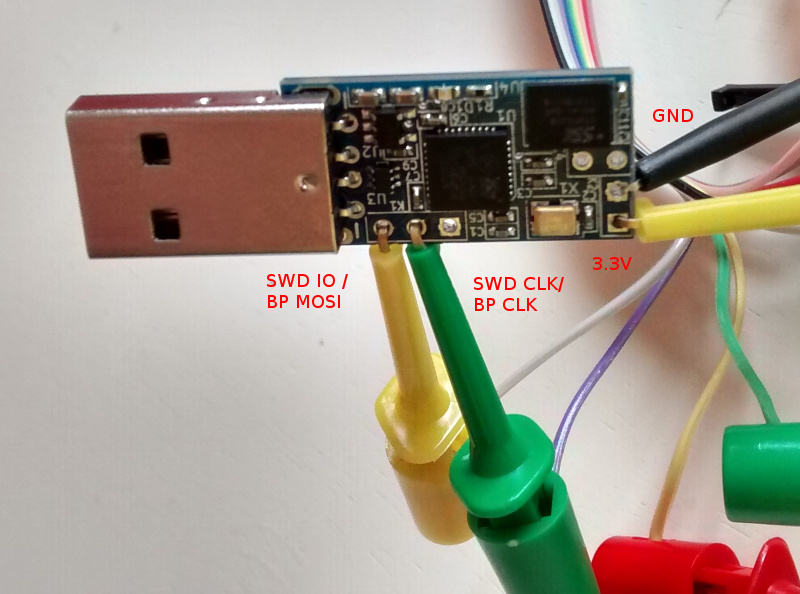
My BP has the Seeed Studio probe cable, so my hookups look like this: Bus Pirate + FST-01 SWD connection That s BP MOSI (grey) to SWD IO, BP CLK (purple) to SWD CLK, BP 3.3V (red) to FST-01 PWR and BP GND (brown) to FST-01 GND. Once that was done I fired up OpenOCD in one terminal and did the following in another:
$ telnet localhost 4444
Trying ::1...
Trying 127.0.0.1...
Connected to localhost.
Escape character is '^]'.
Open On-Chip Debugger
> reset halt
target state: halted
target halted due to debug-request, current mode: Thread
xPSR: 0x01000000 pc: 0xfffffffe msp: 0xfffffffc
Info : device id = 0x20036410
Info : SWD IDCODE 0x1ba01477
Error: Failed to read memory at 0x1ffff7e2
Warn : STM32 flash size failed, probe inaccurate - assuming 128k flash
Info : flash size = 128kbytes
> stm32f1x unlock 0
Device Security Bit Set
stm32x unlocked.
INFO: a reset or power cycle is required for the new settings to take effect.
> reset halt
target state: halted
target halted due to debug-request, current mode: Thread
xPSR: 0x01000000 pc: 0xfffffffe msp: 0xfffffffc
> flash write_image erase /home/noodles/checkouts/gnuk/src/build/gnuk.elf
auto erase enabled
wrote 109568 bytes from file /home/noodles/checkouts/gnuk/src/build/gnuk.elf in 95.055603s (1.126 KiB/s)
> stm32f1x lock 0
stm32x locked
> reset halt
target state: halted
target halted due to debug-request, current mode: Thread 
xPSR: 0x01000000 pc: 0x08000280 msp: 0x20005000
Then it was a matter of disconnecting the gnuk from the BP, plugging it into my USB port and seeing it come up successfully:
usb 1-2: new full-speed USB device number 11 using xhci_hcd
usb 1-2: New USB device found, idVendor=234b, idProduct=0000
usb 1-2: New USB device strings: Mfr=1, Product=2, SerialNumber=3
usb 1-2: Product: Gnuk Token
usb 1-2: Manufacturer: Free Software Initiative of Japan
usb 1-2: SerialNumber: FSIJ-1.1.7-87063020
usb 1-2: ep 0x82 - rounding interval to 1024 microframes, ep desc says 2040 microframes
More once I actually have a 4K key loaded on it.

Next.

Previous.