Search Results: "nomeata"

29 December 2013

Joachim Breitner: Sim Serim as a browser game

Recently, I gave the very elegant board game Sim Serim away as a present, without actually playing it, leaving me curious about the game. One can easily play it on paper (you just need a paper, and 4 tokens like coins for each player, BoardGameGeek has English rules the of game), but I took this as an opportunity to learn more about HTML5 canvas and nodejs, and so I created the browser game Sum Serum , implementing the game mechanics of Sim Serim . You can play it locally with two people, or over the network. Contributions are welcome! Especially slicker graphics...
In other news, given that in recent years I became one, I m on BoardGameGeek myself now, see my profile there.

19 December 2013

Joachim Breitner: My contribution to XKCD s #949 is not needed

A few hours ago I posted about share-file, a small tool to make a local file available at a public URL so that it is transferred from my machine, without being stored at some central server. I wanted to create something like FileTea, but usable from the command line. My post made it to HackerNews (which brought my server to its knees for a while; let s say I had the opportunity to find out what setting for apache s MaxClient option works on my machine...), where the comments (besides some misunderstanding about the notable features of share-file) contained interesting links related to solving #949:

Joachim Breitner: My contribution to XKCD s #949

Randall Munroe rightly put shame on all the geeks in the world when he pointed out that transferring files over the internet is still an unsolved problem. I am a big fan of FileTea s approach to transferring files, where they are streamed from browser to browser, without registration and without being stored on some central server, and where closing the browser tab reliably cleans up the transfer. But I wanted something that works from the command line, so I created a small tool called share-file that will use SSH port forwarding to serve the files from a local, embedded web server at a publicly available port, as shown in these screenshots:
It works without additional dependencies (but better with python-magic installed) and requires a publicly available SSH server configured with GatewayPorts clientspecified. For more details, see the README, and to try it out, simply fetch it with git clone git://git.nomeata.de/share-file.git. BTW, if someone implements a command line client for FileTea, I ll happily dump share-file for it.

17 November 2013

Joachim Breitner: Breaking News: Debian TC leaked decision on init system

According to the German news page heisse news , the Debian Technical Committee has made a decision on the question about the default init system in Debian: There will be none! Instead, according to Ian Vorlon Bart, Debian will start to distribute a suspend-to-disk image to their users, with all daemons already started, completely eradicating the need for an init system. If you are able to read German, read all about it at Debian Technical Committee entscheidet sich gegen ein Init-System

13 November 2013

Joachim Breitner: Constructing a list in a Monad

In Haskell, lists are ubiquitous. In real-world Haskell, monads are ubiquitous. So it should be an easy task to fill a list with values obtained in a monad, i.e. a list of n random numbers (in the Rand monad), or getting some input from the user, and storing it in a list, until the user chooses to finish the input. The task For now, assume a function getInput :: IO Int; we want to run it 10000 and then have the list of the values returned. Sounds simple and straight forward, but it is actually really hard to get the run-time behaviour that we naively and optimistically expect. The expectation In an imperative setting, we would have a simple counting loop. In the loop, we run getInput, allocate a new cell for the linked list, and append it to the list. Clearly, this Can we achieve that with Haskell? Let s look at a few alternatives (complete code available)
Attempt 1: The accumulator I ll start with the probably worst attempt. Unfortunately, from what I have seen from correcting Haskell exams, this is what beginners would write, especially if they have the above imperative algorithm in mind, and know about the convert loops to recursion with accumulators approach to solving Haskell problems:
accumAppend :: Int -> IO [Int]
accumAppend n = go n []
  where
    go 0 l = return l
    go n l = do  x <- getInput; go (n-1) (l++[x]) 
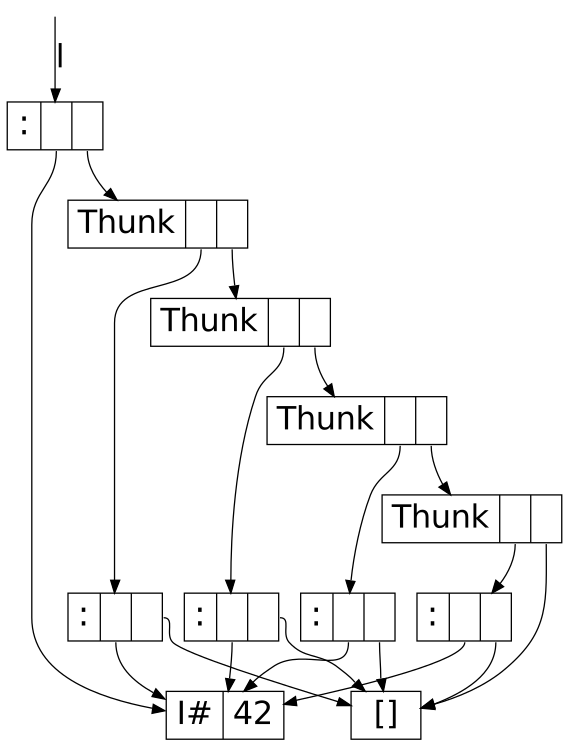
To check the space usage of this, I pass -Kn to the GHC runtime and see what limit is just enough to let this program calculate accumAppend 10000 and fully evaluate the resulting list. It turns out that we need 328336 bytes of stack space. So what about the second requirement; that the list is fully evaluated? Experienced Haskellers see it immediatelly: The accumulator is not used in the loop, so each iteration adds a thunk around the previous value, that would add the next entry to the end. Only when the list is actually used, these are run, each traversing the whole list, causing quadratic cost. We can verify this using ghc-vis:
Clearly (and not surprisingly) this is not the best solution. Attempt 2: The accumulator (forced) Lets try to fix the second issue, by making sure that the list is always fully evaluated. We import Control.DeepSeq and write
accumAppendSeq :: Int -> IO [Int]
accumAppendSeq n = go n []
  where
    go 0 l = return l
    go n l = do  x <- getInput ; go (n-1) $!! (l++[x]) 
As the accumulator gets fully evaluated before being passed to the next invocation of go, the result will not contain thunks. But note that this has also fixed the stack consumption: The code now runs the smallest setting for -K, 8 bytes. This works as both go and deepseq are tail-recursive. But this is still not the solution we are looking for, as the quadradic cost caused by using ++ is still there. Attempt 3: The accumulator (reversed) Since we know that l++[x] is expensive, but x:l is cheap, we can simply use this to update the accumulator. This has the slightly annoying consequence that the entries of the list are in the reverse order, but we can fix that in the base case:
accumReverse :: Int -> IO [Int]
accumReverse n = go n []
  where
    go 0 l = return (reverse l)
    go n l = do  x <- getInput ; go (n-1) (x:l) 
And indeed, we get noticably faster code that still runs in 8 bytes of stack. Unfortunately, we still don t construct the final list directly. Attempt 4: Naive recursion Maybe we can do without an accumulator. The most naive such code would be
listRecurse :: Int -> IO [Int]
listRecurse n = go n
  where
    go 0 = return []
    go n = do  x <- getInput; r <- go (n-1); return (x:r) 
and I d expect that most experienced Haskellers would write that code (if they are asked not to use a library function). And indeed, this code does create the final list directly. But it requires a large stack or 164616 bytes. The reason is that this is no longer tail recursive: After calling go again we need to take the result and prepend x Attempt 5: library functions Maybe we should simply not worry about the implementation, and use library functions? Clearly, the authors of such libraries have found the best solution. So how does
listReplicateM :: Int -> IO [Int]
listReplicateM n = Control.Monad.replicateM n getInput
fare? Unfortunately, not better than the naive recursion. In fact, the stack space requirement is the same 164616 bytes. The same holds when using special libraries for generating and consuming list, e.g. the Streams module from the vector package:
listStreams :: Int -> IO [Int]
listStreams n = MStream.toList $ MStream.replicateM n getInput
Attempt 6: Difference lists It is time to dig deeper into our box of tricks. What if we have lists with constant time Snoc (a.k.a. appending a new element)? Then Attempt 3 would not require reversing the list. Such lists are provided by difference lists; there are libraries for that, but we can simply implement them using lambdas:
accumDList :: Int -> IO [Int]
accumDList n = go n id
  where
    go 0 l = return (l [])
    go n l = do  x <- getInput; go (n-1) (l . (x:)) 
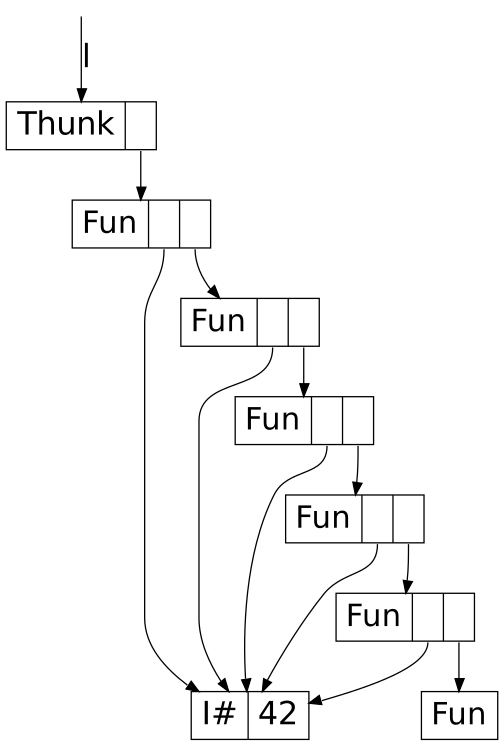
Indeed, no stack is required (8 bytes are enough). But we are cheating here: We are still not constructing the final list, but rather we combine functions that append elements to lists. So when accumDList returns, what we have in memory, is a thunk and sequence of partial function applications in the wrong order, and evaluating the thunk does basically the same thing as reverse in Attempt 3. It might be a bit faster, is still not satisfying enough:
Attempt 7: Unsafe functions Even deepter in the box of tricks, somewhere in the grit and dust where one usually should not reach, there is a function that can help us out here: unsafeInterleaveIO. This allow us to modify the naive recursion in a way that first creates the Cons-cell, and then continues the loop:
listUnsafeInterleave :: Int -> IO [Int]
listUnsafeInterleave n = do  l <- go n; return $!! l 
  where
    go 0 = return []
    go n = do x <- getInput
              r <- unsafeInterleaveIO (go (n-1))
              return (x:r)
The stack consumption is 8 bytes. It is worth noting that the all to deepseq (in $!!) will actually drive the evaluation of go. Also, it guarantees that the unsafe effects of unsafeInterleaveIO are confined to the execution of listUnsafeInterleave, i.e. are actually safe. Run time statistics I ran criterion over the functions (generating lists of length 1000), and found these results: Conclusion There are many ways to write a list-constructing list in Haskell, none are perfect they either fill the heap, or do not construct the list directly (usually requiring a second pass through it), or rely on IO-specific unsafe functions. The naive recursion performs the best, but may cause a stack overflow (note, though that from GHC 7.8, the stack will be unlimited). The next best option seems to be the difference lists
I m still wondering: What would be required from Haskell, GHC or the monads in question to have a fully satisfactory solution here, i.e. one that is as fast as the naive recursion, as stack efficient as the difference list solution, and allocates no thunks, only list cells?

23 October 2013

Joachim Breitner: First citation

Just found out that I was cited academically for the first time: Pablo Buiras and Alejandro Russo s paper Lazy Programs Leak Secrets at NordSec2013 builds upon my work dup Explicit un-sharing in Haskell , which I had submitted to last year s Haskell symposium and Haskell Implementers Workshop, but eventually only published on arXiv.

5 October 2013

Joachim Breitner: Why PVP is better than no PVP

This is a reply to Roman Cheplyaka s post Why PVP doesn't work , where he argues that Haskell packages should not per default put upper bounds on their build dependencies (as mandated by the Package Versioning Policy), at least not without good reason. I disagree, and I d like to explain why. I assume that you are packaging your libraries and programs not only for your fellow developers, but also for users. Hackage has turned not only into a hub for developers sharing their libraries, but also for users to conveniently download stuff from. And when I say users, I include xmonad users (although they write a bit of Haskell for their configuration) and beginners (who we certainly don t expect to understand and make sense of error messages that occur if some obscure crypto-related dependency of their favourite web framework fails to build). And for their benefit we should try hard to make sure cabal install either succeeds (great) or fails early with an error message that the user can understand as I could not find a package configuration of which the maintainers believe with good confidence that it works. Please talk to them. I speak with some experience, because as a maintainer of the >666 Haskell packages in Debian, I am, in a sense, a very heavy user. In the years after the PVP got commonly accepted, we could noticeably reduce the number of build failures that we encounter on our machines and the Debian build farms, simply because the meta data (which we transfer to the Debian package level) prevented such builds from being attempted. We now even have a build compatibility prediction system: We maintain a text file with all Haskell packages in Debian, together with a directory of patches (where we sometimes indeed override the packages Cabal file), and a script that runs cabal-install s dependency checker against this day. This way, when I want to upgrade a package, I can simply change the version in the file and know what packages will be broken. So I change their version until I either find a fixed-point (and only then actually upload packages to the user) or find a problem, which I then report to the maintainers or start cooking up my own patches. This works really well, but it only does because most maintainers are following the PVP. That s why I argue: Please continue to do so. (What we would probably need instead of less using the PVP is more tools in helping us with it. I could imagine a build bot that finds packages on Hackage with an upper bound on a package where a newer version exists, fetches those and automatically tries to build against the new version, and if it succeeds, sends a message to the maintainer: Your dependency on bar in foo also builds against version 0.42 of bar; please check for incompatibilities that are not expressed in the type system and upload a new version of foo allowing bar-0.42. Isn t that something the Stackage infrastructure can be used for?) (What we could probably use as well (and is probably a stepping stone towards what I just said) is a way to tell cabal-install to ignore a certain build dependency version bound. This way we still prevent normal users from trying a dependency version that the maintainer did not test, but nevertheless make it as easy as possible for the advanced user to try nevertheless, and then hopefully report about it to the maintainer. Of course, other had that idea before, someone just has to make it happen.)

3 October 2013

Joachim Breitner: Experimenting with the TI eZ430 Chronos

For a while I have been eyeing with the TI eZ430 Chronos watch, a slightly bulky sports watch that not only comes with a built-in thermometer, barometer and accelerometer, but also a freely programmable micro controller (from the TI MSP430 family hence the name). In addition it has a small radio chip included and can communicate wirelessly with the computer, or possibly other devices. All in all, a very geeky toy. A week ago I managed to buy one quite cheaply via eBay (30 including shipping). It took me a while to get an overview of the various resources about the device. Here is what I have learned. After I found that out, I tried to hack a bit on the various software. The first issue I had (and still have) is that I cannot use the buttons of the device while it is attached to the debug board. They do work if forget to take out the battery, but supposedly that is bad for the battery. So my compile-upload-test-cycle becomes a compile-upload-detach-insert-battery-test-remove-battery-attach-cycle. I could not find out how to emulate button presses using mspdebug. Any suggestions are welcome. The other problem was the new altimeter hardware: Neither OpenChronos nor openchronos-ng support that yet. I originally planned to port the driver from the official software to a random OpenChronos fork when I read that Richard Rondu did that to openchronos-ng yet. I found the code in a month-old merge-request. I tried it, it worked, and I started to clean up the code a bit and add a variometer mode to it, e.g. displaying the current rate of climb my ultimate goal is to use this as a surprisingly cheap variometer for paragliding. After a day of hacking and quickly lifting the watch from the room floor to the room ceiling and back I believe that it works okish, although quite a few parameter can benefit from more tweaking: sample rate (currently 20Hz), length of history (currently 2s) and the linear regression method (currently simply the difference between the average of the samples of the current second with the samples of the last second). As always, patches welcome, the code is in my fork on sf.net.
Next to do would be to enable some buzzing noise depending on the rate of change; during flight I don t want to decipher a low-contract LCD screen. But it is questionable whether the buzzer is loud enough we ll see. I was also happy to hear that there are other zE430-hackers in Karlsruhe, one of them for example tries to make the alarm clock sleep-cycle-aware.

29 September 2013

Joachim Breitner: Heidelberg Laureates Forum 2013

During the last week I was attending the first Heidelberg Laureates Forum as one of the lucky 200 accepted young scientists. The HFL is a (from now on hopefully yearly) event that brings together Fields Medalists, Abel Prize laureates and Turing Award winners with young scientists (undergraduates, Ph.D. students and postdocs) from both fields in the city of Heidelberg. The extremely well organized week consisted of lectures from the laureates, some workshops held by postdocs, excursions and plenty of good food. Videos of the lectures are available (but don t work on Linux, at least not for me ), and I have shot a few pictures of the event as well. I believe that my favourite lectures where Michael Atiyah s Advice to a Young Mathematician , Vladimir Voevodsky s Univalent Foundations of Mathematics , William Morton Kahan s Desperately Needed Remedies for the Undebuggability of Large-Scale Floating-Point Computations in Science and Engineering and Alan Kay s Putting Turing to Work . Where are all the functional programmers? During that event, one gets to talk to many other math and computer scientists researchers; sometimes just Where are you from? and What do you do? , sometimes long discussions. Unfortunately, I hardly found one who is into functional programming language research is that only because the event was parallel to ICFP (which I really would have liked to attend as well), or is functional programming really just about 1% of all computer science? What is a proof? My other research interest lies in interactive theorem proving, especially using Isabelle. Of course that is a topic that one can discuss with almost everyone at that event, including the mathematicians. The reactions were rather mixed: On the one end of the spectrum, some mathematicians seriously doubt that they would ever trust a computer to check proofs and that it would ever be efficient enough to use. Others would not mind having a button that tells whether their paper written in LaTeX is correct , but were not keen to invest time or thought into making the proof readable by the computer. And then there were some (but very few!) who had not heard of theorem proving before and were very excited by the prospect of being able to obtain certainty about their proofs immediately and without having to bother other scientists with it. During the mathematician s panel discussions, where I posed the question Do you see value in or even a need for machine-checked proofs in mathematics. , Efim Zelmanov (Fields Medal 1994) said a proof is what other mathematicians see as a proof . I found this attitude a bit surprising for me, a proof has always been a rigorous derivation within a formal system (say, ZFC set theory), and what we write in papers is a (less formal) description of the actual proof, whose existence we believe in. Therefore I was very happy to see Vladimir Voevodsky give a very committed talk about Univalent Foundations and how using that as the language for mathematics will allow more of mathematics to be cast in a formal, machine-checked form. I got the chance to discuss this with him in person, as I wanted to hear his option on Isabelle, and especially on the usefulness of the style of structured proof that Isar provides, and which is closer to the style of proofs that mathematicians use in papers. He said that he enjoyed writing his proof in the style required in Type Theory and in Coq, and that maybe mathematicians should and will adjust to the language of the system, while I believe that a structured proof languages like Isar, independent of the underlying logic (HOL in this case; which is insufficient to form a base for all of abstract mathematics), is a very useful feature and that proof assistants should adjust to the mathematicians.
We also briefly discussed the idea of mine to work with theorem provers already with motivated students in high schools, e.g. in math clubs, and found that simple proofs about arithmetic of natural numbers could be feasible here, without being too trivial. All in all a very rewarding and special week, and I can only recommend to try to attend one of the next forums, if possible.

14 September 2013

Joachim Breitner: Adding safe coercions to Haskell

Yesterday, I pushed my first sizable contribution to GHC, the Haskell compiler. The feature solves the problem that newtypes are not always free: If we have newtype Age = MkAge Int, then we have all learned that the Age function has zero run-time cost. But if the Int that we want to convert is inside another type, the conversion is no longer free: Converting a Maybe Int to a Maybe Age using, for example, fmap Age, will cause time and space overhead at runtime, and there was no way around it. Well, there is unsafeCoerce, but really, that ought to be avoided. So after some discussion with and encouragement of Simon Peyton Jones at RDP in Eindhoven this year I worked on a design (which was developed, as far as I know, by Simon, Roman Cheplyaka, Stephanie Weirich, Richard Eisenberg and me). In GHC 7.8, there will be a function coerce :: Coercible a b => a -> b that works, from the user point of view, like unsafeCoerce (i.e. no run-time cost), but with the big difference that it will only typecheck if the compiler can infer that it indeed is safe to coerce between a and b. So it will derive Coercible Age Int, and Coercible Int Age, and Coercible (Maybe Age) (Maybe Int) and even stuff like Coercible (Int -> Age) (Age -> Int), but not Coercible Int Bool. It will also not coerce between Age and Int if the constructor MkAge is not exported, to respect module boundaries. Under the hood this relies on the also new feature of roles, which were solved to make the previously unsafe GeneralizedNewtypeDeriving feature safe again, and which also guarantee that coerce is indeed as safe as the name suggests. The feature will come with 7.8, but not fully advertised , so things might change again for 7.10, and bugs with the feature may not necessarily qualify to be fixed in further 7.8.x releases, so beware. It also does not automatically convert fmap Age into coerce, but it is a step in that direction.

8 September 2013

Joachim Breitner: You-Say-First has dice

A while ago I wrote a small web application called You-Say-First. It allows multiple users to join a chat room where they can, besides chatting, enter moves that are only shown to everyone once everyone has submitted one. This way you can play games like Rock-Stone-Scissors or Diplomacy online, even if you want to play by your own strange rules that none of the standard, game-specific web sites support. Or even make up many kind of games on the spot!
I was approached by Jason Worley who said he liked the site, but would have a need for dice rolling to play the games he wants to play. So he gets dice rolling: Just say, in the chat, what kind of dice you want and the server will roll them for you and tell everyone about them. I tried to make it understand many variations of the command, so you can say roll a die, please , toss five coins or throw 3D20 . If the server does not react, try modifying your command. As always I m happy about feedback, bugreports and patches, and I hope that it is a useful tool for you.

3 September 2013

Joachim Breitner: Bachelor Thesis on Monads for Uncertainty

A work-related blog post for a change, but still about Haskell. My student Alexander Kuhnle has submitted his bachelor thesis Modeling Uncertain Data using Monads and an Application to the Sequence Alignment Problem today, in which he explores way to generalize algorithms from bio informatics (in particular suffix tree) to work on data with uncertainties of various kinds (indeterminism, probabilities etc.). He utilizes monads and variations thereof to make the code polymorphic in the particular kind of uncertainty. If this sounds interesting to you, have a look, and feel free to share your optinion with us.

12 August 2013

Joachim Breitner: A song about Isabelle (the theorem prover)

For the final dinner of the Marktoberdorf Summer School 2013 I created the song This is a theorem about working with the theorem prover Isabelle, to the lyrics of Boomtown Rat s I don t like mondays . Nice-to-print PDF version available as well. Enjoy, and if you like it, have a look at other song texts that I wrote.

16 July 2013

Joachim Breitner: Real World Haskell Applications

Today I held a lightning talk at the Karlsruhe Functional Programmer s Group, where I presented Real World Haskell applications, i.e. programs that are written in Haskell, are somewhat mature and well-known and have non-programmers as their target group. Here is the (surely subjective) list that I have come up (also see the slides): There is also an impressive list of industrial users that use Haskell without talking about it much, but that does not work well to show off that you can do any kind of application in Haskell. If I missed anything important, let me know!

Joachim Breitner: Ultimate Tic Tac Toe is always won by X

The blog Math with Bad Drawings recently featured an article about Ultimate Tic Tac Toe, a variant of Tic Tac Toe where each of the nine fields is a separate game of Tic Tac Toe. To mark a field of the large game as your, you have to win the small game therein. If you chose a field in the small game, this position determines the small field that the other play may play next. See the linked article for a full explanation. As far as I know, the question of who wins this game was open; at least nothing definite was known on Hacker News or on the Board Games StackExchange site. We discussed this a bit in our office, and my coworker Denis Lohner came up with what seems to be a winning strategy. Update: Not surprising, but with these variants of the rule, the winning strategy was already known.
Strategy Assume Denis ( ) plays against me ( ). Like most suggestions for a winning strategy for the first player, Denis (X) starts with the middle:


Now I have to put my in the center field of the center game. No matter where I place it, Denis will send me back ot the middle, until one field of the center game is free. Doing this eight times inevitably puts us in a position like this:


The only way I can influence the game is by chosing which I place last; this determines where Denis goes now. But (and please verify that carefully) it will not matter: The only thing required from that field is that there is a second field that, together with the center, forms a row (or column or diagonal); all fields satisfy that. Assume I placed the top-left last, and Denis has to go there. He will send me to that field:


Now the game of the first field is repeated: Whereever I send him, he will send me back. This works great for all fields but the middle field. The middle field is special: When I send him there, he has the free choice. He will pick the bottom-right game. In any case we will end up in this situation: I won the center game; I likely have a few in the top-left game. To be precise: I have a there if and only if the he has a in the top-left corner of the corresponding game. He also has the diagonal of the lower-right game. For example:


I have to put my mark in the lower-right game now. From now on, whereever I go, he will send me to either to the top-left or bottom-right game. I can do nothing about it (I cannot send him to the diagonal any more, and whereever I send him there is at least one of the top-left or bottom-right fields fee), so he wil easily win all the other games by getting the diagonal. Eventually, he wins the whole game with the bottom row or the right column:


This is not a formal proof yet, but hopefully close enough to convince you, or alternatively allow you to precisely describe how you can prevent losing against Denis strategy.

11 July 2013

Joachim Breitner: Running Circle Packing in the Browser using Haste

Half a year ago, I wrote a small Haskell library called circle-packing to pack circles in a tight arrangement. I used this to experiment with the fay compiler, which compiles Haskell to JavaScript, and the result was quite nice. Recently, I was pointed to haste, another Haskell-to-JavaScript-compiler, and gave it a shot. It required no changes to my code, and after a bug in the compiler was fixed, I could successfully run the example compiled with haste. Some observations:

21 June 2013

Joachim Breitner: Haskell and Debian talk at HaL8

I just finished my Haskell und Debian talk at the Haskell-Workshop HaL8 in Leipzig. Unfortunately I was thrown a off track by time constraints and since there were much less beginners and interested visitors in the audience than I had anticipated, so I skipped some parts and improvised others somewhat chaotically, so the presentation was not up to the standards that I expect from my talks. If you have attended (or if you have not) I recommend you have a look at the extended abstract (in German), which contains what I skipped and is much clearer than what I said.

25 May 2013

Joachim Breitner: My first CTAN package: Typesetting Continued Equalities

I recently had a TeX itch to scratch: I am working on a paper that has several multi-line continued equalities where, depending on the size of the expressions and the explanations of each step, I chose among a few layouts. But implementing the layout together with the actual code was inefficient, as switching the layout involved changing every line. So I came up with the package conteq which allows you to typeset continued equations in a simple declarative manner, e.g.
\begin conteq 
  e^ \pi\cdot i  \\
= -1               & Euler's formula \\
< 0                & this is an inequality \\ 
< \sqrt 3 \\
= \int e^ -x^2  dx & this is due to Gauss.
\end conteq 
and allows you to select the layout via an parameter to the environment, or globally, or either. Also, the styling of the explanations (italics? wrapped in ... ?) can be configured simply by redefining a macro. For more details and an overview of the various styles, check out the package documentation.
If this sounds useful to you, fetch the conteq package from CTAN. But beware: It uses quite current features of the expl3 package, so you need at least the version from 2012/07/02 (TeXLive 2013 is good). You can file bug reports at the GitHub mirror of my git repository.
I d like to thank Bruno Le Floch and Joseph Wright, who made me aware of expl3 on various TeX Exchange questions. I haven t heard of this term before, but supposedly it is the right translation for the German word Gleichungskette .

11 May 2013

Joachim Breitner: How to play Rock-Paper-Scissors online?

There was an interesting question by Fool recently on the StackExchange site for Boardgames: How do you play a game like Rock-Paper-Scissors with friends online? Or any other game where players have to simultaneously submit their moves (e.g. Diplomacy, or Rock-Paper-Scissors-Lizzard-Spock), which, as I just learned, are simultaneous action selection games. While there are websites dedicated to playing specific games, such as webdiplomacy.net, we could not find a generic one that you can use if you, for example, invent your own variants of a game.
So I created one: At you-say-first.nomeata.de you can enter rooms and share the URL with your friends. On the one hand, you have a regular chat room there. But there is also the possibility to enter moves (whatever a move may be to you) and only when all players have done that and marked the move as final, it is shown to everyone. If you want to try it out: There is an integrated, not very fancy Rock-Paper-Scissors-playing bot. Just enter a room, join and say I want to play!
Note that this site can be used for more than just for games. Have you ever observed that persons would often want other to express their preference (e.g. where to dine) first to not reveal their own preference, so that they can (or pretend to) change their mind if they would contradict? In such situations simultaneous action selection can be a fairer method. A technical note: I created this web app using meteor (a JavaScript framework building on node.js and MongoDB that allows for reactive programming), and it is also hosted on meteor.com. I chose Meteor after someone mentioned Firebase to me, which looked very slick, but was not Free Software, so I looked for alternatives. I did not do any cross-browser-testing, and the UI design could be improved, so if you want to help out (or just complain), please use the GitHub code repository and issue tracker.

24 April 2013

Joachim Breitner: The carbondioxide footprint of Debian's Haskell packages

By now, Debian ships quite a lot of Haskell packages (~600). Because of GHC's ABI volatility, whenever we upload a new version of a library, we have to rebuild all libraries that depend on that. In particular, if we upload a new version of the compiler itself, we have to rebuild all Haskell library packages. So we have to rebuild stuff a lot. Luckily, Debian has a decent autobuilding setup so that I just need to tell it what to rebuild, and the rest happens automatically (including figuring out the actual order to build things).
I was curious how much we use the buildd system compared to other packages, and also how long the builders are busy building Haskell packages. All the data is in a postgresql database on buildd.debian.org, so with some python and javascript code, I can visualize this. The graphs show the number of all uploads by autobuilder on the amd64 architecture, with haskell uploads specially marked, and the second graph does the same for the build time. You can select time ranges and get aggregate statistics for that time span. During the last four days a complete rebuild was happening, due to the upload of GHC 7.6.3. During these 2 days and 18 hours building 537 packages took 48 hours of build time and produced 15kg of CO2. That is 94% of all uploads and 91% the total build time. The numbers are lower for the whole of last year: 52% of uploads, 31% of build time and 57kg of CO2. (The CO2 numbers are very rough estimates.)
Note that amd64 is a bit special, as most packages are uploaded on this architecture by the developers, so no automatic builds are happening. On other architectures have, every upload of a (arch:any) package is built, so the share of Haskell packages will be lower. Unfortunately, at the moment the database does not provide me with a table across all architectures (and I was too lazy to make it configurable yet).

Next.

Previous.