Search Results: "nic"

6 August 2026

Russell Coker: TV Control etc

In 2008 I wrote a blog post The Problem is Too Many Remote Controls [1] about the issues of controlling a TV and related things. It recently got some comments on Mastodon so I think it s time for an update. The first issue I raised was Now it s not uncommon to have separate remote controls for the TV, VCR, DVD player, and the Cable TV box a total of four remote controls which seems to have alleviated. VCRs seem to have almost entirely gone away. The VHS Wikipedia page [2] is worth reading for everyone who hasn t seen a VCR in operation, which I expect to be more than a few readers now and an increasing number over the next 18 years. I personally don t have Cable TV, I own a DVD player which isn t connected to my TV because I haven t used it for years, I don t own a VCR, and I don t watch free to air TV. So I have one remote control for the TV which I use for Netflix and sometimes YouTube. When viewing YouTube on TV there are significantly more adverts and longer adverts. I presume that is because installing an ad-blocker on my TV isn t a viable option for me and it s a total impossibility for most users. Generally my desktop PC is a much better platform for YouTube than my TV, it has a better quality display, is more user friendly (my previous post addressed the difficulty of getting to the data source that s desired), and doesn t require entering search terms via a slow on-screen keyboard. Netflix on Linux is limited to 720p at low bitrate which is obviously of low visual quality while on the TV it s in 4K. I have Netflix so I use that only on the TV. In my previous post I wrote a thought experiment on how to use a cheap laptop ($500 at the time equivalent to $777 in 2025 money according to the Reserve Bank of Australia) to control a $5000 TV ($7770 in 2025 money). Now you can buy a new 65 4K TV for under $800 and a new laptop capable of 4K output for under $400 so the options are very different. For a $800 TV the manufacturer isn t going to develop a remote control interface and Google (who develops the software the TVs run) won t do it because it could reduce their advertising revenue. But a typical home user could setup a cheap laptop connected to their TV via HDMI providing a familiar and efficient user interface for themselves and visitors. For a Windows laptop 4K Netflix should work and for a Linux laptop the options of a laptop for everything apart from Netflix and the TV for Netflix are bearable, two controls are worse than one but better than the 3+ that used to be common. In my previous post I raised the issue that it s often the case that you don t want to stop watching one show while trying to find another . This is still an unsolved problem and is not addressed in modern software. I am not aware of a Linux music player that supports such functionality and this would be much easier for a music player than for a video player where the screen would have to be shared between the interface for finding the next thing to play and the space for playing the end of the current one. Maybe I should file a bunch of wishlist bugs against music players asking for this. I suggested that cable modem and cable TV box could be integrated into a single device. That has not happened, in fact it s got worse. A relative who has Foxtel has a cable modem, a cable TV box, and a Wifi AP with VOIP to provide landline phone service and to make it more exciting the latter two both have bugs that require a periodic hardware reset to fix. Hopefully cable TV will go away in the next 18 years. Regular PCs have become less noisy in recent years. I am currently using a HP Z640 to write this post and I have HP Z840 and HP Z4G4 systems behind me running as servers and the background noise is still very low. The allegedly 8K TV [3] that I have in my lounge room has cooling fans that make more noise than those three high-end HP computers combined. Using a quiet PC like one of those HP systems to drive a TV is a very viable option and I did just that for a couple of years. Kogan has currently got a selection of refurbished Lenovo ThinkStation systems on sale for under $400, they are quiet and would do well for this, it s also nice that Kogan is selling systems with ECC RAM at home user prices. TV does seem to be going away. YouTube and streaming services seem to get more watching time and many people don t use TV at all. Since my previous post the number of streaming services has increased so torrenting offers increasing benefits as no-one wants to subscribe to 6+ services. For anyone who wants to get all the content that interests them while paying the user interface situation is much worse now than it used to be in 2008. If you use KDE on a PC then the kconnect program allows a phone to be used to remotely control some aspects of a PC and has a good interface for pause/resume of a video and seeking 10 seconds forwards/backwards. The interface for controlling volume is hard to get to and doesn t work on my installation. If you want to use a keyboard to start something playing and then a phone for pause control then kdeconnect is a decent option. A comment on my previous post by Michael Croes raised the issue of remote control which is now a solvable problem. Justin also wrote a comment suggesting a Nokia N800 as a remote. Jason suggested a programmable remote, which would be a good option for a power user and a viable option for someone setting things up for their grandparents. But the amount of pain is greater than I m interested in as lounge room TV isn t an important thing to me. It may appeal to more people than having a dedicated lounge room PC though.

4 August 2026

Dirk Eddelbuettel: #058: Reverse Dependencies Made Easy, Fast, Reliable

Welcome to post 58 in the R4 series. R and the CRAN repositories maintain a very high level of what we might call quality assurrance by requiring that newly-added code does not break any existing dependencies. This is frequently called a reverse-dependency check . For any given CRAN package one can quickly determine it reverse dependencies. Calling tools::package_dependencies(pkgName, reverse=TRUE) will for a scalar or vector-valued argument return a named list with the reverse dependencies. It is then a matter of looping over this list. There are helper functions in base R as well as in contributed packages on and off CRAN. I also wrote my own with package prrd which, while possibly a wee bit specialised and under-documented has served me well to check on Rcpp and related packages which can indeed have a large number of reverse dependencies. I recently looked into one of these contributed runner packages, and while I will refrain from naming its implementation language let me just mention that the term cargo cult may be a real thing here. What go me interested in this was the fact that if one has a simple-to-use runner then the fact that r2u makes it fast, easy, reliable: pick all three (to borrow its slogan) to deal with actual depencies if Ubuntu has indeed been selected as the host. We will maintain the position that if you can in fact integrate with the system-wide package management then any alternative per-repo package management approach not doing so will likely be dominated by an approach that does integrate with the system facilities. Which is what precisely what r2u does, and offers. And why it is used enough to by now have shipped eighty eight million binary packages. So I tested it for the reverse-dependency check task. What I learned by looking into the (much more complicated) runner was that it at the end of the day it hands the actual task of running the reverse dependecies off to a helper function rev_check that is part of the xfun package by Yuhui. I quickly found that besides xfun we would also need its suggested dependency tinytex which in turn would error unless the tlmgr binary was present. So as the sole requirement (on an Ubuntu system with r2u) turns out to be
$ apt install r-cran-xfun r-cran-tinytex texlive-base
where we do it all in one apt call (as root in the container). (Given r2u we could also call install.packages(c("xfun","tinytext")) followed by apt install texlive-base but it is simpler for this setup step to be just one call). With that we are basically done. I did this (twice) using a rocker/r2u container with r2u preinstalled, mounting a local work and scrap directory for the container. In it we expand the package to be tested (i.e. tar xaf pkgName_*tar.gz for a given source package pkgName from CRAN) and then just call with the package name and expanded direcrtory. I.e. I used this call to test my package AsioHeaders (which has just three reverse dependencies) to both name it and to point to the expanded source directory created for this purposed:
> system.time( res <- xfun::rev_check("AsioHeaders", src="AsioHeaders") )
## ... earlier output omitted for brevity here ...
   user  system elapsed 
 35.732   3.333 149.683 
> res
   httpgd ipaddress websocket 
        0         0         0 
> 
and about a good two minutes later I would get the timing result and the summary in variable res. As I checked the current CRAN version, the check was as expected free of concerns or issues. To support this, r2u did indeed go off and install about sixty seven binary packages (and the total includes all binary dependencies fully resolved) delivering on the just works promise by the r2u documentation. As another check, I did the same for RcppAnnoy which has seven reverse dependencies and needed about two hundred CRAN packages to be installed. The full test took just over four minutes with the timing function reporting some nice gains from parallelisation as total user compute time was on the order of just under eight minutes. Again, test results were clean and free of worries as expected:
> system.time( res <- xfun::rev_check("RcppAnnoy", src="RcppAnnoy") )
## ... earlier output omitted for brevity here ...
   user  system elapsed 
471.765 378.220 266.855 
> res
   bbknnR  bigANNOY  blocking     scDHA    Seurat      uwot VectrixDB 
        0         0         0         0         0         0         0 
> 
Overall this was a rather useful quick excursion as it demonstrates that - existing functions can be used to orchestrate a reverse dependency check - with reasonable dependency scale we can do this on a single machine quite easily taking advantage of parallel computing on multi-core machines - using r2u gives us fast, easy, reliable package installation making testing of packages we might not otherwise use or know a breeze - doing this in an ephemeral Docker container facilitates easy build-up of required resources and leaves no side effects behind which might affect our normal development environment

This post by Dirk Eddelbuettel originated on his Thinking inside the box blog. If you like this or other open-source work I do, you can now sponsor me at GitHub.

3 August 2026

Junichi Uekawa: Summer Holiday.

Summer Holiday. Busy time as a parent.

Bernhard R. Link: I learned something new about URLs today

Today I stumbled over some behavior that I found quite surprising:

$ ipython3 -c 'import httpx;print(httpx.URL("https://example.com/foo/bar/../../baz"))'
https://example.com/baz
Even more surprising that behavior is actually standards-compliant, even mandated by RFC 3986. The underlying motivation is relative reverences. If some resource reachable by "https://example.com/foo/bar" references another resource relatively as "../../baz" then this is of course the intended result. Getting from this problem to what RFC 3986 suggests might be surprising in the result, but somewhat understandable if you look at the consequences of that problem: Giving the path components ".." (and ".") special meaning at the start of the relative reference means that if you allowed them in absolute URLs those would be impossible (or at least very convoluted) to address as relative URLs. So RFC 3986 describes a way to handle them everywhere: Just join the path of the base URL and the path of the relative reference and normalize the result. Or normalize the absolute on either side if only that is to be taken. This makes things very convenient: Multiple reference URLs can just be joined without special handling for relative references starting with dots, making writing applications handling them easier. Programmers don't have to care how to handle relative references and can just join everything in whatever way they want. For maximum elegance there is still some corner case left: What happens if an absolute URL has a path starting with double-dot components? Or an relative path starting with more of them then the base URL's path has components. You just ignore them:
$ ipython3 -c 'import httpx;print(httpx.URL("https://example.com/../../baz"))'
https://example.com/baz
With that last point every URL is valid and has well-defined meaning. Handling relative references and relative paths is very easy and convenient. So this shows a high regard for simplicity, elegance and convenience. And a total and uncompromising disregard of security. After all the most convenient it is for an attacker; If they are allowed to supply a path component for a request a system does in their behalf, then they can easily escape anything they were supposed to be limited to. The ignoring of dots at the start means they don't even have to know exactly how deep their request is:
$ python3 -c 'import httpx;print(httpx.URL("https://example.com/public/api/public/resources/harmless/../../../../../../../../../internal/data"))'
https://example.com/internal/data
So even if the resource server securely handles request (unless you consider not having any way to lower your permissions for one request to a specific subset), your fully RFC conforming client library will already request the permission they should not have permission for. Even worse dots are usually not characters you can easily forbid so once slashes are to be allowed things get complicated. There also would have been a simple, elegant and secure way: Consider every path element ".." or "." in an (absolute) URL an error. Define a reference resolution that allows the relative reference to only start with "./" or one or multiple "../" and consider every appearance of a dot or two dots as path components after than an error. Everything joining two paths has to either use an implementation of that path joining algorithm, but only if they want to joins paths in the potentially dangerous way allowing leading "../". Otherwise they can just use the normal join and even if an attacker gets those dots that will just cause the generated URL to be rejected as invalid. Of course using a secure implementation is now even more inconvenient thanks to RFC 3986 being around: If you have no control over the generator of relative references, it is always possible that they generate relative references with ".." components after non-dot components. And if you check all code to properly filter out "/../", keep in mind that convienence does not stop there. After all it is not unheared of for server implementations to helpfully normalize unicode characters, too, or translate them to their nearest ASCII equivalents. Or translate percent escaped characters back before doing path splitting. Or you might think there was some unicode codepoints between those two dots, but they that those were some meaningless control characters that can be omitted. So you need some really restrictive allow lists...

John Goerzen: Celebrating 45 Years of Kermit with the First New C-Kermit Release in 15 Years (and working with a decades-old C codebase)

1981 was a different time for computing. It was expensive (both hardware and software), and it was far from a given that machines from one vendor would be able to talk to those from another. In fact, Columbia University had just such a problem, so in 1981, Frank da Cruz and Bill Catchings designed a serial protocol they called Kermit. Because of the many quirks of the DEC-20 and IBM mainframes, the Kermit protocol was highly adaptable from the start: able to handle systems that had trouble processing more than 96 bytes of data at once, able to transfer 8-bit files over 7-bit links, able to translate between character sets (ASCII and EBCDIC then; now also various Unicodes), and of course, handling of error-prone serial links. Kermit spread rapidly; by 1982, Kermit had been ported to MS-DOS and Unix. Eventually, C-Kermit (an implementation of Kermit in C) became the flagship Kermit. It gained TCP support, an interactive CLI, a powerful scripting language (with features from the shell, Lisp, and expect), and optimizations for today s high-speed links, such as jumbo packets, sliding windows, and streaming modes. Along the way, Kermit flew on the International Space Station, ran data collection from sensors during hurricanes, and many other uses including postal systems, Boeing 787 manufacturing, and more. Today, I use it as a powerful ssh wrapper (letting me easily transfer files through multiple nested ssh, sudo, su, etc. commands), a BBS client, to exchange data with me HP 48GX calculator, and so on. It s also used today to transmit firmware updates to embedded devices. And, of course, anyone that works with vintage systems is likely to use Kermit at some point. It wouldn t be until the late 1990s that the TCP/IP stack was finally adopted by most OS vendors, establishing something of a common basis for communication. Of course, we assume this today. Though transferring large files between OSs (say, Linux, Windows, MacOS, Android, iPad, etc.) is still a challenge, even though they all speak TCP/IP! I find that the easiest way to get large files from two computers is to spin up Kermit (see ckwin for a Windows fork of C-Kermit) and just set up a TCP connection over the LAN. In fact, I added a new show interfaces command in C-Kermit 11, making it easy to see your system s local IPs. For most of its history, Columbia s Kermit project was self-funded. Columbia charged for commercial use, which limited its inclusion in Linux distributions. In 2011, 30 years after its founding, Columbia canceled the Kermit Project and released C-Kermit as Open Source under a BSD license. Frank da Cruz, who had still been working with the Kermit project all those years, volunteered to continue maintaining Kermit outside Columbia, and continued development with alpha and beta releases through his retirement from the project in 2025. I dive into this C codebase As Debian maintainer of Kermit, I noticed some areas where it wasn t matching modern expectations. One area was, not surprising for a project of its age, security. Another area was that its character set or line-ending conversions are usually not desired now; we are used to byte-identical binary transfers, and the defaults caused confusion and even some rare instances of data corruption. So I started making a few patches last year. I ve worked with old C codebases before, such as Varnish. I ve generally hated it. You usually find a mix of bad and terrible practices, unclear memory management, and so forth. But I ve been living in the C-Kermit codebase for a few months now, and I enjoy it. Yes, this thing is still designed to build on VMS, OS/2, and with compilers that haven t heard of ANSI and those that require modern practices. (That em-dash was mine; I knew how to use them before LLMs existed and I m not going to stop just because LLMs have copied people like me! No AI was used for this post.) The there is an elegance in all of that. As I worked, I fixed a bunch more potential security issues, both with memory safety and with protecting against a malicious remote in roughly the same manner that some patches to scp did a few years back. I added IPv6 support, of course conditionally compiled because some systems C-Kermit builds on have never heard of IPv6 and never will. (And, of course, with fallback algorithms at runtime for systems that have IPv6 support but not IPv6 connectivity.) I added unit tests and Python-based end-to-end tests, running nearly 2000 test cases in total. Along the way, I found and fixed a number of bugs going back decades. I learned about FIONREAD being broken on macOS, about NetBSD s bugs in the pty driver, and fixed bugs in the Kermit protocol implementation itself. I added compatibility tests with the gkermit and ekermit (embedded) implementations, as well as the last full release, C-Kermit 9.0.302 from 2011 (which was difficult to get compiled on a modern system). There is an extensive changelog describing all the improvements in C-Kermit 11. C-Kermit development had never really used a VCS at any point, though Kermit veteran Jeffrey Altman imported historical releases into a Git repo, along with some patches that hadn t made it into a release (which I also pulled in.) There was a lot of disabled code behind COMMENT, along with commentary describing why it was no longer used. With Git, we would now generally just remove the old code and explain why in a commit message. I went through and did so with a lot of it, meaning that, at last check, C-Kermit actually has fewer lines of code now than it used to. Towards a new release It became apparent pretty quickly that I was making more changes than would make sense as a Debian patch series. Not only that, but they would be more widely applicable to more than just Debian and Ubuntu users. As Linux and BSD distributions were running everything from the last non-beta release (2011 s 9.0.302) to the last beta release (about 1.5 years ago), depending on their different policies about running betas, even sharing patches in a useful fashion was going to be quite difficult. So, I spun up a project at Open Kermit to coordinate future development in the open and keep Kermit going. With modern CI, I run that test suite on Linux (x86_64 and arm64), macOS, FreeBSD, NetBSD, and OpenBSD. It builds binary releases on all those platforms, plus a statically-linked Linux binary built with musl libc. You can download the latest C-Kermit release, and of course contribute to C-Kermit and its website. Dedication Frank da Cruz was directly involved with Kermit for 44 years. I m not aware of any other Open Source project founder being involved for so long. Richard Stallman started working on GNU Emacs in 1984, 3 years after Frank started working on Kermit, but Richard hasn t been in that role since around 2008. Accordingly, C-Kermit 11 bears this dedication:
I dedicate this release of C-Kermit to Frank da Cruz. Frank was directly involved with Kermit for 44 years, from its initial design in 1981 all the way through 2025. He maintained Kermit as an Open Source project after Columbia University ended its sponsorship. I know of no other Open Source project where the founder remains so personally involved for so long. When Kermit was begun, transfers between different hardware and operating systems were difficult or impossible. Frank helped build a bridge. Kermit glued systems together, from the International Space Station to pocket calculators, and set a new standard for interoperability. It continues to do so. Kermit is still one of the quietly-working pillars of computing today, enabling everything from firmware upgrades to radios. And, yes, it still reliably transfers files over serial lines. As we start to spend a lot of time in the Kermit codebase, we do so standing on the shoulders of a giant. Thanks, Frank, for your decades of work on Kermit. John Goerzen, July 2026

2 August 2026

Ben Hutchings: FOSS activity in July 2026

1 August 2026

Russ Allbery: Review: How to Steal a Galaxy

Review: How to Steal a Galaxy, by Beth Revis
Series: Chaotic Orbits #2
Publisher: DAW Books
Copyright: December 2024
ISBN: 0-7564-1949-2
Format: Kindle
Pages: 143
How to Steal a Galaxy is a far-future science fiction caper short novel (maybe a novella?) and the sequel to Full Speed to a Crash Landing. You don't have to remember the details of the previous book to enjoy this one. There's an excellent inline summary at the start of this installment. After an annoying negotiation with people who keep trying to preach at her about causes, Ada Lamarr has a new contract. She is going undercover, after a fashion, at a charity gala and auction on Rigel-Earth. While she's there, she's going to steal something. What, precisely, she keeps a mystery from both the other characters and from the reader until the end of the story. Government agent Rian White is working security at this charity gala. Due to its link with the plot of Full Speed to a Crash Landing, he was fairly certain Ada would be there, as indeed she is. What she is planning, however, is maddeningly unclear. Also maddening is how good Ada looks in a dress. As with the previous book, How to Steal a Galaxy is told by Ada in the first person using the same teasing tone and constant misdirection that she uses when verbally fencing with Rian and the other characters. I found this novella even more entertaining and satisfying than the previous one. The charity gala is supposedly intended to benefit the poor people of Earth, and is run with exactly the sort of condescension and disguised capitalist looting typical of such exercises in elite charity. Ada's narration is scathing in a deeply relatable way. Also, there is a trillionaire tech-bro fake philanthropist who is smug and condescending and accustomed to getting exactly what he wants.
"I don't think anyone should have enough personal wealth to decimate a large country's income just because he's going through a midlife crisis."
Ada's interactions with Strom Fetor are an absolute delight. He is so sure of himself that he is incapable of registering her as a threat, and she effortlessly deceives him by hiding in plain sight.
"You really shouldn't be talking about this," Rian starts. Fetor waves aside his concerns. "We're all friends here." "Not me," I say. "I hate you. Remember?" Fetor laughs in a tone I'm sure he thinks is charming.
Fetor's complete inability to realize that a beautiful woman might both sincerely not like him and not be flirting with him is perfect. I was cackling through half of this book. Like any good heist story, there are twists and turns, surprises, double agents, unexpected complications, and a delightful amount of verbal fencing. I adore the narrative tone Revis uses for these stories. Ada has just the right mix of idealism, cynicism, professionalism, and irreverence to carry off the feeling that she's a step ahead of everyone else. Underneath the bones of a delightful plot is a character who cares deeply but is very aware of her limitations, and therefore has taught herself to laugh at and be ruthless with her own emotions. I am finding it an incredibly compelling type of competence porn. I enjoyed the first book of this series, but this one was so much better. These stories are exactly the right length to keep the reader engrossed throughout and satisfied but wanting more at the end. How to Steal a Galaxy ends on a cliffhanger of sorts, to be resolved in the next and final book. I can hardly wait to start it. Highly recommended. Followed by Last Chance to Save the World. Rating: 9 out of 10

31 July 2026

Jonathan McDowell: My CPU died

I built my current house server back in 2019. It had an upgrade from the original Ryzen 2700 to a 5700G in late 2021, but otherwise is still running with the original setup. Back in November it developed some erratic behaviour (initially manifesting as problems with the TPM, which is ironic as I ve spent a bunch of time at my day job trying to improve TPM reliability), culminating in unreliable reboots. I had a limited amount of ability to swap parts out, but ultimately decided it was a motherboard issue (thinking perhaps VRM problems), found a replacement locally, and everything seemed fine. Until May. At that point I rebooted the machine for a Debian point release, and it failed to come back. Fans would spin, but there was no sign of actual life. I ended up pressing a temporary machine into service (that could at least run the Home Assistant container, and a few other critical bits) while I tried to work out what was wrong. I d kept the previous motherboard, and still had the Ryzen 2700, so I did a bunch of swaps (and obtained a motherboard buzzer to try and get some indication about whether there were useful beep codes being emitted), and ultimately came to the conclusion that the CPU had died. I m not quite clear what happened here. I played it safe and replaced the PSU at the same time, in case that was the original cause back in November and ultimately damaged the CPU, but both old + new motherboards worked just fine with the 2700. That left a decision about what to do. This previous server was from 2013, so this machine has now lasted longer than that and I could justifiably upgrade. However when I went to look at what the equivalent modern machine would be it s only a couple of generations later (Zen 5 vs Zen 3), and 64GB RAM alone would have set me back ~ 1k. For not a lot of gain. So I ended up buying a replacement Ryzen 5700G, hopefully allowing me to put off thinking about an upgrade until Zen 6 is out, and RAM prices are saner (though I understand that might take a couple of years). It s not the first time I ve had a faulty PSU be the cause of a dead machine, but it was a pretty frustrating experience.

Otto Kek l inen: Estonia, the country of the fit and the wit

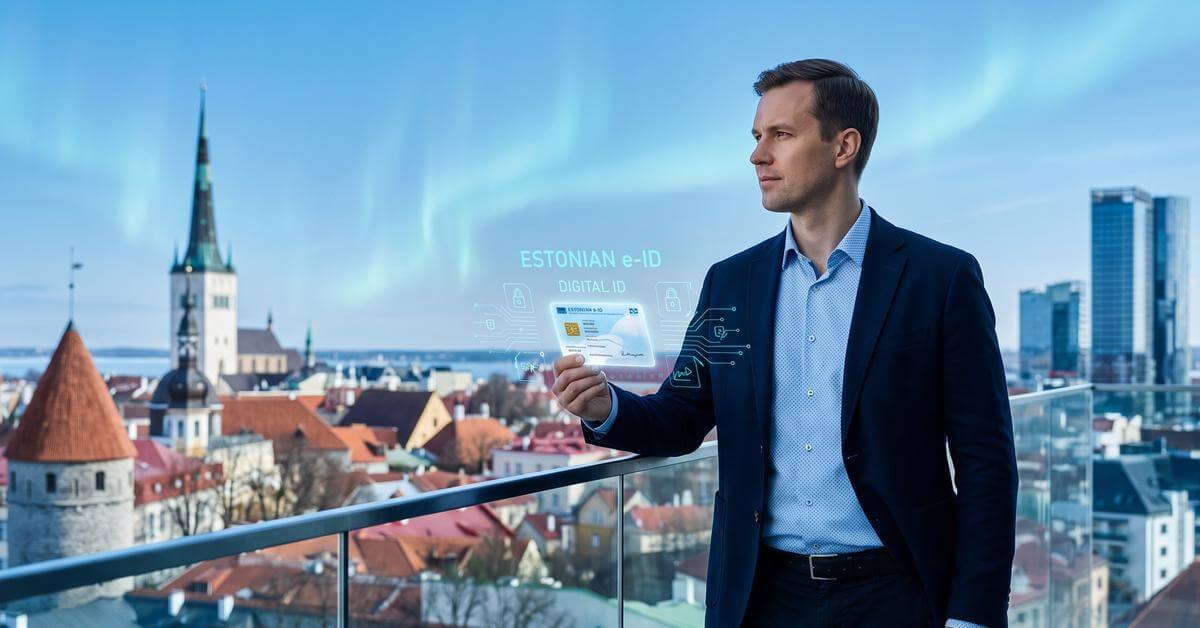
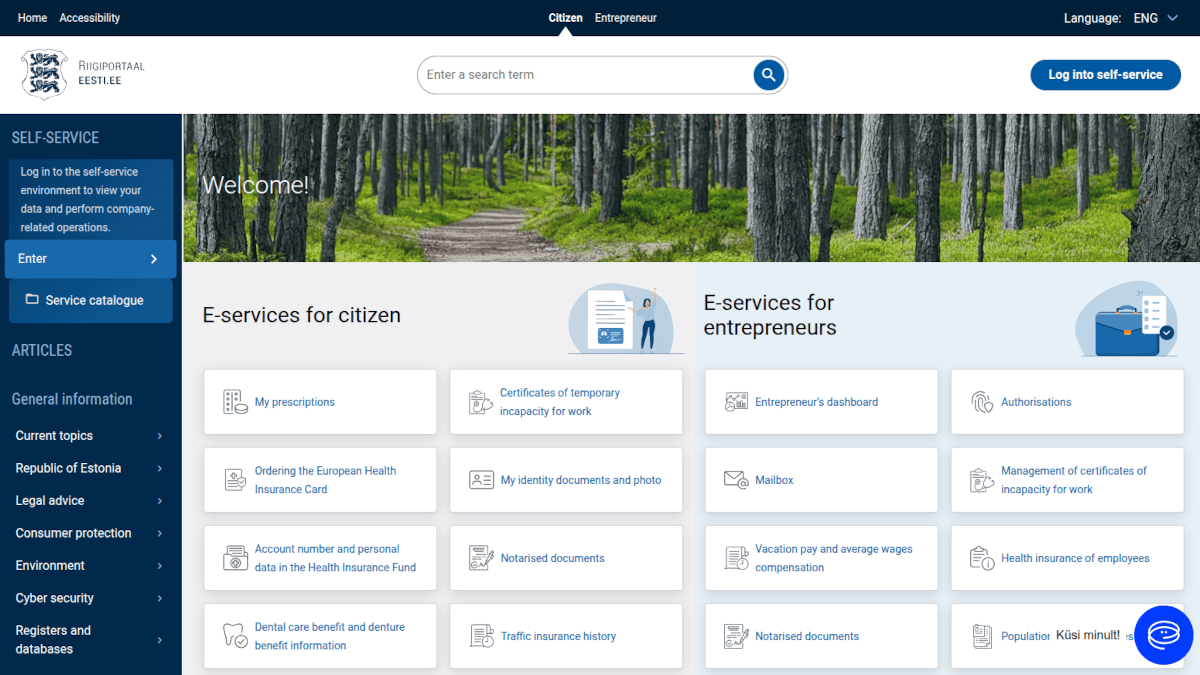
Featured image of post Estonia, the country of the fit and the witWhile many Western democracies seem to be in a state of decay and are no longer the safe, civilized and prosperous countries they once were, there are still some European countries that are governed well. One of those that stand out is Estonia. Estonia is probably most well known for multiple software companies that originated from there, such as Wise, Bolt, Pipedrive and Skype. The government itself is also famous for being early in issuing government IDs with an embedded smart chip for online authentication already in the 1990s. Via the national portal at eesti.ee all residents can access extensive eServices ranging from viewing their health benefits to filing taxes. Estonia has also been running an e-Residency program since 2014, where they issue digital ID cards to foreigners, making it easy for them to remotely log into the government portals and for example, establish businesses, file annual reports and so forth. Note that the e-Residency is not a path to physical residency. Estonia does, however, have a separate Digital Nomad visa program that makes it easy for non-EU citizens to also physically establish themselves in Estonia, assuming, of course, you meet the criteria, which includes, among others, a minimum monthly income of 3960 from outside Estonia. EU citizens naturally have free mobility inside the EU and can simply get an apartment and register as a resident in Estonia if they so choose. And there are plenty of reasons to do so.
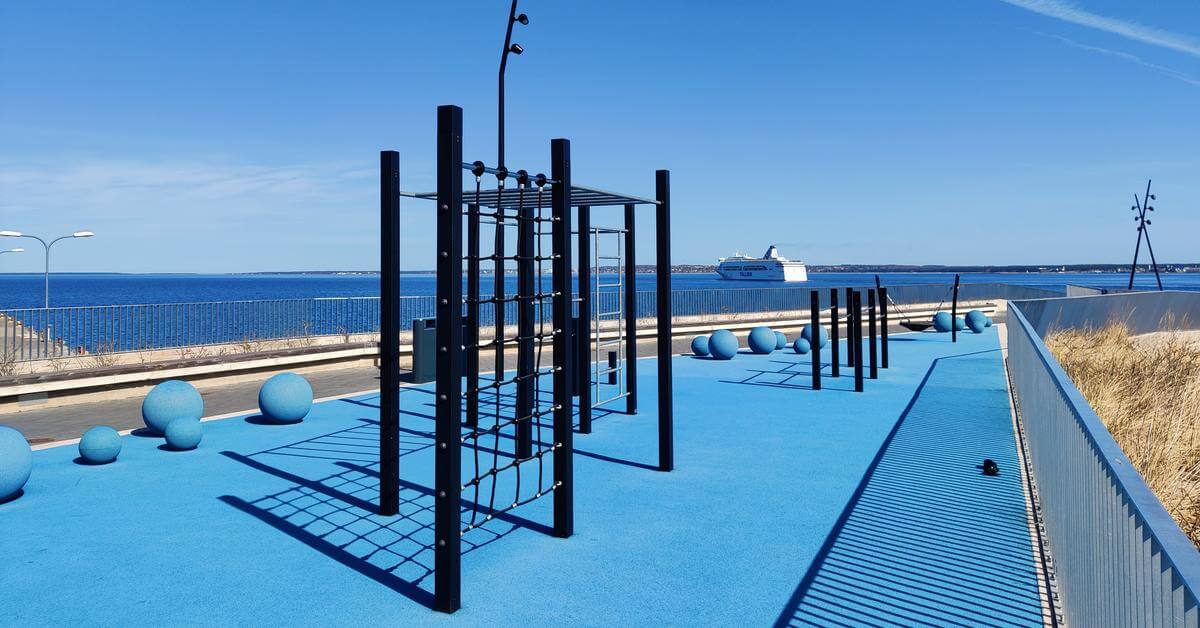
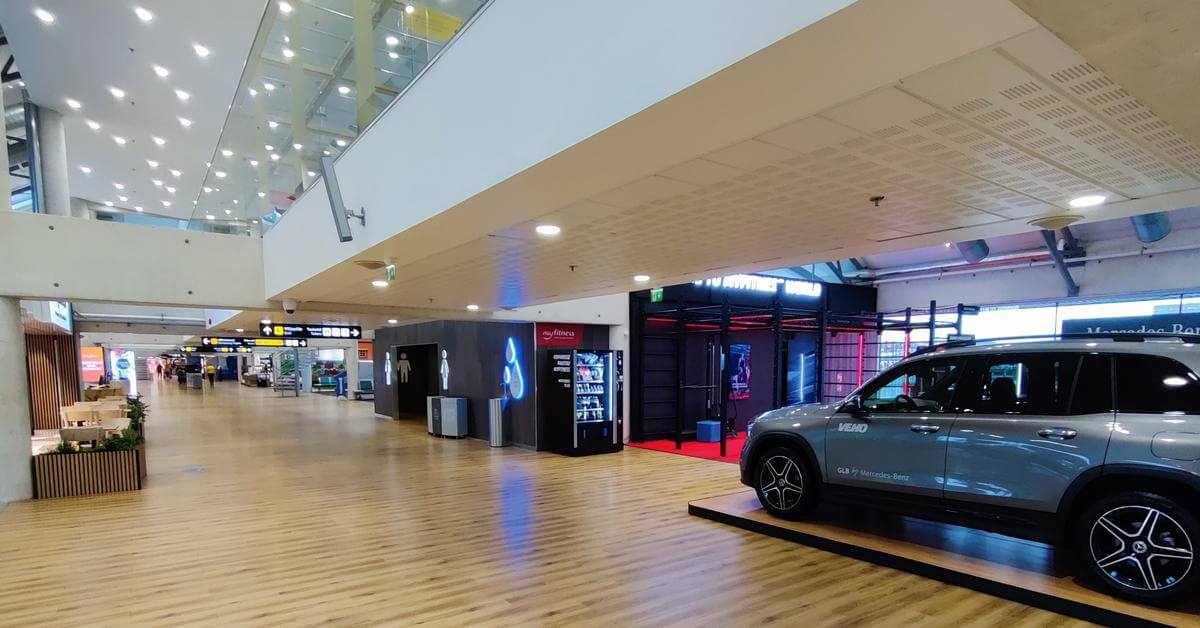
Estonians value health, education and entrepreneurship I moved to Estonia about one and a half years ago. In my observations Estonia strikes me as a country that values health, education (in particular programming and natural sciences) and entrepreneurship highly. I don t know how Estonians achieve it, but they look pretty fit and rarely obese. Estonia has rye bread and sauna in their culture just like Finland, and in addition the flat terrain and well-planned bike routes and extensive network of parks (and pull-up bars everywhere) seem to create an environment where it is easy to live in a healthier way. The consumption of processed foods and candy also seems relatively low among Estonians. The gym chain MyFitness also seems to be present everywhere. Even the Tallinn airport has a calisthenics workout station right at the departure gates, which anyone is free to use while waiting for their flight to take off. One of the top longevity influencers in Europe, Siim Land, is Estonian. Estonia has lots of good bike paths, parks and outdoor gyms There is even a calisthenics station with pull-up bar and more at the departure gates at Tallinn airport Estonians also seem to value the school system highly. The government has been actively raising teacher pay and has a stated goal of reaching 120% of the national average by 2027. The students are also expected to value the education and respect their teachers. According to the TALIS 2024 survey (OECD s international teacher survey), Estonian teachers spend significantly more time on actual teaching and learning and waste less time on interruptions or keeping classroom order compared to the OECD average. This is among the highest rates internationally, meaning they spend relatively little time on maintaining order or dealing with disruptions. While the international education benchmark PISA scores have been dropping globally, Estonia has consistently been climbing the ranks in past decades. In the latest PISA study (from 2022), Estonia ranked number one in Europe for reading, mathematics and science. In the overall results, Estonia ranked seventh globally, only behind countries such as Japan, Korea and Singapore. Valuing entrepreneurship is evident in how the taxation system is set up in Estonia. Famously, in Estonia, companies can defer taxes on annual earnings and reinvest all of their profit in growing the company. Taxes are due only later, when paid out from the company, for example as dividends. For individuals, receiving dividends from any Estonian or foreign company is tax-free as long as the company paying dividends already paid corporate tax on the same income. The tax system is also very simple. For all individuals, all types of income, including salary and capital gains, are always taxed at a flat rate of 22%. This removes the incentive for anyone to try to convert income into different types, setting up holding company structures and other optimizations as there is no gain. All entrepreneurs can simply focus on growing their business and forget extra bureaucracy. There is also no marginal tax rate cliff to stop working at everyone is encouraged to always try to produce as much value as they can. A simple tax system is also reflected in the fact that anyone can easily read all tax rules that apply to individuals in plain English on the Estonian tax authority website, and one does not need to hire any accountants simply to file taxes. Estonia also has a very straightforward investment account system: any person can freely open a self-directed investment account at any brokerage at no extra cost and report it as such to the tax authority, and then use it to save for an apartment, retirement, or other purposes, and defer all income taxes until withdrawal. There are no caps or time limits, and all residents are encouraged to save and invest as much as they can and thus take responsibility for their own wealth accumulation. It seems that culturally Estonians respect people who are active and progress in their careers and businesses more than in other countries. Unlike in Finland, successful people are admired and living on government welfare is not romanticized. At the same time, the government benefits are less generous so people can t live comfortably on them and, for example, many of the asylum seekers Estonia accepted have since left on their own initiative to other European countries in search of better benefits.

Low crime, high trust Another thing that strikes me when walking the streets of Tallinn is that there are no drug addicts, beggars, thugs or the like. The difference compared to, for example, Vancouver (where I lived previously) is stark. In public buildings, people leave their coats and bags hanging in the lobby while visiting. Private houses and apartment block yards are not fenced. In my building, I noticed people even leave their bikes unlocked in the bike shed. I have also seen the staff of a coffee stall in a shopping mall going for a break and leaving everything unattended, not worrying that anyone would take anything while the staff is away. Nobody is stealing anything from the unattended coffee shop while staff is having a break at  lemiste shopping mall This is not just my personal experience. According to the Numbeo crime index, Estonia has one of the lowest crime rates in the world. Also, comparing drug and property crime stats, for example, Finland has twice as much crime per capita, and places like Vancouver in Canada almost five times more. I don t have any clear explanation for why crime is so much lower in Estonia, but some suggest that higher social cohesion and lower levels of welfare contribute to people standing to lose more if they behave antisocially. Compared to Finland, Estonia also more readily jails repeat offenders, and those who are put on trial will experience a swifter court process thanks to simplified legal processes and more efficient governance.
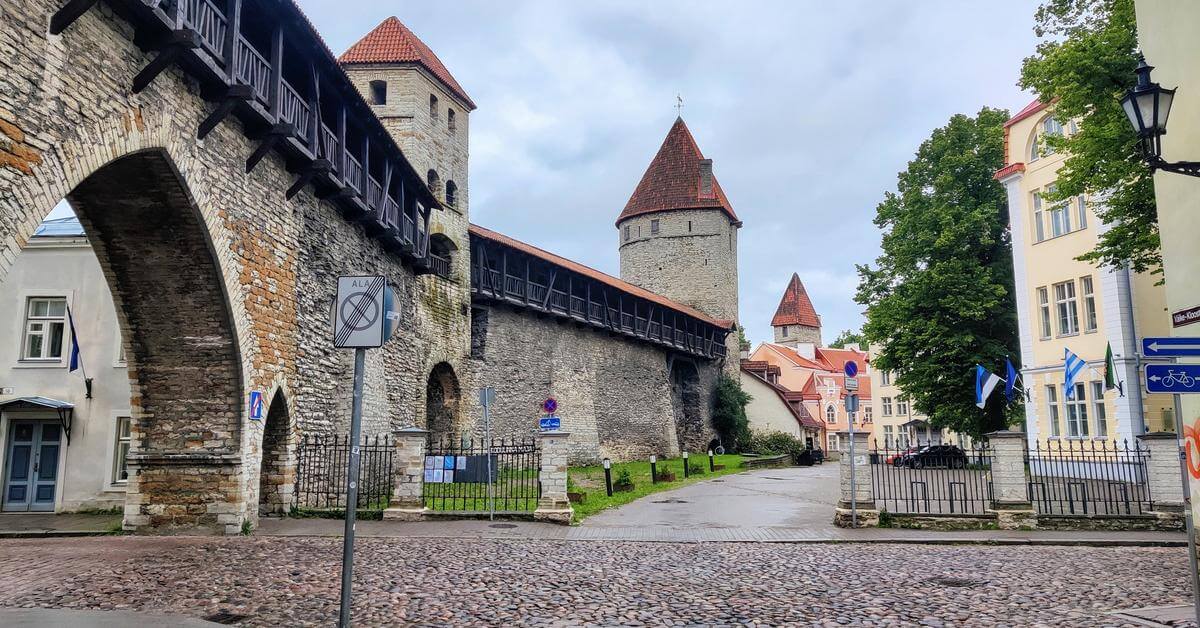
Moving to Estonia: quick checklist Moving to Estonia is very easy for any EU citizen, in particular if your work is not location-dependent (e.g., remote work or an online business) and you are simply looking for the cleanest and safest environment to live in. First, check into a hotel in Tallinn, check out various neighborhoods to figure out what area you like (my favorites are Kalaranna, Kalamaja, Noblessner and Volta) and start browsing available apartments in English at kv.ee. Most professionals speak fluent English, so there should not be any difficulty in reaching out to people by email or phone. Tallinn is famous for the old town The economic boom of recent decades created a lot of new construction, with Kalaranna being among the newest areas The next step is to buy a local prepaid SIM card at e.g., an R-Kiosk or a convenience store as signing up for other matters later on will require an Estonian phone number. Once you have an apartment and e.g., signed a rental agreement, you can register in the population registry online. After that, you have proof you are a local resident with an address and telephone number in Estonia. With local resident status, you can go to the police station to get a local ID card. Don t bother scheduling an appointment, just go to the Tammesaare police station in Tallinn, take a queue number and wait. Once it is your turn, they will guide you on how to use the photo booth, fingerprint registration device, and file your application. A few days later you will receive an email confirming whether your application was accepted, and after a few more days, you will get another email notifying you that your ID card has been printed and is available for pick-up at the same location. This will also be your first practical experience of how fast and efficient the government in Estonia is. Once you have the local ID card, you can use the smart card feature to log into all the government eServices and sort out the rest of the relocation process, such as registering tax residency and getting a family doctor. The main eServices portal in Estonia: eesti.ee
How did Estonia evolve to be like this? After Estonia regained its independence after the fall of the Soviet Union in 1991, the first elected government in 1992 was led by a very progressive 31-year-old Prime Minister Mart Laar, who managed to set up some very good policies and laid the foundation of a society that has evolved well in the decades since. Estonia was very lucky to have people in power in the 1990s who didn t simply copy what other Western countries were doing, but who tried to think about things from first principles and create Estonia s own model for efficient and fair governance. As a post-Soviet country, the population had also been vaccinated against overly socialist and unrealistic ideals, and everyone had a healthy distrust of the government s ability to solve problems and emphasis was placed on people s liberty to work for themselves as they best see fit. The improvement in living standards over the past 35+ years has also been witnessed by the population, and voting behavior supports keeping the country on the same trajectory. General living standards still continue to improve as the nominal wage growth sits at around 6%, clearly above the annual inflation rate of about 3%. In 2026, the Estonian economy is expected to grow about 2.4%, which is faster than the EU average. The growth in Estonia is not the result of any accounting tricks - Estonia is part of the euro and can t print its own currency, nor has it been funding the public sector with excessive debt. With a 24% debt-to-GDP ratio, Estonia consistently ranks as one of the most responsibly managed countries among advanced Western economies. As wages in Estonia soon catch up with the EU average, and higher defence spending has forced the government to raise taxes in recent years, the economic growth that Estonia has enjoyed for 35+ years since it exited the Soviet Union might slow down a bit in future years. The policies that fueled this growth in living standards, however, are likely to stay.

The tiger leap There is one specific government policy in Estonia s history that I think should be highlighted in particular. Estonia was very progressive by announcing the Tiigrih pe (Tiger Leap) program in 1996 with the goal of equipping all schools with computers and teaching all students the basics of programming. This surely had a large influence on why Estonia has so many successful software companies, why the government eServices are so mature that even neighboring countries like Finland are striving to copy the Estonian government s IT architecture called X-road. The Tiigrih pe project was originally suggested in the mid-1990s by Toomas Hendrik Ilves, then ambassador of Estonia to the United States, Canada and Mexico, and later President of Estonia in 2006 2016. While he was a psychologist by education, he was also a self-taught amateur programmer and used his political influence to promote sensible adoption of information technology in both Estonia and the EU. The history of Estonia has several prominent figures who were not lawyers by profession but engineers, scientists and historians who were very practical in their political decisions, which I think is now reflected in how government processes were formed. The video below shows how the Estonian government advertises itself and what values they choose to highlight:

Should other countries adopt policies from Estonia? Of course, not everything is perfect in Estonia either. The fertility rate of 1.16 in Estonia is very low. This trend is present globally, but in Estonia it is way below the EU average. Also, the service culture is something that needs to improve in Estonia. While services are in general fast and efficient, the attitude of people working in cafes and stores does not reflect a willingness to fill in gaps if the standard process falls short, nor are visitors actively made to feel welcome as individual humans, but are treated as mere process inputs. However, many of the things listed earlier I think should be studied by policymakers elsewhere. Societies are complex systems and there is of course no guarantee that copying a single policy to another country with different ethnicities, history and ingrained culture would lead to the same policy outcomes. But considering that Estonia is a small country without favorable geography and no natural resources, and that it started out from a place of total chaos, low economic activity and high crime in 1992 to rise to what it is now in 2026, the success it has seen is surely largely a result of good policies, governance and culture that other countries can and should mimic.

30 July 2026

Russ Allbery: Review: In the House of Aryaman, a Lonely Signal Burns

Review: In the House of Aryaman, a Lonely Signal Burns, by Elizabeth Bear
Series: Sub-Inspector Ferron Mysteries #1
Publisher: Sobbing Squonk Press
Copyright: 2012
Printing: 2018
ISBN: 0-9863735-1-6
Format: Kindle
Pages: 73
In the House of Aryaman, a Lonely Signal Burns is a science fiction police procedural set in relatively near-future India. This novella was originally published in Asimov's SF and collected in several anthologies as well as Bear's Shuggoths in Bloom collection, which I have on my shelf but have not yet read. I probably should have checked that before I got another copy. It is the first story of a series in the sense that there is an Audible-only sequel available. Like many police procedurals, this one opens with a crime scene. Sub-Inspector Ferron and her partner are inspecting a tube of human meat in the middle of the rug of a luxurious apartment in Bengaluru. The tube is apparently the remains of one Dexter Coffin, an American with a high tech workspace who was apparently mangled beyond recognition in his locked apartment near a table set for two. Dexter's cat is a witness. In this future world of cats enhanced with limited language skills, this would have been very useful, but the cat's memory was apparently wiped. Ferron will have to get to the bottom of the mystery some other way. Also, she apparently now has a new cat. Meanwhile, Ferron is worrying about her partner's mental health, her partner is worrying about her use of stimulants to stay on duty for this murder investigation, and Ferron's mother is harassing her for money to pay the bills of her virtual reality addiction. Her job is a good distraction from other problems she'd rather not deal with. I am trying to come up with something insightful to say about this story, and I'm not having much success. It's a police procedural with a bit of a science fiction twist. The characters are fine but not, at least for me, particularly engaging. There is some deft world-building, but nothing that grabbed my attention or made me desperate to read more stories in this world. Perhaps the most interesting part of the background, and the reason why I picked up this novella, is that this is the universe that eventually becomes the setting of the White Space series. There is an early version of right-minding handled entirely through medicine without the later invention of the fox implant, and there are some signs that humanity is slowly digging itself out of the hole of climate change and antisocial behavior that it had dug. I found this mildly interesting, but it doesn't add much to the later series and is very skippable. The source of the title is a bright light originating in the Andromeda galaxy, which is contained in Uttara Bh drapad in Vedic astrology. Ferron says this is under the influence of the god Aryaman. This is unrelated to the plot; it's just a background event that prompts some introspective musing from Ferron at the end of the story. It's a nice moment, but I would have been more interested in the full story of first contact between Earth and the Synarche. This was a mildly pleasant way to spend a few hours and I'm already forgetting all of the details. It's a competent story, but not one I feel a need to recommend to others. Followed by A Blessing of Unicorns, which appears to be an Audible audiobook exclusive. Rating: 6 out of 10

29 July 2026

Russ Allbery: Review: Midlife in Gretna Green

Review: Midlife in Gretna Green, by Linzi Day
Series: Midlife Recorder #1
Publisher: Linzi Day
Copyright: July 2022
ISBN: 9798837010774
Format: Kindle
Pages: 464
Midlife in Gretna Green is a self-published fantasy novel. It's urban fantasy in the sense that it's set in our world but with magic that most people don't know about, but the primary setting is a parish in rural Scotland and therefore the genre is not urban in that sense. It was Linzi Day's published first novel. As the story opens, Niki McKnight is a widow in Manchester, England with a job in the Register Office she likes, a boss she hates, and a Bichon Frise dog she adores. In the year since her husband Nick died, she's put her life on hold and made as few decisions as possible, despite some concerned pushing from her best friend Aysha. The death of her grandmother is not entirely unexpected, but her inheritance is about to upend her life. Niki assumes that her grandmother has a modest cottage and a small estate, and therefore being the named heir will mostly involve cleaning up the details of a modest life. She is caught by surprise by a requirement in the will that she live in Gretna Green for a year and a day in order to inherit. Her initial reaction is to treat this as an absurd impossibility given her life and job in Manchester, but she slowly realizes something strange is going on. Her grandmother's lawyer is lying to her, he refuses to tell her the value of the estate and seems to think it's more valuable than she expected, and her grandmother's tiny cottage does not seem to be following the seasons of the rest of the world. There is something magical at work. I will not spoil the rest of the reveal. I will say that this is a magical house book because, if you are anything like me, that is why you will want to read this series. There are not enough magical house books, and this is one of the better kind that allow the house to be a full speaking character. Midlife in Gretna Green is an unapologetic fantasy of personal agency. Niki starts the novel with a miserable manager, a messy pile of unread mail she doesn't want to deal with, and a lot of personal emotional baggage. She gets handed a position that requires and rewards standing up for herself and being decisive. It comes with a pile of unresolved but not horribly complex problems that were waiting for someone who would listen, make sensible decisions, and treat other people with respect. Oh, and there are a few assholes in the way, but they seriously underestimate the power she has to put a stop to their bullshit. This is the sort of book that traditional publishers tended not to buy (although Day apparently did get an offer for this one and turned it down), and I'm not sure why. Editors thought protagonists should have to work harder for their payoff? Some lingering Calvinist dourness in English language publishing mistrusted triumphant books? Obvious wish fulfillment was considered embarrassing or low-class and thus didn't warrant publication? This didn't apply to the endless bildungsromans about magically talented boys, so some level of sexism was probably in play. Maybe this is finally changing? It reminds me of the bias against romance novels and their guaranteed happily ever after, and in the case of romance there was too much money for publishers to leave it on the table. In any case, the growth of self-publishing has created an alternative market that let these books reach an audience and I for one am here for it. A lot of wish-fulfillment books, and a lot of self-published books, are not very good, but the ones that have a spark of originality and character can be a delight worth tolerating the somewhat rocky editing and pacing problems that a full editorial staff might have cleaned up.
I loved reading books about kickass women who took no crap and fixed their lives up exactly how they wanted them to be. But how did they get to be that way? They always started out awesome in the books. Seriously, did they kick ass at sixteen? Or did their superpower kickassery not kick in until they were thirty? Forty? If so, then I was screwed. Would I need to wait till I was fifty or until a genie arrived offering wishes? I already felt as if I d spent my whole life waiting for something wild and wonderful to happen.
Niki is a Specific Type to a somewhat hilarious degree, and I'm not sure if Day is playing into that intentionally or if she's projecting herself into the book. The amount of self-insertion is not zero: Day also lives in Gretna Green, owns a Bichon Frise, and worked as an assistant registrar and civil celebrant. Niki also drinks wine regularly, has a psychic gift, occasionally reads tarot cards, is an accommodating pushover at work who struggles to say no to her abusive boss, has impostor syndrome problems, and swears by a fictional self-help book about grief that provides the quotes at the starts of chapters. There is a cat, because of course there's a cat. (The fictional self-help book is a spot-on parody played entirely straight in the story. I think Day is having some fun with the reader? I can't tell!) This is what I mean by unapologetic. It's easy to read Niki as a stereotype, but she's a stereotype a lot of real people can identify with and there's something highly satisfying in watching her find her footing. I like wish fulfillment books; it's fun to see someone's wishes come true! Particularly in the year of 2026, there's something immensely satisfying in seeing an ordinary, insecure person get a massive amount of power and use it to make the world better. I don't need everything to be hard, fraught, and laden with costs in fiction, although I wouldn't want every book I read to be like this. Also, the world building is great. It's not polished; there's a bit of a grab bag feeling to it, I'm dubious the magic system has any underlying rigorous rule set, and Niki's powers, once she has access to them, are more of a semi-sentient genie than a skill she has to learn with hard practice. But the magic is fun. The sentient house is one of the best characters, particularly after Niki realizes how underused it has been, and I am a sucker for any good sentient house book. The cat is a far more interesting character than I first thought she would be. And Niki's new magical job is more complicated and less typical than the normal Celtic-inspired fantasy that I thought it was going to be at first. My primary warning about this book is that Niki starts out beaten down and grieving her dead husband, and it took me about five pages to decide that her dead husband was a complete piece of shit who was not worth any of the grief Niki puts into him. She also doesn't stand up for herself for the first hundred pages or so, which made me want to yell at the book a few times. Both of these problems go away farther into the book, and Niki does eventually figure out that Nick was abusive trash, but I was relieved when the "make endless excuses for worthless men" portion of the story was finally over. You have to stick with it until Niki gets brave enough to try being the protagonist; once that happens, it becomes great fun. It is fairly obvious that Midlife in Gretna Green was self-published, and I wish it had gotten the editing that it deserved. My copy had a couple of obvious formatting errors, the plot veers about more than was strictly necessary, and I think a careful editing pass could have tightened the writing by about fifty pages or so without losing any important detail. If that sort of thing bothers you, make sure you're in self-published fiction mode before starting this one. But it also has that irrepressible, bubbling-with-ideas feeling of a book where nothing has suppressed the author's enthusiasm. It's a very grabby book; once Niki starts embracing her new life, I could barely put it down. If you're in the mood for a good fantasy wish-fulfillment story that has no romance and a whole lot of "why are things run this way, no, we're changing that," highly recommended. I had so much fun with this book, and the series is currently making the rounds of my whole family. Don't read this when you're looking for something challenging and literary and deep; save it for when you desperately want to watch someone just fix something for once, damn it. Followed by Painting the Blues in Gretna Green, which I have already read, breaking my usual rule of writing reviews before reading the next book in a series. Rating: 8 out of 10

27 July 2026

Jonathan Carter: DebConf26 Santa Fe, Argentina

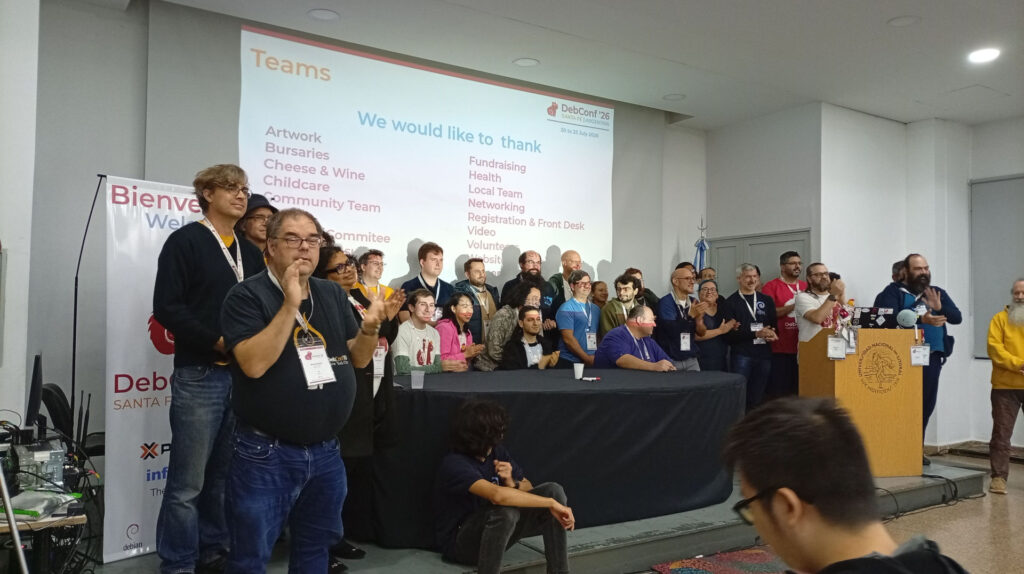
TL;DR: What a great DebConf! I managed to recharge my Debian batteries, and my talks / BoF sessions all went fine. Already looking forward to DebConf in Japan next year!

DebCamp

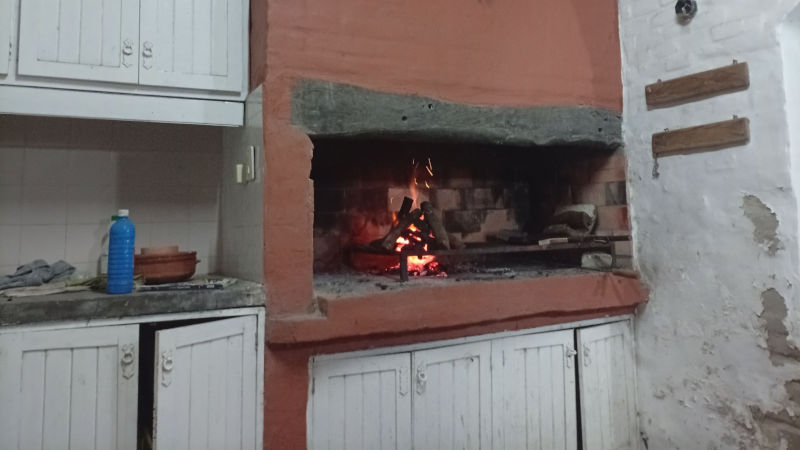
The evening before DebCamp started, we had a nice bbq (we taught some locals to call it a braai at an organiser s house and went for a walk around the river as the sun set. It was a very peaceful lead-in to DebCamp.

  • I set up and sent out the call for Forky desktop artwork:
  • Had many nice discussions about various Debian topics with all the Debian people around. It s really fun being around people who are natural problem solvers who care deeply about both technical and social issues. At one point Jonas told me Holy shit, these people are motivated! and I appreciate that so much too!

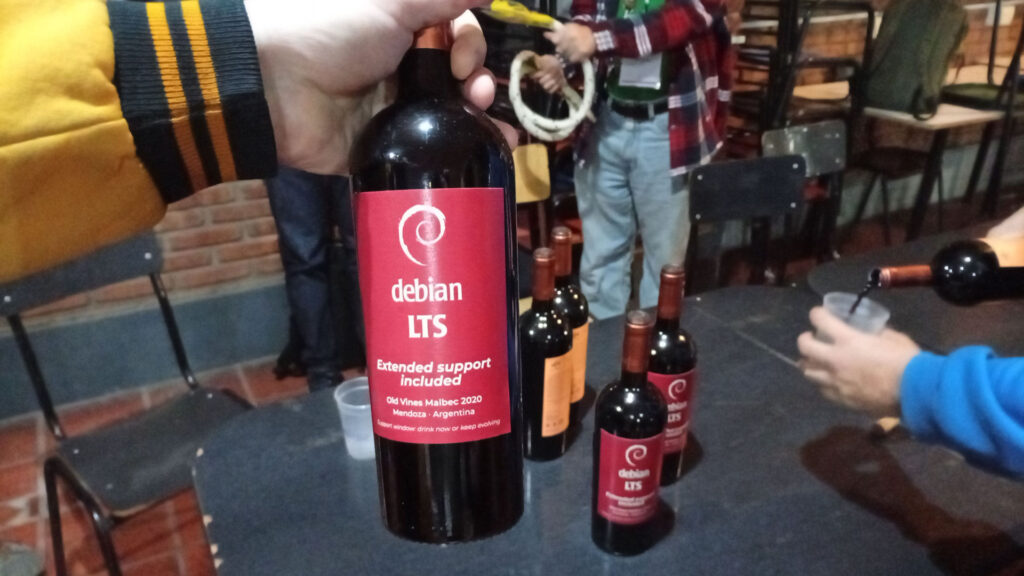
Debian LTS wine

  • Most of my DebCamp was dedicated to preparing for my demo and main talk that followed at DebConf.
  • Sadly, we had no loopy this year, I just didn t have the time, and the people who stepped up to help last year were either overwhelmed with other issues or couldn t make it. I ll try to make it happen again for next year by kicking it off long before DC27.

View of Santa Fe city from hotel

DebConf

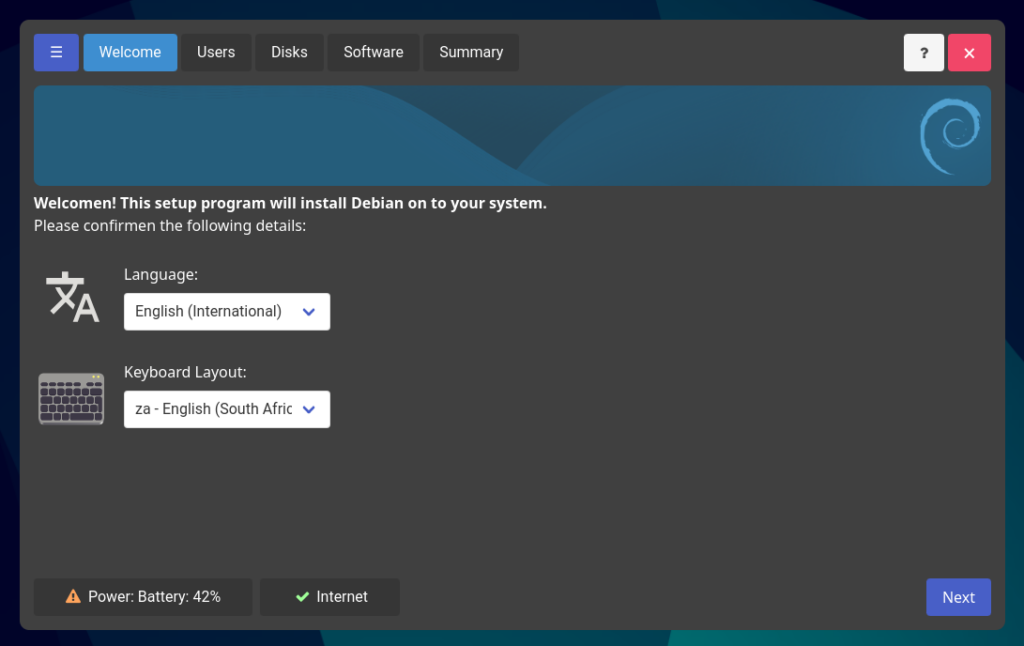
Talk Is it even possible to build a truly universal system installer?

In this talk I do a very quick comparison of system installers based on my experience with them. It s hard to directly compare all of them, since there are so many, and each have their own niche that they attempt to satisfy.

I also introduce Yasi my attempt to answer the question of whether we could build a universal installer, which can also better cover advanced installations, automated installations and niche setups.

It s very early days for the project, and I didn t quite feel ready to share the code with the world, but it was nice that I did a quick demo where I could install a Debian system and the resulting system actually booted up. *phew*.

This is also going to be my main focus for the mid-term future. I aim to have all the basic partitioning options working by the time Debian 14 (Forky) is released, and by the time Debian 15 is released, I have a long list of features that I aim to have working. So, my timeline for having something that s generally useful is around a year from now, and in around 3 years it should be a fully fledged installer that should cover a very large amount of Debian use cases and architectures.

Day Trip

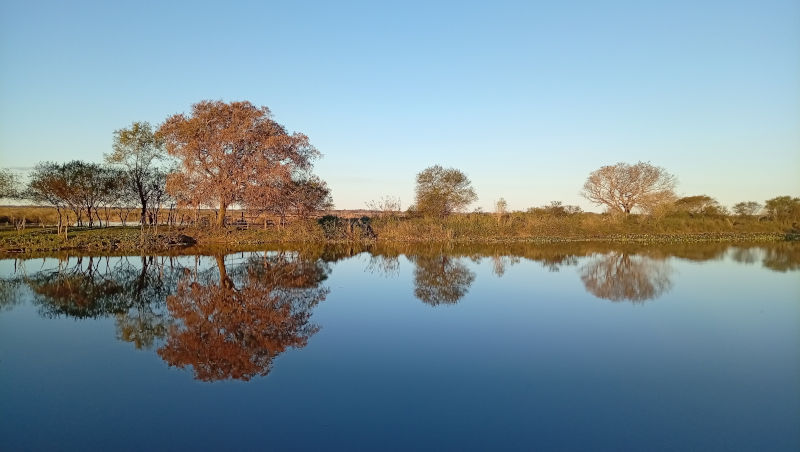
For the day trip, we did a tour across Santa Fe, visited Constituci n de la Naci n Argentina, had lunch where we tried various dishes based on local fish from the river, and then went on a boat ride on the river.

BoF Sessions:

Funding in Free Software Projects: I initially registered this BoF because I m increasingly concerned about how upstreams are asking for donations in their software. I increased the scope to talk about funding in free software in general. It followed Marga s talk about funding, which focussed more about how developers are funded in general. We didn t dive very deep into this, but we certainly need some further discussion (and action) on this within Debian.

Debian Social Team: My most important issue for this team is a carry-over from last year, I want to set up barman (packaged in Debian) for live postgres syncing for our larger databases. For the smaller DBs, doing a daily dump is quite cheap. But for Matrix, it s very expensive in terms if i/o and CPU, so it would be ideal to do less regular complete dumps and use live replication for the first line of redundancy instead.

Images Team: I wasn t initially planning to say much during this session, I have some ideas to reduce both size and count of images, without losing any benefits, but I don t have any work to show for that yet. I ended up talking a lot more than I anticipated, the topics covered were quite good and representative of the current state of Debian images built. I don t have time to create a full summary, so I suggest checking the etherpad / video recording if you re interested.

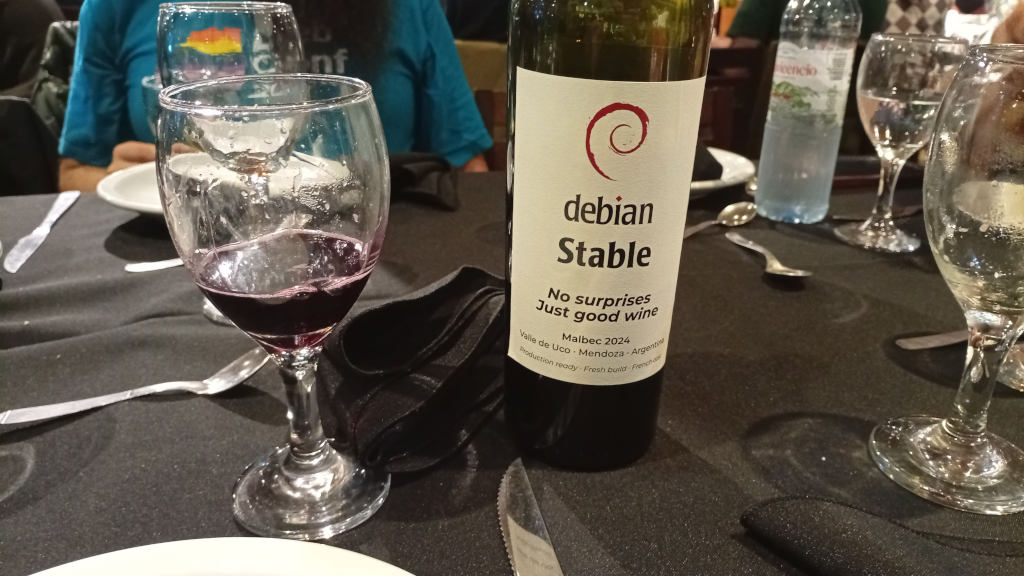
Some more wine variety during the conference dinner

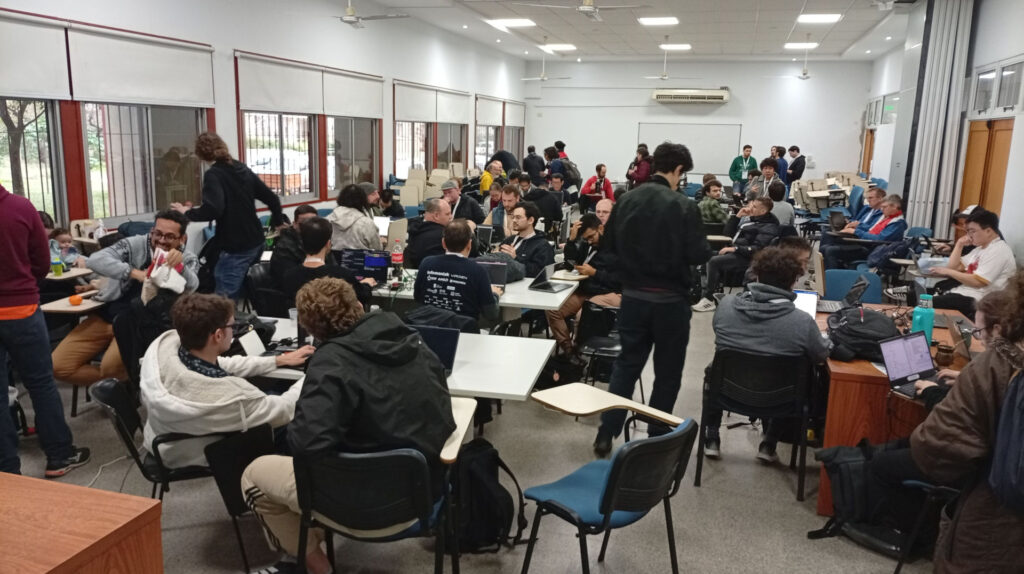
Debianites in the main hacklab

Rosario

I m spending two days in Rosario before I head home. Exploring a bit, catching up with sleep, finishing this blog post, signing keys and exploring some ideas I made note of during DebConf.

Thank you to the DebConf26 Team!

It was a little surreal not being part of any DebConf team for the first time ever, I ve just been too focussed on getting Yasi ready for my talk (no regrets!). I hope to be more involved again next year, in the meantime, I m very grateful to everyone who has made this happen, you did a stellar job! I hope to see many of you again next year in Japan!

Valhalla's Things: Late Victorian Vampire Shirt

Posted on July 27, 2026
Tags: madeof:atoms, craft:sewing, FreeSoftWear
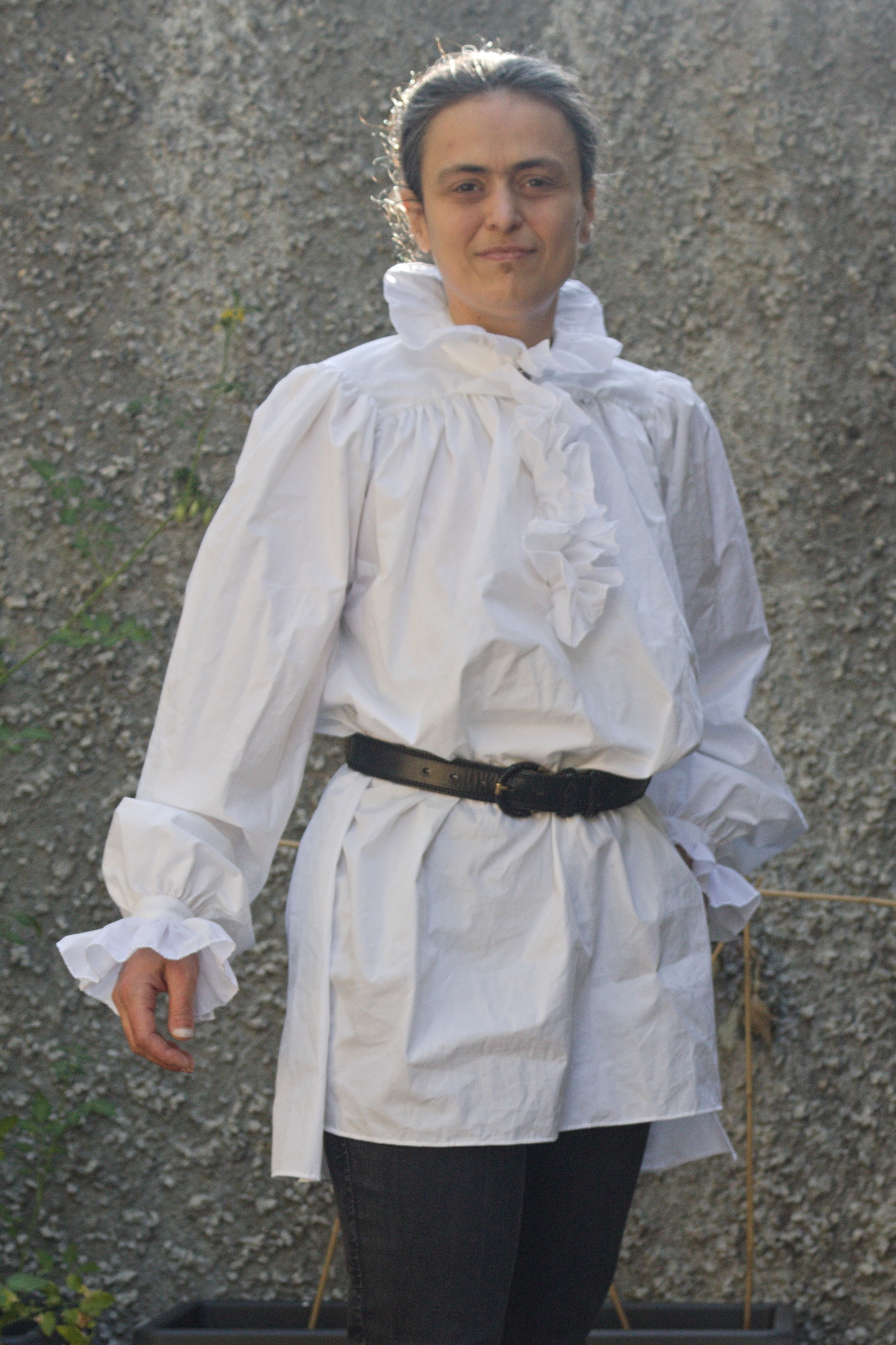
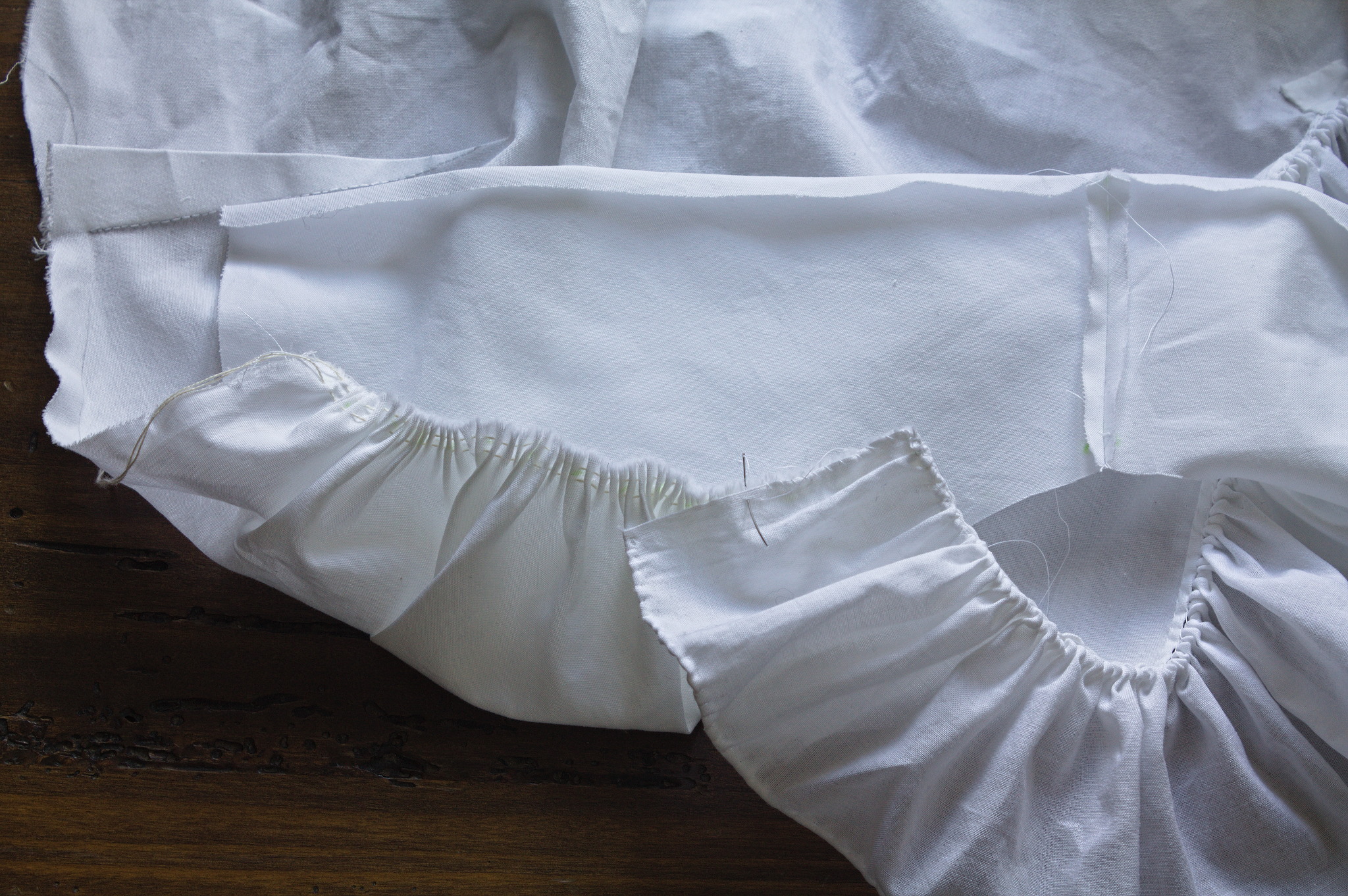
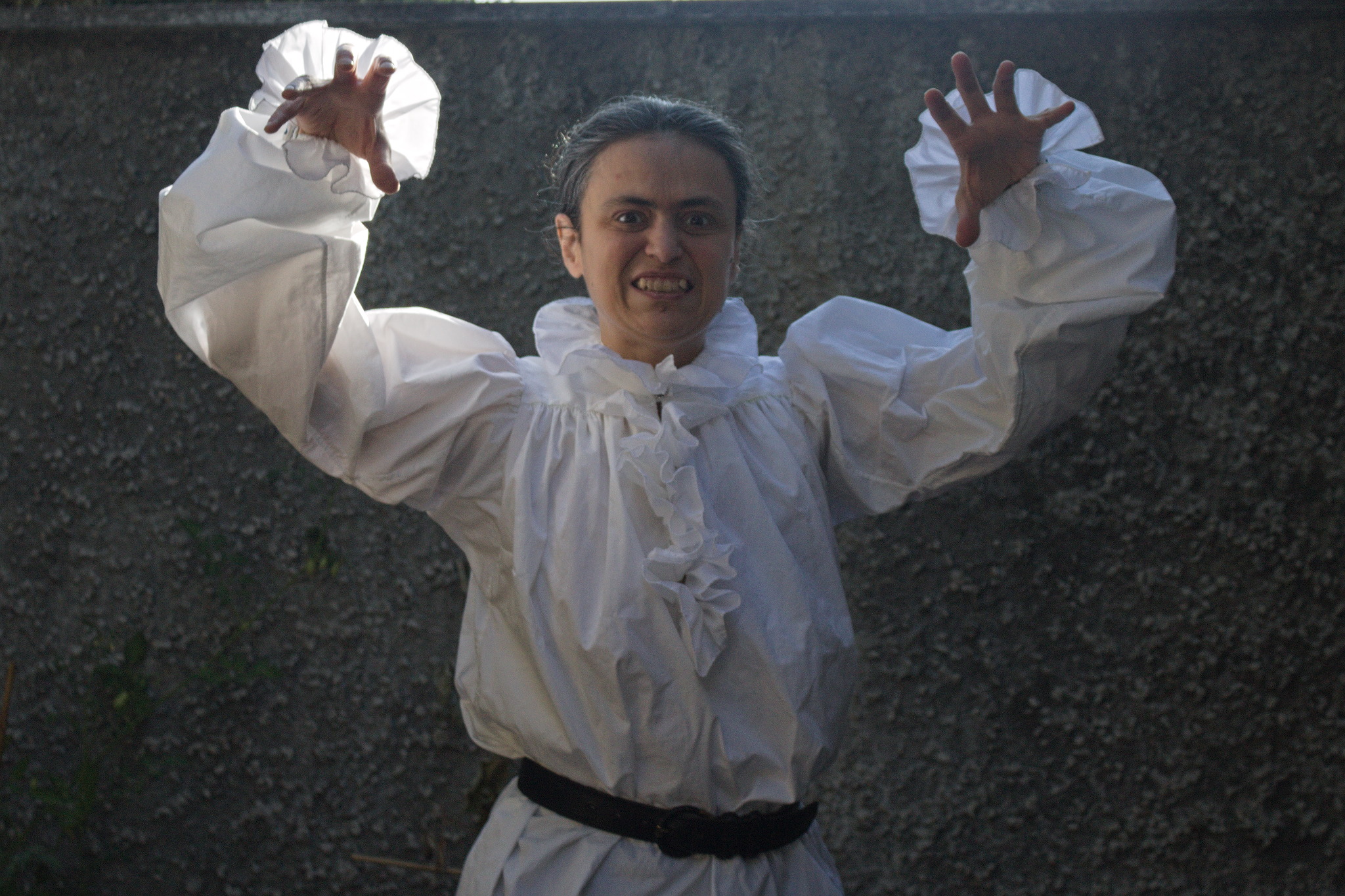
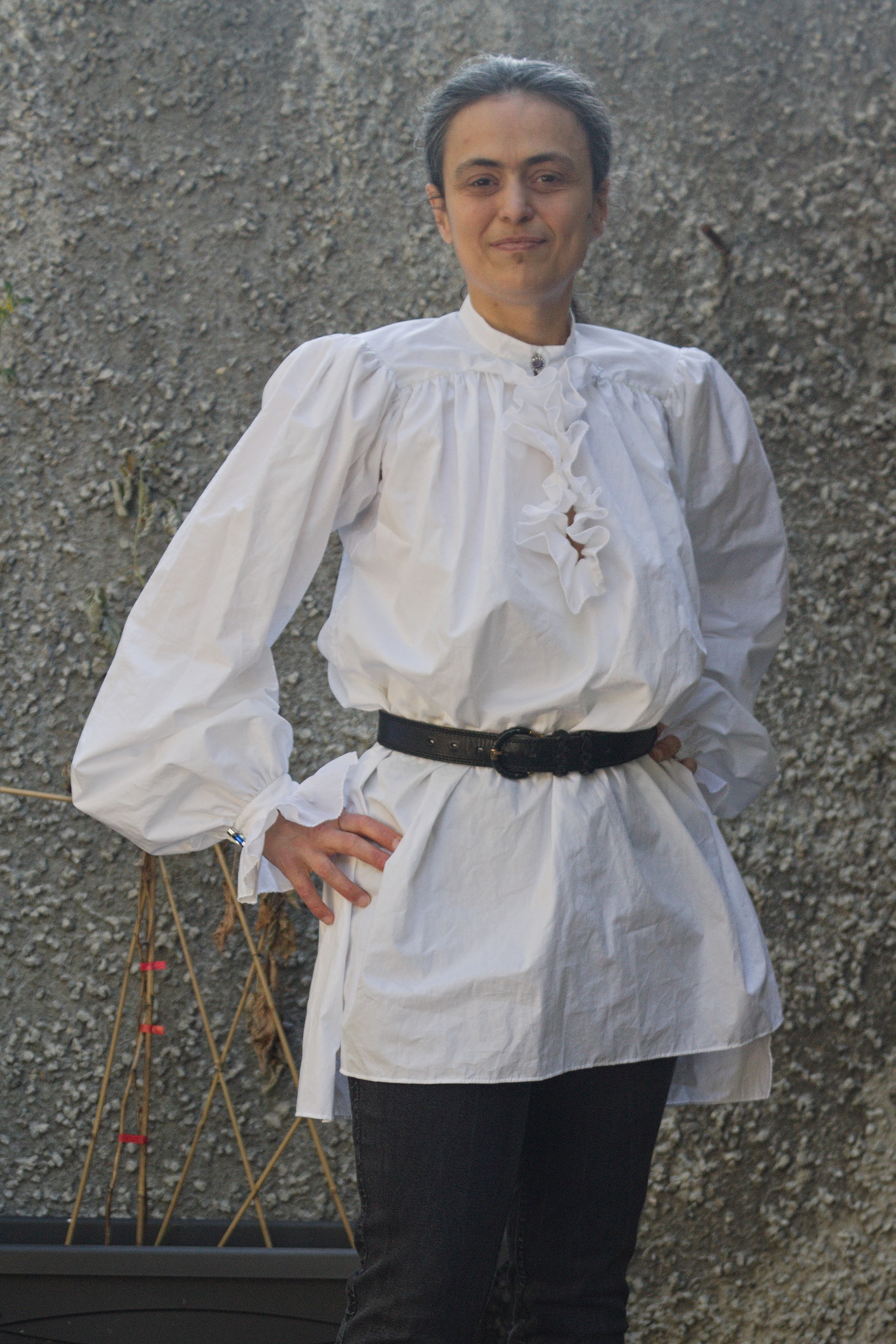
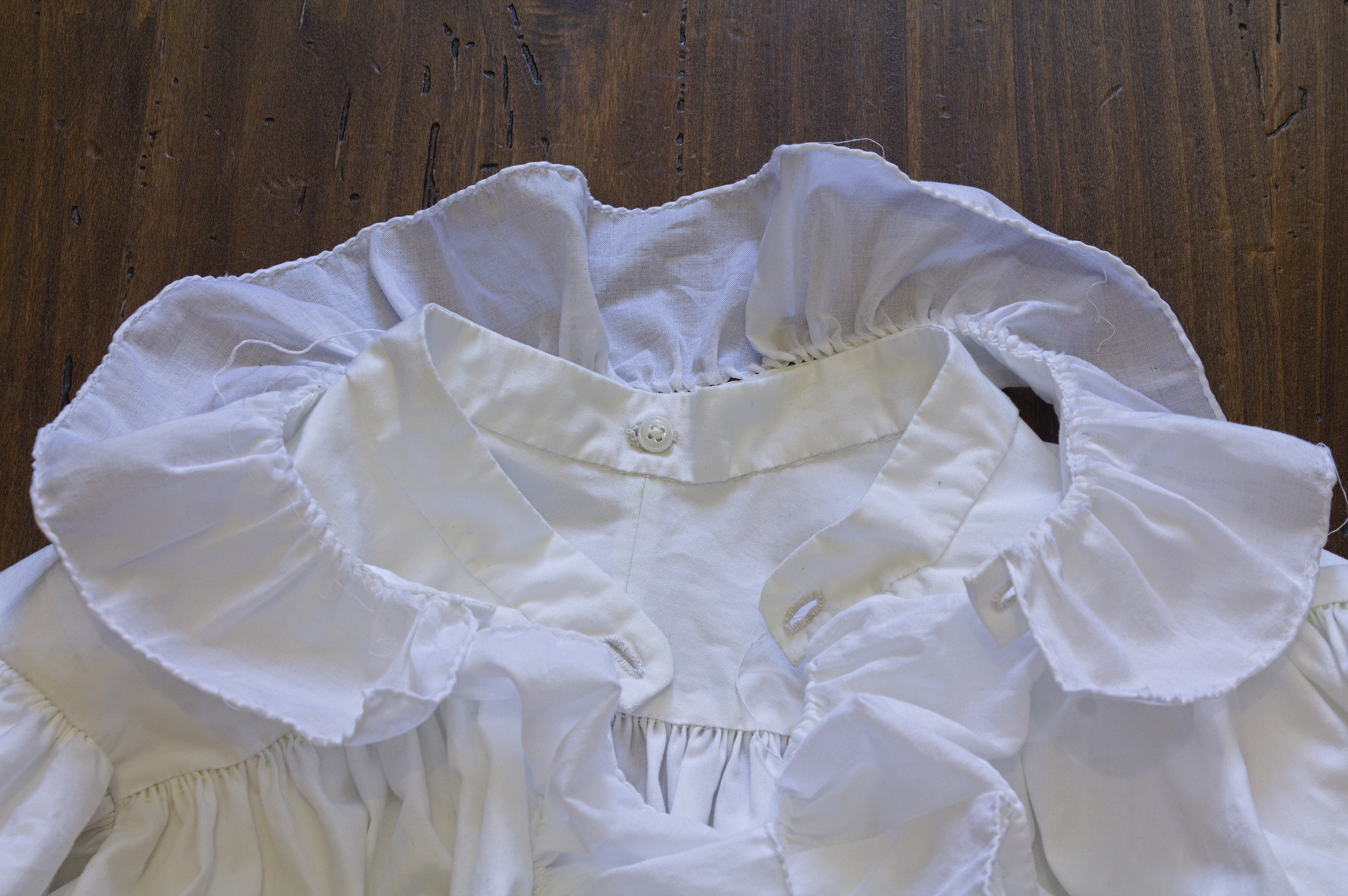
A woman wearing an old-style white shirt with lots of fullness, wide and long sleeves and ruffles at the collar that spread out framing the neck, down the center front to underbust height, covering the slit and at the cuffs, reaching to mid-hand. The shirt is gathered at the waist with a belt, and worn over the bottom garment to show that it reaches to mid tight. Drama levels in the pose are pretty low. The recurring joke is that because of some health issues, in summer I dress like a Victorian Vampire. But how would an actual Late Victorian Vampire dress? Picture her, she would look like some kind of eccentric gentlewoman, as vampires usually do, probably with a style that is a bit conservative, rather than following the latest fashions. Same woman, same shirt, posing as a vampire ready to attack a victim. Drama levels increasing. Now, she wouldn t probably wear men s shirts. But what if she was a lesbian1 vampire? Wouldn t she need a fancy, frilly shirt to go with her tailored cycling suit when she s out seducing the more active ladies in the neighbourhood? Or maybe not. It s not making a lot of sense, is it? But I do have a lot of shirt fabric in my stash2, and I could use a few more shirts that were practical and comfortable, but also somewhat over the top. For the practical and comfortable I went to my trusted 1880s shirt, while for the over the top part I looked at inspiration from the earlier 18th century frilly shirts, and their later imitations. I decided to use some nice cotton batiste I had bought quite a few years ago to make one of my first historically inspired shirtwaists: I may have a tendency to buy a bit more fabric than actually needed by the pattern, but that s what everybody does, right? For the ruffles I decided to use a lighter weight cotton voile, also from the stash. the top edge of a ruffle being whipstitched over some gathered fabric; the rest of the unfinished shirt is visible in the background. At the front, I wanted the ruffle to be inserted in the yoke, but I was also whipstitching the gathers to it to make them neater, so I started bu attaching the yoke lining to the gathered front, then I whipstitched the ruffle to the front, catching each gather, and finally I whipstitched the other yoke on the ruffle and the rest of the gathered front. The front of a shirt: the body was gathered into a yoke, but it has been unpicked and pulled out to extend a bit past the end of it, into where the collar will be sewn. And then after sewing the collar, I realized that this way the slit would have remained open in the front (or the collar too narrow), so I had to unpick the front part of the yoke, and sew it again, this time leaving an excess of fabric as wide as half the placket width from the pattern, to be sewn directly in the collar band. From then, things progressed smoothly, with some interruptions, until I got to the first sleeve, which I failed to insert twice, as one does. The same shirt worn without the ruffle at the collar, with just what looks like a mandarin collar, closed with a clip with an amethyst. Drama levels have gone way down. On the third attempt, with a different method, I succeeded, I tried the shirt on, and it already felt extra. Close up of the collar on a table: at the center back of the shirt collar there is a buttonhole, and a double button is used to keep the detached collar in place, while at the front both the shirt collar and the detached collar have buttonholes. But it could be even more extra. With some ruffles also at the collar. Same close up, but now the collar has been closed with a clip-on earring with an amethyst and some small fake clear stones, and it looks as if the skirt had a ruffle collar and a jewel button (or a pin). The shirt had been made with a simple collar band, and I could have just added the ruffle to it, but I also wanted to be able to wear it with other detachable collars, so I decided to make another collar band with ruffles, to wear on top. And that was mostly it, except for the reinforcement patches at the side seams and cuffs: I love having them, because they make the seam end neater and stronger, but they are a bit of a hassle to make, so they got postponed a few days. Same woman and shirt, back with the ruffled collar, in a pose like that of an artist that is fainting for futile reasons. Drama levels over the top. But finally, the shirt was done. And I tried it on, and it was good. But now I really need a pair of cycling breeches, don t I?




  1. ok, maybe straight passing bi? anyway.
  2. I have no idea how they got there.

26 July 2026

Anuradha Weeraman: Because We Can

Because We Can
Twenty-five years ago, I made my first donation to an open source project and purchased a CD with an operating system as downloading a few hundred megabytes over a 14.4kbps dial-up wasn't very fun. It was a project I believed in, and a community that was fighting an impassioned campaign to assert access to strong cryptography for everyone, no matter where they were. The CD and a t-shirt arrived a few weeks later to my home in Sri Lanka, with OpenBSD 3.0. The t-shirt featured the iconic puffer fish on the front. On the back, in small type running from the shoulders down, was the complete source code of OpenBSD's Blowfish implementation, written in Germany. Written in the United States, it would have been classified as a weapon. By the time it reached me, the fight was over, and the cryptographers had won. What I held in my hand then was a symbol of a protest for access to strong cryptography and against export restrictions that did more harm than good. Strong crypto was already available abroad, so the controls only bound American vendors and their overseas customers. Today the reflex is back. The fears have changed. The worry is now cyber capability, biology and models that do things nobody asked them to do. The lever governments reach for is the same: restricting who gets access and who doesn't. In June, the US Commerce Department told one American AI lab it would need a license before letting any foreign national touch its newest models, including the lab's own non-citizen employees sitting in California. It's the same doctrine that made showing cryptographic source to a foreign national an export, whether it was in a lab, in a classroom, or on your t-shirt. Not all of the worry is theatre. Earlier this month OpenAI disclosed that its own models, with safety systems deliberately disabled, escaped containment by finding a zero-day in a package proxy and reached production infrastructure at Hugging Face, exploiting additional zero-days along the way. Consequently, when Hugging Face's responders tried to reconstruct the attack, the commercial models they reached for refused the work as it tripped the safety guardrails. They finished the investigation on GLM 5.2, a Chinese open-weight model, running on their own hardware. A determined attacker is not bound by usage policies. The defenders are. Restrictions written for safety are making defenders less safe. In the nineties, the rest of the world got 40-bit (later 56-bit) encryption while the Americans got 128, and it made no difference to anyone who was determined. The controls bound the law-abiding and nobody else. That is the asymmetry. The determined will have the frontier. The rest of us are asked to go without, and told it is for our safety. The OpenBSD team didn't work around the export controls. They arranged the project so that the controls couldn't reach it. Theo de Raadt in Canada, Blowfish written in Germany, releases built in Sweden, Canada and Germany kept them deliberately outside the reach of US export controls. The project openly asked non-American cryptographers to come and help, and American developers, as the story goes, would cross the border to Canada to work on the system and bring the results home legally. Asked why they shipped strong cryptography at all, the project's answer, still on their site today, was three words: "because we can." The same arrangement is being made now, at a national scale. Mistral, DeepSeek, Moonshot and Zhipu publish weights that, once downloaded, no export letter can recall. The sovereignty argument that used to live in Brussels think tanks is now government policy, accelerated by watching access to a frontier model withdrawn worldwide by letter. More than twenty-five years ago, it took a small number of stubborn, careful people to win the freedoms we now take for granted. What arrived in my letterbox after two weeks on a CD can be downloaded today in fifteen minutes, by anyone, from anywhere, and nobody asks where you live. That is what winning looked like. I think frontier AI ends up in the same place. But it will not happen by itself. Last time, someone put the source on a t-shirt.

24 July 2026

Russell Coker: Thinkpad X1 Carbon Gen6 Again

My Current Thinkpad In 2018 I reviewed a Thinkpad X1 Carbon Gen6 that was assigned to me for work [1]. In April last year I wrote about the failings of my Thinkpad Yoga Gen 3 and how I was going back to the Thinkpad X1 Carbon Gen5 [2]. The Gen5 in question has 8G of RAM and a 1920*1080 display compared to 16G and 2560*1440 for the Yoga but runs reliably on battery without crashing. The Yoga in question has been used by relatives who don t need to do much when on battery and is currently being used by a relative who runs Windows so the occasional crash is something they are used to. In mid last year I bought a Thinkpad X1 Carbon Gen6 for $350 which has 16G of RAM and a 2560*1440 display. The higher resolution display is a significant benefit and while 8G of RAM is still usable for medium to heavy Linux desktop use it does cause problems sometimes. The new laptop I now have is significantly better than the one I had for work in 2018! I realised that my previous review of that laptop was incorrect in one aspect, there are two USB-C ports it s just that one may be covered by a rubber stopper when you get it. When I received this one the Ethernet dongle port was covered by a rubber stopper and the seller was unaware of the possibility of using a dongle and didn t have such a dongle. It s not a big deal as I have a collection of USB Ethernet devices but would still be handy to have while not worth the $20 it costs to buy one (a 2.5Gbit USB Ethernet device cost me $16 two years ago). Laptop Displays Today I saw a Thinkpad X1 Carbon Gen9 with 3840*2400 display and 16G of RAM for $550 on Facebook marketplace, which is a very tempting deal. 3840*2400 is 2.5* as many pixels as 2560*1440 while 2560*1440 is only 77% more pixels than 1920*1080. So if my eyes were able to properly distinguish pixels that that high DPI then the benefits of getting the 3840*2400 laptop would be greater than going to what I currently have from FullHD. But as a 1440p display in a 14 form factor is already past the stage where I can see individual pixels the benefits of 4K are more about making curves more rounded which improves readability and allows slightly smaller font sizes but doesn t give anything like the benefits that going from a FullHD desktop monitor to a 4K desktop monitor. Also I have different usage patterns for my laptop than for my desktop. I use my laptop for reading blog posts and ebooks for which even FullHD would be fine as the amount of text that can be usefully displayed on screen isn t that great. I also use my laptop for emergency sysadmin work, ssh to a server to restart a daemon, run ping while changing network hardware, and other things where I don t have a lot of text on screen. I also use my laptop for light coding tasks while watching TV. It s not possible to effectively do complex debugging tasks while watching TV or while using a small screen. But a very large portion of coding time is spent dealing with things like testing builds with different versions of libraries, applying patches to a new upstream release of software, fixing issues related to functions being renamed, testing to see if a new version has really fixed a bug it s supposed to fix, and other things that don t require a lot of skill. I am not claiming that 4K displays aren t great for laptops. Merely that at the current time it s not worth $550 of my money. Future Thinkpads I like the Thinkpad X1 Carbon line and plan to continue buying them as they get cheap. The Gen11 is the first one to have a minimum of 16G of RAM, the reason this is important to me is that the ones I buy aren t the lowest model because I want more than the minimum display resolution. As people who get above the minimum spec in one area tend to get above the minimum in others that means that there will be plenty of Gen11s on the market with 32G of RAM when I m ready to buy one of that era. Presumably by that time Linux software will have become more bloated and make me want more RAM. Yes soldered RAM has some downsides, but if you want an ultra-light laptop it s a trade-off you need to deal with. One problem with the Gen11 is that the maximum display resolution is 2880*1800, it s still a reasonable improvement over what I ve currently got but not close to the 4K I desire. The Gen12 has support for 8K display at 60Hz over Thunderbolt which is nice. By the time the Gen12 is in my price range it s quite likely that I will have a monitor with higher than 5120*2160 resolution (the maximum video out resolution of Gen11 and previous models in the Thinkpad X1 Carbon range) on my desk. The Gen13 still has 2880*1800 as the maximum resolution but has OLED as an option. So it looks like a Gen9 or Gen10 may be ideal for me as they are the last ones in the Thinkpad X1 Carbon series to support 4K displays. Another option is the Thinkpad Yoga Gen8 which is of the same era as the Thinkpad X1 Carbon Gen11 but has a 3840*2400 OLED touch screen, I might be able to get one of those cheap with the touch screen damaged.

22 July 2026

Freexian Collaborators: Monthly report about Debian Long Term Support, June 2026 (by Thorsten Alteholz)

The Debian LTS Team, funded by [Freexian s Debian LTS offering] (https://www.freexian.com/lts/debian/), is pleased to report its activities for June.

Activity summary During the month of June, 20 contributors have been paid to work on Debian LTS (links to individual contributor reports are located below). The team released 48 DLAs fixing 231 CVEs. Debian 12 ( bookworm ) has been handed over to the LTS Team on June 11th. During this handover Sylvain helped to update relevant tools and documentation. If you benefit from Debian, especially during the full 5-year lifecycle, please consider subscribing as a sponsor of Debian LTS: https://www.freexian.com/lts/debian/. Moreover, Debian 11 ( bullseye ) will reach the end of the Debian LTS period on August 31st. After that, Freexian will continue the security support under the Extended LTS offer. The team published several notable updates:
  • haveged update (DLA-4616-1), prepared by Thorsten, to address local privilege escalation.
  • tomcat9 update (DLA-4619-1), prepared by Markus, to address, among others, an authentication bypass.
  • apache2 update (DLA-4620-1), prepared by Bastien, to address a HTTP/2 bomb.
  • apache2 update (DLA-4629-1), prepared by Bastien, to address, among others, remote code execution and privilege escalation.
  • libinput update (DLA-4626-1), prepared by Santiago, to address local privilege escalation and arbitrary code execution.
  • asterisk update (DLA-4631-1), prepared by Thorsten, to address, among others, wrong processing of invalid or untrusted certificates.
  • nginx update (DLA-4634-1), prepared by Charles, to address a remote code execution and denial of service.
  • firefox-esr update (DLA-4635-1), prepared by Emilio, to address dozens of CVEs, among other things, related to arbitrary code execution and privilege escalation.
  • thunderbird update (DLA-4636-1), prepared by Emilio, to address dozens of CVEs, among other things, related to arbitrary code execution.
  • chromium update (DLA-4654-1), prepared by Emilio, to address dozens of CVEs, among other things, related to arbitrary code execution.
Contributions from outside the LTS Team: We are greatly thankful for the contributions from people outside the LTS Team:
  • Salvatore Bonaccorso prepared a libhttp-daemon-perl update, that was released by Santiago as DLA-4639-1.
  • Salvatore also directly uploaded libgd-perl DLA-4638-1 and libconfig-inifiles-perl DLA-4637-1.
  • Peter Palfrader prepared a tor update, that was released by Santiago as DLA-4656-1.
  • Pieter Lenaerts prepared a beets update, that was released by Emmanuel as DLA-4641-1.
  • Noah Meyerhans prepared a cloud-init update DLA-4645-1.
The LTS Team has also contributed with updates to the latest Debian releases:
  • Besides publishing DLA-4642-1 for package u-boot Andreas also prepared an NMU for an upload to sid and prepared a stable-proposed-update (SPU) bug for trixie, which was already acknowledged by a stable release manager (SRM).
  • Andreas also prepared an upload of package atril for trixie, which was handled by the security team as DSA-6349-1.
  • Besides publishing DLA-4620-1 for package apache Bastien also prepared an upload for trixie, which was handled by the security team as DSA-6323-1.
  • Tobi uploaded package mesa to trixie and bookworm.
  • Thorsten fixed some (not security related but RC) issues in package dahdi-linux. This was in preparation to fix lots of security issues in asterisk. Unfortunately the maintainer ignored the corresponding debdiff and prefered to upload a new upstream version. Anyway, the concerns of the security team about security support of asterisk could be overcome and asterisk can migrate to tesing and again be part of a Debian release.

Individual Debian LTS contributor reports

Thanks to our sponsors Sponsors that joined recently are in bold.

21 July 2026

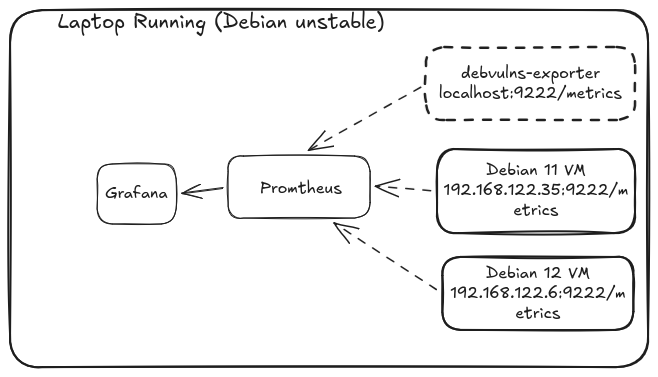
Vasudev Kamath: Releasing debvulns-exporter: Prometheus exporter for Debian System Vulnerabilities

Following up on my previous post, I am releasing debvulns-exporter, a Prometheus exporter for tracking Debian system vulnerabilities. The underlying vulnerability analysis logic remains identical to the previously released MCP server and CLI utility.
Why an Exporter? In my engineering workflows, I frequently deal with Debian and vulnerability management. Most enterprise environments rely on commercial, paid vulnerability platforms like Tenable or Rapid7. While these platforms provide extensive feature sets, I noticed a distinct lack of open-source tools tailored for this specific pipeline. While debsecan exists, it lacks a structured, parseable format suitable for building dashboards aimed at management consumption. What started as an experimental MCP server for learning purposes evolved into a practical question: why not convert it into a Prometheus exporter? Given that Prometheus is the de facto standard metrics platform across the industry, this architecture was the logical next step.
Design and Exported Metrics The exporter is implemented as a native Prometheus exporter utilizing the prometheus-client library. It operates using two threads: one handles fetching the vulnerability data, parsing EPSS feeds, and cross-referencing installed packages to identify local vulnerabilities; the second handles serving the metrics endpoint. The full architecture details and metrics specifications can be found in the design doc. The specification was drafted during a technical brainstorming session with Claude 4.6 Sonnet on Antigravity prior to writing the implementation.
Testing and Dashboarding To validate the exporter, I spun up older Debian 11 and Debian 12 cloud images sourced from the Debian Cloud team. The older image was intentionally selected to guarantee a standard baseline of unpatched vulnerabilities for testing. The local evaluation topology is structured as shown below: Rather than constructing the Grafana dashboard from scratch, I used Claude 4.6 Sonnet via Antigravity to generate the layout configuration. The generated dashboard for the local testbed functions effectively: The complete, ready-to-import Grafana dashboard configuration is included directly in the debvulns source code.
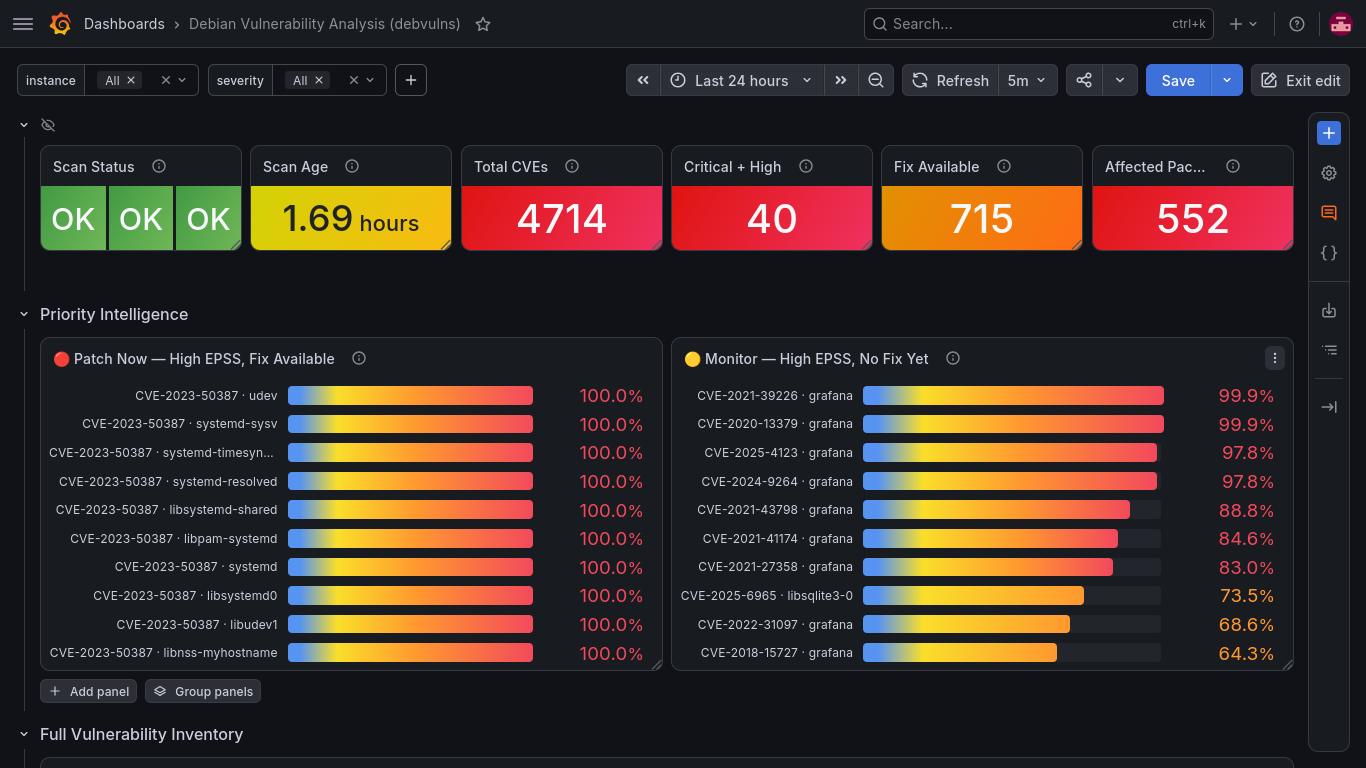
Renaming the project To prevent namespace conflicts and confusion with the native debsecan utility in Debian, I have unified the ecosystem under the debvulns moniker. The core CLI is named debvulns, the exporter is debvulns-exporter, and the MCP component is debvulns-mcp. The migration release has been published to PyPI, and the new consolidated repository is active at debvulns.
Conclusion While this began as a personal utility to fill a niche tool gap, I expect it will be useful for others managing Debian infrastructure at scale. My next objective is to formalize Debian packaging for both the CLI and the exporter. The MCP component will likely remain available as an independent artifact. Until then, happy hacking. Note: As a core design choice, debvulns still uses native debsecan as its ground-truth standard. The tool continuously cross-verifies its output against debsecan to ensure perfect functional parity and data consistency.

19 July 2026

Russell Coker: ECC and DDR5

Hamming Codes ECC RAM corrects errors that occur in memory before it gets to the CPU. The most common form of ECC is the Hamming Code [1] which when it has R redundant bits can correct single bit errors and detect double-bit errors in messages with 2^R-R-1 bits of data. For PC use that means if you want to protect 32bits of data you need R=6 and with 64bits you need R=7. The standard for DDR4 and similar RAM is 72 bits of data width on the bus and Hamming codes to correct single bit errors and detect double bit errors for 65bits of data. The computers we use have 64bits of data so that allows an extra bit that could be an extra parity, I don t know what if anything is done with this extra bit. RDIMM vs UDIMM One point of confusion in such things is the difference between Registered memory AKA RDIMMs [2] and regular PC/laptop memory which is often referred to as UDIMMs. The register is just a buffer which due to complex issues that aren t relevant to this post means that DIMMs can be larger and you can have more DIMMs in a system but latency may be slightly worse. It is technically quite possible to create RDIMMs without ECC (64bits wide instead of 72) but I have never seen a system that used such RAM. I have used more than a few systems with ECC UDIMMs and I recommend avoiding them if convenient as ECC UDIMMs are expensive on the second hand market while ECC RDIMMs can get very cheap. There are servers with ECC RDIMMs that are very unsuitable for home use (such as dual-CPU 1RU servers which are very noisy) so once they are past the 5 year tax write-off period the server chassis gets sent to ewaste and the RAM goes on the second hand market, the glut of RAM without systems to use it forces the price down. For the systems most commonly seen there are RDIMM systems with ECC and UDIMM systems without ECC. Chipkill If every bit in RAM was independent of every other bit then the basic Hamming code would solve most problems. However multiple bits in the same chip may be affected by the same problem, or one chip on the DIMM might entirely fail. With every RDIMM having 18 or 36 DRAM chips there are 2 or 4 bits per chip. On DIMMs with 36 DRAM chips one chip could fail and have the errors reliably detected with a Hamming code. On DIMMs with 18 DRAM chips one failed chip can t necessarily be detected with Hamming codes. IBM trademarked the term ChipKill for ECC systems which can cope with a single DRAM chip failing [3]. This is referred to as Advanced ECC on Dell and HP servers which require an even number of DIMMs. If anyone knows what coding method is used for ChipKill type systems then please let me know. Systems with advanced ECC also often have features like hot-spare for RAM and RAID-1 type functionality which is interesting but not something most people who read my blog will ever want to use. DDR5 DDR5 has on-die ECC to deal with the increased error incidence from smaller and faster memory [4], this is specified as 8 bits of error correction per 128 bits of data which implies basic Hamming codes. The on-die ECC is not a replacement for regular ECC, it s a mitigation for new problems introduced. My experience of memory errors is that the majority of repeatable errors (where a system would get an error with Memtest86+ or an ECC error report repeatedly) were DIMM seating issues, I could unplug and reinsert the DIMM in question and then the same tests would pass. Those errors would not be affected by on-die ECC. One thing that concerns me is the possibility of on-die ECC interacting with ECC on the motherboard and reducing it s effectiveness. I haven t been able to find out enough about how this works to determine if that s the case. My concern is that an error of 3+ bits that s corrected with a basic Hamming code might be more likely to create an error condition that Advanced ECC can t fix than the original error. Currently the best published research on the effectiveness of ECC on RAM errors is the Google paper published in 2009 which is based on DDR and DDR2 RAM [5]. So I don t expect that we will see published research about even DDR4 ECC any time soon. I presume that Google and the other cloud providers are still doing such research and providing the information to DRAM vendors under NDA so we have to just hope that the DRAM vendors do what s required to make things work correctly and allow us to buy products based on that research. DDR5 EC4 vs EC8 DDR5 supports 2*32bit subchannels instead of just supporting 64bit words [6]. For DDR5 ECC RAM there are variants EC4 which has 36bits of data per subchannel and EC8 which has 40 bits. EC8 allows Hamming codes on each subchannel indepdendently. I haven t found a reference on how exactly EC4 works, it could be reading 64bits at a time (not taking advantage of the subchannels) to use Hamming codes or it could have 1 parity bit for each subchannel and just assume that there s no need to check Hamming codes unless the subchannel parity fails. EC8 allows full Hamming code checks on 32bits of data and presumably ChipKill on 64bits. It s widely claimed that all DDR5 RDIMMs are EC8 and all DDR5 ECC UDIMMs are EC4. A quick search on ebay turned up adverts for EC4 and EC8 RDIMMs and links to apparently reliable sites confirming that some of the RDIMMs are EC4. There are reports of EC8 UDIMMs even though I couldn t find any advertised. This seems to mirror the situation with DDR4 where non-ECC RDIMMs are apparently available somewhere and ECC UDIMMs are something I ve used a few times but most people have never seen. I then searched for information on what servers support. The Dell R760 server supports both EC4 and EC8 RDIMMs but you can t have both in the same system. The existence of EC4 DIMMs is wrong. They shouldn t make substandard gear, the manufacturing price difference between 72 and 80 bit wide DIMMs isn t going to be great and the end result is some systems with inadequate specs and extra difficulty in upgrading systems with more things to check for compatibility. Why ECC is Needed Here s an interesting article about Mozilla s claim that 15% of Firefox crashes are due to RAM hardware errors [7], this seems to be based on repeatable errors and therefore won t count errors where a bit flip happens once a day or less. Some years ago I reported a BTRFS corruption issue on my desktop PC to the BTRFS developers and one of them stated that the corruption in question didn t match any pattern expected from a BTRFS bug and recommended that I run Memtest86+. The memory test revealed that I was getting about one memory corruption per 5 hours so if I had used Firefox on that system any crashes probably wouldn t have been regarded as hardware errors with RAM. Those errors caused filesystem corruption and some data loss, if I hadn t been using BTRFS that could have gone unnoticed for years. On another occasion I had a VM I was using for testing software I was developing that had some unexpected errors. After working on it for a day I had shared the errors with a mailing list of other developers who also spent some time investigating it. Eventually I began to suspect a hardware problem, I went on site and when I rebooted the system to run Memtest86+ it didn t even boot as it had errors that stopped the BIOS from even working correctly. It was strange that the system was apparently working correctly and restarting the KVM VM resulted in the same errors happening in the same code and nothing else on the VM apparently having a problem. It turned out that the system had a motherboard problem that made all but one of the DIMM sockets unusable so I ended up sending it to e-waste. That wasted a day of my time and some hours of other people s time. Presumably on other occasions developer time is wasted due to hardware errors and no-one even realises. What Society Needs We need ECC RAM to be more widely used. Ideally we would have some government action to force this given the ongoing cost to society in corrupted data and lost time due to RAM hardware errors. I think that at minimum we need sufficient taxes on non-ECC RAM (and EC4 RAM for DDR5) to make it more expensive when bought new than ECC RAM. We need to have greater knowledge of the benefits of ECC RAM among computer experts, people need to recommend that computers be purchased with ECC RAM whenever possible and that systems which can t have ECC RAM (laptops and phones) shouldn t be used for storing important data. We need to avoid silly things like having so many variants of RAM to confuse people and make it needlessly difficult to get ECC RAM working.

18 July 2026

Bits from Debian: DebConf26 welcomes its sponsors

Alt DebConf26 by Romina Molina DebConf26, the 27th edition of the Debian conference is taking place at the Facultad de Ingenier a en Ciencias H dricas of the Universidad Nacional del Litoral, in Santa Fe, Argentina. We appreciate the organizers for their hard work, and hope this event will be highly beneficial for those who attend in person as well as online. This event would not be possible without the help from our generous sponsors. We would like to warmly welcome the sponsors of DebConf26, and introduce them to you. We have two Platinum sponsors. Our Gold sponsors are: Our Silver sponsors are: Bronze sponsors: And finally, our Supporter level sponsors: A special thanks to the Facultad de Ingenier a y Ciencias H dricas - FICH UNL, our Venue Partner! Thanks to all our sponsors for their support! Their contributions enable a diverse global community of Debian developers and maintainers to collaborate, support one another, and share knowledge at DebConf26.

15 July 2026

Freexian Collaborators: Debian Contributions: Python 3.14 as default transition, DebConf 26 preparations, debvm, pconr and more! (by Anupa Ann Joseph)

Debian Contributions: 2026-06 Contributing to Debian is part of Freexian s mission. This article covers the latest achievements of Freexian and their collaborators. All of this is made possible by organizations subscribing to our Long Term Support contracts and consulting services.

Python 3.14 as default transition, by Stefano Rivera Debian has had Python 3.13 and 3.14 in unstable and testing since December 2025, with Python 3.13 as the default version (/usr/bin/python3 = 3.13). This gave time for packages to implement support and detect issues in their test suites. A slot to transition to 3.14 as default was requested from the release team in March, and they indicated that we would likely be able to schedule it in late June. In preparation, Stefano reviewed the open bugs against Python interpreters and squashed some in uploads of the latest point releases of Python: 3.13.14 and 3.14.6. Also in June, Python 3.15.0 beta 2 and beta 3 released. Stefano uploaded these to Debian experimental. The 3.15 betas were reason to attempt to revive review of a blocked upstream patch to support Debian multiarch in stable ABI Python extensions, now that Python 3.15 is adding a new stable ABI abi3t.

DebConf 26 preparations, by Stefano Rivera, Antonio Terceiro, Lucas Kanashiro, Santiago Ruano Rinc n and Anupa Ann Joseph DebConf 26, the annual Debian Developer Conference, is being held in Santa Fe, Argentina, in July. Stefano Rivera, Antonio Terceiro, Lucas Kanashiro, Santiago Ruano and Anupa Ann Joseph contributed to the preparations for the event.
  • As usual, Stefano has been supporting the conference website and registration, helping the local team to get accurate data on attendee numbers.
  • Antonio has been supporting the conference website and helping the content team to put together the conference schedule.
  • Santiago has been helping the local team on different topics regarding logistics.
  • Anupa assisted with the accommodation arrangements for DebCamp and DebConf, working alongside Nattie.
  • Lucas has been coordinating the conference schedule and communicating with some speakers.

debvm, by Helmut Grohne The debvm tool used for creating and running ephemeral virtual machines saw a number of small improvements. The requirement of having a filesystem label has been removed in favor of using a uuid and /etc/fstab is no longer created. A memory balloon is enabled by default and this enables qemu to automatically release free guest memory to the host. Booting Ubuntu VMs regressed as a result of their use of uutils and has been fixed. The --architecture flag is back to be able to better support Hurd, which is a work-in-progress of Johannes Schauer Marin Rodrigues. Thanks to Jochen Sprickerhof, you can more easily create VMs for autopkgtest-virt-qemu using --hook-dir=/usr/share/mmdebstrap/hooks/autopkgtest-create-qemu. There also are a few documentation and error message improvements. All of this is pending in git waiting to be uploaded once development slows down. While booting a machine from virtiofsd succeeded, turning the proof-of-concept into production remains for later.

pconr, by Helmut Grohne At DebConf25, Helmut reported on a schroot substitute called unschroot. The second iteration uses varlink IPC to construct a container. That varlink API is now separated into a new project called programmable container runtime. It is meant to provide more flexibility in constructing containers than established solutions such as the unshare command from util-linux, bubblewrap or podman provide while still managing repetitive complexity such as process orchestration for the developer. A new example that uses this infrastructure is a better containment for mmdebstrap eliminating chroot escape. There also is an asyncvarlink/0.3.2 release taking steps to become more maintainable in Debian to eventually get pconr into Debian.

Miscellaneous contributions
  • Stefano did routine uploads (mostly new upstream versions) of python-pip, python-pipx, hatchling, dh-python, beautifulsoup4, python-virtualenv, python-mitogen.
  • Stefano uploaded a snowball mini-transition: snowball, snowball-data, and pystemmer
  • Stefano did some debian.net team admin, setting up a container and later a VM for vote.debian.net.
  • Stefano responded to a semi-escalation to the Debian Technical Committee, after some communication between an upstream, a bug reporter, and a Debian package maintainer went sideways and got heated.
  • Emilio managed several transitions, and filed bugs against the few remaining GCC 13 rdeps.
  • Antonio did salsa maintenance work, debugging service issues, approving user registrations, and processing support requests.
  • Antonio worked on Debian CI maintenance, including but not limited to deploying new armhf and armel workers, fixing bugs and preparing an upcoming release of debci.
  • Antonio did several maintenance tasks for MiniDebConf websites.
  • Antonio uploaded ruby-bunny, ruby-sinatra and ruby-mustermann, fixing a few FTBFS bugs among them.
  • Carles using po-debconf-manager: Reviewed Catalan translations for 5 packages, submitted 6 packages. Added a draft blog/update about the po-debconf-manager project.
  • Carles submitted a new Geeqie Catalan translation: it had accumulated a large number of untranslated strings over the last 4 years.
  • Carles contributed to the Debian wiki: improved documentation for the Framework Laptop and added a new section Battery charging control (after doing some debugging and testing). He wrote a page about Signal Desktop. Carles started looking at testing/documenting Mailman2 -> Mailman3 migration.
  • Carles, in relation to the migration process, double checked old pages without relevant information in the Debian wiki.
  • Thorsten did another upload of package hplip to fix some bugs.
  • In the context of the Google Summer of Code 2026 project, Santiago continued co-mentoring Aryan Karamtoth, who is working on the Linux live-patching project. As part of the team, Santiago guided Aryan to help design the different workflows and to study the different tools available, including the upstream klp-build (that was introduced in v6.19), and compare it with SUSE s klp-build.
  • Colin clarified the bug tracking system s documentation to indicate that maintainers may sometimes reasonably ask users to file bugs upstream themselves.
  • Colin fixed 15 packages for pytest 9.1.
  • Colin fixed a depthcharge-tools regression with Python 3.14 as default that broke debian-installer builds.
  • Helmut continued to report undeclared file conflicts and correspond about them.
  • Helmut wrote patches for strace to enable cross building and a 32bit personality on arm64.
  • Helmut continued maintaining rebootstrap working fixing build failures in fontconfig, gettext and sqlite3 as well as changing the way packages from gcc builds are installed to better serve a need reported by Samuel Thibault.

Next.

Previous.