Benjamin Mako Hill: Annual Free Software Foundation Fundraiser
Tomorrow, at this time, I'll probably be unsuccessfully trying to find a
comfortable position on a seat of the Bilmanbus to Irun. Very early
on Saturday, as soon as we get off the bus, Maria and I will quickly head to
Hondarribia's beach in Cape Higer to symbolically wet our feet in the waters
of the Cantabrian Sea.
We won't have much time to enjoy the cold waters of the ocean, though.
Soon after that, we'll have to take a deep breath, look East, and start
walking if we want to achieve our utmost objective: take a bath in the
beautiful beaches of the Cap de Creus, in the Mediterranean sea. In between,
30 days and 840 kilometres of thick woods, deep valleys, high peaks and cold
waters, all of which shape incredible landscapes.

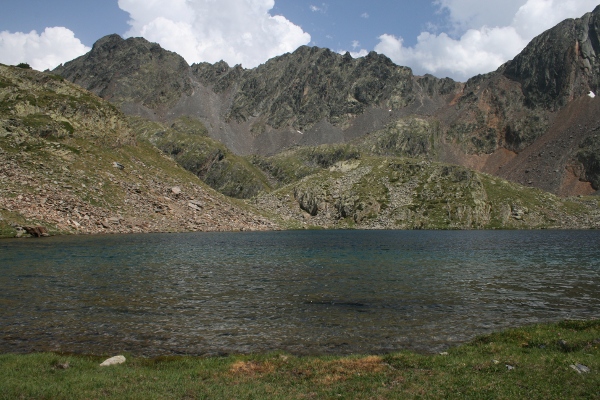
The Portella de Baiau, during our 2008 trip
For a whole month, we'll be mostly disconnected from everything else that
isn't our knee ache, our blisters, the Sun over our heads or where to get
food. It's the first time I leave on a hiking trip as long and tough as this
one, and I feel both uncertainty and eagerness. We've been so busy during the
last few months that we've been unable to train at all for this, and I'm
probably in the worst physical condition in a decade. It's too late
to take care of that now, so we'll try to take good care of our legs and
spine.
In order to get back home in the Mediterranean, we'll have to
be fast, some days joining two stages and skipping a few that we know are not
that interesting (sections over asphalt, etc.). It's hard to make it in just
one month, but we'll try our best. The plan is going to sleep not long after sunset, getting up at dawn, to be able to walk for a decent time before the heat
starts being a handicap and just resting at midday, when the Sun is
strongest.
Of course, this means that I'm missing, yet again, this year's edition
of DebConf in New York City, which is
really sad because I was looking forward hanging around with
Mako,
Mika,
Biella, micah,
Clint and the rest of the
NYC/
Boston gang, but when
the idea of doing a long trip this summer popped up around January, it was
clear DebConf seemed unlikely this year. I hope all of you have a lot of
fun, and see you in a few weeks!
Grml users out there: We are interested in getting your feedback so we can further improve Grml. We are also working on a webpage which lists happy Grml users and also some quotes and use cases. Now we need your help:
Please provide your feedback and take part in Grml s user survey!
You might be aware of GRUB s loopback option for booting an ISO, I wrote about it in Boot an ISO via Grub2 more than a year ago. A few months ago Goswin von Brederlow came up with this idea:
grml functions great as rescue system. So it would be nice to have a boot entry for it in grub instead of having to go look for the CD when needed. To make installing and updating simple it would be great if one could install this as a normal debian package which would register itself in grub (and maybe lilo too).What a lovely idea: no need for a CD or USB stick as long as the bootloader and the harddisk are still working. Minimal manual intervention needed to keep it up2date and working sounds like the perfect rescue system.
# choose Grml version: VERSION=grml64-medium_2010.12 # create directory mkdir -p /boot/grml # download and verify ISO cd /boot/grml wget download.grml.org/$ VERSION .iso ,.md5 md5sum -c $ VERSION .iso.md5To deploy grub-imageboot:
# choose Grml version: VERSION=grml64-medium_2010.12 # create directory mkdir -p /boot/images # download and verify ISO cd /boot/images wget download.grml.org/$ VERSION .iso ,.md5 md5sum -c $ VERSION .iso.md5That s it! Now when running update-grub you should get something like:
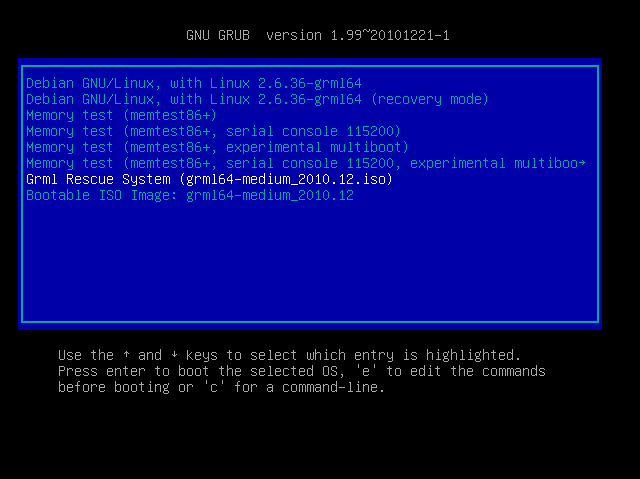
# update-grub Generating grub.cfg ... Found linux image: /boot/vmlinuz-2.6.36-grml64 Found initrd image: /boot/initrd.img-2.6.36-grml64 Found memtest86+ image: /boot/memtest86+.bin Found memtest86+ multiboot image: /boot/memtest86+_multiboot.bin No volume groups found Found Grml ISO image: /boot/grml/grml64-medium_2010.12.iso Found memdisk: /boot/memdisk Found iso image: /boot/images/grml64-medium_2010.12.iso doneVoil , when rebooting your system you should see something like:
The Grml Rescue System entry is what grml-rescueboot provides and Bootable ISO Image is what s provided by grub-imageboot. Just select the entry you d like to use, press enter and and you should get the bootsplash of the according ISO.
BTW: I ve tested this with Ubuntu 10.10 too, grml-rescueboot works out-of-the-box with the Ubuntu ISO as well, it just doesn t support the memdisk ISO boot by grub-imageboot (yet).
Tip: if you want to use grml-rescueboot and grub-imageboot with the same ISOs without having them twice on the disk just point the configuration option IMAGES in /etc/default/grub-imageboot to the according directory (like /boot/grml).
Note: if you re using the ext 2,3,4 filesystem on the partition that s being used for /boot please be aware that you need GRUB >=1.98+20100804-12 (newer version is already available in Debian/unstable and hopefully migrates to squeeze in time) or GRUB >=1.99~20101122-1 because of the INDIRECT_BLOCKS support, see #543924 for the details.
PS: We think about providing grml-rescueboot and grub-imageboot within official Debian. If you re interested in seeing integration support for other distributions as well please help and drop us a note.
Update: Ulrich mru Dangel suggested pdnsd as nice alternative to dnsmasq and Cyril KiBi Brulebois pointed out, that it s not necessary to invoke dnsmasq after fresh installation as it s running by default then I adjusted the text accordingly, thanks for the pointers!
If /etc/resolv.conf doesn t provide any nameserver entries glibc[1] will automatically initialize the nameserver to the loopback address. This is nice for dealing with chroots without having to manually edit resolv.conf to get working DNS.
Just install a basic DNS forwarder like dnsmasq ( apt-get install dnsmasq ) or if it s already on your box just start it ( /etc/init.d/dnsmasq start ). That s it. Now when chrooting into a system without an existing resolv.conf configuration it will give you a working DNS setup without any further work.
PS: Grml ships dnsmasq by default and /etc/init.d/dnsmasq start or Start dnsmasq will work out-of-the box. In Ubuntu the dnsmasq package is available only through the universe repository but the dnsmasq-base package (providing e.g. the init script) is shipped by default, so replace the /etc/init.d/dnsmasq command with a simple dnsmasq there.
[1] At least the [e]glibc versions provided on Debian and Ubuntu are known to provide this glibc extension. Other libc implementations like dietlibc and uclibc don t seem to provide it, so don t strictly rely on this feature but use it as the icing on the cake.
While doing some bigger downloads, my wifi network used to have big problems, seeing tx errors, frame errors on the router. The router is old ASUS WL-500g Deluxe which was running OpenWrt Kamikaze up to now. I was anyway thinking going for something with 802.11a or 802.11n support, so I started to look for replacement. While looking for it and checking what newer boxes are supported by OpenWrt, I noticed, that I can finally try using 2.6 kernel and I should get working wireless as well with free (what was not possible for very long time).
I gave it a try and upgraded to Backfire 10.03.1-rc4. And looks there is no need to upgrade hardware right now. No more tx errors, the wireless is much more stable and faster.
Thanks to anybody who helped to create free drivers for Broadcom 4306 wireless chip.
PS: Upgrading OpenWrt while keeping configuration lead to horrible mess in my case, so I rather did clean install reconfiguring everything and rediscovering all errors I've made in the past.
Filed under: Linux 3 comments Flattr this!
On the 13/14 November 2010 there is a nice event in the so called Ruhrpott : OpenRheinRuhr. And I d like to invite YOU :)What should you expect from heading to the RIM in Oberhausen and paying 5 entry-fee? You get a nice program full of great talks (like mine about bley ;), mikas about OpenSource management, tokkees about Git and XTarans about cli-helpers and unknown tools), a bunch of nice people showing you their distro, software, etc (Debian is there too), a social event, a keysigning party and a lot of hacking and fun. So if you are somewhere nearby, join us and enjoy the event!
I used to think that couples who share a single email address were
just too cute. Then I saw this article which imported this whole
"keeping each other honest" logic into the practice.
Mika and I have never even had accounts on each other's servers.
I m currently working on something which will eventually amount to a
re-bootstrapping of sorts of the Debian/m68k (Linux) port patches to
the Linux kernel, gcc, etc. are prepared (some have been accepted into
upstream or the packages already). I will probably have more, once the
compile processes finish, anyway (even emulated, it s slow).
I think that, once I get past that TLS (thread-local storage, needed
by eglibc) migration, I will try to find out a list of packages needed
for debootstrap (AFAICT: all packages marked Essential, or of priority
important, and all marked Build-Essential (for the *-builder variant),
and their dependencies (although I ll substitute sysv-rc with file-rc,
which is better and needs less deps)) and pull arch:all from sid, then
build the rest myself using a consistent snapshot of sid possibly with
patches going to unreleased. Then I can use cowbuilder to make cleaner
packages, which can eventually be uploaded (once I get enough to get a
buildd running kernel, bootloader, etc) binNMUs are way to go here
I suppose. I will only upload once it s self-hosted, installable (seen
by edos-debcheck), clean, etc. (i.e. I ll rebuild all
binaries) and probably keep a bootstrap repo around (until m68k caught
up) so that unstable (possibly amended by unreleased for a while) will
not again become uninstallable, e.g. if arch:all packages change their
dependencies (Python, gcc-defaults are some I ve seen). That bootstrap
repository is needed anyway because debootstrap can t install from two
separate repositories (unstable+unreleased for example).
Progress is slow because I try to keep as close to official packages
as possible, refuse to cross-compile, and try to produce uploadable if
possible packages all the time. Getting patches into packages, so that
I can build from unstable, instead of debian-ports.org unreleased, has
proven time-consuming and occasionally frustrating as well. Although I
would like to thank the people who helped me on the way already. (I am
not naming any in fear of forgetting some, but you know who you are )
They are among the Debian (gcc, kernel, m68k) and Linux-68k crowd.
(Why does genattrtab in gcc-4.4 take 3 hours when it took less than
half an hour in gcc-4.3 anyway?)
I m also still working on mksh and
some Python ISO hacks for mika and some
minor stuff, and further cleaning up MirBSD.
I wrote the following as a foreword for the great German book Open Source Projektmanagementthat Michael Prokop wrote. Unfortunately the foreword didn't manage it in time into the book because of various circumstances. As I'm not a person to throw away already written material, here is it for your reading pleasure. Maybe it makes you consider obtaining a copy of the German language book for yourself!
The Whole is more than the Sum of the Parts When I first met Mika at a Linux conference some years ago I quickly noticed that he had potential. The way he asked questions and tackled issues did impress me. We did meet again at various events, joined forces in various projects and knew that the result would be good. Back in the year 2004 the only real live CD was Knoppix. It always was too sluggish for me because I never really liked KDE and also OpenOffice.org was too bloated for me. I was working since a year at an Internet provider, felt comfortable in the shell and was missing the tools on Knoppix which I used daily. Often enough the frustration with the status quo starts the best projects. And so I had the idea spinning around to start a sysadmin live CD. There was just one problem here: Exactly at the same time Mika had already started such a project. And I knew one thing: it would had been a lost race to compete with him in creating the better live CD. So I joined his team and helped with the best of my knowledge. The name choice alone showed that he was the right person for the job: Grml an expression of the frustration that even he felt which spoke directly to the heart of so many. But it wasn't just the chosen name that showed that Mika was the right person for the job of the project leader. It's always the sum of the parts, no matter how minor they might look. He quickly managed a first release and in light of that also created an event which was fitting for the release of the first version: the OS04 an Open Source event which managed to get JonMaddogHall as keynote speaker. Mika managed through his welcoming way to lure more people into helping out. The team grew over the years, further regular releases increased the fan base, not only through the creative release names which are surely one of the parts that helped create the success. He always was open to suggestions for new tools that helped to extend the project. The lived openness did lead among other things to the case that other live CDs started to use the grml build system. JUXlala 2.0 (the system for preschool kids) is just one example. Why do I write primarily about Grml, one could get subliminal advertising probably cheaper? I do it because Grml is an extremely good example of the experience revealed in this book. And even though every project is different, it is still exactly the sum of the parts that leads to the success of a project. And exactly these parts are covered in this book and can be considered for the project at hand and get implemented accordingly. Good luck whether in large or small.
Rhonda
Due to a variety of people and places we want to see, Mika and I have
regrouped around a more ambitious travel schedule in Italy for the next
week or so. Our new plan is:
Finally I m back from DebConf10 in New York. It was the first DebConf I attended and it was just great. Thanks a lot to all involved people for making DebConf such a great event.
I had a big todo list for DebCamp and DebConf and managed to get a bunch of work done. Besides several discussions, bug hunting, testing stuff and attending BoFs and talks the work that I could get done for Debian included:
The svn repository used to draft the Debian Project News just passed the
sixth hundreds commit. If my calculations are correct, that's quite
more than the number of edits done, back when the DPN was drafted in the
wiki. I take it as a hint, that the new work flow works better than the
old one.
However, playing a bit with statistics (done by horrible shell one
liners ;)
I noticed, that - while every Debian Developer may commit to
the subversion repository - not that many commits from other DDs where
made: Of the 602 commits so far, only 70 where done by other DDs:
alex@melusine:~$ svn log --xml svn://svn.debian.org/svn/publicity \
xmlstarlet sel -t -m "/log/logentry/author" -v "concat(.,' ')" \
sed -e "s/ /\n/g" sort uniq -c sort -n grep -v guest grep -v tolimar
1
1 abe
1 hertzog
1 holger
1 mika
1 paravoid
2 pabs
3 alfie
15 zobel
20 gio
25 spaillard
To give credit where credit is due, here are the guest commits:
16 tpeteul-guest
21 jeremiah-guest
25 gmascellani-guest
36 madamezou-guest
122 taffit-guest
Many thanks so far, but I would like to advertise the Debian Project News and invite every DD
to help us and to commit directly. It's quite easy:
Run svn co
svn+ssh://svn.debian.org/svn/publicity/dpn/en/current, edit
the index.wml file, and then commit your changes back to the repository.
(Well, ideally you would also honor Status flag and won't commit, if
it's not open-for-edit.)
As for the format: While we indeed use wml, you just need some basic
HTML knowledge. To add a paragraph just use the following with proper
content:
<a name="X"></a> <h2>Fancy title</h2> <p>More details about the topic.</p>Usually the articles are kind of sorted by importance, so unless you are pretty sure it might be the easiest to just add your article at the end of the regular news, just before the other news sections. Should you not be able to fill an entire paragraph, feel free to just a one or two sentences to the other news section (just add a <p>...</p> with your content to the end of the other news). Don't worry about style, your English or syntax: It won't end up on the web page directly, it's reviewed and checked, so you can't do anything wrong. More details are available in the wiki at http://wiki.debian.org/ProjectNews/HowToContribute. Feel free to ask any questions unanswered on the publicity list at debian-publicity@lists.debian.org. Feel also free to contact us there, if you would like to help by translations or reviews. The more people help, the less work it's for everyone :) If you are not a Debian Developer, but still would like to help us, it's no problem. All you need is an account on our Alioth System (very easy to get, you just need to ask) and request to join the publicity project. See http://wiki.debian.org/ProjectNews/HowToContribute#Becominganeditoryourself for the respective links.
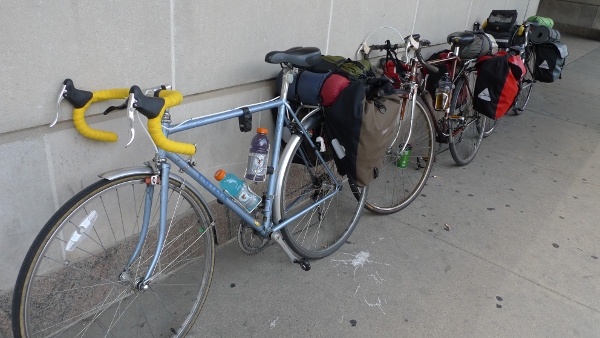
DebConf being in New York City this year, clearly the right way to get
there was to bike, together with Molly
and Daf. Being touring newbs, there were a few
mishaps.
We then had some problems with Molly's brakes, and it took a long time
to navigate out of the city, but eventually we found ourself on the
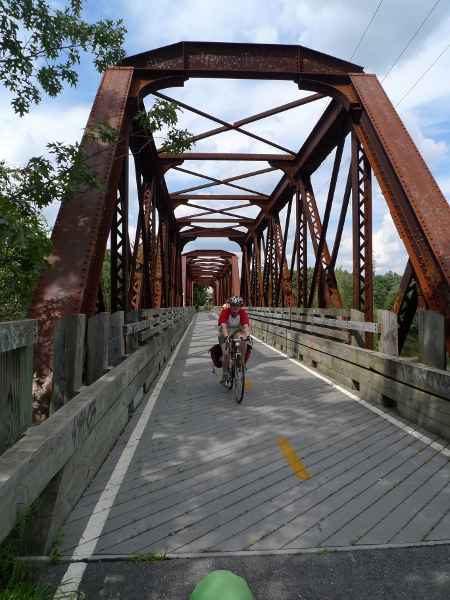
"Washington Secondary Trail" a wonderful bike path along an old
rail line. Every couple miles there'd be an old covered rail bridge over
the river, and it was a well-paved straight shot for about ten miles,
with no cars and no need to navigate.
Just as we were getting into things after the bike trail ended,
something completely unexpected happened.
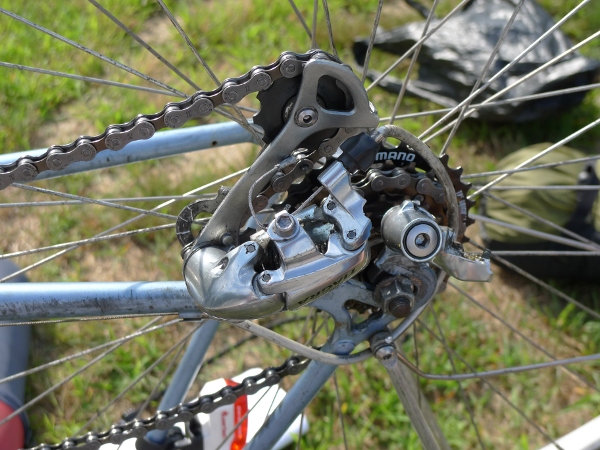
This is Daf's derailleur after it sheared off in the middle as we
attempted to start after a red light outside Tractor Supply Co.
Luckily, John and his son Chris lent us a hand and hauled Daf and his
bike to the nearest bicycle shop in the back of their pickup truck.
They'd just come from there, where John had bought Chris a new helmet.
Greenway Cycles, the only bike shop in a
twenty mile radius, was
three miles away.
We got there an hour before it closed and Rick replaced the derailleur
and straightened the hanger in a jiffy.
Due to all these things, we didn't get as far as we'd planned in the
first day and ended up camping in Seaport Campground in Mystic,
Connecticut, rolling in at around 22:00. We did about 65 miles, including
six due to the detour to the cycle shop. Carrying camping gear is heavy!
Several delicious peanut butter and jelly bagels and some wheatberry and
couscous salad later, we were passed out.
The second day included less bike trouble, but was no less eventful, and
we were tired from the previous day's riding. The highlights included
taking a tiny sidewalk path that I'm baffled how Google knows about up
onto a sidewalk alongside the I-95 bridge across the Thames to New
London, Connecticut.
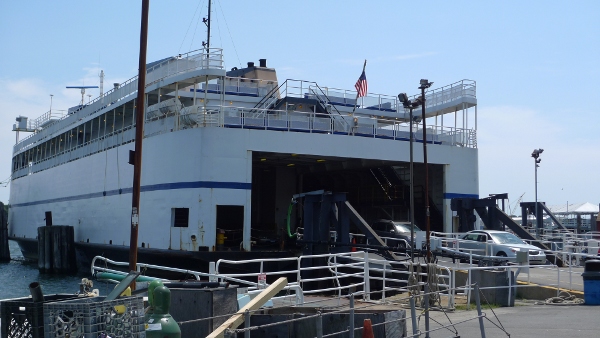
The 13:00 ferry from New London to Orient Point, New York, where we got
some remarkably good veggie burgers (whole edamame visible!) for lunch.
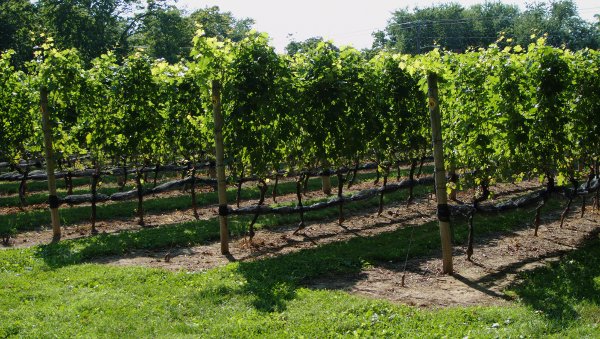
And a vineyard on the north fork of Long Island, where we stopped for a
quick tasting and ended up picking up a bottle of
barrel-fermented chardonnay. The
vineyard was small 23 acres, with 11 acres of grapes and the
proprietors were friendly and extremely interested in our trip. They
gave us a dollar off on the bottle due to our method of transport.
It turns out there are only two trains a day on the Long Island rail,
and we just barely caught the 18:52 return from Riverhead. We had mere
seconds in the station and ended up without enough cash to pay for
tickets onboard, but the conductor just took what we had and gave us
tickets to Penn Station anyway.
Outside Penn, a girl with a mohawk and a messenger bag overheard us
talking about biking up Broadway and told us to bike up 8th Avenue
instead. "Always bike up 8th and down Broadway because they have bike
lanes in those directions." Thus, we didn't die dodging taxis in the
dark.
So basically, due to various people being extremely nice to us for no
good reason, we made it to Columbia University around 22:30, on the
correct day. Warm fuzzies for humanity all around.
On each last Friday of July the annual System Administrator Appreciation Day is taking place.
Matt Simmons organized a SysAdmin Day Meetup to celebrate this event in New York. If you re in New York on 30th of July consider registering yourself (it s free and takes just a few seconds).
If you are participant of the Debian Conference in New York and are already hacking at the DebCamp you might want to join our group of Debian people who plan to show up, currently consisting of Paul Wise, Lars Wirzenius, Thomas Lange and myself. If you plan to join please ping me so we can show up at the SysAdmin Day Meetup together.
Tomorrow, at this time, I'll probably be unsuccessfully trying to find a
comfortable position on a seat of the Bilmanbus to Irun. Very early
on Saturday, as soon as we get off the bus, Maria and I will quickly head to
Hondarribia's beach in Cape Higer to symbolically wet our feet in the waters
of the Cantabrian Sea.
We won't have much time to enjoy the cold waters of the ocean, though.
Soon after that, we'll have to take a deep breath, look East, and start
walking if we want to achieve our utmost objective: take a bath in the
beautiful beaches of the Cap de Creus, in the Mediterranean sea. In between,
30 days and 840 kilometres of thick woods, deep valleys, high peaks and cold
waters, all of which shape incredible landscapes.

The Portella de Baiau, during our 2008 trip
For a whole month, we'll be mostly disconnected from everything else that
isn't our knee ache, our blisters, the Sun over our heads or where to get
food. It's the first time I leave on a hiking trip as long and tough as this
one, and I feel both uncertainty and eagerness. We've been so busy during the
last few months that we've been unable to train at all for this, and I'm
probably in the worst physical condition in a decade. It's too late
to take care of that now, so we'll try to take good care of our legs and
spine.
In order to get back home in the Mediterranean, we'll have to
be fast, some days joining two stages and skipping a few that we know are not
that interesting (sections over asphalt, etc.). It's hard to make it in just
one month, but we'll try our best. The plan is going to sleep not long after sunset, getting up at dawn, to be able to walk for a decent time before the heat
starts being a handicap and just resting at midday, when the Sun is
<strongest.>
Of course, this means that I'm missing, yet again, this year's edition
of DebConf in New York City, which is
really sad because I was looking forward hanging around with
Mako,
Mika,
Biella, micah,
Clint and the rest of the
NYC/
Boston gang, but when
the idea of doing a long trip this summer popped up around January, it was
clear DebConf seemed unlikely this year. I hope all of you have a lot of
fun, and see you in a few weeks!
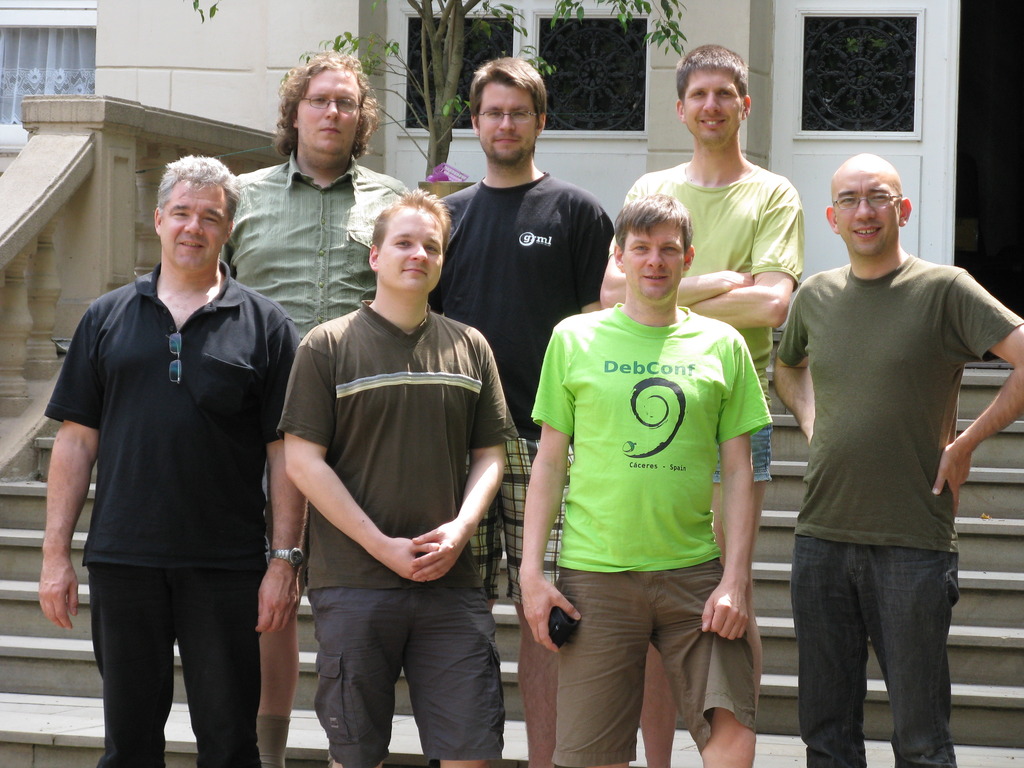
Last weekend (2010-07-02 2010-07-04) nine people met at the FAI developer workshop at Linuxhotel in Essen/Germany. If you can t remember: FAI is a non-interactive system to install, customize and manage Linux systems and software configurations on computers as well as virtual machines and chroot environments, from small networks to large-scale infrastructures and clusters.
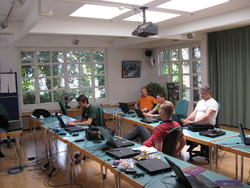
The participants of the FAI meeting:
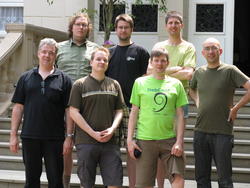
second row from left to right: Michael Goetze, Michael Prokop, Andreas Schuldei
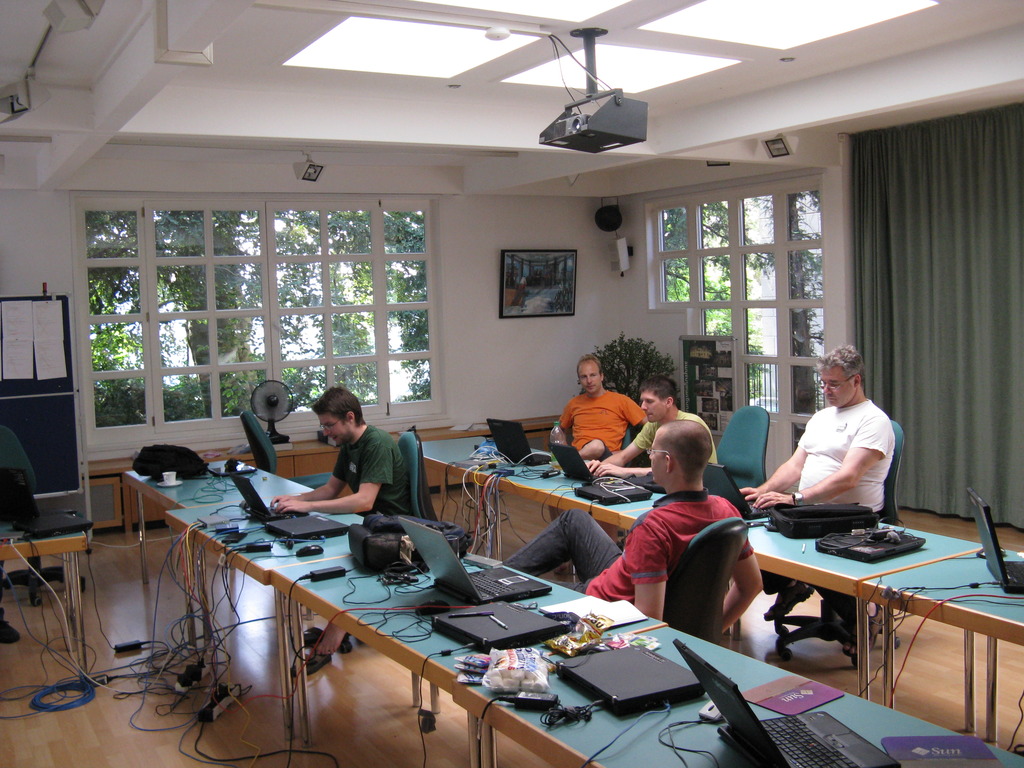
Between the hack sessions and discussions the attending people presented their FAI usage and approaches. Some notes from the presentations:
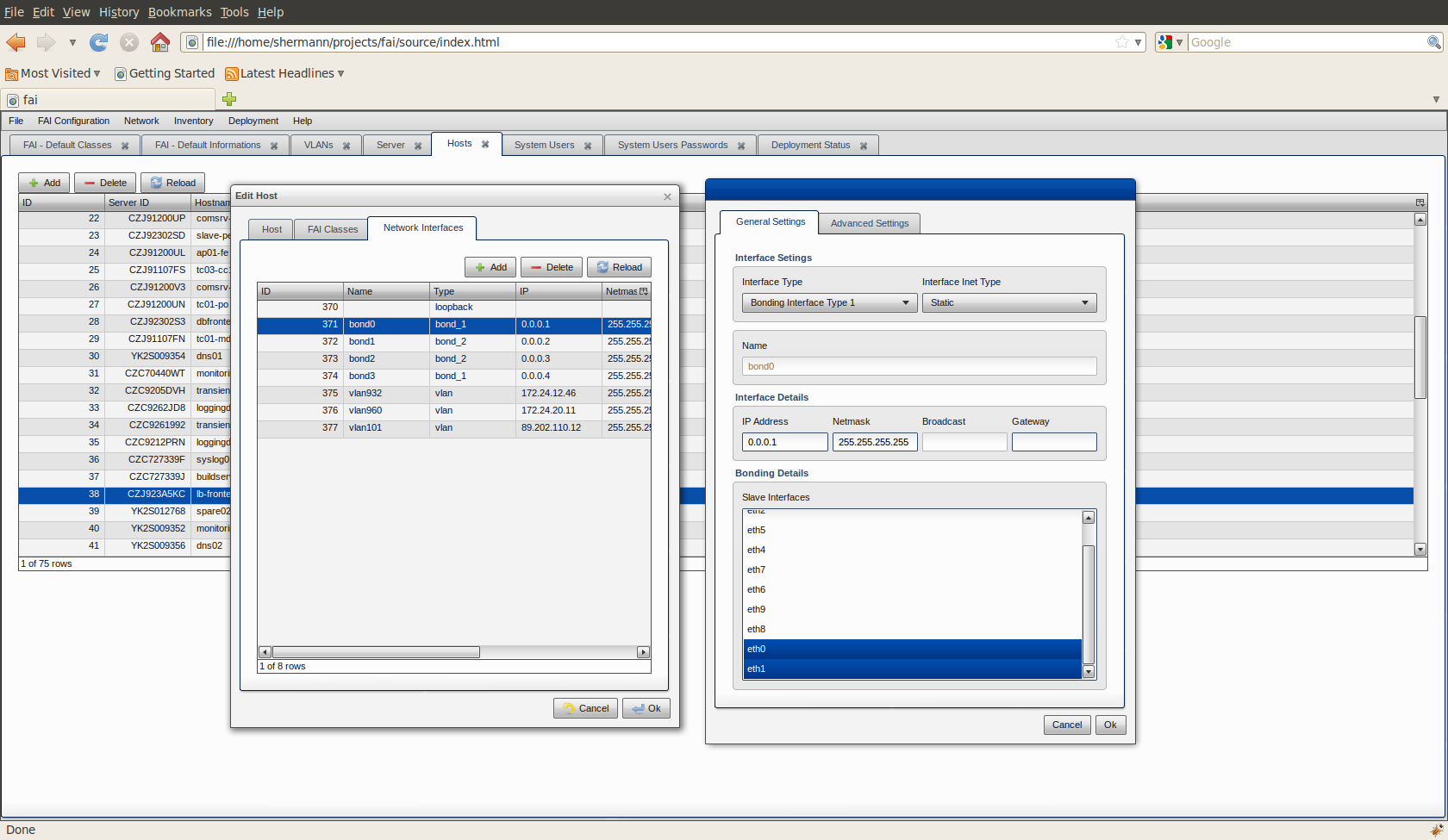
A demo video is available at blip.tv. Currently Stephan is searching for a nice name for his FAI management tool please send suggestions either to him or to the linux-fai-devel mailinglist.
Grml / Michael Prokop
Grml is a Debian based Linux live system specially made for system administrators. Grml uses grml-live for building the ISOs, whereas grml-live itself uses FAI s dirinstall feature to build the live system. This provides the Grml team with a nice way to autobuild 18 ISOs per day, known as daily.grml.org. Mika also presented Grml s netscript bootoption and the ethdevice bootoption of live-initramfs which is useful for booting Grml/FAI via PXE.
Host Europe / Michael Goetze
Host Europe uses FAI for installing Debian and Ubuntu (32+64 bit) in the support center. They have ~20 FAI classes and use a Debian lenny NFSROOT as base for all deployed systems. Their main problems with FAI aren t related to FAI itself, but instead e.g. broadcom NICs with lack of support for it in Lenny s kernel. They are not using softupdate (yet) and currently use Kickstart for deploying CentOS but are working on deploying CentOS with FAI as well.
LIS AG / Sebastian Hetze
Linux Information Systems AG (LIS AG) are using FAI 3.2.17 and provide a luma and PyQt based GUI to their customers. They use DHCP, LDAP and DDNS for inventory, configuration and deployment.
Mathematical Institute of the University of Bonn / Manuel Hachtkemper
The Mathematical Institute of the University of Bonn uses FAI 3.1.8 and 3.3.5 for managing ~150 systems. They are automatically running softupdates every day, reporting how many hosts actually did run the softupdate and how many didn t run. The involved failogwatch tool supports two regex files, one for excluding specific hosts and the other one for grepping for known problems in the logs.
Spotify / Andreas Schuldei + Mattias Jansson
Spotify is a peer-to-peer music streaming service and the operating people at Spotify use FAI for deploying the systems. Currently they are using FAI 3.3.3 to deploy ~400 bare metal machines and ~150 virtualised machines. They have their class names in DNS using the txt/Text record entry. They are using a self written prepend_class script to manage dependencies between classes.
University K ln / Thomas Lange
Thomas uses FAI s trunk version (of course
From 2nd to 4th of July 2010 the FAI developer workshop will take place at the Linuxhotel in Essen/Germany. FAI? FAI is the abbreviation for Fully Automatic Installation. It s a non-interactive system to install, customize and manage Linux systems and software configurations on computers as well as virtual machines and chroot environments, from small networks to large-scale infrastructures and clusters.
As the name states the workshop is targeted towards FAI developers. We the FAI developers want to get FAI into shape for squeeze, discuss pending issues like Ubuntu packaging, release management and of course meet in real life for networking and socializing. Our rough roadmap for the FAI weekend looks like this:
Friday:
I love EtherPad for online collaboration in real-time. By today (14th of April 2010) new pad creation will be disabled at EtherPad.com. Being aware of that in advance and as the EtherPad software was open sourced recently friends of mine and I were working on providing a dedicated EtherPad setup. TitanPad was born!
Quoting our TOS / Privacy Info:
TitanPad was launched to provide an EtherPad setup which is unrelated to any commercial and political entities. Its goal is to offer a stable service through proper operating.Now TitanPad is officially up and running and you re free to use it for online collaboration. Feel free to drop your feedback, questions and suggestions to our team via mail to support (at) titanpad.com.
[...]
I m working for a customer who s using IBM blades. Remote access isn t limited to e.g. SoL but also possible through a Remote Console feature using a Java applet.
After migrating one of my 32bit systems to a fresh 64bit system I suddenly couldn t use this Remote Console feature any longer. The error message was (leaving it for search engines and help other affected users):
load: class vnc.VncViewer.class not found. java.lang.ClassNotFoundException: vnc.VncViewer.class at sun.plugin2.applet.Applet2ClassLoader.findClass(Applet2ClassLoader.java:152) at java.lang.ClassLoader.loadClass(ClassLoader.java:303) at java.lang.ClassLoader.loadClass(ClassLoader.java:248) at sun.plugin2.applet.Plugin2ClassLoader.loadCode(Plugin2ClassLoader.java:447) at sun.plugin2.applet.Plugin2Manager.createApplet(Plugin2Manager.java:2880) at sun.plugin2.applet.Plugin2Manager$AppletExecutionRunnable.run(Plugin2Manager.java:1397) at java.lang.Thread.run(Thread.java:619) Caused by: java.net.ConnectException: Network is unreachable at java.net.PlainSocketImpl.socketConnect(Native Method) at java.net.PlainSocketImpl.doConnect(PlainSocketImpl.java:333) at java.net.PlainSocketImpl.connectToAddress(PlainSocketImpl.java:195) at java.net.PlainSocketImpl.connect(PlainSocketImpl.java:182) at java.net.SocksSocketImpl.connect(SocksSocketImpl.java:366) at java.net.Socket.connect(Socket.java:525) at sun.net.NetworkClient.doConnect(NetworkClient.java:161) at sun.net.www.http.HttpClient.openServer(HttpClient.java:394) at sun.net.www.http.HttpClient.openServer(HttpClient.java:529) at sun.net.www.http.HttpClient.<init>(HttpClient.java:233) at sun.net.www.http.HttpClient.New(HttpClient.java:306) at sun.net.www.http.HttpClient.New(HttpClient.java:323) at sun.net.www.protocol.http.HttpURLConnection.getNewHttpClient(HttpURLConnection.java:860) at sun.net.www.protocol.http.HttpURLConnection.plainConnect(HttpURLConnection.java:801) at sun.net.www.protocol.http.HttpURLConnection.connect(HttpURLConnection.java:726) at sun.net.www.protocol.http.HttpURLConnection.getInputStream(HttpURLConnection.java:1049) at java.net.HttpURLConnection.getResponseCode(HttpURLConnection.java:373) at sun.plugin2.applet.Applet2ClassLoader.getBytes(Applet2ClassLoader.java:458) at sun.plugin2.applet.Applet2ClassLoader.access$000(Applet2ClassLoader.java:46) at sun.plugin2.applet.Applet2ClassLoader$1.run(Applet2ClassLoader.java:126) at java.security.AccessController.doPrivileged(Native Method) at sun.plugin2.applet.Applet2ClassLoader.findClass(Applet2ClassLoader.java:123) ... 6 more Exception: java.lang.ClassNotFoundException: vnc.VncViewer.classThe error message might not be obvious at a glance and that s why I m writing about it actually. It s NOT the:
load: class vnc.VncViewer.class not found.why it s failing but instead the real reason for the failure is the:
java.net.ConnectException: Network is unreachableAs you can read in Debian s Bug Tracking System in bug #560044:
Netbase has recently introduced the sysctl-settingTo quote /etc/sysctl.d/bindv6only.conf:
net.ipv6.bindv6only=1 in /etc/sysctl.d/bindv6only.conf and this setting will probably be the default in squeeze. This setting breaks networking in java, and any traffic will always
result in a java.net.SocketException: Network is unreachable .
When disabled, IPv6 sockets will also be able to send and receive IPv4 traffic with addresses in the form ::ffff:192.0.2.1 and daemons listening on IPv6 sockets will also accept IPv4 connections. When IPV6_V6ONLY is enabled, daemons interested in both IPv4 and IPv6 connections must open two listening sockets.To work around this issue you can either execute the Java process through "java -Djava.net.preferIPv4Stack=true" or to change the IPv6 behaviour system wide execute "sysctl -w net.ipv6.bindv6only=0". To make this setting permanent across reboots adjust the setting inside /etc/sysctl.d/bindv6only.conf. After applying this workaround the Remote Console should work again.
Next.