Search Results: "mez"

10 September 2016

Dirk Eddelbuettel: New package gettz on CRAN

gettz is now on CRAN in its initial release 0.0.1. It provides a possible fallback in situations where Sys.timezone() fails to determine the system timezone. That can happen when e.g. the file /etc/localtime somehow is not a link into the corresponding file with zoneinfo data in, say, /usr/share/zoneinfo. Duane McCully provided a nice StackOverflow answer with code that offers fallbacks via /etc/timezone (on Debian/Ubuntu) or /etc/sysconfig/clock (on RedHat/CentOS/Fedora, and rumour has it, BSD* systems) or /etc/TIMEZONE (on Solaris). The gettz micro-package essentially encodes that approach so that we have an optional fallback when Sys.timezone() comes up empty. In the previous paragraph, note the stark absense of OS X where there seems nothing to query, and of course Windows. Contributions for either would be welcome. For questions or comments use the issue tracker off the GitHub repo.

This post by Dirk Eddelbuettel originated on his Thinking inside the box blog. Please report excessive re-aggregation in third-party for-profit settings.

3 September 2016

Antonio Terceiro: testing build reprodubility with debrepro

Earlier today I was handling a reproducibility bug and decided I had to try a reproducibility test by myself. I tried reprotest, but I was being hit by a disorderfs issue and I was not sure whether the problem was with reprotest or not (at this point I cannot reproduce that anymore). So I decided to hack a simple script to that, and it works. I even included it in devscripts after writing a manpage. Of course reprotest is more complete, extensible, and supports arbitrary virtualization backends for doing the more dangerous/destructive variations (such as changing the hostname and other things that require root) but for quick tests debrepro does the job. Usage examples:

$ debrepro                                 # builds current directory
$ debrepro /path/to/sourcepackage          # builds package there
$ gbp-buildpackage --git-builder=debrepro  # can be used with vcs wrappers as well

debrepro will do two builds with a few variations between them, including $USER, $PATH, timezone, locale, umask, current time, and will even build under disorderfs if available. Build path variation is also performed because by definition the builds are done in different directories. If diffoscope is installed, it will be used for deep comparison of non-matching binaries. If you are interested and don t want to build devscripts from source or wait for the next release, you can just grab the script, save it as debrepro somewhere on your $PATH and make it executable.

31 August 2016

Chris Lamb: Free software activities in August 2016

Here is my monthly update covering what I have been doing in the free software world (previously):

Reproducible builds

Whilst anyone can inspect the source code of free software for malicious flaws, most Linux distributions provide binary (or "compiled") packages to end users. The motivation behind the Reproducible Builds effort is to allow verification that no flaws have been introduced either maliciously and accidentally during this compilation process by promising identical binary packages are always generated from a given source.

Diffoscope diffoscope is our "diff on steroids" that will not only recursively unpack archives but will transform binary formats into human-readable forms in order to compare them:
  • Added a command-line interface to the try.diffoscope.org web service.
  • Added a JSON comparator.
  • In the HTML output, highlight lines when hovering to make it easier to visually track.
  • Ensure that we pass str types to our Difference class, otherwise we can't be sure we can render them later.
  • Testsuite improvements:
    • Generate test coverage reports.
    • Add tests for Haskell and GitIndex comparators.
    • Completely refactored all of the comparator tests, extracting out commonly-used routines.
    • Confirm rendering of text and HTML presenters when checking non-existing files.
    • Dropped a squashfs test as it was simply too unreliable and/or has too many requirements to satisfy.
  • A large number of miscellaneous cleanups, including:
    • Reworking the comparator setup/preference internals by dynamically importing classes via a single list.
    • Split exceptions out into dedicated diffoscope.exc module.
    • Tidying the PROVIDERS dict in diffoscope/__init__.py.
    • Use html.escape over xml.sax.saxutils.escape, cgi.escape, etc.
    • Removing hard-coding of manual page targets names in debian/rules.
    • Specify all string format arguments as logging function parameters, not using interpolation.
    • Tidying imports, correcting indentation levels and drop unnecessary whitespace.

disorderfs disorderfs is our FUSE filesystem that deliberately introduces nondeterminism in system calls such as readdir(3).
  • Added a testsuite to prevent regressions. (f124965)
  • Added a --sort-dirents=yes no option for forcing deterministic ordering. (2aae325)

Other
  • Improved strip-nondeterminism, our tool to remove specific nondeterministic information after a build:
    • Match more styles of Java .properties files.
    • Remove hyphen from "non-determinism" and "non-deterministic" throughout package for consistency.
  • Improvements to our testing infrastucture:
    • Improve the top-level navigation so that we can always get back to "home" of a package.
    • Give expandable elements cursor: pointer CSS styling to highlight they are clickable.
    • Drop various trailing underlined whitespaces after links.
    • Explicitly log that build was successful or not.
    • Various code-quality improvements, including prefering str.format over concatentation.
  • Miscellaneous updates to our filter-packages internal tool:
    • Add --random=N and --url options.
    • Add support for --show=comments.
    • Correct ordering so that --show-version runs after --filter-ftbfs.
    • Rename --show-ftbfs to --filter-ftbfs and --show-version to --show=version.
  • Created a proof-of-concept reproducible-utils package to contain commonly-used snippets aimed at developers wishing to make their packages reproducible.


I also submitted 92 patches to fix specific reproducibility issues in advi, amora-server, apt-cacher-ng, ara, argyll, audiotools, bam, bedtools, binutils-m68hc1x, botan1.10, broccoli, congress, cookiecutter, dacs, dapl, dateutils, ddd, dicom3tools, dispcalgui, dnssec-trigger, echoping, eekboek, emacspeak, eyed3, fdroidserver, flashrom, fntsample, forkstat, gkrellm, gkrellm, gnunet-gtk, handbrake, hardinfo, ircd-irc2, ircd-ircu, jack-audio-connection-kit, jpy, kxmlgui, libbson, libdc0, libdevel-cover-perl, libfm, libpam-ldap, libquvi, librep, lilyterm, mozvoikko, mp4h, mp4v2, myghty, n2n, nagios-nrpe, nikwi, nmh, nsnake, openhackware, pd-pdstring, phpab, phpdox, phpldapadmin, pixelmed-codec, pleiades, pybit, pygtksourceview, pyicu, python-attrs, python-gflags, quvi, radare2, rc, rest2web, roaraudio, rt-extension-customfieldsonupdate, ruby-compass, ruby-pg, sheepdog, tf5, ttf-tiresias, ttf-tiresias, tuxpaint, tuxpaint-config, twitter-bootstrap3, udpcast, uhub, valknut, varnish, vips, vit, wims, winswitch, wmweather+ & xshisen.

Debian GNU/Linux
Debian LTS

This month I have been paid to work 15 hours on Debian Long Term Support (LTS). In that time I did the following:
  • "Frontdesk" duties, triaging CVEs, etc.
  • Authored the patch & issued DLA 596-1 for extplorer, a web-based file manager, fixing an archive traversal exploit.
  • Issued DLA 598-1 for suckless-tools, fixing a segmentation fault in the slock screen locking tool.
  • Issued DLA 599-1 for cracklib2, a pro-active password checker library, fixing a stack-based buffer overflow when parsing large GECOS fields.
  • Improved the find-work internal tool adding optional colour highlighting and migrating it to Python 3.
  • Wrote an lts-missing-uploads tool to find mistakes where there was no correponding package in the archive after an announcement.
  • Added optional colour highlighting to the lts-cve-triage tool.

Uploads
  • redis 2:3.2.3-1 New upstream release, move to the DEP-5 debian/copyright format, ensure that we are running as root in LSB initscripts and add a README.Source regarding our local copies of redis.conf and sentinel.conf.
  • python-django:
    • 1:1.10-1 New upstream release.
    • 1:1.10-2 Fix test failures due to mishandled upstream translation updates.

  • gunicorn:
    • 19.6.0-2 Reload logrotate in the postrotate action to avoid processes writing to the old files and move to DEP-5 debian/copyright format.
    • 19.6.0-3 Drop our /usr/sbin/gunicorn ,3 -debian and related Debian-specific machinery to be more like upstream.
    • 19.6.0-4 Drop "template" systemd .service files and point towards examples and documentation instead.

  • adminer:
    • 4.2.5-1 Take over package maintenance, completely overhauling the packaging with a new upstream version, move to virtual-mysql-server to support MariaDB, updating package names of dependencies and fix the outdated Apache configuration.
    • 4.2.5-2 Correct the php5 package names.


FTP Team As a Debian FTP assistant I ACCEPTed 90 packages: android-platform-external-jsilver, android-platform-frameworks-data-binding, camlpdf, consolation, dfwinreg, diffoscope, django-restricted-resource, django-testproject, django-testscenarios, gitlab-ci-multi-runner, gnome-shell-extension-taskbar, golang-github-flynn-archive-go-shlex, golang-github-jamesclonk-vultr, golang-github-weppos-dnsimple-go, golang-golang-x-time, google-android-ndk-installer, haskell-expiring-cache-map, haskell-hclip, haskell-hdbc-session, haskell-microlens-ghc, haskell-names-th, haskell-persistable-record, haskell-should-not-typecheck, haskell-soap, haskell-soap-tls, haskell-th-reify-compat, haskell-with-location, haskell-wreq, kbtin, libclipboard-perl, libgtk3-simplelist-perl, libjs-jquery-selectize.js, liblemon, libplack-middleware-header-perl, libreoffice, libreswan, libtest-deep-json-perl, libtest-timer-perl, linux, linux-signed, live-tasks, llvm-toolchain-3.8, llvm-toolchain-snapshot, lua-luv, lua-torch-image, lua-torch-nn, magic-wormhole, mini-buildd, ncbi-vdb, node-ast-util, node-es6-module-transpiler, node-es6-promise, node-inline-source-map, node-number-is-nan, node-object-assign, nvidia-graphics-drivers, openhft-chronicle-bytes, openhft-chronicle-core, openhft-chronicle-network, openhft-chronicle-threads, openhft-chronicle-wire, pycodestyle, python-aptly, python-atomicwrites, python-click-log, python-django-casclient, python-git-os-job, python-hypothesis, python-nosehtmloutput, python-overpy, python-parsel, python-prov, python-py, python-schema, python-tackerclient, python-tornado, pyvo, r-cran-cairo, r-cran-mi, r-cran-rcppgsl, r-cran-sem, ruby-curses, ruby-fog-rackspace, ruby-mixlib-archive, ruby-tzinfo-data, salt-formula-swift, scapy3k, self-destructing-cookies, trollius-redis & websploit.

1 August 2016

Chris Lamb: Free software activities in July 2016

Here is my monthly update covering a large part of what I have been doing in the free software world (previously):


Debian
  • Created a proof-of-concept wrapper for pymysql to reduce the diff between Ubuntu and Debian's packaging of python-django. (tree)
  • Improved the NEW queue HTML report to display absolute timestamps when placing the cursor over relative times as well as to tidy the underlying HTML generation.
  • Tidied and pushed for the adoption of a patch against dak to also send mails to the signer of an uploaded package on security-master. (#796784)

LTS

This month I have been paid to work 14 hours on Debian Long Term Support (LTS). In that time I did the following:
  • "Frontdesk" duties, triaging CVEs, etc.
  • Improved the bin/lts-cve-triage.py script to ignore packages that have been marked as unsupported.
  • Improved the bin/contact-maintainers script to print a nicer error message if you mistype the package name.
  • Issued the following advisories:
    • DLA 541-1 for libvirt making the password policy consistent across the QEMU and VNC backends with respect to empty passwords.
    • DLA 574-1 for graphicsmagick fixing two denial-of-service vulnerabilities.
    • DLA 548-1 and DLA 550-1 for drupal7 fixing an open HTTP redirect vulnerability and a privilege escalation issue respectfully.
    • DLA 557-1 for dietlibc removing the current directory from the current path.
    • DLA 577-1 for redis preventing the redis-cli tool creating world-readable history files.

Uploads
  • redis:
    • 3.2.1-2 Avoiding race conditions in upstream test suite.
    • 3.2.1-3 Correcting world_readable ~/.rediscli_history files.
    • 3.2.1-4 Preventing a race condition in the previous upload's patch.
    • 3.2.2-1 New upstream release.
    • 3.2.1-4~bpo8+1 Backport to jessie-backports.
  • strip-nondeterminism:
    • 0.020-1 Improved the PNG handler to not blindly trust chunk sizes, rewriting most of the existing code.
    • 0.021-1 Correcting a regression in the PNG handler where it would leave temporary files in the generated binaries.
    • 0.022-1 Correcting a further regression in the PNG handler with respect to IEND chunk detection.
  • python-redis (2.10.5-1~bpo8+1) Backport to jessie-backports.
  • reprotest (0.2) Sponsored upload.

Patches contributed


I submitted patches to fix faulty initscripts in lm-sensors, rsync, sane-backends & vsftpd.

In addition, I submitted 7 patches to fix typos in debian/rules against cme:, gnugk: incorrect reference to dh_install_init, php-sql-formatter, python-django-crispy-forms, libhook-lexwrap-perl, mknbi & ruby-unf-ext.

I also submitted 6 patches to fix reproducible toolchain issues (ie. ensuring the output is reproducible rather than the package itself) against libextutils-parsexs-perl: Please make the output reproducible, perl, naturaldocs, python-docutils, ruby-ronn & txt2tags.

Lastly, I submitted 65 patches to fix specific reproducibility issues in amanda, boolector, borgbackup, cc1111, cfingerd, check-all-the-things, cobbler, ctop, cvs2svn, eb, eurephia, ezstream, feh, fonts-noto, fspy, ftplib, fvwm, gearmand, gngb, golang-github-miekg-pkcs11, gpick, gretl, hibernate, hmmer, hocr, idjc, ifmail, ironic, irsim, lacheck, libmemcached-libmemcached-perl, libmongoc, libwebsockets, minidlna, mknbi, nbc, neat, nfstrace, nmh, ntopng, pagekite, pavuk, proftpd-dfsg, pxlib, pysal, python-kinterbasdb, python-mkdocs, sa-exim, speech-tools, stressapptest, tcpflow, tcpreen, ui-auto, uisp, uswsusp, vtun, vtwm, why3, wit, wordgrinder, xloadimage, xmlcopyeditor, xorp, xserver-xorg-video-openchrome & yersinia.

RC bugs

I also filed 68 RC bugs for packages that access the internet during build against betamax, curl, django-localflavor, django-polymorphic, dnspython, docker-registry, elasticsearch-curator, elib.intl, elib.intl, elib.intl, fabulous, flask-restful, flask-restful, flask-restful, foolscap, gnucash-docs, golang-github-azure-go-autorest, golang-github-fluent-fluent-logger-golang, golang-github-franela-goreq, golang-github-mesos-mesos-go, golang-github-shopify-sarama, golang-github-unknwon-com, golang-github-xeipuuv-gojsonschema, htsjdk, lemonldap-ng, libanyevent-http-perl, libcommons-codec-java, libfurl-perl, libgravatar-url-perl, libgravatar-url-perl, libgravatar-url-perl, libgravatar-url-perl, libgravatar-url-perl, libhttp-async-perl, libhttp-oai-perl, libhttp-proxy-perl, libpoe-component-client-http-perl, libuv, libuv1, licenseutils, licenseutils, licenseutils, musicbrainzngs, node-oauth, node-redis, nodejs, pycurl, pytest, python-aiohttp, python-asyncssh, python-future, python-guacamole, python-latexcodec, python-pysnmp4, python-qtawesome, python-simpy, python-social-auth, python-structlog, python-sunlight, python-webob, python-werkzeug, python-ws4py, testpath, traitlets, urlgrabber, varnish-modules, webtest & zurl.


Finally, I filed 100 FTBFS bugs against abind, backup-manager, boot, bzr-git, cfengine3, chron, cloud-sptheme, cookiecutter, date, django-uwsgi, djangorestframework, docker-swarm, ekg2, evil-el, fasianoptions, fassets, fastinfoset, fest-assert, fimport, ftrading, gdnsd, ghc-testsuite, golang-github-magiconair-properties, golang-github-mattn-go-shellwords, golang-github-mitchellh-go-homedir, gplots, gregmisc, highlight.js, influxdb, jersey1, jflex, jhdf, kimwitu, libapache-htpasswd-perl, libconfig-model-itself-perl, libhtml-tidy-perl, liblinux-prctl-perl, libmoox-options-perl, libmousex-getopt-perl, libparanamer-java, librevenge, libvirt-python, license-reconcile, louie, mako, mate-indicator-applet, maven-compiler-plugin, mgt, mgt, mgt, misc3d, mnormt, nbd, ngetty, node-xmpp, nomad, perforate, pyoperators, pyqi, python-activipy, python-bioblend, python-cement, python-gevent, python-pydot-ng, python-requests-toolbelt, python-ruffus, python-scrapy, r-cran-digest, r-cran-getopt, r-cran-lpsolve, r-cran-rms, r-cran-timedate, resteasy, ruby-berkshelf-api-client, ruby-fog-libvirt, ruby-grape-msgpack, ruby-jquery-rails, ruby-kramdown-rfc2629, ruby-moneta, ruby-parser, ruby-puppet-forge, ruby-rbvmomi, ruby-redis-actionpack, ruby-unindent, ruby-web-console, scalapack-doc, scannotation, snow, sorl-thumbnail, svgwrite, systemd-docker, tiles-request, torcs, utf8proc, vagrant-libvirt, voms-api-java, wcwidth, xdffileio, xmlgraphics-commons & yorick.

FTP Team

As a Debian FTP assistant I ACCEPTed 114 packages: apertium-isl-eng, apertium-mk-bg, apertium-urd-hin, apprecommender, auto-apt-proxy, beast-mcmc, caffe, caffe-contrib, debian-edu, dh-make-perl, django-notification, dpkg-cross, elisp-slime-nav, evil-el, fig2dev, file, flightgear-phi, friendly-recovery, fwupd, gcc-5-cross, gdbm, gnustep-gui, golang-github-cznic-lldb, golang-github-dghubble-sling, golang-github-docker-leadership, golang-github-rogpeppe-fastuuid, golang-github-skarademir-naturalsort, golang-glide, gtk+2.0, gtranscribe, kdepim4, kitchen, lepton, libcgi-github-webhook-perl, libcypher-parser, libimporter-perl, liblist-someutils-perl, liblouis, liblouisutdml, libneo4j-client, libosinfo, libsys-cpuaffinity-perl, libtest2-suite-perl, linux, linux-grsec, lua-basexx, lua-compat53, lua-fifo, lua-http, lua-lpeg-patterns, lua-mmdb, lua-openssl, mash, mysql-5.7, node-quickselect, nsntrace, nvidia-graphics-drivers, nvidia-graphics-drivers-legacy-304xx, nvidia-graphics-drivers-legacy-340xx, openorienteering-mapper, oslo-sphinx, p4est, patator, petsc, php-mailparse, php-yaml, pykdtree, pypass, python-bioblend, python-cotyledon, python-jack-client, python-mido, python-openid-cla, python-os-api-ref, python-pydotplus, python-qtconsole, python-repoze.sphinx.autointerface, python-vispy, python-zenoss, r-cran-bbmle, r-cran-corpcor, r-cran-ellipse, r-cran-minpack.lm, r-cran-rglwidget, r-cran-rngtools, r-cran-scatterd3, r-cran-shinybs, r-cran-tibble, reproject, retext, ring, ruby-github-api, ruby-rails-assets-jquery-ui, ruby-swd, ruby-url-safe-base64, ruby-vmstat, ruby-webfinger, rustc, shadowsocks-libev, slepc, staticsite, steam, straight.plugin, svgwrite, tasksh, u-msgpack-python, ufo2otf, user-mode-linux, utf8proc, vizigrep, volk, wchartype, websockify & wireguard.

28 July 2016

Norbert Preining: TUG 2016 Day 3 Stories and Histories

The last day of TUG 2016, or at least the last day of talks, brought four one-hour talks from special guests, and several others, where many talks told us personal stories and various histories.
tug2016-biglow A great finish of a great conference. Jennifer Claudio The case for justified text Due to a strange timezone bug in my calendar program, I completely overslept a morning meeting and breakfast, as well as the first talk, so unfortunately I don t have anything to report about this surely intersting talk comparing justification in various word processors and TeX. Leyla Akhmadeeva, Rinat Gizatullin, Boris Veytsman Are justification and hyphenation good or bad for the reader? Still half dizzy and without coffee, I couldn t really follow this talk, and only woke up till the end when there was a lot of interesting discussion about speed reading and its non-existence (because it is simply skimming over text), and improvements on reading comprehension. Charles Bigelow Looking for legibility Another special guest, Charles Bigelow, presented a huge pool of research and work into readability, and how attitude and usage of fonts change over time. A very involving and well laid out talk, full of interesting background images and personal opinions and thoughts. Charles also touched onto topics of readability on modern devices like e-readers and mobiles. He compared the recent developments in font design for mobile devices with their work on Lucida 20+ years ago, and concluded that both arrived at the same solutions. A very educating and amusing talk packed full with information on readability. I surely will revisit the recording in a study session. David Walden Some notes on the history of digital typography David touches on many topics of the history of digital typography which he has experienced himself over the years: First the development of newspaper production and printing, then the evolvement of editors from simple text editors over word processors to full-fledged DTP programs. Finally he touches on various algorithmic problems that appear in the publishing business. Tim Inkster The beginning of my career Tim, our fanatastic guide through his print shop the Procupine s Quill on the second excursion day, talked about his private ups and downs in the printing business, all filled with an infinite flow of funny stories and surprising anecdotes. Without slides and anything but his voice and his stories, he kept us hanging on his lips without a break. I recommend watching the recording of his talk because one cannot convey the funny comments and great stories he shared with us in this simple blog. Joe Clark Type and tiles on the TTC Joe unveils the history of rise and fall of the underground types and
tiles in Toronto. It is surprising to me that a small metro network as in Toronto can have such a long history of changes of design, layout, presentation. Some of the photos completely stymed me how can anyone put up signs like that? I was thinking. To quote Joe (hopefully I remember correctly):
You see what happens without adult supervision.
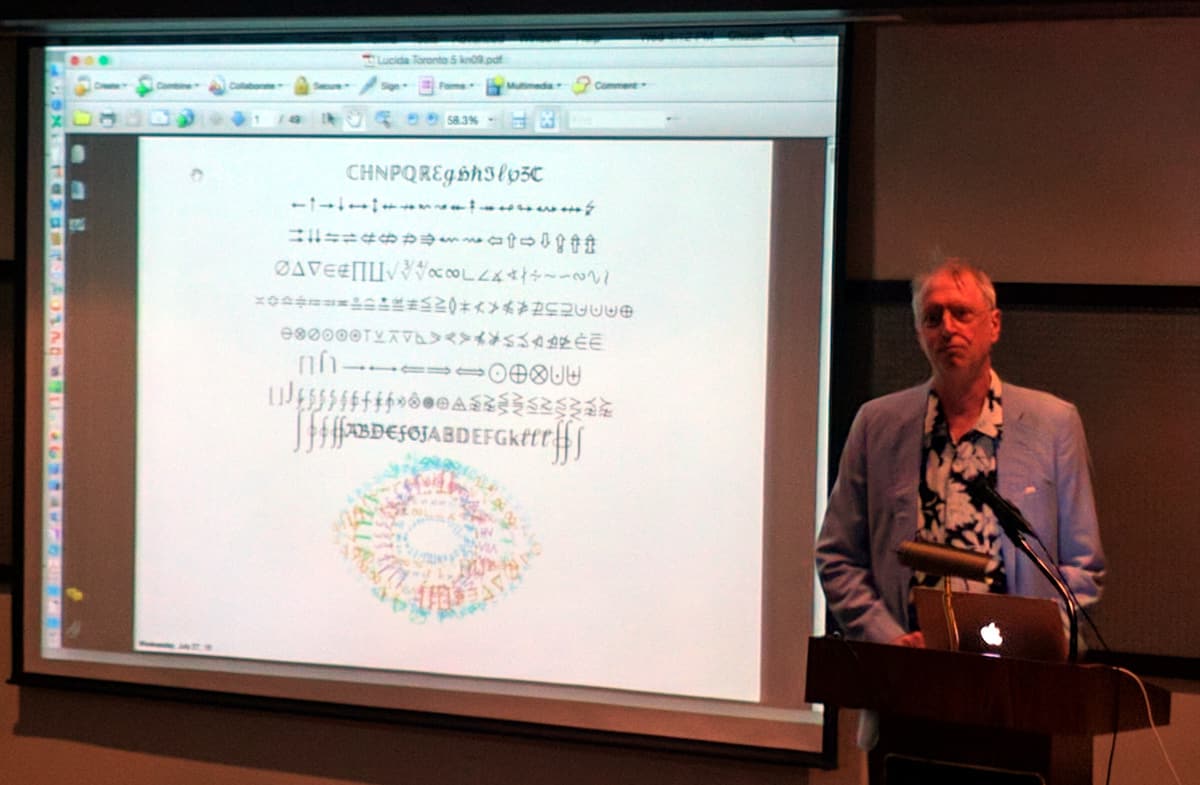
Abdelouahad Bayar Towards an operational (La)TeX package supporting optical scaling of dynamic mathematical symbols A technical talk about a trial in providing optical scaling of mathematical symbols. As far as I understand it tries to improve on the TeX way of doing extensible math symbols by glueing things together. It seems to be highly involved and technically interesting project, but I couldn t completely grasp the aim of it. Michael Cohen, Blanca Mancilla, John Plaice Zebrackets: A score of years and delimiters John introduced us to Zebrackets, stripped parentheses and brackets, to help us keep track of pairing of those beasts. But as we know, Zebras are very elusive animals, and so we saw lots of stripped brackets around. The idea of better markup of matching parentheses is definitely worth developing. Charles Bigelow Probably approximately not quite correct: Revise, repeat The second talk of Charles, this time on the history of the Lucida fonts, from the early beginnings drawn on graph paper to recent developments using FontLab producing OpenType fonts. A truly unique crash course through the development of one of the very big families of fonts, and one of the first outside Computer Modern that had also support for proper math typesetting in TeX.
Aggressively legible!
One of the key phrases that popped up again and again was aggressively legible, mostly in negative connotations as far to fat symbols or far to big Arabic letters. But for me this font family is still close to my heart. I purchased it back than from Y&Y for my PhD thesis, and since then have upgraded to the TUG version including the OpenType fonts, and I use them for most of my presentation. Maybe I like the aggressive legibility! Chuck slided in lots of nice comments about Kris Holmes, the development practice in their cooperation, stories of business contacts, and many more, making this talk a very lively and amusing, and at the same time very educating talk.
This concluded the TUG conference talks, and we thanked Pavneet for his excellent organization. But since we still have up to two days of excursions, many people dispersed quickly, just to meet again for a optional Type and Tile Tour 3-5 subway stops with discussion of typesetting This guided tour through the underground of Toronto, guided by Joe Clark who spoke in the morning about this topic, was attended by far too many participants. I think there were around 25 when we left. I thought that this will not work out properly, and so decided to leave the group and wander around alone. The last program point for today was dinner with a blues music concert in the near by Jazz Bistro:
jazz-bistro Excellent life music in a bit schick/sophisticated atmosphere was a good finish for this excellent day. With Herb from MacTeX and his wife we killed two bottles of red wine, before slowly tingling back to the hotel. A great finishing day of talks.

21 July 2016

Reproducible builds folks: Reproducible builds: week 62 in Stretch cycle

What happened in the Reproducible Builds effort between June 26th and July 2nd 2016: Read on to find out why we're lagging some weeks behind ! GSoC and Outreachy updates Toolchain fixes With the doxygen upload we are now down to only 2 modified packages in our repository: dpkg and rdfind. Weekly reports delay and the future of statistics To catch up with our backlog of weekly reports we have decided to skip some of the statistics for this week. We might publish them in a future report, or we might switch to a format where we summarize them more (and which we can create (even) more automatically), we'll see. We are doing these weekly statistics because we believe it's appropriate and useful to credit people's work and make it more visible. What do you think? We would love to hear your thoughts on this matter! Do you read these statistics? Somewhat? Actually, thanks to the power of notmuch, Holger came up with what you can see below, so what's missing for this week are the uploads fixing irreprodubilities. Which we really would like to show for the reasons stated above and because we really really need these uploads to happen ;-) But then we also like to confirm the bugs are really gone, which (atm) requires manual checking, and to look for the words "reproducible" and "deterministic" (and spelling variations) in debian/changelogs of all uploads, to spot reproducible work not tracked via the BTS. And we still need to catch up on the backlog of weekly reports. Bugs submitted with reproducible usertags It seems DebCamp in Cape Town was hugely successful and made some people get a lot of work done: 61 bugs have been filed with reproducible builds usertags and 60 of them had patches: Package reviews 437 new reviews have been added (though most of them were just linking the bug, "only" 56 new issues in packages were found), an unknown number has been been updated and 60 have been removed in this week, adding to our knowledge about identified issues. 4 new issue types have been found: Weekly QA work 98 FTBFS bugs have been reported by Chris Lamb and Santiago Vila. diffoscope development strip-nondeterminism development tests.reproducible-builds.org Misc. This week's edition was written by Mattia Rizzolo, Reiner Herrmann, Ceridwen and Holger Levsen and reviewed by a bunch of Reproducible builds folks on IRC.

8 July 2016

Reproducible builds folks: Managing container and environment state

Author: ceridwen With some more help from Martin Pitt, it became clear to me that my previous mental model of how autopkgtest worked is very different from how it does work. I'll illustrate by borrowing my previous example. I know that schroot has the following behavior:
The default behaviour is as follows (all directory paths are inside the chroot). A login shell is run in the current working directory. If this is not available, it will try $HOME (when --preserve-environment is used), then the user's home directory, and / inside the chroot in turn. A command is always run in the current working directory inside the chroot. If none of the directories are available, schroot will exit with an error status.
I was naively thinking that the way autopkgtest would work is that it would set the current working directory of the schroot call and the ensuing subprocess call would thus take place in that directory inside the schroot. That is not how it works. If you want to change directories inside the virtual server, you have to use cd. The same is true of, at least, environment variables, which have their own specific handling in the adt_testbed.Testbed methods but have to be passed as strings, and umask. I'm assuming this is because the direct methods with qemu images or LXC containers don't work. What this means is that I was thinking about the problem the wrong way: what reprotest needs to do is generate shell scripts. This is how autopkgtest works. If this goes beyond laying out commands linearly one after another, for instance if it demands conditionals or other nested constructs, the right way to do it is to build an abstract syntax tree representation of the shell script and then convert it to code. Whether I need more complicated shell scripts depends on my approach to handling state in the containers. I need to know what state persists across separate command executions: if I call adt_testbed.Testbed.execute() twice, what if any changes I make to the container will carry forward from the first to the second? There are three categories here. First, some properties of a system aren't preserved even from one command execution to the next, like working directory and environment variables. (I thought working directory would be preserved, but it's not). The second is state that persists while the testbed is open and is then automatically reverted when it's closed, like files copied into temporary directories on the tesbed. The third is state that persists across different sessions on the same container and must be cleaned up by reprotest. It's worth noting that which state falls into which category may vary by the container in question, though for the most part I can either do unnecessary cleanup or issue unnecessary commands to handle the differences. autopkgtest itself has a very different approach to cleanup, as it relies almost entirely on the builtin reversion capabilities from some of its containers. I would prefer to avoid doing the same, partly because I know that some of the modifications I need to make, for instance creating new users or mounting disorderfs, can't be reverted by the faster, simpler containers like schroot. From discussions with Lunar, I think that the variations that correspond to environment variables (captures_environment, home, locales, path, and timezone) fall into the first category, but because of the special handling for them they don't require sending a separate command. The shell (bash foo) accepts a script or command as an argument so it also doesn't need a separate command. Setting the working directory and umask require separate commands that have to be joined. On Linux, setarch also accepts a command/script as an argument so can be handled like the shell, but there's no unified POSIX protocol for mocking uname so other OSes will require different approaches. Users, groups, file ordering, host, and domain will require cleanup in all containers except for (maybe) qemu. If I want to handle the cleanup in the shell scripts themselves, I need conditionals so that for instance the shell script only tries to unmount disorderfs if disorderfs was successfully mounted. This approach would simplify the error handling problems I've had before, where when a build crashes cleanup code run from Python doesn't get run until after the testbed stop accepting commands. Lunar suggested the Plumbum library to me, and I think I can use it to avoid writing my own shell AST library. It has a method that converts the Python representation of a shell script into a string that can be passed to Testbed.command(). Integrating Plumbum to generate the necessary scripts is where I'm going in the next week. Any feedback on any of this is welcome. I'm also curious what other projects are using autopkgtest code. Holger brought to my attention piuparts, which brings the list up to four that I'm aware of, autopkgtest itself, sbuild, piuparts, and now reprotest.

2 July 2016

Paul Tagliamonte: Hello, InfluxDB

Last week, I posted about python-sense, and API wrapper for the internal Sense API. I wrote this so that I could pull data about myself into my own databases, allowing me to use that information for myself. One way I'm doing this is by pulling my room data into an InfluxDB database, letting me run time series queries against my environmental data.
#!/usr/bin/env python
from influxdb import InfluxDBClient
import json
import datetime as dt
from sense.service import Sense
api = Sense()
data = api.room_sensors(quantity=20)
def items(data):
    for flavor, series in data.items():
        for datum in reversed(series):
            value = datum['value']
            if value == -1:
                continue
            timezone = dt.timezone(dt.timedelta(
                seconds=datum['offset_millis'] / 1000,
            ))
            when = dt.datetime.fromtimestamp(
                datum['datetime'] / 1000,
            ).replace(tzinfo=timezone)
            yield flavor, when, value
client = InfluxDBClient(
    'url.to.host.here',
    443,
    'username',
    'password',
    'sense',
    ssl=True,
)
def series(data):
    for flavor, when, value in items(data):
        yield  
            "measurement": " ".format(flavor),
            "tags":  
                "user": "paultag"
             ,
            "time": when.isoformat(),
            "fields":  
                "value": value,
             
         
client.write_points(list(series(data)))
I'm able to run this on a cron, automatically loading data from the Sense API into my Influx database. I can then use that with something like Grafana, to check out what my room looks like over time.

21 June 2016

Matthew Garrett: I've bought some more awful IoT stuff

I bought some awful WiFi lightbulbs a few months ago. The short version: they introduced terrible vulnerabilities on your network, they violated the GPL and they were also just bad at being lightbulbs. Since then I've bought some other Internet of Things devices, and since people seem to have a bizarre level of fascination with figuring out just what kind of fractal of poor design choices these things frequently embody, I thought I'd oblige.

Today we're going to be talking about the KanKun SP3, a plug that's been around for a while. The idea here is pretty simple - there's lots of devices that you'd like to be able to turn on and off in a programmatic way, and rather than rewiring them the simplest thing to do is just to insert a control device in between the wall and the device andn ow you can turn your foot bath on and off from your phone. Most vendors go further and also allow you to program timers and even provide some sort of remote tunneling protocol so you can turn off your lights from the comfort of somebody else's home.

The KanKun has all of these features and a bunch more, although when I say "features" I kind of mean the opposite. I plugged mine in and followed the install instructions. As is pretty typical, this took the form of the plug bringing up its own Wifi access point, the app on the phone connecting to it and sending configuration data, and the plug then using that data to join your network. Except it didn't work. I connected to the plug's network, gave it my SSID and password and waited. Nothing happened. No useful diagnostic data. Eventually I plugged my phone into my laptop and ran adb logcat, and the Android debug logs told me that the app was trying to modify a network that it hadn't created. Apparently this isn't permitted as of Android 6, but the app was handling this denial by just trying again. I deleted the network from the system settings, restarted the app, and this time the app created the network record and could modify it. It still didn't work, but that's because it let me give it a 5GHz network and it only has a 2.4GHz radio, so one reset later and I finally had it online.

The first thing I normally do to one of these things is run nmap with the -O argument, which gives you an indication of what OS it's running. I didn't really need to in this case, because if I just telnetted to port 22 I got a dropbear ssh banner. Googling turned up the root password ("p9z34c") and I was logged into a lightly hacked (and fairly obsolete) OpenWRT environment.

It turns out that here's a whole community of people playing with these plugs, and it's common for people to install CGI scripts on them so they can turn them on and off via an API. At first this sounds somewhat confusing, because if the phone app can control the plug then there clearly is some kind of API, right? Well ha yeah ok that's a great question and oh good lord do things start getting bad quickly at this point.

I'd grabbed the apk for the app and a copy of jadx, an incredibly useful piece of code that's surprisingly good at turning compiled Android apps into something resembling Java source. I dug through that for a while before figuring out that before packets were being sent, they were being handed off to some sort of encryption code. I couldn't find that in the app, but there was a native ARM library shipped with it. Running strings on that showed functions with names matching the calls in the Java code, so that made sense. There were also references to AES, which explained why when I ran tcpdump I only saw bizarre garbage packets.

But what was surprising was that most of these packets were substantially similar. There were a load that were identical other than a 16-byte chunk in the middle. That plus the fact that every payload length was a multiple of 16 bytes strongly indicated that AES was being used in ECB mode. In ECB mode each plaintext is split up into 16-byte chunks and encrypted with the same key. The same plaintext will always result in the same encrypted output. This implied that the packets were substantially similar and that the encryption key was static.

Some more digging showed that someone had figured out the encryption key last year, and that someone else had written some tools to control the plug without needing to modify it. The protocol is basically ascii and consists mostly of the MAC address of the target device, a password and a command. This is then encrypted and sent to the device's IP address. The device then sends a challenge packet containing a random number. The app has to decrypt this, obtain the random number, create a response, encrypt that and send it before the command takes effect. This avoids the most obvious weakness around using ECB - since the same plaintext always encrypts to the same ciphertext, you could just watch encrypted packets go past and replay them to get the same effect, even if you didn't have the encryption key. Using a random number in a challenge forces you to prove that you actually have the key.

At least, it would do if the numbers were actually random. It turns out that the plug is just calling rand(). Further, it turns out that it never calls srand(). This means that the plug will always generate the same sequence of challenges after a reboot, which means you can still carry out replay attacks if you can reboot the plug. Strong work.

But there was still the question of how the remote control works, since the code on github only worked locally. tcpdumping the traffic from the server and trying to decrypt it in the same way as local packets worked fine, and showed that the only difference was that the packet started "wan" rather than "lan". The server decrypts the packet, looks at the MAC address, re-encrypts it and sends it over the tunnel to the plug that registered with that address.

That's not really a great deal of authentication. The protocol permits a password, but the app doesn't insist on it - some quick playing suggests that about 90% of these devices still use the default password. And the devices are all based on the same wifi module, so the MAC addresses are all in the same range. The process of sending status check packets to the server with every MAC address wouldn't take that long and would tell you how many of these devices are out there. If they're using the default password, that's enough to have full control over them.

There's some other failings. The github repo mentioned earlier includes a script that allows arbitrary command execution - the wifi configuration information is passed to the system() command, so leaving a semicolon in the middle of it will result in your own commands being executed. Thankfully this doesn't seem to be true of the daemon that's listening for the remote control packets, which seems to restrict its use of system() to data entirely under its control. But even if you change the default root password, anyone on your local network can get root on the plug. So that's a thing. It also downloads firmware updates over http and doesn't appear to check signatures on them, so there's the potential for MITM attacks on the plug itself. The remote control server is on AWS unless your timezone is GMT+8, in which case it's in China. Sorry, Western Australia.

It's running Linux and includes Busybox and dnsmasq, so plenty of GPLed code. I emailed the manufacturer asking for a copy and got told that they wouldn't give it to me, which is unsurprising but still disappointing.

The use of AES is still somewhat confusing, given the relatively small amount of security it provides. One thing I've wondered is whether it's not actually intended to provide security at all. The remote servers need to accept connections from anywhere and funnel decent amounts of traffic around from phones to switches. If that weren't restricted in any way, competitors would be able to use existing servers rather than setting up their own. Using AES at least provides a minor obstacle that might encourage them to set up their own server.

Overall: the hardware seems fine, the software is shoddy and the security is terrible. If you have one of these, set a strong password. There's no rate-limiting on the server, so a weak password will be broken pretty quickly. It's also infringing my copyright, so I'd recommend against it on that point alone.

comment count unavailable comments

19 June 2016

Elena 'valhalla' Grandi: StickerConstructorSpec compliant swirl

StickerConstructorSpec compliant swirl

This evening I've played around a bit with the Sticker Constructor Specification https://github.com/terinjokes/StickerConstructorSpec and its https://github.com/terinjokes/StickerConstructorSpec/blob/master/assets/hexagonal-sticker_template.svg, and this is the result:

Immagine/fotohttp://social.gl-como.it/photos/valhalla/image/e8ee069635b2823e168c358d2a753f14


Now I just have to:

* find somebody in Europe who prints good stickers and doesn't require illustrator (or other proprietary software) to submit files for non-rectangular shapes
* find out which Debian team I should contact to submit the files so that they can be used by everybody interested.

But neither will happen today, nor probably tomorrow, because lazy O:-)

Edit: now that I'm awake I realized I forgot to thank @Enrico Zini Zini and MadameZou for their help in combining my two proposals in a better design.

Source svg http://social.gl-como.it/attach/3

13 June 2016

Reproducible builds folks: First alpha release of reprotest

Author: ceridwen The first, very-alpha release of reprotest is now out at PyPi. It should hit Debian experimental later this week. While it only builds on an existing system (as I'm still working on support for virtualization), it can now check its own reproducibility, which it does in its own tests, both using setuptools and debuild. Unfortunately, setuptools seems to generate file-order-dependent binaries, meaning python setup.py bdist creates unreproducible binaries. With debuild, reprotest probably would be reproducible with the modified packages from the Reproducible Builds project, though I haven't tested that yet. It tests 'captures_environment', 'fileordering' (renamed from 'filesystem'), 'home', 'kernel', 'locales', 'path', 'time', 'timezone', and 'umask'. The other variations require superuser privileges and modifications that would be unsafe to make to a running system, so they will only be enabled in the containers. The next major part of the project is integrating autopkgtests's container management system into reprotest. For the curious, autopkgtest is composed of a main program, adt-run, which then calls other command-line programs, adt-virt-chroot, adt-virt-lxd, adt-virt-schroot, adt-virt-null, adt-virt-schroot, and adt-virt-qemu, that communicate with the containers. (The autopkgtest maintainer has since renamed the programs, but the underlying structure remains the same.) I think this is a bit of an odd design but it works well for my purposes since the container programs already have existing CLIs that reprotest can use.

11 June 2016

Paul Tagliamonte: It's all relative

As nearly anyone who's worked with me will attest to, I've long since touted nedbat's talk Pragmatic Unicode, or, How do I stop the pain? as one of the most foundational talks, and required watching for all programmers. The reason is because netbat hits on something bigger - something more fundamental than how to handle Unicode -- it's how to handle data which is relative. For those who want the TL;DR, the argument is as follows: Facts of Life:
  1. Computers work with Bytes. Bytes go in, Bytes go out.
  2. The world needs more than 256 symbols.
  3. You need both Bytes and Unicode
  4. You cannot infer the encoding of bytes.
  5. Declared encodings can be Wrong
Now, to fix it, the following protips:
  1. Unicode sandwich
  2. Know what you have
  3. TEST
Relative Data I've started to think more about why we do the things we do when we write code, and one thing that continues to be a source of morbid schadenfreude is watching code break by failing to handle Unicode right. It's hard! However, watching what breaks lets you gain a bit of insight into how the author thinks, and what assumptions they make. When you send someone Unicode, there are a lot of assumptions that have to be made. Your computer has to trust what you (yes, you!) entered into your web browser, your web browser has to pass that on over the network (most of the time without encoding information), to a server which reads that bytestream, and makes a wild guess at what it should be. That server might save it to a database, and interpolate it into an HTML template in a different encoding (called Mojibake), resulting in a bad time for everyone involved. Everything's awful, and the fact our computers can continue to display text to us is a goddamn miracle. Never forget that. When it comes down to it, when I see a byte sitting on a page, I don't know (and can't know!) if it's Windows-1252, UTF-8, Latin-1, or EBCDIC. What's a poem to me is terminal garbage to you. Over the years, hacks have evolved. We have magic numbers, and plain ole' hacks to just guess based on the content. Of course, like all good computer programs, this has lead to its fair share of hilarious bugs, and there's nothing stopping files from (validly!) being multiple things at the same time. Like many things, it's all in the eye of the beholder. Timezones Just like Unicode, this is a word that can put your friendly neighborhood programmer into a series of profanity laden tirades. Go find one in the wild, and ask them about what they think about timezone handling bugs they've seen. I'll wait. Go ahead. Rants are funny things. They're fun to watch. Hilarious to give. Sometimes just getting it all out can help. They can tell you a lot about the true nature of problems. It's funny to consider the isomorphic nature of Unicode rants and Timezone rants. I don't think this is an accident. U n i c o d e timezone Sandwich Ned's Unicode Sandwich applies -- As early as we can, in the lowest level we can (reading from the database, filesystem, wherever!), all datetimes must be timezone qualified with their correct timezone. Always. If you mean UTC, say it's in UTC. Treat any unqualified datetimes as "bytes". They're not to be trusted. Never, never, never trust 'em. Don't process any datetimes until you're sure they're in the right timezone. This lets the delicious inside of your datetime sandwich handle timezones with grace, and finally, as late as you can, turn it back into bytes (if at all!). Treat locations as tzdb entries, and qualify datetime objects into their absolute timezone (EST, EDT, PST, PDT) It's not until you want to show the datetime to the user again should you consider how to re-encode your datetime to bytes. You should think about what flavor of bytes, what encoding -- what timezone -- should I be encoding into? TEST Just like Unicode, testing that your code works with datetimes is important. Every time I think about how to go about doing this, I think about that one time that mjg59 couldn't book a flight starting Tuesday from AKL, landing in HNL on Monday night, because United couldn't book the last leg to SFO. Do you ever assume dates only go forward as time goes on? Remember timezones. Construct test data, make sure someone in New Zealand's +13:45 can correctly talk with their friends in Baker Island's -12:00, and that the events sort right. Just because it's Noon on New Years Eve in England doesn't mean it's not 1 AM the next year in New Zealand. Places a few miles apart may go on Daylight savings different days. Indian Standard Time is not even aligned on the hour to GMT (+05:30)! Test early, and test often. Memorize a few timezones, and challenge your assumptions when writing code that has to do with time. Don't use wall clocks to mean monotonic time. Remember there's a whole world out there, and we only deal with part of it. It's also worth remembering, as Andrew Pendleton pointed out to me, that it's possible that a datetime isn't even unique for a place, since you can never know if 2016-11-06 01:00:00 in America/New_York (in the tzdb) is the first one, or second one. Storing EST or EDT along with your datetime may help, though! Pitfalls Improper handling of timezones can lead to some interesting things, and failing to be explicit (or at least, very rigid) in what you expect will lead to an unholy class of bugs we've all come to hate. At best, you have confused users doing math, at worst, someone misses a critical event, or our security code fails. I recently found what I regard to be a pretty bad bug in apt (which David has prepared a fix for and is pending upload, yay! Thank you!), which boiled down to documentation and code expecting datetimes in a timezone, but accepting any timezone, and silently treating it as UTC. The solution is to hard-fail, which is an interesting choice to me (as a vocal fan of timezone aware code), but at the least it won't fail by misunderstanding what the server is trying to communicate, and I do understand and empathize with the situation the apt maintainers are in. Final Thoughts Overall, my main point is although most modern developers know how to deal with Unicode pain, I think there is a more general lesson to learn -- namely, you should always know what data you have, and always remember what it is. Understand assumptions as early as you can, and always store them with the data.

6 June 2016

Reproducible builds folks: Reprotest has a preliminary CLI and configuration file handling

Author: ceridwen This is the first draft of reprotest's interface, and I welcome comments on how to improve it. At the moment, reprotest's CLI takes two mandatory arguments, the build command to run and the build artifact file to test after running the build. If the build command or build artifact have spaces, they have to be passed as strings, e.g. "debuild -b -uc -us". For optional arguments, it has --variations, which accepts a list of possible build variations to test, one or more of 'captures_environment', 'domain_host', 'filesystem', 'home', 'kernel', 'locales', 'path', 'shell', 'time', 'timezone', 'umask', and 'user_group' (see variations for more information); --dont_vary, which makes reprotest not test any variations in the given list (the default is to run all variations); --source_root, which accepts a directory to run the build command in and defaults to the current working directory; and --verbose, which will eventually enable more detailed logging. To get help for the CLI, run reprotest -h or reprotest --help. The config file has one section, basics, and the same options as the CLI, except there's no dont_vary option, and there are build_command and artifact options. If build_command and/or artifact are set in the config file, reprotest can be run without passing those as command-line arguments. Command-line arguments always override config file options. Reprotest currently searches the working directory for the config file, but it will also eventually search the user's home directory. A sample config file is below.
[basics]
build_command = setup.py sdist
artifact = dist/reprotest-0.1.tar.gz
source_root = reprotest/
variations =
  captures_environment
  domain_host
  filesystem
  home
  host
  kernel
  locales
  path
  shell
  time
  timezone
  umask
  user_group
At the moment, the only build variations that reprotest actually tests are the environment variable variations: captures_environment, home, locales, and timezone. Over the next week, I plan to add the rest of the basic variations and accompanying tests. I also need to write tests for the CLI and the configuration file. After that, I intend to work on getting (s)chroot communication working, which will involve integrating autopkgtest code. Some of the variations require specific other packages to be installed: for instance, the locales variation currently requires the fr_CH.UTF-8 locale. Locales are a particular problem because I don't know of a way in Debian to specify that a given locale must be installed. For other packages, it's unclear to me whether I should specify them as depends or recommends: they aren't dependencies in a strict sense, but marking them as dependencies will make it easier to install a fully-functional reprotest. When reprotest runs with variations enabled that it can't test because it doesn't have the correct packages installed, I intend to have it print a warning but continue to run. tests.reproducible-builds.org also has different settings, such as different locales, for different architectures. I'm not clear on why this is. I'd prefer to avoid having to generate a giant list of variations based on architecture, but if necessary, I can do that. The prebuilder script contains variations specific to Linux, to Debian, and to pbuilder/cowbuilder. I'm not including Debian-specific variations until I get much more of the basic functionality implemented, and I'm not sure I'm going to include pbuilder-specific variations ever, because it's probably better for extensibility to other OSes, e.g. BSD, to add support for plugins or more complicated configurations. I implemented the variations by creating a function for each variation. Each function takes as input two build commands, two source trees, and two sets of environment variables and returns the same. At the moment, I'm using dictionaries for the environment variables, mutating them in-place and passing the references forward. I'm probably going to replace those at some point with an immutable mapping. While at the moment, reprotest only builds on the existing system, when I start extending it to other build environments, this will require double-dispatch, because the code that needs to be executed will depend on both the variation to be tested and the environment being built on. At the moment, I'm probably going to implement this with a dictionary with tuple keys of (build_environment, variation) or nested dictionaries. If it's necessary for code to depend on OS or architecture, too, this could end up becoming a triple or quadruple dispatch.

22 May 2016

Reproducible builds folks: Reproducible builds: week 56 in Stretch cycle

What happened in the Reproducible Builds effort between May 15th and May 21st 2016: Media coverage Blog posts from our GSoC and Outreachy contributors: Documentation update Ximin Luo clarified instructions on how to set SOURCE_DATE_EPOCH. Toolchain fixes Other upstream fixes Packages fixed The following 18 packages have become reproducible due to changes in their build dependencies: abiword angband apt-listbugs asn1c bacula-doc bittornado cdbackup fenix gap-autpgrp gerbv jboss-logging-tools invokebinder modplugtools objenesis pmw r-cran-rniftilib x-loader zsnes The following packages have become reproducible after being fixed: Some uploads have fixed some reproducibility issues, but not all of them: Patches submitted that have not made their way to the archive yet: Reproducibility-related bugs filed: Package reviews 51 reviews have been added, 19 have been updated and 15 have been removed in this week. 22 FTBFS bugs have been reported by Chris Lamb, Santiago Vila, Niko Tyni and Daniel Schepler. tests.reproducible-builds.org Misc. This week's edition was written by Reiner Herrmann and Holger Levsen and reviewed by a bunch of Reproducible builds folks on IRC.

17 May 2016

Reproducible builds folks: Reproducible builds: week 55 in Stretch cycle

What happened in the Reproducible Builds effort between May 8th and May 14th 2016: Documentation updates Toolchain fixes Packages fixed The following 28 packages have become newly reproducible due to changes in their build dependencies: actor-framework ask asterisk-prompt-fr-armelle asterisk-prompt-fr-proformatique coccinelle cwebx d-itg device-tree-compiler flann fortunes-es idlastro jabref konclude latexdiff libint minlog modplugtools mummer mwrap mxallowd mysql-mmm ocaml-atd ocamlviz postbooks pycorrfit pyscanfcs python-pcs weka The following 9 packages had older versions which were reproducible, and their latest versions are now reproducible again due to changes in their build dependencies: csync2 dune-common dune-localfunctions libcommons-jxpath-java libcommons-logging-java libstax-java libyanfs-java python-daemon yacas The following packages have become newly reproducible after being fixed: The following packages had older versions which were reproducible, and their latest versions are now reproducible again after being fixed: Some uploads have fixed some reproducibility issues, but not all of them: Patches submitted that have not made their way to the archive yet: Package reviews 344 reviews have been added, 125 have been updated and 20 have been removed in this week. 14 FTBFS bugs have been reported by Chris Lamb. tests.reproducible-builds.org Misc. Dan Kegel sent a mail to report about his experiments with a reproducible dpkg PPA for Ubuntu. According to him sudo add-apt-repository ppa:dank/dpkg && sudo apt-get update && sudo apt-get install dpkg should be enough to get reproducible builds on Ubuntu 16.04. This week's edition was written by Ximin Luo and Holger Levsen and reviewed by a bunch of Reproducible builds folks on IRC.

2 May 2016

Reproducible builds folks: Reproducible builds: week 53 in Stretch cycle

What happened in the Reproducible Builds effort between April 24th and 30th 2016. Media coverage Reproducible builds were mentioned explicitly in two talks at the Mini-DebConf in Vienna: Aspiration together with the OTF CommunityLab released their report about the Reproducible Builds summit in December 2015 in Athens. Toolchain fixes Now that the GCC development window has been opened again, the SOURCE_DATE_EPOCH patch by Dhole and Matthias Klose to address the issue timestamps_from_cpp_macros (__DATE__ / __TIME__) has been applied upstream and will be released with GCC 7. Following that Matthias Klose also has uploaded gcc-5/5.3.1-17 and gcc-6/6.1.1-1 to unstable with a backport of that SOURCE_DATE_EPOCH patch. Emmanuel Bourg uploaded maven/3.3.9-4, which uses SOURCE_DATE_EPOCH for the maven.build.timestamp. (SOURCE_DATE_EPOCH specification) Other upstream changes Alexis Bienven e submitted a patch to Sphinx which extends SOURCE_DATE_EPOCH support for copyright years in generated documentation. Packages fixed The following 12 packages have become reproducible due to changes in their build dependencies: hhvm jcsp libfann libflexdock-java libjcommon-java libswingx1-java mobile-atlas-creator not-yet-commons-ssl plexus-utils squareness svnclientadapter The following packages have became reproducible after being fixed: Some uploads have fixed some reproducibility issues, but not all of them: Patches submitted that have not made their way to the archive yet: Package reviews 95 reviews have been added, 15 have been updated and 129 have been removed in this week. 22 FTBFS bugs have been reported by Chris Lamb and Martin Michlmayr. diffoscope development strip-nondeterminism development tests.reproducible-builds.org Misc. Amongst the 29 interns who will work on Debian through GSoC and Outreachy there are four who will be contributing to Reproducible Builds for Debian and Free Software. We are very glad to welcome ceridwen, Satyam Zode, Scarlett Clark and Valerie Young and look forward to working together with them the coming months (and maybe beyond)! This week's edition was written by Reiner Herrmann and Holger Levsen and reviewed by a bunch of Reproducible builds folks on IRC.

18 April 2016

Dirk Eddelbuettel: RcppCCTZ 0.0.4

A few days ago a new upstream version "2.0" of CCTZ was released. See here for the corresponding post on the Google OpenSource Blog. CCTZ is a C++ library for translating between absolute and civil times using the rules of a time zone. It requires only a proper C++11 compiler and the standard IANA time zone data base which standard Unix, Linux, OS X, ... computers tend to have in /usr/share/zoneinfo. RcppCCTZ connects this library to R by relying on Rcpp. This new version adds more support to the notion of civil time representation -- i.e. independent of timezones -- which can then be mapped to different time zone representations. Changes in this version are summarized here:
Changes in version 0.0.4 (2016-04-17)
  • Synchronized with CCTZ v2 upstream.
  • Updated examples.cpp accordingly
A quick example is provided here where we look at the time when Neil Armstrong first stepped on the moon as an absolute ("civil") time and two local representations:
// from examples/hello.cc
// 
// [[Rcpp::export]]
int helloMoon()  
    cctz::time_zone syd;
    if (!cctz::load_time_zone("Australia/Sydney", &syd)) return -1;
    // Neil Armstrong first walks on the moon
    const auto tp1 = cctz::convert(cctz::civil_second(1969, 7, 21, 12, 56, 0), syd);
    const std::string s = cctz::format("%F %T %z", tp1, syd);
    Rcpp::Rcout << s << "\n";
    cctz::time_zone nyc;
    cctz::load_time_zone("America/New_York", &nyc);
    const auto tp2 = cctz::convert(cctz::civil_second(1969, 7, 20, 22, 56, 0), nyc);
    return tp2 == tp1 ? 0 : 1;
 
We can call this from R, and get the expected result (of equivalence between the dates):
R> library(RcppCCTZ)
R> helloMoon()
1969-07-21 12:56:00 +1000
[1] 0
R>
We also have a diff to the previous version thanks to CRANberries. More details, issue tickets etc at the GitHub repository.

This post by Dirk Eddelbuettel originated on his Thinking inside the box blog. Please report excessive re-aggregation in third-party for-profit settings.

12 April 2016

Reproducible builds folks: Reproducible builds: week 48 in Stretch cycle

What happened in the reproducible builds effort between March 20th and March 26th: Toolchain fixes Daniel Kahn Gillmor worked on removing build path from build symbols submitting a patch adding -fdebug-prefix-map to clang to match GCC, another patch against gcc-5 to backport the removal of -fdebug-prefix-map from DW_AT_producer, and finally by proposing the addition of a normalizedebugpath to the reproducible feature set of dpkg-buildflags that would use -fdebug-prefix-map to replace the current directory with . using -fdebug-prefix-map. Sergey Poznyakoff merged the --clamp-mtime option so that it will be featured in the next Tar release. This option is likely to be used by dpkg-deb to implement deterministic mtimes for packaged files. Packages fixed The following packages have become reproducible due to changes in their build dependencies: augeas, gmtkbabel, ktikz, octave-control, octave-general, octave-image, octave-ltfat, octave-miscellaneous, octave-mpi, octave-nurbs, octave-octcdf, octave-sockets, octave-strings, openlayers, python-structlog, signond. The following packages became reproducible after getting fixed: Some uploads fixed some reproducibility issues, but not all of them: Patches submitted which have not made their way to the archive yet: tests.reproducible-builds.org i386 build nodes have been setup by converting 2 of the 4 amd64 nodes to i386. (h01ger) Package reviews 92 reviews have been removed, 66 added and 31 updated in the previous week. New issues: timestamps_generated_by_xbean_spring, timestamps_generated_by_mangosdk_spiprocessor. Chris Lamb filed 7 FTBFS bugs. Misc. On March 20th, Chris Lamb gave a talk at FOSSASIA 2016 in Singapore. The very same day, but a few timezones apart, h01ger did a presentation at LibrePlanet 2016 in Cambridge, Massachusetts. Seven GSoC/Outreachy applications were made by potential interns to work on various aspects of the reproducible builds effort. On top of interacting with several applicants, prospective mentors gathered to review the applications.

27 March 2016

Lunar: Reproducible builds: week 48 in Stretch cycle

What happened in the reproducible builds effort between March 20th and March 26th:

Toolchain fixes
  • Sebastian Ramacher uploaded breathe/4.2.0-1 which makes its output deterministic. Original patch by Chris Lamb, merged uptream.
  • Rafael Laboissiere uploaded octave/4.0.1-1 which allows packages to be built in place and avoid unreproducible builds due to temporary build directories appearing in the .oct files.
Daniel Kahn Gillmor worked on removing build path from build symbols submitting a patch adding -fdebug-prefix-map to clang to match GCC, another patch against gcc-5 to backport the removal of -fdebug-prefix-map from DW_AT_producer, and finally by proposing the addition of a normalizedebugpath to the reproducible feature set of dpkg-buildflags that would use -fdebug-prefix-map to replace the current directory with . using -fdebug-prefix-map. As succesful result of lobbying at LibrePlanet 2016, the --clamp-mtime option will be featured in the next Tar release. This option is likely to be used by dpkg-deb to implement deterministic mtimes for packaged files.

Packages fixed The following packages have become reproducible due to changes in their build dependencies: augeas, gmtkbabel, ktikz, octave-control, octave-general, octave-image, octave-ltfat, octave-miscellaneous, octave-mpi, octave-nurbs, octave-octcdf, octave-sockets, octave-strings, openlayers, python-structlog, signond. The following packages became reproducible after getting fixed: Some uploads fixed some reproducibility issues, but not all of them: Patches submitted which have not made their way to the archive yet:
  • #818742 on milkytracker by Reiner Herrmann: sorts the list of source files.
  • #818752 on tcl8.4 by Reiner Herrmann: sort source files using C locale.
  • #818753 on tk8.6 by Reiner Herrmann: sort source files using C locale.
  • #818754 on tk8.5 by Reiner Herrmann: sort source files using C locale.
  • #818755 on tk8.4 by Reiner Herrmann: sort source files using C locale.
  • #818952 on marionnet by ceridwen: dummy out build date and uname to make build reproducible.
  • #819334 on avahi by Reiner Herrmann: ship upstream changelog instead of the one generated by gettextize (although duplicate of #804141 by Santiago Vila).

tests.reproducible-builds.org i386 build nodes have been setup by converting 2 of the 4 amd64 nodes to i386. (h01ger)

Package reviews 92 reviews have been removed, 66 added and 31 updated in the previous week. New issues: timestamps_generated_by_xbean_spring, timestamps_generated_by_mangosdk_spiprocessor. Chris Lamb filed 7 FTBFS bugs.

Misc. On March 20th, Chris Lamb gave a talk at FOSSASIA 2016 in Singapore. The very same day, but a few timezones apart, h01ger did a presentation at LibrePlanet 2016 in Cambridge, Massachusetts. Seven GSoC/Outreachy applications were made by potential interns to work on various aspects of the reproducible builds effort. On top of interacting with several applicants, prospective mentors gathered to review the applications. Huge thanks to Linda Naeun Lee for the new hackergotchi visible on Planet Debian.

23 March 2016

Daniel Pocock: GSoC 2016 opportunities for Voice, Video and Chat Communication

I've advertised a GSoC project under Debian for improving voice, video and chat communication with free software. Replacing Skype, Viber and WhatsApp is a big task, however, it is quite achievable by breaking it down into small chunks of work. I've been cataloguing many of the key improvements needed to make Free RTC products work together. Many of these chunks are within the scope of a GSoC project. If you can refer any students, if you would like to help as a mentor or if you are a student, please come and introduce yourself on the FreeRTC mailing list. If additional mentors volunteer, there is a good chance we can have more than one student funded to work on this topic. The deadline is Friday, 25 March 2016 The student application deadline is 25 March 2016 19:00 UTC. This is a hard deadline for students. Mentors can still join after the deadline, during the phase where student applications are evaluated. The Google site can be very busy in the hours before the deadline so it is recommended to try and complete the application at least 8 hours before the final deadline. Action items for students:
  • Register yourself on the Google Site and submit an application. You can submit applications to multiple organizations. For example, if you wish to focus on the DruCall module for Drupal, you can apply to both Debian and Drupal.
  • Join the FreeRTC mailing list and send a message introducing yourself. Tell us which topics you are interested in, which programming languages your are most confident with and which organizations you applied to through the Google site.
  • Create an application wiki page on the Debian wiki. You are permitted to edit the page after the 25 March deadline, so if you are applying at the last minute, just create a basic list of things you will work on and expand it over the following 2-3 days
Introducing yourself and making a strong application When completing the application form for Google, the wiki page and writing the email to introduce yourself, consider including the following details:
  • Link to any public profile you have on sites like Github or bug trackers
  • Tell us about your programming language skills, list the top three programming languages you are comfortable with and tell us how many years you have used each
  • other skills you have or courses you have completed
  • any talks you have given at conferences
  • any papers you have had published
  • any conferences you have attended or would like to attend
  • where you are located and where you study, including timezone
  • any work experience you already have
  • any courses, exams or employment commitments you have between 22 May and 24 August
  • anybody from your local free software community or university who may be willing to help as an additional mentor
Further reading Please also see my other project idea, for ham radio / SDR projects and my blog Want to be selected for Google Summer of Code 2016?. If you are not selected in 2016 We try to make contact with all students who apply and give some feedback, in particular, we will try to let you know what to do to increase your chances of selection in the next year, 2017. Applying for GSoC and being interviewed by mentors is a great way to practice for applying for other internships and jobs.

Next.

Previous.