Search Results: "keithp"

30 August 2011

Keith Packard: TeleMini

TeleMini Dual-deploy altimeter with telemetry now available TeleMini is a miniature dual-deploy flight computer with data logging and radio telemetry. Small enough to fit comfortably in an 18mm tube, this powerful package does everything you need on a single board: I don t have anything in these images to show just how tiny this board is but the spacing between the screw terminals is 2.54mm (0.1in), and the whole board is only 13mm wide (1/2in). We ve been flying these for quite a while; testing the hardware and tuning the firmware. My new 29mm mmt airframe, Koala, sports a TeleMini board for apogee-only deployment. It s been really nice to have something flying on G s and H s that doesn t depend on the vagaries of delay grains.

20 March 2011

Keith Packard: Altos0.9.2

AltOS 0.9.2 Minor update to ground station software Bdale and I are pleased to announce the release of AltOS version 0.9.2. AltOS is the core of the software for all of the Altus Metrum products. It consists of cc1111-based microcontroller firmware and Java-based ground station software. AltosUI Just a few bug fixes AltOS version 0.9.2 is a minor release with just a couple of fixes: No Firmware Update AltOS version 0.9.2 does not include any firmware changes. We re still busy testing the Kalman filter code; that ll be in the next major release.

29 November 2010

Keith Packard: Altos0.8

AltOS 0.8 New Software and Firmware for Altus Metrum Devices Bdale and I are pleased to announce the release of AltOS version 0.8. AltOS is the core of the software for all of the Altus Metrum products. It consists of cc1111-based microcontroller firmware and Java-based ground station software. AltosUI New Features in the AltusMetrum Ground Station AltOS version 0.8 contains significant upgrades to the ground station software, AltosUI: Continuing Features AltOS version 0.8 continues to provide the following features: AltOS Firmware Update AltOS version 0.8 contains a minor firmware update for TeleMetrum to resolve an issue with main deployment. A mis-feature in the igniter firing code would delay main deployment by 2 seconds in some cases. Thanks to our contributors! We had a lot of help with this release: Future Plans A number of features are implemented or in process in the sources available in our publicly visible repository that are not part of the current stable release. There are any number of additions that could be made to this list; feel free to send along ideas that you ve got. Of course, all of this software is licensed under the GNU General Public License, so you can get the source and hack on it in the comfort of your own home.

Bdale Garbee: AltOS 0.8 Released

Keith and I just released version 0.8 of AltOS, the open source firmware and software system associated with our TeleMetrum hobby rocket avionics system. The AltosUI ground station user interface is significantly improved, with lots of new features including a much cleaner view of what's happening during different stages of the flight experience, a post-flight data plotting interface with pan and zoom, and a very cool live view of where the rocket is overlayed on data from Google Maps! All existing TeleMetrum owners are encouraged to download, install, and begin using this new version immediately.

19 October 2010

Keith Packard: psas-roll-control

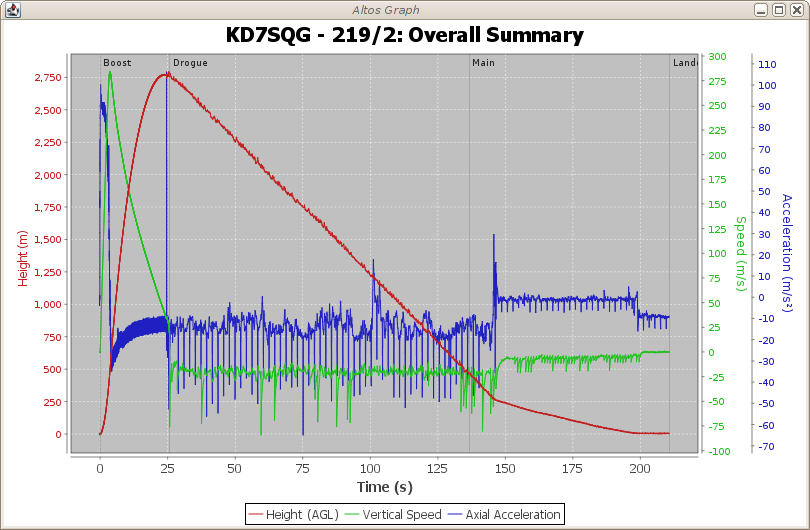
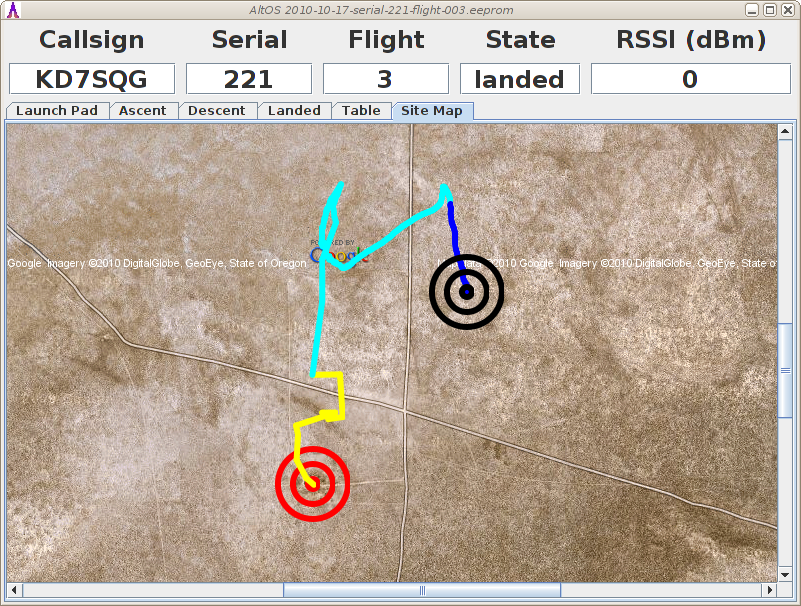
The PSAS team planned to have their LV2.3 airframe updates ready for BALLS this year, but RL interfered and they weren t ready to go on time. A quick bit of rescheduling and we decided to fly over the weekend of the 16-17 of October. Tsolo and family welcomed us warmly as we arrived on Saturday afternoon after driving over from Portland. They ve got a new puppy who is also cute and friendly. We managed to get the launch tower and flight operations set up before dark, cooked dinner and spent the evening prepping the airframe. It was cold overnight, but the light cloud cover that had been there when we arrived was nearly gone by morning. I called in to open the waiver and was asked to hold until noon, which suited us just fine. The rocket finally made it onto the rail around 1:30 and we managed to convince the launch controller to actually light the motor at 2:44:39 (according to the GPS data). Flying on a CTI N2850 blue-streak, LV2.3 hit about 380m/s and reached 4851m. This was the first flight with the new fin system, you can see how that works in the video here: <iframe frameborder="0" height="480" src="http://player.vimeo.com/video/15972443" width="640"></iframe>Portland State Aerospace LV2.3 flight with roll control from Keith Packard on Vimeo. The roll control system worked as designed, executing a programmed sequence of maneuvers during ascent. You can see the canard fins moving back and forth in the video, controlling the roll of the airframe. Yes, the fins really do spin separately from the airframe. You can see how that was constructed here: PSAS LV2.3 Spin Can Live telemetry and stored flight data, consisting of GPS coordinates along with barometry altimeter and accelerometer information, was collected using the TeleMetrum flight computer. The airframe was recovered about 800m downrange. Thanks to Portland State University for their support in hosting PSAS and Oregon Rocketry for letting us fly at their launch site.

10 September 2010

Keith Packard: altos-release

AltOS The Altus Metrum Operating System Altos is the core of the software for all of the Altus Metrum products. It runs on the 8051-based micro-controllers within both the flight computer and the ground station devices. AltOS a small cooperatively multi-tasking operating system. AltOS Version 0.7.1 Released Bdale and I have just released AltOS version 0.7.1. Version 0.7.1 is the first release to include the new Java-based ground station software which runs on Linux, Mac OS X and various Windows flavors. AltOS Changes in 0.7.1
  1. Deal with Windows and Mac OSX USB stacks. These two operating systems do interesting things with USB and found some boundary conditions within the AltOS USB stack which couldn t be tested on Linux. With test cases discovered, the panic calls were turned into code that dealt with these cases correctly.
  2. Increase packet mode payload size and add callsigns. The callsigns are set by the master end of the packet link (normally the TeleDongle) so that the entire radio conversation conforms to regulatory requirements. Increasing the payload size makes data transfers go faster.
  3. Place configuration data in fixed flash addresses. This change makes it possible to read the serial number and radio calibration data back out of the flash data when reprogramming a device.
TeleMetrum Changes in 0.7.1
  1. Ensure GPS date information is written to on-board data logger. The GPS date information is used when constructing eeprom log file names; without this, the eeprom downloading tool would generate a filename based on the current date.
  2. Allow TeleMetrum to be used as a programming dongle. This means the user can reprogram a TeleDongle or another TeleMetrum using the TeleMetrum as a programming dongle. Before this, only the TeleDongle could be used to program other devices.
AltosUI - Ground Station Software for Altus Metrum devices Version 0.7.1 is the first release containing our new cross-platform Java-based user interface. AltosUI can: Three Operating Systems, One AltosUI AltosUI provides all of these features on the three target operating systems, Linux, Mac OS X (version 10.5 or newer) and Windows (XP, Vista or 7). The bulk of the software is written in Java and is built once and tested and delivered on all three target platforms. A tiny shim library is built on each system to provide access to the Altus Metrum devices connected over the USB link. Thanks to our contributors! We ve gotten lots of help getting this software built and tested: Future Plans With the basic AltOS and AltosUI functionality running, we ve got lots of ideas about where to take the system in the future. And, we d love to hear ideas from you as well. Some of the ideas we ve like to get done include:
  1. Google Earth file export. We had a Linux-based C program to export a KML (Keyhole Markup Language) file that Google Earth can read and present to the user overlayed on satellite photo data.
  2. Data Plotting. Being able to plot flight data right in the UI would be nice, and there are several Java plotting packages available to try out.
  3. State-dependent display. When the rocket is on the pad, you only want to know if it s ready to fly. When the rocket is descending on a chute, you want to know where it is in the sky and how fast its falling. Presenting a limited amount of information that is most likely interesting to the user should make the display more useful.
  4. Ejection charge testing. The TeleMetrum firmware has the ability to fire ejection charges over the USB or radio links. Safely hooking this up to the user interface will allow for wireless ejection system testing. The key here is safely , of course, which means figuring out a fool proof user interface.
I m sure there are any number of additions that could be made to this list; feel free to send along ideas that you ve got. Of course, all of this software is licensed under the GNU General Public License, so you can get the source and hack on it in the comfort of your own home.

27 April 2010

Bdale Garbee: TeleMetrum in Stock

First, I was pleasantly surprised to discover that TeleMetrum is now the subject of a post on the Make magazine site. Very cool! As reported last week, I've been waiting for better GPS antennas to arrive, but heavy snow here in Colorado last Friday delayed delivery. They finally arrived, and as I hoped, they appear to completely solve our signal strength problem! So... [drum roll, please!]... I am very happy to announce that the first production build of TeleMetrum boards and starter kits are now "in stock" at the Garbee and Garbee web store, along with other products designed by the Altus Metrum community! Keith and I are still working on the new Java-based ground station software and user documentation for the system. Watch this space for updates. I hope we'll have both ready for download by the time customers actually receive hardware...

21 April 2010

Keith Packard: Altus Metrum web store opens

Bdale has just opened up the Garbee and Garbee web store to sell Altus Metrum electronics including TeleMetrum and TeleDongle. The TeleMetrum boards aren t quite ready to ship, so they re marked as out of stock for another couple of days. That s because we ve decided to switch GPS antennas to improve GPS reception and we won t have enough of those until Friday to start shipping boards. The TM boards themselves are working great and we ve flown them several times. We ve already sold a couple of TeleDongle boards for use without TeleMetrum. These boards contain the CC1111 transceiver chip along with an 8-pin connector that can be used for USB, SPI or serial communication. This adds long-range wireless digital communication to almost any project. Steve Conklin has posted his plans for these boards. We sell TeleDongle as either bare boards or packaged in a pretty blue box with a USB cable attached. All of the hardware designs are licensed under the TAPR open hardware license and software under the GPL. All of the tools used to design the hardware and build the software are also free software (already packaged for Debian, of course) so you can take these designs and do whatever you want with them.

16 March 2010

Bdale Garbee: TeleMetrum v1.0 Order Placed

I've been too busy (work, family, and fighting a nasty cold!) to write much text lately, other than the comments I put on launch photos uploaded to my Flickr stream, but the remainder of our testing of the prototype TeleMetrum v0.2 boards went really well! The only significant change we decided to make before going to production was to change the 3.3 volt regulator from a 100mA to a 150mA part. This will ensure adequate power for the companion boards we have planned, even when the GPS chip is in maximum power mode searching for satellites during a cold start. So... [drum roll, please] Keith and I just placed the orders for our first production lot of TeleMetrum v1.0 boards! With any luck, in 3-4 weeks we should have a pile of altimeters to sell, along with the associated TeleDongle ground stations already in stock. Stay tuned!

15 February 2010

Bdale Garbee: TeleMetrum v0.2 First Test Flight

On Saturday, I joined The Albuquerque Rocket Society monthly launch in Rio Rancho, NM. A friend, Mike, who lives in the area joined me for the launch. While the morning started off clear and calm, if a bit cold... the wind came up hard and we had to call it quits before lunch. But before the wind "blew us away", I managed to get one flight in. And it was an absolutely perfect test of one of my brand-new TeleMetrum v0.2 boards! My cut-down Hawk Mountain "Raptor" kit, renamed "G-Spot" last October during my quest to exceed 50 g acceleration, was loaded with TeleMetrum serial number 51... and launched on a Cesaroni 229H255WT-14A motor. The ascent was beautiful! I've put a few photos of the rocket leaving the launch rail up on flickr. However, despite a clear sky, we quickly lost sight of it! I managed to spot a bit of the smoke trail from the delay grain as the rocket approached apogee, but that was it! None of us at the launch saw anything after apogee! After losing sight of the rocket, I turned my attention to my computer, where we were receiving a solid telemetry stream. It quickly became apparent that the rocket was descending normally under chute. As it got closer to the ground, I started calling out elevation, azimuth, and distance numbers, but still nobody could spot the rocket. As expected, we lost the RF link once the rocket reached the ground. As various folks on the flight line wished me luck finding my rocket, I put the last reported GPS position into my hand-held receiver. Staring at the map display, Mike and I realized the rocket was far down range, near one of the roads into the site. We jumped into my vehicle and drove down the road to the point closest to the rocket's reported position. We then walked to where the GPS receiver said the rocket should be... And found the rocket within about 20 feet! That was well within the window of position uncertainty my hand-held GPS was reporting at the time. Things just don't get much better than that! We picked up the rocket, and returned to the flight line only a few minutes after leaving it. After dumping the data from the board's on-board memory, I quickly generated the usual plots, along with a kml file that can be viewed in Google Earth. The rocket reached 1881 meters apogee, or around 6173 feet, and the maximum acceleration was 19.5 g. It touched down nearly 1.3 miles down range from the launch rail, in sage-brush desert. I honestly don't think I would have found the rocket without at least the radio beacon. It was hugely gratifying that the GPS worked and let me walk right up to the rocket! I could not have asked for a better test of the new electronics! Later in the day, Keith flew a successful test of serial number 52 at a launch in Wilsonville, Oregon. We're very happy with these results! Weather permitting, I hope to get more test flights in next weekend at Hudson Ranch. Stay tuned!

Keith Packard: TeleMetrum v0.2 testing

Test Flying TeleMetrum v0.2 Bdale and I got a chance to test fly the new version (0.2) of our TeleMetrum flight computers. Bdale flew with the Albuquerque Rocket Society down in New Mexico while I flew near home with Oregon Rocketry during our February model launch. I flew my Dynastar Grappler which I have modified to create a large payload bay out of a foot of the original body tube: I cut a sled out of plywood and mounted the TeleMetrum on one side, and a small 110mAh battery on the back: The field we use for model launches is surrounded by tall fir trees, so we tend to stick to reasonably small motors. This time, I loaded up an Aerotech 24mm E18 motor and trimmed the delay down to about 5 seconds as this rocket uses simple motor ejection. This flight didn t exercise the new ejection circuitry. In any case, the flight was perfect, telemetry worked all the way down to the ground using just a 1/4 wave whip antenna on the receiver. Here s the data recorded in the on-board eeprom: The maximum reported altitude was 186m, velocity was 49m/s and acceleration was 53m/s . As expected, the GPS loses tracking during boost, but rapidly re-acquires near apogee and tracks the rocket all the way back to the ground. The flight track can be viewed in Google Earth. Needless to say, both Bdale and I are extremely pleased with the performance of the new hardware.

19 November 2009

Bdale Garbee: TeleMetrum Progress

Keith and I have been pretty quiet about TeleMetrum for a while... but that doesn't mean we've been idle! In recent weeks, I've built up several more flight units and two more ground station boards, as noted in my production log. We're both trusting rockets solely to our boards and Keith's firmware at this point. In fact, we've accumulated a significant number of succesful flights, including a cool drag-race between 4" airframes at NCR Oktoberfest where we both put brand-new, nearly identical rockets fully at risk flying only TeleMetrum boards, and a flight by Keith the same weekend on a full-K Loki K350W moon-burner in which he set a new personal altitude record! I've also flown a board with 100-g accelerometer installed successfully in a flight that peaked at 52.8 g! We're now hard at work on a "next version" of the hardware, incorporating everything we've learned so far. There are a number of significant changes planned: To make all this fit, I'm stretching the board an extra 1/4 inch to a total outline of 1 by 2.75 inches. We're also moving all the connectors, the GPS patch antenna, and the beeper to the "back side" of the PC board. This is a win on several levels... it will allow us to have silk-screen labels for the connectors, will help protect the baro sensor from sunlight and the various surface mount parts from physical damage during rocket prep, and opens up more board surface area for component placement and routing on the "top side" of the board. In practice, this means that boards will be mounted on standoffs with all the active components facing "down" and the connectors facing "up." Before we'll be ready to build some of these, we need to get in some more flights to test the various changes we're making. In particular, the change in ejection charge circuit, and the GPS receiver chip and antenna choices we're now favoring. Unfortunately, Keith and I are now both into the time of year where launch opportunities come less frequently, even before we consider the weather. Meanwhile, Keith's firmware and ground station software are now doing nearly everything we've envisioned wanting from this project. It seems entirely likely that he'll be ready to declare "version 1.0" soon after we obtain and verify the functionality of our next version of the hardware... In the meantime, our friends at Woot have posted a really funny video combining material from a couple launches this summer of my 10-inch Goblin, on one of which we flew some of their screaming flying monkey dolls... Enjoy!

15 May 2009

Bdale Garbee: Altus Metrum Logo

Thanks to my wife Karen's graphic design skills, and Keith's SVG-foo, the Altus Metrum group of projects now has a logo!

15 April 2009

Bdale Garbee: TeleMetrum Mounted

Last night, I stayed up late reworking the avionics bay in my Giant Leap Vertical Assault kit. This is the rocket I set my personal best altitude to date of 14,141 feet above ground level with. The Missile Works RRC2 mini will move to a lesser airframe to keep it below 10k feet AGL since it's an early unit with the supposedly-buggy early firmware. In its place, I've mounted a PerfectFlite MiniAlt/WD to handle primary deployment duties... and serial number 1 of TeleMetrum! Meanwhile, Keith has completely rewritten the guts of the firmware in the last few days to eliminate FreeRTOS since it turns out to just be too heavy for our needs on this project. My board is now running a snapshot of his latest work, and in bench testing I've confirmed that it can do launch detect, log sensor data until the non-volatile memory chip is full, and dump the raw data over USB for analysis after a flight. Weather has been an issue in Colorado recently, but as soon as we get a decent launch day (maybe as early as this weekend?), I'm looking forward to flying this rocket on one or all of the Cesaroni I205, I540, and J285 currently in my box to get some initial flight data recorded. Keep your fingers crossed for me that the storm front headed towards us clears out by the weekend!

27 March 2009

Bdale Garbee: TeleMetrum Working

Keith and I have been plugging away for the last couple weeks turning on and testing the various bits of TeleMetrum, and I can now very happily report that we have all the hardware working! Amazingly, we got almost everything right in the hardware design. Only two things need to be changed. We need to be able to control the chip select line on the the SPI non-volatile memory chip, which means we need one more GPIO line to it from the processor. To free up a line, we gave up the ability to put the accelerometer in to self test mode. Two trace cuts and two jumpers to the current board implement this change. The last thing we got working just this evening was the ability to sense the presence of an ejection charge igniter. We need another resistor in each of the two sense circuits to form a voltage divider so that we don't overload the ADC input. Not sure how we missed that in our many design reviews! Oh well. To ensure robust ignition of the electric matches we prefer to use for ejection charges, we charge a 1000uF cap to a voltage higher than our ADC inputs can handle. Fixing this problem on the current boards requires changing the values of two resistors, then tacking extra resistor to one end of each of the existing ones and then wiring the other ends of the new resistors to ground. Since the resistors in question are all 0402 surface mount parts, this is a royal pain... but with my finest dental-pick soldering iron tip, and working under the inspection microscope, it is indeed possible. Alternatively, if the ability to sense igniter continuity isn't important, just leaving off R14 and R15 at least prevents the 3.3V processor from going whacko due to having 5V applied to two ADC inputs! I'm really impressed at how well these first two boards reflow soldered in the electric skillet in my basement came out. Getting the right amount of solder paste on the board is something I'm likely to get better at with practice, but so far we've only had a few (very obvious during inspection) shorts to clean up, and a couple poorly soldered pins. All in all, I couldn't be happier with how this has gone... and I'm really looking forward to flying one of these boards sometime soon as an auxiliarly payload to gather some initial flight data!

29 January 2009

Bdale Garbee: Facial Dignity

People keep asking me about the beard thing... Here's my take on what happened and why. Just before I left for LCA 2009, my wife offered to send along one of the limited edition prints of her award-winning waterfall photograph. She knew from prior years that the LCA organizers often host an auction or raffle to raise money for some worthy charity at the conference banquet. Since the photo was taken at Milford Sound on the way to last year's LCA in Melbourne, there was a connection between the photo and LCA. We had no idea what this year's charity might be, nor did we anticipate that her photo would become the centerpiece of the evening's fund-raising activities. The charity selected this year was an organization that is trying to save the Tasmanian Devil from extinction. Professor Hamish McCallum, the chief scientist with the program, gave a talk after dinner and before the auction began. The native population is suffering from a fatal facial tumor disease that results in horrible lesions, and is likely to kill off all the Devils within a decade or three. My family and I all have a strong love of nature, and Karen and I had the pleasure of touring Tasmania after LCA 2003 in Perth, so this seemed like a great charity to raise money for with her photo. As often happens at LCA, the auction and related fund-raising activities got complicated. This year, the photo alone was bid up to $2500 (which was very cool!), before people started offering things for higher bids. For years, going maybe as far back as Perth, I've been cajoled about shaving my beard if the bidding hit some level, and have always said no. This year, someone offered $5000 if I would shave my beard, and again I said no. Much later, after more cajoling and many counter offers, when the bids and various matching offers had us approaching $20,000 in total donation to the charity, I relented and announced that if we hit a total of $25,000 going to the charity I would consent to a shave. The resulting frenzy, including the suggestion that if it went high enough Linus should do the shaving, and the formation of a bidding consortium that kept raising more money and bidding against itself, was completely unexpected! Others have tried to capture details of the insanity, but the bottom line is that by the end of the evening, the total had blown way past anything we could have imagined, and by the end of the conference the total going to the charity was on the order of $40,000! Why did I agree to let Linus shave my beard? To be honest, I'm not entirely certain. I only had one beer that evening, so I can't blame intoxication. The fact that it would yield a worthy charity something over 10 times what my wife's photo alone had drawn as a maximum bid seemed significant to me. In hindsight, I also think I was at least a little bit curious to see what my face looked like after having a beard since sometime around September of 1982! In any case, I made the offer, insane amounts of money were raised, and on the last day of the conference, over the lunch hour, Linus took trimmers in hand and removed my beard in front of an audience. The reactions have been completely overwhelming. A local TV station and a local newspaper in Hobart were both there and ran stories. The ripple of mentions in the blogosphere was and is just astounding. There's even a silly Shaving Bdale game created overnight by the "Mad Scientists" at Secret Lab! And from all over the globe, people I do and don't know have been sending emails and finding me on IRC to plead with me to grow my beard again! Right after the shave, my good friend Keith Packard said "Bdale, grow it back!". Before I left Hobart, my wife emailed saying she and the kids hoped I wasn't waiting until I got home to start. Joey Hess blogged a hairy tale about how I'd scarred the minds of young Debian developers. The leader of Debian-RS sent word by email that the group all hoped I would re-grow my beard. And on and on and on... I'm really not used to being the center of so much attention! Being suddenly without beard felt weird in lots of silly little ways. I was hyper-sensitive to drafts. The feel of cold beverages hitting my upper lip was downright strange. And I kept wanting to scratch what wasn't there! After making faces at myself in the mirror for a while, I decided I really wasn't happy, and do prefer being bearded. So I haven't shaved since Saturday morning in Hobart, and am pretty scruffy looking. My wife said today that I'm "already starting to look like Bdale again". At the current growth rate, I have high hopes of having at least some facial dignity back by the time I speak at FOSDEM. And no, I won't be shaving my beard off again any time soon...

26 May 2008

David Nusinow: Card Games

A few months back, keithp introduced me to Treehouse/Icehouse as a generic system for gaming, like playing cards. Recently I realized that I didn't actually know many card games, and most of those that I did know I'd forgotten long ago. So today I spent a good chunk of the afternoon learning a few new games and playing them. John McLeod's site was the first hit I found on Google, and it's a phenomenal resource full of games from all over the world. The games that I learned or re-learned today were Casino, 500 Rum (which is a Rummy/Gin Rummy variant), and German Whist.

It's striking how many games are generally unknown these days. We have so many other forms of entertainment available that we've collectively forgotten how to play most of these games. It's fun to be reminded what you can do with a simple deck or two of cards though.

3 January 2008

Anthony Towns: tempus fugit

I blogged a fair bit about darcs some time ago, but since then I’ve not been able to get comfortable with the patch algebra’s approach to dealing with conflicting merges – I think mostly because it doesn’t provide a way for the user to instruct darcs on how to recover from a conflict and continue on. I’ve had a look at bzr since then, but it just feels slow, to the point where I tend to rsync things around instead of using it properly, and it just generally hasn’t felt comfortable. On the other hand, a whole bunch of other folks I respect have been a bit more decisive than I have on this, and from where I sit, there’s been a notable trend:
Keith Packard, Oct 2006
Repository formats matter, Tyrannical SCM selection
Ted Tso, Mar 2007
Git and hg
Joey Hess, Oct 2007
Git transitions, etckeeper, git archive as distro package format
Of course, Rusty swings the other way, as do the OpenSolaris guys. The OpenSolaris conclusions seem mostly out of date if you’re able to use git 1.5, and I haven’t learnt quilt to miss its mode of operation the way Rusty does. And as far as the basics go, Carl Worth did an interesting exercise in translating an introduction to Mercurial into the equivalent for git, so that looks okay for git too.

30 June 2007

Eric Dorland: Random

One thing I'm really missing is Montr al in the summer time. Particularly the Fantasia Festival, where I would usually take in twenty-odd movies over a couple of weeks and I've been going for years. It was great. New York doesn't seem to have anything that compares, except maybe The New York Asian Film Festival. But that seems quite a bit smaller and more focused. I'll still check out it out though.

It's been nearly 7 months since I've moved here and time has really flown. Work has consumed most of my life and it's been amazing, but I'm starting to feel like it's lacking in certain areas. I've barely seen most of Manhattan and it's really not that big. I need to make sure I get the balance right.

DebConf 7 was fantastic, doubly so since I got to share it. My BoF was not that popular (which is what I expected) but people were interested and audience participation was high, so I was pleased. I sort of divided my time between the conference and being a tourist, so I hope no one felt like I was ignoring them. Edinburgh was an amazing city, really very beautiful. It felt good to be connected with this place (my mother was born in Perth, not too far away). Simon, Martin and Kai, you guys rock!

Speaking of DebConf, I should have cornered Keith for some troubleshooting. I bought a spiffy new desktop recently with a 965G chipset and plugged in an SDVO card and tried to get dual monitor set up going. After much Googling I found that Xrandr is apparently the new cool way to configure this, but information is pretty scarce. I can't seem to get them to both work at the same time. There could be problems because they have different resolutions (one is a 22" wide screen and one is a regular 19"). The lack of information about this is slightly frustrating and tells me either no one is trying this or no one else is having problems. Neither is good :)

29 June 2007

David Nusinow: Post Debconf Spewage

I've been back from Edinburgh for a few days, but this is the first real chance I've had to sit down and write a little bit about it. I'll preface this blog post by saying that my first Debconf was probably the best single week of my entire life. Yeah, it was that awesome.

I won't talk about all the stuff that happened, because that would just take too long. The most important thing was that I got to see a number of old friends again and spend more time with them in one run than ever before. That alone was really enormous for me. On top of that was the pleasure of finally meeting so many people in person. I met a few XSF members finally, including Julien Cristau, my partner in crime. There's no way I could possibly list everyone that I'm so thankful to have finally met. There was one very memorable evening in the night venue where it was largely the same crowd who's usually in #debian-devel when I'm on, and we all just couldn't stop cracking jokes and laughing (not to mention ITP'ing absurd programs). There was another night when Old World Cambridge collided with New World Cambridge, and much Pimm's was had by (almost) all. There was staying up until 5 in the morning and stumbling back to the hostel in the dawn to try and get some sleep before running back to the conference. The most delightful thing about all this was that so many people I already knew and loved were there, and everyone who I hadn't met in person before turned out to be even better in real life. It was like a week of the purest joy.

I also got the privilege of giving my talk and BoF to fairly full audiences, particularly the former. The BoF was on maintaining packages with git. I didn't expect more than 10 people to show, but more than 5 times that did express interest, so many that they moved it to the main lecture hall instead of the small discussion room that it was going to be in originally. I hadn't really planned out how to handle an audience like that, and while I managed to get other people in the audience talking (thanks in particular to Madduck, MadCoder, and keithp for adding so much to the discussion) I felt like I had to fumble through a lot of it. That's the nature of a BoF I guess. I also gave a talk on my plans for the XSF for the Lenny release. I'll talk about that stuff in future blog posts (some of which are overdue) but I will say that it was surprisingly well attended given that it was scheduled for 9:45 am after one of the usual nights of drinking and hacking until dawn.

I have to echo others and give a big thank you to the organizers. You guys did a great job, and persevered in the face of adversity (read: cowgate) and really made a great conference out of it. I learned a lot, laughed even more, and drank even more than that and I can't wait to do it again.

Next.

Previous.