Search Results: "jh"

18 August 2015

Aigars Mahinovs: Debconf 15 group photo

The long awaited group photo from Debconf15 is now available: here and here. Due to its spectacular glory, the Google Photos could not handle the massive 52 Mb, and 19283*8740=168.5Mpix of awesomness, so there is only a half-size version. Also I plan to have a lightning talk on Thursday on how exactly such things are made :)

16 June 2015

Simon Josefsson: SSH Host Certificates with YubiKey NEO

If you manage a bunch of server machines, you will undoubtedly have run into the following OpenSSH question:
The authenticity of host 'host.example.org (1.2.3.4)' can't be established.
RSA key fingerprint is 1b:9b:b8:5e:74:b1:31:19:35:48:48:ba:7d:d0:01:f5.
Are you sure you want to continue connecting (yes/no)?
If the server is a single-user machine, where you are the only person expected to login on it, answering yes once and then using the ~/.ssh/known_hosts file to record the key fingerprint will (sort-of) work and protect you against future man-in-the-middle attacks. I say sort-of, since if you want to access the server from multiple machines, you will need to sync the known_hosts file somehow. And once your organization grows larger, and you aren t the only person that needs to login, having a policy that everyone just answers yes on first connection on all their machines is bad. The risk that someone is able to successfully MITM attack you grows every time someone types yes to these prompts. Setting up one (or more) SSH Certificate Authority (CA) to create SSH Host Certificates, and have your users trust this CA, will allow you and your users to automatically trust the fingerprint of the host through the indirection of the SSH Host CA. I was surprised (but probably shouldn t have been) to find that deploying this is straightforward. Even setting this up with hardware-backed keys, stored on a YubiKey NEO, is easy. Below I will explain how to set this up for a hypothethical organization where two persons (sysadmins) are responsible for installing and configuring machines. I m going to assume that you already have a couple of hosts up and running and that they run the OpenSSH daemon, so they have a /etc/ssh/ssh_host_rsa_key* public/private keypair, and that you have one YubiKey NEO with the PIV applet and that the NEO is in CCID mode. I don t believe it matters, but I m running a combination of Debian and Ubuntu machines. The Yubico PIV tool is used to configure the YubiKey NEO, and I will be using OpenSC s PKCS#11 library to connect OpenSSH with the YubiKey NEO. Let s install some tools:
apt-get install yubikey-personalization yubico-piv-tool opensc-pkcs11 pcscd
Every person responsible for signing SSH Host Certificates in your organization needs a YubiKey NEO. For my example, there will only be two persons, but the number could be larger. Each one of them will have to go through the following process. The first step is to prepare the NEO. First mode switch it to CCID using some device configuration tool, like yubikey-personalization.
ykpersonalize -m1
Then prepare the PIV applet in the YubiKey NEO. This is covered by the YubiKey NEO PIV Introduction but I ll reproduce the commands below. Do this on a disconnected machine, saving all files generated on one or more secure media and store that in a safe.
user=simon
key= dd if=/dev/random bs=1 count=24 2>/dev/null   hexdump -v -e '/1 "%02X"' 
echo $key > ssh-$user-key.txt
pin= dd if=/dev/random bs=1 count=6 2>/dev/null   hexdump -v -e '/1 "%u"' cut -c1-6 
echo $pin > ssh-$user-pin.txt
puk= dd if=/dev/random bs=1 count=6 2>/dev/null   hexdump -v -e '/1 "%u"' cut -c1-8 
echo $puk > ssh-$user-puk.txt
yubico-piv-tool -a set-mgm-key -n $key
yubico-piv-tool -k $key -a change-pin -P 123456 -N $pin
yubico-piv-tool -k $key -a change-puk -P 12345678 -N $puk
Then generate a RSA private key for the SSH Host CA, and generate a dummy X.509 certificate for that key. The only use for the X.509 certificate is to make PIV/PKCS#11 happy they want to be able to extract the public-key from the smartcard, and do that through the X.509 certificate.
openssl genrsa -out ssh-$user-ca-key.pem 2048
openssl req -new -x509 -batch -key ssh-$user-ca-key.pem -out ssh-$user-ca-crt.pem
You import the key and certificate to the PIV applet as follows:
yubico-piv-tool -k $key -a import-key -s 9c < ssh-$user-ca-key.pem
yubico-piv-tool -k $key -a import-certificate -s 9c < ssh-$user-ca-crt.pem
You now have a SSH Host CA ready to go! The first thing you want to do is to extract the public-key for the CA, and you use OpenSSH's ssh-keygen for this, specifying OpenSC's PKCS#11 module.
ssh-keygen -D /usr/lib/x86_64-linux-gnu/opensc-pkcs11.so -e > ssh-$user-ca-key.pub
If you happen to use YubiKey NEO with OpenPGP using gpg-agent/scdaemon, you may get the following error message:
no slots
cannot read public key from pkcs11
The reason is that scdaemon exclusively locks the smartcard, so no other application can access it. You need to kill scdaemon, which can be done as follows:
gpg-connect-agent SCD KILLSCD SCD BYE /bye
The output from ssh-keygen may look like this:
ssh-rsa AAAAB3NzaC1yc2EAAAADAQABAAABAQCp+gbwBHova/OnWMj99A6HbeMAGE7eP3S9lKm4/fk86Qd9bzzNNz2TKHM7V1IMEj0GxeiagDC9FMVIcbg5OaSDkuT0wGzLAJWgY2Fn3AksgA6cjA3fYQCKw0Kq4/ySFX+Zb+A8zhJgCkMWT0ZB0ZEWi4zFbG4D/q6IvCAZBtdRKkj8nJtT5l3D3TGPXCWa2A2pptGVDgs+0FYbHX0ynD0KfB4PmtR4fVQyGJjJ0MbF7fXFzQVcWiBtui8WR/Np9tvYLUJHkAXY/FjLOZf9ye0jLgP1yE10+ihe7BCxkM79GU9BsyRgRt3oArawUuU6tLgkaMN8kZPKAdq0wxNauFtH
Now all your users in your organization needs to add a line to their ~/.ssh/known_hosts as follows:
@cert-authority *.example.com ssh-rsa AAAAB3NzaC1yc2EAAAADAQABAAABAQCp+gbwBHova/OnWMj99A6HbeMAGE7eP3S9lKm4/fk86Qd9bzzNNz2TKHM7V1IMEj0GxeiagDC9FMVIcbg5OaSDkuT0wGzLAJWgY2Fn3AksgA6cjA3fYQCKw0Kq4/ySFX+Zb+A8zhJgCkMWT0ZB0ZEWi4zFbG4D/q6IvCAZBtdRKkj8nJtT5l3D3TGPXCWa2A2pptGVDgs+0FYbHX0ynD0KfB4PmtR4fVQyGJjJ0MbF7fXFzQVcWiBtui8WR/Np9tvYLUJHkAXY/FjLOZf9ye0jLgP1yE10+ihe7BCxkM79GU9BsyRgRt3oArawUuU6tLgkaMN8kZPKAdq0wxNauFtH
Each sysadmin needs to go through this process, and each user needs to add one line for each sysadmin. While you could put the same key/certificate on multiple YubiKey NEOs, to allow users to only have to put one line into their file, dealing with revocation becomes a bit more complicated if you do that. If you have multiple CA keys in use at the same time, you can roll over to new CA keys without disturbing production. Users may also have different policies for different machines, so that not all sysadmins have the power to create host keys for all machines in your organization. The CA setup is now complete, however it isn't doing anything on its own. We need to sign some host keys using the CA, and to configure the hosts' sshd to use them. What you could do is something like this, for every host host.example.com that you want to create keys for:
h=host.example.com
scp root@$h:/etc/ssh/ssh_host_rsa_key.pub .
gpg-connect-agent "SCD KILLSCD" "SCD BYE" /bye
ssh-keygen -D /usr/lib/x86_64-linux-gnu/opensc-pkcs11.so -s ssh-$user-ca-key.pub -I $h -h -n $h -V +52w ssh_host_rsa_key.pub
scp ssh_host_rsa_key-cert.pub root@$h:/etc/ssh/
The ssh-keygen command will use OpenSC's PKCS#11 library to talk to the PIV applet on the NEO, and it will prompt you for the PIN. Enter the PIN that you set above. The output of the command would be something like this:
Enter PIN for 'PIV_II (PIV Card Holder pin)': 
Signed host key ssh_host_rsa_key-cert.pub: id "host.example.com" serial 0 for host.example.com valid from 2015-06-16T13:39:00 to 2016-06-14T13:40:58
The host now has a SSH Host Certificate installed. To use it, you must make sure that /etc/ssh/sshd_config has the following line:
HostCertificate /etc/ssh/ssh_host_rsa_key-cert.pub
You need to restart sshd to apply the configuration change. If you now try to connect to the host, you will likely still use the known_hosts fingerprint approach. So remove the fingerprint from your machine:
ssh-keygen -R $h
Now if you attempt to ssh to the host, and using the -v parameter to ssh, you will see the following:
debug1: Server host key: RSA-CERT 1b:9b:b8:5e:74:b1:31:19:35:48:48:ba:7d:d0:01:f5
debug1: Host 'host.example.com' is known and matches the RSA-CERT host certificate.
Success! One aspect that may warrant further discussion is the host keys. Here I only created host certificates for the hosts' RSA key. You could create host certificate for the DSA, ECDSA and Ed25519 keys as well. The reason I did not do that was that in this organization, we all used GnuPG's gpg-agent/scdaemon with YubiKey NEO's OpenPGP Card Applet with RSA keys for user authentication. So only the host RSA key is relevant. Revocation of a YubiKey NEO key is implemented by asking users to drop the corresponding line for one of the sysadmins, and regenerate the host certificate for the hosts that the sysadmin had created host certificates for. This is one reason users should have at least two CAs for your organization that they trust for signing host certificates, so they can migrate away from one of them to the other without interrupting operations.

8 June 2015

Timo Jyrinki: Quick Look: Dell XPS 13 Developer Edition (2015) with Ubuntu 14.04 LTS

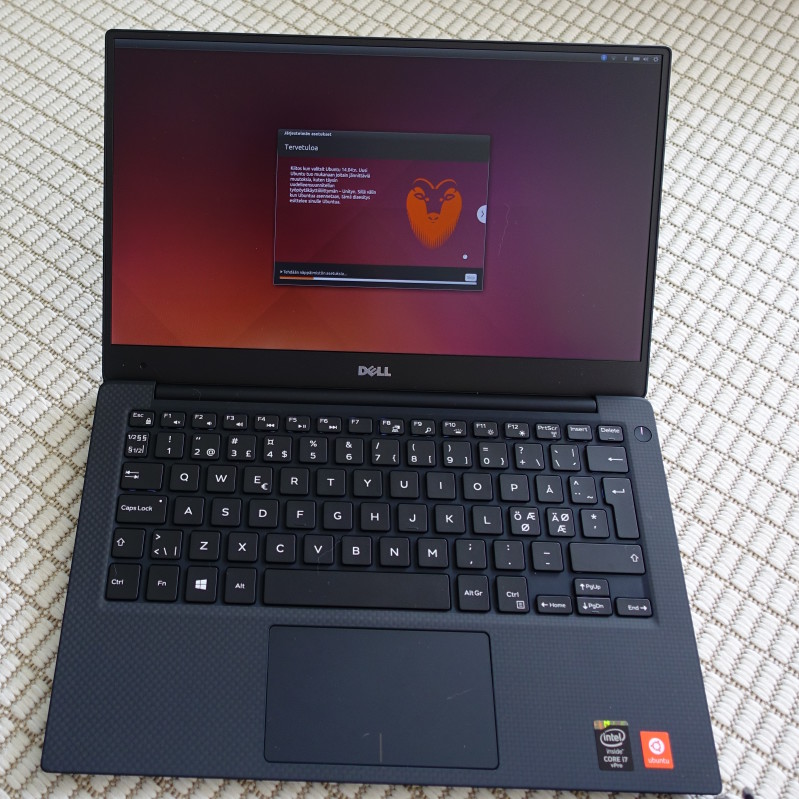
I recently obtained the newest Dell's Ubuntu developer offering, XPS 13 (2015, model 9343). I opted in for FullHD non-touch display, mostly because of better battery life, the actual no need for higher resolution, and matte screen which is great outside. Touch would have been "nice-to-have", but in my work I don't really need it.

The other specifications include i7-5600U CPU, 8GB RAM, 256GB SSD [edit: lshw], and of course Ubuntu 14.04 LTS pre-installed as OEM specific installation. It was not possible to directly order it from Dell site, as Finland is reportedly not online market for Dell... The wholesale company however managed to get two models on their lists and so it's now possible to order via retailers. [edit: here are some country specific direct web order links however US, DE, FR, SE, NL]

In this blog post I give a quick look on how I started up using it, and do a few observations on the pre-installed Ubuntu included. I personally was interested in using the pre-installed Ubuntu like a non-Debian/Ubuntu developer would use it, but Dell has also provided instructions for Ubuntu 15.04, Debian 7.0 and Debian 8.0 advanced users among else. Even if not using the pre-installed Ubuntu, the benefit from buying an Ubuntu laptop is obviously smaller cost and on the other hand contributing to free software (by paying for the hardware enablement engineering done by or purchased by Dell).
Unboxing
The Black Box. (and white cat)

Opened box.


First time lid opened, no dust here yet!
First time boot up, transitioning from the boot logo to a first time Ubuntu video.
A small clip from the end of the welcoming video.
First time setup. Language, Dell EULA, connecting to WiFi, location, keyboard, user+password.
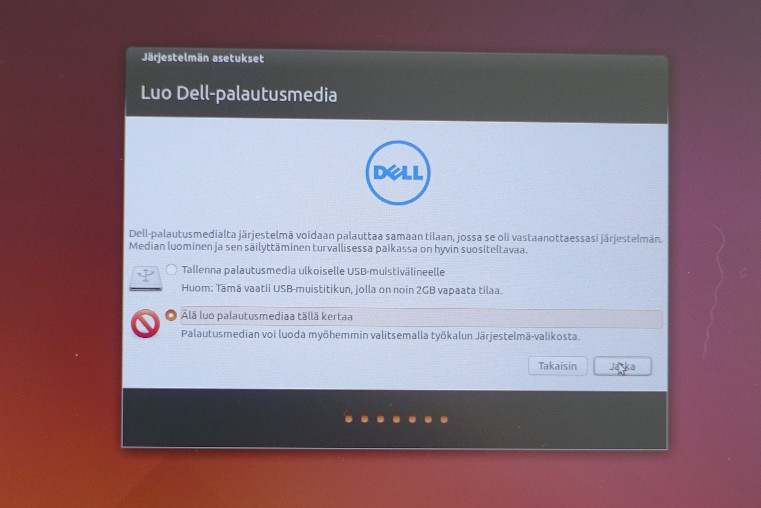
Creating recovery media. I opted not to do this as I had happened to read that it's highly recommended to install upgrades first, including to this tool.
Finalizing setup.
Ready to log in!
It's alive!
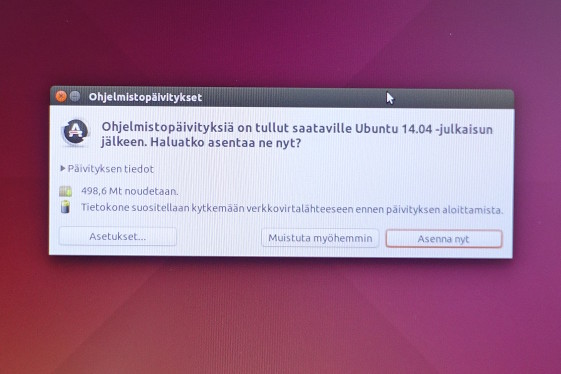
Not so recent 14.04 LTS image... lots of updates.
Problems in the First BatchUnfortunately the first batch of XPS 13:s with Ubuntu are going to ship with some problems. They're easy to fix if you know how to, but it's sad that they're there to begin with in the factory image. There is no knowledge when a fixed batch will start shipping - July maybe?

First of all, installing software upgrades stops. You need to run the following command via Dash Terminal once: sudo apt-get install -f (it suggests upgrading libc-dev-bin, libc6-dbg, libc6-dev and udev). After that you can continue running Software Updater as usual, maybe rebooting in between.

Secondly, the fixed touchpad driver is included but not enabled by default. You need to enable the only non-enabled Additional Driver as seen in the picture below or instructed in Youtube.

Dialog enabling the touchpad driver.

Clarification: you can safely ignore the two paragraphs below, they're just for advanced users like me who want to play with upgraded driver stacks.

Optionally, since I'm interested in the latest graphics drivers especially in case of a brand new hardware like Intel Broadwell, I upgraded my Ubuntu to use the 14.04.2 Hardware Enablement stack (matches 14.10 hardware support): sudo apt install --install-recommends libgles2-mesa-lts-utopic libglapi-mesa-lts-utopic linux-generic-lts-utopic xserver-xorg-lts-utopic libgl1-mesa-dri-lts-utopic libegl1-mesa-drivers-lts-utopic libgl1-mesa-glx-lts-utopic:i386

Even though it's much better than a normal Ubuntu 14.10 would be since many of the Dell fixes continue to be in use, some functionality might become worse compared to the pre-installed stack. The only thing I have noticed though is the internal microphone not working anymore out-of-the-box, requiring a kernel patch as mentioned in Dell's notes. This is not a surprise since the real eventual upstream support involves switching from HDA to I2S and during 14.10 kernel work that was not nearly done. If you're excited about new drivers, I'd recommend waiting until August when the 15.04 based 14.04.3 stack is available (same package names, but 'vivid' instead of 'utopic'). [edit: I couldn't resist myself when I saw linux-generic-lts-vivid (3.19 kernel) is already in the archives. 14.04.2 + that gives me working microphone again!]
ConclusionDell XPS 13 Developer Edition with Ubuntu 14.04 LTS is an extremely capable laptop + OS combination nearing perfection, but not quite there because of the software problems in the launch pre-install image. The laptop looks great, feels like a quality product should and is very compact for the screen size.

I've moved over all my work onto it and everything so far is working smoothly in my day-to-day tasks. I'm staying at Ubuntu 14.04 LTS and using my previous LXC configuration to run the latest Ubuntu and Debian development versions. I've also done some interesting changes already like LUKS In-Place Conversion, converting the pre-installed Ubuntu into whole disk encrypted one (not recommended for the faint hearted, GRUB reconfiguration is a bit of a pain).

I look happily forward to working a few productive years with this one!

1 April 2015

Clint Adams: The SFLC is Hiring

The SFLC is hiring: idealist job posting This is not actually an April 1 joke.

23 March 2015

Jonathan Dowland: Linux music players, 2015 edition

Now I'm back to Linux on the Desktop for my dayjob, I was slightly nervous about checking out the state of the art for Linux music players; an area I've never felt the Linux desktop was very strong on. However for the time being I've largely side-stepped the issue by listening to BBC 6 Music for most of the day. For better or worse, I scrobble, and somebody has written a neat web app for scrobbling along to radio stations. When I want to listen to something different for a change, I've been trying out a trial of Google Play Music, for which somebody has written a Chrome extension to scrobble. On the rare occasions I listen to local music, I'm using VLC. Google Play Music seems pretty good, but I'm not getting a lot from my trial because 6 Music is generally fantastic. Scrobbling 6 Music has revealed a bit of a disconnect for how I use last.fm, and how website thinks you should use it. Within a day or two, my "music compability" with 6 Music was (predictably) "SUPER". Looking at my "Top artists", right near the top are 6 Music's current playlist favourites Courtney Barnett and Nadine Shah, who I can (at least) recall the songs that have been played; just below them are Young Fathers, who I cannot. A little lower are Hot Chip and Slaves: both artists who have current singles out which I enjoyed for a while, but the relentless BBC playlist policy is overdoing them and I'm inclined to switch over when they come on now. If I listen to a whole album in a given week, then the artist will likely (and rightly) be sat at the top of "last 7 days"; if I don't, then it could be something I can't even remember listening to.

9 January 2015

Uwe Hermann: My GPG key transition to a 4096-bit key

This is long overdue, so here goes:
-----BEGIN PGP SIGNED MESSAGE-----
Hash: SHA1,SHA512
I'm transitioning my GPG key from an old 1024D key to a new 4096R key.
The old key will continue to be valid for some time, but I prefer
all new correspondance to be encrypted to the new key, and will be making
all signatures going forward with the new key.
This transition document is signed with both keys to validate the transition.
If you have signed my old key, I would appreciate signatures on my new
key as well, provided that your signing policy permits that without
re-authenticating me.
Old key:
pub   1024D/0x5DD5685778D621B4 2000-03-07
      Key fingerprint = 0F3C 34D1 E4A3 8FC6 435C  01BA 5DD5 6857 78D6 21B4
New key:
pub   4096R/0x1D661A372FED8F94 2013-12-30
      Key fingerprint = 9A17 578F 8646 055C E19D  E309 1D66 1A37 2FED 8F94
-----BEGIN PGP SIGNATURE-----
Version: GnuPG v1
iEYEARECAAYFAlSwEaIACgkQXdVoV3jWIbQW5QCgoFHVU/D4fKSbvmGv3nNy3MAW
S2UAn075ztmxQ8Y9/22crbUug1sEjfh5iQIcBAEBCgAGBQJUsBGiAAoJEB1mGjcv
7Y+U9PgP/29jPvrNcdWsLI8YK9U6+JzS+TMXNyfp6CQXc8O/+zJwqvvxNpqY3rLM
5otRLIEJ2EVdiF8sCWTDGusS9NkMePzumR0AFAR0iltIkekO5O0HbHhK0sXJQv0s
EipDpFRO9k4/CBpJEy6Pkkxwd3ndtmwrL1/oKeVmM4E62PJd9ofMpQb/gMUsrA8u
F8xoOXY8Os82Rrd759PypSxNecjd6SYaVJTHgFbZ0QIMJkdKaufifzARdw+v5jwg
8Q11BhpYxvUSugZgiciKA6RjRK5bfRnT8VQPFd0zneilsIW13zz/jub9df/vtM5L
vY/6jHvXczYXSG8EGpHJQCD3KtQJPWZ0Nz9rAm4emEPmR2qav6KGARatYAm0RBqZ
Y81YUEuiWzGli6DH1m9SQe8bqM/J94vQAAX9VqUn2gz0Z0Ey25kVQE7NOGsbbGVS
vD/E74FSk1At9/RGpstrfEjsDKPRman2xk/oZe+08sRB22CJl40N4tZV9AkCJNom
HHGZKp+VEKaCEiLUIRjKTHt2HTThg39zmxl+OnoTSFYvloxrDJyi9SxZgCAmBhbD
7kLkaSDmdUj6CmoilGU+gd2zmQl2D+RHinYZBxOUf1vi1MDLWNcLIMgrz4mRXgzE
YKkG0newf9UbyJw42sXe2ukNQBIqBcL/DmAhG7V+r0RD7MQnMEYy
=09bN
-----END PGP SIGNATURE-----
The new key is available from keyservers, e.g. pgp.mit.edu or others. In other news: Yes, I've not been blogging much recently, will try to do updates more often. In the mean time, you can also refer to my Twitter account for random stuff or the new sigrok Twitter account for sigrok-related posts.

22 December 2014

Erich Schubert: Java sum-of-array comparisons

This is a follow-up to the post by Daniel Lemire on a close topic.
Daniel Lemire hat experimented with boxing a primitive array in an interface, and has been trying to measure the cost.
I must admit I was a bit sceptical about his results, because I have seen Java successfully inlining code in various situations.
For an experimental library I occasionally work on, I had been spending quite a bit of time on benchmarking. Previously, I had used Google Caliper for it (I even wrote an evaluation tool for it to produce better statistics). However, Caliper hasn't seen much updates recently, and there is a very attractive similar tool at openJDK now, too: Java Microbenchmarking Harness (actually it can be used for benchmarking at other scale, too).
Now that I have experience in both, I must say I consider JMH superior, and I have switched over my microbenchmarks to it. One of the nice things is that it doesn't make this distinction of micro vs. macrobenchmarks, and the runtime of your benchmarks is easier to control.
I largely recreated his task using JMH. The benchmark task is easy: compute the sum of an array; the question is how much the cost is when allowing different data structures than double[].
My results, however, are quite different. And the statistics of JMH indicate the differences may be not significant, and thus indicating that Java manages to inline the code properly.
adapterFor       1000000  thrpt  50  836,898   13,223  ops/s
adapterForL      1000000  thrpt  50  842,464   11,008  ops/s
adapterForR      1000000  thrpt  50  810,343    9,961  ops/s
adapterWhile     1000000  thrpt  50  839,369   11,705  ops/s
adapterWhileL    1000000  thrpt  50  842,531    9,276  ops/s
boxedFor         1000000  thrpt  50  848,081    7,562  ops/s
boxedForL        1000000  thrpt  50  840,156   12,985  ops/s
boxedForR        1000000  thrpt  50  817,666    9,706  ops/s
boxedWhile       1000000  thrpt  50  845,379   12,761  ops/s
boxedWhileL      1000000  thrpt  50  851,212    7,645  ops/s
forSum           1000000  thrpt  50  845,140   12,500  ops/s
forSumL          1000000  thrpt  50  847,134    9,479  ops/s
forSumL2         1000000  thrpt  50  846,306   13,654  ops/s
forSumR          1000000  thrpt  50  831,139   13,519  ops/s
foreachSum       1000000  thrpt  50  843,023   13,397  ops/s
whileSum         1000000  thrpt  50  848,666   10,723  ops/s
whileSumL        1000000  thrpt  50  847,756   11,191  ops/s
The postfix is the iteration type: sum using for loops, with local variable for the length (L), or in reverse order (R); while loops (again with local variable for the length). The prefix is the data layout: the primitive array, the array using a static adapter (which is the approach I have been using in many implementations in cervidae) and using a "boxed" wrapper class around the array (roughly the approach that Daniel Lemire has been investigating. On the primitive array, I also included the foreach loop approach (for(double v:array) ).
If you look at the standard deviations, the results are pretty much identical, except for reverse loops. This is not surprising, given the strong inlining capabilities of Java - all of these codes will lead to next to the same CPU code after warmup and hotspot optimization.
I do not have a full explanation of the differences the others have been seeing. There is no "polymorphism" occurring here (at runtime) - there is only a single Array implementation in use; but this was the same with his benchmark.
Here is a visualization of the results (sorted by average):
Result boxplots
As you can see, most results are indiscernible. The measurement standard deviation is higher than the individual differences. If you run the same benchmark again, you will likely get a different ranking.
Note that performance may - drastically - drop once you use multiple adapters or boxing classes in the same hot codepath. Java Hotspot keeps statistics on the classes it sees, and as long as it only sees 1-2 different types, it performs quite aggressive optimizations instead of doing "virtual" method calls.

30 November 2014

Thorsten Alteholz: My Debian Activities in November 2014

FTP assistant In contrast to the last month, this month has been rather quiet and I really liked that :-) . The stress has moved to the next team. So all in all I marked 101 packages for accept and had to reject 27 packages. As I mostly reviewed really new packages, I didn t have to file any RC bug this month. Squeeze LTS This was my fifth month that I did some work for the Squeeze LTS initiative, started by Raphael Hertzog at Freexian. This month I got assigned a workload of 14.25h and I spent these hours to upload new versions of: I also uploaded [DLA 85-1] libxml-security-java security update, but as nobody of the LTS sponsors had any interest in this package, I did this in my spare time. A package with security in its name should not be affected by security issues. This month my failure of the month has been the binutils package. Although the security team prepared the way for finding the correct patches for all those CVEs, I somehow managed to not find them. This is embarassing I am also a bit disappointed by current LTS users. All important packages have been made available for testing before uploading them to the archive. Apart from some brave fellow DDs, no other feedback was reported on debian-lts. Complaints arrived only when the packages have been finally uploaded. Do admins have enough time nowadays and don t need to use some kind of testbed? Times are changing Other packages This month I even found some time to sponsor uploads, so please welcome a new version of fastaq in experimental and patiently wait for aegaen and kmc to pass NEW. At this point I also want to mention the Debian Med Advent Calendar, which was announced in this email and already mentioned by Andreas in his latest Debian Med bits. Everybody is invited to take care of as much as possible poor souls. Support If you would like to support my Debian work you could either be part of the Freexian initiative (see above) or consider to send some bitcoins to 1JHnNpbgzxkoNexeXsTUGS6qUp5P88vHej. Contact me at donation@alteholz.eu if you prefer another way to donate. Every kind of support is most appreciated.

27 November 2014

Jonathan Dowland: PGP transition statement

-----BEGIN PGP SIGNED MESSAGE-----
Hash: SHA512,SHA1
I'm transitioning from my old, 1024-bit DSA PGP key, FD35 0B0A C6DD 5D91 DB7A 83D1 168B 4E71 7032 F238, to my newer, 4096-bit RSA key, E037 CB2A 1A00 61B9 4336 3C8B 0907 4096 06AA AAAA. If you have signed my old key, I'd be very grateful if you would consider signing my new key. (Thanks in advance!) This is long overdue! I've had 06AAAAAA since 2009, but it took me a while to get enough signatures on it for me to consider a transition. I still have far more signatures on my older key, owing to attending more conferences when I was using it than since I switched. This statement, available in plaintext at http://jmtd.net/log/pgp_transition/statement.txt, has been signed with both keys. I've marked my old key as expiring in around 72 days time, which coincides with my change of job, and will be just short of ten years since I generated it.
-----BEGIN PGP SIGNATURE-----
Version: GnuPG/MacGPG2 v2.0.22 (Darwin)
iQIcBAEBCgAGBQJUdysuAAoJEAkHQJYGqqqquQ0QALVGcn9Wbasg0oh8JeE8rN7h
k7FeZjmGk+ZwfXwo4Eq4pjxKp+TN+r4xBCFSHDRmMaAm9q7aWF/RqkdNiEtioQfJ
SmfzLsoEnSBmS9dr1LvAoxIlUzs/9Lt8EY2tB4NQne3QIu3VyRBjQDvqff6KJgkV
849+GsrJezkg/2VFZkZp1N9y0YwrmezV/1j0N6zR8Y20LlF4YuD3egUJYvbrQ1pA
krJwhiHskXRinqviYMg4CuTZZ3m2wc4fM6uiY5t9taqK90KFgmg73KvW6Rx2L+XP
BUzTlSYHnK+qI23Cng//DthFww2Wf9RofkfRgXk0zAe4+DcoMZzALKtZQA6GrT46
wzsmu459p5nUwwa6BzUvqBzyVtzbtHN5xaFwbjHCPlemsFlH/8LHackJLsBvr2Gp
q292huYu/HNo+Q6OIslFX6rc5AR3HKdbU2DxYMPAfI+CEtW1XwetK8ADSZc1v54C
+sc+Yb2kAleLX2xMIfS9JqvcKOP2Gbo7nTdRPnS2jZRWOv8JxVfFiSzHVODtlLfk
AmRvms5rQ2nPnB21yOd+DP2sACVKY0MS7/UwMh2hoQLR/bSu/jRh24n3WHDfQWtF
Jp4AD80ABFV2t/pSP1L70HlxwPmOzra8AVzCdXMOT/SdT387rSM9fvue4FY5goT+
/pResJSl9pAbBCtjOFJoiEYEARECAAYFAlR3Ky4ACgkQFotOcXAy8jiLawCgofsp
ggze/iSpfkyeL0vhXi6N/WMAoLQogFQY+VaQrVP3lGl1VVh4jw0W
=JBA4
-----END PGP SIGNATURE-----

16 November 2014

Stefano Zacchiroli: Debsources Participation in FOSS Outreach Program

Jingjie Jiang selected as OPW intern for Debsources I'm glad to announce that Jingjie Jiang, AKA sophiejjj, has been selected as intern to work on Debsources as part of the FOSS Outreach Program (formerly known as Outreach Program for Women, or OPW). I'll co-mentor her work together with Matthieu Caneill. I've just added sophiejjj's blog to Planet Debian, so you will soon hear about her work in the Debian blogosphere. I've been impressed by the interest that the Debsources proposal in this round of OPW has spawned. Together with Matthieu I have interacted with more than a dozen OPW applicants. Many of them have contributed useful patches during the application period, and those patches have been in production at http://sources.debian.net since quite a while now (see the commit log for details). A special mention goes to Akshita Jha, who has shown a lot of determination in tackling both simple and complex issues affecting Debsources. I hope there will be other chances to work with her in the future. OPW internship will begin December 9th, fasten your seat belts for a boost in Debsources development!

10 November 2014

Petter Reinholdtsen: A Debian package for SMTP via Tor (aka SMTorP) using exim4

The right to communicate with your friends and family in private, without anyone snooping, is a right every citicen have in a liberal democracy. But this right is under serious attack these days. A while back it occurred to me that one way to make the dragnet surveillance conducted by NSA, GCHQ, FRA and others (and confirmed by the whisleblower Snowden) more expensive for Internet email, is to deliver all email using SMTP via Tor. Such SMTP option would be a nice addition to the FreedomBox project if we could send email between FreedomBox machines without leaking metadata about the emails to the people peeking on the wire. I proposed this on the FreedomBox project mailing list in October and got a lot of useful feedback and suggestions. It also became obvious to me that this was not a novel idea, as the same idea was tested and documented by Johannes Berg as early as 2006, and both the Mailpile and the Cables systems propose a similar method / protocol to pass emails between users. To implement such system one need to set up a Tor hidden service providing the SMTP protocol on port 25, and use email addresses looking like username@hidden-service-name.onion. With such addresses the connections to port 25 on hidden-service-name.onion using Tor will go to the correct SMTP server. To do this, one need to configure the Tor daemon to provide the hidden service and the mail server to accept emails for this .onion domain. To learn more about Exim configuration in Debian and test the design provided by Johannes Berg in his FAQ, I set out yesterday to create a Debian package for making it trivial to set up such SMTP over Tor service based on Debian. Getting it to work were fairly easy, and the source code for the Debian package is available from github. I plan to move it into Debian if further testing prove this to be a useful approach. If you want to test this, set up a blank Debian machine without any mail system installed (or run apt-get purge exim4-config to get rid of exim4). Install tor, clone the git repository mentioned above, build the deb and install it on the machine. Next, run /usr/lib/exim4-smtorp/setup-exim-hidden-service and follow the instructions to get the service up and running. Restart tor and exim when it is done, and test mail delivery using swaks like this:
torsocks swaks --server dutlqrrmjhtfa3vp.onion \
  --to fbx@dutlqrrmjhtfa3vp.onion
This will test the SMTP delivery using tor. Replace the email address with your own address to test your server. :) The setup procedure is still to complex, and I hope it can be made easier and more automatic. Especially the tor setup need more work. Also, the package include a tor-smtp tool written in C, but its task should probably be rewritten in some script language to make the deb architecture independent. It would probably also make the code easier to review. The tor-smtp tool currently need to listen on a socket for exim to talk to it and is started using xinetd. It would be better if no daemon and no socket is needed. I suspect it is possible to get exim to run a command line tool for delivery instead of talking to a socket, and hope to figure out how in a future version of this system. Until I wipe my test machine, I can be reached using the fbx@dutlqrrmjhtfa3vp.onion mail address, deliverable over SMTorP. :)

9 November 2014

John Goerzen: Being Different

This evening, after the boys were in bed, Laura and I sat down to an episode of MASH (a TV series from the 70s) and leftover homemade pumpkin bars. She commented, Sometimes I wonder what generation we re in. This doesn t seem to be something people our age are usually doing. Probably true. I suppose people my age aren t usually learning to play the penny whistle or put up antennas in trees either. We ve had a fun day today a different sort of day in a lot of ways. We took the boys for their first Wichita Symphony Orchestra experience they were doing their first-ever family concert (Beethoven Lived Upstairs, which combined Beethoven s music with a two-person play aimed at kids). And they had an instrument petting zoo beforehand. Both boys loved it.
From November 8, 2014
After that, we took them to a sushi place for the first time. We ordered different types of rolls for our table, encouraging them to start with the California roll. They loved it (though Oliver did complain it was a bit hard to eat). Jacob happily devoured everything he could that wasn t spicy. He would have probably devoured the plate of California roll slices by himself if I hadn t stopped him and encouraged him to slow down and try some other things too. It doesn t seem very common around here to take 5-year-olds to a sushi place and plan on them eating the same sort of food that the adults around them are. It is a lot of fun to be different. Jacob and Oliver both have their unique personalities and interests, and I hope that they continue to find strength and joy in all the ways they are unique.

1 November 2014

Thorsten Alteholz: My Debian Activities in October 2014

FTP assistant This month has been the month before the freeze. Lots of people uploaded a package at the last moment and wanted to have it in testing before everything is over. This resulted in even more processed package than in September. I was able to accept 407 packages and had to reject 77. The whole FTP team managed it to bring the NEW queue below 40 waiting packages. As the Release team doesn t like to see binary-NEW packages appearing in unstable (at least those which change the soname of a lib), this number will increase again. But, that s life I am glad that a freeze happens only every few years. So I would particularly thank my dear wife for her patience, when she saw me sitting in front of that damned computer again and again. Squeeze LTS This was my fourth month that I did some work for the Squeeze LTS initiative, started by Raphael Hertzog at Freexian. This month I got assigned a workload of 13.75h and I spent these hours to upload new versions of I also prepared a new upload of wget and still wait for some feedback. In this case some default values had to be changed and I better wait a bit before I break some scripts. Moreover five CVEs accumulated for php5, so I guess another upload has to be done for this package. This will be ready in the next days I also tried to work on libtasn1-3 and librack-ruby. There hadn t been DSAs for these packages and I tried to dig into the upstream repositories. Unfortunately I failed to find the correct patches. Kudos to the Security Team who have to struggle with all kind of commit messages on a daily basis. Other packages I didn t have time to do any work on my own packages. But during my ftp-time I saw one or another package that deals with some kind of home automation. Up to now there doesn t seem to be a Debian group who deals with this topic. Maybe it is time to start one? Support If you would like to support my Debian work you could either be part of the Freexian initiative (see above) or consider to send some bitcoins to 1JHnNpbgzxkoNexeXsTUGS6qUp5P88vHej. Contact me at donation@alteholz.eu if you prefer another way to donate. Every kind of support is most appreciated.

14 October 2014

Julian Andres Klode: Key transition

I started transitioning from 1024D to 4096R. The new key is available at: https://people.debian.org/~jak/pubkey.gpg and the keys.gnupg.net key server. A very short transition statement is available at: https://people.debian.org/~jak/transition-statement.txt and included below (the http version might get extended over time if needed). The key consists of one master key and 3 sub keys (signing, encryption, authentication). The sub keys are stored on an OpenPGP v2 Smartcard. That s really cool, isn t it? Somehow it seems that GnuPG 1.4.18 also works with 4096R keys on this smartcard (I accidentally used it instead of gpg2 and it worked fine), although only GPG 2.0.13 and newer is supposed to work.
-----BEGIN PGP SIGNED MESSAGE-----
Hash: SHA1,SHA512
Because 1024D keys are not deemed secure enough anymore, I switched to
a 4096R one.
The old key will continue to be valid for some time, but i prefer all
future correspondence to come to the new one.  I would also like this
new key to be re-integrated into the web of trust.  This message is
signed by both keys to certify the transition.
the old key was:
pub   1024D/00823EC2 2007-04-12
      Key fingerprint = D9D9 754A 4BBA 2E7D 0A0A  C024 AC2A 5FFE 0082 3EC2
And the new key is:
pub   4096R/6B031B00 2014-10-14 [expires: 2017-10-13]
      Key fingerprint = AEE1 C8AA AAF0 B768 4019  C546 021B 361B 6B03 1B00
-----BEGIN PGP SIGNATURE-----
Version: GnuPG v2
iEYEARECAAYFAlQ9j+oACgkQrCpf/gCCPsKskgCgiRn7DoP5RASkaZZjpop9P8aG
zhgAnjHeE8BXvTSkr7hccNb2tZsnqlTaiQIcBAEBCgAGBQJUPY/qAAoJENc8OeVl
gLOGZiMP/1MHubKmA8aGDj8Ow5Uo4lkzp+A89vJqgbm9bjVrfjDHZQIdebYfWrjr
RQzXdbIHnILYnUfYaOHUzMxpBHya3rFu6xbfKesR+jzQf8gxFXoBY7OQVL4Ycyss
4Y++g9m4Lqm+IDyIhhDNY6mtFU9e3CkljI52p/CIqM7eUyBfyRJDRfeh6c40Pfx2
AlNyFe+9JzYG1i3YG96Z8bKiVK5GpvyKWiggo08r3oqGvWyROYY9E4nLM9OJu8EL
GuSNDCRJOhfnegWqKq+BRZUXA2wbTG0f8AxAuetdo6MKmVmHGcHxpIGFHqxO1QhV
VM7VpMj+bxcevJ50BO5kylRrptlUugTaJ6il/o5sfgy1FdXGlgWCsIwmja2Z/fQr
ycnqrtMVVYfln9IwDODItHx3hSwRoHnUxLWq8yY8gyx+//geZ0BROonXVy1YEo9a
PDplOF1HKlaFAHv+Zq8wDWT8Lt1H2EecRFN+hov3+lU74ylnogZLS+bA7tqrjig0
bZfCo7i9Z7ag4GvLWY5PvN4fbws/5Yz9L8I4CnrqCUtzJg4vyA44Kpo8iuQsIrhz
CKDnsoehxS95YjiJcbL0Y63Ed4mkSaibUKfoYObv/k61XmBCNkmNAAuRwzV7d5q2
/w3bSTB0O7FHcCxFDnn+tiLwgiTEQDYAP9nN97uibSUCbf98wl3/
=VRZJ
-----END PGP SIGNATURE-----

Filed under: Uncategorized

1 October 2014

Thorsten Alteholz: My Debian Activities in September 2014

FTP assistant Starting an article with self laudation might be bad style, but this month I was busy as a bee and could accept 312 packages, 75 packages more than last month. 34 times I contacted the maintainer to ask a question and 51 times I had to reject a package. These numbers remain constant. The number of packages in NEW dropped to about 180. If you want your package included in Jessie, please double-check it and upload an improved version. Squeeze LTS This was my third month that I did some work for the Squeeze LTS initiative, started by Raphael Hertzog at Freexian. All in all I got assigned a workload of 11h for September and I spent these hours to upload new versions of I further tried to upload a new version of python-django. Unfortunately I could not figure out why some of the internal tests of the package failed. So I fowarded the package to Raphael, who could resolve all issues. The Squeeze version of PHP5 contains 140 patches. According to quilt 47 of them are identified to be already in 5.3.29 and 48 patches need to be revised. Some of them are really big, rather old and not really supported in the new 5.3.n version.
As nobody will talk about Squeeze LTS in a few months, I better better avoid the hassle of preparing a point release and concentrate only on security patches further on. Other packages This month I uploaded a new version of net-dns-fingerprint, which closes an RC bug. Unfortunately the package does not work with all DNS servers anymore. Patches or hints what happened are very welcome :-) . Support If you would like to support my Debian work you could either be part of the Freexian initiative (see above) or consider to send some bitcoins to 1JHnNpbgzxkoNexeXsTUGS6qUp5P88vHej. Contact me at donation@alteholz.eu if you prefer another way to donate. Every kind of support is most appreciated.

31 August 2014

Thorsten Alteholz: My Debian activities in August 2014

FTP assistant By pure chance I was able to accept 237 packages, the same number as last month. 33 times I contacted the maintainer to ask a question about a package and 55 times I had to reject a package. The reject number increased a bit as I also worked on packages that already got a note but had not been fully processed. In contrast I only filed three serious bugs this month. Currently there are about 200 packages still waiting in the NEW queue As the freeze for Jessie comes closer every day, I wonder whether all of them can be processed in time. So I don t mind if every maintainer checks the package again and maybe uploads an improved version that can be processed faster. Squeeze LTS This was my second month that I did some work for the Squeeze LTS initiative, started by Raphael Hertzog at Freexian All in all I got assigned a workload of 16.5h for August. I spent these hours to upload new versions of As last month I prepared these uploads on the basis of the corresponding DSAs for Wheezy. For these packages backporting the Wheezy patches to Squeeze was rather easy. I also had a look at python-django and eglibc. Although the python-django patches apply now, the package fails some tests and these issues need some further investigation. In case of eglibc, my small pbuilder didn t have enough resources and trying to build the package resulted in a full disk after more than three hours of work. For PHP5 Ond ej Sur (the real maintainer) suggested to use point releases of upstream instead of applying only patches. I am curious about how much effort is needed for this approach. Stay tuned, next month you will be told more details! Anyway, this is still a lot of fun and I hope I can finish python-django, eglibc and php5 in September. Other packages This month my meep packages plus mpb have been part of a small hdf5 transition. All five packages needed a small patch and a new upload. As the patch was already provided by Gilles Filippini, this was done rather quickly. Support If you would like to support my Debian work you could either be part of the Freexian initiative (see above) or consider to send some bitcoins to 1JHnNpbgzxkoNexeXsTUGS6qUp5P88vHej. Contact me at donation@alteholz.eu if you prefer another way to donate. Every kind of support is most appreciated.

2 June 2014

Francesca Ciceri: 100 bugs triaged: achievement unlocked

After two weeks working as OPW intern for Mozilla, it's time for a recap!
What exactly I've been doing in these two weeks? 100 bugs triaged: achievement unlocked! Yes, this is the thing I'm most proud of. I'm a bit cheating here, as strictly speaking, since the beginning of the internship I've triaged only 44 bugs.
But I've decided to count from the beginning of my activity on bugzilla, at the end of March, since I've started work on that as part of the small contribution required for applying to OPW.
Therefore, it's all OPW related :) Here's the grand total. Right now, I've decided to work on an average of 5 bugs a day: it's mostly triage and/or verification, which is quite fun.
It consists in trying to have a more complete and detailed bug report for the developers: asking the right questions to the reporter, ensuring that the bug is filed against the right product or component and all the information about platforms and version are correct. Or verifying that the bug isn't a duplicate, which involves doing some voodoo with Bugzilla quicksearch (I'm not so good with that yet, mostly because I'm not imaginative enough in the queries... but I'm getting better!) Sometimes triaging means reading lots of documentation (to be sure that something is a bug and not a feature) and checking meta-bugs and release notes to be able to pinpoint the time when something was introduced and the reasoning behind it.
That takes a lot of time, but it makes you discover some funny things, like the Mighty Bouncing Unicorn. And while I know it sounds a bit cruel, it's really good when you're verifying a fix and you find it's not totally ok, or that it triggered another bug.
I've been assured that feeling satisfied after that it's an essential part of the sadistic QA work. Writing FAQs for new triager This started as a personal project even before knowing I've been selected for OPW, and it's now part of my internship: I've been writing a first draft of FAQ for those who approach for the first time the Bug Triaging and Verifying work in Mozilla. It meant taking a whole lot of IRC logs and scan them for the most asked questions during bugdays, and you can find here my first draft. I'll send a RFC today about it on dev-quality mailing list and link it to the main Bugdays page. Lessons learned So, what I've learned in these two weeks? That I'm pretty good at figuring things alone, but I like to have feedback on what I'm working on.
That testing things is an art, and perfectionism is a big plus.
That there are such things as stupid questions, but you have to ask them nonetheless.
That people in the Mozilla community are quite friendly and not scary at all. Not even in video! :) Wishlist I've been thinking about this a lot, and I think I'd like to have They will probably become my next pet project.

27 May 2014

Jon Dowland: 2012 In Review

2013 is nearly all finished up and so I thought I'd spend a little time writing up what was noteable in the last twelve months. When I did so I found an unfinished draft from the year before. It would be a shame for it to go to waste, so here it is. 2012 was an interesting year in many respects with personal highs and lows. Every year I see a lots of "round-up"-style blog posts on the web, titled things like "2012 in music", which attempt to summarize the highlights of the year in that particular context. Here's JWZ's effort, for example. Often they are prefixed with statements like "2012 was a strong year for music" or whatever. For me, 2012 was not a particularly great year. I discovered quite a lot of stuff that I love that was new to me, but not new in any other sense. In Music, there were a bunch of come-back albums that made the headlines. I picked up both of Orbital's Wonky and Brian Eno's Lux (debatably a comeback: his first ambient record since 1983, his first solo effort since 2005, but his fourth collaborative effort on Warp in the naughties). I've enjoyed them both, but I've already forgotten Wonky and I still haven't fully embraced Lux (and On Land has not been knocked from the top spot when I want to listen to ambience.) There was also Throbbing Gristle's (or X-TG) final effort, a semi/post-TG, partly posthumous double-album swan song effort which, even more than Lux, I still haven't fully digested. In all honesty I think it was eclipsed by the surprise one-off release of a live recording of a TG side project featuring Nik Void of Factory Floor: Carter Tutti Void's Transverse, which is excellent. Ostensibly a four-track release, there's a studio excerpt V4 studio (Slap 1) which is available from (at least) Amazon. There's also a much more obscure fifth "unreleased" track cruX which I managed to "buy" from one of the web shops for zero cost. The other big musical surprise for me last year was Beth Jeans Houghton and the Hooves of Destiny: Yours Truly, Cellophane Nose. I knew nothing of BJH, although it turns out I've heard some of her singles repeatedly on Radio 6, but her band's guitarist Ed Blazey and his partner lived in the flat below me briefly. In that time I managed to get to the pub with him just once, but he kindly gave me a copy of their album on 12" afterwards. It reminds me a bit of Goldfrapp circa "Seventh Tree": I really like it and I'm looking forward to whatever they do next. Reznor's How To Destroy Angels squeezed out An Omen EP which failed to set my world on fire as a coherent collection, despite a few strong songs individually. In movies, sadly once again I'd say most of the things I recall seeing would be "also rans". Prometheus was a disappointment, although I will probably rewatch it in 2D at least once. The final Batman was fun although not groundbreaking to me and it didn't surpass Ledger's efforts in The Dark Knight. Inception remains my favourite Nolan by a long shot. Looper is perhaps the stand-out, not least because it came from nowhere and I managed to avoid any hype. In games, I moaned about having moaning about too many games, most of which are much older than 2012. I started Borderlands 2 after enjoying Borderlands (disqualified on age grounds) but to this day haven't persued it much further. I mostly played the two similar meta-games: The Playstation Plus download free games in a fixed time period and the more sporadic but bountiful humble bundle whack-a-mole. More on these another time. In reading, as is typical I mostly read stuff that was not written in 2012. Of that which was, Charles Stross's The Apocalypse Codex was an improvement over The Fuller Memorandum which I did not enjoy much, but in general I'm finding I much prefer Stross's older work to his newer; David Byrne's How Music Works was my first (and currently last) Google Books ebook purchase, and I read it entirely on a Nexus 7. I thoroughly enjoyed the book but the experience has not made a convert of me away from paper. He leans heavily on his own experiences which is inevitable but fortunately they are wide and numerous. Iain Banks' Stonemouth was an enjoyable romp around a fictional Scottish town (one which, I am reliably informed, is incredibly realistical rendered). One of his "mainstream" novels, It avoided a particular plot pattern that I've grown to dread with Banks, much to my suprise (and pleasure). Finally, the stand-out pleasant surprise novel of the year was Pratchett and Baxter's The Long Earth. With a plot device not unlike Banks' Transition or Stross's Family Trade series, the pair managed to write a journey-book capturing the sense-of-wonder that these multiverse plots are good for. (Or perhaps I have a weakness for them). It's hard to find the lines between Baxter and Pratchett's writing, but the debatably-reincarnated Tibetan Monk-cum-Artificial Intelligence 'Lobsang' must surely be Pratchett's. Pratchett managed to squeeze out another non-Discworld novel (Dodger) as well as a long-overdue short story collection, although I haven't read either of them yet. On to 2013's write-up...

14 May 2014

Olivier Berger: Using RDFAlchemy together with RDFLib s SPARQLStore to query DBPedia and process resources in OO way

I ve been searching for interesting ways to manipulate RDF graphs in Python, to create an application that would handle Linked Data Resources in an OO-way, i.e. using Python classes and not tables/sets/lists of triples. The data will be persisted in graphs in a triple store, accessed through a SPARQL enpoint. In this post, I ll illustrate how I managed to tie RDFLib s SPARQLStore plugin and RDFAlchemy to reach a rather nice looking result.
RDFLib provides tools to manipulate graphs, but most of the examples I found didn t load Graph instances from SPARQL, and generally used SPARQLWrapper results (tables) manually. Here comes a first tool to the rescue : SPARQLStore, which allows to dynamically query a remote SPARQL endpoint when navigating an RDFLib graph. I couldn t find a lot of documentation about it, but I found some hints in slide 51 of the excellent presentation by Tatiana Al-Chueyr Linking the world with Python and Semantics. Now, I know how I can manipulate the RDFLib Graphs queried from a remote SPARQL endpoint with the usual methods, I m still not satisfied, because I want OO stuff, not lists of (predicate, object) tuples. Here comes the second tool, RDFAlchemy, which allows to create descriptor classes mapping RDF Resources to Python classes. Here again, there isn t much docs available, but I found the excellent tutorial by Ted Lawless Reading and writing RDF for VIVO with RDFAlchemy. Now we can put the 2 pieces together, modulo a few precautions : the SPARQLStore plugin of RDFLib will generate SPARQL queries everytime a graph is navigated, whereas RDFAlchemy expects the graph to be in memory (at least AFAIU). So we ll have to manually pre-load the contents of the graphs that we need for all the attributes of the descriptor classes. I ve written an example code that illustrates this by trying to query french films in Wikipedia. Here s a copy of the gist. Attention, it will query DBPedia a lot, so pay attention to the bandwidth and memory if you change parameters. It isn t perfect, and I still need to investigate benefits and limitations of the approach. On clear limitation is the number of SPARQL queries made on the endpoint, instead of a smarter pre-loading. Also, on a side note, during tests I could spot a few issues with SPARQLStore, which seems lagging behind probably not used by so many people. The RDFAlchemy project doesn t seem to be in great health, mostly unmaintained from what I can see (and notice that I linked to the GitHub clone/fork that seemed to be the latest maintained while the original author s seems dead), but nevertheless, the code works with a more recent RDFLib, so that s not so bad. Stay tuned for more adventures in Linked Data land in Python.

Next.

Previous.