Search Results: "hug"

19 January 2025

Petter Reinholdtsen: 121 packages in Debian mapped to hardware for automatic recommendation

For some years now, I have been working on a automatic hardware based package recommendation system for Debian and other Linux distributions. The isenkram system I started on back in 2013 now consist of two subsystems, one locating firmware files using the information provided by apt-file, and one matching hardware to packages using information provided by AppStream. The former is very similar to the mechanism implemented in debian-installer to pick the right firmware packages to install. This post is about the latter system. Thanks to steady progress and good help from both other Debian and upstream developers, I am happy to report that the Isenkram system now are able to recommend 121 packages using information provided via AppStream. The mapping is done using modalias information provided by the kernel, the same information used by udev when creating device files, and the kernel when deciding which kernel modules to load. To get all the modalias identifiers relevant for your machine, you can run the following command on the command line:
find /sys/devices -name modalias -print0   xargs -0 sort -u
The modalias identifiers can look something like this:
acpi:PNP0000
cpu:type:x86,ven0000fam0006mod003F:feature:,0000,0001,0002,0003,0004,0005,0006,0007,0008,0009,000B,000C,000D,000E,000F,0010,0011,0013,0015,0016,0017,0018,0019,001A,001B,001C,001D,001F,002B,0034,003A,003B,003D,0068,006B,006C,006D,006F,0070,0072,0074,0075,0076,0078,0079,007C,0080,0081,0082,0083,0084,0085,0086,0087,0088,0089,008B,008C,008D,008E,008F,0091,0092,0093,0094,0095,0096,0097,0098,0099,009A,009B,009C,009D,009E,00C0,00C5,00E1,00E3,00EB,00ED,00F0,00F1,00F3,00F5,00F6,00F9,00FA,00FB,00FD,00FF,0100,0101,0102,0103,0111,0120,0121,0123,0125,0127,0128,0129,012A,012C,012D,0140,0160,0161,0165,016C,017B,01C0,01C1,01C2,01C4,01C5,01C6,01F9,024A,025A,025B,025C,025F,0282
dmi:bvnDellInc.:bvr2.18.1:bd08/14/2023:br2.18:svnDellInc.:pnPowerEdgeR730:pvr:rvnDellInc.:rn0H21J3:rvrA09:cvnDellInc.:ct23:cvr:skuSKU=NotProvided
pci:v00008086d00008D3Bsv00001028sd00000600bc07sc80i00
platform:serial8250
scsi:t-0x05
usb:v413CpA001d0000dc09dsc00dp00ic09isc00ip00in00
The entries above are a selection of the complete set available on a Dell PowerEdge R730 machine I have access to, to give an idea about the various styles of hardware identifiers presented in the modalias format. When looking up relevant packages in a Debian Testing installation on the same R730, I get this list of packages proposed:
% sudo isenkram-lookup
firmware-bnx2x
firmware-nvidia-graphics
firmware-qlogic
megactl
wsl
%
The list consist of firmware packages requested by kernel modules, as well packages with program to get the status from the RAID controller and to maintain the LAN console. When the edac-utils package providing tools to check the ECC RAM status will enter testing in a few days, it will also show up as a proposal from isenkram. In addition, once the mfiutil package we uploaded in October get past the NEW processing, it will also propose a tool to configure the RAID controller. Another example is the trusty old Lenovo Thinkpad X230, which have hardware handled by several packages in the archive. This is running on Debian Stable:
% isenkram-lookup 
beignet-opencl-icd
bluez
cheese
ethtool
firmware-iwlwifi
firmware-misc-nonfree
fprintd
fprintd-demo
gkrellm-thinkbat
hdapsd
libpam-fprintd
pidgin-blinklight
thinkfan
tlp
tp-smapi-dkms
tpb
%
Here there proposal consist of software to handle the camera, bluetooth, network card, wifi card, GPU, fan, fingerprint reader and acceleration sensor on the machine. Here is the complete set of packages currently providing hardware mapping via AppStream in Debian Unstable: air-quality-sensor, alsa-firmware-loaders, antpm, array-info, avarice, avrdude, bmusb-v4l2proxy, brltty, calibre, colorhug-client, concordance-common, consolekit, dahdi-firmware-nonfree, dahdi-linux, edac-utils, eegdev-plugins-free, ekeyd, elogind, firmware-amd-graphics, firmware-ath9k-htc, firmware-atheros, firmware-b43-installer, firmware-b43legacy-installer, firmware-bnx2, firmware-bnx2x, firmware-brcm80211, firmware-carl9170, firmware-cavium, firmware-intel-graphics, firmware-intel-misc, firmware-ipw2x00, firmware-ivtv, firmware-iwlwifi, firmware-libertas, firmware-linux-free, firmware-mediatek, firmware-misc-nonfree, firmware-myricom, firmware-netronome, firmware-netxen, firmware-nvidia-graphics, firmware-qcom-soc, firmware-qlogic, firmware-realtek, firmware-ti-connectivity, fpga-icestorm, g810-led, galileo, garmin-forerunner-tools, gkrellm-thinkbat, goldencheetah, gpsman, gpstrans, gqrx-sdr, i8kutils, imsprog, ledger-wallets-udev, libairspy0, libam7xxx0.1, libbladerf2, libgphoto2-6t64, libhamlib-utils, libm2k0.9.0, libmirisdr4, libnxt, libopenxr1-monado, libosmosdr0, librem5-flash-image, librtlsdr0, libticables2-8, libx52pro0, libykpers-1-1, libyubikey-udev, limesuite, linuxcnc-uspace, lomoco, madwimax, media-player-info, megactl, mixxx, mkgmap, msi-keyboard, mu-editor, mustang-plug, nbc, nitrokey-app, nqc, ola, openfpgaloader, openocd, openrazer-driver-dkms, pcmciautils, pcscd, pidgin-blinklight, ponyprog, printer-driver-splix, python-yubico-tools, python3-btchip, qlcplus, rosegarden, scdaemon, sispmctl, solaar, spectools, sunxi-tools, t2n, thinkfan, tlp, tp-smapi-dkms, trezor, tucnak, ubertooth, usbrelay, uuu, viking, w1retap, wsl, xawtv, xinput-calibrator, xserver-xorg-input-wacom and xtrx-dkms. In addition to these, there are several with patches pending in the Debian bug tracking system, and even more where no-one wrote patches yet. Good candiates for the latter are packages with udev rules but no AppStream hardware information. The isenkram system consist of two packages, isenkram-cli with the command line tools, and isenkram with a GUI background process. The latter will listen for dbus events from udev emitted when new hardware become available (like when inserting a USB dongle or discovering a new bluetooth device), look up the modalias entry for this piece of hardware in AppStream (and a hard coded list of mappings from isenkram - currently working hard to move this list to AppStream), and pop up a dialog proposing to install any not already installed packages supporting this hardware. It work very well today when inserting the LEGO Mindstorms RCX, NXT and EV3 controllers. :) If you want to make sure more hardware related packages get recommended, please help out fixing the remaining packages in Debian to provide AppStream metadata with hardware mappings. As usual, if you use Bitcoin and want to show your support of my activities, please send Bitcoin donations to my address 15oWEoG9dUPovwmUL9KWAnYRtNJEkP1u1b.

16 January 2025

Sergio Talens-Oliag: Command line tools to process templates

I ve always been a fan of template engines that work with text files, mainly to work with static site generators, but also to generate code, configuration files, and other text-based files. For my own web projects I used to go with Jinja2, as all my projects were written in Python, while for static web sites I used the template engines included with the tools I was using, i.e. Liquid with Jekyll and Go Templates (based on the text/template and the html/template go packages) for Hugo. When I needed to generate code snippets or configuration files from shell scripts I used to go with sed and/or envsubst, but lately things got complicated and I started to use a command line application called tmpl that uses the Go Template Language with functions from the Sprig library.

tmplI ve been using my fork of the tmpl program to process templates on CI/CD pipelines (gitlab-ci) to generate configuration files and code snippets because it uses the same syntax used by helm (easier to use by other DevOps already familiar with the format) and the binary is small and can be easily included into the docker images used by the pipeline jobs. One interesting feature of the tmpl tool is that it can read values from command line arguments and from multiple files in different formats (YAML, JSON, TOML, etc) and merge them into a single object that can be used to render the templates. There are alternatives to the tmpl tool and I ve looked at them (i.e. simple ones like go-template-cli or complex ones like gomplate), but I haven t found one that fits my needs. For my next project I plan to evaluate a move to a different tool or template format, as tmpl is not being actively maintained (as I said, I m using my own fork) and it is not included on existing GNU/Linux distributions (I packaged it for Debian and Alpine, but I don t want to maintain something like that without an active community and I m not interested in being the upstream myself, as I m trying to move to Rust instead of Go as the compiled programming language for my projects).

Mini JinjaLooking for alternate tools to process templates on the command line I found the minijinja rust crate, a minimal implementation of the Jinja2 template engine that also includes a small command line utility (minijinja-cli) and I believe I ll give it a try on the future for various reasons:
  • I m already familiar with the Jinja2 syntax and it is widely used on the industry.
  • On my code I can use the original Jinja2 module for Python projects and MiniJinja for Rust programs.
  • The included command line utility is small and easy to use, and the binaries distributed by the project are good enough to add them to the docker container images used by CI/CD pipelines.
  • As I want to move to Rust I can try to add functionalities to the existing command line client or create my own version of it if they are needed (don t think so, but who knows).

12 January 2025

Divine Attah-Ohiemi: My 30-Day Outreachy Experience with the Debian Community

Hey everyone! It s Divine Attah-Ohiemi here, and I m excited to share what I ve been up to in my internship with the Debian community. It s been a month since I began this journey, and if you re thinking about applying for Outreachy, let me give you a glimpse into my project and the amazing people I get to work with. So, what s it like in the Debian community? It s a fantastic mix of folks from all walks of life seasoned developers, curious newbies, and everyone in between. What really stands out is how welcoming everyone is. I m especially thankful to my mentors, Thomas Lange, Carsten Schoenert, and Subin Siby, for their guidance and for always clocking in whenever I have questions. It feels like a big family where you can share your ideas and learn from each other. The commitment to diversity and merit is palpable, making it a great place for anyone eager to jump in and contribute. Now, onto the project! We re working on improving the Debian website by switching from WML (Web Meta Language) to Hugo, a modern static site generator. This change doesn t just make the site faster; it significantly reduces the time it takes to build compared to WML. Plus, it makes it way easier for non-developers to contribute and add pages since the content is built from Markdown files. It s all about enhancing the experience for both new and existing users. My role involves developing a proof of concept for this transition. I m migrating existing pages while ensuring that old links still work, so users won t run into dead ends. It s a bit of a juggling act, but knowing that my work is helping to make Debian more accessible is incredibly rewarding. What gets me most excited is the chance to contribute to a project that s been around for over 20 years! It s an honor to be part of something so significant and to help shape its future. How cool is it to know that what I m doing will impact users around the globe? In the past month, I ve learned a bunch of new things. For instance, I ve been diving into Apache's mod_rewrite to automatically map old multilingual URLs to new ones. This is important since Hugo handles localization differently than WML. I ve also been figuring out how to set up 301 redirects to prevent dead links, which is crucial for a smooth user experience. One of the more confusing parts has been using GNU Make to manage Perl scripts for dynamic pages. It s a bit of a learning curve, but I m tackling it head-on. Each challenge is a chance to grow, and I m here for it! If you re considering applying to the Debian community through Outreachy, I say go for it! There s so much to learn and experience, and you ll be welcomed with open arms. Happy coding, everyone!

5 January 2025

Enrico Zini: ncdu on files to back up

I use borg and restic to backup files in my system. Sometimes I run a huge download or clone a large git repo and forget to mark it with CACHEDIR.TAG, and it gets picked up slowing the backup process and wasting backup space uselessly. I would like to occasionally audit the system to have an idea of what is a candidate for backup. ncdu would be great for this, but it doesn't know about backup exclusion filters. Let's teach it then. Here's a script that simulates a backup and feeds the results to ncdu:
#!/usr/bin/python3
import argparse
import os
import sys
import time
import stat
import json
import subprocess
import tempfile
from pathlib import Path
from typing import Any
FILTER_ARGS = [
    "--one-file-system",
    "--exclude-caches",
    "--exclude",
    "*/.cache",
]
BACKUP_PATHS = [
    "/home",
]
class Dir:
    """
    Dispatch borg output into a hierarchical directory structure.
    borg prints a flat file list, ncdu needs a hierarchical JSON.
    """
    def __init__(self, path: Path, name: str):
        self.path = path
        self.name = name
        self.subdirs: dict[str, "Dir"] =  
        self.files: list[str] = []
    def print(self, indent: str = "") -> None:
        for name, subdir in self.subdirs.items():
            print(f" indent name: /")
            subdir.print(indent + " ")
        for name in self.files:
            print(f" indent name ")
    def add(self, parts: tuple[str, ...]) -> None:
        if len(parts) == 1:
            self.files.append(parts[0])
            return
        subdir = self.subdirs.get(parts[0])
        if subdir is None:
            subdir = Dir(self.path / parts[0], parts[0])
            self.subdirs[parts[0]] = subdir
        subdir.add(parts[1:])
    def to_data(self) -> list[Any]:
        res: list[Any] = []
        st = self.path.stat()
        res.append(self.collect_stat(self.name, st))
        for name, subdir in self.subdirs.items():
            res.append(subdir.to_data())
        dir_fd = os.open(self.path, os.O_DIRECTORY)
        try:
            for name in self.files:
                try:
                    st = os.lstat(name, dir_fd=dir_fd)
                except FileNotFoundError:
                    print(
                        "Possibly broken encoding:",
                        self.path,
                        repr(name),
                        file=sys.stderr,
                    )
                    continue
                if stat.S_ISDIR(st.st_mode):
                    continue
                res.append(self.collect_stat(name, st))
        finally:
            os.close(dir_fd)
        return res
    def collect_stat(self, fname: str, st) -> dict[str, Any]:
        res =  
            "name": fname,
            "ino": st.st_ino,
            "asize": st.st_size,
            "dsize": st.st_blocks * 512,
         
        if stat.S_ISDIR(st.st_mode):
            res["dev"] = st.st_dev
        return res
class Scanner:
    def __init__(self) -> None:
        self.root = Dir(Path("/"), "/")
        self.data = None
    def scan(self) -> None:
        with tempfile.TemporaryDirectory() as tmpdir_name:
            mock_backup_dir = Path(tmpdir_name) / "backup"
            subprocess.run(
                ["borg", "init", mock_backup_dir.as_posix(), "--encryption", "none"],
                cwd=Path.home(),
                check=True,
            )
            proc = subprocess.Popen(
                [
                    "borg",
                    "create",
                    "--list",
                    "--dry-run",
                ]
                + FILTER_ARGS
                + [
                    f" mock_backup_dir ::test",
                ]
                + BACKUP_PATHS,
                cwd=Path.home(),
                stderr=subprocess.PIPE,
            )
            assert proc.stderr is not None
            for line in proc.stderr:
                match line[0:2]:
                    case b"- ":
                        path = Path(line[2:].strip().decode())
                    case b"x ":
                        continue
                    case _:
                        raise RuntimeError(f"Unparsable borg output:  line!r ")
                if path.parts[0] != "/":
                    raise RuntimeError(f"Unsupported path:  path.parts!r ")
                self.root.add(path.parts[1:])
    def to_json(self) -> list[Any]:
        return [
            1,
            0,
             
                "progname": "backup-ncdu",
                "progver": "0.1",
                "timestamp": int(time.time()),
             ,
            self.root.to_data(),
        ]
    def export(self):
        return json.dumps(self.to_json()).encode()
def main():
    parser = argparse.ArgumentParser(
        description="Run ncdu to estimate sizes of files to backup."
    )
    parser.parse_args()
    scanner = Scanner()
    scanner.scan()
    # scanner.root.print()
    res = subprocess.run(["ncdu", "-f-"], input=scanner.export())
    sys.exit(res.returncode)
if __name__ == "__main__":
    main()

1 January 2025

Russ Allbery: 2024 Book Reading in Review

In 2024, I finished and reviewed 46 books, not counting another three books I've finished but not yet reviewed and which will therefore roll over to 2025. This is slightly fewer books than the last couple of years, but more books than 2021. Reading was particularly spotty this year, with much of the year's reading packed into late November and December. This was a year in which I figured out I was trying to do too much, but did not finish figuring out what to do about it. Reading and particularly reviewing reflected that, with long silent periods and then attempts to catch up. One of the goals for next year is to find a more sustainable balance for the hobbies in my life, including reading. My favorite books I read this year were Ashley Herring Blake's Bright Falls sapphic romance trilogy: Delilah Green Doesn't Care, Astrid Parker Doesn't Fail, and Iris Kelly Doesn't Date. These are not perfect books, but they made me laugh, made me cry, and were impossible to put down. My thanks to a video from BookTuber Georgia Marie for the recommendation. I Shall Wear Midnight was the best of the remaining Pratchett novels. It's the penultimate Tiffany Aching book and, in my opinion, the best. All of the elements of the previous books come together in snarky competence porn that was a delight to read. The best book I read last year was Mark Lawrence's The Book That Wouldn't Burn, which much to my surprise did not make a single award list for its publication year of 2023. It was a tour de force of world-building that surprised me multiple times. Unfortunately, the sequel was not as good and I fear the series may be heading in the wrong direction. I am attempting to stay hopeful about the upcoming third and concluding book. I didn't read much non-fiction this year, but the best of what I did read was Zeke Faux's Number Go Up about the cryptocurrency bubble. This book will not change anyone's mind, but it's a readable and entertaining summary of some of the more obvious cryptocurrency scams. I also had enough quibbles with it to write an extended review, which is a compliment of sorts. The Discworld read-through is done, so I may either start or return to another series re-read in 2025. I have a huge backlog of all sorts of books, though, so we will see how the year goes. As always, I have no specific numeric goals, just a hope that I can make time for regular and varied reading and maintain a rhythm with writing reviews. The full analysis includes some additional personal reading statistics, probably only of interest to me.

Louis-Philippe V ronneau: 2024 A Musical Retrospective

Another musical retrospective. If you enjoy this, I also did a 2022 and a 2023 one. Albums In 2024, I added 88 new albums to my collection that's a lot! This year again, I bought the vast majority of my music on Bandcamp. To be honest, I'm quite distraught by what's become of that website. Although it stays a wonderful place to buy underground music, Songtradr, the new owner of the platform, has been shown to be viciously anti-union. Money continues to ruin the world, I guess. Concerts I continued to go to a lot of concerts in 2024 (25!). Over the past 3 years, I have been going to more and more concerts, and I think I've reached my "peak". A mean of a concert every two weeks is quite a lot :) If you also like music and concerts, but find yourself not going to as many as you would like, the real secret is not to be afraid to go to concerts alone. Going with friends is always fun, but if I restricted myself to only going to concerts in a group, I'd barely see a few each year. Another good advice is to bring a book or something else1 to pass the time between sets. It can often take 30-45 minutes between sets for the artists to get their instruments ready, which can get quite boring if you just stand there and wait. Anyway, here are the concerts I went to in 2024: Shout out to the Gancio project and to the folks running the Montreal instance. It continues to be a smash hit and most of the interesting concerts end up being advertised there. See you all in 2025!




  1. I bought a Miyoo Mini Plus, a handheld Linux console running OnionOS, for that express reason. So far it's been great and I've been very happy to revisit some childhood classics.

31 December 2024

Russ Allbery: Review: Metal from Heaven

Review: Metal from Heaven, by August Clarke
Publisher: Erewhon
Copyright: November 2024
ISBN: 1-64566-099-0
Format: Kindle
Pages: 443
Metal from Heaven is industrial-era secondary-world fantasy with a literary bent. It is a complete story in one book, and I would be very surprised by a sequel. Clarke previously wrote the Scapegracers young-adult trilogy, which got excellent reviews and a few award nominations, as H.A. Clarke. This is his first adult novel.
Know I adore you. Look out over the glow. The cities sundered, their machines inverted, mountains split and prairies blazing, that long foreseen Hereafter crowning fast. This calamity is a promise made to you. A prayer to you, and to your shadow which has become my second self, tucked behind my eye and growing in tandem with me, pressing outwards through the pupil, the smarter, truer, almost bursting reason for our wrath. Do not doubt me. Just look. Watch us rise as the sun comes up over the beauty. The future stains the bleakness so pink. When my violence subsides, we will have nothing, and be champions.
Marney Honeycutt is twelve years old, a factory worker, and lustertouched. She works in the Yann I. Chauncey Ichorite Foundry in Ignavia City, alongside her family and her best friend, shaping the magical metal ichorite into the valuable industrial products of a new age of commerce and industry. She is the oldest of the lustertouched, the children born to factory workers and poisoned by the metal. It has made her allergic, prone to fits at any contact with ichorite, but also able to exert a strange control over the metal if she's willing to pay the price of spasms and hallucinations for hours afterwards. As Metal from Heaven opens, the workers have declared a strike. Her older sister is the spokesperson, demanding shorter hours, safer working conditions, and an investigation into the health of the lustertouched children. Chauncey's response is to send enforcer snipers to kill the workers, including the entirety of her family.
The girl sang, "Unalone toward dawn we go, toward the glory of the new morning." An enforcer shot her in the belly, and when she did not fall, her head.
Marney survives, fleeing into the city, swearing an impossible personal revenge against Yann Chauncey. An act of charity gets her a ticket on a train into the countryside. The woman who bought her ticket is a bandit who is on the train to rob it. Marney's ability to control ichorite allows her to help the bandits in return, winning her a place with the Highwayman's Choir who have been preying on the shipments of the rich and powerful and then disappearing into the hills. The Choir's secret is that the agoraphobic and paranoid Baron of the Fingerbluffs is dead and has been for years. He was killed by his staff, Hereafterist idealists, who have turned his remote territory into an anarchist commune and haven for pirates and bandits. This becomes Marney's home and the Choir becomes her family, but she never forgets her oath of revenge or the childhood friend she left behind in the piles of bodies and to whom this story is narrated. First, Clarke's writing is absolutely gorgeous.
We scaled the viny mountain jags at Montrose Barony's legal edge, the place where land was and wasn't Ignavia, Royston, and Drustland alike. There was a border but it was diffuse and hallucinatory, even more so than most. On legal papers and state maps there were harsh lines that squashed topography and sanded down the mountains into even hills in planter's rows, but here among the jutting rocks and craggy heather, the ground was lineless.
The rhythm of it, the grasp of contrast and metaphor, the word choice! That climactic word "lineless," with its echo of limitless. So good. Second, this is the rarest of books: a political fantasy that takes class and religion seriously and uses them for more than plot drivers. This is not at all our world, and the technology level is somewhat ambiguous, but the parallels to the Gilded Age and Progressive Era are unmistakable. The Hereafterists that Marney joins are political anarchists, not in the sense of alternative governance structures and political theory sanitized for middle-class liberals, but in the sense of Emma Goldman and Peter Kropotkin. The society they have built in the Fingerbluffs is temporary, threatened, and contingent, but it is sincere and wildly popular among the people who already lived there. Even beyond politics, class is a tangible force in this book. Marney is a factory worker and the child of factory workers. She barely knows how to read and doesn't magically learn over the course of the book. She has friends who are clever in the sense rewarded by politics and nobility, who navigate bureaucracies and political nuance, but that is not Marney's world. When, towards the end of the book, she has to deal with a gathering of high-class women, the contrast is stark, and she navigates that gathering only by being entirely unexpected. Perhaps the best illustration of the subtlety of this is the terminology in the book for lesbian. Marney is a crawly, which is a slur thrown at people like her (and one of the rare fictional slurs that work exactly as the author intended) but is also simply what she calls herself. Whether or not it functions as a slur depends on context, and the context is never hard to understand. The high-class lesbians she meets later are Lunarists, and react to crawly as a vile and insulting word. They use language to separate themselves from both the insult and from the social class that uses it. Language is an indication of culture and manners and therefore of morality, unlike deeds, which admit endless justifications.
Conversation was fleeting. Perdita managed with whomever stood near her, chipper about every prettiness she saw, the flitting butterflies, the dappled light between the leaves, the lushness and the fragrance of untamed land, and her walking companions took turns sharing in her delight. It was infectious, how happy she was. She was going to slaughter millions. She was going to skip like this all the while.
The handling of religion is perhaps even better. Marney was raised a Tullian, which sits alongside two other fleshed-out fictional religions and sketches of several more. Tullians tend to be conservative and patriarchal, and Marney has a realistically complicated relationship with faith: sticking with some Tullian worship practices and gestures because they're part of who she is, feeling a kinship to other Tullians, discarding beliefs that don't fit her, and revising others. Every major religion has a Hereafterist spin or reinterpretation that upends or reverses the parts of the religion that were used to prop up the existing social order and brings it more in line with Hereafterist ideals. We see the Tullian Hereafterist variation in detail, and as someone who has studied a lot of methods of reinterpreting Christianity, I was impressed by how well Clarke invents both a belief system and its revisionist rewrite. This is exactly how religions work in human history, but one almost never sees this subtlety in fantasy novels. Marney's allergy to ichorite causes her internal dialogue to dissolve into hallucinatory synesthesia when she's manipulating or exposed to it. Since that's most of the book, substantial portions read like drug trips with growing body horror. I normally hate this type of narration, so it's a sign of just how good Clarke's writing is that I tolerated it and even enjoyed parts. It helps that the descriptions are irreverent and often surprising, full of unexpected metaphors and sudden turns. It's very hard not to quote paragraph after paragraph of this book. Clarke is also doing a lot with gender that I don't feel qualified to comment in detail on, but it would not surprise me to see this book in the Otherwise Award recommendation list. I can think of three significant male characters, all of whom are well-done, but every other major character is female by at least some gender definition. Within that group, though, is huge gender diversity of the complicated and personal type that doesn't force people into defined boxes. Marney's sexuality is similarly unclassified and sometimes surprising. My one complaint is that I thought the sex scenes (which, to warn, are often graphic) fell into the literary fiction trap of being described so closely and physically that it didn't feel like anyone involved was actually enjoying themselves. (This is almost certainly a matter of personal taste.) I had absolutely no idea how Clarke was going to end this book, and the last couple of chapters caught me by surprise. I'm still not sure what I think about the climax. It's not the ending that I wanted, but one of the merits of this book is that it never did what I thought I wanted and yet made me enjoy the journey anyway. It is, at least, a genre ending, not a literary ending: The reader gets a full explanation of what is going on, and the setting is not static the way that it so often is in literary fiction. The characters can change the world, for good or for ill. The story felt frustrating and incomplete when I first finished it, but I haven't stopped thinking about this book and I think I like the shape of it a bit more now. It was certainly unexpected, at least by me. Clarke names Dhalgren as one of their influences in the acknowledgments, and yes, Metal from Heaven is that kind of book. This is the first 2024 novel I've read that felt like the kind of book that should be on award shortlists. I'm not sure it was entirely successful, and there are parts of it that I didn't like or that weren't for me, but it's trying to do something different and challenging and uncomfortable, and I think it mostly worked. And the writing is so good.
She looked like a mythic princess from the old woodcuts, who ruled nature by force of goodness and faith and had no legal power.
Metal from Heaven is not going to be everyone's taste. If you do not like literary fantasy, there is a real chance that you will hate this. I am very glad that I read it, and also am going to take a significant break from difficult books before I tackle another one. But then I'm probably going to try the Scapegracers series, because Clarke is an author I want to follow. Content notes: Explicit sex, including sadomasochistic sex. Political violence, mostly by authorities. Murdered children, some body horror, and a lot of serious injuries and death. Rating: 8 out of 10

28 December 2024

Thomas Goirand: Running a Lenovo Legion pro 7 laptop under Debian

As I was tired of long build times, so I convinced my boss to buy me a Lenovo Legion pro 7. The reason is: this laptop has an AMD Ryzen 9 7945HX that has 16 cores (32 threads). This reduces a lot the time I have to just wait for my laptop to compile, or run unit tests, especially for big packages like Ceph, OpenVSwitch, and so on. When buying it, I knew it would not be a good fit for Debian, as this type of laptop is aimed at gaming, and the support under Linux is rather bad. I wish Lenovo had other policies, but that is the way it is: if you re a Linux user, you re not suppose to be needing a big CPU, apparently. Anyways, I slowly have been able to fix all issues over this year. In this blog post I ll explain how I fixed all problems, in the hope it can be useful to others. And I ll explain what the src:lenovolegionlinux package (that I now maintain in Debian) does. Video The laptop comes with an nVidia RTX-4080 and a Radeon. I quickly tried the radeon, but couldn t make it work with an external monitor. So I gave up on it, disabled it, and now I m using the proprietary nVidia driver from non-free. I don t like it: the nVidia card drains too much power, and I don t care at all 3D acceleration. I would have prefer an intel board, but no choice: all laptops with this kind of CPU comes with gamer s 3D card. Anyways, apart from the power issue, it works out well. Fan control This sounds like a non-issue, but it is a huge one. Indeed, if not controlling the fan, it is impossible to get the full potential of the CPUs that are otherwise throttling. One may end up using the laptop at a few hundred MHz instead of 5GHz+. More on this later. Sound It took me a really long time to figure out what to do. Indeed, while the sound card works out of the box, the issue was that my laptop came with a TI (Texas Instrument) speaker firmware that isn t on by default. I suppose the purpose is to save on power when it isn t in use. Anyways, to have sound working, one need in Debian, to run at least kernel 6.10, which means for me, running the Bookworm backport, so that there s a kernel module for the speakers. But that s not it. The speakers also need a proprietary firmware in /lib/firmware/TAS2XXX38*.bin. I was able to find that in the ti.com forum. As I tried so many packages, I wouldn t be able to tell which one was the correct one. Once that was done, the firmware needs to be initialized through the i2c interface. I could find a script that did that, which I pushed in my lenovolegionlinux package (see below). WiFi WiFi worked out of the box for me, just it wouldn t wake up if I closed the laptop lead. This fixed it for me in /etc/modprobe.d/rtw8852be.conf: options rtw89_pci disable_aspm_l1=y disable_aspm_l1ss=y
options rtw89_core disable_ps_mode=y lenovolegionlinux package I came across https://github.com/johnfanv2/LenovoLegionLinux which I packaged. The result is now 4 binary packages: lenovolegionlinux-dkms that provides the kernel module for accessing the fan control. python3-legion-linux that provides legion_cli and legion_gui, written in Python, that make it possible to control the kernel module. I often use sudo legion_gui, click on Other options and then switch the power profile from quiet to balanced. Many things on this GUI do no work for me, like the fancurve thingy, but should be working for other flavors of Legion laptops. Please feel free to contribute. There s also legiond that provides a daemon for setting-up the fan curve on wake up. And finally, I pushed my i2c speaker script to a new lenovolegionlinux-sound debian binary package that I have just uploaded today, in the hope it may be useful for others. Conclusion Finally, almost everything is (almost) working as expected. Just my webcam (lsusb says it s a Luxvisions Innotech Limited Integrated Camera) went dark at some point (it did work previously). It is now as if it is working, but just transmitting a black picture. If anyone knows how to fix, please tell me. Also, I only get 40 minutes of battery time if I m lucky, I hope this could be fixed. But overall, I m happy of the laptop. Thanks to Ding Shenghao for his support of many people in the ti.com forum. Thanks to the people maintaining the LenovoLegionLinux that helped me a lot writing this Debian package. Please try and report issue with lenovolegionlinux in Debian, and help me improving it. It is in Salsa s debian namespace in the hope that others may push contributions.

24 December 2024

Divine Attah-Ohiemi: Seamless Transitions: Mastering Apache Redirects for a Smooth Hugo Migration

This week, I dove into setting up redirects with Apache to make the transition to Hugo's multilingual system smoother. The challenge? Ensuring that all those old links still worked while I migrated to the new URL format. For instance, I needed to redirect: /es/distrib to /distrib/index.es.html
/es/social_contract to /social_contract.es.html
/es/intro/about to /intro/about.es.html
/da to /index.da.html

To tackle this, I turned to Apache's mod_rewrite. Here s the magic I came up with in my .htaccess file: RewriteCond % REQUEST_URI ^/([a-z] 2 (?:-[a-z] 2 )?)/(.*)$
RewriteCond % DOCUMENT_ROOT /$2/index.%1.html -f
RewriteCond % DOCUMENT_ROOT /$1/$2 !-d
RewriteRule ^/([a-z] 2 (?:-[a-z] 2 )?)/(.*)$ /$2/index.%1.html [last,redirect]

RewriteCond % REQUEST_URI ^/([a-z] 2 (?:-[a-z] 2 )?)/(.*)$
RewriteCond % DOCUMENT_ROOT /$2.%1.html -f
RewriteCond % DOCUMENT_ROOT /$1/$2 !-d
RewriteRule ^/([a-z] 2 (?:-[a-z] 2 )?)/(.*)$ /$2.%1.html [last,redirect]

What s happening here? The rules check if the URL starts with a language code (like /es or /da). Then, they verify whether the corresponding HTML file exists. If it does, and the path isn t a directory, voil ! The user gets redirected to the new format. It s a bit of a dance with conditions and rules, but it s satisfying to see everything working seamlessly. Now, as I continue migrating content, users clicking on old links won t end up in a digital dead end. It s all about keeping the flow smooth and maintaining that user experience. So, if you re also juggling multilingual pages and thinking about making the switch to Hugo, don t underestimate the power of mod_rewrite. It s your best friend in the world of redirects! Happy coding!

21 December 2024

Benjamin Mako Hill: Thug Life

My current playlist is this diorama of Lulu the Piggy channeling Tupac Shakur in a toy vending machine in the basement of New World Mall in Flushing Chinatown.

19 December 2024

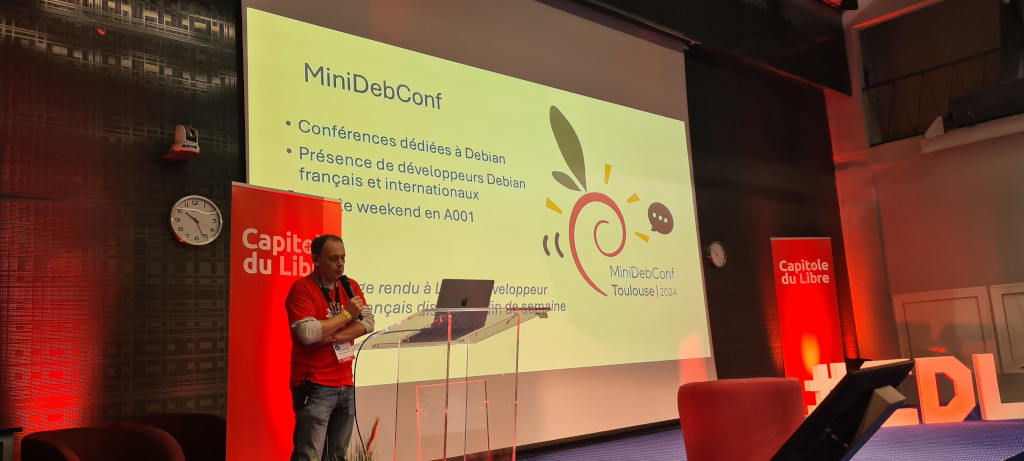
Gregory Colpart: MiniDebConf Toulouse 2024

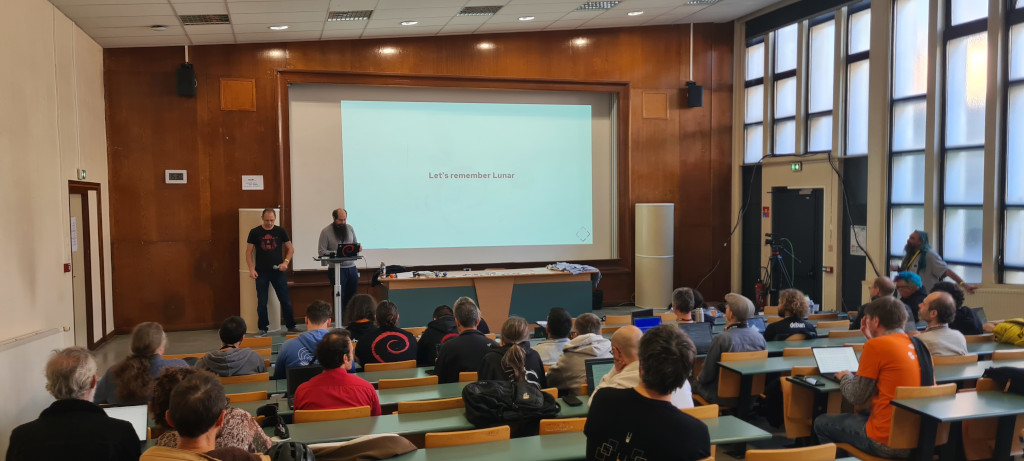
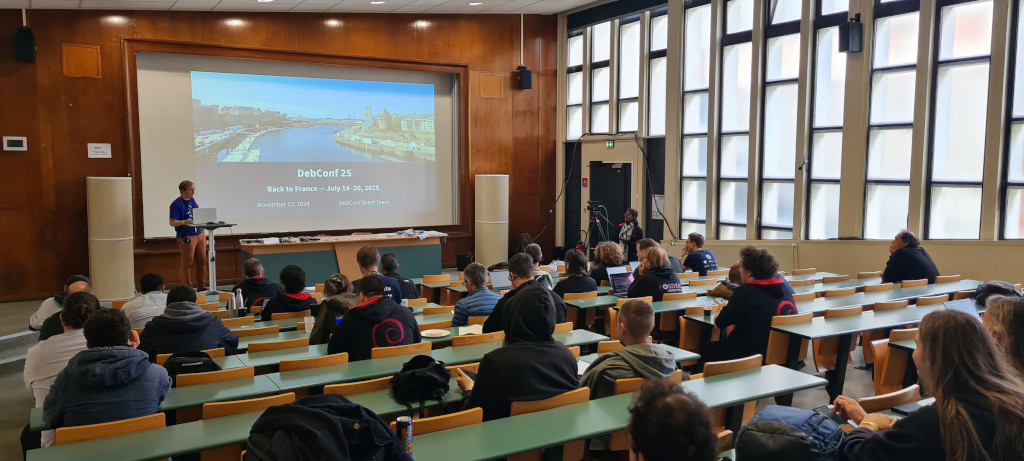
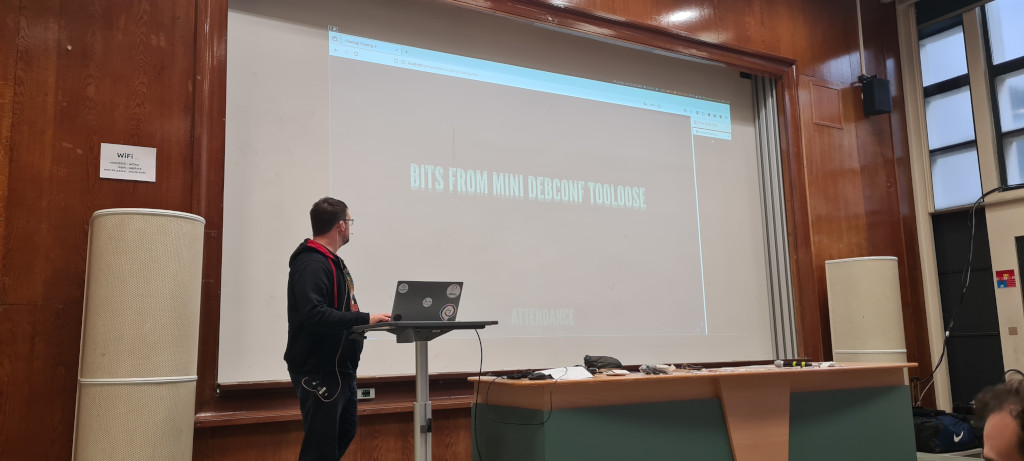
After the MiniDebConf Marseille 2019, COVID-19 made it impossible or difficult to organize new MiniDebConfs for a few years. With the gradual resumption of in-person events (like FOSDEM, DebConf, etc.), the idea emerged to host another MiniDebConf in France, but with a lighter organizational load. In 2023, we decided to reach out to the organizers of Capitole du Libre to repeat the experience of 2017: hosting a MiniDebConf alongside their annual event in Toulouse in November. However, our request came too late for 2023. After discussions with Capitole du Libre in November 2023 in Toulouse and again in February 2024 in Brussels, we confirmed that a MiniDebConf Toulouse would take place in November 2024! We then assembled a small organizing team and got to work: a Call for Papers in May 2024, adding a two-day MiniDebCamp, coordinating with the DebConf video team, securing sponsors, creating a logo, ordering T-shirts and stickers, planning the schedule, and managing registrations. Even with lighter logistics (conference rooms, badges, and catering during the weekend were handled by Capitole du Libre), there was still quite a bit of preparation to do. On Thursday, November 14, and Friday, November 15, 2024, about forty developers arrived from around the world (France, Spain, Italy, Switzerland, Germany, England, Brazil, Uruguay, India, Brest, Marseille ) to spend two days at the MiniDebCamp in the beautiful collaborative spaces of Artilect in Toulouse city center.
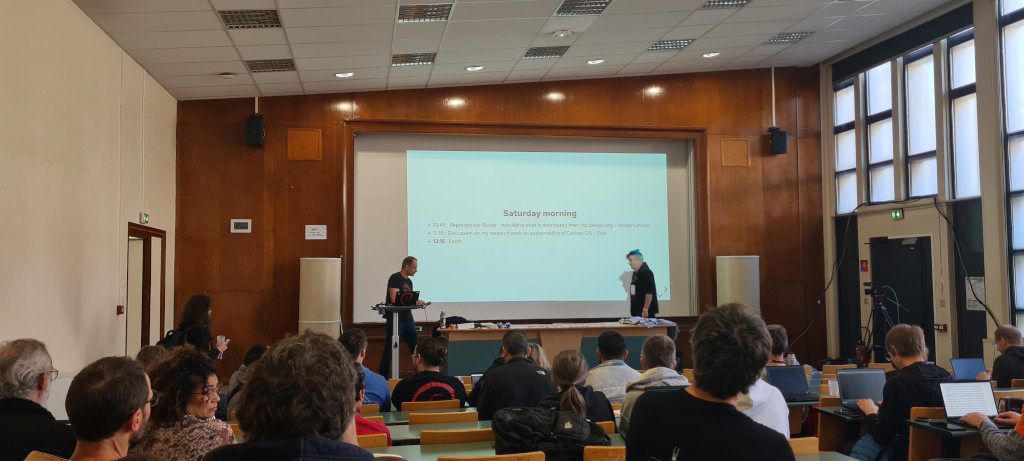
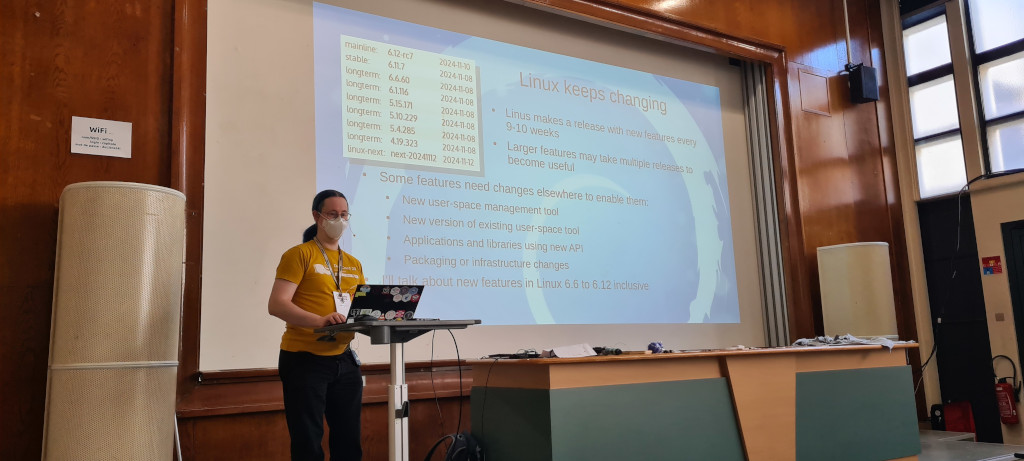
Then, on Saturday, November 16, and Sunday, November 17, 2024, the MiniDebConf took place at ENSEEIHT as part of the Capitole du Libre event. The conference kicked off on Saturday morning with an opening session by J r my Lecour, which included a tribute to Lunar (Nicolas Dandrimont). This was followed by Reproducible Builds Rebuilding What is Distributed from ftp.debian.org (Holger Levsen) and Discussion on My Research Work on Sustainability of Debian OS (Eda). After lunch at the Capitole du Libre food trucks, the intense afternoon schedule began: What s New in the Linux Kernel (and What s Missing in Debian) (Ben Hutchings), Linux Live Patching in Debian (Santiago Ruano Rinc n), Trixie on Mobile: Are We There Yet? (Arnaud Ferraris), PostgreSQL Container Groups, aka cgroups Down the Road (C dric Villemain), Upgrading a Thousand Debian Hosts in Less Than an Hour (J r my Lecour and myself), and Using Debusine to Automate Your QA (Stefano Rivera & co). Sunday marked the second day, starting with a presentation on DebConf 25 (Benjamin Somers), which will be held in Brest in July 2025. The morning continued with talks: How LTS Goes Beyond LTS (Santiago Ruano Rinc n & Roberto C. S nchez), Cross-Building (Helmut Grohne), and State of JavaScript (Bastien Roucari s). In the afternoon, there were Lightning Talks, PyPI Security: Past, Present & Future (Salvo LtWorf Tomaselli), and the classic Bits from DPL (Andreas Tille), before closing with the final session led by Pierre-Elliott B cue. All talks are available on video (a huge thanks to the amazing DebConf video team), and many thanks to our sponsors (Viridien, Freexian, Evolix, Collabora, and Data Bene). A big thank-you as well to the entire Capitole du Libre team for hosting and supporting us see you in Brest in July 2025! Articles about (or mentioning) MiniDebConf Toulouse:

9 December 2024

Gunnar Wolf: Some tips for those who still administer Drupal7-based sites

A bit of history: Drupal at my workplace (and in Debian) My main day-to-day responsibility in my workplace is, and has been for 20 years, to take care of the network infrastructure for UNAM s Economics Research Institute. One of the most visible parts of this responsibility is to ensure we have a working Web presence, and that it caters for the needs of our academic community. I joined the Institute in January 2005. Back then, our designer pushed static versions of our webpage, completely built in her computer. This was standard practice at the time, and lasted through some redesigns, but I soon started advocating for the adoption of a Content Management System. After evaluating some alternatives, I recommended adopting Drupal. It took us quite a bit to do the change: even though I clearly recall starting work toward adopting it as early as 2006, according to the Internet Archive, we switched to a Drupal-backed site around June 2010. We started using it somewhere in the version 6 s lifecycle. As for my Debian work, by late 2012 I started getting involved in the maintenance of the drupal7 package, and by April 2013 I became its primary maintainer. I kept the drupal7 package up to date in Debian until 2018; the supported build methods for Drupal 8 are not compatible with Debian (mainly, bundling third-party libraries and updating them without coordination with the rest of the ecosystem), so towards the end of 2016, I announced I would not package Drupal 8 for Debian. By March 2016, we migrated our main page to Drupal 7. By then, we already had several other sites for our academics projects, but my narrative follows our main Web site. I did manage to migrate several Drupal 6 (D6) sites to Drupal 7 (D7); it was quite involved process, never transparent to the user, and we did have the backlash of long downtimes (or partial downtimes, with sites half-available only) with many of our users. For our main site, we took the opportunity to do a complete redesign and deployed a fully new site. You might note that March 2016 is after the release of D8 (November 2015). I don t recall many of the specifics for this decision, but if I m not mistaken, building the new site was a several months long process not only for the technical work of setting it up, but for the legwork of getting all of the needed information from the different areas that need to be represented in the Institute. Not only that: Drupal sites often include tens of contributed themes and modules; the technological shift the project underwent between its 7 and 8 releases was too deep, and modules took a long time (if at all many themes and modules were outright dumped) to become available for the new release. Naturally, the Drupal Foundation wanted to evolve and deprecate the old codebase. But the pain to migrate from D7 to D8 is too big, and many sites have remained under version 7 Eight years after D8 s release, almost 40% of Drupal installs are for version 7, and a similar proportion runs a currently-supported release (10 or 11). And while the Drupal Foundation made a great job at providing very-long-term support for D7, I understand the burden is becoming too much, so close to a year ago (and after pushing several times the D7, they finally announced support will finish this upcoming January 5.

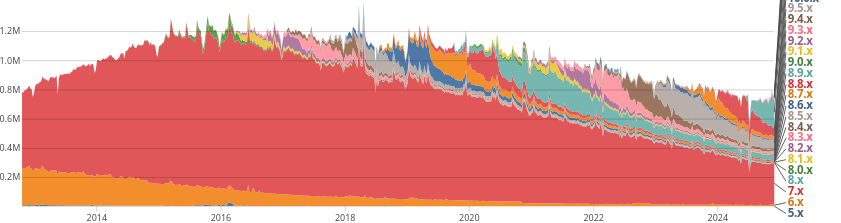
Drupal 7 must go! I found the following usage graphs quite interesting: the usage statistics for all Drupal versions follows a very positive slope, peaking around 2014 during the best years of D7, and somewhat stagnating afterwards, staying since 2015 at the 25000 28000 sites mark (I m very tempted to copy the graphs, but builtwith s terms of use are very clear in not allowing it). There is a sharp drop in the last year I attribute it to the people that are leaving D7 for other technologies after its end-of-life announcement. This becomes clearer looking only at D7 s usage statistics: D7 peaks at 15000 installs in 2016 stays there for close to 5 years, and has a sharp drop to under 7500 sites in the span of one year. D8 has a more regular rise, peak and fall peaking at ~8500 between 2020 and 2021, and down to close to 2500 for some months already; D9 has a very brief peak of almost 9000 sites in 2023 and is now close to half of it. Currently, the Drupal king appears to be D10, still on a positive slope and with over 9000 sites. Drupal 11 is still just a blip in builtwith s radar, with 3 registered sites as of September 2024 :- After writing this last paragraph, I came across the statistics found in the Drupal webpage; the methodology for acquiring its data is completely different: while builtwith s methodology is their trade secret, you can read more about how Drupal s data is gathered (and agree or disagree with it , but at least you have a page detailing 12 years so far of reported data, producing the following graph (which can be shared under the CC BY-SA license ): Drupal usage statistics by version 2013 2024 This graph is disgregated into minor versions, and I don t want to come up with yet another graph for it but it supports (most of) the narrative I presented above although I do miss the recent drop builtwith reported in D7 s numbers!

And what about Backdrop? During the D8 release cycle, a group of Drupal developers were not happy with the depth of the architectural changes that were being adopted, particularly the transition to the Symfony PHP component framework, and forked the D7 codebase to create the Backdrop CMS, a modern version of Drupal, without dropping the known and tested architecture it had. The Backdrop developers keep working closely together with the Drupal community, and although its usage numbers are way smaller than Drupal s, seems to be sustainable and lively. Of course, as I presented their numbers in the previous section, you can see Backdrop s numbers in builtwith are way, way lower. I have found it to be a very warm and welcoming community, eager to receive new members. And, thanks to its contributed D2B Migrate module, I found it is quite easy to migrate a live site from Drupal 7 to Backdrop.

Migration by playbook! So Well, I m an academic. And (if it s not obvious to you after reading so far ), one of the things I must do in my job is to write. So I decided to write an article to invite my colleagues to consider Backdrop for their D7 sites in Cuadernos T cnicos Universitarios de la DGTIC, a young journal in our university for showcasing technical academical work. And now that my article got accepted and published, I m happy to share it with you of course, if you can read Spanish But anyway Given I have several sites to migrate, and that I m trying to get my colleagues to follow suite, I decided to automatize the migration by writing an Ansible playbook to do the heavy lifting. Of course, the playbook s users will probably need to tweak it a bit to their personal needs. I m also far from an Ansible expert, so I m sure there is ample room fo improvement in my style. But it works. Quite well, I must add.

But with this size of database I did stumble across a big pebble, though. I am working on the migration of one of my users sites, and found that its database is huge. I checked the mysqldump output, and it got me close to 3GB of data. And given the D2B_migrate is meant to work via a Web interface (my playbook works around it by using a client I wrote with Perl s WWW::Mechanize), I repeatedly stumbled with PHP s maximum POST size, maximum upload size, maximum memory size I asked for help in Backdrop s Zulip chat site, and my attention was taken off fixing PHP to something more obvious: Why is the database so large? So I took a quick look at the database (or rather: my first look was at the database server s filesystem usage). MariaDB stores each table as a separate file on disk, so I looked for the nine largest tables:
# ls -lhS head
total 3.8G
-rw-rw---- 1 mysql mysql 2.4G Dec 10 12:09 accesslog.ibd
-rw-rw---- 1 mysql mysql 224M Dec  2 16:43 search_index.ibd
-rw-rw---- 1 mysql mysql 220M Dec 10 12:09 watchdog.ibd
-rw-rw---- 1 mysql mysql 148M Dec  6 14:45 cache_field.ibd
-rw-rw---- 1 mysql mysql  92M Dec  9 05:08 aggregator_item.ibd
-rw-rw---- 1 mysql mysql  80M Dec 10 12:15 cache_path.ibd
-rw-rw---- 1 mysql mysql  72M Dec  2 16:39 search_dataset.ibd
-rw-rw---- 1 mysql mysql  68M Dec  2 13:16 field_revision_field_idea_principal_articulo.ibd
-rw-rw---- 1 mysql mysql  60M Dec  9 13:19 cache_menu.ibd
A single table, the access log, is over 2.4GB long. The three following tables are, cache tables. I can perfectly live without their data in our new site! But I don t want to touch the slightest bit of this site until I m satisfied with the migration process, so I found a way to exclude those tables in a non-destructive way: given D2B_migrate works with a mysqldump output, and given that mysqldump locks each table before starting to modify it and unlocks it after its job is done, I can just do the following:
$ perl -e '$output = 1; while (<>)   $output=0 if /^LOCK TABLES  (accesslog search_index watchdog cache_field cache_path) /; $output=1 if /^UNLOCK TABLES/; print if $output ' < /tmp/d7_backup.sql  > /tmp/d7_backup.eviscerated.sql; ls -hl /tmp/d7_backup.sql /tmp/d7_backup.eviscerated.sql
-rw-rw-r-- 1 gwolf gwolf 216M Dec 10 12:22 /tmp/d7_backup.eviscerated.sql
-rw------- 1 gwolf gwolf 2.1G Dec  6 18:14 /tmp/d7_backup.sql
Five seconds later, I m done! The database is now a tenth of its size, and D2B_migrate is happy to take it. And I m a big step closer to finishing my reliance on (this bit of) legacy code for my highly-visible sites

Freexian Collaborators: Debian Contributions: OpenMPI transitions, cPython 3.12.7+ update uploads, Python 3.13 Transition, and more! (by Anupa Ann Joseph, Stefano Rivera)

Debian Contributions: 2024-11 Contributing to Debian is part of Freexian s mission. This article covers the latest achievements of Freexian and their collaborators. All of this is made possible by organizations subscribing to our Long Term Support contracts and consulting services.

Transition management, by Emilio Pozuelo Monfort Emilio has been helping finish the mpi-defaults switch to mpich on 32-bit architectures, and the openmpi transitions. This involves filing bugs for the reverse dependencies, doing NMUs, and requesting removals for outdated (Not Built from Source) binaries on 32-bit architectures where openmpi is no longer available. Those transitions got entangled with a few others, such as the petsc stack, and were blocking many packages from migrating to testing. These transitions were completed in early December.

cPython 3.12.7+ update uploads, by Stefano Rivera Python 3.12 had failed to build on mips64el, due to an obscure dh_strip failure. The mips64el porters never figured it out, but the missing build on mips64el was blocking migration to Debian testing. After waiting a month, enough changes had accumulated in the upstream 3.12 maintenance git branch that we could apply them in the hope of changing the output enough to avoid breaking dh_strip. This worked. Of course there were other things to deal with too. A test started failing due to a Debian-specific patch we carry for python3.x-minimal, and it needed to be reworked. And Stefano forgot to strip the trailing + from PY_VERSION, which confuses some python libraries. This always requires another patch when applying git updates from the maintenance branch. Stefano added a build-time check to catch this mistake in the future. Python 3.12.7 migrated.

Python 3.13 Transition, by Stefano Rivera and Colin Watson During November the Python 3.13-add transition started. This is the first stage of supporting a new version of Python in Debian archive (after preparatory work), adding it as a new supported but non-default version. All packages with compiled Python extensions need to be re-built to add support for the new version. We have covered the lead-up to this transition in the past. Due to preparation, many of the failures we hit were expected and we had patches waiting in the bug tracker. These could be NMUed to get the transition moving. Others had been known about but hadn t been worked on, yet. Some other packages ran into new issues, as we got further into the transition than we d been able to in preparation. The whole Debian Python team has been helping with this work. The rebuild stage of the 3.13-add transition is now over, but many packages need work before britney will let python3-defaults migrate to testing.

Limiting build concurrency based on available RAM, by Helmut Grohne In recent years, the concurrency of CPUs has been increasing as has the demand for RAM by linkers. What has not been increasing as quickly is the RAM supply in typical machines. As a result, we more frequently run into situations where the package builds exhaust memory when building at full concurrency. Helmut initiated a discussion about generalizing an approach to this in Debian packages. Researching existing code that limits concurrency as well as providing possible extensions to debhelper and dpkg to provide concurrency limits based on available system RAM. Thus far there is consensus on the need for a more general solution, but ideas are still being collected for the precise solution.

MiniDebConf Toulouse at Capitole du Libre The whole Freexian Collaborator team attended MiniDebConf Toulouse, part of the Capitole du Libre event. Several members of the team gave talks: Stefano and Anupa worked as part of the video team, streaming and recording the event s talks.

Miscellaneous contributions
  • Stefano looked into packaging the latest upstream python-falcon version in Debian, in support of the Python 3.13 transition. This appeared to break python-hug, which is sadly looking neglected upstream, and the best course of action is probably its removal from Debian.
  • Stefano uploaded videos from various 2024 Debian events to PeerTube and YouTube.
  • Stefano and Santiago visited the site for DebConf 2025 in Brest, after the MiniDebConf in Toulouse, to meet with the local team and scout out the venue. The on-going DebConf 25 organization work of last month also included handling the logo and artwork call for proposals.
  • Stefano helped the press team to edit a post for bits.debian.org on OpenStreetMap s migration to Debian.
  • Carles implemented multiple language support on po-debconf-manager and tested it using Portuguese-Brazilian during MiniDebConf Toulouse. The system was also tested and improved by reviewing more than 20 translations to Catalan, creating merge requests for those packages, and providing user support to new users. Additionally, Carles implemented better status transitions, configuration keys management and other small improvements.
  • Helmut sent 32 patches for cross build failures. The wireplumber one was an interactive collaboration with Dylan A ssi.
  • Helmut continued to monitor the /usr-move, sent a patch for lib64readline8 and continued several older patch conversations. lintian now reports some aliasing issues in unstable.
  • Helmut initiated a discussion on the semantics of *-for-host packages. More feedback is welcome.
  • Helmut improved the crossqa.debian.net infrastructure to fail running lintian less often in larger packages.
  • Helmut continued maintaining rebootstrap mostly dropping applied patches and continuing discussions of submitted patches.
  • Helmut prepared a non-maintainer upload of gzip for several long-standing bugs.
  • Colin came up with a plan for resolving the multipart vs. python-multipart name conflict, and began work on converting reverse-dependencies.
  • Colin upgraded 42 Python packages to new upstream versions. Some were complex: python-catalogue had some upstream version confusion, pydantic and rpds-py involved several Rust package upgrades as prerequisites, and python-urllib3 involved first packaging python-quart-trio and then vendoring an unpackaged test-dependency.
  • Colin contributed Incus support to needrestart upstream.
  • Lucas set up a machine to do a rebuild of all ruby reverse dependencies to check what will be broken by adding ruby 3.3 as an alternative interpreter. The tool used for this is mass-rebuild and the initial rebuilds have already started. The ruby interpreter maintainers are planning to experiment with debusine next time.
  • Lucas is organizing a Debian Ruby sprint towards the end of January in Paris. The plan of the team is to finish any missing bits of Ruby 3.3 transition at the time, try to push Rails 7 transition and fix RC bugs affecting the ruby ecosystem in Debian.
  • Anupa attended a Debian Publicity team meeting in-person during MiniDebCamp Toulouse.
  • Anupa moderated and posted in the Debian Administrator group in LinkedIn.

29 November 2024

Bits from Debian: Debian welcomes its new Outreachy interns

Outreachy logo Debian continues participating in Outreachy, and we're excited to announce that Debian has selected two interns for the Outreachy December 2024 - March 2025 round. Patrick Noblet Appiah will work on Automatic Indi-3rd-party driver update, mentored by Thorsten Alteholz. Divine Attah-Ohiemi will work on Making the Debian main website more attractive by switching to HuGo as site generator, mentored by Carsten Schoenert, Subin Siby and Thomas Lange.
Congratulations and welcome Patrick Noblet Appiah and Divine Attah-Ohiemi! From the official website: Outreachy provides three-month internships for people from groups traditionally underrepresented in tech. Interns work remotely with mentors from Free and Open Source Software (FOSS) communities on projects ranging from programming, user experience, documentation, illustration and graphical design, to data science. The Outreachy programme is possible in Debian thanks to the efforts of Debian developers and contributors who dedicate their free time to mentor students and outreach tasks, and the Software Freedom Conservancy's administrative support, as well as the continued support of Debian's donors, who provide funding for the internships. Join us and help extend Debian! You can follow the work of the Outreachy interns reading their blogs (they are syndicated in Planet Debian), and chat with us in the #debian-outreach IRC channel and mailing list.

22 November 2024

Matthew Palmer: Invalid Excuses for Why Your Release Process Sucks

In my companion article, I made the bold claim that your release process should consist of no more than two steps:
  1. Create an annotated Git tag;
  2. Run a single command to trigger the release pipeline.
As I have been on the Internet for more than five minutes, I m aware that a great many people will have a great many objections to this simple and straightforward idea. In the interests of saving them a lot of wear and tear on their keyboards, I present this list of common reasons why these objections are invalid. If you have an objection I don t cover here, the comment box is down the bottom of the article. If you think you ve got a real stumper, I m available for consulting engagements, and if you turn out to have a release process which cannot feasibly be reduced to the above two steps for legitimate technical reasons, I ll waive my fees.

But I automatically generate my release notes from commit messages! This one is really easy to solve: have the release note generation tool feed directly into the annotation. Boom! Headshot.

But all these files need to be edited to make a release! No, they absolutely don t. But I can see why you might think you do, given how inflexible some packaging environments can seem, and since that s how we ve always done it .

Language Packages Most languages require you to encode the version of the library or binary in a file that you want to revision control. This is teh suck, but I m yet to encounter a situation that can t be worked around some way or another. In Ruby, for instance, gemspec files are actually executable Ruby code, so I call code (that s part of git-version-bump, as an aside) to calculate the version number from the git tags. The Rust build tool, Cargo, uses a TOML file, which isn t as easy, but a small amount of release automation is used to take care of that.

Distribution Packages If you re building Linux distribution packages, you can easily apply similar automation faffery. For example, Debian packages take their metadata from the debian/changelog file in the build directory. Don t keep that file in revision control, though: build it at release time. Everything you need to construct a Debian (or RPM) changelog is in the tag version numbers, dates, times, authors, release notes. Use it for much good.

The Dreaded Changelog Finally, there s the CHANGELOG file. If it s maintained during the development process, it typically has an archive of all the release notes, under version numbers, with an Unreleased heading at the top. It s one more place to remember to have to edit when making that preparing release X.Y.Z commit, and it is a gift to the Demon of Spurious Merge Conflicts if you follow the policy of every commit must add a changelog entry . My solution: just burn it to the ground. Add a line to the top with a link to wherever the contents of annotated tags get published (such as GitHub Releases, if that s your bag) and never open it ever again.

But I need to know other things about my release, too! For some reason, you might think you need some other metadata about your releases. You re probably wrong it s amazing how much information you can obtain or derive from the humble tag so think creatively about your situation before you start making unnecessary complexity for yourself. But, on the off chance you re in a situation that legitimately needs some extra release-related information, here s the secret: structured annotation. The annotation on a tag can be literally any sequence of octets you like. How that data is interpreted is up to you. So, require that annotations on release tags use some sort of structured data format (say YAML or TOML or even XML if you hate your release manager), and mandate that it contain whatever information you need. You can make sure that the annotation has a valid structure and contains all the information you need with an update hook, which can reject the tag push if it doesn t meet the requirements, and you re sorted.

But I have multiple packages in my repo, with different release cadences and versions! This one is common enough that I just refer to it as the monorepo drama . Personally, I m not a huge fan of monorepos, but you do you, boo. Annotated tags can still handle it just fine. The trick is to include the package name being released in the tag name. So rather than a release tag being named vX.Y.Z, you use foo/vX.Y.Z, bar/vX.Y.Z, and baz/vX.Y.Z. The release automation for each package just triggers on tags that match the pattern for that particular package, and limits itself to those tags when figuring out what the version number is.

But we don t semver our releases! Oh, that s easy. The tag pattern that marks a release doesn t have to be vX.Y.Z. It can be anything you want. Relatedly, there is a (rare, but existent) need for packages that don t really have a conception of releases in the traditional sense. The example I ve hit most often is automatically generated bindings packages, such as protobuf definitions. The source of truth for these is a bunch of .proto files, but to be useful, they need to be packaged into code for the various language(s) you re using. But those packages need versions, and while someone could manually make releases, the best option is to build new per-language packages automatically every time any of those definitions change. The versions of those packages, then, can be datestamps (I like something like YYYY.MM.DD.N, where N starts at 0 each day and increments if there are multiple releases in a single day). This process allows all the code that needs the definitions to declare the minimum version of the definitions that it relies on, and everything is kept in sync and tracked almost like magic.

Th-th-th-th-that s all, folks! I hope you ve enjoyed this bit of mild debunking. Show your gratitude by buying me a refreshing beverage, or purchase my professional expertise and I ll answer all of your questions and write all your CI jobs.

20 November 2024

Russell Coker: Solving Spam and Phishing for Corporations

Centralisation and Corporations An advantage of a medium to large company is that it permits specialisation. For example I m currently working in the IT department of a medium sized company and because we have standardised hardware (Dell Latitude and Precision laptops, Dell Precision Tower workstations, and Dell PowerEdge servers) and I am involved in fixing all Linux compatibility issues on that I can fix most problems in a small fraction of the time that I would take to fix on a random computer. There is scope for a lot of debate about the extent to which companies should standardise and centralise things. But for computer problems which can escalate quickly from minor to serious if not approached in the correct manner it s clear that a good deal of centralisation is appropriate. For people doing technical computer work such as programming there s a large portion of the employees who are computer hobbyists who like to fiddle with computers. But if the support system is run well even they will appreciate having computers just work most of the time and for a large portion of the failures having someone immediately recognise the problem, like the issues with NVidia drivers that I have documented so that first line support can implement workarounds without the need for a lengthy investigation. A big problem with email in the modern Internet is the prevalence of Phishing scams. The current corporate approach to this is to send out test Phishing email to people and then force computer security training on everyone who clicks on them. One problem with this is that attackers only need to fool one person on one occasion and when you have hundreds of people doing something on rare occasions that s not part of their core work they will periodically get it wrong. When every test Phishing run finds several people who need extra training it seems obvious to me that this isn t a solution that s working well. I will concede that the majority of people who click on the test Phishing email would probably realise their mistake if asked to enter the password for the corporate email system, but I think it s still clear that this isn t a great solution. Let s imagine for the sake of discussion that everyone in a company was 100% accurate at identifying Phishing email and other scam email, if that was the case would the problem be solved? I believe that even in that hypothetical case it would not be a solved problem due to the wasted time and concentration. People can spend minutes determining if a single email is legitimate. On many occasions I have had relatives and clients forward me email because they are unsure if it s valid, it s great that they seek expert advice when they are unsure about things but it would be better if they didn t have to go to that effort. What we ideally want to do is centralise the anti-Phishing and anti-spam work to a small group of people who are actually good at it and who can recognise patterns by seeing larger quantities of spam. When a spam or Phishing message is sent to 600 people in a company you don t want 600 people to individually consider it, you want one person to recognise it and delete/block all 600. If 600 people each spend one minute considering the matter then that s 10 work hours wasted! The Rationale for Human Filtering For personal email human filtering usually isn t viable because people want privacy. But corporate email isn t private, it s expected that the company can read it under certain circumstances (in most jurisdictions) and having email open in public areas of the office where colleagues might see it is expected. You can visit gmail.com on your lunch break to read personal email but every company policy (and common sense) says to not have actually private correspondence on company systems. The amount of time spent by reception staff in sorting out such email would be less than that taken by individuals. When someone sends a spam to everyone in the company instead of 500 people each spending a couple of minutes working out whether it s legit you have one person who s good at recognising spam (because it s their job) who clicks on a remove mail from this sender from all mailboxes button and 500 messages are deleted and the sender is blocked. Delaying email would be a concern. It s standard practice for CEOs (and C*Os at larger companies) to have a PA receive their email and forward the ones that need their attention. So human vetting of email can work without unreasonable delays. If we had someone checking all email for the entire company probably email to the senior people would never get noticeably delayed and while people like me would get their mail delayed on occasion people doing technical work generally don t have notifications turned on for email because it s a distraction and a fast response isn t needed. There are a few senders where fast response is required, which is mostly corporations sending a click this link within 10 minutes to confirm your password change email. Setting up rules for all such senders that are relevant to work wouldn t be difficult to do. How to Solve This Spam and Phishing became serious problems over 20 years ago and we have had 20 years of evolution of email filtering which still hasn t solved the problem. The vast majority of email addresses in use are run by major managed service providers and they haven t managed to filter out spam/phishing mail effectively so I think we should assume that it s not going to be solved by filtering. There is talk about what AI technology might do for filtering spam/phishing but that same technology can product better crafted hostile email to avoid filters. An additional complication for corporate email filtering is that some criteria that are used to filter personal email don t apply to corporate mail. If someone sends email to me personally about millions of dollars then it s obviously not legit. If someone sends email to a company then it could be legit. Companies routinely have people emailing potential clients about how their products can save millions of dollars and make purchases over a million dollars. This is not a problem that s impossible to solve, it s just an extra difficulty that reduces the efficiency of filters. It seems to me that the best solution to the problem involves having all mail filtered by a human. A company could configure their mail server to not accept direct external mail for any employee s address. Then people could email files to colleagues etc without any restriction but spam and phishing wouldn t be a problem. The issue is how to manage inbound mail. One possibility is to have addresses of the form it+russell.coker@example.com (for me as an employee in the IT department) and you would have a team of people who would read those mailboxes and forward mail to the right people if it seemed legit. Having addresses like it+russell.coker means that all mail to the IT department would be received into folders of the same account and they could be filtered by someone with suitable security level and not require any special configuration of the mail server. So the person who read the is mailbox would have a folder named russell.coker receiving mail addressed to me. The system could be configured to automate the processing of mail from known good addresses (and even domains), so they could just put in a rule saying that when Dell sends DMARC authenticated mail to is+$USER it gets immediately directed to $USER. This is the sort of thing that can be automated in the email client (mail filtering is becoming a common feature in MUAs). For a FOSS implementation of such things the server side of it (including extracting account data from a directory to determine which department a user is in) would be about a day s work and then an option would be to modify a webmail program to have extra functionality for approving senders and sending change requests to the server to automatically direct future mail from the same sender. As an aside I have previously worked on a project that had a modified version of the Horde webmail system to do this sort of thing for challenge-response email and adding certain automated messages to the allow-list. The Change One of the first things to do is configuring the system to add every recipient of an outbound message to the allow list for receiving a reply. Having a script go through the sent-mail folders of all accounts and adding the recipients to the allow lists would be easy and catch the common cases. But even with processing the sent mail folders going from a working system without such things to a system like this will take some time for the initial work of adding addresses to the allow lists, particularly for domain wide additions of all the sites that send password confirmation messages. You would need rules to direct inbound mail to the old addresses to the new style and then address a huge amount of mail that needs to be categorised. If you have 600 employees and the average amount of time taken on the first day is 10 minutes per user then that s 100 hours of work, 12 work days. If you had everyone from the IT department, reception, and executive assistants working on it that would be viable. After about a week there wouldn t be much work involved in maintaining it. Then after that it would be a net win for the company. The Benefits If the average employee spends one minute a day dealing with spam and phishing email then with 600 employees that s 10 hours of wasted time per day. Effectively wasting one employee s work! I m sure that s the low end of the range, 5 minutes average per day doesn t seem unreasonable especially when people are unsure about phishing email and send it to Slack so multiple employees spend time analysing it. So you could have 5 employees being wasted by hostile email and avoiding that would take a fraction of the time of a few people adding up to less than an hour of total work per day. Then there s the training time for phishing mail. Instead of having every employee spend half an hour doing email security training every few months (that s 300 hours or 7.5 working weeks every time you do it) you just train the few experts. In addition to saving time there are significant security benefits to having experts deal with possibly hostile email. Someone who deals with a lot of phishing email is much less likely to be tricked. Will They Do It? They probably won t do it any time soon. I don t think it s expensive enough for companies yet. Maybe government agencies already have equivalent measures in place, but for regular corporations it s probably regarded as too difficult to change anything and the costs aren t obvious. I have been unsuccessful in suggesting that managers spend slightly more on computer hardware to save significant amounts of worker time for 30 years.

19 November 2024

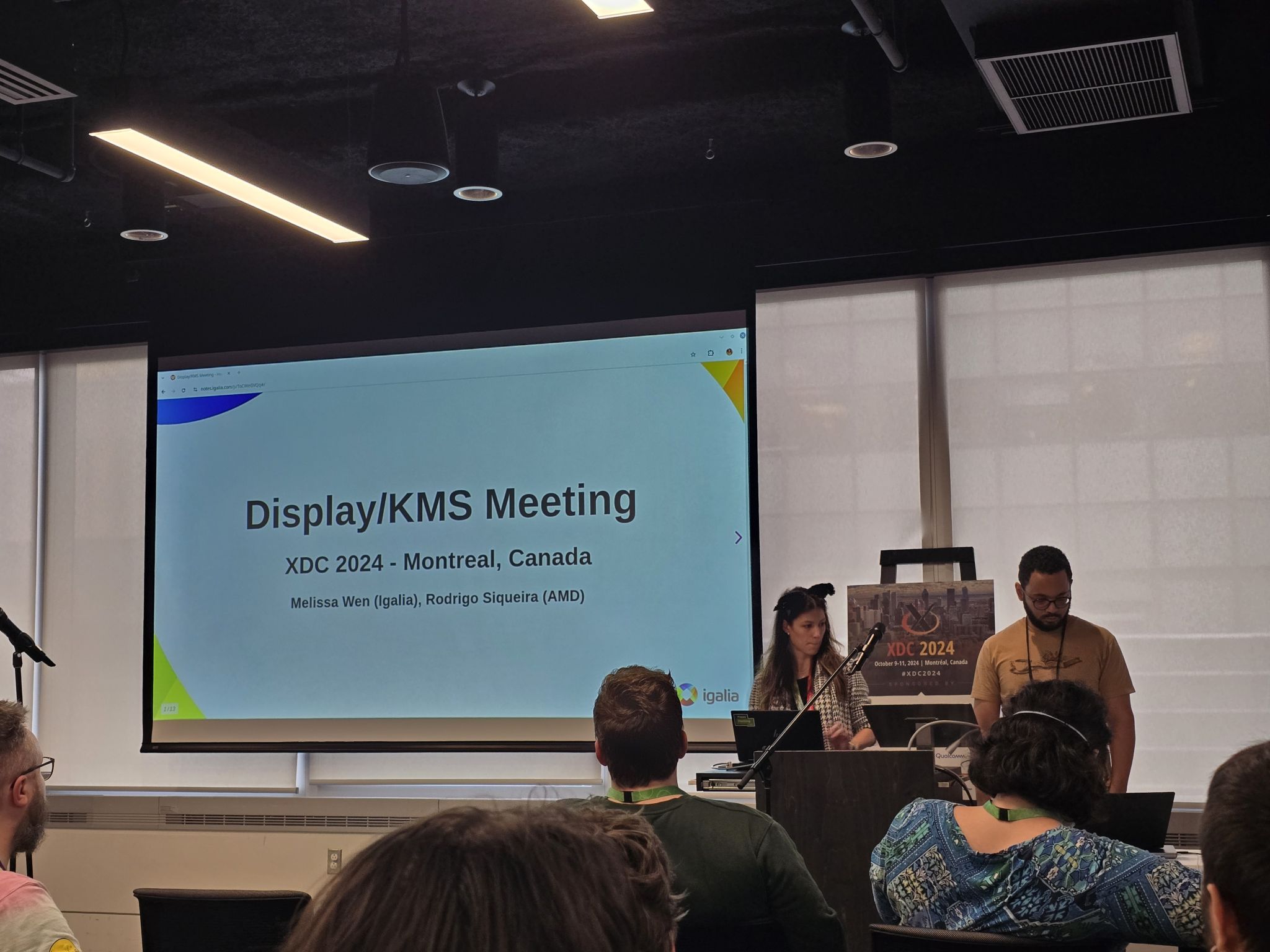
Melissa Wen: Display/KMS Meeting at XDC 2024: Detailed Report

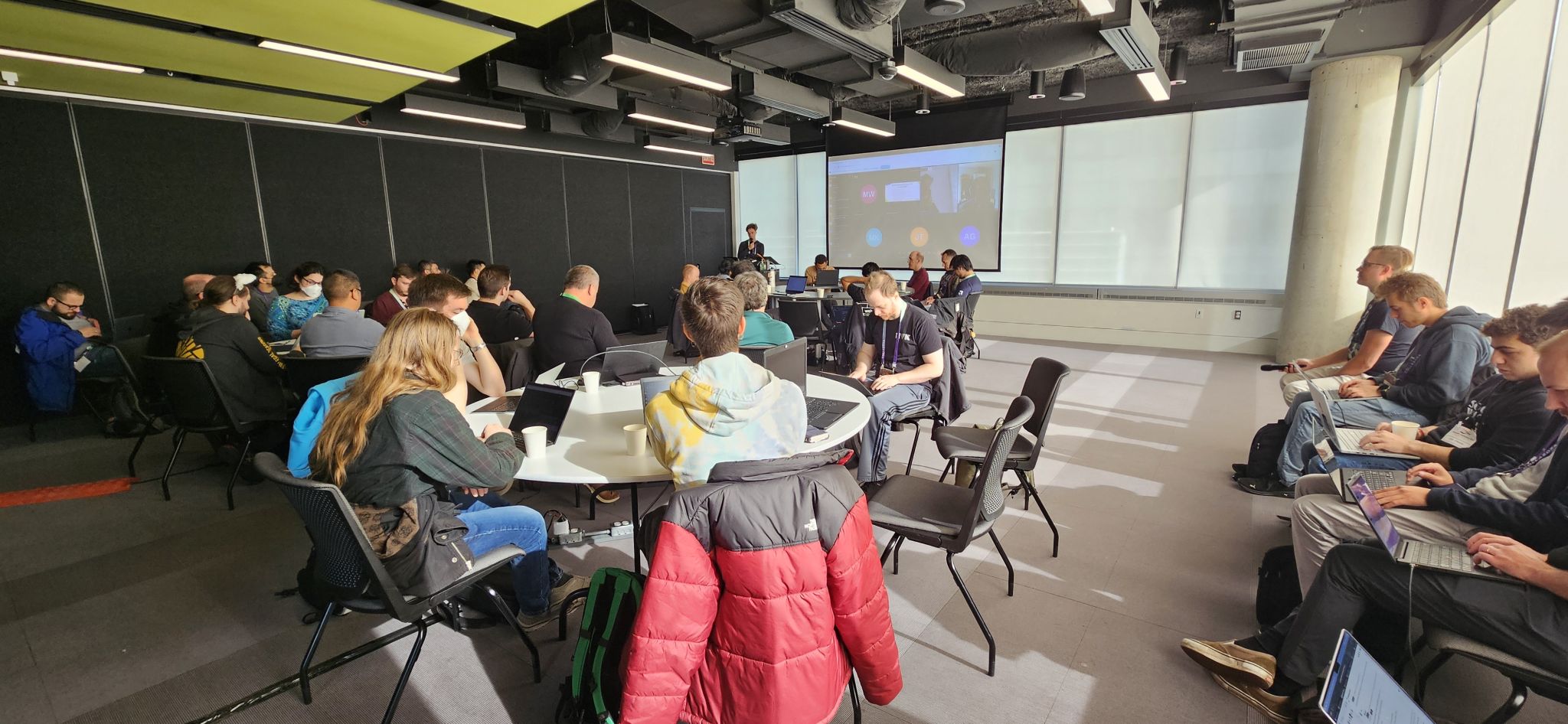
XDC 2024 in Montreal was another fantastic gathering for the Linux Graphics community. It was again a great time to immerse in the world of graphics development, engage in stimulating conversations, and learn from inspiring developers. Many Igalia colleagues and I participated in the conference again, delivering multiple talks about our work on the Linux Graphics stack and also organizing the Display/KMS meeting. This blog post is a detailed report on the Display/KMS meeting held during this XDC edition. Short on Time?
  1. Catch the lightning talk summarizing the meeting here (you can even speed up 2x):
  1. For a quick written summary, scroll down to the TL;DR section.

TL;DR This meeting took 3 hours and tackled a variety of topics related to DRM/KMS (Linux/DRM Kernel Modesetting):
  • Sharing Drivers Between V4L2 and KMS: Brainstorming solutions for using a single driver for devices used in both camera capture and display pipelines.
  • Real-Time Scheduling: Addressing issues with non-blocking page flips encountering sigkills under real-time scheduling.
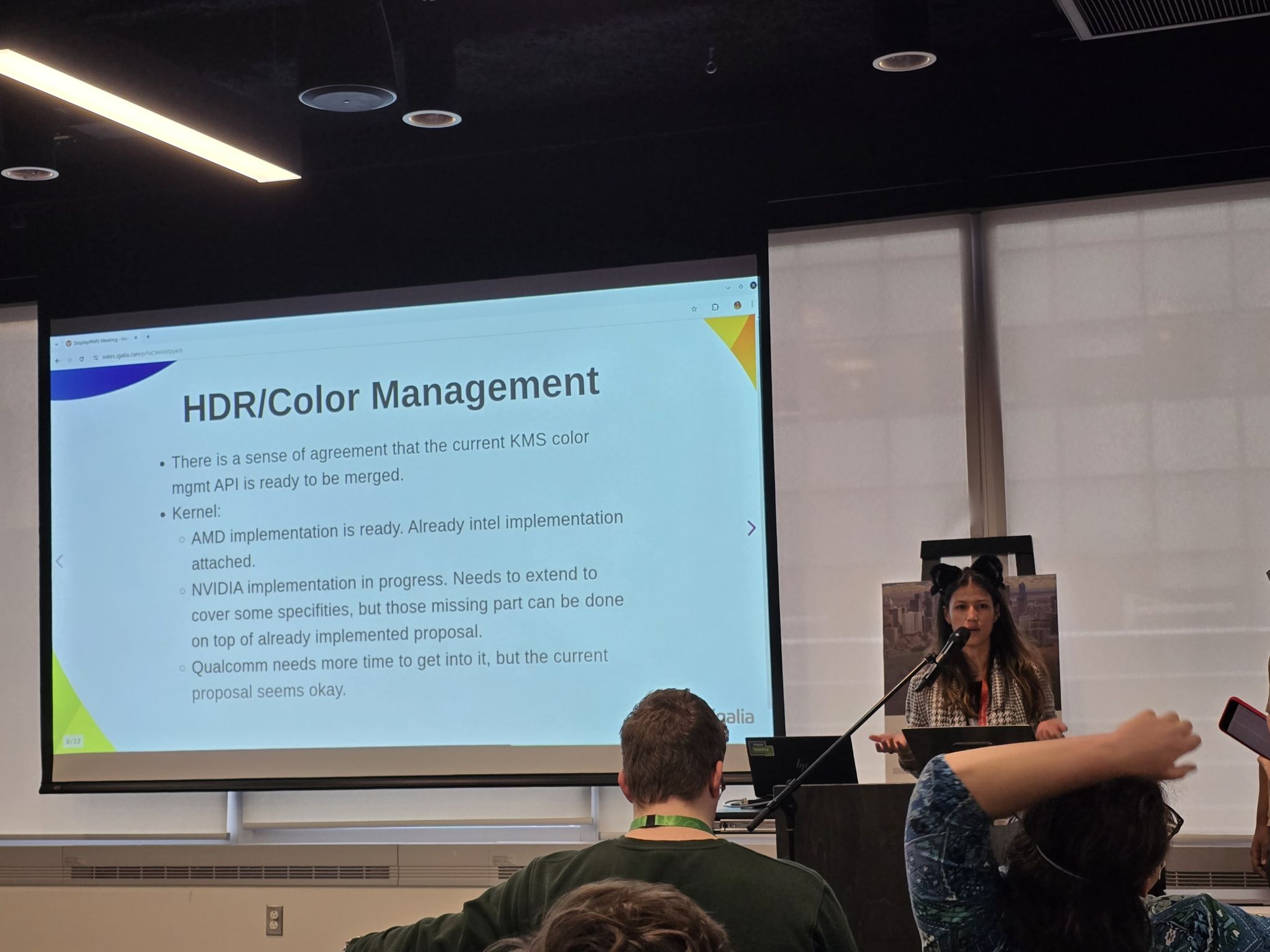
  • HDR/Color Management: Agreement on merging the current proposal, with NVIDIA implementing its special cases on VKMS and adding missing parts on top of Harry Wentland s (AMD) changes.
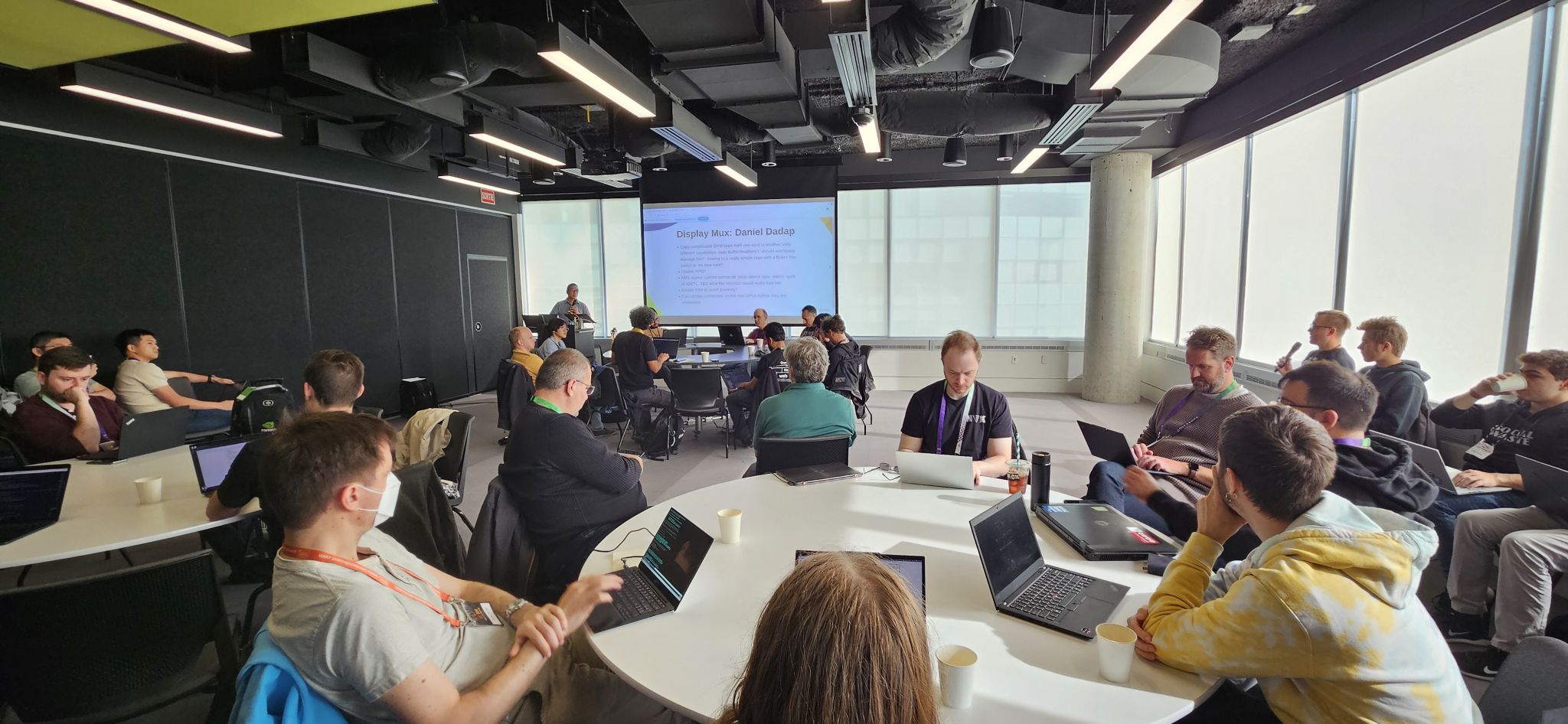
  • Display Mux: Collaborative design discussions focusing on compositor control and cross-sync considerations.
  • Better Commit Failure Feedback: Exploring ways to equip compositors with more detailed information for failure analysis.

Bringing together Linux display developers in the XDC 2024 While I didn t present a talk this year, I co-organized a Display/KMS meeting (with Rodrigo Siqueira of AMD) to build upon the momentum from the 2024 Linux Display Next hackfest. The meeting was attended by around 30 people in person and 4 remote participants. Speakers: Melissa Wen (Igalia) and Rodrigo Siqueira (AMD) Link: https://indico.freedesktop.org/event/6/contributions/383/ Topics: Similar to the hackfest, the meeting agenda was built over the first two days of the conference and mixed talks follow-up with new ideas and ongoing community efforts. The final agenda covered five topics in the scheduled order:
  1. How to share drivers between V4L2 and DRM for bridge-like components (new topic);
  2. Real-time Scheduling (problems encountered after the Display Next hackfest);
  3. HDR/Color Management (ofc);
  4. Display Mux (from Display hackfest and XDC 2024 talk, bringing AMD and NVIDIA together);
  5. (Better) Commit Failure Feedback (continuing the last minute topic of the Display Next hackfest).

Unpacking the Topics Similar to the hackfest, the meeting agenda evolved over the conference. During the 3 hours of meeting, I coordinated the room and discussion rounds, and Rodrigo Siqueira took notes and also contacted key developers to provide a detailed report of the many topics discussed. From his notes, let s dive into the key discussions!

How to share drivers between V4L2 and KMS for bridge-like components. Led by Laurent Pinchart, we delved into the challenge of creating a unified driver for hardware devices (like scalers) that are used in both camera capture pipelines and display pipelines.
  • Problem Statement: How can we design a single kernel driver to handle devices that serve dual purposes in both V4L2 and DRM subsystems?
  • Potential Solutions:
    1. Multiple Compatible Strings: We could assign different compatible strings to the device tree node based on its usage in either the camera or display pipeline. However, this approach might raise concerns from device tree maintainers as it could be seen as a layer violation.
    2. Separate Abstractions: A single driver could expose the device to both DRM and V4L2 through separate abstractions: drm-bridge for DRM and V4L2 subdev for video. While simple, this approach requires maintaining two different abstractions for the same underlying device.
    3. Unified Kernel Abstraction: We could create a new, unified kernel abstraction that combines the best aspects of drm-bridge and V4L2 subdev. This approach offers a more elegant solution but requires significant design effort and potential migration challenges for existing hardware.

Real-Time Scheduling Challenges We have discussed real-time scheduling during this year Linux Display Next hackfest and, during the XDC 2024, Jonas Adahl brought up issues uncovered while progressing on this front.
  • Context: Non-blocking page-flips can, on rare occasions, take a long time and, for that reason, get a sigkill if the thread doing the atomic commit is a real-time schedule.
  • Action items:
    • Explore alternative backtraces during the busy wait (e.g., ftrace).
    • Investigate the maximum thread time in busy wait to reproduce issues faced by compositors. Tools like RTKit (mutter) can be used for better control (Michel D nzer can help with this setup).

HDR/Color Management This is a well-known topic with ongoing effort on all layers of the Linux Display stack and has been discussed online and in-person in conferences and meetings over the last years. Here s a breakdown of the key points raised at this meeting:
  • Talk: Color operations for Linux color pipeline on AMD devices: In the previous day, Alex Hung (AMD) presented the implementation of this API on AMD display driver.
  • NVIDIA Integration: While they agree with the overall proposal, NVIDIA needs to add some missing parts. Importantly, they will implement these on top of Harry Wentland s (AMD) proposal. Their specific requirements will be implemented on VKMS (Virtual Kernel Mode Setting driver) for further discussion. This VKMS implementation can benefit compositor developers by providing insights into NVIDIA s specific needs.
  • Other vendors: There is a version of the KMS API applied on Intel color pipeline. Apart from that, other vendors appear to be comfortable with the current proposal but lacks the bandwidth to implement it right now.
  • Upstream Patches: The relevant upstream patches were can be found here. [As humorously notes, this series is eagerly awaiting your Acked-by (approval)]
  • Compositor Side: The compositor developers have also made significant progress.
    • KDE has already implemented and validated the API through an experimental implementation in Kwin.
    • Gamescope currently uses a driver-specific implementation but has a draft that utilizes the generic version. However, some work is still required to fully transition away from the driver-specific approach. AP: work on porting gamescope to KMS generic API
    • Weston has also begun exploring implementation, and we might see something from them by the end of the year.
  • Kernel and Testing: The kernel API proposal is well-refined and meets the DRM subsystem requirements. Thanks to Harry Wentland effort, we already have the API attached to two hardware vendors and IGT tests, and, thanks to Xaver Hugl, a compositor implementation in place.
Finally, there was a strong sense of agreement that the current proposal for HDR/Color Management is ready to be merged. In simpler terms, everything seems to be working well on the technical side - all signs point to merging and shipping the DRM/KMS plane color management API!

Display Mux During the meeting, Daniel Dadap led a brainstorming session on the design of the display mux switching sequence, in which the compositor would arm the switch via sysfs, then send a modeset to the outgoing driver, followed by a modeset to the incoming driver.
  • Context:
  • Key Considerations:
    • HPD Handling: There was a general consensus that disabling HPD can be part of the sequence for internal panels and we don t need to focus on it here.
    • Cross-Sync: Ensuring synchronization between the compositor and the drivers is crucial. The compositor should act as the drm-master to coordinate the entire sequence, but how can this be ensured?
    • Future-Proofing: The design should not assume the presence of a mux. In future scenarios, direct sharing over DP might be possible.
  • Action points:
    • Sharing DP AUX: Explore the idea of sharing DP AUX and its implications.
    • Backlight: The backlight definition represents a problem in the mux switch context, so we should explore some of the current specs available for that.

Towards Better Commit Failure Feedback In the last part of the meeting, Xaver Hugl asked for better commit failure feedback.
  • Problem description: Compositors currently face challenges in collecting detailed information from the kernel about commit failures. This lack of granular data hinders their ability to understand and address the root causes of these failures.
To address this issue, we discussed several potential improvements:
  • Direct Kernel Log Access: One idea is to directly load relevant kernel logs into the compositor. This would provide more detailed information about the failure and potentially aid in debugging.
  • Finer-Grained Failure Reporting: We also explored the possibility of separating atomic failures into more specific categories. Not all failures are critical, and understanding the nature of the failure can help compositors take appropriate action.
  • Enhanced Logging: Currently, the dmesg log doesn t provide enough information for user-space validation. Raising the log level to capture more detailed information during failures could be a viable solution.
By implementing these improvements, we aim to equip compositors with the necessary tools to better understand and resolve commit failures, leading to a more robust and stable display system.

A Big Thank You! Huge thanks to Rodrigo Siqueira for these detailed meeting notes. Also, Laurent Pinchart, Jonas Adahl, Daniel Dadap, Xaver Hugl, and Harry Wentland for bringing up interesting topics and leading discussions. Finally, thanks to all the participants who enriched the discussions with their experience, ideas, and inputs, especially Alex Goins, Antonino Maniscalco, Austin Shafer, Daniel Stone, Demi Obenour, Jessica Zhang, Joan Torres, Leo Li, Liviu Dudau, Mario Limonciello, Michel D nzer, Rob Clark, Simon Ser and Teddy Li. This collaborative effort will undoubtedly contribute to the continued development of the Linux display stack. Stay tuned for future updates!

12 November 2024

Paul Tagliamonte: Complex for Whom?

In basically every engineering organization I ve ever regarded as particularly high functioning, I ve sat through one specific recurring conversation which is not a conversation about complexity . Things are good or bad because they are or aren t complex, architectures needs to be redone because it s too complex some refactor of whatever it is won t work because it s too complex. You may have even been a part of some of these conversations or even been the one advocating for simple light-weight solutions. I ve done it. Many times. Rarely, if ever, do we talk about complexity within its rightful context complexity for whom. Is a solution complex because it s complex for the end user? Is it complex if it s complex for an API consumer? Is it complex if it s complex for the person maintaining the API service? Is it complex if it s complex for someone outside the team maintaining it to understand? Complexity within a problem domain I ve come to believe, is fairly zero-sum there s a fixed amount of complexity in the problem to be solved, and you can choose to either solve it, or leave it for those downstream of you to solve that problem on their own. That being said, while I believe there is a lower bound in complexity to contend with for a problem, I do not believe there is an upper bound to the complexity of solutions possible. It is always possible, and in fact, very likely that teams create problems for themselves while trying to solve a problem. The rest of this post is talking to the lower bound. When getting feedback on an early draft of this blog post, I ve been informed that Fred Brooks coined a term for what I call lower bound complexity Essential Complexity , in the paper No Silver Bullet Essence and Accident in Software Engineering , which is a better term and can be used interchangeably.

Complexity Culture In a large enough organization, where the team is high functioning enough to have and maintain trust amongst peers, members of the team will specialize. People will begin to engage with subsets of the work to be done, and begin to have their efficacy measured against that part of the organization s problems. Incentives shift, and over time it becomes increasingly likely that two engineers may have two very different priorities when working on the same system together. Someone accountable for uptime and tasked with responding to outages will begin to resist changes. Someone accountable for rapidly delivering features will resist gates between them and their users. Companies (either wittingly or unwittingly) will deal with this by tasking engineers with both production (feature development) and operational tasks (maintenance), so the difference in incentives isn t usually as bad as it could be. When we get a bunch of folks from far-flung corners of an organization in a room, fire up a slide deck and throw up some aspirational to-be architecture diagram in order to get a sign-off to solve some problem (be it someone needs a credible promotion packet, new feature needs to get delivered, or the system has begun to fail and needs fixing), the initial reaction will, more often than I d like, start to devolve into a discussion of how this is going to introduce a bunch of complexity, going to be hard to maintain, why can t you make it less complex? Right around here is when I start to try and contextualize the conversation happening around me understand what complexity is that being discussed, and understand who is taking on that burden. Think about who should be owning that problem, and work through the tradeoffs involved. Is it best solved here, or left to consumers (be them other systems, developers, or users). Should something become an API call s optional param, taking on all the edge-cases and on, or should users have to implement the logic using the data you return (leaving everyone else to take on all the edge-cases and maintenance)? Should you process the data, or require the user to preprocess it for you? Frequently it s right to make an active and explicit decision to simplify and leave problems to be solved downstream, since they may not actually need to be solved or perhaps you expect consumers will want to own the specifics of how the problem is solved, in which case you leave lots of documentation and examples. Many other times, especially when it s something downstream consumers are likely to hit, it s best solved internal to the system, since the only thing that can come of leaving it unsolved are bugs, frustration and half-correct solutions. This is a grey-space of tradeoffs, not a clear decision tree. No one wants the software manifestation of a katamari ball or a junk drawer, nor does anyone want a half-baked service unable to handle the simplest use-case.

Head-in-sand as a Service Popoffs about how complex something is, are, to a first approximation, best understood as meaning complicated for the person making comments . A lot of the #thoughtleadership believe that an AWS hosted EKS k8s cluster running images built by CI talking to an AWS hosted PostgreSQL RDS is not complex. They re right. Mostly right. This is less complex less complex for them. It s not, however, without complexity and its own tradeoffs it s just complexity that they do not have to deal with. Now they don t have to maintain machines that have pesky operating systems or hard drive failures. They don t have to deal with updating the version of k8s, nor ensuring the backups work. No one has to push some artifact to prod manually. Deployments happen unattended. You click a button and get a cluster. On the other hand, developers outside the ops function need to deal with troubleshooting CI, debugging access control rules encoded in turing complete YAML, permissions issues inside the cluster due to whatever the fuck a service mesh is, everyone needs to learn how to use some k8s tools they only actually use during a bad day, likely while doing some x.509 troubleshooting to connect to the cluster (an internal only endpoint; just port forward it) not to mention all sorts of rules to route packets to their project (a single repo s binary being run in 3 containers on a single vm host). Beyond that, there s the invisible complexity complexity on the interior of a service you depend on. I think about the dozens of teams maintaining the EKS service (which is either run on EC2 instances, or alternately, EC2 instances in a trench coat, moustache and even more shell scripts), the RDS service (also EC2 and shell scripts, but this time accounting for redundancy, backups, availability zones), scores of hypervisors pulled off the shelf (xen, kvm) smashed together with the ones built in-house (firecracker, nitro, etc) running on hardware that has to be refreshed and maintained continuously. Every request processed by network ACL rules, AWS IAM rules, security group rules, using IP space announced to the internet wired through IXPs directly into ISPs. I don t even want to begin to think about the complexity inherent in how those switches are designed. Shitloads of complexity to solve problems you may or may not have, or even know you had. What s more complex? An app running in an in-house 4u server racked in the office s telco closet in the back running off the office Verizon line, or an app running four hypervisors deep in an AWS datacenter? Which is more complex to you? What about to your organization? In total? Which is more prone to failure? Which is more secure? Is the complexity good or bad? What type of Complexity can you manage effectively? Which threaten the system? Which threaten your users?

COMPLEXIVIBES This extends beyond Engineering. Decisions regarding what tools are we able to use be them existing contracts with cloud providers, CIO mandated SaaS products, a list of the only permissible open source projects will incur costs in terms of expressed complexity . Pinning open source projects to a fixed set makes SBOM production less complex . Using only one SaaS provider s product suite (even if its terrible, because it has all the types of tools you need) makes accreditation less complex . If all you have is a contract with Pauly T s lowest price technically acceptable artisinal cloudary and haberdashery, the way you pay for your compute is less complex for the CIO shop, though you will find yourself building your own hosted database template, mechanism to spin up a k8s cluster, and all the operational and technical burden that comes with it. Or you won t and make it everyone else s problem in the organization. Nothing you can do will solve for the fact that you must now deal with this problem somewhere because it was less complicated for the business to put the workloads on the existing contract with a cut-rate vendor. Suddenly, the decision to reduce complexity because of an existing contract vehicle has resulted in a huge amount of technical risk and maintenance burden being onboarded. Complexity you would otherwise externalize has now been taken on internally. With a large enough organizations (specifically, in this case, i m talking about you, bureaucracies), this is largely ignored or accepted as normal since the personnel cost is understood to be free to everyone involved. Doing it this way is more expensive, more work, less reliable and less maintainable, and yet, somehow, is, in a lot of ways, less complex to the organization. It s particularly bad with bureaucracies, since screwing up a contract will get you into much more trouble than delivering a broken product, leaving basically no reason for anyone to care to fix this. I can t shake the feeling that for every story of technical mandates gone awry, somewhere just out of sight there s a decisionmaker optimizing for what they believe to be the least amount of complexity least hassle, fewest unique cases, most consistency as they can. They freely offload complexity from their accreditation and risk acceptance functions through mandates. They will never have to deal with it. That does not change the fact that someone does.

TC;DR (TOO COMPLEX; DIDN T REVIEW) We wish to rid ourselves of systemic Complexity after all, complexity is bad, simplicity is good. Removing upper-bound own-goal complexity ( accidental complexity in Brooks s terms) is important, but once you hit the lower bound complexity, the tradeoffs become zero-sum. Removing complexity from one part of the system means that somewhere else maybe outside your organization or in a non-engineering function must grow it back. Sometimes, the opposite is the case, such as when a previously manual business processes is automated. Maybe that s a good idea. Maybe it s not. All I know is that what doesn t help the situation is conflating complexity with everything we don t like legacy code, maintenance burden or toil, cost, delivery velocity.
  • Complexity is not the same as proclivity to failure. The most reliable systems I ve interacted with are unimaginably complex, with layers of internal protection to prevent complete failure. This has its own set of costs which other people have written about extensively.
  • Complexity is not cost. Sometimes the cost of taking all the complexity in-house is less, for whatever value of cost you choose to use.
  • Complexity is not absolute. Something simple from one perspective may be wildly complex from another. The impulse to burn down complex sections of code is helpful to have generally, but sometimes things are complicated for a reason, even if that reason exists outside your codebase or organization.
  • Complexity is not something you can remove without introducing complexity elsewhere. Just as not making a decision is a decision itself; choosing to require someone else to deal with a problem rather than dealing with it internally is a choice that needs to be considered in its full context.
Next time you re sitting through a discussion and someone starts to talk about all the complexity about to be introduced, I want to pop up in the back of your head, politely asking what does complex mean in this context? Is it lower bound complexity? Is this complexity desirable? Is what they re saying mean something along the lines of I don t understand the problems being solved, or does it mean something along the lines of this problem should be solved elsewhere? Do they believe this will result in more work for them in a way that you don t see? Should this not solved at all by changing the bounds of what we should accept or redefine the understood limits of this system? Is the perceived complexity a result of a decision elsewhere? Who s taking this complexity on, or more to the point, is failing to address complexity required by the problem leaving it to others? Does it impact others? How specifically? What are you not seeing? What can change? What should change?

10 November 2024

Reproducible Builds: Reproducible Builds in October 2024

Welcome to the October 2024 report from the Reproducible Builds project. Our reports attempt to outline what we ve been up to over the past month, highlighting news items from elsewhere in tech where they are related. As ever, if you are interested in contributing to the project, please visit our Contribute page on our website. Table of contents:
  1. Beyond bitwise equality for Reproducible Builds?
  2. Two Ways to Trustworthy at SeaGL 2024
  3. Number of cores affected Android compiler output
  4. On our mailing list
  5. diffoscope
  6. IzzyOnDroid passed 25% reproducible apps
  7. Distribution work
  8. Website updates
  9. Reproducibility testing framework
  10. Supply-chain security at Open Source Summit EU
  11. Upstream patches

Beyond bitwise equality for Reproducible Builds? Jens Dietrich, Tim White, of Victoria University of Wellington, New Zealand along with Behnaz Hassanshahi and Paddy Krishnan of Oracle Labs Australia published a paper entitled Levels of Binary Equivalence for the Comparison of Binaries from Alternative Builds :
The availability of multiple binaries built from the same sources creates new challenges and opportunities, and raises questions such as: Does build A confirm the integrity of build B? or Can build A reveal a compromised build B? . To answer such questions requires a notion of equivalence between binaries. We demonstrate that the obvious approach based on bitwise equality has significant shortcomings in practice, and that there is value in opting for alternative notions. We conceptualise this by introducing levels of equivalence, inspired by clone detection types.
A PDF of the paper is freely available.

Two Ways to Trustworthy at SeaGL 2024 On Friday 8th November, Vagrant Cascadian will present a talk entitled Two Ways to Trustworthy at SeaGL in Seattle, WA. Founded in 2013, SeaGL is a free, grassroots technical summit dedicated to spreading awareness and knowledge about free source software, hardware and culture. Vagrant s talk:
[ ] delves into how two project[s] approaches fundamental security features through Reproducible Builds, Bootstrappable Builds, code auditability, etc. to improve trustworthiness, allowing independent verification; trustworthy projects require little to no trust. Exploring the challenges that each project faces due to very different technical architectures, but also contextually relevant social structure, adoption patterns, and organizational history should provide a good backdrop to understand how different approaches to security might evolve, with real-world merits and downsides.

Number of cores affected Android compiler output Fay Stegerman wrote that the cause of the Android toolchain bug from September s report that she reported to the Android issue tracker has been found and the bug has been fixed.
the D8 Java to DEX compiler (part of the Android toolchain) eliminated a redundant field load if running the class s static initialiser was known to be free of side effects, which ended up accidentally depending on the sharding of the input, which is dependent on the number of CPU cores used during the build.
To make it easier to understand the bug and the patch, Fay also made a small example to illustrate when and why the optimisation involved is valid.

On our mailing list On our mailing list this month:

diffoscope diffoscope is our in-depth and content-aware diff utility that can locate and diagnose reproducibility issues. This month, Chris Lamb made the following changes, including preparing and uploading versions 279, 280, 281 and 282 to Debian:
  • Ignore errors when listing .ar archives (#1085257). [ ]
  • Don t try and test with systemd-ukify in the Debian stable distribution. [ ]
  • Drop Depends on the deprecated python3-pkg-resources (#1083362). [ ]
In addition, Jelle van der Waa added support for Unified Kernel Image (UKI) files. [ ][ ][ ] Furthermore, Vagrant Cascadian updated diffoscope in GNU Guix to version 282. [ ][ ]

IzzyOnDroid passed 25% reproducible apps The IzzyOnDroid project has reached a good milestone by reaching over 25% of the ~1,200 Android apps provided by their repository (of official APKs built by the original application developers) having been confirmed to be reproducible by a rebuilder.

Distribution work In Debian this month:
  • Holger Levsen uploaded devscripts version 2.24.2, including many changes to the debootsnap, debrebuild and reproducible-check scripts. This is the first time that debrebuild actually works (using sbuild s unshare backend). As part of this, Holger also fixed an issue in the reproducible-check script where a typo in the code led to incorrect results [ ]
  • Recently, a news entry was added to snapshot.debian.org s homepage, describing the recent changes that made the system stable again:
    The new server has no problems keeping up with importing the full archives on every update, as each run finishes comfortably in time before it s time to run again. [While] the new server is the one doing all the importing of updated archives, the HTTP interface is being served by both the new server and one of the VM s at LeaseWeb.
    The entry list a number of specific updates surrounding the API endpoints and rate limiting.
  • Lastly, 12 reviews of Debian packages were added, 3 were updated and 18 were removed this month adding to our knowledge about identified issues.
Elsewhere in distribution news, Zbigniew J drzejewski-Szmek performed another rebuild of Fedora 42 packages, with the headline result being that 91% of the packages are reproducible. Zbigniew also reported a reproducibility problem with QImage. Finally, in openSUSE, Bernhard M. Wiedemann published another report for that distribution.

Website updates There were an enormous number of improvements made to our website this month, including:
  • Alba Herrerias:
    • Improve consistency across distribution-specific guides. [ ]
    • Fix a number of links on the Contribute page. [ ]
  • Chris Lamb:
  • hulkoba
  • James Addison:
    • Huge and significant work on a (as-yet-merged) quickstart guide to be linked from the homepage [ ][ ][ ][ ][ ]
    • On the homepage, link directly to the Projects subpage. [ ]
    • Relocate dependency-drift notes to the Volatile inputs page. [ ]
  • Ninette Adhikari:
    • Add a brand new Success stories page that highlights the success stories of Reproducible Builds, showcasing real-world examples of projects shipping with verifiable, reproducible builds . [ ][ ][ ][ ][ ][ ]
  • Pol Dellaiera:
    • Update the website s README page for building the website under NixOS. [ ][ ][ ][ ][ ]
    • Add a new academic paper citation. [ ]
Lastly, Holger Levsen filed an extensive issue detailing a request to create an overview of recommendations and standards in relation to reproducible builds.

Reproducibility testing framework The Reproducible Builds project operates a comprehensive testing framework running primarily at tests.reproducible-builds.org in order to check packages and other artifacts for reproducibility. In October, a number of changes were made by Holger Levsen, including:
  • Add a basic index.html for rebuilderd. [ ]
  • Update the nginx.conf configuration file for rebuilderd. [ ]
  • Document how to use a rescue system for Infomaniak s OpenStack cloud. [ ]
  • Update usage info for two particular nodes. [ ]
  • Fix up a version skew check to fix the name of the riscv64 architecture. [ ]
  • Update the rebuilderd-related TODO. [ ]
In addition, Mattia Rizzolo added a new IP address for the inos5 node [ ] and Vagrant Cascadian brought 4 virt nodes back online [ ].

Supply-chain security at Open Source Summit EU The Open Source Summit EU took place recently, and covered plenty of topics related to supply-chain security, including:

Upstream patches The Reproducible Builds project detects, dissects and attempts to fix as many currently-unreproducible packages as possible. We endeavour to send all of our patches upstream where appropriate. This month, we wrote a large number of such patches, including:

Finally, If you are interested in contributing to the Reproducible Builds project, please visit our Contribute page on our website. However, you can get in touch with us via:

Next.

Previous.