Search Results: "dom"

12 April 2026

Colin Watson: Free software activity in March 2026

My Debian contributions this month were all sponsored by Freexian. You can also support my work directly via Liberapay or GitHub Sponsors. OpenSSH I fixed CVE-2026-3497 in unstable, thanks to a fix in Ubuntu by Marc Deslauriers. Relatedly, I applied an Ubuntu patch by Athos Ribeiro to not default to weak GSS-API exchange algorithms. I m looking forward to being able to split out GSS-API key exchange support in OpenSSH once Ubuntu 26.04 LTS has been released! This stuff will still be my problem, but at least it won t be in packages that nearly everyone has installed. Python packaging New upstream versions: I packaged pybind11-stubgen, needed for new upstream versions of pytango. Tests of reproducible builds revealed that it didn t generate imports in a stable order; I contributed a fix for that upstream. I worked with the security team to release DSA-6161-1 in multipart, fixing CVE-2026-28356 (upstream discussion). (Most of the work for this was in February, but the vulnerability was still embargoed when I published my last monthly update.) In trixie-backports, I updated pytest-django to 4.12.0. I fixed a number of packages to support building with pyo3 0.28: Other build/test failures: Rust packaging New upstream versions: Other bits and pieces I upgraded tango to 10.1.2, and yubihsm-shell to 2.7.2. Code reviews

10 April 2026

Reproducible Builds: Reproducible Builds in March 2026

Welcome to the March 2026 report from the Reproducible Builds project! These reports outline what we ve been up to over the past month, highlighting items of news from elsewhere in the increasingly-important area of software supply-chain security. As ever, if you are interested in contributing to the Reproducible Builds project, please see the Contribute page on our website.

  1. Linux kernel hash-based integrity checking proposed
  2. Distribution work
  3. Tool development
  4. Upstream patches
  5. Documentation updates
  6. Two new academic papers
  7. Misc news

Linux kernel hash-based integrity checking proposed Eric Biggers posted to the Linux Kernel Mailing List in response to a patch series posted by Thomas Wei schuh to introduce a calculated hash-based system of integrity checking to complement the existing signature-based approach. Thomas original post mentions:
The current signature-based module integrity checking has some drawbacks in combination with reproducible builds. Either the module signing key is generated at build time, which makes the build unreproducible, or a static signing key is used, which precludes rebuilds by third parties and makes the whole build and packaging process much more complicated.
However, Eric s followup message goes further:
I think this actually undersells the feature. It s also much simpler than the signature-based module authentication. The latter relies on PKCS#7, X.509, ASN.1, OID registry, crypto_sig API, etc in addition to the implementations of the actual signature algorithm (RSA / ECDSA / ML-DSA) and at least one hash algorithm.

Distribution work In Debian this month,
  • Lucas Nussbaum announced Debaudit, a new service to verify the reproducibility of Debian source packages :
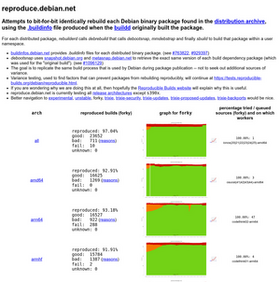
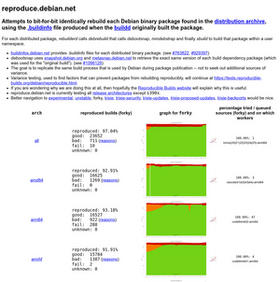
    debaudit complements the work of the Reproducible Builds project. While reproduce.debian.net focuses on ensuring that binary packages can be bit-for-bit reproduced from their source packages, debaudit focuses on the preceding step: ensuring that the source package itself is a faithful and reproducible representation of its upstream source or Vcs-Git repository.
  • kpcyrd filed a bug against the librust-const-random-dev package reporting that the compile-time-rng feature of the ahash crate uses the const-random crate in turn, which uses a macro to read/generate a random number generator during the build. This issue was also filed upstream.
  • 60 reviews of Debian packages were added, 4 were updated and 16 were removed this month adding to our knowledge about identified issues. One new issue types was added, pkgjs_lock_json_file_issue.
Lastly, Bernhard M. Wiedemann posted another openSUSE monthly update for their work there.

Tool development diffoscope is our in-depth and content-aware diff utility that can locate and diagnose reproducibility issues. This month, Chris Lamb made a number of changes, including preparing and uploading versions, 314 and 315 to Debian.
  • Chris Lamb:
    • Don t run test_code_is_black_clean test in the autopkgtests. (#1130402). [ ]
    • Add some debugging info for PyPI debugging. [ ]
  • Jelle van der Waa:
    • Fix compatibility with LLVM version 22. [ ]
    • Adjust the PGP file detection regular expression. [ ]
  • Michael R. Crusoe:
    • Reformat the source code using Black version 26.1.0 [ ][ ]
In addition, Vagrant Cascadian updated diffoscope in GNU Guix to version 315.
rebuilderd, our server designed monitor the official package repositories of Linux distributions and attempt to reproduce the observed results there; it powers, amongst other things, reproduce.debian.net. A new version, 0.26.0, was released this month, with the following improvements:
  • Much smoother onboarding/installation.
  • Complete database redesign with many improvements.
  • New REST HTTP API.
  • It s now possible to artificially delay the first reproduce attempt. This gives archive infrastructure more time to catch up.
  • And many, many other changes.

Upstream patches The Reproducible Builds project detects, dissects and attempts to fix as many currently-unreproducible packages as possible. We endeavour to send all of our patches upstream where appropriate. This month, we wrote a large number of such patches, including:

Documentation updates Once again, there were a number of improvements made to our website this month including:
  • kpcyrd:
    • Add a new page about Rust specifics. [ ][ ][ ]
  • Robin Candau:
    • Add link to the diffoci Arch Linux package on the Tools page. [ ]
  • Timo Pohl:

Two new academic papers Marc Ohm, Timo Pohl, Ben Swierzy and Michael Meier published a paper on the threat of cache poisoning in the Python ecosystem: Attacks on software supply chains are on the rise, and attackers are becoming increasingly creative in how they inject malicious code into software components. This paper is the first to investigate Python cache poisoning, which manipulates bytecode cache files to execute malicious code without altering the human-readable source code. We demonstrate a proof of concept, showing that an attacker can inject malicious bytecode into a cache file without failing the Python interpreter s integrity checks. In a large-scale analysis of the Python Package Index, we find that about 12,500 packages are distributed with cache files. Through manual investigation of cache files that cannot be reproduced automatically from the corresponding source files, we identify classes of reasons for irreproducibility to locate malicious cache files. While we did not identify any malware leveraging this attack vector, we demonstrate that several widespread package managers are vulnerable to such attacks. A PDF of the paper is available online.
Mario Lins of the University of Linz, Austria, has published their PhD doctoral thesis on the topic of Software supply chain transparency: We begin by examining threats to the software distribution stage the point at which artifacts (e.g., mobile apps) are delivered to end users with an emphasis on mobile ecosystems [and] we next focus on the operating system on mobile devices, with an emphasis on mitigating bootloader-targeted attacks. We demonstrate how to compensate lost security guarantees on devices with an unlocked bootloader. This allows users to flash custom operating systems on devices that no longer receive security updates from the original manufacturer without compromising security. We then move to the source code stage. [Also,] we introduce a new architecture to ensure strong source-to-binary correspondence by leveraging the security guarantees of Confidential Computing technology. Finally, we present The Supply Chain Game, an organizational security approach that enhances standard risk-management methods. We demonstrate how game-theoretic techniques, combined with common risk management practices, can derive new criteria to better support decision makers. A PDF of the paper is available online.

Misc news On our mailing list this month:
  • Holger Levsen announced that this year s Reproducible Builds summit will almost certainly be held in Gothenburg, Sweden, from September 22 until 24, followed by two days of hacking. However, these dates are preliminary and not 100% final an official announcement is forthcoming.
  • Mark Wielaard posted to our list asking a question on the difference between debugedit and relative debug paths based on a comment on the Build path page: Have people tried more modern versions of debugedit to get deterministic (absolute) DWARF paths and found issues with it?


Finally, if you are interested in contributing to the Reproducible Builds project, please visit our Contribute page on our website. However, you can get in touch with us via:

6 April 2026

Thorsten Alteholz: My Debian Activities in March 2026

Debian LTS/ELTS This was my hundred-forty-first month that I did some work for the Debian LTS initiative, started by Raphael Hertzog at Freexian. During my allocated time I uploaded or worked on: I also worked on the check-advisories script and proposed a fix for cases where issues would be assigned to the coordinator instead of the person who forgot doing something. I also did some work for a kernel update and packages snapd and ldx on security-master and attended the monthly LTS/ELTS meeting. Last but not least I started to work on gst-plugins-bad1.0 Debian Printing This month I uploaded a new upstream versions: Several packages take care of group lpadmin in their maintainer scripts. With the upload of version 260.1-1 of systemd there is now a central package (systemd systemd-standalone-sysusers systemd-sysusers) that takes care of this. Other dependencies like adduser can now be dropped. This work is generously funded by Freexian! Debian Lomiri This month I continued to work on unifying packaging on Debian and Ubuntu. This makes it easier to work on those packages independent of the used platform. I am also able to upload Debian packages to the corresponding Ubuntu PPA now. A small bug had to be fixed in the python script to allow the initial configuration in Launchpad. This work is generously funded by Fre(i)e Software GmbH! Debian Astro This month I uploaded a new upstream version or a bugfix version of: I also uploaded lots of indi-drivers (libplayerone, libsbig, libricohcamerasdk, indi-asi, indi-eqmod, indi-fishcamp, indi-inovaplx, indi-pentax, indi-playerone, indi-sbig, indi-mi, libahp-xc, indi-aagcloudwatcher, indi-aok, indi-apogee, libapogee3, indi-nightscape, libasi, libinovasdk, libmicam, indi-avalon, indi-beefocus, indi-bresserexos2, indi-dsi, indi-ffmv, indi-fli, indi-gige, info-gphoto, indi-gpsd, indi-gpsnmea, indi-limesdr, indi-maxdomeii, indi-mgen, indi-rtklib, indi-shelyak, indi-starbook, indi-starbookten, indi-talon6, indi-weewx-json, indi-webcam, indi-orion-ssg3, indi-armadillo-playtypus ) to experimental to make progress with the indi-transition. No problems with those drivers appeared and the next step would be the upload of indi version 2.x to unstable. I hope this will happen soon, as new drivers are already waiting in the pipeline. There have been also four packages, that migrated to the official indi package and are no longer needed as 3rdparty drivers (indi-astrolink4, indi-astromechfoc, indi-dreamfocuser, indi-spectracyber). While working on these packages, I thought about testing them. Unfortunately I don t have enough hardware to really check out every package, so I can upload most of them only as is. In case anybody is interested in a better testing coverage and me being able to provide upstream patches, I would be very glad about hardware donations. Debian IoT This month I uploaded a new upstream version or a bugfix version of: Debian Mobcom This month I uploaded a new upstream version or a bugfix version of: misc This month I uploaded a new upstream version or a bugfix version of: I also sponsored the upload of Matomo. Thanks a lot to William for preparing the package.

29 March 2026

Russ Allbery: Review: The Sovereign

Review: The Sovereign, by C.L. Clark
Series: Magic of the Lost #3
Publisher: Orbit
Copyright: September 2025
ISBN: 0-316-54286-5
Format: Kindle
Pages: 575
The Sovereign is the third and concluding book of C.L. Clark's Magic of the Lost high fantasy trilogy. I recommend reading the books of this series close together, since there are a lot of characters and a lot of continuity between books that is helpful to remember, but it was not quite as difficult this time to remember where the story left off. At the end of The Faithless, the political situation in Balladaire (not-France) was more stable, but the threat of a plague lay on the horizon. That threat arrives in earnest in this book, along with new threats from both Balladaire's former colonial conscript soldiers and from neighboring Taargen (not-Germany, sort of, although the parallel isn't as close). Luca and Touraine have finally admitted that they're deeply in love, but they are still very different people with different goals and ethics. Luca is determined to do anything necessary to save her kingdom, but her definition of her kingdom is sharp and brittle. Touraine is torn between far too many loyalties, plus the lingering worry that her morals and Luca's may not be compatible. I think the hardest part of this sort of series is finding an ending the reader will find satisfying. This one, unfortunately, did not work for me, but that may be more due to personal preference than objective flaws. There have been two threads through this series: an improbable romance embedded in a network of complex personal relationships, and a political commentary on colonialism and post-colonial wars. I was enjoying the former, but it was the latter that felt fresh and interesting to me. The plot threads in The Faithless outside of Balladaire expanded that complexity, and I was hoping the final volume would continue in that direction. How could a colonial power atone for its history? How does the former colony establish its own governance? Is there a path to freedom without violence? Are attempts to chart a more moral course doomed to open lines of attack for one's other enemies? It's clear that Clark was thinking about similar themes, but The Sovereign narrows the field instead of widens it, restricts the political options, and then resolves most questions in a massive war. This is not that surprising of a conclusion, but it's one that I found unsatisfying and, honestly, a little boring. Yes, one way to resolve all the competing tensions is for everyone to try to kill each other and whoever survives wins, and historically that's one of the more likely outcomes, but that ending doesn't wrestle with the politics as much as it collapses them. Clark instead focuses this concluding volume on the romance, which becomes even more fraught, tragic, and dramatic than it was in previous books (and that's saying something). The hard questions of divided loyalties and moral conflicts are mostly framed by questions about Touraine's loyalty to Luca and Luca's trust of Touraine. This is all very Shakespearean, full of hard choices, sudden reversals, miscommunication, and a very deep conflict between Luca's realpolitik and Touraine's stubborn personal morality. If this is what you were reading the series for, if you were hoping for a maximum-drama sapphic relationship, you may thoroughly enjoy this. I thought it had its moments, but I wish they had been balanced by more moments of cool-headed practicality and creative political ingenuity. My biggest frustration with this ending is that the characters largely stop doing politics. The political complexity was the strength of both The Unbroken and The Faithless: People who intensely dislike each other negotiate because there is something larger to be gained, personal decisions made without considering the political ramifications have costs, and multiple characters are trying hard to find a way to turn a nasty, exploitative world into something better without simply killing everyone who disagrees. Many of the characters were objectively bad at politics, inexperienced and immature, but they stumbled or dragged or fought their way into political solutions anyway. I thought Clark moved too far away from that in The Sovereign. Everyone goes deep into their own emotions and desire for vengeance or conquest or revolution and stops compromising. To a depressingly large extent, the story is resolved by killing everyone who disagrees. I think the story is poorer for it. One of the other threads of the series is Balladairan magic, or rather its odd absence. Luca has one understanding of it, the rebels introduced in The Faithless have a different understanding of it, and its pursuit is set up as critical to resolving the threat of a plague. We do get an explanation of sorts, but it's not as complete or as satisfying as I was hoping, and the symbolism of Balladaire's missing magic is left frustratingly murky. For me, this has some of the same problems as the political conclusion: I wanted an intellectual catharsis alongside the emotional catharsis, but that was not the direction Clark was taking the story. I like reading about these characters. All of Luca, Touraine, and Pruett are complex, comprehensible, flawed, and often intriguing. But my favorite character in the story, the person I latched on to as an emotional path through the story, was Sabine. Her refreshingly straightforward loyalty and lack of drama was a breath of fresh air. She has some great moments in this book, but there too I got wrong-footed by the direction Clark went with her arc and found its conclusion deeply unsatisfying. I'm not sure how many of these complaints are because of missed opportunities in the novel, how many were due to a mismatch of taste, and how many were due to not being in the right mood to read this conclusion. I'm sure that it didn't help that I read this simultaneous with another novel in which the characters were always miserable, or that I read it in early 2026 with, uh, all that entails. I suspect that if you came away from the first two books invested in the messy romance and wanting MOAR DRAMA, you may get exactly what you were hoping for. That, sadly, was not what I was hoping for. I can't really recommend this. I thought it dragged in places and didn't deliver the ending I wanted. But it has some great moments, it does wrap up the threads of the trilogy as advertised, and at least the romance gets a dramatic climax worthy of the tension that has been built through the previous books. If that matches what you were enjoying in the previous books, you may well enjoy this more than I did. Rating: 5 out of 10

27 March 2026

Samuel Henrique: I use curl with ECH btw (in Debian)

tl;dr This is an experimental feature that, for the first time, brings full ECH support to curl on Debian using OpenSSL. Starting with curl 8.19.0-3+exp2 (Debian Experimental), you can now use ECH, with HTTPS-RR and DoH for maximum privacy. curl 8.19.0-3+exp2 is quite fresh at the time of writing, bear in mind that your repository might not have synced the package yet, all mirrors should have it by March 27th 14:00 UTC.
# defo.ie is a test server that confirms whether ECH was successfully used
curl -v --ech hard https://defo.ie/ech-check.php
# For Encrypted Client Hello (ECH) + DNS over HTTPS (DoH)
curl -v --ech hard --doh-url https://1.1.1.1/dns-query https://defo.ie/ech-check.php
"--ech hard" tells curl to refuse the connection entirely if ECH cannot be negotiated. Or, if you would like to try it out in a container:
podman run debian:experimental /bin/bash -c 'apt install --update -t experimental -y curl && curl -v --ech hard --doh-url https://1.1.1.1/dns-query https://defo.ie/ech-check.php'
(in case you haven't noticed, apt now has the --update option for the upgrade and install commands)

For Privacy CloudFlare calls it "the last puzzle piece to privacy" in their must-read announcement: https://blog.cloudflare.com/announcing-encrypted-client-hello/. Encrypted Client Hello (rfc9849) encrypts the "which website are you connecting to?" part of the TLS handshake that was previously visible in plaintext. HTTPS-RR (rfc9460) is a DNS record type that publishes connection parameters for a service, including the public key clients need to perform ECH. DNS Over HTTPS (rfc8484) encrypts DNS queries by tunneling them over HTTPS, hiding what domains you're looking up from network observers. When all three operate together over a CDN with shared IP space, the target domain name is hidden from passive observers; the HTTPS-RR record is queried over DoH in order to retrieve the ECH key (rfc9848) for the TLS handshake. Seems like quite an important feature, and in fact the major browsers have it enabled for some time now, the trick is that they do not use OpenSSL (Chrome uses BoringSSL and Firefox uses NSS). For everyone else, the only option is to patch OpenSSL or wait until 4.0.0 is released, and so part of the reason Debian is the first distro to enable it (curl + OpenSSL + ECH) is that the OpenSSL maintainer (Sebastian Andrzej Siewior) packaged the alpha release just 3 days after it was published. Do not forget that ECH support is experimental and currently relies on the alpha release of OpenSSL.

wcurl Gets It Too Considering wcurl is just a wrapper on curl, it gets the feature for free:
wcurl --curl-options="--ech hard --doh-url https://1.1.1.1/dns-query" $URL
If you're using wcurl, you don't want to have to set parameters, this is just to show that the feature is there and if you have a .curlrc file, it can enable the feature seamlessly.

Other Debian Releases Given the ECH feature requires OpenSSL >= 4, it will not make it to Debian 13, having a small chance of going to Debian 13 Backports (emphasis on small). It should get to Debian Unstable and Debian Testing within the next couple of months as the OpenSSL GA release happens and gets packaged, but you should be able to install the package from Experimental in your Unstable and Testing systems without issues. It will also be in Debian 14 once it becomes the new Stable.

Shoulders of Giants Stephen Farrell's presentation from OpenSSL Conference 2025 has a lot of background on the work involved: Encrypted Client Hello Lessons learned from trying to do something that was probably too complicated They have been working on implementing ECH in open-source projects for years, something as big as this doesn't happen without lots of people dedicating both their paid and free times over it. I ended up being the person who enabled it on Debian, which was pretty much the least amount of work between everyone involved, but hey it's fun flipping the switch and telling you about it.

Background Since 2025, the curl developers started organizing an yearly meeting with all maintainers of curl in Operating Systems. The 2026 edition happened in March 26th: https://github.com/curl/curl/wiki/curl-distro-discussion-2026. Attendance was really good, and as you can imagine one of the topics of discussion was ECH, in which it was pointed out that having OpenSSL 4 was the main requirement but besides it nothing unusual was needed. In Debian Experimental, we have been enabling HTTPS-RR since March 2025, and OpenSSL 4.0.0 alpha was packaged just recently (2026-03-13) by Sebastian Andrzej Siewior, it's time for the next step. The curl distro meeting was just the motivation I needed to go ahead and enable it in Debian Experimental, so as part of our Debian Brasil Weekly Meetings I've prepared and uploaded the changes, while Carlos Henrique Lima Melara worked on addressing a recent test regression for Debian Unstable. Unfortunately sergiodj couldn't join and I'm sure he's jealous of the hacking session now.

Appendix While writing this, I've noticed one of the authors of the CloudFlare blogpost is the previous curl maintainer on Debian; Alessandro Ghedini let me take over the maintenance back in 2021 and today curl is maintained by a team of 4 people, it's nice to see Alessandro's involvement.

24 March 2026

Russ Allbery: Review: A Shadow in Summer

Review: A Shadow in Summer, by Daniel Abraham
Series: Long Price Quartet #1
Publisher: Tor
Copyright: March 2006
ISBN: 0-7653-1340-5
Format: Hardcover
Pages: 331
A Shadow in Summer is a high fantasy novel, the first of (as the name implies) a completed four-book series. Daniel Abraham is perhaps better known as half of the writing pair behind James S.A. Corey, author of the Expanse series. This was his first novel. Otah was the sixth son of a Khai, sent like many of the unwanted later children of the powerful to learn the secrets of the andat and be trained as a poet. He learned his lessons well enough to reject the school and its teachings and walk away. Amat Kyaan has worked her way up from nothing to become the senior overseer of the foreign Galtic House Wilsin in the sun-drenched port city of Saraykeht. Liat is her apprentice, distracted by young love. Maati is a new apprentice poet, having endured his training and sent to learn from Heshai how to eventually hold the andat Removing-The-Part-That-Continues, better known as Seedless. None of them know they will find themselves entangled in a plot to destroy the poet of Saraykeht and, through him, the city's most potent economic tool. A poet in this world is not what we would think of a poet. They are, in essence, magical slave-drivers who capture the essence of an andat, a spirit embodying an idea that is coerced into the prison of volition and obedience by the poet. The andat Seedless, the embodiment of the concept of removing the spark of life, is central to the economic wealth of Saraykeht in a way that is startling in its simplicity: Seedless can remove the seeds from a warehouse full of cotton at a thought. This gives Saraykeht a massive productivity advantage in the cotton trade. Seedless is also a powerful potential weapon. What he can do to cotton, he could as easily do to any other crop, or to people. The Galts are not fond of the independence and power of Saraykeht, but as long as the city controls a powerful andat, they do not dare to attack it directly. Indirectly, though... that's another matter. This is one of those fantasy novels with meticulous and thoughtful world-building, careful and evocative prose, and a complex ensemble cast of interesting characters that the novel then attempts to make utterly miserable and complicit in their own misery. There should be a name for this style of writing. It's not tragedy because the ending is not tragic, precisely. It's not magic realism; the andats are openly magical, which makes this clearly high fantasy. But Abraham approaches the story from the type of realist frame that considers the pain and desperation of the characters to be more interesting than their ability to overcome challenges. Amat starts the story as an admirable, sharp-witted expert manager, so her life is destroyed and she's subjected to sexual violence. Heshai loathes himself and veers between a tragic figure and a wastrel as the story systematically undermines opportunities for redemption. Maati is young and idealistic, so of course every character in the book sets out to crush his idealism under the weight of unforeseen consequences. There is a sad and depressing love triangle, because this is exactly the sort of book that has a sad and depressing love triangle. At the end of the novel, everyone who survives is older and wiser in the sense that some stories seem to think wisdom comes from the accumulation of trauma. I find books like this so immensely frustrating because their merits are so clear. The world-building is careful and detailed in a way that includes economic systems, unlike so much fantasy. It is full of small, intriguing touches, such as the use of posture and gesture to communicate the emotional valence of one's words. Abraham understands the moral implications of poets and andats and the story tackles them head-on. The writing flows beautifully and gave me a strong sense of the city. I wanted to like this book for the obvious skill that went into it, and sometimes I even managed. And yet, it's taken me three months to finish A Shadow in Summer because I simply do not want to spend this much time around miserable people. I would get through one or two chapters in a night and then wanted to read something happy or defiant or heroic, rather than watching slow-motion train wrecks intermixed with desperate attempts to navigate stifling layers of immoral systems. It's not that the story lacks a moral compass. The characters are sincerely trying to make the world a better place, with some success. It even delivers a happy ending of sorts. But so much of the journey was watching the lives of the characters fall apart. I am completely unsurprised that some people loved this book. I'm still intrigued enough by the world-building that I'm half-tempted to try to read the sequel even after having to drag myself through this one. I had a similar reaction to Abraham's The Dragon's Path, though, so I think Abraham is just not for me. I may get back to the Expanse at some point, but having to drag myself through both of his solo novels I've tried, in two different series, probably indicates an incompatibility between author and reader. That's a shame, given the quality of the writing. Followed by A Betrayal in Winter. Content notes: Sexual and reproductive violence as significant plot elements. Rating: 6 out of 10

21 March 2026

Jonathan Dowland: Ladytron

I saw Ladytron perform in Digital, Newcastle last night. The last time I saw them was, I think, at the same venue, 18 years ago. Time flies!
Photo of the trio performing on stage
Back in the day (perhaps their heyday, perhaps not!) Ladytron ploughed a particular sonic furrow and did it very well. Going into the gig I had set my expectations that, should they play just these hits, I'd have a good time. The gig exceeded my expectations. The setlist very much did not lean into their best-known period: the more recent few albums were very well represented and to me this felt very confident. The lead singer, Helen Marnie, demonstrated some excellent range, particularly on some of the new songs. Daniel Hunt did a lot of backing vocals and they were really complementary to Helen's: underscoring but not overpowering. I enjoyed nerding out watching Mira Ayoro's excellent wrangling of her Korg MS-20. One highlight was an encore performance of Light & Magic, which was arguably the "alternate version" as available on the expanded versions of that album or the Remixed and Rare companion. I thought I'd try to put together a 5-track playlist for a friend who attended the gig but isn't super familiar with them. As usual this is hard. I'm going to avoid the obvious hits, try to represent their whole career and try to ensure the current trio each get a vocal turn in the selection. They actually released their latest album, Paradises, yesterday as well. One track from it is in the list below. I'm Not Scared by Ladytron Kingdom Undersea by Ladytron Blue Jeans by Ladytron He took her to a movie by Ladytron Transparent Days by Ladytron (If you can't see anything, the bandcamp embeds have been stripped out by whatever you are viewing this with)

C.J. Collier: The WWW::Mechanize::Chrome Saga: A Comprehensive Narrative of PR #104

The
WWW::Mechanize::Chrome Saga: A Comprehensive Narrative of PR #104 This document synthesizes the extensive work performed from March
13th to March 20th, 2026, to harden, stabilize, and refactor the
WWW::Mechanize::Chrome library and its test suite. This
effort involved deep dives into asynchronous programming,
platform-specific bug hunting, and strategic architectural
decisions.

Part I:
The Quest for Cross-Platform Stability (March 13 16) The initial phase of work focused on achieving a green test suite
across a variety of Linux distributions and preparing for a new release.
This involved significant hardening of the library to account for
different browser versions, OS-level security restrictions, and
filesystem differences.

Key Milestones &
Engineering Decisions:
  • Fedora & RHEL-family Success: A major effort
    was undertaken to achieve a 100% pass rate on modern Fedora 43 and
    CentOS Stream 10. This required several key engineering decisions to
    handle modern browser behavior:
    • Decision: Implement Asynchronous DOM Serialization
      Fallback. Synchronous fallbacks in an async context are
      dangerous. To prevent Resource was not cached errors during
      saveResources, we implemented a fully asynchronous fallback
      in _saveResourceTree. By chaining
      _cached_document with DOM.getOuterHTML
      messages, we can reconstruct document content without blocking the event
      loop, even if Chromium has evicted the resource from its cache. This
      also proved resilient against Fedora s security policies, which often
      block file:// access.
    • Decision: Truncate Filenames for Cross-Platform
      Safety. To avoid File name too long errors,
      especially on Windows where the MAX_PATH limit is 260
      characters, filenameFromUrl was hardened. The filename
      truncation was reduced to a more conservative 150
      characters, leaving ample headroom for deeply nested CI
      temporary directories. Logic was also added to preserve file extensions
      during truncation and to sanitize backslashes from URI paths.
    • Decision: Expand Browser Discovery Paths. To
      support RHEL-based systems out-of-the-box, the
      default_executable_names was expanded to include
      headless_shell and search paths were updated to include
      /usr/lib64/chromium-browser/.
    • Decision: Mitigate Race Conditions with Stabilization Waits
      and Resilient Fetching. On fast systems,
      DOM.documentUpdated events could invalidate
      nodeIds immediately after navigation, causing XPath queries
      to fail with Could not find node with given id . A small stabilization
      sleep(0.25s) was added after page loads to ensure the DOM
      is settled. Furthermore, the asynchronous DOM fetching loop was hardened
      to gracefully handle these errors by catching protocol errors and
      returning an empty string for any node that was invalidated during
      serialization, ensuring the overall process could complete.
  • Windows Hardening:
    • Decision: Adopt Platform-Aware Watchdogs. The test
      suite s reliance on ualarm was a blocker for Windows, where
      it is not implemented. The t::helper::set_watchdog function
      was refactored to use standard alarm() (seconds) on Windows
      and ualarm (microseconds) on Unix-like systems, enabling
      consistent test-level timeout enforcement.
  • Version 0.77 Release:
    • Decision: Adopt SOP for Version Synchronization.
      The project maintains duplicate version strings across 24+ files. A
      Standard Operating Procedure was adopted to use a batch-replacement tool
      to update all sub-modules in lib/ and to always run
      make clean and perl Makefile.PL to ensure
      META.json and META.yml reflect the new
      version. After achieving stability on Linux, the project version was
      bumped to 0.77.
  • Infrastructure & Strategic Work:
    • The ad2 Windows Server 2025 instance was restored and
      optimized, with Active Directory demoted and disk I/O performance
      improved.
    • A strategic proposal for the Heterogeneous Directory
      Replication Protocol (HDRP) was drafted and published.

Part II: The
Great Async Refactor (March 17 18) Despite success on Linux, tests on the slow ad2 Windows
host were still plagued by intermittent, indefinite hangs. This
triggered a fundamental architectural shift to move the library s core
from a mix of synchronous and asynchronous code to a fully non-blocking
internal API.

Key Milestones &
Engineering Decisions:
  • Decision: Expose a _future API.
    Instead of hardcoding timeouts in the library, the core strategy was to
    refactor all blocking methods (xpath, field,
    get, etc.) into thin wrappers around new non-blocking
    ..._future counterparts. This moved timeout management to
    the test harness, allowing for flexible and explicit handling of
    stalls.
    # Example library implementation
    sub xpath($self, $query, %options)  
        return $self->xpath_future($query, %options)->get;
     
    
    sub xpath_future($self, $query, %options)  
        # Async implementation using $self->target->send_message(...)
     
  • Decision: Centralize Test Hardening in a Helper.
    A dedicated test library, t/lib/t/helper.pm, was created to
    contain all stabilization logic. Safe wrappers (safe_get,
    safe_xpath) were implemented there, using
    Future->wait_any to race asynchronous operations against
    a timeout, preventing tests from hanging.
    # Example test helper implementation
    sub safe_xpath  
        my ($mech, $query, %options) = @_;
        my $timeout = delete $options timeout    5;
        my $call_f = $mech->xpath_future($query, %options);
        my $timeout_f = $mech->sleep_future($timeout)->then(sub   Future->fail("Timeout")  );
        return Future->wait_any($call_f, $timeout_f)->get;
     
  • Decision: Refactor Node Attribute Cache.
    Investigations into flaky checkbox tests (t/50-tick.t)
    revealed that WWW::Mechanize::Chrome::Node was storing
    attributes as a flat list ([key, val, key, val]), which was
    inefficient for lookups and individual updates. The cache was refactored
    to definitively use a HashRef, providing O(1) lookups
    and enabling atomic dual-updates where both the browser property (via
    JS) and the internal library attribute are synchronized
    simultaneously.
  • Decision: Implement Self-Cancelling Socket
    Watchdog. On Windows, traditional watchdog processes often
    failed to detect parent termination, leading to 60-second hangs after
    successful tests. We implemented a new socket-based watchdog in
    t::helper that listens on an ephemeral port; the background
    process terminates immediately when the parent socket closes,
    eliminating these cumulative delays.
  • Decision: Deep Recursive Refactoring & Form
    Selection. To make the API truly non-blocking, the entire
    internal call stack had to be refactored. For example, making
    get_set_value_future non-blocking required first making its
    dependency, _field_by_name, asynchronous. This culminated
    in refactoring the entire form selection API (form_name,
    form_id, etc.) to use the new asynchronous
    _future lookups, which was a key step in mitigating the
    Windows deadlocks.
  • Decision: Fix Critical Regressions & Memory
    Cycles.
    • Evaluation Normalization: Implemented a
      _process_eval_result helper to centralize the parsing of
      results from Runtime.evaluate. This ensures consistent
      handling of return values and exceptions between synchronous
      (eval_in_page) and asynchronous (eval_future)
      calls.
    • Memory Cycle Mitigation: A significant memory
      leak was discovered where closures attached to CDP event futures (like
      for asynchronous body retrieval) would capture strong references to
      $self and the $response object, creating a
      circular reference. The established rule is to now always use
      Scalar::Util::weaken on both $self and any
      other relevant objects before they are used inside a
      ->then block that is stored on an object.
    • Context Propagation (wantarray): A
      major regression was discovered where Perl s wantarray
      context, which distinguishes between scalar and list context, was lost
      inside asynchronous Future->then blocks. This caused
      methods like xpath to return incorrect results (e.g., a
      count instead of a list of nodes). The solution was to adopt the Async
      Context Pattern : capture wantarray in the synchronous
      wrapper, pass it as an option to the _future method, and
      then use that captured value inside the future s final resolution
      block.
      # Synchronous Wrapper
      sub xpath($self, $query, %options)  
          $options  wantarray   = wantarray; # 1. Capture
          return $self->xpath_future($query, %options)->get; # 2. Pass
       
      
      # Asynchronous Implementation
      sub xpath_future($self, $query, %options)  
          my $wantarray = delete $options  wantarray  ; # 3. Retrieve
          # ... async logic ...
          return $doc->then(sub  
              if ($wantarray)   # 4. Respect
                  return Future->done(@results);
                else  
                  return Future->done($results[0]);
               
           );
       
    • Asynchronous Body Retrieval & Robust Content
      Fallbacks: Fixed a bug where decoded_content()
      would return empty strings by ensuring it awaited a
      __body_future. This was implemented by storing the
      retrieval future directly on the response object
      ($response-> __body_future ). To make this more robust,
      a tiered strategy was implemented: first try to get the content from the
      network response, but if that fails (e.g., for about:blank
      or due to cache eviction), fall back to a JavaScript
      XMLSerializer to get the live DOM content.
    • Signature Hardening: Fixed Too few arguments
      errors when using modern Perl signatures with
      Future->then. Callbacks were updated to use optional
      parameters (sub($result = undef) ... ) to gracefully
      handle futures that resolve with no value.
    • XHTML Split-Brain Bug: Resolved a
      long-standing Chromium bug (40130141) where content provided via
      setDocumentContent is parsed differently than content
      loaded from a URL. A workaround was implemented: for XHTML documents,
      WMC now uses a JavaScript-based XPath evaluation
      (document.evaluate) against the live DOM, bypassing the
      broken CDP search mechanism.

Derived Architectural Rules
& SOPs:
  • Rule: Always provide _future variants.
    Every library method that interacts with the browser via CDP must have a
    non-blocking asynchronous counterpart.
  • Rule: Centralize stabilization in the test layer.
    All timeout and retry logic should reside in the test harness
    (t/lib/t/helper.pm), not in the core library.
  • Rule: Explicitly propagate wantarray
    context. Synchronous wrappers must capture the caller s context
    and pass it down the Future chain to ensure correct
    scalar/list behavior.
  • Rule: The entire call chain must be asynchronous.
    To enable non-blocking timeouts, even a single hidden blocking call in
    an otherwise asynchronous method will cause a stall.
  • SOP: Reduce Library Noise. Diagnostic messages
    (warn, note, diag) should be
    removed from library code before commits. All such messages should be
    converted to use the internal $self->log('debug', ...)
    mechanism, ensuring a clean TAP output for CI systems.

Part III: The
MutationObserver Saga (March 19) With most of the library refactored to be asynchronous, one stubborn
test, t/65-is_visible.t, continued to fail with timeouts.
This led to an ambitious, but ultimately unsuccessful, attempt to
replace the wait_until_visible polling logic with a more
modern MutationObserver.

Key Milestones & Challenges:
  • The Theory: The goal was to replace an inefficient
    repeat sleep loop with an event-driven
    MutationObserver in JavaScript that would notify Perl
    immediately when an element s visibility changed.
  • Implementation & Cascade Failure: The
    implementation proved incredibly difficult and introduced a series of
    new, hard-to-diagnose bugs:
    1. An incorrect function signature for
      callFunctionOn_future.
    2. A critical unit mismatch, passing seconds from Perl to JavaScript s
      setTimeout, which expected milliseconds.
    3. A fundamental hang where the MutationObserver s
      JavaScript Promise would never resolve, even after the
      underlying DOM element changed.
  • Debugging Maze: Multiple attempts to fix the
    checkVisibility JavaScript logic inside the observer
    callback, including making it more robust by adding DOM tree traversal
    and extensive console.log tracing, failed to resolve the
    hang. This highlighted the opacity and difficulty of debugging complex,
    cross-language asynchronous interactions, especially when dealing with
    low-level browser APIs.

Procedural Learning:
Granular Edits The effort was plagued by procedural missteps in using automated
file-editing tools. Initial attempts to replace large code blocks in a
single operation led to accidental code loss and match failures.
  • Decision: Adopt Delete, then Add Workflow.
    Following forceful user correction, a new SOP was established for all
    future modifications:
    1. Isolate: Break the file into small, manageable
      chunks (e.g., 250 lines).
    2. Delete: Perform a delete operation by replacing
      the old code block with an empty string.
    3. Add: Perform an add operation by inserting the
      new code into the empty space.
    4. Verify: Verifying each atomic step before
      proceeding. This granular process, while slower, ensured surgical
      precision and regained technical control over the large
      Chrome.pm module.
The consistent failure of the MutationObserver approach
eventually led to the decision to abandon it in favor of stabilizing the
original, more transparent implementation.

Part IV:
Reversion and Final Stabilization (March 20) After exhausting all reasonable attempts to fix the
MutationObserver, a strategic decision was made to revert
to the simpler, more transparent polling implementation and fix it
correctly. This proved to be the correct path to a stable solution.

Key Milestones &
Engineering Decisions:
  • Decision: Perform Strategic Reversion. The
    MutationObserver implementation, when integrated via
    callFunctionOn_future with awaitPromise,
    proved fundamentally unstable. Its JavaScript promise would consistently
    fail to resolve, causing indefinite hangs. A decision was made to
    revert all MutationObserver code from
    WWW::Mechanize::Chrome.pm and restore the original
    repeat sleep polling mechanism. A stable,
    understandable solution was prioritized over an elegant but broken
    one.
  • Decision: Correct Timeout Delegation in the
    Harness. The root cause of the original timeout failure was
    identified as a race condition in the t/lib/t/helper.pm
    test harness. The safe_wait_until_* wrappers were
    implementing their own timeout (via wait_any and
    sleep_future) that raced against the underlying polling
    function s internal timeout. This led to intermittent failures on slow
    machines. The helpers were refactored to delegate all timeout
    management to the library s polling functions, ensuring a
    single, authoritative timer controlled the operation.
  • Decision: Optimize Polling Performance. At the
    user s request, the polling interval was reduced from 300ms to
    150ms. This modest performance improvement reduced the
    test suite s wallclock execution time by over a second while maintaining
    stability.
  • Decision: Tune Test Watchdogs. The global watchdog
    timeout was adjusted to 12 seconds, specifically calculated as 1.5x the
    observed real execution time of the optimized test. This provides a
    data-driven safety margin for CI.

Part
V: The Last Bug A Platform-Specific Memory Leak (March 20) With all other tests passing, a single memory leak failure in
t/78-memleak.t persisted, but only on the Windows
ad2 environment. This required a different approach than
the timeout fixes.

Key Milestones:
  • The Bug: A strong reference cycle involving the
    on_dialog event listener was not being broken on Windows,
    despite multiple attempts to fix it. Fixes that worked on Linux (such as
    calling on_dialog(undef) in DESTROY) were not
    sufficient on the Windows host.
  • The Diagnosis: The issue was determined to be a
    deep, platform-specific interaction between Perl s garbage collector,
    the IO::Async event loop implementation on Windows, and the
    Test::Memory::Cycle module. The cycle report was identical
    on both platforms, but the cleanup behavior was different.
  • Failed Attempts: A series of increasingly
    aggressive fixes were attempted to break the cycle, including:
    1. Moving the on_dialog(undef) call from
      close() to DESTROY().
    2. Explicitly deleteing the listener and callback
      properties from the object hash in DESTROY.
    3. Swapping between $self->remove_listener and
      $self->target->unlisten in a mistaken attempt to find
      the correct un-registration method.
  • Pragmatic Solution: After exhausting all reasonable
    code-level fixes without a resolution on Windows, the user opted to mark
    the failing test as a known issue for that specific platform.
  • Final Fix: The single failing test in
    t/78-memleak.t was wrapped in a conditional
    TODO block that only executes on Windows
    (if ($^O =~ /MSWin32/i)), formally acknowledging the bug
    without blocking the build. This allows the test suite to pass in CI
    environments while flagging the issue for future, deeper
    investigation.

Part VI: CI Hardening (March
20) A final failure in the GitHub Actions CI environment revealed one
last configuration flaw.

Key Milestones:
  • The Bug: The CI was running
    prove --nocount --jobs 3 -I local/ -bl xt t directly. This
    command was missing the crucial -It/lib include path, which
    is necessary for test files to locate the t::helper module.
    This resulted in nearly all tests failing with
    Can't locate t/helper.pm in @INC.
  • The Investigation: An analysis of
    Makefile.PL revealed a custom MY::test block
    specifically designed to inject the -It/lib flag into the
    make test command. This confirmed that
    make test is the correct, canonical way to run the test
    suite for this project.
  • The Fix: The
    .github/workflows/linux.yml file was modified to replace
    the direct prove call with make test in the
    Run Tests step. This ensures the CI environment runs the
    tests in the exact same way as a local developer, with all necessary
    include paths correctly configured by the project s build system.

Final Outcome After this long and arduous journey, the
WWW::Mechanize::Chrome test suite is now stable and
passing on all targeted platforms, with known
platform-specific issues clearly documented in the code. The project is
in a vastly more robust and reliable state.

20 March 2026

Michael Ablassmeier: virtnbdbackup 2.46 - bitlocker recovery keys

I ve released virtnbdbackup 2.46 which now attempts to extract the bitlocker recovery keys during backup. The windows domains need a working qemu agent installed during backup for this to work. Using the agent, it also extracts the available guestinfo (network config, OS version etc..) from the domain and stores it alongside with the backup.

16 March 2026

Russ Allbery: Review: The Martian Contingency

Review: The Martian Contingency, by Mary Robinette Kowal
Series: Lady Astronaut #4
Publisher: Tor
Copyright: 2025
ISBN: 1-250-23703-3
Format: Kindle
Pages: 390
The Martian Contingency is the fourth book of the mostly-realistic science fiction alternate history series that began with the novelette "The Lady Astronaut of Mars" and the novel The Calculating Stars. It returns to Elma York as the main character, covering her second trip to Mars after the events of The Fated Sky. It's helpful to remember the events of the previous two books to follow some of the plot. Elma is back on Mars, this time as second in command. The immediate goal of the second Mars mission is to open more domes and land additional crew currently in orbit, creating the first permanent human settlement on Mars. The long-term goal is to set up Mars as a refuge in case the greenhouse effect caused by the meteor strike in The Calculating Stars continues to spiral out of control. Elma is anxious and not looking forward to being partly in charge, particularly since her position is partly due to her fame with the public (and connection with the American president). She'd rather just be a pilot. But she'll do what the mission needs from her, and at least this time her husband is with her on Mars. As one might expect from earlier installments of this series, The Martian Contingency starts with the details and rhythms of life in a dangerous, highly technical, and mission-driven scientific environment: hard science fiction of the type most closely modeled on NASA and real space missions. Given that this is aimed at permanent Mars colonies that would theoretically have to be independent of Earth, it requires a huge amount of suspension of disbelief for the premise, but Kowal at least tries for verisimilitude in the small details. I am not an expert in early space program technology (Kowal's alternate history diverges into a greatly accelerated space program in the 1950s and, for example, uses female mathematicians for most calculations), so I don't know how successful this is, but it feels crunchy and believable. As with the previous books, though, this is not just a day in the life of an astronaut. There's something wrong, something that happened during the first Mars expedition while Elma was in orbit and left odd physical clues, and no one is willing to talk about it. Elma is just starting to poke around before the politics at home go off the rails (again), exacerbated by a cringe-worthy social error by Elma herself, and she once again has to navigate egregious sexism and political meddling in a highly dangerous environment a long way from home. It is a little surprising that I like this series as much as I do. I don't particularly care for pseudo-realistic science fiction, although I admit there is something deeply satisfying about reading about people following checklists properly. The idea of permanent Mars colonies as an escape from a doomed Earth is unbelievable and deeply silly, but Kowal locked herself into that alternate future with "The Lady Astronaut of Mars," which is still set in the future of all of the books so far. A primary conflict in each of the books comes from the egregious sexism and racism of a culture based on 1950s American attitudes towards both, and the amount of progress Elma can make against either is limited, contingent, and constantly compromised. And yet. At its best, this series is excellent competence porn, both in the spirit of the Apollo 13 movie and for the navigation of social and political obstacles and idiocy. Elma is highly competent in a believable and sympathetic way, with strengths, weaknesses, and an ongoing struggle with anxiety. There is something rewarding in watching people solve problems and eventually triumph by being professional, careful, principled, and creative. It's enough to make a good book, even if I am not that interested in the setting and technology. As with the rest of the series, this will not be for everyone. You have to be up for reading about a lot of truly awful sexism and racism without the payoff of a complete triumph. This is a system that Elma navigates, not overthrows, and that's not going to be enough for some readers. You also have to accept the premise of a Mars colony, which in an otherwise hard science fiction novel is a bit much despite Kowal's attempts to acknowledge some of the difficulties. But if you don't mind that drawbacks, this series continues to be an opportunity to read about people being quietly and professionally competent. This is not my favorite entry, mostly because Elma makes a rather humiliating mistake that's central to the plot and has a lot of after-effects (and therefore a lot of time in the spotlight), and because there is rather a lot of discussion of sexuality that felt childish to me. The intent was to try to capture the way people in the 1950s talked about sex, and perhaps Kowal was successful in that, but I didn't enjoy the experience. But I still found myself pulled into the plot and happily rooting for the characters, even though a reader of "The Lady Astronaut of Mars" has a pretty good idea of how everything will turn out. If you liked the series so far, recommended, although I doubt it will be the favorite entry for most readers. If you did not like the earlier books of the series, this one will not change your mind. Content notes: Way, way too much detailed discussion of an injury to a fingernail than I wanted to read, as well as some other rather explicit description of physical injury. Reproductive health care through the lens of the 1950s, so, uh, yeah. A whole lot of sexism, racism, and other forms of discrimination that is mostly worked around rather than confronted. Rating: 7 out of 10

Freexian Collaborators: Monthly report about Debian Long Term Support, February 2026 (by Thorsten Alteholz)

The Debian LTS Team, funded by [Freexian s Debian LTS offering] (https://www.freexian.com/lts/debian/), is pleased to report its activities for February.

Activity summary During the month of February, 20 contributors have been paid to work on Debian LTS (links to individual contributor reports are located below). The team released 35 DLAs fixing 527 CVEs. We also welcomed Arnaud Rebillout to the team and had to say farewell to Roberto, who left the team after more than nine years as part of it. The team continued preparing security updates in its usual rhythm. Beyond the updates targeting Debian 11 ( bullseye ), which is the current release under LTS, the team also proposed updates for more recent releases (Debian 12 ( bookworm ) and Debian 13 ( trixie )), including Debian unstable. Notable security updates:
  • Guilhem Moulin prepared DLA 4492-1 for gnutls28 to fix vulnerabilities which may lead to Denial of Service.
  • Utkarsh Gupta prepared DLA 4464-1 for xrdp, to fix a a vulnerability that could allow remote attackers to execute arbitrary code on the target system.
  • Emilio Pozuelo Monfort prepared DLA-4465-1 to replace ClamAV 1.0 with ClamAV 1.4. This latter is the current LTS version supported by upstream.
  • Markus Koschany prepared DLA 4468-1 for tomcat9, to fix a vulnerability that can be used to bypass security constraints.
  • Santiago Ruano Rinc n prepared DLA 4471-1 to update package debian-security-support, the Debian security coverage checker.
  • Bastien Roucari s prepared DLA 4473-1 for zabbix, to fix a potential remote code execution vulnerability.
  • Paride Legovini prepared DLA 4478-1 for tcpflow, to fix a vulnerability that might result in DoS and potentially code execution.
  • Thorsten Alteholz prepared DLA 4477-1 for munge, to fix a vulnerability which may allow local users to leak the MUNGE cryptographic key and forge arbitrary credentials.
  • Ben Hutchings prepared DLA 4475-1 and DLA 4476-1 for Linux kernel updates.
  • Chris Lamb prepared DLA 4482-1 for ceph, to fix SSL certificate checking in the Python bindings.
  • Andreas Henriksson prepared DLA 4491-1 to fix vulnerabilities in glib2.0, which could result in denial of service, memory corruption or potentially arbitrary code execution.
Contributions from outside the LTS Team:
  • The update of nova was prepared by the maintainer, Thomas Goirand. The corresponding DLA 4486-1 was published by Carlos Henrique Lima Melara.
  • The updates of thunderbird were prepared by the maintainer Christoph Goehre. The corresponding DLA 4466-1 and DLA 4495-1 was published by Emilio Pozuelo Monfort.
The LTS Team has also contributed with updates to the latest Debian releases:
  • Jochen prepared a point update of wireshark for bookworm (#1127945).
  • Jochen prepared point updates of erlang for trixie (#1127606) and bookworm (#1127607).
  • Bastien helped preparing DSA 6160-1 for netty and uploaded a fixed package to unstable.
  • Bastien prepared a point update of zabbix for trixie (#1127437).
  • Tobias prepared a point update of modsecurity-crs for bookworm (#1128655).
  • Tobias prepared a point update of busybox for bookworm (#1129503).
  • Tobias helped preparing DSA 6138-1 for libpng1.6.
  • Daniel prepared point updates of python-authlib for trixie (#1129477) and bookworm (#1129246).
  • Ben uploaded several Linux kernel packages to trixie-backports and bookworm-backports.
  • Ben prepared point updates of wireless-regdb for trixie and bookworm.
Other than the work related to updates, Sylvain made several improvements to the documentation and tooling used by the team. Some milestones in the lifecycle of two Debian releases are just around the corner. The support of Debian 12 will be handed over to the LTS team on June 11th 2026. After August 31st, support for Debian 11 will move from Debian LTS to ELTS managed by Freexian.

Individual Debian LTS contributor reports

Thanks to our sponsors Sponsors that joined recently are in bold.

15 March 2026

Marco d'Itri: Bypassing deep packet inspection with socat and HTTPS tunnels

Recently I found myself with a few hours to kill, but with the only available connectivity provided by an annoying firewall which would normally allow requests only to a few very specific web sites. This post shows how to work around this kind of restrictions by hiding SSH in an HTTPS connection, which then can be used as a SOCKS proxy to allow general connectivity. socat does all the hard work. First, create two self-signed RSA keys pairs, one for the client (bongo) and one for the server (attila):
domain=bongo.example.net
openssl req -x509 -newkey rsa:2048 -days 7300 \
  -subj /CN=$domain -addext "subjectAltName = DNS:$domain" \
  -keyout socat.key -nodes \
  -out socat.pem
Then, concatenate the public and private keys to create the file provided to the cert option, and use the public key as the file for the cafile option on the other side. On the client side, if you normally would connect to attila.example.net then you can add something like this to ~/.ssh/config:
Host httpstunnel-attila.example.net
 ProxyCommand socat --statistics STDIO OPENSSL:attila.example.net:443, 
   cert=$HOME/.ssh/socat-bongo.pem,cafile=$HOME/.ssh/socat-attila.pem, 
   snihost=$ SOCAT_SNI:-x.com 
 DynamicForward 1080
 Compression yes
 HostKeyAlias attila.example.net
 ControlMaster yes
 ControlPath ~/.ssh/.control_attila.example.net_22_%r
The ProxyCommand directive uses socat to provide the connectivity which ssh will use over stdio instead of connecting to port 22 of the server. The snihost option is enough to make many firewalls believe that this is an authorized HTTPS request. On the server side we use a simple systemd unit to start a forking instance of socat, which will accept and process requests from the client (and from random crawlers on the Internet: expect a lot of cruft in that log...):
[Unit]
Description=socat tunnel
After=network.target
[Service]
Type=exec
ExecStart=socat -ly OPENSSL-LISTEN:443,fork,reuseaddr, 
  cert=%d/tlskey,cafile=%d/tlsca TCP:localhost:22
SuccessExitStatus=143
LoadCredential=tlskey:/etc/ssh/socat-attila.pem
LoadCredential=tlsca:/etc/ssh/socat-bongo.pem
Restart=on-abnormal
RestartSec=5s
DynamicUser=yes
PrivateDevices=yes
PrivateTmp=yes
ProtectClock=yes
ProtectControlGroups=yes
ProtectHome=yes
ProtectHostname=yes
ProtectKernelLogs=yes
ProtectKernelModules=yes
ProtectKernelTunables=yes
ProtectProc=invisible
ProtectSystem=strict
RestrictAddressFamilies=AF_INET AF_INET6 AF_UNIX
RestrictNamespaces=yes
RestrictRealtime=yes
RestrictSUIDSGID=yes
LockPersonality=yes
MemoryDenyWriteExecute=yes
NoNewPrivileges=yes
AmbientCapabilities=CAP_NET_BIND_SERVICE
CapabilityBoundingSet=CAP_NET_BIND_SERVICE
SystemCallArchitectures=native
SystemCallErrorNumber=EPERM
SystemCallFilter=@system-service
SystemCallFilter=~@resources
SystemCallFilter=~@privileged
[Install]
WantedBy=multi-user.target
Strong sandboxing is enabled, so the socat instance is confined with very limited privileges. An interesting point is the use of systemd credentials to provide the cryptographic keys, since it allows to store them in a part of the file system which would not be accessible to the program. Advanced users can use this method to provide the keys from secure storage.

Russell Coker: The Difference Between Email and Instant Messaging

Introduction With various forms of IM becoming so prevalent and a lot of communication that used to be via email happening via IM I ve been thinking about the differences between Email and IM. I think it s worth comparing them not for the purpose of convincing people to use one or the other (most people will use whatever is necessary to communicate with the people who are important to them) but for the purpose of considering ways to improve them and use them more effectively. Also I don t think that users of various electronic communications systems have had a free choice in what to use for at least 25 years and possibly much longer depending on how you define a free choice. What you use is determined by who you want to communicate with and by what systems are available in your region. So there s no possibility of an analysis of this issue giving a result of let s all change what we use as almost everyone lacks the ability to make a choice. What the Difference is Not The name Instant Messaging implies that it is fast, and probably faster than other options. This isn t necessarily the case, when using a federated IM system such as Matrix or Jabber there can be delays while the servers communicate with each other. Email used to be a slow communication method, in the times of UUCP and Fidonet email there could be multiple days of delay in sending email. In recent times it s expected that email is quite fast, many web sites have options for authenticating an email address which have to be done within 5 minutes so the common expectation seems to be that all email is delivered to the end user in less than 5 minutes. When an organisation has a mail server on site (which is a common configuration choice for a small company) the mail delivery can be faster than common IM implementations. The Wikipedia page about Instant Messaging [1] links to the Wikipedia page about Real Time Computing [2] which is incorrect. Most IM systems are obviously designed for minimum average delays at best. For most software it s not a bad thing to design for the highest performance on average and just let users exercise patience when they get an unusual corner case that takes much longer than expected. If an IM message takes a few minutes to arrive then that s life on the Internet which was the catchphrase of an Australian Internet entrepreneur in the 90s that infuriated some of his customers. Protocol and Data Format Differences Data Formats Email data contains the sender, one or more recipients, some other metadata (time, subject, etc), and the message body. The recipients are typically an arbitrary list of addresses which can only be validated by the destination mail servers. The sender addresses weren t validated in any way and are now only minimally validated as part of anti-spam measures. IM data is sent through predefined connections called rooms or channels. When an IM message is sent to a room it can tag one or more members of the room to indicate that they may receive a special notification of the message. In many implementations it s possible to tag a user who isn t in the room which may result in them being invited to the room. But in IM there is no possibility to add a user to the CC list for part of a discussion and then just stop CCing messages to them later on in the discussion. Protocols Internet email is a well established system with an extensive user base. Adding new mandatory features to the protocols isn t viable because many old systems won t be updated any time soon. So while it is possible to send mail that s SSL encrypted and has a variety of authentication mechanisms that isn t something that can be mandatory for all email. Most mail servers are configured to use the SSL option if it s available but send in cleartext otherwise, so a hostile party could launch a Man In the Middle (MITM) attack and pretend to be the mail server in question but without SSL support. Modern IM protocols tend to be based on encryption, even XMPP (Jabber) which is quite an old IM protocol can easily be configured to only support encrypted messaging and it s reasonable to expect that all other servers that will talk to you will at least support SSL. Even for an IM system that is run by a single company the fact that communication with the servers is encrypted by SSL makes it safer than most email. A security model of this can only be read by you, me, and the staff at an American corporation isn t the worst type of Internet security. The Internet mail infrastructure makes no attempt to send mail in order and the design of the Simple Mail Transfer Protocol (SMTP) means that a network problem after a message has been sent but before the recipient has confirmed receipt will mean that the message is duplicated and this is not considered to be a problem. The IM protocols are designed to support reliable ordered transfer of messages and Matrix (the most recently designed IM protocol) has cryptographic connections between users. Forgery For most email systems there is no common implementation that prevents forging email. For Internet email transferred via SMTP it s possible to use technologies like SPF and DKIM/DMARC to make recipients aware of attempts at forgery, but many recipient systems will still allow email that fails such checks to be delivered. The default configuration tends to be permitting everything and all of the measures to prevent forgery require extra configuration work and often trade-offs as some users desire features that go against security. The default configuration of most mail servers doesn t even prevent trivial forgeries of email from the domain(s) owned by that server. For evidence check the SPF records of some domains that you communicate with and see if they end with -all (to block email from bad sources), ~all (to allow email from bad sources through after possibly logging an error), ?all (to be neutral on mail from unknown sources, or just lack a SPF record entirely. The below shows that of the the top four mail servers in the world only outlook.com has a policy to reject mail from bad sources.
# dig -t txt _spf.google.com grep spf1
_spf.google.com.	300	IN	TXT	"v=spf1 ip4:74.125.0.0/16 ip4:209.85.128.0/17 ip6:2001:4860:4864::/56 ip6:2404:6800:4864::/56 ip6:2607:f8b0:4000::/36 ip6:2800:3f0:4000::/36 ip6:2a00:1450:4000::/36 ip6:2c0f:fb50:4000::/36 ~all"
# dig -t txt outlook.com grep spf1
outlook.com.		126	IN	TXT	"v=spf1 include:spf2.outlook.com -all"
# dig -t txt _spf.mail.yahoo.com grep spf1
_spf.mail.yahoo.com.	1800	IN	TXT	"v=spf1 ptr:yahoo.com ptr:yahoo.net ip4:34.2.71.64/26 ip4:34.2.75.0/26 ip4:34.2.84.64/26 ip4:34.2.85.64/26 ip4:34.2.64.0/22 ip4:34.2.68.0/23 ip4:34.2.70.0/23 ip4:34.2.72.0/22 ip4:34.2.78.0/23 ip4:34.2.80.0/23 ip4:34.2.82.0/23 ip4:34.2.84.0/24 ip4:34.2.86.0" "/23 ip4:34.2.88.0/23 ip4:34.2.90.0/23 ip4:34.2.92.0/23 ip4:34.2.85.0/24 ip4:34.2.94.0/23 ?all"
# dig -t txt icloud.com grep spf1
icloud.com.		3586	IN	TXT	"v=spf1 ip4:17.41.0.0/16 ip4:17.58.0.0/16 ip4:17.142.0.0/15 ip4:17.57.155.0/24 ip4:17.57.156.0/24 ip4:144.178.36.0/24 ip4:144.178.38.0/24 ip4:112.19.199.64/29 ip4:112.19.242.64/29 ip4:222.73.195.64/29 ip4:157.255.1.64/29" " ip4:106.39.212.64/29 ip4:123.126.78.64/29 ip4:183.240.219.64/29 ip4:39.156.163.64/29 ip4:57.103.64.0/18" " ip6:2a01:b747:3000:200::/56 ip6:2a01:b747:3001:200::/56 ip6:2a01:b747:3002:200::/56 ip6:2a01:b747:3003:200::/56 ip6:2a01:b747:3004:200::/56 ip6:2a01:b747:3005:200::/56 ip6:2a01:b747:3006:200::/56 ~all"
In most IM systems there is a strong connection between people who communicate. If I send you two direct messages they will appear in the same room, and if someone else tries forging messages from me (EG by replacing the c and e letters in my address with Cyrillic letters that look like them or by mis-spelling my name) a separate room will be created and it will be obvious that something unexpected is happening. Protecting against the same attacks in email requires the user carefully reading the message, given that it s not uncommon for someone to start a message to me with Hi Russel (being unable to correctly copy my name from the To: field of the message they are writing) it s obvious that any security measure relying on such careful reading will fail. The IM protections against casual forgery also apply to rooms with multiple users, a new user can join a room for the purpose of spamming but they can t send a casual message impersonating a member of the room. A user can join a Matrix room I m in with the name Russell from another server but the potential for confusion will be minimised by a message notifying everyone that another Russell has joined the room and the list of users will show two Russells. For email the protections against forgery when sending to a list server are no different than those when sending to an individual directly which means very weak protections. Authenticating the conversation context once as done with IM is easier and more reliable than authenticating each message independently. Is Email Sucking the Main Technical Difference? It seems that the problems with forgery, spam, and general confusion when using email are a large part of the difference between email and IM. But in terms of technical issues the fact that email has significantly more users (if only because you need an email account to sign up for an IM system) is a major difference. Internet email is currently a universal system (apart from when it breaks from spam) and it has historically been used to gateway to other email systems like Fidonet, Uucp, and others. The lack of tight connection between parties that exchange messages in email makes it easier to bridge between protocols but harder to authenticate communication. Most of the problems with Internet email are not problems for everyone at all times, they are technical trade-offs that work well for some situations and for some times. Unfortunately many of those trade-offs are for things that worked well 25+ years ago. The GUI From a user perspective there doesn t have to be a great difference between email and IM. Email is usually delivered quickly enough to be in the same range as IM. The differences in layout between IM client software and email client software is cosmetic, someone could write an email client that organises messages in the same way as Slack or another popular IM system such that the less technical users wouldn t necessarily know the difference. The significant difference in the GUI for email and IM software was a design choice. Conversation Organisation The most significant difference in the operation of email and IM at the transport level is the establishment of connections in IM. Another difference is the fact that there are no standards implemented for the common IM implementations to interoperate which is an issue of big corporations creating IM systems and deliberately making them incompatible. The methods for managing email need to be improved. Having an inbox that s an unsorted mess of mail isn t useful if you want to track one discussion, breaking it out into different sub folders for common senders (similar to IM folders for DMs) as a standard feature without having to setup rules for each sender would be nice. Someone could design an email program with multiple layouts, one being the traditional form (which seems to be copied from Eudora [3]) and one with the inbox (or other folders) split up into conversations. There are email clients that support managing email threads which can be handy in some situations but often isn t the best option for quickly responding to messages that arrived recently. Archiving Most IM systems have no method for selectively archiving messages, there s a request open for a bookmark function in Matrix and there s nothing stopping a user from manually copying a message. But there s nothing like the convenient ability to move email to an archive folder in most IM systems. Without good archiving IM is a transient medium. This is OK for conversations but not good for determining the solutions to technical problems unless there is a Wiki or other result which can be used without relying on archives. Composing Messages In a modern email client when sending a message it prompts you for things that it considers complete, so if you don t enter a Subject or have the word attached in the message body but no file is attached to the message then it will prompt you to confirm that you aren t making a mistake. In an IM client the default is usually that pressing ENTER sends the message so every paragraph is a new message. IM clients are programmed to encourage lots of short messages while email clients are programmed to encourage more complete messages. Social Issues Quality The way people think about IM and email is very different, as one example there was never a need for a site like nohello.net for email. The idea that it s acceptable to use even lower quality writing in IM than people tend to use in email seems to be a major difference between the communication systems. It can be a good thing to have a chatty environment with messages that are regarded as transient for socialising, but that doesn t seem ideal for business use. Ownership Email is generally regarded as being comparable to physical letters. It is illegal and widely considered to be socially wrong to steal a letter from someone s letterbox if you regret sending it. In email the only unsend function I m aware of is that in Microsoft software which is documented to only work within the same organisation, and that only works if the recipient hasn t read the message. The message is considered to be owned by the recipient. But for IM it s a widely supported and socially acceptable function to delete or edit messages that have been sent. The message is regarded as permanently the property of the sender. What Should We Do? Community Creators When creating a community (and I use this in the broadest sense including companies) you should consider what types of communication will work well. When I started the Flounder group [4] I made a deliberate decision that non-free communication systems go against the aim of the group, I started it with a mailing list and then created a Matrix room which became very popular. Now the list hardly gets any use. It seems that most of the communication in the group is fairly informal and works better with IM. Does it make sense to use both? Should IM systems be supplemented with other systems that facilitate more detail such as a Wiki or a Lemmy room/instance [5] to cover the lack of long form communication? I have created a Lemmy room for Flounder but it hasn t got much interest so far. It seems that almost no-one makes a strategic decision about such issues. Software Developers It would be good to have the same options for archiving IM as there are for email. Also some options to encourage quality in IM communication similar to the way email clients want confirmation before sending messages without a subject or that might be missing an attachment. It would also be good to have better options for managing conversations in email. The Inbox as currently used is good for some things but a button to switch between that and a conversation view would be good. There are email clients that allow selecting message sort order and aggregation (kmail has a good selection of options) but they are designed for choosing a single setup that you like not between multiple views based on the task you are doing. It would be good to have links between different communication systems, if users had the option of putting their email address in their IM profile it would make things much easier. Having entirely separate systems for email and IM isn t good for users. Users The overall communications infrastructure could be improved if more people made tactical decisions about where and how to communicate. Keep the long messages to email and the chatty things to IM. Also for IM just do the communication not start with hello . To discourage wasting time I generally don t reply to messages that just say hello unless it s the first ever IM from someone. Conclusion A large part of the inefficiencies in electronic communication are due to platforms and usage patterns evolving with little strategic thought. The only apparent strategic thought is coming from corporations that provide IM services and have customer lock in at the core of their strategies. Free software developers have done great work in developing software to solve tactical problems but the strategies of large scale communications aren t being addressed. Email is loosely coupled and universal while IM is tightly coupled, authenticated, and often siloed. This makes email a good option for initial contact but a risk for ongoing discussions. There is no great solution to these issues as they are largely a problem due to the installed user base. But I think we can mitigate things with some GUI design changes and strategic planning of communication.

12 March 2026

Reproducible Builds: Reproducible Builds in February 2026

Welcome to the February 2026 report from the Reproducible Builds project! These reports outline what we ve been up to over the past month, highlighting items of news from elsewhere in the increasingly-important area of software supply-chain security. As ever, if you are interested in contributing to the Reproducible Builds project, please see the Contribute page on our website.

  1. reproduce.debian.net
  2. Tool development
  3. Distribution work
  4. Miscellaneous news
  5. Upstream patches
  6. Documentation updates
  7. Four new academic papers

reproduce.debian.net The last year has seen the introduction, development and deployment of reproduce.debian.net. In technical terms, this is an instance of rebuilderd, our server designed monitor the official package repositories of Linux distributions and attempt to reproduce the observed results there. This month, however, Holger Levsen added suite-based navigation (eg. Debian trixie vs forky) to the service (in addition to the already existing architecture based navigation) which can be observed on, for instance, the Debian trixie-backports or trixie-security pages.

Tool development diffoscope is our in-depth and content-aware diff utility that can locate and diagnose reproducibility issues. This month, Chris Lamb made a number of changes, including preparing and uploading versions, 312 and 313 to Debian. In particular, Chris updated the post-release deployment pipeline to ensure that the pipeline does not fail if the automatic deployment to PyPI fails [ ]. In addition, Vagrant Cascadian updated an external reference for the 7z tool for GNU Guix. [ ]. Vagrant Cascadian also updated diffoscope in GNU Guix to version 312 and 313.

Distribution work In Debian this month:
  • 26 reviews of Debian packages were added, 5 were updated and 19 were removed this month adding to our extensive knowledge about identified issues.
  • A new debsbom package was uploaded to unstable. According to the package description, this package generates SBOMs (Software Bill of Materials) for distributions based on Debian in the two standard formats, SPDX and CycloneDX. The generated SBOM includes all installed binary packages and also contains Debian Source packages.
  • In addition, a sbom-toolkit package was uploaded, which provides a collection of scripts for generating SBOM. This is the tooling used in Apertis to generate the Licenses SBOM and the Build Dependency SBOM. It also includes dh-setup-copyright, a Debhelper addon to generate SBOMs from DWARF debug information, which are extracted from DWARF debug information by running dwarf2sources on every ELF binaries in the package and saving the output.
Lastly, Bernhard M. Wiedemann posted another openSUSE monthly update for their work there.

Miscellaneous news

Upstream patches The Reproducible Builds project detects, dissects and attempts to fix as many currently-unreproducible packages as possible. We endeavour to send all of our patches upstream where appropriate. This month, we wrote a large number of such patches, including:

Documentation updates Once again, there were a number of improvements made to our website this month including:

Four new academic papers Julien Malka and Arnout Engelen published a paper titled Lila: Decentralized Build Reproducibility Monitoring for the Functional Package Management Model:
[While] recent studies have shown that high reproducibility rates are achievable at scale demonstrated by the Nix ecosystem achieving over 90% reproducibility on more than 80,000 packages the problem of effective reproducibility monitoring remains largely unsolved. In this work, we address the reproducibility monitoring challenge by introducing Lila, a decentralized system for reproducibility assessment tailored to the functional package management model. Lila enables distributed reporting of build results and aggregation into a reproducibility database [ ].
A PDF of their paper is available online.
Javier Ron and Martin Monperrus of KTH Royal Institute of Technology, Sweden, also published a paper, titled Verifiable Provenance of Software Artifacts with Zero-Knowledge Compilation:
Verifying that a compiled binary originates from its claimed source code is a fundamental security requirement, called source code provenance. Achieving verifiable source code provenance in practice remains challenging. The most popular technique, called reproducible builds, requires difficult matching and reexecution of build toolchains and environments. We propose a novel approach to verifiable provenance based on compiling software with zero-knowledge virtual machines (zkVMs). By executing a compiler within a zkVM, our system produces both the compiled output and a cryptographic proof attesting that the compilation was performed on the claimed source code with the claimed compiler. [ ]
A PDF of the paper is available online.
Oreofe Solarin of Department of Computer and Data Sciences, Case Western Reserve University, Cleveland, Ohio, USA, published It s Not Just Timestamps: A Study on Docker Reproducibility:
Reproducible container builds promise a simple integrity check for software supply chains: rebuild an image from its Dockerfile and compare hashes. We built a Docker measurement pipeline and apply it to a stratified sample of 2,000 GitHub repositories that contained a Dockerfile. We found that only 56% produce any buildable image, and just 2.7% of those are bitwise reproducible without any infrastructure configurations. After modifying infrastructure configurations, we raise bitwise reproducibility by 18.6%, but 78.7% of buildable Dockerfiles remain non-reproducible.
A PDF of Oreofe s paper is available online.
Lastly, Jens Dietrich and Behnaz Hassanshahi published On the Variability of Source Code in Maven Package Rebuilds:
[In] this paper we test the assumption that the same source code is being used [by] alternative builds. To study this, we compare the sources released with packages on Maven Central, with the sources associated with independently built packages from Google s Assured Open Source and Oracle s Build-from-Source projects. [ ]
A PDF of their paper is available online.

Finally, if you are interested in contributing to the Reproducible Builds project, please visit our Contribute page on our website. However, you can get in touch with us via:

11 March 2026

Sven Hoexter: RFC 9849 - Encrypted Client Hello

Now that ECH is standardized I started to look into it to understand what's coming. While generally desirable to not leak the SNI information, I'm not sure if it will ever make it to the masses of (web)servers outside of big CDNs. Beside of the extension of the TLS protocol to have an inner and outer ClientHello, you also need (frequent) updates to your HTTPS/SVCB DNS records. The idea is to rotate the key quickly, the OpenSSL APIs document talks about hourly rotation. Which means you've to have encrypted DNS in place (I guess these days DNSoverHTTPS is the most common case), and you need to be able to distribute the private key between all involved hosts + update DNS records in time. In addition to that you can also use a "shared mode" where you handle the outer ClientHello (the one using the public key from DNS) centrally and the inner ClientHello on your backend servers. I'm not yet sure if that makes it easier or even harder to get it right. That all makes sense, and is feasible for setups like those at Cloudflare where the common case is that they provide you NS servers for your domain, and terminate your HTTPS connections. But for the average webserver setup I guess we will not see a huge adoption rate. Or we soon see something like a Caddy webserver on steroids which integrates a DNS server for DoH with not only automatic certificate renewal build in, but also automatic ECHConfig updates. If you want to read up yourself here are my starting points: RFC 9849 TLS Encrypted Client Hello RFC 9848 Bootstrapping TLS Encrypted ClientHello with DNS Service Bindings RFC 9934 Privacy-Enhanced Mail (PEM) File Format for Encrypted ClientHello (ECH) OpenSSL 4.0 ECH APIs curl ECH Support nginx ECH Support Cloudflare Good-bye ESNI, hello ECH! If you're looking for a test endpoint, I see one hosted by Cloudflare:
$ dig +short IN HTTPS cloudflare-ech.com
1 . alpn="h3,h2" ipv4hint=104.18.10.118,104.18.11.118 ech=AEX+DQBBFQAgACDBFqmr34YRf/8Ymf+N5ZJCtNkLm3qnjylCCLZc8rUZcwAEAAEAAQASY2xvdWRmbGFyZS1lY2guY29tAAA= ipv6hint=2606:4700::6812:a76,2606:4700::6812:b76

8 March 2026

Gunnar Wolf: As Answers Get Cheaper, Questions Grow Dearer

This post is an unpublished review for As Answers Get Cheaper, Questions Grow Dearer
This opinion article tackles the much discussed issues of Large Language Models (LLMs) both endangering jobs and improving productivity. The authors begin by making a comparison, likening the current understanding of the effects LLMs are currently having upon knowledge-intensive work to that of artists in the early XIX century, when photography was first invented: they explain that photography didn t result in painting becoming obsolete, but undeniably changed in a fundamental way. Realism was no longer the goal of painters, as they could no longer compete in equal terms with photography. Painters then began experimenting with the subjective experiences of color and light: Impressionism no longer limits to copying reality, but adds elements of human feeling to creations. The authors argue that LLMs make getting answers terribly cheap not necessarily correct, but immediate and plausible. In order for the use of LLMs to be advantageous to users, a good working knowledge of the domain in which LLMs are queried is key. They cite as LLMs increasing productivity on average 14% at call centers, where questions have unambiguous answers and the knowledge domain is limited, but causing prejudice close to 10% to inexperience entrepreneurs following their advice in an environment where understanding of the situation and critical judgment are key. The problem, thus, becomes that LLMs are optimized to generate plausible answers. If the user is not a domain expert, plausibility becomes a stand-in for truth . They identify that, with this in mind, good questions become strategic: Questions that continue a line of inquiry, that expand the user s field of awareness, that reveal where we must keep looking. They liken this to Clayton Christensen s 2010 text on consulting : A consultant s value is not in having all the answers, but in teaching clients how to think. LLMs are already, and will likely become more so as they improve, game-changing for society. The authors argue that for much of the 20th century, an individual s success was measured by domain mastery, but bring to the table that the defining factor is no longer knowledge accumulation, but the ability to formulate the right questions. Of course, the authors acknowledge (it s even the literal title of one of the article s sections) that good questions need strong theoretical foundations. Knowing a specific domain enables users to imagine what should happen if following a specific lead, anticipate second-order effects, and evaluate whether plausible answers are meaningful or misleading. Shortly after I read the article I am reviewing, I came across a data point that quite validates its claims: A short, informally published paper on combinatorics and graph theory titled Claude s Cycles written by Donald Knuth (one of the most respected Computer Science professors and researchers and author of the very well known The Art of Computer Programming series of books). Knuth s text, and particularly its postscripts , perfectly illustrate what the article of this review conveys: LLMs can help a skillful researcher connect the dots in very varied fields of knowledge, perform tiring and burdensome calculators, even try mixing together some ideas that will fail or succeed. But guided by a true expert of the field, asking the right, insightful and informed questions will the answers prove to be of value and, in this case, of immense value. Knuth writes of a particular piece of the solution, I would have found this solution myself if I d taken time to look carefully at all 760 of the generalizable solutions for m=3 , but having an LLM perform all the legwork it was surely a better use of his time. Christensen, C.M. How Will You Measure Your Life? Harvard Business Review Press (2017). Knuth, D. Claude s Cycles. https://cs.stanford.edu/~knuth/papers/claude-cycles.pdf

2 March 2026

Ben Hutchings: FOSS activity in February 2026

25 February 2026

Joachim Breitner: Vibe-coding a debugger for a DSL

Earlier this week a colleague of mine, Emilio Jes s Gallego Arias, shared a demo of something he built as an experiment, and I felt the desire to share this and add a bit of reflection. (Not keen on watching a 5 min video? Read on below.)

What was that? So what did you just see (or skipped watching)? You could see Emilio s screen, running VSCode and editing a Lean file. He designed a small programming language that he embedded into Lean, including an evaluator. So far, so standard, but a few things stick out already:
  • Using Lean s very extensible syntax this embedding is rather elegant and pretty.
  • Furthermore, he can run this DSL code right there, in the source code, using commands like #eval. This is a bit like the interpreter found in Haskell or Python, but without needing a separate process, or like using a Jupyter notebook, but without the stateful cell management.
This is already a nice demonstration of Lean s abilities and strength, as we know them. But what blew my mind the first time was what happened next: He had a visual debugger that allowed him to debug his DSL program. It appeared on the right, in Lean s Info View , where various Lean tools can hook into, show information and allow the user to interact. But it did not stop there, and my mind was blown a second time: Emilio opened VSCode s Debugger pane on the left, and was able to properly use VSCode s full-fledged debugger frontend for his own little embedded programming language! Complete with highlighting the executed line, with the ability to set breakpoints there, and showing the state of local variables in the debugger. Having a good debugger is not to be taken for granted even for serious, practical programming languages. Having it for a small embedded language that you just built yourself? I wouldn t have even considered that.

Did it take long? If I were Emilio s manager I would applaud the demo and then would have to ask how many weeks he spent on that. Coming up with the language, getting the syntax extension right, writing the evaluator and especially learning how the debugger integration into VSCode (using the DAP protocol) works, and then instrumenting his evaluator to speak that protocol that is a sizeable project! It turns out the answer isn t measured in weeks: it took just one day of coding together with GPT-Codex 5.3. My mind was blown a third time.

Why does Lean make a difference? I am sure this post is just one of many stories you have read in recent weeks about how new models like Claude Opus 4.6 and GPT-Codex 5.3 built impressive things in hours that would have taken days or more before. But have you seen something like this? Agentic coding is powerful, but limited by what the underlying platform exposes. I claim that Lean is a particularly well-suited platform to unleash the agents versatility. Here we are using Lean as a programming language, not as a theorem prover (which brings other immediate benefits when using agents, e.g. the produced code can be verified rather than merely plausible, but that s a story to be told elsewhere.) But arguably because Lean is also a theorem prover, and because of the requirements that stem from that, its architecture is different from that of a conventional programming language implementation:
  • As a theorem prover, it needs extensible syntax to allow formalizing mathematics in an ergonomic way, but it can also be used for embedding syntax.
  • As a theorem prover, it needs the ability to run tactics written by the user, hence the ability to evaluate the code right there in the editor.
  • As a theorem prover, it needs to give access to information such as tactic state, and such introspection abilities unlock many other features such as a debugger for an embedded language.
  • As a theorem prover, it has to allow tools to present information like the tactic state, so it has the concept of interactive Widgets .
So Lean s design has always made such a feat possible. But it was no easy feat. The Lean API is large, and documentation never ceases to be improvable. In the past, it would take an expert (or someone willing to become one) to pull off that stunt. These days, coding assistants have no issue digesting, understanding and using the API, as Emilio s demo shows. The combination of Lean s extensibility and the ability of coding agents to make use of that is a game changer to how we can develop software, with rich, deep, flexible and bespoke ways to interact with our code, created on demand.

Where does that lead us? Emilio actually shared more such demos (Github repository). A visual explorer for the compiler output (have a look at the screenshot. A browser-devtool-like inspection tool for Lean s InfoTree . Any of these provide a significant productivity boost. Any of these would have been a sizeable project half a year ago. Now it s just a few hours of chatting with the agent. So allow me to try and extrapolate into a future where coding agents have continued to advance at the current pace, and are used ubiquitously. Is there then even a point in polishing these tools, shipping them to our users, documenting them? Why build a compiler explorer for our users, if our users can just ask their agent to build one for them, right then when they need it, tailored to precisely the use case they have, with no unnecessary or confusing feature. The code would be single use, as the next time the user needs something like that the agent can just re-create it, maybe slightly different because every use case is different. If that comes to pass then Lean may no longer get praise for its nice out-of-the-box user experience, but instead because it is such a powerful framework for ad-hoc UX improvements. And Emilio wouldn t post demos about his debugger. He d just use it.

23 February 2026

Wouter Verhelst: On Free Software, Free Hardware, and the firmware in between

When the Free Software movement started in the 1980s, most of the world had just made a transition from free university-written software to non-free, proprietary, company-written software. Because of that, the initial ethical standpoint of the Free Software foundation was that it's fine to run a non-free operating system, as long as all the software you run on that operating system is free. Initially this was just the editor. But as time went on, and the FSF managed to write more and more parts of the software stack, their ethical stance moved with the times. This was a, very reasonable, pragmatic stance: if you don't accept using a non-free operating system and there isn't a free operating system yet, then obviously you can't write that free operating system, and the world won't move towards a point where free operating systems exist. In the early 1990s, when Linus initiated the Linux kernel, the situation reached the point where the original dream of a fully free software stack was complete. Or so it would appear. Because, in fact, this was not the case. Computers are physical objects, composed of bits of technology that we refer to as "hardware", but in order for these bits of technology to communicate with other bits of technology in the same computer system, they need to interface with each other, usually using some form of bus protocol. These bus protocols can get very complicated, which means that a bit of software is required in order to make all the bits communicate with each other properly. Generally, this software is referred to as "firmware", but don't let that name deceive you; it's really just a bit of low-level software that is very specific to one piece of hardware. Sometimes it's written in an imperative high-level language; sometimes it's just a set of very simple initialization vectors. But whatever the case might be, it's always a bit of software. And although we largely had a free system, this bit of low-level software was not yet free. Initially, storage was expensive, so computers couldn't store as much data as today, and so most of this software was stored in ROM chips on the exact bits of hardware they were meant for. Due to this fact, it was easy to deceive yourself that the firmware wasn't there, because you never directly interacted with it. We knew it was there; in fact, for some larger pieces of this type of software it was possible, even in those days, to install updates. But that was rarely if ever done at the time, and it was easily forgotten. And so, when the free software movement slapped itself on the back and declared victory when a fully free operating system was available, and decided that the work of creating a free software environment was finished, that only keeping it recent was further required, and that we must reject any further non-free encroachments on our fully free software stack, the free software movement was deceiving itself. Because a computing environment can never be fully free if the low-level pieces of software that form the foundations of that computing environment are not free. It would have been one thing if the Free Software Foundation declared it ethical to use non-free low-level software on a computing environment if free alternatives were not available. But unfortunately, they did not. In fact, something very strange happened. In order for some free software hacker to be able to write a free replacement for some piece of non-free software, they obviously need to be able to actually install that theoretical free replacement. This isn't just a random thought; in fact it has happened. Now, it's possible to install software on a piece of rewritable storage such as flash memory inside the hardware and boot the hardware from that, but if there is a bug in your software -- not at all unlikely if you're trying to write software for a piece of hardware that you don't have documentation for -- then it's not unfathomable that the replacement piece of software will not work, thereby reducing your expensive piece of technology to something about as useful as a paperweight. Here's the good part. In the late 1990s and early 2000s, the bits of technology that made up computers became so complicated, and the storage and memory available to computers so much larger and cheaper, that it became economically more feasible to create a small, tiny, piece of software stored in a ROM chip on the hardware, with just enough knowledge of the bus protocol to download the rest from the main computer. This is awesome for free software. If you now write a replacement for the non-free software that comes with the hardware, and you make a mistake, no wobbles! You just remove power from the system, let the DRAM chips on the hardware component fully drain, return power, and try again. You might still end up with a brick of useless silicon if some of the things you sent to your technology make it do things that it was not designed to do and therefore you burn through some critical bits of metal or plastic, but the chance of this happening is significantly lower than the chance of you writing something that impedes the boot process of the piece of hardware and you are unable to fix it because the flash is overwritten. There is anecdotal evidence that there are free software hackers out there who do so. So, yay, right? You'd think the Free Software foundation would jump at the possibility to get more free software? After all, a large part of why we even have a Free Software Foundation in the first place, was because of some piece of hardware that was misbehaving, so you would think that the foundation's founders would understand the need for hardware to be controlled by software that is free. The strange thing, what has always been strange to me, is that this is not what happened. The Free Software Foundation instead decided that non-free software on ROM or flash chips is fine, but non-free software -- the very same non-free software, mind -- that touches the general storage device that you as a user use, is not. Never mind the fact that the non-free software is always there, whether it sits on your storage device or not. Misguidedness aside, if some people decide they would rather not update the non-free software in their hardware and use the hardware with the old and potentially buggy version of the non-free software that it came with, then of course that's their business. Unfortunately, it didn't quite stop there. If it had, I wouldn't have written this blog post. You see, even though the Free Software Foundation was about Software, they decided that they needed to create a hardware certification program. And this hardware certification program ended up embedding the strange concept that if something is stored in ROM it's fine, but if something is stored on a hard drive it's not. Same hardware, same software, but different storage. By that logic, Windows respects your freedom as long as the software is written to ROM. Because this way, the Free Software Foundation could come to a standstill and pretend they were still living in the 90s. An unfortunate result of the "RYF" program is that it means that companies who otherwise would have been inclined to create hardware that was truly free, top to bottom, are now more incentivised by the RYF program to create hardware in which the non-free low-level software can't be replaced. Meanwhile, the rest of the world did not pretend to still be living in the nineties, and free hardware communities now exist. Because of how the FSF has marketed themselves out of the world, these communities call themselves "Open Hardware" communities, rather than "Free Hardware" ones, but the principle is the same: the designs are there, if you have the skill you can modify it, but you don't have to. In the mean time, the open hardware community has evolved to a point where even CPUs are designed in the open, which you can design your own version of. But not all hardware can be implemented as RISC-V, and so if you want a full system that builds RISC-V you may still need components of the system that were originally built for other architectures but that would work with RISC-V, such as a network card or a GPU. And because the FSF has done everything in their power to disincentivise people who would otherwise be well situated to build free versions of the low-level software required to support your hardware, you may now be in the weird position where we seem to have somehow skipped a step.
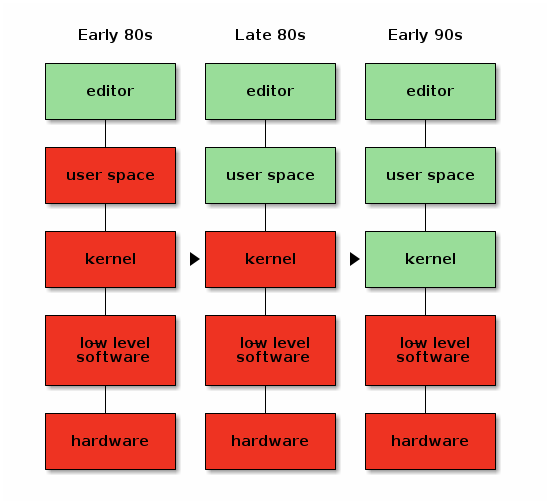
My own suspicion is that the universe is not only queerer than we suppose, but queerer than we can suppose.
-- J.B.S. Haldane (comments for this post will not pass moderation. Use your own blog!)

17 February 2026

Freexian Collaborators: Monthly report about Debian Long Term Support, January 2026 (by Santiago Ruano Rinc n)

The Debian LTS Team, funded by Freexian s Debian LTS offering, is pleased to report its activities for January.

Activity summary During the month of January, 20 contributors have been paid to work on Debian LTS (links to individual contributor reports are located below). The team released 33 DLAs fixing 216 CVEs. The team continued preparing security updates in its usual rhythm. Beyond the updates targeting Debian 11 ( bullseye ), which is the current release under LTS, the team also proposed updates for more recent releases (Debian 12 ( bookworm ) and Debian 13 ( trixie )), including Debian unstable. We highlight several notable security updates here below. Notable security updates:
  • python3.9, prepared by Andrej Shadura (DLA-4455-1), fixing multiple vulnerabilities in the Python interpreter.
  • php, prepared by Guilhem Moulin (DLA-4447-1), fixing two vulnerabilities that could yield to request forgery or denial of service.
  • apache2, prepared by Bastien Roucari s DLA-4452-1, fixing four CVEs.
  • linux-6.1, prepared by Ben Hutchings (DLA-4436-1), as a regular update of the linux 6.1 backport to Debian 11.
  • python-django, prepared by Chris Lamb (DLA-4458-1), resolving multiple vulnerabilities.
  • firefox-esr prepared by Emilio Pozuelo Monfort (DLA-4439-1)
  • gnupg2, prepared by Roberto S nchez (DLA-4437-1), fixing multiple issues, including CVE-2025-68973 that could potentially be exploited to execute arbitrary code.
  • apache-log4j2, prepared by Markus Koschany (DLA-4444-1)
  • ceph, prepared by Utkarsh Gupta (DLA-4460-1)
  • inetutils, prepared by Andreas Henriksson (DLA-4453-1), fixing an authentication bypass in telnetd.
Moreover, Sylvain Beucler studied the security support status of p7zip, a fork of 7zip that has become unmaintained upstream. To avoid letting the users continue using an unsupported package, Sylvain has investigated a path forward in collaboration with the security team and the 7zip maintainer, looking to replace p7zip with 7zip. It is to note however that 7zip developers don t reveal the information about the patches that fix CVEs, making it difficult to backport single patches to fix vulnerabilities in Debian released versions. Contributions from outside the LTS Team: Thunderbird, prepared by maintainer Christoph Goehre. The DLA (DLA-4442-1) was published by Emilio. The LTS Team has also contributed with updates to the latest Debian releases:
  • Bastien uploaded gpsd to unstable, and proposed updates for trixie #1126121 and bookworm #1126168 to fix two CVEs.
  • Bastien also prepared the imagemagick updates for trixie and bookworm, released as DSA-6111-1, along with the bullseye update DLA-4448-1.
  • Chris proposed a trixie point update for python-django (#112646), and the work for bookworm was completed in February (#1079454). The longstanding bookworm update required tracking down a regression in the django-storages packages.
  • Markus prepared tomcat10 updates for trixie and bookworm (DSA-6120-1), and tomcat11 for trixie (DSA-6121-1)
  • Thorsten Alteholz prepared bookworm point updates for zvbi (#1126167) to fix five CVEs; taglib (#1126273) to fix one CVE; and libuev (#1126370) to fix one CVE.
  • Utkarsh prepared an unstable update of node-lodash to fix one CVE.
Other than the work related to updates, Sylvain made several improvements to the documentation and tooling used by the team.

Individual Debian LTS contributor reports

Thanks to our sponsors Sponsors that joined recently are in bold.

Next.

Previous.