Search Results: "dod"

7 October 2012

Sune Vuorela: Playing with webstuff

So, the other day, I wrote a blog post asking people to make sure their private hacks become published somehow. So in the sprit of that, I should also publish my recent hacks. I have been toying around as a web dude and created two nice pieces of oldschool webby software. So. Time to introductions: Dodoma is a simple online note taking application. I have created a boring homepage for it on http://sune.vuorela.dk/dodoma and I have a screenshot here:
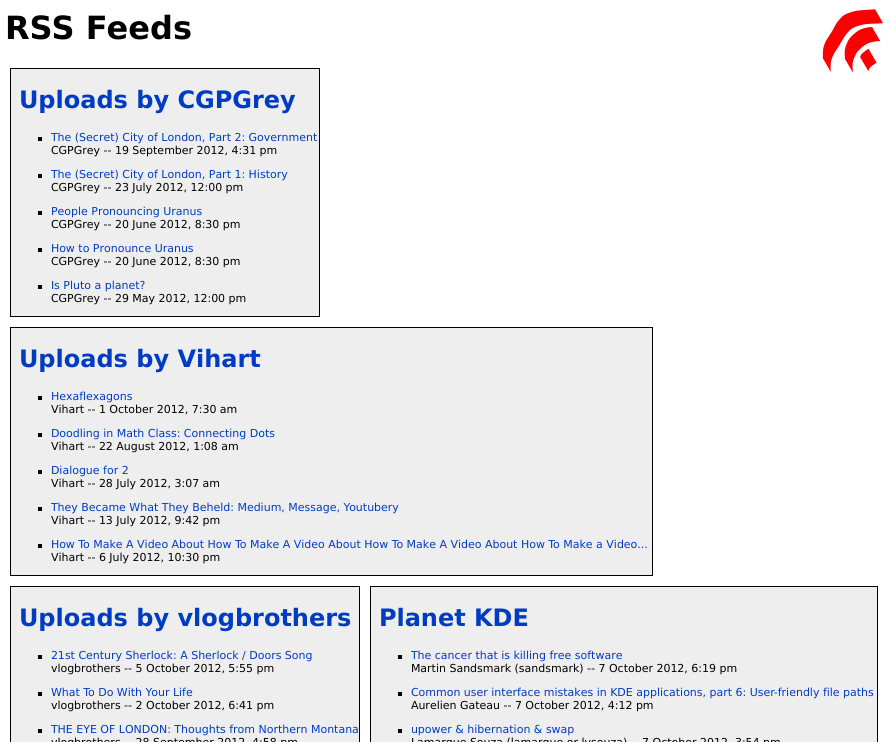
Screenshot of webapp Kadaka is a simple rss reader showing the five newest items from various rss feeds. Has special support for youtube channels.
I have created a boring homepage for it on http://sune.vuorela.dk/kadaka and I have a screenshot here:
Screenshot of kadaka Have fun with those two apps. Patches always welcome. Some of you might wonder where does he get those crazy names from . Well. One of them I found on a map. Thats actually a way I name quite many of my projects. Even those that don t even leave my harddrive. And the other one actually also is on a map, but I saw it on a frequently used bus in Tallin, Estonia. And. I am considering naming my next fancy projects after some of the cool words found on the join the game member page. If you want to be part of that, feel free to Join the game!

Dominique Dumont: Dpkg source editor/checker is going native

Hello As Config::Model was becoming too big with too many dependencies, I ve moved all Debian stuff from Config::Model repository into a separate Debian repository. If you install only libconfig-model-perl 2.026-1 (from experimental), the command cme check dpkg will not work. You must also install libconfig-model-dpkg-perl to get it back. libconfig-model-dpkg-perl is currently in experimental. libconfig-model-dpkg-perl repository is hosted on Alioth in debian perl-packaging team and is a Debian native package. Nevertheless, it will be uploaded to CPAN. (just like dh-make-perl).
All people involved in packaging are welcome to hack it or suggest improvements I ll upload both packages into unstable once the dust settles. All the best
Tagged: config-model, debian, dpkg, Perl

26 August 2012

Gregor Herrmann: RC bugs 2012/34

good news: I'm seeing more & more people contributing to RC bugs in the BTS. here are my own contributions for the past week:

13 August 2012

Jonathan Wiltshire: From building to demolishing

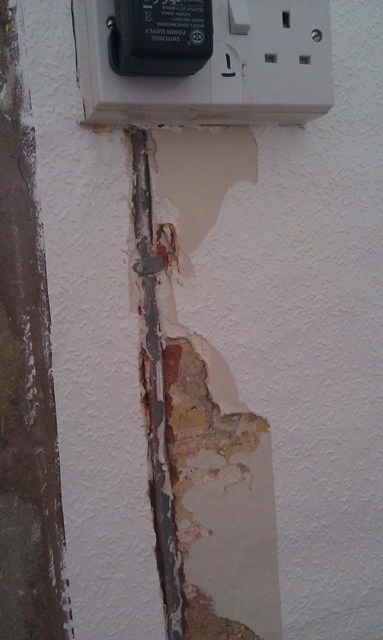
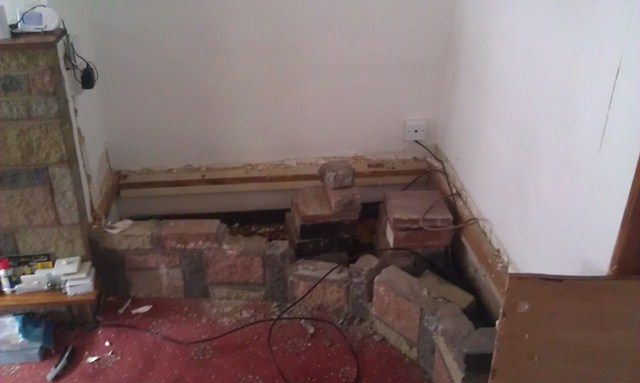
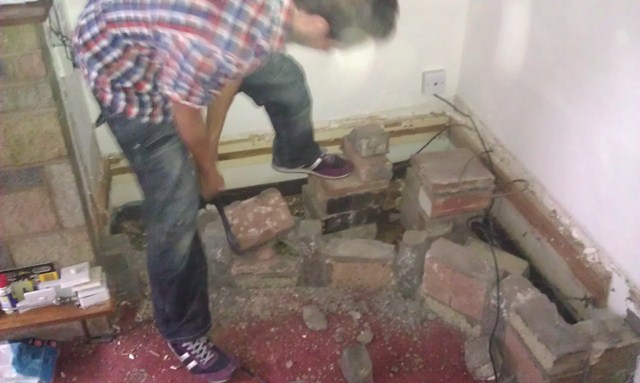
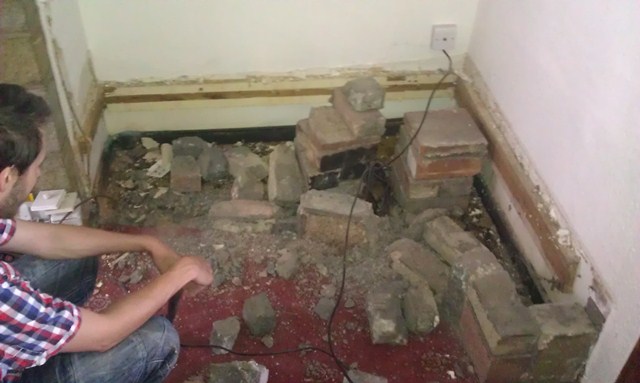
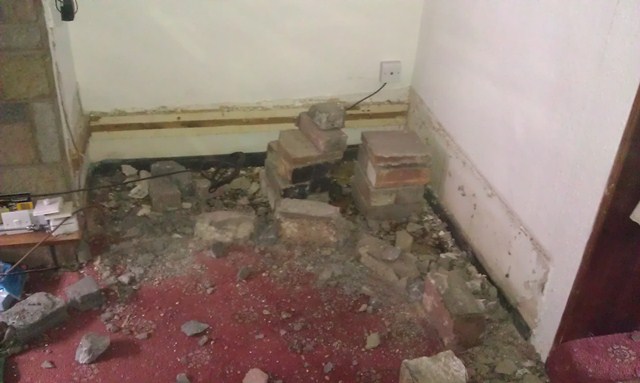
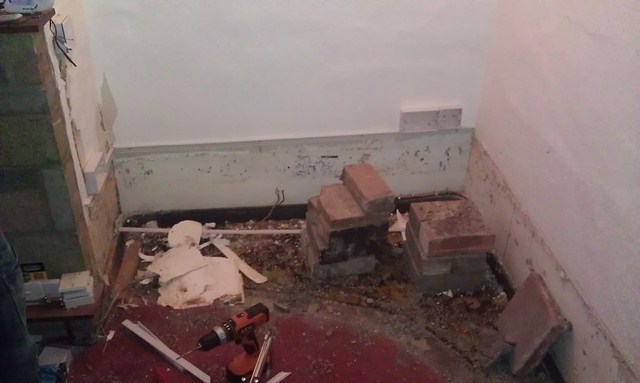
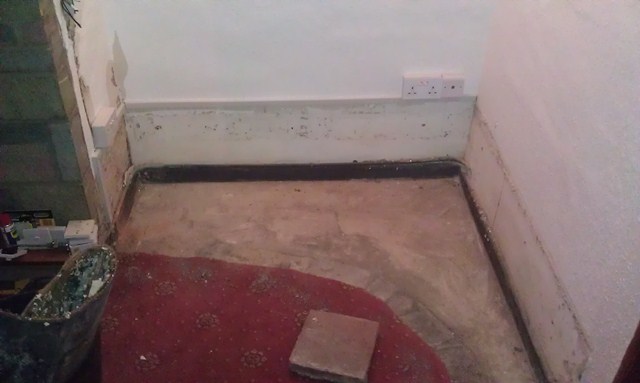
Building things is fun, but sometimes it s nice to have a little light relief with a sledgehammer. Saturday was one of those occasions; there is was a decorative wall in the corner of our lounge. It should have died about thirty years ago and I ve hated it ever since we moved in a year ago. First job was to remove the sockets and cable running up the side, which was a nice surprise in itself: Looks like whoever installed it believed that mastick and wallpaper is a suitable covering to stop drill bits. Hmm. Next we could take out the wall itself. In this case the wooden top was sealed down with more mastick and supported by piles of bricks, then the wall had been secured with concrete and not proper mortar. Fortunately a good sledgehammering soon took care of that: Those bricks truly were hideous, and they are all around the dodgy gas fire and another similar feature in the opposite corner of the room. Incidentally, the newly-revealed carpet in the void should also have died in the seventies (it went straight into the skip), but at least now we have some understanding of the mysterious wallpaper we found under the stairs. Finally we had enough room to work with surface trunking (a temporary housing until the gas pipe is removed and we can bury the cables properly): And the final result, with the sockets moved to a more sensible level and the cable properly protected, new LightwaveRF sockets in the corner and a shiny new aerial point ready for cabinets to go into the gap:
13/08: A couple of people pointed out that in the first photo, the offending cable is in a protected zone. This is true, but it wiggles half way round the room from the CU in a similar fashion first sometimes in trunking, sometimes clipped to the fireplace, and sometimes masticked and papered flush with the plaster surface.
From building to demolishing is a post from: jwiltshire.org.uk Flattr

15 July 2012

Steve Langasek: For those who care about my foot

Sitting in the airport during a layover on my way back from DebConf is one of the few times of year that time and motivation come together and routinely lead me to blog. Each year's DebConf has been special in its own way. This year at DebConf 12, in addition to the usual routine of catching up with all my far-away Debian friends, and of making new Debian friends in a country I've never been before, I got a special treat: my first opportunity to experience the practice of medicine in a foreign country. Last Saturday after arriving in Managua, I discovered that the very pretty paving stones making up the hotel walkway were also very slippery when wet, and the thin rubber strips that had been helpfully put in place to make them less slippery did not measurably succeed in doing so. So as it was raining that afternoon (as it does nearly every afternoon this time of year in Nicaragua), I slipped, and made the critical error of not falling. Instead, I stopped my slide - as it happens, by using the big toe of my left foot as if it were a roller skate brake. I don't recommend this, particularly if, as in my case, you already had it on your todo list to consult a podiatrist after DebConf regarding an ongoing feeling of weakness in precisely that part of precisely that foot. So while everything seemed fine the next day, Monday I woke up early with excruciating pain in my foot which, having forgotten about the incident two days prior, seemed to come from nowhere. After favoring the foot for another day and trying to keep the pain at bay using just OTC drugs, by Tuesday my foot was quite swollen and a source of concern. So I visited the clinic on the university campus, where the doctor diagnosed me with a dropped arch plus cellulitis due to bacteria entering through some invisible cut. Conclusion: university campus clinics are equally useless the world over. But at least in addition to pointlessly prescribing antibiotics, the doctor also prescribed some anti-inflammatory drugs to help bring the swelling down. Nevertheless, my questionable mobility kept both me and Patty from attending the day trip on Wednesday, which was a real shame as I had been keen to climb a volcano that day with my fellow Debian Developers (which in the end didn't happen for anyone, but that's a story for someone else's blog). Instead I took it easy for the day at the hotel, together with a few others who had opted not to attend the day trip, catching up on email and other work and hoping matters would improve. But by the end of the day the swelling was as bad as ever, if not worse, and I had no idea what was going on. Was it broken? Was something dislocated? And so I decided that the following day I would go to the hospital. The nearest hospital, as given in the DebConf local information page, is the Hospital Militar. It's a strange sort of thing as an American who remembers the 1980s to be seeking medical care from a facility operated by the Nicaraguan military; but accompanied by Fitoria, my native escort from the local team I had nothing to worry about; and besides, as a frequent international traveler I long ago learned the secret truth that people are people everywhere, no matter what flag they were born under. The highlight of the hospital visit was definitely when a member of the hospital staff, in full military uniform, shooed me towards a chair instead of standing to talk to her because "every patient has the right to sit, no matter what country they're in". After six x-rays and a doctor's consult, the conclusion was that it's probably not a broken bone and that it will probably clear up in just a couple of days with an even-better anti-inflammatory prescription and taking care of it by not walking on it. And indeed, my foot was already feeling better by Friday and aside from a little tenderness is now just about 100%. There are plenty of other entries on Planet Debian talking about the conference itself, and I don't think I have much to add to what's already been said there. But as for Nicaragua, I can conclude that it must be one of the best countries in the world to break your foot in - between the help of the hotel staff, the top-notch medical professionals, and above all the support of the DebConf local team (with a very big thank you again to Fitoria!), this is one brand of socialized medicine I can appreciate.

2 July 2012

Dominique Dumont: Kerberos configuration editor looking for a maintainer

Hello A while ago, Peter Knowles wrote a configuration model for Kerberos. Unfortunately, his priorities shifted before he completed this work. He was kind enough to send me the prototype in hope someone could take over. Although I do not know Kerberos, I believe the model is rather complete. Just click on the image below to judge for yourself: Class diagram of Kerberos configuration model This work was released under a LGPL-2+ license. There are some tasks left to get a Kerberos configuration editor. These are mentioned in config-model-kerberos readme file. To look at the code, just clone config-model-kerberos with
git://github.com/dod38fr/config-model-kerberos.git
If you need more information on Config::Model, see: If you are interested in adopting Kerberos model, please keep us informed on config-model-users at lists.sourceforge.net. This will avoid duplicated work. On my side, I ll gladly answer questions related to Config::Model to help you get started. All the best
Tagged: Config::Model, Kerberos, Perl

3 June 2012

Jordi Mallach: GNOME 3.4 in wheezy

Users of Debian sid will have noticed: the final (and interesting) bits of GNOME 3.4 have landed and if all looks as good as it does now, they should migrate to wheezy in about a week. 3.2 3.4 hasn't been as complicated as the previous horrible transition, but still had some complications due to Cogl/Clutter incompatibilities. Other than that, our major problem has been manpower, but this isn't new for many other Debian teams. We've also seen new incarnations of Linux-only technology is now mandatory which makes our lives a bit more miserable due to kfreebsd-* and hurd-i386, but for now we've still been able to dodge it. It seems wheezy+1 will be fun in that regard though, and we might need to take drastic approaches. If all goes well and the current lot (GNOME Shell, Control Center, Settings daemon, Mutter...) transitions without additional problems, we should be wrapping up our transitions for wheezy with Evolution and friends (currently sitting in experimental), and hopefully GDM 3.4. As we get many questions regarding the status of GDM in Debian, let's add a short note on this. Packaging GDM, at least in its current upstream form, is not a matter of unpacking a new tarball and editing debian/changelog. When Joss works on a new major version, the amount of tweaking to break away from stuff that works on other distros but is not so simple in Debian is outstanding (see, for example, the current unfinished work for GDM 3.2 in our SVN repo). In our case, to handle our GDM defaults, we even need changes to the underlying configuration system, dconf. This evidently takes some effort to do, and unfortunately our GDM expert has had little time for Debian lately, but we're confident we'll end up with a GDM in wheezy that is on par with Debian standards. We are, as always, reachable at #debian-gnome in the OFTC IRC network. Have fun!

12 May 2012

Steve Kemp: On working from home

Recently an ex-colleague of mine changed jobs and suggested that I write something about the pros and cons of working from home. I've thought about this subject, off and on, for a few years and frustratingly I think most of the pros and the cons are the same: I live in a two-bedroom flat in Edinburgh. (Having just spent thousands on a new bathroom I don't expect I'll be moving any time soon. A rough budget of 40-50,000 would let me convert my attic into two/three rooms. So there is growth potential!) In my flat I have made one of the bedrooms an office. The office contains: One PC is for work. One PC is for me. One phone is for work. One phone is my own. Every working day I switch on the work router, the work phone, the work PC around 09:30. I then work, taking a lunch-break between either 12:00-13:00 or 13:00-14:00, until 18:00 at which point I switch off the work toys. I ignore my personal PC during the working day with the exception that it is the source of my music. I can reach across and hit the appropriate multi-media keys to select Play/Pause/Next Track/Previous Track/Volume Up/Volume Down. (When thenever the work-phone rings the first ring is ignored as I scramble to hit "Mute" or "Pause"..!) So what are some of the advantages/drawbacks? Well I'm at home. So the environment is one that I've made myself, and enjoy. The music is mine. The colour-scheme is mine. The pictures on the walls are mine. I have a Steve-loving chair. There is no soulless air-conditioning, no horrible cubicles, and no noisy people talking. The downside? No people talking. If I didn't leave my house at lunchtime I'd speak to zero people face to face in an average working day. That took a while for me to notice, but it is not nice. Since I work from home "the commute" takes seconds. I tend to get out of bed and wander straight to the desk. I'll work non-stop, then get dressed around lunchtime so that I can go out for lunch. Hail, Rain, Snow, or Sunshine I leave the house for lunch every single day (unless waiting for an atypical delivery). Because if I didn't I'd have no human contact. In the afternoon if it is a nice day I'll get undressed again, because I can, so why the hell not? Providing you're focussed working from home has several advantages that I can think of - I've no qualms about setting the washing machine going before I start work knowing that I can "spare" five minutes to empty it later in the day. Similarly I've no concern about ordering (even large) items, because I know what time the postman comes, and I know I'm never going to be out and miss a delivery. When I first started working from home I had a laptop instead of a PC and there were mornings when I worked, lazily, from my bed, or from my sofa whilst watching TV. That didn't last for long because I just didn't do a good job. I think I got away with it in the sense that I don't think people noticed, but I expect if it had lasted for longer it would have been quickly apparent. I stopped because the line was blurring between "home life" and "work life". Having a dedicated working area is essential in keeping me focussed. I don't do "home things" when I'm in "work time" - with very rare exceptions. Yes I wander around and pace if I'm thinking, yes I make more tea and coffee than I would in a real office, and yes I might open windows, phone a friend, read my gas meter, washup dishes, or similar as I'm "making coffee". But on the whole it only works if I work when I'm working. I could save money by using my work-internet instead of paying for personal-internet, but keeping the two links separate is another way of being focussed. I don't do "dodgy" things on the internet, on the whole (haha), but if I do I'd want to be damn sure that that was via my link and not the work-link - and having two PCs and two network links I know that is the case. There have been times when the work link has broken and I've used my personal link + openvpn to continue working, or at the very least re-join our internal chatroom and say "Internet down, brb". As a system administrator there are times when I have to do things either early in the morning, late at night, or even during a weekend. I guess a final advantage is that this is not a struggle - providing I don't schedule such operations at times when I'm in the pub, meeting friends, or taking pictures of cute strangers, it isn't a struggle to say "I'll do this after 8pm tonight", or set the alarm early. No long walk to an office, and if I've already got food cooking for my tea I can eat it nearby whilst still configuring things and testing sites/services/machines. So pros: I'm in my own environment, I don't worry about receiving parcels, meter-readings, and have wonderfully pleasant music all day. Ancillory bonuses are really side-effects of being in my environment: I have my good coffee, my nice cups, I can eat food I enjoy. etc, etc. Cons: You must be dedicated. You must be focussed lest you give in to temptation and cease working for minutes/hours at a time. You lose part of your home space - I can't turn this room into a childrens bedroom, for example. Nothing earth-shattering. I've done this for five years now, and although I was a little skeptical initially I thought "Why not?" It has worked out well and I think if I ever did need to leave my current position I'd have no hesitation about working from home in the future. Finally it has to be said that when I've had partners in my life they've traditionally been the type to wake up later than me. I get significant brownie points for being able to wake them up around 10/11AM with a cup of hot coffee & breakfast in bed every morning. By virtue of having a separate space I can close the door and not be disturbed by them walking around. I'm sure I've forgotten things - but as an initial pass the benefits and disadvantages of working from home are the same: You're in your own house. ObQuote: "Explorers in the further regions of experience." - HellRaiser

20 April 2012

Dominique Dumont: A success story for Config::Model

Hello Here s a mail telling how the Config::Model Perl module was used to refactor existing configuration tools in Perl. Some punctuation and blank lines were added to improve the flow of this text. The full name and mail address of gkr is withheld on his request.
I took over a perl script that was responsible to pull data from several sources and push it after validation and re-packaging including some meta data into one of our production systems. The script was never intended to be used for more then a few month. But as things go, we were still using it after a few years. Only now for a lot more sources. Since all the configuration of sources and meta data were contained as a single hash in this script, it became very unwieldy. Although the configuration seldom changed, once it got added it was not an option to keep it like this especially as we decided to prepare a Debian package for faster installation and version tracking. So I had to re-work it and was looking for some library that was allowing me to define how the configuration has to look like, providing sensible hard coded and computed defaults for some of the values. This was when I found Config::Model on Cpan. It was, after some digging into the documentation, quite simple to define a rough first version of the complete config, including global default values as ini file and very simple to read in and write out. A more advanced version was not working because the Config::Model in Debian squeeze did not provide needed features. Switching to yaml as configuration file format not only increased readability but also worked with the standard Squeeze package. Consistency is checked automatically inside the model so broken configurations are more unlikely in the future. Of course I had some work re-factoring the original source but Config::Model allowed an easy addition of a value-checked and documented configuration file. To access the Config::Model::Instance I added small wrapper packages that allowed an easy access of the config elements by name to make the source easier to understand. The re-factoring needed for creating a Debian package for the Script which is now a set of modules and a small executable was simple once I had Config::Model working, since I was able to add new configuration items effortlessly and remove a lot of hard coded parameters. I don t use the cli tool yet for configuration editing but that s going to be the next step.
Many thanks to gkr for this feedback. Let s hope he will continue to give feedback on his usage of Config::Model. All the best
Tagged: config-model, configuration, debian, Perl

13 April 2012

Gregor Herrmann: cme fix dpkg-copyright

a short note to all fans of Copyright-Format 1.0: if you have debian/copyright files formatted according to one of the myriads of revisions of DEP5 & want to convert them to the released format, just run
cme fix dpkg-copyright
& be done with it.

cme is in the libconfig-model-perl package, & you should try to use the version from unstable, since Dominique constantly improves it (& he's also always open to proposals & nit-pickings from me merci beaucoup !).

More info about Config::Model on its homepage.

Martin F. Krafft: Mouse on Mars

The atmosphere in Munich s Backstage Werk just before the opening act to the Mouse on Mars was very chilled. People sat on the stairs or scattered themselves over the dance floor while low-fi ambient tunes came from the speakers. It wasn t loud, you had to try hard to hear the people mumble. I have no idea who the opening act was, and their first tune was very nice and groovy. Then ensued a noise explosion, one could only pity the electronic equipment that was being asked to perform in ways that may be described as everything else than you expect , and of course, the base beat shook the building; I am quite sure they didn t use treble at all, but I may also simply have been unable to hear it. Plus, it seemed to us that the musicians catered for what may be a widespread decrease of attention span: it was noticable how they jumped from one thing to the next, not leaving them (or their listeners) any time to get in the groove. My brother and I went outside for a bit and talked about today s music and its simplicity. We postulated the repetitiveness as the basis of a mass movement, considered scene clubs that played heavy techno to an audience that is so entirely different to who historically frequented such musical performances, and in general tried to avoid assuming a position between simplifying society and accepting that individual freedom is as eclectic as can be. When MoM opened, they continued pretty much in line with their openers and half way through the first tune, I started to wonder how long I would last, or when it would be reasonable to step outside again. I had been a little afraid this would happen, having bought and listened to their latest album Parastrophics in preparation of the concert and not being able to get into it. However, what then followed blew us away. Still heavy, still all over the place, but now they were developing sound scenes, ripping them apart, having fun playing with and teasing the audience, while putting on a groove that inevitably made your muscles twitch with the beat. David Bowie called MoM the next big thing and I have to give it to them: MoM have always had a certain aura of that s what your music is like? we can improve on that! to them, and yesterday, they continued along those lines with astounding consistency, and it felt fresh. It also felt real. They weren t just pushing buttons and computers making music, they were making music and the computers were their instruments. Between the two founding members of MoM sat Dodo Nkishi, drummer and microphone artist, and if you don t believe, fast, big breakbeat can be performed live, well, you re wrong. Most everyone in the room was dancing. And while I was more swaying in awe, watching and wondering how the heck they are doing what they are doing, I couldn t contain the bouncing any longer. They came back for an encore and there was no more stopping the crowd, Thomas or me. Three tracks later, they waved goodbye and left, but a bunch of us simply continued to dance. Thomas questioned who would last longer and I started yelling loudly for another encore. The lights turned on, I considered it a slap in the face, but I did not stop yelling. Others tuned in. And then the lights went off and the band came back. Following their 2.5 hour show, gosh was I exhausted. It was a magnificent show. If you aren t afraid of big beat electronica and you take pleasure in nonstandard art, I heartily recommend you ensure that MoM aren t soon playing near you without you there. PS: MoM will play at the (D sseldorf Open-Source Festival)[http://www.open-source-festival.de/en/] on 30 June 2012! PPS: Now I listen to Parastrophics and I am really enjoying it. NP: Mouse on Mars: Parastrophics

28 March 2012

Andrew Pollock: [life/americania] Four days in New Orleans

Sarah's Mum had accrued too much annual leave and had to take some time off work, so Sarah did some (very mild) arm twisting and convinced her to come over for 3 weeks, and do a 5 day cruise to Mexico out of New Orleans. Unfortunately, my annual leave situation wasn't quite so abundant, and I had a lot going on at work, so regretfully I didn't join them on the cruise, and instead went to New Orleans for a four day weekend when they returned. From all reports, the cruise was very good. Zoe handled it well, although she did say "home" a lot. One of the two stops in Mexico was to check out some Mayan ruins, which looked awesome from the photos. The other stop involved a dolphin encounter. I was incredibly envious of all that they got to do, and would have loved to have gone with them, as I've never been on a cruise ship either. I can also report that no cats were lost during this bachelor stint. I had a night flight on the Wednesday evening to get there, which was scheduled to get in at around midnight, and I'd booked a motel room near the airport for that night, and we'd booked a vacation rental home for Thursday to Sunday nights. Unfortunately, my flight ended being delayed something like 2.5 hours, so I didn't get into New Orleans until around 2am. The house we rented did the trick nicely. It was a small "shotgun" duplex in what looked like a nice neighbourhood. It was advertised as being close to the street car line, but they were doing some work on the tracks, so the street car didn't seem to be running as far down the line as it usually did, so it ended up being a bit more of a trek to get to it. It was also extremely slow, and there was a marathon on the Sunday, which closed everything down for a long time, making it a generally pretty unreliable form the transport. We ended up renting a car for Saturday and Sunday, which was something of a saga in itself, as Enterprise didn't have any cars at the location we'd booked one, so after a couple of hours cooling our heels there (Zoe was incredibly well-behaved, all things considered), they shuttled us over to another location and we ended up with a minivan instead of a compact, which for the same price, allayed our concerns about being able to transport all of our luggage to the airport on Monday morning. We had a very early morning flight on Monday morning to come back, which got into SFO at around 9am, and I went directly to work from there. Thursday We all arrived at the house, separately. It ended up taking them 2 hours to disembark the ship when it came back into port, with Customs taking an eternity to process everyone. I think we went exploring the local area that afternoon, and took a street car into the city to check out Bourbon Street, having a Cajun dinner at Remoulade. Friday In the morning, we went to check out Lafayette Cemetery Number 2. Sarah took Zoe back to the house for a nap, and Sarah's Mum and I continued back to explore the French Quarter some more, walking down the length of Royal Street (which was vastly different from Bourbon Street, just one block over). We had lunch at the French Market. The cemetery was interesting, as pretty much all of the graves were these huge above ground tombs, that seemed to have multiple family members interred in them. Apparently the cemetery filled up quite quickly courtesy of a Yellow Fever outbreak. After lunch, Sarah's Mum and I continued wandering around the French Quarter. We went and took a look at the Mississippi River, and I had an encounter with a grifter who was so good at his job I couldn't bring myself to argue with him over the $20 he diddled me out of. We tried to get to the Civil War Museum, but it closed at 4pm. We looked at the Robert E. Lee Monument, which seemed to be draped in drunks, and then I think we rendezvoused with Sarah and Zoe back on Canal Street for dinner at The Court of Two Sisters (which apparently we were under-dressed for, as Sarah and her Mum said we were getting a lot of dirty looks from other patrons). Saturday On Saturday morning, we had the aforementioned car rental experience from hell, and by the time we had the car it was lunchtime, so Zoe napped in the car after lunch on the way out to Oak Alley Plantation, where we were introduced to the delightful beverage known as the mint julep, and took a tour of the house and wandered the grounds. Sunday On Sunday, Sarah and her Mum did a swamp tour, and Zoe and I went to the zoo. As I said earlier, there was a marathon that completely closed down Saint Charles Avenue, which is where the street cars run, so after walking down to where the street cars started operating (which ended up being most of the way down South Carrollton Avenue), the driver informed me that the street cars were queuing up at the corner of South Carrollton and Saint Charles, and I should get off her street car and get on the one at the front of the queue. I did this, but the driver of the front street car informed me that she wouldn't be leaving for an hour and half. At this point, I started considering a bus instead. Zoe and I went to check out the Mississippi River, which was quite close to where we were, and then I went back, and despite a street car having left (without any passengers) the driver of the current street car couldn't tell me when she'd be leaving, so I started walking down Saint Charles Avenue. Unfortunately, Zoe's going through a phase where she wants to be carried everywhere, so I was lugging her all over the place on my hip. Sarah didn't take a stroller with her, and instantly regretted it. Lesson learned. Eventually we managed to get onto a bus, which dropped us off at Audubon Park, which had Audubon Zoo at the other end of it. There was a playground near the Saint Charles Avenue end of the park, so Zoe had a bit of a play on that, and then we continued through the park to the zoo. Mercifully, the zoo had dodgy strollers for rent, and there was no way in the world I wasn't going to rent one of them, so that made getting around with Zoe a lot easier on my back. We had a really good time at the zoo. There was some sort of a music festival on in the parklands within the zoo grounds, and that included a jumping castle, which Zoe expressed a desire to have a go on. She had a fabulous time on it. I think she probably spent about 15 minutes in there, without any tears. I was very impressed. I took a brief video of some of her antics. It was getting close to Zoe's nap time, and she was getting tired, but fortunately Sarah and her Mum were able to pick us up from the zoo after their swamp tour and Zoe got to nap back at the house. Monday We had a very early start. Unfortunately, our flight (with United) was a couple of days after United and Continental officially merged, and despite having checked in online, we had to queue up with everyone else (for an extended period of time) to drop off our checked luggage. Then there was a 45 minute line for security screening. We pulled the "toddler going to melt down" card and jumped to the head of the line, but Sarah's Mum had to wait. The flight ended up being delayed because people were stuck in the security line. Overall impressions of New Orleans Fabulous architecture. There were so many gorgeous houses on Saint Charles Avenue and the surrounding area. I'd have loved to do an architecture tour. Crap (but cheap) public transport. $3 gets you a day pass. The street cars are cute, but slow and unpredictable. The drivers were remarkably unhelpful. The buses were okay. Great food. Zoe seemed to have a liking for the spicy stuff. I gave her some fresh alligator jerky, and after some initial coughing and spluttering at the spiciness of it, she came back for more. Post-Katrina recovery. We really only saw a very small part of the city, but there were still some houses with boarded up windows, and some vacant blocks where buildings had been demolished, but largely you'd not have been able to tell that large parts of the city had been underwater, from casual inspection. I really enjoyed the trip, even though it was brief, I feel like I got a good feel for the place. We were there just after Mardi Gras, and there were still beads everywhere. Draped all over fences. Over power lines. Trees on the parade route were absolutely covered in beads. I'd have loved to have been there for Mardi Gras. My friend Brandon, who is an excellent street photographer, took some great photos that capture some of it. Photos from Sarah's cruise and our time in New Orleans are here.

16 March 2012

Dominique Dumont: Config::Model and cme to help debian transitions

Hello As maintainer of libwx-scintilla-perl, I had to update the package to update a dependency declation to close bug #662427. The dependency was good enough for the package to work but it blocked the linpng15 transition. This is yet another detail to remember when updating package: whether the dependencies are impacted by a transition. As I m really bad at remembering such details, I ve added the relevant check in the dpkg control source model used by cme. Now running cme check dpkg will warn you if a dependency impacts a transition. And cme fix dpkg will fix you dependency list as resquested by a transition. Well, that holds true for the transition I m aware of. Feel free to contact me if more transition checks are needed. For those who are curious (or want to send me a patch for another transition), here s the actual implementation of these new checks. All the best

8 March 2012

Raphaël Hertzog: People Behind Debian: Gregor Herrmann, member of the Perl team

Photo by Aigars Mahinovs

I followed Gregor s evolution within Debian because I used to be somewhat active in the Perl team. His case is exemplar because it shows that you don t need to be an IT professional to join Debian and to make a difference. His QA page is impressive with hundreds of packages maintained and hundreds of non-maintainer uploads too. While he started out slowly, I remember meeting him at Debconf 7 in Edinburgh and after that he really got more implicated. Again a case of someone joining for technical reasons but getting more involved and staying there for social reasons! :-) Let s jump into the interview and learn more about him. Raphael: Who are you? Gregor: I m 41 years old, and I live in Innsbruck, Austria, in a shared apartment with a friend of mine. In my day job, I m working at the regional addiction prevention agency, so I m one of the few Debian guys who s not an IT student or professional. I started maintaining packages in 2006, and I am a DD since April 2008. Raphael: How did you start contributing to Debian? Gregor: After having used Debian on servers for some years, I finally switched to it on the desktop after some procrastinating. Soon afterwards I wanted to know more about the making-of , started to join mailing lists, filed bugs, and tried to learn packaging. Luckily I quickly found a permanent sponsor Tony Mancill, and we re still co-maintaining each others packages. And when I packaged my first Perl modules, Gunnar Wolf invited me to join the Debian Perl Group, an offer I accepted a few days later. And I m still there :) Later, the NM process, although it involved some waiting times, was also a good learning experience due to my AM Wouter Verhelst. (And in the meantime the organization of the NM process has vastly improved, from what I hear.) So my starting point for joining Debian was my curiosity but what really helped me to find my way into the project was the support of the people who invited and helped me. Raphael: What s your biggest achievement within Debian or Ubuntu? Gregor: I m not sure I can name a single big achievement but I guess I can say that my contributions to the Debian Perl Group have helped to make and keep the team a success story. Raphael: The pkg-perl team seems to work very well. As an active member, can you explain us how it is organized? How do you explain its success? In particular it seems to be a great entry point for new contributors. Gregor: The team is huge, both in numbers of members and packages (over 2200). Since last DebConf we manage our source packages in git, we have 2 mailing lists and an IRC channel, and we manage to keep an overview by using PET, the Package Entropy Tracker. It s true that we get new members on a regular basis; we try to invite people (like it happened to me 6 years ago :) ) but there are also quite a few new contributors who find our docs and introduce themselves on the mailing list. Maybe someone should conduct a study and ask them what motivated them to join. :) We hand out group membership/commit access quickly, and we try to mentor new contributors actively during their early times in the group. Some of them leave for other projects after some time, but many also stay and become DDs later. I m not sure what the reasons for the group s success are, maybe a combination of: For everyone interested in joining the Debian Perl Group, our Welcome page on the wiki is a good starting point. Raphael: What are your plans for Debian Wheezy? Gregor: Nothing overly exciting. What I should do is getting a newer JabRef into Debian (which involves packaging some new Java libraries any takers?). A solution for libdatetime-timezone-perl (which ships timezone data converted to Perl modules and tends to get outdated when the timezone data change) would be nice; let s see if #660404 leads to some results And some Perl packages will also need a bit of work for the hardening build flags release goal (cf. #657853). Raphael: What s the biggest problem of Debian? Gregor: Inertia. While I really like the fact that Debian is a volunteer project, and that every contributor works when and on what they decide to work on, I get the feeling that Debian could do better in moving forward, innovating, taking decisions. I also think that more uniformity in managing source packages would make things easier; it s quite amazing to see how many source formats, packaging helpers, patch systems, RCSs etc. are used all over the archive. I m not advocating for mono-cultures, and I consider this diversity a strength in general, but having to find out first how this particular package works when preparing a bug fix can be annoying. On the bright side, I think that the myth Debian and its mailing lists are mostly about flames can be seen as dispelled in the meantime. Sure, sometimes the tone could be a bit more civil, but in general most of the interactions I ve seen in the last years were friendly and helpful. IMO, the Debian Project consists of mostly nice and cooperative people, and that s what makes it fun for me. Raphael: You re one of the most dedicated participants to RCBW (Release Critical Bugs of the Week), an initiative to fix RC bugs every week. How much time do you spend on it? What would you advise to people who are considering to join the movement? Gregor: I got into the habit of fixing RC bugs after having been invited to my first Bug Squashing Party in Munich some years ago. During this weekend I saw that fixing RC bugs can be fun, is often not that difficult, and gives a warm fuzzy feeling :) I can definitely recommend attending a BSP if one happens to be organized near you. After tasting blood at this first BSP I tried to continue looking at RC bugs, and I guess I spend something around half an hour per day on it. I usually blog about it once a week, in order to motivate others to join in. And joining is easy: just take a look at the tips people like Zack, Vorlon, or me have written. You don t have to be a DD to help, many of my NMUs are based on patches that others kindly prepare and send to the BTS kudos! Another nice aspect is that the RC bug list contains problems from different fields: general packaging problems, language-specific issues, policy violations, etc. So there s something for everybody, and you don t have to be an expert in all fields to fix a specific bug. What s rewarding about fixing RC bugs is not only the feeling of accomplishment and the knowledge about having helped the next release I also received quite a few Thank you mails from maintainers who were busy at that time and appreciated the help. Raphael: Do you have wishes for Debian Wheezy? Gregor: Well, there s not so much left of the Wheezy release cycle if we manage to freeze in June :) Some quick thoughts for Wheezy and Wheezy+1: Raphael: Is there someone in Debian that you admire for their contributions? Gregor: There are many people in Debian I admire, too many to name them all. The first one that comes to my mind is Russ Allbery who not only does great work from lintian to Debian policy but who also sets a great example of communicating in a perfectly polite and respectful way even in heated discussions.
Thank you to Gregor for the time spent answering my questions. I hope you enjoyed reading his answers as I did. Note that older interviews are indexed on wiki.debian.org/PeopleBehindDebian.

Subscribe to my newsletter to get my monthly summary of the Debian/Ubuntu news and to not miss further interviews. You can also follow along on Identi.ca, Google+, Twitter and Facebook.

2 comments Liked this article? Click here. My blog is Flattr-enabled.

24 February 2012

Dominique Dumont: Config::Model: new cme command is available

Hello I ve (finally) released a new version of Config::Model. The main change for users is the deprecation of the config-edit program in favor of cme program. Instead of using options, this cme uses command keywords like git, so users will have more possibilities while typing less. bash completion is provided for cme command and options. Following Debian annoucement regarding the recommended format of Debian copyright file (aka DEP-5), I ve also updated the URL in Debian copyright model. If your package is already in a DEP-5 format, you can update the URL with this simple command: cme fix dpkg-copyright Check the wiki on github for more example of cme command. All the best

15 February 2012

Bartosz Feński: Asus Zenbook (UX31e) eventually stable under Linux

Seems that Intel developers eventually created patch that solves the main issue with Zenbook under Linux.
With Eugeni Dodonov s patch I m finally able to use RC6 feature and have stable system with acceptable battery lifetime. Almost two days without sudden shutdown using that patch ;) Happily there s chance that this patch is going to be included in 3.3.x mainline kernel. Beware that i915.i915_enable_rc6=1 kernel option means something different with patched and vanilla kernel.

31 January 2012

Paul Tagliamonte: python-sunlight (or: get at some awesome US Political data programmatically)

I ve spent a few days during work, after work and on the weekend working on python-sunlight, a unified API implementation of a few Sunlight services. This is very unstable, and not released yet (so please don t rely on it yet), but it will be shortly. Be sure to sign up for an API Key, and dump the key to ~/.sunlight.key there s a simple script to help with some of this in bin/, but nothing solid yet. I do, however, encourage you to use it and play around with it, and report your bugs. Contributions (in the form of code) are also very welcome, so please do fork the project and play around with it. Just to give everyone a taste of how cool this is this will pull up a list of twitter IDs of people who mention free market more then anyone else according to the congressional record:

from sunlight import capitolwords
from sunlight import congress
for person in capitolwords.phrases_by_entity(
    "legislator",
    phrase="free market",
    sort="count",
):
    n = congress.legislators( bioguide_id=person['legislator'],
        all_legislators="true" )
    if len(n) >= 1:
        n = n[0]
        if n['twitter_id'] != "":
            print n['twitter_id']
And the output:
RepRonPaul
stevekingia
SenSherrodBrown
JacksonLeeTX18
SenatorLeahy
ChuckGrassley
SenJohnMcCain
OrrinHatch
DanaRohrabacher
JudgeTedPoe
McConnellPress
edtowns
SenatorDurbin
SenatorSessions
SenatorHarkin
SenChrisDodd
russfeingold
RosLehtinen
sencarllevin
senjonkyl
Dennis_Kucinich
senatorsanders
SenatorReid
RepDanBurton
RepMikePence
SenSamBrownback
joebiden
FrankPallone
ToddAkin
senatorboxer
RepTrentFranks
JohnCornyn
Have fun! Show off what cha got, and please let me know if you do something cool!

6 December 2011

Steve Langasek: Making jam from bugs

This weekend, we held a combined Debian Bug Squashing Party and Ubuntu Local Jam in Portland, OR. A big thank you to PuppetLabs for hosting! Thanks to a brilliant insight from Kees Cook, we were able to give everyone access to their own pre-configured build environment as soon as they walked in the door by deploying schroot/sbuild instances in "the cloud" (in this case, Amazon EC2). Small blips with the mirrors notwithstanding, this worked out pretty well, and let people start to get their hands dirty as soon as they walked in the door instead of spending a lot of time up front doing the boring work of setting up a build environment. This was a big win for people who had never done a package build before, and I highly recommend it for future BSPs. You can read about the build environment setup in the Debian wiki, and details on setting up your own BSP cloud in Kees's blog. (And the cloud instances were running Ubuntu 11.10 guests, with Debian unstable chroots - a perfect pairing for our joint Debian/Ubuntu event!) So how did this curious foray into a combined Ubuntu/Debian event go? Not too shabby: When all was said and done, we didn't get a chance to tackle any wheezy release critical bugs like we'd hoped. That's ok, that leaves us something to do for our next event, which will be bigger and even better than this one. Maybe even big enough to rival one of those crazy, all-weekend BSPs that they have in Germany...

30 November 2011

Russell Coker: Links November 2011

Forbes has an interesting article about crowd-sourcing by criminals and law enforcement [1]. Ulissescastr0 made a Youtube video showing how to install SE Linux on Debian/Etch [2]. Probably no-one is using Etch nowadays so this video is outdated, but it s a good way of teaching people. It would be good if someone made a similar video showing how to do SE Linux things on Squeeze. I discovered the above SE Linux video through Explow which provides a neat interface to multiple searches and information sources [3]. I don t think I will be using Explow much in future as I could get the same result through Google video search. They also have a news portal but there are other sites for that. But it does seem that Explow would be useful for newbies. Eric Michael Johnson wrote an interesting article about the inherent bias in Psychological research based in the US [4]. People who live in urban environments think differently in some ways to people who live in different environments or who have different lifestyles. Therefore generalising from university students in the US to the entire human race is likely to get incorrect results. This is something to consider the next time you are tempted to generalise to the wider population from your own friends, colleagues, etc. The Daily Kos has a scary article about the TSA having a woman detained for reciting part of the US constitution [5]. The US will remain on my list of countries to avoid for the forseeable future. Vorlon has written an informative article about the use of hardening options when building Debian packages [6]. It s now even easier to do this, so every package that simultaneously deals with data of differing levels of integrity or sensitivity should be built this way. Bunker Roy gave an interesting TED talk about his Barefoot College that teaches useful skills to people in rural parts of India who don t have a traditional school education [7]. His talk really shows up some of the arrogance in the people who run traditional education. Justin Hall-Tipping gave an interesting TED talk about ways of solving the world energy problems [8]. He started with explaining the problems and why they need to be urgently solved and then described in detail some of the research that his group has done to solve the problems. This includes flexible photo-voltaic cells, infra-red vision to save on lighting, and a way of using carbon nano-tubes to control the thermal properties of windows.

26 November 2011

Jonathan McDowell: All I need is a large enough white wall

I think I'm currently supposed to be out buying a TV at the moment. Or something else expensive. Instead I'm lying on the sofa listening to Whale and drinking tea. That's much better in my opinion, but it reminded me that I hadn't mentioned that I bought a projector. I had the loan of a projector for a while when I was in Belfast. It was a huge thing that made a lot of noise, but was pretty cool for watching films with. When I moved to the US I decided not to bother with a TV to start with - using my laptop did just fine for most things. Except films. They really benefit from a bigger screen. Especially if you want to watch them with someone else. So I started looking at pico projectors, because I wanted something small and cute that I could throw in a bag with my tiny laptop. At the time the best the pico projectors could do was 840x480, which I felt wasn't really that great. However back in January TI announced their DLP Pico HD chipset, offering a resolution 1280x800. I kept a look out for projectors using this to appear, and eventually, in July, Amazon claimed to have availability of the Vivtek Qumi. So I bought one. And I'm very happy with it. I'm not a heavy user, and there are some niggles, but it's small and does exactly what I want. In low light conditions it'll happily throw an image all the way across the room, which is more than it's rated at. There's a mini-HDMI connector on the back, so it's a doddle to plug it into my laptop using the supplied HDMI to mini-HDMI cable. The laptop auto-detects the device and extends the desktop appropriate, as you'd expect. It'll also do media playback itself - there's a USB host port and a micro SD slot on the back. This works ok, and the included remote means you can easily set the projector somewhere above your head and still be able to easily control it. Unfortunately the built in speakers are fairly useless. There's a 3.5mm socket for external speakers, but having to plug something else in detracts from the convenience factor of the built-in media player. Also my unit had the power switch installed upside down (the little red line indicating the power is on actually shows up when it's off), but that's the only complaint I've got about the build quality. There's a little neoprene case to store the thing in as well. So, er, yeah. I think I can continue to make do without a normal TV for a while longer and avoid the nightmare that I suspect are the shops on Black Friday.

Next.

Previous.