Search Results: "dave"

31 December 2010

Dirk Eddelbuettel: R / Finance 2011 Call for Papers: Updated and expanded

One week ago, I sent the updated announcement below to the r-sig-finance list; this was kindly blogged about by fellow committee member Josh and by our pal Dave @ REvo. By now. I also updated the R / Finance conference website. So to round things off, a quick post here is in order as well. It may even get a few of the esteemed reader to make a New Year's resolution about submitting a paper :) Dear R / Finance community, The preparations for R/Finance 2011 are progressing, and due to favourable responses from the different sponsors we contacted, we are now able to offer

  1. a competition for best paper, which given the focus of the conference will award for both an 'academic' paper and an 'industry' paper
  2. availability of travel grants for up to two graduate students provided suitable papers were accepted for presentations
More details are below in the updated Call for Papers. Please feel free to re-circulate this Call for Papers with collegues, students and other associations. Cheers, and Season's Greeting, Dirk (on behalf of the organizing / program committee) Call for Papers: R/Finance 2011: Applied Finance with R April 29 and 30, 2011 Chicago, IL, USA The third annual R/Finance conference for applied finance using R will be held this spring in Chicago, IL, USA on April 29 and 30, 2011. The two-day conference will cover topics including portfolio management, time series analysis, advanced risk tools, high-performance computing, market microstructure and econometrics. All will be discussed within the context of using R as a primary tool for financial risk management, portfolio construction, and trading. Complete papers or one-page abstracts (in txt or pdf format) are invited to be submitted for consideration. Academic and practitioner proposals related to R are encouraged. We welcome submissions for full talks, abbreviated lightning talks, and for a limited number of pre-conference (longer) seminar sessions. Presenters are strongly encouraged to provide working R code to accompany the presentation/paper. Data sets should also be made public for the purposes of reproducibility (though we realize this may be limited due to contracts with data vendors). Preference may be given to presenters who have released R packages. The conference will award two $1000 prizes for best paper: one for best practitioner-oriented paper and one for best academic-oriented paper. Further, to defray costs for graduate students, two travel and expense grants of up to $500 each will be awarded to graduate students whose papers are accepted. To be eligible, a submission must be a full paper; extended abstracts are not eligible. Please send submissions to: committee at RinFinance.com The submission deadline is February 15th, 2011. Early submissions may receive early acceptance and scheduling. The graduate student grant winners will be notified by February 23rd, 2011. Submissions will be evaluated and submitters notified via email on a rolling basis. Determination of whether a presentation will be a long presentation or a lightning talk will be made once the full list of presenters is known. R/Finance 2009 and 2010 included attendees from around the world and featured keynote presentations from prominent academics and practitioners. 2009-2010 presenters names and presentations are online at the conference website. We anticipate another exciting line-up for 2011---including keynote presentations from John Bollinger, Mebane Faber, Stefano Iacus, and Louis Kates. Additional details will be announced via the conference website as they become available. For the program committee:
Gib Bassett, Peter Carl, Dirk Eddelbuettel, Brian Peterson,
Dale Rosenthal, Jeffrey Ryan, Joshua Ulrich

20 November 2010

Axel Beckert: Useful but Unknown Unix Tools: WebDAV client for the commandline

Ever wondered how to test or connect to a WebDAV server on the commandline? Don t want to use a bloaty GUI file manager to connect to a WebDAV server? Then use cadaver (Debian package), a WebDAV client reminiscent of the classic ftp commandline client (plus tab completion :-).
$ cadaver https://webdav.phys.ethz.ch/unixhome/abe/vortraege
Authentication required for D-PHYS on server  webdav.phys.ethz.ch':
Username: abe
Password: 
dav:/unixhome/abe/vortraege/> ls
Listing collection  /unixhome/abe/vortraege/': succeeded.
Coll:   wml                                    0  Mar 13  2007
dav:/unixhome/abe/vortraege/> quit
Connection to  webdav.phys.ethz.ch' closed.
There is also nd which works more like ncftpget/ncftpput/wget/wput, but I didn t get the current version in Debian to work with our WebDAV server. Last time I used nd was back then at ECOS times more than half a decade ago.

18 November 2010

John Goerzen: The TSA: Stupid, Owned, or Complicit?

I have long been in Bruce Schneier s camp, thinking that the TSA is a joke: nothing but security theater. A few recent examples come to mind: I don t get it. They have been completely reactionary since they began. They have a complete failure of institutional imagination. Something happens, and then a new rule comes out to prevent the thing that everybody is now expecting. And what happens about the thing that people aren t expecting yet? Nothing. So we now have to take off our shoes because one guy tried to use them for something nefarious. OK, fine, but the next guy is probably going to try something other than shoes. Which is why, I m sure, many people are pointing out that the TSA is over-reliant on technology and device detection and completely underemphasizing evildoer detection as, we are repeatedly reminded, the Israelis excel at. The TSA s attempt to remedy that was foolish at best, and, according to a recent report, not grounded in science. Which is why I am heartened that, almost a decade after 9/11, Americans are starting to let go of their fear and be ready to reclaim some sense of intelligence at the security line. The fact that politicians think there is something to be gained by being tough on TSA s invasive screening procedures, rather than risk looking soft on terrorism, is evidence of this. So, what I haven t yet worked out is this: What gives, TSA? Are they: (Note: this criticism is directed mostly at the upper levels of TSA management; I do not believe the people most of us see have the ability to change the system, even if they wanted to.) One final word: I also get annoyed at all the people that grouse at the TSA checking 80-year-olds as thoroughly as everyone else. An 80-year-old could be wearing a hidden device just as much as anyone else could, and if we don t check them, then someday they probably will. The key is to be smart about who we check carefully. Use data, behavioral analysis, simple questioning, etc it works, and is a lot better than exempting people under 13 and over 80 from screening on arbitrary grounds. Also, it might help anyone with a blurry groin. And it might just save a bunch of us from getting cancer.

15 October 2010

Enrico Zini: Award winning code

Award winning code Me and Yuwei had a fun day at hhhmcr (#hhhmcr) and even managed to put together a prototype that won the first prize \o/ We played with the gmp24 dataset kindly extracted from Twitter by Michael Brunton-Spall of the Guardian into a convenient JSON dataset. The idea was to find ways of making it easier to look at the data and making sense of it. This is the story of what we did, including the code we wrote. The original dataset has several JSON files, so the first task was to put them all together:
#!/usr/bin/python
# Merge the JSON data
# (C) 2010 Enrico Zini <enrico@enricozini.org>
# License: WTFPL version 2 (http://sam.zoy.org/wtfpl/)
import simplejson
import os
res = []
for f in os.listdir("."):
    if not f.startswith("gmp24"): continue
    data = open(f).read().strip()
    if data == "[]": continue
    parsed = simplejson.loads(data)
    res.extend(parsed)
print simplejson.dumps(res)
The results however were not ordered by date, as GMP had to use several accounts to twit because Twitter was putting Greather Manchester Police into jail for generating too much traffic. There would be quite a bit to write about that, but let's stick to our work. Here is code to sort the JSON data by time:
#!/usr/bin/python
# Sort the JSON data
# (C) 2010 Enrico Zini <enrico@enricozini.org>
# License: WTFPL version 2 (http://sam.zoy.org/wtfpl/)
import simplejson
import sys
import datetime as dt
all_recs = simplejson.load(sys.stdin)
all_recs.sort(key=lambda x: dt.datetime.strptime(x["created_at"], "%a %b %d %H:%M:%S +0000 %Y"))
simplejson.dump(all_recs, sys.stdout)
I then wanted to play with Tf-idf for extracting the most important words of every tweet:
#!/usr/bin/python
# tfifd - Annotate JSON elements with Tf-idf extracted keywords
#
# Copyright (C) 2010  Enrico Zini <enrico@enricozini.org>
#
# This program is free software: you can redistribute it and/or modify
# it under the terms of the GNU General Public License as published by
# the Free Software Foundation, either version 3 of the License, or
# (at your option) any later version.
#
# This program is distributed in the hope that it will be useful,
# but WITHOUT ANY WARRANTY; without even the implied warranty of
# MERCHANTABILITY or FITNESS FOR A PARTICULAR PURPOSE.  See the
# GNU General Public License for more details.
#
# You should have received a copy of the GNU General Public License
# along with this program.  If not, see <http://www.gnu.org/licenses/>.
import sys, math
import simplejson
import re
# Read all the twits
records = simplejson.load(sys.stdin)
# All the twits by ID
byid = dict(((x["id"], x) for x in records))
# Stopwords we ignore
stopwords = set(["by", "it", "and", "of", "in", "a", "to"])
# Tokenising engine
re_num = re.compile(r"^\d+$")
re_word = re.compile(r"(\w+)")
def tokenise(tweet):
    "Extract tokens from a tweet"
    for tok in tweet["text"].split():
        tok = tok.strip().lower()
        if re_num.match(tok): continue
        mo = re_word.match(tok)
        if not mo: continue
        if mo.group(1) in stopwords: continue
        yield mo.group(1)
# Extract tokens from tweets
tokenised = dict(((x["id"], list(tokenise(x))) for x in records))
# Aggregate token counts
aggregated =  
for d in byid.iterkeys():
    for t in tokenised[d]:
        if t in aggregated:
            aggregated[t] += 1
        else:
            aggregated[t] = 1
def tfidf(doc, tok):
    "Compute TFIDF score of a token in a document"
    return doc.count(tok) * math.log(float(len(byid)) / aggregated[tok])
# Annotate tweets with keywords
res = []
for name, tweet in byid.iteritems():
    doc = tokenised[name]
    keywords = sorted(set(doc), key=lambda tok: tfidf(doc, tok), reverse=True)[:5]
    tweet["keywords"] = keywords
    res.append(tweet)
simplejson.dump(res, sys.stdout)
I thought this was producing a nice summary of every tweet but nobody was particularly interested, so we moved on to adding categories to tweet. Thanks to Yuwei who put together some useful keyword sets, we managed to annotate each tweet with a place name (i.e. "Stockport"), a social place name (i.e. "pub", "bank") and a social category (i.e. "man", "woman", "landlord"...) The code is simple; the biggest work in it was the dictionary of keywords:
#!/usr/bin/python
# categorise - Annotate JSON elements with categories
#
# Copyright (C) 2010  Enrico Zini <enrico@enricozini.org>
# Copyright (C) 2010  Yuwei Lin <yuwei@ylin.org>
#
# This program is free software: you can redistribute it and/or modify
# it under the terms of the GNU General Public License as published by
# the Free Software Foundation, either version 3 of the License, or
# (at your option) any later version.
#
# This program is distributed in the hope that it will be useful,
# but WITHOUT ANY WARRANTY; without even the implied warranty of
# MERCHANTABILITY or FITNESS FOR A PARTICULAR PURPOSE.  See the
# GNU General Public License for more details.
#
# You should have received a copy of the GNU General Public License
# along with this program.  If not, see <http://www.gnu.org/licenses/>.
import sys, math
import simplejson
import re
# Electoral wards from http://en.wikipedia.org/wiki/List_of_electoral_wards_in_Greater_Manchester
placenames = ["Altrincham", "Sale West",
"Altrincham", "Ashton upon Mersey", "Bowdon", "Broadheath", "Hale Barns", "Hale Central", "St Mary", "Timperley", "Village",
"Ashton-under-Lyne",
"Ashton Hurst", "Ashton St Michael", "Ashton Waterloo", "Droylsden East", "Droylsden West", "Failsworth East", "Failsworth West", "St Peter",
"Blackley", "Broughton",
"Broughton", "Charlestown", "Cheetham", "Crumpsall", "Harpurhey", "Higher Blackley", "Kersal",
"Bolton North East",
"Astley Bridge", "Bradshaw", "Breightmet", "Bromley Cross", "Crompton", "Halliwell", "Tonge with the Haulgh",
"Bolton South East",
"Farnworth", "Great Lever", "Harper Green", "Hulton", "Kearsley", "Little Lever", "Darcy Lever", "Rumworth",
"Bolton West",
"Atherton", "Heaton", "Lostock", "Horwich", "Blackrod", "Horwich North East", "Smithills", "Westhoughton North", "Chew Moor", "Westhoughton South",
"Bury North",
"Church", "East", "Elton", "Moorside", "North Manor", "Ramsbottom", "Redvales", "Tottington",
"Bury South",
"Besses", "Holyrood", "Pilkington Park", "Radcliffe East", "Radcliffe North", "Radcliffe West", "St Mary", "Sedgley", "Unsworth",
"Cheadle",
"Bramhall North", "Bramhall South", "Cheadle", "Gatley", "Cheadle Hulme North", "Cheadle Hulme South", "Heald Green", "Stepping Hill",
"Denton", "Reddish",
"Audenshaw", "Denton North East", "Denton South", "Denton West", "Dukinfield", "Reddish North", "Reddish South",
"Hazel Grove",
"Bredbury", "Woodley", "Bredbury Green", "Romiley", "Hazel Grove", "Marple North", "Marple South", "Offerton",
"Heywood", "Middleton",
"Bamford", "Castleton", "East Middleton", "Hopwood Hall", "Norden", "North Heywood", "North Middleton", "South Middleton", "West Heywood", "West Middleton",
"Leigh",
"Astley Mosley Common", "Atherleigh", "Golborne", "Lowton West", "Leigh East", "Leigh South", "Leigh West", "Lowton East", "Tyldesley",
"Makerfield",
"Abram", "Ashton", "Bryn", "Hindley", "Hindley Green", "Orrell", "Winstanley", "Worsley Mesnes",
"Manchester Central",
"Ancoats", "Clayton", "Ardwick", "Bradford", "City Centre", "Hulme", "Miles Platting", "Newton Heath", "Moss Side", "Moston",
"Manchester", "Gorton",
"Fallowfield", "Gorton North", "Gorton South", "Levenshulme", "Longsight", "Rusholme", "Whalley Range",
"Manchester", "Withington",
"Burnage", "Chorlton", "Chorlton Park", "Didsbury East", "Didsbury West", "Old Moat", "Withington",
"Oldham East", "Saddleworth",
"Alexandra", "Crompton", "Saddleworth North", "Saddleworth South", "Saddleworth West", "Lees", "St James", "St Mary", "Shaw", "Waterhead",
"Oldham West", "Royton",
"Chadderton Central", "Chadderton North", "Chadderton South", "Coldhurst", "Hollinwood", "Medlock Vale", "Royton North", "Royton South", "Werneth",
"Rochdale",
"Balderstone", "Kirkholt", "Central Rochdale", "Healey", "Kingsway", "Littleborough Lakeside", "Milkstone", "Deeplish", "Milnrow", "Newhey", "Smallbridge", "Firgrove", "Spotland", "Falinge", "Wardle", "West Littleborough",
"Salford", "Eccles",
"Claremont", "Eccles", "Irwell Riverside", "Langworthy", "Ordsall", "Pendlebury", "Swinton North", "Swinton South", "Weaste", "Seedley",
"Stalybridge", "Hyde",
"Dukinfield Stalybridge", "Hyde Godley", "Hyde Newton", "Hyde Werneth", "Longdendale", "Mossley", "Stalybridge North", "Stalybridge South",
"Stockport",
"Brinnington", "Central", "Davenport", "Cale Green", "Edgeley", "Cheadle Heath", "Heatons North", "Heatons South", "Manor",
"Stretford", "Urmston",
"Bucklow-St Martins", "Clifford", "Davyhulme East", "Davyhulme West", "Flixton", "Gorse Hill", "Longford", "Stretford", "Urmston",
"Wigan",
"Aspull New Springs Whelley", "Douglas", "Ince", "Pemberton", "Shevington with Lower Ground", "Standish with Langtree", "Wigan Central", "Wigan West",
"Worsley", "Eccles South",
"Barton", "Boothstown", "Ellenbrook", "Cadishead", "Irlam", "Little Hulton", "Walkden North", "Walkden South", "Winton", "Worsley",
"Wythenshawe", "Sale East",
"Baguley", "Brooklands", "Northenden", "Priory", "Sale Moor", "Sharston", "Woodhouse Park"]
# Manual coding from Yuwei
placenames.extend(["City centre", "Tameside", "Oldham", "Bury", "Bolton",
"Trafford", "Pendleton", "New Moston", "Denton", "Eccles", "Leigh", "Benchill",
"Prestwich", "Sale", "Kearsley", ])
placenames.extend(["Trafford", "Bolton", "Stockport", "Levenshulme", "Gorton",
"Tameside", "Blackley", "City centre", "Airport", "South Manchester",
"Rochdale", "Chorlton", "Uppermill", "Castleton", "Stalybridge", "Ashton",
"Chadderton", "Bury", "Ancoats", "Whalley Range", "West Yorkshire",
"Fallowfield", "New Moston", "Denton", "Stretford", "Eccles", "Pendleton",
"Leigh", "Altrincham", "Sale", "Prestwich", "Kearsley", "Hulme", "Withington",
"Moss Side", "Milnrow", "outskirt of Manchester City Centre", "Newton Heath",
"Wythenshawe", "Mancunian Way", "M60", "A6", "Droylesden", "M56", "Timperley",
"Higher Ince", "Clayton", "Higher Blackley", "Lowton", "Droylsden",
"Partington", "Cheetham Hill", "Benchill", "Longsight", "Didsbury",
"Westhoughton"])
# Social categories from Yuwei
soccat = ["man", "woman", "men", "women", "youth", "teenager", "elderly",
"patient", "taxi driver", "neighbour", "male", "tenant", "landlord", "child",
"children", "immigrant", "female", "workmen", "boy", "girl", "foster parents",
"next of kin"]
for i in range(100):
    soccat.append("%d-year-old" % i)
    soccat.append("%d-years-old" % i)
# Types of social locations from Yuwei
socloc = ["car park", "park", "pub", "club", "shop", "premises", "bus stop",
"property", "credit card", "supermarket", "garden", "phone box", "theatre",
"toilet", "building site", "Crown court", "hard shoulder", "telephone kiosk",
"hotel", "restaurant", "cafe", "petrol station", "bank", "school",
"university"]
extras =   "placename": placenames, "soccat": soccat, "socloc": socloc  
# Normalise keyword lists
for k, v in extras.iteritems():
    # Remove duplicates
    v = list(set(v))
    # Sort by length
    v.sort(key=lambda x:len(x), reverse=True)
# Add keywords
def add_categories(tweet):
    text = tweet["text"].lower()
    for field, categories in extras.iteritems():
        for cat in categories:
            if cat.lower() in text:
                tweet[field] = cat
                break
    return tweet
# Read all the twits
records = (add_categories(x) for x in simplejson.load(sys.stdin))
simplejson.dump(list(records), sys.stdout)
All these scripts form a nice processing chain: each script takes a list of JSON records, adds some bit and passes it on. In order to see what we have so far, here is a simple script to convert the JSON twits to CSV so they can be viewed in a spreadsheet:
#!/usr/bin/python
# Convert the JSON twits to CSV
# (C) 2010 Enrico Zini <enrico@enricozini.org>
# License: WTFPL version 2 (http://sam.zoy.org/wtfpl/)
import simplejson
import sys
import csv
rows = ["id", "created_at", "text", "keywords", "placename"]
writer = csv.writer(sys.stdout)
for rec in simplejson.load(sys.stdin):
    rec["keywords"] = " ".join(rec["keywords"])
    rec["placename"] = rec.get("placename", "")
    writer.writerow([rec[row] for row in rows])
At this point we were coming up with lots of questions: "were there more reports on women or men?", "which place had most incidents?", "what were the incidents involving animals?"... Time to bring Xapian into play. This script reads all the JSON tweets and builds a Xapian index with them:
#!/usr/bin/python
# toxapian - Index JSON tweets in Xapian
#
# Copyright (C) 2010  Enrico Zini <enrico@enricozini.org>
#
# This program is free software: you can redistribute it and/or modify
# it under the terms of the GNU General Public License as published by
# the Free Software Foundation, either version 3 of the License, or
# (at your option) any later version.
#
# This program is distributed in the hope that it will be useful,
# but WITHOUT ANY WARRANTY; without even the implied warranty of
# MERCHANTABILITY or FITNESS FOR A PARTICULAR PURPOSE.  See the
# GNU General Public License for more details.
#
# You should have received a copy of the GNU General Public License
# along with this program.  If not, see <http://www.gnu.org/licenses/>.
import simplejson
import sys
import os, os.path
import xapian
DBNAME = sys.argv[1]
db = xapian.WritableDatabase(DBNAME, xapian.DB_CREATE_OR_OPEN)
stemmer = xapian.Stem("english")
indexer = xapian.TermGenerator()
indexer.set_stemmer(stemmer)
indexer.set_database(db)
data = simplejson.load(sys.stdin)
for rec in data:
    doc = xapian.Document()
    doc.set_data(str(rec["id"]))
    indexer.set_document(doc)
    indexer.index_text_without_positions(rec["text"])
    # Index categories as categories
    if "placename" in rec:
        doc.add_boolean_term("XP" + rec["placename"].lower())
    if "soccat" in rec:
        doc.add_boolean_term("XS" + rec["soccat"].lower())
    if "socloc" in rec:
        doc.add_boolean_term("XL" + rec["socloc"].lower())
    db.add_document(doc)
db.flush()
# Also save the whole dataset so we know where to find it later if we want to
# show the details of an entry
simplejson.dump(data, open(os.path.join(DBNAME, "all.json"), "w"))
And this is a simple command line tool to query to the database:
#!/usr/bin/python
# xgrep - Command line tool to query the GMP24 tweet Xapian database
#
# Copyright (C) 2010  Enrico Zini <enrico@enricozini.org>
#
# This program is free software: you can redistribute it and/or modify
# it under the terms of the GNU General Public License as published by
# the Free Software Foundation, either version 3 of the License, or
# (at your option) any later version.
#
# This program is distributed in the hope that it will be useful,
# but WITHOUT ANY WARRANTY; without even the implied warranty of
# MERCHANTABILITY or FITNESS FOR A PARTICULAR PURPOSE.  See the
# GNU General Public License for more details.
#
# You should have received a copy of the GNU General Public License
# along with this program.  If not, see <http://www.gnu.org/licenses/>.
import simplejson
import sys
import os, os.path
import xapian
DBNAME = sys.argv[1]
db = xapian.Database(DBNAME)
stem = xapian.Stem("english")
qp = xapian.QueryParser()
qp.set_default_op(xapian.Query.OP_AND)
qp.set_database(db)
qp.set_stemmer(stem)
qp.set_stemming_strategy(xapian.QueryParser.STEM_SOME)
qp.add_boolean_prefix("place", "XP")
qp.add_boolean_prefix("soc", "XS")
qp.add_boolean_prefix("loc", "XL")
query = qp.parse_query(sys.argv[2],
    xapian.QueryParser.FLAG_BOOLEAN  
    xapian.QueryParser.FLAG_LOVEHATE  
    xapian.QueryParser.FLAG_BOOLEAN_ANY_CASE  
    xapian.QueryParser.FLAG_WILDCARD  
    xapian.QueryParser.FLAG_PURE_NOT  
    xapian.QueryParser.FLAG_SPELLING_CORRECTION  
    xapian.QueryParser.FLAG_AUTO_SYNONYMS)
enquire = xapian.Enquire(db)
enquire.set_query(query)
count = 40
matches = enquire.get_mset(0, count)
estimated = matches.get_matches_estimated()
print "%d/%d results" % (matches.size(), estimated)
data = dict((str(x["id"]), x) for x in simplejson.load(open(os.path.join(DBNAME, "all.json"))))
for m in matches:
    rec = data[m.document.get_data()]
    print rec["text"]
print "%d/%d results" % (matches.size(), matches.get_matches_estimated())
total = db.get_doccount()
estimated = matches.get_matches_estimated()
print "%d results over %d documents, %d%%" % (estimated, total, estimated * 100 / total)
Neat! Now that we have a proper index that supports all sort of cool things, like stemming, tag clouds, full text search with complex queries, lookup of similar documents, suggest keywords and so on, it was just fair to put together a web service to share it with other people at the event. It helped that I had already written similar code for apt-xapian-index and dde before. Here is the server, quickly built on bottle. The very last line starts the server and it is where you can configure the listening interface and port.
#!/usr/bin/python
# xserve - Make the GMP24 tweet Xapian database available on the web
#
# Copyright (C) 2010  Enrico Zini <enrico@enricozini.org>
#
# This program is free software: you can redistribute it and/or modify
# it under the terms of the GNU General Public License as published by
# the Free Software Foundation, either version 3 of the License, or
# (at your option) any later version.
#
# This program is distributed in the hope that it will be useful,
# but WITHOUT ANY WARRANTY; without even the implied warranty of
# MERCHANTABILITY or FITNESS FOR A PARTICULAR PURPOSE.  See the
# GNU General Public License for more details.
#
# You should have received a copy of the GNU General Public License
# along with this program.  If not, see <http://www.gnu.org/licenses/>.
import bottle
from bottle import route, post
from cStringIO import StringIO
import cPickle as pickle
import simplejson
import sys
import os, os.path
import xapian
import urllib
import math
bottle.debug(True)
DBNAME = sys.argv[1]
QUERYLOG = os.path.join(DBNAME, "queries.txt")
data = dict((str(x["id"]), x) for x in simplejson.load(open(os.path.join(DBNAME, "all.json"))))
prefixes =   "place": "XP", "soc": "XS", "loc": "XL"  
prefix_desc =   "place": "Place name", "soc": "Social category", "loc": "Social location"  
db = xapian.Database(DBNAME)
stem = xapian.Stem("english")
qp = xapian.QueryParser()
qp.set_default_op(xapian.Query.OP_AND)
qp.set_database(db)
qp.set_stemmer(stem)
qp.set_stemming_strategy(xapian.QueryParser.STEM_SOME)
for k, v in prefixes.iteritems():
    qp.add_boolean_prefix(k, v)
def make_query(qstring):
    return qp.parse_query(qstring,
        xapian.QueryParser.FLAG_BOOLEAN  
        xapian.QueryParser.FLAG_LOVEHATE  
        xapian.QueryParser.FLAG_BOOLEAN_ANY_CASE  
        xapian.QueryParser.FLAG_WILDCARD  
        xapian.QueryParser.FLAG_PURE_NOT  
        xapian.QueryParser.FLAG_SPELLING_CORRECTION  
        xapian.QueryParser.FLAG_AUTO_SYNONYMS)
@route("/")
def index():
    query = urllib.unquote_plus(bottle.request.GET.get("q", ""))
    out = StringIO()
    print >>out, '''
<html>
<head>
<title>Query</title>
<script src="http://ajax.googleapis.com/ajax/libs/jquery/1.4.2/jquery.min.js"></script>
<script type="text/javascript">
$(function() 
    $("#queryfield")[0].focus()
 )
</script>
</head>
<body>
<h1>Search</h1>
<form method="POST" action="/query">
Keywords: <input type="text" name="query" value="%s" id="queryfield">
<input type="submit">
<a href="http://xapian.org/docs/queryparser.html">Help</a>
</form>''' % query
    print >>out, '''
<p>Example: "car place:wigan"</p>

<p>Available prefixes:</p>

<ul>
'''
    for pfx in prefixes.keys():
        print >>out, "<li><a href='/catinfo/%s'>%s - %s</a></li>" % (pfx, pfx, prefix_desc[pfx])
    print >>out, '''
</ul>
'''
    oldqueries = []
    if os.path.exists(QUERYLOG):
        total = db.get_doccount()
        fd = open(QUERYLOG, "r")
        while True:
            try:
                q = pickle.load(fd)
            except EOFError:
                break
            oldqueries.append(q)
        fd.close()
        def print_query(q):
            count = q["count"]
            print >>out, "<li><a href='/query?query=%s'>%s (%d/%d %.2f%%)</a></li>" % (urllib.quote_plus(q["q"]), q["q"], count, total, count * 100.0 / total)
        print >>out, "<p>Last 10 queries:</p><ul>"
        for q in oldqueries[:-10:-1]:
            print_query(q)
        print >>out, "</ul>"
        # Remove duplicates
        oldqueries = dict(((x["q"], x) for x in oldqueries)).values()
        print >>out, "<table>"
        print >>out, "<tr><th>10 queries with most results</th><th>10 queries with least results</th></tr>"
        print >>out, "<tr><td>"
        print >>out, "<ul>"
        oldqueries.sort(key=lambda x:x["count"], reverse=True)
        for q in oldqueries[:10]:
            print_query(q)
        print >>out, "</ul>"
        print >>out, "</td><td>"
        print >>out, "<ul>"
        nonempty = [x for x in oldqueries if x["count"] > 0]
        nonempty.sort(key=lambda x:x["count"])
        for q in nonempty[:10]:
            print_query(q)
        print >>out, "</ul>"
        print >>out, "</td></tr>"
        print >>out, "</table>"
    print >>out, '''
</body>
</html>'''
    return out.getvalue()
@route("/query")
@route("/query/")
@post("/query")
@post("/query/")
def query():
    query = bottle.request.POST.get("query", bottle.request.GET.get("query", ""))
    enquire = xapian.Enquire(db)
    enquire.set_query(make_query(query))
    count = 40
    matches = enquire.get_mset(0, count)
    estimated = matches.get_matches_estimated()
    total = db.get_doccount()
    out = StringIO()
    print >>out, '''
<html>
<head><title>Results</title></head>
<body>
<h1>Results for "<b>%s</b>"</h1>
''' % query
    if estimated == 0:
        print >>out, "No results found."
    else:
        # Give as results the first 30 documents; also use them as the key
        # ones to use to compute relevant terms
        rset = xapian.RSet()
        for m in enquire.get_mset(0, 30):
            rset.add_document(m.document.get_docid())
        # Compute the tag cloud
        class NonTagFilter(xapian.ExpandDecider):
            def __call__(self, term):
                return not term[0].isupper() and not term[0].isdigit()
        cloud = []
        maxscore = None
        for res in enquire.get_eset(40, rset, NonTagFilter()):
            # Normalise the score in the interval [0, 1]
            weight = math.log(res.weight)
            if maxscore == None: maxscore = weight
            tag = res.term
            cloud.append([tag, float(weight) / maxscore])
        max_weight = cloud[0][1]
        min_weight = cloud[-1][1]
        cloud.sort(key=lambda x:x[0])
        def mklink(query, term):
            return "/query?query=%s" % urllib.quote_plus(query + " and " + term)
        print >>out, "<h2>Tag cloud</h2>"
        print >>out, "<blockquote>"
        for term, weight in cloud:
            size = 100 + 100.0 * (weight - min_weight) / (max_weight - min_weight)
            print >>out, "<a href='%s' style='font-size:%d%%; color:brown;'>%s</a>" % (mklink(query, term), size, term)
        print >>out, "</blockquote>"
        print >>out, "<h2>Results</h2>"
        print >>out, "<p><a href='/'>Search again</a></p>"
        print >>out, "<p>%d results over %d documents, %.2f%%</p>" % (estimated, total, estimated * 100.0 / total)
        print >>out, "<p>%d/%d results</p>" % (matches.size(), estimated)
        print >>out, "<ul>"
        for m in matches:
            rec = data[m.document.get_data()]
            print >>out, "<li><a href='/item/%s'>%s</a></li>" % (rec["id"], rec["text"])
        print >>out, "</ul>"
        fd = open(QUERYLOG, "a")
        qinfo = dict(q=query, count=estimated)
        pickle.dump(qinfo, fd)
        fd.close()
    print >>out, '''
<a href="/">Search again</a>

</body>
</html>'''
    return out.getvalue()
@route("/item/:id")
@route("/item/:id/")
def show(id):
    rec = data[id]
    out = StringIO()
    print >>out, '''
<html>
<head><title>Result %s</title></head>
<body>
<h1>Raw JSON record for twit %s</h1>
<pre>''' % (rec["id"], rec["id"])
    print >>out, simplejson.dumps(rec, indent=" ")
    print >>out, '''
</pre>
</body>
</html>'''
    return out.getvalue()
@route("/catinfo/:name")
@route("/catinfo/:name/")
def catinfo(name):
    prefix = prefixes[name]
    out = StringIO()
    print >>out, '''
<html>
<head><title>Values for %s</title></head>
<body>
''' % name
    terms = [(x.term[len(prefix):], db.get_termfreq(x.term)) for x in db.allterms(prefix)]
    terms.sort(key=lambda x:x[1], reverse=True)
    freq_min = terms[0][1]
    freq_max = terms[-1][1]
    def mklink(name, term):
        return "/query?query=%s" % urllib.quote_plus(name + ":" + term)
    # Build tag cloud
    print >>out, "<h1>Tag cloud</h1>"
    print >>out, "<blockquote>"
    for term, freq in sorted(terms[:20], key=lambda x:x[0]):
        size = 100 + 100.0 * (freq - freq_min) / (freq_max - freq_min)
        print >>out, "<a href='%s' style='font-size:%d%%; color:brown;'>%s</a>" % (mklink(name, term), size, term)
    print >>out, "</blockquote>"
    print >>out, "<h1>All terms</h1>"
    print >>out, "<table>"
    print >>out, "<tr><th>Occurrences</th><th>Name</th></tr>"
    for term, freq in terms:
        print >>out, "<tr><td>%d</td><td><a href='/query?query=%s'>%s</a></td></tr>" % (freq, urllib.quote_plus(name + ":" + term), term)
    print >>out, "</table>"
    print >>out, '''
</body>
</html>'''
    return out.getvalue()
# Change here for bind host and port
bottle.run(host="0.0.0.0", port=8024)
...and then we presented our work and ended up winning the contest. This was the story of how we wrote this set of award winning code.

4 July 2010

Bernd Zeimetz: gimp-plugin-registry 3.5-1

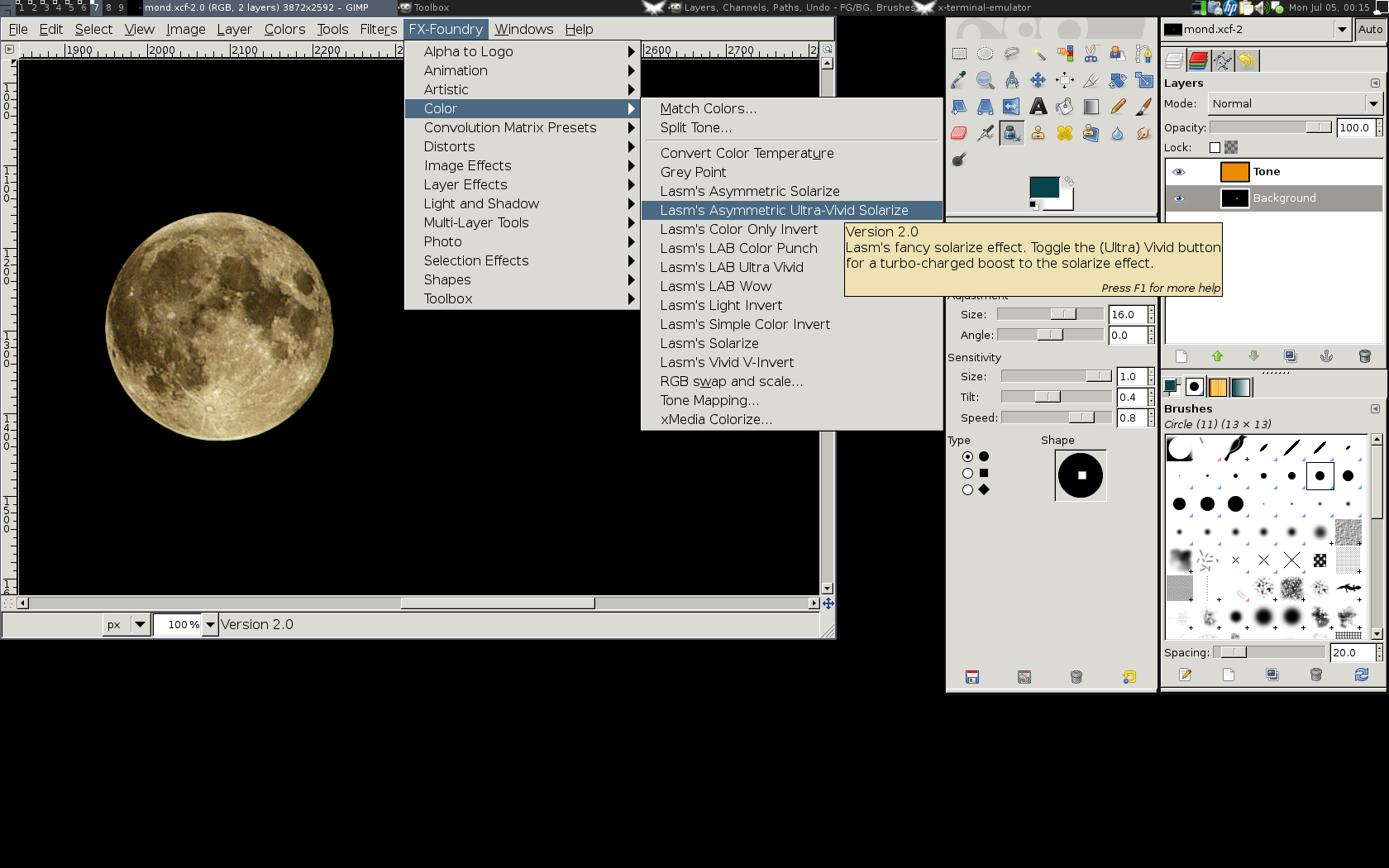
During the last three months and since my last blog-post about gimp-plugin-registry a lot happened: Mainly a large number of new plugins was added, but also various enhancements and bugfixes went into the package, together with updates for various already included plugins. The GIMP screenshot with open FX-Foundry menu For those who don't know gimp-plugin-registry yet, it is a collection of scripts and plugins for The GIMP. The name is based on the webpage GIMP Plugin Registry, where most (new) plugins and scripts are listed. So far the package ships with 170 scripts/plugins. Most of the scripts are written in TinyScheme, but there are also several plugins in C or Python. Probably most noticeable is the inclusion of the GIMP FX Foundry, which is an awesome collection of 124 scripts. Below follows a list of all scripts and plugins as shown in the long description of the Debian package. New plugins are marked with a bold fontface. If there is any interest from other distributions to include the package, I'd be happy to help out to make an integration as easy as possible. The few interesting parts could be ripped out of debian/rules and shipped as a normal Makefile, so they could be used easily. More complicated is the generation of the package description and copyright information, but I guess instead of writing debian/coyright and debian/control, it should be possible to integrate the information into a rpm spec file template or similar files. So in case you're interested to port the package to Fedora, OpenSuSE or some other distribution, don't hesitate to contact me! The sources are available via git, see git.recluse.de for details. For wishes, suggestions and bug reports either use the Debian BTS or Launchpad. While I prefer bugs via the BTS, it might be easier for non-Debian users to file bugs in the Ubuntu Launchpad.
26 October 2009

MJ Ray: debian kernel, firmware and virtualisation

The debian GNU/Linux kernel s firmware content is one of the most troubling bugs, and (as I understand it): The latest Bits from the kernel team included: A constructive discussion was held about the outstanding firmware issues, how the team addresses them and how we might work with upstream to address our DSFG issues with kernel sources. The fuller minutes expand it a little: The main topic was concerned with continued splitting of non free firmware and ensuring Debian kernels remain useful even with our DSFG challenges. Discussion about upstream firmware releases and general agreement was reached to talk to Dave Woodhouse about this (as he did most of the upstream firmware splits) . Action item for Vince and Max to talk to Dave Woodhouse. Good luck and thanks for working on this! Another interesting point for our co-op is that xen dom 0 patches will be included in the squeeze kernel release subject to ongoing stabilisation work. The feature will be marked as deprecated and will not appear in future releases. vserver (which I still use on one server) is also going away, but that s less of a surprise. It appears that OpenVZ is the only one with continuing support in the debian kernel, so I guess I d better take another look at it (after it failed messily last time I tried). Will you be changing your virtualisation approach? Do you think debian will get any encouragement for its firmware-splitting, or more flaming for not going far enough?

24 September 2009

Paul Wise: Adobe CMap and AGLFN data now free software!

In March 2009 I contacted Adobe about the self-contradictory nature of the license for the Adobe Glyph List For New Fonts (AGLFN) data. I did so because one of the upstreams I am involved in (fonttools) embeds a copy of aglfn.txt and I noticed the license was a bit strange. An Adobe employee by the name of David Lemon replied to say that the license would become less free than it was. I then asked him to consider using a free software license for both the Adobe CMap and AGLFN data. We discussed the benefits and drawbacks of doing this for both Adobe and the free software community. David was initially skeptical about the balance between benefits and drawbacks for Adobe and I was feeling pessimistic about the situation. The conversation ended and several months passed, with me sending the occasional ping and David being busy. Then in June he told me a new license was coming in a month. So I sent another ping on September 20th to find out what the status of that was. A couple of days later I received a mail saying that the Adobe CMap data has now been released under the BSD license and that the Adobe AGLFN data will soon follow! Please note that while this means that modifications are technically allowed, they are still strongly discouraged for compatibility reasons. Adobe has assigned an emailable maintainer (currently Ken Lunde) for these files so there is no reason that modifications should not be done upstream. You can also edit the wiki to document things or post in the forum. If you happen to meet David, Ken or Dave McAllister (who manages the Open@Adobe program) somewhere, please thank them and offer beverages. So, what does this mean for free software projects? Debian CJK users will be able to read many more PDFs with CJK characters without using any non-free packages once the new CMap files reach main. I will need to package the new AGLFN data for Debian. I will need to remove the embedded AGLFN from fonttools upstream and adapt it to use the packaged one if available or suggest the user download it if not. GNU Classpath and the other software projects using AGLFN data might like to do the same. I may consider writing a library for loading the AGLFN data, mainly as an exercise in learning how to write a good library though. Oh, and perhaps I can convince (Kenshi MUTO) my minimal level of involvement in this is worth a beer if I ever meet him :D

14 May 2009

Kees Cook: partial NX emulation in Ubuntu

Now available for early testing, Ubuntu Karmic Alpha 1 has a kernel feature I ve long wanted in Ubuntu: NX emulation. Basically, if your hardware lacks NX support, the kernel will emulate the feature using memory segment limits and ordering. This was AFAIBT originally developed by PaX, and a similar version (with histories including work by Solar Designer and maybe OpenBSD?) has been carried in RedHat/Fedora for a while now (under the larger project called ExecShield , covering multiple protection technologies). As more and more of the monolithic ExecShield kernel patch has been taken upstream (many thanks to Arjan van de Ven for pushing them), the patch in RedHat has been shrinking. Recently, Dave Jones split up the remaining pieces into logical chunks small enough that I could actually read it without going cross-eyed. From this, I ported the nx-emulation patches to Ubuntu s kernel, and now they re happily live in Karmic. So, instead of this:
$ ./vulnerable-setuid-program $OVERFLOW_AND_SHELLCODE
# id
uid=0(root) gid=0(root) groups=0(root)
We get this:
$ ./vulnerable-setuid-program $OVERFLOW_AND_SHELLCODE
Segmentation fault (core dumped)
$ dmesg tail -n1
[170131.763976] vulnerable-set[16278]: general protection ip:80489c5 sp:bfa3e330 error:0 in vulnerable-setuid-program[8048000+1000]
Though, as always, please just use 64bit instead. :) Update: gave credit to PaX, thanks for the corrections!

29 April 2009

Biella Coleman: The Politics of Open Source

Call for papers: JITP-2010
The Politics of Open Source
May 6-7, 2010 - Amherst, Massachusetts Full Paper Submission Due Date: January 10, 2010 Approach
Free/Libre and Open Source Software (FOSS) has made significant advances, both technically and organizationally, since its emergence in the mid-1980s. Over the last decade, it has moved from a software development approach involving mostly volunteers to a more complex ecology where firms, nonprofit organizations, government agencies and volunteers may be involved. Moreover, the production paradigm continues to expand to other areas of digital content (e.g., Creative Commons, Wikipedia, Connexions, etc.). In this conference we use the phrase open source to capture this broader phenomenon. The Program Committee encourages disciplinary and interdisciplinary approaches to the study of open source, broadly defined. Politics in the conference title, can have many interpretations. Political issues closely tied to the free and open source software movement(s) include: national government policies related to the adoption of open source technologies or questions related to interoperability and open standards, software patents, vendor lock-in, and copyright. These are central themes we expect may be discussed in this forum. In this context, we welcome international submissions since differences in the political perspective appear in international contexts. However, topics related to how the concept of openness has led to various interpretations, adaptations, and applications of open source in other domains, and political issues that surround these broader innovations, are also welcome. Specific topics might include, but are not limited to: General topics related to the politics of open source:
+ How open source software or its principles are changing politics
+ Emerging transparencies in software, systems and society
+ Open source in the developing world and other international contexts
+ The political economy of open source
+ Digital divides and open source Open source and the public sector:
+ Open source software and transparency in government
+ Government policies toward open source and open standards
+ Regulation and open source Open source and democracy:
+ Open source and democratic engagement
+ Open source voting systems
+ Activism, political mobilization and open source The expansion of open source into other domains:
+ Understanding how open source collaboration works and how it can be extended into other areas of collective action
+ Policy areas, such as the effects of free textbooks on education policy or the politics of One Laptop Per Child
+ The political implications of open source in other cultural domains Keynote Speakers
We are pleased to confirm Eric von Hippel (MIT) and Clay Johnson (Sunlight Labs) as the daily keynote speakers for JITP-2010. Paper Submissions
Authors are invited to prepare and submit to JITP a manuscript following one of the six submission formats by January 10, 2010. These formats include research papers, policy viewpoints, workbench notes, review essays, book reviews, and papers on teaching innovation. The goal is to produce a special issue, or double issue, of JITP with a wide variety of approaches to the broad theme of The Politics of Open Source.

How to Submit
Everything you need to know about how to prepare and submit a strong JITP paper is documented at http://www.jitp.net/. Papers will be put through an expedited blind peer review process by the Program Committee, and authors will be notified about a decision by March 10, 2010. A small number of papers will be accepted for presentation at the conference. Other paper authors will be invited to present a poster during the Friday evening reception. All posters must include a YouTube version of their research findings. Best Paper and Poster Cash Prizes
The author (or authors) of the best research paper will receive a single $1,000 prize. The creator (or creators) of the best poster/research presentation will also receive a single prize of $1,000. Program Committee
M.V. Lee Badgett, University of Massachusetts Amherst
Paul M.A. Baker, Georgia Institute of Technology
Deborah Bryant, Oregon State University Open Source Lab
Andrea Calderaro, European University Institute
Mark Cassell, Kent State University
Edward Cherlin, Earth Treasury
Gabriella Coleman, New York University
Doug Downham, University of Massachusetts Amherst
Robert English, Daystar Computing & University of Massachusetts Amherst
Joseph Feller, University College Cork
Jelena Karanovic, Rutgers University
Dave Karpf, University of Pennsylvania/Miller Center for Public Affairs
Jeremy Hunsinger, Virginia Tech
Andrea Kavanaugh, Virginia Tech
Jose Marichal, California Lutheran University
Jens Hardings Perl, Pontificia Universidad Cat lica de Chile
Charlie Schweik, University of Massachusetts Amherst, co-chair
Stuart Shulman, University of Massachusetts Amherst, co-chair
Megan Squire, Elon University
Krishna Ravi Srinivas, Research Information System For Developing Nations
Louis Suarez-Potts, Sun Microsystems, Inc. & OpenOffice.org
Anas Tawileh, Cardiff University & Meedan.net

4 April 2009

Russell Coker: Real-World Car Safety Tests

The car safety tests that are required for every new mass-market passenger vehicle are flawed in many ways. Here is a list of the most obvious flaws (please point out any that I ve missed):

  1. There has been no research to make accurate crash-test dummies to represent women and children, and I believe that there has been no research to make crash-test dummies to accurately represent people of racial groups that are not common in the US. Basically the medical research used to make crash test dummies was performed on male cadavers that were readily available in the US.

  2. The standard tests involve a direct collision with a centrally targeted stationary object, a direct collision with an offset stationary object, and solid objects (representing cars) hitting the vehicle from the read and the side. These simulate crashes where there is little or no attempt made to avoid the collision, they are probably really good for protecting drunk drivers. But any sane and sober driver is probably going to make some effort to avoid the collision and the resulting impact will not be at a multiple of 90 degrees. Note that when a car directly hits the side of a moving car it is quite different to hitting the side of a stationary car (which is what is tested).

  3. There are no standard tests for the probability of a vehicle rolling in the event of a crash or of what would happen to the occupants if it was to roll. Rollover crashes are among the most dangerous

  4. The tests do not take into account the ability of the driver to avoid a crash or minimise the damage. The ability to avoid crashes is a major advantage for cars with a low center of gravity, AWD, and traction control. It s a major problem for vehicles with a high center of gravity and with tires that are not designed for road use (IE 4WD/SUV vehicles).

But generally the crash-test results are of some use provided that you start by looking at the results from vehicles that have good safety features such as the Audi Quattro, the AWD version of the VW Passat, a Mercedes with 4MOTION, or any other vehicle with constant four wheel drive, road tires, four wheel traction control, and a low center of gravity. The RACV (the main car owners advocacy organisation in Victoria and also a major car insurance company) [1] has published the used car safety ratings report [2]. This was produced by the Monash University Accident Research Centre and is based on the analysis of 3,000,000 crashes reported to police in Australia and New Zealand. Results are only available for cars which have been in common use on Australian and New Zealand roads for some time (so there aren t many entries for vehicles that are less than 5 years old or for particularly expensive vehicles). The report also includes estimates on the purchase prices of some of the safest vehicles. A vehicle that is significantly better than average can be purchased for as little as $5000! Now if you want to buy a new vehicle then choosing the latest version of a model that has rated well on the used-car tests should be safe if the new car crash tests also report good results. It seems likely that the latest Mazda 6 or VW Passat will also rate well on the used-car tests in a few years time. It s a pity that the report didn t note which of the vehicles that rated well have models that have good features to avoid collisions such as EBA, ABS, AWD, and traction-control. A friend who is active in the free software community recently had a very lucky escape from a significant crash. From his description I doubt that car safety features had much to do with him escaping without injury, I think that it was mostly luck. While his car did have a good range of safety features (and was rated well on the used-car tests), a high-speed collision that involves a truck can easily result in a car being squashed flat. I have already sent him the RACV link which he is using as part of the process to decide what new car to purchase. But I think that this information needs to be spread more widely. I have not searched for information on such analysis of crashes being performed in other countries, please leave a comment if you know of any good research that will be useful for other people. One thing to note however is that given the global scope of car manufacturing, results from one country will have some validity in others. I expect that a VW Passat that is sold in Germany or the US will be almost identical to the Australian version.

28 March 2009

Jordi Mallach: An update on GRUB2

Some time ago I wrote about the the state of GRUB2 and a milestone on getting it boot my Apple PowerBook G4 without manual intervention. More than a year later, GRUB2 has changed and improved a lot, as the community keeps growing and patches and ideas are continously being posted. Some months and commits after my previous post, GRUB broke again on Apple OpenFirmware and I'd get dropped to OF console, the amount of commits since the last known working version and the current SVN was quite big, and although I was able to narrow it to a few suspicious changes, I had no time to bisect it properly, and sadly I had to go back to yaboot for a while. But procrastinating sometimes helps, and when I should have been writing and studying, on December I gave GRUB a new try on my laptop to see if a few important changes to memory allocation would have changed anything. And it did! So after fighting quite a few problems, I was able to report partial success to grub-devel. Again, getting GRUB installed correctly was a bit challenging and needed some hackery, due to incorrectly generated device.map, and the linux module mysteriously not getting loaded. Luckily, Michel D nzer found out that this was due to a bug in sort ordering in the HFS module, which broke the lookup of files with underscores like _linux.mod, and for which he posted a possible fix by taking Linux's table of character ordering, which is a blob of hex values. GRUB developers didn't seem too happy about applying the patch: they argument that a blob like that should be well documented or written in some other more readable way, and there's a possible problem with the mix of Linux GPLv2 and GRUB GPLv3+ codebases, if a table of data like what Michel posted is actually copyrightable. The discussion ended up dying and nothing was done... until Pavel Roskin picked it up weeks later and posted a new patch, based on hfsutils GPLv2+ code, which addressed these issues. The new patch seems to have a few issues, which makes it fail as before, but hopefully it'll be fixed soon. Additionally, I wasn't able to boot using UUIDs as the search commands fails to detect the correct boot device on my system (but not on Michel's), so I had to disable that in /etc/default/grub. To workaround the linux module loading bug while the patch is fixed, I just added this ugly hack to /etc/grub.d/09_local_prelinux:
#! /bin/sh -e
# Work-around for bugs in the hfs module which makes the load of
# linux.mod fail.
cat << EOF
insmod (hd,3)/usr/lib/grub/powerpc-ieee1275/_linux.mod
insmod linux
EOF
This is enough to get the initrd and linux commands available. However, update-grub will still add search commands to your menu entries even if you disabled UUID support; I can't understand why, but I know it breaks on my PowerBook due to some OF rarety. Just removing the line from the menu entry will leave me with a working config that boots without any manual editing at GRUB prompt. The latest GRUB snapshot in Debian fixes the device.map issue, but adds one last issue: update-grub will fail due to some gfxterm detection code, a workaround is to replace an exit 1 with exit 0 when this happens in /etc/grub.d/00_header. On the weird architectures front, it's worth noting that this month Dave Miller popped up on the list and started posting patches to fix the rotten SPARC port, and I think it's safe to assume that it'll be on an usable state really soon. Impressive!

26 March 2009

Ben Hutchings: Busy at PyCon

This week I'm at PyCon in Chicago, helping to train and supervise the A/V team in recording the tutorials and talks. We have a lot of inexperienced volunteers but they're learning quickly. Carl Karsten (in charge of A/V) and Ryan Verner (another outsider with long experience from LCA) are organising things. Ryan, Dave Noble and I provide technical assistance to the rest of the team. I'm also working on my first Django app, which will be used for reviewing files. This is essentially a clone of the excellent work done by Gunnar Wolf and Damian Viano in Pentabarf. PyCon doesn't have a centralised database so this is a standalone application. Ryan is now applying styles to my horribly bare HTML, and I have a short list of bugs to fix before we ask the video team to start reviewing. The tutorials started yesterday and talks wil start tomorrow in different rooms, so we have to set up all the equipment again and reconfigure for multiple cameras. Hopefully by Saturday things will be running smoothly and I can spend some time in the city. It would be a shame to come all this way and stay by the airport for the entire time!

7 March 2009

Martin Meredith: Cheese Nibbles and Podcasts

So, fanatical readers of my blog (are there any?) may remember a long time back that I got bored and wrote a little script that amused me. While testing something out yesterday, I needed to find a domain that I wasn t using in production so I could test on it. I stumbled across Cheese Nibbles which had a lovely We ll be back with something cool soon message on it. So, I did my tests, and they worked. Everything s good. I d actually forgotten what was on Cheese Nibbles in the first place, so I started rooting round in the code. I found the old site, and I decided to resurrect it. I posted in a couple of IRC channels, to see if other people found the site amusing, and got the following back in response
<Daviey> neat
<Daviey> Mez: rss feed needed
<Mez> Daviey: *chuckles*
<Mez> but then it d be twitter
<Daviey> sure, but a shared account :)
<Daviey> Or.. make it twitter when changed
So, well, thanks to Dave Walker s suggestion, I did a quick google, and within 6 minutes, had it working. You can find the twitter feed at http://twitter.com/cheesenibbles Also, over the last couple of weeks I ve been working with Zeth from my local LUG (and the tech, who shall remain anonymous, like The Stig ) on a podcast, which we are, for now calling The Podcast (imaginative I know). I was interviewed in the first podcast (which Zeth did alone, and I (apparently) provided the comedy element for) and presented with Zeth for the second one. Also, as the second one was recorded during the Ubuntu Global Bug Jam, of which I was running one of the venues, I actually allowed myself to be interviewed for it aswell. The podcast is very rough around the edges at the moment, and well, we haven t got a website, or an RSS feed yet, but you can find the show notes here, and download the podcast episode in either MP3 Format, or OGG Format All comments/thoughts/suggestions welcome!

15 February 2009

Holger Levsen: FOSDEM videos released

In a nice coincedence with the release of Lenny (cheers!!1), the low-quality versions of the videos from the Debian DevRoom at FOSDEM 2009 are available now!

Better quality versions will be encoded and uploaded by Ben over the next days. I'd also like to collect the slides from the talks there, so if you had a talk there, please send them to Wouter and/or me, and Wouter, please send me the slides you collected on the presetation computer ;-)

Basically I'm very happy with our results, excpet for two things: sadly the computer running dvswitch wasn't powerful enough to do picture in picture (and due to time constraints we weren't able to switch to a more powerful one), so we'll have to plan this better next year. And second, I have no real clue how useful our streaming efforts are, I believe the recordings are useful, but in both cases feedback from people who find them useful is appreciated! Covering FOSDEM is certainly a lot of fun, but it's also a lot of work and leaves not much room for seeing other parts of the conference. So a short reply (I'll post this to d-d-a with reply-to set to -project) will be very much appreciated! :)

Big thanks go to Womble2, edrz, xerrako, Q_, danielsan, DaCa, tokkee, luca, Yoe, Ganneff, franklin, huhn, luk, CarlFK, daven and some more volunteers I cannot remember right now! Also not to be forgotten the FOSDEM crew & volunteers for an awesome event and the people from CCC Hamburg who came by car and took a lot of audio/video/computer equipment for us (and left 90min later than planned! Thanks again!)! And also Debian (via the DPL) for some 120 Euros to rent equiqment and for buying batteries and the always needed duct-tape!

30 January 2009

Russell Coker: How to Support Straight Marriage

There is currently a lot of discussion about how to protect marriage , such discussion is based on the issue of whether Gay Marriage should be prohibited to protect Straight Marriage. Some straight people believe that their own marriage would be better if homosexuals were allowed to get married, some have even declared that they won t get married until discrimination in this regard is ended. I don t believe that whether some other people get married will make any difference to my marriage. I believe that any two consenting adults who are not closely related should be allowed to get married, but I am not going to write about that today. What I will address is some positive steps that can be taken by a government to protect Straight Marriage without regard to Gay Marriage. By the most objective criteria, death is the greatest obstacle to marriage. To protect someone s marriage you should first protect them from becoming a widow or widower for as long as possible. Also protecting the lives of children (both biological and adopted) is important for protecting marriage. Here are some of the many ways of preventing needless death:

  1. Don t start wars except in the most extreme situations. Wars inevitably involve the death of soldiers (some of whom are married) and any war that is anything other than the smallest border incident will involve the death of civilians (married people and children).

  2. Protect the food supply and the environment. When toxic chemicals, heavy metals, or radioactive material are released in the environment it results in a statistical increase in the death rate from cancer.

  3. Increase the funding for medical research. Today there are many medical situations which can be routinely and safely resolved which would have been likely to be fatal 10 or 20 years ago. More medical research will lead to more diseases being cured.

  4. Spread positive technology around the world. Protecting marriage should have a larger scope than your local region, therefore life-saving medicine needs to be affordable in all countries. Patents that prevent this need to be voided in the poorer regions of the world.

  5. Increase the research on car safety. Car crashes are one of the largest causes of death and significant injury in the first world which can be easily reduced. Unfortunately there has been little research on making cars safe for women and children (crash-test dummies for woman and children are to a large extent scaled-down models based on research on men due to the lack of female and child cadavers for research [1]). Also I believe that the majority of car safety research in regard to crash test dummies was done in the US and therefore is biased towards caucasians and afro-americans - I believe that research on other races is needed to give equal protection to all races (caucasian and afro-american races are in a minority in the world).

This is by no means a comprehensive list, but it does cover some issues that are current and well known. Now the next objective way to analyse this issue is to look at statistics related to divorce. It seems that money is an issue related to divorce and therefore protecting the finances of married people is a way of protecting marriage. The first thing that can be done is to give people more continuity of employment. Being in a situation where you could lose your job at short notice is stressful and has to have a negative impact on a married couple. Recently the supposedly conservative Liberal government in Australia was trying to ban Gay Marriage while also introducing legislation to make it easier to lay off employees who have done nothing wrong (based on business issues). Among other things the Work Choices legislation made it more difficult for such employees to take out bank loans (which means that they often pay higher interest rates). A final issue that causes stress for married couples is the school system (which is broken in many ways). I m not going to try and cover this in detail here, but I will note that installing flag-poles (as the Liberal government wanted to do) is not the solution to problems with the education system. Addressing these real issues will take some government funding, but it s not a lot and a much greater amount of money could be saved by ending the war on drugs . If the people who claim to be protecting straight marriage can address these other more serious problems that threaten straight marriages then I still won t agree with calls to ban gay marriage. But it would make then seem less hypocritical.

26 January 2009

MJ Ray: Hardware Questions: Asus M5200N, Ubuntu, GPRS and an iPod Touch?

Moving on from the horrible tax situation, I m struggling to get three pieces of hardware working. I m terrible with hardware. Can anyone help me get these working better, please?
  1. I ve been lent an Asus M5200N after I busted my shoulder with a 7kg laptop at #davebcs. I ve managed to enable processor scaling as ondemand, but like the page says, the fan is noisy. Other sites report that the Centrino s thermal limit is 100C, so is it OK to set the fan not to kick in until 78C on the sensor? The default is 40C which means it s permanently on - the coolest the fan makes it is about 74C.
  2. The Asus has Ubuntu on it (intrepid I think). Is there an easier way to get my three GPRS connection working than copying the config files from the old laptop and using the terminal? Network Manager doesn t seem to work and I can t see what it s trying to do or why it s failing (where s its debug log?). Alternatively, is there a distribution better suited to occasional laptop use than Ubuntu?
  3. I ve been lent an iPod Touch. However, when plugging it into the USB on the Asus, the screen says simply iTunes and the quick start guide says to connect it to iTunes. Can gtkpod do this, is there another way to start it up from Ubuntu, Debian or GoboLinux, or shall I beg access to a computer running iTunes?
Thanks for any answers. I may send out small gifts in return because questions 2 and 3 seem very awkward to me.

22 January 2009

Kyle McMartin: fudcon f11 thumbnails

tired looking spot pfrields intro pfrields intro pfrields intro pjones notting and dcbw davej representing davej ajax hacks gregdek More coming when I can find the time to convert them to jpg

21 January 2009

Kyle McMartin: fudcon f11

I was in Boston last week for FUDcon F11. As usual, despite bringing several tonnes of camera gear, I couldn t be bothered to pull it out aside from a few (terrible) casual shots. But hey, I m not big on being spontaneous. Anyway, the two hackfest days were really productive (as were the days I managed to make it out to the Red Hat office.) Although sadly we didn t make it into MIT for the Sunday hackfest day, due to the weather and the Sunday bus schedule in Arlington. paul's intro session Instead of DaveJ doing his usual what s going on in the kernel for F$next I pitched that session and Dave held a session on dracut, he and Jeremy s new framework for building initramfs. My session was well attended and got a lot of questions about various things like the new drivers/staging policy (though, that s a post for another time.) dcbw and notting The rest of the time was productively spent poking at updates for the kernel for F9 and F10, rebasing them to 2.6.28, and poking at 2.6.29-rc1 for rawhide. This meant btrfs, while not ready for your critical data, was in mainline! After pushing out the new build, I spent most of the weekend doing some btrfs testing, and pushing out a new btrfsprogs build. Once they were composed into rawhide, I believe Fedora became the first to ship the mainline working btrfs in a distro. paul's closing session All said, it was a fairly productive weekend, and FUDPub on Saturday night was a great chance to catch up with a bunch of my coworkers who I rarely get to see. I kind of wish I had bothered to set up an umbrella and get some decent shots of my friends, colleagues and coworkers having a raucous good time, but oh well, there s always next release. off-topic
I absolutely hate being politic, and desperately hate posting about life or whatever, since I don t care about yours and don t see why you should care about mine, but the callous arrogance of these striking transit workers here in Ottawa is beginning to irritate me. These are people who ve threatened to picket students attempting to get to school if the universities accepted funding from the municipal government to continue to run replacement shuttles, and (though they ve reached a side agreement now) had threatened to picket for attempting to hire more drivers to increase their ParaTranspo service which provides shuttle services for the elderly and less-able-bodied residents of Ottawa. My point is, one of the shops I walked past on the high street yesterday said it best: Caution, possibly NSFW depending on your point of view. Given that I live in a (fairly) suburban part of Ottawa, this means I get to enjoy a forty minute walk to the nearest (competent) grocery store or coffee shop, and haven t bothered much. But hey, wonderful North American urban planning strikes again. Huzzah.

7 January 2009

Lucas Nussbaum: Date/time anecdotes

If you don t know that leap years don t always happen every 4 years, you really should read about the switch from the Julian to the Gregorian calendar. PostgreSQL s documentation on the topic is also interesting, as well as the output of ncal -p. On a related subject, the insertion of a leap second triggered a few interesting blog posts from Dave Jones (1, 2, 3), and also a Linux bug, reported on slashdot, and already fixed. (Yes, that post was mostly an I-need-to-bookmark-this post.)

Next.

Previous.