Search Results: "christoph"

12 September 2016

Reproducible builds folks: Reproducible Builds: week 72 in Stretch cycle

What happened in the Reproducible Builds effort between Sunday September 4 and Saturday September 10 2016: Reproducible work in other projects Python 3.6's dictonary type now retains the insertion order. Thanks to themill for the report. In coreboot, Alexander Couzens committed a change to make their release archives reproducible. Patches submitted Reviews of unreproducible packages We've been adding to our knowledge about identified issues. 3 issue types have been added: 1 issue type has been updated: 16 have been have updated: 13 have been removed, not including removed packages: 100s of packages have been tagged with the more generic captures_build_path, and many with captures_kernel_version, user_hostname_manually_added_requiring_further_investigation, user_hostname_manually_added_requiring_further_investigation, captures_shell_variable_in_autofoo_script, etc. Particular thanks to Emanuel Bronshtein for his work here. Weekly QA work FTBFS bugs have been reported by: diffoscope development strip-nondeterminism development tests.reproducible-builds.org: Misc. This week's edition was written by Chris Lamb and Holger Levsen and reviewed by a bunch of Reproducible Builds folks on IRC.

10 September 2016

Sylvain Le Gall: Release of OASIS 0.4.7

I am happy to announce the release of OASIS v0.4.7. Logo OASIS small OASIS is a tool to help OCaml developers to integrate configure, build and install systems in their projects. It should help to create standard entry points in the source code build system, allowing external tools to analyse projects easily. This tool is freely inspired by Cabal which is the same kind of tool for Haskell. You can find the new release here and the changelog here. More information about OASIS in general on the OASIS website. Pull request for inclusion in OPAM is pending. Here is a quick summary of the important changes: Features: This version contains a lot of changes and is the achievement of a huge amount of work. The addition of OMake as a plugin is a huge progress. The overall work has been targeted at making OASIS more library like. This is still a work in progress but we made some clear improvement by getting rid of various side effect (like the requirement of using "chdir" to handle the "-C", which leads to propage ~ctxt everywhere and design OASISFileSystem). I would like to thanks again the contributor for this release: Spiros Eliopoulos, Paul Snively, Jeremie Dimino, Christopher Zimmermann, Christophe Troestler, Max Mouratov, Jacques-Pascal Deplaix, Geoff Shannon, Simon Cruanes, Vladimir Brankov, Gabriel Radanne, Evgenii Lepikhin, Petter Urkedal, Gerd Stolpmann and Anton Bachin.


30 August 2016

Christoph Egger: DANE and DNSSEC Monitoring

At this year's FrOSCon I repeted my presentation on DNSSEC. In the audience, there was the suggestion of a lack of proper monitoring plugins for a DANE and DNSSEC infrastructure that was easily available. As I already had some personal tools around and some spare time to burn I've just started a repository with some useful tools. It's available on my website and has mirrors on Gitlab and Github. I intent to keep this repository up-to-date with my personal requirements (which also means adding a xmpp check soon) and am happy to take any contributions (either by mail or as "pull requests" on one of the two mirrors). It currently has smtp (both ssmtp and starttls) and https support as well as support for checking valid DNSSEC configuration of a zone. While working on it it turned out some things can be complicated. My language of choice was python3 (if only because the ssl library has improved since 2.7 a lot), however ldns and unbound in Debian lack python3 support in their bindings. This seems fixable as the source in Debian is buildable and useable with python3 so it just needs packaging adjustments. Funnily the ldns module, which is only needed for check_dnssec, in debian is currently buggy for python2 and python3 and ldns' python3 support is somewhat lacking so I spent several hours hunting SWIG problems.

11 August 2016

Christoph Egger: Looking for a replacement Homeserver

Almost exactly six years ago I bought one of these Fuloong 6064 mini PCs. The machine has been working great ever since both collecting my mail and acting as an IMAP server as well as providing public services -- it's also keyserver.siccegge.de. However jessie is supposed to be the last Debian release supporting the hardware and the system's rather slow and lacks memory. This is especially noticeable with IMAP spam filter training and mail indexing. Therefore I'm looking for some nice replacement -- preferably non-x86 again (no technical reasons). My requirements are pretty simple: Now I'd consider one of these ARM boards and get it a nice case but they seem all to either fail in terms of SATA or not being faster at all (and one needs to go for outdated hardware to stand a chance of mainline kernel support). If anyone knows something nice and non-x86 I'll happily take suggestions.

29 May 2016

Christoph Berg: vcswatch is now looking for tags

About a week ago, I extended vcswatch to also look at tags in git repositories. Previously, it was solely paying attention to the version number in the top paragraph in debian/changelog, and would alert if that version didn't match the package version in Debian unstable or experimental. The idea is that "UNRELEASED" versions will keep nagging the maintainer (via DDPO) not to forget that some day this package needs an upload. This works for git, svn, bzr, hg, cvs, mtn, and darcs repositories (in decreasing order of actual usage numbers in Debian. I had actually tried to add arch support as well, but that VCS is so weird that it wasn't worth the trouble). There are several shortcomings in that simple approach: The new mechanism fixes this for git repositories by also looking at the output of git describe --tags. If there are any commits since the last tag, and the vcswatch status according to debian/changelog would otherwise be "OK", a new status "COMMITS" is set. DDPO will report e.g. "1.4-1+2", to be read as "2 commits since the tag [debian/]1.4-1". Of the 16644 packages using git in Debian, currently 7327 are "OK", 2649 are in the new "COMMITS" state, and 4227 are "NEW". 723 are "OLD" and 79 are "UNREL" which indicates that the package in Debian is ahead of the git repository. 1639 are in an ERROR state. So far the new mechanism works for git only, but other VCSes could be added as well.

18 April 2016

Reproducible builds folks: Reproducible builds: week 50 in Stretch cycle

What happened in the reproducible builds effort between April 3rd and April 9th 2016: Media coverage Emily Ratliff wrote an article for SecurityWeek called Establishing Correspondence Between an Application and its Source Code - How Combining Two Completely Separate Open Source Projects Can Make Us All More Secure. Tails have started work on a design for freezable APT repositories to make it easier and practical to perform reproductions of an entire distribution at a given point in time, which will be needed to create reproducible installation- or live-media. Toolchain fixes Alexis Bienven e submitted patches adding support for SOURCE_DATE_EPOCH in several tools: transfig, imagemagick, rdtool, and asciidoctor. boyska submitted one for python-reportlab. Packages fixed The following packages have become reproducible due to changes in their build dependencies: atinject-jsr330 brailleutils cglib3 gnugo libcobra-java libgnumail-java libjchart2d-java libjcommon-java libjfreechart-java libjide-oss-java liblaf-widget-java liblastfm-java liboptions-java octave-control octave-mpi octave-nan octave-parallel octave-stk octave-struct octave-tsa oar The following packages became reproducible after getting fixed: Several uploads fixed some reproducibility issues, but not all of them: Patches submitted which have not made their way to the archive yet: Other upstream fixes Alexander Batischev made a commit to make newsbeuter reproducible. tests.reproducible-builds.org Package reviews 93 reviews have been removed, 66 added and 21 updated in the previous week. 12 new FTBFS bugs have been reported by Chris Lamb and Niko Tyni. Misc. This week's edition was written by Lunar, Holger Levsen, Reiner Herrmann, Mattia Rizzolo and Ximin Luo. With the departure of Lunar as a full-time contributor, Reproducible Builds Weekly News (this thing you're reading) has moved from his personal Debian blog on Debian People to the Reproducible Builds team web site on Debian Alioth. You may want to update your RSS or Atom feeds. Very many thanks to Lunar for writing and publishing this weekly news for so long, well & continously!

14 March 2016

Lunar: Reproducible builds: week 46 in Stretch cycle

What happened in the reproducible builds effort between March 6th and March 12th:

Packages fixed The following packages have become reproducible due to changes in their build dependencies: dfc, gap-openmath, gnubik, gplanarity, iirish, iitalian, monajat, openimageio, plexus-digest, ruby-fssm, vdr-plugin-dvd, vdr-plugin-spider. The following packages became reproducible after getting fixed:
  • adduser/3.114 by Niels Thykier.
  • bsdmainutils/9.0.7 by Michael Meskes.
  • criu/2.0-1 by Salvatore Bonaccorso.
  • genometools/1.5.8+ds-2 by Sascha Steinbiss.
  • gfs2-utils/3.1.8-1 uploaded by Bastian Blank, fix by Christoph Berg.
  • gmerlin/1.2.0~dfsg+1-5 by IOhannes m zm lnig.
  • heroes/0.21-14 by Stephen Kitt.
  • kmc/2.3+dfsg-3 by Sascha Steinbiss.
  • polyml/5.6-3 by James Clarke.
  • sed/4.2.2-7.1 by Niels Thykier.
  • snpomatic/1.0-3 by Sascha Steinbiss.
  • tantan/13-4 by Sascha Steinbiss.
Some uploads fixed some reproducibility issues, but not all of them: Patches submitted which have not made their way to the archive yet:
  • #817979 on modernizr by Sascha Steinbiss: sort list of files included in feature-detects.js.
  • #818027 on snapper by Sascha Steinbiss: always use /bin/sh as shell.

tests.reproducible-builds.org Always use all cores on armhf builders. (h01ger) Improve the look of Debian dashboard. (h01ger)

Package reviews 118 reviews have been removed, 114 added and 15 updated in the previous week. 15 FTBFS have been filled by Chris Lamb. New issues: xmlto_txt_output_locale_specific.

Misc. Lunar seeks new maintainers for diffoscope, several mailing lists, and these very weekly reports.

29 February 2016

Dirk Eddelbuettel: New CRAN package gunsales

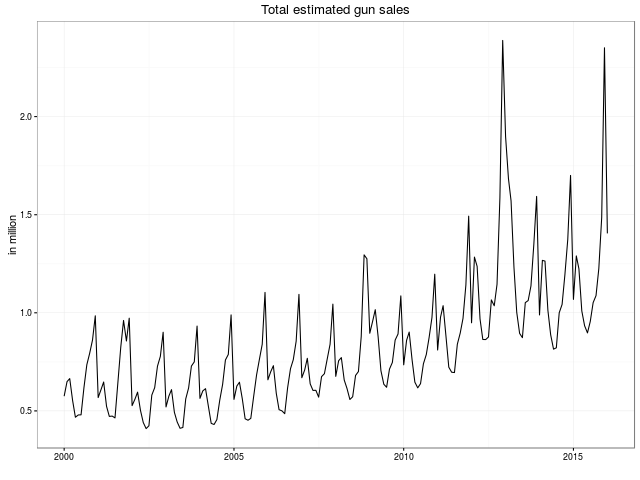
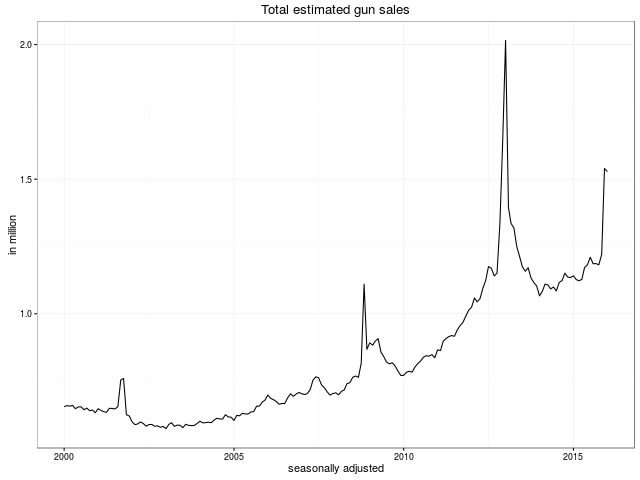
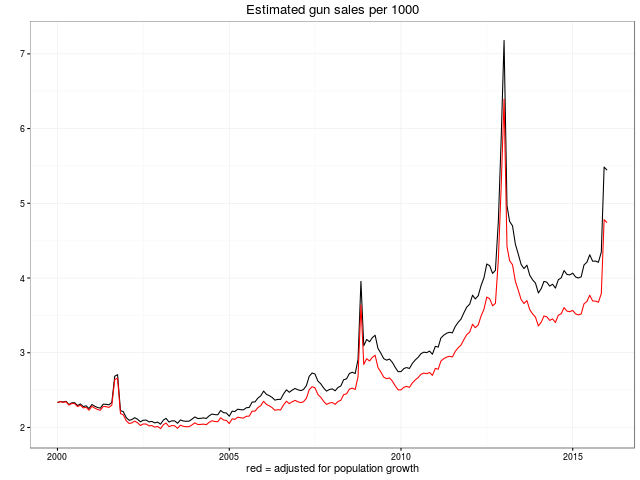
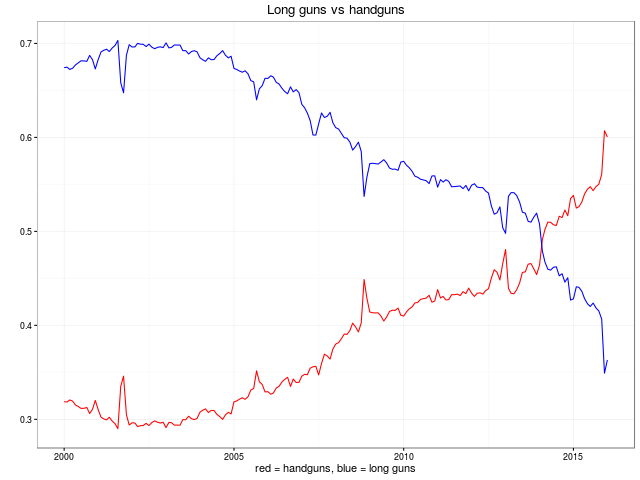
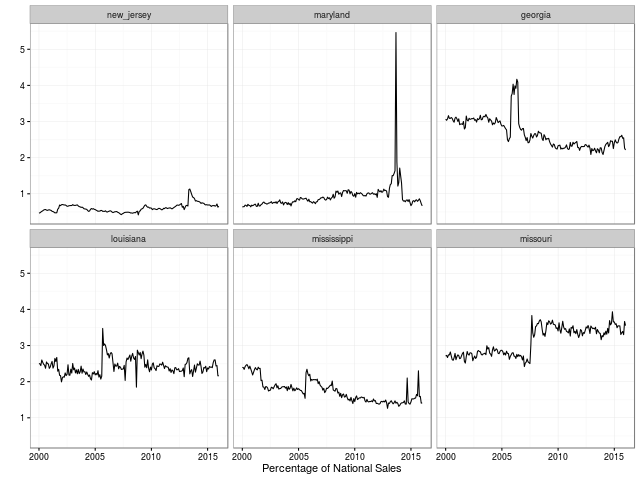
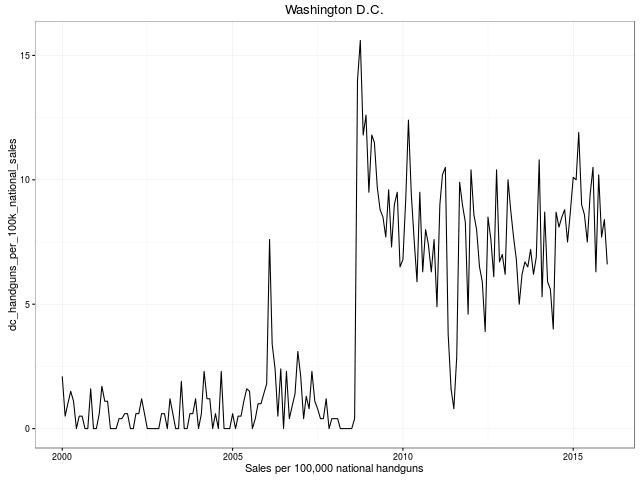
This is based on joint work with Gregor Aisch and Josh Keller of the New York Times. A new package gunsales is now on the CRAN network for R. It is based the NYTimes/gunsales repository underlying the excellent New York Times visualizations, first published first in December 2015 and updated with more recent data since. The analysis takes public government data on gun sales from the National Instant Criminal Background Check System (NICS). The original data is scraped from the pdf, included in the package, and analysed in a cross-section and time-series manner. The standard US Census tool X-13ARIMA-SEATS is used to deseasonalize the timeseries at the national or state level. (Note that Buzzfeed also published data and (Python) code in another GitHub repo.) As an aside, it was the use of X-13ARIMA-SEATS here -- and its somewhat awkward and manual installation also seen in the initial versions of the code in the NYTimes/gunsales repo -- which lead to the recent work by Christoph Sax and myself. We now provide a new package x13binary on CRAN so that Christoph's excellent seasonal package can simply depend upon it and have a working binary provided and installed ready to use; see the recent blog post for more. The net result is that a package like this new gunsales project can simply depend upon seasonal and also be assurred that x13binary "just works". As Martha would say, "A Good Thing". Back to the gunsales project. Following the initial publication of the repository with the data and R code in a simple script, I felt compelled to reorganize it as a package. Packages for R, as we teach our students, colleagues, or anybody else who wants to listen are really the best way to bundle code, data, documentation (i.e. vignettes) and tests. All that exists now in the gunsales package. The package now has one main function, analysis(), which returns a single dataframe object. This dataframe object can then be fed to two plotting functions. The first, plot_gunsales(), will then recreate all the (base R) plots from the original code base. The second, ggplot_gunsales(), does the same but via ggplot2. This should give anybody the ability to look at the data, study the transformations done, form and maybe test new hypotheses and visualize in manner comparable to the original publication. As an amuse gueule, here are the key plots also shown in the main README.md at GitHub: Total Estimated Gun Sales Total Estimated Gun Sales, Seasonally Adjusted Total Estimated Gun Sales, Population-Growth Adjusted Handguns vs Longguns Six States DC We look forward to more remixes and analysis of this data. The plan of the GitHub repository is to keep the data set updated as new data points are published.

This post by Dirk Eddelbuettel originated on his Thinking inside the box blog. Please report excessive re-aggregation in third-party for-profit settings.

24 February 2016

Christoph Egger: doveadm deduplicate

Without further words:
% for i in $(seq 1 90) ; do doveadm mailbox status messages debian.buildd.archive.2011.05   column -t ;  doveadm deduplicate mailbox debian.buildd.archive.2011.05 ; done
debian.buildd.archive.2011.05  messages=8094
debian.buildd.archive.2011.05  messages=7939
debian.buildd.archive.2011.05  messages=7816
debian.buildd.archive.2011.05  messages=7698
debian.buildd.archive.2011.05  messages=7610
debian.buildd.archive.2011.05  messages=7529
debian.buildd.archive.2011.05  messages=7455
debian.buildd.archive.2011.05  messages=7375
debian.buildd.archive.2011.05  messages=7294
debian.buildd.archive.2011.05  messages=7215
debian.buildd.archive.2011.05  messages=7136
debian.buildd.archive.2011.05  messages=7032
debian.buildd.archive.2011.05  messages=6941
debian.buildd.archive.2011.05  messages=6839
debian.buildd.archive.2011.05  messages=6721
debian.buildd.archive.2011.05  messages=6631
debian.buildd.archive.2011.05  messages=6553
debian.buildd.archive.2011.05  messages=6476
debian.buildd.archive.2011.05  messages=6388
debian.buildd.archive.2011.05  messages=6301
debian.buildd.archive.2011.05  messages=6211
debian.buildd.archive.2011.05  messages=6140
debian.buildd.archive.2011.05  messages=6056
debian.buildd.archive.2011.05  messages=6007
debian.buildd.archive.2011.05  messages=5955
debian.buildd.archive.2011.05  messages=5887
debian.buildd.archive.2011.05  messages=5826
debian.buildd.archive.2011.05  messages=5752
debian.buildd.archive.2011.05  messages=5706
debian.buildd.archive.2011.05  messages=5657
debian.buildd.archive.2011.05  messages=5612
debian.buildd.archive.2011.05  messages=5570
debian.buildd.archive.2011.05  messages=5523
debian.buildd.archive.2011.05  messages=5474
debian.buildd.archive.2011.05  messages=5422
debian.buildd.archive.2011.05  messages=5382
debian.buildd.archive.2011.05  messages=5343
debian.buildd.archive.2011.05  messages=5308
debian.buildd.archive.2011.05  messages=5256
debian.buildd.archive.2011.05  messages=5221
debian.buildd.archive.2011.05  messages=5168
debian.buildd.archive.2011.05  messages=5133
debian.buildd.archive.2011.05  messages=5092
debian.buildd.archive.2011.05  messages=5058
debian.buildd.archive.2011.05  messages=5030
debian.buildd.archive.2011.05  messages=4994
debian.buildd.archive.2011.05  messages=4964
debian.buildd.archive.2011.05  messages=4935
debian.buildd.archive.2011.05  messages=4900
debian.buildd.archive.2011.05  messages=4868
debian.buildd.archive.2011.05  messages=4838
debian.buildd.archive.2011.05  messages=4811
debian.buildd.archive.2011.05  messages=4778
debian.buildd.archive.2011.05  messages=4748
debian.buildd.archive.2011.05  messages=4722
debian.buildd.archive.2011.05  messages=4686
debian.buildd.archive.2011.05  messages=4661
debian.buildd.archive.2011.05  messages=4637
debian.buildd.archive.2011.05  messages=4613
debian.buildd.archive.2011.05  messages=4593
debian.buildd.archive.2011.05  messages=4570
debian.buildd.archive.2011.05  messages=4554
debian.buildd.archive.2011.05  messages=4536
debian.buildd.archive.2011.05  messages=4520
debian.buildd.archive.2011.05  messages=4500
debian.buildd.archive.2011.05  messages=4481
debian.buildd.archive.2011.05  messages=4466
debian.buildd.archive.2011.05  messages=4445
debian.buildd.archive.2011.05  messages=4430
debian.buildd.archive.2011.05  messages=4417
debian.buildd.archive.2011.05  messages=4405
debian.buildd.archive.2011.05  messages=4390
debian.buildd.archive.2011.05  messages=4376
debian.buildd.archive.2011.05  messages=4366
debian.buildd.archive.2011.05  messages=4360
debian.buildd.archive.2011.05  messages=4350
debian.buildd.archive.2011.05  messages=4336
debian.buildd.archive.2011.05  messages=4329
debian.buildd.archive.2011.05  messages=4320
debian.buildd.archive.2011.05  messages=4315
debian.buildd.archive.2011.05  messages=4312
debian.buildd.archive.2011.05  messages=4311
debian.buildd.archive.2011.05  messages=4309
debian.buildd.archive.2011.05  messages=4308

23 February 2016

Uwe Kleine-K nig: Christoph Hellwig vs VMware

On Thursday the lawsuit about GPL compliance of VMware's ESXi products starts. I support Christoph's position and share his view that VMware's product is in conflict with the GPL. Read more on the software freedom conservancy's FAQ about the case. I keep my fingers crossed!

21 February 2016

Lunar: Reproducible builds: week 43 in Stretch cycle

What happened in the reproducible builds effort between February 14th and February 20th 2016:

Toolchain fixes Yaroslav Halchenko uploaded cython/0.23.4+git4-g7eed8d8-1 which makes its output deterministic. Original patch by Chris Lamb. Didier Raboud uploaded pyppd/1.0.2-3 to experimental which now serialize PPD deterministically. Lunar submitted two patches for lcms to add a way for clients to set the creation date/time in profile headers and initialize all bytes when writing named colors.

Packages fixed The following packages have become reproducible due to changes in their build dependencies: dbconfig-common, dctrl-tools, dvdwizard, ekg2, expeyes, galternatives, gpodder, icewm, latex-mk, libiio, lives, navit, po4a, tasksel, tilda, vdr-plugin-infosatepg, xaos. The following packages became reproducible after getting fixed: Some uploads fixed some reproducibility issues, but not all of them: Unknown status:
  • tomcat7/7.0.68-1 by Emmanuel Bourg (test suite fails in test environment).
Patches submitted which have not made their way to the archive yet:
  • #814840 on tor by Petter Reinholdtsen: use the UTC timezone when calling asciidoc.
  • #815082 on arachne-pnr by Dhole: use the C locale to format the changelog date.
  • #815192 on manpages-de by Reiner Herrmann: tell grep to always treat the input as text so that it works with non-UTF-8 locales.
  • #815193 on razorqt by Reiner Herrmann: tell grep to always treat the input as text so that it works with non-UTF-8 locales.
  • #815250 on jacal by Reiner Herrmann: use the C locale to format the build date.
  • #815252 on colord by Lunar: remove extra timestamps when generating CMF and spectra and implement support for SOURCE_DATE_EPOCH.

reproducible.debian.net Two new package sets have been added: freedombox and freedombox_build-depends. (h01ger)

diffoscope development diffoscope version 49 was released on February 17th. It continues to improve handling of debug symbols for ELF files. Their content will now be compared separately to make them more readable. The search for matching debug packages is more efficient by looking only for .deb files in the same parent directory. Alongside more bug fixes, support for ICC profiles has been added, and libarchive is now also used to read metadata for ar archives.

strip-nondeterminism development Reiner Herrmann added support to normalize Gettext .mo files.

Package reviews 170 reviews have been removed, 172 added and 54 updated in the previous week. 34 new FTBFS bugs have been opened by Chris Lamb, h01ger and Reiner Herrmann. New issues added this week: lxqt_translate_desktop_binary_file_matched_under_certain_locales, timestamps_in_manpages_generated_by_autogen. Improvements to the prebuilder script: avoid ccache, skip disorderfs hook if device nodes cannot be created, compatibility with grsec trusted path execution (Reiner Herrmann), code cleanup (Esa Peuha).

Misc. Steven Chamberlain highlighted reproducibility problems due to differences in how Linux and FreeBSD handle permissions for symlinks. Some possible ways forward have been discussed on the reproducible-builds mailing list. Bernhard M. Wiedemann reported on some reproducibility tests made on OpenSuse mentioning the growing support for SOURCE_DATE_EPOCH. If you are eligible for Outreachy or Google Summer of Code, consider spending the summer working on reproducible builds!

17 February 2016

Arturo Borrero Gonz lez: An update about the HA stack on Debian


Great news! The HA stack has been finally updated and you can find now both pacemaker & corosync in Debian stretch.

This is thanks to the hard work of some people, specially Christoph Berg, Ferenc W gner, Martin Loschwitz and others.

By the time of this blogpost, in testing (stretch) you have:

Additionally, unstable contains:
which is great news. However, pcs just joined Debian and there seem to be some rough edges to be worked out.
what to do now
Now that the people mentioned above did the hard work developing the packages, please do test them and report bugs.
Having a great stretch stable release (including the HA stack) is in your hands as well.

best regards!

6 February 2016

Julien Danjou: FOSDEM 2016, recap

Last week-end, I was in Brussels, Belgium for the FOSDEM, one of the greatest open source developer conference. I was not sure to go there this year (I already skipped it in 2015), but it turned out I was requested to do a talk in the shared Lua & GNU Guile devroom. As a long time Lua user and developer, and a follower of GNU Guile for several years, the organizer asked me to run a talk that would be a link between the two languages. I've entitled my talk "How awesome ended up with Lua and not Guile" and gave it to a room full of interested users of the awesome window manager . We continued with a panel discussion entitled "The future of small languages Experience of Lua and Guile" composed of Andy Wingo, Christopher Webber, Ludovic Court s, Etiene Dalcol, Hisham Muhammaad and myself. It was a pretty interesting discussion, where both language shared their views on the state of their languages. It was a bit awkward to talk about Lua & Guile whereas most of my knowledge was year old, but it turns out many things didn't change. I hope I was able to provide interesting hindsight to both community. Finally, it was a pretty interesting FOSDEM to me, and it was a long time I didn't give talk here, so I really enjoyed it. See you next year!

2 February 2016

Dirk Eddelbuettel: Like peanut butter and jelly: x13binary and seasonal

This post was written by Dirk Eddelbuettel and Christoph Sax and will be posted on both author's respective blogs. The seasonal package by Christoph Sax brings a very featureful and expressive interface for working with seasonal data to the R environment. It uses the standard tool of the trade: X-13ARIMA-SEATS. This powerful program is provided by the statisticians of the US Census Bureau based on their earlier work (named X-11 and X-12-ARIMA) as well as the TRAMO/SEATS program by the Bank of Spain. X-13ARIMA-SEATS is probably the best known tool for de-seasonalization of timeseries, and used by statistical offices around the world. Sadly, it also has a steep learning curve. One interacts with a basic command-line tool which users have to download, install and properly reference (by environment variables or related means). Each model specification has to be prepared in a special 'spec' file that uses its own, cumbersome syntax. As seasonal provides all the required functionality to use X-13ARIMA-SEATS from R --- see the very nice seasonal demo site --- it still required the user to manually deal with the X-13ARIMA-SEATS installation. So we decided to do something about this. A pair of GitHub repositories provide both the underlying binary in a per-operating system form (see x13prebuilt) as well as a ready-to- use R package (see x13binary) which uses the former to provide binaries for R. And the latter is now on CRAN as package x13binary ready to be used on Windows, OS-X or Linux. And the seasonal package (in version 1.2.0 -- now on CRAN -- or later) automatically makes use of it. Installing seasaonal and x13binary in R is now as easy as:

install.packages("seasonal")
which opens the door for effortless deployment of powerful deasonalization. By default, the principal function of the package employs a number of automated techniques that work well in most circumstances. For example, the following code produces a seasonal adjustment of the latest data of US retail sales (by the Census Bureau) downloaded from Quandl:
library(seasonal) 
library(Quandl)   ## not needed for seasonal but has some niceties for Quandl data
rs <- Quandl(code="USCENSUS/BI_MARTS_44000_SM", type="ts")/1e3
m1 <- seas(rs)
plot(m1, main = "Retail Trade: U.S. Total Sales", ylab = "USD (in Billions)")
This tests for log-transformation, performs an automated ARIMA model search, applies outlier detection, tests and adjusts for trading day and easter effects, and invokes the SEATS method to perform seasonal adjustment. And this is how the adjusted series looks like:
Of course, you can access all available options of X-13ARIMA-SEATS as well. Here is an example where we adjust the latest data for Chinese exports (as tallied by the US FED), taking into account the different effects of Chinese New Year before, during and after the holiday:
xp <- Quandl(code="FRED/VALEXPCNM052N", type="ts")/1e9
m2 <- seas(window(xp, start = 2000),
          xreg = cbind(genhol(cny, start = -7, end = -1, center = "calendar"), 
                       genhol(cny, start = 0, end = 7, center = "calendar"), 
                       genhol(cny, start = 8, end = 21, center = "calendar")
          ),
          regression.aictest = c("td", "user"),
          regression.usertype = "holiday")
plot(m2, main = "Goods, Value of Exports for China", ylab = "USD (in Billions)")
which generates the following chart demonstrating a recent flattening in export activity measured in USD.
We hope this simple examples illustrates both how powerful a tool X-13ARIMA-SEATS is, but also just how easy it is to use X-13ARIMA-SEATS from R now that we provide the x13binary package automating its installation.

This post by Dirk Eddelbuettel originated on his Thinking inside the box blog. Please report excessive re-aggregation in third-party for-profit settings.

1 February 2016

Rapha&#235;l Hertzog: My Free Software Activities in January 2016

My monthly report covers a large part of what I have been doing in the free software world. I write it for my donators (thanks to them!) but also for the wider Debian community because it can give ideas to newcomers and it s one of the best ways to find volunteers to work with me on projects that matter to me. Debian LTS I did not ask for any paid hours this month and won t be requesting paid hours for the next 5 months as I have a big project to handle with a deadline in June. That said I still did a few LTS related tasks: Distro Tracker Due to many nights spent on playing Splatoon (I m at level 33, rank B+, anyone else playing it?), I did not do much work on Distro Tracker. After having received the bug report #809211, I investigated the reasons why SQLite was no longer working satisfactorily in Django 1.9 and I opened the upstream ticket 26063 and I had a long discussion with two upstream developers to find out the best fix. The next point release (1.9.2) will fix that annoying regression. I also merged a couple of contributions (two patches from Christophe Siraut, one adding descriptions to keywords, cf #754413, one making it more obvious that chevrons in action items are actionable to show more data, a patch from Balasankar C in #810226 fixing a bad URL in an action item). I fixed a small bug in the unsubscribe command of the mail bot, it was not properly recognizing source packages. I updated the task notifying of new upstream versions to use the data generated by UDD (instead of the data generated by Christoph Berg s mole-based implementation which was suffering from a few bugs). Debian Packaging Testing experimental sbuild. While following the work of Johannes Schauer on sbuild, I installed the version from experimental to support his work and give him some feedback. In the process I uncovered #810248. Python sponsorship. I reviewed and uploaded many packages for Daniel Stender who keeps doing great work maintaining prospector and all its recursive dependencies: pylint-common, python-requirements-detector, sphinx-argparse, pylint-django, prospector. He also prepared an upload of python-bcrypt which I requested last month for Django. Django packaging. I uploaded Django 1.8.8 to jessie-backports.
My stable updates for Django 1.7.11 was not handled before the release of Debian 8.3 even though it was filed more than 1.5 months before. Misc stuff. My stable update for debian-handbook has been accepted fairly shortly after my last monthly report (thank you Adam!) so I uploaded the package once acked by a release manager. I also sponsor a backports upload of zim prepared by Joerg Desch. Kali related work Kernel work. The switch to Linux 4.3 in Kali resulted in a few bug reports that I investigated with the help of #debian-kernel and where I reported my findings back so that the Debian kernel could also benefit from the fixes I uploaded to Kali: first we included a patch for a regression in the vmwgfx video driver used by VMWare virtual machines (which broke the gdm login screen), then we fixed the input-modules udeb to fix support of some Logitech keyboards in debian-installer (see #796096). Misc work. I made a non-maintainer upload of python-maxminddb to fix #805689 which had been removed from stretch and that we needed in Kali. I also had to NMU libmaxminddb since it was no longer available on armel and we actually support armel in Kali. During that NMU, it occurred to me that dh-exec could offer a feature of optional install , that is installing a file that exists but not failing if it doesn t exist. I filed this as #811064 and it stirred up quite some debate. Thanks See you next month for a new summary of my activities.

No comment Liked this article? Click here. My blog is Flattr-enabled.

17 January 2016

Lunar: Reproducible builds: week 38 in Stretch cycle

What happened in the reproducible builds effort between January 10th and January 16th:

Toolchain fixes Benjamin Drung uploaded mozilla-devscripts/0.43 which sorts the file list in preferences files. Original patch by Reiner Herrmann. Lunar submitted an updated patch series to make timestamps in packages created by dpkg deterministic. To ensure that the mtimes in data.tar are reproducible, with the patches, dpkg-deb uses the --clamp-mtime option added in tar/1.28-1 when available. An updated package has been uploaded to the experimental repository. This removed the need for a modified debhelper as all required changes for reproducibility have been merged or are now covered by dpkg.

Packages fixed The following packages have become reproducible due to changes in their build dependencies: angband-doc, bible-kjv, cgoban, gnugo, pachi, wmpuzzle, wmweather, wmwork, xfaces, xnecview, xscavenger, xtrlock, virt-top. The following packages became reproducible after getting fixed: Some uploads fixed some reproducibility issues, but not all of them: Untested changes:

reproducible.debian.net Once again, Vagrant Cascadian is providing another armhf build system, allowing to run 6 more armhf builder jobs, right there. (h01ger) Stop requiring a modified debhelper and adapt to the latest dpkg experimental version by providing a predetermined identifier for the .buildinfo filename. (Mattia Rizzolo, h01ger) New X.509 certificates were set up for jenkins.debian.net and reproducible.debian.net using Let's Encrypt!. Thanks to GlobalSign for providing certificates for the last year free of charge. (h01ger)

Package reviews 131 reviews have been removed, 85 added and 32 updated in the previous week. FTBFS issues filled: 29. Thanks to Chris Lamb, Mattia Rizzolo, and Niko Tyni. New issue identified: timestamps_in_manpages_added_by_golang_cobra.

Misc. Most of the minutes from the meetings held in Athens in December 2015 are now available to the public.

14 January 2016

Lunar: Reproducible builds: week 37 in Stretch cycle

What happened in the reproducible builds effort between January 3rd and January 9th 2016:

Toolchain fixes David Bremner uploaded dh-elpa/0.0.18 which adds a --fix-autoload-date option (on by default) to take autoload dates from changelog. Lunar updated and sent the patch adding the generation of .buildinfo to dpkg.

Packages fixed The following packages have become reproducible due to changes in their build dependencies: aggressive-indent-mode, circe, company-mode, db4o, dh-elpa, editorconfig-emacs, expand-region-el, f-el, geiser, hyena, js2-mode, markdown-mode, mono-fuse, mysql-connector-net, openbve, regina-normal, sml-mode, vala-mode-el. The following packages became reproducible after getting fixed: Some uploads fixed some reproducibility issues, but not all of them: Patches submitted which have not made their way to the archive yet:
  • #809780 on flask-restful by Chris Lamb: implement support for SOURCE_DATE_EPOCH in the build system.
  • #810259 on avfs by Chris Lamb: implement support for SOURCE_DATE_EPOCH in the build system.
  • #810509 on apt by Mattia Rizzolo: ensure a stable file order is given to the linker.

reproducible.debian.net Add 2 more armhf build nodes provided by Vagrant Cascadian. This added 7 more armhf builder jobs. We now run around 900 tests of armhf packages each day. (h01ger) The footer of each page now indicates by which Jenkins jobs build it. (h01ger)

diffoscope development diffoscope 45 has been released on January 4th. It features huge memory improvements when comparing large files, several fixes of squashfs related issues that prevented comparing two Tails images, and improve the file list of tar and cpio archive to be more precise and consistent over time. It also fixes a typo that prevented the Mach-O to work (Rainer M ller), improves comparisons of ELF files when specified on the command line, and solves a few more encoding issues.

Package reviews 134 reviews have been removed, 30 added and 37 updated in the previous week. 20 new fail to build from source issues were reported by Chris Lamb and Chris West. prebuilder will now skip installing diffoscope to save time if the build results are identical. (Reiner Herrmann)

11 January 2016

Norbert Preining: 10 years TeX Live in Debian

I recently dug through my history of involvement with TeX (Live), and found out that in January there are a lot of anniversaries I should celebrate: 14 years ago I started building binaries for TeX Live, 11 years ago I proposed the packaging TeX Live for Debian, 10 years ago the TeX Live packages entered Debian. There are other things to celebrate next year (2017), namely the 10 year anniversary of the (not so new anymore) infrastructure in short tlmgr of TeX Live packaging, but this will come later. In this blog post I want to concentrate on my involvement in TeX Live and Debian. TeX Live/Debian Those of you not interested in boring and melancholic look-back onto history can safely skip reading this one. For those a bit interested in the history of TeX in Debian, please read on. Debian releases and TeX systems The TeX system of choice has been for long years teTeX, curated by Thomas Esser. Digging through the Debian Archive and combining it with changelog entries as well as personal experiences since I joined Debian, here is a time line of TeX in Debian, all to my best knowledge.
Date Version Name teTeX/TeX Live Maintainers
1993-96 <1 ? ? Christoph Martin
6/1996 1.1 Buzz ?
12/1996 1.2 Rec ?
6/1997 1.3 Bo teTeX 0.4
7/1998 2.0 Ham teTeX 0.9
3/1999 2.1 Slink teTeX 0.9.9N
8/2000 2.2 Potato teTeX 1.0
7/2002 3.0 Woody teTeX 1.0
6/2005 3.1 Sarge teTeX 2.0 Atsuhito Kohda
4/2007 4.0 Etch teTeX 3.0, TeX Live 2005 Frank K ster, NP
2/2009 5.0 Lenny TeX Live 2007 NP
2/2011 6.0 Squeeze TeX Live 2009
5/2013 7.0 Whezzy TeX Live 2012
4/2015 8.0 Jessie TeX Live 2014
??? ??? Stretch TeX Live 2015
The history of TeX in Debian is thus split more or less in 10 years teTeX, and 10 years TeX Live. While I cannot check back to the origins, my guesses are that already in the very first releases (te)TeX was included. The first release I can confirm (via the Debian archive) shipping teTeX is the release Bo (June 1997). Maintainership during the first 10 years showed some fluctuation: The first years/releases (till about 2002) were dominated by Christoph Martin with Adrian Bunk and few others, who did most packaging work on teTeX version 1. After this Atsuhito Kohda with help from Hilmar Preusse and some people brought teTeX up to version 2, and from 2004 to 2007 Frank K ster, again with help of Hilmar Preusse and some other, took over most of the work on teTeX. Other names appearing throughout the changelog are (incomplete list) Julian Gilbey, Ralf Stubner, LaMont Jones, and C.M Connelly (and many more bug-reporters and fixers). Looking at the above table I have to mention the incredible amount of work that both Atsuhito Kohda and Frank K ster have put into the teTeX packages, and many of their contributions have been carried over into the TeX Live packages. While there haven t been many releases during their maintainership, their work has inspired and supported the packaging of TeX Live to a huge extend. Start of TeX Live I got involved in TeX Live back in 2002 when I started building binaries for the alpha-linux architecture. I can t remember when I first had the idea to package TeX Live for Debian, but here is a time line from my first email to the Debian Developers mailing list concerning TeX Live, to the first accepted upload:
Date Subject/Link Comment
2005-01-11 binaries for different architectures in debian packages The first question concerning packaging TeX Live, about including pre-built binaries
2005-01-25 Debian-TeXlive Proposal II A better proposal, but still including pre-built binaries
2005-05-17 Proposal for a tex-base package Proposal for tex-base, later tex-common, as basis for both teTeX and TeX live packages
2015-06-10 Bug#312897: ITP: texlive ITP bug for TeX Live
2005-09-17 Re: Take over of texinfo/info packages Taking over texinfo which was somehow orphaned started here
2005-11-28 Re: texlive-basic_2005-1_i386.changes REJECTED My answer to the rejection by ftp-master of the first upload. This email sparked a long discussion about packaging and helped improve the naming of packages (but not really the packaging itself).
2006-01-12 Upload of TeX Live 2005-1 to Debian The first successful upload
2006-01-22 Accepted texlive-base 2005-1 (source all) TeX Live packages accepted into Debian/experimental
One can see from the first emails that at that time I didn t have any idea about Debian packaging and proposed to ship the binaries built within the TeX Live system on Debian. What followed was first a long discussion about whether there is any need for just another TeX system. The then maintainer Frank K ster took a clear stance in favor of including TeX Live, and after several rounds of proposals, tests, rejections and improvements, the first successful upload of TeX Live packages to Debian/experimental happened on 12 January 2006, so exactly 10 years ago. Packaging Right from the beginning I used a meta-packaging approach. That is, instead of working directly with the source packages, I wrote (Perl) scripts that generated the source packages from a set of directives. There were several reasons why I choose to introduce this extra layer: Till now I am not 100% sure whether it was the best idea, but the scripts remain in place till now, only adapted to the new packaging paradigm in TeX Live (without xml) and adding new functionality. This allows me to just kick off one script that does do all the work, including building .orig.tar.gz, source packages, binary packages. For those interested to follow the frantic activity during the first years, there is a file CHANGES.packaging which for the years from 2005 to 2011 documents very extensively the changes I made in these years. I don t want to count the hours the went into all this  Development over the years TeX Live 2005 was just another TeX system but not the preferred one in Debian Etch and beyond. But then in May 2006, Thomas Esser announced the end of development of teTeX, which cleared the path for TeX Live as main TeX system in Debian (and the world!). The next release of Debian, Lenny (1/2009), already carried only TeX Live. Unfortunately it was only TeX Live 2007 and not 2008, mostly due to me having been involved in rewriting the upstream infrastructure based on Debian package files instead of the notorious xml files. This took quite a lot of attention and time from Debian away to upstream development, but this will be discussed in a different post. Similarly, the release of TeX Live included in Debian Squeeze (released 2/2011) was only TeX Live 2009 (instead of 2010), but since then (Wheezy and Jessie) the releases of TeX Live in Debian were always the latest released ones. Current status Since about 2013 I am trying to keep a regular schedule of new TeX Live packages every month. These helps me to keep up with the changes in upstream packaging and reduces the load of packaging a new release of TeX Live. It also bring to users of unstable and testing a very up-to-date TeX system, where packages at most lack 1 month of behind the TeX Live net updates. Future As most of the readers here know, besides caring for TeX (Live) and related packages in Debian, I am also responsible for the TeX Live Manager (tlmgr) and most of upstream s infrastructure including network distribution. Thus, my (spare, outside work) time needs to be distributed between all these projects (and some others) which leaves less and less time for Debian packaging. Fortunately the packaging is in a state that making regular updates once a month is less of a burden, since most steps are automatized. What is still a bit of a struggle is adapting the binary package (src:texlive-bin) to new releases. But also this has become simpler due to less invasive changes over the years. All in all, I don t have many plans for TeX Live in Debian besides keeping the current system running as it is. Search for and advise to future maintainers and collaborators I would be more than happy if new collaborators appear, with fresh ideas and some spare time. Unfortunately, my experience over these 10 years with people showing up and proposing changes (anyone remembers the guy proposing a complete rewrite in ML or so?) is that nobody really wants to invest time and energy, but search for quick solutions. This is not something that will work with a package like TeX Live, sized of several gigabyte (the biggest in the Debian archive), and complicated inner workings. I advise everyone being interested in helping to package TeX Live for Debian, to first install normal TeX Live from TUG, get used to what actions happen during updates (format rebuilds, hyphenation patters, map file updates). One does not need to have a perfect understanding of what exactly happens down there in the guts (I didn t have in the beginning, either), but if you want to help packaging and never heard about what format dumps or map files are, then this might be a slight obstacle. Conclusion TeX Live is the only TeX system in wide use across lots of architectures and operating systems, and the only comparable system, MikTeX, is Windows specific (also there are traces of ports to Unix). Backed by all the big user groups of TeX, TeX Live will remain the prime choice for the foreseeable future, and thus also TeX Live in Debian.

4 January 2016

Lunar: Reproducible builds: week 36 in Stretch cycle

What happened in the reproducible builds effort between December 27th and January 2nd: Infrastructure dak now silently accepts and discards .buildinfo files (commit 1, 2), thanks to Niels Thykier and Ansgar Burchardt. This was later confirmed as working by Mattia Rizzolo. Packages fixed The following packages have become reproducible due to changes in their build dependencies: banshee-community-extensions, javamail, mono-debugger-libs, python-avro. The following packages became reproducible after getting fixed: Some uploads fixed some reproducibility issues, but not all of them: Untested changes: reproducible.debian.net The testing distribution (the upcoming stretch) is now tested on armhf. (h01ger) Four new armhf build nodes provided by Vagrant Cascandian were integrated in the infrastructer. This allowed for 9 new armhf builder jobs. (h01ger) The RPM-based build system, koji, is now in unstable and testing. (Marek Marczykowski-G recki, Ximin Luo). Package reviews 131 reviews have been removed, 71 added and 53 updated in the previous week. 58 new FTBFS reports were made by Chris Lamb and Chris West. New issues identified this week: nondeterminstic_ordering_in_gsettings_glib_enums_xml, nondeterminstic_output_in_warnings_generated_by_breathe, qt_translate_noop_nondeterminstic_ordering. Misc. Steven Chamberlain explained in length why reproducible cross-building across architectures mattered, and posted results of his tests comparing a stage1 debootstrapped chroot of linux-i386 once done from official Debian packages, the others cross-built from kfreebsd-amd64.

30 December 2015

Christoph Egger: Finally moving the Weblog

As of a few minutes ago, the old weblog on christoph-egger.org is past. I've added redirects for all the entries to the new one at weblog.siccegge.de.if you find any dead links please contact me so I can fix it up. Note that comments are gone. I'll try to include the already present comments on the new blog some time in the future. Not sure if I will ever add a comment function again (though chronicle seems to have some support for that)

Next.

Previous.