Search Results: "cfm"

14 January 2008

MJ Ray: BeCTA advice, DfES e-Consultation

You may have seen the British Educational Communications and Technology Agency (Becta) advising:-
"Schools and colleges should make pupils, teachers and parents aware of the range of free-to-use products (such as office productivity suites) that are available, and how to use them,"
in reports like http://www.informationweek.com/windows/showArticle.jhtml?articleID=205602879&cid=RSSfeed_TechWeb There's also a consultation on "Home Access to Technology" running until Wednesday 2 April at http://www.dcsf.gov.uk/consultations/conDetails.cfm?consultationId=1522 where you may like to suggest that free software is a good route forwards. (Thanks to Christopher Dawkins for informing ALUG.) Are there other related things we could be doing? (Comments form goes to fsfe-uk.)

6 January 2008

Dirk Eddelbuettel: NAS'ed

I had been eyeing an inexpensive network-storage device -- for the non-geeks: think of a hard disk with an ethernet port and some controlling software -- for some time. I was aware of some of the hacking efforts around a few of these but somehow nothing really appealed. I was sort-of looking for nslu2-with-a-disk, and preferably not too expensive. Lo and behold, that's what I saw today in my techbargains feed: a Buffalo LinkStation Live which contains a 500gb SATA for $199 after rebates. Some quick googling lead to these wiki pages which looked promising: anything from enhancing the stock Linux setup by enabling a few more services to a custom Linux distro (similar to my wrt54 router running linux) to reportedly some work-in-progress for a native Debian installation. Nice! So off I went, ordered the thingie for local pickup for an additional 5% off and picked it up a little later at the local Circuit City (where visits are seemingly a recurring event these days). The documentation is very brief and insist that you install something on Windows -- just to find that the little box autoconfigures itself just fine. Presumably some network discovery is going to find the assigned dhcp address which is needed for the web interface. A few minutes later, a new (fixed) IP address was assigned, ntp was enabled and that was about that. After dinner, I quickly followed this tutorial to get the box a bit more Unixy without going too far (yet) from the default: start up telnet via a simple Java command-line tool, login, then enable ssh, set it up in /etc/init.d, add some extra binaries. All very quick and simple [ with the caveat that the addons.tar didn't want to get there via the Java tool, so manual scp once 'inside' did the trick ]. NFS, which I like for shuffling files around, appears to be little trickier for this ARM-based LinkStation Live. So at least for now I am content with simple rsync'ing of my backup directories on the few machines here. Much better than the current setup with mutual backups between workstations and semi-permanently being out of space. All in all a rather pleasant gadget and recommended at the price. The extra $100 in rebates are valid from today to the 12th.

30 December 2007

Steve Kemp: I just don't understand

Whilst I'm very pleased with my new segmented network setup, and the new machine, I'm extremely annoyed that I cannot get a couple of (graphical) Xen guest desktop guests up and running. The initial idea was that I would setup a 64-bit installation of Etch and then communicate with it via VNC - xen-tools will do the necessary magic if you create your guest with "--role=gdm". Unfortunately it doesn't work. When vncserver attempts to start upon an AMD64 host it dies with a segfault - meaning that I cannot create a scratch desktop environment to play with. All of this works perfectly with a 32-bit guest, and that actually is pretty neat. It lets me create a fully virtualised, restorable, environment for working with flash/java/etc. The bug was filed over three years ago as #276948, but there doesn't appear to be a solution. Also, only on the amd64 guest, I'm seeing errors when I try to start X which mention things like "no such file or directory /dev/tty0". I've no idea whats going on there - though it could be a vt (virtual terminal) thing?. The upshot of all this is that I currenly have fewer guests than I was expecting:

skx@gold:~/blog/data$ xm list
Name                                      ID Mem(MiB) VCPUs State   Time(s)
Domain-0                                   0     3114     2 r-----   1180.6
cfmaster.services.xen                      1      256     1 -b----      1.0
etch32.desktop.xen                         2      256     1 -b----      1.4
etch32.security-build.xen                  3      128     1 -b----      1.4
etch64.security-build.xen                  4      128     1 -b----      1.4
sarge32.security-build.xen                 5      128     1 -b----      1.0

15 December 2007

Russell Coker: AISA

When I worked for Red Hat I joined AISA [1] (the Australian Information Security Association - formerly known as ISIG). Red Hat marketting paid for my membership so it was a good deal, I went to meetings (which often had free drinks), said good things about Red Hat security, and it cost me nothing. I was recently asked why I chose not to renew my membership, I didn’t have time to give a full answer so I’ll blog it now. AISA offers discounts on some conferences, books, and training related to computer security, if you plan to purchase such things then they do offer good deals. However I have little time to attend conferences at the moment, not enough time to read all the free Internet resources related to computer security, and feel no need to pay for such training. If at any time I plan to attend a conference where the discount for AISA members is equal or greater than the AISA membership fee then I can easily re-join. AISA membership seems largely to consist of managers and consultants not technical people or people doing R&D type work. This isn’t a bad thing if you are a manager or consultant, but when attending AISA meetings I don’t meet the type of people I meet at events such as SecureCon [2], Linux Conf Au [3], RuxCon [4], and the SE Linux Symposium [5] (which I think is not going to be held again for a while). Meetings of my local LUG [6] typically have more people doing serious technical work related to computer security than the AISA meetings I’ve attended. The AISA code of Ethics has as it’s second criteria “I will comply with all relevant laws“. Some laws can not be obeyed by decent people (study some German or Russian history or what is happening in China right now for examples). Many other laws should not be obeyed. Many countries (including Australia) have enacted many laws which should not be obeyed in the name of the “war on terror“. A final thing that irked me about AISA is their professional membership system (click on this link and download the AISA_Professional_Membership_Requirements_Nov_2006 document for details). It seems that I don’t qualify because I don’t have one of the listed certifications, and a public credit on the NSA web site [7] doesn’t count (yes, I asked about this). I’m not overly worried about this, I figure that any clique that won’t accept me also won’t accept a significant portion of the people that I want to associate with - so we can hang out elsewhere. I don’t recall there being any great benefit to professional membership apart from the possibility of adding it to your business card if you are so inclined (I don’t recall ever putting B.Sc [8] on a business card and don’t plan on adding anything less). There are some real benefits to AISA membership, but not for me.

26 November 2007

Andrew Pollock: [life/americania] Thanksgiving below zero

We got home from our week in Arizona late last night. We decided to drive non-stop yesterday, and get home in a day, rather than split it over two days like we did getting there. It ended up taking around 15 hours (we had an unexpected delay at Lost Hills because we found a stray dog (we initially thought it to be injured to boot) and Sarah was trying to get hold of some local animal control people to do something about it), otherwise it'd have taken closer to 14 hours. The drive to Phoenix was pretty uneventful. We took our time leaving Mountain View on Sunday (we had an early Thanksgiving dinner with all of our neighbours on Saturday night), and decided to call it a night at Cabazon. For about the same price that we stayed in a crappy motel last time we went this way, we stayed at the Morongo Casino, which was really nice. We were in a "Canyon View" room, and, well this is what the view looked like... We arrived at Craig and Sarah's place at about 5pm on Monday afternoon. Their new place is really nice. It's huge, with a huge yard, and a nice view of the hills. I've found suburban Phoenix (well Peoria to be precise) to be the closest looking thing to what I consider "normal Australian suburbia" that I've seen so far in the US. Granted, Peoria's a bit upmarket (at least the part that Craig and Sarah live in). So we spent a day and a half vegging out at Craig and Sarah's place, then on Wednesday afternoon, we headed off to Woods Canyon Lake, in the Sitgreaves National Forests. I rode most of the way with Craig in their new motor home, and then swapped to drive our car after we got close to our destination. It turns out that the headlights in RVs are universally crap, so it was better for the Prius to be out front lighting the way on the gravel road. I'd always associated Arizona with cacti and sand, but as it turns out, the majority of the state is forest. We arrived at the campsite after nightfall, and set up shop. We met some of Craig and Sarah's friends that night, who were all very friendly towards us. It was ridiculously cold that night. We went to bed rather under-dressed for the temperature, and absolutely froze. The next day (Thursday), we all drove from the campsite (Craig towed their Jeep behind the RV) to Woods Canyon Lake itself, and went fishing. Arizona fishing licences for non-Arizona residents were a bit on the expensive side, so Sarah and I just hung out on the rocks and chatted to people and took photos. The collective haul of trout from about 5 hours fishing was pretty impressive. I'm not quite sure why, but Friday was the group Thanksgiving dinner. Everyone pitched in, and cooked up a storm. They deep-fried three turkeys (which came out very nice and looking much less like KFC than I expected), and we had way more food than we needed. We all ate outdoors at around 3:30pm, and it was about 33°F (0.55°C). The only downside of this (aside from it being bloody cold) was the leftovers went cold almost instantly, so going back for seconds was a bit of a disappointment. Everyone gravitated back to the fire pretty quickly afterwards. It got pretty cold that night. I think it was down around -4°C when we went to bed that night. We left a bit before 8am the next morning, and the car thought it was -7°C outside. One of the other campers told Sarah his thermometer was reading something closer to -14°C. I'm not sure how cold it was when we were in New York in January, but I didn't think it was that cold. It was a good week away. The mix of camping and not camping was about just right. Now it's back to work for two weeks before we head off to Australia. Photos from the trip are here.

25 November 2007

Gunnar Wolf: Klezmerson!

Yesterday I went with Nadezhda to the always interesting teatro/bar el Vicio. as she found that Klezmerson were going to play there. We tried to get some more friends to join, but gave too short notice, and ended up having a great night out just by ourselves. Just as a side rant: I just hate that places I want to refer to, and I want other people to get to know, have Flash-only sites! You can read some more things about Klezmerson at -ugh- their MySpace site, even get some of their music there.Their name give away their basic lines: Klezmer and son. The common line to all of the songs they performed is a strong Klezmer feel. Benjam n Shwartz and Mar a Emilia Jimenez (violin/keyboard and flute respectively) are responsible IMHO for most of that spirit, as their instruments are the most traditional ones, and they carry the melodies. But the rythms they play to are plain crazy and extremely well engineered - Cuban son, Colombian cumbia, jazz, rock, and... Well, I'm not a musician. But I really, really enjoyed them. Of course, bought their CD as well.Congratulations to a very surprising and unexpected band!

23 November 2007

Russell Coker: Election 2007

I am a member of the Greens. The main reason for joining them is that they have principles. The Greens Charter [1] guides everything, policy must comply with the charter and candidates agree to uphold the policies which have been ratified if they get elected. There are no “non-core promises“. The policies of the Greens are all positive. The major parties have some mean-spirited policies that aim to help Australians by making things worse for people in other countries. Unfortunately for them the world is very inter-connected at the moment, so it’s difficult to harm other countries without harming yourself in the process. As you might expect the Greens are very positive towards the environment. Anyone who expects to live for more than 30 years (or who has children) should be very concerned about this. Currently even the most cautious estimates of the scope of the climate change problem by reputable scientists suggest that there will be serious problems in the next few decades. If you are young or have children then you should vote for the Greens (that covers most people). Many religious groups have determined that God wants them to help the environment, for example the Australian Anglican Church General Synod 2007 resolved that “the Anglican Communion’s 5th mark of mission to safeguard the integrity of creation and sustain and renew the life of the earth; and recognises that human activity contributing to Climate change is one of the most pressing ethical issues of our time”. Anglicans and believers in other religions that have similar ideas should vote for the Greens. The Greens have policies that are very positive towards minority groups. If you are not a straight-white-Christian then this is a strong reason for voting for the Greens. If you are a straight-white-Christian but have compassion for others (as advocated in the Bible) then again voting for the Greens is the right thing to do. The Greens policies are humane towards people in unfortunate situations, including drug addicts, the mentally ill, and the unemployed. When considering who to vote for keep in mind that at some future time you or a close friend or relative may fall into one of those categories. Finally the Howard government’s industrial relations legislation is very bad for the majority of workers. If the Greens get the balance of power in the Senate then they will be able to get such laws significantly changed or removed. The Greens election web site is here [2]. As an aside, I never liked Paul Keating (our last Prime Minister) until I read his op-ed piece in The Age about John Howard [3]. Also here is an interesting article on preferences and why the major parties want people to misunderstand the Australian electoral system [4]. In summary if you vote for the Greens as your first preference and they don’t win, then your second preference gets counted, and if that party doesn’t win then the third preference counts, etc. So if you have the two major parties in last and second-last position then your second-last preference may make an impact on the result! Putting Greens in the #1 position does not “waste” your vote. Parties get government funding based on the number of #1 votes, vote for the Greens as your first preference and you effectively give them $2 for their next campaign. Finally when a party wins an election they immediately look at where the #1 votes went and often adjust their policies to please the people. Vote #1 for the Greens and if Labour wins they will have more of an incentive to adopt policies that are similar to those of the Greens.

22 November 2007

Russell Coker: Drugs and an Election

As mentioned in my previous post [1] the government is using our money to advertise its policies. I previously covered the “Internet as a threat to children” issue, the other big one is drugs. The first significant message in the “Talking with your kids about drugs” document concerns the criminal penalties for drug use. That could largely be removed if the penalties were dramatically decreased and if hard drugs were administered to registered addicts for a nominal fee. Forcing addicts to commit crimes or work as prostitutes to pay for their addiction just doesn’t work, economically or socially. The next message is that parents should be involved in their children’s lives and be trusted enough that their children will accept advice. A large part of this would be related to the amount of time spent with children which is determined to a large degree by the amount of time not spent working. As I mentioned in my previous post it seems that the actions of the Howard government over the last 10 years has made things significantly worse in this regard by forcing more parents to spend large amounts of their time working (including situations where both parents work full-time) just to pay for a home. One notable omission from the document was any mention of alcohol problems (apart from when mixed with illegal drugs). By many metrics alcohol causes more harm than all the illegal drugs combined. The US attempted to prohibit alcohol and failed dismally, and alcohol is legal in most countries. The government doesn’t want to adopt a harm-minimisation approach to drugs (which bears some similarities to the approach taken to alcohol) and therefore is stuck trying to claim that one somewhat addictive mind-altering substance is somehow inherently different to all other mind-altering substances. The document provided no information at all on harm minimisation. The idea seems to be that it’s better for some children to die of overdoses than for other children to potentially be less scared of the consequences of drug use. The problem is that children are very bad at assessing personal risk so they simply won’t be scared off. It’s best to provide equipment for testing drug purity etc to reduce the harm. The list of reasons for young people to try drugs starts with “availability and acceptability of the drug“, Parmesan cheese is more available and acceptable than any drug but I’ve been avoiding it at every opportunity since I was very young. :-# More serious reasons in the list include “rebellion“, “depression“, “as a way to relax or cope with stress, boredom or pain“, and “to feel OK, at least temporarily (self-medication)“. But predictably there was nothing in the document about why children might consider that their life sucks to badly that they want to rebel in that way, be depressed, stressed, bored, or in pain to a degree that drugs seem like the solution. It seems unreasonable to believe that the school system isn’t a significant part of the cause of teenage problems. Flag poles for flying the Australian Flag [2] seems to be John Howard’s idea of a solution to school problems. I believe that the solution to school problems (both in terms of education and protection of children) is smaller classes, better supervision, an active program to eradicate bullying, and better salaries for teachers. I’ve written about related issues in my school category. I believe that the best thing for individual families to do is to home-school their children from the age of 12 instead of sending them to a high-school (which is much more damaging than a primary school). Another significant issue is drug pushers. They are usually drug users who try to finance their own drug use by selling to others. As most drug users get the same idea there is a lot of competition for sales and therefore they try to encourage more people to use drugs to get more customers. In the Netherlands, Coffee Shops sell a range of the milder drugs at reasonable prices which removes the street market and therefore the pushers. When drugs are produced commercially the quality is standardised which dramatically reduces the risk of infection and overdoses. When drugs are sold by legal companies they are not sold to children (a typical pusher can be expected to sell to anyone). The document has 3.5 pages of information about some of the illegal drugs (out of 23 pages total). They include all the most severe symptoms that most users don’t encounter. If someone reads that information and then talks to a drug user they will be laughed at. They also group drugs in an unreasonable way, for example listing “marijuana” and “hashish” as synonyms and list problems that are caused indirectly. If alcohol was included in that list it would include beer and methylated spirits (ethanol mixed with methanol to supposedly make it undrinkable - rumoured to be consumed by homeless people) in the same section and imply that blindness and other bad results of drinking “metho” apply to beer. It would also say that alcohol kills many people through drunk-driving and is responsible for rapes, wife-beating, and any other crime which can statistically shown to be more likely to be committed by a drunk person. A final issue with the document is that it advises parents to be “informed, up-front and honest” when talking to their children about drugs. Unfortunately the document itself doesn’t demonstrate such qualities. By omitting all information on harm minimisation it is not being up-front at all, and by not mentioning alcohol it’s simply being dishonest. Anyone who tries to convince someone else to not use illegal drugs can expect to hear “but you drink alcohol” as the immediate response from the drug user, it’s necessary to have sensible answers to that issue if you want to be effective in discouraging drug use.

Russell Coker: Internet and an Election

Before the election was called the Howard government (being unethical in every way) started using public money to campaign. Part of this election campaign was two documents sent out to every home (AFAIK) coupled with a media campaign, one was about children and drugs, the other was about children and the Internet. I have to wonder how many people were fooled by this, including a picture of John Howard on the first page after the index made it pretty clear what the purpose was. Before I analyse the content of the documents one thing to keep in mind is the cost of the Iraq war, which the Sydney Morning Herald [1] estimates at $3,000,000,000. Note that this doesn’t include the life-long medical and psychiatric care that some veterans will require or the cost to the economy of such people not being productive tax-payers. It does note that 121 employees of the Australian military have been discharged on medical grounds. If each of those 121 people was disabled in a way that significantly impacted their life then the cost could be as much as $242,000,000. Let’s not assume that everyone who is currently serving and regarded as completely fit will be fine in 10 years time either. The Prime Minister gives a personal introduction to each document, the “NetAlert” document states that $189,000,000 is being spent to protect children on the Internet. The “Talking with your kids about drugs” document states that “more than $1.4 billion” has been spent to combat illicit drug use, I’m not sure what time period that covers - it seems to be his entire 10 years as PM so that would be $140,000,000 per annum. Obviously declaring a war of aggression against Saddam Hussein is something that he considers to be more important than protecting Australian children. Now the content of the NetAlert document. It starts with $84,800,000 to provide access to “the best available internet filtering technology“. I have to wonder, how much would it cost to develop some new Internet filtering software from scratch, or what the opportunity cost might be to re-assign resources from organisations such as CSIRO to the task. I expect that in either case the total would be a lot less than $84,800,000. Developing free software for the task would be a much better use of resources and would also allow cooperation with similar programs in other countries. In the unlikely event that $40,000,000 was required to develop such free software it probably wouldn’t be difficult to get a few other governments to kick in some money and make it $10,000,000 per country. Of course saving $70,000,000 doesn’t sound like much (a mere $3 per person in the country), but it is significantly more than the Free Trade Agreement with the US [2] was supposed to bring in (from memory it was promoted as improving the economic position of the country by $50,000,000 but the best available information is that it made our balance of trade worse). $43,500,000 in additional funding for the police to combat online child sex exploitation is small but OK (it would be better if some of that $84,800,000 had been saved on filtering software and allowed greater expenditure in this area). But it should be noted how child rape in Aboriginal communities is used as a political issue and nothing constructive is done about the problem [3]. I believe that protecting children against rape is far more important than controlling illegal porn (which is where the majority of that $43,500,000 will go). Another possible avenue of research would be on more secure computer systems for Australian homes. It’s all very well to install some filtering software, but if the PC running the software in question is hacked then it’s immediately turned off. Attacks that involve turning web cameras on without the knowledge or consent of the owner are not uncommon either, it’s not unreasonable for a child to get out of bed and then do some homework on their computer before getting dressed - with an insecure computer and a web-cam connected this could be a bad thing… If the Australian government was to mandate that all government data be stored in open formats and that all communication with government computer systems can be done with free software (as a matter of principle you should not have to buy expensive software to communicate with your government) then the incidence of insecure desktop OSs would decrease. The document does recommend some basic OS security mechanisms, but if you use an OS that is insecure by design it’s not going to work. The core message of NetAlert is that children should be supervised when using the net. There is one significant problem with this, full supervision of children requires that at least one parent is not working full-time. In a previous post I compared median house prices and median incomes [4] with the conclusion that even with both parents working it’s difficult to afford a house. It would be difficult for a single income that is below the median to be used to pay the rent on a decent house. So it seems that a significant portion (maybe the vast majority) of Australian families will be forced to do what the government would consider to be a compromise of the Internet safety of their children by having both parents working full-time jobs to pay off a large mortgage (or in some cases merely to pay rent). I believe that making houses more affordable would improve the protection of children and provide other significant benefits for society. If you look at chart 1 and chart 2 on the House Prices research note from the Australian Parliamentary Library [5] you can see a significant increase in the difference between CPI increases and house prices increases since 1996 (when John Howard became Prime Minister) and a significant increase in the ratio of house prices to average income. The charts only include data up to 2006 so don’t show the effects of the Howard government’s “workplace reform” which lowers wages for many people who are below the median income. John Howard is responsible for houses being less affordable and parents being forced to spend more time working and less time supervising their children, I find it offensive that he now tells people to spend more time supervising their children. The document does have some good basic advice about how to supervise children and what level of supervision is necessary. The problem is that children from an early age know more than the typical parents. I doubt the ability of typical Australian parents to implement some of the supervision suggestions on 12yo children. I have been considering writing my own documents on how to filter and monitor child Internet access but the main problem is determining ways of doing so that can be implemented by someone who is not a computer expert. In summary, the Howard government is responsible for reducing the supervision of children and therefore exacerbating the problems that they are claiming to solve. Their NetAlert program provides some information that can’t be implemented by the majority of Australians and entirely skips some of the most sensible steps such as using only secure OSs on machines that will be used on the Internet. I believe that Fedora and CentOS should be recommended by the government in this regard because of the combination of good security by default (of which SE Linux is only one component) and the ease of use. Computers are cheap enough that most families with good Internet connections (the ones at risk in this regard) have multiple computers so no extra cost would be incurred.

12 November 2007

David Welton: The Economist on Business Books

Kicking ass in an unflat world is The Economist's take on recent efforts in the world of business books. As the creator of Squeezed Books, their opinion was of interest to me. As is often the case, they don't disappoint, with lines like
Things to bear in mind as you do, he says, include the need for your company to have purpose, to seek out ideas from the fringes, and to embrace the democratising power of the internet none of which will be news to anyone who has been in business for more than a few minutes.
What really caught me eye, though, was this:
There is also growing demand from overloaded executives for shorter books. So in January Harvard will launch a new hardback series, Memo to the CEO , covering subjects such as lessons from private equity and the future of strategy. Each book will be about 100 pages long and will cost $20. In a similar vein, Harvard has adopted the approach taken by iTunes to pop albums, and has started to sell individual chapters of books online an idea that has been a hit with academics in particular.
A lot of good business books take a sensible central idea, and then proceed to fluff it up to a length where it can be published as a book. Often, this makes for a good read, as the anecdotes and case studies and whatnot are interesting, but for those in a hurry, or simply wanting to know what the basic point of the book is about, it's just padding. So, it looks as if the idea behind Squeezed Books is a good one, now I just need to get better at attracting more people to contribute summaries, and discuss the books on the site. One thing I've done to that end is stipulate that the summaries are available, unless otherwise noted, under a creative commons license.

MJ Ray: Get Safe Online and security through obscurity

This is mainly a comment on the BBC report of the Get Safe Online campaign - the campaign seems to have some good advice, such as securing wireless networks (WPA at least now!), and their website is more useful than other gov.uk ones I've seen, but some comments in the report just seem strange, like "a date of birth and address details were enough for someone to set up a credit card in another name" - if that false credit card would affect us, then we need to fix the credit card issuers, not stop posting details online! Trying to hide details is well-known as security by obscurity and it's not much security at all. I'm disappointed if that's a major focus of Get Safe Online's message. What about trust and encryption advice? Also, many people don't have a choice whether our details are posted online. They are already posted by government agencies like Companies House and then that information is bought and republished by private companies. So, we're not adding much to the risk by using social networking. Finally, it's rather amazing that some Secured Web Browsers can't access much of the content on www.getsafeonline.org because of their careless use of Flash and client-side scripting on their site. Are they safe themselves? Get Safe Online will be travelling around the country offering advice on how to stay safe and secure when using the internet. They're in Bristol tomorrow - if I don't feel nearly as bad as this any more, maybe I'll go visit them and see if the reports are accurate.

7 November 2007

Andrew Pollock: [life/americania] "As keen as mustard"

Daniel observes that the simile "as keen as mustard" isn't grokked by Americans, and had some trouble explaining the etymology of it. As far as I understand it, it derives from a brand of mustard, known as Keen's. Keen's mustard

6 November 2007

Romain Francoise: Shared links for 2007-11-06

21 October 2007

Alastair McKinstry: Whither Darwin/ Terrestrial Planet Finder ?

I see from the BBC and /. that ESA has made its choices in Cosmic Vision 2015-2025. It appears that Darwin did not make the cut. Istead, PLATO and SPICA seem to be holding the banner for exoplanetary exploration. Can someone closer to the decision-making process comment? What does this mean for NASA's Terrestrial Planet Finder? There were considerations of merging Darwin and TPF; does the project live as TPF, or was the task of imaging an exoplanet left to JWST ? Tags , ,

12 October 2007

Biella Coleman: New York Public Library Labs

Interested in what it would be like to digitize a good chunk of the New York Public Library? If yes, join the good folks at the library who are experimenting and implementing new methods, protocols, and best practices and documenting it all on a very nifty blog, NYPL Labs. One of the brains behind these mass movements and migrations is Josh Greenberg, the Director of Digital Strategy and Scholarship. In many respects, it is a dream job for an academic (he got his PhD from the venerable Cornell STS Program and is the author of a forthcoming book, From Betamax to Blockbuster: The Invention of Movies on Video) because he can have a more dramatic and lasting impact on the world in comparison to most social science and humanities work, and in the process he and others will collect and gather all sorts of experiences that I am sure will become rich food for thought and future academic work on digitization, cultural preservation, and access.
9 October 2007

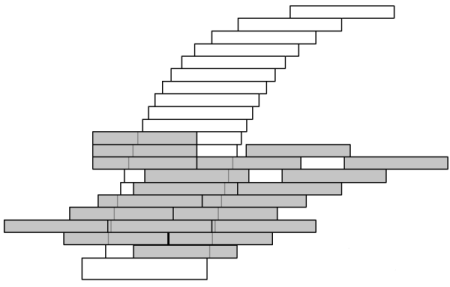
Chris Lamb: Optimal solution for the block stacking problem found

I attended an interesting seminar on the block stacking problem today given by Professor Mike Paterson of the University of Warwick. Like all good problems, it can be stated simply: how far can a stack of n identical blocks be made to hang over the edge of a table? The answer was widely believed to be of order log n (like the white shaded example above), but Mike Paterson and Uri Zwick previously constructed overhangs of order n^ 1/3 . In the seminar today, Paterson and his co-authors presented their proof that order n^ 1/3 is indeed the upper bound possible, resolving a long-standing mathematical problem. Professor Paterson is an excellent orator, highly recommended.

21 September 2007

Cameron Dale: 2Wire Router 2700HG-E Violates HTTP/1.1

I recently upgraded my Internet service with Telus, which included a new wireless router to replace my old high-speed modem. The new router is a 2Wire 2700HG-E which is configured through a web interface. The web interface worked fine at first on some other machines, but whenever I accessed it from my main desktop machine the pages would either fail to load, or have the images in the wrong locations. After much debugging (though it seems obvious now) I finally discovered that this was due to my enabling HTTP pipelining in FireFox on that machine (as suggested by Mozilla). Being the diligent citizen that I am, I of course filed a support request so that this could be fixed in the next version of the 2Wire software. Here is the response I received:
The HomePortal GUI was designed for internet browsers on default settings. We recommend keeping the pipelineing [sic] setting on "false".
Not exactly a good solution, and a little surprising, considering it's relatively straight-forward to implement. I know because I recently upgraded a simple HTTP handler from 1.0 to 1.1 specifically to support pipelining, as part of my work on DebTorrent. Now I've just read "Structured streams: a new transport abstraction", in which the authors state:
implementing pipelining correctly in web servers has proven challenging enough that seven years after the standardization of HTTP/1.1, popular browsers still leave pipelining disabled for compatibility
So it seems pipelining is disabled for a reason, though I had it enabled for years in FireFox and saw no problems (that I know of) until now. Maybe the problems are a thing of the past. Does anyone else have any experiences (good or bad) with pipelining to share?

11 September 2007

Benjamin Mako Hill: It's Selectric!

/copyrighteous/images/selectricity_logo.png Several months ago, I announced that I'd received a grant from mtvU and Cisco to work on a cool voting technology research project called Selectricity. A project in quotidian democracy, Selectricity attempts to apply some of the best voting technology and election methods research towards every-day decision-making. It takes research I did at the MIT Media Lab and packages it into a real, useful, application. I spent probably half of my time over the last several months managing a team of competent hackers and designers as we've built out the project. Last week, press releases and news stories went out as we launched our first production batch of features and a new design. You can check it out online at:
http://selectricity.org
There is a whole line-up of a groups and organizations, some high profile, that will be using the software in the coming months. There's also half a dozen killer new features that are built and waiting in the wings for a little polish and fanfare. We'll be testing and releasing those in the next couple months. No doubt, I'll be mentioning bits and pieces of my work on the project on my blog here. However, if you want to follow development, you should subscribe to the Selectricity News Blog where more full coverage will take place. You can leave feedback, suggestions, and bugs as comments on the blog or email it to team@selectricity.org. The election method code is already published and we'll be releasing the rest of the code under the AGPLv3 when the license is released by the FSF in the next few weeks.

3 August 2007

Biella Coleman: Puerto Rican Folk Music

The downside of NYC is that it is pricey but the upside is that there are a lot of free events to balance out the equation. Last night, I went to one of such free events at Lincoln center to see one of my favorite Puerto Rican folk singers, Roy Brown who was opening for Arlo Guthrie During Roy Brown’s last song, he called out another folk singer who I had never heard of Tao Rodriguez-Seeger to join him and I think that was probably one of my favorite songs of the night. Tao who comes from a family of folk singer types, usually performs with The Mammals and less frequently with The Anarchist Orchestra. His voice, at least in Spanish, is resounding and overpowering yet at the same time sports a certain type of gentle softness. It is striking and beautiful. If you like folk music, in English or Spanish, I would check him out. Here is a clip of a song recorded with Tito Auger and Roy Brown and a link to their recent complilation CD.

2 August 2007

Biella Coleman: Thanks and remember, get your plants!

Thanks for sending me the article and someone also sent me a link to an accessible copy here. And remember, plants work wonders to curb indoor air pollution, which can be as bad or worse than outdoor ones. Here is a list of some of the best polluting fightin’ plants . I used to have many many many plants but when you move nearly every year, you slowly have to get rid of them. last year in Canada we had one and we had to sadly part way with the plant that has been with us for 5 years. But now that I have moved somewhere that will be my home for a bit, I am going to go a little nuts with the plants again. I just love having them. Now I need to find a good greenhouse in NYC that does not charge an arm and a leg.

Next.

Previous.