Search Results: "bap"

6 August 2015

Christoph Egger: unbreaking tt-rss

TinyTiny-RSS has some nice failure modes. And upstream support forums aren't really helpfull so when you search for your current problem, chances are that there is one mention of it on the web, in the forum, and the only thing happening there is people making fun of the reporter. Anyway. This installation has seen lots of error messages from the updater in the last several months:
Warning: Fatal error, unknown preferences key: ALLOW_DUPLICATE_POSTS (owner: 3) in /srv/www/tt-rss.faui2k9.de/root/classes/db/prefs.php on line 108
  
And, more recently, the android app stopped working with ERROR:JSON Parse failed.. Turns out both things are related. First thing I noticed was changing preferences in the web panel stopped working until you use the reset to Defaults option and then changed settings. Plugging wireshark in between showed what was going on (Note: API was displayed as enabled in Preferences/Preferences):
HTTP/1.1 200 OK
Server: nginx/1.8.0
Date: Thu, 06 Aug 2015 11:00:31 GMT
Content-Type: text/json
Transfer-Encoding: chunked
Connection: keep-alive
X-Powered-By: PHP/5.4.43
Content-Language: auto
Set-Cookie: [...]
Expires: Thu, 19 Nov 1981 08:52:00 GMT
Cache-Control: no-store, no-cache, must-revalidate, post-check=0, pre-check=0
Pragma: no-cache
Api-Content-Length: 234
ea

Warning: Fatal error, unknown preferences key: ENABLE_API_ACCESS (owner: 2) in /srv/www/tt-rss.faui2k9.de/root/classes/db/prefs.php on line 108
"seq":0,"status":1,"content": "error":"API_DISABLED" 0
Solution for fixing the Android app (and the logspam on the way as well) seems to be to reset the preferences and then configure tt-rss again (In the webapp, not in the android thing!). Also silences tt-rss update_daemon as well, yay! One last thing: someone out there who wants to explain to me how to fix
Fatal error: Query INSERT INTO ttrss_enclosures
                                                        (content_url, content_type, title, duration, post_id, width, height) VALUES
                                                        ('https://2.gravatar.com/avatar/e6d6ceb7764252af8da058e30cd8cb5f?s=96&d=identicon&r=G', '', '', '', '0', 0, 0) failed: ERROR:  insert or update on table "ttrss_enclosures" violates foreign key constraint "ttrss_enclosures_post_id_fkey"
DETAIL:  Key (post_id)=(0) is not present in table "ttrss_entries". in /srv/www/tt-rss.faui2k9.de/root/classes/db/pgsql.php on line 46
  

7 July 2015

Lunar: Reproducible builds: week 10 in Stretch cycle

What happened about the reproducible builds effort this week: Media coverage Daniel Stender published an English translation of the article which originally appeared in Linux Magazin in Admin Magazine. Toolchain fixes Fixes landed in the Debian archive: Lunar submitted to Debian the patch already sent upstream adding a --clamp-mtime option to tar. Patches have been submitted to add support for SOURCE_DATE_EPOCH to txt2man (Reiner Herrmann), epydoc (Reiner Herrmann), GCC (Dhole), and Doxygen (akira). Dhole uploaded a new experimental debhelper to the reproducible repository which exports SOURCE_DATE_EPOCH. As part of the experiment, the patch also sets TZ to UTC which should help with most timezone issues. It might still be problematic for some packages which would change their settings based on this. Mattia Rizzolo sent upstream a patch originally written by Lunar to make the generate-id() function be deterministic in libxslt. While that patch was quickly rejected by upstream, Andrew Ayer came up with a much better one which sadly could have some performance impact. Daniel Veillard replied with another patch that should be deterministic in most cases without needing extra data structures. It's impact is currently being investigated by retesting packages on reproducible.debian.net. akira added a new option to sbuild for configuring the path in which packages are built. This will be needed for the srebuild script. Niko Tyni asked Perl upstream about it using the __DATE__ and __TIME__ C processor macros. Packages fixed The following 143 packages became reproducible due to changes in their build dependencies: alot, argvalidate, astroquery, blender, bpython, brian, calibre, cfourcc, chaussette, checkbox-ng, cloc, configshell, daisy-player, dipy, dnsruby, dput-ng, dsc-statistics, eliom, emacspeak, freeipmi, geant321, gpick, grapefruit, heat-cfntools, imagetooth, jansson, jmapviewer, lava-tool, libhtml-lint-perl, libtime-y2038-perl, lift, lua-ldoc, luarocks, mailman-api, matroxset, maven-hpi-plugin, mknbi, mpi4py, mpmath, msnlib, munkres, musicbrainzngs, nova, pecomato, pgrouting, pngcheck, powerline, profitbricks-client, pyepr, pylibssh2, pylogsparser, pystemmer, pytest, python-amqp, python-apt, python-carrot, python-crypto, python-darts.lib.utils.lru, python-demgengeo, python-graph, python-mock, python-musicbrainz2, python-pathtools, python-pskc, python-psutil, python-pypump, python-repoze.sphinx.autointerface, python-repoze.tm2, python-repoze.what-plugins, python-repoze.what, python-repoze.who-plugins, python-xstatic-term.js, reclass, resource-agents, rgain, rttool, ruby-aggregate, ruby-archive-tar-minitar, ruby-bcat, ruby-blankslate, ruby-coffee-script, ruby-colored, ruby-dbd-mysql, ruby-dbd-odbc, ruby-dbd-pg, ruby-dbd-sqlite3, ruby-dbi, ruby-dirty-memoize, ruby-encryptor, ruby-erubis, ruby-fast-xs, ruby-fusefs, ruby-gd, ruby-git, ruby-globalhotkeys, ruby-god, ruby-hike, ruby-hmac, ruby-integration, ruby-ipaddress, ruby-jnunemaker-matchy, ruby-memoize, ruby-merb-core, ruby-merb-haml, ruby-merb-helpers, ruby-metaid, ruby-mina, ruby-net-irc, ruby-net-netrc, ruby-odbc, ruby-packet, ruby-parseconfig, ruby-platform, ruby-plist, ruby-popen4, ruby-rchardet, ruby-romkan, ruby-rubyforge, ruby-rubytorrent, ruby-samuel, ruby-shoulda-matchers, ruby-sourcify, ruby-test-spec, ruby-validatable, ruby-wirble, ruby-xml-simple, ruby-zoom, ryu, simplejson, spamassassin-heatu, speaklater, stompserver, syncevolution, syncmaildir, thin, ticgit, tox, transmissionrpc, vdr-plugin-xine, waitress, whereami, xlsx2csv, zathura. The following packages became reproducible after getting fixed: Some uploads fixed some reproducibility issues but not all of them: Patches submitted which have not made their way to the archive yet: reproducible.debian.net A new package set for the X Strike Force has been added. (h01ger) Bugs tagged with locale are now visible in the statistics. (h01ger) Some work has been done add tests for NetBSD. (h01ger) Many changes by Mattia Rizzolo have been merged on the whole infrastructure: debbindiff development Version 26 has been released on June 28th fixing the comparison of files of unknown format. (Lunar) A missing dependency identified in python-rpm affecting debbindiff installation without recommended packages was promptly fixed by Michal iha . Lunar also started a massive code rearchitecture to enhance code reuse and enable new features. Nothing visible yet, though. Documentation update josch and Mattia Rizzolo documented how to reschedule packages from Alioth. Package reviews 142 obsolete reviews have been removed, 344 added and 107 updated this week. Chris West (Faux) filled 13 new bugs for packages failing to build from sources. The following new issues have been added: snapshot_placeholder_replaced_with_timestamp_in_pom_properties, different_encoding, timestamps_in_documentation_generated_by_org_mode and timestamps_in_pdf_generated_by_matplotlib.

23 June 2015

Orestis Ioannou: GSoC Debsources updates

The first 4 weeks have been really great. I had the chance to work on the new webapp, the copyright tracker. Here are my first 4 reports for the weeks: Summary During these weeks i completed the navigation (by prefix, list of versions etc) for the copyright tracker, the license rendering and the API for searching by checksum and by package/version/filename. Still under review the batch API (request many files at once) and the the respective views for the API. In the following weeks I ll work on the database and the plugins to mine license information on update time. Experience The experience i accumulate every week is immense. During the review process of my code i receive great feedback from zack, matthieu, and jpleau. It is a great chance for everyone to improve his/hers coding skills. At the university we barely get any feedback on our code, let alone communicate directly with professors to find the best solution for a given problem. I think it gets development in another level. For example at the university we use git/mercurial for our projects, although we don't really pay attention at commit messages and we marginally make use of these tools besides 'commit pull push'. During the last weeks i had the chance to use far more commands in order to squash amend rebase commits to have a beautiful and useful log history! And this is just a minor example. All in all I think it is a great introduction to the free/open source community for somebody, like me, who has been for years only a user and couldn't find the opportunity to contribute! And don't get me wrong, gsoc is not only about coding skills. At least for myself having the chance to get just a small taste of how the Debian community works, gets organised, get things done (!) is somehow priceless! Summer of code TDD I have finally understood why test driven development is so powerful. As i am advancing in the project i am sometimes obliged to retouch some areas, refactor pieces of code. Having a great test suite that keeps you on track about the changes, and possible outages in advance is pretty powerful. What is coming I feel the project is on the right path. Both clemux (fellow gsoc student working on debsources) and me are advancing in a productive pace. I hope that soon enough the copyright Blueprint will be completed (most notable pending functionalities are the plugins-hooks to mine the licenses at update time, introduction of at least another license oracle possible ninka, statistics) so that everyone can take profit of the new tools provided by DebSources. Although we haven't talked much about it the patch tracker should also come into the play sooner rather than later. Stay tuned!

Orestis Ioannou: GSoC Debsources updates

The first 4 weeks have been really great. I had the chance to work on the new webapp, the copyright tracker. Here are my first 4 reports for the weeks: Summary During these weeks i completed the navigation (by prefix, list of versions etc) for the copyright tracker, the license rendering and the API for searching by checksum and by package/version/filename. Still under review the batch API (request many files at once) and the the respective views for the API. In the following weeks I ll work on the database and the plugins to mine license information on update time. Experience The experience i accumulate every week is immense. During the review process of my code i receive great feedback from zack, matthieu, and jpleau. It is a great chance for everyone to improve his/hers coding skills. At the university we barely get any feedback on our code, let alone communicate directly with professors to find the best solution for a given problem. I think it gets development in another level. For example at the university we use git/mercurial for our projects, although we don't really pay attention at commit messages and we marginally make use of these tools besides 'commit pull push'. During the last weeks i had the chance to use far more commands in order to squash amend rebase commits to have a beautiful and useful log history! And this is just a minor example. All in all I think it is a great introduction to the free/open source community for somebody, like me, who has been for years only a user and couldn't find the opportunity to contribute! And don't get me wrong, gsoc is not only about coding skills. At least for myself having the chance to get just a small taste of how the Debian community works, gets organised, get things done (!) is somehow priceless! Summer of code TDD I have finally understood why test driven development is so powerful. As i am advancing in the project i am sometimes obliged to retouch some areas, refactor pieces of code. Having a great test suite that keeps you on track about the changes, and possible outages in advance is pretty powerful. What is coming I feel the project is on the right path. Both clemux (fellow gsoc student working on debsources) and me are advancing in a productive pace. I hope that soon enough the copyright Blueprint will be completed (most notable pending functionalities are the plugins-hooks to mine the licenses at update time, introduction of at least another license oracle possible ninka, statistics) so that everyone can take profit of the new tools provided by DebSources. Although we haven't talked much about it the patch tracker should also come into the play sooner rather than later. Stay tuned!

21 June 2015

Enrico Zini: debtags-rewrite-python3

debtags rewritten in python3 In my long quest towards closing #540218, I have uploaded a new libept to experimental. Then I tried to build debtags on a sid+experimental chroot and the result runs but has libc's free() print existential warnings about whatevers. At a quick glance, there are now things around like a new libapt, gcc 5 with ABI changes, and who knows what else. I figured how much time it'd take me to debug something like that, and I've used that time to rewrite debtags in python3. It took 8 hours, 5 of pleasant programming and the usual tax of another 3 of utter frustration packaging the results. I guess I gained over the risk of spending an unspecified amount of hours of just pure frustration. So from now on debtags is going to be a pure python3 package, with dependencies on only python3-apt and python3-debian. 700 lines of python instead of several C++ files built on 4 layers of libraries. Hopefully, this is the last of the big headaches I get from hacking on this package. Also, one less package using libept.

17 May 2015

Lunar: Reproducible builds: week 3 in Stretch cycle

What happened about the reproducible builds effort for this week: Toolchain fixes Tomasz Buchert submitted a patch to fix the currently overzealous package-contains-timestamped-gzip warning. Daniel Kahn Gillmor identified #588746 as a source of unreproducibility for packages using python-support. Packages fixed The following 57 packages became reproducible due to changes in their build dependencies: antlr-maven-plugin, aspectj-maven-plugin, build-helper-maven-plugin, clirr-maven-plugin, clojure-maven-plugin, cobertura-maven-plugin, coinor-ipopt, disruptor, doxia-maven-plugin, exec-maven-plugin, gcc-arm-none-eabi, greekocr4gamera, haskell-swish, jarjar-maven-plugin, javacc-maven-plugin, jetty8, latexml, libcgi-application-perl, libnet-ssleay-perl, libtest-yaml-valid-perl, libwiki-toolkit-perl, libwww-csrf-perl, mate-menu, maven-antrun-extended-plugin, maven-antrun-plugin, maven-archiver, maven-bundle-plugin, maven-clean-plugin, maven-compiler-plugin, maven-ear-plugin, maven-install-plugin, maven-invoker-plugin, maven-jar-plugin, maven-javadoc-plugin, maven-processor-plugin, maven-project-info-reports-plugin, maven-replacer-plugin, maven-resources-plugin, maven-shade-plugin, maven-site-plugin, maven-source-plugin, maven-stapler-plugin, modello-maven-plugin1.4, modello-maven-plugin, munge-maven-plugin, ocaml-bitstring, ocr4gamera, plexus-maven-plugin, properties-maven-plugin, ruby-magic, ruby-mocha, sisu-maven-plugin, syncache, vdk2, wvstreams, xml-maven-plugin, xmlbeans-maven-plugin. The following packages became reproducible after getting fixed: Some uploads fixed some reproducibility issues but not all of them: Ben Hutchings also improved and merged several changes submitted by Lunar to linux. Currently untested because in contrib: reproducible.debian.net
Thanks to the reproducible-build team for running a buildd from hell. gregor herrmann
Mattia Rizzolo modified the script added last week to reschedule a package from Alioth, a reason can now be optionally specified. Holger Levsen splitted the package sets page so each set now has its own page. He also added new sets for Java packages, Haskell packages, Ruby packages, debian-installer packages, Go packages, and OCaml packages. Reiner Herrmann added locales-all to the set of packages installed in the build environment as its needed to properly identify variations due to the current locale. Holger Levsen improved the scheduling so new uploads get tested sooner. He also changed the .json output that is used by tracker.debian.org to lists FTBFS issues again but only for issues unrelated to the toolchain or our test setup. Amongst many other small fixes and additions, the graph colors should now be more friendly to red-colorblind people. The fix for pbuilder given in #677666 by Tim Landscheidt is now used. This fixed several FTBFS for OCaml packages. Work on rebuilding with different CPU has continued, a kvm-on-kvm build host has been set been set up for this purpose. debbindiff development Version 19 of debbindiff included a fix for a regression when handling info files. Version 20 fixes a bug when diffing files with many differences toward a last line with no newlines. It also now uses the proper encoding when writing the text output to a pipe, and detects info files better. Documentation update Thanks to Santiago Vila, the unneeded -depth option used with find when fixing mtimes has been removed from the examples. Package reviews 113 obsolete reviews have been removed this week while 77 has been added.

Lunar: Reproducible builds: week 2 in Stretch cycle

What happened about the reproducible builds effort for this week: Media coverage Debian's effort on reproducible builds has been covered in the June 2015 issue of Linux Magazin in Germany. Cover of Linux Magazin June 2015 Article about reproducible builds in Linux Magazin June 2015 Toolchain fixes josch rebased the experimental version of debhelper on 9.20150507. Packages fixed The following 515 packages became reproducible due to changes of their build dependencies: airport-utils, airspy-host, all-in-one-sidebar, ampache, aptfs, arpack, asciio, aspell-kk, asused, balance, batmand, binutils-avr, bioperl, bpm-tools, c2050, cakephp-instaweb, carton, cbp2make, checkbot, checksecurity, chemeq, chronicle, cube2-data, cucumber, darkstat, debci, desktop-file-utils, dh-linktree, django-pagination, dosbox, eekboek, emboss-explorer, encfs, exabgp, fbasics, fife, fonts-lexi-saebom, gdnsd, glances, gnome-clocks, gunicorn, haproxy, haskell-aws, haskell-base-unicode-symbols, haskell-base64-bytestring, haskell-basic-prelude, haskell-binary-shared, haskell-binary, haskell-bitarray, haskell-bool-extras, haskell-boolean, haskell-boomerang, haskell-bytestring-lexing, haskell-bytestring-mmap, haskell-config-value, haskell-mueval, haskell-tasty-kat, itk3, jnr-constants, jshon, kalternatives, kdepim-runtime, kdevplatform, kwalletcli, lemonldap-ng, libalgorithm-combinatorics-perl, libalgorithm-diff-xs-perl, libany-uri-escape-perl, libanyevent-http-scopedclient-perl, libanyevent-perl, libanyevent-processor-perl, libapache-session-wrapper-perl, libapache-sessionx-perl, libapp-options-perl, libarch-perl, libarchive-peek-perl, libaudio-flac-header-perl, libaudio-wav-perl, libaudio-wma-perl, libauth-yubikey-decrypter-perl, libauthen-krb5-simple-perl, libauthen-simple-perl, libautobox-dump-perl, libb-keywords-perl, libbarcode-code128-perl, libbio-das-lite-perl, libbio-mage-perl, libbrowser-open-perl, libbusiness-creditcard-perl, libbusiness-edifact-interchange-perl, libbusiness-isbn-data-perl, libbusiness-tax-vat-validation-perl, libcache-historical-perl, libcache-memcached-perl, libcairo-gobject-perl, libcarp-always-perl, libcarp-fix-1-25-perl, libcatalyst-action-serialize-data-serializer-perl, libcatalyst-controller-formbuilder-perl, libcatalyst-dispatchtype-regex-perl, libcatalyst-plugin-authentication-perl, libcatalyst-plugin-authorization-acl-perl, libcatalyst-plugin-session-store-cache-perl, libcatalyst-plugin-session-store-fastmmap-perl, libcatalyst-plugin-static-simple-perl, libcatalyst-view-gd-perl, libcgi-application-dispatch-perl, libcgi-application-plugin-authentication-perl, libcgi-application-plugin-logdispatch-perl, libcgi-application-plugin-session-perl, libcgi-application-server-perl, libcgi-compile-perl, libcgi-xmlform-perl, libclass-accessor-classy-perl, libclass-accessor-lvalue-perl, libclass-accessor-perl, libclass-c3-adopt-next-perl, libclass-dbi-plugin-type-perl, libclass-field-perl, libclass-handle-perl, libclass-load-perl, libclass-ooorno-perl, libclass-prototyped-perl, libclass-returnvalue-perl, libclass-singleton-perl, libclass-std-fast-perl, libclone-perl, libconfig-auto-perl, libconfig-jfdi-perl, libconfig-simple-perl, libconvert-basen-perl, libconvert-ber-perl, libcpan-checksums-perl, libcpanplus-dist-build-perl, libcriticism-perl, libcrypt-cracklib-perl, libcrypt-dh-gmp-perl, libcrypt-mysql-perl, libcrypt-passwdmd5-perl, libcrypt-simple-perl, libcss-packer-perl, libcss-tiny-perl, libcurses-widgets-perl, libdaemon-control-perl, libdancer-plugin-database-perl, libdancer-session-cookie-perl, libdancer2-plugin-database-perl, libdata-format-html-perl, libdata-uuid-libuuid-perl, libdata-validate-domain-perl, libdate-jd-perl, libdate-simple-perl, libdatetime-astro-sunrise-perl, libdatetime-event-cron-perl, libdatetime-format-dbi-perl, libdatetime-format-epoch-perl, libdatetime-format-mail-perl, libdatetime-tiny-perl, libdatrie, libdb-file-lock-perl, libdbd-firebird-perl, libdbix-abstract-perl, libdbix-class-datetime-epoch-perl, libdbix-class-dynamicdefault-perl, libdbix-class-introspectablem2m-perl, libdbix-class-timestamp-perl, libdbix-connector-perl, libdbix-oo-perl, libdbix-searchbuilder-perl, libdbix-xml-rdb-perl, libdevel-stacktrace-ashtml-perl, libdigest-hmac-perl, libdist-zilla-plugin-emailnotify-perl, libemail-date-format-perl, libemail-mime-perl, libemail-received-perl, libemail-sender-perl, libemail-simple-perl, libencode-detect-perl, libexporter-tidy-perl, libextutils-cchecker-perl, libextutils-installpaths-perl, libextutils-libbuilder-perl, libextutils-makemaker-cpanfile-perl, libextutils-typemap-perl, libfile-counterfile-perl, libfile-pushd-perl, libfile-read-perl, libfile-touch-perl, libfile-type-perl, libfinance-bank-ie-permanenttsb-perl, libfont-freetype-perl, libfrontier-rpc-perl, libgd-securityimage-perl, libgeo-coordinates-utm-perl, libgit-pureperl-perl, libgnome2-canvas-perl, libgnome2-wnck-perl, libgraph-readwrite-perl, libgraphics-colornames-www-perl, libgssapi-perl, libgtk2-appindicator-perl, libgtk2-gladexml-simple-perl, libgtk2-notify-perl, libhash-asobject-perl, libhash-moreutils-perl, libhtml-calendarmonthsimple-perl, libhtml-display-perl, libhtml-fillinform-perl, libhtml-form-perl, libhtml-formhandler-model-dbic-perl, libhtml-html5-entities-perl, libhtml-linkextractor-perl, libhtml-tableextract-perl, libhtml-widget-perl, libhtml-widgets-selectlayers-perl, libhtml-wikiconverter-mediawiki-perl, libhttp-async-perl, libhttp-body-perl, libhttp-date-perl, libimage-imlib2-perl, libimdb-film-perl, libimport-into-perl, libindirect-perl, libio-bufferedselect-perl, libio-compress-lzma-perl, libio-compress-perl, libio-handle-util-perl, libio-interface-perl, libio-multiplex-perl, libio-socket-inet6-perl, libipc-system-simple-perl, libiptables-chainmgr-perl, libjoda-time-java, libjsr305-java, libkiokudb-perl, liblemonldap-ng-cli-perl, liblexical-var-perl, liblingua-en-fathom-perl, liblinux-dvb-perl, liblocales-perl, liblog-dispatch-configurator-any-perl, liblog-log4perl-perl, liblog-report-lexicon-perl, liblwp-mediatypes-perl, liblwp-protocol-https-perl, liblwpx-paranoidagent-perl, libmail-sendeasy-perl, libmarc-xml-perl, libmason-plugin-routersimple-perl, libmasonx-processdir-perl, libmath-base85-perl, libmath-basecalc-perl, libmath-basecnv-perl, libmath-bigint-perl, libmath-convexhull-perl, libmath-gmp-perl, libmath-gradient-perl, libmath-random-isaac-perl, libmath-random-oo-perl, libmath-random-tt800-perl, libmath-tamuanova-perl, libmemoize-expirelru-perl, libmemoize-memcached-perl, libmime-base32-perl, libmime-lite-tt-perl, libmixin-extrafields-param-perl, libmock-quick-perl, libmodule-cpanfile-perl, libmodule-load-conditional-perl, libmodule-starter-pbp-perl, libmodule-util-perl, libmodule-versions-report-perl, libmongodbx-class-perl, libmoo-perl, libmoosex-app-cmd-perl, libmoosex-attributehelpers-perl, libmoosex-blessed-reconstruct-perl, libmoosex-insideout-perl, libmoosex-relatedclassroles-perl, libmoosex-role-timer-perl, libmoosex-role-withoverloading-perl, libmoosex-storage-perl, libmoosex-types-common-perl, libmoosex-types-uri-perl, libmoox-singleton-perl, libmoox-types-mooselike-numeric-perl, libmousex-foreign-perl, libmp3-tag-perl, libmysql-diff-perl, libnamespace-clean-perl, libnet-bonjour-perl, libnet-cli-interact-perl, libnet-daap-dmap-perl, libnet-dbus-glib-perl, libnet-dns-perl, libnet-frame-perl, libnet-google-authsub-perl, libnet-https-any-perl, libnet-https-nb-perl, libnet-idn-encode-perl, libnet-idn-nameprep-perl, libnet-imap-client-perl, libnet-irc-perl, libnet-mac-vendor-perl, libnet-openid-server-perl, libnet-smtp-ssl-perl, libnet-smtp-tls-perl, libnet-smtpauth-perl, libnet-snpp-perl, libnet-sslglue-perl, libnet-telnet-perl, libnhgri-blastall-perl, libnumber-range-perl, libobject-signature-perl, libogg-vorbis-header-pureperl-perl, libopenoffice-oodoc-perl, libparse-cpan-packages-perl, libparse-debian-packages-perl, libparse-fixedlength-perl, libparse-syslog-perl, libparse-win32registry-perl, libpdf-create-perl, libpdf-report-perl, libperl-destruct-level-perl, libperl-metrics-simple-perl, libperl-minimumversion-perl, libperl6-slurp-perl, libpgobject-simple-perl, libplack-middleware-fixmissingbodyinredirect-perl, libplack-test-externalserver-perl, libplucene-perl, libpod-tests-perl, libpoe-component-client-ping-perl, libpoe-component-jabber-perl, libpoe-component-resolver-perl, libpoe-component-server-soap-perl, libpoe-component-syndicator-perl, libposix-strftime-compiler-perl, libposix-strptime-perl, libpostscript-simple-perl, libproc-processtable-perl, libprotocol-osc-perl, librcs-perl, libreadonly-xs-perl, libreturn-multilevel-perl, librivescript-perl, librouter-simple-perl, librrd-simple-perl, libsafe-isa-perl, libscope-guard-perl, libsemver-perl, libset-tiny-perl, libsharyanto-file-util-perl, libshell-command-perl, libsnmp-info-perl, libsoap-lite-perl, libstat-lsmode-perl, libstatistics-online-perl, libstring-compare-constanttime-perl, libstring-format-perl, libstring-toidentifier-en-perl, libstring-tt-perl, libsub-recursive-perl, libsvg-tt-graph-perl, libsvn-notify-perl, libswish-api-common-perl, libtap-formatter-junit-perl, libtap-harness-archive-perl, libtemplate-plugin-number-format-perl, libtemplate-plugin-yaml-perl, libtemplate-tiny-perl, libtenjin-perl, libterm-visual-perl, libtest-block-perl, libtest-carp-perl, libtest-classapi-perl, libtest-cmd-perl, libtest-consistentversion-perl, libtest-data-perl, libtest-databaserow-perl, libtest-differences-perl, libtest-file-sharedir-perl, libtest-hasversion-perl, libtest-kwalitee-perl, libtest-lectrotest-perl, libtest-module-used-perl, libtest-object-perl, libtest-perl-critic-perl, libtest-pod-coverage-perl, libtest-script-perl, libtest-script-run-perl, libtest-spelling-perl, libtest-strict-perl, libtest-synopsis-perl, libtest-trap-perl, libtest-unit-perl, libtest-utf8-perl, libtest-without-module-perl, libtest-www-selenium-perl, libtest-xml-simple-perl, libtest-yaml-perl, libtex-encode-perl, libtext-bibtex-perl, libtext-csv-encoded-perl, libtext-csv-perl, libtext-dhcpleases-perl, libtext-diff-perl, libtext-quoted-perl, libtext-trac-perl, libtext-vfile-asdata-perl, libthai, libthread-conveyor-perl, libthread-sigmask-perl, libtie-cphash-perl, libtie-ical-perl, libtime-stopwatch-perl, libtk-dirselect-perl, libtk-pod-perl, libtorrent, libturpial, libunicode-japanese-perl, libunicode-maputf8-perl, libunicode-stringprep-perl, libuniversal-isa-perl, libuniversal-moniker-perl, liburi-encode-perl, libvi-quickfix-perl, libvideo-capture-v4l-perl, libvideo-fourcc-info-perl, libwiki-toolkit-plugin-rss-reader-perl, libwww-mechanize-formfiller-perl, libwww-mechanize-gzip-perl, libwww-mechanize-perl, libwww-opensearch-perl, libx11-freedesktop-desktopentry-perl, libxc, libxml-dtdparser-perl, libxml-easy-perl, libxml-handler-trees-perl, libxml-libxml-iterator-perl, libxml-libxslt-perl, libxml-rss-perl, libxml-validator-schema-perl, libxml-xpathengine-perl, libxml-xql-perl, llvm-py, madbomber, makefs, mdpress, media-player-info, meta-kde-telepathy, metamonger, mmm-mode, mupen64plus-audio-sdl, mupen64plus-rsp-hle, mupen64plus-ui-console, mupen64plus-video-z64, mussort, newpid, node-formidable, node-github-url-from-git, node-transformers, nsnake, odin, otcl, parsley, pax, pcsc-perl, pd-purepd, pen, prank, proj, proot, puppet-module-puppetlabs-postgresql, python-async, python-pysnmp4, qrencode, r-bioc-graph, r-bioc-hypergraph, r-bioc-iranges, r-bioc-xvector, r-cran-pscl, rbenv, rlinetd, rs, ruby-ascii85, ruby-cutest, ruby-ejs, ruby-factory-girl, ruby-hdfeos5, ruby-kpeg, ruby-libxml, ruby-password, ruby-zip-zip, sdl-sound1.2, stterm, systemd, taktuk, tcc, tryton-modules-account-invoice, ttf-summersby, tupi, tuxpuck, unknown-horizons, unsafe-mock, vcheck, versiontools, vim-addon-manager, vlfeat, vsearch, xacobeo, xen-tools, yubikey-personalization-gui, yubikey-personalization. The following packages became reproducible after getting fixed: Some uploads fixed some reproducibility issues but not all of them: Patches submitted which did not make their way to the archive yet: reproducible.debian.net Alioth now hosts a script that can be used to redo builds and test for a package. This was preliminary done manually through requests over the IRC channel. This should reduce the number of interruptions for jenkins' maintainers The graph of the oldest build per day has been fixed. Maintainance scripts will not error out when they are no files to remove. Holger Levsen started work on being able to test variations of CPU features and build date (as in build in another month of 1984) by using virtual machines. debbindiff development Version 18 has been released. It will uses proper comparators for pk3 and info files. Tar member names are now assumed to be UTF-8 encoded. The limit for the maximum number of different lines has been removed. Let's see on reproducible.debian.net how it goes for pathological cases. It's now possible to specify both --html and --text output. When neither of them is specified, the default will be to print a text report on the standard output (thanks to Paul Wise for the suggestion). Documentation update Nicolas Boulenguez investigated Ada libraries. Package reviews 451 obsolete reviews have been removed and 156 added this week. New identified issues: running kernel version getting captured, random filenames in GHC debug symbols, and timestamps in headers generated by qdbusxml2cpp. Misc. Holger Levsen went to re:publica and talked about reproducible builds to developers and users there. Holger also had a chance to meet FreeBSD developers and discuss the status of FreeBSD. Investigations have started on how it could be made part of our current test system. Laurent Guerby gave Lunar access to systems in the GCC Compile Farm. Hopefully access to these powerful machines will help to fix packages for GCC, Iceweasel, and similar packages requiring long build times.

4 May 2015

Lunar: Reproducible builds: first week in Stretch cycle

Debian Jessie has been released on April 25th, 2015. This has opened the Stretch development cycle. Reactions to the idea of making Debian build reproducibly have been pretty enthusiastic. As the pace is now likely to be even faster, let's see if we can keep everyone up-to-date on the developments. Before the release of Jessie The story goes back a long way but a formal announcement to the project has only been sent in February 2015. Since then, too much work has happened to make a complete report, but to give some highlights: Lunar did a pretty improvised lightning talk during the Mini-DebConf in Lyon. This past week It seems changes were pilling behind the curtains given the amount of activity that happened in just one week. Toolchain fixes We also rebased the experimental version of debhelper twice to merge the latest set of changes. Lunar submitted a patch to add a -creation-date to genisoimage. Reiner Herrmann opened #783938 to request making -notimestamp the default behavior for javadoc. Juan Picca submitted a patch to add a --use-date flag to texi2html. Packages fixed The following packages became reproducible due to changes of their build dependencies: apport, batctl, cil, commons-math3, devscripts, disruptor, ehcache, ftphs, gtk2hs-buildtools, haskell-abstract-deque, haskell-abstract-par, haskell-acid-state, haskell-adjunctions, haskell-aeson, haskell-aeson-pretty, haskell-alut, haskell-ansi-terminal, haskell-async, haskell-attoparsec, haskell-augeas, haskell-auto-update, haskell-binary-conduit, haskell-hscurses, jsch, ledgersmb, libapache2-mod-auth-mellon, libarchive-tar-wrapper-perl, libbusiness-onlinepayment-payflowpro-perl, libcapture-tiny-perl, libchi-perl, libcommons-codec-java, libconfig-model-itself-perl, libconfig-model-tester-perl, libcpan-perl-releases-perl, libcrypt-unixcrypt-perl, libdatetime-timezone-perl, libdbd-firebird-perl, libdbix-class-resultset-recursiveupdate-perl, libdbix-profile-perl, libdevel-cover-perl, libdevel-ptkdb-perl, libfile-tail-perl, libfinance-quote-perl, libformat-human-bytes-perl, libgtk2-perl, libhibernate-validator-java, libimage-exiftool-perl, libjson-perl, liblinux-prctl-perl, liblog-any-perl, libmail-imapclient-perl, libmocked-perl, libmodule-build-xsutil-perl, libmodule-extractuse-perl, libmodule-signature-perl, libmoosex-simpleconfig-perl, libmoox-handlesvia-perl, libnet-frame-layer-ipv6-perl, libnet-openssh-perl, libnumber-format-perl, libobject-id-perl, libpackage-pkg-perl, libpdf-fdf-simple-perl, libpod-webserver-perl, libpoe-component-pubsub-perl, libregexp-grammars-perl, libreply-perl, libscalar-defer-perl, libsereal-encoder-perl, libspreadsheet-read-perl, libspring-java, libsql-abstract-more-perl, libsvn-class-perl, libtemplate-plugin-gravatar-perl, libterm-progressbar-perl, libterm-shellui-perl, libtest-dir-perl, libtest-log4perl-perl, libtext-context-eitherside-perl, libtime-warp-perl, libtree-simple-perl, libwww-shorten-simple-perl, libwx-perl-processstream-perl, libxml-filter-xslt-perl, libxml-writer-string-perl, libyaml-tiny-perl, mupen64plus-core, nmap, openssl, pkg-perl-tools, quodlibet, r-cran-rjags, r-cran-rjson, r-cran-sn, r-cran-statmod, ruby-nokogiri, sezpoz, skksearch, slurm-llnl, stellarium. The following packages became reproducible after getting fixed: Some uploads fixed some reproducibility issues but not all of them: Patches submitted which did not make their way to the archive yet: Improvements to reproducible.debian.net Mattia Rizzolo has been working on compressing logs using gzip to save disk space. The web server would uncompress them on-the-fly for clients which does not accept gzip content. Mattia Rizzolo worked on a new page listing various breakage: missing or bad debbindiff output, missing build logs, unavailable build dependencies. Holger Levsen added a new execution environment to run debbindiff using dependencies from testing. This is required for packages built with GHC as the compiler only understands interfaces built by the same version. debbindiff development Version 17 has been uploaded to unstable. It now supports comparing ISO9660 images, dictzip files and should compare identical files much faster. Documentation update Various small updates and fixes to the pages about PDF produced by LaTeX, DVI produced by LaTeX, static libraries, Javadoc, PE binaries, and Epydoc. Package reviews Known issues have been tagged when known to be deterministic as some might unfortunately not show up on every single build. For example, two new issues have been identified by building with one timezone in April and one in May. RD and help2man add current month and year to the documentation they are producing. 1162 packages have been removed and 774 have been added in the past week. Most of them are the work of proper automated investigation done by Chris West. Summer of code Finally, we learned that both akira and Dhole were accepted for this Google Summer of Code. Let's welcome them! They have until May 25th before coding officialy begins. Now is the good time to help them feel more comfortable by sharing all these little bits of knowledge on how Debian works.

29 April 2015

Dirk Eddelbuettel: Finance-YahooQuote 0.25 hotfix

A hotfix release for the Finance-YahooQuote Perl module on CPAN is now available. Available Yahoo! Finance decided to change the base URL. My thanks to Nicola Chiapolini who not only noticed but also sent me the one-line patch fixing this:
--- YahooQuote.pm~      2010-03-27 01:44:10.000000000 +0100
+++ YahooQuote.pm       2015-04-29 11:31:20.407926674 +0200
@@ -34,7 +34,7 @@
 $VERSION = '0.24';
 
 ## these variables govern what type of quote the modules is retrieving
-$QURLbase = "http://download.finance.yahoo.com/d/quotes.csvr?e=.csv&f=";
+$QURLbase = "http://download.finance.yahoo.com/d/quotes.csv?e=.csv&f=";
 $QURLformat = "snl1d1t1c1p2va2bapomwerr1dyj1x";        # default up to 0.19
 $QURLextended = "s7t8e7e8e9r6r7r5b4p6p5j4m3m4";        # new in 0.20
 $QURLrealtime = "b2b3k2k1c6m2j3"; # also new in 0.20
If need be, edit your file YahooQuote.pm by hand. This change in Finance-YahooQuote will also affect Beancounter and smtm both of which use this module. The fix has been pushed to Debian for the corresponding package and to PAUSE for CPAN package. Having maintained this since 2002 in RCS, I also just created a GitHub repo for it where development/maintenance will now happen.

This post by Dirk Eddelbuettel originated on his Thinking inside the box blog. Please report excessive re-aggregation in third-party for-profit settings.

24 March 2015

Simon Josefsson: Laptop indecision

I wrote last month about buying a new laptop and I still haven t made a decision. One reason for this is because Dell doesn t seem to be shipping the E7250. Some online shops claim to be able to deliver it, but aren t clear on what configuration it has and I really don t want to end up with Dell Wifi. Another issue has been the graphic issues with the Broadwell GPU (see the comment section of my last post). It seems unlikely that this will be fixed in time for Debian Jessie. I really want a stable OS on this machine, as it will be a work-horse and not a toy machine. I haven t made up my mind whether the graphics issue is a deal-breaker for me. Meanwhile, a couple of more sub-1.5kg (sub-3.3lbs) Broadwell i7 s have hit the market. Some of these models were suggested in comments to my last post. I have decided that the 5500U CPU would also be acceptable to me, because some newer laptops doesn t come with the 5600U. The difference is that the 5500U is a bit slower (say 5-10%) and lacks vPro, which I have no need for and mostly consider a security risk. I m not aware of any other feature differences. Since the last round, I have tightened my weight requirement to be sub-1.4kg (sub-3lbs), which excludes some recently introduced models, and actually excludes most of the models I looked at before (X250, X1 Carbon, HP 1040/810). Since I m leaning towards the E7250, with the X250 as a reliable fallback option, I wanted to cut down on the number of further models to consider. Weigth is a simple distinguisher. The 1.4-1.5kg (3-3.3lbs) models I am aware that of that is excluded are the Asus Zenbook UX303LN, the HP Spectre X360, and the Acer TravelMate P645. The Acer Aspire S7-393 (1.3kg) and Toshiba Kira-107 (1.26kg) would have been options if they had RJ45 ports. They may be interesting to consider for others. The new models I am aware of are below. I m including the E7250 and X250 for comparison, since they are my preferred choices from the first round. A column for maximum RAM is added too, since this may be a deciding factor for me. Higher weigth is with touch screens.
Toshiba Z30-B 1.2-1.34kg 16GB 13.3 1920 1080
Fujitsu Lifebook S935 1.24-1.36kg 12GB 13.3 1920 1080
HP EliteBook 820 G2 1.34-1.52kg 16GB 12.5 1920 1080
Dell Latitude E7250 1.25kg 8/16GB? 12.5 1366 768
Lenovo X250 1.42kg 8GB 12.5 1366 768
It appears unclear whether the E7250 is memory upgradeable, some sites say max 8GB some say max 16GB. The X250 and 820 has DisplayPort, the S935 and Z30-B has HDMI, and the E7250 has both DisplayPort/HDMI. The E7250 does not have VGA which the rest has. All of them have 3 USB 3.0 ports except for X250 that only has 2 ports. The E7250 and 820 claims NFC support, but Debian support is not given. Interestingly, all of them have a smartcard reader. All support SDXC memory cards. The S935 has an interesting modular bay which can actually fit a CD reader or an additional battery. There is a detailed QuickSpec PDF for the HP 820 G2, haven t found similar detailed information for the other models. It mentions support for Ubuntu, which is nice. Comparing these laptops is really just academic until I have decided what to think about the Broadwell GPU issues. It may be that I ll go back to a fourth-gen i7 laptop, and then I ll probably pick a cheap reliable machine such as the X240.

4 March 2015

Zlatan Todori : Interviews with FLOSS developers: Paul Wise

After starting with Joey Hess, we continue with Paul Wise. What makes his star to shine are many things such as being a DSA (Debian System Administrator), a helpful hand on mailings list, encouraging people to join Debian teams but most of all - he has encyclopedia knowledge on Debian as a whole which he gladly shares with anyone who asks (very fast response on IRC channels). It is almost impossible for any single person to count all Debian teams, work and places - to know most of those things, you can image the vast knowledge which Paul has. The legend says that his brain has better and faster search engine algorithm on Debian related queries than all other engines combined. So lets see what he has to share with world. me: Who are you? pabs: Paul Wise (pabs) and I have to say that I'm no-where near as knowledgeable as your intro suggests. me: How did you start programming? pabs: Messing around with fractals and graphics things in MS BASIC. me: How would you now advise others to start programming? pabs: Pick an issue in a tool you use, investigate how the tool works and how you can change it, fix that and contribute the change back to the project that created that tool. In the process you will learn skills, interact with the community and contribute to the project. me: Setup of your development machine? pabs: Lenovo Thinkpad with external monitor, Debian testing and some tweaks me What is your preferable language (for hacking)? Why? How do you compare it to other languages? pabs: I currently prefer Python for its readability. It still has some rough edges though the documentation covers them fairly well. I generally pick up new languages when working on projects written in them. Haskell is next on the horizon due to Nikki and the Robots. me: Describe your current most memorable situation as software developer/hacker? pabs: I had a great time creating fractals in BASIC, learning about the Mandelbrot set, L-systems and more. My days and nights of hacking on frhed (a GPLed hex editor for Windows) to help me cheat at Civilisation were pretty memorable. frhed led to my work on reverse engineering the CHM file format (a documentation format for Windows programs). A stand-out moment during my time with Debian was hacking on the derivates census patch generation code during the Debian UK BBQ weekend, surrounded by geeks playing Portal, cooking things, hacking on Debian and generally having a good time (thanks Steve!). me: Some memorable moments from Debian conferences? pabs: There are so many; meeting Debian folks, playing Mao once and then never again, late night games of werewolf, both delectably delicious and hideously disgusting cheeses, fried insects, day trips to beautiful landscapes, inspiring keynotes, exciting BoFs, secret IRC channels for planning surprise birthday parties, blue hair, wet air, blocks of fried cheese, a vast quantity of icecream, pants, geeks in the surf, volcanoes, hiking, a wonderful view, a uni-cycling stormtrooper & more. me: How do you see future of Debian development? pabs: I hope we will continue to exist and uphold our principles for the foreseeable future. I don't have any crystal balls though. me: You recently became member of Debian DSA - what is that like, what roles do you have and what tasks are in front of DSA? pabs: We wrote a bit of text about that for DPN recently. me: You have large knowledge on Debian and you share it with anyone who wants to know more. What motivates you to do so? pabs: I want the operating system I personally rely on to exist into the future, helping folks work on and join Debian can help with that. me: Why should developers and users join Debian community? What makes Debian a great and happy place? pabs: Every Debian contributor has different reasons for joining the community. Personally the Social Contract, the DFSG and the spirit and culture behind them are the main reason to be involved. I also like our many efforts towards technical excellence and correctness. Of course I've made a number of good friends over the years, especially as a result of attending DebConf every year since 2007. me: You are member of Debian publicity team which writes Debian news - do you need more people to join that team and how can they start? pabs: Since there is an infinite amount of work to do, pretty much every part of Debian always needs help, that includes the publicity team. We published a post about ways to help here. me: If someone wants to contribute to Debian in terms of packaging, can they do it anonymously (for example over Tor network, does Debian have .onion address)? pabs: Due to Debian's penchant for transparency it is harder but there are definitely package maintainers who have built up a reputation for good work under a pseudonym over the years and become Debian contributors as a result. I'm not aware of completely anonymous package maintainers but there are definitely people who file bugs using one-off pseudonyms, which is almost the same thing as anonymously. There are definitely Debian contributors and members who use Tor while contributing to Debian. In fact, as Debian is very highly dependent on OpenPGP and the best practices for OpenPGP include refreshing your keyring slowly over Tor, so probably quite a number of Debian contributors use Tor. As far as I know Debian itself does not run any Tor relays or onion services. me: What are places that non-packaging developers and people could join and help spread Debian even more? pabs: There are many ways to help Debian, including non-technical ones. Unfortunately our web page about helping Debian isn't quite up-to-date with all of them but a few more are to volunteer at DebConf, helo with artwork requests, speak about Debian at events or even come up with ideas for projects. Whatever skills you have, Debian can probably make use of them. If you aren't sure where to start, jump on the debian-mentors mailing list or IRC channel and we can probably guide you to the right place within Debian. Don't worry about not being skilled enough, everyone starts somewhere. me: How do you see Debian will manage webapps? pabs: Personally I prefer locally installed software, standard data formats and standard data transfer protocols to the wild webapps world but I understand they are becoming very popular to produce and use due to the ubiquity of the web browser platform. Antonio Terceiro is mentoring a project for this year's newcomer mentorship programs (outreachy/gsoc) that aims to improve support for installing web apps on Debian installations. I hope it succeeds as it could help make Debian more popular on servers and home servers in particular. me: How would you advise Debian (and other FLOSS users) to setup their machine in terms of security and anonymity? pabs: All technology has upsides and downsides. I would advise anyone to analyse their situation and protect themselves accordingly. For example if you have a bad memory, full disk encryption, which is based on pass-phrases might lead to data loss and physical security might be a better choice for protecting your data. The right choices around technology are very much a personal thing. me: Is it better to setup xmonad (because it is Haskell based WM) with small dependency chain or GNOME (because it is getting sandboxed apps) in term of security and privacy implications? pabs: Again, the right choices around technology are very much a personal thing. Due to the design of X11, both of these are approximately equivalent from a window-manager security properties point of view, that is to say, pretty bad. Wayland is one of the possible X11 successors and offers much better security properties. GNOME folks are working on switching to Wayland. Ultimately though it comes down to how each person uses their window manager and which software they run under it. me: Should Debian join Tor project as distro that installs Tor relays by default - should it offer that as option in installer in Debian 9? pabs: Running a Tor relay requires a reasonably fast and reliable Internet connection and should be a conscious decision on behalf of the sysadmin for a computer so Debian probably shouldn't install them by default. If tasksel gets support for installing tasks from Debian Pure Blends, then we could add a Tor relay task to the Debian Sanctuary Pure Blend. me: Have you ever considered joining initiatives such as FreedomBox? pabs: I was quite moved by Eben Moglen's talk at DebConf10 in New York and the resulting BoF. It seemed like a very ambitious project but I didn't really have the knowledge, skills or time to contribute yet. me: Are you a gamer? Valve Steam games are offered for free to Debian Developers - do you use steam and play Valve games? Your thoughts on Steam and non-free Linux gaming? pabs: I play computer games occasionally, all from Debian main or ones that I'm packaging. 0ad is my current go-to for a bit of gaming. I don't have any experience with Steam or non-free games on Linux. me: Is there something you would change in FLOSS ecosystem? pabs: Various folks have highlighted new and ongoing challenges for the FLOSS ecosystem in various places in recent years. Something that I would like to highlight that does not get talked about enough is the choices we make around our digital artefacts. This is the discussion around "preferred form for modification" or "source". The "source" for a particular digital artefact is a deliberate choice on behalf of the authors. Often generated files are distributed alongside the "source" without any instructions for reproducing the generated files from the "source". It sometimes happens that FLOSS contributors forget to distriute what they have chosen as "source", instead just distributing the generated files. This is a fairly well known issue but still happens. What isn't thought about quite as much is that the choice of "source" has consequences for future development possibilities of that "source". Some forms of "source" are more expressive than others, can be modified in a wider variety of ways and are better choices in general. Sometimes the consequences of choosing less expressive forms are mild and other times they are quite important. I hope more people will start to think about these choices. Some examples where, in my opinion, various people could have made better choices are listed in the mail I sent to the games team list last year. Another thing I would like to highlight is the work that organisations like Software Freedom Conservancy and Software in the Public Interest do to protect, defend, promote and support FLOSS projects. It is very important work that needs our interest and support. me: Can FLOSS world create great alternatives to Viber, Dropbox, WhatsUp, Facebook, Skype and other non-free services? pabs: I think that the FLOSS world has already created alternatives to all of those. The success of non-free services doesn't take these alternatives away but it does mean some of them are less useful because some of them are the kind of tools that become more useful with a larger amount of people using them. I don't know what it would take for the FLOSS alternatives to achieve similar success as network effects are hard to overcome. Hopefully mako is right and the network effects are overrated. me: Your thoughts and compare Cloud, IaaS, PaaS, SaaSS? To what should the FLOSS world pay more attention and energy? pabs: Initially I dismissed these as buzzwords and a threat to Free Software. These days I view them as potential opportunities for Free Software. Cloud-related technologies such as OpenStack and virtual machines can make private compute farm hardware more flexible and useful to their owners. IaaS providers can be used to run Debian more simply and cheaply and therefore bring Debian to more people than possible with hardware. PaaS providers can be used to run Free Software services. SaaSS can be based entirely on Free Software and respect users. Of course, just like running Free Software on hardware (proprietary or libre), cloud technology, IaaS, PaaS and SaaSS all come with downsides. The FLOSS world should aim to inform users of our software of these downsides. For example, the Debian installer could note that it is running on Intel CPUs with a proprietary BIOS and various proprietary software running, that it is running on a mobile phone with a locked bootloader, that it is running in a Xen VM on machines owned by Amazon. Free Software services could note they are running on Google App Engine etc. Free Software web browsers, chat clients etc could note when they are connecting to proprietary network services. All these notes could inform users about the downsides present in the particular situation encountered. There is also much work to be done making it easier to run Free Software on top of or use Free Software to connect to all manner of platforms from lowRISC to UEFI to VMware to Google App Engine to GitHub to Facebook. The more places Free Software can reach, the more people will be exposed to the philosophy behind it and the more potential there is for folks to join the community. While co-option of the FLOSS world is a dangerous certainty, co-option of proprietary platforms might be able to expand the reach of the philosophy behind Free Software. me: Your thoughts on Purism (the open hardware laptop initiative that got recently funded on CrowdSupply)? pabs: I don't know enough about that to comment but personally I am more interested in a laptop based on a libre CPU architecture. The RISC-V ISA and the lowRISC project seems to be one of the more promising possibilities at this point in time. me: Did you watch Citizenfour - comments on it? pabs: I've seen the trailer and look forward to watching it at some point, I read there might be a screening at DebConf15.

26 February 2015

EvolvisForge blog: tomcat7 init script is asynchronous

TIL: the init script of tomcat7 in Debian is asynchronous. For some piece of software, our rollout (install and upgrade) process works like this: The first tomcat7 start here is just to unzip the *.war files. For some reason, people like to let tomcat7 do that. This failed today; there were two webapps. Manually unzipping it also did not work for some reason. Re-doing it, inserting a sleep 30 after the here , made it work. In a perfect world, initscripts only return when the service is running, so that the next one started in a nice sequential (not parallel!) init or manual start sequence can do what it needs to, assuming the previous command has fully finished. In this perfect world, those who do wish for faster startup times use a different init system, one that starts things in parallel, for example. Even there, dependencies will wish for the depended-on service to be fully running when they are started; even more so, since the delays between starting things seem to be less for that other init system. So, this is not about the init system, but about the init script; a change that would be a win-win for users of both init schemes. Update: Someone already contacted me with feedback: they suggested to wait until the shutdown port is listened on by tomcat7. We ll look at this later. In the meantime, we re trying to also get rid of the config (and logs) in webapps/ part
PS: If someone is interested in an init script (Debian/LSB sysvinit, I made the effort to finally learn that some months before the other system came) that starts Wildfly (formerly known as JBoss AS) synchronously, waiting until all *.?ar files are fully deployed before returning (though with a timeout in case it won t ever finish), just ask (maybe it will become a dialogue, in which we can improve it together). (We have two versions of it, the more actively maintained one is in a secret internal project though, so I d have to merge it and ready it for publication though, plus the older one is AGPLv3, the newer one was relicenced to a BSDish licence.)

24 February 2015

EvolvisForge blog: Java , logging and the locale

A coworker and I debugged a fascinating problem today. They had a tomcat7 installation with a couple of webapps, and one of the bundled libraries was logging in German. Everything else was logging in English (the webapps themselves, and the things the other bundled libraries did). We searched around a bit, and eventually found that the wrongly-logging library (something jaxb/jax-ws) was using, after unravelling another few layers of library bundling another library as convenience copy (gah, Java!), com.sun.xml.ws.resources.WsservletMessages which contains quite a few com.sun.istack.localization.Localizable members. Looking at the other classes in that package, in particular Localizer, showed that it defaults to the java.util.Locale.getDefault() value for the language. Which is set from the environment. Looking at /proc/pid-of-JVM-running-tomcat7/environ showed nothing, of course . The system locale was, properly, set to English. (We mostly use en_GB.UTF-8 for better paper sizes and the metric system (unless the person requesting the machine, or the admin creating it, still likes the system to speak German *shudder*), but that one still had en_US.UTF-8.) Browsing the documentation for java.util.Locale proved more fruitful: it also contains a setDefault method, which sets the new default locale JVM-wide. Turns out another of the webapps used that for some sort of internal localisation. Clearly, the containment of tomcat7 is incomplete in this case. Documenting for the larger net, in case someone else runs into this. It s not as if things like this would be showing up in the USA, where the majority of development appears to happen.

27 January 2015

Matthias Klumpp: AppStream 0.8 released!

Yesterday I released version 0.8 of AppStream, the cross-distribution standard for software metadata, that is currently used by GNOME-Software, Muon and Apper in to display rich metadata about applications and other software components. What s new? The new release contains some tweaks on AppStreams documentation, and extends the specification with a few more tags and refinements. For example we now recommend sizes for screenshots. The recommended sizes are the ones GNOME-Software already uses today, and it is a good idea to ship those to make software-centers look great, as others SCs are planning to use them as well. Normal sizes as well as sizes for HiDPI displays are defined. This change affects only the distribution-generated data, the upstream metadata is unaffected by this (the distro-specific metadata generator will resize the screenshots anyway). Another addition to the spec is the introduction of an optional <source_pkgname/> tag, which holds the source package name the packages defined in <pkgname/> tags are built from. This is mainly for internal use by the distributor, e.g. it can decide to use this information to link to internal resources (like bugtrackers, package-watch etc.). It may also be used by software-center applications as additional information to group software components. Furthermore, we introduced a <bundle/> tag for future use with 3rd-party application installation solutions. The tag notifies a software-installer about the presence of a 3rd-party application bundle, and provides the necessary information on how to install it. In order to do that, the software-center needs to support the respective installation solution. Currently, the Limba project and Xdg-App bundles are supported. For software managers, it is a good idea to implement support for 3rd-party app installers, as soon as the solutions are ready. Currently, the projects are worked on heavily. The new tag is currently already used by Limba, which is the reason why it depends on the latest AppStream release. How do I get it? All AppStream libraries, libappstream, libappstream-qt and libappstream-glib, are supporting the 0.8 specification in their latest version so in case you are using one of these, you don t need to do anything. For Debian, the DEP-11 spec is being updated at time, and the changes will land in the DEP-11 tools soon. Improve your metadata! This call goes especilly to many KDE projects! Getting good data is partly a task for the distributor, since packaging issues can result in incorrect or broken data, screenshots need to be properly resized etc. However, flawed upstream data can also prevent software from being shown, since software with broken data or missing data will not be incorporated in the distro XML AppStream data file. Richard Hughes of Fedora has created a nice overview of software failing to be included. You can see the failed-list here the data can be filtered by desktop environment etc. For KDE projects, a Comment= field is often missing in their .desktop files (or a <summary/> tag needs to be added to their AppStream upstream XML file). Keep in mind that you are not only helping Fedora by fixing these issues, but also all other distributions cosuming the metadata you ship upstream. For Debian, we will have a similar overview soon, since it is also a very helpful tool to find packaging issues. If you want to get more information on how to improve your upstream metadata, and how new metadata should look like, take a look at the quickstart guide in the AppStream documentation.

19 November 2014

EvolvisForge blog: Valid UTF-8 but invalid XML

Another PSA: something surprising about XML. As you might all know, XML must be valid UTF-8 (or UTF-16 (or another encoding supported by the parser, but one which yields valid Unicode codepoints when read and converted)). Some characters, such as the ampersand & , must be escaped ( &#38; or &#x26; , although &amp; may also work, depending on the domain) or put into a CDATA section ( <![CDATA[&]]> ). A bit surprisingly, a literal backspace character (ASCII 08h, Unicode U+0008) is not allowed in the text. I filed a bugreport against libxml2, asking it to please encode these characters. A bit more research followed. Surprisingly, there are characters that are not valid in XML documents in any way, not even as entities or in CDATA sections. (xmlstarlet, by the way, errors out somewhat nicely for an unescaped literal or entity-escaped backspace, but behaves absolutely hilarious for a literal backspace in a CDATA section.) Basically, XML contains a whitelist for the following Unicode codepoints: Additionally, a certain number of codepoints is discouraged: U+007F U+0084 (IMHO wise), U+0086 U+009F (also wise, but why allow U+0085?), U+FDD0 U+FDEF (a bit surprisingly, but consistent with disallowing the backspace character), and the last two codepoints of every plane (U+FFFE and U+FFFF were already disallowed, but U-0001FFFE, U-0001FFFF, , U-0010FFFF weren t; this is extremely wise). The suggestion seems to be to just strip these characters silently from the XML document . I m a bit miffed about this, as I don t even use XML directly (I m extending a PHP webapplication that is a SOAP client and talks to a Java SOAP-WS) and would expect this to preserve my strings, but, oh my. I ve forwarded the suggestion to just strip them silently to the libxml2 maintainers in the aforementioned bug report, for now, and may even hack that myself (on customer-paid time). More robust than hacking the PHP thingy to strip them first, anyway I ve got no control over the XML after all. Sharing this so that more people know that not all UTF-8 is valid in XML. Maybe it saves someone else some time. (Now wondering whether to address this in my xhtml_escape shell function. Probably should. Meh.)

12 November 2014

Joey Hess: continuing to be pleasantly surprised

Free software has been my career for a long time -- nothing else since 1999 -- and it continues to be a happy surprise each time I find a way to continue that streak. The latest is that I'm being funded for a couple of years to work part-time on git-annex. The funding comes from the DataLad project, which was recently awarded a grant by the National Science Foundation. DataLad folks (at Dartmouth College and at Magdeburg University in Germany) are working on providing easy access to scientific data (particularly neuroimaging). So git-annex will actually be used for science! I'm being funded for around 30 hours of work each month, to do general work on the git-annex core (not on the webapp or assistant). That includes bugfixes and some improvements that are wanted for DataLad, but are all themselves generally useful. (see issue list) This is enough to get by on, at least in my current living situation. It would be great if I could find some funding for my other work time -- but it's also wonderful to have the flexibility to spend time on whatever other interesting projects I might want to.

5 November 2014

Carl Chenet: Send the same short message on Twitter, Pump.io, Diaspora* and a lot more

Follow me on Identi.ca or Twitter or Diaspora*diaspora-banner This is a feedback about installing a self hosted instance of Friendica on a Debian server (Jessie). If you re not interested in why I use Friendica, just go to Prerequisite for Friendica section below. Frustration about social networks Being a huge user of short messages, I was quite frustated to spend so much time on my Twitter account. To be quite honest, there is no much I like about this social network, except the huge population of people being potentially interested in what I write. twitter-logo I also have been using Identi.ca (now powered by Pump.io) for a while. But I tried for a while to manage both networks Pump.io and Twitter by hand and it was quite painful. And something was telling me another social network was going to appear from nowhere one of these days and I ll be just horrible to try to keep it up this way. identica-logo So I was looking for a scalable solution not asking too much personal investment. Subscribing to Diaspora* some days ago on the Framasphere pod, tintouli told me to try Friendica. Hmmm, what s Friendica ? f-intro Friendica is a content manager you can plug on almost anything: social networks (Facebook, Twitter, Pump.io, Diaspora*, ), but also WordPress, XMPP, emails I m in fact just discovering the power of this tool but to plug it on my different social network accounts was quite a good use case for me. And I guess if you re still reading, for you too. I tried to use some shared public servers but I was not quite happy with the result, one connector was still missing or public servers were really unstable. So I m at last self hosting my Friendica. Here is how. Prerequisite for Friendica You need to install the following packages: # apt-get install apache2 libapache2-mod-php5 php5 php5-curl php5-gd php5-mysql mysql-server git Having a already self-modified /etc/php5/apache2/php.ini, I encountered a small issue with libCurl and had to manually add the following line in the php.ini: extension=curl.so Setting up MySQL Connect to MySQL and create an empty database with a dedicated user: # mysql -u root -pV3rYS3cr3t -e create database friendica; GRANT ALL PRIVILEGES ON friendica.* TO friendica@localhost IDENTIFIED BY R3AlLyH4rdT0Gu3ss mysql Setting up Apache My server hosts several services, so I use a subdomain friendica.mydomain.com. If you use a subdomain, of course check you do have declared this subdomain in your DNS zone. apache-logo I use SSL encryption with a wildcard certificate for all my subdomains. My Friendica data are stored in /var/www/friendica. Here is my virtual host configuration for Friendica stored in the file /etc/apache2/sites-available/friendicassl.conf : <VirtualHost *:443>
ServerName friendica.mydomain.com
DocumentRoot /var/www/friendica/
DirectoryIndex index.php index.html
ErrorLog /var/log/apache2/friendica-error-ssl.log
TransferLog /var/log/apache2/friendica-access-ssl.log SSLEngine on
SSLCertificateFile /etc/ssl/certs/mydomain/mydomain.com.crt
SSLCertificateKeyFile /etc/ssl/private/mydomain.com.key
SSLVerifyClient None <Directory /var/www/friendica/>
AllowOverride All
Options FollowSymLinks
Order allow,deny
Allow from all
</Directory>
</VirtualHost> After writing the configuration file, just launch the following commands and it should be good for the Apache configuration: # a2ensite friendicassl && /etc/init.d/apache2 reload friendica-trust Setting up Friendica Get the master zip file of Friendica, copy it on your server and decompress it. Something like : # cd /var/www/ && wget https://github.com/friendica/friendica/archive/master.zip && unzip master.zip && mv friendica-master friendica You need to give www-data (Apache user) the rights to write in /var/www/friendica/view/smarty3/ : # chown -R www-data:www-data /var/www/friendica/view/smarty3 && chmod -R ug+w var/www/friendica/view/smarty3 Ok, I guess we re all set, lets launch the installation process! Using your web browser, connect to friendica.mydomain.com. First step you ll see the installation window which checks the prerequisite before installing. Complete if something is missing.
friendica-installation

First window of the Friendica installation process

Second step asks the host/user/password of the database, complete and the installation process starts. Hopefully all goes just fine. Next you ll have to create a /var/www/friendica/.htconfig.php with the content that the last page of the installation process provides. Just copy/paste, check the rights of this file and now you can connect again to see the register page of friendica at the url https://friendlica.mydomain.com/register . Pretty cool! Register a user That s a fairly easy step. You just need to check before that your server is able to send emails, because the password is going to be sent to you by email. If it is ok, you should now identify on the welcome page of friendica and access your account. That s a huge step to broadcast your short messages everywhere, but we have some last steps before being able to send your short messages on all the social networks we need. A small break, create an app for twitter on apps.twitter.com To send your short messages to Twitter, you need to create an app on apps.twitter.com. Just check you re logged in Twitter and connect to apps.twitter.com. Create an app called with a unique name (apparently), then go to the Keys and Access tokens page, note the consumer key and the consumer secret. You ll later need the name of the app, the consumer key and the consumer secret. friendica-decentralized-network Install and configure the addons Friendica uses an addon system in order to plug on the different third-parties it needs. We are going to configure Twitter, Pump.io and the Diaspora* plug. Let s go back to our server and launches some commands: # cd /tmp && git clone https://github.com/friendica/friendica-addons.git && cd friendica-addons # tar xvf twitter.tgz -C /var/www/friendica/addon # tar xvf pumpio.tgz -C /var/www/friendica/addon # cp -a diaspora /var/www/friendica/addon You need to modify your /var/www/friendica/.htconfig.php file and add the following content at the end: // names of your addons, separated by a comma $a->config['system']['addon'] = pumpio, twitter, diaspora ; // your Twitter consumer key
$a->config['twitter']['consumerkey'] = P4Jl2Pe4j7Lj91eIn0AR8vIl2 ; // your Twitter consumer secret
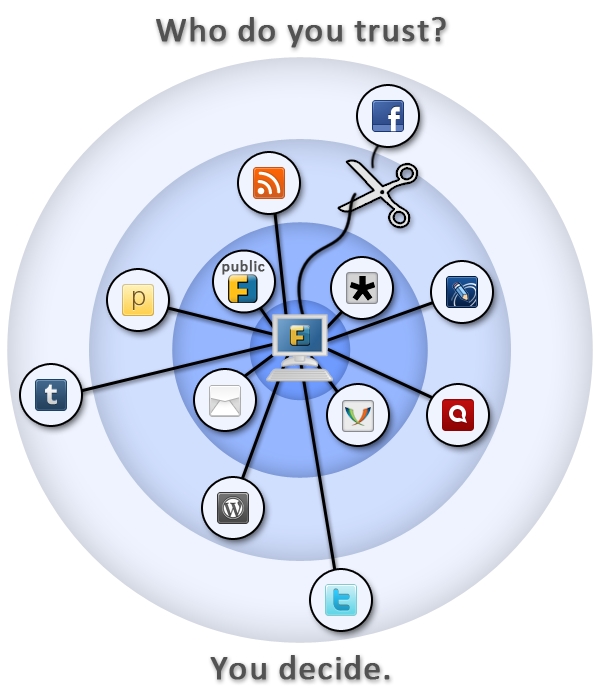
$a->config['twitter']['consumersecret'] = 1DnVkllPik9Ua8jW4fncxwtXZJbs9iFfI5epFzmeI8VxM9pqP1 ; // you Twitter app name $a->config['twitter']['application_name'] = whatever-twitter ; banner_friendica Connect again to Friendica. Go to settings => social networks, you will see the options for Twitter, Pump.io and Diaspora*. Complete the requested information for each of them. Important options you should not forget to check are: Pump.io Twitter Diaspora* Done? Now it s time to send your first broadcasted short message. Yay! Send a short message to your different social networks Connect to Friendica, click on the network page, write your short message in the Share box. Click on the lock lock, you ll see the following setup: friendica-post-default It means your short messages will be broadcasted to the three networks. Or more, it s up to you! That s my setup, feel free to modify. Now close the lock window and send your message. For me it takes some time to appear on Twitter and Diaspora* and it immediatly appears on Identi.ca. Last words friendica-stand Friendica offers to take back the control of your data, by broadcasting content on different media from a single source. While self hosting, you keep your data whatever happends and are not subject to companies losing your data like recently Twitpic. Moreover the philosophy behind Friendica pushed me to dig and test the solution What about you? How do you proceed to broadcast your short messages? Does Friendica offer a good solution in your opinion? Are you interested in the philosophy behind this project? Feel free to share your thoughs in the comments. LAST MINUTE: hey, this article is on Hacker News, don t hesitate to vote for it if you liked it!

30 October 2014

EvolvisForge blog: Tip of the day: bind tomcat7 to loopback i/f only

We already edit /etc/tomcat7/server.xml after installing the tomcat7 Debian package, to get it to talk AJP instead of HTTP (so we can use libapache2-mod-jk to put it behind an Apache 2 httpd, which also terminates SSL): We already comment out the block
    <Connector port="8080" protocol="HTTP/1.1"  
               connectionTimeout="20000"
               URIEncoding="UTF-8"
               redirectPort="8443" />
and remove the comment chars around the line
    <Connector port="8009" protocol="AJP/1.3" redirectPort="8443" />
so all we need to do is edit that line to make it look like
    <Connector address="127.0.0.1" port="8009" protocol="AJP/1.3" redirectPort="8443" />
and we re all set. (Your apache2 vhost needs a line
JkMount /?* ajp13_worker
and everything Just Works with the default configuration.) Now, tomcat7 is only accessible from localhost (Legacy IP), and we don t need to firewall the AJP (or HTTP/8080) port. Do make sure your Apache 2 access configuration works, though

26 October 2014

Gregor Herrmann: RC bugs 2014/38-43

it's this time of the year^Wrelease cycle again almost. in ten days (& roughly two hours), the freeze for the next debian release, codenamed jessie, will start. by this time packages must be in testing in order to be candidates for the release, as explained in the release team's detailed freeze policy. this also means, with the regular testing migration time set to ten days, that tonight's dinstall run closed the regular upload window. & this also means that we should all concentrate on fixing RC bugs to make the freeze as short as possible & jessie yet another great release. before I head over to the UDD bugs page, I'd like to summarize my work on RC bugs in the last weeks, which was again focussed on packages in the Debian Perl Group.

7 October 2014

Andrea Veri: The GNOME Infrastructure is now powered by FreeIPA!

As preannounced here the GNOME Infrastructure switched to a new Account Management System which is reachable at https://account.gnome.org. All the details will follow. Introduction It s been a while since someone actually touched the underlaying authentication infrastructure that powers the GNOME machines. The very first setup was originally configured by Jonathan Blandford (jrb) who configured an OpenLDAP istance with several customized schemas. (pServer fields in the old CVS days, pubAuthorizedKeys and GNOME modules related fields in recent times) While OpenLDAP-server was living on the GNOME machine called clipboard (aka ldap.gnome.org) the clients were configured to synchronize users, groups, passwords through the nslcd daemon. After several years Jeff Schroeder joined the Sysadmin Team and during one cold evening (date is Tue, February 1st 2011) spent some time configuring SSSD to replace the nslcd daemon which was missing one of the most important SSSD features: caching. What surely convinced Jeff to adopt SSSD (a very new but promising sofware at that time as the first release happened right before 2010 s Christmas) and as the commit log also states ( New sssd module for ldap information caching ) was SSSD s caching feature. It was enough for a certain user to log in once and the /var/lib/sss/db directory was populated with its login information preventing the LDAP daemon in charge of picking up login details (from the LDAP server) to query the LDAP server itself every single time a request was made against it. This feature has definitely helped in many occasions especially when the LDAP server was down for a particular reason and sysadmins needed to access a specific machine or service: without SSSD this wasn t ever going to work and sysadmins were probably going to be locked out from the machines they were used to manage. (except if you still had /etc/passwd , /etc/group and /etc/shadow entries as fallback) Things were working just fine except for a few downsides that appeared later on:
  1. the web interface (view) on our LDAP user database was managed by Mango, an outdated tool which many wanted to rewrite in Django that slowly became a huge dinosaur nobody ever wanted to look into again
  2. the Foundation membership information were managed through a MySQL database, so two databases, two sets of users unrelated to each other
  3. users were not able to modify their own account information on their own but even a single e-mail change required them to mail the GNOME Accounts Team which was then going to authenticate their request and finally update the account.
Today s infrastructure changes are here to finally say the issues outlined at (1, 2, 3) are now fixed. What has changed? The GNOME Infrastructure is now powered by Red Hat s FreeIPA which bundles several FOSS softwares into one big bundle all surrounded by an easy and intuitive web UI that will help users update their account information on their own without the need of the Accounts Team or any other administrative entity. Users will also find two custom fields on their Overview page, these being Foundation Member since and Last Renewed on date . As you may have understood already we finally managed to migrate the Foundation membership database into LDAP itself to store the information we want once and for all. As a side note it might be possible that some users that were Foundation members in the past won t find any detail stored on the Foundation fields outlined above. That is actually expected as we were able to migrate all the current and old Foundation members that had an LDAP account registered at the time of the migration. If that s your case and you still would like the information to be stored on the new setup please get in contact with the Membership Committee at stating so. Where can I get my first login credentials? Let s make a little distinction between users that previously had access to Mango (usually maintainers) and users that didn t. If you were used to access Mango before you should be able to login on the new Account Management System by entering your GNOME username and the password you were used to use for loggin in into Mango. (after loggin in the very first time you will be prompted to update your password, please choose a strong password as this account will be unique across all the GNOME Infrastructure) If you never had access to Mango, you lost your password or the first time you read the word Mango on this post you thought why is he talking about a fruit now? you should be able to reset it by using the following command:
ssh -l yourgnomeuserid account.gnome.org
The command will start an SSH connection between you and account.gnome.org, once authenticated (with the SSH key you previously had registered on our Infrastructure) you will trigger a command that will directly send your brand new password on the e-mail registered for your account. From my tests seems GMail sees the e-mail as a phishing attempt probably because the body contains the word password twice. That said if the e-mail won t appear on your INBOX, please double-check your Spam folder. Now that Mango is gone how can I request a new account? With Mango we used to have a form that automatically e-mailed the maintainer of the selected GNOME module which was then going to approve / reject the request. From there and in the case of a positive vote from the maintainer the Accounts Team was going to create the account itself. With the recent introduction of a commit robot directly on l10n.gnome.org the number of account requests reduced its numbers. In addition to that users will now be able to perform pretty much all the needed maintenance on their accounts themselves. That said and while we will probably work on building a form in the future we feel that requesting accounts can definitely be achieved directly by mailing the Accounts Team itself which will mail the maintainer of the respective module and create the account. As just said the number of account creations has become very low and the queue is currently clear. The documentation has been updated to reflect these changes at: https://wiki.gnome.org/AccountsTeam
https://wiki.gnome.org/AccountsTeam/NewAccounts The migration of all the user data and ACLs has been massive and I ve been spending a lot of time reviewing the existing HBAC rules trying to spot possible errors or misconfigurations. If you happen to not being able to access a certain service as you were used to in the past, please get in contact with the Sysadmin Team. All the possible ways to contact us are available at https://wiki.gnome.org/Sysadmin/Contact. What is missing still? Now that the Foundation membership information has been moved to LDAP I ll be looking at porting some of the existing membership scripts to it. What I managed to port already are welcome e-mails for new or existing members. (renewals) Next step will be generating a membership page from LDAP (to populate http://www.gnome.org/foundation/membership) and all the your-membership-is-going-to-lapse e-mails that were being sent till today. Other news /home/users mount on master.gnome.org You will notice that loggin in into master.gnome.org will result in your home directory being empty, don t worry, you did not lose any of your files but master.gnome.org is now currently hosting your home directories itself. As you may have been aware of adding files to the public_html directory on master resulted in them appearing on your people.gnome.org/~userid space. That was unfortunately expected as both master and webapps2 (the machine serving people.gnome.org s webspaces) were mounting the same GlusterFS share. We wanted to prevent that behaviour to happen as we wanted to know who has access to what resource and where. From today master s home directories will be there just as a temporary spot for your tarballs, just scp and use ftpadmin against them, that should be all you need from master. If you are interested in receiving or keeping using your people.gnome.org s webspace please mail stating so. Other news a shiny and new error 500 page has been deployed Thanks to Magdalen Berns (magpie) a new error 500 web page has been deployed on all the Apache istances we host. The page contains an iframe of status.gnome.org and will appear every single time the web server behind the service you are trying to reach will be unreachable for maintenance or other purposes. While I hope you won t see the page that often you can still enjoy it at https://static.gnome.org/error-500/500.html. Make sure to whitelist status.gnome.org on your browser as it currently loads it without https. (as the service is currently hosted on OpenShift which provides us with a *.rhcloud.com wildcard certificate, which differs from the CN the browser would expect it to be)

Next.

Previous.