Search Results: "ah"

24 January 2026

Gunnar Wolf: Finally some light for those who care about Debian on the Raspberry Pi

Finally, some light at the end of the tunnel! As I have said in this blog and elsewhere, after putting quite a bit of work into generating the Debian Raspberry Pi images between late 2018 and 2023, I had to recognize I don t have the time and energy to properly care for it. I even registered a GSoC project for it. I mentored Kurva Prashanth, who did good work on the vmdb2 scripts we use for the image generation but in the end, was unable to push them to be built in Debian infrastructure. Maybe a different approach was needed! While I adopted the images as they were conceived by Michael Stapelberg, sometimes it s easier to start from scratch and build a fresh approach. So, I m not yet pointing at a stable, proven release, but to a good promise. And I hope I m not being pushy by making this public: in the #debian-raspberrypi channel, waldi has shared the images he has created with the Debian Cloud Team s infrastructure. So, right now, the images built so far support Raspberry Pi families 4 and 5 (notably, not the 500 computer I have, due to a missing Device Tree, but I ll try to help figure that bit out Anyway, p400/500/500+ systems are not that usual). Work is underway to get the 3B+ to boot (some hackery is needed, as it only understands MBR partition schemes, so creating a hybrid image seems to be needed). Debian Cloud images for Raspberries Sadly, I don t think the effort will be extended to cover older, 32-bit-only systems (RPi 0, 1 and 2). Anyway, as this effort stabilizes, I will phase out my (stale!) work on raspi.debian.net, and will redirect it to point at the new images.

Comments Andrea Pappacoda tachi@d.o 2026-01-26 17:39:14 GMT+1 Are there any particular caveats compared to using the regular Raspberry Pi OS? Are they documented anywhere? Gunnar Wolf gwolf.blog@gwolf.org 2026-01-26 11:02:29 GMT-6 Well, the Raspberry Pi OS includes quite a bit of software that s not packaged in Debian for various reasons some of it because it s non-free demo-ware, some of it because it s RPiOS-specific configuration, some of it I don t care, I like running Debian wherever possible Andrea Pappacoda tachi@d.o 2026-01-26 18:20:24 GMT+1 Thanks for the reply! Yeah, sorry, I should ve been more specific. I also just care about the Debian part. But: are there any hardware issues or unsupported stuff, like booting from an SSD (which I m currently doing)? Gunnar Wolf gwolf.blog@gwolf.org 2026-01-26 12:16:29 GMT-6 That s beyond my knowledge Although I can tell you that:
  • Raspberry Pi OS has hardware support as soon as their new boards hit the market. The ability to even boot a board can take over a year for the mainline Linux kernel (at least, it has, both in the cases of the 4 and the 5 families).
  • Also, sometimes some bits of hardware are not discovered by the Linux kernels even if the general family boots because they are not declared in the right place of the Device Tree (i.e. the wireless network interface in the 02W is in a different address than in the 3B+, or the 500 does not fully boot while the 5B now does). Usually it is a matter of just declaring stuff in the right place, but it s not a skill many of us have.
  • Also, many RPi hats ship with their own Device Tree overlays, and they cannot always be loaded on top of mainline kernels.
Andrea Pappacoda tachi@d.o 2026-01-26 19:31:55 GMT+1
That s beyond my knowledge Although I can tell you that: Raspberry Pi OS has hardware support as soon as their new boards hit the market. The ability to even boot a board can take over a year for the mainline Linux kernel (at least, it has, both in the cases of the 4 and the 5 families).
Yeah, unfortunately I m aware of that I ve also been trying to boot OpenBSD on my rpi5 out of curiosity, but been blocked by my somewhat unusual setup involving an NVMe SSD as the boot drive :/
Also, sometimes some bits of hardware are not discovered by the Linux kernels even if the general family boots because they are not declared in the right place of the Device Tree (i.e. the wireless network interface in the 02W is in a different address than in the 3B+, or the 500 does not fully boot while the 5B now does). Usually it is a matter of just declaring stuff in the right place, but it s not a skill many of us have.
At some point in my life I had started reading a bit about device trees and stuff, but got distracted by other stuff before I could develop any familiarity with it. So I don t have the skills either :)
Also, many RPi hats ship with their own Device Tree overlays, and they cannot always be loaded on top of mainline kernels.
I m definitely not happy to hear this! Guess I ll have to try, and maybe report back once some page for these new builds materializes.

20 January 2026

Sahil Dhiman: Conferences, why?

Back in December, I was working to help organize multiple different conferences. One has already happened; the rest are still works in progress. That s when the thought struck me: why so many conferences, and why do I work for them? I have been fairly active in the scene since 2020. For most conferences, I usually arrive late in the city on the previous day and usually leave the city on conference close day. Conferences for me are the place to meet friends and new folks and hear about them, their work, new developments, and what s happening in their interest zones. I feel naturally happy talking to folks. In this case, people inspire me to work. Nothing can replace a passionate technical and social discussion, which stretches way into dinner parties and later. For most conference discussions now, I just show up without a set role (DebConf is probably an exception to it). It usually involves talking to folks, suggesting what needs to be done, doing a bit of it myself, and finishing some last-minute stuff during the actual thing. Having more of these conferences and helping make them happen naturally gives everyone more places to come together, meet, talk, and work on something. No doubt, one reason for all these conferences is evangelism for, let s say Free Software, OpenStreetMap, Debian etc. which is good and needed for the pipeline. But for me, the primary reason would always be meeting folks.

19 January 2026

Francesco Paolo Lovergine: A Terramaster NAS with Debian, take two.

After experimenting at home, the very first professional-grade NAS from Terramaster arrived at work, too, with 12 HDD bays and possibly a pair of M2s. NVME cards. In this case, I again installed a plain Debian distribution, but HDD monitoring required some configuration adjustments to run smartd properly.A decent approach to data safety is to run regularly scheduled short and long SMART tests on all disks to detect potential damage. Running such tests on all disks at once isn't ideal, so I set up a script to create a staggered configuration and test multiple groups of disks at different times. Note that it is mandatory to read the devices at each reboot because their names and order can change.Of course, the same principle (short/long test at regular intervals along the week) should be applied for a simpler configuration, as in the case of my home NAS with a pair of RAID1 devices.What follows is a simple script to create a staggered smartd.conf at boot time:
#!/bin/bash
#
# Save this as /usr/local/bin/create-smartd-conf.sh
#
# Dynamically generate smartd.conf with staggered SMART test scheduling
# at boot time based on discovered ATA devices
# HERE IS A LIST OF DIRECTIVES FOR THIS CONFIGURATION FILE.
# PLEASE SEE THE smartd.conf MAN PAGE FOR DETAILS
#
#   -d TYPE Set the device type: ata, scsi[+TYPE], nvme[,NSID],
#           sat[,auto][,N][+TYPE], usbcypress[,X], usbjmicron[,p][,x][,N],
#           usbprolific, usbsunplus, sntasmedia, sntjmicron[,NSID], sntrealtek,
#           ... (platform specific)
#   -T TYPE Set the tolerance to one of: normal, permissive
#   -o VAL  Enable/disable automatic offline tests (on/off)
#   -S VAL  Enable/disable attribute autosave (on/off)
#   -n MODE No check if: never, sleep[,N][,q], standby[,N][,q], idle[,N][,q]
#   -H      Monitor SMART Health Status, report if failed
#   -s REG  Do Self-Test at time(s) given by regular expression REG
#   -l TYPE Monitor SMART log or self-test status:
#           error, selftest, xerror, offlinests[,ns], selfteststs[,ns]
#   -l scterc,R,W  Set SCT Error Recovery Control
#   -e      Change device setting: aam,[N off], apm,[N off], dsn,[on off],
#           lookahead,[on off], security-freeze, standby,[N off], wcache,[on off]
#   -f      Monitor 'Usage' Attributes, report failures
#   -m ADD  Send email warning to address ADD
#   -M TYPE Modify email warning behavior (see man page)
#   -p      Report changes in 'Prefailure' Attributes
#   -u      Report changes in 'Usage' Attributes
#   -t      Equivalent to -p and -u Directives
#   -r ID   Also report Raw values of Attribute ID with -p, -u or -t
#   -R ID   Track changes in Attribute ID Raw value with -p, -u or -t
#   -i ID   Ignore Attribute ID for -f Directive
#   -I ID   Ignore Attribute ID for -p, -u or -t Directive
#   -C ID[+] Monitor [increases of] Current Pending Sectors in Attribute ID
#   -U ID[+] Monitor [increases of] Offline Uncorrectable Sectors in Attribute ID
#   -W D,I,C Monitor Temperature D)ifference, I)nformal limit, C)ritical limit
#   -v N,ST Modifies labeling of Attribute N (see man page)
#   -P TYPE Drive-specific presets: use, ignore, show, showall
#   -a      Default: -H -f -t -l error -l selftest -l selfteststs -C 197 -U 198
#   -F TYPE Use firmware bug workaround:
#           none, nologdir, samsung, samsung2, samsung3, xerrorlba
#   -c i=N  Set interval between disk checks to N seconds
#    #      Comment: text after a hash sign is ignored
#    \      Line continuation character
# Attribute ID is a decimal integer 1 <= ID <= 255
# except for -C and -U, where ID = 0 turns them off.
set -euo pipefail
# Test schedule configuration
BASE_SCHEDULE="L/../../6"  # Long test on Saturdays
TEST_HOURS=(01 03 05 07)   # 4 time slots: 1am, 3am, 5am, 7am
DEVICES_PER_GROUP=3
main()  
    # Get array of device names (e.g., sda, sdb, sdc)
    mapfile -t devices < <(ls -l /dev/disk/by-id/   grep ata   awk ' print $11 '   grep sd   cut -d/ -f3   sort -u)
    if [[ $ #devices[@]  -eq 0 ]]; then
        exit 1
    fi
    # Start building config file
    cat << EOF
# smartd.conf - Auto-generated at boot
# Generated: $(date '+%Y-%m-%d %H:%M:%S')
#
# Staggered SMART test scheduling to avoid concurrent disk load
# Long tests run on Saturdays at different times per group
#
EOF
    # Process devices into groups
    local group=0
    local count_in_group=0
    for i in "$ !devices[@] "; do
        local dev="$ devices[$i] "
        local hour="$ TEST_HOURS[$group] "
        # Add group header at start of each group
        if [[ $count_in_group -eq 0 ]]; then
            echo ""
            echo "# Group $((group + 1)) - Tests at $ hour :00 on Saturdays"
        fi
        # Add device entry
        #echo "/dev/$ dev  -a -o on -S on -s ($ BASE_SCHEDULE /$ hour ) -m root"
        echo "/dev/$ dev  -a -o on -S on -s (L/../../6/$ hour ) -s (S/../.././$(((hour + 12) % 24))) -m root"
        # Move to next group when current group is full
        count_in_group=$((count_in_group + 1))
        if [[ $count_in_group -ge $DEVICES_PER_GROUP ]]; then
            count_in_group=0
            group=$(((group + 1) % $ #TEST_HOURS[@] ))
        fi
    done
 
main "$@"
To run such a script at boot, add a unit file to the systemd configuration.
sudo systemctl  edit --full /etc/systemd/system/regenerate-smartd-conf.service
sudo systemctl enable regenerate-smartd-conf.service
Where the unit service is the following:
[Unit]
Description=Generate smartd.conf with staggered SMART test scheduling
# Wait for all local filesystems and udev device detection
After=local-fs.target systemd-udev-settle.service
Before=smartd.service
Wants=systemd-udev-settle.service
DefaultDependencies=no
[Service]
Type=oneshot
# Only generate the config file, don't touch smartd here
ExecStart=/bin/bash -c '/usr/local/bin/create-smartd-config.sh > /etc/smartd.conf'
StandardOutput=journal
StandardError=journal
RemainAfterExit=yes
[Install]
WantedBy=multi-user.target

17 January 2026

Ravi Dwivedi: My experiences in Brunei

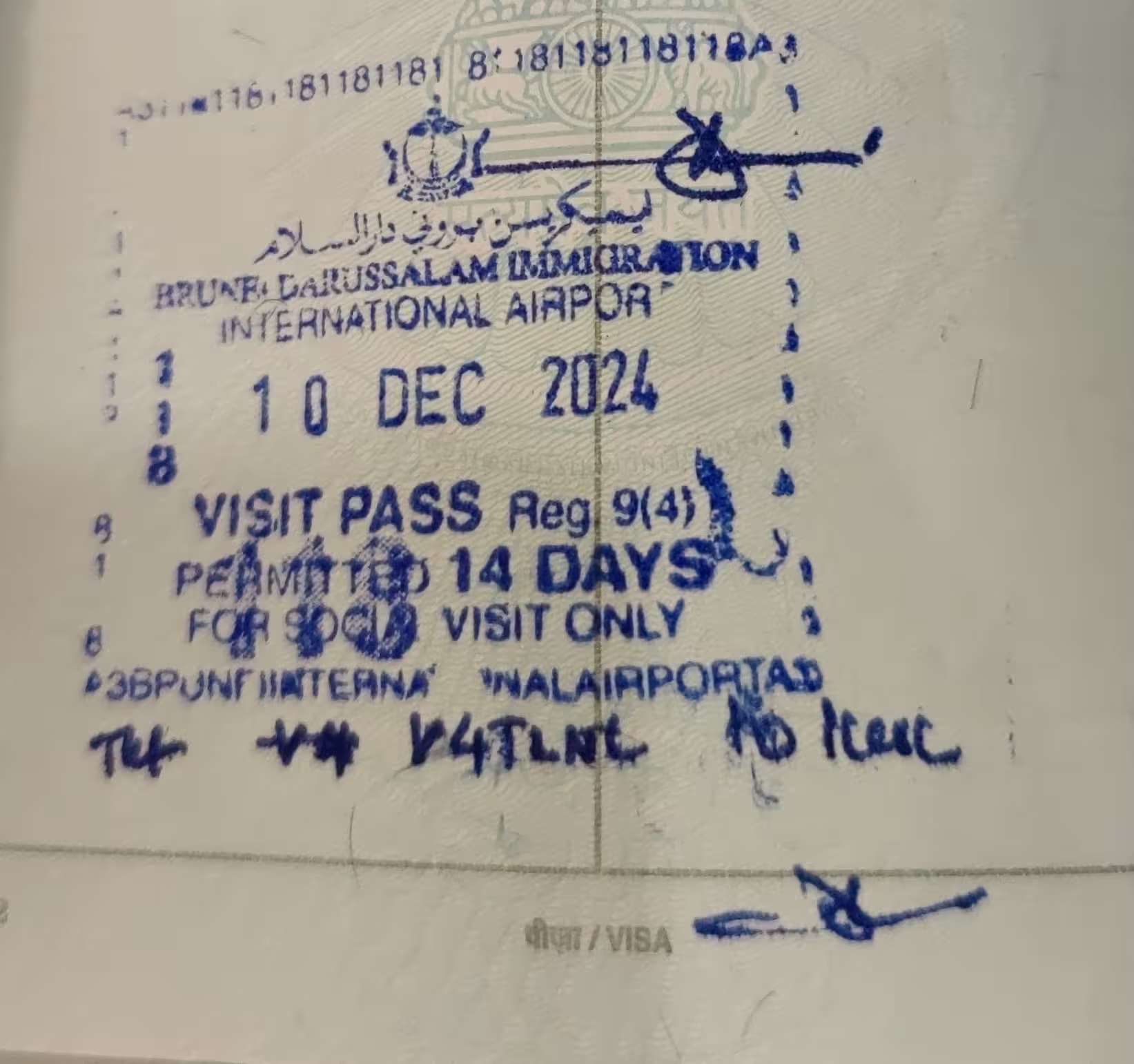
This post covers my friend Badri and my experiences in Brunei. Brunei officially Brunei Darussalam is a country in Southeast Asia, located on Borneo island. It is one of the few remaining absolute monarchies on Earth. On the morning of the 10th of December 2024, Badri and I reached Brunei International Airport by taking a flight from Kuala Lumpur. Upon arrival at the airport, we had to go through the immigration, of course. However, I forgot to fill my arrival card, which I filled while I was in the queue for my immigration. The immigration officer asked me how much cash I was carrying of each currency. After completing the formalities, the immigration officer stamped my passport and let me in. Take a look at Brunei s entry stamp in my passport.
Brunei entry stamp Brunei entry stamp on my passport. Picture by Ravi Dwivedi, released under CC-BY-SA 4.0.
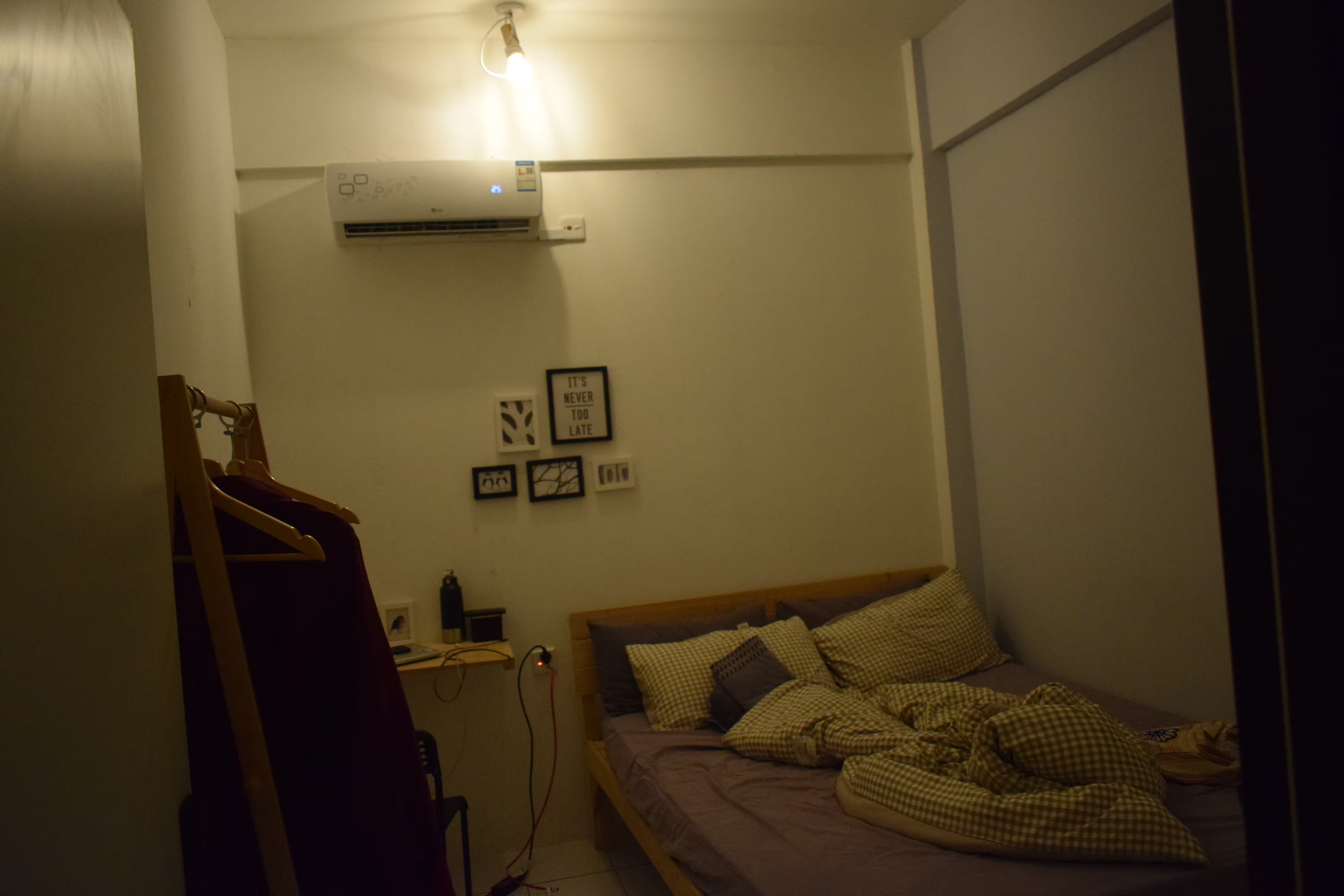
We exchanged Singapore dollars to get some Brunei dollars at the airport. The Brunei dollar was pegged 1:1 with the Singapore dollar, meaning 1 Singapore dollar equals 1 Brunei dollar. The exchange rate we received at the airport was the same. Our (pre-booked) accommodation was located near Gadong mall. So, we went to the information center at the airport to ask how to get there by public transport. However, the person at the information center told us that they didn t know the public transport routes and suggested we take a taxi instead. We came out of the airport and came across an Indian with a mini bus. He offered to drop us at our accommodation for 10 Brunei dollars ( 630). As we were tired after a sleepless night, we didn t negotiate and took the offer. It felt a bit weird using the minibus as our private taxi. In around half-an-hour, we reach our accommodation. The place was more like a guest house than a hotel. In addition to the rooms, it had common space consisting of a hall, a kitchen and a balcony.
Our room in Brunei Our room in Brunei. Picture by Ravi Dwivedi, released under CC-BY-SA 4.0
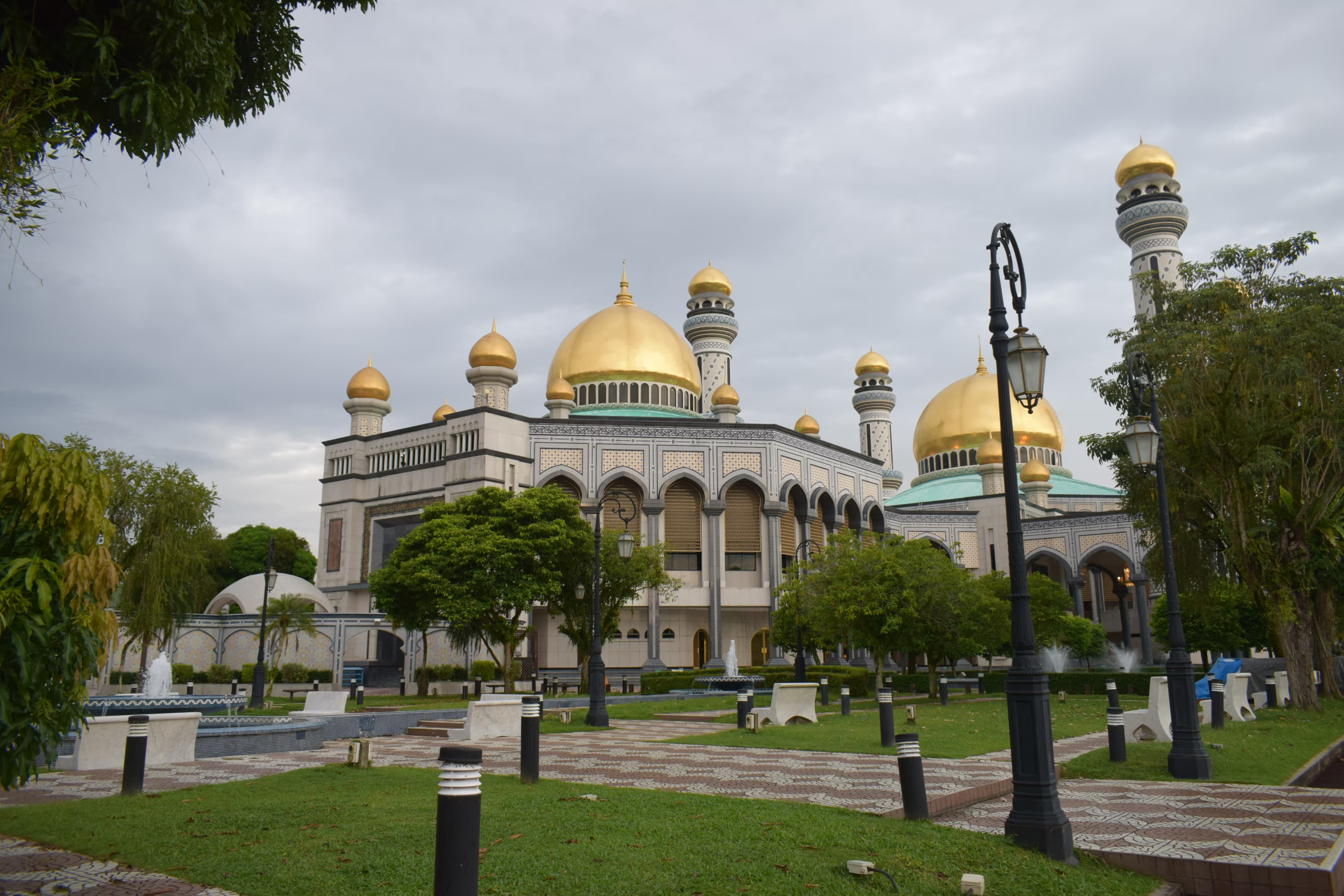
Upon reaching the place, we paid for our room in cash, which was 66.70 Singapore dollars (4200 Indian rupees) for two nights. We reached before the check-in time, so we had to wait for our room to get ready before we entered. The room had a double bed and also a place to hang clothes. We slept for a few hours before going out at night. We went into Gadong mall and had coffee at a caf named The Coffee Bean & Tea Leaf. The regular caffe latte I had here been 5.20 Brunei dollars. On another note, the snacks we got us from Kuala Lumpur covered us for the dinner. The next day 11th of December 2024 we went to a nearby restaurant named Nadj for lunch. The owner was from Kerala. Here we ordered: So, our lunch cost a total of 12.80 Brunei dollars (825 rupees). The naan was unusually thick, and didn t like the taste. After the lunch, we planned to visit Brunei s famous Omar Ali Saifuddien Mosque. However, a minibus driver outside of Gadong Mall told us that the mosque would be closed in half-an-hour and suggested we visit the nearby Jame Asr Hassanil Bolkiah Mosque instead.
Jame' Asr Hassanil Bolkiah Mosque Jame Asr Hassanil Bolkiah Mosque. Picture by Ravi Dwivedi, released under CC-BY-SA 4.0
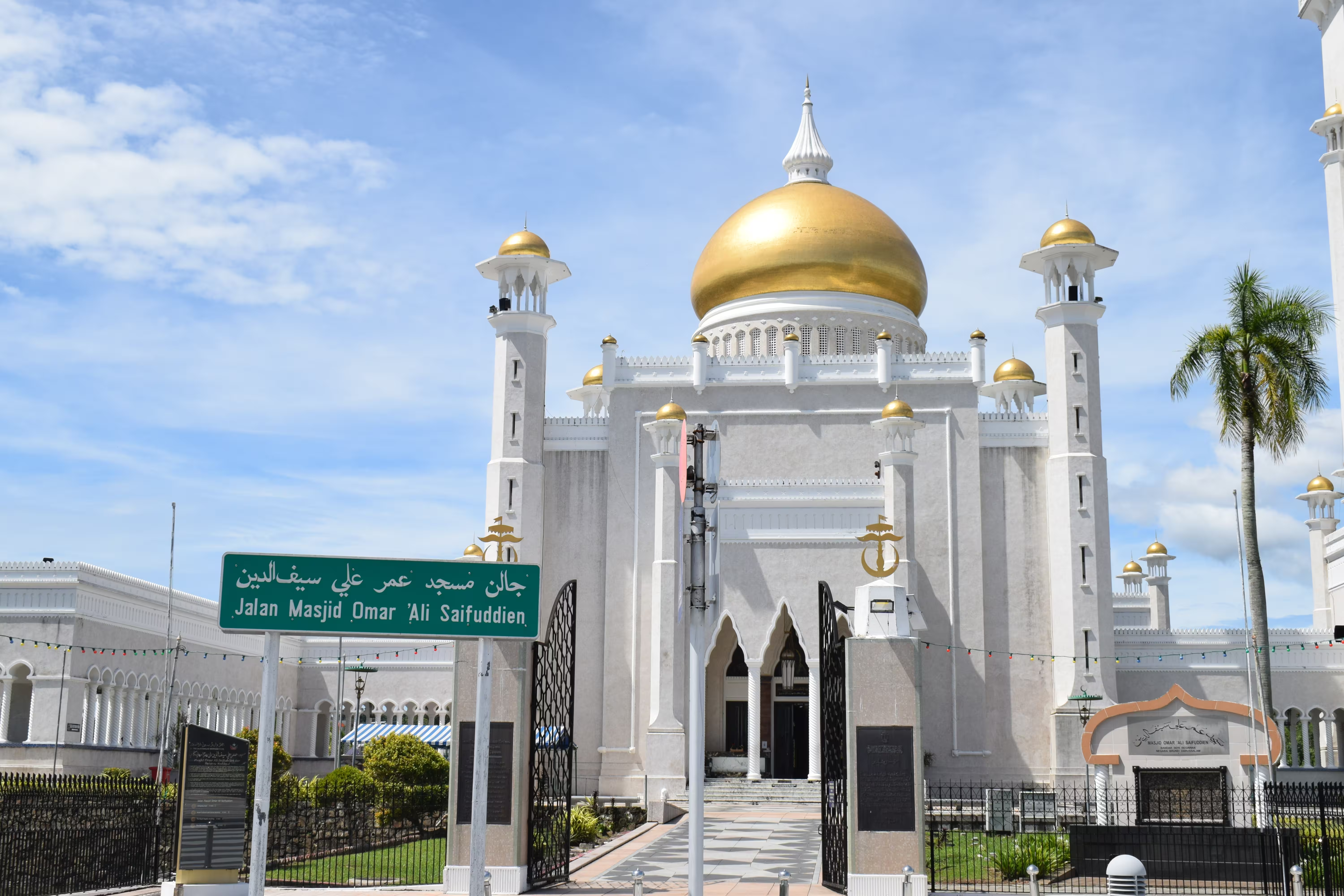
He dropped us there for 1 Brunei dollar per person. The person hailed from Uttar Pradesh and told us about bus routes in Hindi. Buses routes in Brunei were confusing, so the information he gave us was valuable. It was evening, and we had an impression that the mosque and its premises were closed. However, soon enough, we stumbled across an open gate entering the mosque complex. We walked inside for some time, took pictures and exited. Walking in Bandar Seri Begawan wasn t pleasant, though. The pedestrian infrastructure wasn t good. Then we walked back to our place and bought some souvenirs. For dinner and breakfast, we bought bread, fruits and eggs from local shops as we had a kitchen to cook for ourselves. The guest house also had a washing machine (free of charge) which we wanted to use. However, they didn t have detergent. Therefore, we went outside to get some detergent. It was 8 o clock, and most of the shops were closed already. Others had had detergents in large sizes, the ones you would use if you lived there. We ended up getting a small packet at a supermarket. The next day 12th of December we had a flight to Ho Chi Minh City in Vietnam with a long layover in Kuala Lumpur. We had breakfast in the morning and took a bus to Omar Ali Saifuddien Mosque. The mosque was in prayer session, so it was closed for Muslims. Therefore, we just took pictures from the outside and took a bus for the airport.
Omar Ali Saifuddien Mosque Omar Ali Saifuddien Mosque. Picture by Ravi Dwivedi, released under CC-BY-SA 4.0
When the bus reached near the airport, the bus went straight rather than taking a left turn for the airport. Initially, I thought the bus would just take a turn and come back. However, the bus kept going away from the airport. Confused by this, I asked other passengers if the bus was going to the airport. The driver stopped the bus at Muara Town terminal 20 km from the airport. At this point, everyone alighted, except for us. The driver went to a nearby restaurant to have lunch. I felt very uncomfortable stranded in a town which was 20 km from the airport. We had a lot of time, but I was still worried about missing our flight, as I didn t want to get stuck in Brunei. After waiting for 15 minutes, I went inside the restaurant and reminded the driver that we had a flight in a couple of hours and needed to go to the airport. He said he will leave soon. When he was done with his lunch, he drove us to the airport. It was incredibly frustrating. On a positive note, we saw countryside of Brunei that we would have seen otherwise. The bus ride cost us 1 Brunei dollar each.
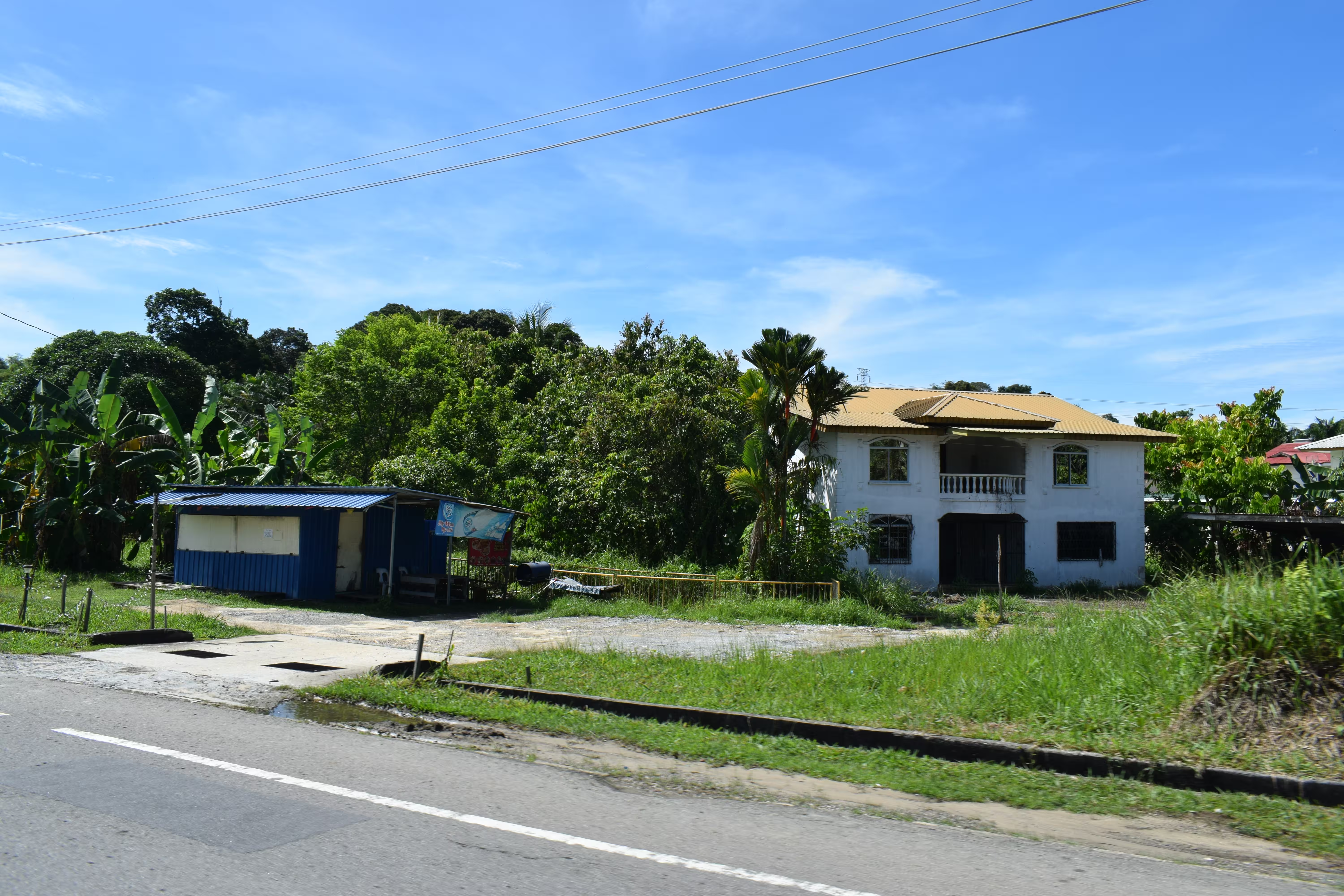
A couple of houses with trees in the background. A shot of Brunei s countryside. Picture by Ravi Dwivedi, released under CC-BY-SA 4.0.
That s it for this one. Meet you in the next one. Stay tuned for the Vietnam post!

16 January 2026

Freexian Collaborators: Monthly report about Debian Long Term Support, December 2025 (by Santiago Ruano Rinc n)

The Debian LTS Team, funded by [Freexian s Debian LTS offering] (https://www.freexian.com/lts/debian/), is pleased to report its activities for December.

Activity summary During the month of December, 18 contributors have been paid to work on Debian LTS (links to individual contributor reports are located below). The team released 41 DLAs fixing 252 CVEs. The team currently focuses on preparing security updates for Debian 11 bullseye , but also looks for contributing with updates for Debian 12 bookworm , Debian 13 trixie and even Debian unstable. Notable security updates:
  • libsoup2.4 (DLA-4398-1), prepared by Andreas Henrikson, fixing several vulnerabilities.
  • glib2.0 (DLA-4412-1), published by Emilio Pozuelo Monfort, addressing multiple issues.
  • lasso (DLA-4397-1), prepared by Sylvain Beucler, addressing multiple issues, including a critical remote code execution (RCE) vulnerability (CVE-2025-47151)
  • roundcube (DLA 4415-1), prepared by Guilhem Moulin, fixing a cross-site-scripting (XSS) (CVE-2025-68461) and an information disclosure (CVE-2025-68460) vulnerabilities
  • mediawiki (DLA 4428-1), published by Guilhem, fixing multiple vulnerabilities could lead to information disclosure, denial of service or privilege escalation.
  • While the DLA has not been published yet, Charles Henrique Melara proposed upstream fixes for seven CVEs in ffmpeg: https://code.ffmpeg.org/FFmpeg/FFmpeg/pulls/21275.
  • python-apt (DLA 4408-1), prepared by Utkarsh Gupta, in coordination with the Debian Security Team and Julian Andres Klode, the apt s maintainer.
  • libpng1.6 (DLA-4396-1), published by Tobias Frost, completing the work started the previous month.
Notable non-security updates:
  • tzdata (DLA-4403-1), prepared by Emilio, including the latest changes to the leap second list and its expiry date, which was set for the end of December.
Contributions from outside the LTS Team:
  • Christoph Berg, co-maintainer of PostgreSQL in Debian, prepared a postgresql-13 update, released as DLA-4420-1
The LTS Team has also contributed with updates to the latest Debian releases:

Individual Debian LTS contributor reports

Thanks to our sponsors Sponsors that joined recently are in bold.

13 January 2026

Aigars Mahinovs: Sedan experience (BMW i5)

Two years of midsize electric sedan experience This February (2026) marks a full 10 years since I started working for BMW, and a key employment bonus is the ability to drive a company car on special two-year leasing terms. Just before the new year 2026 started, I said goodbye to my latest company car. After driving the BMW i4, I switched to the BMW i5. In terms of power, it was a downgrade as I switched from the maximum power i4 M50 xDrive (all-wheel drive, 600 hp) to the i5 eDrive40 (rear-wheel drive, 340 hp). Did I regret that? Not for a single second! After driving 60,000 km in the last two years with the BMW i5, I was really sad to let it go -- it was the best car I have ever driven. Simple as that. Read more (16 min remaining to read)

12 January 2026

Daniel Lange: Resizing Xterm fonts with Ctrl+ and Ctrl+

Xterm misses the convenient option to resize the fonts with Ctrl+<plus> and Ctrl+<minus> like xfce4-terminal or gnome-terminal do out of the box. This feature can be added on Debian systems by dropping a configuration snippet into /etc/X11/Xresources/x11-xterm-fontsize:
! Allow XTerm font size to be changed with Ctrl+<plus> and <minus>
XTerm.vt100.translations: #override \n\
Ctrl <Key> minus: smaller-vt-font() \n\
Ctrl <Key> plus: larger-vt-font()
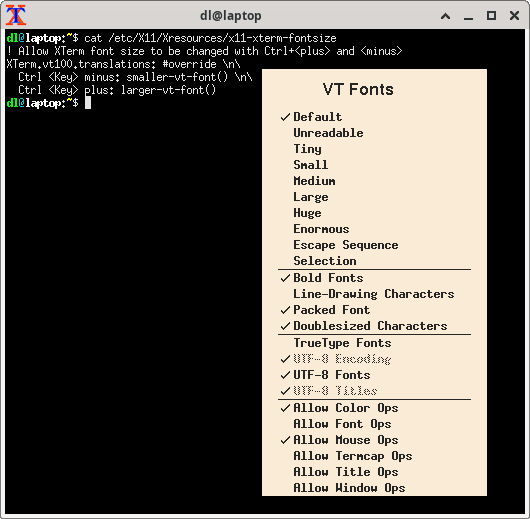
Any new X session will inherit this configuration and Ctrl+<plus> and Ctrl+<minus> will work to adjust the font size (and taking the window size along). The font sizes that Xterm iterates through can be viewed on the Ctrl-<right click> context menu: Screenshot of an Xterm window with the context menu displayed NB: The context menu allows to switch the fonts on systems where the above snippet has not (yet) been installed. So good enough for a one-off. Credits: Stack Overflow/Ask Ubuntu, Matthew Hoener.

Daniel Kahn Gillmor: AI as a Compression Problem

A recent article in The Atlantic makes the case that very large language models effectively contain much of the works they're trained on. This article is an attempt to popularize the insights in the recent academic paper Extracting books from production language models from Ahmed et al. The authors of the paper demonstrate convincingly that well-known copyrighted textual material can be extracted from the chatbot interfaces of popular commercial LLM services. The Atlantic article cites a podcast quote about the Stable Diffusion AI image-generator model, saying "We took 100,000 gigabytes of images and compressed it to a two-gigabyte file that can re-create any of those and iterations of those". By analogy, this suggests we might think of LLMs (which work on text, not the images handled by Stable Diffusion) as a form of lossy textual compression. The entire text of Moby Dick, the canonical Big American Novel is merely 1.2MiB uncompressed (and less than 0.4MiB losslessly compressed with bzip2 -9). It's not surprising to imagine that a model with hundreds of billions of parameters might contain copies of these works. Warning: The next paragraph contains fuzzy math with no real concrete engineering practice behind it! Consider a hypothetical model with 100 billion parameters, where each parameter is stored as a 16-bit floating point value. The model weights would take 200 GB of storage. If you were to fill the parameter space only with losslessly compressed copies of books like Moby Dick, you could still fit half a million books, more than anyone can read in a lifetime. And lossy compression is typically orders of magnitude less in size than lossless compression, so we're talking about millions of works effectively encoded, with the acceptance of some artifacts being injected in the output. I first encountered this "compression" view of AI nearly three years ago, in Ted Chiang's insightful ChatGPT is a Blurry JPEG of the Web. I was suprised that The Atlantic article didn't cite Chiang's piece. If you haven't read Ted Chiang, i strongly recommend his work, and this piece is a great place to start. Chiang aside, the more recent writing that focuses on the idea of compressed works being "contained" in the model weights seems to be used by people interested in wielding some sort of copyright claims against the AI companies that maintain or provide access to these models. There are many many problems with AI today, but attacking AI companies based on copyright concerns seems similar to going after Al Capone for tax evasion. We should be much more concerned with the effect these projects have on cultural homogeneity, mental health, labor rights, privacy, and social control than whether they're violating copyright in some specific instance.

10 January 2026

Matthias Geiger: Building a propagation box for oyster mushrooms

Inspiration In November I watched a short documentary about a guy who grew pearl oyster mushrooms in his backyard. They used pallet boxes (half of a europallet, 60x80x20 cm) as box to keep the substrate the mycelium feeds on in. Since I really enjoy (foraged) mushrooms and had the raw materials lying around, I opted to build it myself. This also had the benefit of using what was available and not just consuming, i.e. buying a pallet box. Preparing the raw materials I had 4.5 m x ~ 25 cm wooden spruce planks at home. My plan was to cut those into 2 m segments, then trim the edges down to 20 cm and then cut them into handy pieces, following the dimension of half a pallet box. This is what they looked after cutting them with an electric chainsaw to around 2 m: raw_planks You can see that the edges are still not straight, because that's how they came out of the sawmill. Once that was done I visited a family member that had a crosscut saw, a table saw and a band saw; all that I would need. First we trimmed the edges of the 2m planks with the table saw so they were somewhat straight; then they were flipped and the other edge was cut straight, and their width cut down to 20 cm. After moving them over to the crosscut saw dividing them into two 60 cm and one 80 cm was fairly easy. When cutting the 2m planks from the 4m ones I calculated with extra offcuts, so I got little waste overall and could use the whole length to get my desired board. This is what the cut pieces looked like: cut_planks Assembly I packed up my planks, now nicely cut to size, and I went to a hardware shop and bought hinges and screws. Assembly was fairly easy and fast: screw a hinge to a corner, hold the other plank onto the hinge so that the corners of both boards touch, and affix the hinge. plank_with_hinge corner_with_hinge When this was done, the frame looked like this: finished_frame As last step I drilled 10mm holes more or less random in the middle of the box. This is where the mushrooms will grow out of later and can be harvested. box_with_holes Closing thoughts This was a fun project I finished in a day. The hinges have the benefit that they allow the box to be folded up lenght-wise: folded This allows for convenient storage. Since it's too cold outside right now, cultivation will have to wait until spring. This also just needs mycelium one can just buy, and some material fungus digests. They can also be fed coffee grounds, and harvest of the fruit body is possible circa every two weeks.

5 January 2026

Jonathan McDowell: Free Software Activities for 2025

Given we ve entered a new year it s time for my annual recap of my Free Software activities for the previous calendar year. For previous years see 2019, 2020, 2021, 2022, 2023 + 2024.

Conferences My first conference of the year was FOSDEM. I d submitted a talk proposal about system attestation in production environments for the attestation devroom, but they had a lot of good submissions and mine was a bit more this is how we do it rather than here s some neat Free Software that does it . I m still trying to work out how to make some of the bits we do more open, but the problem is a lot of the neat stuff is about taking internal knowledge about what should be running and making sure that s the case, and what you end up with if you abstract that is a toolkit that still needs a lot of work to get something useful. I d more luck at DebConf25 where I gave a talk (Don t fear the TPM) trying to explain how TPMs could be useful in a Debian context. Naturally the comments section descended into a discussion about UEFI Secure Boot, which is a separate, if related, thing. DebConf also featured the usual catch up with fellow team members, hanging out with folk I hadn t seen in ages, and generally feeling a bit more invigorated about Debian. Other conferences I considered, but couldn t justify, were All Systems Go! and the Linux Plumbers Conference. I ve no doubt both would have had a bunch of interesting and relevant talks + discussions, but not enough this year. I m going to have to miss FOSDEM this year, due to travel later in the month, and I m uncertain if I m going to make DebConf (for a variety of reasons). That means I don t have a Free Software conference planned for 2026. Ironically FOSSY moving away from Portland makes it a less appealing option (I have Portland friends it would be good to visit). Other than potential Debian MiniConfs, anything else European I should consider?

Debian I continue to try and keep RetroArch in shape, with 1.22.2+dfsg-1 (and, shortly after, 1.22.2+dfsg-2 - git-buildpackage in trixie seems more strict about Build-Depends existing in the outside environment, and I keep forgetting I need Build-Depends-Arch and Build-Depends-Indep to be pretty much the same with a minimal Build-Depends that just has enough for the clean target) getting uploaded in December, and 1.20.0+dfsg-1, 1.20+dfsg-2 + 1.20+dfsg-3 all being uploaded earlier in the year. retroarch-assets had 1.20.0+dfsg-1 uploaded back in April. I need to find some time to get 1.22.0 packaged. libretro-snes9x got updated to 1.63+dfsg-1. sdcc saw 4.5.0+dfsg-1, 4.5.0+dfsg-2, 4.5.0+dfsg-3 (I love major GCC upgrades) and 4.5.0-dfsg-4 uploads. There s an outstanding bug around a LaTeX error building the manual, but this turns out to be a bug in the 2.5 RC for LyX. Huge credit to Tobias Quathamer for engaging with this, and Pavel Sanda + J rgen Spitzm ller from the LyX upstream for figuring out the issue + a fix. Pulseview saw 0.4.2-4 uploaded to fix issues with the GCC 15 + CMake upgrades. I should probably chase the sigrok upstream about new releases; I think there are a bunch of devices that have gained support in git without seeing a tagged release yet. I did an Electronics Team upload for gputils 1.5.2-2 to fix compilation with GCC 15. While I don t do a lot with storage devices these days if I can help it I still pay a little bit of attention to sg3-utils. That resulted in 1.48-2 and 1.48-3 uploads in 2025. libcli got a 1.10.7-3 upload to deal with the libcrypt-dev split out. Finally I got more up-to-date versions of libtorrent (0.15.7-1) and rtorrent (also 0.15.7-1) uploaded to experimental. There s a ppc64el build failure in libtorrent, but having asked on debian-powerpc this looks like a flaky test/code and I should probably go ahead and upload to unstable. I sponsored some uploads for Michel Lind - the initial uploads of plymouth-theme-hot-dog, and the separated out pykdumpfile package. Recognising the fact I wasn t contributing in a useful fashion to the Data Protection Team I set about trying to resign in an orderly fashion - see Andreas call for volunteers that went out in the last week. Shout out to Enrico for pointing out in the past that we should gracefully step down from things we re not actually managing to do, to avoid the perception it s all fine and no one else needs to step up. Took me too long to act on it. The Debian keyring team continues to operate smoothly, maintaining our monthly release cadence with a 3 month rotation ensuring all team members stay familiar with the process, and ensure their setups are still operational (especially important after Debian releases). I handled the 2025.03.23, 2025.06.24, 2025.06.27, 2025.09.18, 2025.12.08 + 2025.12.26 pushes.

Linux TPM related fixes were the theme of my kernel contributions in 2025, all within a work context. Some were just cleanups, but several fixed real issues that were causing us issues. I ve also tried to be more proactive about reviewing diffs in the TPM subsystem; it feels like a useful way to contribute, as well as making me more actively pay attention to what s going on there.

Personal projects I did some work on onak, my OpenPGP keyserver. That resulted in a 0.6.4 release, mainly driven by fixes for building with more recent CMake + GCC versions in Debian. I ve got a set of changes that should add RFC9580 (v6) support, but there s not a lot of test keys out there at present for making sure I m handling things properly. Equally there s a plan to remove Berkeley DB from Debian, which I m completely down with, but that means I need a new primary backend. I ve got a draft of LMDB support to replace that, but I need to go back and confirm I ve got all the important bits implemented before publishing it and committing to a DB layout. I d also like to add sqlite support as an option, but that needs some thought about trying to take proper advantage of its features, rather than just treating it as a key-value store. (I know everyone likes to hate on OpenPGP these days, but I continue to be interested by the whole web-of-trust piece of it, which nothing else I m aware of offers.) That about wraps up 2025. Nothing particularly earth shaking in there, more a case of continuing to tread water on the various things I m involved. I highly doubt 2026 will be much different, but I think that s ok. I scratch my own itches, and if that helps out other folk too then that s lovely, but not the primary goal.

4 January 2026

Sahil Dhiman: Full /8 IPv4 Address Block Holders in 2025

Here, I tried to collect entities that owned full /8 IPv4 address block(s) in 2025. A more comprehensive and historical list can be found at https://en.wikipedia.org/wiki/List_of_assigned_/8_IPv4_address_blocks.

Some notable mentions: Note - HE s list mentions addresses originated (not just owned). Providers also advertise prefixes owned by their customers in Bring Your Own IP (BYOIP) setups. The number of address space owned by entity would mostly be more than their customer owned space (originated by the entity).
  • There s also 126.0.0.0/8 which is mostly Softbank.

Matthew Garrett: What is a PC compatible?

Wikipedia says An IBM PC compatible is any personal computer that is hardware- and software-compatible with the IBM Personal Computer (IBM PC) and its subsequent models . But what does this actually mean? The obvious literal interpretation is for a device to be PC compatible, all software originally written for the IBM 5150 must run on it. Is this a reasonable definition? Is it one that any modern hardware can meet? Before we dig into that, let s go back to the early days of the x86 industry. IBM had launched the PC built almost entirely around off-the-shelf Intel components, and shipped full schematics in the IBM PC Technical Reference Manual. Anyone could buy the same parts from Intel and build a compatible board. They d still need an operating system, but Microsoft was happy to sell MS-DOS to anyone who d turn up with money. The only thing stopping people from cloning the entire board was the BIOS, the component that sat between the raw hardware and much of the software running on it. The concept of a BIOS originated in CP/M, an operating system originally written in the 70s for systems based on the Intel 8080. At that point in time there was no meaningful standardisation - systems might use the same CPU but otherwise have entirely different hardware, and any software that made assumptions about the underlying hardware wouldn t run elsewhere. CP/M s BIOS was effectively an abstraction layer, a set of code that could be modified to suit the specific underlying hardware without needing to modify the rest of the OS. As long as applications only called BIOS functions, they didn t need to care about the underlying hardware and would run on all systems that had a working CP/M port. By 1979, boards based on the 8086, Intel s successor to the 8080, were hitting the market. The 8086 wasn t machine code compatible with the 8080, but 8080 assembly code could be assembled to 8086 instructions to simplify porting old code. Despite this, the 8086 version of CP/M was taking some time to appear, and a company called Seattle Computer Products started producing a new OS closely modelled on CP/M and using the same BIOS abstraction layer concept. When IBM started looking for an OS for their upcoming 8088 (an 8086 with an 8-bit data bus rather than a 16-bit one) based PC, a complicated chain of events resulted in Microsoft paying a one-off fee to Seattle Computer Products, porting their OS to IBM s hardware, and the rest is history. But one key part of this was that despite what was now MS-DOS existing only to support IBM s hardware, the BIOS abstraction remained, and the BIOS was owned by the hardware vendor - in this case, IBM. One key difference, though, was that while CP/M systems typically included the BIOS on boot media, IBM integrated it into ROM. This meant that MS-DOS floppies didn t include all the code needed to run on a PC - you needed IBM s BIOS. To begin with this wasn t obviously a problem in the US market since, in a way that seems extremely odd from where we are now in history, it wasn t clear that machine code was actually copyrightable. In 1982 Williams v. Artic determined that it could be even if fixed in ROM - this ended up having broader industry impact in Apple v. Franklin and it became clear that clone machines making use of the original vendor s ROM code wasn t going to fly. Anyone wanting to make hardware compatible with the PC was going to have to find another way. And here s where things diverge somewhat. Compaq famously performed clean-room reverse engineering of the IBM BIOS to produce a functionally equivalent implementation without violating copyright. Other vendors, well, were less fastidious - they came up with BIOS implementations that either implemented a subset of IBM s functionality, or didn t implement all the same behavioural quirks, and compatibility was restricted. In this era several vendors shipped customised versions of MS-DOS that supported different hardware (which you d think wouldn t be necessary given that s what the BIOS was for, but still), and the set of PC software that would run on their hardware varied wildly. This was the era where vendors even shipped systems based on the Intel 80186, an improved 8086 that was both faster than the 8086 at the same clock speed and was also available at higher clock speeds. Clone vendors saw an opportunity to ship hardware that outperformed the PC, and some of them went for it. You d think that IBM would have immediately jumped on this as well, but no - the 80186 integrated many components that were separate chips on 8086 (and 8088) based platforms, but crucially didn t maintain compatibility. As long as everything went via the BIOS this shouldn t have mattered, but there were many cases where going via the BIOS introduced performance overhead or simply didn t offer the functionality that people wanted, and since this was the era of single-user operating systems with no memory protection, there was nothing stopping developers from just hitting the hardware directly to get what they wanted. Changing the underlying hardware would break them. And that s what happened. IBM was the biggest player, so people targeted IBM s platform. When BIOS interfaces weren t sufficient they hit the hardware directly - and even if they weren t doing that, they d end up depending on behavioural quirks of IBM s BIOS implementation. The market for DOS-compatible but not PC-compatible mostly vanished, although there were notable exceptions - in Japan the PC-98 platform achieved significant success, largely as a result of the Japanese market being pretty distinct from the rest of the world at that point in time, but also because it actually handled Japanese at a point where the PC platform was basically restricted to ASCII or minor variants thereof. So, things remained fairly stable for some time. Underlying hardware changed - the 80286 introduced the ability to access more than a megabyte of address space and would promptly have broken a bunch of things except IBM came up with an utterly terrifying hack that bit me back in 2009, and which ended up sufficiently codified into Intel design that it was one mechanism for breaking the original XBox security. The first 286 PC even introduced a new keyboard controller that supported better keyboards but which remained backwards compatible with the original PC to avoid breaking software. Even when IBM launched the PS/2, the first significant rearchitecture of the PC platform with a brand new expansion bus and associated patents to prevent people cloning it without paying off IBM, they made sure that all the hardware was backwards compatible. For decades, PC compatibility meant not only supporting the officially supported interfaces, it meant supporting the underlying hardware. This is what made it possible to ship install media that was expected to work on any PC, even if you d need some additional media for hardware-specific drivers. It s something that still distinguishes the PC market from the ARM desktop market. But it s not as true as it used to be, and it s interesting to think about whether it ever was as true as people thought. Let s take an extreme case. If I buy a modern laptop, can I run 1981-era DOS on it? The answer is clearly no. First, modern systems largely don t implement the legacy BIOS. The entire abstraction layer that DOS relies on isn t there, having been replaced with UEFI. When UEFI first appeared it generally shipped with a Compatibility Services Module, a layer that would translate BIOS interrupts into UEFI calls, allowing vendors to ship hardware with more modern firmware and drivers without having to duplicate them to support older operating systems1. Is this system PC compatible? By the strictest of definitions, no. Ok. But the hardware is broadly the same, right? There s projects like CSMWrap that allow a CSM to be implemented on top of stock UEFI, so everything that hits BIOS should work just fine. And well yes, assuming they implement the BIOS interfaces fully, anything using the BIOS interfaces will be happy. But what about stuff that doesn t? Old software is going to expect that my Sound Blaster is going to be on a limited set of IRQs and is going to assume that it s going to be able to install its own interrupt handler and ACK those on the interrupt controller itself and that s really not going to work when you have a PCI card that s been mapped onto some APIC vector, and also if your keyboard is attached via USB or SPI then reading it via the CSM will work (because it s calling into UEFI to get the actual data) but trying to read the keyboard controller directly won t2, so you re still actually relying on the firmware to do the right thing but it s not, because the average person who wants to run DOS on a modern computer owns three fursuits and some knee length socks and while you are important and vital and I love you all you re not enough to actually convince a transglobal megacorp to flip the bit in the chipset that makes all this old stuff work. But imagine you are, or imagine you re the sort of person who (like me) thinks writing their own firmware for their weird Chinese Thinkpad knockoff motherboard is a good and sensible use of their time - can you make this work fully? Haha no of course not. Yes, you can probably make sure that the PCI Sound Blaster that s plugged into a Thunderbolt dock has interrupt routing to something that is absolutely no longer an 8259 but is pretending to be so you can just handle IRQ 5 yourself, and you can probably still even write some SMM code that will make your keyboard work, but what about the corner cases? What if you re trying to run something built with IBM Pascal 1.0? There s a risk that it ll assume that trying to access an address just over 1MB will give it the data stored just above 0, and now it ll break. It d work fine on an actual PC, and it won t work here, so are we PC compatible? That s a very interesting abstract question and I m going to entirely ignore it. Let s talk about PC graphics3. The original PC shipped with two different optional graphics cards - the Monochrome Display Adapter and the Color Graphics Adapter. If you wanted to run games you were doing it on CGA, because MDA had no mechanism to address individual pixels so you could only render full characters. So, even on the original PC, there was software that would run on some hardware but not on other hardware. Things got worse from there. CGA was, to put it mildly, shit. Even IBM knew this - in 1984 they launched the PCjr, intended to make the PC platform more attractive to home users. As well as maybe the worst keyboard ever to be associated with the IBM brand, IBM added some new video modes that allowed displaying more than 4 colours on screen at once4, and software that depended on that wouldn t display correctly on an original PC. Of course, because the PCjr was a complete commercial failure, it wouldn t display correctly on any future PCs either. This is going to become a theme. There s never been a properly specified PC graphics platform. BIOS support for advanced graphics modes5 ended up specified by VESA rather than IBM, and even then getting good performance involved hitting hardware directly. It wasn t until Microsoft specced DirectX that anything was broadly usable even if you limited yourself to Microsoft platforms, and this was an OS-level API rather than a hardware one. If you stick to BIOS interfaces then CGA-era code will work fine on graphics hardware produced up until the 20-teens, but if you were trying to hit CGA hardware registers directly then you re going to have a bad time. This isn t even a new thing - even if we restrict ourselves to the authentic IBM PC range (and ignore the PCjr), by the time we get to the Enhanced Graphics Adapter we re not entirely CGA compatible. Is an IBM PC/AT with EGA PC compatible? You d likely say yes , but there s software written for the original PC that won t work there. And, well, let s go even more basic. The original PC had a well defined CPU frequency and a well defined CPU that would take a well defined number of cycles to execute any given instruction. People could write software that depended on that. When CPUs got faster, some software broke. This resulted in systems with a Turbo Button - a button that would drop the clock rate to something approximating the original PC so stuff would stop breaking. It s fine, we d later end up with Windows crashing on fast machines because hardware details will absolutely bleed through. So, what s a PC compatible? No modern PC will run the DOS that the original PC ran. If you try hard enough you can get it into a state where it ll run most old software, as long as it doesn t have assumptions about memory segmentation or your CPU or want to talk to your GPU directly. And even then it ll potentially be unusable or crash because time is hard. The truth is that there s no way we can technically describe a PC Compatible now - or, honestly, ever. If you sent a modern PC back to 1981 the media would be amazed and also point out that it didn t run Flight Simulator. PC Compatible is a socially defined construct, just like Woman . We can get hung up on the details or we can just chill.

  1. Windows 7 is entirely happy to boot on UEFI systems except that it relies on being able to use a BIOS call to set the video mode during boot, which has resulted in things like UEFISeven to make that work on modern systems that don t provide BIOS compatibility
  2. Back in the 90s and early 2000s operating systems didn t necessarily have native drivers for USB input devices, so there was hardware support for trapping OS accesses to the keyboard controller and redirecting that into System Management Mode where some software that was invisible to the OS would speak to the USB controller and then fake a response anyway that s how I made a laptop that could boot unmodified MacOS X
  3. (my name will not be Wolfwings Shadowflight)
  4. Yes yes ok 8088 MPH demonstrates that if you really want to you can do better than that on CGA
  5. and by advanced we re still talking about the 90s, don t get excited

3 January 2026

Louis-Philippe V ronneau: 2025 A Musical Retrospective

2026 already! The winter weather here has really been beautiful and I always enjoy this time of year. Writing this yearly musical retrospective has now become a beloved tradition of mine1 and I enjoy retracing the year's various events through albums I listened to and concerts I went to. Albums In 2025, I added 141 new albums to my collection, around 60% more than last year's haul. I think this might have been too much? I feel like I didn't have time to properly enjoy all of them and as such, I decided to slow down my acquisition spree sometimes in early December, around the time I normally do the complete opposite. This year again, I bought the vast majority of my music on Bandcamp. Most of the other albums I bought as CDs and ripped them. Concerts In 2025, I went to the following 25 (!!) concerts: Although I haven't touched metalfinder's code in a good while, my instance still works very well and I get the occasional match when a big-name artist in my collection comes in town. Most the venues that advertise on Bandsintown are tied to Ticketmaster though, which means most underground artists (i.e. most of the music I listen to) end up playing elsewhere. As such, shout out again to the Gancio project and to the folks running the Montreal instance. It continues to be a smash hit and most of the interesting concerts end up being advertised there. See you all in 2026!

  1. see the 2022, 2023 and 2024 entries

1 January 2026

Daniel Baumann: P r ch storage (in Western Europe)

The majority of P r ch ( ) is stored in Asia (predominantly China, some in Malaysia and Taiwan) because of its climatic conditions:
  • warm (~30 C)
  • humid (~75% RH)
  • stable (comparatively small day to day, day to night, and seasonal differences)
These are ideal for ageing and allow efficient storage in simple storehouses, usually without the need for any air conditioning. The climate in Western European countries is significantly colder, drier, and more variable. However, residential houses offers throughout the year a warm (~20 C), humid (~50% RH), and stable baseline to start with. High quality, long term storage and ageing is possible too with some of the Asian procedures slightly adjusted for the local conditions. Nevertheless, fast accelerated ageing still doesn t work here (even with massive climate control). Personally I prefer the balanced, natural storage over the classical wet or dry , or the mixed traditional storage (of course all storage types are not that meaningful as they are all relative terms anyway). Also I don t like strong fermentation either (P r is not my favourite tea, I only drink it in the 3 months of winter). Therefore, my intention is primarily to preserve the tea while it continues to age normally, keep it in optimal drinking condition and don t rush its fermentation. The value of correct storage is of great importance and has a big effect on P r, and is often overlooked and underrated. Here s a short summary on how to store P r ch (in Western Europe).

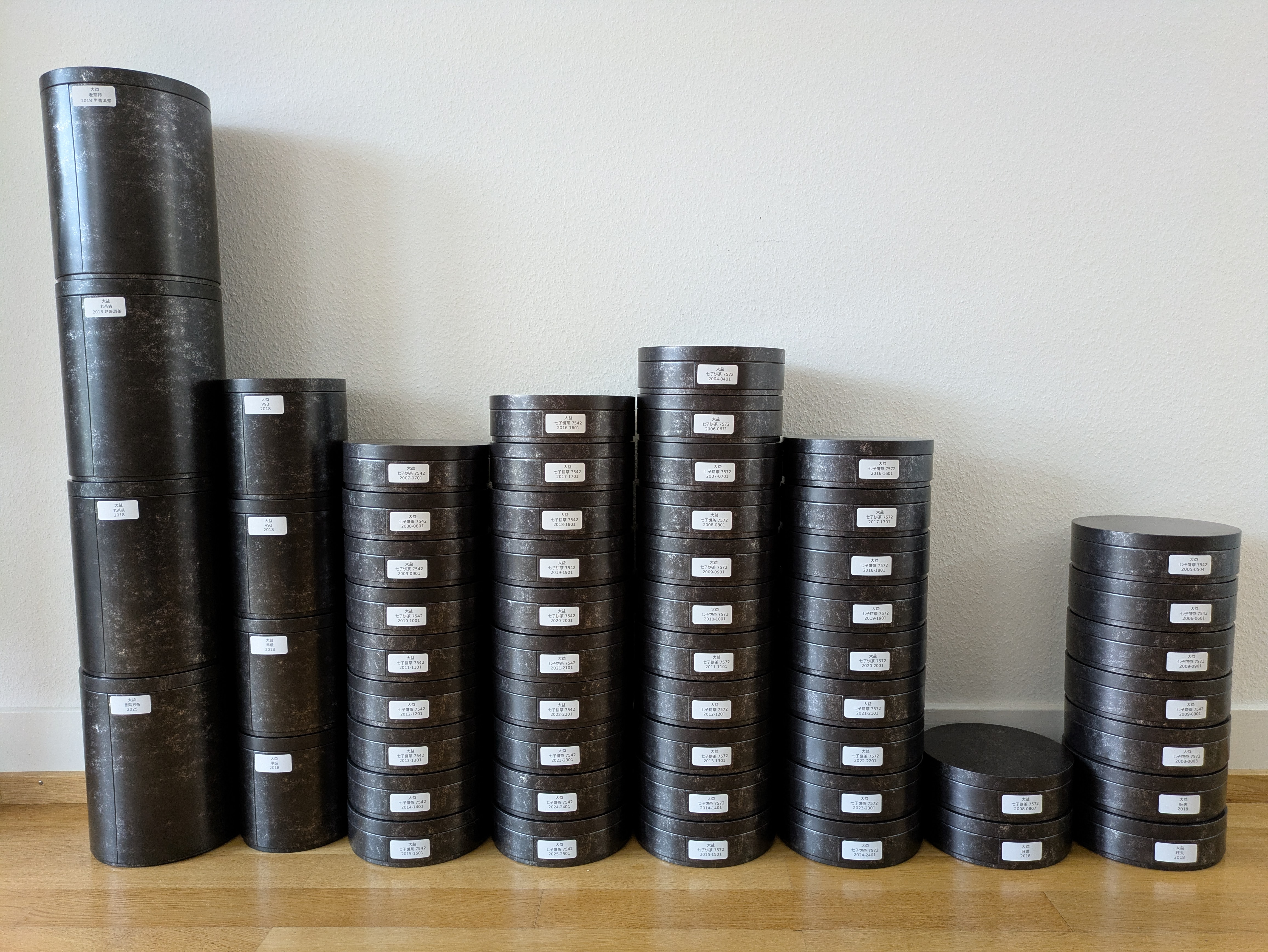
P ' r ch  storage (in Western Europe) Image: some D y P r ch stored at home
1. Location
1.1 No light Choose a location with neither direct nor indirect sunlight (= ultraviolet radiation) exposure:
  • direct sunlight damages organic material ( bleeching )
  • indirect sunlight by heating up the containers inbalances the microclimate ( suppression )
1.2 No odors Choose a location with neither direct nor indirect odor exposure:
  • direct odor immissions (like incense, food, air polution, etc.) makes the tea undrinkable
  • indirect odor immissions (especially other teas stored next to it) taint the taste and dilute the flavours
Always use individual containers for each tea, store only identical tea of the same year and batch in the same container. Idealy never store one cake, brick or tuo on its own, buy multiples and store them together for better ageing.

2. Climate
2.1 Consistent temperature Use a location with no interference from any devices or structures next to it:
  • use an regular indoor location for mild temperature curves (i.e. no attics with large day/night temperature differences)
  • aim for >= 20 C average temperature for natural storage (i.e. no cold basements)
  • don t use a place next to any heat dissipating devices (like radiators, computers, etc.)
  • don t use a place next to an outside facing wall
  • always leave 5 to 10cm distance to a wall for air to circulate (generally prevents mold on the wall but also isolates the containers further from possible immissions)
As consistent temperature as possible allows even and steady fermentation. However, neither air conditioning or filtering is needed. Regular day to day, day to night, and season to season fluctuations are balanced out fine with otherwise correct indoor storage. Also humidity control is much more important for storage and ageing, and much less forgiving than temperature control.

2.2 Consistent humidity Use humidity control packs to ensure a stable humidity level:
  • aim for ~65% RH
Lower than 60% RH will (completely) dry out the tea, higher than 70% RH increases chances for mold.
3. Equipment
3.1 Proper containers Use containers that are long term available and that are easily stackable, both in form and dimensions as well as load-bearing capacity. They should be inexpensive, otherwise it s most likely scam (there are people selling snake-oil containers specifically for tea storage). For long term storage and ageing:
  • never use plastic: they leak chemicals over time (no tupperdors , mylar and zip lock bags, etc.)
  • never use cardboard or bamboo: they let to much air in, absorb too much humity and dry to slow
  • never use wood: they emit odors (no humidors)
  • never use clay: they absorb all humidity and dry out the tea (glazed or porcelain urns are acceptable for short term storage)
Always use sealed but not air tight, cleaned steal cans (i.e. with no oil residues from manufacturing; such as these).
3.2 Proper humidity control Use two-way humidity control packs to either absorb or add moisture depending on the needs:
  • use humidity control pack(s) in every container
  • use one 60g pack (such as these) per 500g of tea

3.3 Proper labels Put labels on the outside of the containers to not need to open them to know what is inside and disturbe the ageing:

  • write at least manufacturer and name, pressing year, and batch number on the label (such as these)
  • if desired and not otherwise kept track already elsewhere, add additional information such as the amount of items, weights, previous storage location/type, date of purchase, vendor, or price, etc.
3.4 Proper monitoring Measuring and checking temperature and humidity regularly prevents storage parameters turning bad going unnoticed:
  • put temperature and humidity measurement sensors (such as these) inside some of the containers (e.g. at least one in every different size/type of container)
  • keep at least one temperature and humidity measurement sensor next to the containers on the outside to monitor the storage location
4. Storage
4.1 Continued maintenance Before beginning to initially store a new tea, let it acclimatize for 2h after unpacking from transport (or longer if temperature differences between indoors and outdoors are high, i.e. in winter). Then continuesly:
  • once a month briefly air all containers for a minute or two
  • once a month check for mold, just to be safe
  • every 3 to 6 months check all humidity control packs for need of replacement
  • monitor battery life of temperature and humidity measurement sensors
Humidity control packs can be recharged (usually voiding any warranty) by submerging them for 2 days in distilled water and 4 hours drying on paper towl afterwards. Check with a weight scale after recharging, they should regain their original weight (e.g. 60g plus ~2 to 5g for the packaging).
Finally With a correct P r ch storage:
  • beginn to drink Sh ng P r ( ) roughly after about 10-15 years, or later
  • beginn to drink Sh u P r ( ) roughly after about 3-5 years, or later
Prepare the tea by breaking it into, or breaking off from it, ~5 to 10g pieces about 1 to 3 months ahead of drinking and consider increase humidity to 70% RH during that time. 2026

31 December 2025

Ravi Dwivedi: Transit through Kuala Lumpur

In my last post, Badri and I reached Kuala Lumpur - the capital of Malaysia - on the 7th of December 2024. We stayed in Bukit Bintang, the entertainment district of the city. Our accommodation was pre-booked at Manor by Mingle , a hostel where I had stayed for a couple of nights in a dormitory room earlier in February 2024. We paid 4937 rupees (the payment was online, so we paid in Indian rupees) for 3 nights for a private room. From the Terminal Bersepadu Selatan (TBS) bus station, we took the metro to the Plaza Rakyat LRT station, which was around 500 meters from the hostel. Upon arriving at the hostel, we presented our passports at their request, followed by a 20 ringgit (400 rupee) deposit which would be refunded once we returned the room keys at checkout.
Outside view of the hostel Manor by Mingle Manor by Mingle - the hostel where we stayed at during our KL transit. Photo by Ravi Dwivedi. Released under the CC-BY-SA 4.0.
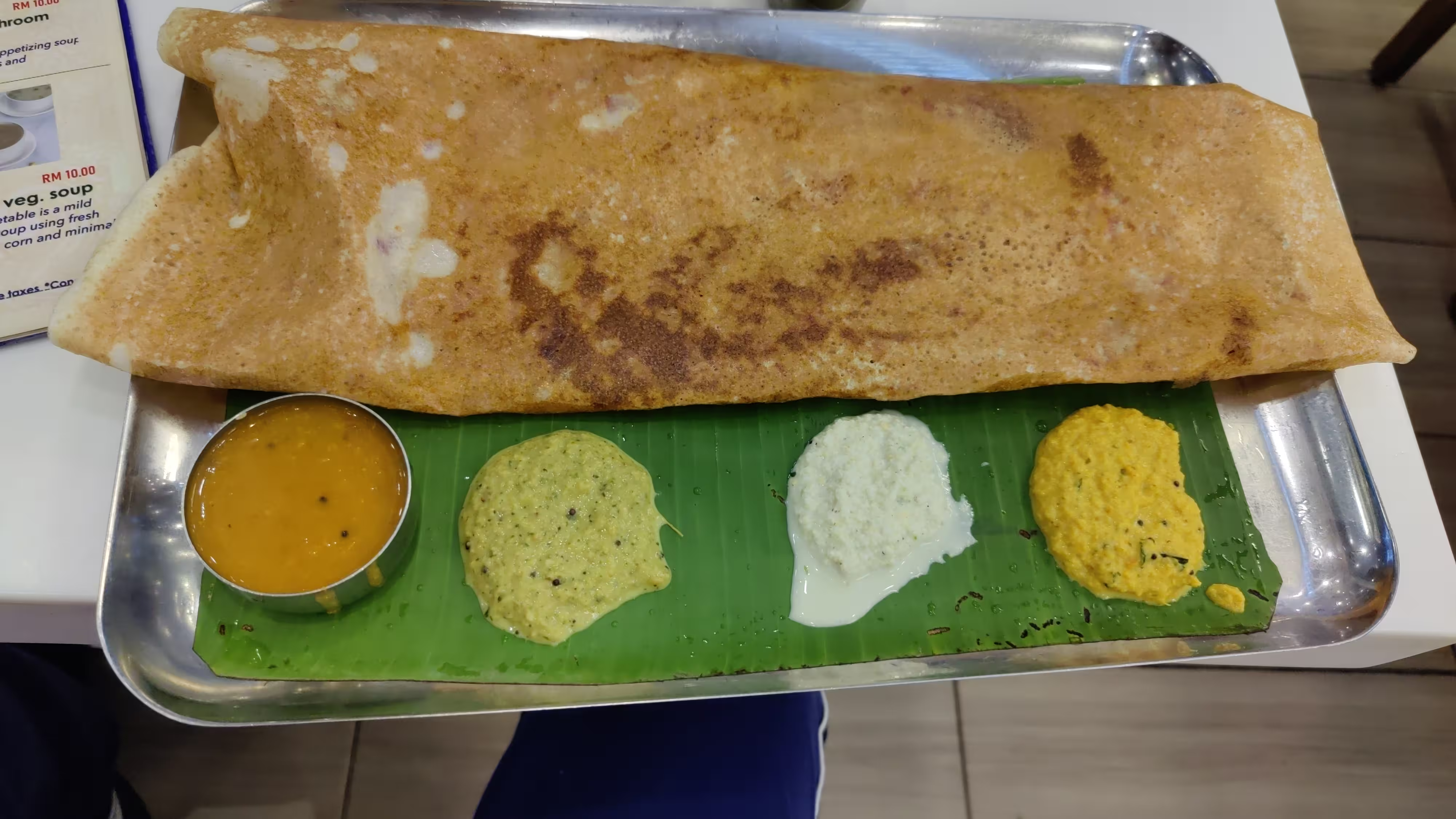
Our room was upstairs and it had a bunk bed. I had seen bunk beds in dormitories before, but this was my first time seeing a bunk bed in a private room. The room did not have any toilets, so we had to use shared toilets. Unusually, the hostel was equipped with a pool. It also had a washing machine with dryers - this was one of the reasons we chose this hostel, because we were traveling light and hadn t packed too many clothes. The machine and dryer cost 10 ringgits (200 rupees) per use, and we only used it once. The hostel provided complimentary breakfast, which included coffee. Outside of breakfast hours, there was also a paid coffee machine. During our stay, we visited a gurdwara - a place of worship for Sikhs - which was within walking distance from our hostel. The name of the gurdwara was Gurdwara Sahib Mainduab. However, it wasn t as lively as I had thought. The gurdwara was locked from the inside, and we had to knock on the gate and call for someone to open it. A man opened the gate and invited us in. The gurdwara was small, and there was only one other visitor - a man worshipping upstairs. We went upstairs briefly, then settled down on the first floor. We had some conversations with the person downstairs who kindly made chai for us. They mentioned that the langar (community meal) is organized on every Friday, which was unlike the gurdwaras I have been to where the langar is served every day. We were there for an hour before we left. We also went to Adyar Ananda Bhavan (a restaurant chain) near our hostel to try the chain in Malaysia. The chain is famous in Southern India and also known by its short name A2B. We ordered
A dosa Dosa served at Adyar Ananda Bhavan. Photo by Ravi Dwivedi. Released under the CC-BY-SA 4.0.
All this came down to around 33 ringgits (including taxes), i.e. around 660 rupees. We also purchased some snacks such as murukku from there for our trip. We had planned a day trip to Malacca, but had to cancel it due to rain. We didn t do a lot in Kuala Lumpur, and it ended up acting as a transit point for us to other destinations: flights from Kuala Lumpur were cheaper than Singapore, and in one case a flight via Kuala Lumpur was even cheaper than a direct flight! We paid 15,000 rupees in total for the following three flights:
  1. Kuala Lumpur to Brunei,
  2. Brunei to Kuala Lumpur, and
  3. Kuala Lumpur to Ho Chi Minh City (Vietnam).
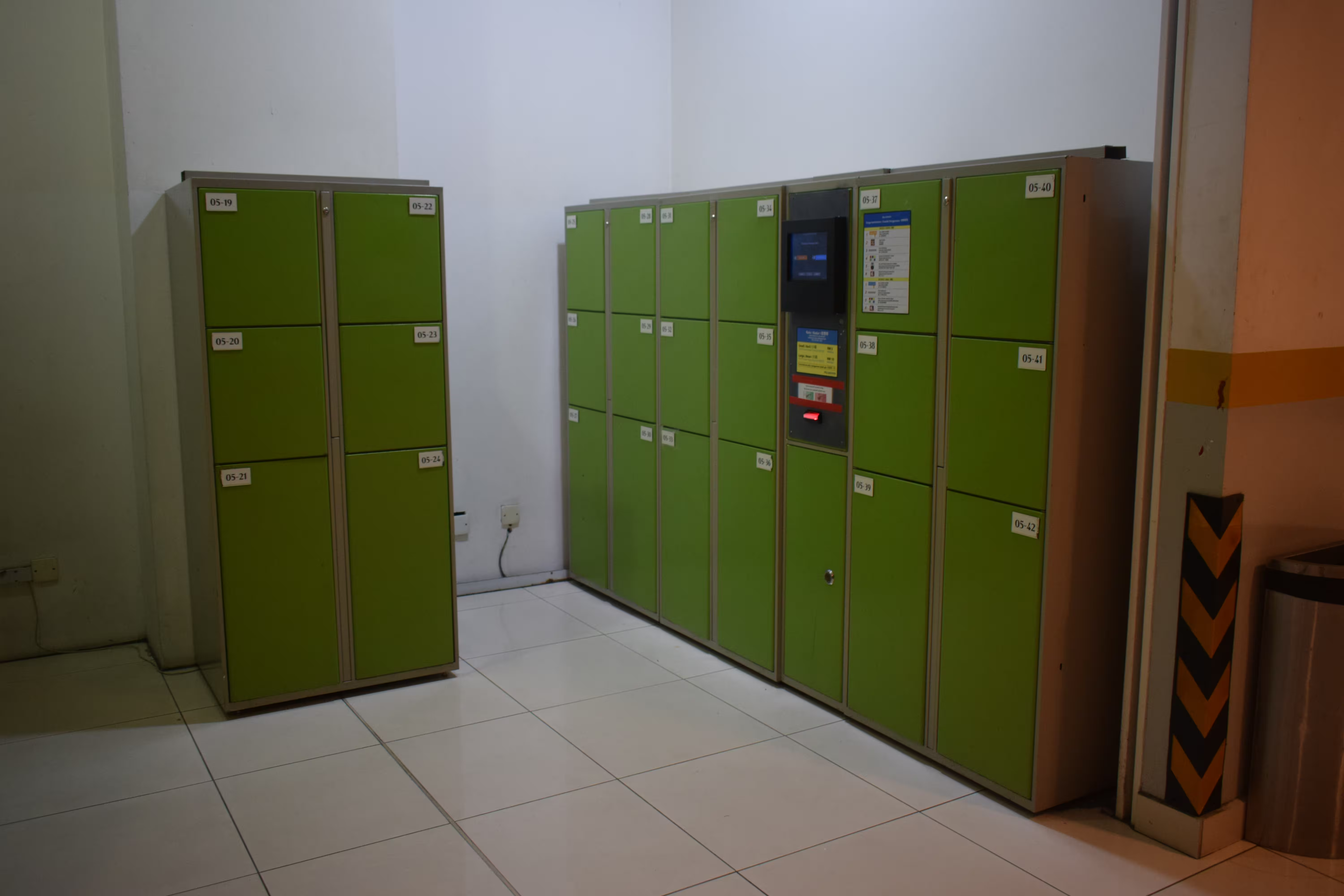
These were all AirAsia flights. The cheap tickets, however, did not include any checked-in luggage, and the cabin luggage weight limit was 7 kg. We also bought quite some stuff in Kuala Lumpur and Singapore, leading to an increase in the weight of our luggage. We estimated that it would be cheaper for us to take only essential items such as clothes, cameras, and laptops, and to leave behind souvenirs and other non-essentials in lockers at the TBS bus stand in Kuala Lumpur, than to pay more for check-in luggage. It would take 140 ringgits for us to add a checked-in bag from Kuala Lumpur to Bandar Seri Begawan and back, while the cost for lockers was 55 ringgits at the rate of 5 ringgits every six hours. We had seen these lockers when we alighted at the bus stand while coming from Johor Bahru. There might have been lockers in the airport itself as well, which would have been more convenient as we were planning to fly back in soon, but we weren t sure about finding lockers at the airport and we didn t want to waste time looking. We had an early morning flight for Brunei on the 10th of December. We checked out from our hostel on the night of the 9th of December, and left for TBS to take a bus to the airport. We took a metro from the nearest metro station to TBS. Upon reaching there, we put our luggage in the lockers. The lockers were automated and there was no staff there to guide us.
Lockers at TBS bus station Lockers at TBS bus station. Photo by Ravi Dwivedi. Released under the CC-BY-SA 4.0.
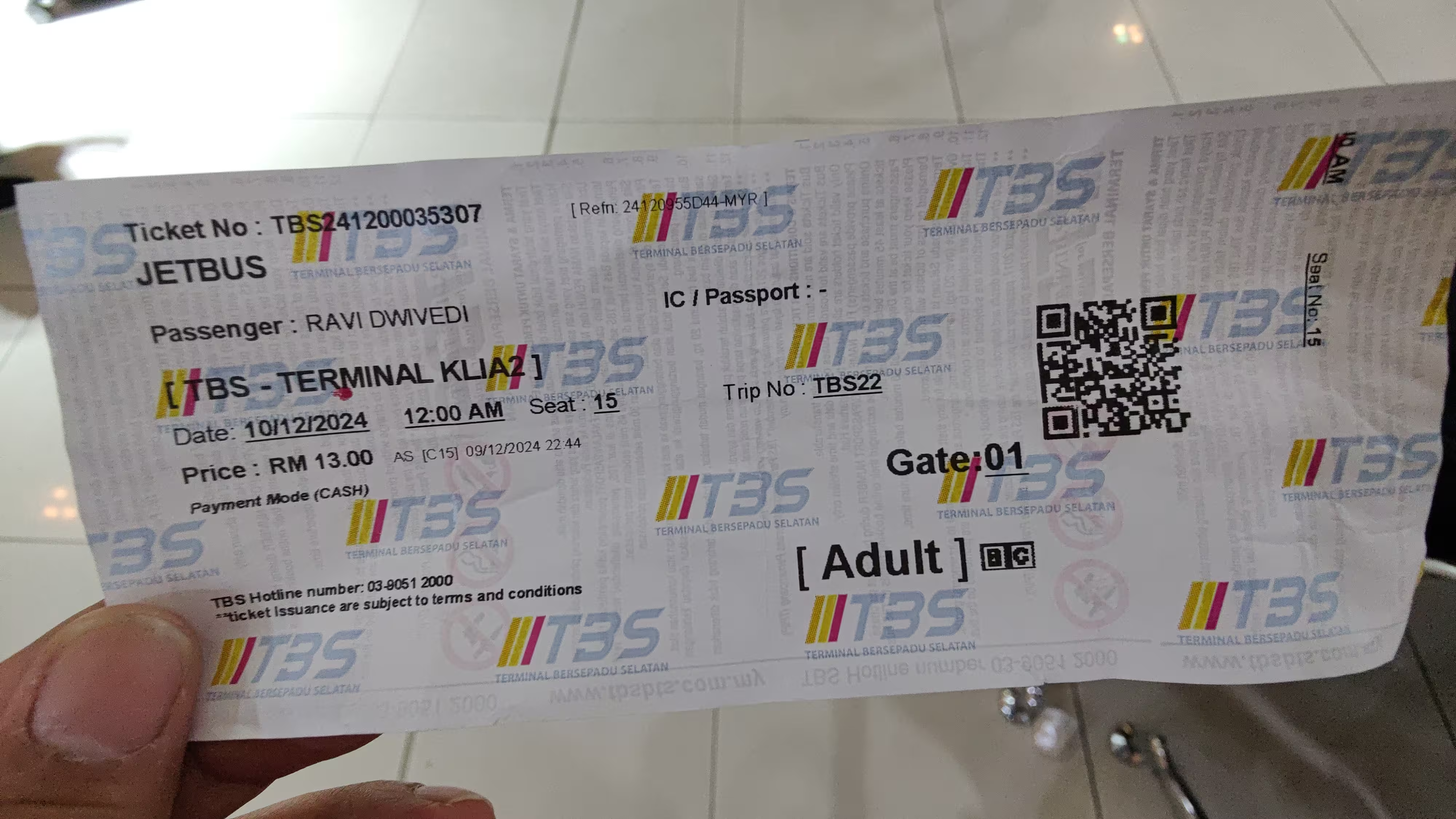
We bought a ticket for the airport bus from a counter at TBS for 26 ringgits for both of us. In order to give us tickets, the person at the counter asked for our passports, and we handed it over to them promptly. Since paying in cash did not provide any extra anonymity, I would advise others to book these buses online. In Malaysia, you also need a boarding pass for buses. The bus terminal had kiosks for getting these printed, but they were broken and we had to go to a counter to obtain them. The boarding pass mentioned our gate number and other details such as our names and departure time of the bus. The company was Jet Bus.
My boarding pass for the bus to the airport in Kuala Lumpur My boarding pass for the bus to the airport in Kuala Lumpur. Photo by Ravi Dwivedi. Released under the CC-BY-SA 4.0.
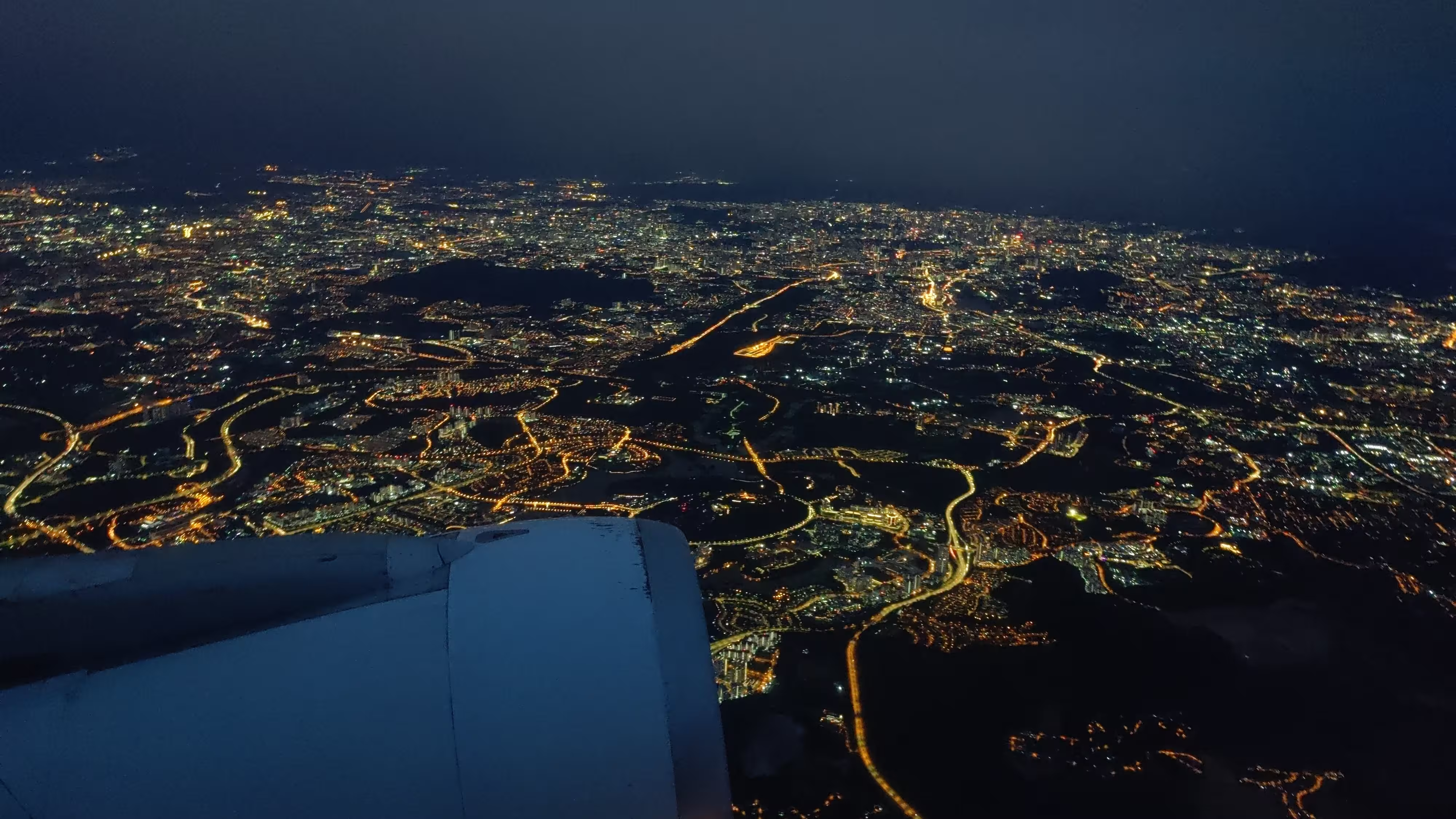
To go to our boarding gate, we had to scan our boarding pass to let the AFC gates open. Then we went downstairs, leading into the waiting area. It had departure boards listing the bus timings and their respective gates. We boarded our bus around 10 minutes before the departure time - 00:00 hours. It departed at its scheduled time and took 45 minutes to reach KL Airport Terminal 2, where we alighted. We reached 6 hours before our flight s departure time of 06:30. We stopped at a convenience store at the airport to have some snacks. Then we weighed our bags at a weighing machine to check whether we were within the weight limit. It turned out that we were. We went to an AirAsia counter to get our boarding passes. The lady at our counter checked our Brunei visas carefully and looked for any Brunei stamps on the passports to verify whether we had used that visa in the past. However, she didn t weigh our bags to check whether they were within the limit, and gave us our boarding passes. We had more than 4 hours to go before our flight. This was the downside of booking an early morning flight - we weren t able to get a full night s sleep. A couple of hours before our flight time, we were hanging around our boarding gate. The place was crowded, so there were no seats available. There were no charging points. There was a Burger King outlet there which had some seating space and charging points. As we were hungry, we ordered two cups of cappuccino coffee (15.9 ringgits) and one large french fries (8.9 ringgits) from Burger King. The total amount was 24 ringgits. When it was time to board the flight, we went to the waiting area for our boarding gates. Soon, we boarded the plane. It took 2.5 hours to reach the Brunei International Airport in the capital city of Bandar Seri Begawan.
View of Kuala Lumpur from the aeroplane View of Kuala Lumpur from the aeroplane. Photo by Ravi Dwivedi. Released under the CC-BY-SA 4.0.

Stay tuned for our experiences in Brunei! Credits: Thanks to Badri, Benson and Contrapunctus for reviewing the draft.

Petter Reinholdtsen: Some of my 2025 free software activities

I guess it is about time I posted a new summary of the free software and open culture activites and projects I have been involved in the last year. The days have been so packed the last year that I have failed with my intention to post at least one blog post per month, so this summary became rather long. I am sorry about this. This year was the year I got tired of the lack of new releases of the multimedia related libraries published via Xiph, and I decided to wrap up the current state and make the releases myself. In a burst of activity early this year, I collected and tested patches, coordinated with other developers and finally made new tarballs and release announcement for theora, and new tarball releases for liboggz, kate and fishsound. This upstreamed several patches accumulated in Debian and other Linux distributions for the last 15 years or so. To change the world and the future, it is important to start with the kids, and one such avenue of change have been created by the current president of FSF Europe, Matthias Kirschner. He wrote a book for children, Ada & Zangemann, and I have been involved in its translation framework for the entire year. The source code has been transformed to Docbook and I have been conducting and coordinating translations into Norwegian Bokm l and Nynorsk, as well as preparing paper editions of the book and an animation movie with Norwegian voices. The Bokm l edition is very close to ready, and will be available early in 2026, and the movie release will follow shortly after this. I intend announce this on my blog and elsewhere when this happen. Please get in touch if you want to help spread the word about this book in Norwegian. I hope we can get the author to Norway when making the Norwegian releases. This year I continued a push for the system I made a few years ago to improve hardware dongle handling on Linux. The Isenkram system use hardware mapping information provided by relevant packages using the AppStream system to propose which Linux distribution packages to install on a given machine to support dongles like cameras, finger print readers, smart card readers, LEGO controllers, ECC memory and other hardware. I have followed up on the list of packages providing such mapping, either to get it into Debian or to upstream the necessary metadata. I am not sure if we are at a point where package maintainers on their own add such information to their packages, but there are Debian lintian reports suggesting it and I have send patches to all packages I am aware of that should include such mappings. Most of the patches are included in Debian now, only 27 was left the last time I checked. As part of my involvement with Debian, I continued my push to get all orphaned packages without a version control repository migrated to git. I am not sure how many packages I went through, but it was in the range of 200-300 packages. In addition to this I updated, sponsored, pushed maintainers for updates upstreamed patches for and fixed RC issues with battery-stats, bs1770gain, isenkram, libonvif, mfiutil, opensnitch, simplescreenrecorder, vlc-plugin-bittorrent and wakeonlan. I've also followed up LEGO related packages, dahdi support for Asterisk, llama.cpp and whisper.cpp in particular for the AMD GPU I was donated by AMD, as well as tried yet again to convince the upstream developers of the photogrammetric workstion e-foto to get their program into a state that could be included in Debian. As I do not buy into the story that it is great to expose oneself to the whims of and priorities of commercial entities to have access to cultural expressions like films and music, I still maintain a huge collection of movies. For this to work well, I have ended up as part of the people maintaining lsdvd upstream and wrapped up a new release fixing several crash bugs caused by DVDs with intentionally broken metadata, and introduced code to list a DVD ID in the lsdvd output. Related to this, I have also worked some add-ons for my main video and music player, and took over upstream maintenance of the Invidious add-on, which sadly stopped working for non-authenticated users when web scrapers made it impossible for Invidious installations to provide a open API, as well as contributed to the NRK and projector control add-ons. As part of my involvement in the Norwegian archiving community and standardisation work, we organised a Noark 5 workshop this spring discussing how to decide what to keep and what to delete in digital archives. We finally managed to apply for Noark 5 certification for the free software archive API Nikita, as well as worked to test and improve the performance of Nikita together with people on my day job at the university. Manufacturing using Free Software is still a focus for me, and I have continued my involved with the LinuxCNC community, organising a developer gathering this summer with the help and sponsoring from the initial start in 2023 from NUUG Foundation and sponsoring from Debian and Redpill-Linpro. We plan to repeat the event also in 2026, but this time NUUG Foundation have told us they do not want a role, so we have found another friendly organisation to handle the money. A popular machine controller with LinuxCNC is the MESA set of electronics, which is centred around a FPGA which now can be programmed using only Free Software. We discussed during this summers gathering how hard it would be to compile the current FPGA source using a Free Software tool chain, and I started looking into this, locating tools to transform the VHDL source into something the Yosys tool chain can handle. Still lot to do there, and I hope to get further next year. An important part of Free Software manufacturing is the ability to design parts and create programs that can be passed to machines making parts, also known as CAD/CAM. The most prominent project for this is FreeCAD, and I have been both pushing to get opencamlib integrated with it in Debian as well as fixing bugs in the handling of Fanuc controlled machines, do make it easier to generate instructions for machines I have access to. I expect to also continue this also next year. This year the UN conference Internet Governance Forum (IGF) was held in Norway, and I tried my best to get a stand for the Norwegian Unix Users Group (NUUG) there. Sadly the effort failed, due to lack of interest with the NUUG Board, but I was happy to see several members at least attend some of the activities related to IGF. Sadly to participate at IGF one need to hand over quite private information, so I decided not to participate in any of the closed forum events myself. Related to NUUG I have been a member of the election board proposing board member candidates to the general assembly, and been part of the program committee of the "Big Tech m vekk" (Big Tech must go away) festival organised by Attac in concert with NUUG and EFN. I've also assisted the Norwegian open TV channel Frikanalen with access to their machines located in a machine room at the university. Related to the University, I have become involved in a small team of students working to build and program robots for the Robocup@Home competition. For 2026 we also plan to use the new features of FreeCAD to make parts for the open hardware robot arm OpenArm. This is also the group that will handle the money for the LinuxCNC gathering in 2026. Also related to the university I was looking into the Linux security auditing system Falco earlier this year, making improvements to the detection rules. This activity is on hold at the moment, and do not expect to continue with this in 2026. I will most likely have to cut down a bit on my free software and open culture activities going forward, as NUUG Foundation, who have funded one day a week for such activities for several years no, sadly have decided they do not want to continue doing this. I am very grateful for their contributions over the years, both with freeing up time for me and supporting several events and projects where I have been involved or taken the initiative on. Now they are reorganizing with more focus on paperwork and applications. As usual, if you use Bitcoin and want to show your support of my activities, please send Bitcoin donations to my address 15oWEoG9dUPovwmUL9KWAnYRtNJEkP1u1b.

Chris Lamb: Favourites of 2025

Here are my favourite books and movies that I read and watched throughout 2025.

Books

Eliza Clark: Boy Parts (2020)Rachel Cusk: The Outline Trilogy (2014 2018)Edith Wharton: The House of Mirth (1905)Michael Finkel: The Art Thief (2023)Tony Judt: When the Facts Change: Essays 1995-2010 (2010)Jennette McCurdy: I'm Glad My Mom Died (2022)Joan Didion: The Year of Magical Thinking (2005)Jill Lepore: These Truths: A History of the United States (2018)

Films Recent releases

Disappointments this year included 28 Years Later (Danny Boyle, 2025), Cover-Up (Laura Poitras & Mark Obenhaus, 2025), Bugonia (Yorgos Lanthimos, 2025) and Caught Stealing (Darren Aronofsky, 2025).
Older releases ie. Films released before 2024, and not including rewatches from previous years. Distinctly unenjoyable watches included War of the Worlds (Rich Lee, 2025), Highest 2 Lowest (Spike Lee, 2025), Elizabethtown (Cameron Crowe, 2005), Crazy Rich Asians (Jon M. Chu, 2018) and Spinal Tap II: The End Continues (Rob Reiner, 2025). On the other hand, unforgettable cinema experiences this year included big-screen rewatches of Chinatown (Roman Polanski, 1974), Koyaanisqatsi (Godfrey Reggio, 1982), Heat (Michael Mann, 1995) and Night of the Hunter (Charles Laughton, 1955).

28 December 2025

Jonathan Dowland: Our study, 2025

We re currently thinking of renovating our study/home office. I ll likely write more about that project. Embarking on it reminded me that I d taken a photo of the state of it nearly a year ago and forgot to post it, so here it is.
Home workspace, January 2025 Home workspace, January 2025
When I took that pic last January, it had been three years since the last one, and the major difference was a reduction in clutter. I've added a lava lamp (charity shop find) and Rob Sheridan print. We got rid of the PO NG chair (originally bought for breast feeding) so we currently have no alternate seating besides the desk chair. As much as I love my vintage mahogany writing desk, our current thinking is it s likely to go. I m exploring whether we could fit in two smaller desks: one main one for the computer, and another workbench for play: the synthesiser, Amiga, crafting and 3d printing projects, etc.

23 December 2025

Daniel Kahn Gillmor: AI and Secure Messaging Don't Mix

AI and Secure Messaging Don't Mix Over on the ACLU's Free Future blog, I just published an article titled AI and Secure Messaging Don't Mix. The blogpost assumes for the sake of the argument that people might actually want to have an AI involved in their personal conversations, and explores why Meta's Private Processing doesn't offer the level of assurance that they want it to offer. In short, the promises of "confidential cloud computing" are built on shaky foundations, especially against adversaries as powerful as Meta themselves. If you really want AI in your chat, the baseline step for privacy preservation is to include it in your local compute base, not to use a network service! But these operators clearly don't value private communication as much as they value binding you to their services. But let's imagine some secure messenger that actually does put message confidentiality first -- and imagine they had integrated some sort of AI capability into the messenger. That at least bypasses the privacy questions around AI use. Would you really want to talk with your friends, as augmented by their local AI, though? Would you want an AI, even one running locally with perfect privacy, intervening in your social connections? What if it summarized your friend's messages to you in a way that led you to misunderstand (or ignore) an important point your friend had made? What if it encouraged you to make an edgy joke that comes across wrong? Or to say something that seriously upsets a friend? How would you respond? How would you even know that it had happened? My handle is dkg. More times than i can count, i've had someone address me in a chat as "dog" and then cringe and apologize and blame their spellchecker/autocorrect. I can laugh these off because the failure mode is so obvious and transparent -- and repeatable. (also, dogs are awesome, so i don't really mind!) But when our attention (and our responses!) are being shaped and molded by these plausibility engines, how will we even know that mistakes are being made? What if the plausibility engine you've hooked into your messenger embeds subtle (or unsubtle!) bias? Don't we owe it to each other to engage with actual human attention?

20 December 2025

Sahil Dhiman: MiniDebConf Navi Mumbai 2025

MiniDebConf Navi Mumbai 2025 which was MiniDebConf Mumbai, which in turn was FOSSMumbai x MiniDebian Conference, happened on 13th and 14th December, 2025, with a hotel as Day 1 venue and a college on Day 2. Originally planned for the 8th of November, it got postponed to December due to operational reasons. Most of the on-ground logistics and other heavy lifting was done by Arya, Vidhya, MumbaiFOSS, and the Remigies Technologies team, so we didn t had to worry much. This time, I gave a talk on Basics of a Free Software Mirror (and how Debian does it) (Presentation URL). I had the idea for this talk for a while and gave a KDE version of it during KDE India Conf 2025. The gist was to explain how Free Software is delivered to users and how one can help. For MDC, I focused a bit on Debian mirror network(s) and who else host mirrors in India and trends.
Me during mirror talk
Credits - niyabits. Thanks for the pictures
At the onset someone mentioned my Termux mirror. Termux is a good project to get into mirror hosting with. I got into mirroring with it. It has low traffic (usually less than 20 GB/day) demands with a high request count and can be done on an existing 6 USD Digital Ocean nodes. Q&A time turned out more interesting than I anticipated. Folks touched upon commercial CDNs instead of community mirrors, supply chain security issues, and a bit of other stuff. We had quite a number of interesting talks and I remember when Arya was telling me during CFP time, bro we have too many talks now :D. Now, preparations have already started for MiniDebConf Kanpur 2026, scheduled for March 14th and 15th at the IIT campus. If you want to help, see the following thread. See you in the next one. A group photo
Day 1 group photo. Click to enlarge

A group photo
Day 2 group photo. Click to enlarge

Next.

Previous.