Search Results: "Lucas Nussbaum"

25 October 2012

Lucas Nussbaum: Release Critical Bugs report for week 43

During the Squeeze release cycle, Alexander Reichle-Schmehl used to blog every week about this. Let s try to continue the tradition. The UDD bugs interface currently knows about the following release critical bugs: Note: I m looking for someone to send this posts on a regular basis. All you need is a blog syndicated on Planet Debian (there s a secret UDD page that generates the HTML code for you ;) ). Contact me if you are interested. taken!

6 July 2012

Lucas Nussbaum: Debian Maintainer Dashboard update

I ve spent some more time on Debian Maintainer Dashboard (DMD), a maintainer/team-centric dashboard relying on Ultimate Debian Database. Done:
- added tabs (jquery really rocks) see example
- added a hacking.html file that describes how to setup a development environment
- created a pad (http://debian.titanpad.com/DMD) to store ideas. TODO:
- recruit contributors ;)

1 July 2012

Lucas Nussbaum: Introducing the Debian Maintainer Dashboard help needed!

The brand new machine for Ultimate Debian Database motivated me to do UDD-related work again, so I implemented an old idea: build a maintainer/team-centric dashboard relying on UDD, the Debian Maintainer Dashboard. The idea is to expose as much useful information as possible about a maintainer s packages, both in the traditional (Developers Packages Overview-like) big table with all the info , but also in a task-oriented listing (to answer the ok, I have two hours for Debian, what should I do now? question). At this point, the Debian Maintainer Dashboard already brings several cool features (try it with my packages or pkg-ruby s packages, or your own!): Of course, as of now, it s pretty ugly: that s the help needed part of the post. I really suck at web design, and would really appreciate if someone would help me to turn it into something nice to use. Besides adding links and colors everywhere, it could probably be nice to add sortable tables, and to create tabs for TODO items , Versions and Bugs (and possibly Lintian, for example). Contact me if you are interested.

30 May 2012

Lucas Nussbaum: Debian archive rebuilds on Amazon Web Services

I like to think that archive rebuilds play an important role in Debian Quality Assurance and Release Management efforts. By trying to rebuild every Debian package from source, one can identify packages that do not build anymore due to changes in other packages (compilers, interpreters, libraries, ). It is also a good way to stress-test all packages that are involved in building other packages. Since 2007, I had been running Debian archive rebuilds on the Grid 5000 testbed, a research infrastructure for performing experiments on distributed systems HPC/Grid/Cloud/P2P. I filed more than 6000 release-critical bugs in the process. Late last year, Amazon kindly offered us a grant to allow us to run such QA tests on Amazon Web Services. With S bastien Badia, we ported the rebuild infrastructure to AWS (scripts), and several rebuilds have already been carried out on AWS. On the technical level, 50 to 100 EC2 spot instances are started, and then controlled from a master instance using SSH. On build instances, a classic sbuild setup is used. Logs are retrieved to the master node after rebuilds, and build instances are simply shut down when there are no more tasks to process. Several tasks are processed simultaneously on each instance, and when they fail, they are retried again with no other concurrent build on the same instance, to eliminate random failures caused by load or timing issues. All the scripts are designed to support other kind of QA tests, not just rebuilds. Moving to Amazon Web Services will facilitate sharing the human workload of doing those tests. It is now possible for developers interested in custom tests to do them themselves (hint hint).

13 April 2012

Lucas Nussbaum: Update of Debian Packaging Tutorial

I ve just updated the Debian Packaging Tutorial. This new version addresses a few comments and questions I received over the past months. Note that there are also french and spanish versions of the tutorial, and I m of course open to adding other translations. The tutorial can be found in the packaging-tutorial package (PDF files are in /usr/share/doc/packaging-tutorial/), or on www.debian.org (see links above).

4 February 2012

Stefano Zacchiroli: bits from the DPL for January 2012

Fresh from the oven, monthly report of what I've been working on as DPL during January 2012.
Dear Developers,
here is another monthly report of what happened in DPL-land, this time for January 2012. There's quite a bit to report about --- including an insane amount of legal-ish stuff --- so please bear with me. Or not. Legal stuff Most of the above wouldn't have been possible without the precious help of folks at SFLC working for SPI and Debian. Be sure to thank SFLC for what they're doing for us and many other Free Software projects. Coordination Nobody stepped up to coordinate the artwork collection for Wheezy I've mentioned last month, so I've tried to do a little bit of that myself. The -publicity team is now preparing the call for artwork and hopefully we'll send it out RSN. In case you want to help, there is still a lot of room for that; just show up on the debian-desktop mailing list. Sprints A Debian Med sprint has happened in January, and Andreas Tille has provided a nice and detailed report about it. Some more sprints are forthcoming this spring, how about yours? Money Important stuff going on Other important stuff has been going on in various area of the project in January. I'd like to point your attention to a couple of things: Miscellanea In the unlikely case you've read thus far, thanks for your attention! Happy Debian hacking.
PS as usual, the boring day-to-day activity log is available at master:/srv/leader/news/bits-from-the-DPL.*

1 January 2012

Lucas Nussbaum: Re: Ubuntu vs Ruby

(original post) > If Ubuntu 12.04 if a LTS release, and Ruby 1.8.7 goes out of support in June of
> 2013, then why is the default still 1.8.7?
>
> Ruby 1.9.2 was released in 2010. Ruby 1.9.3 was released in October of this year. First, there s almost nobody in the Ubuntu development community doing any Ruby work. Packages are just imported from Debian, and Ubuntu follows what is done on the Debian side. In the Debian/Ruby team, we are currently transitioning to a new packaging helper (gem2deb) that makes it much
easier to support several Ruby versions. Once this will be done, switching to 1.9.3 by default will be very easy. We already provide a way for the sysadmin to change the default on a system. Now, doing that transition takes time, and we could have used *your* help (and could still use it). We are still quite on time to do it for Debian wheezy, but it sounds very hard to do it for Ubuntu 12.04 unless someone from Ubuntu steps
up to help.

15 December 2011

Raphaël Hertzog: 3.0 (quilt) is the most widely used Debian source package format

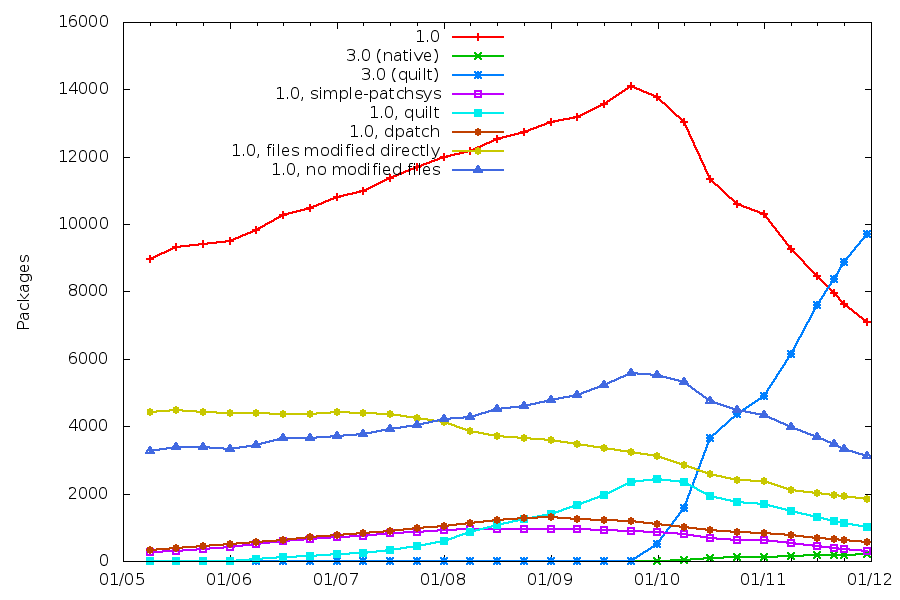
My goal with the 3.0 (quilt) source format has always been to standardize the patch management in Debian source packages. This message seems to have been well understood. dbs and dpatch have been deprecated by their respective maintainers. I made numerous efforts to make this source format useful in as many use cases as possible (but some improvements are still possible) and I have added hints to encourage maintainers to switch. Thanks to this, the adoption rate of this new source format has been very good and it s now the most widely used source package format in Debian only two years after its introduction in Debian unstable. With 9829 source package using 3.0 (quilt) , it surpassed the number of source package still using 1.0 (7368). (Those numbers have been taken from http://upsilon.cc/~zack/stuff/dpkg-v3/ on december 13th 2011.) The number of source packages using 3.0 (quilt) doubled this year.

(Click on the picture to see it full size) Of the 7368 packages using the old format, 6816 packages trigger the missing-debian-source-format lintian tag. This means that only 552 source packages have explicitly opted to keep using the old format and that the bulk of the remaining packages are rarely updated packages that have not been switched yet.

3 comments Liked this article? Click here. My blog is Flattr-enabled.

6 November 2011

Lucas Nussbaum: dash as /bin/sh, and now ld as-needed. Pattern?

I must admit that I ve never been a big fan of the dash as /bin/sh change. I have three main problems with the switch: POSIX compliance as an argument Complying to standards is a really good thing. But when everybody is ignoring the standard because they want the comfort of newer features, maybe it s a sign that the standard should be updated to include those newer features. Most of the bashims used everywhere in scripts were signifiant improvements, like the ability to write:
cp short1/path1,short2/path2 /very/long/common/path/to/a/file
instead of:
cp short1/path1/very/long/common/path/to/a/file short2/path2/very/long/common/path/to/a/file The option to improve bash was not fully explored We started with the premise that bash is bloated, slow, and cannot be improved. Maybe you can help me with that, but I could only find a few simplistic benchmarks comparing dash and bash, and I could not find any analysis of why bash is slow, and why it cannot be improved.
One of the obvious problems is that bash is also an interactive shell, and is linked to ncurses and terminfo, which increases the startup time. But have we investigated the possibility to have a /bin/bash-non-interactive binary that would not be linked to ncurses? The change was brought to users While it is OK for Debian (or Ubuntu, in that case, since that change was done in Ubuntu first) to force its developers to use POSIX-compliant scripts, the switch could have been made only to Debian-created scripts (by switching them from a /bin/sh shebang to a /bin/dash shebang, for example). I have trouble justifying that this change was forced on users as well. Next: linker changes and we are doing it again. A set of linker changes (see also the Ubuntu page) was already done in Ubuntu, and is very likely to be done in Debian as well. This switch requires deep changes in some buildsystems (it requires ordering of libraries and forbids indirect dependencies), and is rather painful (it was reverted before the Ubuntu 11.04 release because it was not possible to fix all the packages during the natty release cycle, but is done in the 11.10 release). Of course, there are justifications for this change. But I m not sure that it s worth all the trouble created for users.

22 September 2011

Lucas Nussbaum: Windows dynamic disks and debian installer ?

Windows has a feature called Dynamic Disks, which makes it ignore the DOS partition table and manage partitions its own ways. gparted is supposed to detect that, and warn the user that it can t deal with that. The solution is to reboot in Windows, switch the partition back to Basic disks , and then proceed with installing Debian (or Ubuntu). However, a student of mine had an interesting experience because gparted did not detect the dynamic disk stuff and did not warn about it, so the student went ahead with installing Debian squeeze. After reboot in Windows, Windows sees the partition as invalid . The same happens with Ubuntu 11.04 (not really surprising). I m surprised I did not find much information about that issue. Does someone has more info ? The student was using two disks in his laptop, and only the second one (not the one used to boot windows) was using dynamic disks .

13 September 2011

Lucas Nussbaum: Why don t cp and tar use fsync()?

I must admit that I m a bit lost about the conclusions of the Don t fear the fsync()! (lf.org down; google cache) debate. My understanding was that using fsync() was the right thing to do when we cared about data being written to disk. When using cp or tar, I usually care about my data being written to the disk, so why don t they use fsync()? Shouldn t they?

1 August 2011

Lucas Nussbaum: Debconf

So, the fifth Debconf I ve had the chance to attend is clearly over now. It was great, and all organizers (and sponsors) really deserve huge thank you for making this event so successful. I m already looking forward to next year s edition. Debconf has been very productive for me. I chaired 4 sessions: I ve also made numerous uploads of Ruby-related packages, and reduced my backlog on UDD to a reasonable level. I even managed to make a developers-reference upload, integrating all the pending patches from the BTS. In other news, I m very excited about the recent progress on expo.debian.net (a mentors.debian.net replacement), which could help streamline our sponsorship process.

4 July 2011

Lucas Nussbaum: Going to RMLL (LSM) and Debconf!

Next week, I ll head to Strasbourg for Rencontres Mondiales du Logiciel Libre 2011. On monday morning, I ll be giving my Debian Packaging Tutorial for the second time. Let s hope it goes well and I can recruit some future DDs! Then, at the end of July, I ll attend Debconf again. Unfortunately, I won t be able to participate in Debcamp this year, but I look forward to a full week of talks and exciting discussions. There, I ll be chairing two sessions about Ruby in Debian and Quality Assurance.

3 July 2011

Iain Lane: Ubuntu upload history now available in UDD

There are two different uses (within Debian/Ubuntu) of the initialism UDD: Ubuntu Distributed Development and the Ultimate Debian Database. This article talks about the latter. At UDS-O in Budapest a few weeks ago we had a session (video) on DEX: an initiative to improve collaboration between Debian and its derivatives. There's an Ubuntu DEX subproject, and this is what the session was about, thinking up ideas. I thought of something that could possibly yield some results --- my action from the session was:
[laney] measure relative uploads between ubuntu and debian and see if anything interesting pops up: TODO
It seems to me that if we could tell which packages were uploaded with the most frequency to Ubuntu with respect to Debian, then we may be able to figure out why this is and if there's any way we can do the work in Debian instead. Clearly for this to happen we are going to need data! And where better to house a load of data than the Ultimate Debian Database itself? So I wrote some scripts to download the Ubuntu changes, handily made available as mbox archives, chop them around a bit and eventually split them out in a format that UDD can understand. Lucas Nussbaum then kindly integrated the output into UDD itself, and the end result is that an as-near-as-possible complete history of Ubuntu uploads is now available for your creative querying. For example, Wednesday sees the most uploads and Sunday the fewest:
udd=> SELECT EXTRACT (DOW FROM date) AS dow, COUNT(EXTRACT (DOW
FROM date)) AS count FROM ubuntu_upload_history GROUP BY dow ORDER
BY count DESC;
 dow   count 
-----+-------
   3   26739
   2   26699
   1   25361
   5   23497
   4   22154
   6    9687
   0    8752
(7 rows)

I'll lovingly craft a script to generate the data we need for the DEX project in the next few days. But I hope that the data proves useful for other things too. The three tables you want to look at (with \d+ at a psql prompt) are ubuntu_upload_history, ubuntu_upload_history_launchpad_closes (LP bugs closed by uploads) and ubuntu_upload_history_closes (Debian bugs closed, probably not so interesting). Information on how to use UDD yourself is on this wiki page.

27 May 2011

Lucas Nussbaum: Packaging tutorial update

This week I finally used my packaging tutorial slides myself, a few days after Phil Hands used them at a UKUUG event. The tutorial is now available as a Debian package (in Debian unstable) named packaging-tutorial, and I ve talked to debian-doc@ about linking it from appropriate places. It s also hosted on collab-maint now, so don t hesitate to contribute. Links :

Lucas Nussbaum: Changes to Ruby in Debian (and Ubuntu)

(this is a copy of an mail sent to ruby-core@ and ruby-talk@) Since the beginning of 2011, the Debian Ruby team has been working on several big changes. Those changes all are available in Debian unstable, some of them are also available in Debian testing, and they should all be available in the next Debian and Ubuntu releases. I think that it addresses most of the reasonable concerns about Ruby in Debian. Using alternatives to switch between Ruby implementations The alternatives system is now used to manage the ruby symlink and the other related symlinks, making it easy to switch between Ruby implementations (only Ruby 1.8 and 1.9.X at the moment) (see this mail for details). The default choice for Ruby is still 1.8, but this change will make it easy for us to make a switch to 1.9.X by default (likely by the release of Debian wheezy). Installing gems executables to /usr/local/bin Rubygems (both as a standalone package, and as shipped with Ruby 1.9.X) now install executables to /usr/local/bin. (The other files still get installed under /var, see this mail) Enabling gem update system gem update system has been re-enabled. Since upgrading rubygems to a version that may not have been properly tested with the rest of the Debian system may cause issues in the user s system, there s a big warning about that. The user can confirm and upgrade rubygems anyway by defining an environment variable. New gem2deb packaging helper There s a new packaging helper, named gem2deb, that makes it very easy to generate Debian source packages from Rubygems. We are in the process of migrating all ruby libraries packaged in Debian to that new helper. It will take some time, though (help is welcomed). Transition status: http://pkg-ruby-extras.alioth.debian.org/wheezy/ One big benefit of the switch to gem2deb for the Ruby community is that, in the process, we are enabling test suites at build time for each package and each Ruby implementation. This should make it easy to detect regressions in new interpreter versions. Ruby 1.9.3 We will switch to Ruby 1.9.3 ASAP (probably when it is branched off trunk, with a package first in Debian experimental). Since the Ruby compatibility version issue is likely to stay around, we will re-evaluate how we are dealing with it (to avoid the ruby1.9.1 package <=> ruby -v = 1.9.2 problem that confuses many users). This is likely by switching the package name to ruby1.9.3 (keep a ruby1.9.1 package for compatibility). The package containing the shared library will stay libruby1.9.1. Links

4 May 2011

Lucas Nussbaum: Debian Packaging Tutorial update

As previously announced, I ve been working on a Debian packaging tutorial. It is composed of about 60 slides providing a throughout overview of Debian packaging. It now reached the point where I consider it ready for use, and I am looking forward to reviews and comments.
The document is split into 4 different PDFs: And of course, it can be found on git.debian.org:
git clone git://git.debian.org/~lucas/packaging-tutorial.git

3 May 2011

Rapha&#235;l Hertzog: My Debian activities in April 2011

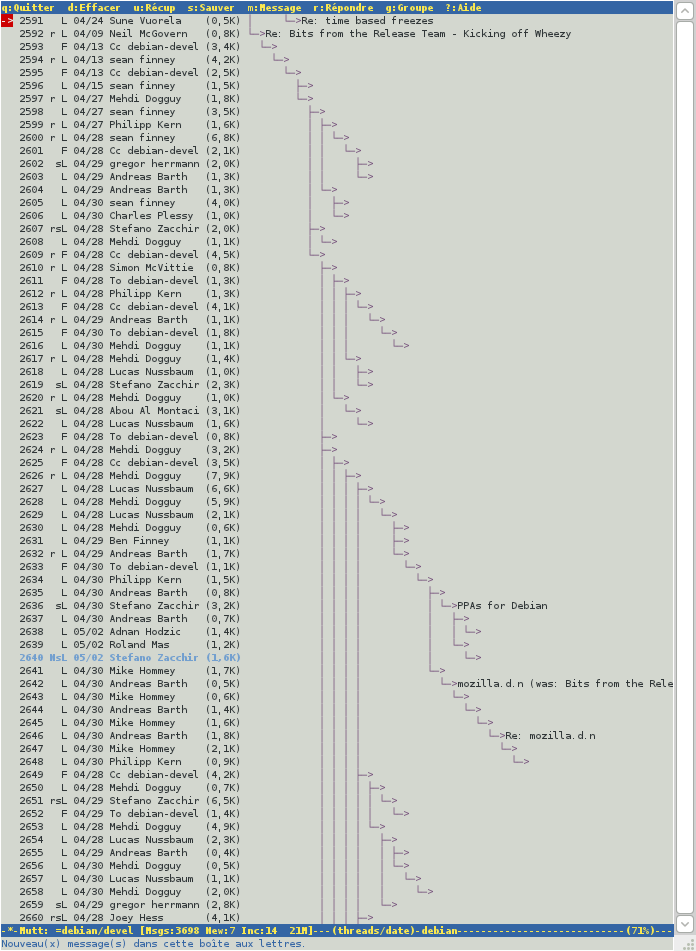
This is my monthly summary of my Debian related activities. If you re among the people who support my work, then you can learn how I spent your money. Otherwise it s just an interesting status update on my various projects. GNOME 3 packaging Right after the GNOME 3 release, I was eager to try it out so I helped the pkg-gnome team to update some of the packages. I did some uploads of totem, totem-pl-parser, gvfs, mutter, gnome-shell, gnome-screensaver. I also kept people informed via my blog and prepared a pinning file for adventurous users who wanted to try it out from experimental (like me). One month later, I m still using GNOME 3. There are rough edges still, but not so many. And I m starting to get used to it. Debian Rolling planning Debian Rolling is a project on my TODO list for quite some time. I decided it was time to do something about it and started a series of articles to help clarify my ideas while getting some early feedback. My goal was to prepare a somewhat polished proposal before posting it to a Debian mailing list. But as usual with Murphy s law, my plan did not work out as expected. Almost immediately after my first post the discussion started on debian-devel:
At this point it s a discussion thread of several hundreds of messages (there are several screens of messages like the one above). Many of the sub-threads have been interesting, but the general discussions mixed too many different things so that there s no clear outcome yet. Lucas Nussbaum tried to make a summary. Obviously I must adjust my plan, there s lots of feedback to process. I accepted to drive a DEP together with Sean Finney to help structure the part of the discussion that focuses on allowing development to continue during freezes. But I m also eager to fix the marketing problem of testing and have the project recognize that testing is a product in itself and that end-users should be encouraged to use it. Package Tracking System maintenance The Package Tracking System is an important tool for Debian developers, and it has been broken by some change on the Bug Tracking System. I worked around it quite quickly so that few people noticed the problem but Cron kept reminding me that I had to properly fix it. I ended up doing it last week-end. While working on the PTS, I took the opportunity to merge a patch from Jan Dittberner to enhance the news RSS feed that the PTS provides. And I also integrated information from backports.debian.org (thanks to Mehdi Dogguy for reminding me #549115). Multiarch update Not much new this month. I fixed two bugs in the multiarch dpkg branch thanks to bug reports from Ubuntu users (LP 767634, LP 756381). I m still waiting on Guillem Jover finishing his review of the multiarch branch. I m pinging him from time to time but it looks like multi-arch is no longer in his short term priority list. :-( I ve been running this code for more than 2 months and it works fine. I want to see it merged. I m ready to update my code should anything need to be changed to please Guillem. But without any feedback we re in a deadlock. Misc dpkg work While fixing a bug in update-alternatives (found in one of the valid reports on launchpad), I noticed that there was room for improvements in the error messages output by update-alternatives. I changed them to reuse the same strings that were already used in other parts of dpkg. The result is that there are a few strings less to translate (always a nice thing for the poor translators who have to deal with the thousands of strings that dpkg contains). I also tried to fix some of the most cryptic error messages in dpkg (see #621763) but that work is stalled at the request of Guillem. Book update We (me and Roland Mas) are almost done with the update of our French book for Debian Squeeze. It will hit the shelves in July or September. I m starting to prepare the fundraising campaign to make an English translation of it. We ll use ulule.com for this. On my blog I have been pleased to interview Meike Reichle, it s the first women that I have interviewed in the series but it s certainly not the last one. I also interviewed Adam D. Barratt, one of our tireless release managers. Thanks Many thanks to the people who gave me 180.35 in March and 235.37 in April. That represents 1.5 and 2 days of work for those months. See you next month for a new summary of my activities.

8 comments Liked this article? Click here. My blog is Flattr-enabled.

2 May 2011

Lucas Nussbaum: Debian rolling discussion on -devel@

Here is my attempt at a summary of the rolling discussion currently happening on debian-devel@. It might not be complete, it s probably a bit biased, but I hope that it s still better than nothing. It was also posted on debian-devel@. If you are involved in Debian development, please discuss it on debian-devel@, rather than in the comments of this blog. If you want to provide feedback about the Debian rolling idea, use this Doodle poll and/or the comments of this blog.
Update : Someone had the good idea to vandalize the poll, and remove all the votes from people in favor of rolling. Before the vadalism (log), the results were:
37 votes: I am a Debian user, I use testing or unstable, and I would like rolling to happen.
6 votes: I am a Debian user, I use testing or unstable, and I DON T want rolling to happen.
17 votes: I am a Debian user, I use stable, and I would like rolling to happen.
3 votes: I am a Debian user, I use stable, and I DON T want rolling to happen.
7 votes: I am NOT a Debian user, but I would probably use it if rolling happened.
1 vote: I am NOT a Debian user, and I don t care about rolling. Motivations There s some user demand for rolling releases. For evidence, one can look at the usage of Debian testing or unstable which clearly goes further than the Debian development community. Or at the quickly growing market share of ArchLinux. Or at the interest in LinuxMint and Aptosid. Or at the DPL s report of his interactions with the press. Debian s only official product is its stable releases. While it s a clearly great and useful product, many users and developers don t recognize themselves in it: it contains software that is too old for their needs. The success of Ubuntu is related to this problem: Ubuntu proposes a different compromise between stability and up-to-date-ness. While concurrencing Ubuntu with more frequent stable releases (released every 6-months, for example) doesn t look like the right thing to do, Debian is in a perfect position to provide a rolling release with marginal additional work, since Debian already has testing (and unstable) to build on. The rolling discussion investigates how we could endorse the concept of a rolling release, provided as a product in addition to stable releases. This rolling release would be based on the current testing branch. Benefits for Debian: Current proposed plan for rolling (Disclaimer: this is mostly my view. It is shared by others, but some details might not be) rolling is mostly about (external) communication. It is not expected to change our development processes fundamentally.
It would be a statement by the project (through a GR, for example). A very preliminary draft was proposed by Raphael Hertzog:
Title: Debian endorses usage of testing by end-users, and renames it to rolling The Debian project recognizes that the Debian testing distribution initially created to make it easier to prepare and test the next stable release has become a useful product of its own. It satisfies the needs of users who are looking for the latest stable versions of software and who can cope (or even appreciate) a system that s constantly evolving. The Debian project decides to endorse this usage and will strive to provide a good experience to users of testing . To better communicate this policy change to our users, testing will be renamed rolling .
Yes, it s mostly PR bullshit , and I don t expect it to significantly change Debian development processes. However, communication is necessary if we want to attract new users. What would change is more attention from developers to what happens in testing/rolling, which is a good thing since a better testing/rolling makes it easier to create stable releases from it. Open questions Most of the discussion is about the influence of the introduction of rolling on Debian development processes, and in particular, on the painful process resulting in stable releases. Many fear that, with rolling , it will be harder to get stable releases out. The root question is: if we do rolling, what do we do during freezes? Several options have been mentioned in the thread:
  1. We could decide not to do anything special: just freeze rolling for ~6 months, as we used to freeze testing. That might bore people who like the constant flux of new upstream releases, but if we decide that it s the only way to ensure high-quality stable releases, so be it.
  2. We could decide to fork a frozen branch when we freeze, and continue to manage rolling using migrations from unstable.
  3. We could mix both solutions: freeze rolling for 3 months, so that most of the stabilization work occurs with a single active branch, and then, for the final release preparation, fork frozen off rolling, and unfreeze rolling.
Two kinds of objections have been raised: Other things that were discussed: Tentative personal conclusion I have the impression that advertising testing as a rolling release usable by end-users is generally considered a good thing.
The renaming of testing to rolling is not as consensual, but most opponents have a whatever ; if you want position. How we deal with freezes is the hard point in this discussion. I m personnally in favor of the freeze rolling for 3 months, then fork frozen and unfreeze rolling plan, though it has some problems too (it is not clear whether the required manpower really decreases at the end of freezes). Where do we go from there? After another round of discussion, we might postpone the how to deal with freezes question to later, and proceed with a GR to measure the support for the testing for end-users + s/testing/rolling/ proposal.

29 April 2011

Rapha&#235;l Hertzog: Do we need project-wide support for Debian rolling?

The discussion about Debian rolling started sooner than expected on debian-devel (see the thread here). I initially wanted to iron out the biggest problems through discussions on my blog and try to submit a somewhat polished proposal instead we ended up discussing the same things both on -devel and on my blog. That said it s not that bad (except for the time I lost to have similar conversations in both places) because the debian-devel discussions included members of the release team and it looks like they are not fundamentally opposed to the idea. Despite this, the introduction of a frozen suite branched off from testing/rolling is not really consensual (yet?). But the idea of officially supporting testing on a best-effort basis appears to have almost no opposition. While some will undoubtedly believe that this is a useless exercise, I believe it would help if the project stated this in a somewhat official manner. My answer to the question in the title is thus: YES I am thus considering to submit a general resolution to that effect. My current draft is below.
Title: Debian endorses usage of testing by end-users, and renames it to rolling The Debian project recognizes that the Debian testing distribution initially created to make it easier to prepare and test the next stable release has become a useful product of its own. It satisfies the needs of users who are looking for the latest stable versions of software and who can cope (or even appreciate) a system that s constantly evolving. The Debian project decides to endorse this usage and will strive to provide a good experience to users of testing . To better communicate this policy change to our users, testing will be renamed rolling . While we believe that this is a good move, we would like to remind our users that Debian is a volunteer project and that our resources are not infinite. Package maintainers are contributing to Debian on a best-effort basis. This means that they might not be able to properly support their package(s) in all distributions. In that case, the project recommends that maintainers apply the following priorities:
  1. Support in stable (security updates, release critical bugs)
  2. Preparation of the next stable release
  3. Support in rolling
Note that this general resolution could have amendments with s/rolling/current/ and that would solve the bikeshedding over the name that started several times already. I deliberately separated Preparation of the next stable release and Support in rolling so that priorities are clear even if we decide to not freeze rolling and to introduce a frozen distribution to finalize the next stable release. I also did not go into too much details on the implications that it might have, it s best to leave that up to each contributor/team/etc. I hesitated to add a paragraph stating that we want to try to gradually improve the usability of testing but in the end I think it would be somewhat redundant. We re always trying to do our best when we decide to take on something. All comments welcome (even if you just agree and would be willing to second such a GR). Update: I will tweak the draft included in this article when I get good suggestions. Thanks to Lucas Nussbaum for the first one.

10 comments Liked this article? Click here. My blog is Flattr-enabled.

Next.

Previous.