Search Results: "Joachim Breitner"

2 October 2014

Joachim Breitner: 11 ways to write your last Haskell program

At my university, we recently held an exam that covered a bit of Haskell, and a simple warm-up question at the beginning asked the students to implement last :: [a] -> a. We did not demand a specific behaviour for last []. This is a survey of various solutions, only covering those that are actually correct. I elided some variation in syntax (e.g. guards vs. if-then-else). Most wrote the naive and straightforward code:
last [x] = x
last (x:xs) = last xs
Then quite a few seemed to be uncomfortable with pattern-matching and used conditional expressions. There was some variety in finding out whether a list is empty:
last (x:xs)
    null xs == True = x
    otherwise       = last xs
last (x:xs)
    length (x:xs) == 1 = x
    otherwise          = last xs
last (x:xs)
    length xs == 0 = x
    otherwise      = last xs
last xs
    lenght xs > 1 = last (tail xs)
    otherwise     = head xs
last xs
    lenght xs == 1 = head xs
    otherwise      = last (tail xs)
last (x:xs)
    xs == []  = x
    otherwise = last xs
The last one is not really correct, as it has the stricter type Eq a => [a] -> a. Also we did not expect our students to avoid the quadratic runtime caused by using length in every step. The next class of answers used length to pick out the right elemet, either using (!!) directly, or simulating it with head and drop:
last xs = xs !! (length xs - 1)
last xs = head (drop (length xs - 1) xs)
There were two submissions that spelled out an explicit left folding recursion:
last (x:xs) = lastHelper x xs
  where
    lastHelper z [] = z
    lastHelper z (y:ys) = lastHelper y ys
And finally there are a few code-golfers that just plugged together some other functions:
last x = head (reverse x)
Quite a lot of ways to write last!

21 September 2014

Joachim Breitner: Using my Kobo eBook reader as an external eInk monitor

I have an office with a nice large window, but more often than not I have to close the shades to be able to see something on my screen. Even worse: There were so many nice and sunny days where I would have loved to take my laptop outside and work there, but it (a Thinkpad T430s) is simply not usable in bright sun. I have seen those nice eInk based eBook readers, who are clearer the brighter they are. That s what I want for my laptop, and I am willing to sacrifice color and a bit of usability due to latency for being able to work in the bright daylight! So while I was in Portland for DebConf14 (where I guess I felt a bit more like tinkering than otherwise) I bought a Kobo Aura HD. I chose this device because it has a resolution similar to my laptop (1440 1080) and I have seen reports from people running their own software on it, including completely separate systems such as Debian or Android. This week, I was able to play around with it. It was indeed simple to tinker with: You can simply copy a tarball to it which is then extracted over the root file system. There are plenty of instructions online, but I found it easier to take them as inspiration and do it my way with basic Linux knowledge that s possible. This way, I extended the system boot script with a hook to a file on the internal SD card, and this file then runs the telnetd daemon that comes with the device s busybox installation. Then I just have to make the device go online and telnet onto it. From there it is a pretty normal Linux system, albeit without an X server, using the framebuffer directly. I even found an existing project providing a VNC client implementation for this and other devices, and pretty soon I could see my laptop screen on the Kobo. Black and white worked fine, but colors and greyscales, including all anti-aliased fonts, were quite broken. After some analysis I concluded that it was confusing the bit pattern of the pixels. Luckily kvncclient shares that code with koreader, which worked fine on my device, so I could copy some files and settings from there et voil : I now have an eInk monitor for my laptop. As a matter of fact, I am writing this text with my Kobo sitting on top of the folded-back laptop screen! I did some minor adjustments to my laptop: All this is still very manual (going online with the kobo, finding its IP address, logging in via telnet, killing the Kobo's normal main program, starting x11vnc, finding my ip address, starting the vnc client, doing the adjustments mentioned above), so I need to automate it a bit. Unfortunately, there is no canonical way to extend the Kobo by your own application: The Kobo developers made their device quite open, but stopped short from actually encouraging extensions, so people have created many weird ways to start programs on the Kobo dedicated start menus, background programs observing when the regular Kobo app opens a specific file, complete replacements for the system. I am considering to simply run an SSH server on the device and drive the whole process from the laptop. I ll keep you up-to-date. A dream for the future would be to turn the kobo into a USB monitor and simply connect it to any computer, where it then shows up as a new external monitor. I wonder if there is a standard for USB monitors, and if it is simple enough (but I doubt it). A word about the kobo development scene: It seems to be quite active and healthy, and a number of interesting applications are provided for it. But unfortunately it all happens on a web forum, and they use it not only for discussion, but also as a wiki, a release page, a bug tracker, a feature request list and as a support line often on one single thread with dozens of posts. This makes it quite hard to find relevant information and decide whether it is still up-to-date. Unfortunately, you cannot really do without it. The PDF viewer that comes with the kobo is barely okish (e.g. no crop functionality), so installing, say, koreader is a must if you read more PDFs than actual ebooks. And then you have to deal with the how-to-start-it problem. That reminds me: I need to find a decent RSS reader for the kobo, or possibly a good RSS-to-epub converter that I can run automatically. Any suggestions? PS and related to this project: Thanks to Kathey!

6 September 2014

Joachim Breitner: ICFP 2014

Another on-my-the-journey-back blog post; this time from the Frankfurt Airport Train Station my flight was delayed (if I knew that I could have watched the remaining Lightning Talks), and so was my train, but despite 5min of running through the Airport just not enough. And now that the free 30 Minutes of Railway Station Internet are used up, I have nothing else to do but blog... Last week I was attending ICFP 2014 in Gothenburg, followed by the Haskell Symposium and the Haskell Implementors Workshop. The justification to attend was the paper on Safe Coercions (joint work with Richard Eisenberg, Simon Peyton Jones and Stephanie Weirich), although Richard got to hold the talk, and did so quite well. So I got to leisurely attend the talks, while fighting the jet-lag that I brought from Portland. There were as expected quite a few interesting talks. Among them the first keynote, Kathleen Fisher on the need for formal methods in cars and toy-quadcopters and unmanned battle helicopters, which made me conclude that my Isabelle skills might eventually become relevant in practical applications. And did you know that if someone gains access to your car s electronics, they can make the seat belt pull you back hard? Stefanie Weirich s keynote (and the subsequent related talks by Jan Stolarek and Richard Eisenberg) on what a dependently typed Haskell would look like and what we could use it for was mouth-watering. I am a bit worried that Haskell will be become a bit obscure for newcomers and people that simply don t want to think about types too much, on the other hand it seems that Haskell as we know it will always stay there, just as a subset of the language. Similarly interesting were refinement types for Haskell (talks by Niki Vazou and by Eric Seidel), in the form of LiquidTypes, something that I have not paid attention to yet. It seems to be a good way for more high assurance in Haskell code. Finally, the Haskell Implementors Workshop had a truckload of exciting developments in and around Haskell: More on GHCJS, Partial type signatures, interactive type-driven development like we know it from Agda, the new Haskell module system and amazing user-defined error messages the latter unfortunately only in Helium, at least for now. But it s not the case that I only sat and listened. During the Haskell Implementors Workshop I held a talk Contributing to GHC with a live demo of me fixing a (tiny) bug in GHC, with the aim of getting more people to hack on GHC (slides, video). The main message here is that it is not that big of deal. And despite me not actually saying much interesting in the talk, I got good feedback afterwards. So if it now actually motivates someone to contribute to GHC, I m even more happier. And then there is of course the Hallway Track. I discussed the issues with fusing a left fold (unfortunately, without a great solution). In order to tackle this problem more systematically, John Wiegley and I created the beginning of a List Fusion Lab , i.e. a bunch of list benchmark and the possibility to compare various implementations (e.g. with different RULES) and various compilers. With that we can hopefully better assess the effect of a change to the list functions. PS: The next train is now also delayed, so I ll likely miss my tram and arrive home even later... PPS: I really have to update my 10 year old picture on my homepage (or redesign it completely). Quite a few people knew my name, but expected someone with shoulder-long hair... PPPS: Haskell is really becoming mainstream: I just talked to a randomly chosen person (the boy sitting next to me in the train), and he is a Haskell enthusiast, building a structured editor for Haskell together with his brother. And all that as a 12th-grader...

30 August 2014

Joachim Breitner: DebConf 14

I m writing this blog post on the plane from Portland towards Europe (which I now can!), using the remaining battery live after having watched one of the DebConf talks that I missed. (It was the systemd talk, which was good and interesting, but maybe I should have watched one of the power management talks, as my battery is running down faster than it should be, I believe.) I mostly enjoyed this year s DebConf. I must admit that I did not come very prepared: I had neither something urgent to hack on, nor important things to discuss with the other attendees, so in a way I had a slow start. I also felt a bit out of touch with the project, both personally and technically: In previous DebConfs, I had more interest in many different corners of the project, and also came with more naive enthusiasm. After more than 10 years in the project, I see a few things more realistic and also more relaxed, and don t react on Wouldn t it be cool to have crazy idea very easily any more. And then I mostly focus on Haskell packaging (and related tooling, which sometimes is also relevant and useful to others) these days, which is not very interesting to most others. But in the end I did get to do some useful hacking, heard a few interesting talks and even got a bit excited: I created a new tool to schedule binNMUs for Haskell packages which is quite generic (configured by just a regular expression), so that it can and will be used by the OCaml team as well, and who knows who else will start using hash-based virtual ABI packages in the future... It runs via a cron job on people.debian.org to produce output for Haskell and for OCaml, based on data pulled via HTTP. If you are a Debian developer and want up-to-date results, log into wuiet.debian.org and run ~nomeata/binNMUs --sql; it then uses the projectb and wanna-build databases directly. Thanks to the ftp team for opening up incoming.debian.org, by the way! Unsurprisingly, I also held a talk on Haskell and Debian (slides available). I talked a bit too long and we had too little time for discussion, but in any case not all discussion would have fitted in 45 minutes. The question of which packages from Hackage should be added to Debian and which not is still undecided (which means we carry on packaging what we happen to want in Debian for whatever reason). I guess the better our tooling gets (see the next section), the more easily we can support more and more packages. I am quite excited by and supportive of Enrico s agenda to remove boilerplate data from the debian/ directories and relying on autodebianization tools. We have such a tool for Haskell package, cabal-debian, but it is unofficial, i.e. neither created by us nor fully endorsed. I want to change that, so I got in touch with the upstream maintainer and we want to get it into shape for producing perfect Debian packages, if the upstream provided meta data is perfect. I d like to see the Debian Haskell Group to follows Enrico s plan to its extreme conclusion, and this way drive innovation in Debian in general. We ll see how that goes. Besides all the technical program I enjoyed the obligatory games of Mao and Werewolves. I also got to dance! On Saturday night, I found a small but welcoming Swing-In-The-Park event where I could dance a few steps of Lindy Hop. And on Tuesday night, Vagrant Cascadian took us (well, three of us) to a blues dancing night, which I greatly enjoyed: The style was so improvisation-friendly that despite having missed the introduction and never having danced Blues before I could jump right in. And in contrast to social dances in Germany, where it is often announced that the girls are also invited to ask the boys, but then it is still mostly the boys who have to ask, here I took only half a minute of standing at the side until I got asked to dance. In retrospect I should have skipped the HP reception and went there directly... I m not heading home at the moment, but will travel directly to G teborg to attend ICFP 2014. I hope the (usually worse) west-to-east jet lag will not prevent me from enjoying that as much as I could.

23 August 2014

Joachim Breitner: This blog goes static

After a bit more than 9 years, I am replacing Serendipity, which as been hosting my blog, by a self-made static solution. This means that when you are reading this, my server no longer has to execute some rather large body of untyped code to produce the bytes sent to you. Instead, that happens once in a while on my laptop, and they are stored as static files on the server. I hope to get a little performance boost from this, so that my site can more easily hold up to being mentioned on hackernews. I also do not want to worry about security issues in Serendipity static files are not hacked. Of course there are down-sides to having a static blog. The editing is a bit more annoying: I need to use my laptop (previously I could post from anywhere) and I edit text files instead of using a JavaScript-based WYSIWYG editor (but I was slightly annoyed by that as well). But most importantly your readers cannot comment on static pages. There are cloud-based solutions that integrate commenting via JavaScript on your static pages, but I decided to go for something even more low-level: You can comment by writing an e-mail to me, and I ll put your comment on the page. This has the nice benefit of solving the blog comment spam problem. The actual implementation of the blog is rather masochistic, as my web page runs on one of these weird obfuscated languages (XSLT). Previously, it contained of XSLT stylesheets producing makefiles calling XSLT sheets. Now it is a bit more-self-contained, with one XSLT stylesheet writing out all the various html and rss files. I managed to import all my old posts and comments thanks to this script by Michael Hamann (I had played around with this some months ago and just spend what seemed to be an hour to me to find this script again) and a small Haskell script. Old URLs are rewritten (using mod_rewrite) to the new paths, but feed readers might still be confused by this. This opens the door to a long due re-design of my webpage. But not today...

19 June 2014

Joachim Breitner: Another instance of Haskell Bytes

When I gave my Haskell Bytes talk on the runtime representation of Haskell values the first time, I wrote here It is in German, so [..] if you want me to translate it, then (convince your professor or employer to) invite me to hold the talk again . This has just happened: I got to hold the talk as a Tech Talk at Galois in Portland, so now you can fetch the text also in English. Thanks to Jason for inviting me!
This was on my way to the Oregon Summer School on Programming Languages in Eugene, where I m right now enjoying the shade of a tree next to the campus. We ve got a relatively packed program with lectures on dependent types, categorical logic and other stuff, and more student talks in the evening (which unfortunately always collide with the open board game evenings at the local board game store). So at least we started to have a round of diplomacy, where I am about to be crushed from four sides at once. (And no, I don t think that this has triggered the illegal download warning that the University of Oregon received about our internet use and threatens our internet connectivity.)

8 June 2014

Joachim Breitner: ZuriHac 2014

I m writing this on the train back from the ZuriHac Haskell Hackathon in Z rich, generously sponsored by Better and Google. My goal for this event was to attract new people to work on GHC, the Haskell compiler, so I announced a GHC bugsquashing project . I collected a few seemingly simple ticket that have a good effort/reward ratio for beginners and encouraged those who showed up to pick one to work on. Roughly six people started, and four actually worked on GHC on all three days. The biggest hurdle for them was to get GHC built for the first time, especially those using a Mac or Windows. They also had to learn to avoid recompilation of the whole compiler, which takes an annoying amount of time (~30 minutes for most people). But once such hurdles weren taken all of them managed to find their way around the source code to the place they need to touch and were able to produce a patch, some of which are already merged into GHC master. When I wasn t giving tips and hints I was working on various small tickets myself, but nothing of great impact. I very much hope that this event will pay off and one or two of the newcomers end up being regular contributors to GHC.

We took breaks from our respective projects to listen to interesting talks by Edward Kmett and Simon Marlow, and on Saturday evening we all went to the shores of the Zurisee and had a nice Barbecue. It was a good opportunity to get into contact with more of the attendees (the hacking itself was separated in multiple smaller office rooms) and I was happy to hear about people having read my recent Call Arity paper, and even found it valuable.

Thanks to the organizers and sponsors for this nice opportunity!

28 May 2014

Joachim Breitner: Predicting the livetime of a Hackage package

The Debian Haskell Group has no proper policy about when to update a certain package to a new version from Hackage. So far, we upgrade when one of us personally needs something, when someone nudges us, if its required as a dependency or just when we feel like it. I was thinking about ways to improve that. One thing that we should definitely do is to upgrade to new versions that differ only in the forth version number, e.g. from 1.2.3.4 to 1.2.3.5 these are most likely bug fix uploads and have little risk of breaking things. (Unless they are only changes to the .cabal file, then they might not be an improvement for our users or us.) I plan to code that soon. But what else can we do? Ideally we d package versions that will be the newest version for a long time, and not versions that are going to be replaced the next day. Unfortunately, deciding that requires visionary powers. But maybe there is a correlation between the upload history and the lifetime of a new package? Maybe there are patterns, e.g. the first upload after a long time tends to be replaced fast, but the third package in a short succession has a high chance to live long? Can we predict the livetime of a freshly uploaded package? So after a bit of hacking I got this graphic:
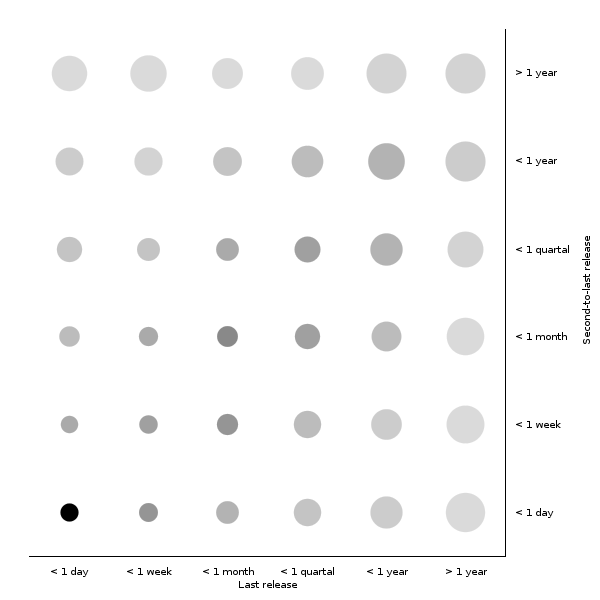
It needs a bit explanation: Both axis are time differences, the picture is one year by one year. For every release of which we know the lifetime (i.e. there has been an upload later), we draw its history on a vertical line. The horizontal position of the line corresponds to the lifetime of the release: A package that was superseded immediately later (which I sometimes do after spotting annoying typos) would appear on the far left, a package that is stable for one year on the far right. The history itself is a series of dots, representing the previous uploads of that package, with their distance from the lower edge indicating the time that has passed since then. So if a package had two updates half a year ago, and then no update for another half year, it would contribute two dots right above each other in the middle of the picture. Unfortunately, the picture does not yield any insight, besides that short-lived packages are more frequent than long-lived packages. So I tried another view:
I grouped uploads by the livetime of their two preceding uploads. For each such groups, the circle indicates the average livetime. The darkness indicates the absolute number in the sample. So we see a correlation between the packages livetime and the livetime of its predecessor, which is also not very surprising. We can state some hypothesis, like: A package replacing a very old package is likely to be long-lived if its pre-predecessor lived very long or very shortly, but less so if that lived for a few months. But I m not sure of the significance of these. I could have also taken into account which uploads are major and which are minor, by looking at the version number, but I didn t. What s the conclusion? Nothing much. I got some funny looking graphs. And there needs to be a way to render pictures like the first within the axes of a Chart diagram. I put the (somewhat hackish) code online feel free to play with it.

26 May 2014

Joachim Breitner: Does list fusion work?

I m writing this in the lunch break of TFP in Soesterberg. The invited talk this morning was by Geoffrey Mainland, and he talked about the difficulties of (informal) reasoning about performance in high-level languages like Haskell, especially with fancy stuff in the compiler like fusion. So I couldn t help but think about a (very small) help here. Consider the the two very similar expressions foldl (+) 0 [0..1000] and foldr (+) 0 [0..1000]. Which of these fuse away the list? Hopefully both, but hard to predict. So with my list-fusion-probe library, you can write
import Data.List.Fusion.Probe (fuseThis)
main = print $ foldr (+) 0 (fuseThis [0..1001])
and find out. If you compile this (with -O!), it will print
500500
If you change the foldr to foldl, it will print
Test: fuseThis: List did not fuse
So you can see that the function fuseThis :: [a] -> [a] does nothing if the list gets fused away, but causes a run-time error if not. It allows you to annotate your code with your assumptions of list fusion, and get shouted at if your assumptions are wrong. It wouldn t be hard to have the compiler give a warning or error message at compile time; we d just need to introduce a special function abortCompilation that, when found in the code during compilation, does just that. Note that you ll have trouble reproducing the above in GHC HEAD, where foldl does fuse (which is what I m going to talk about tomorrow here).

9 May 2014

Joachim Breitner: Going to TFP 2014

Near the end of my internship with Simon Peyton Jones at MSR Cambridge I tackled the problem that foldl is not a good consumer in the sense of list fusion, as the resulting code compiles quite badly. I found an analysis that would allow GHC to safely do the required transformation to fix this in the common case; I dubbed this analysis Call Arity. The code is in GHC master (but not in 7.8), and I get to present at the Trends in Functional Programming conference in Soesterburg in 2 weeks. If you are curious you can either look at the code in CallArity.hs or the submitted paper, which yet has to go through the formal post-conference peer review in order to be officially accepted. If you are going to TFP as well and want to get your GPG key signed, just talk to me there!

24 April 2014

Joachim Breitner: gtk-vector-screenhot screencast

I recently installed piwik on my website, to get some idea about how it is being used. Piwik is a very nice and shiny tool, although it is slightly scary to watch people walk through your website, click for click. Anyways, I now know that I get around 50 visitors per day. But I also learn where they are coming from, and this way I noticed that Shnatsel did a very nice screencast of my gtk-vector-screenshot tool if I had not created it myself I would think it was fake.

Joachim Breitner: gtk-vector-screenshot screencast

I recently installed piwik on my website, to get some idea about how it is being used. Piwik is a very nice and shiny tool, although it is slightly scary to watch people walk through your website, click for click. Anyways, I now know that I get around 50 visitors per day. But I also learn where they are coming from, and this way I noticed that Shnatsel did a very nice screencast of my gtk-vector-screenshot tool if I had not created it myself I would think it was fake.

5 March 2014

Joachim Breitner: Creative use of screen-message

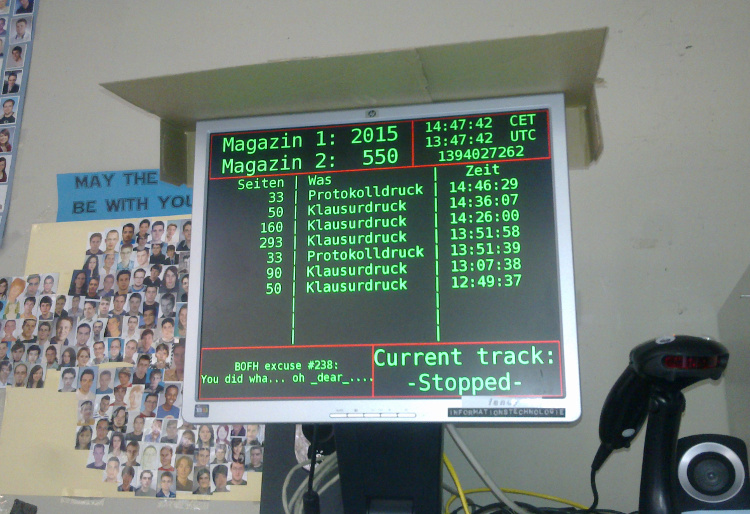
I just learnt that the math and computer science student body is using screen-message to power an information screen in their room:
There are five instances of screen-message, configured to use non-standard colors and a fixed-width fonts, and controlled by the rather new remote control feature, where screen-messages repeatedly keeps reading text from standard input until a form feed character (ASCII 0x0C) comes, and displays that. The window manager ratpoison takes care of tiling the instances. It looks quite a bit like a poor man s version of dividuum s great info-beamer. I was told that they also tried out info-beamer, but the Raspberry Pi was too slow and weak for that, while screen-message and ratpoison run happily on such small hardware. Correction: Info-beamer was not tried, but rather ruled out as overkill for this task.

29 December 2013

Joachim Breitner: Sim Serim as a browser game

Recently, I gave the very elegant board game Sim Serim away as a present, without actually playing it, leaving me curious about the game. One can easily play it on paper (you just need a paper, and 4 tokens like coins for each player, BoardGameGeek has English rules the of game), but I took this as an opportunity to learn more about HTML5 canvas and nodejs, and so I created the browser game Sum Serum , implementing the game mechanics of Sim Serim . You can play it locally with two people, or over the network. Contributions are welcome! Especially slicker graphics...
In other news, given that in recent years I became one, I m on BoardGameGeek myself now, see my profile there.

19 December 2013

Joachim Breitner: My contribution to XKCD s #949 is not needed

A few hours ago I posted about share-file, a small tool to make a local file available at a public URL so that it is transferred from my machine, without being stored at some central server. I wanted to create something like FileTea, but usable from the command line. My post made it to HackerNews (which brought my server to its knees for a while; let s say I had the opportunity to find out what setting for apache s MaxClient option works on my machine...), where the comments (besides some misunderstanding about the notable features of share-file) contained interesting links related to solving #949:

Joachim Breitner: My contribution to XKCD s #949

Randall Munroe rightly put shame on all the geeks in the world when he pointed out that transferring files over the internet is still an unsolved problem. I am a big fan of FileTea s approach to transferring files, where they are streamed from browser to browser, without registration and without being stored on some central server, and where closing the browser tab reliably cleans up the transfer. But I wanted something that works from the command line, so I created a small tool called share-file that will use SSH port forwarding to serve the files from a local, embedded web server at a publicly available port, as shown in these screenshots:
It works without additional dependencies (but better with python-magic installed) and requires a publicly available SSH server configured with GatewayPorts clientspecified. For more details, see the README, and to try it out, simply fetch it with git clone git://git.nomeata.de/share-file.git. BTW, if someone implements a command line client for FileTea, I ll happily dump share-file for it.

17 November 2013

Joachim Breitner: Breaking News: Debian TC leaked decision on init system

According to the German news page heisse news , the Debian Technical Committee has made a decision on the question about the default init system in Debian: There will be none! Instead, according to Ian Vorlon Bart, Debian will start to distribute a suspend-to-disk image to their users, with all daemons already started, completely eradicating the need for an init system. If you are able to read German, read all about it at Debian Technical Committee entscheidet sich gegen ein Init-System

13 November 2013

Joachim Breitner: Constructing a list in a Monad

In Haskell, lists are ubiquitous. In real-world Haskell, monads are ubiquitous. So it should be an easy task to fill a list with values obtained in a monad, i.e. a list of n random numbers (in the Rand monad), or getting some input from the user, and storing it in a list, until the user chooses to finish the input. The task For now, assume a function getInput :: IO Int; we want to run it 10000 and then have the list of the values returned. Sounds simple and straight forward, but it is actually really hard to get the run-time behaviour that we naively and optimistically expect. The expectation In an imperative setting, we would have a simple counting loop. In the loop, we run getInput, allocate a new cell for the linked list, and append it to the list. Clearly, this Can we achieve that with Haskell? Let s look at a few alternatives (complete code available)
Attempt 1: The accumulator I ll start with the probably worst attempt. Unfortunately, from what I have seen from correcting Haskell exams, this is what beginners would write, especially if they have the above imperative algorithm in mind, and know about the convert loops to recursion with accumulators approach to solving Haskell problems:
accumAppend :: Int -> IO [Int]
accumAppend n = go n []
  where
    go 0 l = return l
    go n l = do  x <- getInput; go (n-1) (l++[x]) 
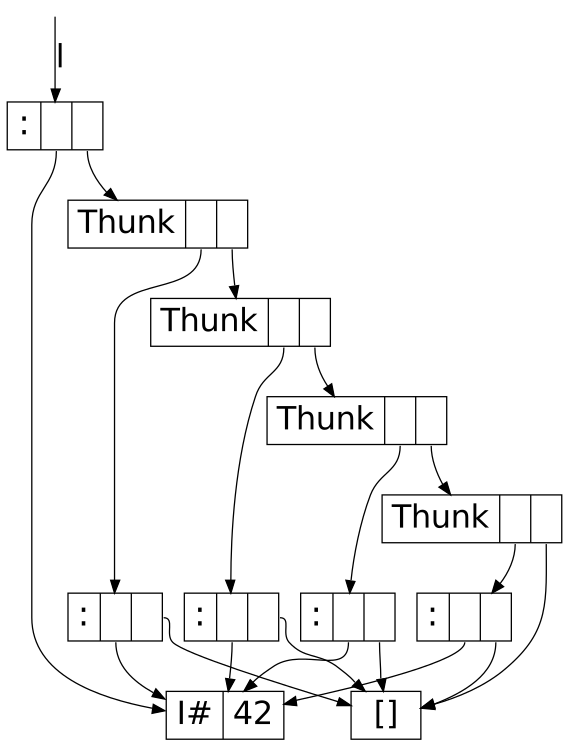
To check the space usage of this, I pass -Kn to the GHC runtime and see what limit is just enough to let this program calculate accumAppend 10000 and fully evaluate the resulting list. It turns out that we need 328336 bytes of stack space. So what about the second requirement; that the list is fully evaluated? Experienced Haskellers see it immediatelly: The accumulator is not used in the loop, so each iteration adds a thunk around the previous value, that would add the next entry to the end. Only when the list is actually used, these are run, each traversing the whole list, causing quadratic cost. We can verify this using ghc-vis:
Clearly (and not surprisingly) this is not the best solution. Attempt 2: The accumulator (forced) Lets try to fix the second issue, by making sure that the list is always fully evaluated. We import Control.DeepSeq and write
accumAppendSeq :: Int -> IO [Int]
accumAppendSeq n = go n []
  where
    go 0 l = return l
    go n l = do  x <- getInput ; go (n-1) $!! (l++[x]) 
As the accumulator gets fully evaluated before being passed to the next invocation of go, the result will not contain thunks. But note that this has also fixed the stack consumption: The code now runs the smallest setting for -K, 8 bytes. This works as both go and deepseq are tail-recursive. But this is still not the solution we are looking for, as the quadradic cost caused by using ++ is still there. Attempt 3: The accumulator (reversed) Since we know that l++[x] is expensive, but x:l is cheap, we can simply use this to update the accumulator. This has the slightly annoying consequence that the entries of the list are in the reverse order, but we can fix that in the base case:
accumReverse :: Int -> IO [Int]
accumReverse n = go n []
  where
    go 0 l = return (reverse l)
    go n l = do  x <- getInput ; go (n-1) (x:l) 
And indeed, we get noticably faster code that still runs in 8 bytes of stack. Unfortunately, we still don t construct the final list directly. Attempt 4: Naive recursion Maybe we can do without an accumulator. The most naive such code would be
listRecurse :: Int -> IO [Int]
listRecurse n = go n
  where
    go 0 = return []
    go n = do  x <- getInput; r <- go (n-1); return (x:r) 
and I d expect that most experienced Haskellers would write that code (if they are asked not to use a library function). And indeed, this code does create the final list directly. But it requires a large stack or 164616 bytes. The reason is that this is no longer tail recursive: After calling go again we need to take the result and prepend x Attempt 5: library functions Maybe we should simply not worry about the implementation, and use library functions? Clearly, the authors of such libraries have found the best solution. So how does
listReplicateM :: Int -> IO [Int]
listReplicateM n = Control.Monad.replicateM n getInput
fare? Unfortunately, not better than the naive recursion. In fact, the stack space requirement is the same 164616 bytes. The same holds when using special libraries for generating and consuming list, e.g. the Streams module from the vector package:
listStreams :: Int -> IO [Int]
listStreams n = MStream.toList $ MStream.replicateM n getInput
Attempt 6: Difference lists It is time to dig deeper into our box of tricks. What if we have lists with constant time Snoc (a.k.a. appending a new element)? Then Attempt 3 would not require reversing the list. Such lists are provided by difference lists; there are libraries for that, but we can simply implement them using lambdas:
accumDList :: Int -> IO [Int]
accumDList n = go n id
  where
    go 0 l = return (l [])
    go n l = do  x <- getInput; go (n-1) (l . (x:)) 
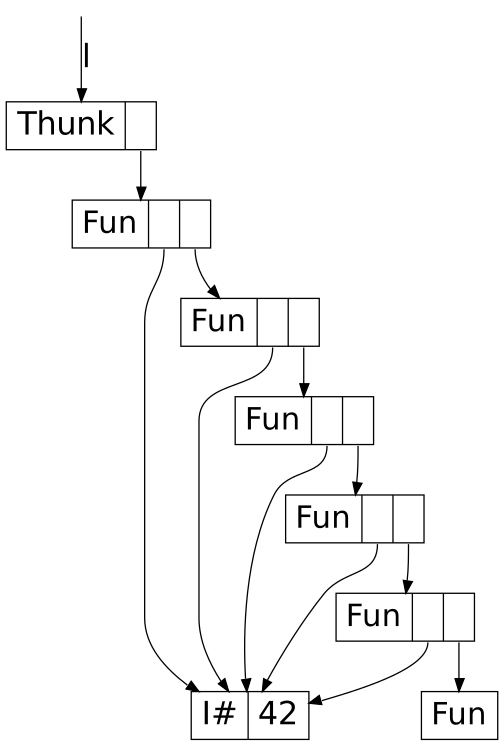
Indeed, no stack is required (8 bytes are enough). But we are cheating here: We are still not constructing the final list, but rather we combine functions that append elements to lists. So when accumDList returns, what we have in memory, is a thunk and sequence of partial function applications in the wrong order, and evaluating the thunk does basically the same thing as reverse in Attempt 3. It might be a bit faster, is still not satisfying enough:
Attempt 7: Unsafe functions Even deepter in the box of tricks, somewhere in the grit and dust where one usually should not reach, there is a function that can help us out here: unsafeInterleaveIO. This allow us to modify the naive recursion in a way that first creates the Cons-cell, and then continues the loop:
listUnsafeInterleave :: Int -> IO [Int]
listUnsafeInterleave n = do  l <- go n; return $!! l 
  where
    go 0 = return []
    go n = do x <- getInput
              r <- unsafeInterleaveIO (go (n-1))
              return (x:r)
The stack consumption is 8 bytes. It is worth noting that the all to deepseq (in $!!) will actually drive the evaluation of go. Also, it guarantees that the unsafe effects of unsafeInterleaveIO are confined to the execution of listUnsafeInterleave, i.e. are actually safe. Run time statistics I ran criterion over the functions (generating lists of length 1000), and found these results: Conclusion There are many ways to write a list-constructing list in Haskell, none are perfect they either fill the heap, or do not construct the list directly (usually requiring a second pass through it), or rely on IO-specific unsafe functions. The naive recursion performs the best, but may cause a stack overflow (note, though that from GHC 7.8, the stack will be unlimited). The next best option seems to be the difference lists
I m still wondering: What would be required from Haskell, GHC or the monads in question to have a fully satisfactory solution here, i.e. one that is as fast as the naive recursion, as stack efficient as the difference list solution, and allocates no thunks, only list cells?

23 October 2013

Joachim Breitner: First citation

Just found out that I was cited academically for the first time: Pablo Buiras and Alejandro Russo s paper Lazy Programs Leak Secrets at NordSec2013 builds upon my work dup Explicit un-sharing in Haskell , which I had submitted to last year s Haskell symposium and Haskell Implementers Workshop, but eventually only published on arXiv.

5 October 2013

Joachim Breitner: Why PVP is better than no PVP

This is a reply to Roman Cheplyaka s post Why PVP doesn't work , where he argues that Haskell packages should not per default put upper bounds on their build dependencies (as mandated by the Package Versioning Policy), at least not without good reason. I disagree, and I d like to explain why. I assume that you are packaging your libraries and programs not only for your fellow developers, but also for users. Hackage has turned not only into a hub for developers sharing their libraries, but also for users to conveniently download stuff from. And when I say users, I include xmonad users (although they write a bit of Haskell for their configuration) and beginners (who we certainly don t expect to understand and make sense of error messages that occur if some obscure crypto-related dependency of their favourite web framework fails to build). And for their benefit we should try hard to make sure cabal install either succeeds (great) or fails early with an error message that the user can understand as I could not find a package configuration of which the maintainers believe with good confidence that it works. Please talk to them. I speak with some experience, because as a maintainer of the >666 Haskell packages in Debian, I am, in a sense, a very heavy user. In the years after the PVP got commonly accepted, we could noticeably reduce the number of build failures that we encounter on our machines and the Debian build farms, simply because the meta data (which we transfer to the Debian package level) prevented such builds from being attempted. We now even have a build compatibility prediction system: We maintain a text file with all Haskell packages in Debian, together with a directory of patches (where we sometimes indeed override the packages Cabal file), and a script that runs cabal-install s dependency checker against this day. This way, when I want to upgrade a package, I can simply change the version in the file and know what packages will be broken. So I change their version until I either find a fixed-point (and only then actually upload packages to the user) or find a problem, which I then report to the maintainers or start cooking up my own patches. This works really well, but it only does because most maintainers are following the PVP. That s why I argue: Please continue to do so. (What we would probably need instead of less using the PVP is more tools in helping us with it. I could imagine a build bot that finds packages on Hackage with an upper bound on a package where a newer version exists, fetches those and automatically tries to build against the new version, and if it succeeds, sends a message to the maintainer: Your dependency on bar in foo also builds against version 0.42 of bar; please check for incompatibilities that are not expressed in the type system and upload a new version of foo allowing bar-0.42. Isn t that something the Stackage infrastructure can be used for?) (What we could probably use as well (and is probably a stepping stone towards what I just said) is a way to tell cabal-install to ignore a certain build dependency version bound. This way we still prevent normal users from trying a dependency version that the maintainer did not test, but nevertheless make it as easy as possible for the advanced user to try nevertheless, and then hopefully report about it to the maintainer. Of course, other had that idea before, someone just has to make it happen.)

Next.

Previous.